WELCOME TO!!!
CDJJ Institute of
Information Technology
CDJJ Intitute of Information Technology
ACCREDITED COMPETENCY
ASSESSMENT CENTER
Orientation on
Competency Based Training
in
EVENTS MANAGEMENT SERVICES NC III
CHRISTINE I. VILLABLANCA
Trainer
1. COMPETENCY BASED TRAINING (CBT)
2. 1O PRINCIPLES OF CBT
3. COMPARATIVE
4. ANALYSIS BETWEEN TRADITIONAL
APPROACH AND CBT APPROACH
5. ROLE AS A TRAINER
6. ROLE AS A TRAINEE
7. QUALIFICATION OVERVIEW
(AQUACULTURE)
8. COMPETENCY BASED LEARNING MATERIAL
(CBLM)
CDJJ Institute of Information Technology
In accordance with the Arrangement on the
Project for Establishment of theCDJJ Institute of
Information Technology between the Government
of the Caloocan City and the TESDA signed on
June 3, 2023, the Project was initiated upon
signing of the Record of Discussion last August
26, 2023.
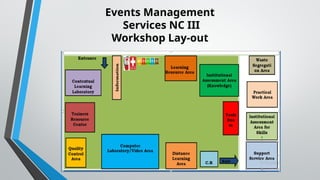
Events Management
Services NC III
Workshop Lay-out
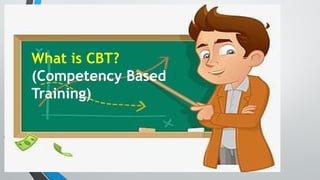
What is CBT?
(Competency Based
Training)
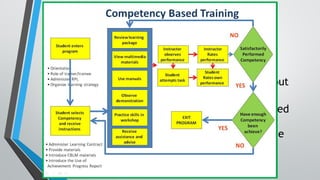
►The framework in teaching skill-based
lesson is called Competency Based
Training (or CBT). It focuses on skills
development that is why its approach differs
from the traditional education.
►In traditional education, the teacher controls
the environment (or called teacher-centered
approach); while in CBT, the learners control
and manipulate the tools and equipment's
with the guide of a teacher (also known as
student-centered approach).
In addition to that, learners are not
compared among each other, instead their
skills are compared against the norms or
standard set by the industry. The training is
also self-paced; an example of this is when
the trainer allows the students to study the
materials & practice the skill on their own.
Lastly, the focus of CBT is on the outcome
or the end product.
10 PRINCIPLES OF CBT
1. Training is based on curriculum
developed from the competency
standard.
2. Learning is competency based or
modular in structure.
3. Training delivery is self-paced and
individualized.
4. Training is based on the work that
must be performed.
5. Training material is directly related to competency
standard.
6. Assessment is based in the collection of evidence of
the performance of work to the industry required
standard.
7.Training is based both on and o the job components
ff
8.Training program allows for recognition of prior learning
(RPL)or current competencies
9.Training allows for multiple entry and exit.
10.Training programs are registered with the UTPRAS.
COMPARATIVE ANALYSIS BETWEEN
TRADITIONAL APPROACH AND CBT APPROACH
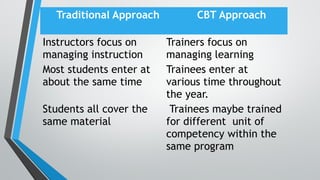
Traditional Approach CBT Approach
Instructors focus on
managing instruction
Trainers focus on
managing learning
Most students enter at
about the same time
Trainees enter at
various time throughout
the year.
Students all cover the
same material
Trainees maybe trained
for different unit of
competency within the
same program
Traditional Approach CBT Approach
Instructors focus on
managing instruction
Trainers focus on
managing learning
Most students enter at
about the same time
Trainees enter at
various time throughout
the year.
Students all cover the
same material
Trainees maybe trained
for different unit of
competency within the
same program
Role of the CBT Trainer
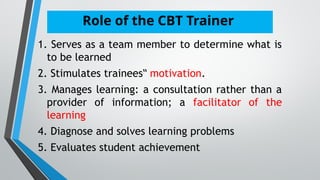
1. Serves as a team member to determine what is
to be learned
2. Stimulates trainees‟ motivation.
3. Manages learning: a consultation rather than a
provider of information; a facilitator of the
learning
4. Diagnose and solves learning problems
5. Evaluates student achievement
Role of the CBT Trainee
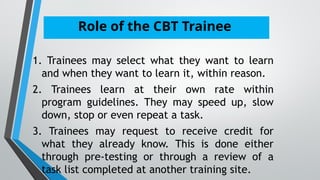
1. Trainees may select what they want to learn
and when they want to learn it, within reason.
2. Trainees learn at their own rate within
program guidelines. They may speed up, slow
down, stop or even repeat a task.
3. Trainees may request to receive credit for
what they already know. This is done either
through pre-testing or through a review of a
task list completed at another training site.
Recognition of Prior Learning (RPL)
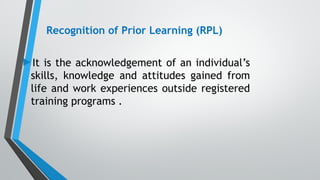
►It is the acknowledgement of an individual’s
skills, knowledge and attitudes gained from
life and work experiences outside registered
training programs .
What is CBLM?
CBLM - Competency-based Learning Materials
- is simply a well designed and carefully
developed learning materials that give
trainees detailed instructions to guide them
through the learning process.
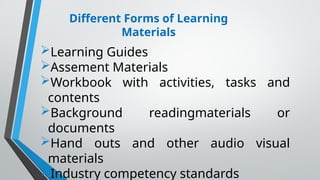
Different Forms of Learning
Materials
Learning Guides
Assement Materials
Workbook with activities, tasks and
contents
Background readingmaterials or
documents
Hand outs and other audio visual
materials
Industry competency standards
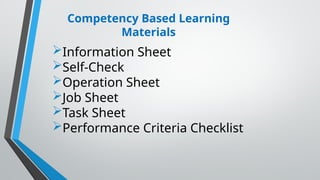
Competency Based Learning
Materials
Information Sheet
Self-Check
Operation Sheet
Job Sheet
Task Sheet
Performance Criteria Checklist
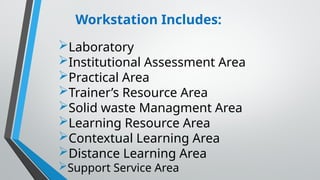
Workstation Includes:
Laboratory
Institutional Assessment Area
Practical Area
Trainer’s Resource Area
Solid waste Managment Area
Learning Resource Area
Contextual Learning Area
Distance Learning Area
Support Service Area
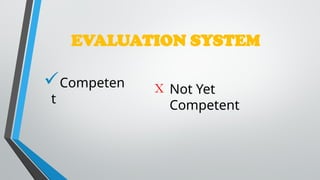
EVALUATION SYSTEM
Competen
t
Χ Not Yet
Competent
EVENTS MANAGEMENT SERVICES
NC III
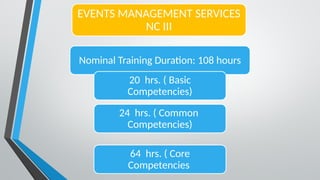
Nominal Training Duration: 108 hours
20 hrs. ( Basic
Competencies)
24 hrs. ( Common
Competencies)
64 hrs. ( Core
Competencies
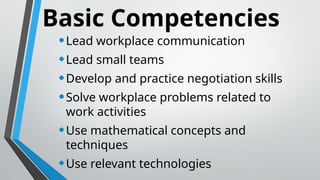
•Lead workplace communication
•Lead small teams
•Develop and practice negotiation skills
•Solve workplace problems related to
work activities
•Use mathematical concepts and
techniques
•Use relevant technologies
Basic Competencies
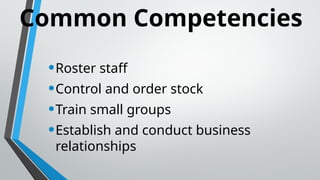
Common Competencies
•Roster staff
•Control and order stock
•Train small groups
•Establish and conduct business
relationships
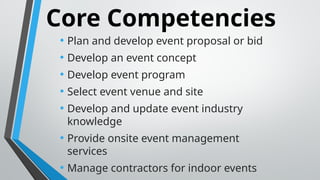
Core Competencies
• Plan and develop event proposal or bid
• Develop an event concept
• Develop event program
• Select event venue and site
• Develop and update event industry
knowledge
• Provide onsite event management
services
• Manage contractors for indoor events
ModuleTitle:
Developing an Event concept
Trainer:
Christine I. Villablanca
Learning Outcomes
LO1: Identify Overall event objective
and scope
LO2: Establish Event concept theme
and format
Learning Outcome # 2
• Establish Event concept theme
and format
Learning Contents
• Typical formats for different styles of events
• Creative options to be consider when developing
an event concept
• Key Stakeholders in different types of events
• Technical and Staging options of different types of
event
• Use of Office Electronic Equipment
• Research Skills to seek information associated with
the event concepts and ideas
• Communication skills to be able to present
proposed concept
QUESTIONS?
CLARIFICATIONS?

Facilitate Learning Session- Trainers Methodology Level 1

  • 1.
    WELCOME TO!!! CDJJ Instituteof Information Technology
  • 2.
    CDJJ Intitute ofInformation Technology ACCREDITED COMPETENCY ASSESSMENT CENTER Orientation on Competency Based Training in EVENTS MANAGEMENT SERVICES NC III CHRISTINE I. VILLABLANCA Trainer
  • 3.
    1. COMPETENCY BASEDTRAINING (CBT) 2. 1O PRINCIPLES OF CBT 3. COMPARATIVE 4. ANALYSIS BETWEEN TRADITIONAL APPROACH AND CBT APPROACH 5. ROLE AS A TRAINER 6. ROLE AS A TRAINEE 7. QUALIFICATION OVERVIEW (AQUACULTURE) 8. COMPETENCY BASED LEARNING MATERIAL (CBLM)
  • 4.
    CDJJ Institute ofInformation Technology In accordance with the Arrangement on the Project for Establishment of theCDJJ Institute of Information Technology between the Government of the Caloocan City and the TESDA signed on June 3, 2023, the Project was initiated upon signing of the Record of Discussion last August 26, 2023.
  • 5.
    Events Management Services NCIII Workshop Lay-out
  • 6.
    What is CBT? (CompetencyBased Training)
  • 7.
    ►The framework inteaching skill-based lesson is called Competency Based Training (or CBT). It focuses on skills development that is why its approach differs from the traditional education. ►In traditional education, the teacher controls the environment (or called teacher-centered approach); while in CBT, the learners control and manipulate the tools and equipment's with the guide of a teacher (also known as student-centered approach).
  • 8.
    In addition tothat, learners are not compared among each other, instead their skills are compared against the norms or standard set by the industry. The training is also self-paced; an example of this is when the trainer allows the students to study the materials & practice the skill on their own. Lastly, the focus of CBT is on the outcome or the end product.
  • 9.
  • 10.
    1. Training isbased on curriculum developed from the competency standard. 2. Learning is competency based or modular in structure. 3. Training delivery is self-paced and individualized. 4. Training is based on the work that must be performed.
  • 11.
    5. Training materialis directly related to competency standard. 6. Assessment is based in the collection of evidence of the performance of work to the industry required standard. 7.Training is based both on and o the job components ff 8.Training program allows for recognition of prior learning (RPL)or current competencies 9.Training allows for multiple entry and exit. 10.Training programs are registered with the UTPRAS.
  • 12.
  • 13.
    Traditional Approach CBTApproach Instructors focus on managing instruction Trainers focus on managing learning Most students enter at about the same time Trainees enter at various time throughout the year. Students all cover the same material Trainees maybe trained for different unit of competency within the same program
  • 14.
    Traditional Approach CBTApproach Instructors focus on managing instruction Trainers focus on managing learning Most students enter at about the same time Trainees enter at various time throughout the year. Students all cover the same material Trainees maybe trained for different unit of competency within the same program
  • 15.
    Role of theCBT Trainer 1. Serves as a team member to determine what is to be learned 2. Stimulates trainees‟ motivation. 3. Manages learning: a consultation rather than a provider of information; a facilitator of the learning 4. Diagnose and solves learning problems 5. Evaluates student achievement
  • 16.
    Role of theCBT Trainee 1. Trainees may select what they want to learn and when they want to learn it, within reason. 2. Trainees learn at their own rate within program guidelines. They may speed up, slow down, stop or even repeat a task. 3. Trainees may request to receive credit for what they already know. This is done either through pre-testing or through a review of a task list completed at another training site.
  • 17.
    Recognition of PriorLearning (RPL) ►It is the acknowledgement of an individual’s skills, knowledge and attitudes gained from life and work experiences outside registered training programs .
  • 18.
    What is CBLM? CBLM- Competency-based Learning Materials - is simply a well designed and carefully developed learning materials that give trainees detailed instructions to guide them through the learning process.
  • 19.
    Different Forms ofLearning Materials Learning Guides Assement Materials Workbook with activities, tasks and contents Background readingmaterials or documents Hand outs and other audio visual materials Industry competency standards
  • 20.
    Competency Based Learning Materials InformationSheet Self-Check Operation Sheet Job Sheet Task Sheet Performance Criteria Checklist
  • 21.
    Workstation Includes: Laboratory Institutional AssessmentArea Practical Area Trainer’s Resource Area Solid waste Managment Area Learning Resource Area Contextual Learning Area Distance Learning Area Support Service Area
  • 22.
  • 23.
    EVENTS MANAGEMENT SERVICES NCIII Nominal Training Duration: 108 hours 20 hrs. ( Basic Competencies) 24 hrs. ( Common Competencies) 64 hrs. ( Core Competencies
  • 24.
    •Lead workplace communication •Leadsmall teams •Develop and practice negotiation skills •Solve workplace problems related to work activities •Use mathematical concepts and techniques •Use relevant technologies Basic Competencies
  • 25.
    Common Competencies •Roster staff •Controland order stock •Train small groups •Establish and conduct business relationships
  • 26.
    Core Competencies • Planand develop event proposal or bid • Develop an event concept • Develop event program • Select event venue and site • Develop and update event industry knowledge • Provide onsite event management services • Manage contractors for indoor events
  • 27.
    ModuleTitle: Developing an Eventconcept Trainer: Christine I. Villablanca
  • 28.
    Learning Outcomes LO1: IdentifyOverall event objective and scope LO2: Establish Event concept theme and format
  • 29.
    Learning Outcome #2 • Establish Event concept theme and format
  • 30.
    Learning Contents • Typicalformats for different styles of events • Creative options to be consider when developing an event concept • Key Stakeholders in different types of events • Technical and Staging options of different types of event • Use of Office Electronic Equipment • Research Skills to seek information associated with the event concepts and ideas • Communication skills to be able to present proposed concept
  • 32.

Editor's Notes

  • #10 next, 10 principles of cbt 1. read only 2. read and explain-this means that you have to finished first the first competency before you can proceed to the next competency in other words it is a pre-requisite. You have to complete all the modules to qualified with this qualification 3. read and explain – that is why i gathered here your experiences so that your training will be personalized according to your needs and it is self-paced because you will be the one responsible for your own learning. 4. read and explain- this means that our training here in DSF is related or in accordance as prescribed in the industry standards. What we do here is actually done in the industry.
  • #11 5. Read……(diretso na daun sa #10)   So that was the 10 principles of cbt