COMPETENCY BASED TRAINING
(CBT)
It is a training delivery approach that
focuses on the competency development of a
learners as a result of a training.
COMPETENCY BASED
TRAINING
•
TRAINING
DELIVERY
APPROACH
FOCUS
COMPETENCY DEVELOPMENT
OF THE LEARNER AS A RESULT
OF THE TRAINING
OUTCOMES RATHER THAN
LEARNING PROCESS WITHIN
SPECIFIED TIME
EMPHASIS WHAT LEARNER CAN DO
ATTAINMENT AND APPLICATION
OF KNOWLEDGE SKILLS AND
ATTITUDE TO A SPECIFIC LEVEL
OF COMPETENCY
CONCERN
COMPETENCY BASED TRAINING
TRAINING
REGULATION
COMPETENCY
STANDARD
COMPETENCY
BASED
CURRICULUM
Serve as basis in
the formulation of
competency
assessment and the
development of
curriculum and
instructional
materials of the
CBT.
Written
Specification of the
knowledge, skills,
attitudes required
for the performance
Guide in developing
learning activities;
Specification of the
course that a
trainee will
undertake to attain
workplace
competencies;
Based from TR.
What is Competency?
Competency involves applying knowledge skills
and attitudes to perform work activities to the
standard expected in the workplace.
Being able to do the job
Knowing how and why things are done
Knowing what to do if things go wrong
Having the right approach to do a job properly and safely
Key Features of Competency
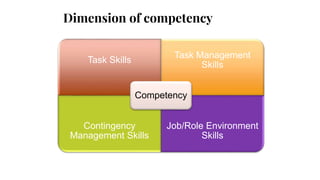
Task Skills
Task Management
Skills
Contingency
Management Skills
Job/Role Environment
Skills
Competency
Dimension of competency
● This requires performance of the task(s) to
the required standard as described in the
unit of competency and expected in the
workplace
● Assessor needs to collect evidence that the
candidates can do the individual actions as
well as the whole task.
Task Skills
● Captures the skills used as people plan and
integrate a number of potentially different
tasks to achieve a complete work outcome.
● Candidates should provide evidence that
they can work efficiently to meet deadlines,
handle a sequence of interrelated tasks and
progress smoothly between tasks.
Task management Skills
● The requirement to respond to irregularities
and breakdown in routines.
● Candidates should show evidence of dealing
with contingencies. For example:
○ Breakdowns
○ Irregularities
○ Imperfections
○ The unknown
Contingency Management Skills
● The requirement to deal with the responsibilities
and expectations of the work environment.
● The capacity to work with others and adapt to
different situations is essential to successful
performances
○ Does the candidate comply with workplace procedures
and standard methods in performing the task?
○ Does the candidate communicate effectively?
○ Does the candidate observe enterprise and regulatory
requirements?
Job/Role Environment Skills
10 PRINCIPLES
OF
COMPETENCY BASED TRAINING
1 2 3 4 5
6 7 8 9 10
Comparative Analysis
between Traditional
Education and CBT
TRADITIONAL CBT
INSTRUCTORS
FOCUS ON
MANAGING
LEARNING
TRAINEES ENTER
AT VARIOUS
TIMES
THROUGHOUT
THE YEAR
INSTRUCTORS
FOCUS ON
MANAGING
INSTRUCTION
MOST STUDENTS
ENTER AT ABOUT
THE SAME TIME
TRADITIONAL CBT
DIFFERENT TRAINEES
MAYBE TRAINED FOR
DIFFERENT UNIT OF
COMPETENCY WITHIN
THE SAME PROGRAM
EACH TRAINEE MOVES
ON THE NEXT TASK
ONLY AFTER
MASTERING THE TASK
HE OR SHE IS
CURRENTLY WORKING
ON
STUDENTS ALL COVER
THE SAME MATERIAL
STUDENTS ALL
PROCEED FROM ONE
TOPIC TO THE NEXT AT
THE SAME TIME
TRADITIONAL CBT
EACH TRAINEE
PROGRESS AT HIS
OR HER OWN PACE
EACH TRAINEE IS
TESTED WHEN
READY TO
DEMONSTRATE
MASTERY
THE INSTRUCTOR
CONTROLS THE
LEARNING PACE
ALL STUDENTS ARE
USUALLY TESTED AT
ONCE
TRADITIONAL CBT
VERY LITTLE
CONTINUOUS
FEEDBACK IS
GIVEN.
IMMEDIATE
FEEDBACK IS
GIVEN AT
CRITICAL
POINTS IN THE
LEARNING
PROCESS.
TRADITIONAL CBT
THE
INSTRUCTOR
MUST BE ABLE
TO ANSWER
QUESTIONS ON
MANY
DIFFERENT
TASKS EACH
DAY.
THE INSTRUCTOR
IS INVOLVED IN
TEACHING ONLY
ONE TOPIC AT A
TIME.
TRADITIONAL CBT
RETESTING IS
DISCOURAGED
OR NOT
ALLOWED.
RETESTING IS
ENCOURAGED
TO REACH
MASTERY
TRADITIONAL CBT
MATERIALS,
TOOLS AND
SUPPLIES FOR
ONLY ONE
TOPIC ARE
NEEDED AT A
TIME.
THE TRAINER
MUST SEE THAT
ALL MATERIALS
NEEDED FOR
MANY TASKS ARE
READILY
AVAILABLE.
TRADITIONAL CBT
THE PROGRAM
IS USUALLY
CLOSED DOWN
OR SHORTENED
DURING THE
SUMMER
MONTHS
THE PROGRAM
IS USUALLY
OPERATED
ALL YEAR
ROUND
CBT Delivery Modalities
Role of
CBT Trainer
Teacher Negotiator
Facilitator Coordinator
Curriculum
Developer
Instructional
Material
Developer
Counselor
Actor
Session
Planner
Roles of the Trainee
1. Trainees may select what they
want to learn and when they want
to learn it, within reason.
2. Trainees learn at their own rate
within program guidelines. They
may speed up, slow down, stop or
even repeat a task.
Roles of the Trainee
3. Trainees may request to receive
credit for what they already know.
This is done either through pre-
testing or through a review or a
task list completed at another
training site.
Roles of the Trainee
4. Trainees may choose how they
want to learn-individually, on a one-
to-one basis, in small group, in large
groups or with audio-visuals.
5. Trainees are responsible for what
they learn and when they learn it.
Roles of the Trainee
6. Trainees decide when they
are ready to perform each task
or demonstrate mastery of
learning to a job-like level of
proficiency before receiving
credit for the task.
Roles of the Trainee
7. Trainees help develop
personalized prescription for
learning worked out cooperatively
and based upon what the students
already knows, his preference for
learning, learning style and other
needs.
Roles of the Trainee
8. Trainees compete against present
job standards and not against other
students and are graded on
achievement of the standards or
criteria of each task.
9. Trainees know “up front”, before
instruction begins what they are
expected to know and do to complete
the program.
Roles of the Trainee
10. Trainees evaluate their
own progress to see how well
they are doing.
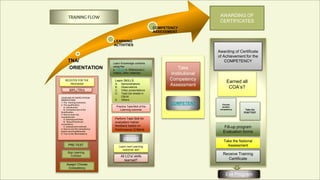
TNA/
ORIENTATION
LEARNING
ACTIVITIES
COMPETENCY
ASSESSMENT
AWARDING OF
CERTIFICATES
REGISTER FOR THE
PROGRAM
RPL/TNA
LEVELING OF EXPECTATION/
ORIENTATION:
1. The training institution
2. The qualification
A. Introduction
B. Competencies of the
Qualification
3. How to learn the
competencies
A. learning activities
B. Requirements per
competency
C. assessment methods
4. How to use the competency-
based Learning Materials
5. Tour to the Workstations
PRE-TEST
Sign Learning
Contract
Assign/ Choose
Competency
Learn Knowledge contents
using the:
a. CBLMs b. References c.
Videos, other materials
Learn SKILLS
A. Demonstrations
B. Observations
C. Video presentations
D. Task/Job sheets in
CBLM
E. Others
Practice Task/Skill of the
Learning outcome
Perform Task Skill for
evaluation/ trainer
feedback based on
Performance Criteria
passed
Learn next Learning
outcome/ skill
All LO’s/ skills
learned?
Take
Institutional
Competency
Assessment
COMPETENT
Awarding of Certificate
of Achievement for the
COMPETENCY
Earned all
COA’s?
Take the
POSTTEST
Choose
another
competency
Fill-up program
Evaluation forms
Take the National
Assessment
Receive Training
Certificate
Exit Program
TRAINING FLOW
RATING SYSTEM
COMPETENT
NOT YET
COMPETENT
C B L M
a simply a well-designed and carefully developed
learning materials that give trainees detailed
instructions to guide them through the learning
process.
WHAT IS CBLM?
Training workshop and stations
The different components or areas of a
competency-based facility are:
1. Practical Work Area - This area is
where the learner acquires the skills
and knowledge components of the
competencies prescribed by the
standard.
2. Learning resource area - This
area is proximate to the heart -
the practical work area. This
area provides the learner with
the knowledge requirements in
the various modules
responding to the
competencies.
3. Institutional assessment area - It
is located very proximate to the
practical work area. This is where
Recognition of Prior Learning is done by
the trainer. This component also
provides the mechanism of assessing
the completion of competencies of a
learner.
4. Contextual Learning Laboratory -
This facility ensures that the
underpinning knowledge, science,
mathematics and communication
principles as applied to the
technology are provided to the
learner.
5. Quality Control Area -
Various tests aside from
metrology and calibration are
conducted in this area
including in-process quality
control.
6. Trainers Resource Center -
This area houses the
learning materials, the
training regulations and
curriculum examples.
7. Distance Learning - This
is to enable the learning
provision outside and away
from the training institution
in terms of print and non-
print media.
8. Computer Laboratory -
This laboratory has an array of
computer units of which
learners are provided for them
to learn and gain appropriate
IT competencies that may
include Word, Excel even
Desktop Publishing.
9. Support Service Area – This
area provide value-adding
competencies as such for
Automotive Service Technician NC
II, welding competency address
underpinning skills in the
particular competency.
Overview of the Training
 Pre-test will be given
 Monitor attendance of trainees
during training
 Assigned respective competencies
 Guide Trainees in undergoing the
activities
 Provide feedback as the training
is going on
Overview of the Training
 After completion of the requirements
for each competency, a post-test will be
given.
 Trainee could also request for an
institutional assessment when ready as
required by certain competency.
 Record trainees “achievement on
Progress Chart and Accomplishment
Chart.
Evaluation
• You will be evaluated by:
 Performance Criteria
 Progress Chart
 Achievement Chart
 Self-Check and written exams
 Observation, demonstration and
oral questioning
competency-based training Presentation.pptx

competency-based training Presentation.pptx

  • 1.
  • 2.
    It is atraining delivery approach that focuses on the competency development of a learners as a result of a training.
  • 3.
    COMPETENCY BASED TRAINING • TRAINING DELIVERY APPROACH FOCUS COMPETENCY DEVELOPMENT OFTHE LEARNER AS A RESULT OF THE TRAINING OUTCOMES RATHER THAN LEARNING PROCESS WITHIN SPECIFIED TIME EMPHASIS WHAT LEARNER CAN DO ATTAINMENT AND APPLICATION OF KNOWLEDGE SKILLS AND ATTITUDE TO A SPECIFIC LEVEL OF COMPETENCY CONCERN
  • 4.
    COMPETENCY BASED TRAINING TRAINING REGULATION COMPETENCY STANDARD COMPETENCY BASED CURRICULUM Serveas basis in the formulation of competency assessment and the development of curriculum and instructional materials of the CBT. Written Specification of the knowledge, skills, attitudes required for the performance Guide in developing learning activities; Specification of the course that a trainee will undertake to attain workplace competencies; Based from TR.
  • 5.
    What is Competency? Competencyinvolves applying knowledge skills and attitudes to perform work activities to the standard expected in the workplace.
  • 6.
    Being able todo the job Knowing how and why things are done Knowing what to do if things go wrong Having the right approach to do a job properly and safely Key Features of Competency
  • 7.
    Task Skills Task Management Skills Contingency ManagementSkills Job/Role Environment Skills Competency Dimension of competency
  • 8.
    ● This requiresperformance of the task(s) to the required standard as described in the unit of competency and expected in the workplace ● Assessor needs to collect evidence that the candidates can do the individual actions as well as the whole task. Task Skills
  • 9.
    ● Captures theskills used as people plan and integrate a number of potentially different tasks to achieve a complete work outcome. ● Candidates should provide evidence that they can work efficiently to meet deadlines, handle a sequence of interrelated tasks and progress smoothly between tasks. Task management Skills
  • 10.
    ● The requirementto respond to irregularities and breakdown in routines. ● Candidates should show evidence of dealing with contingencies. For example: ○ Breakdowns ○ Irregularities ○ Imperfections ○ The unknown Contingency Management Skills
  • 11.
    ● The requirementto deal with the responsibilities and expectations of the work environment. ● The capacity to work with others and adapt to different situations is essential to successful performances ○ Does the candidate comply with workplace procedures and standard methods in performing the task? ○ Does the candidate communicate effectively? ○ Does the candidate observe enterprise and regulatory requirements? Job/Role Environment Skills
  • 12.
    10 PRINCIPLES OF COMPETENCY BASEDTRAINING 1 2 3 4 5 6 7 8 9 10
  • 13.
  • 14.
    TRADITIONAL CBT INSTRUCTORS FOCUS ON MANAGING LEARNING TRAINEESENTER AT VARIOUS TIMES THROUGHOUT THE YEAR INSTRUCTORS FOCUS ON MANAGING INSTRUCTION MOST STUDENTS ENTER AT ABOUT THE SAME TIME
  • 15.
    TRADITIONAL CBT DIFFERENT TRAINEES MAYBETRAINED FOR DIFFERENT UNIT OF COMPETENCY WITHIN THE SAME PROGRAM EACH TRAINEE MOVES ON THE NEXT TASK ONLY AFTER MASTERING THE TASK HE OR SHE IS CURRENTLY WORKING ON STUDENTS ALL COVER THE SAME MATERIAL STUDENTS ALL PROCEED FROM ONE TOPIC TO THE NEXT AT THE SAME TIME
  • 16.
    TRADITIONAL CBT EACH TRAINEE PROGRESSAT HIS OR HER OWN PACE EACH TRAINEE IS TESTED WHEN READY TO DEMONSTRATE MASTERY THE INSTRUCTOR CONTROLS THE LEARNING PACE ALL STUDENTS ARE USUALLY TESTED AT ONCE
  • 17.
    TRADITIONAL CBT VERY LITTLE CONTINUOUS FEEDBACKIS GIVEN. IMMEDIATE FEEDBACK IS GIVEN AT CRITICAL POINTS IN THE LEARNING PROCESS.
  • 18.
    TRADITIONAL CBT THE INSTRUCTOR MUST BEABLE TO ANSWER QUESTIONS ON MANY DIFFERENT TASKS EACH DAY. THE INSTRUCTOR IS INVOLVED IN TEACHING ONLY ONE TOPIC AT A TIME.
  • 19.
    TRADITIONAL CBT RETESTING IS DISCOURAGED ORNOT ALLOWED. RETESTING IS ENCOURAGED TO REACH MASTERY
  • 20.
    TRADITIONAL CBT MATERIALS, TOOLS AND SUPPLIESFOR ONLY ONE TOPIC ARE NEEDED AT A TIME. THE TRAINER MUST SEE THAT ALL MATERIALS NEEDED FOR MANY TASKS ARE READILY AVAILABLE.
  • 21.
    TRADITIONAL CBT THE PROGRAM ISUSUALLY CLOSED DOWN OR SHORTENED DURING THE SUMMER MONTHS THE PROGRAM IS USUALLY OPERATED ALL YEAR ROUND
  • 22.
  • 28.
  • 29.
  • 30.
    Roles of theTrainee 1. Trainees may select what they want to learn and when they want to learn it, within reason. 2. Trainees learn at their own rate within program guidelines. They may speed up, slow down, stop or even repeat a task.
  • 31.
    Roles of theTrainee 3. Trainees may request to receive credit for what they already know. This is done either through pre- testing or through a review or a task list completed at another training site.
  • 32.
    Roles of theTrainee 4. Trainees may choose how they want to learn-individually, on a one- to-one basis, in small group, in large groups or with audio-visuals. 5. Trainees are responsible for what they learn and when they learn it.
  • 33.
    Roles of theTrainee 6. Trainees decide when they are ready to perform each task or demonstrate mastery of learning to a job-like level of proficiency before receiving credit for the task.
  • 34.
    Roles of theTrainee 7. Trainees help develop personalized prescription for learning worked out cooperatively and based upon what the students already knows, his preference for learning, learning style and other needs.
  • 35.
    Roles of theTrainee 8. Trainees compete against present job standards and not against other students and are graded on achievement of the standards or criteria of each task. 9. Trainees know “up front”, before instruction begins what they are expected to know and do to complete the program.
  • 36.
    Roles of theTrainee 10. Trainees evaluate their own progress to see how well they are doing.
  • 37.
    TNA/ ORIENTATION LEARNING ACTIVITIES COMPETENCY ASSESSMENT AWARDING OF CERTIFICATES REGISTER FORTHE PROGRAM RPL/TNA LEVELING OF EXPECTATION/ ORIENTATION: 1. The training institution 2. The qualification A. Introduction B. Competencies of the Qualification 3. How to learn the competencies A. learning activities B. Requirements per competency C. assessment methods 4. How to use the competency- based Learning Materials 5. Tour to the Workstations PRE-TEST Sign Learning Contract Assign/ Choose Competency Learn Knowledge contents using the: a. CBLMs b. References c. Videos, other materials Learn SKILLS A. Demonstrations B. Observations C. Video presentations D. Task/Job sheets in CBLM E. Others Practice Task/Skill of the Learning outcome Perform Task Skill for evaluation/ trainer feedback based on Performance Criteria passed Learn next Learning outcome/ skill All LO’s/ skills learned? Take Institutional Competency Assessment COMPETENT Awarding of Certificate of Achievement for the COMPETENCY Earned all COA’s? Take the POSTTEST Choose another competency Fill-up program Evaluation forms Take the National Assessment Receive Training Certificate Exit Program TRAINING FLOW
  • 38.
  • 39.
  • 40.
    a simply awell-designed and carefully developed learning materials that give trainees detailed instructions to guide them through the learning process. WHAT IS CBLM?
  • 44.
    Training workshop andstations The different components or areas of a competency-based facility are: 1. Practical Work Area - This area is where the learner acquires the skills and knowledge components of the competencies prescribed by the standard.
  • 45.
    2. Learning resourcearea - This area is proximate to the heart - the practical work area. This area provides the learner with the knowledge requirements in the various modules responding to the competencies.
  • 46.
    3. Institutional assessmentarea - It is located very proximate to the practical work area. This is where Recognition of Prior Learning is done by the trainer. This component also provides the mechanism of assessing the completion of competencies of a learner.
  • 47.
    4. Contextual LearningLaboratory - This facility ensures that the underpinning knowledge, science, mathematics and communication principles as applied to the technology are provided to the learner.
  • 48.
    5. Quality ControlArea - Various tests aside from metrology and calibration are conducted in this area including in-process quality control.
  • 49.
    6. Trainers ResourceCenter - This area houses the learning materials, the training regulations and curriculum examples.
  • 50.
    7. Distance Learning- This is to enable the learning provision outside and away from the training institution in terms of print and non- print media.
  • 51.
    8. Computer Laboratory- This laboratory has an array of computer units of which learners are provided for them to learn and gain appropriate IT competencies that may include Word, Excel even Desktop Publishing.
  • 52.
    9. Support ServiceArea – This area provide value-adding competencies as such for Automotive Service Technician NC II, welding competency address underpinning skills in the particular competency.
  • 53.
    Overview of theTraining  Pre-test will be given  Monitor attendance of trainees during training  Assigned respective competencies  Guide Trainees in undergoing the activities  Provide feedback as the training is going on
  • 54.
    Overview of theTraining  After completion of the requirements for each competency, a post-test will be given.  Trainee could also request for an institutional assessment when ready as required by certain competency.  Record trainees “achievement on Progress Chart and Accomplishment Chart.
  • 55.
    Evaluation • You willbe evaluated by:  Performance Criteria  Progress Chart  Achievement Chart  Self-Check and written exams  Observation, demonstration and oral questioning

Editor's Notes

  • #40 TEACHER: PROVIDE INFORMATION, YOU ARE SOURCE OF INFO NEGOTIATOR: NEGOTIATE WITH STAFF, TRAINEE COORDINATOR: COORDINATE TO LEARNERS SESSION PLANNER: PLAN OUT DEVELOPER: DEVELOP LEARNING MATERIALS SUCH AS INSTRUCTIONA SHEET, CBLM PROVIDE GUIDANCE AND COUNCILING