COMPETENCY-BASED
TRAINING( CBT)
BY:NILA JEAN P. BAMOONG
INTRODUCTION
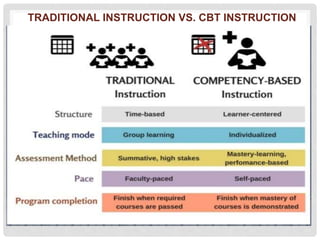
In a traditional educational system,
the unit of progression is time and it
is teacher-centered. In a
Competency-Based Training system,
the unit of progression is mastery of
specific knowledge and skills and is
learned or participant-centered.
 Skill- a task or group of tasks
performed to a specific level of
competency or proficiency which often
use motor functions and typically require
the manipulation of instruments and
equipment. Some skills, however, such
counseling, are knowledge and attitude-
based.
 Competency- a skill performed to a
specific standard under specific
conditions.
COMPETENCY-BASED
TRAINING
 it is a training delivery approach that focuses
on the competency development of the learner
as a result of the training;
 emphasized most on what the learners can
actually do;
 focuses on outcome rather than the learning
process within specified time;
 it is concerned with the attainment and
application of knowledge, skills and attitude to a
specific level of competency.
COMPETENCIES ARE
GAIN THROUGH:
life experience
 formal education
 Apprenticeship
 on-the-job experience
 self-help program
 training and development
programs
KEY FEATURES OF COMPETENCY
being able to do the job
 knowing how and why things
are done
 knowing what to do if things
go wrong
 knowing the right approach to
do a job properly and safely
CHARACTERISTICS OF CBT
1. Competencies are carefully selected.
2. Supporting theory is integrated with skill practice.
Essential knowledge is learned to support the
performance of skills.
3. Detailed training materials are keyed to the
competencies to be achieved and are designed to support
the acquisition of knowledge and skills.
4. Methods of instruction involve mastery learning, the
premise that all participants can master the required
knowledge or skill, provided sufficient time and
appropriate training methods are used.
(Foyster (1990), Delker (1990) and Norton (1987)
5. Participants’ knowledge and skills are assessed as they
enter the program and those with satisfactory knowledge
and skills may bypass training or competencies already
attained.
6. Learning should be self-paced.
7. Flexible training approaches including large group
methods, small group activities and individual study are
essential components.
8. A variety of support materials including print,
audiovisual and simulations (models) keyed to the skills
being mastered are used.
9. Satisfactory completion of training is based on
achievement of all specified competencies.
TEN (10) PRINCIPLES OF CBT
1. The Training Is Based on Curriculum
Developed from The Competency Standards
-The competency-based curriculum is derived
from the competency standards. It is a plan for
structured series of learning experiences toward
achieving of competencies identified by the
industry; it details training methodologies,
resources, facilities, infrastructure and other
materials required both for training and
assessment strategies.
2. LEARNING IS COMPETENCY-BASED OR
MODULAR IN STRUCTURE.
- one competency is one module but some competencies
maybe divided into training modules. A qualification is
composed of a set of competencies a worker should have.
When planning your trainees should learn one competency
after another until they attain all competencies of the
qualification.
UNIT OF COMPETENCY
MODULE 1 MODULE 2 MODULE 3
3. TRAINING DELIVERY IS
INDIVIDUALIZE AND SELF-PACED.
- As trainers, you should provide
activities that will allow each trainee to
advance on his own without waiting for
the other trainees in his class to finish.
Facilities, resources and materials should
also be structured so that trainees could
learned competencies at their own pace.
4. TRAINING IS BASED ON WORK
THAT MUST BE PERFORMED.
- Learning is based on work that must
be performed
5. TRAINING MATERIALS ARE DIRECTLY
RELATED TO THE COMPETENCY
STANDARDS AND THE CURRICULUM
- Competency standards are updated specifications of the
qualification. Oftentimes, learning materials that are directly
related to these standards are not available in bookstores. You
should put your resources together to produce learning
materials and learning activities appropriate to attain the
performance criteria in the competency standard.
- The competency-based curriculum will be your guide to
plan for both training and assessment to your trainees.
Your learning materials should be developed to attain the
assessment criteria in the competency-based curriculum.
COMPETENCY STANDARD
COMPETENCY-BASED
CURRICULUM
LEARNING MATERIALS
6. Assessment of Learners Is Based in
The Collection of Evidences of Work
Performance Based on Industry or
Organizational Required Standards.
Students are judged
against each other
(norm referenced
assessment)
Each student is
assessed against the
evidences based on
standards
TRADITIONAL CBT
7. TRAINING IS BASED ON AND OFF THE
JOB COMPONENTS AND OFF THE JOB
COMPONENTS.
- Better learning with industry and
school partnership
8. THE SYSTEM ALLOWS
RECOGNITION OF PRIOR LEARNING
- CBT focuses on the competencies that are not
yet acquired by the trainee in any learning
situation. Competencies acquired as a result of
previous training, employment and life experiences
should be recognized so that trainees will not waste
time doing the learning activities of the competencies
that they already have. It is one of your tasks to
identify these prior learning of your trainees and plan
for the training of each trainee based on this data.
9. THE SYSTEM ALLOWS FOR LEARNERS TO
ENTER AND EXIT PROGRAMS AT DIFFERENT
TIMES AND LEVELS AND TO RECEIVE AN
AWARD FOR COMPETENCIES ATTAINED AT
ANY POINT.
- There is flexibility for entry and exit from
programs
10. APPROVED TRAINING PROGRAMS
ARE NATIONALLY ACCREDITED
- Training programs are registered
within UTPRAS(Unified TVET
Program Registration and
Accreditation System)
TRADITIONAL INSTRUCTION VS. CBT INSTRUCTION
TRAINING MODALITIES IN
DESIGNING TRAINING PROGRAMS:
• The dualized mode of training delivery is
preferred and recommended. Thus, programs
would contain in-school and in-industry training or
fieldwork components.
• Modular/self-paced learning is a competency-
based training modality wherein the trainee is
allowed to progress at his own pace. The trainer
just facilitates the training delivery.
• Peer teaching/mentoring is a training
modality wherein fast learners are given the
opportunity to assist the slow learners.
• Supervised industry training or on-the-job
training is an approach in training designed
to enhance the knowledge and skills of the
trainee through actual experience in the
workplace to acquire specific competencies
prescribed in the training regulations.
• Project-based instruction is an authentic
instructional model or strategy in which
students plan, implement and evaluate
projects that have real applications.
• Distance learning is a formal education
process in which majority of the instruction
occurs when the students and instructor are
not in the same place.
THE NINE CBT AREAS
1. Practical Work Area - This area is where the learner
acquires the skills and knowledge components of the
competencies prescribed by the standard.
2. Learning Resource Area - This area is proximate to the
heart - the practical work area. This area provides the learner
with the knowledge requirements in the various modules
responding to the competencies. It is a place where projects
can be planned and self-paced learning is based.
3. Institutional Assessment Area - This is where recognition
of prior learning is done by the trainer. This component also
provides the mechanism of assessing the completion of
competencies of a trainee.
4. Contextual Learning Laboratory - This facility ensures
that the underpinning knowledge, science, mathematics and
communication principles as applied to the technology are
provided to the learner.
5. Quality Control Area- Various tests like metrology and
calibration are conducted in this area including in-process
quality control.
9. Support Area - This area provides value-adding
competencies underpinning skills in the particular
competency.
(http://www.trainersmethodologyhub.com/2018/10/competency-based-
training-workshop.html)
6. Trainers Resource Center - This area houses the learning
materials, the training regulations and curriculum exemplars.
This is, also, the place where instructors produce courseware
or training materials.
7. Distance Learning Area - This is to enable the learning
provision outside and away from the training institution in
terms of print and non-print media.
8. Computer Laboratory - This laboratory has an array of
computer units of which learners are provided for them to learn
and gain appropriate IT competencies that may include Word,
(http://www.trainersmethodologyhub.com/2018/10/competency-based-training-workshop.html)
REFEERECES:
• Competency-based Learning Materials. Supervise Work-based Training. National
TVET Training Academy. Technical Education and Skills Development Authority.
2012
• Competency-based Learning Materials. Conduct Competency Assessment.
National TVET Training Academy. Technical Education and Skills Development
Authority. 2012
• https://en.wikipedia.org/wiki/Education_in_the_Philippines#Technical_and_vocatio
nal_education
• http://www.trainersmethodologyhub.com/2018/10/competency-based-training-
workshop.html

tvet.pptx

  • 1.
  • 2.
    INTRODUCTION In a traditionaleducational system, the unit of progression is time and it is teacher-centered. In a Competency-Based Training system, the unit of progression is mastery of specific knowledge and skills and is learned or participant-centered.
  • 3.
     Skill- atask or group of tasks performed to a specific level of competency or proficiency which often use motor functions and typically require the manipulation of instruments and equipment. Some skills, however, such counseling, are knowledge and attitude- based.  Competency- a skill performed to a specific standard under specific conditions.
  • 4.
    COMPETENCY-BASED TRAINING  it isa training delivery approach that focuses on the competency development of the learner as a result of the training;  emphasized most on what the learners can actually do;  focuses on outcome rather than the learning process within specified time;  it is concerned with the attainment and application of knowledge, skills and attitude to a specific level of competency.
  • 5.
    COMPETENCIES ARE GAIN THROUGH: lifeexperience  formal education  Apprenticeship  on-the-job experience  self-help program  training and development programs
  • 6.
    KEY FEATURES OFCOMPETENCY being able to do the job  knowing how and why things are done  knowing what to do if things go wrong  knowing the right approach to do a job properly and safely
  • 7.
    CHARACTERISTICS OF CBT 1.Competencies are carefully selected. 2. Supporting theory is integrated with skill practice. Essential knowledge is learned to support the performance of skills. 3. Detailed training materials are keyed to the competencies to be achieved and are designed to support the acquisition of knowledge and skills. 4. Methods of instruction involve mastery learning, the premise that all participants can master the required knowledge or skill, provided sufficient time and appropriate training methods are used.
  • 8.
    (Foyster (1990), Delker(1990) and Norton (1987) 5. Participants’ knowledge and skills are assessed as they enter the program and those with satisfactory knowledge and skills may bypass training or competencies already attained. 6. Learning should be self-paced. 7. Flexible training approaches including large group methods, small group activities and individual study are essential components. 8. A variety of support materials including print, audiovisual and simulations (models) keyed to the skills being mastered are used. 9. Satisfactory completion of training is based on achievement of all specified competencies.
  • 9.
    TEN (10) PRINCIPLESOF CBT 1. The Training Is Based on Curriculum Developed from The Competency Standards -The competency-based curriculum is derived from the competency standards. It is a plan for structured series of learning experiences toward achieving of competencies identified by the industry; it details training methodologies, resources, facilities, infrastructure and other materials required both for training and assessment strategies.
  • 10.
    2. LEARNING ISCOMPETENCY-BASED OR MODULAR IN STRUCTURE. - one competency is one module but some competencies maybe divided into training modules. A qualification is composed of a set of competencies a worker should have. When planning your trainees should learn one competency after another until they attain all competencies of the qualification. UNIT OF COMPETENCY MODULE 1 MODULE 2 MODULE 3
  • 11.
    3. TRAINING DELIVERYIS INDIVIDUALIZE AND SELF-PACED. - As trainers, you should provide activities that will allow each trainee to advance on his own without waiting for the other trainees in his class to finish. Facilities, resources and materials should also be structured so that trainees could learned competencies at their own pace.
  • 12.
    4. TRAINING ISBASED ON WORK THAT MUST BE PERFORMED. - Learning is based on work that must be performed
  • 13.
    5. TRAINING MATERIALSARE DIRECTLY RELATED TO THE COMPETENCY STANDARDS AND THE CURRICULUM - Competency standards are updated specifications of the qualification. Oftentimes, learning materials that are directly related to these standards are not available in bookstores. You should put your resources together to produce learning materials and learning activities appropriate to attain the performance criteria in the competency standard. - The competency-based curriculum will be your guide to plan for both training and assessment to your trainees. Your learning materials should be developed to attain the assessment criteria in the competency-based curriculum.
  • 14.
  • 15.
    6. Assessment ofLearners Is Based in The Collection of Evidences of Work Performance Based on Industry or Organizational Required Standards. Students are judged against each other (norm referenced assessment) Each student is assessed against the evidences based on standards TRADITIONAL CBT
  • 16.
    7. TRAINING ISBASED ON AND OFF THE JOB COMPONENTS AND OFF THE JOB COMPONENTS. - Better learning with industry and school partnership
  • 17.
    8. THE SYSTEMALLOWS RECOGNITION OF PRIOR LEARNING - CBT focuses on the competencies that are not yet acquired by the trainee in any learning situation. Competencies acquired as a result of previous training, employment and life experiences should be recognized so that trainees will not waste time doing the learning activities of the competencies that they already have. It is one of your tasks to identify these prior learning of your trainees and plan for the training of each trainee based on this data.
  • 18.
    9. THE SYSTEMALLOWS FOR LEARNERS TO ENTER AND EXIT PROGRAMS AT DIFFERENT TIMES AND LEVELS AND TO RECEIVE AN AWARD FOR COMPETENCIES ATTAINED AT ANY POINT. - There is flexibility for entry and exit from programs
  • 19.
    10. APPROVED TRAININGPROGRAMS ARE NATIONALLY ACCREDITED - Training programs are registered within UTPRAS(Unified TVET Program Registration and Accreditation System)
  • 20.
  • 21.
    TRAINING MODALITIES IN DESIGNINGTRAINING PROGRAMS: • The dualized mode of training delivery is preferred and recommended. Thus, programs would contain in-school and in-industry training or fieldwork components. • Modular/self-paced learning is a competency- based training modality wherein the trainee is allowed to progress at his own pace. The trainer just facilitates the training delivery.
  • 22.
    • Peer teaching/mentoringis a training modality wherein fast learners are given the opportunity to assist the slow learners. • Supervised industry training or on-the-job training is an approach in training designed to enhance the knowledge and skills of the trainee through actual experience in the workplace to acquire specific competencies prescribed in the training regulations.
  • 23.
    • Project-based instructionis an authentic instructional model or strategy in which students plan, implement and evaluate projects that have real applications.
  • 24.
    • Distance learningis a formal education process in which majority of the instruction occurs when the students and instructor are not in the same place.
  • 25.
    THE NINE CBTAREAS 1. Practical Work Area - This area is where the learner acquires the skills and knowledge components of the competencies prescribed by the standard. 2. Learning Resource Area - This area is proximate to the heart - the practical work area. This area provides the learner with the knowledge requirements in the various modules responding to the competencies. It is a place where projects can be planned and self-paced learning is based.
  • 26.
    3. Institutional AssessmentArea - This is where recognition of prior learning is done by the trainer. This component also provides the mechanism of assessing the completion of competencies of a trainee. 4. Contextual Learning Laboratory - This facility ensures that the underpinning knowledge, science, mathematics and communication principles as applied to the technology are provided to the learner. 5. Quality Control Area- Various tests like metrology and calibration are conducted in this area including in-process quality control.
  • 27.
    9. Support Area- This area provides value-adding competencies underpinning skills in the particular competency. (http://www.trainersmethodologyhub.com/2018/10/competency-based- training-workshop.html)
  • 28.
    6. Trainers ResourceCenter - This area houses the learning materials, the training regulations and curriculum exemplars. This is, also, the place where instructors produce courseware or training materials. 7. Distance Learning Area - This is to enable the learning provision outside and away from the training institution in terms of print and non-print media. 8. Computer Laboratory - This laboratory has an array of computer units of which learners are provided for them to learn and gain appropriate IT competencies that may include Word,
  • 29.
  • 30.
    REFEERECES: • Competency-based LearningMaterials. Supervise Work-based Training. National TVET Training Academy. Technical Education and Skills Development Authority. 2012 • Competency-based Learning Materials. Conduct Competency Assessment. National TVET Training Academy. Technical Education and Skills Development Authority. 2012 • https://en.wikipedia.org/wiki/Education_in_the_Philippines#Technical_and_vocatio nal_education • http://www.trainersmethodologyhub.com/2018/10/competency-based-training- workshop.html