Trainers Methodology Level I
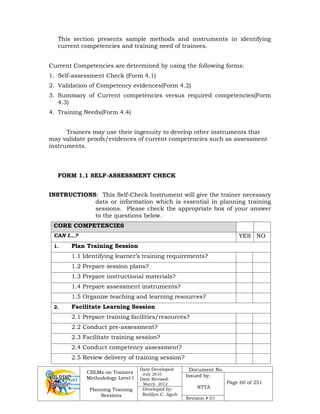
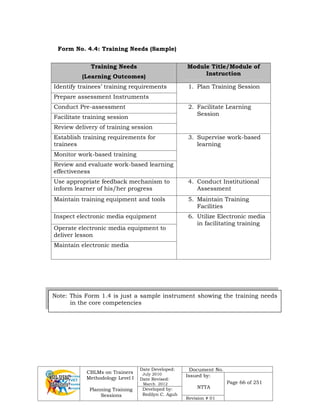
Competency-Based Learning Materials
Planning Training
Sessions
Printed by:
National TVET Trainers Academy
Technical Education and Skills Development Authority
ISBN 978-971-95388-0-6 000-0000-00-0
April 2012
All rights reserved
These Competency-Based Learning
Materials are properties of the National
TVET Trainers Academy. NTTA encourages
the use of the CBLMs contained herein for
education and training purposes with
appropriate credit given to NTTA.
Duplication and/or use of the CBLMs for
commercial purposes require prior written
approval from NTTA.
For further information, please
contact
The Director
National TVET Trainers Academy
Marikina City
Telefax No.: (02)655-6577
Tel. No. : (02)655-7065
e-Mail Add. : nttatesda@yahoo.com
CBLMs on Trainers
Methodology Level I
Planning Training
Sessions
Date Developed:
July 2010
Date Revised:
March 2012
Document No.
Issued by:
NTTA
Page i of viii
Developed by:
Redilyn C. Agub
Revision # 01
HOW TO USE THIS COMPETENCY- BASED LEARNING
MATERIALS
Welcome!
The unit of competency, "Plan Training Session", is one of the
competencies of TRAINERS METHODOLOGY LEVEL I (TM) 1, a course
which comprises the knowledge, skills and attitudes required for a TVET
trainer to possess.
The module, Planning Training Session, contains training materials
and activities related to identifying learner’s requirements, preparing session
plan, preparing basic instructional materials and organizing learning and
teaching activities for you to complete.
In this module, you are required to go through a series of learning
activities in order to complete each learning outcome. In each learning
outcome are Information Sheets, Self-Checks, Task Sheets and Job Sheets.
Follow and perform the activities on your own. If you have questions, do not
hesitate to ask for assistance from your facilitator.
Remember to:
 Read information sheets and complete theself-checks. Suggested
references are included to supplement the materials provided in this
module.
 Perform the Task Sheets and Job Sheets until you are confident that
your outputs conform to the Performance Criteria Checklist that
follows the sheets.
 Submit outputs of the Task Sheets and Job Sheets to your facilitator
for evaluation and recording in the Accomplishment Chart. Outputs
shall serve as your portfolio during the Institutional Competency
Evaluation. When you feel confident that you have had sufficient
practice, ask your trainer to evaluate you. The results of your
assessment will be recorded in your Progress Chart and
Accomplishment Chart.
You must pass the Institutional Competency Evaluation for this
competency before moving to another competency. A Certificate of
Achievement will be awarded to you after passing the evaluation.
You need to complete this module before you can perform the module
on Facilitating Learning Sessions.
CBLMs on Trainers
Methodology Level I
Planning Training
Sessions
Date Developed:
July 2010
Date Revised:
March 2012
Document No.
Issued by:
NTTA
Page ii of viii
Developed by:
Redilyn C. Agub
Revision # 01
TRAINERS METHODOLOGY LEVEL 1
COMPETENCY-BASED LEARNING MATERIALS
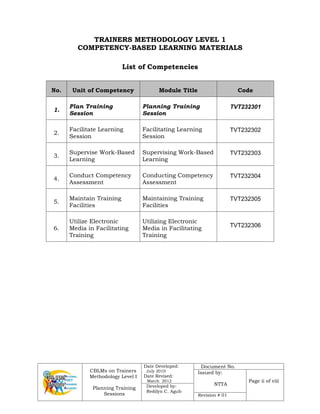
List of Competencies
No. Unit of Competency Module Title Code
1.
Plan Training
Session
Planning Training
Session
TVT232301
2.
Facilitate Learning
Session
Facilitating Learning
Session
TVT232302
3.
Supervise Work-Based
Learning
Supervising Work-Based
Learning
TVT232303
4.
Conduct Competency
Assessment
Conducting Competency
Assessment
TVT232304
5.
Maintain Training
Facilities
Maintaining Training
Facilities
TVT232305
6.
Utilize Electronic
Media in Facilitating
Training
Utilizing Electronic
Media in Facilitating
Training
TVT232306
CBLMs on Trainers
Methodology Level I
Planning Training
Sessions
Date Developed:
July 2010
Date Revised:
March 2012
Document No.
Issued by:
NTTA
Page iii of viii
Developed by:
Redilyn C. Agub
Revision # 01
Table of Contents
HOW TO USE THIS COMPETENCY- BASED LEARNING MATERIAL ....................................i
LIST OF COMPETENCIES................................................................................................................II
TABLE OF CONTENTS................................................................................................................... III
MODULE CONTENT ...................................................................................................................... VII
LEARNING OUTCOME # 1 DETERMINE LEARNER’S TRAINING REQUIREMENTS....... 1
LEARNING EXPERIENCES .............................................................................................................. 3
INFORMATION SHEET 1.1-1 Competency-Based Training.................................................................................5
SELF CHECK 1.1-1 .............................................................................................................................................14
ANSWER KEY 1.1-1...........................................................................................................................................16
INFORMATION SHEET 1.1-2 Training Regulations ..........................................................................................17
Self-Check 1.1-2 ...............................................................................................................................................19
Answer Key 1.1-2 .............................................................................................................................................21
INFORMATION SHEET 1.1-3 Competency Standard........................................................................................22
Self-Check 1.1-3 ...............................................................................................................................................26
Answer Key 1.1-3 .............................................................................................................................................28
INFORMATION SHEET 1.1-4 Competency – Based Curriculum........................................................................29
SELF CHECK 1.1-4 .............................................................................................................................................34
ANSWER KEY 1.1-4...........................................................................................................................................36
INFORMATION SHEET 1.1-5 Characteristics of Learners .................................................................................37
Self –Check 1.1-5..............................................................................................................................................48
Answer Key 1.1-5 .............................................................................................................................................50
Task Sheet 1.1-5 Develop a data gathering tool for trainees characteristics..................................................51
Performance Criteria Checklist 1.1-5 ...............................................................................................................52
INFORMATION SHEET 1.1-6 Trainees’ Current Competencies ........................................................................56
Self-Check 1.1-6 ...............................................................................................................................................68
Answer Key 1.1-6 .............................................................................................................................................69
JOB SHEET 1.1-6 Prepare Training Needs Analysis Forms...............................................................................70
Performance Criteria Checklist 11..11--66 ...............................................................................................................71
CBLMs on Trainers
Methodology Level I
Planning Training
Sessions
Date Developed:
July 2010
Date Revised:
March 2012
Document No.
Issued by:
NTTA
Page iv of viii
Developed by:
Redilyn C. Agub
Revision # 01
LEARNING OUTCOME # 2 PREPARE SESSION PLAN..........................................................72
LEARNING EXPERIENCES ............................................................................................................74
INFORMATION SHEET 1.2-1 Training Design ..................................................................................................75
Self-Check 1.2-2 ...............................................................................................................................................83
Answer Key 1.2-1 .............................................................................................................................................84
Information Sheet 1.2-2 Training Delivery Modes and Methods....................................................................85
Self-Check 1.2-2 ...............................................................................................................................................98
Answer Key 1.2-2 ...........................................................................................................................................100
INFORMATION SHEET 1.2-3 Session Plan .....................................................................................................101
Self-Check 1.2-3 .............................................................................................................................................111
Answer Key 1.2-3 ...........................................................................................................................................112
INFORMATION SHEET 1.2-4 Learning Resources .........................................................................................113
Self-Check 1.2-4 .............................................................................................................................................117
Answer Key 1.2-4 ...........................................................................................................................................118
JOB SHEET 1.2-4 Make Session Plan.............................................................................................................119
Performance Criteria Checklist 1.2-4 .............................................................................................................120
Assignment Sheet 1.2-4 Session Plan...........................................................................................................122
LEARNING OUTCOME # 3 PREPARE BASIC INSTRUCTIONAL MATERIALS…………123
LEARNING EXPERIENCES ......................................................................................................... 124
INFORMATION SHEET 1.3-1 Basic Instructional Materials............................................................................126
Self-Check 1.3-1 .............................................................................................................................................134
Answer Key 1.3-1 ...........................................................................................................................................135
Information Sheet 1.3-2 Competency-Based Learning Module ....................................................................138
Self-Check 1.3-2 .............................................................................................................................................134
Answer Key 1.3-2 .......................................................................................................................................13546
TASK SHEET 1.3-2 Write Preliminary Pages of the CBLM..............................................................................147
Performance Criteria Checklist 1.3-2 .............................................................................................................148
Information Sheet 1.3-3 Instruction Sheets .................................................................................................149
Self Check 1.3-3..............................................................................................................................................156
Answer Key 1.3-3 ...........................................................................................................................................157
TASK SHEET 1.3-3 Develop Information Sheet .............................................................................................158
Performance Criteria Checklist 1.3-3 .............................................................................................................159
Information Sheet 1.3-4 Task Sheet .............................................................................................................160
Self Check 1.3-4..............................................................................................................................................166
Answer Key 1.3-4 ...........................................................................................................................................167
TASK SHEET 1.3-4 Develop an Task Sheet ....................................................................................................168
Performance Criteria Checklist 1.3-4 .............................................................................................................169
CBLMs on Trainers
Methodology Level I
Planning Training
Sessions
Date Developed:
July 2010
Date Revised:
March 2012
Document No.
Issued by:
NTTA
Page v of viii
Developed by:
Redilyn C. Agub
Revision # 01
Information Sheet 1.3-5 OPERATION SHEET ................................................................................................170
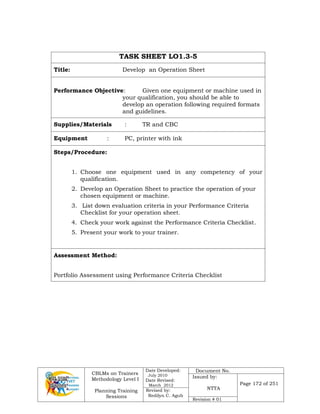
TASK SHEET LO1.3-5 Develop Operation Sheet ............................................................................................172
Performance Criteria Checklist 1.3-5 .............................................................................................................173
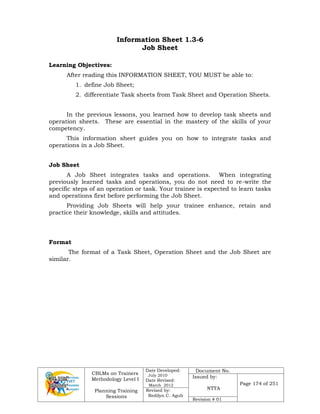
Information Sheet 1.3-6 Job Sheet..............................................................................................................174
TASK SHEET 1.3-6 Develop Job Sheet...........................................................................................................175
Performance Criteria Checklist 1.3-6 .............................................................................................................176
JOB SHEET 1.3-6 Develop CBLM Package .....................................................................................................177
LEARNING OUTCOME NO. 4 PREPARE ASSESSMENT INSTRUMENTS
(INSTITUTIONAL)....................................................................................................................... 183
LEARNING EXPERIENCES ..............................................................................................................................184
Information Sheet 1.4 -1 Institutional Competency Evaluation...................................................................186
Self-Check 1.4-1 .............................................................................................................................................189
Answer Key 1.4-1 ...........................................................................................................................................191
Information Sheet 1.4-2 Evidence Plan ........................................................................................................192
Self-Check 1.4-2 .............................................................................................................................................196
TASK SHEET 1.4-2 Prepare Evidence Plan.....................................................................................................198
Performance Criteria Checklist 1.4-2 .............................................................................................................199
Information Sheet 1.4-3 Table of Specification ............................................................................................200
SELF-CHECK 1.4-3...........................................................................................................................................205
Answer Key 1.4-3 ...........................................................................................................................................207
TASK SHEET 1.4-3 Prepare Table of Specification.........................................................................................208
Performance Criteria Checklist 1.4-3 .............................................................................................................209
Information Sheet 1.4-4 Written Test .........................................................................................................210
TASK SHEET 1.4-4 Construct Written Test ....................................................................................................214
Performance Criteria Checklist 1.4-4 .............................................................................................................215
Information Sheet 1.4-5 Performance Test ..................................................................................................216
TASK SHEET 1.4-5 Construct Performance Test ............................................................................................220
The Performance Criteria Checklist 1.4-5 ......................................................................................................221
Information Sheet 1.4-6 Questioning Tool ..................................................................................................222
Self-Check1.4-6 ..............................................................................................................................................224
Answer Key 1.4-6 ...........................................................................................................................................225
Task Sheet 1.4-6 Construct Questioning Tool...............................................................................................226
Performance Criteria Checklist 1.4-6 .............................................................................................................227
JOB SHEET 1.4-6 Construct an Institutional Competency Evaluation Tool ....................................................228
Performance Criteria Checklist 1.4-6 .............................................................................................................229
CBLMs on Trainers
Methodology Level I
Planning Training
Sessions
Date Developed:
July 2010
Date Revised:
March 2012
Document No.
Issued by:
NTTA
Page vi of viii
Developed by:
Redilyn C. Agub
Revision # 01
LEARNING OUTCOME NO. 5 ORGANIZE LEARNING AND
TEACHING RESOURCES............................................................................................................. 231
LEARNING EXPERIENCES ......................................................................................................... 232
Information Sheet 1.5-1 Training Resources …………………………………………………………………………………………….231
Self-Check 1.5-1 …………………………………………………………………………………………………………………………………… 232
Answer Key 1.5-1 ……………………………………………………………………………………………………………………………………. 233
Task Sheet 1.5-1 Prepare an Inventory of Training Resources......................................................................237
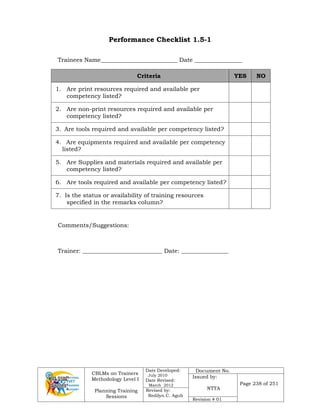
Performance Checklist 1.5-1..........................................................................................................................238
Information Sheet 1.5-2 Workshop Layout ..................................................................................................239
SELF-CHECK 1.5-1...........................................................................................................................................245
Answer Key 1.5-1 ...........................................................................................................................................247
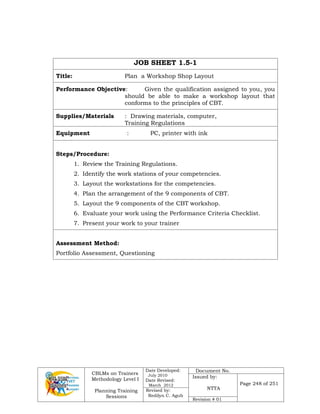
JOB SHEET 1.5-1 Plan a Workshop Shop Layout ...........................................................................................248
Performance Checklist 1.5-1..........................................................................................................................249
BIBLIOGPRAHY ................................................................ERROR! BOOKMARK NOT DEFINED.
CBLMs on Trainers
Methodology Level I
Planning Training
Sessions
Date Developed:
July 2010
Date Revised:
March 2012
Document No.
Issued by:
NTTA
Page vii of viii
Developed by:
Revision # 01
MODULE CONTENT
UNIT OF COMPETENCY Plan Training Session
MODULE TITLE Planning Training Session
MODULE DESCRIPTOR:
This unit covers the knowledge, skills and attitude in planning a training
session. It includes identifying learner’s requirements, preparing session
plan, preparing basic instructional materials and organizing learning and
teaching resources
NOMINAL DURATION:
LEARNING OUTCOMES:
At the end of this module you MUST be able to:
1. Identify learner’s training requirements
2. Prepare session plan
3. Prepare instructional materials
4. Prepare assessment instruments (Institutional)
5. Organize learning and teaching resources
ASSESSMENT CRITERIA:
• Curriculum documents is reviewed and analyzed for training
purposes
• Current competencies of target group are determined
• Competencies required to be attained are compared with current
competencies of target group
• Results of comparison is used to determine training requirements
• Training requirements are validated with appropriate people.
• Training delivery modes are identified appropriate for the training
• Training methods that pertains to the required competencies are
addressed
• Sequence of training activities are determined based on competencies
standards
• Resources to support training are identified
CBLMs on Trainers
Methodology Level I
Planning Training
Sessions
Date Developed:
July 2010
Date Revised:
March 2012
Document No.
Issued by:
NTTA
Page viii of viii
Developed by:
Revision # 01
• Session plan is finalized according to required format
• Instructional materials are prepared and focused on a key concept or
idea related to work activity.
• Text and illustrations are made clear and legible appropriate for the
training requirements of the trainees
• Languages , style and format of the materials are appropriate for the
trainees characteristics and needs
• Relevant modules of instruction are identified, read and interpreted
to identify required evidence
• Evidence requirements are determined which will show full coverage
of the training module to be assessed and consistent to the
performance of the training activities
• Suitable assessment methods are identified which are appropriate
with the learning outcome of the module of instruction.
• Assessment instrument are prepared in accordance with the content
and learning outcome specified under the assessment criteria of the
module of instruction.
• Assessment instruments are checked for validity, fairness, safety and
cost effectiveness.
• Resources required for training are checked for availability
• Appropriate training locations/venue are identified and arranged
according to training needs
• Training resources requirements are documented and access is
arranged in accordance with organization procedures and appropriate
staff.
CBLMs on Trainers
Methodology Level I
Planning Training
Sessions
Date Developed:
July 2010
Date Revised:
March 2012
Document No.
Issued by:
NTTA
Page 1 of 251
Developed by:
Revision # 01
LEARNING OUTCOME # 1 DETERMINE LEARNER’S TRAINING
REQUIREMENTS
CONTENTS:
1. Competency-based Training
2. Training Regulations
3. Competency Standards
4. Competency-based Curriculum
5. Characteristic of Learners
6. Trainees’ Current Competencies
ASSESSMENT CRITERIA:
1. Curriculum documents is reviewed and analyzed for training purposes
2. Current competencies of target group are determined
3. Competencies required to be attained are compared with current
competencies of target group
4. Results of comparison is used to determine training requirements
5. Training requirements are validated with appropriate people.
CONDITION:
Trainees must be provided with the following:
1. WORKPLACE LOCATION
2. EQUIPMENT
- Computer
- LCD
3. TOOLS, ACCESSORIES AND SUPPLIES
- White board
- CD
- Tapes
4. TRAINING MATERIALS
- Learning Packages
- Ball pens
- Whiteboard marker
- Manuals
- The Philippine TVET Trainers-Assessors Qualification Framework
- Procedures Manual on Developing Competency-Based Curriculum
CBLMs on Trainers
Methodology Level I
Planning Training
Sessions
Date Developed:
July 2010
Date Revised:
March 2012
Document No.
Issued by:
NTTA
Page 2 of 251
Developed by:
Revision # 01
ASSESSMENT METHOD:
1. Portfolio
2. Written Test
CBLMs on Trainers
Methodology Level I
Planning Training
Sessions
Date Developed:
July 2010
Date Revised:
March 2012
Document No.
Issued by:
NTTA
Page 3 of 251
Developed by:
Revision # 01
Learning Experiences
Learning Outcome 1
DETERMINE LEARNER’S TRAINING REQUIREMENTS
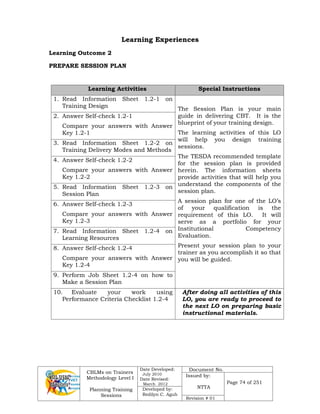
Learning Activities Special Instructions
1. Read Information Sheet 1.1-1
on Competency-Based Training In this Learning Outcome you shall
prepare tools and materials needed
to determine training needs. To be
able to do this, you should
understand the characteristics of
your trainees and analyze the
following:
1. CS
2. TR
3. CBC
Go through the Information Sheets
and answer the self-checks to
ensure that knowledge of the
standards in Competency-based
training are acquired.
The outputs of your practice of this
Learning Outcome are the following:
1. TNA Forms
2. Data gathering tool for
trainees characteristics
These forms will be a part of your
portfolio for you Institutional
Competency Evaluation.
Show your output to your trainer for
his feedback as you accomplish
them.
2. Answer Self-Check 1.1-1
Compare answers with Answer
Key 1.1-1
3. Read Information Sheet 1.1-2
on Training Regulations
4. Answer Self-Check 1.1-2
Compare answers with Answer
Key 1.1-2
5. Read Information Sheet 1.1-3
on Competency Standards
6. Answer Self-Check 1.1-3
Compare answers with Answer
Key 1.1-3
7. Read Information Sheet 1.1-3
on Competency-Based
Curriculum
8. Answer Self-Check 1.1-4
Compare answers with Answer
Key 1.1-4
9. Read Information Sheet 1.1-5
on Characteristics of Learners
10. Answer Self-Check 1.1-5
Compare answers with Answer
Key 1.1-5
11. Perform Task Sheet 1.1-5 on
how to develop a data gathering
tool for trainees characteristics
12. Evaluate your own output
using Performance Criteria
Checklist 1.1-5
13. Read Information Sheet 1.1-6
CBLMs on Trainers
Methodology Level I
Planning Training
Sessions
Date Developed:
July 2010
Date Revised:
March 2012
Document No.
Issued by:
NTTA
Page 4 of 251
Developed by:
Revision # 01
on Trainees’ Current
Competencies
14. Answer Self-Check 1.1-6
Compare answers with Answer
Key 1.1-6
15. Perform Job Sheet 1.1-6 on
how to prepare TNA forms
16. Evaluate your own output
using Performance Criteria
Checklist 1.1-6
After doing all activities of this
LO, you are ready to proceed to
the next LO on preparing
session plans.
CBLMs on Trainers
Methodology Level I
Planning Training
Sessions
Date Developed:
July 2010
Date Revised:
March 2012
Document No.
Issued by:
NTTA
Page 5 of 251
Developed by:
Redilyn C. Agub
Revision # 01
INFORMATION SHEET 1.1-1
Competency-Based Training
Learning Objectives
After reading this information sheet, you must be able to:
1. define Competency-Based Training;
2. enumerate and explain the ten principles of CBT;
In a traditional educational system, the unit of progression is time and
it is teacher-centered. In a Competency Based Training system, the unit of
progression is mastery of specific knowledge and skills and is learner- or
participant-centered. Two key terms used in competency-based training are:
 Skill—A task or group of tasks performed to a specific level of
competency or proficiency which often use motor functions and
typically require the manipulation of instruments and equipment (e.g.,
use of vacuum cleaner in cleaning carpeted floor). Some skills,
however, such as counseling, are knowledge- and attitude-based.
 Competency—A skill performed to a specific standard under specific
conditions.
Trainers Methodology I is a training program for TVET trainers in
using the Competency-Based Training Delivery Approach for training and
assessment.
The learning activities that you are about to undergo will give you a
hands-on training on how to plan, design, implement, monitor and evaluate
CBT.
In this lesson you will be introduced to CBT, its principles and
context.
Competency-Based Training
• It is a training delivery approach that focuses on the competency
development of the learner as a result of the training;
• Emphasizes most on what the learner can actually do;
• Focuses on outcomes rather than the learning process within
specified time;
• It is concerned with the attainment and application of knowledge,
skills and attitude to a specific level of competency.
In CBT, the education and training system should begin and end with
the customer needs.
CBLMs on Trainers
Methodology Level I
Planning Training
Sessions
Date Developed:
July 2010
Date Revised:
March 2012
Document No.
Issued by:
NTTA
Page 6 of 251
Developed by:
Redilyn C. Agub
Revision # 01
Competency
Competency involves applying knowledge, skills and attitudes to
perform work activities to the standard expected in the workplace.
Competencies are gained through:
• life experience
• formal education
• apprenticeship
• on-the-job experience
• self-help programs
• training and development programs
Key features of competency
• being able to do the job
• knowing how and why things are done
• knowing what to do if things go wrong
• Knowing the right approach to do a job properly and safely.
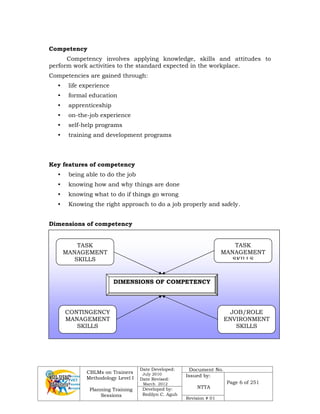
Dimensions of competency
DIMENSIONS OF COMPETENCY
TASK
MANAGEMENT
SKILLS
CONTINGENCY
MANAGEMENT
SKILLS
TASK
MANAGEMENT
SKILLS
JOB/ROLE
ENVIRONMENT
SKILLS
CBLMs on Trainers
Methodology Level I
Planning Training
Sessions
Date Developed:
July 2010
Date Revised:
March 2012
Document No.
Issued by:
NTTA
Page 7 of 251
Developed by:
Redilyn C. Agub
Revision # 01
1) Task Skills
• This requires performance of the task[s] to the required standard as
described in the unit of competency and expected in the workplace.
• Trainer needs to provide activities to develop individual actions as
well as the whole task.
2) Task Management Skills
• Captures the skills used as people plan and integrate a number of
potentially different tasks to achieve a complete work outcome.
• Trainees should be provided with learning activities that develop
skills to be able work efficiently to meet deadlines, handle a sequence
of interrelated tasks and progress smoothly between tasks.
3) Contingency Management Skills
• The requirement to respond to irregularities and breakdowns in
routines.
• Activities that develop skills of trainees in dealing with contingencies
should be well planned. For example:
a. breakdown
b. irregularities
c. imperfections
d. the unknown.
Exposure to these conditions during the in-house training
should be a part of the practice of the skills.
4) Job/Role Environment
• The requirement to deal with the responsibilities and expectations of
the work environment.
• The capacity to work with others and adapt to different situations is
central to successful performance
• Does the trainee comply with workplace procedures and standard
methods in performing the task?
• Does the trainee communicate effectively?
• Does the trainee observe enterprise and regulatory requirements?
CBLMs on Trainers
Methodology Level I
Planning Training
Sessions
Date Developed:
July 2010
Date Revised:
March 2012
Document No.
Issued by:
NTTA
Page 8 of 251
Developed by:
Redilyn C. Agub
Revision # 01
Ten (10) Principles of CBT
1) The training is based on curriculum developed from the competency
standards.
The Competency Standard (CS) is the written specification of the
knowledge, skills and attitudes and values required for the performance of a
job, occupation or trade and the corresponding standard of performance
required for these in the workplace.
The industry workers identify these standards and are promulgated by
the Technical Education and Skills Development Authority in the Training
Regulations (TR).
The Competency Based Curriculum (CBC) is derived from the
Competency Standards. It is a plan for structured series of learning
experiences toward achieving of competencies identified by the industry; it
details training methodologies, resources, facilities, infrastructure and other
materials required both for training and assessment strategies.
2) Learning is competency-based or modular in structure.
Generally one competency is one module but some competencies
maybe divided into training modules. A qualification is composed of a set of
competencies a worker should have. When planning your training, your
trainees should learn one competency after another until they attain all
competencies of the qualification.
Learning is based on the Competency-based Curriculum
Unit of Competency
Module
1
Module
2
Module
3
CBLMs on Trainers
Methodology Level I
Planning Training
Sessions
Date Developed:
July 2010
Date Revised:
March 2012
Document No.
Issued by:
NTTA
Page 9 of 251
Developed by:
Redilyn C. Agub
Revision # 01
3) Training delivery is individualized and self-paced.
As trainers, you should provide activities that will allow each trainee
to advance on his own without waiting for the other trainees in his class to
finish. Facilities, resources and materials should also be structured so that
trainees could learn competencies at their own pace.
4) Training is based on work that must be performed.
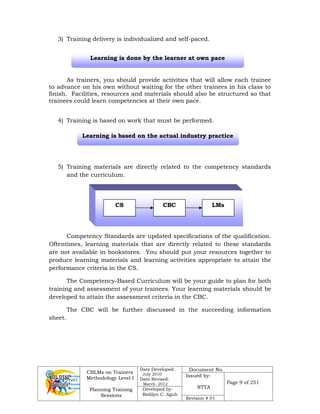
5) Training materials are directly related to the competency standards
and the curriculum.
Competency Standards are updated specifications of the qualification.
Oftentimes, learning materials that are directly related to these standards
are not available in bookstores. You should put your resources together to
produce learning materials and learning activities appropriate to attain the
performance criteria in the CS.
The Competency-Based Curriculum will be your guide to plan for both
training and assessment of your trainees. Your learning materials should be
developed to attain the assessment criteria in the CBC.
The CBC will be further discussed in the succeeding information
sheet.
CS CBC LMs
Learning is based on the actual industry practice
Learning is done by the learner at own pace
CBLMs on Trainers
Methodology Level I
Planning Training
Sessions
Date Developed:
July 2010
Date Revised:
March 2012
Document No.
Issued by:
NTTA
Page 10 of 251
Developed by:
Redilyn C. Agub
Revision # 01
6) Assessment of learners is based in the collection of evidences of work
performance based on industry or organizational required standards.
7) Training is based on and off the job components and off the job
components.
8) The system allows Recognition of Prior Learning (RPL).
CBT focuses on the competencies that are not yet acquired by the
trainee in any learning situation. Competencies acquired as a result of
previous training, employment and life experiences should be recognized so
that trainees will not waste time doing the learning activities of the
competencies that they already have. It is one of your task to identify these
prior learning of your trainees and plan for the training of each trainee
based on this data.
9) The system allows for learner to enter and exit programs at different
times and levels and to receive an award for competencies attained at
any point.
10) Approved training programs are nationally accredited.
Traditional
Students are judged
against each other (norm
referenced Assessment)
CBTVET
Each Student is assessed
against the evidences
based on standard
There is flexibility for entry and exit from programs
Training programs are registered within UTPRAS
Better learning with industry and school partnership
Workers and Students can have prior skills recognized
CBLMs on Trainers
Methodology Level I
Planning Training
Sessions
Date Developed:
July 2010
Date Revised:
March 2012
Document No.
Issued by:
NTTA
Page 11 of 251
Developed by:
Redilyn C. Agub
Revision # 01
Any program offered in TVET should be registered with the Unified
TVET Program Registration and Accreditation System (UTPRAS). This covers
the following:
1. Program Registration is a compulsory compliance with minimum
requirement prescribed in the Training Regulations(TRs) and
anchored on competency-based system. Program registration
prescribes full compliance with prevailing training standards,
correction of sub-standard ones and denial of registration of
registration for those who fail to comply. An integral part of
program registration is the monitoring of registered programs for
continuous compliance to standards.
2. Program Accreditation is a voluntary process of demonstrating
quality assurance to programs and institutional processes that
shall lead to the recognition and conferment of awards various
levels of exemplary performance.
Compliance to UTPRAS would include training approaches,
curriculum, learning materials, facilities, resources and other training
materials. You should therefore learn how to plan and implement
Competency-Based Training to comply with UTPRAS.
This training on Trainers Methodology is one of the requirements of
UTPRAS.
CBLMs on Trainers
Methodology Level I
Planning Training
Sessions
Date Developed:
July 2010
Date Revised:
March 2012
Document No.
Issued by:
NTTA
Page 12 of 251
Developed by:
Redilyn C. Agub
Revision # 01
Comparative Analysis between Traditional Education and CBT
Traditional Competency Based
 Instructors focus on managing
instruction
 Trainers focus on managing
learning
 Most students enter at about the
same time
 Trainees enter at various times
throughout the year
 Students all cover the same material  Different trainees maybe trained for
different unit of competency within
the same program
 Students all proceed from one topic
to the next at the same time
 Each trainee moves on the next
task only after mastering the task
he or she is currently working on
 The instructor controls the learning
pace
 Each trainee progress at his or her
own pace
 All students are usually tested once  Each trainee is tested when ready
to demonstrate mastery
 Very little continuous feedback is
given
 Immediate feedback is given to
each trainees at critical points in
the learning process
 The instructor is involved in
teaching only one topic at a time
 The instructor must be able to
answer questions on many different
tasks each day
 Retesting is discouraged or not
allowed at all
 Retesting is encouraged to reach
mastery
 Materials, tools and supplies for
only one topic are needed at a time
 The trainer must see that all
materials needed for many tasks
are readily available
 The number of students enrolled is
maximum capacity at the beginning
of the year and declines to half or
less towards the end
 As vacancies are filled, trainees
enrolment remains at capacity all
year long
 Most instructions are delivered by  The trainer must manage the use of
a wide variety of instructional
CBLMs on Trainers
Methodology Level I
Planning Training
Sessions
Date Developed:
July 2010
Date Revised:
March 2012
Document No.
Issued by:
NTTA
Page 13 of 251
Developed by:
Redilyn C. Agub
Revision # 01
Traditional Competency Based
or dependent upon the instructor media and materials each day
 The programs is usually closed
down or shortened during the
summer months
 The program usually operated year
round
 The evening program is usually
separated and distinct from the day
program
 Day and evening program both
have access to all learning guides
and resources
 The instructor controls the
sequence in which topics will be
covered
 If possible, trainee determine the
sequence of the tasks
CBLMs on Trainers
Methodology Level I
Planning Training
Sessions
Date Developed:
July 2010
Date Revised:
March 2012
Document No.
Issued by:
NTTA
Page 14 of 251
Developed by:
Redilyn C. Agub
Revision # 01
SELF CHECK 1.1-1
TRUE OR FALSE:
Tell whether the given statement about CBT is true or false. Write (T) if the
statement True and (F) if the statement is False. Write your answer to a
separate sheet.
_________ 1. The CBT approach is useful in determining the capability of the
trainers to apply into practice the obtained knowledge, skills
and attitude from the training.
________ 2. CBT focuses on the learning process within a specified time or
duration rather than on the expected outcome.
________ 3. The same with the traditional approach it begins with the
demand/needs of the customer, specifically the industry.
________ 4. Institutions/schools are obliged to meet the set requirement of
the Authority before a training program is implemented.
_______ 5. Evidences are used in the evaluation of the obtained skills and
knowledge of the trainee according to the standard.
_______ 6. Group work/team is the main training delivery necessary in the
conduct of CBT.
_______7. Various trainees could be trained for different unit of competency
in one program.
_______ 8. CBT concentrates on managing instructions.
_______ 9. Trainers are allowed to give little feedback to maximize the time.
_______ 10. Trainers/instructor encouraged trainees for re-evaluation.
CBLMs on Trainers
Methodology Level I
Planning Training
Sessions
Date Developed:
July 2010
Date Revised:
March 2012
Document No.
Issued by:
NTTA
Page 15 of 251
Developed by:
Redilyn C. Agub
Revision # 01
Identification: Given the following statements, identify what dimension of is
being described in the situations. (Task Management Skills, Task Skills,
Contingency Management Skills or Job/Role Environment Skills)
_____ 1. Notification of shift availability, or non attendance for shift, is given
without undue delay and according to store policies and
procedures.
______2. Relevant safety systems information is accessed, analyzed and used
in responding to an identified hazard.
______3. Following presentation, feedback on product design is obtained
from the appropriate personnel. Any modifications are identified
and incorporated into the final design.
______ 4. Tools and equipment are cleaned and stored in accordance with
workplace requirements.
______ 5. Trainers manage unexpected circumstances happened during the
actual conduct of the tasks.
CBLMs on Trainers
Methodology Level I
Planning Training
Sessions
Date Developed:
July 2010
Date Revised:
March 2012
Document No.
Issued by:
NTTA
Page 16 of 251
Developed by:
Redilyn C. Agub
Revision # 01
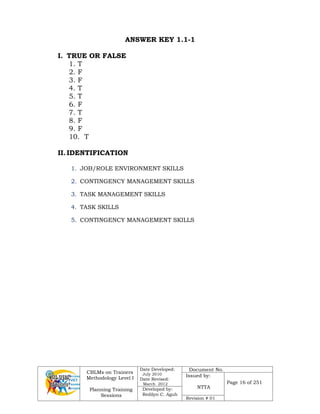
ANSWER KEY 1.1-1
I. TRUE OR FALSE
1. T
2. F
3. F
4. T
5. T
6. F
7. T
8. F
9. F
10. T
II.IDENTIFICATION
1. JOB/ROLE ENVIRONMENT SKILLS
2. CONTINGENCY MANAGEMENT SKILLS
3. TASK MANAGEMENT SKILLS
4. TASK SKILLS
5. CONTINGENCY MANAGEMENT SKILLS
CBLMs on Trainers
Methodology Level I
Planning Training
Sessions
Date Developed:
July 2010
Date Revised:
March 2012
Document No.
Issued by:
NTTA
Page 17 of 251
Developed by:
Redilyn C. Agub
Revision # 01
INFORMATION SHEET 1.1-2
Training Regulations
Learning Objectives:
After reading this INFORMATION SHEET, YOU MUST be able to:
1. define a Training Regulations;
2. describe the significance of the TR to Competency Based Training;
3. enumerate the parts of a Training Regulations.
In the previous Information Sheet you were introduced to the
Competency Based Training (CBT). The Training Regulations plays a big
role in TVET training. It is the basis in the formulation of competency
assessment and the development of curriculum and instructional materials
for CBT.
In this lesson you will have a tour of the different parts of the TR in
relation to Competency Based Training delivery.
The mandate
Technical Education and Skills Development Act of 1994
(Republic Act No. 7796)
Section 22, “Establishment and Administration of the National Trade
Skills Standards” of the RA 7796 known as the TESDA Act mandates
TESDA to establish national occupational skill standards. The
Authority shall develop and implement a certification and
accreditation program in which private industry group and trade
association are accredited to conduct approved trade tests, and the
local government units to promote such trade testing activities in their
respective areas in accordance with the guidelines to be set by the
Authority
Training Regulations
The Training Regulation (TR) is the document that serves as a basis in
the formulation of competency assessment and the development of
curriculum and instructional materials for competency-based technical
education and skills development (TESD). The training Regulations consist
of two components: the occupational skills standard and the training
standards.
The Training Regulations serve as basis for the:
1. Competency assessment and certification;
2. Registration and delivery of training programs; and
CBLMs on Trainers
Methodology Level I
Planning Training
Sessions
Date Developed:
July 2010
Date Revised:
March 2012
Document No.
Issued by:
NTTA
Page 18 of 251
Developed by:
Redilyn C. Agub
Revision # 01
3. Development of curriculum and assessment instruments.
Every qualification has its own TR. You can download the TR of your
qualification from the TESDA website (www.tesda.gov.ph).
Sections of the TR
Section 1:
Definition of the Qualification – refers to the group of competencies that
describes the different functions of the
qualification.
This section enumerates the Basic
Competencies, Common Competencies and
Core Competencies of the qualification
It also enumerates the job titles of workers who
qualified for this qualification.
Section 2:
Competency Standards – gives the specifications of competencies required
for effective work performance.
This section will be further discussed in the
succeeding information sheets.
Section 3:
Training Standards – contains information and requirements in designing
training program for certain Qualification. It
includes:
1. Curriculum design,
2. Training delivery;
3. Trainee entry requirements;
4. Tools equipment and materials;
5. Training facilities;
6. Trainer’s qualification and
7. Institutional assessment.
Section 4:
National Assessment and Certification Arrangement – describes the
policies governing assessment and certification
procedure.
CBLMs on Trainers
Methodology Level I
Planning Training
Sessions
Date Developed:
July 2010
Date Revised:
March 2012
Document No.
Issued by:
NTTA
Page 19 of 251
Developed by:
Redilyn C. Agub
Revision # 01
Self-Check 1.1-2
Multiple Choice: Choose the letter of the best answer. Write the letter of
your choice on the your answer sheet.
1. The authority that is mandated to develop the Competency Standards
is
A. TESDA
B. NTTA
C. DEPED
D. CHED
2. The main basis of the assessment tools and instructional materials of
competency based training and assessment is the
A. Competency based curriculum
B. Competency standards
C. Training regulations
D. training standards
3. This section enumerates the job titles of workers who are competent
in the qualification described in the Training Regulation.
A. Section 1. Definition of Qualification
B. Section 2. Competency Standards
C. Section 3. Training Standards
D. Section 4. National Assessment and Certification
Arrangement
4. This section contains information and requirements in designing
training programs for the qualification.
A. Section 1. Definition of Qualification
B. Section 2. Competency Standards
C. Section 3. Training Standards
D. Section 4. National Assessment and Certification
Arrangement
CBLMs on Trainers
Methodology Level I
Planning Training
Sessions
Date Developed:
July 2010
Date Revised:
March 2012
Document No.
Issued by:
NTTA
Page 20 of 251
Developed by:
Redilyn C. Agub
Revision # 01
5. This section gives the specifications of competencies required for
effective work performance.
A. Section 1. Definition of Qualification
B. Section 2. Competency Standards
C. Section 3. Training Standards
D. Section 4. National Assessment and Certification
Arrangement
CBLMs on Trainers
Methodology Level I
Planning Training
Sessions
Date Developed:
July 2010
Date Revised:
March 2012
Document No.
Issued by:
NTTA
Page 21 of 251
Developed by:
Redilyn C. Agub
Revision # 01
Answer Key 1.1-2
1. A
2. B
3. A
4. C
5. B
CBLMs on Trainers
Methodology Level I
Planning Training
Sessions
Date Developed:
July 2010
Date Revised:
March 2012
Document No.
Issued by:
NTTA
Page 22 of 251
Developed by:
Redilyn C. Agub
Revision # 01
INFORMATION SHEET 1.1-3
Competency Standard
Learning Objectives
After reading this information sheet, you must be able to:
1. define competency standard;
2. identify the parts of the Competency Standard;
3. identify the elements and performance criteria of your competency;
The Competency Standard is the main basis of Competency-Based
Training. All learning materials shall be based on the assessment criteria of
each competency.
In this lesson, you will be introduced to the CS which will be helpful
in planning your training activities. You may need a copy of the
Competency Standards of your qualification to better understand this
lesson.
Competency Standard
Competency Standard (CS) is the written specification of the
knowledge, skills and attitudes and values required for the performance of a
job, occupation or trade and the corresponding standard of performance
required for these in the workplace.
Unit of Competency
Together all the parts of the unit of competency:
• Describe a work activity
• Guide the trainer in determining whether the learner is competent.
Each part of the unit of competency was written with the purpose of
achieving these two aims.
CBLMs on Trainers
Methodology Level I
Planning Training
Sessions
Date Developed:
July 2010
Date Revised:
March 2012
Document No.
Issued by:
NTTA
Page 23 of 251
Developed by:
Redilyn C. Agub
Revision # 01
Parts of Competency Standard
1. Unit Title
• Defines the area of competency
• Written in output terms - ‘obtain, prepare and supply materials for
production’ [verb]
• Comprise a manageable component of work
2. Unit Descriptor
• Outlines what is done in the workplace
• Expands on information in the title
• Clarifies scope and intent of the unit
• Helps to differentiate competencies with similar titles
3. Elements and Performance Criteria
Elements describe in output terms the functions that a person who
works in a particular area of work is able to do.
Performance criteria are evaluative statements that specify what is to
be assessed and the required level of performance.
UNIT OF COMPETENCY
UNIT OF DESCRIPTOR
ELEMENTS PERFORMANCE CRITERIA
RANGE OF VARIABLES
EVIDENCE GUIDE
CBLMs on Trainers
Methodology Level I
Planning Training
Sessions
Date Developed:
July 2010
Date Revised:
March 2012
Document No.
Issued by:
NTTA
Page 24 of 251
Developed by:
Redilyn C. Agub
Revision # 01
4. Elements
• Building blocks of a unit of competency
• Describe in outcome terms the functions that a person who works in a
particular area of work is able to perform [start with a verb]
• Describes actions or outcomes that are demonstrable and assessable
and which the candidate must attain.
5. Performance Criteria
• Specifies what is assessed and the required level of performance.
• Precise standards of the competency
• Covers all components/ dimensions of competency
• Focus on evidence to prove competency evaluative statements
6. Range of Variable
• Describes the curriculum or context in which the work is to be
performed.
• Defines the boundaries within which the unit of competency applies
• Range of situations that should be the focus of assessment
• Relates to the unit of competency as a whole
• Allows for insertion of specific knowledge and enterprise requirements
7. Evidence Plan
• The purpose of the evidence guide is to guide the assessor in the
collection of evidence
• It must be related directly to: the elements and performance criteria
and range of variables.
8. Critical Aspect of Competency
• Tells the assessor what evidence is essential for successful
performance.
• It identifies the essential:
 Productive evidence – completes workplace/service to
specification
 Knowledge evidence – things that must be known
CBLMs on Trainers
Methodology Level I
Planning Training
Sessions
Date Developed:
July 2010
Date Revised:
March 2012
Document No.
Issued by:
NTTA
Page 25 of 251
Developed by:
Redilyn C. Agub
Revision # 01
 Process evidence
 Complies with industry practice and procedures
 Complies with OH&S practice
Examples:
 Sets up tools and equipment
 Handle tools, materials and equipment
 Identifies and solves faults and problems
 Communicate with others to ensure safe and effective
operations
9. Underpinning Knowledge
• knowledge or concepts involved in performing skills of the
competency.
• It includes: Specific knowledge that is essential to the performance of
the competency and evidence of knowledge of legislation, regulations
and Codes of Practice
10. Underpinning Skills
• skills needed to achieve the elements and performance criteria in the
unit of competency.
• It includes both: generic skills (communication) and industry specific
skills (hand tools)
CBLMs on Trainers
Methodology Level I
Planning Training
Sessions
Date Developed:
July 2010
Date Revised:
March 2012
Document No.
Issued by:
NTTA
Page 26 of 251
Developed by:
Redilyn C. Agub
Revision # 01
Self-Check 1.1-3
Multiple Choice:
Choose the letter of the best answer. Write the letter of your choice on your
answer sheet.
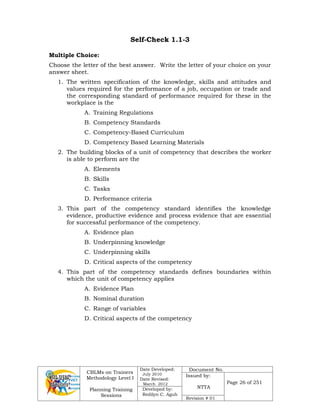
1. The written specification of the knowledge, skills and attitudes and
values required for the performance of a job, occupation or trade and
the corresponding standard of performance required for these in the
workplace is the
A. Training Regulations
B. Competency Standards
C. Competency-Based Curriculum
D. Competency Based Learning Materials
2. The building blocks of a unit of competency that describes the worker
is able to perform are the
A. Elements
B. Skills
C. Tasks
D. Performance criteria
3. This part of the competency standard identifies the knowledge
evidence, productive evidence and process evidence that are essential
for successful performance of the competency.
A. Evidence plan
B. Underpinning knowledge
C. Underpinning skills
D. Critical aspects of the competency
4. This part of the competency standards defines boundaries within
which the unit of competency applies
A. Evidence Plan
B. Nominal duration
C. Range of variables
D. Critical aspects of the competency
CBLMs on Trainers
Methodology Level I
Planning Training
Sessions
Date Developed:
July 2010
Date Revised:
March 2012
Document No.
Issued by:
NTTA
Page 27 of 251
Developed by:
Redilyn C. Agub
Revision # 01
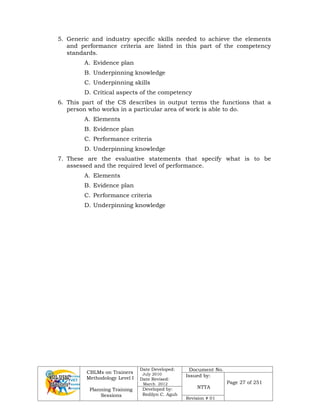
5. Generic and industry specific skills needed to achieve the elements
and performance criteria are listed in this part of the competency
standards.
A. Evidence plan
B. Underpinning knowledge
C. Underpinning skills
D. Critical aspects of the competency
6. This part of the CS describes in output terms the functions that a
person who works in a particular area of work is able to do.
A. Elements
B. Evidence plan
C. Performance criteria
D. Underpinning knowledge
7. These are the evaluative statements that specify what is to be
assessed and the required level of performance.
A. Elements
B. Evidence plan
C. Performance criteria
D. Underpinning knowledge
CBLMs on Trainers
Methodology Level I
Planning Training
Sessions
Date Developed:
July 2010
Date Revised:
March 2012
Document No.
Issued by:
NTTA
Page 28 of 251
Developed by:
Redilyn C. Agub
Revision # 01
Answer Key 1.1-3
1. B
2. A
3. D
4. C
5. C
6. A
7. C
CBLMs on Trainers
Methodology Level I
Planning Training
Sessions
Date Developed:
July 2010
Date Revised:
March 2012
Document No.
Issued by:
NTTA
Page 29 of 251
Developed by:
Redilyn C. Agub
Revision # 01
INFORMATION SHEET 1.1-4
Competency – Based Curriculum
Learning Objectives
After reading this INFORMATION SHEET, YOU MUST able to:
1. explain the relationship of the Training Regulations and the
Competency-Based Curriculum;
2. identify and discuss the parts of the CBC.
The Competency-Based Curriculum (CBC) is a guide in developing
learning activities. Understanding the CBC will help you establish trainee’s
training needs and plan for Competency-Based Training.
In this lesson, each part of the CBC will be discussed.
Competency-Based Curriculum (CBC)
The CBC is a plan for structured series of learning experiences toward
achieving of competencies identified by the industry; it details training
methodologies, resources, facilities, infrastructure and other materials
required both for training and assessment strategies. It is a specification of
the course a trainee will undertake to attain workplace competencies. It is
developed based on the Training Regulations.
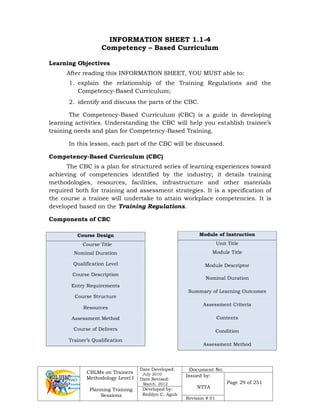
Components of CBC
Course Design
Course Title
Nominal Duration
Qualification Level
Course Description
Entry Requirements
Course Structure
Resources
Assessment Method
Course of Delivers
Trainer’s Qualification
Module of Instruction
Unit Title
Module Title
Module Descriptor
Nominal Duration
Summary of Learning Outcomes
Assessment Criteria
Contents
Condition
Assessment Method
CBLMs on Trainers
Methodology Level I
Planning Training
Sessions
Date Developed:
July 2010
Date Revised:
March 2012
Document No.
Issued by:
NTTA
Page 30 of 251
Developed by:
Redilyn C. Agub
Revision # 01
Course Design – is an overall description of the course. It includes, among
others, information on the:
• Qualification covered by the course;
• Course outcomes;
• Units of competency and the corresponding module titles;
• Students entry requirements;
• Resources;
• Training delivery and assessment strategies; and
• Trainer’s qualifications.
Course Design Format
1. Course Title/ Qualification Level – a name rising out of the
qualification and NC level in the PTTQF.
Example: Computer Hardware Servicing NC II
2. Nominal Duration – the approximate length of time the course will be
finished.
Example: 329 hours
3. Course Description – statement on the coverage of the course, its
relevance in the industry sector, and the possible occupations the
trainee will have after completion.
Example: This course is designed to develop knowledge,
skills, and attitudes of a Computer Technician in accordance with
industry standards. It covers basic and common competencies
such as installing, maintaining, configuring, and diagnosing
computer systems and networks.
4. Entry Requirements – qualifications of a trainee who intend to enter
the course. These are stated as competencies. Any physical traits
must also be stated.
Example: Student/trainee must possess the following
qualifications:
 Able to communicate both oral and written
 Physically and mentally fit.
 With good moral character.
 Can perform basic mathematical and logical
computations.
 Analytical and logical thinking.
CBLMs on Trainers
Methodology Level I
Planning Training
Sessions
Date Developed:
July 2010
Date Revised:
March 2012
Document No.
Issued by:
NTTA
Page 31 of 251
Developed by:
Redilyn C. Agub
Revision # 01
5. Course Structure – tabulated presentation of units of competency
covered by the course and the corresponding module title- its learning
outcomes and nominal duration.
Example:
Units of
Competency
Module
Title
Learning Outcomes
Nominal
Duration
1.Install
computer
systems and
networks
1.1Installing
computer
systems and
networks
1.1.1 Plan and prepare for
installation
1.1.2 Install equipment/device
system
1.1.3 Conduct test
60 hours
2.Diagnose and
troubleshoot
computer
systems
2.1
Diagnosing
and trouble
shooting
computer
systems
2.1.1 Plan and prepare for
diagnosis of faults of computer
systems
2.1.2 Diagnose faults of
computer systems
2.1.3 Repair defects in computer
systems and networks
2.1.4 Test systems and networks
100
hours
6. Assessment Methods – A listing of all the methods of gathering
evidences used in the course to measure the attainment of the
learning outcomes.
Example: Observation/questioning, demonstration/questioning,
written examination
7. Course Delivery – the training modes used to implement the course
Example: dual training, apprenticeship, distance education
Module of Instruction
1. Unit Title – a unit of competency which when applied a work
situation can logically stand alone. It express in outcome terms.
Example: Install Computer Systems and Networks
2. Module Title – the name given to curricular unit, it should be
associated with the unit of competency.
Example: Installing Computer Systems and Networks
3. Module Descriptor – brief description of the intention of the module,
its scope and delimitation.
Example: this module covers the outcomes required in installing,
assembling and testing computers and common peripherals.
CBLMs on Trainers
Methodology Level I
Planning Training
Sessions
Date Developed:
July 2010
Date Revised:
March 2012
Document No.
Issued by:
NTTA
Page 32 of 251
Developed by:
Redilyn C. Agub
Revision # 01
4. Nominal Duration- estimated/suggested number of training hours
per module (time to achieve the module).
Example: 60 hours
5. Learning Outcome – it is a statement that specifies what learner will
be able to do as result of the learning process; it should be written in
an action statement, begins with action verb plus the object of the
action.
Example: LO1. Plan and prepare installation
LO2. Install equipment/device system
6. Assessment Criteria – list of criteria by which the achievement of the
learning outcome will be judged based on evidence; specify the
performance outcome the learner will be expected to demonstrate at
the conclusion of the learning outcome.
Example:
1. Installation planned and prepared to ensure that safety
measures, policies and procedures followed, and that work is
appropriately sequenced in accordance with the industry
standards
2. Technical personnel consulted to ensure that the work
coordinated effectively with others involved on the worksite
3. Computer systems and network devices obtained in accordance
with the established procedures and to comply with
requirements
7. Content – list of specific knowledge, skills, attitudes and safety that
are necessary in order to achieve the specific learning outcomes.
Example:
• Safety procedures
• Basic terms, concepts, functions and characteristics of PC
Hardware components
• Structure of operating systems
• Familiarization with the various computer systems’
Components and peripherals
• system configuration/ settings of computer systems and
Devices
8. Conditions – specifies the context of the training, this include list of
tools and equipment, access to learning resources and equipment
manuals, and types of facility.
CBLMs on Trainers
Methodology Level I
Planning Training
Sessions
Date Developed:
July 2010
Date Revised:
March 2012
Document No.
Issued by:
NTTA
Page 33 of 251
Developed by:
Redilyn C. Agub
Revision # 01
Example: The students/trainees must be provided with the
following:
 Personal Protective equipment ( ex. protective eyewear, anti
static wrist wrap)
 Electronic laboratory hand tools (assorted pliers, assorted
screw drivers, soldering iron & desoldering tool)

9. Methodologies – one or combinations of different learning
approaches, methods and techniques to deliver learning activity/ies
which are consistent with CBT principles.
Example: Lecture-demonstration, self-paced, group discussion
10. Assessment Method – the methods used to gather evidences of
sufficient quantity on which to make sound judgement about trainee’s
competency; assessment methods include observation,
demonstration/simulation, questioning and written test.
Example: Demonstration with questioning, written examination
CBLMs on Trainers
Methodology Level I
Planning Training
Sessions
Date Developed:
July 2010
Date Revised:
March 2012
Document No.
Issued by:
NTTA
Page 34 of 251
Developed by:
Redilyn C. Agub
Revision # 01
SELF CHECK 1.1-4
Direction: Read the question below carefully. Choose the correct letter
which represents the best answer. Write your answers on a separate sheet.
1. The specifications of a qualification – the methodologies, resources,
facilities, infrastructure and other materials required both for
training and assessment strategies is the
A. Competency Standards
B. Qualification Title
C. Training Regulations
D. Competency Based Curriculum
2. This is a statement of one or combinations of different learning
approaches, methods and techniques to deliver learning activity/ies
for the qualification which are consistent with CBT principles.
A. conditions
B. contents
C. methodologies
D. learning outcomes
3. The statement on the coverage of the course, its relevance in the
industry sector, and the possible occupations the trainee will have
after completion is written in the
A. Assessment criteria
B. Course content
C. Course descriptor
D. Course title
4. This part of the CBC specifies the performance outcome the learner
will be expected to demonstrate at the conclusion of the learning
outcome.
A. Assessment criteria
B. Course content
C. Learning outcome
D. Performance criteria
CBLMs on Trainers
Methodology Level I
Planning Training
Sessions
Date Developed:
July 2010
Date Revised:
March 2012
Document No.
Issued by:
NTTA
Page 35 of 251
Developed by:
Redilyn C. Agub
Revision # 01
5. What part of the CBC specifies the context of the training, this include
list of tools and equipment, access to learning resources and
equipment manuals, and types of facility?
A. content
B. outline
C. condition
D. descriptor
6. It is a statement that specifies what learner will be able to do as result
of the learning process. It is written in
A. Assessment criteria
B. Learning outcome
C. Module content
D. Module descriptor
CBLMs on Trainers
Methodology Level I
Planning Training
Sessions
Date Developed:
July 2010
Date Revised:
March 2012
Document No.
Issued by:
NTTA
Page 36 of 251
Developed by:
Redilyn C. Agub
Revision # 01
ANSWER KEY 1.1-4
1. D
2. C
3. C
4. A
5. C
6. B
CBLMs on Trainers
Methodology Level I
Planning Training
Sessions
Date Developed:
July 2010
Date Revised:
March 2012
Document No.
Issued by:
NTTA
Page 37 of 251
Developed by:
Redilyn C. Agub
Revision # 01
INFORMATION SHEET 1.1-5
Characteristics of Learners
Learning Objective: After reading this INFORMATION SHEET, YOU MUST
be able to determine the different characteristics of
trainees.
One of the most important data that you must have when planning
training sessions is the characteristics of your trainees. In CBT, we consider
individual differences in training because CBT is self-paced. The design of
training and instructional materials should therefore suit characteristics of
each trainee.
This lesson will discuss the different characteristics that you should
know about your learner so that you will be able to plan training for each of
them.
CHARACTERISTICS OF LEARNERS
One important part of planning a training session is to analyze
trainees so that the training suits their:
1. ability level
2. learning styles & preferences
3. motivations and
4. interests because they are the bases in choosing the methodologies to
be used by the trainer.
It is important to note that:
a. One of the key features of competency-based training is that, it is
customized and personalized. This is difficult to achieve if trainers
are not aware of, either, the differences among trainees, or, how
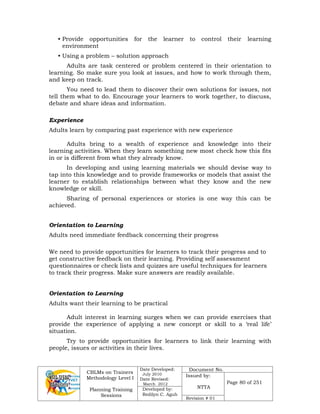
they may be able to work with these trainees to address their
specific needs to allow them to demonstrate competence.
b. While the issues are diverse, the solutions are frequently applicable
across different topics.
c. Not all issues for trainers are issues for trainees.
d. By altering some simple components of training, issues can be
resolved; e.g. language issues - having assessment in the local
language rather than in English.
CBLMs on Trainers
Methodology Level I
Planning Training
Sessions
Date Developed:
July 2010
Date Revised:
March 2012
Document No.
Issued by:
NTTA
Page 38 of 251
Developed by:
Redilyn C. Agub
Revision # 01
TRAINEE’S CHARACTERISTICS TO BE CONSIDERED WHEN PLANNING
A TRAINING SESSION
Characteristics of
trainees
What does this mean to the plan?
Language,
literacy and
numeracy (LL&N)
This influences the methods you can use and
the activities and tasks that are suitable to
the training and the trainee. You must be
prepared for different LL&N levels and must
have numerous resources available for
different requirements.
Cultural
background
Be aware of different cultural backgrounds
and practices.
There maybe activities that you choose which
are inappropriate because of cultural
background and practices.
Education and
general
knowledge
General education levels are helpful for you
to know at what level to pitch the delivery of
the session.
Gender The whole plan is affected if you have a group
of all female, all male or a mixture if there are
activities that involve demonstration, role
play and so on
Age Age can affect the plan depending on what is
delivered, how it is delivered and at what
pace it is delivered
Physical ability Be aware of any trainee who is less able than
others to perform physical tasks before the
beginning of the session
CBLMs on Trainers
Methodology Level I
Planning Training
Sessions
Date Developed:
July 2010
Date Revised:
March 2012
Document No.
Issued by:
NTTA
Page 39 of 251
Developed by:
Redilyn C. Agub
Revision # 01
Previous
experience with
the topic
Different levels of experience can be useful,
and to plan well ahead, you should know
who has what experience so it can be used to
you and other trainees’ advantage
Previous learning
experience
It is helpful if you have knowledge of trainees’
general attitudes towards learning
Training level
completed
This helps you identify other trainings
attended by your prospective students
Special courses You may use their special training and ability
in some special arrangements/assignments
during training
Learning style A trainee could be auditory, visual or
kinesthetic
Other needs This refers to special needs that would be
requested by the trainees. e.g. schedule for
working student, single parent, etc
LEARNING STYLES
Some trainees sit through hours of lectures and retain all the
information presented while others benefit more from hands-on lab classes.
Reason? Trainees have different learning styles, which present both trainers
and students with a problem when classes are taught in one set way that
might only benefit one kind of learner. Trainees can however, help
themselves by finding out what kind of learner style they belong to and
customize their study habits to that particular style.
There are three major groups of learners, which are Kinesthetic,
Visual and Auditory. These groups represent three very different kinds of
trainees, who are all presented with difficulties during their education.
Most of the time trainees have combinations of these learning styles.
I. Visual Learner
The visual learner will often lose focus during long oral lectures,
especially if these are not accompanied by drawings and illustrations. The
visual learner takes mental pictures of information given, so in order for this
kind of learner to retain information, oral or written, presentations of new
information must contain diagrams and drawings, preferably in color. The
CBLMs on Trainers
Methodology Level I
Planning Training
Sessions
Date Developed:
July 2010
Date Revised:
March 2012
Document No.
Issued by:
NTTA
Page 40 of 251
Developed by:
Redilyn C. Agub
Revision # 01
visual learner can't concentrate with a lot of activity around him and will
focus better and learn faster in a quiet study environment.
Visual learners are often:
1. Good spellers
2. Fast readers
3. Great at seeing the big picture but often forget smaller details
4. Good at remembering faces but have a hard time remembering names
The visual learner will benefit from:
1. Color-coded notes
2. Using drawings to illustrate
3. Outlining information
4. Using mind maps and flash cards
II. Kinesthetic Learner
Kinesthetic learners are described as the students in the classroom,
who have problems sitting still and who often bounce their legs while tapping
their fingers on the desks. They are often referred to as hyperactive students
with concentration issues.
Kinesthetic learners are often:
Gifted performers
Naturally athletic
To get the most of an education the kinesthetic learner can:
1. Choose classes with hands-on labs
2. Study with (loud) music in the background
3. Use memory and flash cards
4. Study in small groups
5. Take breaks often during study
CBLMs on Trainers
Methodology Level I
Planning Training
Sessions
Date Developed:
July 2010
Date Revised:
March 2012
Document No.
Issued by:
NTTA
Page 41 of 251
Developed by:
Redilyn C. Agub
Revision # 01
III. Auditory Learner
For the auditory learner, oral presentations are crucial for
understanding a subject, as this kind of learner has the ability to remember
speeches and lectures in detail but has a hard time with written text. Having
to read long texts is pointless and will not be retained by the auditory learner
unless it is read aloud.
The auditory learner often has:
1. Strong language skills
2. A well-developed vocabulary
3. The ability to follow spoken directions well
4. A hard time remembering faces but easily remembers names
For the auditory learner to get the most out of classes it can be helpful
to:
1. Record lectures
2. Use word associations
3. Listen to audiotapes
4. Read notes aloud
5. Sit in the front of the class where the teacher can easily be seen and
heard.
6. Study and discuss subjects with other students
The structured questionnaire below was prepared as a data
gathering tool to help determine trainees’ characteristics. Let trainees
answer these questions before answering the data gathering
instrument for determining trainees’ characteristics.
CBLMs on Trainers
Methodology Level I
Planning Training
Sessions
Date Developed:
July 2010
Date Revised:
March 2012
Document No.
Issued by:
NTTA
Page 42 of 251
Developed by:
Redilyn C. Agub
Revision # 01
What's Your Learning Style?
For these questions, choose the first answer that comes to mind and
click on a, b, or c. Do not spend too much time thinking about any one
question.
1. When you study for a test, would you rather
A. read notes, read headings in a book, and look at diagrams
and illustrations?
B. have someone ask you questions, or repeat facts silently to
yourself?
C. write things out on index cards and make models or
diagrams?
2. Which of these do you do when you listen to music?
A. daydream (see things that go with the music)
B. hum a along
C. move with the music, tap your foot, etc.
3. When you work at solving a problem do you
A. make a list, organize the steps, and check them off as they
are done?
B. make a few phone calls and talk to friends or experts?
C. make a model of the problem or walk through all the steps in
your mind?
4. When you read for fun, do you prefer
A. a travel book with a lot of pictures in it?
B. a mystery book with a lot of conversation in it?
C. a book where you answer questions and solve problems?
5. To learn how a computer works, would you rather
A. watch a movie about it?
B. listen to someone explain it?
C. take the computer apart and try to figure it out for yourself?
CBLMs on Trainers
Methodology Level I
Planning Training
Sessions
Date Developed:
July 2010
Date Revised:
March 2012
Document No.
Issued by:
NTTA
Page 43 of 251
Developed by:
Redilyn C. Agub
Revision # 01
6. You have just entered a science museum, what will you do first?
A. look around and find a map showing the locations of the
various exhibits.
B. talk to a museum guide and ask about exhibits.
C. go into the first exhibit that looks interesting, and read
directions later.
7. What kind of restaurant would you rather not go to?
A. one with the lights too bright
B. one with the music too loud
C. one with uncomfortable chairs
8. Would you rather go to
A. an art class?
B. a music class?
C. an exercise class?
9. Which are you most likely to do when you are happy?
A. grin
B. shout with joy
C. jump for joy
10. If you were at a party, what would you be most likely to remember the
next day?
A. the faces of the people there, but not the names
B. the names but not the faces
C. the things you did and said while you were there
11. When you see the word "d - o - g", what do you do first?
A. think of a picture of a particular dog
B. say the word "dog" to yourself silently
C. sense the feeling of being with a dog (petting it, running with
it, etc.)
12. When you tell a story, would you rather
A. write it?
B. tell it out loud?
C. act it out?
CBLMs on Trainers
Methodology Level I
Planning Training
Sessions
Date Developed:
July 2010
Date Revised:
March 2012
Document No.
Issued by:
NTTA
Page 44 of 251
Developed by:
Redilyn C. Agub
Revision # 01
TO DETERMINE YOUR LEARNING STYLE:
Total your a's, b's, and c's. If you scored mostly
A's you may have a visual learning style.
B’s you may have an auditory learning style.
C’s you may have a kinesthetic learning style
13. What is most distracting for you when you are trying to concentrate?
A. visual distractions
B. noises
C. other sensations like, hunger, tight shoes, or worry
14. What are you most likely to do when you are angry?
A. scowl
B. shout or "blow up"
C. stomp off and slam doors
15. When you aren't sure how to spell a word, which of these are you most
likely to do?
A. write it out to see if it looks right
B. sound it out
C. write it out to see if it feels right
16. Which are you most likely to do when standing in a long line at the
movies?
A. look at posters advertising other movies
B. talk to the person next to you
C. tap your foot or move around in some other way
CBLMs on Trainers
Methodology Level I
Planning Training
Sessions
Date Developed:
July 2010
Date Revised:
March 2012
Document No.
Issued by:
NTTA
Page 45 of 251
Developed by:
Redilyn C. Agub
Revision # 01
Kolb's Learning Inventory
Kolb’s learning inventory of learning styles describes a learning process
and a style with the emphasis on the need for learning to be grounded in
experience, and the importance of a person being active in learning. It provides
guidance in situations where learner differences play a role in communication
and human interaction. The model provides ways to gauge personal inclinations
toward learning, and offers a clear and actionable way to accommodate learners
in learning environments. There are 4 main styles. Most people have a
preference for 1 or 2 styles.
In the United Kingdom, Honey and Mumford (1992) built on David Kolb’s
innovative work and offered a model of learning preferences using the
descriptions Activist, Reflector, Theorist and Pragmatist.
CBLMs on Trainers
Methodology Level I
Planning Training
Sessions
Date Developed:
July 2010
Date Revised:
March 2012
Document No.
Issued by:
NTTA
Page 46 of 251
Developed by:
Redilyn C. Agub
Revision # 01
Activist
Learns by having a go
They perceive information concretely and process it actively. They
integrate experience and application. They learn by trial and error. They believe
in self discovery. They are enthusiastic about new things. They are adaptable,
even relish change. They excel when flexibility is needed. They often reach
accurate conclusions in the absence of logical reason. They are risk takers.
They are at ease with people. They enrich reality by taking what is and adding
to it. Sometimes they are seen as manipulative and pushy.
Their philosophy is: “I’ll try anything once.”
Reflector
Learns most from activities where they can watch, listen and then
review what has happened.
They perceive information concretely and process it reflectively. They
integrate experience with the Self. They learn by listening and sharing ideas.
They are imaginative thinkers who believe in their own experience. They
excel in viewing direct experience from many perspectives. They value
insightful thinking. They work for harmony. They need to be personally
involved, seek commitment. Are interested in people and culture. They are
thoughtful people who enjoy observing others. They absorb reality. They
seem to take in the atmosphere almost like osmosis.
Their philosophy is to be cautious, to consider all possible angles and
implications before making a move. “I need more information.”
Theorist
Learns most when ideas are linked to existing theories and concepts.
They perceive information abstractly and process it reflectively. They
form theories and concepts by integrating their observations into what is
known. They seek continuity. They need to know what the experts think.
They learn by thinking through ideas. They value sequential thinking. Need
details. They critique information and collect data. They are thorough and
industrious. They will re-examine the facts if situations perplex them. They
enjoy traditional classrooms. Schools are made for them. They are more
interested in ideas then people. They prefer to maximise certainty and are
uncomfortable with subjective judgements.
Their philosophy prizes rationality and logic: “If it’s logical, it’s good.”
CBLMs on Trainers
Methodology Level I
Planning Training
Sessions
Date Developed:
July 2010
Date Revised:
March 2012
Document No.
Issued by:
NTTA
Page 47 of 251
Developed by:
Redilyn C. Agub
Revision # 01
Pragmatist
Learns most from learning activities that are directly relevant to their
situation.
They perceive information abstractly and process it actively. They
integrate theory and practice. They learn by testing theories and applying
common sense. They are pragmatists, they believe if something works, use
it. They are down-to-earth problem solvers who resent being given answers.
They do not stand on ceremony but get right to the point. They have a
limited tolerance for fuzzy ideas. They value strategic thinking. They are
skills-oriented. They experiment and tinker with things. They need to know
how things work. They edit reality, cut right to the heart of things.
Sometimes they seem bossy and impersonal.
Their philosophy is: “There is always a better way.” “If it works, it’s
good.”
CBLMs on Trainers
Methodology Level I
Planning Training
Sessions
Date Developed:
July 2010
Date Revised:
March 2012
Document No.
Issued by:
NTTA
Page 48 of 251
Developed by:
Redilyn C. Agub
Revision # 01
Self –Check 1.1-5
Instruction: Write the letter of the correct answer on your answer sheet.
1. Which of the following characteristics affect learning outcome?
A. educational attainment
B. learning styles
C. previous experiences
D. all of the above
2. What is the learning style of a learner who has a strong language
skills?
A. auditory
B. kinesthetic
C. mixture of visual and auditory
D. visual
3. A learner who likes manipulating devices has a ___________ learning
style.
A. auditory
B. kinesthetic
C. mixture of visual and auditory
D. visual
4. Which of the following is not important in planning a session?
A. ability level
B. learning preferences
C. Training method
D. none of the above
5. A trainee that perceives things abstractly and process them actively
and learns by testing theories and applying common sense is an
A. Activist
B. Pragmatist
C. Reflector
D. Theorist
CBLMs on Trainers
Methodology Level I
Planning Training
Sessions
Date Developed:
July 2010
Date Revised:
March 2012
Document No.
Issued by:
NTTA
Page 49 of 251
Developed by:
Redilyn C. Agub
Revision # 01
6. Imaginative thinkers who believe and reflects on their experiences are
A. Activist
B. Pragmatist
C. Reflector
D. Theorist
7. A trainee who form theories and concepts by integrating his
observations into what is known. He needs to know what the experts
think.
A. Activist
B. Pragmatist
C. Reflector
D. Theorist
8. A trainee who perceive information concretely and process it actively
and by trial and error.
A. Activist
B. Pragmatist
C. Reflector
D. Theorist
CBLMs on Trainers
Methodology Level I
Planning Training
Sessions
Date Developed:
July 2010
Date Revised:
March 2012
Document No.
Issued by:
NTTA
Page 50 of 251
Developed by:
Redilyn C. Agub
Revision # 01
Answer Key 1.1-5
1. D
2. C
3. B
4. D
5. B
6. C
7. D
8. A
CBLMs on Trainers
Methodology Level I
Planning Training
Sessions
Date Developed:
July 2010
Date Revised:
March 2012
Document No.
Issued by:
NTTA
Page 51 of 251
Developed by:
Redilyn C. Agub
Revision # 01
Task Sheet 1.1-5
Title : Develop a data gathering tool for trainees characteristics
Performance Objective:
Given the qualification you are assigned to you should be able to
develop a data gathering tool for trainees’ characteristics that is
suitable for the learners that you have in your region or area of
operation.
Supplies : Bond paper
Equipment : PC, printer with ink
Steps/Procedure:
1. Search for the sample data gathering tool for trainees’
characteristics in the CD that was provided to you.
2. Based on the clients that you have and the qualification assigned to
you, edit the file to make a data gathering tool for trainees
characteristics which is suitable to your qualification and area of
operation.
3. Present your work to your trainer.
Note: the sample given below is a formatted for TM1. You have to
make a questionnaire that you can use with your prospective trainees.
Assessment Method:
Portfolio Assessment, Performance Criteria Checklist
CBLMs on Trainers
Methodology Level I
Planning Training
Sessions
Date Developed:
July 2010
Date Revised:
March 2012
Document No.
Issued by:
NTTA
Page 52 of 251
Developed by:
Redilyn C. Agub
Revision # 01
Performance Criteria Checklist 1.1-5
CRITERIA
Does your output have the following?
YES NO
trainees characteristics discussed in this information sheet
in making your questionnaire
section for gathering the basic profiles of your trainees
choices for ease of accomplishing the form
ethnic groups belonging to your area of operation in the
cultural and language background category
previous learning experiences suited for your qualification
special courses that are related to your qualification
CBLMs on Trainers
Methodology Level I
Planning Training
Sessions
Date Developed:
July 2010
Date Revised:
March 2012
Document No.
Issued by:
NTTA
Page 53 of 251
Developed by:
Redilyn C. Agub
Revision # 01
Sample Data Gathering Instrument for Trainee’s
Characteristics
Please answer the following instrument according to the
characteristics described below. Encircle the letter of your choice that best
describes you as a learner. Blank spaces are provided for some data that
need your response.
Characteristics of learners
Language, literacy
and numeracy
(LL&N)
Average grade in:
English
a. 95 and above
b. 90 to 94
c. 85 to 89
d. 80 to 84
e. 75 to 79
Average grade in:
Math
a. 95 and above
b. 90 to 94
c. 85 to 89
d. 80 to 84
e. 75 to 79
Cultural and
language
background
Ethnicity/culture:
a. Ifugao
b. Igorot
c. Ibanag
d. Gaddang
e. Muslim
f. Ibaloy
g. Others( please specify)_____________
Education &
general
knowledge
Highest Educational Attainment:
a. High School Level
b. High School Graduate
c. College Level
d. College Graduate
e. with units in Master’s degree
f. Masteral Graduate
The structured questionnaire below was prepared as a data gathering tool to help
the trainer collect data on trainee’s characteristics. This questionnaire maybe
filled up by each trainee and validated by the trainer from possible sources like
the Trainee’s Profile and through personal interview of each trainee.
CBLMs on Trainers
Methodology Level I
Planning Training
Sessions
Date Developed:
July 2010
Date Revised:
March 2012
Document No.
Issued by:
NTTA
Page 54 of 251
Developed by:
Redilyn C. Agub
Revision # 01
Characteristics of learners
g. With units in Doctoral Level
h. Doctoral Graduate
Sex a. Male
b. Female
Age Your age: _____
Physical ability 1. Disabilities(if any)_____________________
2. Existing Health Conditions (Existing illness if
any)
a. None
b. Asthma
c. Heart disease
d. Anemia
e. Hypertension
f. Diabetes
g. Others(please specify) ___________________
Previous
experience with
the topic
TM Certificates
a. TQ certified
b. TM graduate
c. TM trainer
d. TM lead trainer
Number of years as a competency trainer ______
Previous
learning
experience
List down trainings related to TM
___________________________
___________________________
___________________________
Training Level
completed
National Certificates acquired and NC level
___________________________
___________________________
Special courses Other courses related to TM
a. Units in education
CBLMs on Trainers
Methodology Level I
Planning Training
Sessions
Date Developed:
July 2010
Date Revised:
March 2012
Document No.
Issued by:
NTTA
Page 55 of 251
Developed by:
Redilyn C. Agub
Revision # 01
Characteristics of learners
b. Master’s degree units in education
c. Others(please specify)
_________________________
Learning styles a. Visual - The visual learner takes mental
pictures of information given, so in order for
this kind of learner to retain information,
oral or written, presentations of new
information must contain diagrams and
drawings, preferably in color. The visual
learner can't concentrate with a lot of activity
around him and will focus better and learn
faster in a quiet study environment.
b. Kinesthetic - described as the students in
the classroom, who have problems sitting
still and who often bounce their legs while
tapping their fingers on the desks. They are
often referred to as hyperactive students
with concentration issues.
c. Auditory- a learner who has the ability to
remember speeches and lectures in detail
but has a hard time with written text. Having
to read long texts is pointless and will not be
retained by the auditory learner unless it is
read aloud.
d. Activist - Learns by having a go
e. Reflector - Learns most from activities where
they can watch, listen and then review what
has happened.
f. Theorist - Learns most when ideas are linked
to existing theories and concepts.
g. Pragmatist - Learns most from learning
activities that are directly relevant to their
situation.
Other needs a. Financially challenged
b. Working student
c. Solo parent
d. Others(please specify)
___________________________
CBLMs on Trainers
Methodology Level I
Planning Training
Sessions
Date Developed:
July 2010
Date Revised:
March 2012
Document No.
Issued by:
NTTA
Page 56 of 251
Developed by:
Redilyn C. Agub
Revision # 01
INFORMATION SHEET 1.1-6
Trainees’ Current Competencies
Learning Objectives:
After reading this INFORMATION SHEET, YOU MUST be able to:
1. define current competencies;
2. explain why there is a need to identify the trainees’ current
competencies;
In the previous lessons, you learned that important data about your
trainees are needed as inputs in planning your training sessions. One of
them is the trainee’s characteristics.
Trainee’s training needs is another important data that you need to
collect as a trainer so that you will be able to identify the skills and
competencies needed by individual trainees. In CBT, competencies or skills
that are already previously acquired by the trainee will no longer be repeated
in their learning activities.
In this lesson, you will learn to determine these current competencies.
Current Competencies
Current competencies are the skills and knowledge of your new
trainees obtained through formal training, work experience or life
experience. These should be determined before you can prepare your session
plan, so as not include the same competencies where the trainees are
already competent.
How can the Current Competencies be Determined
Current competencies can be determined by using the following:
1. Self-Assessment Checklist – It is a checklist of competencies required
of a qualification.
2. Proof of Competencies - Portfolio assessment or validation of evidences
of competency such as employment certificates with specific duties
and responsibilities, projects personally done by the trainee, certificate
of awards and other related proofs.
3. Pre-assessment result
Pre-assessment in CBT has the following functions:
a. Diagnostic - intended to diagnose areas of weakness, or
misunderstanding, and strength. It involves collecting evidence
to diagnose or identify a training need or performance problem.
“You can’t prescribe the remedy till you understand the cause”
CBLMs on Trainers
Methodology Level I
Planning Training
Sessions
Date Developed:
July 2010
Date Revised:
March 2012
Document No.
Issued by:
NTTA
Page 57 of 251
Developed by:
Redilyn C. Agub
Revision # 01
This type of assessment is used to identify a learner’s gaps in
knowledge and to ensure the content of the subsequent training
will meet the learners’ needs.
The pre-test is a written test that would initially test the
knowledge of your trainees on the competencies that they need
to learn
b. Formative - This type of assessment assists and supports
learning by providing feedback about performance and progress
towards the achievement of competency. It is also a method for
the collection of evidence, and determining a candidate’s
readiness for her or his final assessment.
For our purpose, this type of assessment will be used to
assess whether a trainee is ready to be assessed for purposes of
Recognition of Prior Learning
c. Summative Assessment – In case the trainee is ready to be
assessed for a competency as a result of his employment and
life experiences, you may finally give him a summative
assessment to recognize his prior learning for some or all of the
competencies of the qualification.
Why determine current competencies?
1. To identify the competencies to be covered in the training plan.
2. To assess the trainee’s current competency in comparison to the
stated standards of competence required
3. To identify which relevant skills the trainee possesses and does not
possess, so that the training program can be tailored accordingly.
Assessment Methodologies
Observation Checklist
This is a checklist completed by a trainer or the workplace assessor
while observing the learner’s performance on relevant
tasks.
Practical Demonstration
Demonstrates competence by showing steps or process used to
produce a product or service
CBLMs on Trainers
Methodology Level I
Planning Training
Sessions
Date Developed:
July 2010
Date Revised:
March 2012
Document No.
Issued by:
NTTA
Page 58 of 251
Developed by:
Redilyn C. Agub
Revision # 01
Project
Demonstration of skills and knowledge in the completion of a project.
360º Feedback
Using a structured process to gather and analyse feedback from peers,
supervisors and people who are supervised.
Case Study
Response to a situation which is presented to the learner. Used to
ascertain the learners problem solving techniques and underpinning
knowledge.
Oral presentation
Learners give an oral presentation about an area of knowledge or their
projects to a small group, usually including a trainer, their assessor, their
colleagues and any other interested parties.
Journal
A journal that records learning activities, skills and knowledge
acquisition.
Problem Solving
Implementing problem solving techniques to analyse a product or
process for problems or errors.
Project
Demonstration of skills and knowledge in the completion of a
project.
Video or Audio Tapes
Recording performance in the workplace that is subsequently reviewed
by an assessor.
Certificate of Award or Employment
Certificate of employment or awards that reflect the responsibilities of
the trainee maybe a proof of his competency.
Assessment is the gathering of evidence from a range of sources, and
frequently more than one type of evidence is used to fairly and reliably
determine competence. When selecting an appropriate strategy for the
collection of evidence in determining trainees’ current competency, there are
CBLMs on Trainers
Methodology Level I
Planning Training
Sessions
Date Developed:
July 2010
Date Revised:
March 2012
Document No.
Issued by:
NTTA
Page 59 of 251
Developed by:
Redilyn C. Agub
Revision # 01
factors that need consideration. These factors, which will be discussed in
MODULE 4, include:
o The requirements of the specific competency unit(s) or learning
outcome
o The needs of the assessor and the trainee being assessed
o The authenticity of the evidence. That is, that it actually relates
to the performance of the person being assessed, and not that of
another person.
o Sufficiency of the evidence to demonstrate competency
o The currency of evidence. That the evidence is still relevant and
current according to competency standard requirements.
o Whether the task being assessed or the location of the
assessment involve a strong element of OH & S or
environmental risk
In cases of doubtful proof or evidence submitted, it will always be the
right of the Trainer to investigate.
For Certificates of Award or Employment:
1. The Trainer can call or personally ask for confirmation from the
signatories of the certificate issued by a company or an industry.
In reviewing the documents submitted by the trainee, the following
should be considered:
 Authenticity of the document
 Date acquired
 Standing of the company/employer who issued the certificate
For submitted projects/videos/photos:
2. The Trainer can visit the company to prove the existence of the
workplace where the task/job was done.
In the example above, the Trainer must be assured that the
documents are valid and authentic. In this case he needs to call the
company that issued the certificates to confirm the validity and
authenticity of the documents. Careful consideration should be given to
the collection of evidences to ensure that all components of the
competency being assessed are effectively addressed.
CBLMs on Trainers
Methodology Level I
Planning Training
Sessions
Date Developed:
July 2010
Date Revised:
March 2012
Document No.
Issued by:
NTTA
Page 60 of 251
Developed by:
Redilyn C. Agub
Revision # 01
This section presents sample methods and instruments in identifying
current competencies and training need of trainees.
Current Competencies are determined by using the following forms:
1. Self-assessment Check (Form 4.1)
2. Validation of Competency evidences(Form 4.2)
3. Summary of Current competencies versus required competencies(Form
4.3)
4. Training Needs(Form 4.4)
Trainers may use their ingenuity to develop other instruments that
may validate proofs/evidences of current competencies such as assessment
instruments.
FORM 1.1 SELF-ASSESSMENT CHECK
INSTRUCTIONS: This Self-Check Instrument will give the trainer necessary
data or information which is essential in planning training
sessions. Please check the appropriate box of your answer
to the questions below.
CORE COMPETENCIES
CAN I…? YES NO
1. Plan Training Session
1.1 Identifying learner’s training requirements?
1.2 Prepare session plans?
1.3 Prepare instructional materials?
1.4 Prepare assessment instruments?
1.5 Organize teaching and learning resources?
2. Facilitate Learning Session
2.1 Prepare training facilities/resources?
2.2 Conduct pre-assessment?
2.3 Facilitate training session?
2.4 Conduct competency assessment?
2.5 Review delivery of training session?
CBLMs on Trainers
Methodology Level I
Planning Training
Sessions
Date Developed:
July 2010
Date Revised:
March 2012
Document No.
Issued by:
NTTA
Page 61 of 251
Developed by:
Redilyn C. Agub
Revision # 01
CORE COMPETENCIES
CAN I…? YES NO
3. Supervise Work-Based Learning
3.1 Establish training requirements for trainees?
3.2 Monitor work-based training?
3.3 Review and evaluate work-based learning
effectiveness?
4. Conduct Institutional Assessment
4.1 Orient the trainee?
4.2 Gather evidence?
4.3 Make assessment decision?
4.4 Record assessment results?
4.5 Provide feedback to trainees?
5. Maintain Training Facilities
5.1 Plan Maintenance activities?
5.2 Prepare schedule of maintenance?
5.3 Implement housekeeping activities?
5.4 Maintain training equipment and tools?
5.5 Document maintenance inspections?
6. Utilize electronic media in facilitating training
6.1 Inspect electronic media equipment?
6.2 Operate electronic media equipment to deliver a
lesson?
6.3 Maintain electronic media?
Note: In making the Self-Check for your Qualification, all required competencies
should be specified. It is therefore required of a Trainer to be well- versed
of the CBC or TR of the program qualification he is teaching.
CBLMs on Trainers
Methodology Level I
Planning Training
Sessions
Date Developed:
July 2010
Date Revised:
March 2012
Document No.
Issued by:
NTTA
Page 62 of 251
Developed by:
Redilyn C. Agub
Revision # 01
Evidences/Proof of Current Competencies(Sample)
Form 1.2: Evidence of Current Competencies acquired related to
Job/Occupation
Current
competencies
Proof/Evidence Means of validating
Prepare Session
Plan
Complete session plan
with the prescribed format
prepared by the trainer
Submitted a complete set
of session plan
Prepare basic
instructional
materials
Complete CBLM with the
prescribed format
prepared by the trainer
Submitted a complete
CBLM for one qualification
Organize teaching
and learning
resources
Picture of actual workshop
layout of trainer
Submitted the picture of
actual workshop layout
certified by the Vocational
Instruction Supervisor
Use Personal
Computer in
Educational
Technology
National Certificate in PC
Operations
Projects such as
presentations, CBLM,
session plans, flyers and
other instructional
materials
Submitted an
authenticated copy of
National Certificate
CBLMs on Trainers
Methodology Level I
Planning Training
Sessions
Date Developed:
July 2010
Date Revised:
March 2012
Document No.
Issued by:
NTTA
Page 63 of 251
Developed by:
Redilyn C. Agub
Revision # 01
Identifying Training Gaps
From the accomplished Self-Assessment Check (Form 1.1) and the
evidences of current competencies (Form 1.2), the Trainer will be able to
identify what the training needs of the prospective trainee are.
Form 1.3 Summary of Current Competencies Versus Required
Competencies (Sample)
Required Units of
Competency/Learning
Outcomes based on CBC
Current
Competencies
Training
Gaps/Requirements
1. Plan Training Session
1.1 Determine
trainee’s training
requirements
Determine trainee’s
training
requirements
1.2 Determine
relevant training
methods, training
activities and
training delivery
modes
Determine relevant
training methods,
training activities
and training delivery
modes
1.3 Prepare session
plans
Prepare session plans
1.4 Prepare basic
instructional
materials
Prepare basic
instructional
materials
1.5 Organize
teaching and
learning resources
Organize teaching
and learning
resources
CBLMs on Trainers
Methodology Level I
Planning Training
Sessions
Date Developed:
July 2010
Date Revised:
March 2012
Document No.
Issued by:
NTTA
Page 64 of 251
Developed by:
Redilyn C. Agub
Revision # 01
2. Facilitate Learning Session
Required Units of
Competency/Learning
Outcomes based on CBC
Current
Competencies
Training
Gaps/Requirements
2.1 Orient trainers
on the CBT
delivery system
2.1 Orient trainers on
the CBT delivery
system
2.2 Use appropriate
methods based on
the level and
characteristics of
trainees
2.2 Use appropriate
methods based on
the level and
characteristics of
trainees
2.3 Assist trainers in
achieving learning
outcomes
Assist trainers in
achieving learning
outcomes
2.4 Provide necessary
feedback to
improve trainer’s
competence
Provide necessary
feedback to improve
trainer’s competence
3. Supervise Work-Based Learning
3.4 Establish
training
requirements for
trainees
Establish training
requirements for
trainees
3.5 Monitor work-
based training
Monitor work-based
training
3.6 Review and
evaluate work-
based learning
effectiveness
Review and evaluate
work-based learning
effectiveness
4. Conduct Competency Assessment
4.1 Orient trainees
on the evidence
requirements in
the relevant
evidence plan
4.1 Orient trainees
on the evidence
requirements in the
relevant evidence
plan
CBLMs on Trainers
Methodology Level I
Planning Training
Sessions
Date Developed:
July 2010
Date Revised:
March 2012
Document No.
Issued by:
NTTA
Page 65 of 251
Developed by:
Redilyn C. Agub
Revision # 01
Required Units of
Competency/Learning
Outcomes based on CBC
Current
Competencies
Training
Gaps/Requirements
4.2 Gather and
document
evidences using
relevant
assessment tools
4.2 Gather and
document evidences
using relevant
assessment tools
4.3 Evaluate and
record assessment
results in
accordance with
the approved
rating system
4.3 Evaluate and
record assessment
results in accordance
with the approved
rating system
4.4 Use appropriate
feedback
mechanism to
inform trainee of
his progress
Use appropriate
feedback mechanism
to inform trainee of
his progress
5. Maintain Training Facilities
5.1 Implement
housekeeping
activities
5.1 Implement
housekeeping
activities
5.2 Maintain training
equipment and
tools
5.2 Maintain
training equipment
and tools
6. Utilize Electronic Media In Facilitating Training
6.1 Inspect electronic
media equipment
Inspect electronic
media equipment
6.2 Operate
electronic media
equipment
Operate electronic
media equipment
6.3 Maintain
electronic media
equipment
Maintain electronic
media equipment
Using Form No. 1.4, convert the Training Gaps into a Training Needs/
Requirements. Refer to the CBC in identifying the Module Title or Unit of
Competency of the training needs identified.
CBLMs on Trainers
Methodology Level I
Planning Training
Sessions
Date Developed:
July 2010
Date Revised:
March 2012
Document No.
Issued by:
NTTA
Page 66 of 251
Developed by:
Redilyn C. Agub
Revision # 01
Form No. 4.4: Training Needs (Sample)
Training Needs
(Learning Outcomes)
Module Title/Module of
Instruction
Identify trainees’ training requirements 1. Plan Training Session
Prepare assessment Instruments
Conduct Pre-assessment 2. Facilitate Learning
Session
Facilitate training session
Review delivery of training session
Establish training requirements for
trainees
3. Supervise work-based
learning
Monitor work-based training
Review and evaluate work-based learning
effectiveness
Use appropriate feedback mechanism to
inform learner of his/her progress
4. Conduct Institutional
Assessment
Maintain training equipment and tools 5. Maintain Training
Facilities
Inspect electronic media equipment 6. Utilize Electronic media
in facilitating training
Operate electronic media equipment to
deliver lesson
Maintain electronic media
Note: This Form 1.4 is just a sample instrument showing the training needs
in the core competencies
CBLMs on Trainers
Methodology Level I
Planning Training
Sessions
Date Developed:
July 2010
Date Revised:
March 2012
Document No.
Issued by:
NTTA
Page 67 of 251
Developed by:
Redilyn C. Agub
Revision # 01
Summary
In planning for competency-based training, the following
should be determined by the trainer:
1. The competencies as required by the Competency
standards
2. Trainee’s characteristics
3. Trainees current competencies
4. Trainee’s Training Needs
To determine learner’s training needs the trainer need to do
the following:
1. Analyze the competency standard
2. Prepare the TNA forms
3. Prepare the pre-test
4. Prepare the Institutional Competency Evaluation
CBLMs on Trainers
Methodology Level I
Planning Training
Sessions
Date Developed:
July 2010
Date Revised:
March 2012
Document No.
Issued by:
NTTA
Page 68 of 251
Developed by:
Redilyn C. Agub
Revision # 01
Self-Check 1.1-6
On your answer sheet, answer the following questions:
1. Why is it necessary to determine the current competencies
of your trainee before preparing your Session Plan?
2. What are the three factors to be considered in using
evidences submitted by a prospective trainee as proof of his
current competencies?
3. What are the ways of determining current competencies of a
trainee?
4. What is a training gap?
CBLMs on Trainers
Methodology Level I
Planning Training
Sessions
Date Developed:
July 2010
Date Revised:
March 2012
Document No.
Issued by:
NTTA
Page 69 of 251
Developed by:
Redilyn C. Agub
Revision # 01
Answer Key 1.1-6
1. To ensure that the current competencies of the trainee are
recognized and learning activities related to the current
competencies are no longer assigned to him, trainees current
competencies has to be determined.
2. a. authenticity of the document
b. date when the competencies were acquired (currency)
c. standing of the company/employer who issued the
certificate (validity)
3. a. Self-Assessment Checklist
b. Proof of competencies such as employment certificates,
projects personally done by the trainee, awards and other
related proofs
c. Pre-assessment result
4. A training gap is the difference between the current
competencies and those required.
CBLMs on Trainers
Methodology Level I
Planning Training
Sessions
Date Developed:
July 2010
Date Revised:
March 2012
Document No.
Issued by:
NTTA
Page 70 of 251
Developed by:
Redilyn C. Agub
Revision # 01
JOB SHEET 1.1-6
Title : Prepare Training Needs Analysis Forms
Performance Objective:
Given the sample forms for Identifying Training Needs Analysis,
you should be able to make Forms 4.1, 4.2, 4.3 and 4.4 for the
qualification you are assigned to.
Supplies : Bond paper
Equipment : PC, printer with ink
Steps/Procedure:
1. Secure TR and CBC for the qualification you are assigned to.
2. Search your CD for the templates of the TNA forms.
3. Make the Self-Assessment Check (Form 4.1).
4. Using sample Evidence of Current Competencies acquired related to
Job/Occupation (Form 4.2) of Trainer’s Methodology I, prepare a
list of possible evidences of current competencies.
5. Construct a blank form for determining discrepancies between
competencies in the TR and current competencies or Training
Gaps (Form 4.3) of prospective trainees.
6. Prepare a template for the Training Needs of trainees. (Form 4.4)
Assessment Method:
Portfolio Assessment
CBLMs on Trainers
Methodology Level I
Planning Training
Sessions
Date Developed:
July 2010
Date Revised:
March 2012
Document No.
Issued by:
NTTA
Page 71 of 251
Developed by:
Redilyn C. Agub
Revision # 01
Performance Criteria Checklist 11..11--66
Trainee’s Name__________________________ Date ________________
Criteria YES NO
1. All required competencies are listed from BASIC,
COMMON to CORE(Form 1.1).
2. Possible evidences of current competencies are listed
(Form 1.2).
3. Means of validating evidences of competencies are
listed.
4. Templates in assessing discrepancies between
current and required competencies are prepared
(Form 1.3).
5. Training need form is prepared for basic, common
and core competencies (Form 1.4).
Comments/Suggestions:
Trainer: ___________________________ Date: ________
CBLMs on Trainers
Methodology Level I
Planning Training
Sessions
Date Developed:
July 2010
Date Revised:
March 2012
Document No.
Issued by:
NTTA
Page 72 of 251
Developed by:
Redilyn C. Agub
Revision # 01
LEARNING OUTCOME # 2 PREPARE SESSION PLAN
CONTENTS:
1. Training Design
2. Training Delivery Modes and Methods
3. Session Plan
4. Learning Resources
ASSESSMENT CRITERIA:
1. Instructional blueprint is developed
2. Training delivery modes are identified appropriate for the training
3. Training methods that pertains to the required competencies are
addressed
4. Sequence of training activities are determined based on
competency standards
5. Resources to support training are identified
6. Session plan is finalized according to required format
CONDITION:
Students/Trainees must be provided with the following:
1. WORKPLACE LOCATION
2. EQUIPMENT
- Computer
- LCD
3. TOOLS, ACCESSORIES AND SUPPLIES
- White board
- CD
- Tapes
4. TRAINING MATERIALS
- Learning Packages
- Bond Paper
CBLMs on Trainers
Methodology Level I
Planning Training
Sessions
Date Developed:
July 2010
Date Revised:
March 2012
Document No.
Issued by:
NTTA
Page 73 of 251
Developed by:
Redilyn C. Agub
Revision # 01
- Ball pens
- Whiteboard markers
- Manuals
- Competency Standards
- Training Regulations
ASSESSMENT METHOD:
Portfolio
CBLMs on Trainers
Methodology Level I
Planning Training
Sessions
Date Developed:
July 2010
Date Revised:
March 2012
Document No.
Issued by:
NTTA
Page 74 of 251
Developed by:
Redilyn C. Agub
Revision # 01
Learning Experiences
Learning Outcome 2
PREPARE SESSION PLAN
Learning Activities Special Instructions
1. Read Information Sheet 1.2-1 on
Training Design
The Session Plan is your main
guide in delivering CBT. It is the
blueprint of your training design.
The learning activities of this LO
will help you design training
sessions.
The TESDA recommended template
for the session plan is provided
herein. The information sheets
provide activities that will help you
understand the components of the
session plan.
A session plan for one of the LO’s
of your qualification is the
requirement of this LO. It will
serve as a portfolio for your
Institutional Competency
Evaluation.
Present your session plan to your
trainer as you accomplish it so that
you will be guided.
2. Answer Self-check 1.2-1
Compare your answers with Answer
Key 1.2-1
3. Read Information Sheet 1.2-2 on
Training Delivery Modes and Methods
4. Answer Self-check 1.2-2
Compare your answers with Answer
Key 1.2-2
5. Read Information Sheet 1.2-3 on
Session Plan
6. Answer Self-check 1.2-3
Compare your answers with Answer
Key 1.2-3
7. Read Information Sheet 1.2-4 on
Learning Resources
8. Answer Self-check 1.2-4
Compare your answers with Answer
Key 1.2-4
9. Perform Job Sheet 1.2-4 on how to
Make a Session Plan
10. Evaluate your work using
Performance Criteria Checklist 1.2-4
After doing all activities of this
LO, you are ready to proceed to
the next LO on preparing basic
instructional materials.
CBLMs on Trainers
Methodology Level I
Planning Training
Sessions
Date Developed:
July 2010
Date Revised:
March 2012
Document No.
Issued by:
NTTA
Page 75 of 251
Developed by:
Redilyn C. Agub
Revision # 01
INFORMATION SHEET 1.2-1
Training Design
Learning Objective:
After reading this INFORMATION SHEET, YOU MUST be able to
identify the factors to be considered in developing training design.
In LO1 you learned how to develop materials to determine training
characteristics and needs. The Competency Standards which is the main
basis of Competency-Based Training was discussed so that you will be able
to determine the competencies required of your qualification. The
assessment criteria is also the basis for assessing the skills of a trainee
during the pre-assessment and in recognizing prior learning.
In this lesson, we will discuss the factors that we should consider
when designing a training program so that we make our session plan.
Training is a set of a systematic processes designed to meet learning
objectives related to trainees' current or future jobs. These processes can be
grouped into the following phases; needs analysis, design, development,
implementation, and evaluation. The phases are sequential, with the
outputs of the previous phases providing the inputs to those that follow.
Training Need
Analysis
Training Plan
Development
Training Design
Training Delivery
Training Program
Evaluation
Figure 2.1. The Training Process
CBLMs on Trainers
Methodology Level I
Planning Training
Sessions
Date Developed:
July 2010
Date Revised:
March 2012
Document No.
Issued by:
NTTA
Page 76 of 251
Developed by:
Redilyn C. Agub
Revision # 01
Training design is a systematic process that is employed to develop
education and training programs in a consistent and reliable fashion.
Instructional Design (also called Instructional Systems Design
(ISD)) is the practice of creating "instructional experiences which make the
acquisition of knowledge and skill more efficient, effective, and appealing."
The process consists broadly of determining the current state and needs of
the learner, defining the end goal of instruction, and creating some
"intervention" to assist in the transition. Ideally the process is informed by
pedagogically (process of teaching) and andragogically (adult learning) tested
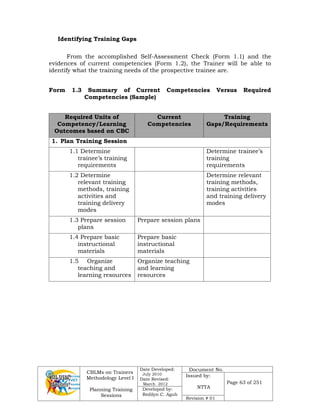
theories of learning and may take place in student-only, teacher-led or
community-based settings. The outcome of this instruction may be directly
observable and scientifically measured or completely hidden and assumed.
There are many instructional design models but many are based on the
ADDIE model with the five phases:
1. analysis - analyze learner characteristics, task to be learned, etc.
Identify Instructional Goals, Conduct Instructional Analysis,
Analyze Learners and Contexts
2. design - develop learning objectives, choose an instructional approach
Write Performance Objectives, Develop Assessment Instruments,
Develop Instructional Strategy
3. development - create instructional or training materials
Design and selection of materials appropriate for learning
activity, Design and Conduct Formative Evaluation
4. implementation - deliver or distribute the instructional materials
5. evaluation - make sure the materials achieved the desired goals
Design and Conduct Summative Evaluation
TThhee aannaallyyssiiss ooff tthhee CCSS iiss aa vveerryy iimmppoorrttaanntt sstteepp iinn tthhee ddeessiiggnn ooff yyoouurr
ttrraaiinniinngg pprrooggrraamm.. IInn tthhee aannaallyyssiiss yyoouu nneeeedd ttoo eessttaabblliisshh tthhee ffoolllloowwiinngg::
11.. tthhee mmaaiinn sskkiillll ttoo bbee mmaasstteerreedd;;
22.. tthhee lleeaarrnniinngg ccoonntteennttss ooff tthhee ccoommppeetteenncciieess iinncclluuddiinngg tthhee
uunnddeerrppiinnnniinngg kknnoowwlleeddggee aanndd sskkiillllss..
33.. aasssseessssmmeenntt ccrriitteerriiaa ffoorr tthhee sskkiillll ttoo bbee mmaasstteerreedd..
IInn tthhee ssttrruuccttuurree ooff tthhee CCSS,, eeaacchh ccoommppeetteennccyy wwaass ddiivviiddeedd iinnttoo lleeaarrnniinngg
oouuttccoommeess.. LLeeaarrnniinngg oouuttccoommeess ddeessccrriibbee tthhee ttaasskk nneeeeddeedd ttoo ccoommpplleettee tthhee
ccoommppeetteennccyy.. YYoouu sshhoouulldd aallwwaayyss eessttaabblliisshh tthhee mmaaiinn ccoommppeetteennccyy aanndd tthhee
ttaasskkss iinnvvoollvveedd..
CBLMs on Trainers
Methodology Level I
Planning Training
Sessions
Date Developed:
July 2010
Date Revised:
March 2012
Document No.
Issued by:
NTTA
Page 77 of 251
Developed by:
Redilyn C. Agub
Revision # 01
IInn aannaallyyzziinngg tthhee aasssseessssmmeenntt ccrriitteerriiaa ooff tthhee LLeeaarrnniinngg OOuuttccoommee aallwwaayyss
llooookk ffoorr tthhee ttaasskk ttoo bbee mmaasstteerreedd.. CCoommbbiinniinngg tthhee ttaasskkss ooff tthhee LLooss aanndd tthhee
uunnddeerrppiinnnniinngg sskkiillllss wwoouulldd ccoommpplleettee tthhee ccoommppeetteennccyy..
EExxaammppllee::
IInn CCoommppuutteerr HHaarrddwwaarree SSeerrvviicciinngg tthhee ffiirrsstt ccoommppeetteennccyy iiss IInnssttaallll
CCoommppuutteerr SSyysstteemm aanndd NNeettwwoorrkkss.. TThhee mmaaiinn ccoommppeetteennccyy iiss ttoo IInnssttaallll
ccoommppuutteerr ssyysstteemm aanndd nneettwwoorrkkss.. TThhee ccoommppeetteennccyy iiss ddiivviiddeedd iinnttoo tthhee
ffoolllloowwiinngg LLOOss::
LO1. Plan and prepare for installation
LO2. Install equipment/device system
LO3. Conduct test
In most cases, the trainer would immediately proceed to the
installation of computer called “assemble and disassemble”. But if we
were to analyze the first LO training should start with planning and
preparing for installation. Let us analyze the assessment criteria of
LO1.
1. Installation planned and prepared to ensure that safety measures,
policies and procedures followed, and that work is appropriately
sequenced in accordance with the industry standards
2. Technical personnel consulted to ensure that the work coordinated
effectively with others involved on the worksite
3. Computer systems and network devices obtained in accordance
with the established procedures and to comply with requirements
4. Location where devices and systems to be installed is determined
from job requirements
5. Materials necessary to complete the work obtained in accordance
with established procedures and checked against job requirements
6. Tools, equipment and testing devices needed to carry out the
installation work obtained in accordance with established
procedures and checked for correct operation and safety
7. Preparatory work checked to ensure that no unnecessary damage
has occurred and that work complies with requirements
The first challenge here is to identify the main task to be mastered.
Then identify the other tasks that are essential to the attainment of
the main task. In analyzing the criteria look for the verbs that would
signal a skill to be done.
In the first criteria, the verbs are “planned and prepared”. The verbs
that follow are “consulted”, “obtained” and “checked”. The main skill
here would be planning and preparation for the installation of
computer which is a task in the installation of computer system and
networks.
CBLMs on Trainers
Methodology Level I
Planning Training
Sessions
Date Developed:
July 2010
Date Revised:
March 2012
Document No.
Issued by:
NTTA
Page 78 of 251
Developed by:
Redilyn C. Agub
Revision # 01
Now that we have identified the main task of the LO, we shall identify
the topics or contents based on the given assessment criteria that help
us attain the main task to be mastered.
In the first criteria, there is the “safety measures, policies and
procedures” which may be included as a content unless this topic was
discussed in your common competencies. Be careful that this topic
should not be discussed as the universe of safety measures, policies
and procedures. You should limit the content on those that are
needed for the competency which is installation of computer system
and networks.
In the second criteria, there is the “technical personnel to be
consulted”. These will be the people that should be contacted.
In the third criteria, we can see the computer systems and network
devices. This is a very important topic because this will be the
hardware needed to be installed. Since topic is a broad content, it will
be divided into chunks. Going back to the CBC, these are the
recommended contents for this topic:
Tools, equipment and testing devices are not in the CBC but you
should include them as content.
After establishing the contents, you should not forget that the main
task is planning and preparing for installation. You should prepare
an activity that would give a trainee an opportunity to practice this
task.
Designing your training session would involve developing learning
objectives, choosing an instructional approach, develop assessment
instruments and develop instructional strategy. In making your design you
should consider the following:
1. Characteristics of your trainees – basic characteristics
that maybe potential barriers in training should be
identified and addressed on a trainee per trainee basis
when planning training sessions.
2. Adult learning principles – adults learn differently from
elementary and high school students. In choosing your
methods and structuring the training materials
CBLMs on Trainers
Methodology Level I
Planning Training
Sessions
Date Developed:
July 2010
Date Revised:
March 2012
Document No.
Issued by:
NTTA
Page 79 of 251
Developed by:
Redilyn C. Agub
Revision # 01
therefore, you should consider how adult trainees learn.
3. Learning styles of your trainees – varied learning styles
would require variations in the methodologies to be
employed with CBT. Your training design should be able
to provide learning activities for every trainee
considering his learning style.
Applying the Principles of Adult Learning
Learner Motivation
Adults must want to learn
In addition to communicating the learning objectives we need to show
how the learner and their work will benefit from the training.
• Use overviews to engage the learner
• State benefits in the outline of each topic and including learning
activities that reinforce the benefits
• Providing self assessments as a prelude to the module or topic
• Create personas to assist you to focus on the learners
Adults generally have a concept of being responsible for their own
decisions. Keep this in mind and incorporate it in the learning. If you take
this away from them then you will be undermining their ability to engage in
the training.
The most potent motivation for adult learners are internal pressures
(self esteem, life quality). So meet these needs. Allow and encourage people
to explore, recognise their achievements and apply them to their learning
and training.
Learner Orientation
Adults will learn only what they feel they need to learn
Adults must feel the things they are learning are relevant and will be
useful. So make the links to the work they are doing or could be doing in the
future by:
• Including examples and case studies on how others have used the
knowledge or skills
CBLMs on Trainers
Methodology Level I
Planning Training
Sessions
Date Developed:
July 2010
Date Revised:
March 2012
Document No.
Issued by:
NTTA
Page 80 of 251
Developed by:
Redilyn C. Agub
Revision # 01
• Provide opportunities for the learner to control their learning
environment
• Using a problem – solution approach
Adults are task centered or problem centered in their orientation to
learning. So make sure you look at issues, and how to work through them,
and keep on track.
You need to lead them to discover their own solutions for issues, not
tell them what to do. Encourage your learners to work together, to discuss,
debate and share ideas and information.
Experience
Adults learn by comparing past experience with new experience
Adults bring to a wealth of experience and knowledge into their
learning activities. When they learn something new most check how this fits
in or is different from what they already know.
In developing and using learning materials we should devise way to
tap into this knowledge and to provide frameworks or models that assist the
learner to establish relationships between what they know and the new
knowledge or skill.
Sharing of personal experiences or stories is one way this can be
achieved.
Orientation to Learning
Adults need immediate feedback concerning their progress
We need to provide opportunities for learners to track their progress and to
get constructive feedback on their learning. Providing self assessment
questionnaires or check lists and quizzes are useful techniques for learners
to track their progress. Make sure answers are readily available.
Orientation to Learning
Adults want their learning to be practical
Adult interest in learning surges when we can provide exercises that
provide the experience of applying a new concept or skill to a ‘real life’
situation.
Try to provide opportunities for learners to link their learning with
people, issues or activities in their lives.
CBLMs on Trainers
Methodology Level I
Planning Training
Sessions
Date Developed:
July 2010
Date Revised:
March 2012
Document No.
Issued by:
NTTA
Page 81 of 251
Developed by:
Redilyn C. Agub
Revision # 01
Dispositional Barrier
Adults try to avoid failure
Adults often perceive the trial and error approach to learning as too
risky and resist exploring this approach to learning. This is especially true if
the person has experienced learning difficulties in the past. Consider the
learners fears and emotional safety when developing training or learning
activities. Ensure the ‘real’ consequences of failure are low. Begin with easy
learning activities and build complexity once learners have experienced
success.
Learning Styles
Adults do not all learn the same way
Adults have their own styles of learning. So ensure the design of your
program and the way you write learning materials features activities,
content and language that appeals to a broad range of learning styles. Use
visual auditory and kinesthetic language. Include graphics and diagrams.
Consider using role plays, case studies, games, simulations, essays and
readings etc.
When planning your training session, consider the following
deductions:
• People will learn more effectively when using their preferred style
• People improve their capacity to learn when they can expand their
preferences
• When learning materials and activities accommodate a range of
preferences, more learners will be successful
• Training materials can be developed that appeal to learning preferences
In making your session plan you combine knowledge of competencies,
content, learning outcomes, instructional techniques and learning activities.
Putting these together into a structured training program is a challenge for
trainers.
Robert Gagné’s (1999) model useful in providing a structured approach
of learning. This provides a nine steps that can assist you in your plan:
1. Gain Attention – to orientate and motivate the learner
2. Inform Learners of Objectives – to guide learners and to assist them
to organize their thoughts around what they are about to learn
3. Stimulate Recall of Prior Knowledge – because adults learn by
establishing relationships with what they know and a new knowledge
or skill
CBLMs on Trainers
Methodology Level I
Planning Training
Sessions
Date Developed:
July 2010
Date Revised:
March 2012
Document No.
Issued by:
NTTA
Page 82 of 251
Developed by:
Redilyn C. Agub
Revision # 01
4. Present the material – in a way that appeals to the different learning
preferences and is easy to digest
5. Provide guidance for learning – by providing opportunities to
integrate new information into their existing knowledge base
6. Elicit performance by providing safe opportunities to practice
7. Provide feedback – to reinforce or correct learning
8. Assess performance – learners should be given the opportunity for
assessment to gain recognition of their success in learning
99.. Enhance retention and transfer – by encouraging learner to plan the
application of what they have learnt
TThhee sseeqquueennccee ooff aaccttiivviittiieess iinn tthhee sseessssiioonn ppllaann iiss bbaasseedd oonn tthheessee 99
eevveennttss ooff iinnssttrruuccttiioonn..
CBLMs on Trainers
Methodology Level I
Planning Training
Sessions
Date Developed:
July 2010
Date Revised:
March 2012
Document No.
Issued by:
NTTA
Page 83 of 251
Developed by:
Redilyn C. Agub
Revision # 01
Self-Check 1.2-2
Matching Type:
Match the learning activities on Column B with the events of instruction in Column
A. Write the letters of your choice on your answer sheet.
Column A
1. Trainer Demonstration of a skill
2. Video presentation
3. Introduction of the topic
4. Self-check
5. Evaluation of the performance
by the trainer
6. On-the-Job training
7. Review of the previous topic
8. Explaining the performance
objectives of the Job Sheet.
9. Discussing the steps of a task
10. Discussing the result of the
evaluation with the trainee
Column B
A. Gaining attention
B. Informing the learner of the
objective
C. Stimulating recall of prior
learning
D. Presenting the stimulus
E. Providing learner guidance
F. Eliciting performance
G. Providing Feedback
H. Assessing performance
I. Enhancing retention and
transfer
II. Enumeration:
Enumerate 5 adult learning Principles and explain each in relation to how
you will design your training sessions.
CBLMs on Trainers
Methodology Level I
Planning Training
Sessions
Date Developed:
July 2010
Date Revised:
March 2012
Document No.
Issued by:
NTTA
Page 84 of 251
Developed by:
Redilyn C. Agub
Revision # 01
Answer Key 1.2-1
I. Matching Type
1. E
2. D
3. A
4. F
5. H
6. I
7. C
8. B
9. E
10. G.
Model answers
Adults learn by comparing past experience with new experience
Provide activities for sharing their experiences
Adults will learn only what they feel they need to learn
Keep learning activities relevant to what they need to learn. Make sure
you look at issues, and how to work through them, and keep on track.
Adults must want to learn
Motivate trainees before giving learning activities
Adults need immediate feedback concerning their progress
Providing self assessment questionnaires or check lists and quizzes are
useful techniques for learners to track their progress. Make sure answers are
readily available
Adults want their learning to be practical
Try to provide opportunities for learners to link their learning with
people, issues or activities in their lives
Adults try to avoid failure
Ensure the ‘real’ consequences of failure are low. Begin with easy
learning activities and build complexity once learners have experienced
success.
Adults do not all learn the same way
Provide learning materials that cater to varied learning preference
CBLMs on Trainers
Methodology Level I
Planning Training
Sessions
Date Developed:
July 2010
Date Revised:
March 2012
Document No.
Issued by:
NTTA
Page 85 of 251
Developed by:
Redilyn C. Agub
Revision # 01
Information Sheet 1.2-2
Training Delivery Modes and Methods
Learning Objectives:
After reading INFORMATION SHEET, YOU MUST be able to:
1. enumerate the training delivery modes recommended for use in CBT;
2. differentiate the training methods.
In the design of training program, there are 5 steps: analysis, design,
development, implementation and evaluation. Analysis and design were
discussed in the previous information sheet. In designing your training
program it is very important that you choose effective training delivery
modes and methods. In this information sheet we shall discuss training
modes and methods. You should be able to choose training modes and
methods appropriate for the knowledge content and skills to be trained in
your competencies.
In Philippine TVET, we are required to follow the competency-based
training approach. To be able to employ this approach the training
regulations recommends training modalities.
TTrraaiinniinngg DDeelliivveerryy MMooddeess
The competency-based TVET system recognizes various types of
delivery modes both on and off-the-job as the learning is driven by the
competency standards specified by the industry. The following training
modalities may be adopted when designing training programs:
1. The dualized mode training delivery is preferred and
recommended. Thus, programs would comprise both, in-school
and in-industry trainings or fieldwork components. You may refer
to the Dual Training System (DTS) Implementing Rules and
Regulations for the details.
2. Modular/self-paced learning is a competency-based training
modality where the trainee is allowed to progress at his own pace.
The trainer just facilitates the training delivery.
3. Peer teaching/mentoring is a training modality where fast
learners are given the opportunity to assist the slow learners.
4. Supervised-industry-training or on-the-job training is a
training approach designed to enhance the knowledge and skills of
the trainee through actual experience in the workplace. It, also,
CBLMs on Trainers
Methodology Level I
Planning Training
Sessions
Date Developed:
July 2010
Date Revised:
March 2012
Document No.
Issued by:
NTTA
Page 86 of 251
Developed by:
Redilyn C. Agub
Revision # 01
enables the trainee to acquire specific competencies prescribed in
the training regulation.
5. Distance Learning is a formal education process in which
majority of the instruction occurs when the students and
instructor are not in the same place. Distance learning may
employ correspondence study, audio, video or computer
technologies.
Training delivery methods consist of the techniques and materials
used by trainers to structure or design learning experiences. Different
training delivery methods may be better or worse at achieving various
learning objectives.
During the design phase the different training delivery methods are
examined to determine their appropriateness for the learning objectives.
Once appropriate methods are identified, they are applied to the training
plan in the development phase.
There are three categories of learning objectives: knowledge,
skills, and attitudes (KSAs).
Knowledge objectives are of three types: declarative, procedural, and
strategic.
Declarative knowledge is the person's store of factual information.
Procedural knowledge is the person's understanding about how
and when to apply the facts.
Strategic knowledge is used for planning, monitoring, and
revising goal-directed activities.
A skill reflects one's proficiency at specific tasks such as operating a
piece of equipment, giving a presentation, or making a business decision.
The various training delivery methods can be divided into cognitive
and behavioral approaches:
Cognitive methods provide information, maybe in oral or written
form, demonstrate relationships among concepts, or provide the rules for
how to do something. They stimulate learning through their impact on
cognitive processes and are associated most closely with changes in
knowledge and attitudes.
The lecture, discussion, e-learning and, to some extent, case studies
are cognitive methods. Though these types of methods can influence skill
development, it is not their strength.
Conversely, behavioral methods allow the trainee to practice behavior
in a real or simulated fashion. They stimulate learning through experience
and are best at skill development and attitude change.
CBLMs on Trainers
Methodology Level I
Planning Training
Sessions
Date Developed:
July 2010
Date Revised:
March 2012
Document No.
Issued by:
NTTA
Page 87 of 251
Developed by:
Redilyn C. Agub
Revision # 01
Equipment simulators, business games, role plays, the in-basket
technique, behaviour modelling and, to some extent, case studies are
behavioural methods.
Both behavioural and cognitive methods can be used to change
attitudes, though they do so through different means.
Learners have different learning preferences and style on how they will
receive learning. Following are methods that a trainer may use.
Training Methods:
- Lecture - Modular self-paced
- Role Playing - Debate
- Group Discussion - Demonstration
- Forum - SLE
- Buzz Group - Practice
- Brainstorming - Public Speaking
- Case Study - Study Circle
- Field Trip
Active Lecture (With questions and discussions):
o Used to present information and ensures that it is understood
and remembered.
o Questions allow for involvement of participants and clarification
of points made.
o It is flexible and informal, avoids boredom and takes advantage
of experience and different backgrounds.
o It needs a confident and effective trainer to respond to questions
and keep discussion in course.
GROUP SIZE SHOULD BE NO MORE THAN 30 PEOPLE.
Modular self-paced method requires a trainee to read and follow
instructions on a Competency Based Learning Material and learns on his
own pace. The CBLM should be carefully crafted materials that can help the
trainee learn both knowledge and skill.
This method requires the trainer to have a complete CBLM and other
learning materials.
CBLMs on Trainers
Methodology Level I
Planning Training
Sessions
Date Developed:
July 2010
Date Revised:
March 2012
Document No.
Issued by:
NTTA
Page 88 of 251
Developed by:
Redilyn C. Agub
Revision # 01
Debate
o Used to examine alternative views on a contentious subject, to
give practice in preparation and presentation of such views.
o It is done through alternating one-way communication by a
series of speakers on a set topic.
o There is no guarantee, however, of materials being adequately
covered.
o GROUP SIZE CAN BE ANY SIZE.
Group Discussion
o Uses active involvement of participants in the learning process.
o Improves self confidence and takes advantage of existing
knowledge and experience of group.
o Stimulates group to think, question, and express themselves
and to clarify their problems and ideas.
o Done through interactive situation, usually with appointed
leader, there is a set topic, main points and conclusions are
usually reported back to large group.
o GROUP SIZE IS FROM 6-10 PARTICIPANTS
Forum
o Used to present a range of expert’s opinion on a topic, and
interaction between conflicting views.
o This provides information and stimulates interest in a topic.
o Here, experts seat in front of a group and present their views
consecutively.
o It uses one-way communication; although; occasionally
questions maybe addressed to the panel.
o It is difficult to ensure balance of views and needs a competent
chairperson.
Buzz Group
o Usually used in conjunction with structure to sound out
interest, views, opinions in any audiences.
o Involves everyone. Breaks up lecture, increases participant
activity and alertness
o This maybe used to provide feedback
CBLMs on Trainers
Methodology Level I
Planning Training
Sessions
Date Developed:
July 2010
Date Revised:
March 2012
Document No.
Issued by:
NTTA
Page 89 of 251
Developed by:
Redilyn C. Agub
Revision # 01
o After a segment of information presentation, the lecturer asks
participants to talk among themselves for a short time (no more
than 5 minutes) in response to a question or topic he/she
presents
o SIZE IS USUALLY 3 OR 4 PARTICIPANTS
Brainstorming
o Used to develop creative thinking. Maybe used as part of a
planning exercise or to get ideas in order to solve a problem.
o All participants contribute their ideas on a subject or problem.
o All ideas are recorded. Participants are urged to be as open as
possible.
o Contributions are not discussed or evaluated until recording
stage is complete.
o As to its limitation, many ideas may not be subsequently used,
it is necessary to be critical on some suggestions, needs time for
full process to occur.
Case Study
o Provides discussion and aids understanding of real issues, aids
listening and discussions skills. Helps in problem analysis.
o Provides participants with learning which maybe directly
applied to a similar situation in their work.
o Detailed information about a situation or event which illustrates
a particular problem is necessary. The group addresses the
problem in any way which they feel, constructive.
o This however needs careful preparation. A case may not be
relevant to everyone. Participants and contributions vary. It is
time-consuming and careful guidance and intervention maybe
required.
o GROUP SIZE SHOULD BE 3-6 MEMBERS.
Role Playing
o It is the best-known way to help participants both experience
certain feelings and practice certain skills.
o You can set up a dramatic situation in which participants are
required to confront someone else and then discuss the feelings
generated by the role-playing experience.
CBLMs on Trainers
Methodology Level I
Planning Training
Sessions
Date Developed:
July 2010
Date Revised:
March 2012
Document No.
Issued by:
NTTA
Page 90 of 251
Developed by:
Redilyn C. Agub
Revision # 01
o In addition, you can design a role-playing exercise to enable
participants to practice constructive methods of confrontation.
Field Trip
o Field work, site work, outside visit
o Allows participants to observe the operation of an activity or
process on site and record their observation for later analysis.
Demonstration
o Used to explain and demonstrate a process or skills, so that
each group member can understand and reproduce the action.
o Immediate practice is a necessary part of this technique;
otherwise, the process or skill maybe forgotten.
Structured Learning Exercise
o Exercises are used to simulate real-life situations or incidents in
order to highlight interaction and group process or to focus on
problem solving.
o The purpose, structure and operation of exercise are outlined by
the trainer.
o Roles of various participants are described and allocated to
various people.
o Observers may be appointed, recording of the activity is vital
and the trainer usually does not intervene during operation.
o Review and evaluation form a critical part of the learning
process.
Practice
o Used to provide learners with an opportunity to demonstrate
their mastery of new skills or knowledge in a real life situation
Public Speaking
o Every time a participant is called to present or offer to say
something in front of the other participants, it is actually public
speaking.
o This does not make it an easy skill to perform. Besides, different
people have different ways to communicate. The bottom line is
that, if a person feels confident when addressing a crowd, he or
she usually communicates more effectively.
o This confidence can be enhanced through practice.
CBLMs on Trainers
Methodology Level I
Planning Training
Sessions
Date Developed:
July 2010
Date Revised:
March 2012
Document No.
Issued by:
NTTA
Page 91 of 251
Developed by:
Redilyn C. Agub
Revision # 01
Study Circle
o When a group of workers decide that they want to study or learn
from each other’s experience, they form a study circle.
o The group can meet in private homes in the workplace or in any
private function room (secluded area). The circle assigns a study
circle leader who is responsible for minutes and organizing of
the meetings.
Guiding principles in method selection
o A method suitable in one situation may not be appropriate in
another.
o The value of a method and the quality of tools used depends on
how it is applied.
o Methods must complement one another.
James Bennett-Levy et.al. in their research entitled “Acquiring and
Refining CBT Skills and Competencies: Which Training Methods are
Perceived to be Most Effective?” found that different training methods
were perceived to be differentially effective. For instance, reading,
lectures/talks and modeling were perceived to be most useful for the
acquisition of declarative knowledge, while enactive learning strategies (role-
play, self-experiential work), together with modeling and reflective practice,
were perceived to be most effective in enhancing procedural skills. Self-
experiential work and reflective practice were seen as particularly helpful in
improving reflective capability and interpersonal skills.
CBLMs on Trainers
Methodology Level I
Planning Training
Sessions
Date Developed:
July 2010
Date Revised:
March 2012
Document No.
Issued by:
NTTA
Page 92 of 251
Developed by:
Redilyn C. Agub
Revision # 01
Training Methods: Advantages, Limitations, and Tips for Improvement
Training
Method
Advantages Limitations Tips for Improvement
Lecture
Involves
imparting
information
through the
spoken
word,
sometimes
supplement
ed with
audio or
visual aids
• Is time-
efficient for
addressing a
subject and
imparting a
large amount
of information
quickly
• Facilitates
structuring
the
presentation
of ideas and
information
• Allows the
facilitator to
control the
classroom by
directing
timing of
questions
• Is ideal for
factual topics
• Lack of
active
participation
• Facilitation
centered,
essentially
one-way
learning
• No way to
use
experience
of group
members
• Can be
limited by
facilitators’
perception of
experience
• Can
sometimes
cause
frustration,
discontent,
and
alienation
within the
group,
especially
when
participants
cannot
express their
own
experience
Build interest
• Use a lead-off story or
interesting visual that
captures audience’s
attention.
• Present an initial case
problem around which
the lecture will be
structured.
• Ask participants test
questions even if they
have little prior
knowledge to motivate
them to listen to the
lecture for the answer.
Maximize
understanding and
retention
• Reduce the major
points in the lecture to
headlines that act as
verbal subheadings or
memory aids and
arrange in logical order.
• Give examples and
analogies, using real-
life illustrations of the
ideas in the lecture
and, if possible,
comparing the material
and the participants’
knowledge and
experience.
• Use visual backup
(presentation software,
transparencies, brief
handouts, and
demonstrations) to
enable participants to
see, as well as, hear
CBLMs on Trainers
Methodology Level I
Planning Training
Sessions
Date Developed:
July 2010
Date Revised:
March 2012
Document No.
Issued by:
NTTA
Page 93 of 251
Developed by:
Redilyn C. Agub
Revision # 01
what you are saying.
• Set a time limit.
Involve participants
during the lecture
• Interrupt the lecture
periodically to
challenge participants
to give examples of the
concepts presented or
answer spot quiz
questions.
• Illustrate activities
throughout the
presentation to focus
on the points you are
making.
Reinforce the lecture
• Allow time for
feedback, comments,
and questions
• Apply the problem by
posing a problem or
question for
participants to solve
based on the
information in the
lecture.
• Ask participants to
review the contents of
the lecture together or
give them a self-scoring
test.
• Avoid distracting
gestures or
mannerisms such as
playing with the chalk,
ruler, or watch or
adjusting clothing.
CBLMs on Trainers
Methodology Level I
Planning Training
Sessions
Date Developed:
July 2010
Date Revised:
March 2012
Document No.
Issued by:
NTTA
Page 94 of 251
Developed by:
Redilyn C. Agub
Revision # 01
Training
Method
Advantages Limitations
Tips for
Improvement
Small group
discussion is
a group of no
more than 7
participants
who discuss
and
summarize a
given subject
or theme.
The group
selects a
chairperson,
a recorder,
and/or
someone to
report to
plenary.
Can be done any
time and anywhere
• Allows two-way
communication
• Lets group
members learn
each other’s
views and
sometimes
makes
consensus easier
• Allows group
members to take
on different roles
(e.g., leader,
recorder) to
practice
facilitation
techniques
• Involves active
participation
• Lets participants
ask and learn
about unclear
aspects
• Often lets people
who feel
inhibited share
• Can produce a
strong sense of
sharing or
camaraderie
• Challenges
participants to
think, learn, and
solve problems
• Strong
personalities
can
dominate
the group.
• Some group
members
can divert
the group
from its
goals.
• Some
participants
may try to
pursue their
own agenda.
• Conflicts
can arise
and be left
unresolved.
• Ideas can be
limited by
participants’
experience
and
prejudices.
• Outline the
purpose of the
discussion and
write questions
and tasks clearly
to provide focus
and structure.
• Establish ground
rules (e.g.,
courtesy, speaking
in turn, ensuring
everyone agrees
with conclusions)
at the beginning.
• Allow enough time
for all groups to
finish the task and
give feedback.
• Announce
remaining time at
regular intervals.
• Ensure that
participants share
or rotate roles.
• Be aware of
possible conflicts
and anticipate
their effect on the
group’s
contribution in
plenary.
• Reach conclusions
but avoid
repeating points
already presented
in plenary.
CBLMs on Trainers
Methodology Level I
Planning Training
Sessions
Date Developed:
July 2010
Date Revised:
March 2012
Document No.
Issued by:
NTTA
Page 95 of 251
Developed by:
Redilyn C. Agub
Revision # 01
Training
Method
Advantages Limitations
Tips for
Improvement
Role-play is
an imitation
of a specific
life situation
that involves
giving
participants
with details
of the
“person”
they are
asked to
play
• Helps start a
discussion
• Is lively and
participatory,
breaking down
barriers and
encouraging
interaction
• Can help
participants
improve skills,
attitudes, and
perceptions in real
situations
• Is informal and
flexible and
requires few
resources
• Is creative
• Can be used with
all kinds of
groups, regardless
of their education
levels
• Possibility of
misinterpretati
on
• Reliance on
goodwill and
trust among
group members
• Tendency to
oversimplify or
complicate
situations
• Structure the
role-play well,
keeping it brief
and clear in
focus.
• Give clear and
concise
instructions to
participants.
• Carefully
facilitate to deal
with emotions
that arise in the
follow-up
discussion.
• Make
participation
voluntary.
Case study
Pairs or
small groups
are given,
orally or in
writing, a
specific
situation,
event, or
incident and
asked to
analyze and
solve.
• Allows rapid
evaluation of
trainees’
knowledge and
skills
• Provides
immediate
feedback
• Increases
analytical and
thinking skills
• Is the best
realistic
alternative to field
practice
• Sometimes not
all trainees
participate.
• Make the
situation, event
or incident real
and focused on
the topic.
• Initiate with
simple case
studies and
gradually add
more complex
situations.
• Speak or write
simply.
CBLMs on Trainers
Methodology Level I
Planning Training
Sessions
Date Developed:
July 2010
Date Revised:
March 2012
Document No.
Issued by:
NTTA
Page 96 of 251
Developed by:
Redilyn C. Agub
Revision # 01
Training
Method
Advantages Limitations
Tips for
Improvement
Demonstration
The trainer
performs a
specific
operation or job,
showing others
how to do it. The
participants,
then, practice
the task.
• Provides a
step-by-step
process to
participants
• Allows
immediate
practice and
feedback
• Checklist can
be developed
to observe
participants’
progress in
acquiring the
skill
• Explain different
steps of the
procedure.
• Demonstrate an
inappropriate
skill, then an
appropriate skill,
and discuss the
differences.
• Return
appropriate
demonstration
by participants
and give
feedback.
• Practice.
Selecting training methods (instructional techniques)
 There is no best way to help people learn.
 Take these 8 factors into consideration when choosing training
methodology/instructional techniques (Robinson 1979; Apps 1991;
Rothwell and Kanzanas 1992;Tracey 1992):
1. Learning outcomes/objectives
• Acquiring new knowledge?
• Enhancing thinking skills?
• Developing psychomotor skills?
• Or changing attitudes, values and/or feelings?
2. Trainers (instructors)
• Are they capable of using the method?
• Are they comfortable doing so?
3. Content
• Is the content abstract or concrete?
• How complex and comprehensive is the material?
CBLMs on Trainers
Methodology Level I
Planning Training
Sessions
Date Developed:
July 2010
Date Revised:
March 2012
Document No.
Issued by:
NTTA
Page 97 of 251
Developed by:
Redilyn C. Agub
Revision # 01
4. Participants
• How many participants are there?
• What are their characteristics?
• Are they capable of learning through those techniques?
5. Training techniques
• What can realistically be done with the techniques?
• How difficult are the techniques to use?
6. Time
• What time or period is available?
7. Cost
• Are the costs associated with the techniques realistic?
8. Space, equipment, and materials
• Are these all readily available?
RETENTION
Results Indicated
By Tests on
Retention
Senses Used Instructional
Methods
Possible Loss
An average person retains approximately:
10% of what he reads Sight Reading 90%
20% of what he hears Hearing Classroom with
Labs/exercises
80%
30% of what he sees
and hears
Sight Demonstration 70%
75% of what he does Touch Practice by
doing
25%
90% of what he says
and does
Touch and
hearing
Teaching
others
10%
CBLMs on Trainers
Methodology Level I
Planning Training
Sessions
Date Developed:
July 2010
Date Revised:
March 2012
Document No.
Issued by:
NTTA
Page 98 of 251
Developed by:
Redilyn C. Agub
Revision # 01
Self-Check 1.2-2
Multiple Choice
Instructions: Choose the letter of the best answer. Write the letter of
your choice on your answer sheet
1. This method allows immediate practice and feedback.
A. case study
B. equipment simulation
C. demonstration
D. role play
2. This is one of the trainer’s concerns when selecting training
methods.
A. Ready availability
B. Trainers’ capability
C. Level of difficulty of the techniques to be used
D. Number of participants
3. A training method that is used for presenting factual topics is
___.
A. demonstration method
B. discussion method
C. lecture method
D. role playing
4. A training method wherein pairs or small groups are given,
orally or in writing, a specific situation, event, or incident and are
asked to analyze and solve it.
A. case study
B. demonstration method
C. discussion method
D. lecture method
CBLMs on Trainers
Methodology Level I
Planning Training
Sessions
Date Developed:
July 2010
Date Revised:
March 2012
Document No.
Issued by:
NTTA
Page 99 of 251
Developed by:
Redilyn C. Agub
Revision # 01
5. A training method that can help participants improve skills,
attitudes, and perceptions in real situations is ___.
E. demonstration method
F. discussion method
G. lecture method
H. role-playing
CBLMs on Trainers
Methodology Level I
Planning Training
Sessions
Date Developed:
July 2010
Date Revised:
March 2012
Document No.
Issued by:
NTTA
Page 100 of 251
Developed by:
Redilyn C. Agub
Revision # 01
Answer Key 1.2-2
1. C
2. C
3. C
4. A
5. D
CBLMs on Trainers
Methodology Level I
Planning Training
Sessions
Date Developed:
July 2010
Date Revised:
March 2012
Document No.
Issued by:
NTTA
Page 101 of 251
Developed by:
Redilyn C. Agub
Revision # 01
INFORMATION SHEET 1.2-3
Session Plan
Learning Objective: After reading this INFORMATION SHEET, YOU MUST
be able to:
1. identify and explain the different parts of the session plan;
2. explain how learning contents are sequenced;
3. discuss learning activities in relation to the nine events of instruction.
This Information Sheet shows how training content and training
activities are integrated, sequenced, and documented in a training outline
which is used to formulate the completed training curriculum.
Generally, the longer the program, the more often it is delivered, and
the more complex the curriculum, the more detail is required in the training
outline. It is important to make the outline as clear and complete as possible
so that important points will not be overlooked during the preparation of the
trainer guide and the participant materials.
Regardless of the length and complexity of a training program, if other
people will be involved in materials development and delivery, the outline
must be written in sufficient detail to communicate to them the designer's
intent.
What is a Session Plan?
Session Plan is a simply stated, clearly written and flexible trainer aid for
conducting a session or module. It is:
• based on the curriculum of the unit of competency.
• accomplished according to the suggested format .
Benefits of a Session Plan
1. Gives the trainers an idea of where they are and where they are going
2. Gives the trainers and the learners a clear idea of what they are doing
3. Records the training sessions the trainers have taken
4. Gives the trainers a starting point if they have to do the training again
with another learner or group of learners
5. Gives the trainers a firm base to review their performance
Eight Steps For Designing an Effective Session Plan
CBLMs on Trainers
Methodology Level I
Planning Training
Sessions
Date Developed:
July 2010
Date Revised:
March 2012
Document No.
Issued by:
NTTA
Page 102 of 251
Developed by:
Redilyn C. Agub
Revision # 01
Step 1. Define the purpose of the training and target audience
Step 2. Determine participants’ characteristics and training needs
Step 3. Define training goals and objectives
Step 4. Outline training content
Step 5. Develop instructional activities
Step 6. Prepare the written session plan
Step 7. Prepare participants’ evaluation forms
Step 8. Determine follow-up activities for the event
ELEMENTS OF A SESSION PLAN
1. Industry Sector
2. Qualification Title and Level
3. Unit of Competency
4. Module Title
5. Learning Outcomes
6. Introduction
7. Learning Activities
8. Evaluation
9. Teacher’s Reflection
CBLMs on Trainers
Methodology Level I
Planning Training
Sessions
Date Developed:
July 2010
Date Revised:
March 2012
Document No.
Issued by:
NTTA
Page 103 of 251
Developed by:
Redilyn C. Agub
Revision # 01
1. Industry Sector/Qualification & Title
Every qualification belongs to a sector. To know what sector a
particular qualification belongs to, refer to the Training Regulation or
Competency Based Curriculum of the said qualification. Browse TESDA
website: www.tesda.gov.ph for downloadable files.
Example:
Sector: Construction
Qualification: Plumbing
Level: NC III
2. Unit of Competency:
The Units of Competencies comprise a Qualification. Basically they are
grouped into three:
o Basic Competencies
o Common Competencies, and
o Core Competencies
3. Module Title
This is actually the unit of competency. The difference of the Unit of
Competency and the Module Title is, the verb in the module title is in the
present participle (ending in –ing) form.
Example:
Unit of Competency: Draft Plumbing Design
Module Title: Drafting Planning Design
4. Learning Outcomes
Are the learning blocks/units that comprise the module. In the
Training Regulation, they are termed as Elements while in the CBC they are
termed as Learning Outcomes.
Example (From the CBC of Plumbing NC III):
Unit of Competency: Draft Plumbing Design
Learning Outcomes:
LO 1: Determine location/layout of plumbing facilities
LO 2: Layout plumbing plan and/or working drawings
LO 3 : Determine bill of materials
CBLMs on Trainers
Methodology Level I
Planning Training
Sessions
Date Developed:
July 2010
Date Revised:
March 2012
Document No.
Issued by:
NTTA
Page 104 of 251
Developed by:
Redilyn C. Agub
Revision # 01
5. Introduction
This is the part of the session plan that intends to motivate the
student to learn. It will acquaint the student to what he/she is:
1. going to learn in the module,
2. why it is important,
3. how it relates to what has already been learned
It is also termed as Module Descriptor in the CBC.
Example: Unit of Competency : Draft Plumbing Design
Module Descriptor of Draft Plumbing Design:
This module covers the knowledge, skills and attitudes in drafting of
various plumbing designs and/or working drawings taken from the
approved plumbing design.
6. Learning Activities
These are actions the student will do to achieve the learning outcome
stated in the module of instruction.
The session plan template recommended by TESDA follows Robert
Gagne’s nine events of instruction. Let us discuss these steps in relation to
the parts of the session plan.
Nine Events of Instruction
1. Gain Attention
2. Inform Learners of Objectives
3. Stimulate Recall of Prior Knowledge
The first three steps would be a part of the introduction.
Oftentimes these steps need to be integrated with the activities
at the beginning of the training sessions. Every start of the
session, usually in the morning, trainees should be reminded of
the overall objectives of the training, what skills do they need to
learn in relation to the activities they are currently going
through. You should always recall previously learned contents
or tasks and connect it to the overall objective or skill.
4. Present the stimulus/material
5. Provide guidance for learning
Presentation of the stimulus or the topic/content to be learned
depends on the methods chosen to be appropriate by the trainer.
Presentation and development of the lesson should cater to
trainees with different characteristics and learning styles.
CBLMs on Trainers
Methodology Level I
Planning Training
Sessions
Date Developed:
July 2010
Date Revised:
March 2012
Document No.
Issued by:
NTTA
Page 105 of 251
Developed by:
Redilyn C. Agub
Revision # 01
6. Elicit performance
Every content should be given an opportunity to practice.
Knowledge contents would require you to prepare self-checks
while skills to be mastered should be provided with task sheets,
operation sheets or job sheets.
7. Provide feedback
Since CBT provides for self-paced learning, instructional
materials should be developed to allow for self-evaluation which
is a venue for providing feedback for self-paced learning. Answer
key of self-checks for example can give immediate feedback on
the trainee’s responses while Performance Criteria Checklists
can be used for self-evaluation or peer evaluation. The trainer
should always remember that his feedback as the trainer is the
most effective feedback. You should always practice giving
constructive feedback to all trainees.
88.. Assess performance
AAlltthhoouugghh CCBBTT aalllloowwss ffoorr sseellff--eevvaalluuaattiioonn,, tthhee ttrraaiinneerr sshhoouulldd
aallwwaayyss aasssseessss ttrraaiinneeeess’’ ppeerrffoorrmmaannccee uussiinngg tthhee ppeerrffoorrmmaannccee
ccrriitteerriiaa cchheecckklliissttss oorr tthhee iinnssttiittuuttiioonnaall ccoommppeetteennccyy eevvaalluuaattiioonn
ttoooollss..
IInnssttiittuuttiioonnaall ccoommppeetteennccyy aasssseessssmmeenntt sshhoouulldd aallwwaayyss iinncclluuddee
wwrriitttteenn tteesstt ttoo tteesstt kknnoowwlleeddggee,, ppeerrffoorrmmaannccee tteesstt ffoorr sskkiillllss aanndd
iinntteerrvviieeww ttoo aasssseessss aattttiittuuddee aanndd ttoo eennssuurree tthhaatt tthhee ffoouurr
ddiimmeennssiioonnss ooff ccoommppeetteennccyy aarree ccoovveerreedd iinn tthhee aasssseessssmmeenntt..
9. Enhance retention and transfer
Job Sheets are practice tools that integrates tasks learned in the
learning outcomes. Try to make Job Sheets with different
performance conditions to expose the trainee in the different
conditions or situation in an actual job. If the trainee is given an
opportunity for actual job situation, this will be a better
alternative to enhance retention and transfer of learning
Parts of the Learning Activities:
a. Learning Content
b. Presentation
c. Practice
d. Feedback
e. Learning Resources
f. Time (optional)
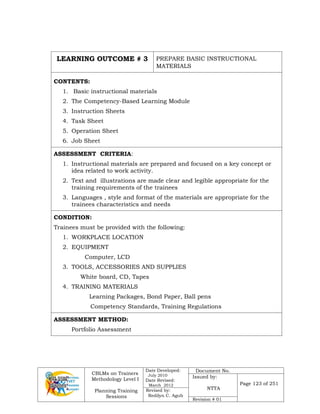
a. Learning Content comprises of the learning elements to be covered
in the learning outcome
CBLMs on Trainers
Methodology Level I
Planning Training
Sessions
Date Developed:
July 2010
Date Revised:
March 2012
Document No.
Issued by:
NTTA
Page 106 of 251
Developed by:
Redilyn C. Agub
Revision # 01
In identifying the learning contents:
1. Summarize the knowledge, skills and/or attitudes to be covered.
2. Present the learning content in small ‘chunks’ of information.
3. Arrange the learning contents logically.
Learning Contents for every Learning Outcomes are specified in the
CBC but if contents are too long to be discussed as a topic, they should be
disintegrated into chunks.
In sequencing contents, the hierarchy of learning should be taken into
consideration. Always arrange your contents from simple to complex.
Gagne’s hierarchy of learning shows how these skills are arranged from
simple to complex:
 Verbal information: Reciting something from memory
 Intellectual skills:
 Discrimination: Recognizing that two classes of things differ
 Concrete concept: Classifying things by their physical features
alone
 Defined concept: Classifying things by their abstract (and
possibly physical) features
 Rule: Applying a simple procedure to solve a problem or
accomplish a task
 Higher-order rule: Applying a complex procedure (or multiple
simple procedures) to solve a problem or accomplish a task
 Cognitive strategies: Inventing or selecting a particular mental
process to solve a problem or accomplish a task
 Attitudes: Choosing to behave in a way that reflects a newly-acquired
value or belief
 Motor skills: Performing a physical task to some specified standard
Within the intellectual skills group there is a learning hierarchy, e.g.
rules can not be learned without mastering a defined concept. To prepare an
instructional design for a given learning objective, one has to construct a
learning hierarchy (sometimes called a task analysis) and ask "what are the
intellectual skills one needs to have mastered in order to achieve an
outcome ?" Since Gagne is also an instructional designer he formulated the
"nine events of instruction" lesson design model that draws both from
behaviorism (lower levels) and cognitivism (higher levels). An idea that has
been taking up by many modern instructional design models is that
teaching should transition from simple to complex skills. It should also be
noted that outcomes can build on various components, e.g. a defined
concept can build on facts (verbal information) and appropriate attitudes.
CBLMs on Trainers
Methodology Level I
Planning Training
Sessions
Date Developed:
July 2010
Date Revised:
March 2012
Document No.
Issued by:
NTTA
Page 107 of 251
Developed by:
Redilyn C. Agub
Revision # 01
b. Presentation, Practice and Feedback
The learning activities for each LO
must ensure that:
Activities and resources to
achieve this:
First - The student is presented with
ideas, concept or process
appropriate for the LO.
(Presentation)
• Reading the INFORMATION
SHEET, Textbook as
references, manuals, resources
that can be browsed from the
internet (Google, TESDA
website, etc)
• Viewing slides, films, film
strips
• Listening to tapes
• Observing an advanced
students
Then - The student is provided an
opportunity to practice or apply
the same knowledge or skill that
was presented.
(Application of concept or methods
learned)
This activity is supported with
TASK/JOB SHEETS
• Answering Self-checks for
knowledge contents
• Solving typical problems
• Hands-on practice of a skill
using the Task Sheets,
Operation Sheets and Job
Sheets
• Critiquing case studies
• Answering questions
Finally - The student is given immediate
feedback on the result of the application
of the concept or methods performed is
receive coaching from the Trainer/
Facilitator if needed.
(Evaluation/Feedback)
• Checking answers with answer
key
• Checking finished product or
procedure with detailed
checklist.
• Having instructor critique
product or performance
This activity is supported with
Answers Keys , Procedural
Checklist and Performance
Criteria Checklist
CBLMs on Trainers
Methodology Level I
Planning Training
Sessions
Date Developed:
July 2010
Date Revised:
March 2012
Document No.
Issued by:
NTTA
Page 108 of 251
Developed by:
Redilyn C. Agub
Revision # 01
7. Learning Resources
These are materials that will be needed to support and facilitate learning of
the students/trainees.
Example:
• CBLM
• Pattern paper
• Pen and pencil
• Eraser
• Drawing instruments
• Drawing table
• Orthographic drawing
• Isometric drawing
• Elevation and section plan
8. Time (optional)
Since the approach of the learning is self-paced, time or duration of
the training is not a MUST. However, a Trainer/facilitator can opt to identify
the time or duration of the training as a basis to identify whether the trainee
is a slow or fast learner.
In documenting the learning process (Trainer’s reflection), it is
advisable to indicate how long it took for each trainee to finish and
successfully apply the process or idea presented.
9. Trainee’s Evaluation
This indicates the method of evaluating the achievement of the
Learning Outcome.
Assessment maybe:
Formative:
- This is a form of progress checks for every Learning
Outcome. Progress check can be conducted through written
tests or practical test.
Summative:
- This is a form of evaluation given at the end of the module.
This can also be conducted through written and practical
tests.
CBLMs on Trainers
Methodology Level I
Planning Training
Sessions
Date Developed:
July 2010
Date Revised:
March 2012
Document No.
Issued by:
NTTA
Page 109 of 251
Developed by:
Redilyn C. Agub
Revision # 01
In preparing the ASSESSMENT PLAN, indicate the:
Testing condition - what are the tools, equipment and supplies
and materials that will be needed
Venue of the evaluation
Type of assessment -written test
-practical tests
Type of evidence
For written tests: answer sheets
For Practical Tests:
* Training outputs – training outputs, project, products
etc.
* Result of performance test based on criteria
10. Trainer’s/Teacher’s Reflection
This part of the Session Plan serves as the documentation of the
conduct of the training on a unit of competency. Highlights of the use of the
CBLM must be recorded/documented and must be considered in the
validation/improvement of the manual.
Factors to be considered in the documentation:
- Successful moments or events experienced throughout the learning
process
- Feedback from the learners/trainees regarding the use of the CBLM
- Result of the Evaluation
Areas like sufficiency of learning content, appropriateness of learning
and evaluation methodology, well-maintained training facilities, capacity
of the Trainer to facilitate the training, sufficiency of learning resources
and other factors related to the conduct of the training shall be recorded
which shall serve as a basis for review, evaluation and improvement of
the session plan
11. Time
Although an optional requirement for self-paced training, time is still
considered as one of the essential factors in identifying effectiveness of the
training delivery and the design of learning materials.
CBLMs on Trainers
Methodology Level I
Planning Training Sessions
Date Developed:
July 2010
Date Revised:
March 2012
Document No.
Issued by:
NTTA
Page 110 of 251
Developed by:
NTTA
Revision # 01
In template form, the session plan will look like this.
SESSION PLAN
Sector :
Qualification Title :
Unit of Competency :
Module Title :
Learning Outcomes:
A. INTRODUCTION
B. LEARNING ACTIVITIES
LO 1:
Learning Content Methods Presentation Practice Feedback Resources Time
LO 2:
C. ASSESSMENT PLAN
 Written Test
 Performance Test
D. TEACHER’S SELF-REFLECTION OF THE SESSION
CBLMs on Trainers
Methodology Level I
Planning Training
Sessions
Date Developed:
July 2010
Date Revised:
March 2012
Document No.
Issued by:
NTTA
Page 111 of 251
Developed by:
Redilyn C. Agub
Revision # 01
Self-Check 1.2-3
Multiple Choice:
Choose the best answer. Write the letter of your choice to your answer
sheet.
1. This is a clearly stated trainer aid in conducting CBT.
A. Lesson plan
B. Session plan
C. Training activity matrix
D. Workshop layout
2. The main basis in planning a training session is the Competency
standard. What part of the competency standards dictates the criteria in
evaluating a skill or a competency?
A. Assessment criteria
B. Performance criteria
C. Underpinning skills
D. Critical aspect of competency
3. The learning units of a module which is termed as the elements in the CS
are called _________________ in the CBC.
A. Learning outcome
B. Performance objective
C. Learning content
D. Dimension of competency
4. In the hierarchy of learning which of the following is the simplest?
A. attitudes
B. Cognitive strategies
C. Intellectual skills
D. verbal information
III. II. Enumeration
Enumerate the 9 events of Instruction in proper order.
CBLMs on Trainers
Methodology Level I
Planning Training
Sessions
Date Developed:
July 2010
Date Revised:
March 2012
Document No.
Issued by:
NTTA
Page 112 of 251
Developed by:
Redilyn C. Agub
Revision # 01
Answer Key 1.2-3
I. Multiple Choice
1. B
2. B
3. A
4. D
II. Enumeration
1. Gain Attention
2. Inform Learners of Objectives
3. Stimulate Recall of Prior Knowledge
4. Present the stimulus/material
5. Provide guidance for learning
6. Elicit performance
7. Provide feedback
88.. Assess performance
9. Enhance retention and transfer
CBLMs on Trainers
Methodology Level I
Planning Training
Sessions
Date Developed:
July 2010
Date Revised:
March 2012
Document No.
Issued by:
NTTA
Page 113 of 251
Revised by:
Redilyn C. Agub
Revision # 01
INFORMATION SHEET 1.2-4
Learning Resources
Learning Objective:
After reading this INFORMATION SHEET, YOU MUST be able to
identify learning resources needed to support learning.
LEARNING RESOURCES
 Learning resources are the things the student will use when
carrying out the instructions outlined in the learning activities.
 Learning resources can be used to present instruction, and for
practice and feedback
I. Types of Learning Resources for Presenting Instruction
1. Print Materials
TYPE INFORMATION/CONTENT
•Textbooks, references, etc. •Facts, concepts, terms, background
information, principles, and actual
steps in performing tasks if
written well and illustrated.
•Technical, shop, and
manufacturer’s manuals
•Step-by-step procedure for
performing task using specific
make or model of a product, tool
or equipment.
•Magazines, journals, trade
publications, pamphlets, and
periodicals
•Leaders, current issues, and trends
in occupation; new advances in
technology; career awareness.
•Instructor-developed
“Instruction Sheets”
•Anything for which other resources
cannot be located.
CBLMs on Trainers
Methodology Level I
Planning Training
Sessions
Date Developed:
July 2010
Date Revised:
March 2012
Document No.
Issued by:
NTTA
Page 114 of 251
Revised by:
Redilyn C. Agub
Revision # 01
2. Non-Print Materials
TYPE INFORMATION/CONTENT
•Still visuals (with & without
sound), slides, film strips, flip
charts, photograph
• Step-by-step procedure in
performing task; interior parts or
construction of devices, close-up
shots; color.
•Motion visuals (with & without
sound)- 16mm, 8mm, film
loops & cartridges, video
tape, video discs
• Complex tasks where motion and
sequence are critical; speed up or
slow down time.
•Cassette tapes, reel-to-reel
tapes, records, and language
machines
• Recordings of specialized sounds
or noises; pronunciation of words.
3. Human Resources
TYPE INFORMATION/CONTENT
• Instructor, aide, tutor or
advanced student
• Live demonstration of skills or
presentation of knowledge for
which no learning resource is yet
available.
CBLMs on Trainers
Methodology Level I
Planning Training
Sessions
Date Developed:
July 2010
Date Revised:
March 2012
Document No.
Issued by:
NTTA
Page 115 of 251
Revised by:
Redilyn C. Agub
Revision # 01
II. Resources Used for Practice and Feedback
PRACTICE FEEDBACK
Non-Print Materials
• Tools and Instrument
• Materials and Supplies
• Equipment
• Customers
• Patrons
• Projects
• Trainers
• Simulators
• Mock-ups
• Field assignment
• Instructor, advanced students, or
aid to observe performance or
evaluate finished product
• Self-Check for evaluating
student’s own work
• Checklist or rating scale in books
or other sources for checking work
Print Materials
• Self-Checks containing
questions, problems, case
studies, situations,
activities, or other
assignments
• Review questions and
problems in books
• Oral quizzes
• Operation Sheets
• Task Sheets
• Job Sheets
• Answer key or solutions to
compare answers with
• Instructor checking answers or
assignment
• Instructor quizzing student or
critiquing report
• Procedural Checklist
• Performance Criteria Checklist
CBLMs on Trainers
Methodology Level I
Planning Training
Sessions
Date Developed:
July 2010
Date Revised:
March 2012
Document No.
Issued by:
NTTA
Page 116 of 251
Revised by:
Redilyn C. Agub
Revision # 01
III. Evaluation Instruments
Institutional Competency Evaluation Tools are packaged by competency.
These materials will serve as both formative and summative evaluation tools
that will give feedback on the progress of the trainee.
CBLMs on Trainers
Methodology Level I
Planning Training
Sessions
Date Developed:
July 2010
Date Revised:
March 2012
Document No.
Issued by:
NTTA
Page 117 of 251
Revised by:
Redilyn C. Agub
Revision # 01
Self-Check 1.2-4
Multiple Choice
Instruction: Encircle the letter of the correct answer.
1. Type of human resource for presenting instruction.
A. Customer
B. Instructor
C. Patrons
D. All of the above
2. Example of a print material as resource used fro practice and
feedback.
A. Mock-ups
B. Cassette tape
C. Job sheet
D. None of the above
3. A flip chart is what type of a non-print material?
A. Still visuals
B. Language machine
C. Motion visuals
D. All of the above
4. Contains a step-by-step for performing task using specific make or
model of a product tool or equipment.
A. Journal
B. References
C. Manufacturer’s manual
D. None of the above
5. Contains a recording of specialized sounds or noises.
A. Film strip
B. Records
C. Simulations
D. All of the above
CBLMs on Trainers
Methodology Level I
Planning Training
Sessions
Date Developed:
July 2010
Date Revised:
March 2012
Document No.
Issued by:
NTTA
Page 118 of 251
Revised by:
Redilyn C. Agub
Revision # 01
Answer Key 1.2-4
1. B
2. A
3. A
4. C
5. B
CBLMs on Trainers
Methodology Level I
Planning Training
Sessions
Date Developed:
July 2010
Date Revised:
March 2012
Document No.
Issued by:
NTTA
Page 119 of 251
Revised by:
Redilyn C. Agub
Revision # 01
JOB SHEET 1.2-4
Title : Make Session Plan
Performance Objective: Given one Learning Outcome of the competency
of your qualification, you should be able to draft a session plan
following the prescribed template.
Supplies/Materials : TR,CBC and Session Plan Template
Equipment : Personal Computer
Steps/Procedure:
1. Secure a copy of the Training Regulations and Competency-
Based Curriculum of your qualification.
2. Choose a Learning Outcome of any of the core competencies of
your qualification.
3. Based on the TR and the CBC Fill-up the template.
4. Analyze the assessment criteria to establish the contents to be
learned by the trainee for the LO.
5. Identify the main skill to be mastered, then the underpinning
skills and underpinning knowledge.
6. Sequence the contents based on the hierarchy of learning, that
is arranging the content from simple to complex.
7. Select appropriate training delivery methods for the contents.
Provision for the methods for the trainees of different
characteristics and needs should be considered in planning for
the methods to be used.
8. Presentation activities should be planned based on methods to
be used.
9. Be sure to have complete activities for presentation, practice and
feedback for each method used.
10. List down resources to be used.
11. Fill-up the section for the Assessment Method.
12. Evaluate your work using the Performance Criteria Checklist
before submitting your work to your trainer. Be sure that all
criteria are complied with.
Assessment Method:
Portfolio Assessment
CBLMs on Trainers
Methodology Level I
Planning Training
Sessions
Date Developed:
July 2010
Date Revised:
March 2012
Document No.
Issued by:
NTTA
Page 120 of 251
Revised by:
Redilyn C. Agub
Revision # 01
Performance Criteria Checklist 1.2-4
Trainee’s Name: ________________________________ Date: ___________________
Criteria YES NO
1. Is the qualification title in the session plan the same with
the qualification title of the modules of instruction?
2. Is the module title indicated the same with the title of the
modules of instruction?
3. Is the nominal duration of the session plan the same with
duration indicated in the modules of instruction?
4. Does the introduction provide information on what is to be
learned in the module?
5. Does the introduction give emphasis to the importance of
the module?
6. Does the learning introduction provide information that
relates to the current module the learners should learn?
7. Are the learning outcomes in the session plan the same with
the modules of instruction?
8. Are the learning contents directly related to the skill to be
mastered?
9. Are the learning contents sequenced by complexity from
simple to complex?
10. Is there a provision of different methods to cater to
trainees with different characteristics?
11. Is the selected mode of delivery of presentation
appropriate for the trainee’s needs?
12. Is the selected activity to practice appropriate for the
trainee’s characteristics and needs?
13. Do the feedback activities provide immediate monitoring
of the trainee’s performance?
14. Does the feedback measure the key factors of learning?
15. Are the resources listed sufficient for the presentation,
practice and feedback activities?
16. Can the required resources be made available on the
execution of the learning experience?
17. Is the time allotment for each learning activity sufficient
CBLMs on Trainers
Methodology Level I
Planning Training
Sessions
Date Developed:
July 2010
Date Revised:
March 2012
Document No.
Issued by:
NTTA
Page 121 of 251
Revised by:
Redilyn C. Agub
Revision # 01
Criteria YES NO
to develop the required competence?
18. Is the total time allotment for each learning activity the
same with the nominal duration indicated?
19. Does the assessment plan provide information about the
assessment criteria?
20. Does the assessment provide information on the type of
assessment?
21. Does the assessment provide information on the type of
evidence?
Comments/Suggestions:
Trainer: ___________________________________ Date: ___________________
CBLMs on Trainers
Methodology Level I
Planning Training
Sessions
Date Developed:
July 2010
Date Revised:
March 2012
Document No.
Issued by:
NTTA
Page 122 of 251
Revised by:
Redilyn C. Agub
Revision # 01
Assignment Sheet 1.2-4
Session Plan
Objective: Given a qualification, you should be able to make a complete
session plan for all COMPETENCIES.
Steps/Procedure:
1. Download the TR and CBC of the qualification assigned to you from
the TESDA website, www.tesda.gov.ph.
2. Make a complete session plan for your qualification.
3. Present your completed session plan on __________________________ .
CBLMs on Trainers
Methodology Level I
Planning Training
Sessions
Date Developed:
July 2010
Date Revised:
March 2012
Document No.
Issued by:
NTTA
Page 123 of 251
Revised by:
Redilyn C. Agub
Revision # 01
LEARNING OUTCOME # 3 PREPARE BASIC INSTRUCTIONAL
MATERIALS
CONTENTS:
1. Basic instructional materials
2. The Competency-Based Learning Module
3. Instruction Sheets
4. Task Sheet
5. Operation Sheet
6. Job Sheet
ASSESSMENT CRITERIA:
1. Instructional materials are prepared and focused on a key concept or
idea related to work activity.
2. Text and illustrations are made clear and legible appropriate for the
training requirements of the trainees
3. Languages , style and format of the materials are appropriate for the
trainees characteristics and needs
CONDITION:
Trainees must be provided with the following:
1. WORKPLACE LOCATION
2. EQUIPMENT
Computer, LCD
3. TOOLS, ACCESSORIES AND SUPPLIES
White board, CD, Tapes
4. TRAINING MATERIALS
Learning Packages, Bond Paper, Ball pens
Competency Standards, Training Regulations
ASSESSMENT METHOD:
Portfolio Assessment
CBLMs on Trainers
Methodology Level I
Planning Training
Sessions
Date Developed:
July 2010
Date Revised:
March 2012
Document No.
Issued by:
NTTA
Page 124 of 251
Revised by:
Redilyn C. Agub
Revision # 01
Learning Experiences
Learning Outcome 3
PREPARE BASIC INSTRUCTIONAL MATERIALS
Learning Activities Special Instructions
1. Read Information Sheet 1.3-1 on
Basic Instructional materials
The focus of this Learning Outcome
is the development of Competency-
Based Learning Materials.
Go through the activities to guide
you in developing a material which
you can use in delivering
Competency-based Training (CBT).
The output of this learning outcome
is a CBLM for one learning outcome
of the competency of your choice.
This material should be based on the
session plan you developed in LO2.
Be sure to show your outputs to
your trainer as you finish each task
so that he can guide you on
developing them.
The sample CBLM will be your
portfolio for the Institutional
Competency Evaluation.
Written test and interview is a part
of the Institutional Competency
Evaluation so be sure to go over the
Information sheets before performing
the tasks.
2. Answer Self-check 1. 3-1
Compare your answers with Answer
Key 1.3-1
3. Read Information Sheet 1.3-2 on the
Competency-Based Learning Module
4. Answer Self-check 1. 3-2
Compare your answers to Answer Key
1.3-2
5. Perform Task Sheet 1.3-2 on how to
write the preliminary pages of the
CBLM
Evaluate your output using the
Performance Criteria Checklist before
showing it to your trainer.
6. Read Information Sheet 1.3-3 on
Instruction Sheets
7. Answer self-check 1. 3-3
Compare your answers to Answer Key
1.3-3
8. Perform Task Sheet 1.3-3 on how to
develop an Information Sheet
Evaluate your output using the
Performance Criteria Checklist before
showing it to your trainer.
9. Read Information Sheet 1.3.4 on
Task Sheet
10. Answer Self-check 1. 3-4
Compare your answers to Answer Key
1.3-4
CBLMs on Trainers
Methodology Level I
Planning Training
Sessions
Date Developed:
July 2010
Date Revised:
March 2012
Document No.
Issued by:
NTTA
Page 125 of 251
Revised by:
Redilyn C. Agub
Revision # 01
11. Perform Task Sheet 1.3-4 on
writing a Task Sheet
Evaluate your output using the
Performance Criteria Checklist before
showing it to your trainer.
12. Read Information Sheet 1.3.5 on
Operation Sheet
13. Perform Task Sheet 1.3-5 on
writing a Task Sheet
14. Evaluate your output using the
Performance Criteria Checklist before
showing it to your trainer.
15. Read Information Sheet 1.3-6 on
Job Sheet
16. Perform the task sheet 1.3-6 on
writing a Job Sheet
Evaluate your output using the
Performance Criteria Checklist before
showing it to your trainer.
17. Perform the Job Sheet 1.3-6 on
make a CBLM Package
Use the CBLM Evaluation tool to
evaluate your output.
CBLMs on Trainers
Methodology Level I
Planning Training
Sessions
Date Developed:
July 2010
Date Revised:
March 2012
Document No.
Issued by:
NTTA
Page 126 of 251
Revised by:
Redilyn C. Agub
Revision # 01
INFORMATION SHEET 1.3-1
Basic Instructional Materials
Learning Objective:
After reading this INFORMATION SHEET, YOU MUST be able to:
1. enumerate different forms of instructional materials;
2. identify the factors to be considered when making the CBLM.
Competency-based training is dependent on the readiness of learning
materials. In this lesson we will discuss varied learning materials to address
the different factors to be considered in designing Competency-based
Learning Materials (CBLM).
Competency-Based Learning Material (CBLM) Package is simply a
well-designed and carefully developed learning materials that give trainees
detailed instructions to guide them through the learning process.
Competency-Based Learning Materials (CBLM) refer to
1. Media that contain information related to work requirement;
2. Learning that is guided toward achieving the competency required in
a workplace;
3. Tools that facilitate individual learning process;
4. Instruments that measure the competency required in the workplace.
Different forms of learning materials
1. Learning guides,
2. Assessment materials,
3. Workbook with activities, tasks and content
4. Background reading materials or documents
5. Hand outs and other audio visual materials
6. Industry competency standards
7. Organizational policies, procedures or legislations
CBLMs on Trainers
Methodology Level I
Planning Training
Sessions
Date Developed:
July 2010
Date Revised:
March 2012
Document No.
Issued by:
NTTA
Page 127 of 251
Revised by:
Redilyn C. Agub
Revision # 01
Factors to be considered when developing the CBLM
1. Principles of CBT
2. Training regulations
3. Trainees characteristics
4. Characteristics of Adult Learners
5. Learning styles
6. Nine events of instruction
7. Dimensions of Competency
Principles of CBT
Competency-Based Training is characterized as individualized and
self-paced, and this is made possible through the use of self-paced learning
materials. Some of the principles of competency-based training that have to
be considered in preparing Competency-Based Learning Materials are the
following:
1. Learning is based on competency required in a workplace;
2. Training materials are directly related to the competency standards
and the curriculum;
3. Training is geared toward performance activities;
4. Criteria for assessing is based on workplace standard;
5. Assessment uses actual performance or evidence related to work
requirement;
6. Learning is done by the learner at own pace.
Training Regulations
The main basis of CBT is the competency standards in the training
regulations. In writing the CBLM it is crucial that you:
• Have a detailed knowledge of the relevant competencies
• Can visualise what competent performance would look like in the
workplace
• Use these understandings to make decisions on the structure,
learning activities and content of the materials we are writing
A thorough analysis of the Competency Standard is a very vital
process before developing your materials. The process is summarized as
follows
1. Each learning outcome within the unit competency needs to be
analysed by considering the performance criteria
CBLMs on Trainers
Methodology Level I
Planning Training
Sessions
Date Developed:
July 2010
Date Revised:
March 2012
Document No.
Issued by:
NTTA
Page 128 of 251
Revised by:
Redilyn C. Agub
Revision # 01
2. For each performance criterion the writer then identifies the
embedded knowledge and skills needed for performance. Many of
the underpinning skills and knowledge are identified in the
evidence guide section of the competency but a prudent trainer will
check this against their knowledge of the learner’s workplace.
Within the learning outcome you should be able to identify the
main task to be mastered before identifying the knowledge contents
essential in the attainment of the main task/skill. You should be
able to determine how this task is related to the main skill of the
competency.
The trainer should take note that a competency is divided into
smaller chunks in the learning outcomes. Combining the tasks
learned in the learning outcomes would complete the competency.
3. The range statements and evidence guides should then be carefully
examined for additional embedded knowledge and skills or to
clarify already identified embedded knowledge and skills
4. Finally the range of variables should be analysed to determine the
context and conditions to which the performance criteria apply.
5. Overlaps in knowledge and skills to the various learning outcomes
and competencies should be identified so that you can efficiently
structure you CBLM.
Trainees Characteristics
Potential barriers to learning may takes its root from the trainees
characteristics. As the trainer, you should be sensitive to these possibilities
so that you can overcome these barriers. Below are some suggested way to
overcome barriers.
Potential Barriers Suggested ways to overcome
Language, Literacy
and Numeracy
Low language, literacy and numeracy is a fact among
trainees in Philippine TVET. To overcome this:
• Use simple language
• Emphasis on pictorial learning materials
• Pairing or “buddy’ approaches
• Ensure reference materials include simple texts
Diversity Diversity in gender, race, age, disability, sexual
orientation, cultural background and socio economic
status
• Consider the diversity of potential learners in
CBLMs on Trainers
Methodology Level I
Planning Training
Sessions
Date Developed:
July 2010
Date Revised:
March 2012
Document No.
Issued by:
NTTA
Page 129 of 251
Revised by:
Redilyn C. Agub
Revision # 01
Potential Barriers Suggested ways to overcome
designing and writing materials
• Include texts or examples that reflect a diversity of
perspectives
• Acknowledge the diversity of knowledge and
experience of the learners
• Provide a range of learning opportunities
• Avoid using potentially offensive stereotypes or
assumptions
• Use plain English, explain acronyms and avoid
colloquialisms
• Actively discourage language that is racist, sexist,
homophobic or demeans people
Disabilities • Avoid fast paced or physically complex learning
tasks
• Attention to the physical environment that learning
is to take place
• Use plain English in training materials and where
possible
• make them available in large print and electronic
formats
• Be flexible in your training options
• Consider what support may need to be offered
• Consider ‘reasonable adjustment’ in assessments
Personal • Adults frequently have significant constraints to
their capacity or motivation to engage in learning
activities. Family and work commitments frequently
mean time is a premium.
• Other personal barriers may show up because of bad
experiences in school or stigma attached to the lack
of skills and knowledge.
• Provide support and understanding for adults who
are striving to learn
• Some learning may need to be designed to affect a
change in a learners belief and values systems
• Accommodate different learning preferences in the
design and delivery of training or learning
• Be flexible
CBLMs on Trainers
Methodology Level I
Planning Training
Sessions
Date Developed:
July 2010
Date Revised:
March 2012
Document No.
Issued by:
NTTA
Page 130 of 251
Revised by:
Redilyn C. Agub
Revision # 01
Potential Barriers Suggested ways to overcome
• Ensure there is a match between the persons needs
and the training or learning activities
• Relate the training or learning to the learners
performance
• Build in opportunities for feedback and
reinforcement
Isolation Location of training venue or learning support in relation
to the learner or other providers.
• Provide information or support for transport to the
venue
• Consider how you can improve access to face-to-face
and other forms of support when using ‘distance
learning’ methods
• Facilitate networking with other learners or people
who can mentor or coach the learner
Key Characteristics of Adult Learners
Adult learners desire that learning be:
• relevant;
• task-oriented;
• participatory (two-way communication);
• friendly (controlled stress, positive feedback);
• varied (demonstrations, case-studies, role play; not just lectures); and
• built on past experience.
These characteristics are based on the following eight principles of adult
learning (Sullivan et al 1995):
• Learning is most productive when the student is ready to learn.
Although motivation is internal, it is up to the clinical trainer to create
a climate that will nurture motivation.
• Learning is most effective when it builds on what the student already
knows or has experienced.
• Learning is most effective when students are aware of what they need
to learn.
• Learning is made easier by using a variety of training methods and
techniques.
CBLMs on Trainers
Methodology Level I
Planning Training
Sessions
Date Developed:
July 2010
Date Revised:
March 2012
Document No.
Issued by:
NTTA
Page 131 of 251
Revised by:
Redilyn C. Agub
Revision # 01
• Opportunities to practice skills initially in controlled or simulated
situations (e.g., through role play or use of anatomic models) are
essential for skill acquisition and for development of skill competency.
• Repetition is necessary to become competent or proficient in a skill.
• The more realistic the learning situation, the more effective the
learning.
• To be effective, feedback should be immediate, positive and
nonjudgmental
Learning Styles
In LO 1 of this competency, we discussed about the different learning
styles. This affect how trainees, gather, organize and think about the
information they acquire from learning. A deeper understanding of each of
the learning style will help you vary the activities both in facilitating learning
sessions and in developing your learning materials. Since you are
developing a learning material which will cater to a wider audience, you
should consider how trainees with different learning style learn.
Nine events of instruction
The sequence of learning activities in the session plan was guided by
the nine events of instruction. In developing your CBLM, it will likewise be
helpful to think of the Robert Gagne’s nine events of instruction as a guide.
The following suggestions may be incorporated into the CBLM to ensure that
these steps are addressed and the module provides activities for self-paced
learning.
Gain Attention Capture the learners attention at the start of each
topic or learning activity by using such things as:
�A thought provoking question
�Storytelling
�Interesting facts
�Case studies
The introdution of every learning content should
be structured such that it catches the attention of
the trainee.
Inform Learners of
Objectives
Providing the learner with specific, measurable
objectives that guide them in the learning process
and assist the learner to organise their thoughts
around what they are about to learn.
A good objective is not a description of the course
contents rather they inform learners of what they
will be able to do under what conditions and to
CBLMs on Trainers
Methodology Level I
Planning Training
Sessions
Date Developed:
July 2010
Date Revised:
March 2012
Document No.
Issued by:
NTTA
Page 132 of 251
Revised by:
Redilyn C. Agub
Revision # 01
what standards. Well framed objectives use
specific verbs like:
�list
�identify
�state
�describe
�define
�solve
�compare and contrast
�operate
Avoid broad objectives such as know, learn and
understand.
Stimulate Recall of
Prior Knowledge
This allows the trainees to build on their previous
knowledge or skills. It is easier for trainees to
encode and store information in long term
memory when they can make linkages to their
previous experiences and knowledge.
The introduction of the information sheet should
contain the recall and rejoinder.
Present the material Chunk the information and organise it to appeal
to the different learning styles.
Provide guidance for
learning
This is not the presentation of content. It is
assistance to facilitate the long term storage of the
new knowledge. Approaches include use of
examples, case studies, graphical representations
and analogies. This is the body of the information
sheet where the content is developed. The
information sheet should contain not only the
facts but how the facts relate to the skill to be
mastered.
Elicit performance Provide the opportunity to practice by providing
an opportunity for the learner do something with
the newly acquired behaviour, skills, or
knowledge. Repetition increases retention.
For knowledge content, our CBLM format
recommends the use of self-checks and for skills,
you should provide a well structured task sheets,
operation sheets and job sheets.
Provide feedback As learners practice it is important to provide
timely
feedback on their performance. This feedback
needs to be specific, not, "you are doing a good
job" Tell them "why" they are doing a good job or
provide specific guidance on how they can
improve.
Your CBLM should provide answer keys to self-
CBLMs on Trainers
Methodology Level I
Planning Training
Sessions
Date Developed:
July 2010
Date Revised:
March 2012
Document No.
Issued by:
NTTA
Page 133 of 251
Revised by:
Redilyn C. Agub
Revision # 01
checks and Performance Criteria Checklist. This
will allow self-evaluation and peer evaluation
which are immediate feedback to trainee’s
practice. The trainee should, however, give his
feedback to every performance of the trainee
based on the assessment criteria.
Assess performance On completion of learning activities learners
should be given the opportunity for assessment.
Enhance retention
and
transfer
Learners should be encouraged to plan the
application of the learning and to consider how to
maintain competence into the future. They may
also be encouraged to review the learning process
they have just completed.
For every competency, there should be an
opportunity to integrate tasks learned in all
Learning Outcomes of the competency. Job
Sheets with different conditions should be
developed to give the trainee an opportunity to
shift or adjust as the condition changes.
Dimensions of competency
The CBLM should provide for the acquisition of the four (4)
dimensions of competency - task skills, task management skills, job role and
environment management skills and contingency management skills.
Sometimes learning materials focus on the task skills and task management
skills. Job role and environment management skills are hardly integrated
except when discussing the occupational health and safety practices. When
you develop your material, be sure to integrate activities that would make
the trainee realize responsibilities towards customer, employer, co-worker
and most specially the environment. When discussing rules and regulations
and laws that govern the occupation or job, instructional materials should
provide activities that will help them learn to adjust to different situations or
conditions of the job.
CBLMs on Trainers
Methodology Level I
Planning Training
Sessions
Date Developed:
July 2010
Date Revised:
March 2012
Document No.
Issued by:
NTTA
Page 134 of 251
Revised by:
Redilyn C. Agub
Revision # 01
Self-Check 1.3-1
I. Enumeration
1-5 Principle of CBT that have to be considered in developing the CBLM
6-10 Factors to be considered when developing the CBLM
11-15 Characteristics of Adult Learners
16–20 Principles of Adult Learning
CBLMs on Trainers
Methodology Level I
Planning Training
Sessions
Date Developed:
July 2010
Date Revised:
March 2012
Document No.
Issued by:
NTTA
Page 135 of 251
Revised by:
Redilyn C. Agub
Revision # 01
Answer Key 1.3-1
1-5 Principle of CBT that have to be considered in developing the
CBLM
1. Learning is based on competency required in a workplace;
2. Training materials are directly related to the competency standards
and the curriculum;
3. Training is geared toward performance activities;
4. Criteria for assessing is based on workplace standard;
5. Assessment uses actual performance or evidence related to work
requirement;
Learning is done by the learner at own pace.
6-10 Factors to be considered when developing the CBLM
6. Principles of CBT
7. Training regulations
8. Trainees characteristics
9. Characteristics of Adult Learners
10. Learning styles
* Nine events of instruction
* Dimensions of Competency
11-15 Characteristics of Adult Learners
Adult learners desire that learning be:
• relevant;
• task-oriented;
• participatory (two-way communication);
• friendly (controlled stress, positive feedback);
• varied (demonstrations, case-studies, role play; not just
lectures); and
• built on past experience.
16-20 Principles of adult learning
• Learning is most productive when the student is ready to learn.
Although motivation is internal, it is up to the clinical trainer to
create a climate that will nurture motivation.
CBLMs on Trainers
Methodology Level I
Planning Training
Sessions
Date Developed:
July 2010
Date Revised:
March 2012
Document No.
Issued by:
NTTA
Page 136 of 251
Revised by:
Redilyn C. Agub
Revision # 01
• Learning is most effective when it builds on what the student
already knows or has experienced.
• Learning is most effective when students are aware of what they
need to learn.
• Learning is made easier by using a variety of training methods and
techniques.
• Opportunities to practice skills initially in controlled or simulated
situations (e.g., through role play or use of anatomic models) are
essential for skill acquisition and for development of skill
competency.
• Repetition is necessary to become competent or proficient in a skill.
• The more realistic the learning situation, the more effective the
learning.
• To be effective, feedback should be immediate, positive and
nonjudgmental
CBLMs on Trainers
Methodology Level I
Planning Training
Sessions
Date Developed:
July 2010
Date Revised:
March 2012
Document No.
Issued by:
NTTA
Page 137 of 251
Revised by:
Redilyn C. Agub
Revision # 01
Module Content
Module Content
Module Content
Module ContentCompetency Summary
Learning Outcome Summary
Learning Experiences
Information Sheet
Self Check
Self Check Answer Key
Operation/Task/Job Sheet
Performance Criteria Checklist
References/Further Reading
PARTS OF A COMPETENCY-BASED LEARNING MATERIAL
PACKAGE
In our efforts to standardize CBLM, the
above parts are recommended for use
in Competency Based Training (CBT) in
Technical Education and Skills
Development Authority (TESDA)
Technology Institutions. The next
sections will show you the components
and features of each part.
List of Competencies
Front Page
CBLMs on Trainers
Methodology Level I
Planning Training
Sessions
Date Developed:
July 2010
Date Revised:
March 2012
Document No.
Issued by:
NTTA
Page 138 of 251
Revised by:
Redilyn C. Agub
Revision # 01
Information Sheet 1.3-2
Competency-Based Learning Module
Learning Objectives:
After reading this INFORMATION SHEET, YOU MUST be able to:
1. enumerate the preliminary pages of the CBLM;
2. describe the components of each page of the CBLM.
In the previous information sheet, we have discussed the factors to
consider when writing a CBLM. You learned how these factors would help
in planning for the development of the CBLM.
In this lesson, you will be introduced to the different parts of the
CBLM.
Parts of the CBLM
A. Preliminary pages
2. Front Page
3. Trainee’s Guide on How to Use the CBLM
4. List of Competencies
5. Competency Summary
6. Learning Outcome Summary
7. Learning Experiences
B. Instruction Sheets
1. Information Sheet
2. Self-Check
3. Task Sheet
4. Operation Sheet
5. Job Sheet
6. Performance Criteria Checklist
CBLMs on Trainers
Methodology Level I
Planning Training
Sessions
Date Developed:
July 2010
Date Revised:
March 2012
Document No.
Issued by:
NTTA
Page 139 of 251
Revised by:
Redilyn C. Agub
Revision # 01
Components of the front Page
Title:
Competency-Based
Learning Material is on
topmost part of the page
Picture:
The picture is an action
picture of the competency
with TESDA official logo
Sector:
The sector to which the
qualification is classified.
This is specified in the
Training Regulations and
the Competency Based
Curriculum
Qualification Title:
The title of the
qualification as stated in
the Training Regulations
Unit of Competency :
The unit of competency as
stated in the CBC
Module Title : The Unit
of Competency stated
with a verb in the present
participle (-ing) form
Name of the School:
The school that developed
the CBLM should be
reflected in the front or
cover page
Institution
quality
assurance
system and the
institution’s
logo
The Qualification
Title and Module
Title
Date Developed,
Date Revised and
the Name of the
Developer
Document
Number (control #)
as per institution’s
QA system
A space for the
issuer of the
document
Revision #
(Revision
number is
00 for the
first
printing of
the
module) Page
Number
CBLMs on Trainers
Methodology Level I
Planning Training
Sessions
Date Developed:
July 2010
Date Revised:
March 2012
Document No.
Issued by:
NTTA
Page 140 of 251
Revised by:
Redilyn C. Agub
Revision # 01
Trainees Guide on How to Use the CBLM
This is a page that gives instructions on how the CBLM Material is
used in training. A sample of the page is shown below.
CBLMs on Trainers
Methodology Level I
Planning Training
Sessions
Date Developed:
July 2010
Date Revised:
March 2012
Document No.
Issued by:
NTTA
Page 141 of 251
Revised by:
Redilyn C. Agub
Revision # 01
List of Competencies – this page contains the Qualification Title on top of
the page. A table follows with the following columns:
a. Competency Number – the competencies should be numbered
as they are arranged in the TR.
b. Unit of Competency – The units of competency should be
reflected in this column as they are stated in the TR and the
CBC.
c. Module Title – The Module title is the unit of competency
whose verb is in the present participle (-ing) form.
d. Code – the unit code is indicated in the TR and the CBC of the
qualification. The Code should be copied as it is.
Note: The whole row of the module should be bold-faced and italicized to emphasize
that it is the competency discussed in the module.
CBLMs on Trainers
Methodology Level I
Planning Training
Sessions
Date Developed:
July 2010
Date Revised:
March 2012
Document No.
Issued by:
NTTA
Page 142 of 251
Revised by:
Redilyn C. Agub
Revision # 01
Module Content– This page reflects the contents and the skills discussed in
the module particularly stated in the unit descriptor. In the unit descriptor,
you may include the underpinning attitudes, knowledge and skills. The
learning outcomes are listed in chronological order as they are listed in the
TR and the CBC although the learning outcomes maybe learned in no
particular order unless pre-requisites are needed. All Assessment Criteria
are summarized here.
CBLMs on Trainers
Methodology Level I
Planning Training
Sessions
Date Developed:
July 2010
Date Revised:
March 2012
Document No.
Issued by:
NTTA
Page 143 of 251
Revised by:
Redilyn C. Agub
Revision # 01
Learning Outcome Summary
This page is a summary of the learning outcome. Below is a sample
page.
Contents – These are the
topics particularly stated in
the TR either as content,
underpinning attitude,
knowledge or skill or as
deemed necessary to achieve
the performance criteria by
the trainer/developer
Assessment Criteria – These
are the performance criteria
identified in the TR as
measures to assess the
competence of the trainee.
Condition – This is a list of
workplace location,
equipment, tools, accessories
and supplies, and training
materials needed by the
training to attain competence
in the particular LO.
Assessment Method – this is
a list of expected assessment
method or instruments to
measure learning.
CBLMs on Trainers
Methodology Level I
Planning Training
Sessions
Date Developed:
July 2010
Date Revised:
March 2012
Document No.
Issued by:
NTTA
Page 144 of 251
Revised by:
Redilyn C. Agub
Revision # 01
Learning Experiences – this page has the Learning Outcome number and
title and a table of all the activities for presentation, practice and feedback
the trainee can undergo for him to attain the required competence. Special
instructions are provided for the trainee to provide directions on the
following:
a. what training materials to secure
b. where to secure or access instructional materials
c. Information Sheets, Operation sheets, Task Sheets and Self-
Check to be used.
d. Recommended sequence of activities
CBLMs on Trainers
Methodology Level I
Planning Training
Sessions
Date Developed:
July 2010
Date Revised:
March 2012
Document No.
Issued by:
NTTA
Page 145 of 251
Revised by:
Redilyn C. Agub
Revision # 01
Self- Check of 1.3-2
Multiple Choice: Choose the correct letter that best describe the statement.
Write your answer in capital letter on your answer sheet.
1. This page has the Learning Outcome number and title and a table of all
the activities for presentation, practice and feedback the trainee can
undergo to attain the required competence this term refers to:
A. Learning Experiences
B. Learning Outcome summary
C. Module content
D. Module title
2. This is a page that contains the content, assessment criteria and
assessment method
A. List of competencies
B. Learning Outcome summary
C. Module content
D. Module title
3. This page contains the Qualification Title on top of the page and a
competency number, unit of competencies, module title and the code in
each column.
A. Front cover
B. List of competencies
C. Learning outcome summary
D. Module content
E. Unit of competencies
4. This page reflects the contents and the skills to be discussed as stated in
the unit descriptor.
A. Front cover
B. List of competencies
C. Learning outcome summary
D. Module content
E. Unit of competencies
CBLMs on Trainers
Methodology Level I
Planning Training
Sessions
Date Developed:
July 2010
Date Revised:
March 2012
Document No.
Issued by:
NTTA
Page 146 of 251
Revised by:
Redilyn C. Agub
Revision # 01
ANSWER KEY 1.3-2
1. A
2. B
3. B
4. D
CBLMs on Trainers
Methodology Level I
Planning Training
Sessions
Date Developed:
July 2010
Date Revised:
March 2012
Document No.
Issued by:
NTTA
Page 147 of 251
Revised by:
Redilyn C. Agub
Revision # 01
TASK SHEET 1.3-2
Title: Write Preliminary Pages of the CBLM
Performance Objective: Given one Competency of the qualification
assigned to you, you should be able to write
preliminary pages of one module of your
qualification following the suggested templates.
Supplies/Materials : TR and CBC
Equipment : PC, printer with ink
Steps/Procedure:
1. Select one competency of your qualification.
2. Secure a copy of your Competency-Based Curriculum. You will
need this in this activity.
3. Draft the cover of the CBLM.
4. Using the sample templates given to you, write the trainees
guide in using the CBLM for this competency.
5. Write the page for the List of competencies. Highlight the name
of the competency you are developing. Make sure that the row
for this competency is italicized and bold faced.
6. Write the page for the Competency Summary.
7. Using the template, draft the learning outcome summary of the
LO of your choice.
8. Refer to the session plan you developed in LO 1 and draft the
Learning Experiences. You may go back to this page for
revisions later after you have finalized the contents of your
CBLM.
9. Evaluate your own output using the Performance Criteria
Checklist.
10. Present your work to your trainer.
Assessment Method:
Portfolio Assessment
CBLMs on Trainers
Methodology Level I
Planning Training
Sessions
Date Developed:
July 2010
Date Revised:
March 2012
Document No.
Issued by:
NTTA
Page 148 of 251
Revised by:
Redilyn C. Agub
Revision # 01
Performance Criteria Checklist 1.3-2
CRITERIA YES NO
Are the following contents present on the pages
Cover
1. Title (Competency-Based Learning Materials)
2. Sector
3. School/Training Center Logo
4. Qualification Title
5. Unit of Competency
6. Module Title (gerund: ing)
7. Name of TTI
Preliminary pages
1. Instructions on how to use the CBLM are clear.
2. List of competencies highlighting the competency
in the module.
3. Summary of Learning Outcomes and Assessment
Criteria; must contain the following in conformity
with the CBC (Module of Instructions);
 Program/Course eg: SMAW NC II
 Unit of Competency
 Module Title
 Introduction
 Learning Outcomes
 Assessment Criteria(summary of all criteria
for the competency)
 Prerequisite
4. Learning Outcome Summary contain the following;
 Learning Outcome Title
 List of Contents
 List of Assessment Criteria specific to the
learning outcome
 Conditions (the list of resources that the
trainee will use to attain the learning
outcome)
 Assessment Methods
CBLMs on Trainers
Methodology Level I
Planning Training
Sessions
Date Developed:
July 2010
Date Revised:
March 2012
Document No.
Issued by:
NTTA
Page 149 of 251
Revised by:
Redilyn C. Agub
Revision # 01
Information Sheet 1.3-3
Instruction Sheets
Learning Objectives: After reading this INFORMATION SHEET, YOU MUST
be able to:
1. identify the types of instruction sheet in a CBLM;
2. discuss guidelines in developing the instruction sheet;
Preliminary pages of the CBLM discussed in previous information
sheets summarize the contents of the materials. In this lesson, we shall be
discussing the main pages of the CBLM called the instruction sheets.
In our efforts to standardize the format of the instruction sheets, we
will discuss the contents and format in this lesson. Guidelines and tips in
writing the instruction sheets will help you improve your writing skills.
Types of Instruction Sheets
Since instruction sheet is designed to guide the trainee on the
different things to be done to learn a unit of competency, different
instruction sheets will be required for different learning activities.
1. Information Sheet
2. Task Sheet
3. Operation Sheet
4. Job Sheet
We will discuss these sheets in detail as go on.
Guidelines in Developing Instructions Sheet
 Use language that is straight forward and is easily understood by the
trainees for whom the material is intended. Define new terms, and do
not use words or phrases that are unusual or ambiguous.
 Supplement the words with illustrations, pictures and diagrams for
greater clarity.
 Give specific directions that are clear and concise. Carefully think
through the sequence of directions.
 Limit each instruction sheet to one to ten sheets of paper if possible,
but avoid overcrowding the page.
 Separate the various items, points, or paragraphs by spacing, by
numbers, letters or bullets.
 Develop a uniform format for all instruction sheets so trainees can
easily find the desired information. Space the various divisions of the
CBLMs on Trainers
Methodology Level I
Planning Training
Sessions
Date Developed:
July 2010
Date Revised:
March 2012
Document No.
Issued by:
NTTA
Page 150 of 251
Revised by:
Redilyn C. Agub
Revision # 01
sheet – such as title, purpose, illustrations and text – to produce an
easily to read and attractive documents.
 Using underlining to emphasize or to distinguish between headings,
subheadings, and content.
 Be consistent in the use of terminology to avoid confusion.
 Include only relevant information. Avoid filling the sheet with
irrelevant or unnecessary information, no matter how fascinating it
may seem.
Information Sheet
Information sheet is not a copy or duplicate of an article from
magazine, newspaper or book. An information sheet is developed when
there are no resources available to explain the required information or to
summarize an article that illustrate new trends and technology and present
hard-to-find data. An information sheet is primarily designed to deliver
pertinent information needed in the attainment of a learning outcome.
A good information sheet has the following characteristics or conforms to
the following criteria:
1. Free from violation of copyright law
2. Contains information essential to the attainment of the learning
outcomes
3. Has a title that gives some idea of the coverage of the sheet
4. Approach in terms of content and presentation is appropriate to the
interest and reading level of the learner
5. The layout, text and drawings are attractive in appearance and legible
6. Has uncommon terms marked for further defining
7. Has acknowledgement per copied part of the sheet
Tips in writing Information Sheets
1. Make sure that the reading level matches that of your trainees
2. Use short paragraphs
3. Use short, concise sentences
4. Position illustrations to the side or just below the sentences referring
to the illustrations
5. Keep information sheet brief
CBLMs on Trainers
Methodology Level I
Planning Training
Sessions
Date Developed:
July 2010
Date Revised:
March 2012
Document No.
Issued by:
NTTA
Page 151 of 251
Revised by:
Redilyn C. Agub
Revision # 01
Parts of Information Sheet:
1. Learning Objectives:
Statements about what a trainee will gain from a course or activity.
These are specific statements about exactly what a trainee should know, be
able to do, or value as a result of accomplishing a learning goal.
Since the information sheet is more on the acquisition of knowledge
related to the main task/skill to be mastered, learning objectives for the
information sheets should be kept on a knowledge level.
Learning Objectives
Introduction/
Overview
Body/Text
CBLMs on Trainers
Methodology Level I
Planning Training
Sessions
Date Developed:
July 2010
Date Revised:
March 2012
Document No.
Issued by:
NTTA
Page 152 of 251
Revised by:
Redilyn C. Agub
Revision # 01
Guidelines for preparing Learning Objectives:
The following guidelines are provided to assist in the development of
appropriate learning objectives for a proposed educational experience:
Step 1. Describe the information, skills, behaviors, or perspectives
trainees in the session will acquire through attendance and
participation.
Step 2. Clearly identify the outcomes or actions trainees can expect to
demonstrate as a result of the educational experiences. See the
action words below.
Step 3. Write the learning objectives that relate to these outcomes and
that reflect the content of the session. Objectives describe the
behavior of the trainee, and:
 are stated clearly
 define or describe an action
 are measurable, in terms of time, space, amount, and/or
frequency.
Example of Measurable Action Words:
Explain, Compare, Evaluate, Differentiate, Identify, Analyze,
Describe, Formulate, Name, Define, Discuss, Assess, List
Note: Avoid the following action words: know, understand, learn and other
verbs that are too broad.
Make learning objectives SMART
Performance objectives should be SMART; that is, Specific,
Measurable, Achievable, Relevant, and Time Bounded.
Specific - Performance objectives must be very clear and detailed enough so
as to leave no room for ambiguity or misinterpretation.
Measurable - Always use a verifiable verb and describe an action that can
be seen and measured.
Achievable - Performance objectives should always be attainable.
Relevant - Performance objectives should be relevant to the performer –
they should relate to the objectives that matter to that person.
CBLMs on Trainers
Methodology Level I
Planning Training
Sessions
Date Developed:
July 2010
Date Revised:
March 2012
Document No.
Issued by:
NTTA
Page 153 of 251
Revised by:
Redilyn C. Agub
Revision # 01
Time bounded - Performance objectives are more effective if they are to be
achieved within a defined time frame.
2. The Introduction/Overview
The paragraph after the objective should be the “overview” or “recall
and rejoinder” statements. This provides the key concepts and allows you to
gain the interest of the learner from the beginning. Statements that contain
the following should be included:
1. how the topic/information will contribute to attainment of the main
skill to be mastered.
2. the connection between previous content to the current content and
the next content.
3. The Body/Text
The body of the CBLM should be the development of the lesson or the
content. It is not purely a statement of facts but it should be developing the
content in a way that will help trainees memorize facts, definition and
functions; analyze associations and connections to the other concepts; and
in some situations providing an opportunity for trainees to explore their
underpinning values and beliefs.
The following are the prescribed formats:
Information Sheet Code
The Information Sheet Code contains the Core Competency
Number.LO number-Information Sheet Number
Example:
Information Sheet 2.3-1
Information Sheet Title
Core
Competency
Number
LO number
Content
Number
CBLMs on Trainers
Methodology Level I
Planning Training
Sessions
Date Developed:
July 2010
Date Revised:
March 2012
Document No.
Issued by:
NTTA
Page 154 of 251
Revised by:
Redilyn C. Agub
Revision # 01
Font : Bookman Old Style
Font size : 14
Alignment : Center
Case : Title Case
Line Space : single
Body
Font : Bookman old style
Font size : 12
Alignment : Justified
Case : Sentence Case
Line Space : single
Space between paragraph: 6 pt after
4. Self-checks
Self-checks are sets of questions that would verify the acquisition of
knowledge stated in the learning objectives. There is no prescribed number
of items nor type of test for self-check. Number of items depends on the
content of the information sheet.
5. Answer Keys
Answer keys are essential feedback tools. Answer keys should always
follow a self-check so that a trainee can check his own answers immediately.
This allows for immediate feedback.
Other Instruction Sheets
Aside from the instructional sheets considered in the previous
discussions, the following instructional sheets maybe used to further
practice the learning contents or skills. These instructional sheets,
although not required, maybe used to enhance the attainment of required
competencies or to allow trainees to acquire knowledge, skills and attitudes
beyond the required competencies.
1. Assignment Sheet
This instruction sheet guides the trainee with respect to what
additional activity needs to be performed in order to master what has been
learned in the information, operation, or job sheet. The assignment may
include problems to be solved, questions to be answered, observations to be
made, readings to be done, or duties to be performed. This may include jobs
that cannot be completed within the training duration but when done,
CBLMs on Trainers
Methodology Level I
Planning Training
Sessions
Date Developed:
July 2010
Date Revised:
March 2012
Document No.
Issued by:
NTTA
Page 155 of 251
Revised by:
Redilyn C. Agub
Revision # 01
greatly improves the skills of the trainees (e.g. research on consequences of
improperly joined wires).
2. Experiment Sheet
This is used to aid the trainee in performing tests or trial problems to
demonstrate scientific principles.
3. Project Planning Sheet
This instruction sheet is prepared by the trainee himself before the
project is built or put into operation. It contains the purpose, background,
and specification of the project and sometimes short term and long term
plans (e.g. install wiring in a residential area)
4. Worksheet
This is a printed form that is filled out by the trainee in the process of
gathering data or solving problems.
CBLMs on Trainers
Methodology Level I
Planning Training
Sessions
Date Developed:
July 2010
Date Revised:
March 2012
Document No.
Issued by:
NTTA
Page 156 of 251
Revised by:
Redilyn C. Agub
Revision # 01
Self Check 1.3-3
Multiple Choice:
Choose the best answer. Write the letter of your choice on your
answer sheet.
1. Learning Objectives of the information sheets should be SMART. S stand
for Specific. A specific objective
A. is clear and detailed
B. relates to the objective or skill to be mastered
C. observable and measurable
D. attainable
2. Which of the following verbs is a good action word for a SMART objective?
A. identify
B. know
C. learn
D. understand
3. Which of the following action words is in a knowledge level?
A. develop
B. explain
C. package
D. weld
4. Which of the following is contained in the body of the Information sheet?
A. introduction
B. objectives
C. title
D. development of the content/topic
5. Which part of the Information Sheet covers the review of the previous
lesson?
A. introductory paragraph
B. learning objectives
C. title
D. body/text
CBLMs on Trainers
Methodology Level I
Planning Training
Sessions
Date Developed:
July 2010
Date Revised:
March 2012
Document No.
Issued by:
NTTA
Page 157 of 251
Revised by:
Redilyn C. Agub
Revision # 01
Answer Key 1.3-3
1. A
2. A
3. B
4. D
5. A
CBLMs on Trainers
Methodology Level I
Planning Training
Sessions
Date Developed:
July 2010
Date Revised:
March 2012
Document No.
Issued by:
NTTA
Page 158 of 251
Revised by:
Redilyn C. Agub
Revision # 01
TASK SHEET 1.3-3
Title: Develop an Information Sheet
Performance Objective: Given one Learning Outcome of the
qualification assigned to you, you should be able
to develop an Information Sheet for all the
contents of your learning outcome following
standard format and guidelines.
Supplies/Materials : TR and CBC
Equipment : PC, printer with ink
Steps/Procedure:
1. Select one learning outcome of your competency.
2. Using your session plan as a guide, develop Information Sheet
of all knowledge contents of your chosen LO.
3. Follow the format discussed above.
4. Be sure to develop contents towards the attainment of the main
skill to be mastered.
5. Prepare a Self-check with answer key.
6. Present your work to your trainer.
Assessment Method:
Portfolio Assessment using the Performance Criteria Checklist
CBLMs on Trainers
Methodology Level I
Planning Training
Sessions
Date Developed:
July 2010
Date Revised:
March 2012
Document No.
Issued by:
NTTA
Page 159 of 251
Revised by:
Redilyn C. Agub
Revision # 01
Performance Criteria Checklist 1.3-3
CRITERIA Yes NO
Information Sheet is free from violation of copyright law
Document contains information essential to the attainment of
the learning outcomes
The title of the sheet gives some idea of the coverage of the
sheet
Approach in terms of content and presentation is appropriate
to the interest and reading level of the trainee
The layout, text and drawings are attractive in appearance and
legible
Uncommon terms are marked for further defining
Acknowledgements are made per copied part of the sheet
Reading level matches that of your trainees
Paragraphs are short
Sentences are concise
Illustrations are located to the side or just below the sentences
referring to the illustrations
Information sheet is not too short but not too long
Prescribed format is followed with the following parts:
1. SMART learning objectives
2. Introduction
3. Body/Text
4. Self-Checks
5. Answer Key
Self-checks assess the knowledge contents in the information
sheet.
There is a model answer or answer key.
CBLMs on Trainers
Methodology Level I
Planning Training
Sessions
Date Developed:
July 2010
Date Revised:
March 2012
Document No.
Issued by:
NTTA
Page 160 of 251
Revised by:
Redilyn C. Agub
Revision # 01
Information Sheet 1.3-4
Task Sheet
Learning Objectives: After reading this INFORMATION SHEET, YOU MUST
be able to:
1. define a task sheet;
2. differentiate a task sheet from an Operation Sheet;
3. differentiate a task sheet from a Job Sheet;
The information sheet contains information and learning activities
that are needed for the acquisition of knowledge contents. Learning
activities for the acquisition of skills would need step procedures which a
trainee could follow to attain specific task/skill.
In this lesson, we will look at how the task sheet is structured so that
a trainee can easily follow procedures and can practice on his own with
minimal assistance from the trainer.
Task Sheets, Operation Sheets and Job Sheets
The task sheet is a set of instructions telling the trainee to perform a
single task. An operation sheet is a set of instructions for the operation or
use of a particular machine or equipment.
A Job Sheet is a set of instructions for the performance of a Job. A
job is a combination of tasks and/or operations needed in to develop a
product or performance of a service or a combination of both.
Example:
Cleaning a check-out room is a Job. Tasks such as dusting, bed
making, bathroom cleaning and floor cleaning are tasks involved in
the Job. Operation of vacuum cleaner and floor polisher will be a
must when doing such a Job.
Task Sheets maybe developed to practice accessing the room, dusting,
bed making, bathroom cleaning and floor cleaning.
Operation Sheets for the use and operation of a vacuum cleaner and
floor polishers can be developed.
A Job sheet on cleaning a check-out room consolidates the tasks and
operations needed for the Job.
In training it may be necessary to slowly combine small tasks as you
develop Job Sheets to integrate previous skills learned to current
tasks. This will allow more practice of previously acquired skills to
enhance retention and transfer.
CBLMs on Trainers
Methodology Level I
Planning Training
Sessions
Date Developed:
July 2010
Date Revised:
March 2012
Document No.
Issued by:
NTTA
Page 161 of 251
Revised by:
Redilyn C. Agub
Revision # 01
Format of a Task Sheet:
1. Task Sheet No. : The task Sheet number shall follow the code
of the last information sheet preceding the task
sheet
2. Title : Describes the Task in a few words. The title
starts with a verb that directly describes the task to
be mastered.
Example: Install an Operating System
3. Performance Objectives are statements which identify the specific
knowledge, skill, or attitude the learner should gain and display as a
result of the learning activity. They have three elements.
 Condition
o Conditions are external factors, prerequisites, or other
requirements for completing the action described in a
performance objective.
o The conditions clause of a performance objective typically
starts with the word “Given”, as in the example below:
Example:
1. Given a 3/4” torque wrench, you should be able to
tighten a spark plug…
2. Given soiled clothes, you should be able to
classify…
In the examples above the conditions are clear. You may give
varied conditions to allow your trainees to make adjustments as
conditions change.
Example:
In housekeeping:
1. Given a dirty occupied room, you should be able to
access the room…
2. Given a dirty unoccupied room, you should…
3. Given a checkout room, you should…
The variations in condition will provide learning activities that
would help trainees learn their contingency management skills because
they would be exposed to different conditions in the job.
CBLMs on Trainers
Methodology Level I
Planning Training
Sessions
Date Developed:
July 2010
Date Revised:
March 2012
Document No.
Issued by:
NTTA
Page 162 of 251
Revised by:
Redilyn C. Agub
Revision # 01
 Performance - The observable behavior that a trainee will
demonstrate. It must have an action verb that is observable and
measurable.
Example:
Given a dirty occupied room, you should be able to
access the room, following standard five star hotel
standards.
 Criterion
o The accuracy level or standard of performance for the task
to be performed. It typically refers to time or quality.
Tolerance levels, standards (measurements, quality
standards, manufacturer’s, etc.), precision standards and
etc.
Example:
Given a 3/4” torque wrench, tighten a spark plug until
1. the crush gasket makes contact with the head or
2. the plug is tightened to the manufacturer's
recommended torque value.
4. Supplies/Materials : These are necessary materials that will be
Equipment needed in the performance of the task
5. Steps/Procedure: The step-by-step procedures for completing
the Task. Include, if appropriate, illustrations,
drawings, or diagrams to clarify the procedures. The
procedures should be detailed and easy to follow.
This will allow trainees to practice the steps on their
own with minimal assistance from you.
6. Assessment Method: This is a list of methods used in evaluating the
performance of the trainee on the particular
task.
Ex. Portfolio, demonstration, observation
When an output or project is required you may
use portfolio evaluation. Demonstration is that
method appropriate when you will ask the trainee to
perform the task as you evaluate him and
observation method is used when you observe the
performance of the skill in an actual job site.
7. Performance Criteria Checklist: This is the checklist that will give
immediate feedback on the performance of a trainee
CBLMs on Trainers
Methodology Level I
Planning Training
Sessions
Date Developed:
July 2010
Date Revised:
March 2012
Document No.
Issued by:
NTTA
Page 163 of 251
Revised by:
Redilyn C. Agub
Revision # 01
as he practices the task or skill. This is a list of
criteria that you will require on the performance of
the task. This checklist will provide for self-
evaluation and peer evaluation. This checklist will
also be used when you will evaluate the
performance of your trainee and decide for the
readiness for the next learning activity or for
Institutional Evaluation as the case maybe.
When evaluating portfolio, the checklist will contain
standards in evaluating the project or output such
as the use of guidelines.
If the task will require the evaluation of the
performance, the checklist should include the
following:
The following should be included in the checklist.
7.1 Work quality/ workmanship. The criteria to be judged are the
quality and/or the quality of work/task performed following the
set of standards such as surface finish, tolerance, clearance and
others.
7.2 Speed. The time allowed for a task/operation to finish.
7.3 Proper Use of Tools/Equipment & Materials. The standard
tools/equipment needed in the performance of the
task/operation.
7.4 Safety. The extent to which the examinee followed standard
safety precautions during the exam.
7.5 Critical Criteria. The performance criteria that significantly
determines competence.
CBLMs on Trainers
Methodology Level I
Planning Training
Sessions
Date Developed:
July 2010
Date Revised:
March 2012
Document No.
Issued by:
NTTA
Page 164 of 251
Revised by:
Redilyn C. Agub
Revision # 01
Task Sheet Number
Title
Performance
Criteria
Supplies/Materials
Equipment
Procedure
Assessment
Method
CBLMs on Trainers
Methodology Level I
Planning Training
Sessions
Date Developed:
July 2010
Date Revised:
March 2012
Document No.
Issued by:
NTTA
Page 165 of 251
Revised by:
Redilyn C. Agub
Revision # 01
Evaluation
Checklist for
Portfolio
Evaluation
CBLMs on Trainers
Methodology Level I
Planning Training
Sessions
Date Developed:
July 2010
Date Revised:
March 2012
Document No.
Issued by:
NTTA
Page 166 of 251
Revised by:
Redilyn C. Agub
Revision # 01
Self Check 1.3-4
Matching type
Direction: Match the descriptor from the column I against to the
terminologies in the column II. Write only the letter on your
answer sheet.
I II
1. The page in your CBLM that is
used to practice a particular
task.
A. Performance
2. The observable behavior that
a student will do to
demonstrate that the lesson is
learned
B. Performance
Objectives
3. Statement which identify the
specific knowledge, skill or
attitude that the trainee
should gain.
C. Task Sheet
4. These are the external factors,
prerequisite for completing the
action described in a
performance objective
D. Performance Criteria
Checklist
5. The element of the
performance objective which is
the basis for evaluating the
performance of the trainee.
E. Condition
6. The page in the CBLM that is
used by the trainee to practice
how to use an equipment or
machine essential in the
performance of a skill.
F. Criterion
7. The page that is used to train
or practice a combination of
tasks and operations and
produce a product or a service
G. Steps/Procedure
8. The page that contains the list
of criteria in evaluating the
performance or a product in a
task/job/operation sheet.
H. Assessment method
I. Job Sheet
J. Operation Sheet
CBLMs on Trainers
Methodology Level I
Planning Training
Sessions
Date Developed:
July 2010
Date Revised:
March 2012
Document No.
Issued by:
NTTA
Page 167 of 251
Revised by:
Redilyn C. Agub
Revision # 01
Answer Key 1.3-4
1. C
2. A
3. B
4. E
5. F
6. J
7. I
8. D.
CBLMs on Trainers
Methodology Level I
Planning Training
Sessions
Date Developed:
July 2010
Date Revised:
March 2012
Document No.
Issued by:
NTTA
Page 168 of 251
Revised by:
Redilyn C. Agub
Revision # 01
TASK SHEET 1.3-4
Title: Develop a Task Sheet
Performance Objective: Given one Learning Outcome of the
qualification assigned to you, you should be able
to develop a Task Sheet following standard
formats.
Supplies/Materials : TR and CBC
Equipment : PC, printer with ink
Steps/Procedure:
1. Choose one Learning Outcome of the qualification assigned to
you.
2. Develop a Task Sheet to practice the task in your learning
outcome based on the recommended format.
3. Develop a Performance Criteria Checklist that will assess the
performance of the trainee.
4. Check your work against the Performance Criteria Checklist
1.3-4
5. Present your work to your trainer.
Assessment Method:
Portfolio Assessment
CBLMs on Trainers
Methodology Level I
Planning Training
Sessions
Date Developed:
July 2010
Date Revised:
March 2012
Document No.
Issued by:
NTTA
Page 169 of 251
Revised by:
Redilyn C. Agub
Revision # 01
Performance Criteria Checklist 1.3-4
CRITERIA Yes No
Are tasks to be addressed by the Task sheet identified?
Is the task related to the performance objective?
Are the operations involved in the job previously addressed in
the training program
Are the tools, equipment, supplies and materials the learner
will need identified?
Are operations sequenced in a logical manner?
Are safety precautions and procedures to be observed, and
sanitary conditions to be maintained and directions for
checking the accuracy of the job indicated?
Are operations that cover the manipulative skills needed to
perform the job listed?
Is there a Performance Criteria Checklist for evaluation?
CBLMs on Trainers
Methodology Level I
Planning Training
Sessions
Date Developed:
July 2010
Date Revised:
March 2012
Document No.
Issued by:
NTTA
Page 170 of 251
Revised by:
Redilyn C. Agub
Revision # 01
Information Sheet 1.3-5
OPERATION SHEET
Learning Objective: After reading this INFORMATION SHEET, YOU MUST
be able to:
1. define an operation sheet;
2. differentiate operation sheet and task sheet.
Task sheet and operation sheets are instructional sheets that are used
in teaching and practicing basic skills for the mastery of a Job.
In this lesson, you will realize how operation sheets are useful in
practicing the operation of equipment or machines.
Operation Sheets
An operation sheet is a set of procedures on the use and maintenance
of an equipment or a machine. The procedures of an operation sheet will
greatly depend on the manufacturer’s manual since operation may vary from
brand to brand. The performance objective of an operation sheet should
then include the manufacturer’s manual as the basis of the criterion or
standard. This is used for teaching a single basic task, operation or process.
It usually includes the operation of tools, machine or equipment in doing a
task or job which involve following correct procedures and sequence. (e.g.
the job is creating different kind of wire joints, the operation is the
procedure in joining wires)
You should always develop an operation sheet for the brand of
machines or equipments existing in your workshop. Notes or information
about the basic operation of other brands may, however, be discussed as an
offshoot of your operation sheet so that your trainee will be able to adjust
when using other brands of the machine or equipment.
Guidelines in Operation Sheet Development
1. Describe or name the operation clearly.
2. Use the correct and accepted occupational and technical terminology.
3. List in proper order all the steps involved in performing the operation.
4. State the instructions in clear and concise language.
5. Use illustrations, diagrams or drawings to clarify the steps.
6. Indicate any critical points that are essential to the success of the
operation.
7. State the accepted criteria for evaluating the quality of the operation.
Note: The format follows the format of a Task Sheet.
CBLMs on Trainers
Methodology Level I
Planning Training
Sessions
Date Developed:
July 2010
Date Revised:
March 2012
Document No.
Issued by:
NTTA
Page 171 of 251
Revised by:
Redilyn C. Agub
Revision # 01
The performance criteria checklist should include criteria on strict
observance of the step by step procedure which are critical in operating the
equipment.
Example:
Did you read the manufacturer’s manual of the equipment before
unpacking the parts?
Did you unplug the machine before dissembling the parts?
CBLMs on Trainers
Methodology Level I
Planning Training
Sessions
Date Developed:
July 2010
Date Revised:
March 2012
Document No.
Issued by:
NTTA
Page 172 of 251
Revised by:
Redilyn C. Agub
Revision # 01
TASK SHEET LO1.3-5
Title: Develop an Operation Sheet
Performance Objective: Given one equipment or machine used in
your qualification, you should be able to
develop an operation following required formats
and guidelines.
Supplies/Materials : TR and CBC
Equipment : PC, printer with ink
Steps/Procedure:
1. Choose one equipment used in any competency of your
qualification.
2. Develop an Operation Sheet to practice the operation of your
chosen equipment or machine.
3. List down evaluation criteria in your Performance Criteria
Checklist for your operation sheet.
4. Check your work against the Performance Criteria Checklist.
5. Present your work to your trainer.
Assessment Method:
Portfolio Assessment using Performance Criteria Checklist
CBLMs on Trainers
Methodology Level I
Planning Training
Sessions
Date Developed:
July 2010
Date Revised:
March 2012
Document No.
Issued by:
NTTA
Page 173 of 251
Revised by:
Redilyn C. Agub
Revision # 01
Performance Criteria Checklist 1.3-5
CRITERIA Yes No
Does your title start with the verb which clearly indicates
what has to be performed?
Does your performance criteria have the following elements:
Criterion?
Performance?
Condition?
Is the operation clearly described?
Are correct and accepted occupational and technical
terminologies used?
Are all the steps involved in performing the operation listed in
proper order?
Are instructions stated in clear and concise language?
Are illustrations, diagrams or drawings used to clarify the
steps?
Are critical points that are essential to the success of the
operation indicated?
Is there a Procedural Checklist to evaluate the performance
of the operation?
CBLMs on Trainers
Methodology Level I
Planning Training
Sessions
Date Developed:
July 2010
Date Revised:
March 2012
Document No.
Issued by:
NTTA
Page 174 of 251
Revised by:
Redilyn C. Agub
Revision # 01
Information Sheet 1.3-6
Job Sheet
Learning Objectives:
After reading this INFORMATION SHEET, YOU MUST be able to:
1. define Job Sheet;
2. differentiate Task sheets from Task Sheet and Operation Sheets.
In the previous lessons, you learned how to develop task sheets and
operation sheets. These are essential in the mastery of the skills of your
competency.
This information sheet guides you on how to integrate tasks and
operations in a Job Sheet.
Job Sheet
A Job Sheet integrates tasks and operations. When integrating
previously learned tasks and operations, you do not need to re-write the
specific steps of an operation or task. Your trainee is expected to learn tasks
and operations first before performing the Job Sheet.
Providing Job Sheets will help your trainee enhance, retain and
practice their knowledge, skills and attitudes.
Format
The format of a Task Sheet, Operation Sheet and the Job Sheet are
similar.
CBLMs on Trainers
Methodology Level I
Planning Training
Sessions
Date Developed:
July 2010
Date Revised:
March 2012
Document No.
Issued by:
NTTA
Page 175 of 251
Revised by:
Redilyn C. Agub
Revision # 01
TASK SHEET 1.3-6
Title: Develop Job Sheet
Performance Objective: Given one competency of your
qualification, you should be able to develop a
Job Sheet, following standard format.
Supplies/Materials : TR and CBC
Equipment : PC, printer with ink
Steps/Procedure:
1. Identify the Job to be mastered.
2. Determine the tasks and operations involved in the Job Sheet.
3. Determine the conditions, performance and criterion for the Job
Sheet. Consider variations on the conditions and/or criterion.
4. Identify the tools, equipment, supplies and materials the trainer
will need.
5. Sequence the operations and tasks in a logical manner.
6. Indicate safety precautions and procedures to be observed, and
sanitary conditions to be maintained and directions for checking
the accuracy of the job.
7. List the operation that covers the manipulative skills needed to
performance of the job.
8. Develop an evaluation instrument or checklist to check each
trainee’s work.
9. Evaluate your work using the Performance Criteria Checklist for
this Task Sheet.
Assessment Method:
Portfolio Assessment using Performance Criteria Checklist
CBLMs on Trainers
Methodology Level I
Planning Training
Sessions
Date Developed:
July 2010
Date Revised:
March 2012
Document No.
Issued by:
NTTA
Page 176 of 251
Revised by:
Redilyn C. Agub
Revision # 01
Performance Criteria Checklist 1.3-6
CRITERIA Yes No
Does your title start with the verb which clearly indicates
what has to be performed?
Does your performance criteria have the following elements:
Criterion?
Performance?
Condition?
Are the tools, equipment, supplies and materials the learner
will need identified?
Are OHS standard included in the procedures?
Are tasks and operations sequenced in a logical manner?
Does the learning activity provide for the attainment of the
assessment criteria of the competency?
Is there a Performance Criteria Checklist for evaluation?
CBLMs on Trainers
Methodology Level I
Planning Training
Sessions
Date Developed:
July 2010
Date Revised:
March 2012
Document No.
Issued by:
NTTA
Page 177 of 251
Revised by:
Redilyn C. Agub
Revision # 01
JOB SHEET 1.3-6
Title : Develop a CBLM Package
Performance Objective: Given one competency of the qualification
assigned to you, you should be able to make a
complete CBLM Package for one Learning
Outcome of your qualification.
Supplies/Materials : TR and CBC
Equipment : PC, printer with ink
Steps/Procedure:
1. Based on your session plan prepared in the previous LO,
prepare a complete CBLM Package.
2. Use the suggested format either for a self-contained or
resource-based CBLM.
3. Use the CBLM Evaluation Instrument to evaluate your own
output.
4. Present your work to your trainer.
Assessment Method:
Portfolio Assessment using Performance Criteria Checklist
CBLMs on Trainers
Methodology Level I
Planning Training
Sessions
Date Developed:
July 2010
Date Revised:
March 2012
Document No.
Issued by:
NTTA
Page 178 of 251
Revised by:
Redilyn C. Agub
Revision # 01
Technical Education and Skills Development Authority
Office for TESDA Technology Institution
National TVET Trainers Academy
CBLM Evaluation Instrument
Sector: __________________________________________________________________
Qualification: ___________________________________________________________
Unit of Competency: ____________________________________________________
Name of Developer: ______________________________________________________
Institution of Developer: _________________________________________________
Please tick () YES if the following contents are present, and NO if not
present on the following parts of the CBLM. Please indicate your remarks.
A. Cover Page YES NO Remarks
Are the following contents present on the cover
page
1. Title (Competency-Based Learning
Materials)
2. Sector
3. School/Training Center Logo
4. Qualification Title
5. Unit of Competency
6. Module Title (gerund: ing)
7. Name of TTI
B. Preliminary Pages YES NO Remarks
1. Summary of Competency-Based Learning
Materials (Optional)
2. Instructions on how to use the CBLM
3. Summary of Learning Outcomes and
Assessment Criteria; must contain the
following in conformity with the CBC
(Module of Instructions);
 Program/Course eg: SMAW NC II
 Unit of Competency
 Module Title
 Introduction
 Learning Outcomes (Summary)
CBLMs on Trainers
Methodology Level I
Planning Training
Sessions
Date Developed:
July 2010
Date Revised:
March 2012
Document No.
Issued by:
NTTA
Page 179 of 251
Revised by:
Redilyn C. Agub
Revision # 01
 Assessment Criteria (Summary)
 Prerequisite
4. Learning Outcome Summary must contain
the following;
 Learning Outcome Title
 List of Contents
 List of Assessment Criteria specific
to the learning outcome
 Conditions (the list of resources that
the trainee will use to attain the
learning outcome)
 Assessment Methods
C. Learning Experiences YES NO Remarks
 Does it have the Learning Outcome
No. and Title
 Are all the learning activities listed
on its column
 Are the special instructions clearly
stated
D: Instruction Sheets
Please tick () YES if the criteria are met and NO if not.
1. Information Sheets YES NO REMARKS
 Does it have a title?
 Does it have an objective?
 Does the objective/s follows the
SMART way of stating objectives
o Specific
o Measurable
o Attainable
o Realistic
o Time bounded
 Does it have an introductory
paragraph stating connection of the
topic to the previous lesson and the
main skill to be mastered?
 Does it present a single idea?
 Does it have relevant
graphics/illustrations to enhance
the textual content?
CBLMs on Trainers
Methodology Level I
Planning Training
Sessions
Date Developed:
July 2010
Date Revised:
March 2012
Document No.
Issued by:
NTTA
Page 180 of 251
Revised by:
Redilyn C. Agub
Revision # 01
 Are the quality of
graphics/illustrations good
 Does it have self-checks?
 Is the direction for self-check clearly
stated
 Does it have answer keys?
2. Operation Sheets
 Does it have a title? (It must start
with a verb, eg: operate, perform,
etc.)
 Does it have objective/s?
 Does the objective/s follow the
SMART way of stating objectives
o Specific
o Measurable
o Attainable
o Realistic
o Time bounded
 Does it have a complete list of tools,
equipment and materials to be used
by trainees in the performance of the
required task?
 Are the step by step procedures to
perform the task presented
sequentially?
 Does it have the relevant
graphics/illustrations for each step
in the procedure?
 Does it have a
procedural/performance checklist?
3. Job Sheets
 Does it have a title? (It must start
with a verb, eg: operate, perform,
etc.)
 Does it have objective/s?
 Does the objective/s follow the
SMART way of stating objectives
o Specific
o Measurable
o Attainable
CBLMs on Trainers
Methodology Level I
Planning Training
Sessions
Date Developed:
July 2010
Date Revised:
March 2012
Document No.
Issued by:
NTTA
Page 181 of 251
Revised by:
Redilyn C. Agub
Revision # 01
o Realistic
o Time bounded
 Does it have a complete list of tools,
equipment and materials to be used
by trainees in the performance of the
required task?
 Are the step by step procedures to
perform the job presented
sequentially?
 Does it have the relevant
graphics/illustrations for each step
in the procedure?
 Does it have a performance
checklist?
E. Text Format YES NO
Title: Font: Bookman, 14 pt. Bold, Center,
12 pt space after
Subheading: Font: Bookman, 12 pt, left
aligned, 6 pt space after
Subheading: Font: Bookman, 12 pt. 0.25”
indentions, 6 pt space after
Paragraph: Font: Bookman, 12pt, normal,
first line indent: 0.5”, space after: 6 pt
Numbered list: Font: Bookman: 12 pt,
normal, hanging indent: 0.25 “. and 0.5”,
space after: 6pt
Bulleted list: Font: Bookman: 12 pt,
normal, hanging indent: 0.25”, and 0.5”,
space after: 6pt
CBLMs on Trainers
Methodology Level I
Planning Training
Sessions
Date Developed:
July 2010
Date Revised:
March 2012
Document No.
Issued by:
NTTA
Page 182 of 251
Revised by:
Redilyn C. Agub
Revision # 01
F. Page Layout YES NO
Paper size: A4, Margin: Left 1in, Right: 1
in, Top: 1 in, Bottom: .5 in
Footer must include the following;
 Institution Quality assurance system
and institution logo
 Qualification title
 Module Title
 Date developed
 Name of developer
 Document number
 Space for issuer of document
 Revision number
 Page number
CBLMs on Trainers
Methodology Level I
Planning Training
Sessions
Date Developed:
July 2010
Date Revised:
March 2012
Document No.
Issued by:
NTTA
Page 183 of 251
Revised by:
Redilyn C. Agub
Revision # 01
LEARNING OUTCOME NO. 4
Prepare Assessment Instruments (Institutional)
Contents:
1. Institutional Competency Evaluation
2. Evidence Plan
3. Table of Specification
4. Written Test
5. Performance Test
6. Questioning Tool
Assessment Criteria
1. Relevant modules of instruction are identified, read and interpreted to
identify required evidence
2. Evidence requirements are determined which will show full coverage of
the training module to be assessed and consistent to the performance
of the training activities
3. Suitable assessment methods are identified which are appropriate
with the learning outcome of the module of instruction.
4. Assessment instrument are prepared in accordance with the content
and learning outcome specified under the assessment criteria of the
module of instruction.
5. Assessment instruments are checked for validity, fairness, safety and
cost effectiveness.
Conditions
The participants will have access to:
1. Computers and relevant modules of instruction.
2. Evidence plan of the qualification.
3. Learning materials
Assessment Method:
1. Portfolio
2. Written Test/Oral interview
3. Performance Criteria Checklist
CBLMs on Trainers
Methodology Level I
Planning Training
Sessions
Date Developed:
July 2010
Date Revised:
March 2012
Document No.
Issued by:
NTTA
Page 184 of 251
Revised by:
Redilyn C. Agub
Revision # 01
LEARNING EXPERIENCES
LEARNING OUTCOME 4
PREPARE ASSESSMENT INSTRUMENTS (Institutional)
Activities Special Instructions
1. Read Information Sheet 1.4-1 on
Institutional Competency Evaluation This Learning Outcome
deals with the
development of the
Institutional Competency
evaluation tool which
trainers use in evaluating
their trainees after
finishing a competency of
the qualification.
Go through the learning
activities outlined for you
on the left column to gain
the necessary information
or knowledge before doing
the tasks to practice
making the parts of the
evaluation tool.
The output of this LO is a
complete Institutional
Competency Evaluation
Package for one
Competency of your
qualification.
Your output shall serve as
one of your portfolio for
your Institutional
Competency Evaluation
for Plan Training
Sessions.
Feel free to show your
outputs to your trainer as
you accomplish them for
2. Answer Self-Check 1.4-1
Compare answers to Answer Key 1.4-1
3. Read Information Sheet 1.4-2 on the
Evidence Plan
4. Answer Self-Check 1.4-2
Compare answers with the answer key
5. Perform Task Sheet 1.4-2 on how to
prepare an evidence plan
Evaluate performance using the
Performance Criteria Checklist
6. Read Information Sheet 1.4-3 on the
Table of Specification
7. Answer Self-Check 1.4-3
Compare answer to answer key 1.4-3
8. Perform Task Sheet 1.4-3 on how to
prepare a Table of Specification
Evaluate performance using the
Performance Criteria Checklist
9. Read Information Sheet 1.4-4 on the
Written Test
10. Answer Self-Check 1.4-4
Compare answers to Answer Key 1.4-4
11. Perform Task Sheet 1.4-4 on how to
construct a written test
Evaluate performance using the
Performance Criteria checklist
12. Read Information Sheet 1.4-5 on the
Performance Test
CBLMs on Trainers
Methodology Level I
Planning Training
Sessions
Date Developed:
July 2010
Date Revised:
March 2012
Document No.
Issued by:
NTTA
Page 185 of 251
Revised by:
Redilyn C. Agub
Revision # 01
13. Answer Self-Check 1.4-5
Compare answers with Answer Key 1.4-5
guidance and evaluation
of your output.
14. Perform Task Sheet 1.4-5 on how to
Construct Performance Test
Evaluate performance using the
performance criteria checklist
15. Read Information Sheet 1.4-6 on the
Questioning Tool
16. Answer Self-Check 1.4-6
Compare answers to Answer Key 1.4-6
17. Perform Task Sheet 1.4-6 on how to
construct the questioning tool
Evaluate performance using the
performance criteria checklist
18. Perform Job Sheet 1.4-6 on how to
construct an Institutional Competency
Evaluation Tool.
Evaluate performance using the
performance criteria checklist
After performing the
activities of LO4 you
may proceed to LO5.
CBLMs on Trainers
Methodology Level I
Planning Training
Sessions
Date Developed:
July 2010
Date Revised:
March 2012
Document No.
Issued by:
NTTA
Page 186 of 251
Revised by:
Redilyn C. Agub
Revision # 01
Information Sheet 1.4 -1
Institutional Competency Evaluation
Learning Objective:
After INFORMATION SHEET, YOU MUST be able to:
1. determine the objectives of an institutional competency evaluation;
2. identify the parts of an Institutional Competency Evaluation Tool
Evaluation is a very significant element of the teaching learning
process. This is done to verify the acquisition of knowledge, skills and
attitude needed acquired from the training.
As a trainer, it is a must that you know how to test or verify that
assessment criteria addressed during the training.
Institutional Competency Evaluation
Institutional Competency Evaluation is the assessment of the
knowledge, skills and attitudes acquired from the training. In CBT,
evaluation is the systematic collection and analysis of data needed to make
decisions whether a trainee is competent or not yet competent.
The Institutional Competency Evaluation is administered by the
trainer within the training duration. Trainees should be evaluated every
after competency. No trainee should be allowed to transfer to another
competency without having been assessed.
For the purpose of CBT, assessments are usually given for the
following purposes:
1. To validate the current competencies of trainees
2. To measure how much trainees have learned in the training sessions
given
3. To help diagnose trainee’s problems and guide future instruction
4. To decide whether trainees are competent or not
The Institutional Competency Evaluation Tool
The competency evaluation tool should be carefully developed so that
it will be able to assess the four dimensions of competency such as the:
1. Task Skill
2. Task Management Skill
3. Job Role and Environment Management Skill
4. Contingency Management Skills
CBLMs on Trainers
Methodology Level I
Planning Training
Sessions
Date Developed:
July 2010
Date Revised:
March 2012
Document No.
Issued by:
NTTA
Page 187 of 251
Revised by:
Redilyn C. Agub
Revision # 01
An analysis of the Modules of Instruction or the Competency
Standards is critical in the preparation of the assessment tool. Performance
criteria for the competency are the main basis for the competency
assessment. You should carefully examine your competency standards so
that these criteria are included as a part of the evidences to be gathered
during assessment.
Characteristics of Good Evaluation Tools
1. Reliability
This refers to consistency of scores by the same person when
re-examined with the same test on different occasion. Your test is
reliable if your test is consistent in testing what it is trying to test.
Factors that may affect Reliability
a) Length of the test – the longer the test the higher the reliability.
b) Difficulty of the test – the bigger the spread of the scores the more
reliable the measured difference is likely to be. Items should not be
too easy or too difficult.
c) Objectivity – this is achieved if scores are independent of the
subjective judgment of individual examinees.
To increase the reliability of the written test we do item-analysis. That
is analyzing the degree of difficulty and the index of discrimination of the test
items. Standard written test items should not be too easy nor too difficult
and it should discriminate those who learned from those who did not learn
anything.
2. Validity
This is the degree to which the test actually measures what it
purports to measure. It provides a direct check on how well the test
fulfils its functions.
Factors that influence the validity of test:
a) Appropriateness of test items;
b) Directions;
c) Reading vocabulary and sentence structures
d) Difficulty of items;
e) Construction of test items – no ambiguous items or leading
items;
CBLMs on Trainers
Methodology Level I
Planning Training
Sessions
Date Developed:
July 2010
Date Revised:
March 2012
Document No.
Issued by:
NTTA
Page 188 of 251
Revised by:
Redilyn C. Agub
Revision # 01
f) Length of the test – sufficient length;
g) Arrangement of items – from easy to difficult; and
h) Patterns of answers – no patterns
To ensure the validity of the evaluation tool, prepare an Evidence Plan
based on the CS. To increase the validity of the written test, you should
prepare a table of specifications.
3. Objectivity
The test must be fair to all the examinee.
4. Discrimination
It must pick up the good examinees from the poor
5. Ease of Administration and Scoring
The test must have the right length and level of sophistication to do
the job.
Parts of the Competency Evaluation Tool
1. Evidence Plan
2. Written Test
3. Performance Test
4. Questioning Tool (with answers)
CBLMs on Trainers
Methodology Level I
Planning Training
Sessions
Date Developed:
July 2010
Date Revised:
March 2012
Document No.
Issued by:
NTTA
Page 189 of 251
Revised by:
Redilyn C. Agub
Revision # 01
Self-Check 1.4-1
K. Multiple Choice:
Choose the letter of the best answer. Write the letter of your choice on your
answer sheet.
1. The systematic collection and analysis of data needed to make decisions
whether a trainee is competent or not yet competent is the
A. Competency Evaluation
B. Demonstration Method
C. Interview/Questioning
D. Performance Test
2. A test that discriminates trainees who learned the training and those who
did not learn is
A. difficult
B. objective
C. reliable
D. valid
3. A test package that measures what it intends to measure is
A. difficult
B. objective
C. reliable
D. valid
4. The tool that ensures validity of your written test is the
A. evidence plan
B. item analysis
C. table of specification
D. Performance Criteria Checklist
CBLMs on Trainers
Methodology Level I
Planning Training
Sessions
Date Developed:
July 2010
Date Revised:
March 2012
Document No.
Issued by:
NTTA
Page 190 of 251
Revised by:
Redilyn C. Agub
Revision # 01
5. The tool that ensures reliability of your written test is the
A. evidence plan
B. item analysis
C. table of specification
D. Performance Criteria Checklist
IV. Enumeration
Characteristics of a good Evaluation Tools
1.
2.
3.
4.
5.
CBLMs on Trainers
Methodology Level I
Planning Training
Sessions
Date Developed:
July 2010
Date Revised:
March 2012
Document No.
Issued by:
NTTA
Page 191 of 251
Revised by:
Redilyn C. Agub
Revision # 01
Answer Key 1.4-1
I. Multiple Choice
1. A
2. C
3. D
4. C
5. B
II. Enumeration
1. Reliable
2. Valid
3. Objective
4. Discriminates poor trainees from good trainees
5. Easy to administer
CBLMs on Trainers
Methodology Level I
Planning Training
Sessions
Date Developed:
July 2010
Date Revised:
March 2012
Document No.
Issued by:
NTTA
Page 192 of 251
Revised by:
Redilyn C. Agub
Revision # 01
Information Sheet 1.4-2
Evidence Plan
Learning Objectives:
After reading this INFORMATION SHEET, YOU MUST be able to:
1. explain the purpose of preparing an evidence plan;
2. determine the sources of the contents of the evidence plan;
3. identify methods appropriate for evaluating a performance criteria.
One essential part of the Competency-Based Training Delivery is the
institutional assessment. Assessment is the process of collecting evidence
and making judgments on whether competency has been achieved. The
purpose of assessment is to confirm that an individual can perform to the
standards expected in the workplace as expressed in the relevant
competency standards.
In this lesson you will learn how to prepare the evidence plan of your
competency.
The Evidence Plan
In developing evidence gathering tools for an institutional assessment,
the first stage is to prepare an evidence plan.
Evidence plans are designed to –
 Serve as a planning tool
 Support the assessment process
 Assist with the collection of evidence
 Inform the learners of what is expected of them before they begin the
assessment
 Serve as a guide for the trainer in determining the method of
assessment to be used
In making an Evidence Plan you should have the Competency
Standards (CS) of the chosen competency and the Evidence Plan Template.
CBLMs on Trainers
Methodology Level I
Planning Training
Sessions
Date Developed:
July 2010
Date Revised:
March 2012
Document No.
Issued by:
NTTA
Page 193 of 251
Revised by:
Redilyn C. Agub
Revision # 01
Parts of the Evidence Plan
Competency
Standard or the
Qualification
Unit of
Competency to
be assessed
Methods of
Assessment
Evidence
Requirements
Critical aspects of competency are the performance criteria that are
listed in the evidence guide of the Competency Standard (CS) as critical.
These criteria are required to be demonstrated by the trainee for him to
be evaluated as competent. You should prepare an institutional
competency assessment tool that will show these evidences.
CBLMs on Trainers
Methodology Level I
Planning Training
Sessions
Date Developed:
July 2010
Date Revised:
March 2012
Document No.
Issued by:
NTTA
Page 194 of 251
Revised by:
Redilyn C. Agub
Revision # 01
1. Competency Standard – this is the title of your qualification
2. Unit of Competency – the institutional evaluation tool is packaged by
competency. The name of the competency is written in this portion.
3. Evidence Requirements – the criteria for judging the competency of the
trainee. These are written in the competency standards. Critical aspects
of competency should be marked with an asterisk (*). Refer to the CS for
the identification of the critical aspects of competency.
4. Methods of Assessment – the methods of collecting evidences per each
performance criteria. At least 2 methods of assessment should be chosen
for each criterion to allow for corroboration of evidences.
Knowledge, skills and attitudes and the four dimensions of
competency are to be assessed. To do this, the following methods are
recommended:
4.1 Written test – to test the acquisition of knowledge
4.2 Performance test – to test the demonstrated skills
4.2.1 Demonstration Method – this is the method used when the
performance of a particular skill is to be assessed within
the workshop.
4.2.2 Observation method – is used when the assessment is
done by observing the trainee on the actual job site while
the trainee is doing his job.
4.2.3 Portfolio evaluation – is used when projects or outputs are
required to collect evidences of competency. In
Institutional Evaluation, we use the Performance Criteria
Checklist to evaluate the output/project.
4.3 Interview/questioning – this is to verify evidences which are
not clearly demonstrated during performance test. This is also
the part of the competency evaluation where you can ask
questions to verify Job Role and Environment Management
Skills and Contingency Management Skills.
CBLMs on Trainers
Methodology Level I
Planning Training
Sessions
Date Developed:
July 2010
Date Revised:
March 2012
Document No.
Issued by:
NTTA
Page 195 of 251
Revised by:
Redilyn C. Agub
Revision # 01
Evidence Plan
Competency
standard:
Unit of
competency:
Ways in which evidence will be collected:
[tick the column]
Observation&
Questioning
Demonstration&
Questioning
ThirdpartyReport
Portfolio
Written
The evidence must show that the trainee…













NOTE: *Critical aspects of competency
CBLMs on Trainers
Methodology Level I
Planning Training
Sessions
Date Developed:
July 2010
Date Revised:
March 2012
Document No.
Issued by:
NTTA
Page 196 of 251
Revised by:
Redilyn C. Agub
Revision # 01
Self-Check 1.4-2
Multiple Choice:
Choose the letter of the best answer. Write the letter of your choice on your
answer sheet.
1. The planning tool for institutional competency evaluation is the
A. Evidence Plan
B. Rating Sheets
C. Table of Specification
D. Evaluation Tool Templates
2. The source of the evidence requirements for institutional competency
evaluation is the
A. Critical aspects of competency
B. Performance criteria
C. Underpinning knowledge and skills
D. All of the above.
3. Which of the following evidence gathering methods is most
appropriately used to evaluation the acquisition of skills when doing
institutional evaluation within a training program?
A. Demonstration method
B. Written Test
C. Observation method
D. Interview/Questioning
4. What evidence gathering method is used when the trainee is observed
as he is doing his job in an actual job site?
A. Demonstration method
B. Written Test
C. Observation method
D. Interview/Questioning
CBLMs on Trainers
Methodology Level I
Planning Training
Sessions
Date Developed:
July 2010
Date Revised:
March 2012
Document No.
Issued by:
NTTA
Page 197 of 251
Revised by:
Redilyn C. Agub
Revision # 01
Answer Key 1.4-2
1. A
2. D
3. A
4. C
CBLMs on Trainers
Methodology Level I
Planning Training
Sessions
Date Developed:
July 2010
Date Revised:
March 2012
Document No.
Issued by:
NTTA
Page 198 of 251
Revised by:
Redilyn C. Agub
Revision # 01
TASK SHEET 1.4-2
Title: Prepare an Evidence Plan
Performance Objective: Given one competency of the qualification
assigned to you, you should be able to Prepare
an Evidence Plan using the required template.
Supplies/Materials : TR and CBC
Equipment : PC, printer with ink
Steps/Procedure:
1. From the CS, develop your evidence requirements from the
elements and performance criteria, underpinning skills and
knowledge and critical aspects of competency.
2. Write your evidence requirements on the first column of the
Evidence Plan Template. Use the present tense (s-form of the
verb) in constructing the list of evidence requirements.
3. Write the evidence-gathering method on the 2nd, 3rd and 4th
column along the first row of the Evidence Plan Template.
Choose at least two kinds of evidence-gathering methods that
would allow you to get the evidence required to determine
competency.
4. Place a check mark on the appropriate box to indicate what
method will be used to gather each evidence requirement. (at
least 2 methods per criteria)
5. Review the evidence plan to check that all evidence
requirements are covered especially the critical aspects of
competency.
6. Use the suggested format.
7. Present your work to your trainer.
8. Keep a copy of this table for use in the next task sheet.
Assessment Method:
Portfolio Assessment using Performance Criteria Checklist, Questioning
CBLMs on Trainers
Methodology Level I
Planning Training
Sessions
Date Developed:
July 2010
Date Revised:
March 2012
Document No.
Issued by:
NTTA
Page 199 of 251
Revised by:
Redilyn C. Agub
Revision # 01
Performance Criteria Checklist 1.4-2
CRITERIA YES NO
1. Are all evidence requirements covered in the evidence
plan?
2. Are the critical aspects of competency marked?
3. Are there enough methods of assessment included that
would allow the trainer to get the evidence required to
determine competency?
4. Are the boxes properly marked to indicate which method
to be used?
5. Is the correct format used?
6. Is the correct tense of the verb used in listing evidence
requirements?
CBLMs on Trainers
Methodology Level I
Planning Training
Sessions
Date Developed:
July 2010
Date Revised:
March 2012
Document No.
Issued by:
NTTA
Page 200 of 251
Revised by:
Redilyn C. Agub
Revision # 01
Information Sheet 1.4-3
Table of Specification
Learning Objective:
After reading this INFORMATION SHEET, YOU MUST be able to:
4. define table of specification;
5. discuss the importance of preparing a table of specifications;
6. determine the parts of the table of specification; and
7. explain how the table specification is prepared.
The Evidence plan is a plan for the institutional evaluation tool. After
preparing the evidence plan, we are now ready to prepare for the
development of the other parts of the evaluation tool such as the written
test.
To ensure the validity of your test, you should prepare a table of
specification so that all contents to be tested have a representative question.
In this lesson, you will learn how the table of specification is prepared.
Table of Specifications
A table that shows what will be tested (taught) is the table of
specifications. For our purpose of institutional evaluation, we shall be
preparing a table of specifications for our written test. This will help us plan
how many items we need to prepare to cover all the contents or objectives
that we need to assess based on the evidence plan you previously prepared.
A table of specifications is a two-way table that matches the objectives
or content you have taught with the level at which you expect students to
perform. It contains an estimate of the percentage of the test to be allocated
to each topic at each level at which it is to be measured. In effect we have
established how much emphasis to give to each objective or topic.
Parts of the Table of Specification
1. Objectives/Content/Topic – these are the content
2. Levels of learning – your questions shall be divided into the levels
of learning: knowledge, comprehension and application.
o Factual/Knowledge – recognition and recall of facts
Example:
The figure 1 in the symbol E6013 signifies
A. Tensile strength
B. Welding position
C. Material thickness
CBLMs on Trainers
Methodology Level I
Planning Training
Sessions
Date Developed:
July 2010
Date Revised:
March 2012
Document No.
Issued by:
NTTA
Page 201 of 251
Revised by:
Redilyn C. Agub
Revision # 01
D. Maximum weld length
o Comprehension - interpret, translates, summarizes or
paraphrase given information
Example:
The megger is used to
A. Measure the amount of illumination
B. Determine the speed of electric motor
C. Measure the resistance of a lightning cable
D. Test the insulation resistance of a circuit
o Application - uses information in a situation different from
original learning context
Example
To measure the voltage of a circuit, you connect
A. A voltmeter across the line
B. An ammeter across the line
C. A voltmeter in series with the line
D. An ammeter in series with the line
3. Percentage/number of items
CBLMs on Trainers
Methodology Level I
Planning Training
Sessions
Date Developed:
July 2010
Date Revised:
March 2012
Document No.
Issued by:
NTTA
Page 202 of 251
Revised by:
Redilyn C. Agub
Revision # 01
TABLE OF SPECIFICATION
Objectives/Content
area/Topics
Knowledge
Comprehen
sion
Application
# of
items/
% of
test
learner’s training
requirements 20%
Session Plan 20%
assessment
instruments
(Institutional)
20%
basic instructional
materials
30%
learning and
teaching resources
10%
TOTAL 100%
We also have to take into account the type of thinking skills we
wish to assess. Whether you use Bloom's taxonomy or another structure,
the levels of learning can help you identify the types of questions (or other
type of assessment) that are appropriate. For ease of use we have used only
three levels: knowledge (recall or recognition), comprehension (or
understanding) and application (or skill), and labeled the columns
accordingly. The important thing is to use levels of thinking that are relevant
for your students and have been incorporated in your instruction. At this
stage it can be helpful to mark an "x" or make a check mark in the cells to
show the levels at which each objective will be measured, as shown in the
example below.
CBLMs on Trainers
Methodology Level I
Planning Training
Sessions
Date Developed:
July 2010
Date Revised:
March 2012
Document No.
Issued by:
NTTA
Page 203 of 251
Revised by:
Redilyn C. Agub
Revision # 01
TABLE OF SPECIFICATION
Objectives/Content
area/Topics
Knowledge
Comprehen
sion
Application
# of
items/
% of
test
learner’s training
requirements
x (10%) x (5%) x (5%) 20%
Session Plan x(5%) x(5%) x (10%) 20%
assessment
instruments
(Institutional)
x(10%) x(10%) 20%
basic instructional
materials
x(10%) x(10%) x(10%) 30%
learning and
teaching resources
x(5%) x(5%) 10%
TOTAL 25% 35% 40% 100%
At this point we recognize that 25% of our test is to be on knowledge,
35% on comprehension, and 40% on application. This does not mean that
we must have 25 knowledge questions; it does mean that the score on the
test will reflect comprehension and application in equal amounts, and
knowledge to a lesser degree than knowledge or application.
It may be that at this point you want to compare the test(s) provided
by the textbook publisher with your completed table of specifications. If they
match and you think the questions are well written, you may decide to use
the test (or parts of the test) provided with the text. On the other hand, you
may find that it will be necessary for you to create a test to provide an
accurate assessment of what the students in your class have learned.
One question frequently asked is how many questions are needed to
adequately sample the content representing an objective or topic. Increasing
the number of questions increases the probability that we will have a good
estimate of what the learner knows and can do.
When translated to number of items per topic, the Table of
Specifications for a 40-item test may look like this:
CBLMs on Trainers
Methodology Level I
Planning Training
Sessions
Date Developed:
July 2010
Date Revised:
March 2012
Document No.
Issued by:
NTTA
Page 204 of 251
Revised by:
Redilyn C. Agub
Revision # 01
TABLE OF SPECIFICATIONS
Content/
Objectives
TEST ITEM DISTRIBUTION TOTAL
NUMBER
OF ITEMS
PERCEN
TAGE (%)Factual
Knowledge
Compre
hension
Application
Training
requirements
4 2 2 8 20%
Session Plan 2 2 4 8 20%
assessment
instruments
4 4 8 20%
basic
instructional
materials
4 4 4 12 30%
learning and
teaching
resources
2 2 4 10%
Total 10 14 16 40 100%
Note: This is a sample. The number of items is not prescribed. The trainer should
decide on the number of items based on the contents of the competency.
For purposes of validating the current competencies of the trainees or
for identifying mastered contents, item placement maybe identified in the
Table of Specifications for easier analysis. At this point you also have to
decide how many questions are needed to measure learning, what type of
questions will be asked and whether a written assessment is sufficient to
measure the competency. In most cases, for skills training, performance
evaluation with interview maybe more appropriate as an assessment
instrument but the effectiveness of written assessment instruments maybe
harnessed through the ingenuity and skills of the trainer. If however, the
trainer decides for a performance evaluation, it should be reflected in the
evidence plan.
CBLMs on Trainers
Methodology Level I
Planning Training
Sessions
Date Developed:
July 2010
Date Revised:
March 2012
Document No.
Issued by:
NTTA
Page 205 of 251
Revised by:
Redilyn C. Agub
Revision # 01
SELF-CHECK 1.4-3
DIRECTIONS: FOR EACH QUESTION BELOW, WRITE THE LETTER
CORRESPONDING TO YOUR ANSWER ON A SHEET OF
PAPER.
1. When is it appropriate to construct a table of specifications?
A. Before you write the test questions
B. After you write the test questions
C. After the students have taken the test
D. ONLY when you have to create the test
2. Are tests from book publishers better than those you develop?
A. Yes, because they wrote the textbook
B. Yes, because they have professionals who write the questions
C. No, because they don't know what you have taught and what
has been emphasized
D. No, because they don’t know your teaching style
3. When should tests from the publisher be used?
A. When you don't have time to construct one
B. Any time
C. None of the time
D. When they correspond to your table of specifications
4. What is the first information entered into the table of specifications?
A. Number of questions per cell
B. Objectives or topics
C. Percentage of test per topic/content
D. Total number of questions on the test
CBLMs on Trainers
Methodology Level I
Planning Training
Sessions
Date Developed:
July 2010
Date Revised:
March 2012
Document No.
Issued by:
NTTA
Page 206 of 251
Revised by:
Redilyn C. Agub
Revision # 01
5. What is the primary consideration when selecting types of questions to
use?
A. How many questions can the students complete in a given
amount of time?
B. Are the students average, above or below average?
C. can the accomplishment of objectives best be measured?
D. How old are the students?
CBLMs on Trainers
Methodology Level I
Planning Training
Sessions
Date Developed:
July 2010
Date Revised:
March 2012
Document No.
Issued by:
NTTA
Page 207 of 251
Revised by:
Redilyn C. Agub
Revision # 01
Answer Key 1.4-3
1. A
2. C
3. D
4. B
5. C
CBLMs on Trainers
Methodology Level I
Planning Training
Sessions
Date Developed:
July 2010
Date Revised:
March 2012
Document No.
Issued by:
NTTA
Page 208 of 251
Revised by:
Redilyn C. Agub
Revision # 01
TASK SHEET 1.4-3
Title: Prepare Table of Specification
Performance Objective:
Given one competency of the qualification assigned to you, you
should be able to prepare a table of specification.
Supplies/Materials : TR and CBC
Equipment : PC, printer with ink
Steps/Procedure:
1. Based on your evidence plan, identify the evidences to be gathered
by the written test. Write these in the first column.
2. Decide on the percentage of distribution of test items based on the
emphasis of your training and the importance of the topic, content
or objective to the main skill to be mastered. Write the percentages
on the last column.
3. Set number of items for the whole test.
4. Compute for the number of items of each content.
5. Compute for the number of items per levels of learning.
6. Present your work to your trainer.
7. Keep a copy of this table for use in the next task sheet.
Assessment Method:
Portfolio Assessment, Questioning, Performance Criteria Checklist
CBLMs on Trainers
Methodology Level I
Planning Training
Sessions
Date Developed:
July 2010
Date Revised:
March 2012
Document No.
Issued by:
NTTA
Page 209 of 251
Revised by:
Redilyn C. Agub
Revision # 01
Performance Criteria Checklist 1.4-3
CRITERIA YES NO
1. Are all contents/evidence requirements in the evidence
plan under the written test column considered in the
table of specifications?
2. Are the levels of learning given consideration?
3. Is the percentage of application items more than factual
or knowledge?
4. Is there enough number of questions to measure the
contents intended to be measured?
5. Does the table of specifications truly indicate the relative
emphasis to be given to each objective and each area of
content?
CBLMs on Trainers
Methodology Level I
Planning Training
Sessions
Date Developed:
July 2010
Date Revised:
March 2012
Document No.
Issued by:
NTTA
Page 210 of 251
Revised by:
Redilyn C. Agub
Revision # 01
Information Sheet 1.4-4
Written Test
Learning Objectives:
After reading this Information Sheet, you must be able to
1. explain the advantage of preparing a reliable test item;
2. determine the type of test appropriate for testing knowledge
contents;
3. enumerate guidelines in preparing a written test.
Evaluation of competency should be assessing the knowledge, skills
and attitude. Written test is a method of assessment which can measure
knowledge, skills and attitude learned in a training program but sometimes
trainers fail to develop questions to test the level of skills and attitude.
In this lesson, we will discuss some tips and guidelines in preparing
the written test. The written test that you will write after this lesson should
follow the guidelines in preparing a test item.
In developing test items always consider the five (5) characteristics of
good test – validity, reliability, objectivity, discrimination and ease of
administration and scoring.
As in the construction of a workable and functional project in shop
work, test construction should follow the same steps. In the construction of
a competency assessment instrument, the following steps are recommended:
1. Examine the established Training Regulations and determine your
objectives. This will help in the analysis of the basic skills and
knowledge requirements of the trade.
2. Construct the table of specifications. This will be your blue print in
constructing individual test items, it will serve as a guide in the
preparation of a set of competency assessment methodology for a
certain trade.
3. Construct test items more than the number required for a set of
Competency Assessment Instrument. This will facilitate item banking
and will give an allowance for correction when the test items will be
deliberated whereby some items might be deleted.
4. Assemble the items for the test. After grouping the items by type,
arrange them such that related items are together. The reason for this
is obvious, it saves examinee time as the test is taken and it will be
easier to point out where the examinee had failed. In assembling items
for the test the speciation table should be followed.
5. Write clear and concise directions for each type of questions. The
direction should tell the examinee what to do, how to do it and where
CBLMs on Trainers
Methodology Level I
Planning Training
Sessions
Date Developed:
July 2010
Date Revised:
March 2012
Document No.
Issued by:
NTTA
Page 211 of 251
Revised by:
Redilyn C. Agub
Revision # 01
to place the responses. They should also contain an example taken
from the subject matter being tested.
6. Study every aspect of the assembled test. After the test is assembled
and directions are written, it is a good policy to lay it aside for several
days, then pick it up again and review each part critically. Consider
each item from the point of view of the workers who will take the
competency assessment. Try to determine those items that are
ambiguous. Check the grammar and be sure that the words used will
be understood by the workers who will take the competency
assessment.
The written test that we shall prepare as a part of the institutional
assessment will largely measure the acquisition of knowledge. Skills and
attitude shall be measured using performance tests with questioning.
Guidelines for Teacher-Made Tests as to Format
1. Include easiest items first.
2. Group smaller items together, i.e. matching, completion, etc.
3. Put all of an item on the same page. Avoid splitting a matching
exercise or response to a multiple-choice question.
4. Number continuously.
5. Write clear, precise directions.
6. For ease of correcting, place blanks for responses to one side of the
paper, or use a separate answer sheet.
7. Avoid patterned responses in true-false, multiple choice, or matching
exercises.
8. Proofread the test carefully for clarity, errors, etc.
9. Make sure copies of the test are dark and legible.
Pointers in the formulation of test questions for written test
1. Keep in mind that it is not possible to measure all outcomes of
instruction with one type of test.
2. Devise your items so that they require the trainee to actually apply
things learned rather than merely recalling or recognizing facts.
3. Make certain that the type of the test items used for measuring each
objective is the one that will measure the objective.
4. Avoid “tricky” or catchy questions. Do not construct puzzling items in
which hidden meaning or subtle clues provide the correct answer.
CBLMs on Trainers
Methodology Level I
Planning Training
Sessions
Date Developed:
July 2010
Date Revised:
March 2012
Document No.
Issued by:
NTTA
Page 212 of 251
Revised by:
Redilyn C. Agub
Revision # 01
5. Do not lift statements directly from the books and use them as test
items.
6. Check to make sure that no item can be answered simply by referring
to the other items. Make an item independent upon the answer of
another
7. Do not include an item for which the answer is obvious to a person
who does not know the subject matter.
8. Word the items in the simplest manner possible. Confine the items
used to the vocabulary level of the examinee. States questions clearly
and eliminate ambiguous items.
9. Arrange the items so that responses will not form a particular pattern.
Guidelines for Constructing Effective True-False Items
1. Use true-false items only when there is a clear-cut true or false
answer to the question.
2. Construct items that are entirely true or entirely false.
3. Avoid using specific determiners, i.e. “never”, “always”, generally”
(Statements that include all or always are usually false, those
including sometimes are usually true.)
4. Rephrase textbook and lecture material rather than quoting it directly.
5. State items positively rather than negatively. If a negative is used,
underline words like NO or NOT.
6. Construct approximately equal numbers of true or false statements
and avoid setting up an answering pattern.
7. Avoid testing for trivial details.
8. If a controversial statement is used, quote the authority.
Guidelines for Constructing Effective Multiple Choice Items
1. Present a single definite concept in the stem.
2. Place all common wording in the stem.
3. Make the alternative grammatically consistent with the stem and with
each other.
4. Avoid verbal association between the stem and the correct
response(grammatical clues)
5. Construct items with a single best item.
6. Include four or five alternatives.
7. Make all choices plausible.
CBLMs on Trainers
Methodology Level I
Planning Training
Sessions
Date Developed:
July 2010
Date Revised:
March 2012
Document No.
Issued by:
NTTA
Page 213 of 251
Revised by:
Redilyn C. Agub
Revision # 01
8. Arrange alternatives in a logical sequence.
9. Avoid using opposites or mutually exclusive alternatives.
10. Eliminate option length and specificity as clue to the correct
response. Make options of similar length.
11. Delete specific determiners from the alternatives.
12. Avoid using “all of the above” and “none of the above” unless these
are used in questions where “all of the above” and “none of the above”
are not desirable responses.
13. Avoid using opposite as possible answers.
14. Phrase stems positively unless emphasizing an exception. If desired
response is an exception to the question, underline except or not in
the question.
15. Vary the position of the correct answer in a random manner.
CBLMs on Trainers
Methodology Level I
Planning Training
Sessions
Date Developed:
July 2010
Date Revised:
March 2012
Document No.
Issued by:
NTTA
Page 214 of 251
Revised by:
Redilyn C. Agub
Revision # 01
TASK SHEET 1.4-4
Title: Construct Written Test
Performance Objective: Given one competency of the qualification
assigned to you, you should be able to develop a
written test.
Supplies/Materials : TR and CBC
Equipment : PC, printer with ink
Steps/Procedure:
1. Analyze the table of specifications you prepared in the previous
lesson.
2. Based on the table of specifications, construct True or False
type of test.
3. Construct Multiple Choice type of test
4. Package your written test.
5. Evaluate your work using the Performance Criteria Checklist.
6. Present your work to your trainer.
Assessment Method:
Portfolio Assessment, Questioning
CBLMs on Trainers
Methodology Level I
Planning Training
Sessions
Date Developed:
July 2010
Date Revised:
March 2012
Document No.
Issued by:
NTTA
Page 215 of 251
Revised by:
Redilyn C. Agub
Revision # 01
Performance Criteria Checklist 1.4-4
CRITERIA
For True or False Type
YES NO
1. Is each item unambiguous (i.e. will each trainee interpret
the item in the same way?
2. Are the items based upon statements that are absolutely
true or false, without qualifications or exceptions?
3. Has the central point of each questions been highlighted
by placing it in a prominent position?
4. Are the items free from statements that are partly true
and partly false?
5. Are the test items free from qualifiers, absolutes, and
ambiguous words which might give clues?
6. Have trick questions been avoided?
7. Are negative question avoided?
8. Does each item contain only one distinct idea?
CRITERIA
For Multiple Choice Type
YES NO
1. Does the question or incomplete statement give adequate
information?
2. Are the items presented clearly and simply?
3. Does each item have one and only one correct answer?
4. Are all the possible responses plausible to students who
lack the information or skill tested by the item.
5. Are the statements containing double negatives avoided?
6. Are grammatical, verbal and length-of-response clues
avoided?
7. Are the responses, so far as possible, arranged in
numerical or logical order?
CBLMs on Trainers
Methodology Level I
Planning Training
Sessions
Date Developed:
July 2010
Date Revised:
March 2012
Document No.
Issued by:
NTTA
Page 216 of 251
Revised by:
Redilyn C. Agub
Revision # 01
Information Sheet 1.4-5
Performance Test
Learning Objectives:
After reading this INFORMATION SHEET, YOU MUST be able to:
1. define performance evaluation;
2. differentiate the procedures of a Job Sheet from that of the instruction
for demonstration in an institutional competency evaluation.
Evaluation of competency covers knowledge, skills and attitudes. To
assess knowledge, we can use written test as a method of assessment but to
effectively assess the skills and attitudes acquired by the trainee in CBT, we
should use performance evaluation which will include a demonstration of
the skill and an interview to follow-up demonstration.
In this lesson, the format and structure of the prescribed performance
test shall be discussed to help you develop your own instructions for
demonstration.
Performance Evaluation
It is the formal determination of an individual’s job-related
competencies and their outcome.
Performance evaluation is accompanied with interview questions
which are used during the actual conduct of the test. This is to support the
evidences gathered by the facilitator/trainer.
GUIDELINES IN FORMULATING PERFORMANCE TEST
This is the practical portion of the competency assessment
instrument. This part measures the skill possessed by the examinee in
relation to the occupation. It consists of General and Specific Instructions,
the List of Materials, Equipment/Tools and the Marking Sheets.
A. GENERAL INSTRUCTIONS
This refers to the overall conduct of the test (before, during and after)
which concerns both the testing officer and the examinee. This part of the
competency assessment specifies the does and don’ts inside the testing
area.
The format of general instructions include:
CBLMs on Trainers
Methodology Level I
Planning Training
Sessions
Date Developed:
July 2010
Date Revised:
March 2012
Document No.
Issued by:
NTTA
Page 217 of 251
Revised by:
Redilyn C. Agub
Revision # 01
 Performance or what must be done
 The conditions or what is given
 The standard of performance expected of the examinee
B. SPECIFIC INSTRUCTIONS
This provides the instructions which the examinee must follow in the
performance of the test.
C. LIST OF MATERIALS, EQUIPMENT
This provides the listing of the materials, equipment/tools needed in
the performance of the skills test. This contains also the complete
specifications of each item in the listing.
Pointers to follow in the construction/formulation of a good Test of
Skills:
1. The test coverage must be consistent with the job description and
skills requirements.
2. The test must not take more than 8 hours to complete.
3. the test statement must specify the exact time within which he
examinee is expected to finish task and the tools/equipment that will
be issued to the examinee.
4. The work performance/specimen or whatever is being tested must be
observable and measurable.
5. The test should be feasible. Do not design tests which makes use of
rare or too expensive equipment.
6. Where applicable there must be a working drawing which is clear and
accurate.
7. The standard performance outcome if possible, should be stated such
as surface finish, clearance or tolerance and number of allowable
errors.
8. Directions must be clear, simple, concise and accurate.
CBLMs on Trainers
Methodology Level I
Planning Training
Sessions
Date Developed:
July 2010
Date Revised:
March 2012
Document No.
Issued by:
NTTA
Page 218 of 251
Revised by:
Redilyn C. Agub
Revision # 01
Sample Performance Test
GENERAL
INSTRUCTIONS
SPECIFIC
INSTRUCTIONS
CBLMs on Trainers
Methodology Level I
Planning Training
Sessions
Date Developed:
July 2010
Date Revised:
March 2012
Document No.
Issued by:
NTTA
Page 219 of 251
Revised by:
Redilyn C. Agub
Revision # 01
CBLMs on Trainers
Methodology Level I
Planning Training
Sessions
Date Developed:
July 2010
Date Revised:
March 2012
Document No.
Issued by:
NTTA
Page 220 of 251
Revised by:
Redilyn C. Agub
Revision # 01
TASK SHEET 1.4-5
Title: Construct Performance Test
Performance Objective: Given one competency of the qualification
assigned to you, you should be able to construct
a Performance Test following prescribed format.
Supplies/Materials : TR and CBC
Equipment : PC, printer with ink
Steps/Procedure:
1. Choose a competency of your assigned qualification and
acquire the Information Sheet.
2. Based on your evidence plan, construct a Performance Test for
the competency making sure that evidences to be gathered will
be covered.
3. Prepare a Performance Criteria Checklist. (refer to the criteria
of your Job Sheets)
4. Use the Performance Criteria Checklist to check your work.
5. Present your work to your trainer.
Assessment Method:
Portfolio Assessment, Questioning
CBLMs on Trainers
Methodology Level I
Planning Training
Sessions
Date Developed:
July 2010
Date Revised:
March 2012
Document No.
Issued by:
NTTA
Page 221 of 251
Revised by:
Redilyn C. Agub
Revision # 01
The Performance Criteria Checklist 1.4-5
Trainee’s Name: ____________________________ Date: ______________________
CRITERIA YES NO
1. Does the general instruction contain the following:
Condition?
Performance?
Criterion?
2. Are specific instructions clear?
3. Is time allotted to finish the job indicated?
4. Are tools, equipments and materials listed?
5. Is there a Performance Criteria Checklist?
Comments/Suggestions:
Trainer: ____________________________ Date: ________________________
CBLMs on Trainers
Methodology Level I
Planning Training
Sessions
Date Developed:
July 2010
Date Revised:
March 2012
Document No.
Issued by:
NTTA
Page 222 of 251
Revised by:
Redilyn C. Agub
Revision # 01
Information Sheet 1.4-6
Questioning Tool
Learning Objectives:
After reading this INFORMATION SHEET, YOU MUST be able to:
1. determine the purpose of the questioning tool;
2. enumerate the types of questions that are in the questioning tool.
3. explain how corroboration of evidences will be achieved using the
questioning tool.
Corroboration of evidences should be achieved when gathering
evidences of competency. In case evidences from the written test and the
performance test results are not enough to decide for the competency of a
trainee, the questioning tool should be used.
In this lesson, we shall discuss the structure of the questioning tool so
that it will help the trainer gather evidences of knowledge, skills and attitude
and the four dimensions of competency needed for the competency being
assessed.
Questioning Tool
The questioning tool is a must in an institutional competency
evaluation tool package. This will be used to verify evidences that were not
clearly demonstrated in the other methods of assessment such as in the
written test and the performance test.
The questioning tools should be able to evaluate the four dimensions
of competency. To be able to do this your questioning tool should contain
questions:
1. to follow-up the demonstration of task skills and task management
skills.
All possible questions should be written here. Although the trainer is
not required to ask questions that are already observed in the
demonstration of skills, you should write all possible questions so that
these questions are ready for use.
2. to verify OHS practices.
Safety practices are very important aspect of the demonstration. List
down questions on safety related to the competency being assessed.
Questions should concentrate on safety practices for the competency
being assessed.
3. to verify Job Role and Environment management skills.
CBLMs on Trainers
Methodology Level I
Planning Training
Sessions
Date Developed:
July 2010
Date Revised:
March 2012
Document No.
Issued by:
NTTA
Page 223 of 251
Revised by:
Redilyn C. Agub
Revision # 01
Questions that will verify the responsibility of the worker towards his
customers, co-employee, employer and the environment are very
important because oftentimes this dimension of competency needs to
be verified using these questions. They are not demonstrated in most
demonstration test.
4. to gather evidences for contingency management skills.
Infrequent events may arise from the job that would need the worker
to adjust. These are the contingency management skills questions
that you need to construct to verify this dimension of the competency.
5. on knowledge of laws, rules and regulations.
Knowledge of Laws, rules and regulations critical to the job should
also be verified. Prepare questions to gather evidences for the specific
competency.
Questioning Tool Template
CBLMs on Trainers
Methodology Level I
Planning Training
Sessions
Date Developed:
July 2010
Date Revised:
March 2012
Document No.
Issued by:
NTTA
Page 224 of 251
Revised by:
Redilyn C. Agub
Revision # 01
Self-Check1.4-6
Enumeration:
Enumerate the 5 classifications of questions required in a questioning tool
1.
2.
3.
4.
5.
CBLMs on Trainers
Methodology Level I
Planning Training
Sessions
Date Developed:
July 2010
Date Revised:
March 2012
Document No.
Issued by:
NTTA
Page 225 of 251
Revised by:
Redilyn C. Agub
Revision # 01
Answer Key 1.4-6
Questions that will evaluate:
1. Task Skills
2. Task Management Skills
3. Job Role and Environment Management Skills
4. Contingency Management Skills
Questions that will evaluate knowledge and application of:
1. OHS practices
2. Laws, rules and regulations
CBLMs on Trainers
Methodology Level I
Planning Training
Sessions
Date Developed:
July 2010
Date Revised:
March 2012
Document No.
Issued by:
NTTA
Page 226 of 251
Revised by:
Redilyn C. Agub
Revision # 01
Task Sheet 1.4-6
Title: Construct a Questioning Tool
Performance Objective:
Given one an evidence plan of the competency assigned to you, you
should be able to construct a questioning tool following prescribed format
and requirements.
Supplies/Materials : TR and CBC, table of specifications
Equipment : PC, printer with ink
Steps/Procedure:
1. Review the evidence plan you prepared previously.
2. Classify the performance criteria by dimensions of competency:
a. Task skills
b. Task Management skills
c. Contingency Management Skills
d. Job/Role and Environment Management Skills
3. Prepare interview questions for these performance criteria as
classified.
4. Prepare questions for:
a. verification of OHS
b. verification of knowledge of laws, rules and regulations
related to the competency you are evaluating.
5. Write the questions in the prescribed template.
6. Prepare the suggested answers to the questions.
7. Evaluate own output using performance checklist
8. Show your work to your trainer for further feedback and
recording.
Assessment Method:
Portfolio Assessment, Questioning
CBLMs on Trainers
Methodology Level I
Planning Training
Sessions
Date Developed:
July 2010
Date Revised:
March 2012
Document No.
Issued by:
NTTA
Page 227 of 251
Revised by:
Redilyn C. Agub
Revision # 01
Performance Criteria Checklist 1.4-6
Criteria YES NO
1. Are all questions related to the competency being
assessed?
2. Are questions classified by dimensions of
competency?
3. Are questions constructed to verify particular
performance criteria of the competency?
4. Are questions stated in a level that trainees will
understand and clearly worded?
5. Do safety questions deal with the OHS for the
competency being assessed?
6. Are questions not leading?
7. Is there a suggested answer for each question?
CBLMs on Trainers
Methodology Level I
Planning Training
Sessions
Date Developed:
July 2010
Date Revised:
March 2012
Document No.
Issued by:
NTTA
Page 228 of 251
Revised by:
Redilyn C. Agub
Revision # 01
JOB SHEET 1.4-6
Title: Construct an Institutional Competency Evaluation Tool
Performance Objective: Given one table of specification prepared in
Job Sheet 1.4-1, you should be able to construct
a set of test questions for a Competency
Assessment.
Supplies/Materials : TR and CBC, table of specifications
Equipment : PC, printer with ink
Steps/Procedure:
1. Choose one competency of your qualification.
2. Prepare an evidence plan.
3. Based on the evidence plan, prepare a table of specifications.
4. Based on the table of specifications, construct True or False type
and Multiple Choice Type of Questions.
5. Prepare the Answer Key.
6. Prepare the Performance Test
7. Prepare the Questioning Tool
8. Prepare the answers to the questions of the questioning tool.
9. Package your Institutional Evaluation Tool.
Assessment Method:
Portfolio Assessment, Questioning
CBLMs on Trainers
Methodology Level I
Planning Training
Sessions
Date Developed:
July 2010
Date Revised:
March 2012
Document No.
Issued by:
NTTA
Page 229 of 251
Revised by:
Redilyn C. Agub
Revision # 01
Performance Criteria Checklist 1.4-6
ASSESSMENT TOOL Yes No
Specific instructions and assessment conditions are clear
and easy to understand
Written information are worded clearly and appropriately
Time allotted is enough to finish the job
Assessment task address the evidence requirements for
the competencies being assessed
The task or test project is adequately described
The task or test project satisfy the criteria on cost
effectiveness.
The task or test project contain a substantial number of
competencies that can be demonstrated
The level of difficulty of the task appropriate to the
competencies being assessed.
The assessment tasks are based on realistic workplace
activities
The assessment activity is suitable for use in other
assessment context
TOOLS AND EQUIPMENT
The tools and equipment needed during the assessment
are appropriate
The tools and equipment needed during the assessment
are available
SUPPLIES AND MATERIALS
The supplies and materials specified for the assessment
are:
Appropriate
Adequately available
EVIDENCE CRITERIA
Validity
The evidence provided relate directly to the unit of
competency being assed
A variety of assessment method have been used as
specified in the instructions
CBLMs on Trainers
Methodology Level I
Planning Training
Sessions
Date Developed:
July 2010
Date Revised:
March 2012
Document No.
Issued by:
NTTA
Page 230 of 251
Revised by:
Redilyn C. Agub
Revision # 01
ASSESSMENT TOOL Yes No
The evidences provided by this assessment are sufficient
for a judgement of the candidate’s competence
The evidences gathered cover all the dimensions of the
competency
The questions focus on the candidate’s ability to interpret
and apply knowledge and problem solving skills across a
wide range of context
Consistency
The evidence collected from this assessment is consistent
with the assessments of other units of competencies
belonging to the same Qualification
Any inconsistencies between this evidence and other
evidence collected about the candidate can be explained
Authenticity
Evidences are verifiable to be the candidates own work
Reliable
The critical elements have been identified to ensure that
the most important aspect are assessed
Consistent instructions to trainees and procedures for
the undertaking assessment are available
Clear guidelines are available to ensure that consistent
decisions over time and with different trainees
CBLMs on Trainers
Methodology Level I
Planning Training
Sessions
Date Developed:
July 2010
Date Revised:
March 2012
Document No.
Issued by:
NTTA
Page 231 of 251
Revised by:
Redilyn C. Agub
Revision # 01
LEARNING OUTCOME NO. 5
Organize Learning and Teaching Resources
Contents:
1. Training Resources
2. Workshop Layout
Assessment Criteria
1. Resources required for training are checked for availability
2. Appropriate training locations/venue are identified and arranged
according to training needs
3. Training resources requirements are documented and access is
arranged in accordance with organization procedures and appropriate
staff.
Conditions
The participants will have access to:
1. necessary supplies and materials/tools/equipment in the preparation
of training facilities/resources
2. learning materials
3.
Assessment Method:
1. Portfolio evaluation
2. Written Test/Oral interview
CBLMs on Trainers
Methodology Level I
Planning Training
Sessions
Date Developed:
July 2010
Date Revised:
March 2012
Document No.
Issued by:
NTTA
Page 232 of 251
Revised by:
Redilyn C. Agub
Revision # 01
LEARNING EXPERIENCES
LEARNING OUTCOME 5
ORGANIZE LEARNING AND TEACHING RESOURCES
Learning Activities Special Instructions
1. Read Information Sheet 1.5-1on Training
Resources
Your workshop layout will
reflect your
understanding of
Competency-based
Training.
In this Learning Outcome
you shall plan how to
layout your training
resources.
The output of your
activities of this LO will be
an Inventory of your
resources by competency
and the workshop layout.
These outputs shall be a
part of your portfolio for
your institutional
competency evaluation for
Plan Training Sessions.
Seek the guidance of your
trainer while you are
accomplishing these
outputs.
2. Answer Self- Check 1.5-1
Compare answers to Answer Key 1.5-1
3. Perform Task Sheet 1.5-1 on how to Prepare an
Inventory of Training Resources
4. Read Information Sheet 1.5-2 on Workshop
Layout
5. Answer Self-Check 1.5-2
Compare answers to answer key 1.5-2
6. Perform Job Sheet 1.5-2 on how to Plan a
workshop Layout
Evaluate performance using the performance
criteria checklist
CBLMs on Trainers
Methodology Level I
Planning Training
Sessions
Date Developed:
July 2010
Date Revised:
March 2012
Document No.
Issued by:
NTTA
Page 233 of 251
Revised by:
Redilyn C. Agub
Revision # 01
Information Sheet 1.5-1
Training Resources
Learning Objective: After reading this INFORMATION SHEET, YOU
MUST be able to
1. identify learning resources for CBT;
2. classify learning resources;
3. check the availability of learning resources against TR requirements.
In planning your learning sessions, learning materials and resources
are very important. These will help you impart knowledge in a more effective
way. Learning resources and materials are directly related to methods of
learning you will be able to use in CBT.
In this lesson you will learn how to identify and monitor the
availability of needed resources for each competency of your qualification.
Training Materials and Resources
Learning resources are information represented, accessible, or stored
in a variety of media and formats.
A. Training materials for the knowledge
1. Print Materials
 Competency Based Learning Materials (CBLM)
 Textbooks, references, etc.
 Technical, shop, and manufacturer’s manual
 Magazines, journals, trade publications, pamphlets, and periodicals
2. Non-Print Materials
 Still visuals (with & without sound), slides, film strips, flip charts,
photograph
 Motion visuals (with & without sound) video tape, video discs
 Interactive e-learning materials
CBLMs on Trainers
Methodology Level I
Planning Training
Sessions
Date Developed:
July 2010
Date Revised:
March 2012
Document No.
Issued by:
NTTA
Page 234 of 251
Revised by:
Redilyn C. Agub
Revision # 01
B. The materials that are used for skills practice
1. Tools and Instruments
2. Materials and Supplies
3. Equipment
4. Simulators/Mock-ups
5. Templates
6. Sample outputs/projects
7. Job Sheets
8. Activity Sheets
9. Operation Sheets
C. Resources used for skills feedback
1. Performance Criteria Checklists
2. Procedural Checklists
3. Evaluation Checklists
4. Achievement/Progress Charts
D. Resources used for knowledge practice
1. Self-checks
2. Post-tests
3. Written tests
4. Review questions
5. Oral quizzes
E. Resources used for knowledge feedback
1. Answer key or solutions to compare answers with
2. Model answer
CBLMs on Trainers
Methodology Level I
Planning Training
Sessions
Date Developed:
July 2010
Date Revised:
March 2012
Document No.
Issued by:
NTTA
Page 235 of 251
Revised by:
Redilyn C. Agub
Revision # 01
How will you gather and consolidate materials?
When gathering the needed materials and resources, it will be better if
you can prepare beforehand a list of all the needed resources that you will
use for a certain session or unit of competency. The list surely will identify
the specific resources, how many are available, how many are required for
the session and remarks.
Each group of resources should have a separate list; let us say for
print materials, it should have a checklist different from list for non-print
and so with the other types of resources. This system will ensure that all the
resources will be available when you conduct the training program.
The Inventory of Training Resources
The Training Regulations (TR) gives a guide on the training resources
needed for CBT of your qualification. The list of the training resources was
grouped as tools, equipment and materials.
An inventory of training resources by competency would be very
helpful in planning your workstations and your learning activities. Group
your resources by competency so that you can plan for the use resources
shared by 2 or more competencies (e.g. in housekeeping vacuum cleaner
and floor polisher are shared in “provide housekeeping for guests” and
“clean premises”).
The inventory would help you decide which mock-ups, simulators or
workstation can be duplicated to accommodate more trainees practicing
particular skills.
The inventory will help you in many ways: 1) it will serve as a monitor
of resources that need to be replenished, repaired or purchased; 2) predict
the supplies and materials needed in a year; 3) plan the use of resources
shared among competencies; and 4) serves as the basis for purchase
requests and annual procurement plan.
CBLMs on Trainers
Methodology Level I
Planning Training
Sessions
Date Developed:
July 2010
Date Revised:
March 2012
Document No.
Issued by:
NTTA
Page 236 of 251
Revised by:
Redilyn C. Agub
Revision # 01
Templates for Inventory of Training Resources
Resources for presenting instruction
 Print Resources As per TR As per
Inventory
Remarks
 Non Print Resources As per TR As per
Inventory
Remarks
Resources for Skills practice of Competency #1
______________________________
 Supplies and Materials As per TR As per
Inventory
Remarks
 Tools As per TR As per
Inventory
Remarks
 Equipment As per TR As per
Inventory
Remarks
Note: In the remarks section, remarks may include for repair, for
replenishment, for reproduction, for maintenance etc.
CBLMs on Trainers
Methodology Level I
Planning Training
Sessions
Date Developed:
July 2010
Date Revised:
March 2012
Document No.
Issued by:
NTTA
Page 237 of 251
Revised by:
Redilyn C. Agub
Revision # 01
Task Sheet 1.5-1
Title: Prepare an Inventory of Training Resources
Performance Objective: Given the TR of the qualification assigned
to you, you should be able to make an Inventory
of Training Resources per competency in your
workshop using the template provided.
Supplies/Materials : TR and CBC
Equipment : PC, printer with ink
Steps/Procedure:
1. Review the list of tools, equipment and materials in the TR of
qualification.
2. Using the suggested templates in information sheet 1.5-1, make
a list of the actual tools, equipment and materials in your
workshop.
3. Group the tools, equipment and materials by competency.
4. Make an inventory by competency.
5. Note down the equipment that are shared by competencies.
6. Evaluate your work using Performance Criteria Checklist 1.5-1.
7. Present your work to your trainer.
8. Keep a copy of this inventory for Job Sheet 1.5-2.
Assessment Method:
Portfolio Assessment, Questioning
CBLMs on Trainers
Methodology Level I
Planning Training
Sessions
Date Developed:
July 2010
Date Revised:
March 2012
Document No.
Issued by:
NTTA
Page 238 of 251
Revised by:
Redilyn C. Agub
Revision # 01
Performance Checklist 1.5-1
Trainees Name__________________________ Date ________________
Criteria YES NO
1. Are print resources required and available per
competency listed?
2. Are non-print resources required and available per
competency listed?
3. Are tools required and available per competency listed?
4. Are equipments required and available per competency
listed?
5. Are Supplies and materials required and available per
competency listed?
6. Are tools required and available per competency listed?
7. Is the status or availability of training resources
specified in the remarks column?
Comments/Suggestions:
Trainer: ___________________________ Date: ________________
CBLMs on Trainers
Methodology Level I
Planning Training
Sessions
Date Developed:
July 2010
Date Revised:
March 2012
Document No.
Issued by:
NTTA
Page 239 of 251
Revised by:
Redilyn C. Agub
Revision # 01
Information Sheet 1.5-2
Workshop Layout
Learning Objective:
After reading this INFORMATION SHEET, YOU MUST be able to
1. enumerate components of a CBT facility;
2. explain the characteristics of a good workshop layout;
A good understanding of every aspect of competency-based training is
a must for every trainer who will use this training modality. Let us now
study one of the important aspects of competency based training delivery,
the competency-based training workshop.
In this lesson, the principles behind the arrangement or layout of a
good workshop will be discussed so that it will help you plan for the layout
of your learning resources and areas.
Workshop Layout
In CBT, this is a well organized physical learning environment. A well
organized and managed workshop is critical to the acquisition of skills.
When planning to layout your shop, consider the following principles
of CBT:
1. Training materials are directly related to the competency
standards and the curriculum.
Your workshop should more or less mimic the equipment that are
in the industry. It should be able to provide for the practice of the
trainees on competencies of the job.
Selection of learning resources in CBT is based solely on the
competencies of the qualification. Competencies should dictate the
learning resources to be laid out, not the other way around.
Availability of learning resources should not dictate the
competencies to be achieved.
There is no need to provide one piece of equipment, tool, instrument,
or other resource per trainee.
CBLMs on Trainers
Methodology Level I
Planning Training
Sessions
Date Developed:
July 2010
Date Revised:
March 2012
Document No.
Issued by:
NTTA
Page 240 of 251
Revised by:
Redilyn C. Agub
Revision # 01
2. Training delivery is individualized and self-paced.
In CBT, the trainees learn at their own pace. Your workshop
layout must provide for this principle. In conventional training
programs it is the trainer who is using the materials as he lectures
and demonstrates skills as trainees sit or stand, watch or listen
passively. The focus of the layout is providing individuals or small
groups with high-quality learning materials that provide for
individualized training. The components of the workshops should,
therefore, be layed out in such a way that trainees will be able to
use the learning resources individually. A lecture room is not
necessary.
Trainee may not have same training needs even within the same
qualification, trainees would be not be working on the same
competency.
Trainees should be given sufficient learning time to perform the
competency successfully. The workshop should provide for trainees
working on the different competencies in one given time.
3. The system allows for learners to enter and exit programs at
different times and levels and to receive an award for
competencies attained at any point.
Multiple starting points is allowed in CBT. Depending on the prior
learning of the trainee, he may start learning any competency of
the qualification. Your workshop layout must allow any trainee to
transfer from one competency to another after passing the
institutional competency evaluation.
A trainer would tend to go back to his conventional shop arrangement.
To avoid this, you may consider the following differences between
conventional workshop arrangements and that of a CBT workshop layout.
CBLMs on Trainers
Methodology Level I
Planning Training
Sessions
Date Developed:
July 2010
Date Revised:
March 2012
Document No.
Issued by:
NTTA
Page 241 of 251
Revised by:
Redilyn C. Agub
Revision # 01
Differences between Conventional and CBT layout
Conventional CBT
Many students are working on the
same task at the same time
On a typical day, trainees may be
working on several different tasks
requiring different materials,
resources, and spaces.
The entire class usually takes written
tests as group.
An individual trainee or small group
takes self-checks when ready,
requiring a separate, quiet, secure
area.
Theory is usually covered in a
classroom with the total group.
Theory is usually integrated directly
into the individualized learning
materials for learning tasks,
requiring individual study pace.
The instructor has to prepare the
teaching aids, consumable supplies,
learning materials, and other
resources for a single lesson on a
given day.
The trainer must make available to
trainees the learning resources
needed to receive instruction in and
to practice several tasks on any given
day.
The instructor is the primary user of
instructional media (e.g. overhead or
projector)
Individual trainees set up and use
instructional media(e.g. computer,
DVD player) requiring booths or
tables; and storage areas for
hardware and software.
Most students take performance
tests in pairs or small groups at
approximately the same time.
Each individual trainee can take
each performance test when he or
she is ready.
When testing of a topic or unit is
complete, the group usually moves
on to the next topic.
A trainee can work on a task as
necessary to reach competence. He
may need the resources for more
than or less than the number of time
others may require.
The instructor provides extra
assignments or responsibilities for
students who complete the unit
before the rest of the group.
Trainees start working on a new
competency as soon as they have
successfully achieved the preceding
one.
CBLMs on Trainers
Methodology Level I
Planning Training
Sessions
Date Developed:
July 2010
Date Revised:
March 2012
Document No.
Issued by:
NTTA
Page 242 of 251
Revised by:
Redilyn C. Agub
Revision # 01
For competency-based training, your trainees have to master all the
required competencies of their training qualification. For this reason, TESDA
has identified the different components of competency-based training
facilities.
The different components or areas of a competency-based facility are:
1. Practical Work Area - This area is where the learner acquires the
skills and knowledge components of the competencies prescribed by
the standard. This area must be subdivided into work stations, which
are arranged in order according to hierarchy of competencies, such as
work stations for auto electrical, for engine overhauling, etc.
2. Learning resource area - This area is proximate to the heart - the
practical work area. This area provides the learner with the knowledge
requirements in the various modules responding to the competencies.
It is a place where projects can be planned and self-paced learning is
based. This area has an array of learning materials in print or soft-
copies for a multimedia environment.
3. Institutional assessment area - It is located very proximate to the
practical work area. This is where Recognition of Prior Learning is
done by the trainer. This component also provides the mechanism of
assessing the completion of competencies of a learner. Upon
completion of all modules within a competency, the trainee is handed
a Certificate of Achievement by the institution. This facility is provided
with a computer system that houses and manages learners’ individual
records. The skills assessment is conducted at the practical work
area.
4. Contextual Learning Laboratory - This facility ensures that the
underpinning knowledge, science, mathematics and communication
principles as applied to the technology are provided to the learner.
5. Quality Control Area - Various tests aside from metrology and
calibration are conducted in this area including in-process quality
control.
6. Trainers Resource Center - This area houses the learning materials,
the training regulations and curriculum exemplars. This is, also, the
place where instructors produce courseware or training materials.
7. Distance Learning - One major issue of TVET is accessibility. This is
the major objective of this component – enhance accessibility of TVET.
This is to enable the learning provision outside and away from the
training institution in terms of print and non-print media.
CBLMs on Trainers
Methodology Level I
Planning Training
Sessions
Date Developed:
July 2010
Date Revised:
March 2012
Document No.
Issued by:
NTTA
Page 243 of 251
Revised by:
Redilyn C. Agub
Revision # 01
8. Computer Laboratory - This area depicts the major physical change
in the delivery – the use of Information Technology. This laboratory
has an array of computer units of which learners are provided for
them to learn and gain appropriate IT competencies that may include
Word, Excel even Desktop Publishing as may be prescribed in the
competency standard and curriculum.
9. Support Service Area - This area provides value-adding competencies
as such for Automotive Service Technician NC II, welding competency
address underpinning skills in the particular competency.
These different CBT areas are being presented to you, in order for you
to convert and prepare your traditional workshops into CBT workshops.
This is one of the requirements before introducing CBT in your institution.
On the other hand, you must have a good grasp of the different
activities to be undertaken in each area, for you must orient your learners
on these different areas before their formal training starts or they will be at a
loss.
Characteristics of a good workshop layout
1. Safe – a safe learning environment is one of the most important
considerations a trainer should consider in every layout. Remember
that a CBT layout should allow trainees on their own.
2. Accessible – a good layout provides for a circulation area both for the
trainer and trainee. If possible, divisions or partitions are limited to
reduce obstruction to the sight of the trainer as the training is going
on. Layout your work stations to allow easy monitoring.
3. Complete components – layout the nine components of CBT
prescribed by TESDA. Depending on the functionality of the
components in your qualification, layout related components next to
each other (e.g. learning resource area, contextual area and distance
learning area).
4. Aligned with the competencies of the qualification – workstations such
as mock-ups should mimic those of the industry where your
competencies are directly related. Each competency should have at
least one workstation for you to be able do CBT.
5. Well-sequenced – workstations that are sequenced from simple to
complex tasks is recommended. Within a competency’s workstation,
activities that will practice small tasks to achieve the main skill to be
mastered should be provided for.
CBLMs on Trainers
Methodology Level I
Planning Training
Sessions
Date Developed:
July 2010
Date Revised:
March 2012
Document No.
Issued by:
NTTA
Page 244 of 251
Revised by:
Redilyn C. Agub
Revision # 01
Depending on what is being delivered, the training environment may
vary quite a lot, from a workstation to an onsite location, outdoors, indoors
or in several locations. You should, always, ensure that all learners have
access to a safe environment and are trained appropriately.
Some qualifications may have workstations that are impossible to set-
up inside a building such as in the case of agriculture related qualifications
and those of the construction sector. In these cases, however, some skills or
tasks maybe practiced inside a workstation. A corresponding work area
should therefore be set-up so that these tasks will be practiced by trainees
before going to the worksite outside the workstation/laboratory.
The Training Regulations
To ensure a quality CBT, the Training Regulations promulgated by
TESDA for every qualification provides a list of Tools, Equipment and
Materials and Training Facilities based on 25 trainees. Space requirement
is, also suggested for the different areas or components of CBT. This is a
good benchmark when laying out your workshop.
CBLMs on Trainers
Methodology Level I
Planning Training
Sessions
Date Developed:
July 2010
Date Revised:
March 2012
Document No.
Issued by:
NTTA
Page 245 of 251
Revised by:
Redilyn C. Agub
Revision # 01
SELF-CHECK 1.5-1
Directions: Select the correct answer from the choices listed below
each item. Write your answer on your answer sheet.
1. A competency-based workshop component that enables learning provision
outside the training institution is ___.
A. Computer laboratory
B. Distance Learning Area
C. Learning Resource Area
D. Support Service Area
2. This area provides the learner with the knowledge requirements in the
various modules responding to the competencies.
A. Computer Laboratory
B. Contextual Learning Area
C. Learning Resource Area
D. Trainers Resource Area
3. The area where in the learners acquires the skills and knowledge
components of the competencies prescribed by the standard is ___.
A. Contextual Learning Area
B. Learning Resource Area
C. Trainers Resource Area
D. Practical Work Area
4. This area provides the mechanism for assessing the completion of
competencies of a learner.
A. Computer Laboratory Area
B. Institutional Assessment Area
C. Quality Control Area
D. Support Service Area
CBLMs on Trainers
Methodology Level I
Planning Training
Sessions
Date Developed:
July 2010
Date Revised:
March 2012
Document No.
Issued by:
NTTA
Page 246 of 251
Revised by:
Redilyn C. Agub
Revision # 01
5. This area ensures that the underpinning knowledge, the science,
mathematics and communication principles as applied to the technology
are provided to the learner.
A. Contextual Learning Area
B. Learning Resource Area
C. Trainers Resource Area
D. Support Service Area
CBLMs on Trainers
Methodology Level I
Planning Training
Sessions
Date Developed:
July 2010
Date Revised:
March 2012
Document No.
Issued by:
NTTA
Page 247 of 251
Revised by:
Redilyn C. Agub
Revision # 01
SELF-CHECK 1.5-1
1. B
2. C
3. D
4. B
5. A
CBLMs on Trainers
Methodology Level I
Planning Training
Sessions
Date Developed:
July 2010
Date Revised:
March 2012
Document No.
Issued by:
NTTA
Page 248 of 251
Revised by:
Redilyn C. Agub
Revision # 01
JOB SHEET 1.5-1
Title: Plan a Workshop Shop Layout
Performance Objective: Given the qualification assigned to you, you
should be able to make a workshop layout that
conforms to the principles of CBT.
Supplies/Materials : Drawing materials, computer,
Training Regulations
Equipment : PC, printer with ink
Steps/Procedure:
1. Review the Training Regulations.
2. Identify the work stations of your competencies.
3. Layout the workstations for the competencies.
4. Plan the arrangement of the 9 components of CBT.
5. Layout the 9 components of the CBT workshop.
6. Evaluate your work using the Performance Criteria Checklist.
7. Present your work to your trainer
Assessment Method:
Portfolio Assessment, Questioning
CBLMs on Trainers
Methodology Level I
Planning Training
Sessions
Date Developed:
July 2010
Date Revised:
March 2012
Document No.
Issued by:
NTTA
Page 249 of 251
Revised by:
Redilyn C. Agub
Revision # 01
Performance Checklist 1.5-1
Trainees Name__________________________ Date ________________
Criteria YES NO
1. All components of a CBT workshop are laid out.
2. Components are labeled.
3. Related components are proximate to each
other.
4. Each competency of the qualification has at
least one workstation.
5. Workstations are accessible to trainees and
trainers.
6. Workstations/ mock-ups are sequenced to
learn from simple to complex skills.
5. Work flow in the shop layout is considered.
6. Workstations are labeled.
7. Workstations mimic that of the industry set-up
for the competency.
Comments/Suggestions:
Trainer: ___________________________ Date: ________________
CBLMs on Trainers
Methodology Level I
Planning Training
Sessions
Date Developed:
July 2010
Date Revised:
March 2012
Document No.
Issued by:
NTTA
Page 250 of 251
Revised by:
Redilyn C. Agub
Revision # 01
Sample Workshop Layout
Contributed by:
Michael Angelo Neo
CBLMs on Trainers
Methodology Level I
Planning Training
Sessions
Date Developed:
July 2010
Date Revised:
March 2012
Document No.
Issued by:
NTTA
Page 251 of 251
Revised by:
Redilyn C. Agub
Revision # 01
Bibliography
DeVellis, R. F. (1991). Scale development: Theory and applications. Newbury
Park: Sage Publications.
Mendenilla, Amores, Paulino, etc. (2008) Assessor Methodology 1 version 5
Santos, Z.C. and Pastor, G.N. (2009). Psychological Measurement and
Evaluation. Rex Bookstore.
Skills Standards and Certification Office (1999). Competency Assessment
Instrument Development Course
Sullivan, Rick, PhD. (September 1995), The Competency-Based Approach to
Training,
TESDA Planning Office. (2010) The TVET Glossary of Terms Fourth Edition
Websites
Dobson, Graeme. (Otober 2003). A Guide to Writing Competency Based
Training Materials, National Volunter Skills Centre, Retrieved
(February 2012 ) from http://www.reproline.jhu.edu/english/6read/
6training/ cbt/cbt.htm
Instructional Development Timeline(n.d), , Retrieved (February 2012) from
http://my-ecoach.com/project.php?id=12152&project_step=28465
Robert Gagne(n.d). Retieved (February 2012) from
http://mennta.hi.is/starfsfolk/solrunb/gagne.htm
Other Materials
National TVET Trainers Academy (2007), Presentation Materials of AM/TM 1
Aguilar, Katherine Amore, (2012). Developing Competency Assessment Tools
January 2010
The Philippine TVET Trainers -Assessors Qualification
Framework
INTRODUCTION
Rationale
1. Technical Education and Skills Development Authority’s (TESDA’s)
mandate is to manage and supervise technical education and skills
development in the Philippines. As part of this mandate, TESDA
uses competency assessment and certification as both the means
and the end of competency and skills development.
2. TESDA’s vision is being the leading partner in the development of
the Filipino workforce with world-class competence and positive
work values.
3. In the performance of its mandate and the pursuit of its vision,
TESDA supervises more than 4,500 Technical Vocational
Institutions consisting of 4,148 private TVET Institutions, 365
Public Schools and Training Centers, 822 enterprises providing
learnership and apprenticeship programs and 126 TESDA
Technology Institutions.
4. The Technical Vocational Institutions employ more than 23,000
Technical Vocational Education and Training (TVET) Trainers
covering 215 qualifications.
5. Given the enormous number of Technical Training Institutions,
TVET Trainers and the diversity of their coverage, TESDA
endeavored to ensure consistent delivery of quality training
services across the country through the implementation of the
National TVET Trainers-Assessors Qualification Program (NTTAQP)
in 2006. This Program aims to qualify and certify the current pool
of technical trainers-assessors to ensure their competence in trade
qualifications, and training and assessment methodologies.
Objectives:
Over-all Objectives:
To ensure consistent delivery of quality technical-vocational
education and training services through the training, assessment,
qualification and creation of a pool of technical trainers-assessors
competent in trade qualifications and training and assessment
methodologies.
Objectives for TESDA:
1. Specify the competency standards of TVET Trainers given
different roles and qualification levels.
2. Establish a structure that will ensure the systematic and
purposive development of TVET Trainers.
3. Certify the competence of TVET Trainers at different roles and
levels of technical training.
Objectives for TVET Trainers:
1. Enumerate the competency requirements at different
qualification levels of TVET Trainers.
2. Be motivated to pursue continuous self-development in
competencies related to the competency requirements at various
qualification levels of the technical-vocational education and
training.
3. Demonstrate and be certified on the required competencies of a
given qualification level prior to performing role specific to that
level.
TVET Trainer
A TVET Trainer is a professional who enables a learner or a group
of learners to develop competencies to performing a particular
trade or technical work. Towards this end, a TVET Trainer may
assume various roles such as training facilitator, competency
assessor, training designer and developer and training supervisor.
Coverage:
1. Targets all TVET Trainers of With Training Regulation (WTR)
registered programs such as those in the private TVET Institutions,
Public Schools and Training Centers, enterprises providing
learnership and apprenticeship programs and TESDA Technology
Institutions
2. Includes definition of qualification, competency standards,
curriculum, training standards, and assessment and certification
procedures
3. Competency standards based on the functions of training delivery,
competency assessment, training design/development and training
supervision.
GUIDING PRINCIPLES:
1. Learning is defined as a change in the individual that is not
attributable to biological changes. Such change is manifest in
terms of behaviors that is observable and measurable. Learning
outcomes are therefore measurable and can be assessed against
established standards. The ability to achieve consistent learning
outcomes is indicative of training effectiveness.
2. For learning to be effective in the workplace, there must be an
alignment of the organization’s business/institutional needs,
performance needs, capability needs and environmental needs
(Blanchard, Robinson and Robinson). This implies that addressing
the capability needs through workplace learning must be anchored
on the performance that will enable achievement of the
organization’s over-all needs and objectives. Likewise, learning
interventions must be based on environmental infrastructures and
support systems to enable application of learning in the workplace.
3. There are several concepts and principles that enable effective
learning such as the adult learning principle (Knowles),
constructivism, information theory, multiple intelligences, whole
brain approach, etc. Facilitators of adult learners must be well-
versed in the appropriate learning concepts, principles and theories
to be able to apply the appropriate methodologies that will be
effective in various learning situations and learner profile and to
ensure consistent delivery of learning outcomes that enable
performance improvements.
4. The training cycle consists of: training needs analysis; training
design and development; training delivery (training administration
and facilitation); and, training evaluation. All these training
functions, including the management of these functions, contribute
to training effectiveness. Trainers need to perform various roles and
be competent in the function of such roles.
5. There are three domains of learning outcomes: cognitive, affective
and psychomotor skills (Bloom). To be effective, the learning
interventions must consider these three domains as the goals of
the training process and as the basis for assessing learning
outcomes.
6. There is a zone of proximal development which implies that
learning occurs just above the learner’s current competency
(Vygotsky). Scaffolding, or step-by-step approach, facilitates
learning and development. Knowledge, skills and prior experience
provide the foundation for the scaffolding. The zone of proximal
development also implies that the learner must work with a more
capable person or the “more knowledgeable other” to learn
effectively.
7. To facilitate the acquisition of competencies effectively, trainers
must be a specialist in the area of competency being facilitated.
However, as the trainer assumes broader responsibilities,
particularly through the exercise of management responsibilities,
there is a need for said trainer to be a specialist and a generalist at
the same time.
8. Learning is not always facilitated by an individual. Team teaching
enables holistic development through the pooled expertise of two or
more facilitators. Team teaching likewise enables trainer
development as the junior trainers learn from the more senior
trainers.
9. Learning is a lifelong process that is acquired through formal and
non-formal education as well as from personal experiences and
exposure. Formal education has its equivalence in terms of both
non-formal education and personal experiences, which can be
measured and validated in terms of acquired competencies.
10. The delivery of training should adhere to the design of the
curriculum. Delivery shall be guided by the 10 basic principles of
competency-based TVET:
a. The training shall be based on curriculum developed from the
competency standards;
b. Learning is modular in its structure;
c. Training delivery is learner-centered and should accommodate
individualized and self-paced learning strategies;
d. Training is based on work that must be performed;
e. Training materials are directly related to the competency
standards and the curriculum modules;
f. Assessment is based on the collection of evidence of the
performance of the work to the industry standard;
g. Training is based both on and off-the-job components;
h. Training program allows for recognition of prior learning (RPL)
or current competencies;
i. Training allows for multiple entry and exit; and,
j. Training programs are nationally accredited.
QUALIFICATION FRAMEWORK:
General Guidelines
1. The Framework shall consist of four (4) levels corresponding to the
different roles assumed by trainers. These are: Trainer
Qualification Level I for Trainer/Assessors; Trainer Qualification
Level II for Training Designers/Developers; Trainer Qualification
Level III for Training Supervisors and Mentors; and, Training Level
IV for Master Trainer.
2. Those being certified in Levels I and II must be specialists in the
areas of competencies they will facilitate while those being certified
in Levels III and IV must be both specialists and generalists.
3. The trainer curriculum specified in this program is an enabler and
is intended to facilitate trainer development through the various
qualification levels. Taking the various courses under the
curriculum is not a strict requirement as the trainer may acquire
the required competencies through other means.
4. While there is an implied progression in the qualification levels,
any trainer who feels competent and qualified for a particular level
may, without necessarily being certified in the previous levels,
apply for assessment and certification for that level, provided that
the level’s entry requirements for certification has been satisfied.
5. The educational requirement as entry requirement for certification
may be waived through demonstration of the following equivalent
competencies:
a. Bachelor’s Degree
i. Oral and written English communication
ii. Quantitative and Qualitative Analysis
iii. Verbal Reasoning
b. Masteral Degree
i. Leadership
ii. Research Project
Qualification Levels:
Qualification
Levels
Trainer
Qualification
I:
Trainer/Asses
sor
Trainer
Qualification
II:
Training
Designer/
Developer
Trainer
Qualification
III:
Training
Mentor
Trainer
Qualification
IV:
Master Trainer
Definition Conducts
technical
training and
competency
assessments
Designs and
develops
curriculum,
courses and
instructional
materials
Supervises,
develops and
mentors
technical
trainers
Extends the
body of
knowledge in
the field of
technical
vocational
education and
training.
Entry
Requirements
 BS Graduate
or Equivalent
 Certified in
NC Level that
will be
handled
 BS Graduate
or Equivalent
 Certified in
the
NC Level that
will be
handled
 With portfolio
of relevant
actual work
outputs
 BS Graduate
or
Equivalent
 Certified in
the highest
available NC
Level in the
Training
Regulation
 With
portfolio of
relevant
actual work
outputs
 MS Graduate
or
Equivalent
 Certified
highest
available NC
Level in the
Training
Regulation
 With
portfolio of
relevant
actual work
outputs
Basic
Competency
Requirements
1. Communication
2. Apply math and science principles in technical training
3. Apply environmental principles and advocate conservation
4. Utilize IT Applications in technical training
5. Work in teams
6. Apply work ethics, values and quality principles
7. Work effectively in vocational education and training
8. Foster and promote a learning culture
9. Ensure a healthy and safe learning environment
10.Maintain and enhance professional practice
11.Appreciate cost-benefits of technical training
12.Understand and analyze global labor markets
Qualification
Levels
Trainer
Qualification
I:
Trainer/Asses
sor
Trainer
Qualification
II:
Training
Designer/
Developer
Trainer
Qualification
III:
Training
Mentor
Trainer
Qualification
IV:
Master Trainer
Core
Competency
Requirements
1. Plan Training
Sessions
2. Facilitate
learning
Sessions
3. Supervise
Work-Based
Learning
4. Conduct
Competency
Assessment
5. Maintain
Training
Facilities
6. Utilize
electronic
media in
facilitating
training
1. Facilitate
Developmen
t of
competency
standards
2. Conduct
Training
Needs
Analysis
3. Develop
training
curriculum
4. Develop
learning
materials
5. Develop
assessment
tools
6. Design and
Develop
maintenanc
e system of
training
facilities
7. Develop
Learning
Materials for
e-learning
1. Facilitate
development
and review
of training
policies and
procedures
2. Develop and
execute
training
plans
3. Prepare and
manage
training
budgets
4. Nurture and
capacitate
trainers/
assessors
5. Evaluate
trainers/ass
essors
performance
6. Lead and
Coordinate
training/
assessment
evaluation
7. Facilitate
assessment
moderation
8. Lead and
coordinate
training/ass
essment
1. Institutional
ize TVET
systems
and
processes
institutions
/enterprises
2. Conduct
research on
TVET
3. Promote,
advocate
and
strengthen
industry
and TVET
linkages
4. Provide
professional
developmen
t to TVET
experts
Qualification
Levels
Trainer
Qualification
I:
Trainer/Asses
sor
Trainer
Qualification
II:
Training
Designer/
Developer
Trainer
Qualification
III:
Training
Mentor
Trainer
Qualification
IV:
Master Trainer
Trainer’s
Curriculum
Course on
Training
Methodologies
and
Assessment
Course on
Training
Design and
Development
Course on
Supervision
and
Development of
Trainers
Continuing
Professional
Education
TTeecchhnniiccaall EEdduuccaattiioonn aanndd SSkkiillllss DDeevveellooppmmeenntt AAuutthhoorriittyy
NNaattiioonnaall TTVVEETT TTrraaiinneerrss AAccaaddeemmyy
VVAALLIIDDAATTIIOONN OOFF CCOOMMPPEETTEENNCCYY--BBAASSEEDD LLEEAARRNNIINNGG MMAATTEERRIIAALLSS ((CCBBLLMMss))
QQUUEESSTTIIOONNNNAAIIRREE
Introduction:
The National TVET Trainers Academy (NTTA) of the Technical Education and Skills
Development Authority (TESDA) is undertaking continuous validation of the herein contained
Competency-Based Learning Materials (CBLMs), through their actual use, for purposes of
improving the CBLMs.
The users of these CBLMs are encouraged to give their valuable comments and
recommendations to meet the given purpose. The patience and diligence of the users in
answering every item of the questionnaire are requested. All responses shall be treated with
confidentiality. As found acceptable, the indicated comments and recommendations would
be considered in the process of improvement of the materials.
Instruction:
The questionnaire is divided into two parts. Part I requires a more detailed and in-
depth analysis of the materials in order to obtain important notes which would greatly
contribute to their improvement. Part II is more general in approach in gathering comments
on the CBLMs.
Please tick the box corresponding to your answer. If you tick NO, please write your
comments, suggestions and observations on the space provided.
Please accomplish the Validation Instrument and submit to your trainer/facilitator at
the end of the training.
Module Title :_______________________________________________________
Name:______________________________________________________________
Last First M.I.
Position/Designation:_________No. of Years of Experience as Trainer ___________
Title of Qualifications Earned:____________________________________________
Educational
Attainment:_______________________________________________________
Training Institution/ Company____________________________________________
Address: __________________________________________________________
Tel/CP Nos. __________________ E-mail Address: _________________________
Signature:______________________________Date:________________________
PART I
Please check the appropriate box. Aside from the correctness and orderliness of the
materials, please write on the space provided your specific comments, suggestion and
observation especially when you check the box corresponding to the NO reply.
1) COVER PAGE:
Does the Cover Page supplies enough information to immediately recognize that the
material is a CBLM?
If the answer is NO, please indicate your suggestion/observation.
COVER
PAGE:______________________________________________________________________
___________________________________________________________________________
___________________________________________________________________________
___________________________________________________________________________
___________________________________________________________________________
2) Table of Content: Are all the materials inside the package listed
down in correct sequential order ?
_______________________________________________________
_______________________________________________________
3) CBLM User’s Guide: Does the CBLM User’s Guide give clear
direction on how to use the CBLM?
_______________________________________________________
_______________________________________________________
4) List of Competency: Does this page inform and guide you on
the scope of the material and give you a comprehensive top down
perspective of the whole program?
_______________________________________________________
_______________________________________________________
YES NO
YES NO
YES NO
YES NO
5) Module Content: Does this page help you understand the different activities of the
module which conforms to the requirement of the competency standard/competency-
based curriculum?
If NO, please specify which part of the Module Content NOT
helpful to you and give us your suggestion.
__________________________________________________________________________
__________________________________________________________________________
__________________________________________________________________________
6) Competency Summary: Does this material give you clear introduction and description
of the unit of competency you are about to learn, including the Learning Outcomes and
Assessment Criteria?
If NO, please specify which part of the Competency Summary not
clear to you and give us your suggestion.
__________________________________________________________________________
__________________________________________________________________________
__________________________________________________________________________
7) Learning Outcome Summary: Does the content of the Learning Outcome Summary
give you a clear outline of the Contents, Performance Criteria, Condition and Assessment
Method that would take place in a given Learning Outcome?
If NO, please specify which part of the Learning Outcome
Summary is not clear to you and give us your suggestion.
__________________________________________________________________________
__________________________________________________________________________
__________________________________________________________________________
8) Learning Experience: Does the content of this page give you a clear and sequential
guide to the activities in a specific Learning Outcome?
If NO, please specify which part of the Learning Experience is not
clear and in order.
__________________________________________________________________________
__________________________________________________________________________
NO
YES
NO
YES
NO
YES
NO
YES
9) Are the Information Sheets readable, easy to understand and address the knowledge
requirements of the specific Learning Outcome?
If NO, please specify which Information Sheet is not an
appropriate learning content.
___________________________________________________________________________
___________________________________________________________________________
__________________________________________________________________________
10) Are the Information Sheets sufficient to attain the knowledge required in the
assessment criteria of the specific Learning Outcome?
If not, please write the missing content on the spaces
provided below.
LO1:_______________________________________________________________________
LO2:_______________________________________________________________________
LO3:_______________________________________________________________________
LO4:_______________________________________________________________________
LO5:_______________________________________________________________________
11) Are the prepared Self-Checks have clear direction and relevant test items to measure
the knowledge learned in the information sheet?
If NO, please specify which Self-check do not have clear direction
and relevant test items.
___________________________________________________________________________
___________________________________________________________________________
______________________________________________________________________
12) Are the Task/Operation/Job Sheets in appropriate sequence, easy to understand and
would help in the attainment of the skills necessary for the learning outcome?
If NO, please specify which Task/Operation/Job Sheet is:
NOT In appropriate
sequence.___________________________________________________________________
___________________________________________________________________________
NO
YES
YES NO
NO
YES
NO
YES
___________________________________________________________________________
NOT easy to understand_______________________________________________________
___________________________________________________________________________
___________________________________________________________________________
would NOT help in the attainment of the skills necessary for the learning outcome
___________________________________________________________________________
___________________________________________________________________________
___________________________________________________________________________
13) Are the Task/Operation/Job Sheets sufficient to attain the skills required in the
assessment criteria of each learning outcome?
If NO, please specify which Task/Operation/Job Sheet should be
included in the LOs below:
LO1:_______________________________________________________________________
LO2:_______________________________________________________________________
LO3:_______________________________________________________________________
LO4:_______________________________________________________________________
LO5:_______________________________________________________________________
14) Are the Procedural/Performance Criteria Checklists valid, sufficient and available for
every Operation/Task/Job Sheets?
If NO, please specify the appropriate Procedural/Performance Criteria
Checklist.
___________________________________________________________________________
___________________________________________________________________________
___________________________________________________________________________
15) Is the list of references/ bibliography of materials for further readings or
Acknowledgement page included in this package?
If NO, please specify which module does NOT have the
Bibliography or Acknowledgement page
___________________________________________________________________________
___________________________________________________________________________
NO
YES
NO
YES
NO
YES
PART II
Competency-Based Learning
Materials Checklist
Directions: Rate the CBLM against
each of the following criteria. Place a
tick [ / ] in the NO or YES box beside
each item to indicate how well the
materials meet the criterion.
Unit of Competency:
Title of Module:
Title of LO:
Yes No Comments
1. The learning materials contain the
following basic components:
a. clear directions for using the
learning materials or self explanatory
format
b. a rationale or introduction
explaining the purpose and
importance of the skill or knowledge
being covered.
c. a competency statement of learning
outcomes
d. clear, complete explanations of the
activities to be completed in order to
achieve each learning outcomes
e. instructions sheet or reference to
other resources/references
containing the needed information
f. device for immediate feedback
g. a performance checklist designed to
measure actual student performance
of the competency
2. The learning materials also contain the
following components:
a. listing of prerequisites
b. definition of terms
c. Job sheets/Task Sheets
d. Self-checks
d. assessment instrument
3. The learning material either includes all
necessary materials or clearly specifies
what outside materials are needed
4. The learning material contains a variety
of activities to suit a range of learning
abilities and style
5. The learning materials provides
opportunities for trainees to interact
with peers, trainer, and others
6. Supplementary enrichment activities are
provided to meet the needs and interest
of the trainees.
Other Comments/Suggestions:
___________________________________________________________________________
___________________________________________________________________________
___________________________________________________________________________
_______________________________
Thank you for your patience and diligence in answering every item
of the questionnaire, as requested.
- from the NTTA Family -
Dir. F. B. Zurbano
Ms. P.V. Lucas Ms. A.P. Panem Mr. N.M. Pascual
Ms. R.C. Agub Ms. K.V. Aguilar Mr. A.P. Francisco Mr. L.A. Ladia
Mr. R.M. Mirasol Ms. L.I. De Guzman Mr. J.M. Casas Mr. R.B. Mueden
Administrative Support:
Developers:
Director
For inquiries, please contact:
The Director, NTTA
Telefax No. (02)655-6577/Tel. No. (02) 655-7065
nttatesda@yahoo.com
The Competency-Based Learning Materials contained herein
support the development of the competency Plan Training Sessions,
which is one of the competencies of a Technical Education and Skills
Development trainer under the Deliver Training Session competency of
the Trainers Methodology Level I Qualification, in reference to the
Philippine TVET Trainers Qualification Framework.
The PTTQF is the system that establishes the structure and
specifies the competency standards, as bases for certification of TESD
trainers given different roles and qualification levels as follows: TM Level I:
Trainer/Assessor; TM Level II: Training Designer/Developer; TM Level III:
Training Mentor; and TM Level IV: Master Trainer.
The competencies under the TM Level I Qualification include the
following:
Deliver Training Session
• Plan Training Sessions;
• Facilitate Learning Sessions;
• Supervise Work-Based Learning;
• Utilize Electronic Media in Facilitating Training;
• Maintain Training Facilities; and
Conduct Competency Assessment.
Technical Education and Skills Development Authority
National TVET Trainers Academy
The National TVET Trainers Academy of the Technical Education and Skills Development Authority leads
in training and development of TESD trainers aligned to industry requirements. The NTTA is highly recognized for
its global expertise, state-of-the-art training technologies and innovative programs and services, whose graduates
are sought for employment both local and overseas.
The NTTA serves the TESD trainers by providing them with continuous and integrated programs that help
them attain the appropriate qualification. By doing this, it helps TESDA achieves its purpose of providing quality
TESD; and drives the Authority’s economic model through proactively responding to TESD trainers’ training
needs based on industry demands.
Continuously, the NTTA improves its programs to exceed its customers’ satisfaction level. Its programs
are also explicitly designed such that other than graduates, secondary output training materials are produced
resulting to savings tantamount to materials development cost. In addition, the NTTA empowers its regional
counterparts and manages them to produce “multiplier effect” to extend its reach and expand service coverage.
Likewise, it constantly provides its counterparts with technical assistance to standardize training delivery, thus
ascertain program quality.

Plan training sessions

  • 2.
    Trainers Methodology LevelI Competency-Based Learning Materials Planning Training Sessions
  • 3.
    Printed by: National TVETTrainers Academy Technical Education and Skills Development Authority ISBN 978-971-95388-0-6 000-0000-00-0 April 2012 All rights reserved These Competency-Based Learning Materials are properties of the National TVET Trainers Academy. NTTA encourages the use of the CBLMs contained herein for education and training purposes with appropriate credit given to NTTA. Duplication and/or use of the CBLMs for commercial purposes require prior written approval from NTTA. For further information, please contact The Director National TVET Trainers Academy Marikina City Telefax No.: (02)655-6577 Tel. No. : (02)655-7065 e-Mail Add. : nttatesda@yahoo.com
  • 5.
    CBLMs on Trainers MethodologyLevel I Planning Training Sessions Date Developed: July 2010 Date Revised: March 2012 Document No. Issued by: NTTA Page i of viii Developed by: Redilyn C. Agub Revision # 01 HOW TO USE THIS COMPETENCY- BASED LEARNING MATERIALS Welcome! The unit of competency, "Plan Training Session", is one of the competencies of TRAINERS METHODOLOGY LEVEL I (TM) 1, a course which comprises the knowledge, skills and attitudes required for a TVET trainer to possess. The module, Planning Training Session, contains training materials and activities related to identifying learner’s requirements, preparing session plan, preparing basic instructional materials and organizing learning and teaching activities for you to complete. In this module, you are required to go through a series of learning activities in order to complete each learning outcome. In each learning outcome are Information Sheets, Self-Checks, Task Sheets and Job Sheets. Follow and perform the activities on your own. If you have questions, do not hesitate to ask for assistance from your facilitator. Remember to:  Read information sheets and complete theself-checks. Suggested references are included to supplement the materials provided in this module.  Perform the Task Sheets and Job Sheets until you are confident that your outputs conform to the Performance Criteria Checklist that follows the sheets.  Submit outputs of the Task Sheets and Job Sheets to your facilitator for evaluation and recording in the Accomplishment Chart. Outputs shall serve as your portfolio during the Institutional Competency Evaluation. When you feel confident that you have had sufficient practice, ask your trainer to evaluate you. The results of your assessment will be recorded in your Progress Chart and Accomplishment Chart. You must pass the Institutional Competency Evaluation for this competency before moving to another competency. A Certificate of Achievement will be awarded to you after passing the evaluation. You need to complete this module before you can perform the module on Facilitating Learning Sessions.
  • 6.
    CBLMs on Trainers MethodologyLevel I Planning Training Sessions Date Developed: July 2010 Date Revised: March 2012 Document No. Issued by: NTTA Page ii of viii Developed by: Redilyn C. Agub Revision # 01 TRAINERS METHODOLOGY LEVEL 1 COMPETENCY-BASED LEARNING MATERIALS List of Competencies No. Unit of Competency Module Title Code 1. Plan Training Session Planning Training Session TVT232301 2. Facilitate Learning Session Facilitating Learning Session TVT232302 3. Supervise Work-Based Learning Supervising Work-Based Learning TVT232303 4. Conduct Competency Assessment Conducting Competency Assessment TVT232304 5. Maintain Training Facilities Maintaining Training Facilities TVT232305 6. Utilize Electronic Media in Facilitating Training Utilizing Electronic Media in Facilitating Training TVT232306
  • 7.
    CBLMs on Trainers MethodologyLevel I Planning Training Sessions Date Developed: July 2010 Date Revised: March 2012 Document No. Issued by: NTTA Page iii of viii Developed by: Redilyn C. Agub Revision # 01 Table of Contents HOW TO USE THIS COMPETENCY- BASED LEARNING MATERIAL ....................................i LIST OF COMPETENCIES................................................................................................................II TABLE OF CONTENTS................................................................................................................... III MODULE CONTENT ...................................................................................................................... VII LEARNING OUTCOME # 1 DETERMINE LEARNER’S TRAINING REQUIREMENTS....... 1 LEARNING EXPERIENCES .............................................................................................................. 3 INFORMATION SHEET 1.1-1 Competency-Based Training.................................................................................5 SELF CHECK 1.1-1 .............................................................................................................................................14 ANSWER KEY 1.1-1...........................................................................................................................................16 INFORMATION SHEET 1.1-2 Training Regulations ..........................................................................................17 Self-Check 1.1-2 ...............................................................................................................................................19 Answer Key 1.1-2 .............................................................................................................................................21 INFORMATION SHEET 1.1-3 Competency Standard........................................................................................22 Self-Check 1.1-3 ...............................................................................................................................................26 Answer Key 1.1-3 .............................................................................................................................................28 INFORMATION SHEET 1.1-4 Competency – Based Curriculum........................................................................29 SELF CHECK 1.1-4 .............................................................................................................................................34 ANSWER KEY 1.1-4...........................................................................................................................................36 INFORMATION SHEET 1.1-5 Characteristics of Learners .................................................................................37 Self –Check 1.1-5..............................................................................................................................................48 Answer Key 1.1-5 .............................................................................................................................................50 Task Sheet 1.1-5 Develop a data gathering tool for trainees characteristics..................................................51 Performance Criteria Checklist 1.1-5 ...............................................................................................................52 INFORMATION SHEET 1.1-6 Trainees’ Current Competencies ........................................................................56 Self-Check 1.1-6 ...............................................................................................................................................68 Answer Key 1.1-6 .............................................................................................................................................69 JOB SHEET 1.1-6 Prepare Training Needs Analysis Forms...............................................................................70 Performance Criteria Checklist 11..11--66 ...............................................................................................................71
  • 8.
    CBLMs on Trainers MethodologyLevel I Planning Training Sessions Date Developed: July 2010 Date Revised: March 2012 Document No. Issued by: NTTA Page iv of viii Developed by: Redilyn C. Agub Revision # 01 LEARNING OUTCOME # 2 PREPARE SESSION PLAN..........................................................72 LEARNING EXPERIENCES ............................................................................................................74 INFORMATION SHEET 1.2-1 Training Design ..................................................................................................75 Self-Check 1.2-2 ...............................................................................................................................................83 Answer Key 1.2-1 .............................................................................................................................................84 Information Sheet 1.2-2 Training Delivery Modes and Methods....................................................................85 Self-Check 1.2-2 ...............................................................................................................................................98 Answer Key 1.2-2 ...........................................................................................................................................100 INFORMATION SHEET 1.2-3 Session Plan .....................................................................................................101 Self-Check 1.2-3 .............................................................................................................................................111 Answer Key 1.2-3 ...........................................................................................................................................112 INFORMATION SHEET 1.2-4 Learning Resources .........................................................................................113 Self-Check 1.2-4 .............................................................................................................................................117 Answer Key 1.2-4 ...........................................................................................................................................118 JOB SHEET 1.2-4 Make Session Plan.............................................................................................................119 Performance Criteria Checklist 1.2-4 .............................................................................................................120 Assignment Sheet 1.2-4 Session Plan...........................................................................................................122 LEARNING OUTCOME # 3 PREPARE BASIC INSTRUCTIONAL MATERIALS…………123 LEARNING EXPERIENCES ......................................................................................................... 124 INFORMATION SHEET 1.3-1 Basic Instructional Materials............................................................................126 Self-Check 1.3-1 .............................................................................................................................................134 Answer Key 1.3-1 ...........................................................................................................................................135 Information Sheet 1.3-2 Competency-Based Learning Module ....................................................................138 Self-Check 1.3-2 .............................................................................................................................................134 Answer Key 1.3-2 .......................................................................................................................................13546 TASK SHEET 1.3-2 Write Preliminary Pages of the CBLM..............................................................................147 Performance Criteria Checklist 1.3-2 .............................................................................................................148 Information Sheet 1.3-3 Instruction Sheets .................................................................................................149 Self Check 1.3-3..............................................................................................................................................156 Answer Key 1.3-3 ...........................................................................................................................................157 TASK SHEET 1.3-3 Develop Information Sheet .............................................................................................158 Performance Criteria Checklist 1.3-3 .............................................................................................................159 Information Sheet 1.3-4 Task Sheet .............................................................................................................160 Self Check 1.3-4..............................................................................................................................................166 Answer Key 1.3-4 ...........................................................................................................................................167 TASK SHEET 1.3-4 Develop an Task Sheet ....................................................................................................168 Performance Criteria Checklist 1.3-4 .............................................................................................................169
  • 9.
    CBLMs on Trainers MethodologyLevel I Planning Training Sessions Date Developed: July 2010 Date Revised: March 2012 Document No. Issued by: NTTA Page v of viii Developed by: Redilyn C. Agub Revision # 01 Information Sheet 1.3-5 OPERATION SHEET ................................................................................................170 TASK SHEET LO1.3-5 Develop Operation Sheet ............................................................................................172 Performance Criteria Checklist 1.3-5 .............................................................................................................173 Information Sheet 1.3-6 Job Sheet..............................................................................................................174 TASK SHEET 1.3-6 Develop Job Sheet...........................................................................................................175 Performance Criteria Checklist 1.3-6 .............................................................................................................176 JOB SHEET 1.3-6 Develop CBLM Package .....................................................................................................177 LEARNING OUTCOME NO. 4 PREPARE ASSESSMENT INSTRUMENTS (INSTITUTIONAL)....................................................................................................................... 183 LEARNING EXPERIENCES ..............................................................................................................................184 Information Sheet 1.4 -1 Institutional Competency Evaluation...................................................................186 Self-Check 1.4-1 .............................................................................................................................................189 Answer Key 1.4-1 ...........................................................................................................................................191 Information Sheet 1.4-2 Evidence Plan ........................................................................................................192 Self-Check 1.4-2 .............................................................................................................................................196 TASK SHEET 1.4-2 Prepare Evidence Plan.....................................................................................................198 Performance Criteria Checklist 1.4-2 .............................................................................................................199 Information Sheet 1.4-3 Table of Specification ............................................................................................200 SELF-CHECK 1.4-3...........................................................................................................................................205 Answer Key 1.4-3 ...........................................................................................................................................207 TASK SHEET 1.4-3 Prepare Table of Specification.........................................................................................208 Performance Criteria Checklist 1.4-3 .............................................................................................................209 Information Sheet 1.4-4 Written Test .........................................................................................................210 TASK SHEET 1.4-4 Construct Written Test ....................................................................................................214 Performance Criteria Checklist 1.4-4 .............................................................................................................215 Information Sheet 1.4-5 Performance Test ..................................................................................................216 TASK SHEET 1.4-5 Construct Performance Test ............................................................................................220 The Performance Criteria Checklist 1.4-5 ......................................................................................................221 Information Sheet 1.4-6 Questioning Tool ..................................................................................................222 Self-Check1.4-6 ..............................................................................................................................................224 Answer Key 1.4-6 ...........................................................................................................................................225 Task Sheet 1.4-6 Construct Questioning Tool...............................................................................................226 Performance Criteria Checklist 1.4-6 .............................................................................................................227 JOB SHEET 1.4-6 Construct an Institutional Competency Evaluation Tool ....................................................228 Performance Criteria Checklist 1.4-6 .............................................................................................................229
  • 10.
    CBLMs on Trainers MethodologyLevel I Planning Training Sessions Date Developed: July 2010 Date Revised: March 2012 Document No. Issued by: NTTA Page vi of viii Developed by: Redilyn C. Agub Revision # 01 LEARNING OUTCOME NO. 5 ORGANIZE LEARNING AND TEACHING RESOURCES............................................................................................................. 231 LEARNING EXPERIENCES ......................................................................................................... 232 Information Sheet 1.5-1 Training Resources …………………………………………………………………………………………….231 Self-Check 1.5-1 …………………………………………………………………………………………………………………………………… 232 Answer Key 1.5-1 ……………………………………………………………………………………………………………………………………. 233 Task Sheet 1.5-1 Prepare an Inventory of Training Resources......................................................................237 Performance Checklist 1.5-1..........................................................................................................................238 Information Sheet 1.5-2 Workshop Layout ..................................................................................................239 SELF-CHECK 1.5-1...........................................................................................................................................245 Answer Key 1.5-1 ...........................................................................................................................................247 JOB SHEET 1.5-1 Plan a Workshop Shop Layout ...........................................................................................248 Performance Checklist 1.5-1..........................................................................................................................249 BIBLIOGPRAHY ................................................................ERROR! BOOKMARK NOT DEFINED.
  • 11.
    CBLMs on Trainers MethodologyLevel I Planning Training Sessions Date Developed: July 2010 Date Revised: March 2012 Document No. Issued by: NTTA Page vii of viii Developed by: Revision # 01 MODULE CONTENT UNIT OF COMPETENCY Plan Training Session MODULE TITLE Planning Training Session MODULE DESCRIPTOR: This unit covers the knowledge, skills and attitude in planning a training session. It includes identifying learner’s requirements, preparing session plan, preparing basic instructional materials and organizing learning and teaching resources NOMINAL DURATION: LEARNING OUTCOMES: At the end of this module you MUST be able to: 1. Identify learner’s training requirements 2. Prepare session plan 3. Prepare instructional materials 4. Prepare assessment instruments (Institutional) 5. Organize learning and teaching resources ASSESSMENT CRITERIA: • Curriculum documents is reviewed and analyzed for training purposes • Current competencies of target group are determined • Competencies required to be attained are compared with current competencies of target group • Results of comparison is used to determine training requirements • Training requirements are validated with appropriate people. • Training delivery modes are identified appropriate for the training • Training methods that pertains to the required competencies are addressed • Sequence of training activities are determined based on competencies standards • Resources to support training are identified
  • 12.
    CBLMs on Trainers MethodologyLevel I Planning Training Sessions Date Developed: July 2010 Date Revised: March 2012 Document No. Issued by: NTTA Page viii of viii Developed by: Revision # 01 • Session plan is finalized according to required format • Instructional materials are prepared and focused on a key concept or idea related to work activity. • Text and illustrations are made clear and legible appropriate for the training requirements of the trainees • Languages , style and format of the materials are appropriate for the trainees characteristics and needs • Relevant modules of instruction are identified, read and interpreted to identify required evidence • Evidence requirements are determined which will show full coverage of the training module to be assessed and consistent to the performance of the training activities • Suitable assessment methods are identified which are appropriate with the learning outcome of the module of instruction. • Assessment instrument are prepared in accordance with the content and learning outcome specified under the assessment criteria of the module of instruction. • Assessment instruments are checked for validity, fairness, safety and cost effectiveness. • Resources required for training are checked for availability • Appropriate training locations/venue are identified and arranged according to training needs • Training resources requirements are documented and access is arranged in accordance with organization procedures and appropriate staff.
  • 13.
    CBLMs on Trainers MethodologyLevel I Planning Training Sessions Date Developed: July 2010 Date Revised: March 2012 Document No. Issued by: NTTA Page 1 of 251 Developed by: Revision # 01 LEARNING OUTCOME # 1 DETERMINE LEARNER’S TRAINING REQUIREMENTS CONTENTS: 1. Competency-based Training 2. Training Regulations 3. Competency Standards 4. Competency-based Curriculum 5. Characteristic of Learners 6. Trainees’ Current Competencies ASSESSMENT CRITERIA: 1. Curriculum documents is reviewed and analyzed for training purposes 2. Current competencies of target group are determined 3. Competencies required to be attained are compared with current competencies of target group 4. Results of comparison is used to determine training requirements 5. Training requirements are validated with appropriate people. CONDITION: Trainees must be provided with the following: 1. WORKPLACE LOCATION 2. EQUIPMENT - Computer - LCD 3. TOOLS, ACCESSORIES AND SUPPLIES - White board - CD - Tapes 4. TRAINING MATERIALS - Learning Packages - Ball pens - Whiteboard marker - Manuals - The Philippine TVET Trainers-Assessors Qualification Framework - Procedures Manual on Developing Competency-Based Curriculum
  • 14.
    CBLMs on Trainers MethodologyLevel I Planning Training Sessions Date Developed: July 2010 Date Revised: March 2012 Document No. Issued by: NTTA Page 2 of 251 Developed by: Revision # 01 ASSESSMENT METHOD: 1. Portfolio 2. Written Test
  • 15.
    CBLMs on Trainers MethodologyLevel I Planning Training Sessions Date Developed: July 2010 Date Revised: March 2012 Document No. Issued by: NTTA Page 3 of 251 Developed by: Revision # 01 Learning Experiences Learning Outcome 1 DETERMINE LEARNER’S TRAINING REQUIREMENTS Learning Activities Special Instructions 1. Read Information Sheet 1.1-1 on Competency-Based Training In this Learning Outcome you shall prepare tools and materials needed to determine training needs. To be able to do this, you should understand the characteristics of your trainees and analyze the following: 1. CS 2. TR 3. CBC Go through the Information Sheets and answer the self-checks to ensure that knowledge of the standards in Competency-based training are acquired. The outputs of your practice of this Learning Outcome are the following: 1. TNA Forms 2. Data gathering tool for trainees characteristics These forms will be a part of your portfolio for you Institutional Competency Evaluation. Show your output to your trainer for his feedback as you accomplish them. 2. Answer Self-Check 1.1-1 Compare answers with Answer Key 1.1-1 3. Read Information Sheet 1.1-2 on Training Regulations 4. Answer Self-Check 1.1-2 Compare answers with Answer Key 1.1-2 5. Read Information Sheet 1.1-3 on Competency Standards 6. Answer Self-Check 1.1-3 Compare answers with Answer Key 1.1-3 7. Read Information Sheet 1.1-3 on Competency-Based Curriculum 8. Answer Self-Check 1.1-4 Compare answers with Answer Key 1.1-4 9. Read Information Sheet 1.1-5 on Characteristics of Learners 10. Answer Self-Check 1.1-5 Compare answers with Answer Key 1.1-5 11. Perform Task Sheet 1.1-5 on how to develop a data gathering tool for trainees characteristics 12. Evaluate your own output using Performance Criteria Checklist 1.1-5 13. Read Information Sheet 1.1-6
  • 16.
    CBLMs on Trainers MethodologyLevel I Planning Training Sessions Date Developed: July 2010 Date Revised: March 2012 Document No. Issued by: NTTA Page 4 of 251 Developed by: Revision # 01 on Trainees’ Current Competencies 14. Answer Self-Check 1.1-6 Compare answers with Answer Key 1.1-6 15. Perform Job Sheet 1.1-6 on how to prepare TNA forms 16. Evaluate your own output using Performance Criteria Checklist 1.1-6 After doing all activities of this LO, you are ready to proceed to the next LO on preparing session plans.
  • 17.
    CBLMs on Trainers MethodologyLevel I Planning Training Sessions Date Developed: July 2010 Date Revised: March 2012 Document No. Issued by: NTTA Page 5 of 251 Developed by: Redilyn C. Agub Revision # 01 INFORMATION SHEET 1.1-1 Competency-Based Training Learning Objectives After reading this information sheet, you must be able to: 1. define Competency-Based Training; 2. enumerate and explain the ten principles of CBT; In a traditional educational system, the unit of progression is time and it is teacher-centered. In a Competency Based Training system, the unit of progression is mastery of specific knowledge and skills and is learner- or participant-centered. Two key terms used in competency-based training are:  Skill—A task or group of tasks performed to a specific level of competency or proficiency which often use motor functions and typically require the manipulation of instruments and equipment (e.g., use of vacuum cleaner in cleaning carpeted floor). Some skills, however, such as counseling, are knowledge- and attitude-based.  Competency—A skill performed to a specific standard under specific conditions. Trainers Methodology I is a training program for TVET trainers in using the Competency-Based Training Delivery Approach for training and assessment. The learning activities that you are about to undergo will give you a hands-on training on how to plan, design, implement, monitor and evaluate CBT. In this lesson you will be introduced to CBT, its principles and context. Competency-Based Training • It is a training delivery approach that focuses on the competency development of the learner as a result of the training; • Emphasizes most on what the learner can actually do; • Focuses on outcomes rather than the learning process within specified time; • It is concerned with the attainment and application of knowledge, skills and attitude to a specific level of competency. In CBT, the education and training system should begin and end with the customer needs.
  • 18.
    CBLMs on Trainers MethodologyLevel I Planning Training Sessions Date Developed: July 2010 Date Revised: March 2012 Document No. Issued by: NTTA Page 6 of 251 Developed by: Redilyn C. Agub Revision # 01 Competency Competency involves applying knowledge, skills and attitudes to perform work activities to the standard expected in the workplace. Competencies are gained through: • life experience • formal education • apprenticeship • on-the-job experience • self-help programs • training and development programs Key features of competency • being able to do the job • knowing how and why things are done • knowing what to do if things go wrong • Knowing the right approach to do a job properly and safely. Dimensions of competency DIMENSIONS OF COMPETENCY TASK MANAGEMENT SKILLS CONTINGENCY MANAGEMENT SKILLS TASK MANAGEMENT SKILLS JOB/ROLE ENVIRONMENT SKILLS
  • 19.
    CBLMs on Trainers MethodologyLevel I Planning Training Sessions Date Developed: July 2010 Date Revised: March 2012 Document No. Issued by: NTTA Page 7 of 251 Developed by: Redilyn C. Agub Revision # 01 1) Task Skills • This requires performance of the task[s] to the required standard as described in the unit of competency and expected in the workplace. • Trainer needs to provide activities to develop individual actions as well as the whole task. 2) Task Management Skills • Captures the skills used as people plan and integrate a number of potentially different tasks to achieve a complete work outcome. • Trainees should be provided with learning activities that develop skills to be able work efficiently to meet deadlines, handle a sequence of interrelated tasks and progress smoothly between tasks. 3) Contingency Management Skills • The requirement to respond to irregularities and breakdowns in routines. • Activities that develop skills of trainees in dealing with contingencies should be well planned. For example: a. breakdown b. irregularities c. imperfections d. the unknown. Exposure to these conditions during the in-house training should be a part of the practice of the skills. 4) Job/Role Environment • The requirement to deal with the responsibilities and expectations of the work environment. • The capacity to work with others and adapt to different situations is central to successful performance • Does the trainee comply with workplace procedures and standard methods in performing the task? • Does the trainee communicate effectively? • Does the trainee observe enterprise and regulatory requirements?
  • 20.
    CBLMs on Trainers MethodologyLevel I Planning Training Sessions Date Developed: July 2010 Date Revised: March 2012 Document No. Issued by: NTTA Page 8 of 251 Developed by: Redilyn C. Agub Revision # 01 Ten (10) Principles of CBT 1) The training is based on curriculum developed from the competency standards. The Competency Standard (CS) is the written specification of the knowledge, skills and attitudes and values required for the performance of a job, occupation or trade and the corresponding standard of performance required for these in the workplace. The industry workers identify these standards and are promulgated by the Technical Education and Skills Development Authority in the Training Regulations (TR). The Competency Based Curriculum (CBC) is derived from the Competency Standards. It is a plan for structured series of learning experiences toward achieving of competencies identified by the industry; it details training methodologies, resources, facilities, infrastructure and other materials required both for training and assessment strategies. 2) Learning is competency-based or modular in structure. Generally one competency is one module but some competencies maybe divided into training modules. A qualification is composed of a set of competencies a worker should have. When planning your training, your trainees should learn one competency after another until they attain all competencies of the qualification. Learning is based on the Competency-based Curriculum Unit of Competency Module 1 Module 2 Module 3
  • 21.
    CBLMs on Trainers MethodologyLevel I Planning Training Sessions Date Developed: July 2010 Date Revised: March 2012 Document No. Issued by: NTTA Page 9 of 251 Developed by: Redilyn C. Agub Revision # 01 3) Training delivery is individualized and self-paced. As trainers, you should provide activities that will allow each trainee to advance on his own without waiting for the other trainees in his class to finish. Facilities, resources and materials should also be structured so that trainees could learn competencies at their own pace. 4) Training is based on work that must be performed. 5) Training materials are directly related to the competency standards and the curriculum. Competency Standards are updated specifications of the qualification. Oftentimes, learning materials that are directly related to these standards are not available in bookstores. You should put your resources together to produce learning materials and learning activities appropriate to attain the performance criteria in the CS. The Competency-Based Curriculum will be your guide to plan for both training and assessment of your trainees. Your learning materials should be developed to attain the assessment criteria in the CBC. The CBC will be further discussed in the succeeding information sheet. CS CBC LMs Learning is based on the actual industry practice Learning is done by the learner at own pace
  • 22.
    CBLMs on Trainers MethodologyLevel I Planning Training Sessions Date Developed: July 2010 Date Revised: March 2012 Document No. Issued by: NTTA Page 10 of 251 Developed by: Redilyn C. Agub Revision # 01 6) Assessment of learners is based in the collection of evidences of work performance based on industry or organizational required standards. 7) Training is based on and off the job components and off the job components. 8) The system allows Recognition of Prior Learning (RPL). CBT focuses on the competencies that are not yet acquired by the trainee in any learning situation. Competencies acquired as a result of previous training, employment and life experiences should be recognized so that trainees will not waste time doing the learning activities of the competencies that they already have. It is one of your task to identify these prior learning of your trainees and plan for the training of each trainee based on this data. 9) The system allows for learner to enter and exit programs at different times and levels and to receive an award for competencies attained at any point. 10) Approved training programs are nationally accredited. Traditional Students are judged against each other (norm referenced Assessment) CBTVET Each Student is assessed against the evidences based on standard There is flexibility for entry and exit from programs Training programs are registered within UTPRAS Better learning with industry and school partnership Workers and Students can have prior skills recognized
  • 23.
    CBLMs on Trainers MethodologyLevel I Planning Training Sessions Date Developed: July 2010 Date Revised: March 2012 Document No. Issued by: NTTA Page 11 of 251 Developed by: Redilyn C. Agub Revision # 01 Any program offered in TVET should be registered with the Unified TVET Program Registration and Accreditation System (UTPRAS). This covers the following: 1. Program Registration is a compulsory compliance with minimum requirement prescribed in the Training Regulations(TRs) and anchored on competency-based system. Program registration prescribes full compliance with prevailing training standards, correction of sub-standard ones and denial of registration of registration for those who fail to comply. An integral part of program registration is the monitoring of registered programs for continuous compliance to standards. 2. Program Accreditation is a voluntary process of demonstrating quality assurance to programs and institutional processes that shall lead to the recognition and conferment of awards various levels of exemplary performance. Compliance to UTPRAS would include training approaches, curriculum, learning materials, facilities, resources and other training materials. You should therefore learn how to plan and implement Competency-Based Training to comply with UTPRAS. This training on Trainers Methodology is one of the requirements of UTPRAS.
  • 24.
    CBLMs on Trainers MethodologyLevel I Planning Training Sessions Date Developed: July 2010 Date Revised: March 2012 Document No. Issued by: NTTA Page 12 of 251 Developed by: Redilyn C. Agub Revision # 01 Comparative Analysis between Traditional Education and CBT Traditional Competency Based  Instructors focus on managing instruction  Trainers focus on managing learning  Most students enter at about the same time  Trainees enter at various times throughout the year  Students all cover the same material  Different trainees maybe trained for different unit of competency within the same program  Students all proceed from one topic to the next at the same time  Each trainee moves on the next task only after mastering the task he or she is currently working on  The instructor controls the learning pace  Each trainee progress at his or her own pace  All students are usually tested once  Each trainee is tested when ready to demonstrate mastery  Very little continuous feedback is given  Immediate feedback is given to each trainees at critical points in the learning process  The instructor is involved in teaching only one topic at a time  The instructor must be able to answer questions on many different tasks each day  Retesting is discouraged or not allowed at all  Retesting is encouraged to reach mastery  Materials, tools and supplies for only one topic are needed at a time  The trainer must see that all materials needed for many tasks are readily available  The number of students enrolled is maximum capacity at the beginning of the year and declines to half or less towards the end  As vacancies are filled, trainees enrolment remains at capacity all year long  Most instructions are delivered by  The trainer must manage the use of a wide variety of instructional
  • 25.
    CBLMs on Trainers MethodologyLevel I Planning Training Sessions Date Developed: July 2010 Date Revised: March 2012 Document No. Issued by: NTTA Page 13 of 251 Developed by: Redilyn C. Agub Revision # 01 Traditional Competency Based or dependent upon the instructor media and materials each day  The programs is usually closed down or shortened during the summer months  The program usually operated year round  The evening program is usually separated and distinct from the day program  Day and evening program both have access to all learning guides and resources  The instructor controls the sequence in which topics will be covered  If possible, trainee determine the sequence of the tasks
  • 26.
    CBLMs on Trainers MethodologyLevel I Planning Training Sessions Date Developed: July 2010 Date Revised: March 2012 Document No. Issued by: NTTA Page 14 of 251 Developed by: Redilyn C. Agub Revision # 01 SELF CHECK 1.1-1 TRUE OR FALSE: Tell whether the given statement about CBT is true or false. Write (T) if the statement True and (F) if the statement is False. Write your answer to a separate sheet. _________ 1. The CBT approach is useful in determining the capability of the trainers to apply into practice the obtained knowledge, skills and attitude from the training. ________ 2. CBT focuses on the learning process within a specified time or duration rather than on the expected outcome. ________ 3. The same with the traditional approach it begins with the demand/needs of the customer, specifically the industry. ________ 4. Institutions/schools are obliged to meet the set requirement of the Authority before a training program is implemented. _______ 5. Evidences are used in the evaluation of the obtained skills and knowledge of the trainee according to the standard. _______ 6. Group work/team is the main training delivery necessary in the conduct of CBT. _______7. Various trainees could be trained for different unit of competency in one program. _______ 8. CBT concentrates on managing instructions. _______ 9. Trainers are allowed to give little feedback to maximize the time. _______ 10. Trainers/instructor encouraged trainees for re-evaluation.
  • 27.
    CBLMs on Trainers MethodologyLevel I Planning Training Sessions Date Developed: July 2010 Date Revised: March 2012 Document No. Issued by: NTTA Page 15 of 251 Developed by: Redilyn C. Agub Revision # 01 Identification: Given the following statements, identify what dimension of is being described in the situations. (Task Management Skills, Task Skills, Contingency Management Skills or Job/Role Environment Skills) _____ 1. Notification of shift availability, or non attendance for shift, is given without undue delay and according to store policies and procedures. ______2. Relevant safety systems information is accessed, analyzed and used in responding to an identified hazard. ______3. Following presentation, feedback on product design is obtained from the appropriate personnel. Any modifications are identified and incorporated into the final design. ______ 4. Tools and equipment are cleaned and stored in accordance with workplace requirements. ______ 5. Trainers manage unexpected circumstances happened during the actual conduct of the tasks.
  • 28.
    CBLMs on Trainers MethodologyLevel I Planning Training Sessions Date Developed: July 2010 Date Revised: March 2012 Document No. Issued by: NTTA Page 16 of 251 Developed by: Redilyn C. Agub Revision # 01 ANSWER KEY 1.1-1 I. TRUE OR FALSE 1. T 2. F 3. F 4. T 5. T 6. F 7. T 8. F 9. F 10. T II.IDENTIFICATION 1. JOB/ROLE ENVIRONMENT SKILLS 2. CONTINGENCY MANAGEMENT SKILLS 3. TASK MANAGEMENT SKILLS 4. TASK SKILLS 5. CONTINGENCY MANAGEMENT SKILLS
  • 29.
    CBLMs on Trainers MethodologyLevel I Planning Training Sessions Date Developed: July 2010 Date Revised: March 2012 Document No. Issued by: NTTA Page 17 of 251 Developed by: Redilyn C. Agub Revision # 01 INFORMATION SHEET 1.1-2 Training Regulations Learning Objectives: After reading this INFORMATION SHEET, YOU MUST be able to: 1. define a Training Regulations; 2. describe the significance of the TR to Competency Based Training; 3. enumerate the parts of a Training Regulations. In the previous Information Sheet you were introduced to the Competency Based Training (CBT). The Training Regulations plays a big role in TVET training. It is the basis in the formulation of competency assessment and the development of curriculum and instructional materials for CBT. In this lesson you will have a tour of the different parts of the TR in relation to Competency Based Training delivery. The mandate Technical Education and Skills Development Act of 1994 (Republic Act No. 7796) Section 22, “Establishment and Administration of the National Trade Skills Standards” of the RA 7796 known as the TESDA Act mandates TESDA to establish national occupational skill standards. The Authority shall develop and implement a certification and accreditation program in which private industry group and trade association are accredited to conduct approved trade tests, and the local government units to promote such trade testing activities in their respective areas in accordance with the guidelines to be set by the Authority Training Regulations The Training Regulation (TR) is the document that serves as a basis in the formulation of competency assessment and the development of curriculum and instructional materials for competency-based technical education and skills development (TESD). The training Regulations consist of two components: the occupational skills standard and the training standards. The Training Regulations serve as basis for the: 1. Competency assessment and certification; 2. Registration and delivery of training programs; and
  • 30.
    CBLMs on Trainers MethodologyLevel I Planning Training Sessions Date Developed: July 2010 Date Revised: March 2012 Document No. Issued by: NTTA Page 18 of 251 Developed by: Redilyn C. Agub Revision # 01 3. Development of curriculum and assessment instruments. Every qualification has its own TR. You can download the TR of your qualification from the TESDA website (www.tesda.gov.ph). Sections of the TR Section 1: Definition of the Qualification – refers to the group of competencies that describes the different functions of the qualification. This section enumerates the Basic Competencies, Common Competencies and Core Competencies of the qualification It also enumerates the job titles of workers who qualified for this qualification. Section 2: Competency Standards – gives the specifications of competencies required for effective work performance. This section will be further discussed in the succeeding information sheets. Section 3: Training Standards – contains information and requirements in designing training program for certain Qualification. It includes: 1. Curriculum design, 2. Training delivery; 3. Trainee entry requirements; 4. Tools equipment and materials; 5. Training facilities; 6. Trainer’s qualification and 7. Institutional assessment. Section 4: National Assessment and Certification Arrangement – describes the policies governing assessment and certification procedure.
  • 31.
    CBLMs on Trainers MethodologyLevel I Planning Training Sessions Date Developed: July 2010 Date Revised: March 2012 Document No. Issued by: NTTA Page 19 of 251 Developed by: Redilyn C. Agub Revision # 01 Self-Check 1.1-2 Multiple Choice: Choose the letter of the best answer. Write the letter of your choice on the your answer sheet. 1. The authority that is mandated to develop the Competency Standards is A. TESDA B. NTTA C. DEPED D. CHED 2. The main basis of the assessment tools and instructional materials of competency based training and assessment is the A. Competency based curriculum B. Competency standards C. Training regulations D. training standards 3. This section enumerates the job titles of workers who are competent in the qualification described in the Training Regulation. A. Section 1. Definition of Qualification B. Section 2. Competency Standards C. Section 3. Training Standards D. Section 4. National Assessment and Certification Arrangement 4. This section contains information and requirements in designing training programs for the qualification. A. Section 1. Definition of Qualification B. Section 2. Competency Standards C. Section 3. Training Standards D. Section 4. National Assessment and Certification Arrangement
  • 32.
    CBLMs on Trainers MethodologyLevel I Planning Training Sessions Date Developed: July 2010 Date Revised: March 2012 Document No. Issued by: NTTA Page 20 of 251 Developed by: Redilyn C. Agub Revision # 01 5. This section gives the specifications of competencies required for effective work performance. A. Section 1. Definition of Qualification B. Section 2. Competency Standards C. Section 3. Training Standards D. Section 4. National Assessment and Certification Arrangement
  • 33.
    CBLMs on Trainers MethodologyLevel I Planning Training Sessions Date Developed: July 2010 Date Revised: March 2012 Document No. Issued by: NTTA Page 21 of 251 Developed by: Redilyn C. Agub Revision # 01 Answer Key 1.1-2 1. A 2. B 3. A 4. C 5. B
  • 34.
    CBLMs on Trainers MethodologyLevel I Planning Training Sessions Date Developed: July 2010 Date Revised: March 2012 Document No. Issued by: NTTA Page 22 of 251 Developed by: Redilyn C. Agub Revision # 01 INFORMATION SHEET 1.1-3 Competency Standard Learning Objectives After reading this information sheet, you must be able to: 1. define competency standard; 2. identify the parts of the Competency Standard; 3. identify the elements and performance criteria of your competency; The Competency Standard is the main basis of Competency-Based Training. All learning materials shall be based on the assessment criteria of each competency. In this lesson, you will be introduced to the CS which will be helpful in planning your training activities. You may need a copy of the Competency Standards of your qualification to better understand this lesson. Competency Standard Competency Standard (CS) is the written specification of the knowledge, skills and attitudes and values required for the performance of a job, occupation or trade and the corresponding standard of performance required for these in the workplace. Unit of Competency Together all the parts of the unit of competency: • Describe a work activity • Guide the trainer in determining whether the learner is competent. Each part of the unit of competency was written with the purpose of achieving these two aims.
  • 35.
    CBLMs on Trainers MethodologyLevel I Planning Training Sessions Date Developed: July 2010 Date Revised: March 2012 Document No. Issued by: NTTA Page 23 of 251 Developed by: Redilyn C. Agub Revision # 01 Parts of Competency Standard 1. Unit Title • Defines the area of competency • Written in output terms - ‘obtain, prepare and supply materials for production’ [verb] • Comprise a manageable component of work 2. Unit Descriptor • Outlines what is done in the workplace • Expands on information in the title • Clarifies scope and intent of the unit • Helps to differentiate competencies with similar titles 3. Elements and Performance Criteria Elements describe in output terms the functions that a person who works in a particular area of work is able to do. Performance criteria are evaluative statements that specify what is to be assessed and the required level of performance. UNIT OF COMPETENCY UNIT OF DESCRIPTOR ELEMENTS PERFORMANCE CRITERIA RANGE OF VARIABLES EVIDENCE GUIDE
  • 36.
    CBLMs on Trainers MethodologyLevel I Planning Training Sessions Date Developed: July 2010 Date Revised: March 2012 Document No. Issued by: NTTA Page 24 of 251 Developed by: Redilyn C. Agub Revision # 01 4. Elements • Building blocks of a unit of competency • Describe in outcome terms the functions that a person who works in a particular area of work is able to perform [start with a verb] • Describes actions or outcomes that are demonstrable and assessable and which the candidate must attain. 5. Performance Criteria • Specifies what is assessed and the required level of performance. • Precise standards of the competency • Covers all components/ dimensions of competency • Focus on evidence to prove competency evaluative statements 6. Range of Variable • Describes the curriculum or context in which the work is to be performed. • Defines the boundaries within which the unit of competency applies • Range of situations that should be the focus of assessment • Relates to the unit of competency as a whole • Allows for insertion of specific knowledge and enterprise requirements 7. Evidence Plan • The purpose of the evidence guide is to guide the assessor in the collection of evidence • It must be related directly to: the elements and performance criteria and range of variables. 8. Critical Aspect of Competency • Tells the assessor what evidence is essential for successful performance. • It identifies the essential:  Productive evidence – completes workplace/service to specification  Knowledge evidence – things that must be known
  • 37.
    CBLMs on Trainers MethodologyLevel I Planning Training Sessions Date Developed: July 2010 Date Revised: March 2012 Document No. Issued by: NTTA Page 25 of 251 Developed by: Redilyn C. Agub Revision # 01  Process evidence  Complies with industry practice and procedures  Complies with OH&S practice Examples:  Sets up tools and equipment  Handle tools, materials and equipment  Identifies and solves faults and problems  Communicate with others to ensure safe and effective operations 9. Underpinning Knowledge • knowledge or concepts involved in performing skills of the competency. • It includes: Specific knowledge that is essential to the performance of the competency and evidence of knowledge of legislation, regulations and Codes of Practice 10. Underpinning Skills • skills needed to achieve the elements and performance criteria in the unit of competency. • It includes both: generic skills (communication) and industry specific skills (hand tools)
  • 38.
    CBLMs on Trainers MethodologyLevel I Planning Training Sessions Date Developed: July 2010 Date Revised: March 2012 Document No. Issued by: NTTA Page 26 of 251 Developed by: Redilyn C. Agub Revision # 01 Self-Check 1.1-3 Multiple Choice: Choose the letter of the best answer. Write the letter of your choice on your answer sheet. 1. The written specification of the knowledge, skills and attitudes and values required for the performance of a job, occupation or trade and the corresponding standard of performance required for these in the workplace is the A. Training Regulations B. Competency Standards C. Competency-Based Curriculum D. Competency Based Learning Materials 2. The building blocks of a unit of competency that describes the worker is able to perform are the A. Elements B. Skills C. Tasks D. Performance criteria 3. This part of the competency standard identifies the knowledge evidence, productive evidence and process evidence that are essential for successful performance of the competency. A. Evidence plan B. Underpinning knowledge C. Underpinning skills D. Critical aspects of the competency 4. This part of the competency standards defines boundaries within which the unit of competency applies A. Evidence Plan B. Nominal duration C. Range of variables D. Critical aspects of the competency
  • 39.
    CBLMs on Trainers MethodologyLevel I Planning Training Sessions Date Developed: July 2010 Date Revised: March 2012 Document No. Issued by: NTTA Page 27 of 251 Developed by: Redilyn C. Agub Revision # 01 5. Generic and industry specific skills needed to achieve the elements and performance criteria are listed in this part of the competency standards. A. Evidence plan B. Underpinning knowledge C. Underpinning skills D. Critical aspects of the competency 6. This part of the CS describes in output terms the functions that a person who works in a particular area of work is able to do. A. Elements B. Evidence plan C. Performance criteria D. Underpinning knowledge 7. These are the evaluative statements that specify what is to be assessed and the required level of performance. A. Elements B. Evidence plan C. Performance criteria D. Underpinning knowledge
  • 40.
    CBLMs on Trainers MethodologyLevel I Planning Training Sessions Date Developed: July 2010 Date Revised: March 2012 Document No. Issued by: NTTA Page 28 of 251 Developed by: Redilyn C. Agub Revision # 01 Answer Key 1.1-3 1. B 2. A 3. D 4. C 5. C 6. A 7. C
  • 41.
    CBLMs on Trainers MethodologyLevel I Planning Training Sessions Date Developed: July 2010 Date Revised: March 2012 Document No. Issued by: NTTA Page 29 of 251 Developed by: Redilyn C. Agub Revision # 01 INFORMATION SHEET 1.1-4 Competency – Based Curriculum Learning Objectives After reading this INFORMATION SHEET, YOU MUST able to: 1. explain the relationship of the Training Regulations and the Competency-Based Curriculum; 2. identify and discuss the parts of the CBC. The Competency-Based Curriculum (CBC) is a guide in developing learning activities. Understanding the CBC will help you establish trainee’s training needs and plan for Competency-Based Training. In this lesson, each part of the CBC will be discussed. Competency-Based Curriculum (CBC) The CBC is a plan for structured series of learning experiences toward achieving of competencies identified by the industry; it details training methodologies, resources, facilities, infrastructure and other materials required both for training and assessment strategies. It is a specification of the course a trainee will undertake to attain workplace competencies. It is developed based on the Training Regulations. Components of CBC Course Design Course Title Nominal Duration Qualification Level Course Description Entry Requirements Course Structure Resources Assessment Method Course of Delivers Trainer’s Qualification Module of Instruction Unit Title Module Title Module Descriptor Nominal Duration Summary of Learning Outcomes Assessment Criteria Contents Condition Assessment Method
  • 42.
    CBLMs on Trainers MethodologyLevel I Planning Training Sessions Date Developed: July 2010 Date Revised: March 2012 Document No. Issued by: NTTA Page 30 of 251 Developed by: Redilyn C. Agub Revision # 01 Course Design – is an overall description of the course. It includes, among others, information on the: • Qualification covered by the course; • Course outcomes; • Units of competency and the corresponding module titles; • Students entry requirements; • Resources; • Training delivery and assessment strategies; and • Trainer’s qualifications. Course Design Format 1. Course Title/ Qualification Level – a name rising out of the qualification and NC level in the PTTQF. Example: Computer Hardware Servicing NC II 2. Nominal Duration – the approximate length of time the course will be finished. Example: 329 hours 3. Course Description – statement on the coverage of the course, its relevance in the industry sector, and the possible occupations the trainee will have after completion. Example: This course is designed to develop knowledge, skills, and attitudes of a Computer Technician in accordance with industry standards. It covers basic and common competencies such as installing, maintaining, configuring, and diagnosing computer systems and networks. 4. Entry Requirements – qualifications of a trainee who intend to enter the course. These are stated as competencies. Any physical traits must also be stated. Example: Student/trainee must possess the following qualifications:  Able to communicate both oral and written  Physically and mentally fit.  With good moral character.  Can perform basic mathematical and logical computations.  Analytical and logical thinking.
  • 43.
    CBLMs on Trainers MethodologyLevel I Planning Training Sessions Date Developed: July 2010 Date Revised: March 2012 Document No. Issued by: NTTA Page 31 of 251 Developed by: Redilyn C. Agub Revision # 01 5. Course Structure – tabulated presentation of units of competency covered by the course and the corresponding module title- its learning outcomes and nominal duration. Example: Units of Competency Module Title Learning Outcomes Nominal Duration 1.Install computer systems and networks 1.1Installing computer systems and networks 1.1.1 Plan and prepare for installation 1.1.2 Install equipment/device system 1.1.3 Conduct test 60 hours 2.Diagnose and troubleshoot computer systems 2.1 Diagnosing and trouble shooting computer systems 2.1.1 Plan and prepare for diagnosis of faults of computer systems 2.1.2 Diagnose faults of computer systems 2.1.3 Repair defects in computer systems and networks 2.1.4 Test systems and networks 100 hours 6. Assessment Methods – A listing of all the methods of gathering evidences used in the course to measure the attainment of the learning outcomes. Example: Observation/questioning, demonstration/questioning, written examination 7. Course Delivery – the training modes used to implement the course Example: dual training, apprenticeship, distance education Module of Instruction 1. Unit Title – a unit of competency which when applied a work situation can logically stand alone. It express in outcome terms. Example: Install Computer Systems and Networks 2. Module Title – the name given to curricular unit, it should be associated with the unit of competency. Example: Installing Computer Systems and Networks 3. Module Descriptor – brief description of the intention of the module, its scope and delimitation. Example: this module covers the outcomes required in installing, assembling and testing computers and common peripherals.
  • 44.
    CBLMs on Trainers MethodologyLevel I Planning Training Sessions Date Developed: July 2010 Date Revised: March 2012 Document No. Issued by: NTTA Page 32 of 251 Developed by: Redilyn C. Agub Revision # 01 4. Nominal Duration- estimated/suggested number of training hours per module (time to achieve the module). Example: 60 hours 5. Learning Outcome – it is a statement that specifies what learner will be able to do as result of the learning process; it should be written in an action statement, begins with action verb plus the object of the action. Example: LO1. Plan and prepare installation LO2. Install equipment/device system 6. Assessment Criteria – list of criteria by which the achievement of the learning outcome will be judged based on evidence; specify the performance outcome the learner will be expected to demonstrate at the conclusion of the learning outcome. Example: 1. Installation planned and prepared to ensure that safety measures, policies and procedures followed, and that work is appropriately sequenced in accordance with the industry standards 2. Technical personnel consulted to ensure that the work coordinated effectively with others involved on the worksite 3. Computer systems and network devices obtained in accordance with the established procedures and to comply with requirements 7. Content – list of specific knowledge, skills, attitudes and safety that are necessary in order to achieve the specific learning outcomes. Example: • Safety procedures • Basic terms, concepts, functions and characteristics of PC Hardware components • Structure of operating systems • Familiarization with the various computer systems’ Components and peripherals • system configuration/ settings of computer systems and Devices 8. Conditions – specifies the context of the training, this include list of tools and equipment, access to learning resources and equipment manuals, and types of facility.
  • 45.
    CBLMs on Trainers MethodologyLevel I Planning Training Sessions Date Developed: July 2010 Date Revised: March 2012 Document No. Issued by: NTTA Page 33 of 251 Developed by: Redilyn C. Agub Revision # 01 Example: The students/trainees must be provided with the following:  Personal Protective equipment ( ex. protective eyewear, anti static wrist wrap)  Electronic laboratory hand tools (assorted pliers, assorted screw drivers, soldering iron & desoldering tool)  9. Methodologies – one or combinations of different learning approaches, methods and techniques to deliver learning activity/ies which are consistent with CBT principles. Example: Lecture-demonstration, self-paced, group discussion 10. Assessment Method – the methods used to gather evidences of sufficient quantity on which to make sound judgement about trainee’s competency; assessment methods include observation, demonstration/simulation, questioning and written test. Example: Demonstration with questioning, written examination
  • 46.
    CBLMs on Trainers MethodologyLevel I Planning Training Sessions Date Developed: July 2010 Date Revised: March 2012 Document No. Issued by: NTTA Page 34 of 251 Developed by: Redilyn C. Agub Revision # 01 SELF CHECK 1.1-4 Direction: Read the question below carefully. Choose the correct letter which represents the best answer. Write your answers on a separate sheet. 1. The specifications of a qualification – the methodologies, resources, facilities, infrastructure and other materials required both for training and assessment strategies is the A. Competency Standards B. Qualification Title C. Training Regulations D. Competency Based Curriculum 2. This is a statement of one or combinations of different learning approaches, methods and techniques to deliver learning activity/ies for the qualification which are consistent with CBT principles. A. conditions B. contents C. methodologies D. learning outcomes 3. The statement on the coverage of the course, its relevance in the industry sector, and the possible occupations the trainee will have after completion is written in the A. Assessment criteria B. Course content C. Course descriptor D. Course title 4. This part of the CBC specifies the performance outcome the learner will be expected to demonstrate at the conclusion of the learning outcome. A. Assessment criteria B. Course content C. Learning outcome D. Performance criteria
  • 47.
    CBLMs on Trainers MethodologyLevel I Planning Training Sessions Date Developed: July 2010 Date Revised: March 2012 Document No. Issued by: NTTA Page 35 of 251 Developed by: Redilyn C. Agub Revision # 01 5. What part of the CBC specifies the context of the training, this include list of tools and equipment, access to learning resources and equipment manuals, and types of facility? A. content B. outline C. condition D. descriptor 6. It is a statement that specifies what learner will be able to do as result of the learning process. It is written in A. Assessment criteria B. Learning outcome C. Module content D. Module descriptor
  • 48.
    CBLMs on Trainers MethodologyLevel I Planning Training Sessions Date Developed: July 2010 Date Revised: March 2012 Document No. Issued by: NTTA Page 36 of 251 Developed by: Redilyn C. Agub Revision # 01 ANSWER KEY 1.1-4 1. D 2. C 3. C 4. A 5. C 6. B
  • 49.
    CBLMs on Trainers MethodologyLevel I Planning Training Sessions Date Developed: July 2010 Date Revised: March 2012 Document No. Issued by: NTTA Page 37 of 251 Developed by: Redilyn C. Agub Revision # 01 INFORMATION SHEET 1.1-5 Characteristics of Learners Learning Objective: After reading this INFORMATION SHEET, YOU MUST be able to determine the different characteristics of trainees. One of the most important data that you must have when planning training sessions is the characteristics of your trainees. In CBT, we consider individual differences in training because CBT is self-paced. The design of training and instructional materials should therefore suit characteristics of each trainee. This lesson will discuss the different characteristics that you should know about your learner so that you will be able to plan training for each of them. CHARACTERISTICS OF LEARNERS One important part of planning a training session is to analyze trainees so that the training suits their: 1. ability level 2. learning styles & preferences 3. motivations and 4. interests because they are the bases in choosing the methodologies to be used by the trainer. It is important to note that: a. One of the key features of competency-based training is that, it is customized and personalized. This is difficult to achieve if trainers are not aware of, either, the differences among trainees, or, how they may be able to work with these trainees to address their specific needs to allow them to demonstrate competence. b. While the issues are diverse, the solutions are frequently applicable across different topics. c. Not all issues for trainers are issues for trainees. d. By altering some simple components of training, issues can be resolved; e.g. language issues - having assessment in the local language rather than in English.
  • 50.
    CBLMs on Trainers MethodologyLevel I Planning Training Sessions Date Developed: July 2010 Date Revised: March 2012 Document No. Issued by: NTTA Page 38 of 251 Developed by: Redilyn C. Agub Revision # 01 TRAINEE’S CHARACTERISTICS TO BE CONSIDERED WHEN PLANNING A TRAINING SESSION Characteristics of trainees What does this mean to the plan? Language, literacy and numeracy (LL&N) This influences the methods you can use and the activities and tasks that are suitable to the training and the trainee. You must be prepared for different LL&N levels and must have numerous resources available for different requirements. Cultural background Be aware of different cultural backgrounds and practices. There maybe activities that you choose which are inappropriate because of cultural background and practices. Education and general knowledge General education levels are helpful for you to know at what level to pitch the delivery of the session. Gender The whole plan is affected if you have a group of all female, all male or a mixture if there are activities that involve demonstration, role play and so on Age Age can affect the plan depending on what is delivered, how it is delivered and at what pace it is delivered Physical ability Be aware of any trainee who is less able than others to perform physical tasks before the beginning of the session
  • 51.
    CBLMs on Trainers MethodologyLevel I Planning Training Sessions Date Developed: July 2010 Date Revised: March 2012 Document No. Issued by: NTTA Page 39 of 251 Developed by: Redilyn C. Agub Revision # 01 Previous experience with the topic Different levels of experience can be useful, and to plan well ahead, you should know who has what experience so it can be used to you and other trainees’ advantage Previous learning experience It is helpful if you have knowledge of trainees’ general attitudes towards learning Training level completed This helps you identify other trainings attended by your prospective students Special courses You may use their special training and ability in some special arrangements/assignments during training Learning style A trainee could be auditory, visual or kinesthetic Other needs This refers to special needs that would be requested by the trainees. e.g. schedule for working student, single parent, etc LEARNING STYLES Some trainees sit through hours of lectures and retain all the information presented while others benefit more from hands-on lab classes. Reason? Trainees have different learning styles, which present both trainers and students with a problem when classes are taught in one set way that might only benefit one kind of learner. Trainees can however, help themselves by finding out what kind of learner style they belong to and customize their study habits to that particular style. There are three major groups of learners, which are Kinesthetic, Visual and Auditory. These groups represent three very different kinds of trainees, who are all presented with difficulties during their education. Most of the time trainees have combinations of these learning styles. I. Visual Learner The visual learner will often lose focus during long oral lectures, especially if these are not accompanied by drawings and illustrations. The visual learner takes mental pictures of information given, so in order for this kind of learner to retain information, oral or written, presentations of new information must contain diagrams and drawings, preferably in color. The
  • 52.
    CBLMs on Trainers MethodologyLevel I Planning Training Sessions Date Developed: July 2010 Date Revised: March 2012 Document No. Issued by: NTTA Page 40 of 251 Developed by: Redilyn C. Agub Revision # 01 visual learner can't concentrate with a lot of activity around him and will focus better and learn faster in a quiet study environment. Visual learners are often: 1. Good spellers 2. Fast readers 3. Great at seeing the big picture but often forget smaller details 4. Good at remembering faces but have a hard time remembering names The visual learner will benefit from: 1. Color-coded notes 2. Using drawings to illustrate 3. Outlining information 4. Using mind maps and flash cards II. Kinesthetic Learner Kinesthetic learners are described as the students in the classroom, who have problems sitting still and who often bounce their legs while tapping their fingers on the desks. They are often referred to as hyperactive students with concentration issues. Kinesthetic learners are often: Gifted performers Naturally athletic To get the most of an education the kinesthetic learner can: 1. Choose classes with hands-on labs 2. Study with (loud) music in the background 3. Use memory and flash cards 4. Study in small groups 5. Take breaks often during study
  • 53.
    CBLMs on Trainers MethodologyLevel I Planning Training Sessions Date Developed: July 2010 Date Revised: March 2012 Document No. Issued by: NTTA Page 41 of 251 Developed by: Redilyn C. Agub Revision # 01 III. Auditory Learner For the auditory learner, oral presentations are crucial for understanding a subject, as this kind of learner has the ability to remember speeches and lectures in detail but has a hard time with written text. Having to read long texts is pointless and will not be retained by the auditory learner unless it is read aloud. The auditory learner often has: 1. Strong language skills 2. A well-developed vocabulary 3. The ability to follow spoken directions well 4. A hard time remembering faces but easily remembers names For the auditory learner to get the most out of classes it can be helpful to: 1. Record lectures 2. Use word associations 3. Listen to audiotapes 4. Read notes aloud 5. Sit in the front of the class where the teacher can easily be seen and heard. 6. Study and discuss subjects with other students The structured questionnaire below was prepared as a data gathering tool to help determine trainees’ characteristics. Let trainees answer these questions before answering the data gathering instrument for determining trainees’ characteristics.
  • 54.
    CBLMs on Trainers MethodologyLevel I Planning Training Sessions Date Developed: July 2010 Date Revised: March 2012 Document No. Issued by: NTTA Page 42 of 251 Developed by: Redilyn C. Agub Revision # 01 What's Your Learning Style? For these questions, choose the first answer that comes to mind and click on a, b, or c. Do not spend too much time thinking about any one question. 1. When you study for a test, would you rather A. read notes, read headings in a book, and look at diagrams and illustrations? B. have someone ask you questions, or repeat facts silently to yourself? C. write things out on index cards and make models or diagrams? 2. Which of these do you do when you listen to music? A. daydream (see things that go with the music) B. hum a along C. move with the music, tap your foot, etc. 3. When you work at solving a problem do you A. make a list, organize the steps, and check them off as they are done? B. make a few phone calls and talk to friends or experts? C. make a model of the problem or walk through all the steps in your mind? 4. When you read for fun, do you prefer A. a travel book with a lot of pictures in it? B. a mystery book with a lot of conversation in it? C. a book where you answer questions and solve problems? 5. To learn how a computer works, would you rather A. watch a movie about it? B. listen to someone explain it? C. take the computer apart and try to figure it out for yourself?
  • 55.
    CBLMs on Trainers MethodologyLevel I Planning Training Sessions Date Developed: July 2010 Date Revised: March 2012 Document No. Issued by: NTTA Page 43 of 251 Developed by: Redilyn C. Agub Revision # 01 6. You have just entered a science museum, what will you do first? A. look around and find a map showing the locations of the various exhibits. B. talk to a museum guide and ask about exhibits. C. go into the first exhibit that looks interesting, and read directions later. 7. What kind of restaurant would you rather not go to? A. one with the lights too bright B. one with the music too loud C. one with uncomfortable chairs 8. Would you rather go to A. an art class? B. a music class? C. an exercise class? 9. Which are you most likely to do when you are happy? A. grin B. shout with joy C. jump for joy 10. If you were at a party, what would you be most likely to remember the next day? A. the faces of the people there, but not the names B. the names but not the faces C. the things you did and said while you were there 11. When you see the word "d - o - g", what do you do first? A. think of a picture of a particular dog B. say the word "dog" to yourself silently C. sense the feeling of being with a dog (petting it, running with it, etc.) 12. When you tell a story, would you rather A. write it? B. tell it out loud? C. act it out?
  • 56.
    CBLMs on Trainers MethodologyLevel I Planning Training Sessions Date Developed: July 2010 Date Revised: March 2012 Document No. Issued by: NTTA Page 44 of 251 Developed by: Redilyn C. Agub Revision # 01 TO DETERMINE YOUR LEARNING STYLE: Total your a's, b's, and c's. If you scored mostly A's you may have a visual learning style. B’s you may have an auditory learning style. C’s you may have a kinesthetic learning style 13. What is most distracting for you when you are trying to concentrate? A. visual distractions B. noises C. other sensations like, hunger, tight shoes, or worry 14. What are you most likely to do when you are angry? A. scowl B. shout or "blow up" C. stomp off and slam doors 15. When you aren't sure how to spell a word, which of these are you most likely to do? A. write it out to see if it looks right B. sound it out C. write it out to see if it feels right 16. Which are you most likely to do when standing in a long line at the movies? A. look at posters advertising other movies B. talk to the person next to you C. tap your foot or move around in some other way
  • 57.
    CBLMs on Trainers MethodologyLevel I Planning Training Sessions Date Developed: July 2010 Date Revised: March 2012 Document No. Issued by: NTTA Page 45 of 251 Developed by: Redilyn C. Agub Revision # 01 Kolb's Learning Inventory Kolb’s learning inventory of learning styles describes a learning process and a style with the emphasis on the need for learning to be grounded in experience, and the importance of a person being active in learning. It provides guidance in situations where learner differences play a role in communication and human interaction. The model provides ways to gauge personal inclinations toward learning, and offers a clear and actionable way to accommodate learners in learning environments. There are 4 main styles. Most people have a preference for 1 or 2 styles. In the United Kingdom, Honey and Mumford (1992) built on David Kolb’s innovative work and offered a model of learning preferences using the descriptions Activist, Reflector, Theorist and Pragmatist.
  • 58.
    CBLMs on Trainers MethodologyLevel I Planning Training Sessions Date Developed: July 2010 Date Revised: March 2012 Document No. Issued by: NTTA Page 46 of 251 Developed by: Redilyn C. Agub Revision # 01 Activist Learns by having a go They perceive information concretely and process it actively. They integrate experience and application. They learn by trial and error. They believe in self discovery. They are enthusiastic about new things. They are adaptable, even relish change. They excel when flexibility is needed. They often reach accurate conclusions in the absence of logical reason. They are risk takers. They are at ease with people. They enrich reality by taking what is and adding to it. Sometimes they are seen as manipulative and pushy. Their philosophy is: “I’ll try anything once.” Reflector Learns most from activities where they can watch, listen and then review what has happened. They perceive information concretely and process it reflectively. They integrate experience with the Self. They learn by listening and sharing ideas. They are imaginative thinkers who believe in their own experience. They excel in viewing direct experience from many perspectives. They value insightful thinking. They work for harmony. They need to be personally involved, seek commitment. Are interested in people and culture. They are thoughtful people who enjoy observing others. They absorb reality. They seem to take in the atmosphere almost like osmosis. Their philosophy is to be cautious, to consider all possible angles and implications before making a move. “I need more information.” Theorist Learns most when ideas are linked to existing theories and concepts. They perceive information abstractly and process it reflectively. They form theories and concepts by integrating their observations into what is known. They seek continuity. They need to know what the experts think. They learn by thinking through ideas. They value sequential thinking. Need details. They critique information and collect data. They are thorough and industrious. They will re-examine the facts if situations perplex them. They enjoy traditional classrooms. Schools are made for them. They are more interested in ideas then people. They prefer to maximise certainty and are uncomfortable with subjective judgements. Their philosophy prizes rationality and logic: “If it’s logical, it’s good.”
  • 59.
    CBLMs on Trainers MethodologyLevel I Planning Training Sessions Date Developed: July 2010 Date Revised: March 2012 Document No. Issued by: NTTA Page 47 of 251 Developed by: Redilyn C. Agub Revision # 01 Pragmatist Learns most from learning activities that are directly relevant to their situation. They perceive information abstractly and process it actively. They integrate theory and practice. They learn by testing theories and applying common sense. They are pragmatists, they believe if something works, use it. They are down-to-earth problem solvers who resent being given answers. They do not stand on ceremony but get right to the point. They have a limited tolerance for fuzzy ideas. They value strategic thinking. They are skills-oriented. They experiment and tinker with things. They need to know how things work. They edit reality, cut right to the heart of things. Sometimes they seem bossy and impersonal. Their philosophy is: “There is always a better way.” “If it works, it’s good.”
  • 60.
    CBLMs on Trainers MethodologyLevel I Planning Training Sessions Date Developed: July 2010 Date Revised: March 2012 Document No. Issued by: NTTA Page 48 of 251 Developed by: Redilyn C. Agub Revision # 01 Self –Check 1.1-5 Instruction: Write the letter of the correct answer on your answer sheet. 1. Which of the following characteristics affect learning outcome? A. educational attainment B. learning styles C. previous experiences D. all of the above 2. What is the learning style of a learner who has a strong language skills? A. auditory B. kinesthetic C. mixture of visual and auditory D. visual 3. A learner who likes manipulating devices has a ___________ learning style. A. auditory B. kinesthetic C. mixture of visual and auditory D. visual 4. Which of the following is not important in planning a session? A. ability level B. learning preferences C. Training method D. none of the above 5. A trainee that perceives things abstractly and process them actively and learns by testing theories and applying common sense is an A. Activist B. Pragmatist C. Reflector D. Theorist
  • 61.
    CBLMs on Trainers MethodologyLevel I Planning Training Sessions Date Developed: July 2010 Date Revised: March 2012 Document No. Issued by: NTTA Page 49 of 251 Developed by: Redilyn C. Agub Revision # 01 6. Imaginative thinkers who believe and reflects on their experiences are A. Activist B. Pragmatist C. Reflector D. Theorist 7. A trainee who form theories and concepts by integrating his observations into what is known. He needs to know what the experts think. A. Activist B. Pragmatist C. Reflector D. Theorist 8. A trainee who perceive information concretely and process it actively and by trial and error. A. Activist B. Pragmatist C. Reflector D. Theorist
  • 62.
    CBLMs on Trainers MethodologyLevel I Planning Training Sessions Date Developed: July 2010 Date Revised: March 2012 Document No. Issued by: NTTA Page 50 of 251 Developed by: Redilyn C. Agub Revision # 01 Answer Key 1.1-5 1. D 2. C 3. B 4. D 5. B 6. C 7. D 8. A
  • 63.
    CBLMs on Trainers MethodologyLevel I Planning Training Sessions Date Developed: July 2010 Date Revised: March 2012 Document No. Issued by: NTTA Page 51 of 251 Developed by: Redilyn C. Agub Revision # 01 Task Sheet 1.1-5 Title : Develop a data gathering tool for trainees characteristics Performance Objective: Given the qualification you are assigned to you should be able to develop a data gathering tool for trainees’ characteristics that is suitable for the learners that you have in your region or area of operation. Supplies : Bond paper Equipment : PC, printer with ink Steps/Procedure: 1. Search for the sample data gathering tool for trainees’ characteristics in the CD that was provided to you. 2. Based on the clients that you have and the qualification assigned to you, edit the file to make a data gathering tool for trainees characteristics which is suitable to your qualification and area of operation. 3. Present your work to your trainer. Note: the sample given below is a formatted for TM1. You have to make a questionnaire that you can use with your prospective trainees. Assessment Method: Portfolio Assessment, Performance Criteria Checklist
  • 64.
    CBLMs on Trainers MethodologyLevel I Planning Training Sessions Date Developed: July 2010 Date Revised: March 2012 Document No. Issued by: NTTA Page 52 of 251 Developed by: Redilyn C. Agub Revision # 01 Performance Criteria Checklist 1.1-5 CRITERIA Does your output have the following? YES NO trainees characteristics discussed in this information sheet in making your questionnaire section for gathering the basic profiles of your trainees choices for ease of accomplishing the form ethnic groups belonging to your area of operation in the cultural and language background category previous learning experiences suited for your qualification special courses that are related to your qualification
  • 65.
    CBLMs on Trainers MethodologyLevel I Planning Training Sessions Date Developed: July 2010 Date Revised: March 2012 Document No. Issued by: NTTA Page 53 of 251 Developed by: Redilyn C. Agub Revision # 01 Sample Data Gathering Instrument for Trainee’s Characteristics Please answer the following instrument according to the characteristics described below. Encircle the letter of your choice that best describes you as a learner. Blank spaces are provided for some data that need your response. Characteristics of learners Language, literacy and numeracy (LL&N) Average grade in: English a. 95 and above b. 90 to 94 c. 85 to 89 d. 80 to 84 e. 75 to 79 Average grade in: Math a. 95 and above b. 90 to 94 c. 85 to 89 d. 80 to 84 e. 75 to 79 Cultural and language background Ethnicity/culture: a. Ifugao b. Igorot c. Ibanag d. Gaddang e. Muslim f. Ibaloy g. Others( please specify)_____________ Education & general knowledge Highest Educational Attainment: a. High School Level b. High School Graduate c. College Level d. College Graduate e. with units in Master’s degree f. Masteral Graduate The structured questionnaire below was prepared as a data gathering tool to help the trainer collect data on trainee’s characteristics. This questionnaire maybe filled up by each trainee and validated by the trainer from possible sources like the Trainee’s Profile and through personal interview of each trainee.
  • 66.
    CBLMs on Trainers MethodologyLevel I Planning Training Sessions Date Developed: July 2010 Date Revised: March 2012 Document No. Issued by: NTTA Page 54 of 251 Developed by: Redilyn C. Agub Revision # 01 Characteristics of learners g. With units in Doctoral Level h. Doctoral Graduate Sex a. Male b. Female Age Your age: _____ Physical ability 1. Disabilities(if any)_____________________ 2. Existing Health Conditions (Existing illness if any) a. None b. Asthma c. Heart disease d. Anemia e. Hypertension f. Diabetes g. Others(please specify) ___________________ Previous experience with the topic TM Certificates a. TQ certified b. TM graduate c. TM trainer d. TM lead trainer Number of years as a competency trainer ______ Previous learning experience List down trainings related to TM ___________________________ ___________________________ ___________________________ Training Level completed National Certificates acquired and NC level ___________________________ ___________________________ Special courses Other courses related to TM a. Units in education
  • 67.
    CBLMs on Trainers MethodologyLevel I Planning Training Sessions Date Developed: July 2010 Date Revised: March 2012 Document No. Issued by: NTTA Page 55 of 251 Developed by: Redilyn C. Agub Revision # 01 Characteristics of learners b. Master’s degree units in education c. Others(please specify) _________________________ Learning styles a. Visual - The visual learner takes mental pictures of information given, so in order for this kind of learner to retain information, oral or written, presentations of new information must contain diagrams and drawings, preferably in color. The visual learner can't concentrate with a lot of activity around him and will focus better and learn faster in a quiet study environment. b. Kinesthetic - described as the students in the classroom, who have problems sitting still and who often bounce their legs while tapping their fingers on the desks. They are often referred to as hyperactive students with concentration issues. c. Auditory- a learner who has the ability to remember speeches and lectures in detail but has a hard time with written text. Having to read long texts is pointless and will not be retained by the auditory learner unless it is read aloud. d. Activist - Learns by having a go e. Reflector - Learns most from activities where they can watch, listen and then review what has happened. f. Theorist - Learns most when ideas are linked to existing theories and concepts. g. Pragmatist - Learns most from learning activities that are directly relevant to their situation. Other needs a. Financially challenged b. Working student c. Solo parent d. Others(please specify) ___________________________
  • 68.
    CBLMs on Trainers MethodologyLevel I Planning Training Sessions Date Developed: July 2010 Date Revised: March 2012 Document No. Issued by: NTTA Page 56 of 251 Developed by: Redilyn C. Agub Revision # 01 INFORMATION SHEET 1.1-6 Trainees’ Current Competencies Learning Objectives: After reading this INFORMATION SHEET, YOU MUST be able to: 1. define current competencies; 2. explain why there is a need to identify the trainees’ current competencies; In the previous lessons, you learned that important data about your trainees are needed as inputs in planning your training sessions. One of them is the trainee’s characteristics. Trainee’s training needs is another important data that you need to collect as a trainer so that you will be able to identify the skills and competencies needed by individual trainees. In CBT, competencies or skills that are already previously acquired by the trainee will no longer be repeated in their learning activities. In this lesson, you will learn to determine these current competencies. Current Competencies Current competencies are the skills and knowledge of your new trainees obtained through formal training, work experience or life experience. These should be determined before you can prepare your session plan, so as not include the same competencies where the trainees are already competent. How can the Current Competencies be Determined Current competencies can be determined by using the following: 1. Self-Assessment Checklist – It is a checklist of competencies required of a qualification. 2. Proof of Competencies - Portfolio assessment or validation of evidences of competency such as employment certificates with specific duties and responsibilities, projects personally done by the trainee, certificate of awards and other related proofs. 3. Pre-assessment result Pre-assessment in CBT has the following functions: a. Diagnostic - intended to diagnose areas of weakness, or misunderstanding, and strength. It involves collecting evidence to diagnose or identify a training need or performance problem. “You can’t prescribe the remedy till you understand the cause”
  • 69.
    CBLMs on Trainers MethodologyLevel I Planning Training Sessions Date Developed: July 2010 Date Revised: March 2012 Document No. Issued by: NTTA Page 57 of 251 Developed by: Redilyn C. Agub Revision # 01 This type of assessment is used to identify a learner’s gaps in knowledge and to ensure the content of the subsequent training will meet the learners’ needs. The pre-test is a written test that would initially test the knowledge of your trainees on the competencies that they need to learn b. Formative - This type of assessment assists and supports learning by providing feedback about performance and progress towards the achievement of competency. It is also a method for the collection of evidence, and determining a candidate’s readiness for her or his final assessment. For our purpose, this type of assessment will be used to assess whether a trainee is ready to be assessed for purposes of Recognition of Prior Learning c. Summative Assessment – In case the trainee is ready to be assessed for a competency as a result of his employment and life experiences, you may finally give him a summative assessment to recognize his prior learning for some or all of the competencies of the qualification. Why determine current competencies? 1. To identify the competencies to be covered in the training plan. 2. To assess the trainee’s current competency in comparison to the stated standards of competence required 3. To identify which relevant skills the trainee possesses and does not possess, so that the training program can be tailored accordingly. Assessment Methodologies Observation Checklist This is a checklist completed by a trainer or the workplace assessor while observing the learner’s performance on relevant tasks. Practical Demonstration Demonstrates competence by showing steps or process used to produce a product or service
  • 70.
    CBLMs on Trainers MethodologyLevel I Planning Training Sessions Date Developed: July 2010 Date Revised: March 2012 Document No. Issued by: NTTA Page 58 of 251 Developed by: Redilyn C. Agub Revision # 01 Project Demonstration of skills and knowledge in the completion of a project. 360º Feedback Using a structured process to gather and analyse feedback from peers, supervisors and people who are supervised. Case Study Response to a situation which is presented to the learner. Used to ascertain the learners problem solving techniques and underpinning knowledge. Oral presentation Learners give an oral presentation about an area of knowledge or their projects to a small group, usually including a trainer, their assessor, their colleagues and any other interested parties. Journal A journal that records learning activities, skills and knowledge acquisition. Problem Solving Implementing problem solving techniques to analyse a product or process for problems or errors. Project Demonstration of skills and knowledge in the completion of a project. Video or Audio Tapes Recording performance in the workplace that is subsequently reviewed by an assessor. Certificate of Award or Employment Certificate of employment or awards that reflect the responsibilities of the trainee maybe a proof of his competency. Assessment is the gathering of evidence from a range of sources, and frequently more than one type of evidence is used to fairly and reliably determine competence. When selecting an appropriate strategy for the collection of evidence in determining trainees’ current competency, there are
  • 71.
    CBLMs on Trainers MethodologyLevel I Planning Training Sessions Date Developed: July 2010 Date Revised: March 2012 Document No. Issued by: NTTA Page 59 of 251 Developed by: Redilyn C. Agub Revision # 01 factors that need consideration. These factors, which will be discussed in MODULE 4, include: o The requirements of the specific competency unit(s) or learning outcome o The needs of the assessor and the trainee being assessed o The authenticity of the evidence. That is, that it actually relates to the performance of the person being assessed, and not that of another person. o Sufficiency of the evidence to demonstrate competency o The currency of evidence. That the evidence is still relevant and current according to competency standard requirements. o Whether the task being assessed or the location of the assessment involve a strong element of OH & S or environmental risk In cases of doubtful proof or evidence submitted, it will always be the right of the Trainer to investigate. For Certificates of Award or Employment: 1. The Trainer can call or personally ask for confirmation from the signatories of the certificate issued by a company or an industry. In reviewing the documents submitted by the trainee, the following should be considered:  Authenticity of the document  Date acquired  Standing of the company/employer who issued the certificate For submitted projects/videos/photos: 2. The Trainer can visit the company to prove the existence of the workplace where the task/job was done. In the example above, the Trainer must be assured that the documents are valid and authentic. In this case he needs to call the company that issued the certificates to confirm the validity and authenticity of the documents. Careful consideration should be given to the collection of evidences to ensure that all components of the competency being assessed are effectively addressed.
  • 72.
    CBLMs on Trainers MethodologyLevel I Planning Training Sessions Date Developed: July 2010 Date Revised: March 2012 Document No. Issued by: NTTA Page 60 of 251 Developed by: Redilyn C. Agub Revision # 01 This section presents sample methods and instruments in identifying current competencies and training need of trainees. Current Competencies are determined by using the following forms: 1. Self-assessment Check (Form 4.1) 2. Validation of Competency evidences(Form 4.2) 3. Summary of Current competencies versus required competencies(Form 4.3) 4. Training Needs(Form 4.4) Trainers may use their ingenuity to develop other instruments that may validate proofs/evidences of current competencies such as assessment instruments. FORM 1.1 SELF-ASSESSMENT CHECK INSTRUCTIONS: This Self-Check Instrument will give the trainer necessary data or information which is essential in planning training sessions. Please check the appropriate box of your answer to the questions below. CORE COMPETENCIES CAN I…? YES NO 1. Plan Training Session 1.1 Identifying learner’s training requirements? 1.2 Prepare session plans? 1.3 Prepare instructional materials? 1.4 Prepare assessment instruments? 1.5 Organize teaching and learning resources? 2. Facilitate Learning Session 2.1 Prepare training facilities/resources? 2.2 Conduct pre-assessment? 2.3 Facilitate training session? 2.4 Conduct competency assessment? 2.5 Review delivery of training session?
  • 73.
    CBLMs on Trainers MethodologyLevel I Planning Training Sessions Date Developed: July 2010 Date Revised: March 2012 Document No. Issued by: NTTA Page 61 of 251 Developed by: Redilyn C. Agub Revision # 01 CORE COMPETENCIES CAN I…? YES NO 3. Supervise Work-Based Learning 3.1 Establish training requirements for trainees? 3.2 Monitor work-based training? 3.3 Review and evaluate work-based learning effectiveness? 4. Conduct Institutional Assessment 4.1 Orient the trainee? 4.2 Gather evidence? 4.3 Make assessment decision? 4.4 Record assessment results? 4.5 Provide feedback to trainees? 5. Maintain Training Facilities 5.1 Plan Maintenance activities? 5.2 Prepare schedule of maintenance? 5.3 Implement housekeeping activities? 5.4 Maintain training equipment and tools? 5.5 Document maintenance inspections? 6. Utilize electronic media in facilitating training 6.1 Inspect electronic media equipment? 6.2 Operate electronic media equipment to deliver a lesson? 6.3 Maintain electronic media? Note: In making the Self-Check for your Qualification, all required competencies should be specified. It is therefore required of a Trainer to be well- versed of the CBC or TR of the program qualification he is teaching.
  • 74.
    CBLMs on Trainers MethodologyLevel I Planning Training Sessions Date Developed: July 2010 Date Revised: March 2012 Document No. Issued by: NTTA Page 62 of 251 Developed by: Redilyn C. Agub Revision # 01 Evidences/Proof of Current Competencies(Sample) Form 1.2: Evidence of Current Competencies acquired related to Job/Occupation Current competencies Proof/Evidence Means of validating Prepare Session Plan Complete session plan with the prescribed format prepared by the trainer Submitted a complete set of session plan Prepare basic instructional materials Complete CBLM with the prescribed format prepared by the trainer Submitted a complete CBLM for one qualification Organize teaching and learning resources Picture of actual workshop layout of trainer Submitted the picture of actual workshop layout certified by the Vocational Instruction Supervisor Use Personal Computer in Educational Technology National Certificate in PC Operations Projects such as presentations, CBLM, session plans, flyers and other instructional materials Submitted an authenticated copy of National Certificate
  • 75.
    CBLMs on Trainers MethodologyLevel I Planning Training Sessions Date Developed: July 2010 Date Revised: March 2012 Document No. Issued by: NTTA Page 63 of 251 Developed by: Redilyn C. Agub Revision # 01 Identifying Training Gaps From the accomplished Self-Assessment Check (Form 1.1) and the evidences of current competencies (Form 1.2), the Trainer will be able to identify what the training needs of the prospective trainee are. Form 1.3 Summary of Current Competencies Versus Required Competencies (Sample) Required Units of Competency/Learning Outcomes based on CBC Current Competencies Training Gaps/Requirements 1. Plan Training Session 1.1 Determine trainee’s training requirements Determine trainee’s training requirements 1.2 Determine relevant training methods, training activities and training delivery modes Determine relevant training methods, training activities and training delivery modes 1.3 Prepare session plans Prepare session plans 1.4 Prepare basic instructional materials Prepare basic instructional materials 1.5 Organize teaching and learning resources Organize teaching and learning resources
  • 76.
    CBLMs on Trainers MethodologyLevel I Planning Training Sessions Date Developed: July 2010 Date Revised: March 2012 Document No. Issued by: NTTA Page 64 of 251 Developed by: Redilyn C. Agub Revision # 01 2. Facilitate Learning Session Required Units of Competency/Learning Outcomes based on CBC Current Competencies Training Gaps/Requirements 2.1 Orient trainers on the CBT delivery system 2.1 Orient trainers on the CBT delivery system 2.2 Use appropriate methods based on the level and characteristics of trainees 2.2 Use appropriate methods based on the level and characteristics of trainees 2.3 Assist trainers in achieving learning outcomes Assist trainers in achieving learning outcomes 2.4 Provide necessary feedback to improve trainer’s competence Provide necessary feedback to improve trainer’s competence 3. Supervise Work-Based Learning 3.4 Establish training requirements for trainees Establish training requirements for trainees 3.5 Monitor work- based training Monitor work-based training 3.6 Review and evaluate work- based learning effectiveness Review and evaluate work-based learning effectiveness 4. Conduct Competency Assessment 4.1 Orient trainees on the evidence requirements in the relevant evidence plan 4.1 Orient trainees on the evidence requirements in the relevant evidence plan
  • 77.
    CBLMs on Trainers MethodologyLevel I Planning Training Sessions Date Developed: July 2010 Date Revised: March 2012 Document No. Issued by: NTTA Page 65 of 251 Developed by: Redilyn C. Agub Revision # 01 Required Units of Competency/Learning Outcomes based on CBC Current Competencies Training Gaps/Requirements 4.2 Gather and document evidences using relevant assessment tools 4.2 Gather and document evidences using relevant assessment tools 4.3 Evaluate and record assessment results in accordance with the approved rating system 4.3 Evaluate and record assessment results in accordance with the approved rating system 4.4 Use appropriate feedback mechanism to inform trainee of his progress Use appropriate feedback mechanism to inform trainee of his progress 5. Maintain Training Facilities 5.1 Implement housekeeping activities 5.1 Implement housekeeping activities 5.2 Maintain training equipment and tools 5.2 Maintain training equipment and tools 6. Utilize Electronic Media In Facilitating Training 6.1 Inspect electronic media equipment Inspect electronic media equipment 6.2 Operate electronic media equipment Operate electronic media equipment 6.3 Maintain electronic media equipment Maintain electronic media equipment Using Form No. 1.4, convert the Training Gaps into a Training Needs/ Requirements. Refer to the CBC in identifying the Module Title or Unit of Competency of the training needs identified.
  • 78.
    CBLMs on Trainers MethodologyLevel I Planning Training Sessions Date Developed: July 2010 Date Revised: March 2012 Document No. Issued by: NTTA Page 66 of 251 Developed by: Redilyn C. Agub Revision # 01 Form No. 4.4: Training Needs (Sample) Training Needs (Learning Outcomes) Module Title/Module of Instruction Identify trainees’ training requirements 1. Plan Training Session Prepare assessment Instruments Conduct Pre-assessment 2. Facilitate Learning Session Facilitate training session Review delivery of training session Establish training requirements for trainees 3. Supervise work-based learning Monitor work-based training Review and evaluate work-based learning effectiveness Use appropriate feedback mechanism to inform learner of his/her progress 4. Conduct Institutional Assessment Maintain training equipment and tools 5. Maintain Training Facilities Inspect electronic media equipment 6. Utilize Electronic media in facilitating training Operate electronic media equipment to deliver lesson Maintain electronic media Note: This Form 1.4 is just a sample instrument showing the training needs in the core competencies
  • 79.
    CBLMs on Trainers MethodologyLevel I Planning Training Sessions Date Developed: July 2010 Date Revised: March 2012 Document No. Issued by: NTTA Page 67 of 251 Developed by: Redilyn C. Agub Revision # 01 Summary In planning for competency-based training, the following should be determined by the trainer: 1. The competencies as required by the Competency standards 2. Trainee’s characteristics 3. Trainees current competencies 4. Trainee’s Training Needs To determine learner’s training needs the trainer need to do the following: 1. Analyze the competency standard 2. Prepare the TNA forms 3. Prepare the pre-test 4. Prepare the Institutional Competency Evaluation
  • 80.
    CBLMs on Trainers MethodologyLevel I Planning Training Sessions Date Developed: July 2010 Date Revised: March 2012 Document No. Issued by: NTTA Page 68 of 251 Developed by: Redilyn C. Agub Revision # 01 Self-Check 1.1-6 On your answer sheet, answer the following questions: 1. Why is it necessary to determine the current competencies of your trainee before preparing your Session Plan? 2. What are the three factors to be considered in using evidences submitted by a prospective trainee as proof of his current competencies? 3. What are the ways of determining current competencies of a trainee? 4. What is a training gap?
  • 81.
    CBLMs on Trainers MethodologyLevel I Planning Training Sessions Date Developed: July 2010 Date Revised: March 2012 Document No. Issued by: NTTA Page 69 of 251 Developed by: Redilyn C. Agub Revision # 01 Answer Key 1.1-6 1. To ensure that the current competencies of the trainee are recognized and learning activities related to the current competencies are no longer assigned to him, trainees current competencies has to be determined. 2. a. authenticity of the document b. date when the competencies were acquired (currency) c. standing of the company/employer who issued the certificate (validity) 3. a. Self-Assessment Checklist b. Proof of competencies such as employment certificates, projects personally done by the trainee, awards and other related proofs c. Pre-assessment result 4. A training gap is the difference between the current competencies and those required.
  • 82.
    CBLMs on Trainers MethodologyLevel I Planning Training Sessions Date Developed: July 2010 Date Revised: March 2012 Document No. Issued by: NTTA Page 70 of 251 Developed by: Redilyn C. Agub Revision # 01 JOB SHEET 1.1-6 Title : Prepare Training Needs Analysis Forms Performance Objective: Given the sample forms for Identifying Training Needs Analysis, you should be able to make Forms 4.1, 4.2, 4.3 and 4.4 for the qualification you are assigned to. Supplies : Bond paper Equipment : PC, printer with ink Steps/Procedure: 1. Secure TR and CBC for the qualification you are assigned to. 2. Search your CD for the templates of the TNA forms. 3. Make the Self-Assessment Check (Form 4.1). 4. Using sample Evidence of Current Competencies acquired related to Job/Occupation (Form 4.2) of Trainer’s Methodology I, prepare a list of possible evidences of current competencies. 5. Construct a blank form for determining discrepancies between competencies in the TR and current competencies or Training Gaps (Form 4.3) of prospective trainees. 6. Prepare a template for the Training Needs of trainees. (Form 4.4) Assessment Method: Portfolio Assessment
  • 83.
    CBLMs on Trainers MethodologyLevel I Planning Training Sessions Date Developed: July 2010 Date Revised: March 2012 Document No. Issued by: NTTA Page 71 of 251 Developed by: Redilyn C. Agub Revision # 01 Performance Criteria Checklist 11..11--66 Trainee’s Name__________________________ Date ________________ Criteria YES NO 1. All required competencies are listed from BASIC, COMMON to CORE(Form 1.1). 2. Possible evidences of current competencies are listed (Form 1.2). 3. Means of validating evidences of competencies are listed. 4. Templates in assessing discrepancies between current and required competencies are prepared (Form 1.3). 5. Training need form is prepared for basic, common and core competencies (Form 1.4). Comments/Suggestions: Trainer: ___________________________ Date: ________
  • 84.
    CBLMs on Trainers MethodologyLevel I Planning Training Sessions Date Developed: July 2010 Date Revised: March 2012 Document No. Issued by: NTTA Page 72 of 251 Developed by: Redilyn C. Agub Revision # 01 LEARNING OUTCOME # 2 PREPARE SESSION PLAN CONTENTS: 1. Training Design 2. Training Delivery Modes and Methods 3. Session Plan 4. Learning Resources ASSESSMENT CRITERIA: 1. Instructional blueprint is developed 2. Training delivery modes are identified appropriate for the training 3. Training methods that pertains to the required competencies are addressed 4. Sequence of training activities are determined based on competency standards 5. Resources to support training are identified 6. Session plan is finalized according to required format CONDITION: Students/Trainees must be provided with the following: 1. WORKPLACE LOCATION 2. EQUIPMENT - Computer - LCD 3. TOOLS, ACCESSORIES AND SUPPLIES - White board - CD - Tapes 4. TRAINING MATERIALS - Learning Packages - Bond Paper
  • 85.
    CBLMs on Trainers MethodologyLevel I Planning Training Sessions Date Developed: July 2010 Date Revised: March 2012 Document No. Issued by: NTTA Page 73 of 251 Developed by: Redilyn C. Agub Revision # 01 - Ball pens - Whiteboard markers - Manuals - Competency Standards - Training Regulations ASSESSMENT METHOD: Portfolio
  • 86.
    CBLMs on Trainers MethodologyLevel I Planning Training Sessions Date Developed: July 2010 Date Revised: March 2012 Document No. Issued by: NTTA Page 74 of 251 Developed by: Redilyn C. Agub Revision # 01 Learning Experiences Learning Outcome 2 PREPARE SESSION PLAN Learning Activities Special Instructions 1. Read Information Sheet 1.2-1 on Training Design The Session Plan is your main guide in delivering CBT. It is the blueprint of your training design. The learning activities of this LO will help you design training sessions. The TESDA recommended template for the session plan is provided herein. The information sheets provide activities that will help you understand the components of the session plan. A session plan for one of the LO’s of your qualification is the requirement of this LO. It will serve as a portfolio for your Institutional Competency Evaluation. Present your session plan to your trainer as you accomplish it so that you will be guided. 2. Answer Self-check 1.2-1 Compare your answers with Answer Key 1.2-1 3. Read Information Sheet 1.2-2 on Training Delivery Modes and Methods 4. Answer Self-check 1.2-2 Compare your answers with Answer Key 1.2-2 5. Read Information Sheet 1.2-3 on Session Plan 6. Answer Self-check 1.2-3 Compare your answers with Answer Key 1.2-3 7. Read Information Sheet 1.2-4 on Learning Resources 8. Answer Self-check 1.2-4 Compare your answers with Answer Key 1.2-4 9. Perform Job Sheet 1.2-4 on how to Make a Session Plan 10. Evaluate your work using Performance Criteria Checklist 1.2-4 After doing all activities of this LO, you are ready to proceed to the next LO on preparing basic instructional materials.
  • 87.
    CBLMs on Trainers MethodologyLevel I Planning Training Sessions Date Developed: July 2010 Date Revised: March 2012 Document No. Issued by: NTTA Page 75 of 251 Developed by: Redilyn C. Agub Revision # 01 INFORMATION SHEET 1.2-1 Training Design Learning Objective: After reading this INFORMATION SHEET, YOU MUST be able to identify the factors to be considered in developing training design. In LO1 you learned how to develop materials to determine training characteristics and needs. The Competency Standards which is the main basis of Competency-Based Training was discussed so that you will be able to determine the competencies required of your qualification. The assessment criteria is also the basis for assessing the skills of a trainee during the pre-assessment and in recognizing prior learning. In this lesson, we will discuss the factors that we should consider when designing a training program so that we make our session plan. Training is a set of a systematic processes designed to meet learning objectives related to trainees' current or future jobs. These processes can be grouped into the following phases; needs analysis, design, development, implementation, and evaluation. The phases are sequential, with the outputs of the previous phases providing the inputs to those that follow. Training Need Analysis Training Plan Development Training Design Training Delivery Training Program Evaluation Figure 2.1. The Training Process
  • 88.
    CBLMs on Trainers MethodologyLevel I Planning Training Sessions Date Developed: July 2010 Date Revised: March 2012 Document No. Issued by: NTTA Page 76 of 251 Developed by: Redilyn C. Agub Revision # 01 Training design is a systematic process that is employed to develop education and training programs in a consistent and reliable fashion. Instructional Design (also called Instructional Systems Design (ISD)) is the practice of creating "instructional experiences which make the acquisition of knowledge and skill more efficient, effective, and appealing." The process consists broadly of determining the current state and needs of the learner, defining the end goal of instruction, and creating some "intervention" to assist in the transition. Ideally the process is informed by pedagogically (process of teaching) and andragogically (adult learning) tested theories of learning and may take place in student-only, teacher-led or community-based settings. The outcome of this instruction may be directly observable and scientifically measured or completely hidden and assumed. There are many instructional design models but many are based on the ADDIE model with the five phases: 1. analysis - analyze learner characteristics, task to be learned, etc. Identify Instructional Goals, Conduct Instructional Analysis, Analyze Learners and Contexts 2. design - develop learning objectives, choose an instructional approach Write Performance Objectives, Develop Assessment Instruments, Develop Instructional Strategy 3. development - create instructional or training materials Design and selection of materials appropriate for learning activity, Design and Conduct Formative Evaluation 4. implementation - deliver or distribute the instructional materials 5. evaluation - make sure the materials achieved the desired goals Design and Conduct Summative Evaluation TThhee aannaallyyssiiss ooff tthhee CCSS iiss aa vveerryy iimmppoorrttaanntt sstteepp iinn tthhee ddeessiiggnn ooff yyoouurr ttrraaiinniinngg pprrooggrraamm.. IInn tthhee aannaallyyssiiss yyoouu nneeeedd ttoo eessttaabblliisshh tthhee ffoolllloowwiinngg:: 11.. tthhee mmaaiinn sskkiillll ttoo bbee mmaasstteerreedd;; 22.. tthhee lleeaarrnniinngg ccoonntteennttss ooff tthhee ccoommppeetteenncciieess iinncclluuddiinngg tthhee uunnddeerrppiinnnniinngg kknnoowwlleeddggee aanndd sskkiillllss.. 33.. aasssseessssmmeenntt ccrriitteerriiaa ffoorr tthhee sskkiillll ttoo bbee mmaasstteerreedd.. IInn tthhee ssttrruuccttuurree ooff tthhee CCSS,, eeaacchh ccoommppeetteennccyy wwaass ddiivviiddeedd iinnttoo lleeaarrnniinngg oouuttccoommeess.. LLeeaarrnniinngg oouuttccoommeess ddeessccrriibbee tthhee ttaasskk nneeeeddeedd ttoo ccoommpplleettee tthhee ccoommppeetteennccyy.. YYoouu sshhoouulldd aallwwaayyss eessttaabblliisshh tthhee mmaaiinn ccoommppeetteennccyy aanndd tthhee ttaasskkss iinnvvoollvveedd..
  • 89.
    CBLMs on Trainers MethodologyLevel I Planning Training Sessions Date Developed: July 2010 Date Revised: March 2012 Document No. Issued by: NTTA Page 77 of 251 Developed by: Redilyn C. Agub Revision # 01 IInn aannaallyyzziinngg tthhee aasssseessssmmeenntt ccrriitteerriiaa ooff tthhee LLeeaarrnniinngg OOuuttccoommee aallwwaayyss llooookk ffoorr tthhee ttaasskk ttoo bbee mmaasstteerreedd.. CCoommbbiinniinngg tthhee ttaasskkss ooff tthhee LLooss aanndd tthhee uunnddeerrppiinnnniinngg sskkiillllss wwoouulldd ccoommpplleettee tthhee ccoommppeetteennccyy.. EExxaammppllee:: IInn CCoommppuutteerr HHaarrddwwaarree SSeerrvviicciinngg tthhee ffiirrsstt ccoommppeetteennccyy iiss IInnssttaallll CCoommppuutteerr SSyysstteemm aanndd NNeettwwoorrkkss.. TThhee mmaaiinn ccoommppeetteennccyy iiss ttoo IInnssttaallll ccoommppuutteerr ssyysstteemm aanndd nneettwwoorrkkss.. TThhee ccoommppeetteennccyy iiss ddiivviiddeedd iinnttoo tthhee ffoolllloowwiinngg LLOOss:: LO1. Plan and prepare for installation LO2. Install equipment/device system LO3. Conduct test In most cases, the trainer would immediately proceed to the installation of computer called “assemble and disassemble”. But if we were to analyze the first LO training should start with planning and preparing for installation. Let us analyze the assessment criteria of LO1. 1. Installation planned and prepared to ensure that safety measures, policies and procedures followed, and that work is appropriately sequenced in accordance with the industry standards 2. Technical personnel consulted to ensure that the work coordinated effectively with others involved on the worksite 3. Computer systems and network devices obtained in accordance with the established procedures and to comply with requirements 4. Location where devices and systems to be installed is determined from job requirements 5. Materials necessary to complete the work obtained in accordance with established procedures and checked against job requirements 6. Tools, equipment and testing devices needed to carry out the installation work obtained in accordance with established procedures and checked for correct operation and safety 7. Preparatory work checked to ensure that no unnecessary damage has occurred and that work complies with requirements The first challenge here is to identify the main task to be mastered. Then identify the other tasks that are essential to the attainment of the main task. In analyzing the criteria look for the verbs that would signal a skill to be done. In the first criteria, the verbs are “planned and prepared”. The verbs that follow are “consulted”, “obtained” and “checked”. The main skill here would be planning and preparation for the installation of computer which is a task in the installation of computer system and networks.
  • 90.
    CBLMs on Trainers MethodologyLevel I Planning Training Sessions Date Developed: July 2010 Date Revised: March 2012 Document No. Issued by: NTTA Page 78 of 251 Developed by: Redilyn C. Agub Revision # 01 Now that we have identified the main task of the LO, we shall identify the topics or contents based on the given assessment criteria that help us attain the main task to be mastered. In the first criteria, there is the “safety measures, policies and procedures” which may be included as a content unless this topic was discussed in your common competencies. Be careful that this topic should not be discussed as the universe of safety measures, policies and procedures. You should limit the content on those that are needed for the competency which is installation of computer system and networks. In the second criteria, there is the “technical personnel to be consulted”. These will be the people that should be contacted. In the third criteria, we can see the computer systems and network devices. This is a very important topic because this will be the hardware needed to be installed. Since topic is a broad content, it will be divided into chunks. Going back to the CBC, these are the recommended contents for this topic: Tools, equipment and testing devices are not in the CBC but you should include them as content. After establishing the contents, you should not forget that the main task is planning and preparing for installation. You should prepare an activity that would give a trainee an opportunity to practice this task. Designing your training session would involve developing learning objectives, choosing an instructional approach, develop assessment instruments and develop instructional strategy. In making your design you should consider the following: 1. Characteristics of your trainees – basic characteristics that maybe potential barriers in training should be identified and addressed on a trainee per trainee basis when planning training sessions. 2. Adult learning principles – adults learn differently from elementary and high school students. In choosing your methods and structuring the training materials
  • 91.
    CBLMs on Trainers MethodologyLevel I Planning Training Sessions Date Developed: July 2010 Date Revised: March 2012 Document No. Issued by: NTTA Page 79 of 251 Developed by: Redilyn C. Agub Revision # 01 therefore, you should consider how adult trainees learn. 3. Learning styles of your trainees – varied learning styles would require variations in the methodologies to be employed with CBT. Your training design should be able to provide learning activities for every trainee considering his learning style. Applying the Principles of Adult Learning Learner Motivation Adults must want to learn In addition to communicating the learning objectives we need to show how the learner and their work will benefit from the training. • Use overviews to engage the learner • State benefits in the outline of each topic and including learning activities that reinforce the benefits • Providing self assessments as a prelude to the module or topic • Create personas to assist you to focus on the learners Adults generally have a concept of being responsible for their own decisions. Keep this in mind and incorporate it in the learning. If you take this away from them then you will be undermining their ability to engage in the training. The most potent motivation for adult learners are internal pressures (self esteem, life quality). So meet these needs. Allow and encourage people to explore, recognise their achievements and apply them to their learning and training. Learner Orientation Adults will learn only what they feel they need to learn Adults must feel the things they are learning are relevant and will be useful. So make the links to the work they are doing or could be doing in the future by: • Including examples and case studies on how others have used the knowledge or skills
  • 92.
    CBLMs on Trainers MethodologyLevel I Planning Training Sessions Date Developed: July 2010 Date Revised: March 2012 Document No. Issued by: NTTA Page 80 of 251 Developed by: Redilyn C. Agub Revision # 01 • Provide opportunities for the learner to control their learning environment • Using a problem – solution approach Adults are task centered or problem centered in their orientation to learning. So make sure you look at issues, and how to work through them, and keep on track. You need to lead them to discover their own solutions for issues, not tell them what to do. Encourage your learners to work together, to discuss, debate and share ideas and information. Experience Adults learn by comparing past experience with new experience Adults bring to a wealth of experience and knowledge into their learning activities. When they learn something new most check how this fits in or is different from what they already know. In developing and using learning materials we should devise way to tap into this knowledge and to provide frameworks or models that assist the learner to establish relationships between what they know and the new knowledge or skill. Sharing of personal experiences or stories is one way this can be achieved. Orientation to Learning Adults need immediate feedback concerning their progress We need to provide opportunities for learners to track their progress and to get constructive feedback on their learning. Providing self assessment questionnaires or check lists and quizzes are useful techniques for learners to track their progress. Make sure answers are readily available. Orientation to Learning Adults want their learning to be practical Adult interest in learning surges when we can provide exercises that provide the experience of applying a new concept or skill to a ‘real life’ situation. Try to provide opportunities for learners to link their learning with people, issues or activities in their lives.
  • 93.
    CBLMs on Trainers MethodologyLevel I Planning Training Sessions Date Developed: July 2010 Date Revised: March 2012 Document No. Issued by: NTTA Page 81 of 251 Developed by: Redilyn C. Agub Revision # 01 Dispositional Barrier Adults try to avoid failure Adults often perceive the trial and error approach to learning as too risky and resist exploring this approach to learning. This is especially true if the person has experienced learning difficulties in the past. Consider the learners fears and emotional safety when developing training or learning activities. Ensure the ‘real’ consequences of failure are low. Begin with easy learning activities and build complexity once learners have experienced success. Learning Styles Adults do not all learn the same way Adults have their own styles of learning. So ensure the design of your program and the way you write learning materials features activities, content and language that appeals to a broad range of learning styles. Use visual auditory and kinesthetic language. Include graphics and diagrams. Consider using role plays, case studies, games, simulations, essays and readings etc. When planning your training session, consider the following deductions: • People will learn more effectively when using their preferred style • People improve their capacity to learn when they can expand their preferences • When learning materials and activities accommodate a range of preferences, more learners will be successful • Training materials can be developed that appeal to learning preferences In making your session plan you combine knowledge of competencies, content, learning outcomes, instructional techniques and learning activities. Putting these together into a structured training program is a challenge for trainers. Robert Gagné’s (1999) model useful in providing a structured approach of learning. This provides a nine steps that can assist you in your plan: 1. Gain Attention – to orientate and motivate the learner 2. Inform Learners of Objectives – to guide learners and to assist them to organize their thoughts around what they are about to learn 3. Stimulate Recall of Prior Knowledge – because adults learn by establishing relationships with what they know and a new knowledge or skill
  • 94.
    CBLMs on Trainers MethodologyLevel I Planning Training Sessions Date Developed: July 2010 Date Revised: March 2012 Document No. Issued by: NTTA Page 82 of 251 Developed by: Redilyn C. Agub Revision # 01 4. Present the material – in a way that appeals to the different learning preferences and is easy to digest 5. Provide guidance for learning – by providing opportunities to integrate new information into their existing knowledge base 6. Elicit performance by providing safe opportunities to practice 7. Provide feedback – to reinforce or correct learning 8. Assess performance – learners should be given the opportunity for assessment to gain recognition of their success in learning 99.. Enhance retention and transfer – by encouraging learner to plan the application of what they have learnt TThhee sseeqquueennccee ooff aaccttiivviittiieess iinn tthhee sseessssiioonn ppllaann iiss bbaasseedd oonn tthheessee 99 eevveennttss ooff iinnssttrruuccttiioonn..
  • 95.
    CBLMs on Trainers MethodologyLevel I Planning Training Sessions Date Developed: July 2010 Date Revised: March 2012 Document No. Issued by: NTTA Page 83 of 251 Developed by: Redilyn C. Agub Revision # 01 Self-Check 1.2-2 Matching Type: Match the learning activities on Column B with the events of instruction in Column A. Write the letters of your choice on your answer sheet. Column A 1. Trainer Demonstration of a skill 2. Video presentation 3. Introduction of the topic 4. Self-check 5. Evaluation of the performance by the trainer 6. On-the-Job training 7. Review of the previous topic 8. Explaining the performance objectives of the Job Sheet. 9. Discussing the steps of a task 10. Discussing the result of the evaluation with the trainee Column B A. Gaining attention B. Informing the learner of the objective C. Stimulating recall of prior learning D. Presenting the stimulus E. Providing learner guidance F. Eliciting performance G. Providing Feedback H. Assessing performance I. Enhancing retention and transfer II. Enumeration: Enumerate 5 adult learning Principles and explain each in relation to how you will design your training sessions.
  • 96.
    CBLMs on Trainers MethodologyLevel I Planning Training Sessions Date Developed: July 2010 Date Revised: March 2012 Document No. Issued by: NTTA Page 84 of 251 Developed by: Redilyn C. Agub Revision # 01 Answer Key 1.2-1 I. Matching Type 1. E 2. D 3. A 4. F 5. H 6. I 7. C 8. B 9. E 10. G. Model answers Adults learn by comparing past experience with new experience Provide activities for sharing their experiences Adults will learn only what they feel they need to learn Keep learning activities relevant to what they need to learn. Make sure you look at issues, and how to work through them, and keep on track. Adults must want to learn Motivate trainees before giving learning activities Adults need immediate feedback concerning their progress Providing self assessment questionnaires or check lists and quizzes are useful techniques for learners to track their progress. Make sure answers are readily available Adults want their learning to be practical Try to provide opportunities for learners to link their learning with people, issues or activities in their lives Adults try to avoid failure Ensure the ‘real’ consequences of failure are low. Begin with easy learning activities and build complexity once learners have experienced success. Adults do not all learn the same way Provide learning materials that cater to varied learning preference
  • 97.
    CBLMs on Trainers MethodologyLevel I Planning Training Sessions Date Developed: July 2010 Date Revised: March 2012 Document No. Issued by: NTTA Page 85 of 251 Developed by: Redilyn C. Agub Revision # 01 Information Sheet 1.2-2 Training Delivery Modes and Methods Learning Objectives: After reading INFORMATION SHEET, YOU MUST be able to: 1. enumerate the training delivery modes recommended for use in CBT; 2. differentiate the training methods. In the design of training program, there are 5 steps: analysis, design, development, implementation and evaluation. Analysis and design were discussed in the previous information sheet. In designing your training program it is very important that you choose effective training delivery modes and methods. In this information sheet we shall discuss training modes and methods. You should be able to choose training modes and methods appropriate for the knowledge content and skills to be trained in your competencies. In Philippine TVET, we are required to follow the competency-based training approach. To be able to employ this approach the training regulations recommends training modalities. TTrraaiinniinngg DDeelliivveerryy MMooddeess The competency-based TVET system recognizes various types of delivery modes both on and off-the-job as the learning is driven by the competency standards specified by the industry. The following training modalities may be adopted when designing training programs: 1. The dualized mode training delivery is preferred and recommended. Thus, programs would comprise both, in-school and in-industry trainings or fieldwork components. You may refer to the Dual Training System (DTS) Implementing Rules and Regulations for the details. 2. Modular/self-paced learning is a competency-based training modality where the trainee is allowed to progress at his own pace. The trainer just facilitates the training delivery. 3. Peer teaching/mentoring is a training modality where fast learners are given the opportunity to assist the slow learners. 4. Supervised-industry-training or on-the-job training is a training approach designed to enhance the knowledge and skills of the trainee through actual experience in the workplace. It, also,
  • 98.
    CBLMs on Trainers MethodologyLevel I Planning Training Sessions Date Developed: July 2010 Date Revised: March 2012 Document No. Issued by: NTTA Page 86 of 251 Developed by: Redilyn C. Agub Revision # 01 enables the trainee to acquire specific competencies prescribed in the training regulation. 5. Distance Learning is a formal education process in which majority of the instruction occurs when the students and instructor are not in the same place. Distance learning may employ correspondence study, audio, video or computer technologies. Training delivery methods consist of the techniques and materials used by trainers to structure or design learning experiences. Different training delivery methods may be better or worse at achieving various learning objectives. During the design phase the different training delivery methods are examined to determine their appropriateness for the learning objectives. Once appropriate methods are identified, they are applied to the training plan in the development phase. There are three categories of learning objectives: knowledge, skills, and attitudes (KSAs). Knowledge objectives are of three types: declarative, procedural, and strategic. Declarative knowledge is the person's store of factual information. Procedural knowledge is the person's understanding about how and when to apply the facts. Strategic knowledge is used for planning, monitoring, and revising goal-directed activities. A skill reflects one's proficiency at specific tasks such as operating a piece of equipment, giving a presentation, or making a business decision. The various training delivery methods can be divided into cognitive and behavioral approaches: Cognitive methods provide information, maybe in oral or written form, demonstrate relationships among concepts, or provide the rules for how to do something. They stimulate learning through their impact on cognitive processes and are associated most closely with changes in knowledge and attitudes. The lecture, discussion, e-learning and, to some extent, case studies are cognitive methods. Though these types of methods can influence skill development, it is not their strength. Conversely, behavioral methods allow the trainee to practice behavior in a real or simulated fashion. They stimulate learning through experience and are best at skill development and attitude change.
  • 99.
    CBLMs on Trainers MethodologyLevel I Planning Training Sessions Date Developed: July 2010 Date Revised: March 2012 Document No. Issued by: NTTA Page 87 of 251 Developed by: Redilyn C. Agub Revision # 01 Equipment simulators, business games, role plays, the in-basket technique, behaviour modelling and, to some extent, case studies are behavioural methods. Both behavioural and cognitive methods can be used to change attitudes, though they do so through different means. Learners have different learning preferences and style on how they will receive learning. Following are methods that a trainer may use. Training Methods: - Lecture - Modular self-paced - Role Playing - Debate - Group Discussion - Demonstration - Forum - SLE - Buzz Group - Practice - Brainstorming - Public Speaking - Case Study - Study Circle - Field Trip Active Lecture (With questions and discussions): o Used to present information and ensures that it is understood and remembered. o Questions allow for involvement of participants and clarification of points made. o It is flexible and informal, avoids boredom and takes advantage of experience and different backgrounds. o It needs a confident and effective trainer to respond to questions and keep discussion in course. GROUP SIZE SHOULD BE NO MORE THAN 30 PEOPLE. Modular self-paced method requires a trainee to read and follow instructions on a Competency Based Learning Material and learns on his own pace. The CBLM should be carefully crafted materials that can help the trainee learn both knowledge and skill. This method requires the trainer to have a complete CBLM and other learning materials.
  • 100.
    CBLMs on Trainers MethodologyLevel I Planning Training Sessions Date Developed: July 2010 Date Revised: March 2012 Document No. Issued by: NTTA Page 88 of 251 Developed by: Redilyn C. Agub Revision # 01 Debate o Used to examine alternative views on a contentious subject, to give practice in preparation and presentation of such views. o It is done through alternating one-way communication by a series of speakers on a set topic. o There is no guarantee, however, of materials being adequately covered. o GROUP SIZE CAN BE ANY SIZE. Group Discussion o Uses active involvement of participants in the learning process. o Improves self confidence and takes advantage of existing knowledge and experience of group. o Stimulates group to think, question, and express themselves and to clarify their problems and ideas. o Done through interactive situation, usually with appointed leader, there is a set topic, main points and conclusions are usually reported back to large group. o GROUP SIZE IS FROM 6-10 PARTICIPANTS Forum o Used to present a range of expert’s opinion on a topic, and interaction between conflicting views. o This provides information and stimulates interest in a topic. o Here, experts seat in front of a group and present their views consecutively. o It uses one-way communication; although; occasionally questions maybe addressed to the panel. o It is difficult to ensure balance of views and needs a competent chairperson. Buzz Group o Usually used in conjunction with structure to sound out interest, views, opinions in any audiences. o Involves everyone. Breaks up lecture, increases participant activity and alertness o This maybe used to provide feedback
  • 101.
    CBLMs on Trainers MethodologyLevel I Planning Training Sessions Date Developed: July 2010 Date Revised: March 2012 Document No. Issued by: NTTA Page 89 of 251 Developed by: Redilyn C. Agub Revision # 01 o After a segment of information presentation, the lecturer asks participants to talk among themselves for a short time (no more than 5 minutes) in response to a question or topic he/she presents o SIZE IS USUALLY 3 OR 4 PARTICIPANTS Brainstorming o Used to develop creative thinking. Maybe used as part of a planning exercise or to get ideas in order to solve a problem. o All participants contribute their ideas on a subject or problem. o All ideas are recorded. Participants are urged to be as open as possible. o Contributions are not discussed or evaluated until recording stage is complete. o As to its limitation, many ideas may not be subsequently used, it is necessary to be critical on some suggestions, needs time for full process to occur. Case Study o Provides discussion and aids understanding of real issues, aids listening and discussions skills. Helps in problem analysis. o Provides participants with learning which maybe directly applied to a similar situation in their work. o Detailed information about a situation or event which illustrates a particular problem is necessary. The group addresses the problem in any way which they feel, constructive. o This however needs careful preparation. A case may not be relevant to everyone. Participants and contributions vary. It is time-consuming and careful guidance and intervention maybe required. o GROUP SIZE SHOULD BE 3-6 MEMBERS. Role Playing o It is the best-known way to help participants both experience certain feelings and practice certain skills. o You can set up a dramatic situation in which participants are required to confront someone else and then discuss the feelings generated by the role-playing experience.
  • 102.
    CBLMs on Trainers MethodologyLevel I Planning Training Sessions Date Developed: July 2010 Date Revised: March 2012 Document No. Issued by: NTTA Page 90 of 251 Developed by: Redilyn C. Agub Revision # 01 o In addition, you can design a role-playing exercise to enable participants to practice constructive methods of confrontation. Field Trip o Field work, site work, outside visit o Allows participants to observe the operation of an activity or process on site and record their observation for later analysis. Demonstration o Used to explain and demonstrate a process or skills, so that each group member can understand and reproduce the action. o Immediate practice is a necessary part of this technique; otherwise, the process or skill maybe forgotten. Structured Learning Exercise o Exercises are used to simulate real-life situations or incidents in order to highlight interaction and group process or to focus on problem solving. o The purpose, structure and operation of exercise are outlined by the trainer. o Roles of various participants are described and allocated to various people. o Observers may be appointed, recording of the activity is vital and the trainer usually does not intervene during operation. o Review and evaluation form a critical part of the learning process. Practice o Used to provide learners with an opportunity to demonstrate their mastery of new skills or knowledge in a real life situation Public Speaking o Every time a participant is called to present or offer to say something in front of the other participants, it is actually public speaking. o This does not make it an easy skill to perform. Besides, different people have different ways to communicate. The bottom line is that, if a person feels confident when addressing a crowd, he or she usually communicates more effectively. o This confidence can be enhanced through practice.
  • 103.
    CBLMs on Trainers MethodologyLevel I Planning Training Sessions Date Developed: July 2010 Date Revised: March 2012 Document No. Issued by: NTTA Page 91 of 251 Developed by: Redilyn C. Agub Revision # 01 Study Circle o When a group of workers decide that they want to study or learn from each other’s experience, they form a study circle. o The group can meet in private homes in the workplace or in any private function room (secluded area). The circle assigns a study circle leader who is responsible for minutes and organizing of the meetings. Guiding principles in method selection o A method suitable in one situation may not be appropriate in another. o The value of a method and the quality of tools used depends on how it is applied. o Methods must complement one another. James Bennett-Levy et.al. in their research entitled “Acquiring and Refining CBT Skills and Competencies: Which Training Methods are Perceived to be Most Effective?” found that different training methods were perceived to be differentially effective. For instance, reading, lectures/talks and modeling were perceived to be most useful for the acquisition of declarative knowledge, while enactive learning strategies (role- play, self-experiential work), together with modeling and reflective practice, were perceived to be most effective in enhancing procedural skills. Self- experiential work and reflective practice were seen as particularly helpful in improving reflective capability and interpersonal skills.
  • 104.
    CBLMs on Trainers MethodologyLevel I Planning Training Sessions Date Developed: July 2010 Date Revised: March 2012 Document No. Issued by: NTTA Page 92 of 251 Developed by: Redilyn C. Agub Revision # 01 Training Methods: Advantages, Limitations, and Tips for Improvement Training Method Advantages Limitations Tips for Improvement Lecture Involves imparting information through the spoken word, sometimes supplement ed with audio or visual aids • Is time- efficient for addressing a subject and imparting a large amount of information quickly • Facilitates structuring the presentation of ideas and information • Allows the facilitator to control the classroom by directing timing of questions • Is ideal for factual topics • Lack of active participation • Facilitation centered, essentially one-way learning • No way to use experience of group members • Can be limited by facilitators’ perception of experience • Can sometimes cause frustration, discontent, and alienation within the group, especially when participants cannot express their own experience Build interest • Use a lead-off story or interesting visual that captures audience’s attention. • Present an initial case problem around which the lecture will be structured. • Ask participants test questions even if they have little prior knowledge to motivate them to listen to the lecture for the answer. Maximize understanding and retention • Reduce the major points in the lecture to headlines that act as verbal subheadings or memory aids and arrange in logical order. • Give examples and analogies, using real- life illustrations of the ideas in the lecture and, if possible, comparing the material and the participants’ knowledge and experience. • Use visual backup (presentation software, transparencies, brief handouts, and demonstrations) to enable participants to see, as well as, hear
  • 105.
    CBLMs on Trainers MethodologyLevel I Planning Training Sessions Date Developed: July 2010 Date Revised: March 2012 Document No. Issued by: NTTA Page 93 of 251 Developed by: Redilyn C. Agub Revision # 01 what you are saying. • Set a time limit. Involve participants during the lecture • Interrupt the lecture periodically to challenge participants to give examples of the concepts presented or answer spot quiz questions. • Illustrate activities throughout the presentation to focus on the points you are making. Reinforce the lecture • Allow time for feedback, comments, and questions • Apply the problem by posing a problem or question for participants to solve based on the information in the lecture. • Ask participants to review the contents of the lecture together or give them a self-scoring test. • Avoid distracting gestures or mannerisms such as playing with the chalk, ruler, or watch or adjusting clothing.
  • 106.
    CBLMs on Trainers MethodologyLevel I Planning Training Sessions Date Developed: July 2010 Date Revised: March 2012 Document No. Issued by: NTTA Page 94 of 251 Developed by: Redilyn C. Agub Revision # 01 Training Method Advantages Limitations Tips for Improvement Small group discussion is a group of no more than 7 participants who discuss and summarize a given subject or theme. The group selects a chairperson, a recorder, and/or someone to report to plenary. Can be done any time and anywhere • Allows two-way communication • Lets group members learn each other’s views and sometimes makes consensus easier • Allows group members to take on different roles (e.g., leader, recorder) to practice facilitation techniques • Involves active participation • Lets participants ask and learn about unclear aspects • Often lets people who feel inhibited share • Can produce a strong sense of sharing or camaraderie • Challenges participants to think, learn, and solve problems • Strong personalities can dominate the group. • Some group members can divert the group from its goals. • Some participants may try to pursue their own agenda. • Conflicts can arise and be left unresolved. • Ideas can be limited by participants’ experience and prejudices. • Outline the purpose of the discussion and write questions and tasks clearly to provide focus and structure. • Establish ground rules (e.g., courtesy, speaking in turn, ensuring everyone agrees with conclusions) at the beginning. • Allow enough time for all groups to finish the task and give feedback. • Announce remaining time at regular intervals. • Ensure that participants share or rotate roles. • Be aware of possible conflicts and anticipate their effect on the group’s contribution in plenary. • Reach conclusions but avoid repeating points already presented in plenary.
  • 107.
    CBLMs on Trainers MethodologyLevel I Planning Training Sessions Date Developed: July 2010 Date Revised: March 2012 Document No. Issued by: NTTA Page 95 of 251 Developed by: Redilyn C. Agub Revision # 01 Training Method Advantages Limitations Tips for Improvement Role-play is an imitation of a specific life situation that involves giving participants with details of the “person” they are asked to play • Helps start a discussion • Is lively and participatory, breaking down barriers and encouraging interaction • Can help participants improve skills, attitudes, and perceptions in real situations • Is informal and flexible and requires few resources • Is creative • Can be used with all kinds of groups, regardless of their education levels • Possibility of misinterpretati on • Reliance on goodwill and trust among group members • Tendency to oversimplify or complicate situations • Structure the role-play well, keeping it brief and clear in focus. • Give clear and concise instructions to participants. • Carefully facilitate to deal with emotions that arise in the follow-up discussion. • Make participation voluntary. Case study Pairs or small groups are given, orally or in writing, a specific situation, event, or incident and asked to analyze and solve. • Allows rapid evaluation of trainees’ knowledge and skills • Provides immediate feedback • Increases analytical and thinking skills • Is the best realistic alternative to field practice • Sometimes not all trainees participate. • Make the situation, event or incident real and focused on the topic. • Initiate with simple case studies and gradually add more complex situations. • Speak or write simply.
  • 108.
    CBLMs on Trainers MethodologyLevel I Planning Training Sessions Date Developed: July 2010 Date Revised: March 2012 Document No. Issued by: NTTA Page 96 of 251 Developed by: Redilyn C. Agub Revision # 01 Training Method Advantages Limitations Tips for Improvement Demonstration The trainer performs a specific operation or job, showing others how to do it. The participants, then, practice the task. • Provides a step-by-step process to participants • Allows immediate practice and feedback • Checklist can be developed to observe participants’ progress in acquiring the skill • Explain different steps of the procedure. • Demonstrate an inappropriate skill, then an appropriate skill, and discuss the differences. • Return appropriate demonstration by participants and give feedback. • Practice. Selecting training methods (instructional techniques)  There is no best way to help people learn.  Take these 8 factors into consideration when choosing training methodology/instructional techniques (Robinson 1979; Apps 1991; Rothwell and Kanzanas 1992;Tracey 1992): 1. Learning outcomes/objectives • Acquiring new knowledge? • Enhancing thinking skills? • Developing psychomotor skills? • Or changing attitudes, values and/or feelings? 2. Trainers (instructors) • Are they capable of using the method? • Are they comfortable doing so? 3. Content • Is the content abstract or concrete? • How complex and comprehensive is the material?
  • 109.
    CBLMs on Trainers MethodologyLevel I Planning Training Sessions Date Developed: July 2010 Date Revised: March 2012 Document No. Issued by: NTTA Page 97 of 251 Developed by: Redilyn C. Agub Revision # 01 4. Participants • How many participants are there? • What are their characteristics? • Are they capable of learning through those techniques? 5. Training techniques • What can realistically be done with the techniques? • How difficult are the techniques to use? 6. Time • What time or period is available? 7. Cost • Are the costs associated with the techniques realistic? 8. Space, equipment, and materials • Are these all readily available? RETENTION Results Indicated By Tests on Retention Senses Used Instructional Methods Possible Loss An average person retains approximately: 10% of what he reads Sight Reading 90% 20% of what he hears Hearing Classroom with Labs/exercises 80% 30% of what he sees and hears Sight Demonstration 70% 75% of what he does Touch Practice by doing 25% 90% of what he says and does Touch and hearing Teaching others 10%
  • 110.
    CBLMs on Trainers MethodologyLevel I Planning Training Sessions Date Developed: July 2010 Date Revised: March 2012 Document No. Issued by: NTTA Page 98 of 251 Developed by: Redilyn C. Agub Revision # 01 Self-Check 1.2-2 Multiple Choice Instructions: Choose the letter of the best answer. Write the letter of your choice on your answer sheet 1. This method allows immediate practice and feedback. A. case study B. equipment simulation C. demonstration D. role play 2. This is one of the trainer’s concerns when selecting training methods. A. Ready availability B. Trainers’ capability C. Level of difficulty of the techniques to be used D. Number of participants 3. A training method that is used for presenting factual topics is ___. A. demonstration method B. discussion method C. lecture method D. role playing 4. A training method wherein pairs or small groups are given, orally or in writing, a specific situation, event, or incident and are asked to analyze and solve it. A. case study B. demonstration method C. discussion method D. lecture method
  • 111.
    CBLMs on Trainers MethodologyLevel I Planning Training Sessions Date Developed: July 2010 Date Revised: March 2012 Document No. Issued by: NTTA Page 99 of 251 Developed by: Redilyn C. Agub Revision # 01 5. A training method that can help participants improve skills, attitudes, and perceptions in real situations is ___. E. demonstration method F. discussion method G. lecture method H. role-playing
  • 112.
    CBLMs on Trainers MethodologyLevel I Planning Training Sessions Date Developed: July 2010 Date Revised: March 2012 Document No. Issued by: NTTA Page 100 of 251 Developed by: Redilyn C. Agub Revision # 01 Answer Key 1.2-2 1. C 2. C 3. C 4. A 5. D
  • 113.
    CBLMs on Trainers MethodologyLevel I Planning Training Sessions Date Developed: July 2010 Date Revised: March 2012 Document No. Issued by: NTTA Page 101 of 251 Developed by: Redilyn C. Agub Revision # 01 INFORMATION SHEET 1.2-3 Session Plan Learning Objective: After reading this INFORMATION SHEET, YOU MUST be able to: 1. identify and explain the different parts of the session plan; 2. explain how learning contents are sequenced; 3. discuss learning activities in relation to the nine events of instruction. This Information Sheet shows how training content and training activities are integrated, sequenced, and documented in a training outline which is used to formulate the completed training curriculum. Generally, the longer the program, the more often it is delivered, and the more complex the curriculum, the more detail is required in the training outline. It is important to make the outline as clear and complete as possible so that important points will not be overlooked during the preparation of the trainer guide and the participant materials. Regardless of the length and complexity of a training program, if other people will be involved in materials development and delivery, the outline must be written in sufficient detail to communicate to them the designer's intent. What is a Session Plan? Session Plan is a simply stated, clearly written and flexible trainer aid for conducting a session or module. It is: • based on the curriculum of the unit of competency. • accomplished according to the suggested format . Benefits of a Session Plan 1. Gives the trainers an idea of where they are and where they are going 2. Gives the trainers and the learners a clear idea of what they are doing 3. Records the training sessions the trainers have taken 4. Gives the trainers a starting point if they have to do the training again with another learner or group of learners 5. Gives the trainers a firm base to review their performance Eight Steps For Designing an Effective Session Plan
  • 114.
    CBLMs on Trainers MethodologyLevel I Planning Training Sessions Date Developed: July 2010 Date Revised: March 2012 Document No. Issued by: NTTA Page 102 of 251 Developed by: Redilyn C. Agub Revision # 01 Step 1. Define the purpose of the training and target audience Step 2. Determine participants’ characteristics and training needs Step 3. Define training goals and objectives Step 4. Outline training content Step 5. Develop instructional activities Step 6. Prepare the written session plan Step 7. Prepare participants’ evaluation forms Step 8. Determine follow-up activities for the event ELEMENTS OF A SESSION PLAN 1. Industry Sector 2. Qualification Title and Level 3. Unit of Competency 4. Module Title 5. Learning Outcomes 6. Introduction 7. Learning Activities 8. Evaluation 9. Teacher’s Reflection
  • 115.
    CBLMs on Trainers MethodologyLevel I Planning Training Sessions Date Developed: July 2010 Date Revised: March 2012 Document No. Issued by: NTTA Page 103 of 251 Developed by: Redilyn C. Agub Revision # 01 1. Industry Sector/Qualification & Title Every qualification belongs to a sector. To know what sector a particular qualification belongs to, refer to the Training Regulation or Competency Based Curriculum of the said qualification. Browse TESDA website: www.tesda.gov.ph for downloadable files. Example: Sector: Construction Qualification: Plumbing Level: NC III 2. Unit of Competency: The Units of Competencies comprise a Qualification. Basically they are grouped into three: o Basic Competencies o Common Competencies, and o Core Competencies 3. Module Title This is actually the unit of competency. The difference of the Unit of Competency and the Module Title is, the verb in the module title is in the present participle (ending in –ing) form. Example: Unit of Competency: Draft Plumbing Design Module Title: Drafting Planning Design 4. Learning Outcomes Are the learning blocks/units that comprise the module. In the Training Regulation, they are termed as Elements while in the CBC they are termed as Learning Outcomes. Example (From the CBC of Plumbing NC III): Unit of Competency: Draft Plumbing Design Learning Outcomes: LO 1: Determine location/layout of plumbing facilities LO 2: Layout plumbing plan and/or working drawings LO 3 : Determine bill of materials
  • 116.
    CBLMs on Trainers MethodologyLevel I Planning Training Sessions Date Developed: July 2010 Date Revised: March 2012 Document No. Issued by: NTTA Page 104 of 251 Developed by: Redilyn C. Agub Revision # 01 5. Introduction This is the part of the session plan that intends to motivate the student to learn. It will acquaint the student to what he/she is: 1. going to learn in the module, 2. why it is important, 3. how it relates to what has already been learned It is also termed as Module Descriptor in the CBC. Example: Unit of Competency : Draft Plumbing Design Module Descriptor of Draft Plumbing Design: This module covers the knowledge, skills and attitudes in drafting of various plumbing designs and/or working drawings taken from the approved plumbing design. 6. Learning Activities These are actions the student will do to achieve the learning outcome stated in the module of instruction. The session plan template recommended by TESDA follows Robert Gagne’s nine events of instruction. Let us discuss these steps in relation to the parts of the session plan. Nine Events of Instruction 1. Gain Attention 2. Inform Learners of Objectives 3. Stimulate Recall of Prior Knowledge The first three steps would be a part of the introduction. Oftentimes these steps need to be integrated with the activities at the beginning of the training sessions. Every start of the session, usually in the morning, trainees should be reminded of the overall objectives of the training, what skills do they need to learn in relation to the activities they are currently going through. You should always recall previously learned contents or tasks and connect it to the overall objective or skill. 4. Present the stimulus/material 5. Provide guidance for learning Presentation of the stimulus or the topic/content to be learned depends on the methods chosen to be appropriate by the trainer. Presentation and development of the lesson should cater to trainees with different characteristics and learning styles.
  • 117.
    CBLMs on Trainers MethodologyLevel I Planning Training Sessions Date Developed: July 2010 Date Revised: March 2012 Document No. Issued by: NTTA Page 105 of 251 Developed by: Redilyn C. Agub Revision # 01 6. Elicit performance Every content should be given an opportunity to practice. Knowledge contents would require you to prepare self-checks while skills to be mastered should be provided with task sheets, operation sheets or job sheets. 7. Provide feedback Since CBT provides for self-paced learning, instructional materials should be developed to allow for self-evaluation which is a venue for providing feedback for self-paced learning. Answer key of self-checks for example can give immediate feedback on the trainee’s responses while Performance Criteria Checklists can be used for self-evaluation or peer evaluation. The trainer should always remember that his feedback as the trainer is the most effective feedback. You should always practice giving constructive feedback to all trainees. 88.. Assess performance AAlltthhoouugghh CCBBTT aalllloowwss ffoorr sseellff--eevvaalluuaattiioonn,, tthhee ttrraaiinneerr sshhoouulldd aallwwaayyss aasssseessss ttrraaiinneeeess’’ ppeerrffoorrmmaannccee uussiinngg tthhee ppeerrffoorrmmaannccee ccrriitteerriiaa cchheecckklliissttss oorr tthhee iinnssttiittuuttiioonnaall ccoommppeetteennccyy eevvaalluuaattiioonn ttoooollss.. IInnssttiittuuttiioonnaall ccoommppeetteennccyy aasssseessssmmeenntt sshhoouulldd aallwwaayyss iinncclluuddee wwrriitttteenn tteesstt ttoo tteesstt kknnoowwlleeddggee,, ppeerrffoorrmmaannccee tteesstt ffoorr sskkiillllss aanndd iinntteerrvviieeww ttoo aasssseessss aattttiittuuddee aanndd ttoo eennssuurree tthhaatt tthhee ffoouurr ddiimmeennssiioonnss ooff ccoommppeetteennccyy aarree ccoovveerreedd iinn tthhee aasssseessssmmeenntt.. 9. Enhance retention and transfer Job Sheets are practice tools that integrates tasks learned in the learning outcomes. Try to make Job Sheets with different performance conditions to expose the trainee in the different conditions or situation in an actual job. If the trainee is given an opportunity for actual job situation, this will be a better alternative to enhance retention and transfer of learning Parts of the Learning Activities: a. Learning Content b. Presentation c. Practice d. Feedback e. Learning Resources f. Time (optional) a. Learning Content comprises of the learning elements to be covered in the learning outcome
  • 118.
    CBLMs on Trainers MethodologyLevel I Planning Training Sessions Date Developed: July 2010 Date Revised: March 2012 Document No. Issued by: NTTA Page 106 of 251 Developed by: Redilyn C. Agub Revision # 01 In identifying the learning contents: 1. Summarize the knowledge, skills and/or attitudes to be covered. 2. Present the learning content in small ‘chunks’ of information. 3. Arrange the learning contents logically. Learning Contents for every Learning Outcomes are specified in the CBC but if contents are too long to be discussed as a topic, they should be disintegrated into chunks. In sequencing contents, the hierarchy of learning should be taken into consideration. Always arrange your contents from simple to complex. Gagne’s hierarchy of learning shows how these skills are arranged from simple to complex:  Verbal information: Reciting something from memory  Intellectual skills:  Discrimination: Recognizing that two classes of things differ  Concrete concept: Classifying things by their physical features alone  Defined concept: Classifying things by their abstract (and possibly physical) features  Rule: Applying a simple procedure to solve a problem or accomplish a task  Higher-order rule: Applying a complex procedure (or multiple simple procedures) to solve a problem or accomplish a task  Cognitive strategies: Inventing or selecting a particular mental process to solve a problem or accomplish a task  Attitudes: Choosing to behave in a way that reflects a newly-acquired value or belief  Motor skills: Performing a physical task to some specified standard Within the intellectual skills group there is a learning hierarchy, e.g. rules can not be learned without mastering a defined concept. To prepare an instructional design for a given learning objective, one has to construct a learning hierarchy (sometimes called a task analysis) and ask "what are the intellectual skills one needs to have mastered in order to achieve an outcome ?" Since Gagne is also an instructional designer he formulated the "nine events of instruction" lesson design model that draws both from behaviorism (lower levels) and cognitivism (higher levels). An idea that has been taking up by many modern instructional design models is that teaching should transition from simple to complex skills. It should also be noted that outcomes can build on various components, e.g. a defined concept can build on facts (verbal information) and appropriate attitudes.
  • 119.
    CBLMs on Trainers MethodologyLevel I Planning Training Sessions Date Developed: July 2010 Date Revised: March 2012 Document No. Issued by: NTTA Page 107 of 251 Developed by: Redilyn C. Agub Revision # 01 b. Presentation, Practice and Feedback The learning activities for each LO must ensure that: Activities and resources to achieve this: First - The student is presented with ideas, concept or process appropriate for the LO. (Presentation) • Reading the INFORMATION SHEET, Textbook as references, manuals, resources that can be browsed from the internet (Google, TESDA website, etc) • Viewing slides, films, film strips • Listening to tapes • Observing an advanced students Then - The student is provided an opportunity to practice or apply the same knowledge or skill that was presented. (Application of concept or methods learned) This activity is supported with TASK/JOB SHEETS • Answering Self-checks for knowledge contents • Solving typical problems • Hands-on practice of a skill using the Task Sheets, Operation Sheets and Job Sheets • Critiquing case studies • Answering questions Finally - The student is given immediate feedback on the result of the application of the concept or methods performed is receive coaching from the Trainer/ Facilitator if needed. (Evaluation/Feedback) • Checking answers with answer key • Checking finished product or procedure with detailed checklist. • Having instructor critique product or performance This activity is supported with Answers Keys , Procedural Checklist and Performance Criteria Checklist
  • 120.
    CBLMs on Trainers MethodologyLevel I Planning Training Sessions Date Developed: July 2010 Date Revised: March 2012 Document No. Issued by: NTTA Page 108 of 251 Developed by: Redilyn C. Agub Revision # 01 7. Learning Resources These are materials that will be needed to support and facilitate learning of the students/trainees. Example: • CBLM • Pattern paper • Pen and pencil • Eraser • Drawing instruments • Drawing table • Orthographic drawing • Isometric drawing • Elevation and section plan 8. Time (optional) Since the approach of the learning is self-paced, time or duration of the training is not a MUST. However, a Trainer/facilitator can opt to identify the time or duration of the training as a basis to identify whether the trainee is a slow or fast learner. In documenting the learning process (Trainer’s reflection), it is advisable to indicate how long it took for each trainee to finish and successfully apply the process or idea presented. 9. Trainee’s Evaluation This indicates the method of evaluating the achievement of the Learning Outcome. Assessment maybe: Formative: - This is a form of progress checks for every Learning Outcome. Progress check can be conducted through written tests or practical test. Summative: - This is a form of evaluation given at the end of the module. This can also be conducted through written and practical tests.
  • 121.
    CBLMs on Trainers MethodologyLevel I Planning Training Sessions Date Developed: July 2010 Date Revised: March 2012 Document No. Issued by: NTTA Page 109 of 251 Developed by: Redilyn C. Agub Revision # 01 In preparing the ASSESSMENT PLAN, indicate the: Testing condition - what are the tools, equipment and supplies and materials that will be needed Venue of the evaluation Type of assessment -written test -practical tests Type of evidence For written tests: answer sheets For Practical Tests: * Training outputs – training outputs, project, products etc. * Result of performance test based on criteria 10. Trainer’s/Teacher’s Reflection This part of the Session Plan serves as the documentation of the conduct of the training on a unit of competency. Highlights of the use of the CBLM must be recorded/documented and must be considered in the validation/improvement of the manual. Factors to be considered in the documentation: - Successful moments or events experienced throughout the learning process - Feedback from the learners/trainees regarding the use of the CBLM - Result of the Evaluation Areas like sufficiency of learning content, appropriateness of learning and evaluation methodology, well-maintained training facilities, capacity of the Trainer to facilitate the training, sufficiency of learning resources and other factors related to the conduct of the training shall be recorded which shall serve as a basis for review, evaluation and improvement of the session plan 11. Time Although an optional requirement for self-paced training, time is still considered as one of the essential factors in identifying effectiveness of the training delivery and the design of learning materials.
  • 122.
    CBLMs on Trainers MethodologyLevel I Planning Training Sessions Date Developed: July 2010 Date Revised: March 2012 Document No. Issued by: NTTA Page 110 of 251 Developed by: NTTA Revision # 01 In template form, the session plan will look like this. SESSION PLAN Sector : Qualification Title : Unit of Competency : Module Title : Learning Outcomes: A. INTRODUCTION B. LEARNING ACTIVITIES LO 1: Learning Content Methods Presentation Practice Feedback Resources Time LO 2: C. ASSESSMENT PLAN  Written Test  Performance Test D. TEACHER’S SELF-REFLECTION OF THE SESSION
  • 123.
    CBLMs on Trainers MethodologyLevel I Planning Training Sessions Date Developed: July 2010 Date Revised: March 2012 Document No. Issued by: NTTA Page 111 of 251 Developed by: Redilyn C. Agub Revision # 01 Self-Check 1.2-3 Multiple Choice: Choose the best answer. Write the letter of your choice to your answer sheet. 1. This is a clearly stated trainer aid in conducting CBT. A. Lesson plan B. Session plan C. Training activity matrix D. Workshop layout 2. The main basis in planning a training session is the Competency standard. What part of the competency standards dictates the criteria in evaluating a skill or a competency? A. Assessment criteria B. Performance criteria C. Underpinning skills D. Critical aspect of competency 3. The learning units of a module which is termed as the elements in the CS are called _________________ in the CBC. A. Learning outcome B. Performance objective C. Learning content D. Dimension of competency 4. In the hierarchy of learning which of the following is the simplest? A. attitudes B. Cognitive strategies C. Intellectual skills D. verbal information III. II. Enumeration Enumerate the 9 events of Instruction in proper order.
  • 124.
    CBLMs on Trainers MethodologyLevel I Planning Training Sessions Date Developed: July 2010 Date Revised: March 2012 Document No. Issued by: NTTA Page 112 of 251 Developed by: Redilyn C. Agub Revision # 01 Answer Key 1.2-3 I. Multiple Choice 1. B 2. B 3. A 4. D II. Enumeration 1. Gain Attention 2. Inform Learners of Objectives 3. Stimulate Recall of Prior Knowledge 4. Present the stimulus/material 5. Provide guidance for learning 6. Elicit performance 7. Provide feedback 88.. Assess performance 9. Enhance retention and transfer
  • 125.
    CBLMs on Trainers MethodologyLevel I Planning Training Sessions Date Developed: July 2010 Date Revised: March 2012 Document No. Issued by: NTTA Page 113 of 251 Revised by: Redilyn C. Agub Revision # 01 INFORMATION SHEET 1.2-4 Learning Resources Learning Objective: After reading this INFORMATION SHEET, YOU MUST be able to identify learning resources needed to support learning. LEARNING RESOURCES  Learning resources are the things the student will use when carrying out the instructions outlined in the learning activities.  Learning resources can be used to present instruction, and for practice and feedback I. Types of Learning Resources for Presenting Instruction 1. Print Materials TYPE INFORMATION/CONTENT •Textbooks, references, etc. •Facts, concepts, terms, background information, principles, and actual steps in performing tasks if written well and illustrated. •Technical, shop, and manufacturer’s manuals •Step-by-step procedure for performing task using specific make or model of a product, tool or equipment. •Magazines, journals, trade publications, pamphlets, and periodicals •Leaders, current issues, and trends in occupation; new advances in technology; career awareness. •Instructor-developed “Instruction Sheets” •Anything for which other resources cannot be located.
  • 126.
    CBLMs on Trainers MethodologyLevel I Planning Training Sessions Date Developed: July 2010 Date Revised: March 2012 Document No. Issued by: NTTA Page 114 of 251 Revised by: Redilyn C. Agub Revision # 01 2. Non-Print Materials TYPE INFORMATION/CONTENT •Still visuals (with & without sound), slides, film strips, flip charts, photograph • Step-by-step procedure in performing task; interior parts or construction of devices, close-up shots; color. •Motion visuals (with & without sound)- 16mm, 8mm, film loops & cartridges, video tape, video discs • Complex tasks where motion and sequence are critical; speed up or slow down time. •Cassette tapes, reel-to-reel tapes, records, and language machines • Recordings of specialized sounds or noises; pronunciation of words. 3. Human Resources TYPE INFORMATION/CONTENT • Instructor, aide, tutor or advanced student • Live demonstration of skills or presentation of knowledge for which no learning resource is yet available.
  • 127.
    CBLMs on Trainers MethodologyLevel I Planning Training Sessions Date Developed: July 2010 Date Revised: March 2012 Document No. Issued by: NTTA Page 115 of 251 Revised by: Redilyn C. Agub Revision # 01 II. Resources Used for Practice and Feedback PRACTICE FEEDBACK Non-Print Materials • Tools and Instrument • Materials and Supplies • Equipment • Customers • Patrons • Projects • Trainers • Simulators • Mock-ups • Field assignment • Instructor, advanced students, or aid to observe performance or evaluate finished product • Self-Check for evaluating student’s own work • Checklist or rating scale in books or other sources for checking work Print Materials • Self-Checks containing questions, problems, case studies, situations, activities, or other assignments • Review questions and problems in books • Oral quizzes • Operation Sheets • Task Sheets • Job Sheets • Answer key or solutions to compare answers with • Instructor checking answers or assignment • Instructor quizzing student or critiquing report • Procedural Checklist • Performance Criteria Checklist
  • 128.
    CBLMs on Trainers MethodologyLevel I Planning Training Sessions Date Developed: July 2010 Date Revised: March 2012 Document No. Issued by: NTTA Page 116 of 251 Revised by: Redilyn C. Agub Revision # 01 III. Evaluation Instruments Institutional Competency Evaluation Tools are packaged by competency. These materials will serve as both formative and summative evaluation tools that will give feedback on the progress of the trainee.
  • 129.
    CBLMs on Trainers MethodologyLevel I Planning Training Sessions Date Developed: July 2010 Date Revised: March 2012 Document No. Issued by: NTTA Page 117 of 251 Revised by: Redilyn C. Agub Revision # 01 Self-Check 1.2-4 Multiple Choice Instruction: Encircle the letter of the correct answer. 1. Type of human resource for presenting instruction. A. Customer B. Instructor C. Patrons D. All of the above 2. Example of a print material as resource used fro practice and feedback. A. Mock-ups B. Cassette tape C. Job sheet D. None of the above 3. A flip chart is what type of a non-print material? A. Still visuals B. Language machine C. Motion visuals D. All of the above 4. Contains a step-by-step for performing task using specific make or model of a product tool or equipment. A. Journal B. References C. Manufacturer’s manual D. None of the above 5. Contains a recording of specialized sounds or noises. A. Film strip B. Records C. Simulations D. All of the above
  • 130.
    CBLMs on Trainers MethodologyLevel I Planning Training Sessions Date Developed: July 2010 Date Revised: March 2012 Document No. Issued by: NTTA Page 118 of 251 Revised by: Redilyn C. Agub Revision # 01 Answer Key 1.2-4 1. B 2. A 3. A 4. C 5. B
  • 131.
    CBLMs on Trainers MethodologyLevel I Planning Training Sessions Date Developed: July 2010 Date Revised: March 2012 Document No. Issued by: NTTA Page 119 of 251 Revised by: Redilyn C. Agub Revision # 01 JOB SHEET 1.2-4 Title : Make Session Plan Performance Objective: Given one Learning Outcome of the competency of your qualification, you should be able to draft a session plan following the prescribed template. Supplies/Materials : TR,CBC and Session Plan Template Equipment : Personal Computer Steps/Procedure: 1. Secure a copy of the Training Regulations and Competency- Based Curriculum of your qualification. 2. Choose a Learning Outcome of any of the core competencies of your qualification. 3. Based on the TR and the CBC Fill-up the template. 4. Analyze the assessment criteria to establish the contents to be learned by the trainee for the LO. 5. Identify the main skill to be mastered, then the underpinning skills and underpinning knowledge. 6. Sequence the contents based on the hierarchy of learning, that is arranging the content from simple to complex. 7. Select appropriate training delivery methods for the contents. Provision for the methods for the trainees of different characteristics and needs should be considered in planning for the methods to be used. 8. Presentation activities should be planned based on methods to be used. 9. Be sure to have complete activities for presentation, practice and feedback for each method used. 10. List down resources to be used. 11. Fill-up the section for the Assessment Method. 12. Evaluate your work using the Performance Criteria Checklist before submitting your work to your trainer. Be sure that all criteria are complied with. Assessment Method: Portfolio Assessment
  • 132.
    CBLMs on Trainers MethodologyLevel I Planning Training Sessions Date Developed: July 2010 Date Revised: March 2012 Document No. Issued by: NTTA Page 120 of 251 Revised by: Redilyn C. Agub Revision # 01 Performance Criteria Checklist 1.2-4 Trainee’s Name: ________________________________ Date: ___________________ Criteria YES NO 1. Is the qualification title in the session plan the same with the qualification title of the modules of instruction? 2. Is the module title indicated the same with the title of the modules of instruction? 3. Is the nominal duration of the session plan the same with duration indicated in the modules of instruction? 4. Does the introduction provide information on what is to be learned in the module? 5. Does the introduction give emphasis to the importance of the module? 6. Does the learning introduction provide information that relates to the current module the learners should learn? 7. Are the learning outcomes in the session plan the same with the modules of instruction? 8. Are the learning contents directly related to the skill to be mastered? 9. Are the learning contents sequenced by complexity from simple to complex? 10. Is there a provision of different methods to cater to trainees with different characteristics? 11. Is the selected mode of delivery of presentation appropriate for the trainee’s needs? 12. Is the selected activity to practice appropriate for the trainee’s characteristics and needs? 13. Do the feedback activities provide immediate monitoring of the trainee’s performance? 14. Does the feedback measure the key factors of learning? 15. Are the resources listed sufficient for the presentation, practice and feedback activities? 16. Can the required resources be made available on the execution of the learning experience? 17. Is the time allotment for each learning activity sufficient
  • 133.
    CBLMs on Trainers MethodologyLevel I Planning Training Sessions Date Developed: July 2010 Date Revised: March 2012 Document No. Issued by: NTTA Page 121 of 251 Revised by: Redilyn C. Agub Revision # 01 Criteria YES NO to develop the required competence? 18. Is the total time allotment for each learning activity the same with the nominal duration indicated? 19. Does the assessment plan provide information about the assessment criteria? 20. Does the assessment provide information on the type of assessment? 21. Does the assessment provide information on the type of evidence? Comments/Suggestions: Trainer: ___________________________________ Date: ___________________
  • 134.
    CBLMs on Trainers MethodologyLevel I Planning Training Sessions Date Developed: July 2010 Date Revised: March 2012 Document No. Issued by: NTTA Page 122 of 251 Revised by: Redilyn C. Agub Revision # 01 Assignment Sheet 1.2-4 Session Plan Objective: Given a qualification, you should be able to make a complete session plan for all COMPETENCIES. Steps/Procedure: 1. Download the TR and CBC of the qualification assigned to you from the TESDA website, www.tesda.gov.ph. 2. Make a complete session plan for your qualification. 3. Present your completed session plan on __________________________ .
  • 135.
    CBLMs on Trainers MethodologyLevel I Planning Training Sessions Date Developed: July 2010 Date Revised: March 2012 Document No. Issued by: NTTA Page 123 of 251 Revised by: Redilyn C. Agub Revision # 01 LEARNING OUTCOME # 3 PREPARE BASIC INSTRUCTIONAL MATERIALS CONTENTS: 1. Basic instructional materials 2. The Competency-Based Learning Module 3. Instruction Sheets 4. Task Sheet 5. Operation Sheet 6. Job Sheet ASSESSMENT CRITERIA: 1. Instructional materials are prepared and focused on a key concept or idea related to work activity. 2. Text and illustrations are made clear and legible appropriate for the training requirements of the trainees 3. Languages , style and format of the materials are appropriate for the trainees characteristics and needs CONDITION: Trainees must be provided with the following: 1. WORKPLACE LOCATION 2. EQUIPMENT Computer, LCD 3. TOOLS, ACCESSORIES AND SUPPLIES White board, CD, Tapes 4. TRAINING MATERIALS Learning Packages, Bond Paper, Ball pens Competency Standards, Training Regulations ASSESSMENT METHOD: Portfolio Assessment
  • 136.
    CBLMs on Trainers MethodologyLevel I Planning Training Sessions Date Developed: July 2010 Date Revised: March 2012 Document No. Issued by: NTTA Page 124 of 251 Revised by: Redilyn C. Agub Revision # 01 Learning Experiences Learning Outcome 3 PREPARE BASIC INSTRUCTIONAL MATERIALS Learning Activities Special Instructions 1. Read Information Sheet 1.3-1 on Basic Instructional materials The focus of this Learning Outcome is the development of Competency- Based Learning Materials. Go through the activities to guide you in developing a material which you can use in delivering Competency-based Training (CBT). The output of this learning outcome is a CBLM for one learning outcome of the competency of your choice. This material should be based on the session plan you developed in LO2. Be sure to show your outputs to your trainer as you finish each task so that he can guide you on developing them. The sample CBLM will be your portfolio for the Institutional Competency Evaluation. Written test and interview is a part of the Institutional Competency Evaluation so be sure to go over the Information sheets before performing the tasks. 2. Answer Self-check 1. 3-1 Compare your answers with Answer Key 1.3-1 3. Read Information Sheet 1.3-2 on the Competency-Based Learning Module 4. Answer Self-check 1. 3-2 Compare your answers to Answer Key 1.3-2 5. Perform Task Sheet 1.3-2 on how to write the preliminary pages of the CBLM Evaluate your output using the Performance Criteria Checklist before showing it to your trainer. 6. Read Information Sheet 1.3-3 on Instruction Sheets 7. Answer self-check 1. 3-3 Compare your answers to Answer Key 1.3-3 8. Perform Task Sheet 1.3-3 on how to develop an Information Sheet Evaluate your output using the Performance Criteria Checklist before showing it to your trainer. 9. Read Information Sheet 1.3.4 on Task Sheet 10. Answer Self-check 1. 3-4 Compare your answers to Answer Key 1.3-4
  • 137.
    CBLMs on Trainers MethodologyLevel I Planning Training Sessions Date Developed: July 2010 Date Revised: March 2012 Document No. Issued by: NTTA Page 125 of 251 Revised by: Redilyn C. Agub Revision # 01 11. Perform Task Sheet 1.3-4 on writing a Task Sheet Evaluate your output using the Performance Criteria Checklist before showing it to your trainer. 12. Read Information Sheet 1.3.5 on Operation Sheet 13. Perform Task Sheet 1.3-5 on writing a Task Sheet 14. Evaluate your output using the Performance Criteria Checklist before showing it to your trainer. 15. Read Information Sheet 1.3-6 on Job Sheet 16. Perform the task sheet 1.3-6 on writing a Job Sheet Evaluate your output using the Performance Criteria Checklist before showing it to your trainer. 17. Perform the Job Sheet 1.3-6 on make a CBLM Package Use the CBLM Evaluation tool to evaluate your output.
  • 138.
    CBLMs on Trainers MethodologyLevel I Planning Training Sessions Date Developed: July 2010 Date Revised: March 2012 Document No. Issued by: NTTA Page 126 of 251 Revised by: Redilyn C. Agub Revision # 01 INFORMATION SHEET 1.3-1 Basic Instructional Materials Learning Objective: After reading this INFORMATION SHEET, YOU MUST be able to: 1. enumerate different forms of instructional materials; 2. identify the factors to be considered when making the CBLM. Competency-based training is dependent on the readiness of learning materials. In this lesson we will discuss varied learning materials to address the different factors to be considered in designing Competency-based Learning Materials (CBLM). Competency-Based Learning Material (CBLM) Package is simply a well-designed and carefully developed learning materials that give trainees detailed instructions to guide them through the learning process. Competency-Based Learning Materials (CBLM) refer to 1. Media that contain information related to work requirement; 2. Learning that is guided toward achieving the competency required in a workplace; 3. Tools that facilitate individual learning process; 4. Instruments that measure the competency required in the workplace. Different forms of learning materials 1. Learning guides, 2. Assessment materials, 3. Workbook with activities, tasks and content 4. Background reading materials or documents 5. Hand outs and other audio visual materials 6. Industry competency standards 7. Organizational policies, procedures or legislations
  • 139.
    CBLMs on Trainers MethodologyLevel I Planning Training Sessions Date Developed: July 2010 Date Revised: March 2012 Document No. Issued by: NTTA Page 127 of 251 Revised by: Redilyn C. Agub Revision # 01 Factors to be considered when developing the CBLM 1. Principles of CBT 2. Training regulations 3. Trainees characteristics 4. Characteristics of Adult Learners 5. Learning styles 6. Nine events of instruction 7. Dimensions of Competency Principles of CBT Competency-Based Training is characterized as individualized and self-paced, and this is made possible through the use of self-paced learning materials. Some of the principles of competency-based training that have to be considered in preparing Competency-Based Learning Materials are the following: 1. Learning is based on competency required in a workplace; 2. Training materials are directly related to the competency standards and the curriculum; 3. Training is geared toward performance activities; 4. Criteria for assessing is based on workplace standard; 5. Assessment uses actual performance or evidence related to work requirement; 6. Learning is done by the learner at own pace. Training Regulations The main basis of CBT is the competency standards in the training regulations. In writing the CBLM it is crucial that you: • Have a detailed knowledge of the relevant competencies • Can visualise what competent performance would look like in the workplace • Use these understandings to make decisions on the structure, learning activities and content of the materials we are writing A thorough analysis of the Competency Standard is a very vital process before developing your materials. The process is summarized as follows 1. Each learning outcome within the unit competency needs to be analysed by considering the performance criteria
  • 140.
    CBLMs on Trainers MethodologyLevel I Planning Training Sessions Date Developed: July 2010 Date Revised: March 2012 Document No. Issued by: NTTA Page 128 of 251 Revised by: Redilyn C. Agub Revision # 01 2. For each performance criterion the writer then identifies the embedded knowledge and skills needed for performance. Many of the underpinning skills and knowledge are identified in the evidence guide section of the competency but a prudent trainer will check this against their knowledge of the learner’s workplace. Within the learning outcome you should be able to identify the main task to be mastered before identifying the knowledge contents essential in the attainment of the main task/skill. You should be able to determine how this task is related to the main skill of the competency. The trainer should take note that a competency is divided into smaller chunks in the learning outcomes. Combining the tasks learned in the learning outcomes would complete the competency. 3. The range statements and evidence guides should then be carefully examined for additional embedded knowledge and skills or to clarify already identified embedded knowledge and skills 4. Finally the range of variables should be analysed to determine the context and conditions to which the performance criteria apply. 5. Overlaps in knowledge and skills to the various learning outcomes and competencies should be identified so that you can efficiently structure you CBLM. Trainees Characteristics Potential barriers to learning may takes its root from the trainees characteristics. As the trainer, you should be sensitive to these possibilities so that you can overcome these barriers. Below are some suggested way to overcome barriers. Potential Barriers Suggested ways to overcome Language, Literacy and Numeracy Low language, literacy and numeracy is a fact among trainees in Philippine TVET. To overcome this: • Use simple language • Emphasis on pictorial learning materials • Pairing or “buddy’ approaches • Ensure reference materials include simple texts Diversity Diversity in gender, race, age, disability, sexual orientation, cultural background and socio economic status • Consider the diversity of potential learners in
  • 141.
    CBLMs on Trainers MethodologyLevel I Planning Training Sessions Date Developed: July 2010 Date Revised: March 2012 Document No. Issued by: NTTA Page 129 of 251 Revised by: Redilyn C. Agub Revision # 01 Potential Barriers Suggested ways to overcome designing and writing materials • Include texts or examples that reflect a diversity of perspectives • Acknowledge the diversity of knowledge and experience of the learners • Provide a range of learning opportunities • Avoid using potentially offensive stereotypes or assumptions • Use plain English, explain acronyms and avoid colloquialisms • Actively discourage language that is racist, sexist, homophobic or demeans people Disabilities • Avoid fast paced or physically complex learning tasks • Attention to the physical environment that learning is to take place • Use plain English in training materials and where possible • make them available in large print and electronic formats • Be flexible in your training options • Consider what support may need to be offered • Consider ‘reasonable adjustment’ in assessments Personal • Adults frequently have significant constraints to their capacity or motivation to engage in learning activities. Family and work commitments frequently mean time is a premium. • Other personal barriers may show up because of bad experiences in school or stigma attached to the lack of skills and knowledge. • Provide support and understanding for adults who are striving to learn • Some learning may need to be designed to affect a change in a learners belief and values systems • Accommodate different learning preferences in the design and delivery of training or learning • Be flexible
  • 142.
    CBLMs on Trainers MethodologyLevel I Planning Training Sessions Date Developed: July 2010 Date Revised: March 2012 Document No. Issued by: NTTA Page 130 of 251 Revised by: Redilyn C. Agub Revision # 01 Potential Barriers Suggested ways to overcome • Ensure there is a match between the persons needs and the training or learning activities • Relate the training or learning to the learners performance • Build in opportunities for feedback and reinforcement Isolation Location of training venue or learning support in relation to the learner or other providers. • Provide information or support for transport to the venue • Consider how you can improve access to face-to-face and other forms of support when using ‘distance learning’ methods • Facilitate networking with other learners or people who can mentor or coach the learner Key Characteristics of Adult Learners Adult learners desire that learning be: • relevant; • task-oriented; • participatory (two-way communication); • friendly (controlled stress, positive feedback); • varied (demonstrations, case-studies, role play; not just lectures); and • built on past experience. These characteristics are based on the following eight principles of adult learning (Sullivan et al 1995): • Learning is most productive when the student is ready to learn. Although motivation is internal, it is up to the clinical trainer to create a climate that will nurture motivation. • Learning is most effective when it builds on what the student already knows or has experienced. • Learning is most effective when students are aware of what they need to learn. • Learning is made easier by using a variety of training methods and techniques.
  • 143.
    CBLMs on Trainers MethodologyLevel I Planning Training Sessions Date Developed: July 2010 Date Revised: March 2012 Document No. Issued by: NTTA Page 131 of 251 Revised by: Redilyn C. Agub Revision # 01 • Opportunities to practice skills initially in controlled or simulated situations (e.g., through role play or use of anatomic models) are essential for skill acquisition and for development of skill competency. • Repetition is necessary to become competent or proficient in a skill. • The more realistic the learning situation, the more effective the learning. • To be effective, feedback should be immediate, positive and nonjudgmental Learning Styles In LO 1 of this competency, we discussed about the different learning styles. This affect how trainees, gather, organize and think about the information they acquire from learning. A deeper understanding of each of the learning style will help you vary the activities both in facilitating learning sessions and in developing your learning materials. Since you are developing a learning material which will cater to a wider audience, you should consider how trainees with different learning style learn. Nine events of instruction The sequence of learning activities in the session plan was guided by the nine events of instruction. In developing your CBLM, it will likewise be helpful to think of the Robert Gagne’s nine events of instruction as a guide. The following suggestions may be incorporated into the CBLM to ensure that these steps are addressed and the module provides activities for self-paced learning. Gain Attention Capture the learners attention at the start of each topic or learning activity by using such things as: �A thought provoking question �Storytelling �Interesting facts �Case studies The introdution of every learning content should be structured such that it catches the attention of the trainee. Inform Learners of Objectives Providing the learner with specific, measurable objectives that guide them in the learning process and assist the learner to organise their thoughts around what they are about to learn. A good objective is not a description of the course contents rather they inform learners of what they will be able to do under what conditions and to
  • 144.
    CBLMs on Trainers MethodologyLevel I Planning Training Sessions Date Developed: July 2010 Date Revised: March 2012 Document No. Issued by: NTTA Page 132 of 251 Revised by: Redilyn C. Agub Revision # 01 what standards. Well framed objectives use specific verbs like: �list �identify �state �describe �define �solve �compare and contrast �operate Avoid broad objectives such as know, learn and understand. Stimulate Recall of Prior Knowledge This allows the trainees to build on their previous knowledge or skills. It is easier for trainees to encode and store information in long term memory when they can make linkages to their previous experiences and knowledge. The introduction of the information sheet should contain the recall and rejoinder. Present the material Chunk the information and organise it to appeal to the different learning styles. Provide guidance for learning This is not the presentation of content. It is assistance to facilitate the long term storage of the new knowledge. Approaches include use of examples, case studies, graphical representations and analogies. This is the body of the information sheet where the content is developed. The information sheet should contain not only the facts but how the facts relate to the skill to be mastered. Elicit performance Provide the opportunity to practice by providing an opportunity for the learner do something with the newly acquired behaviour, skills, or knowledge. Repetition increases retention. For knowledge content, our CBLM format recommends the use of self-checks and for skills, you should provide a well structured task sheets, operation sheets and job sheets. Provide feedback As learners practice it is important to provide timely feedback on their performance. This feedback needs to be specific, not, "you are doing a good job" Tell them "why" they are doing a good job or provide specific guidance on how they can improve. Your CBLM should provide answer keys to self-
  • 145.
    CBLMs on Trainers MethodologyLevel I Planning Training Sessions Date Developed: July 2010 Date Revised: March 2012 Document No. Issued by: NTTA Page 133 of 251 Revised by: Redilyn C. Agub Revision # 01 checks and Performance Criteria Checklist. This will allow self-evaluation and peer evaluation which are immediate feedback to trainee’s practice. The trainee should, however, give his feedback to every performance of the trainee based on the assessment criteria. Assess performance On completion of learning activities learners should be given the opportunity for assessment. Enhance retention and transfer Learners should be encouraged to plan the application of the learning and to consider how to maintain competence into the future. They may also be encouraged to review the learning process they have just completed. For every competency, there should be an opportunity to integrate tasks learned in all Learning Outcomes of the competency. Job Sheets with different conditions should be developed to give the trainee an opportunity to shift or adjust as the condition changes. Dimensions of competency The CBLM should provide for the acquisition of the four (4) dimensions of competency - task skills, task management skills, job role and environment management skills and contingency management skills. Sometimes learning materials focus on the task skills and task management skills. Job role and environment management skills are hardly integrated except when discussing the occupational health and safety practices. When you develop your material, be sure to integrate activities that would make the trainee realize responsibilities towards customer, employer, co-worker and most specially the environment. When discussing rules and regulations and laws that govern the occupation or job, instructional materials should provide activities that will help them learn to adjust to different situations or conditions of the job.
  • 146.
    CBLMs on Trainers MethodologyLevel I Planning Training Sessions Date Developed: July 2010 Date Revised: March 2012 Document No. Issued by: NTTA Page 134 of 251 Revised by: Redilyn C. Agub Revision # 01 Self-Check 1.3-1 I. Enumeration 1-5 Principle of CBT that have to be considered in developing the CBLM 6-10 Factors to be considered when developing the CBLM 11-15 Characteristics of Adult Learners 16–20 Principles of Adult Learning
  • 147.
    CBLMs on Trainers MethodologyLevel I Planning Training Sessions Date Developed: July 2010 Date Revised: March 2012 Document No. Issued by: NTTA Page 135 of 251 Revised by: Redilyn C. Agub Revision # 01 Answer Key 1.3-1 1-5 Principle of CBT that have to be considered in developing the CBLM 1. Learning is based on competency required in a workplace; 2. Training materials are directly related to the competency standards and the curriculum; 3. Training is geared toward performance activities; 4. Criteria for assessing is based on workplace standard; 5. Assessment uses actual performance or evidence related to work requirement; Learning is done by the learner at own pace. 6-10 Factors to be considered when developing the CBLM 6. Principles of CBT 7. Training regulations 8. Trainees characteristics 9. Characteristics of Adult Learners 10. Learning styles * Nine events of instruction * Dimensions of Competency 11-15 Characteristics of Adult Learners Adult learners desire that learning be: • relevant; • task-oriented; • participatory (two-way communication); • friendly (controlled stress, positive feedback); • varied (demonstrations, case-studies, role play; not just lectures); and • built on past experience. 16-20 Principles of adult learning • Learning is most productive when the student is ready to learn. Although motivation is internal, it is up to the clinical trainer to create a climate that will nurture motivation.
  • 148.
    CBLMs on Trainers MethodologyLevel I Planning Training Sessions Date Developed: July 2010 Date Revised: March 2012 Document No. Issued by: NTTA Page 136 of 251 Revised by: Redilyn C. Agub Revision # 01 • Learning is most effective when it builds on what the student already knows or has experienced. • Learning is most effective when students are aware of what they need to learn. • Learning is made easier by using a variety of training methods and techniques. • Opportunities to practice skills initially in controlled or simulated situations (e.g., through role play or use of anatomic models) are essential for skill acquisition and for development of skill competency. • Repetition is necessary to become competent or proficient in a skill. • The more realistic the learning situation, the more effective the learning. • To be effective, feedback should be immediate, positive and nonjudgmental
  • 149.
    CBLMs on Trainers MethodologyLevel I Planning Training Sessions Date Developed: July 2010 Date Revised: March 2012 Document No. Issued by: NTTA Page 137 of 251 Revised by: Redilyn C. Agub Revision # 01 Module Content Module Content Module Content Module ContentCompetency Summary Learning Outcome Summary Learning Experiences Information Sheet Self Check Self Check Answer Key Operation/Task/Job Sheet Performance Criteria Checklist References/Further Reading PARTS OF A COMPETENCY-BASED LEARNING MATERIAL PACKAGE In our efforts to standardize CBLM, the above parts are recommended for use in Competency Based Training (CBT) in Technical Education and Skills Development Authority (TESDA) Technology Institutions. The next sections will show you the components and features of each part. List of Competencies Front Page
  • 150.
    CBLMs on Trainers MethodologyLevel I Planning Training Sessions Date Developed: July 2010 Date Revised: March 2012 Document No. Issued by: NTTA Page 138 of 251 Revised by: Redilyn C. Agub Revision # 01 Information Sheet 1.3-2 Competency-Based Learning Module Learning Objectives: After reading this INFORMATION SHEET, YOU MUST be able to: 1. enumerate the preliminary pages of the CBLM; 2. describe the components of each page of the CBLM. In the previous information sheet, we have discussed the factors to consider when writing a CBLM. You learned how these factors would help in planning for the development of the CBLM. In this lesson, you will be introduced to the different parts of the CBLM. Parts of the CBLM A. Preliminary pages 2. Front Page 3. Trainee’s Guide on How to Use the CBLM 4. List of Competencies 5. Competency Summary 6. Learning Outcome Summary 7. Learning Experiences B. Instruction Sheets 1. Information Sheet 2. Self-Check 3. Task Sheet 4. Operation Sheet 5. Job Sheet 6. Performance Criteria Checklist
  • 151.
    CBLMs on Trainers MethodologyLevel I Planning Training Sessions Date Developed: July 2010 Date Revised: March 2012 Document No. Issued by: NTTA Page 139 of 251 Revised by: Redilyn C. Agub Revision # 01 Components of the front Page Title: Competency-Based Learning Material is on topmost part of the page Picture: The picture is an action picture of the competency with TESDA official logo Sector: The sector to which the qualification is classified. This is specified in the Training Regulations and the Competency Based Curriculum Qualification Title: The title of the qualification as stated in the Training Regulations Unit of Competency : The unit of competency as stated in the CBC Module Title : The Unit of Competency stated with a verb in the present participle (-ing) form Name of the School: The school that developed the CBLM should be reflected in the front or cover page Institution quality assurance system and the institution’s logo The Qualification Title and Module Title Date Developed, Date Revised and the Name of the Developer Document Number (control #) as per institution’s QA system A space for the issuer of the document Revision # (Revision number is 00 for the first printing of the module) Page Number
  • 152.
    CBLMs on Trainers MethodologyLevel I Planning Training Sessions Date Developed: July 2010 Date Revised: March 2012 Document No. Issued by: NTTA Page 140 of 251 Revised by: Redilyn C. Agub Revision # 01 Trainees Guide on How to Use the CBLM This is a page that gives instructions on how the CBLM Material is used in training. A sample of the page is shown below.
  • 153.
    CBLMs on Trainers MethodologyLevel I Planning Training Sessions Date Developed: July 2010 Date Revised: March 2012 Document No. Issued by: NTTA Page 141 of 251 Revised by: Redilyn C. Agub Revision # 01 List of Competencies – this page contains the Qualification Title on top of the page. A table follows with the following columns: a. Competency Number – the competencies should be numbered as they are arranged in the TR. b. Unit of Competency – The units of competency should be reflected in this column as they are stated in the TR and the CBC. c. Module Title – The Module title is the unit of competency whose verb is in the present participle (-ing) form. d. Code – the unit code is indicated in the TR and the CBC of the qualification. The Code should be copied as it is. Note: The whole row of the module should be bold-faced and italicized to emphasize that it is the competency discussed in the module.
  • 154.
    CBLMs on Trainers MethodologyLevel I Planning Training Sessions Date Developed: July 2010 Date Revised: March 2012 Document No. Issued by: NTTA Page 142 of 251 Revised by: Redilyn C. Agub Revision # 01 Module Content– This page reflects the contents and the skills discussed in the module particularly stated in the unit descriptor. In the unit descriptor, you may include the underpinning attitudes, knowledge and skills. The learning outcomes are listed in chronological order as they are listed in the TR and the CBC although the learning outcomes maybe learned in no particular order unless pre-requisites are needed. All Assessment Criteria are summarized here.
  • 155.
    CBLMs on Trainers MethodologyLevel I Planning Training Sessions Date Developed: July 2010 Date Revised: March 2012 Document No. Issued by: NTTA Page 143 of 251 Revised by: Redilyn C. Agub Revision # 01 Learning Outcome Summary This page is a summary of the learning outcome. Below is a sample page. Contents – These are the topics particularly stated in the TR either as content, underpinning attitude, knowledge or skill or as deemed necessary to achieve the performance criteria by the trainer/developer Assessment Criteria – These are the performance criteria identified in the TR as measures to assess the competence of the trainee. Condition – This is a list of workplace location, equipment, tools, accessories and supplies, and training materials needed by the training to attain competence in the particular LO. Assessment Method – this is a list of expected assessment method or instruments to measure learning.
  • 156.
    CBLMs on Trainers MethodologyLevel I Planning Training Sessions Date Developed: July 2010 Date Revised: March 2012 Document No. Issued by: NTTA Page 144 of 251 Revised by: Redilyn C. Agub Revision # 01 Learning Experiences – this page has the Learning Outcome number and title and a table of all the activities for presentation, practice and feedback the trainee can undergo for him to attain the required competence. Special instructions are provided for the trainee to provide directions on the following: a. what training materials to secure b. where to secure or access instructional materials c. Information Sheets, Operation sheets, Task Sheets and Self- Check to be used. d. Recommended sequence of activities
  • 157.
    CBLMs on Trainers MethodologyLevel I Planning Training Sessions Date Developed: July 2010 Date Revised: March 2012 Document No. Issued by: NTTA Page 145 of 251 Revised by: Redilyn C. Agub Revision # 01 Self- Check of 1.3-2 Multiple Choice: Choose the correct letter that best describe the statement. Write your answer in capital letter on your answer sheet. 1. This page has the Learning Outcome number and title and a table of all the activities for presentation, practice and feedback the trainee can undergo to attain the required competence this term refers to: A. Learning Experiences B. Learning Outcome summary C. Module content D. Module title 2. This is a page that contains the content, assessment criteria and assessment method A. List of competencies B. Learning Outcome summary C. Module content D. Module title 3. This page contains the Qualification Title on top of the page and a competency number, unit of competencies, module title and the code in each column. A. Front cover B. List of competencies C. Learning outcome summary D. Module content E. Unit of competencies 4. This page reflects the contents and the skills to be discussed as stated in the unit descriptor. A. Front cover B. List of competencies C. Learning outcome summary D. Module content E. Unit of competencies
  • 158.
    CBLMs on Trainers MethodologyLevel I Planning Training Sessions Date Developed: July 2010 Date Revised: March 2012 Document No. Issued by: NTTA Page 146 of 251 Revised by: Redilyn C. Agub Revision # 01 ANSWER KEY 1.3-2 1. A 2. B 3. B 4. D
  • 159.
    CBLMs on Trainers MethodologyLevel I Planning Training Sessions Date Developed: July 2010 Date Revised: March 2012 Document No. Issued by: NTTA Page 147 of 251 Revised by: Redilyn C. Agub Revision # 01 TASK SHEET 1.3-2 Title: Write Preliminary Pages of the CBLM Performance Objective: Given one Competency of the qualification assigned to you, you should be able to write preliminary pages of one module of your qualification following the suggested templates. Supplies/Materials : TR and CBC Equipment : PC, printer with ink Steps/Procedure: 1. Select one competency of your qualification. 2. Secure a copy of your Competency-Based Curriculum. You will need this in this activity. 3. Draft the cover of the CBLM. 4. Using the sample templates given to you, write the trainees guide in using the CBLM for this competency. 5. Write the page for the List of competencies. Highlight the name of the competency you are developing. Make sure that the row for this competency is italicized and bold faced. 6. Write the page for the Competency Summary. 7. Using the template, draft the learning outcome summary of the LO of your choice. 8. Refer to the session plan you developed in LO 1 and draft the Learning Experiences. You may go back to this page for revisions later after you have finalized the contents of your CBLM. 9. Evaluate your own output using the Performance Criteria Checklist. 10. Present your work to your trainer. Assessment Method: Portfolio Assessment
  • 160.
    CBLMs on Trainers MethodologyLevel I Planning Training Sessions Date Developed: July 2010 Date Revised: March 2012 Document No. Issued by: NTTA Page 148 of 251 Revised by: Redilyn C. Agub Revision # 01 Performance Criteria Checklist 1.3-2 CRITERIA YES NO Are the following contents present on the pages Cover 1. Title (Competency-Based Learning Materials) 2. Sector 3. School/Training Center Logo 4. Qualification Title 5. Unit of Competency 6. Module Title (gerund: ing) 7. Name of TTI Preliminary pages 1. Instructions on how to use the CBLM are clear. 2. List of competencies highlighting the competency in the module. 3. Summary of Learning Outcomes and Assessment Criteria; must contain the following in conformity with the CBC (Module of Instructions);  Program/Course eg: SMAW NC II  Unit of Competency  Module Title  Introduction  Learning Outcomes  Assessment Criteria(summary of all criteria for the competency)  Prerequisite 4. Learning Outcome Summary contain the following;  Learning Outcome Title  List of Contents  List of Assessment Criteria specific to the learning outcome  Conditions (the list of resources that the trainee will use to attain the learning outcome)  Assessment Methods
  • 161.
    CBLMs on Trainers MethodologyLevel I Planning Training Sessions Date Developed: July 2010 Date Revised: March 2012 Document No. Issued by: NTTA Page 149 of 251 Revised by: Redilyn C. Agub Revision # 01 Information Sheet 1.3-3 Instruction Sheets Learning Objectives: After reading this INFORMATION SHEET, YOU MUST be able to: 1. identify the types of instruction sheet in a CBLM; 2. discuss guidelines in developing the instruction sheet; Preliminary pages of the CBLM discussed in previous information sheets summarize the contents of the materials. In this lesson, we shall be discussing the main pages of the CBLM called the instruction sheets. In our efforts to standardize the format of the instruction sheets, we will discuss the contents and format in this lesson. Guidelines and tips in writing the instruction sheets will help you improve your writing skills. Types of Instruction Sheets Since instruction sheet is designed to guide the trainee on the different things to be done to learn a unit of competency, different instruction sheets will be required for different learning activities. 1. Information Sheet 2. Task Sheet 3. Operation Sheet 4. Job Sheet We will discuss these sheets in detail as go on. Guidelines in Developing Instructions Sheet  Use language that is straight forward and is easily understood by the trainees for whom the material is intended. Define new terms, and do not use words or phrases that are unusual or ambiguous.  Supplement the words with illustrations, pictures and diagrams for greater clarity.  Give specific directions that are clear and concise. Carefully think through the sequence of directions.  Limit each instruction sheet to one to ten sheets of paper if possible, but avoid overcrowding the page.  Separate the various items, points, or paragraphs by spacing, by numbers, letters or bullets.  Develop a uniform format for all instruction sheets so trainees can easily find the desired information. Space the various divisions of the
  • 162.
    CBLMs on Trainers MethodologyLevel I Planning Training Sessions Date Developed: July 2010 Date Revised: March 2012 Document No. Issued by: NTTA Page 150 of 251 Revised by: Redilyn C. Agub Revision # 01 sheet – such as title, purpose, illustrations and text – to produce an easily to read and attractive documents.  Using underlining to emphasize or to distinguish between headings, subheadings, and content.  Be consistent in the use of terminology to avoid confusion.  Include only relevant information. Avoid filling the sheet with irrelevant or unnecessary information, no matter how fascinating it may seem. Information Sheet Information sheet is not a copy or duplicate of an article from magazine, newspaper or book. An information sheet is developed when there are no resources available to explain the required information or to summarize an article that illustrate new trends and technology and present hard-to-find data. An information sheet is primarily designed to deliver pertinent information needed in the attainment of a learning outcome. A good information sheet has the following characteristics or conforms to the following criteria: 1. Free from violation of copyright law 2. Contains information essential to the attainment of the learning outcomes 3. Has a title that gives some idea of the coverage of the sheet 4. Approach in terms of content and presentation is appropriate to the interest and reading level of the learner 5. The layout, text and drawings are attractive in appearance and legible 6. Has uncommon terms marked for further defining 7. Has acknowledgement per copied part of the sheet Tips in writing Information Sheets 1. Make sure that the reading level matches that of your trainees 2. Use short paragraphs 3. Use short, concise sentences 4. Position illustrations to the side or just below the sentences referring to the illustrations 5. Keep information sheet brief
  • 163.
    CBLMs on Trainers MethodologyLevel I Planning Training Sessions Date Developed: July 2010 Date Revised: March 2012 Document No. Issued by: NTTA Page 151 of 251 Revised by: Redilyn C. Agub Revision # 01 Parts of Information Sheet: 1. Learning Objectives: Statements about what a trainee will gain from a course or activity. These are specific statements about exactly what a trainee should know, be able to do, or value as a result of accomplishing a learning goal. Since the information sheet is more on the acquisition of knowledge related to the main task/skill to be mastered, learning objectives for the information sheets should be kept on a knowledge level. Learning Objectives Introduction/ Overview Body/Text
  • 164.
    CBLMs on Trainers MethodologyLevel I Planning Training Sessions Date Developed: July 2010 Date Revised: March 2012 Document No. Issued by: NTTA Page 152 of 251 Revised by: Redilyn C. Agub Revision # 01 Guidelines for preparing Learning Objectives: The following guidelines are provided to assist in the development of appropriate learning objectives for a proposed educational experience: Step 1. Describe the information, skills, behaviors, or perspectives trainees in the session will acquire through attendance and participation. Step 2. Clearly identify the outcomes or actions trainees can expect to demonstrate as a result of the educational experiences. See the action words below. Step 3. Write the learning objectives that relate to these outcomes and that reflect the content of the session. Objectives describe the behavior of the trainee, and:  are stated clearly  define or describe an action  are measurable, in terms of time, space, amount, and/or frequency. Example of Measurable Action Words: Explain, Compare, Evaluate, Differentiate, Identify, Analyze, Describe, Formulate, Name, Define, Discuss, Assess, List Note: Avoid the following action words: know, understand, learn and other verbs that are too broad. Make learning objectives SMART Performance objectives should be SMART; that is, Specific, Measurable, Achievable, Relevant, and Time Bounded. Specific - Performance objectives must be very clear and detailed enough so as to leave no room for ambiguity or misinterpretation. Measurable - Always use a verifiable verb and describe an action that can be seen and measured. Achievable - Performance objectives should always be attainable. Relevant - Performance objectives should be relevant to the performer – they should relate to the objectives that matter to that person.
  • 165.
    CBLMs on Trainers MethodologyLevel I Planning Training Sessions Date Developed: July 2010 Date Revised: March 2012 Document No. Issued by: NTTA Page 153 of 251 Revised by: Redilyn C. Agub Revision # 01 Time bounded - Performance objectives are more effective if they are to be achieved within a defined time frame. 2. The Introduction/Overview The paragraph after the objective should be the “overview” or “recall and rejoinder” statements. This provides the key concepts and allows you to gain the interest of the learner from the beginning. Statements that contain the following should be included: 1. how the topic/information will contribute to attainment of the main skill to be mastered. 2. the connection between previous content to the current content and the next content. 3. The Body/Text The body of the CBLM should be the development of the lesson or the content. It is not purely a statement of facts but it should be developing the content in a way that will help trainees memorize facts, definition and functions; analyze associations and connections to the other concepts; and in some situations providing an opportunity for trainees to explore their underpinning values and beliefs. The following are the prescribed formats: Information Sheet Code The Information Sheet Code contains the Core Competency Number.LO number-Information Sheet Number Example: Information Sheet 2.3-1 Information Sheet Title Core Competency Number LO number Content Number
  • 166.
    CBLMs on Trainers MethodologyLevel I Planning Training Sessions Date Developed: July 2010 Date Revised: March 2012 Document No. Issued by: NTTA Page 154 of 251 Revised by: Redilyn C. Agub Revision # 01 Font : Bookman Old Style Font size : 14 Alignment : Center Case : Title Case Line Space : single Body Font : Bookman old style Font size : 12 Alignment : Justified Case : Sentence Case Line Space : single Space between paragraph: 6 pt after 4. Self-checks Self-checks are sets of questions that would verify the acquisition of knowledge stated in the learning objectives. There is no prescribed number of items nor type of test for self-check. Number of items depends on the content of the information sheet. 5. Answer Keys Answer keys are essential feedback tools. Answer keys should always follow a self-check so that a trainee can check his own answers immediately. This allows for immediate feedback. Other Instruction Sheets Aside from the instructional sheets considered in the previous discussions, the following instructional sheets maybe used to further practice the learning contents or skills. These instructional sheets, although not required, maybe used to enhance the attainment of required competencies or to allow trainees to acquire knowledge, skills and attitudes beyond the required competencies. 1. Assignment Sheet This instruction sheet guides the trainee with respect to what additional activity needs to be performed in order to master what has been learned in the information, operation, or job sheet. The assignment may include problems to be solved, questions to be answered, observations to be made, readings to be done, or duties to be performed. This may include jobs that cannot be completed within the training duration but when done,
  • 167.
    CBLMs on Trainers MethodologyLevel I Planning Training Sessions Date Developed: July 2010 Date Revised: March 2012 Document No. Issued by: NTTA Page 155 of 251 Revised by: Redilyn C. Agub Revision # 01 greatly improves the skills of the trainees (e.g. research on consequences of improperly joined wires). 2. Experiment Sheet This is used to aid the trainee in performing tests or trial problems to demonstrate scientific principles. 3. Project Planning Sheet This instruction sheet is prepared by the trainee himself before the project is built or put into operation. It contains the purpose, background, and specification of the project and sometimes short term and long term plans (e.g. install wiring in a residential area) 4. Worksheet This is a printed form that is filled out by the trainee in the process of gathering data or solving problems.
  • 168.
    CBLMs on Trainers MethodologyLevel I Planning Training Sessions Date Developed: July 2010 Date Revised: March 2012 Document No. Issued by: NTTA Page 156 of 251 Revised by: Redilyn C. Agub Revision # 01 Self Check 1.3-3 Multiple Choice: Choose the best answer. Write the letter of your choice on your answer sheet. 1. Learning Objectives of the information sheets should be SMART. S stand for Specific. A specific objective A. is clear and detailed B. relates to the objective or skill to be mastered C. observable and measurable D. attainable 2. Which of the following verbs is a good action word for a SMART objective? A. identify B. know C. learn D. understand 3. Which of the following action words is in a knowledge level? A. develop B. explain C. package D. weld 4. Which of the following is contained in the body of the Information sheet? A. introduction B. objectives C. title D. development of the content/topic 5. Which part of the Information Sheet covers the review of the previous lesson? A. introductory paragraph B. learning objectives C. title D. body/text
  • 169.
    CBLMs on Trainers MethodologyLevel I Planning Training Sessions Date Developed: July 2010 Date Revised: March 2012 Document No. Issued by: NTTA Page 157 of 251 Revised by: Redilyn C. Agub Revision # 01 Answer Key 1.3-3 1. A 2. A 3. B 4. D 5. A
  • 170.
    CBLMs on Trainers MethodologyLevel I Planning Training Sessions Date Developed: July 2010 Date Revised: March 2012 Document No. Issued by: NTTA Page 158 of 251 Revised by: Redilyn C. Agub Revision # 01 TASK SHEET 1.3-3 Title: Develop an Information Sheet Performance Objective: Given one Learning Outcome of the qualification assigned to you, you should be able to develop an Information Sheet for all the contents of your learning outcome following standard format and guidelines. Supplies/Materials : TR and CBC Equipment : PC, printer with ink Steps/Procedure: 1. Select one learning outcome of your competency. 2. Using your session plan as a guide, develop Information Sheet of all knowledge contents of your chosen LO. 3. Follow the format discussed above. 4. Be sure to develop contents towards the attainment of the main skill to be mastered. 5. Prepare a Self-check with answer key. 6. Present your work to your trainer. Assessment Method: Portfolio Assessment using the Performance Criteria Checklist
  • 171.
    CBLMs on Trainers MethodologyLevel I Planning Training Sessions Date Developed: July 2010 Date Revised: March 2012 Document No. Issued by: NTTA Page 159 of 251 Revised by: Redilyn C. Agub Revision # 01 Performance Criteria Checklist 1.3-3 CRITERIA Yes NO Information Sheet is free from violation of copyright law Document contains information essential to the attainment of the learning outcomes The title of the sheet gives some idea of the coverage of the sheet Approach in terms of content and presentation is appropriate to the interest and reading level of the trainee The layout, text and drawings are attractive in appearance and legible Uncommon terms are marked for further defining Acknowledgements are made per copied part of the sheet Reading level matches that of your trainees Paragraphs are short Sentences are concise Illustrations are located to the side or just below the sentences referring to the illustrations Information sheet is not too short but not too long Prescribed format is followed with the following parts: 1. SMART learning objectives 2. Introduction 3. Body/Text 4. Self-Checks 5. Answer Key Self-checks assess the knowledge contents in the information sheet. There is a model answer or answer key.
  • 172.
    CBLMs on Trainers MethodologyLevel I Planning Training Sessions Date Developed: July 2010 Date Revised: March 2012 Document No. Issued by: NTTA Page 160 of 251 Revised by: Redilyn C. Agub Revision # 01 Information Sheet 1.3-4 Task Sheet Learning Objectives: After reading this INFORMATION SHEET, YOU MUST be able to: 1. define a task sheet; 2. differentiate a task sheet from an Operation Sheet; 3. differentiate a task sheet from a Job Sheet; The information sheet contains information and learning activities that are needed for the acquisition of knowledge contents. Learning activities for the acquisition of skills would need step procedures which a trainee could follow to attain specific task/skill. In this lesson, we will look at how the task sheet is structured so that a trainee can easily follow procedures and can practice on his own with minimal assistance from the trainer. Task Sheets, Operation Sheets and Job Sheets The task sheet is a set of instructions telling the trainee to perform a single task. An operation sheet is a set of instructions for the operation or use of a particular machine or equipment. A Job Sheet is a set of instructions for the performance of a Job. A job is a combination of tasks and/or operations needed in to develop a product or performance of a service or a combination of both. Example: Cleaning a check-out room is a Job. Tasks such as dusting, bed making, bathroom cleaning and floor cleaning are tasks involved in the Job. Operation of vacuum cleaner and floor polisher will be a must when doing such a Job. Task Sheets maybe developed to practice accessing the room, dusting, bed making, bathroom cleaning and floor cleaning. Operation Sheets for the use and operation of a vacuum cleaner and floor polishers can be developed. A Job sheet on cleaning a check-out room consolidates the tasks and operations needed for the Job. In training it may be necessary to slowly combine small tasks as you develop Job Sheets to integrate previous skills learned to current tasks. This will allow more practice of previously acquired skills to enhance retention and transfer.
  • 173.
    CBLMs on Trainers MethodologyLevel I Planning Training Sessions Date Developed: July 2010 Date Revised: March 2012 Document No. Issued by: NTTA Page 161 of 251 Revised by: Redilyn C. Agub Revision # 01 Format of a Task Sheet: 1. Task Sheet No. : The task Sheet number shall follow the code of the last information sheet preceding the task sheet 2. Title : Describes the Task in a few words. The title starts with a verb that directly describes the task to be mastered. Example: Install an Operating System 3. Performance Objectives are statements which identify the specific knowledge, skill, or attitude the learner should gain and display as a result of the learning activity. They have three elements.  Condition o Conditions are external factors, prerequisites, or other requirements for completing the action described in a performance objective. o The conditions clause of a performance objective typically starts with the word “Given”, as in the example below: Example: 1. Given a 3/4” torque wrench, you should be able to tighten a spark plug… 2. Given soiled clothes, you should be able to classify… In the examples above the conditions are clear. You may give varied conditions to allow your trainees to make adjustments as conditions change. Example: In housekeeping: 1. Given a dirty occupied room, you should be able to access the room… 2. Given a dirty unoccupied room, you should… 3. Given a checkout room, you should… The variations in condition will provide learning activities that would help trainees learn their contingency management skills because they would be exposed to different conditions in the job.
  • 174.
    CBLMs on Trainers MethodologyLevel I Planning Training Sessions Date Developed: July 2010 Date Revised: March 2012 Document No. Issued by: NTTA Page 162 of 251 Revised by: Redilyn C. Agub Revision # 01  Performance - The observable behavior that a trainee will demonstrate. It must have an action verb that is observable and measurable. Example: Given a dirty occupied room, you should be able to access the room, following standard five star hotel standards.  Criterion o The accuracy level or standard of performance for the task to be performed. It typically refers to time or quality. Tolerance levels, standards (measurements, quality standards, manufacturer’s, etc.), precision standards and etc. Example: Given a 3/4” torque wrench, tighten a spark plug until 1. the crush gasket makes contact with the head or 2. the plug is tightened to the manufacturer's recommended torque value. 4. Supplies/Materials : These are necessary materials that will be Equipment needed in the performance of the task 5. Steps/Procedure: The step-by-step procedures for completing the Task. Include, if appropriate, illustrations, drawings, or diagrams to clarify the procedures. The procedures should be detailed and easy to follow. This will allow trainees to practice the steps on their own with minimal assistance from you. 6. Assessment Method: This is a list of methods used in evaluating the performance of the trainee on the particular task. Ex. Portfolio, demonstration, observation When an output or project is required you may use portfolio evaluation. Demonstration is that method appropriate when you will ask the trainee to perform the task as you evaluate him and observation method is used when you observe the performance of the skill in an actual job site. 7. Performance Criteria Checklist: This is the checklist that will give immediate feedback on the performance of a trainee
  • 175.
    CBLMs on Trainers MethodologyLevel I Planning Training Sessions Date Developed: July 2010 Date Revised: March 2012 Document No. Issued by: NTTA Page 163 of 251 Revised by: Redilyn C. Agub Revision # 01 as he practices the task or skill. This is a list of criteria that you will require on the performance of the task. This checklist will provide for self- evaluation and peer evaluation. This checklist will also be used when you will evaluate the performance of your trainee and decide for the readiness for the next learning activity or for Institutional Evaluation as the case maybe. When evaluating portfolio, the checklist will contain standards in evaluating the project or output such as the use of guidelines. If the task will require the evaluation of the performance, the checklist should include the following: The following should be included in the checklist. 7.1 Work quality/ workmanship. The criteria to be judged are the quality and/or the quality of work/task performed following the set of standards such as surface finish, tolerance, clearance and others. 7.2 Speed. The time allowed for a task/operation to finish. 7.3 Proper Use of Tools/Equipment & Materials. The standard tools/equipment needed in the performance of the task/operation. 7.4 Safety. The extent to which the examinee followed standard safety precautions during the exam. 7.5 Critical Criteria. The performance criteria that significantly determines competence.
  • 176.
    CBLMs on Trainers MethodologyLevel I Planning Training Sessions Date Developed: July 2010 Date Revised: March 2012 Document No. Issued by: NTTA Page 164 of 251 Revised by: Redilyn C. Agub Revision # 01 Task Sheet Number Title Performance Criteria Supplies/Materials Equipment Procedure Assessment Method
  • 177.
    CBLMs on Trainers MethodologyLevel I Planning Training Sessions Date Developed: July 2010 Date Revised: March 2012 Document No. Issued by: NTTA Page 165 of 251 Revised by: Redilyn C. Agub Revision # 01 Evaluation Checklist for Portfolio Evaluation
  • 178.
    CBLMs on Trainers MethodologyLevel I Planning Training Sessions Date Developed: July 2010 Date Revised: March 2012 Document No. Issued by: NTTA Page 166 of 251 Revised by: Redilyn C. Agub Revision # 01 Self Check 1.3-4 Matching type Direction: Match the descriptor from the column I against to the terminologies in the column II. Write only the letter on your answer sheet. I II 1. The page in your CBLM that is used to practice a particular task. A. Performance 2. The observable behavior that a student will do to demonstrate that the lesson is learned B. Performance Objectives 3. Statement which identify the specific knowledge, skill or attitude that the trainee should gain. C. Task Sheet 4. These are the external factors, prerequisite for completing the action described in a performance objective D. Performance Criteria Checklist 5. The element of the performance objective which is the basis for evaluating the performance of the trainee. E. Condition 6. The page in the CBLM that is used by the trainee to practice how to use an equipment or machine essential in the performance of a skill. F. Criterion 7. The page that is used to train or practice a combination of tasks and operations and produce a product or a service G. Steps/Procedure 8. The page that contains the list of criteria in evaluating the performance or a product in a task/job/operation sheet. H. Assessment method I. Job Sheet J. Operation Sheet
  • 179.
    CBLMs on Trainers MethodologyLevel I Planning Training Sessions Date Developed: July 2010 Date Revised: March 2012 Document No. Issued by: NTTA Page 167 of 251 Revised by: Redilyn C. Agub Revision # 01 Answer Key 1.3-4 1. C 2. A 3. B 4. E 5. F 6. J 7. I 8. D.
  • 180.
    CBLMs on Trainers MethodologyLevel I Planning Training Sessions Date Developed: July 2010 Date Revised: March 2012 Document No. Issued by: NTTA Page 168 of 251 Revised by: Redilyn C. Agub Revision # 01 TASK SHEET 1.3-4 Title: Develop a Task Sheet Performance Objective: Given one Learning Outcome of the qualification assigned to you, you should be able to develop a Task Sheet following standard formats. Supplies/Materials : TR and CBC Equipment : PC, printer with ink Steps/Procedure: 1. Choose one Learning Outcome of the qualification assigned to you. 2. Develop a Task Sheet to practice the task in your learning outcome based on the recommended format. 3. Develop a Performance Criteria Checklist that will assess the performance of the trainee. 4. Check your work against the Performance Criteria Checklist 1.3-4 5. Present your work to your trainer. Assessment Method: Portfolio Assessment
  • 181.
    CBLMs on Trainers MethodologyLevel I Planning Training Sessions Date Developed: July 2010 Date Revised: March 2012 Document No. Issued by: NTTA Page 169 of 251 Revised by: Redilyn C. Agub Revision # 01 Performance Criteria Checklist 1.3-4 CRITERIA Yes No Are tasks to be addressed by the Task sheet identified? Is the task related to the performance objective? Are the operations involved in the job previously addressed in the training program Are the tools, equipment, supplies and materials the learner will need identified? Are operations sequenced in a logical manner? Are safety precautions and procedures to be observed, and sanitary conditions to be maintained and directions for checking the accuracy of the job indicated? Are operations that cover the manipulative skills needed to perform the job listed? Is there a Performance Criteria Checklist for evaluation?
  • 182.
    CBLMs on Trainers MethodologyLevel I Planning Training Sessions Date Developed: July 2010 Date Revised: March 2012 Document No. Issued by: NTTA Page 170 of 251 Revised by: Redilyn C. Agub Revision # 01 Information Sheet 1.3-5 OPERATION SHEET Learning Objective: After reading this INFORMATION SHEET, YOU MUST be able to: 1. define an operation sheet; 2. differentiate operation sheet and task sheet. Task sheet and operation sheets are instructional sheets that are used in teaching and practicing basic skills for the mastery of a Job. In this lesson, you will realize how operation sheets are useful in practicing the operation of equipment or machines. Operation Sheets An operation sheet is a set of procedures on the use and maintenance of an equipment or a machine. The procedures of an operation sheet will greatly depend on the manufacturer’s manual since operation may vary from brand to brand. The performance objective of an operation sheet should then include the manufacturer’s manual as the basis of the criterion or standard. This is used for teaching a single basic task, operation or process. It usually includes the operation of tools, machine or equipment in doing a task or job which involve following correct procedures and sequence. (e.g. the job is creating different kind of wire joints, the operation is the procedure in joining wires) You should always develop an operation sheet for the brand of machines or equipments existing in your workshop. Notes or information about the basic operation of other brands may, however, be discussed as an offshoot of your operation sheet so that your trainee will be able to adjust when using other brands of the machine or equipment. Guidelines in Operation Sheet Development 1. Describe or name the operation clearly. 2. Use the correct and accepted occupational and technical terminology. 3. List in proper order all the steps involved in performing the operation. 4. State the instructions in clear and concise language. 5. Use illustrations, diagrams or drawings to clarify the steps. 6. Indicate any critical points that are essential to the success of the operation. 7. State the accepted criteria for evaluating the quality of the operation. Note: The format follows the format of a Task Sheet.
  • 183.
    CBLMs on Trainers MethodologyLevel I Planning Training Sessions Date Developed: July 2010 Date Revised: March 2012 Document No. Issued by: NTTA Page 171 of 251 Revised by: Redilyn C. Agub Revision # 01 The performance criteria checklist should include criteria on strict observance of the step by step procedure which are critical in operating the equipment. Example: Did you read the manufacturer’s manual of the equipment before unpacking the parts? Did you unplug the machine before dissembling the parts?
  • 184.
    CBLMs on Trainers MethodologyLevel I Planning Training Sessions Date Developed: July 2010 Date Revised: March 2012 Document No. Issued by: NTTA Page 172 of 251 Revised by: Redilyn C. Agub Revision # 01 TASK SHEET LO1.3-5 Title: Develop an Operation Sheet Performance Objective: Given one equipment or machine used in your qualification, you should be able to develop an operation following required formats and guidelines. Supplies/Materials : TR and CBC Equipment : PC, printer with ink Steps/Procedure: 1. Choose one equipment used in any competency of your qualification. 2. Develop an Operation Sheet to practice the operation of your chosen equipment or machine. 3. List down evaluation criteria in your Performance Criteria Checklist for your operation sheet. 4. Check your work against the Performance Criteria Checklist. 5. Present your work to your trainer. Assessment Method: Portfolio Assessment using Performance Criteria Checklist
  • 185.
    CBLMs on Trainers MethodologyLevel I Planning Training Sessions Date Developed: July 2010 Date Revised: March 2012 Document No. Issued by: NTTA Page 173 of 251 Revised by: Redilyn C. Agub Revision # 01 Performance Criteria Checklist 1.3-5 CRITERIA Yes No Does your title start with the verb which clearly indicates what has to be performed? Does your performance criteria have the following elements: Criterion? Performance? Condition? Is the operation clearly described? Are correct and accepted occupational and technical terminologies used? Are all the steps involved in performing the operation listed in proper order? Are instructions stated in clear and concise language? Are illustrations, diagrams or drawings used to clarify the steps? Are critical points that are essential to the success of the operation indicated? Is there a Procedural Checklist to evaluate the performance of the operation?
  • 186.
    CBLMs on Trainers MethodologyLevel I Planning Training Sessions Date Developed: July 2010 Date Revised: March 2012 Document No. Issued by: NTTA Page 174 of 251 Revised by: Redilyn C. Agub Revision # 01 Information Sheet 1.3-6 Job Sheet Learning Objectives: After reading this INFORMATION SHEET, YOU MUST be able to: 1. define Job Sheet; 2. differentiate Task sheets from Task Sheet and Operation Sheets. In the previous lessons, you learned how to develop task sheets and operation sheets. These are essential in the mastery of the skills of your competency. This information sheet guides you on how to integrate tasks and operations in a Job Sheet. Job Sheet A Job Sheet integrates tasks and operations. When integrating previously learned tasks and operations, you do not need to re-write the specific steps of an operation or task. Your trainee is expected to learn tasks and operations first before performing the Job Sheet. Providing Job Sheets will help your trainee enhance, retain and practice their knowledge, skills and attitudes. Format The format of a Task Sheet, Operation Sheet and the Job Sheet are similar.
  • 187.
    CBLMs on Trainers MethodologyLevel I Planning Training Sessions Date Developed: July 2010 Date Revised: March 2012 Document No. Issued by: NTTA Page 175 of 251 Revised by: Redilyn C. Agub Revision # 01 TASK SHEET 1.3-6 Title: Develop Job Sheet Performance Objective: Given one competency of your qualification, you should be able to develop a Job Sheet, following standard format. Supplies/Materials : TR and CBC Equipment : PC, printer with ink Steps/Procedure: 1. Identify the Job to be mastered. 2. Determine the tasks and operations involved in the Job Sheet. 3. Determine the conditions, performance and criterion for the Job Sheet. Consider variations on the conditions and/or criterion. 4. Identify the tools, equipment, supplies and materials the trainer will need. 5. Sequence the operations and tasks in a logical manner. 6. Indicate safety precautions and procedures to be observed, and sanitary conditions to be maintained and directions for checking the accuracy of the job. 7. List the operation that covers the manipulative skills needed to performance of the job. 8. Develop an evaluation instrument or checklist to check each trainee’s work. 9. Evaluate your work using the Performance Criteria Checklist for this Task Sheet. Assessment Method: Portfolio Assessment using Performance Criteria Checklist
  • 188.
    CBLMs on Trainers MethodologyLevel I Planning Training Sessions Date Developed: July 2010 Date Revised: March 2012 Document No. Issued by: NTTA Page 176 of 251 Revised by: Redilyn C. Agub Revision # 01 Performance Criteria Checklist 1.3-6 CRITERIA Yes No Does your title start with the verb which clearly indicates what has to be performed? Does your performance criteria have the following elements: Criterion? Performance? Condition? Are the tools, equipment, supplies and materials the learner will need identified? Are OHS standard included in the procedures? Are tasks and operations sequenced in a logical manner? Does the learning activity provide for the attainment of the assessment criteria of the competency? Is there a Performance Criteria Checklist for evaluation?
  • 189.
    CBLMs on Trainers MethodologyLevel I Planning Training Sessions Date Developed: July 2010 Date Revised: March 2012 Document No. Issued by: NTTA Page 177 of 251 Revised by: Redilyn C. Agub Revision # 01 JOB SHEET 1.3-6 Title : Develop a CBLM Package Performance Objective: Given one competency of the qualification assigned to you, you should be able to make a complete CBLM Package for one Learning Outcome of your qualification. Supplies/Materials : TR and CBC Equipment : PC, printer with ink Steps/Procedure: 1. Based on your session plan prepared in the previous LO, prepare a complete CBLM Package. 2. Use the suggested format either for a self-contained or resource-based CBLM. 3. Use the CBLM Evaluation Instrument to evaluate your own output. 4. Present your work to your trainer. Assessment Method: Portfolio Assessment using Performance Criteria Checklist
  • 190.
    CBLMs on Trainers MethodologyLevel I Planning Training Sessions Date Developed: July 2010 Date Revised: March 2012 Document No. Issued by: NTTA Page 178 of 251 Revised by: Redilyn C. Agub Revision # 01 Technical Education and Skills Development Authority Office for TESDA Technology Institution National TVET Trainers Academy CBLM Evaluation Instrument Sector: __________________________________________________________________ Qualification: ___________________________________________________________ Unit of Competency: ____________________________________________________ Name of Developer: ______________________________________________________ Institution of Developer: _________________________________________________ Please tick () YES if the following contents are present, and NO if not present on the following parts of the CBLM. Please indicate your remarks. A. Cover Page YES NO Remarks Are the following contents present on the cover page 1. Title (Competency-Based Learning Materials) 2. Sector 3. School/Training Center Logo 4. Qualification Title 5. Unit of Competency 6. Module Title (gerund: ing) 7. Name of TTI B. Preliminary Pages YES NO Remarks 1. Summary of Competency-Based Learning Materials (Optional) 2. Instructions on how to use the CBLM 3. Summary of Learning Outcomes and Assessment Criteria; must contain the following in conformity with the CBC (Module of Instructions);  Program/Course eg: SMAW NC II  Unit of Competency  Module Title  Introduction  Learning Outcomes (Summary)
  • 191.
    CBLMs on Trainers MethodologyLevel I Planning Training Sessions Date Developed: July 2010 Date Revised: March 2012 Document No. Issued by: NTTA Page 179 of 251 Revised by: Redilyn C. Agub Revision # 01  Assessment Criteria (Summary)  Prerequisite 4. Learning Outcome Summary must contain the following;  Learning Outcome Title  List of Contents  List of Assessment Criteria specific to the learning outcome  Conditions (the list of resources that the trainee will use to attain the learning outcome)  Assessment Methods C. Learning Experiences YES NO Remarks  Does it have the Learning Outcome No. and Title  Are all the learning activities listed on its column  Are the special instructions clearly stated D: Instruction Sheets Please tick () YES if the criteria are met and NO if not. 1. Information Sheets YES NO REMARKS  Does it have a title?  Does it have an objective?  Does the objective/s follows the SMART way of stating objectives o Specific o Measurable o Attainable o Realistic o Time bounded  Does it have an introductory paragraph stating connection of the topic to the previous lesson and the main skill to be mastered?  Does it present a single idea?  Does it have relevant graphics/illustrations to enhance the textual content?
  • 192.
    CBLMs on Trainers MethodologyLevel I Planning Training Sessions Date Developed: July 2010 Date Revised: March 2012 Document No. Issued by: NTTA Page 180 of 251 Revised by: Redilyn C. Agub Revision # 01  Are the quality of graphics/illustrations good  Does it have self-checks?  Is the direction for self-check clearly stated  Does it have answer keys? 2. Operation Sheets  Does it have a title? (It must start with a verb, eg: operate, perform, etc.)  Does it have objective/s?  Does the objective/s follow the SMART way of stating objectives o Specific o Measurable o Attainable o Realistic o Time bounded  Does it have a complete list of tools, equipment and materials to be used by trainees in the performance of the required task?  Are the step by step procedures to perform the task presented sequentially?  Does it have the relevant graphics/illustrations for each step in the procedure?  Does it have a procedural/performance checklist? 3. Job Sheets  Does it have a title? (It must start with a verb, eg: operate, perform, etc.)  Does it have objective/s?  Does the objective/s follow the SMART way of stating objectives o Specific o Measurable o Attainable
  • 193.
    CBLMs on Trainers MethodologyLevel I Planning Training Sessions Date Developed: July 2010 Date Revised: March 2012 Document No. Issued by: NTTA Page 181 of 251 Revised by: Redilyn C. Agub Revision # 01 o Realistic o Time bounded  Does it have a complete list of tools, equipment and materials to be used by trainees in the performance of the required task?  Are the step by step procedures to perform the job presented sequentially?  Does it have the relevant graphics/illustrations for each step in the procedure?  Does it have a performance checklist? E. Text Format YES NO Title: Font: Bookman, 14 pt. Bold, Center, 12 pt space after Subheading: Font: Bookman, 12 pt, left aligned, 6 pt space after Subheading: Font: Bookman, 12 pt. 0.25” indentions, 6 pt space after Paragraph: Font: Bookman, 12pt, normal, first line indent: 0.5”, space after: 6 pt Numbered list: Font: Bookman: 12 pt, normal, hanging indent: 0.25 “. and 0.5”, space after: 6pt Bulleted list: Font: Bookman: 12 pt, normal, hanging indent: 0.25”, and 0.5”, space after: 6pt
  • 194.
    CBLMs on Trainers MethodologyLevel I Planning Training Sessions Date Developed: July 2010 Date Revised: March 2012 Document No. Issued by: NTTA Page 182 of 251 Revised by: Redilyn C. Agub Revision # 01 F. Page Layout YES NO Paper size: A4, Margin: Left 1in, Right: 1 in, Top: 1 in, Bottom: .5 in Footer must include the following;  Institution Quality assurance system and institution logo  Qualification title  Module Title  Date developed  Name of developer  Document number  Space for issuer of document  Revision number  Page number
  • 195.
    CBLMs on Trainers MethodologyLevel I Planning Training Sessions Date Developed: July 2010 Date Revised: March 2012 Document No. Issued by: NTTA Page 183 of 251 Revised by: Redilyn C. Agub Revision # 01 LEARNING OUTCOME NO. 4 Prepare Assessment Instruments (Institutional) Contents: 1. Institutional Competency Evaluation 2. Evidence Plan 3. Table of Specification 4. Written Test 5. Performance Test 6. Questioning Tool Assessment Criteria 1. Relevant modules of instruction are identified, read and interpreted to identify required evidence 2. Evidence requirements are determined which will show full coverage of the training module to be assessed and consistent to the performance of the training activities 3. Suitable assessment methods are identified which are appropriate with the learning outcome of the module of instruction. 4. Assessment instrument are prepared in accordance with the content and learning outcome specified under the assessment criteria of the module of instruction. 5. Assessment instruments are checked for validity, fairness, safety and cost effectiveness. Conditions The participants will have access to: 1. Computers and relevant modules of instruction. 2. Evidence plan of the qualification. 3. Learning materials Assessment Method: 1. Portfolio 2. Written Test/Oral interview 3. Performance Criteria Checklist
  • 196.
    CBLMs on Trainers MethodologyLevel I Planning Training Sessions Date Developed: July 2010 Date Revised: March 2012 Document No. Issued by: NTTA Page 184 of 251 Revised by: Redilyn C. Agub Revision # 01 LEARNING EXPERIENCES LEARNING OUTCOME 4 PREPARE ASSESSMENT INSTRUMENTS (Institutional) Activities Special Instructions 1. Read Information Sheet 1.4-1 on Institutional Competency Evaluation This Learning Outcome deals with the development of the Institutional Competency evaluation tool which trainers use in evaluating their trainees after finishing a competency of the qualification. Go through the learning activities outlined for you on the left column to gain the necessary information or knowledge before doing the tasks to practice making the parts of the evaluation tool. The output of this LO is a complete Institutional Competency Evaluation Package for one Competency of your qualification. Your output shall serve as one of your portfolio for your Institutional Competency Evaluation for Plan Training Sessions. Feel free to show your outputs to your trainer as you accomplish them for 2. Answer Self-Check 1.4-1 Compare answers to Answer Key 1.4-1 3. Read Information Sheet 1.4-2 on the Evidence Plan 4. Answer Self-Check 1.4-2 Compare answers with the answer key 5. Perform Task Sheet 1.4-2 on how to prepare an evidence plan Evaluate performance using the Performance Criteria Checklist 6. Read Information Sheet 1.4-3 on the Table of Specification 7. Answer Self-Check 1.4-3 Compare answer to answer key 1.4-3 8. Perform Task Sheet 1.4-3 on how to prepare a Table of Specification Evaluate performance using the Performance Criteria Checklist 9. Read Information Sheet 1.4-4 on the Written Test 10. Answer Self-Check 1.4-4 Compare answers to Answer Key 1.4-4 11. Perform Task Sheet 1.4-4 on how to construct a written test Evaluate performance using the Performance Criteria checklist 12. Read Information Sheet 1.4-5 on the Performance Test
  • 197.
    CBLMs on Trainers MethodologyLevel I Planning Training Sessions Date Developed: July 2010 Date Revised: March 2012 Document No. Issued by: NTTA Page 185 of 251 Revised by: Redilyn C. Agub Revision # 01 13. Answer Self-Check 1.4-5 Compare answers with Answer Key 1.4-5 guidance and evaluation of your output. 14. Perform Task Sheet 1.4-5 on how to Construct Performance Test Evaluate performance using the performance criteria checklist 15. Read Information Sheet 1.4-6 on the Questioning Tool 16. Answer Self-Check 1.4-6 Compare answers to Answer Key 1.4-6 17. Perform Task Sheet 1.4-6 on how to construct the questioning tool Evaluate performance using the performance criteria checklist 18. Perform Job Sheet 1.4-6 on how to construct an Institutional Competency Evaluation Tool. Evaluate performance using the performance criteria checklist After performing the activities of LO4 you may proceed to LO5.
  • 198.
    CBLMs on Trainers MethodologyLevel I Planning Training Sessions Date Developed: July 2010 Date Revised: March 2012 Document No. Issued by: NTTA Page 186 of 251 Revised by: Redilyn C. Agub Revision # 01 Information Sheet 1.4 -1 Institutional Competency Evaluation Learning Objective: After INFORMATION SHEET, YOU MUST be able to: 1. determine the objectives of an institutional competency evaluation; 2. identify the parts of an Institutional Competency Evaluation Tool Evaluation is a very significant element of the teaching learning process. This is done to verify the acquisition of knowledge, skills and attitude needed acquired from the training. As a trainer, it is a must that you know how to test or verify that assessment criteria addressed during the training. Institutional Competency Evaluation Institutional Competency Evaluation is the assessment of the knowledge, skills and attitudes acquired from the training. In CBT, evaluation is the systematic collection and analysis of data needed to make decisions whether a trainee is competent or not yet competent. The Institutional Competency Evaluation is administered by the trainer within the training duration. Trainees should be evaluated every after competency. No trainee should be allowed to transfer to another competency without having been assessed. For the purpose of CBT, assessments are usually given for the following purposes: 1. To validate the current competencies of trainees 2. To measure how much trainees have learned in the training sessions given 3. To help diagnose trainee’s problems and guide future instruction 4. To decide whether trainees are competent or not The Institutional Competency Evaluation Tool The competency evaluation tool should be carefully developed so that it will be able to assess the four dimensions of competency such as the: 1. Task Skill 2. Task Management Skill 3. Job Role and Environment Management Skill 4. Contingency Management Skills
  • 199.
    CBLMs on Trainers MethodologyLevel I Planning Training Sessions Date Developed: July 2010 Date Revised: March 2012 Document No. Issued by: NTTA Page 187 of 251 Revised by: Redilyn C. Agub Revision # 01 An analysis of the Modules of Instruction or the Competency Standards is critical in the preparation of the assessment tool. Performance criteria for the competency are the main basis for the competency assessment. You should carefully examine your competency standards so that these criteria are included as a part of the evidences to be gathered during assessment. Characteristics of Good Evaluation Tools 1. Reliability This refers to consistency of scores by the same person when re-examined with the same test on different occasion. Your test is reliable if your test is consistent in testing what it is trying to test. Factors that may affect Reliability a) Length of the test – the longer the test the higher the reliability. b) Difficulty of the test – the bigger the spread of the scores the more reliable the measured difference is likely to be. Items should not be too easy or too difficult. c) Objectivity – this is achieved if scores are independent of the subjective judgment of individual examinees. To increase the reliability of the written test we do item-analysis. That is analyzing the degree of difficulty and the index of discrimination of the test items. Standard written test items should not be too easy nor too difficult and it should discriminate those who learned from those who did not learn anything. 2. Validity This is the degree to which the test actually measures what it purports to measure. It provides a direct check on how well the test fulfils its functions. Factors that influence the validity of test: a) Appropriateness of test items; b) Directions; c) Reading vocabulary and sentence structures d) Difficulty of items; e) Construction of test items – no ambiguous items or leading items;
  • 200.
    CBLMs on Trainers MethodologyLevel I Planning Training Sessions Date Developed: July 2010 Date Revised: March 2012 Document No. Issued by: NTTA Page 188 of 251 Revised by: Redilyn C. Agub Revision # 01 f) Length of the test – sufficient length; g) Arrangement of items – from easy to difficult; and h) Patterns of answers – no patterns To ensure the validity of the evaluation tool, prepare an Evidence Plan based on the CS. To increase the validity of the written test, you should prepare a table of specifications. 3. Objectivity The test must be fair to all the examinee. 4. Discrimination It must pick up the good examinees from the poor 5. Ease of Administration and Scoring The test must have the right length and level of sophistication to do the job. Parts of the Competency Evaluation Tool 1. Evidence Plan 2. Written Test 3. Performance Test 4. Questioning Tool (with answers)
  • 201.
    CBLMs on Trainers MethodologyLevel I Planning Training Sessions Date Developed: July 2010 Date Revised: March 2012 Document No. Issued by: NTTA Page 189 of 251 Revised by: Redilyn C. Agub Revision # 01 Self-Check 1.4-1 K. Multiple Choice: Choose the letter of the best answer. Write the letter of your choice on your answer sheet. 1. The systematic collection and analysis of data needed to make decisions whether a trainee is competent or not yet competent is the A. Competency Evaluation B. Demonstration Method C. Interview/Questioning D. Performance Test 2. A test that discriminates trainees who learned the training and those who did not learn is A. difficult B. objective C. reliable D. valid 3. A test package that measures what it intends to measure is A. difficult B. objective C. reliable D. valid 4. The tool that ensures validity of your written test is the A. evidence plan B. item analysis C. table of specification D. Performance Criteria Checklist
  • 202.
    CBLMs on Trainers MethodologyLevel I Planning Training Sessions Date Developed: July 2010 Date Revised: March 2012 Document No. Issued by: NTTA Page 190 of 251 Revised by: Redilyn C. Agub Revision # 01 5. The tool that ensures reliability of your written test is the A. evidence plan B. item analysis C. table of specification D. Performance Criteria Checklist IV. Enumeration Characteristics of a good Evaluation Tools 1. 2. 3. 4. 5.
  • 203.
    CBLMs on Trainers MethodologyLevel I Planning Training Sessions Date Developed: July 2010 Date Revised: March 2012 Document No. Issued by: NTTA Page 191 of 251 Revised by: Redilyn C. Agub Revision # 01 Answer Key 1.4-1 I. Multiple Choice 1. A 2. C 3. D 4. C 5. B II. Enumeration 1. Reliable 2. Valid 3. Objective 4. Discriminates poor trainees from good trainees 5. Easy to administer
  • 204.
    CBLMs on Trainers MethodologyLevel I Planning Training Sessions Date Developed: July 2010 Date Revised: March 2012 Document No. Issued by: NTTA Page 192 of 251 Revised by: Redilyn C. Agub Revision # 01 Information Sheet 1.4-2 Evidence Plan Learning Objectives: After reading this INFORMATION SHEET, YOU MUST be able to: 1. explain the purpose of preparing an evidence plan; 2. determine the sources of the contents of the evidence plan; 3. identify methods appropriate for evaluating a performance criteria. One essential part of the Competency-Based Training Delivery is the institutional assessment. Assessment is the process of collecting evidence and making judgments on whether competency has been achieved. The purpose of assessment is to confirm that an individual can perform to the standards expected in the workplace as expressed in the relevant competency standards. In this lesson you will learn how to prepare the evidence plan of your competency. The Evidence Plan In developing evidence gathering tools for an institutional assessment, the first stage is to prepare an evidence plan. Evidence plans are designed to –  Serve as a planning tool  Support the assessment process  Assist with the collection of evidence  Inform the learners of what is expected of them before they begin the assessment  Serve as a guide for the trainer in determining the method of assessment to be used In making an Evidence Plan you should have the Competency Standards (CS) of the chosen competency and the Evidence Plan Template.
  • 205.
    CBLMs on Trainers MethodologyLevel I Planning Training Sessions Date Developed: July 2010 Date Revised: March 2012 Document No. Issued by: NTTA Page 193 of 251 Revised by: Redilyn C. Agub Revision # 01 Parts of the Evidence Plan Competency Standard or the Qualification Unit of Competency to be assessed Methods of Assessment Evidence Requirements Critical aspects of competency are the performance criteria that are listed in the evidence guide of the Competency Standard (CS) as critical. These criteria are required to be demonstrated by the trainee for him to be evaluated as competent. You should prepare an institutional competency assessment tool that will show these evidences.
  • 206.
    CBLMs on Trainers MethodologyLevel I Planning Training Sessions Date Developed: July 2010 Date Revised: March 2012 Document No. Issued by: NTTA Page 194 of 251 Revised by: Redilyn C. Agub Revision # 01 1. Competency Standard – this is the title of your qualification 2. Unit of Competency – the institutional evaluation tool is packaged by competency. The name of the competency is written in this portion. 3. Evidence Requirements – the criteria for judging the competency of the trainee. These are written in the competency standards. Critical aspects of competency should be marked with an asterisk (*). Refer to the CS for the identification of the critical aspects of competency. 4. Methods of Assessment – the methods of collecting evidences per each performance criteria. At least 2 methods of assessment should be chosen for each criterion to allow for corroboration of evidences. Knowledge, skills and attitudes and the four dimensions of competency are to be assessed. To do this, the following methods are recommended: 4.1 Written test – to test the acquisition of knowledge 4.2 Performance test – to test the demonstrated skills 4.2.1 Demonstration Method – this is the method used when the performance of a particular skill is to be assessed within the workshop. 4.2.2 Observation method – is used when the assessment is done by observing the trainee on the actual job site while the trainee is doing his job. 4.2.3 Portfolio evaluation – is used when projects or outputs are required to collect evidences of competency. In Institutional Evaluation, we use the Performance Criteria Checklist to evaluate the output/project. 4.3 Interview/questioning – this is to verify evidences which are not clearly demonstrated during performance test. This is also the part of the competency evaluation where you can ask questions to verify Job Role and Environment Management Skills and Contingency Management Skills.
  • 207.
    CBLMs on Trainers MethodologyLevel I Planning Training Sessions Date Developed: July 2010 Date Revised: March 2012 Document No. Issued by: NTTA Page 195 of 251 Revised by: Redilyn C. Agub Revision # 01 Evidence Plan Competency standard: Unit of competency: Ways in which evidence will be collected: [tick the column] Observation& Questioning Demonstration& Questioning ThirdpartyReport Portfolio Written The evidence must show that the trainee…              NOTE: *Critical aspects of competency
  • 208.
    CBLMs on Trainers MethodologyLevel I Planning Training Sessions Date Developed: July 2010 Date Revised: March 2012 Document No. Issued by: NTTA Page 196 of 251 Revised by: Redilyn C. Agub Revision # 01 Self-Check 1.4-2 Multiple Choice: Choose the letter of the best answer. Write the letter of your choice on your answer sheet. 1. The planning tool for institutional competency evaluation is the A. Evidence Plan B. Rating Sheets C. Table of Specification D. Evaluation Tool Templates 2. The source of the evidence requirements for institutional competency evaluation is the A. Critical aspects of competency B. Performance criteria C. Underpinning knowledge and skills D. All of the above. 3. Which of the following evidence gathering methods is most appropriately used to evaluation the acquisition of skills when doing institutional evaluation within a training program? A. Demonstration method B. Written Test C. Observation method D. Interview/Questioning 4. What evidence gathering method is used when the trainee is observed as he is doing his job in an actual job site? A. Demonstration method B. Written Test C. Observation method D. Interview/Questioning
  • 209.
    CBLMs on Trainers MethodologyLevel I Planning Training Sessions Date Developed: July 2010 Date Revised: March 2012 Document No. Issued by: NTTA Page 197 of 251 Revised by: Redilyn C. Agub Revision # 01 Answer Key 1.4-2 1. A 2. D 3. A 4. C
  • 210.
    CBLMs on Trainers MethodologyLevel I Planning Training Sessions Date Developed: July 2010 Date Revised: March 2012 Document No. Issued by: NTTA Page 198 of 251 Revised by: Redilyn C. Agub Revision # 01 TASK SHEET 1.4-2 Title: Prepare an Evidence Plan Performance Objective: Given one competency of the qualification assigned to you, you should be able to Prepare an Evidence Plan using the required template. Supplies/Materials : TR and CBC Equipment : PC, printer with ink Steps/Procedure: 1. From the CS, develop your evidence requirements from the elements and performance criteria, underpinning skills and knowledge and critical aspects of competency. 2. Write your evidence requirements on the first column of the Evidence Plan Template. Use the present tense (s-form of the verb) in constructing the list of evidence requirements. 3. Write the evidence-gathering method on the 2nd, 3rd and 4th column along the first row of the Evidence Plan Template. Choose at least two kinds of evidence-gathering methods that would allow you to get the evidence required to determine competency. 4. Place a check mark on the appropriate box to indicate what method will be used to gather each evidence requirement. (at least 2 methods per criteria) 5. Review the evidence plan to check that all evidence requirements are covered especially the critical aspects of competency. 6. Use the suggested format. 7. Present your work to your trainer. 8. Keep a copy of this table for use in the next task sheet. Assessment Method: Portfolio Assessment using Performance Criteria Checklist, Questioning
  • 211.
    CBLMs on Trainers MethodologyLevel I Planning Training Sessions Date Developed: July 2010 Date Revised: March 2012 Document No. Issued by: NTTA Page 199 of 251 Revised by: Redilyn C. Agub Revision # 01 Performance Criteria Checklist 1.4-2 CRITERIA YES NO 1. Are all evidence requirements covered in the evidence plan? 2. Are the critical aspects of competency marked? 3. Are there enough methods of assessment included that would allow the trainer to get the evidence required to determine competency? 4. Are the boxes properly marked to indicate which method to be used? 5. Is the correct format used? 6. Is the correct tense of the verb used in listing evidence requirements?
  • 212.
    CBLMs on Trainers MethodologyLevel I Planning Training Sessions Date Developed: July 2010 Date Revised: March 2012 Document No. Issued by: NTTA Page 200 of 251 Revised by: Redilyn C. Agub Revision # 01 Information Sheet 1.4-3 Table of Specification Learning Objective: After reading this INFORMATION SHEET, YOU MUST be able to: 4. define table of specification; 5. discuss the importance of preparing a table of specifications; 6. determine the parts of the table of specification; and 7. explain how the table specification is prepared. The Evidence plan is a plan for the institutional evaluation tool. After preparing the evidence plan, we are now ready to prepare for the development of the other parts of the evaluation tool such as the written test. To ensure the validity of your test, you should prepare a table of specification so that all contents to be tested have a representative question. In this lesson, you will learn how the table of specification is prepared. Table of Specifications A table that shows what will be tested (taught) is the table of specifications. For our purpose of institutional evaluation, we shall be preparing a table of specifications for our written test. This will help us plan how many items we need to prepare to cover all the contents or objectives that we need to assess based on the evidence plan you previously prepared. A table of specifications is a two-way table that matches the objectives or content you have taught with the level at which you expect students to perform. It contains an estimate of the percentage of the test to be allocated to each topic at each level at which it is to be measured. In effect we have established how much emphasis to give to each objective or topic. Parts of the Table of Specification 1. Objectives/Content/Topic – these are the content 2. Levels of learning – your questions shall be divided into the levels of learning: knowledge, comprehension and application. o Factual/Knowledge – recognition and recall of facts Example: The figure 1 in the symbol E6013 signifies A. Tensile strength B. Welding position C. Material thickness
  • 213.
    CBLMs on Trainers MethodologyLevel I Planning Training Sessions Date Developed: July 2010 Date Revised: March 2012 Document No. Issued by: NTTA Page 201 of 251 Revised by: Redilyn C. Agub Revision # 01 D. Maximum weld length o Comprehension - interpret, translates, summarizes or paraphrase given information Example: The megger is used to A. Measure the amount of illumination B. Determine the speed of electric motor C. Measure the resistance of a lightning cable D. Test the insulation resistance of a circuit o Application - uses information in a situation different from original learning context Example To measure the voltage of a circuit, you connect A. A voltmeter across the line B. An ammeter across the line C. A voltmeter in series with the line D. An ammeter in series with the line 3. Percentage/number of items
  • 214.
    CBLMs on Trainers MethodologyLevel I Planning Training Sessions Date Developed: July 2010 Date Revised: March 2012 Document No. Issued by: NTTA Page 202 of 251 Revised by: Redilyn C. Agub Revision # 01 TABLE OF SPECIFICATION Objectives/Content area/Topics Knowledge Comprehen sion Application # of items/ % of test learner’s training requirements 20% Session Plan 20% assessment instruments (Institutional) 20% basic instructional materials 30% learning and teaching resources 10% TOTAL 100% We also have to take into account the type of thinking skills we wish to assess. Whether you use Bloom's taxonomy or another structure, the levels of learning can help you identify the types of questions (or other type of assessment) that are appropriate. For ease of use we have used only three levels: knowledge (recall or recognition), comprehension (or understanding) and application (or skill), and labeled the columns accordingly. The important thing is to use levels of thinking that are relevant for your students and have been incorporated in your instruction. At this stage it can be helpful to mark an "x" or make a check mark in the cells to show the levels at which each objective will be measured, as shown in the example below.
  • 215.
    CBLMs on Trainers MethodologyLevel I Planning Training Sessions Date Developed: July 2010 Date Revised: March 2012 Document No. Issued by: NTTA Page 203 of 251 Revised by: Redilyn C. Agub Revision # 01 TABLE OF SPECIFICATION Objectives/Content area/Topics Knowledge Comprehen sion Application # of items/ % of test learner’s training requirements x (10%) x (5%) x (5%) 20% Session Plan x(5%) x(5%) x (10%) 20% assessment instruments (Institutional) x(10%) x(10%) 20% basic instructional materials x(10%) x(10%) x(10%) 30% learning and teaching resources x(5%) x(5%) 10% TOTAL 25% 35% 40% 100% At this point we recognize that 25% of our test is to be on knowledge, 35% on comprehension, and 40% on application. This does not mean that we must have 25 knowledge questions; it does mean that the score on the test will reflect comprehension and application in equal amounts, and knowledge to a lesser degree than knowledge or application. It may be that at this point you want to compare the test(s) provided by the textbook publisher with your completed table of specifications. If they match and you think the questions are well written, you may decide to use the test (or parts of the test) provided with the text. On the other hand, you may find that it will be necessary for you to create a test to provide an accurate assessment of what the students in your class have learned. One question frequently asked is how many questions are needed to adequately sample the content representing an objective or topic. Increasing the number of questions increases the probability that we will have a good estimate of what the learner knows and can do. When translated to number of items per topic, the Table of Specifications for a 40-item test may look like this:
  • 216.
    CBLMs on Trainers MethodologyLevel I Planning Training Sessions Date Developed: July 2010 Date Revised: March 2012 Document No. Issued by: NTTA Page 204 of 251 Revised by: Redilyn C. Agub Revision # 01 TABLE OF SPECIFICATIONS Content/ Objectives TEST ITEM DISTRIBUTION TOTAL NUMBER OF ITEMS PERCEN TAGE (%)Factual Knowledge Compre hension Application Training requirements 4 2 2 8 20% Session Plan 2 2 4 8 20% assessment instruments 4 4 8 20% basic instructional materials 4 4 4 12 30% learning and teaching resources 2 2 4 10% Total 10 14 16 40 100% Note: This is a sample. The number of items is not prescribed. The trainer should decide on the number of items based on the contents of the competency. For purposes of validating the current competencies of the trainees or for identifying mastered contents, item placement maybe identified in the Table of Specifications for easier analysis. At this point you also have to decide how many questions are needed to measure learning, what type of questions will be asked and whether a written assessment is sufficient to measure the competency. In most cases, for skills training, performance evaluation with interview maybe more appropriate as an assessment instrument but the effectiveness of written assessment instruments maybe harnessed through the ingenuity and skills of the trainer. If however, the trainer decides for a performance evaluation, it should be reflected in the evidence plan.
  • 217.
    CBLMs on Trainers MethodologyLevel I Planning Training Sessions Date Developed: July 2010 Date Revised: March 2012 Document No. Issued by: NTTA Page 205 of 251 Revised by: Redilyn C. Agub Revision # 01 SELF-CHECK 1.4-3 DIRECTIONS: FOR EACH QUESTION BELOW, WRITE THE LETTER CORRESPONDING TO YOUR ANSWER ON A SHEET OF PAPER. 1. When is it appropriate to construct a table of specifications? A. Before you write the test questions B. After you write the test questions C. After the students have taken the test D. ONLY when you have to create the test 2. Are tests from book publishers better than those you develop? A. Yes, because they wrote the textbook B. Yes, because they have professionals who write the questions C. No, because they don't know what you have taught and what has been emphasized D. No, because they don’t know your teaching style 3. When should tests from the publisher be used? A. When you don't have time to construct one B. Any time C. None of the time D. When they correspond to your table of specifications 4. What is the first information entered into the table of specifications? A. Number of questions per cell B. Objectives or topics C. Percentage of test per topic/content D. Total number of questions on the test
  • 218.
    CBLMs on Trainers MethodologyLevel I Planning Training Sessions Date Developed: July 2010 Date Revised: March 2012 Document No. Issued by: NTTA Page 206 of 251 Revised by: Redilyn C. Agub Revision # 01 5. What is the primary consideration when selecting types of questions to use? A. How many questions can the students complete in a given amount of time? B. Are the students average, above or below average? C. can the accomplishment of objectives best be measured? D. How old are the students?
  • 219.
    CBLMs on Trainers MethodologyLevel I Planning Training Sessions Date Developed: July 2010 Date Revised: March 2012 Document No. Issued by: NTTA Page 207 of 251 Revised by: Redilyn C. Agub Revision # 01 Answer Key 1.4-3 1. A 2. C 3. D 4. B 5. C
  • 220.
    CBLMs on Trainers MethodologyLevel I Planning Training Sessions Date Developed: July 2010 Date Revised: March 2012 Document No. Issued by: NTTA Page 208 of 251 Revised by: Redilyn C. Agub Revision # 01 TASK SHEET 1.4-3 Title: Prepare Table of Specification Performance Objective: Given one competency of the qualification assigned to you, you should be able to prepare a table of specification. Supplies/Materials : TR and CBC Equipment : PC, printer with ink Steps/Procedure: 1. Based on your evidence plan, identify the evidences to be gathered by the written test. Write these in the first column. 2. Decide on the percentage of distribution of test items based on the emphasis of your training and the importance of the topic, content or objective to the main skill to be mastered. Write the percentages on the last column. 3. Set number of items for the whole test. 4. Compute for the number of items of each content. 5. Compute for the number of items per levels of learning. 6. Present your work to your trainer. 7. Keep a copy of this table for use in the next task sheet. Assessment Method: Portfolio Assessment, Questioning, Performance Criteria Checklist
  • 221.
    CBLMs on Trainers MethodologyLevel I Planning Training Sessions Date Developed: July 2010 Date Revised: March 2012 Document No. Issued by: NTTA Page 209 of 251 Revised by: Redilyn C. Agub Revision # 01 Performance Criteria Checklist 1.4-3 CRITERIA YES NO 1. Are all contents/evidence requirements in the evidence plan under the written test column considered in the table of specifications? 2. Are the levels of learning given consideration? 3. Is the percentage of application items more than factual or knowledge? 4. Is there enough number of questions to measure the contents intended to be measured? 5. Does the table of specifications truly indicate the relative emphasis to be given to each objective and each area of content?
  • 222.
    CBLMs on Trainers MethodologyLevel I Planning Training Sessions Date Developed: July 2010 Date Revised: March 2012 Document No. Issued by: NTTA Page 210 of 251 Revised by: Redilyn C. Agub Revision # 01 Information Sheet 1.4-4 Written Test Learning Objectives: After reading this Information Sheet, you must be able to 1. explain the advantage of preparing a reliable test item; 2. determine the type of test appropriate for testing knowledge contents; 3. enumerate guidelines in preparing a written test. Evaluation of competency should be assessing the knowledge, skills and attitude. Written test is a method of assessment which can measure knowledge, skills and attitude learned in a training program but sometimes trainers fail to develop questions to test the level of skills and attitude. In this lesson, we will discuss some tips and guidelines in preparing the written test. The written test that you will write after this lesson should follow the guidelines in preparing a test item. In developing test items always consider the five (5) characteristics of good test – validity, reliability, objectivity, discrimination and ease of administration and scoring. As in the construction of a workable and functional project in shop work, test construction should follow the same steps. In the construction of a competency assessment instrument, the following steps are recommended: 1. Examine the established Training Regulations and determine your objectives. This will help in the analysis of the basic skills and knowledge requirements of the trade. 2. Construct the table of specifications. This will be your blue print in constructing individual test items, it will serve as a guide in the preparation of a set of competency assessment methodology for a certain trade. 3. Construct test items more than the number required for a set of Competency Assessment Instrument. This will facilitate item banking and will give an allowance for correction when the test items will be deliberated whereby some items might be deleted. 4. Assemble the items for the test. After grouping the items by type, arrange them such that related items are together. The reason for this is obvious, it saves examinee time as the test is taken and it will be easier to point out where the examinee had failed. In assembling items for the test the speciation table should be followed. 5. Write clear and concise directions for each type of questions. The direction should tell the examinee what to do, how to do it and where
  • 223.
    CBLMs on Trainers MethodologyLevel I Planning Training Sessions Date Developed: July 2010 Date Revised: March 2012 Document No. Issued by: NTTA Page 211 of 251 Revised by: Redilyn C. Agub Revision # 01 to place the responses. They should also contain an example taken from the subject matter being tested. 6. Study every aspect of the assembled test. After the test is assembled and directions are written, it is a good policy to lay it aside for several days, then pick it up again and review each part critically. Consider each item from the point of view of the workers who will take the competency assessment. Try to determine those items that are ambiguous. Check the grammar and be sure that the words used will be understood by the workers who will take the competency assessment. The written test that we shall prepare as a part of the institutional assessment will largely measure the acquisition of knowledge. Skills and attitude shall be measured using performance tests with questioning. Guidelines for Teacher-Made Tests as to Format 1. Include easiest items first. 2. Group smaller items together, i.e. matching, completion, etc. 3. Put all of an item on the same page. Avoid splitting a matching exercise or response to a multiple-choice question. 4. Number continuously. 5. Write clear, precise directions. 6. For ease of correcting, place blanks for responses to one side of the paper, or use a separate answer sheet. 7. Avoid patterned responses in true-false, multiple choice, or matching exercises. 8. Proofread the test carefully for clarity, errors, etc. 9. Make sure copies of the test are dark and legible. Pointers in the formulation of test questions for written test 1. Keep in mind that it is not possible to measure all outcomes of instruction with one type of test. 2. Devise your items so that they require the trainee to actually apply things learned rather than merely recalling or recognizing facts. 3. Make certain that the type of the test items used for measuring each objective is the one that will measure the objective. 4. Avoid “tricky” or catchy questions. Do not construct puzzling items in which hidden meaning or subtle clues provide the correct answer.
  • 224.
    CBLMs on Trainers MethodologyLevel I Planning Training Sessions Date Developed: July 2010 Date Revised: March 2012 Document No. Issued by: NTTA Page 212 of 251 Revised by: Redilyn C. Agub Revision # 01 5. Do not lift statements directly from the books and use them as test items. 6. Check to make sure that no item can be answered simply by referring to the other items. Make an item independent upon the answer of another 7. Do not include an item for which the answer is obvious to a person who does not know the subject matter. 8. Word the items in the simplest manner possible. Confine the items used to the vocabulary level of the examinee. States questions clearly and eliminate ambiguous items. 9. Arrange the items so that responses will not form a particular pattern. Guidelines for Constructing Effective True-False Items 1. Use true-false items only when there is a clear-cut true or false answer to the question. 2. Construct items that are entirely true or entirely false. 3. Avoid using specific determiners, i.e. “never”, “always”, generally” (Statements that include all or always are usually false, those including sometimes are usually true.) 4. Rephrase textbook and lecture material rather than quoting it directly. 5. State items positively rather than negatively. If a negative is used, underline words like NO or NOT. 6. Construct approximately equal numbers of true or false statements and avoid setting up an answering pattern. 7. Avoid testing for trivial details. 8. If a controversial statement is used, quote the authority. Guidelines for Constructing Effective Multiple Choice Items 1. Present a single definite concept in the stem. 2. Place all common wording in the stem. 3. Make the alternative grammatically consistent with the stem and with each other. 4. Avoid verbal association between the stem and the correct response(grammatical clues) 5. Construct items with a single best item. 6. Include four or five alternatives. 7. Make all choices plausible.
  • 225.
    CBLMs on Trainers MethodologyLevel I Planning Training Sessions Date Developed: July 2010 Date Revised: March 2012 Document No. Issued by: NTTA Page 213 of 251 Revised by: Redilyn C. Agub Revision # 01 8. Arrange alternatives in a logical sequence. 9. Avoid using opposites or mutually exclusive alternatives. 10. Eliminate option length and specificity as clue to the correct response. Make options of similar length. 11. Delete specific determiners from the alternatives. 12. Avoid using “all of the above” and “none of the above” unless these are used in questions where “all of the above” and “none of the above” are not desirable responses. 13. Avoid using opposite as possible answers. 14. Phrase stems positively unless emphasizing an exception. If desired response is an exception to the question, underline except or not in the question. 15. Vary the position of the correct answer in a random manner.
  • 226.
    CBLMs on Trainers MethodologyLevel I Planning Training Sessions Date Developed: July 2010 Date Revised: March 2012 Document No. Issued by: NTTA Page 214 of 251 Revised by: Redilyn C. Agub Revision # 01 TASK SHEET 1.4-4 Title: Construct Written Test Performance Objective: Given one competency of the qualification assigned to you, you should be able to develop a written test. Supplies/Materials : TR and CBC Equipment : PC, printer with ink Steps/Procedure: 1. Analyze the table of specifications you prepared in the previous lesson. 2. Based on the table of specifications, construct True or False type of test. 3. Construct Multiple Choice type of test 4. Package your written test. 5. Evaluate your work using the Performance Criteria Checklist. 6. Present your work to your trainer. Assessment Method: Portfolio Assessment, Questioning
  • 227.
    CBLMs on Trainers MethodologyLevel I Planning Training Sessions Date Developed: July 2010 Date Revised: March 2012 Document No. Issued by: NTTA Page 215 of 251 Revised by: Redilyn C. Agub Revision # 01 Performance Criteria Checklist 1.4-4 CRITERIA For True or False Type YES NO 1. Is each item unambiguous (i.e. will each trainee interpret the item in the same way? 2. Are the items based upon statements that are absolutely true or false, without qualifications or exceptions? 3. Has the central point of each questions been highlighted by placing it in a prominent position? 4. Are the items free from statements that are partly true and partly false? 5. Are the test items free from qualifiers, absolutes, and ambiguous words which might give clues? 6. Have trick questions been avoided? 7. Are negative question avoided? 8. Does each item contain only one distinct idea? CRITERIA For Multiple Choice Type YES NO 1. Does the question or incomplete statement give adequate information? 2. Are the items presented clearly and simply? 3. Does each item have one and only one correct answer? 4. Are all the possible responses plausible to students who lack the information or skill tested by the item. 5. Are the statements containing double negatives avoided? 6. Are grammatical, verbal and length-of-response clues avoided? 7. Are the responses, so far as possible, arranged in numerical or logical order?
  • 228.
    CBLMs on Trainers MethodologyLevel I Planning Training Sessions Date Developed: July 2010 Date Revised: March 2012 Document No. Issued by: NTTA Page 216 of 251 Revised by: Redilyn C. Agub Revision # 01 Information Sheet 1.4-5 Performance Test Learning Objectives: After reading this INFORMATION SHEET, YOU MUST be able to: 1. define performance evaluation; 2. differentiate the procedures of a Job Sheet from that of the instruction for demonstration in an institutional competency evaluation. Evaluation of competency covers knowledge, skills and attitudes. To assess knowledge, we can use written test as a method of assessment but to effectively assess the skills and attitudes acquired by the trainee in CBT, we should use performance evaluation which will include a demonstration of the skill and an interview to follow-up demonstration. In this lesson, the format and structure of the prescribed performance test shall be discussed to help you develop your own instructions for demonstration. Performance Evaluation It is the formal determination of an individual’s job-related competencies and their outcome. Performance evaluation is accompanied with interview questions which are used during the actual conduct of the test. This is to support the evidences gathered by the facilitator/trainer. GUIDELINES IN FORMULATING PERFORMANCE TEST This is the practical portion of the competency assessment instrument. This part measures the skill possessed by the examinee in relation to the occupation. It consists of General and Specific Instructions, the List of Materials, Equipment/Tools and the Marking Sheets. A. GENERAL INSTRUCTIONS This refers to the overall conduct of the test (before, during and after) which concerns both the testing officer and the examinee. This part of the competency assessment specifies the does and don’ts inside the testing area. The format of general instructions include:
  • 229.
    CBLMs on Trainers MethodologyLevel I Planning Training Sessions Date Developed: July 2010 Date Revised: March 2012 Document No. Issued by: NTTA Page 217 of 251 Revised by: Redilyn C. Agub Revision # 01  Performance or what must be done  The conditions or what is given  The standard of performance expected of the examinee B. SPECIFIC INSTRUCTIONS This provides the instructions which the examinee must follow in the performance of the test. C. LIST OF MATERIALS, EQUIPMENT This provides the listing of the materials, equipment/tools needed in the performance of the skills test. This contains also the complete specifications of each item in the listing. Pointers to follow in the construction/formulation of a good Test of Skills: 1. The test coverage must be consistent with the job description and skills requirements. 2. The test must not take more than 8 hours to complete. 3. the test statement must specify the exact time within which he examinee is expected to finish task and the tools/equipment that will be issued to the examinee. 4. The work performance/specimen or whatever is being tested must be observable and measurable. 5. The test should be feasible. Do not design tests which makes use of rare or too expensive equipment. 6. Where applicable there must be a working drawing which is clear and accurate. 7. The standard performance outcome if possible, should be stated such as surface finish, clearance or tolerance and number of allowable errors. 8. Directions must be clear, simple, concise and accurate.
  • 230.
    CBLMs on Trainers MethodologyLevel I Planning Training Sessions Date Developed: July 2010 Date Revised: March 2012 Document No. Issued by: NTTA Page 218 of 251 Revised by: Redilyn C. Agub Revision # 01 Sample Performance Test GENERAL INSTRUCTIONS SPECIFIC INSTRUCTIONS
  • 231.
    CBLMs on Trainers MethodologyLevel I Planning Training Sessions Date Developed: July 2010 Date Revised: March 2012 Document No. Issued by: NTTA Page 219 of 251 Revised by: Redilyn C. Agub Revision # 01
  • 232.
    CBLMs on Trainers MethodologyLevel I Planning Training Sessions Date Developed: July 2010 Date Revised: March 2012 Document No. Issued by: NTTA Page 220 of 251 Revised by: Redilyn C. Agub Revision # 01 TASK SHEET 1.4-5 Title: Construct Performance Test Performance Objective: Given one competency of the qualification assigned to you, you should be able to construct a Performance Test following prescribed format. Supplies/Materials : TR and CBC Equipment : PC, printer with ink Steps/Procedure: 1. Choose a competency of your assigned qualification and acquire the Information Sheet. 2. Based on your evidence plan, construct a Performance Test for the competency making sure that evidences to be gathered will be covered. 3. Prepare a Performance Criteria Checklist. (refer to the criteria of your Job Sheets) 4. Use the Performance Criteria Checklist to check your work. 5. Present your work to your trainer. Assessment Method: Portfolio Assessment, Questioning
  • 233.
    CBLMs on Trainers MethodologyLevel I Planning Training Sessions Date Developed: July 2010 Date Revised: March 2012 Document No. Issued by: NTTA Page 221 of 251 Revised by: Redilyn C. Agub Revision # 01 The Performance Criteria Checklist 1.4-5 Trainee’s Name: ____________________________ Date: ______________________ CRITERIA YES NO 1. Does the general instruction contain the following: Condition? Performance? Criterion? 2. Are specific instructions clear? 3. Is time allotted to finish the job indicated? 4. Are tools, equipments and materials listed? 5. Is there a Performance Criteria Checklist? Comments/Suggestions: Trainer: ____________________________ Date: ________________________
  • 234.
    CBLMs on Trainers MethodologyLevel I Planning Training Sessions Date Developed: July 2010 Date Revised: March 2012 Document No. Issued by: NTTA Page 222 of 251 Revised by: Redilyn C. Agub Revision # 01 Information Sheet 1.4-6 Questioning Tool Learning Objectives: After reading this INFORMATION SHEET, YOU MUST be able to: 1. determine the purpose of the questioning tool; 2. enumerate the types of questions that are in the questioning tool. 3. explain how corroboration of evidences will be achieved using the questioning tool. Corroboration of evidences should be achieved when gathering evidences of competency. In case evidences from the written test and the performance test results are not enough to decide for the competency of a trainee, the questioning tool should be used. In this lesson, we shall discuss the structure of the questioning tool so that it will help the trainer gather evidences of knowledge, skills and attitude and the four dimensions of competency needed for the competency being assessed. Questioning Tool The questioning tool is a must in an institutional competency evaluation tool package. This will be used to verify evidences that were not clearly demonstrated in the other methods of assessment such as in the written test and the performance test. The questioning tools should be able to evaluate the four dimensions of competency. To be able to do this your questioning tool should contain questions: 1. to follow-up the demonstration of task skills and task management skills. All possible questions should be written here. Although the trainer is not required to ask questions that are already observed in the demonstration of skills, you should write all possible questions so that these questions are ready for use. 2. to verify OHS practices. Safety practices are very important aspect of the demonstration. List down questions on safety related to the competency being assessed. Questions should concentrate on safety practices for the competency being assessed. 3. to verify Job Role and Environment management skills.
  • 235.
    CBLMs on Trainers MethodologyLevel I Planning Training Sessions Date Developed: July 2010 Date Revised: March 2012 Document No. Issued by: NTTA Page 223 of 251 Revised by: Redilyn C. Agub Revision # 01 Questions that will verify the responsibility of the worker towards his customers, co-employee, employer and the environment are very important because oftentimes this dimension of competency needs to be verified using these questions. They are not demonstrated in most demonstration test. 4. to gather evidences for contingency management skills. Infrequent events may arise from the job that would need the worker to adjust. These are the contingency management skills questions that you need to construct to verify this dimension of the competency. 5. on knowledge of laws, rules and regulations. Knowledge of Laws, rules and regulations critical to the job should also be verified. Prepare questions to gather evidences for the specific competency. Questioning Tool Template
  • 236.
    CBLMs on Trainers MethodologyLevel I Planning Training Sessions Date Developed: July 2010 Date Revised: March 2012 Document No. Issued by: NTTA Page 224 of 251 Revised by: Redilyn C. Agub Revision # 01 Self-Check1.4-6 Enumeration: Enumerate the 5 classifications of questions required in a questioning tool 1. 2. 3. 4. 5.
  • 237.
    CBLMs on Trainers MethodologyLevel I Planning Training Sessions Date Developed: July 2010 Date Revised: March 2012 Document No. Issued by: NTTA Page 225 of 251 Revised by: Redilyn C. Agub Revision # 01 Answer Key 1.4-6 Questions that will evaluate: 1. Task Skills 2. Task Management Skills 3. Job Role and Environment Management Skills 4. Contingency Management Skills Questions that will evaluate knowledge and application of: 1. OHS practices 2. Laws, rules and regulations
  • 238.
    CBLMs on Trainers MethodologyLevel I Planning Training Sessions Date Developed: July 2010 Date Revised: March 2012 Document No. Issued by: NTTA Page 226 of 251 Revised by: Redilyn C. Agub Revision # 01 Task Sheet 1.4-6 Title: Construct a Questioning Tool Performance Objective: Given one an evidence plan of the competency assigned to you, you should be able to construct a questioning tool following prescribed format and requirements. Supplies/Materials : TR and CBC, table of specifications Equipment : PC, printer with ink Steps/Procedure: 1. Review the evidence plan you prepared previously. 2. Classify the performance criteria by dimensions of competency: a. Task skills b. Task Management skills c. Contingency Management Skills d. Job/Role and Environment Management Skills 3. Prepare interview questions for these performance criteria as classified. 4. Prepare questions for: a. verification of OHS b. verification of knowledge of laws, rules and regulations related to the competency you are evaluating. 5. Write the questions in the prescribed template. 6. Prepare the suggested answers to the questions. 7. Evaluate own output using performance checklist 8. Show your work to your trainer for further feedback and recording. Assessment Method: Portfolio Assessment, Questioning
  • 239.
    CBLMs on Trainers MethodologyLevel I Planning Training Sessions Date Developed: July 2010 Date Revised: March 2012 Document No. Issued by: NTTA Page 227 of 251 Revised by: Redilyn C. Agub Revision # 01 Performance Criteria Checklist 1.4-6 Criteria YES NO 1. Are all questions related to the competency being assessed? 2. Are questions classified by dimensions of competency? 3. Are questions constructed to verify particular performance criteria of the competency? 4. Are questions stated in a level that trainees will understand and clearly worded? 5. Do safety questions deal with the OHS for the competency being assessed? 6. Are questions not leading? 7. Is there a suggested answer for each question?
  • 240.
    CBLMs on Trainers MethodologyLevel I Planning Training Sessions Date Developed: July 2010 Date Revised: March 2012 Document No. Issued by: NTTA Page 228 of 251 Revised by: Redilyn C. Agub Revision # 01 JOB SHEET 1.4-6 Title: Construct an Institutional Competency Evaluation Tool Performance Objective: Given one table of specification prepared in Job Sheet 1.4-1, you should be able to construct a set of test questions for a Competency Assessment. Supplies/Materials : TR and CBC, table of specifications Equipment : PC, printer with ink Steps/Procedure: 1. Choose one competency of your qualification. 2. Prepare an evidence plan. 3. Based on the evidence plan, prepare a table of specifications. 4. Based on the table of specifications, construct True or False type and Multiple Choice Type of Questions. 5. Prepare the Answer Key. 6. Prepare the Performance Test 7. Prepare the Questioning Tool 8. Prepare the answers to the questions of the questioning tool. 9. Package your Institutional Evaluation Tool. Assessment Method: Portfolio Assessment, Questioning
  • 241.
    CBLMs on Trainers MethodologyLevel I Planning Training Sessions Date Developed: July 2010 Date Revised: March 2012 Document No. Issued by: NTTA Page 229 of 251 Revised by: Redilyn C. Agub Revision # 01 Performance Criteria Checklist 1.4-6 ASSESSMENT TOOL Yes No Specific instructions and assessment conditions are clear and easy to understand Written information are worded clearly and appropriately Time allotted is enough to finish the job Assessment task address the evidence requirements for the competencies being assessed The task or test project is adequately described The task or test project satisfy the criteria on cost effectiveness. The task or test project contain a substantial number of competencies that can be demonstrated The level of difficulty of the task appropriate to the competencies being assessed. The assessment tasks are based on realistic workplace activities The assessment activity is suitable for use in other assessment context TOOLS AND EQUIPMENT The tools and equipment needed during the assessment are appropriate The tools and equipment needed during the assessment are available SUPPLIES AND MATERIALS The supplies and materials specified for the assessment are: Appropriate Adequately available EVIDENCE CRITERIA Validity The evidence provided relate directly to the unit of competency being assed A variety of assessment method have been used as specified in the instructions
  • 242.
    CBLMs on Trainers MethodologyLevel I Planning Training Sessions Date Developed: July 2010 Date Revised: March 2012 Document No. Issued by: NTTA Page 230 of 251 Revised by: Redilyn C. Agub Revision # 01 ASSESSMENT TOOL Yes No The evidences provided by this assessment are sufficient for a judgement of the candidate’s competence The evidences gathered cover all the dimensions of the competency The questions focus on the candidate’s ability to interpret and apply knowledge and problem solving skills across a wide range of context Consistency The evidence collected from this assessment is consistent with the assessments of other units of competencies belonging to the same Qualification Any inconsistencies between this evidence and other evidence collected about the candidate can be explained Authenticity Evidences are verifiable to be the candidates own work Reliable The critical elements have been identified to ensure that the most important aspect are assessed Consistent instructions to trainees and procedures for the undertaking assessment are available Clear guidelines are available to ensure that consistent decisions over time and with different trainees
  • 243.
    CBLMs on Trainers MethodologyLevel I Planning Training Sessions Date Developed: July 2010 Date Revised: March 2012 Document No. Issued by: NTTA Page 231 of 251 Revised by: Redilyn C. Agub Revision # 01 LEARNING OUTCOME NO. 5 Organize Learning and Teaching Resources Contents: 1. Training Resources 2. Workshop Layout Assessment Criteria 1. Resources required for training are checked for availability 2. Appropriate training locations/venue are identified and arranged according to training needs 3. Training resources requirements are documented and access is arranged in accordance with organization procedures and appropriate staff. Conditions The participants will have access to: 1. necessary supplies and materials/tools/equipment in the preparation of training facilities/resources 2. learning materials 3. Assessment Method: 1. Portfolio evaluation 2. Written Test/Oral interview
  • 244.
    CBLMs on Trainers MethodologyLevel I Planning Training Sessions Date Developed: July 2010 Date Revised: March 2012 Document No. Issued by: NTTA Page 232 of 251 Revised by: Redilyn C. Agub Revision # 01 LEARNING EXPERIENCES LEARNING OUTCOME 5 ORGANIZE LEARNING AND TEACHING RESOURCES Learning Activities Special Instructions 1. Read Information Sheet 1.5-1on Training Resources Your workshop layout will reflect your understanding of Competency-based Training. In this Learning Outcome you shall plan how to layout your training resources. The output of your activities of this LO will be an Inventory of your resources by competency and the workshop layout. These outputs shall be a part of your portfolio for your institutional competency evaluation for Plan Training Sessions. Seek the guidance of your trainer while you are accomplishing these outputs. 2. Answer Self- Check 1.5-1 Compare answers to Answer Key 1.5-1 3. Perform Task Sheet 1.5-1 on how to Prepare an Inventory of Training Resources 4. Read Information Sheet 1.5-2 on Workshop Layout 5. Answer Self-Check 1.5-2 Compare answers to answer key 1.5-2 6. Perform Job Sheet 1.5-2 on how to Plan a workshop Layout Evaluate performance using the performance criteria checklist
  • 245.
    CBLMs on Trainers MethodologyLevel I Planning Training Sessions Date Developed: July 2010 Date Revised: March 2012 Document No. Issued by: NTTA Page 233 of 251 Revised by: Redilyn C. Agub Revision # 01 Information Sheet 1.5-1 Training Resources Learning Objective: After reading this INFORMATION SHEET, YOU MUST be able to 1. identify learning resources for CBT; 2. classify learning resources; 3. check the availability of learning resources against TR requirements. In planning your learning sessions, learning materials and resources are very important. These will help you impart knowledge in a more effective way. Learning resources and materials are directly related to methods of learning you will be able to use in CBT. In this lesson you will learn how to identify and monitor the availability of needed resources for each competency of your qualification. Training Materials and Resources Learning resources are information represented, accessible, or stored in a variety of media and formats. A. Training materials for the knowledge 1. Print Materials  Competency Based Learning Materials (CBLM)  Textbooks, references, etc.  Technical, shop, and manufacturer’s manual  Magazines, journals, trade publications, pamphlets, and periodicals 2. Non-Print Materials  Still visuals (with & without sound), slides, film strips, flip charts, photograph  Motion visuals (with & without sound) video tape, video discs  Interactive e-learning materials
  • 246.
    CBLMs on Trainers MethodologyLevel I Planning Training Sessions Date Developed: July 2010 Date Revised: March 2012 Document No. Issued by: NTTA Page 234 of 251 Revised by: Redilyn C. Agub Revision # 01 B. The materials that are used for skills practice 1. Tools and Instruments 2. Materials and Supplies 3. Equipment 4. Simulators/Mock-ups 5. Templates 6. Sample outputs/projects 7. Job Sheets 8. Activity Sheets 9. Operation Sheets C. Resources used for skills feedback 1. Performance Criteria Checklists 2. Procedural Checklists 3. Evaluation Checklists 4. Achievement/Progress Charts D. Resources used for knowledge practice 1. Self-checks 2. Post-tests 3. Written tests 4. Review questions 5. Oral quizzes E. Resources used for knowledge feedback 1. Answer key or solutions to compare answers with 2. Model answer
  • 247.
    CBLMs on Trainers MethodologyLevel I Planning Training Sessions Date Developed: July 2010 Date Revised: March 2012 Document No. Issued by: NTTA Page 235 of 251 Revised by: Redilyn C. Agub Revision # 01 How will you gather and consolidate materials? When gathering the needed materials and resources, it will be better if you can prepare beforehand a list of all the needed resources that you will use for a certain session or unit of competency. The list surely will identify the specific resources, how many are available, how many are required for the session and remarks. Each group of resources should have a separate list; let us say for print materials, it should have a checklist different from list for non-print and so with the other types of resources. This system will ensure that all the resources will be available when you conduct the training program. The Inventory of Training Resources The Training Regulations (TR) gives a guide on the training resources needed for CBT of your qualification. The list of the training resources was grouped as tools, equipment and materials. An inventory of training resources by competency would be very helpful in planning your workstations and your learning activities. Group your resources by competency so that you can plan for the use resources shared by 2 or more competencies (e.g. in housekeeping vacuum cleaner and floor polisher are shared in “provide housekeeping for guests” and “clean premises”). The inventory would help you decide which mock-ups, simulators or workstation can be duplicated to accommodate more trainees practicing particular skills. The inventory will help you in many ways: 1) it will serve as a monitor of resources that need to be replenished, repaired or purchased; 2) predict the supplies and materials needed in a year; 3) plan the use of resources shared among competencies; and 4) serves as the basis for purchase requests and annual procurement plan.
  • 248.
    CBLMs on Trainers MethodologyLevel I Planning Training Sessions Date Developed: July 2010 Date Revised: March 2012 Document No. Issued by: NTTA Page 236 of 251 Revised by: Redilyn C. Agub Revision # 01 Templates for Inventory of Training Resources Resources for presenting instruction  Print Resources As per TR As per Inventory Remarks  Non Print Resources As per TR As per Inventory Remarks Resources for Skills practice of Competency #1 ______________________________  Supplies and Materials As per TR As per Inventory Remarks  Tools As per TR As per Inventory Remarks  Equipment As per TR As per Inventory Remarks Note: In the remarks section, remarks may include for repair, for replenishment, for reproduction, for maintenance etc.
  • 249.
    CBLMs on Trainers MethodologyLevel I Planning Training Sessions Date Developed: July 2010 Date Revised: March 2012 Document No. Issued by: NTTA Page 237 of 251 Revised by: Redilyn C. Agub Revision # 01 Task Sheet 1.5-1 Title: Prepare an Inventory of Training Resources Performance Objective: Given the TR of the qualification assigned to you, you should be able to make an Inventory of Training Resources per competency in your workshop using the template provided. Supplies/Materials : TR and CBC Equipment : PC, printer with ink Steps/Procedure: 1. Review the list of tools, equipment and materials in the TR of qualification. 2. Using the suggested templates in information sheet 1.5-1, make a list of the actual tools, equipment and materials in your workshop. 3. Group the tools, equipment and materials by competency. 4. Make an inventory by competency. 5. Note down the equipment that are shared by competencies. 6. Evaluate your work using Performance Criteria Checklist 1.5-1. 7. Present your work to your trainer. 8. Keep a copy of this inventory for Job Sheet 1.5-2. Assessment Method: Portfolio Assessment, Questioning
  • 250.
    CBLMs on Trainers MethodologyLevel I Planning Training Sessions Date Developed: July 2010 Date Revised: March 2012 Document No. Issued by: NTTA Page 238 of 251 Revised by: Redilyn C. Agub Revision # 01 Performance Checklist 1.5-1 Trainees Name__________________________ Date ________________ Criteria YES NO 1. Are print resources required and available per competency listed? 2. Are non-print resources required and available per competency listed? 3. Are tools required and available per competency listed? 4. Are equipments required and available per competency listed? 5. Are Supplies and materials required and available per competency listed? 6. Are tools required and available per competency listed? 7. Is the status or availability of training resources specified in the remarks column? Comments/Suggestions: Trainer: ___________________________ Date: ________________
  • 251.
    CBLMs on Trainers MethodologyLevel I Planning Training Sessions Date Developed: July 2010 Date Revised: March 2012 Document No. Issued by: NTTA Page 239 of 251 Revised by: Redilyn C. Agub Revision # 01 Information Sheet 1.5-2 Workshop Layout Learning Objective: After reading this INFORMATION SHEET, YOU MUST be able to 1. enumerate components of a CBT facility; 2. explain the characteristics of a good workshop layout; A good understanding of every aspect of competency-based training is a must for every trainer who will use this training modality. Let us now study one of the important aspects of competency based training delivery, the competency-based training workshop. In this lesson, the principles behind the arrangement or layout of a good workshop will be discussed so that it will help you plan for the layout of your learning resources and areas. Workshop Layout In CBT, this is a well organized physical learning environment. A well organized and managed workshop is critical to the acquisition of skills. When planning to layout your shop, consider the following principles of CBT: 1. Training materials are directly related to the competency standards and the curriculum. Your workshop should more or less mimic the equipment that are in the industry. It should be able to provide for the practice of the trainees on competencies of the job. Selection of learning resources in CBT is based solely on the competencies of the qualification. Competencies should dictate the learning resources to be laid out, not the other way around. Availability of learning resources should not dictate the competencies to be achieved. There is no need to provide one piece of equipment, tool, instrument, or other resource per trainee.
  • 252.
    CBLMs on Trainers MethodologyLevel I Planning Training Sessions Date Developed: July 2010 Date Revised: March 2012 Document No. Issued by: NTTA Page 240 of 251 Revised by: Redilyn C. Agub Revision # 01 2. Training delivery is individualized and self-paced. In CBT, the trainees learn at their own pace. Your workshop layout must provide for this principle. In conventional training programs it is the trainer who is using the materials as he lectures and demonstrates skills as trainees sit or stand, watch or listen passively. The focus of the layout is providing individuals or small groups with high-quality learning materials that provide for individualized training. The components of the workshops should, therefore, be layed out in such a way that trainees will be able to use the learning resources individually. A lecture room is not necessary. Trainee may not have same training needs even within the same qualification, trainees would be not be working on the same competency. Trainees should be given sufficient learning time to perform the competency successfully. The workshop should provide for trainees working on the different competencies in one given time. 3. The system allows for learners to enter and exit programs at different times and levels and to receive an award for competencies attained at any point. Multiple starting points is allowed in CBT. Depending on the prior learning of the trainee, he may start learning any competency of the qualification. Your workshop layout must allow any trainee to transfer from one competency to another after passing the institutional competency evaluation. A trainer would tend to go back to his conventional shop arrangement. To avoid this, you may consider the following differences between conventional workshop arrangements and that of a CBT workshop layout.
  • 253.
    CBLMs on Trainers MethodologyLevel I Planning Training Sessions Date Developed: July 2010 Date Revised: March 2012 Document No. Issued by: NTTA Page 241 of 251 Revised by: Redilyn C. Agub Revision # 01 Differences between Conventional and CBT layout Conventional CBT Many students are working on the same task at the same time On a typical day, trainees may be working on several different tasks requiring different materials, resources, and spaces. The entire class usually takes written tests as group. An individual trainee or small group takes self-checks when ready, requiring a separate, quiet, secure area. Theory is usually covered in a classroom with the total group. Theory is usually integrated directly into the individualized learning materials for learning tasks, requiring individual study pace. The instructor has to prepare the teaching aids, consumable supplies, learning materials, and other resources for a single lesson on a given day. The trainer must make available to trainees the learning resources needed to receive instruction in and to practice several tasks on any given day. The instructor is the primary user of instructional media (e.g. overhead or projector) Individual trainees set up and use instructional media(e.g. computer, DVD player) requiring booths or tables; and storage areas for hardware and software. Most students take performance tests in pairs or small groups at approximately the same time. Each individual trainee can take each performance test when he or she is ready. When testing of a topic or unit is complete, the group usually moves on to the next topic. A trainee can work on a task as necessary to reach competence. He may need the resources for more than or less than the number of time others may require. The instructor provides extra assignments or responsibilities for students who complete the unit before the rest of the group. Trainees start working on a new competency as soon as they have successfully achieved the preceding one.
  • 254.
    CBLMs on Trainers MethodologyLevel I Planning Training Sessions Date Developed: July 2010 Date Revised: March 2012 Document No. Issued by: NTTA Page 242 of 251 Revised by: Redilyn C. Agub Revision # 01 For competency-based training, your trainees have to master all the required competencies of their training qualification. For this reason, TESDA has identified the different components of competency-based training facilities. The different components or areas of a competency-based facility are: 1. Practical Work Area - This area is where the learner acquires the skills and knowledge components of the competencies prescribed by the standard. This area must be subdivided into work stations, which are arranged in order according to hierarchy of competencies, such as work stations for auto electrical, for engine overhauling, etc. 2. Learning resource area - This area is proximate to the heart - the practical work area. This area provides the learner with the knowledge requirements in the various modules responding to the competencies. It is a place where projects can be planned and self-paced learning is based. This area has an array of learning materials in print or soft- copies for a multimedia environment. 3. Institutional assessment area - It is located very proximate to the practical work area. This is where Recognition of Prior Learning is done by the trainer. This component also provides the mechanism of assessing the completion of competencies of a learner. Upon completion of all modules within a competency, the trainee is handed a Certificate of Achievement by the institution. This facility is provided with a computer system that houses and manages learners’ individual records. The skills assessment is conducted at the practical work area. 4. Contextual Learning Laboratory - This facility ensures that the underpinning knowledge, science, mathematics and communication principles as applied to the technology are provided to the learner. 5. Quality Control Area - Various tests aside from metrology and calibration are conducted in this area including in-process quality control. 6. Trainers Resource Center - This area houses the learning materials, the training regulations and curriculum exemplars. This is, also, the place where instructors produce courseware or training materials. 7. Distance Learning - One major issue of TVET is accessibility. This is the major objective of this component – enhance accessibility of TVET. This is to enable the learning provision outside and away from the training institution in terms of print and non-print media.
  • 255.
    CBLMs on Trainers MethodologyLevel I Planning Training Sessions Date Developed: July 2010 Date Revised: March 2012 Document No. Issued by: NTTA Page 243 of 251 Revised by: Redilyn C. Agub Revision # 01 8. Computer Laboratory - This area depicts the major physical change in the delivery – the use of Information Technology. This laboratory has an array of computer units of which learners are provided for them to learn and gain appropriate IT competencies that may include Word, Excel even Desktop Publishing as may be prescribed in the competency standard and curriculum. 9. Support Service Area - This area provides value-adding competencies as such for Automotive Service Technician NC II, welding competency address underpinning skills in the particular competency. These different CBT areas are being presented to you, in order for you to convert and prepare your traditional workshops into CBT workshops. This is one of the requirements before introducing CBT in your institution. On the other hand, you must have a good grasp of the different activities to be undertaken in each area, for you must orient your learners on these different areas before their formal training starts or they will be at a loss. Characteristics of a good workshop layout 1. Safe – a safe learning environment is one of the most important considerations a trainer should consider in every layout. Remember that a CBT layout should allow trainees on their own. 2. Accessible – a good layout provides for a circulation area both for the trainer and trainee. If possible, divisions or partitions are limited to reduce obstruction to the sight of the trainer as the training is going on. Layout your work stations to allow easy monitoring. 3. Complete components – layout the nine components of CBT prescribed by TESDA. Depending on the functionality of the components in your qualification, layout related components next to each other (e.g. learning resource area, contextual area and distance learning area). 4. Aligned with the competencies of the qualification – workstations such as mock-ups should mimic those of the industry where your competencies are directly related. Each competency should have at least one workstation for you to be able do CBT. 5. Well-sequenced – workstations that are sequenced from simple to complex tasks is recommended. Within a competency’s workstation, activities that will practice small tasks to achieve the main skill to be mastered should be provided for.
  • 256.
    CBLMs on Trainers MethodologyLevel I Planning Training Sessions Date Developed: July 2010 Date Revised: March 2012 Document No. Issued by: NTTA Page 244 of 251 Revised by: Redilyn C. Agub Revision # 01 Depending on what is being delivered, the training environment may vary quite a lot, from a workstation to an onsite location, outdoors, indoors or in several locations. You should, always, ensure that all learners have access to a safe environment and are trained appropriately. Some qualifications may have workstations that are impossible to set- up inside a building such as in the case of agriculture related qualifications and those of the construction sector. In these cases, however, some skills or tasks maybe practiced inside a workstation. A corresponding work area should therefore be set-up so that these tasks will be practiced by trainees before going to the worksite outside the workstation/laboratory. The Training Regulations To ensure a quality CBT, the Training Regulations promulgated by TESDA for every qualification provides a list of Tools, Equipment and Materials and Training Facilities based on 25 trainees. Space requirement is, also suggested for the different areas or components of CBT. This is a good benchmark when laying out your workshop.
  • 257.
    CBLMs on Trainers MethodologyLevel I Planning Training Sessions Date Developed: July 2010 Date Revised: March 2012 Document No. Issued by: NTTA Page 245 of 251 Revised by: Redilyn C. Agub Revision # 01 SELF-CHECK 1.5-1 Directions: Select the correct answer from the choices listed below each item. Write your answer on your answer sheet. 1. A competency-based workshop component that enables learning provision outside the training institution is ___. A. Computer laboratory B. Distance Learning Area C. Learning Resource Area D. Support Service Area 2. This area provides the learner with the knowledge requirements in the various modules responding to the competencies. A. Computer Laboratory B. Contextual Learning Area C. Learning Resource Area D. Trainers Resource Area 3. The area where in the learners acquires the skills and knowledge components of the competencies prescribed by the standard is ___. A. Contextual Learning Area B. Learning Resource Area C. Trainers Resource Area D. Practical Work Area 4. This area provides the mechanism for assessing the completion of competencies of a learner. A. Computer Laboratory Area B. Institutional Assessment Area C. Quality Control Area D. Support Service Area
  • 258.
    CBLMs on Trainers MethodologyLevel I Planning Training Sessions Date Developed: July 2010 Date Revised: March 2012 Document No. Issued by: NTTA Page 246 of 251 Revised by: Redilyn C. Agub Revision # 01 5. This area ensures that the underpinning knowledge, the science, mathematics and communication principles as applied to the technology are provided to the learner. A. Contextual Learning Area B. Learning Resource Area C. Trainers Resource Area D. Support Service Area
  • 259.
    CBLMs on Trainers MethodologyLevel I Planning Training Sessions Date Developed: July 2010 Date Revised: March 2012 Document No. Issued by: NTTA Page 247 of 251 Revised by: Redilyn C. Agub Revision # 01 SELF-CHECK 1.5-1 1. B 2. C 3. D 4. B 5. A
  • 260.
    CBLMs on Trainers MethodologyLevel I Planning Training Sessions Date Developed: July 2010 Date Revised: March 2012 Document No. Issued by: NTTA Page 248 of 251 Revised by: Redilyn C. Agub Revision # 01 JOB SHEET 1.5-1 Title: Plan a Workshop Shop Layout Performance Objective: Given the qualification assigned to you, you should be able to make a workshop layout that conforms to the principles of CBT. Supplies/Materials : Drawing materials, computer, Training Regulations Equipment : PC, printer with ink Steps/Procedure: 1. Review the Training Regulations. 2. Identify the work stations of your competencies. 3. Layout the workstations for the competencies. 4. Plan the arrangement of the 9 components of CBT. 5. Layout the 9 components of the CBT workshop. 6. Evaluate your work using the Performance Criteria Checklist. 7. Present your work to your trainer Assessment Method: Portfolio Assessment, Questioning
  • 261.
    CBLMs on Trainers MethodologyLevel I Planning Training Sessions Date Developed: July 2010 Date Revised: March 2012 Document No. Issued by: NTTA Page 249 of 251 Revised by: Redilyn C. Agub Revision # 01 Performance Checklist 1.5-1 Trainees Name__________________________ Date ________________ Criteria YES NO 1. All components of a CBT workshop are laid out. 2. Components are labeled. 3. Related components are proximate to each other. 4. Each competency of the qualification has at least one workstation. 5. Workstations are accessible to trainees and trainers. 6. Workstations/ mock-ups are sequenced to learn from simple to complex skills. 5. Work flow in the shop layout is considered. 6. Workstations are labeled. 7. Workstations mimic that of the industry set-up for the competency. Comments/Suggestions: Trainer: ___________________________ Date: ________________
  • 262.
    CBLMs on Trainers MethodologyLevel I Planning Training Sessions Date Developed: July 2010 Date Revised: March 2012 Document No. Issued by: NTTA Page 250 of 251 Revised by: Redilyn C. Agub Revision # 01 Sample Workshop Layout Contributed by: Michael Angelo Neo
  • 263.
    CBLMs on Trainers MethodologyLevel I Planning Training Sessions Date Developed: July 2010 Date Revised: March 2012 Document No. Issued by: NTTA Page 251 of 251 Revised by: Redilyn C. Agub Revision # 01 Bibliography DeVellis, R. F. (1991). Scale development: Theory and applications. Newbury Park: Sage Publications. Mendenilla, Amores, Paulino, etc. (2008) Assessor Methodology 1 version 5 Santos, Z.C. and Pastor, G.N. (2009). Psychological Measurement and Evaluation. Rex Bookstore. Skills Standards and Certification Office (1999). Competency Assessment Instrument Development Course Sullivan, Rick, PhD. (September 1995), The Competency-Based Approach to Training, TESDA Planning Office. (2010) The TVET Glossary of Terms Fourth Edition Websites Dobson, Graeme. (Otober 2003). A Guide to Writing Competency Based Training Materials, National Volunter Skills Centre, Retrieved (February 2012 ) from http://www.reproline.jhu.edu/english/6read/ 6training/ cbt/cbt.htm Instructional Development Timeline(n.d), , Retrieved (February 2012) from http://my-ecoach.com/project.php?id=12152&project_step=28465 Robert Gagne(n.d). Retieved (February 2012) from http://mennta.hi.is/starfsfolk/solrunb/gagne.htm Other Materials National TVET Trainers Academy (2007), Presentation Materials of AM/TM 1 Aguilar, Katherine Amore, (2012). Developing Competency Assessment Tools
  • 264.
    January 2010 The PhilippineTVET Trainers -Assessors Qualification Framework INTRODUCTION Rationale 1. Technical Education and Skills Development Authority’s (TESDA’s) mandate is to manage and supervise technical education and skills development in the Philippines. As part of this mandate, TESDA uses competency assessment and certification as both the means and the end of competency and skills development. 2. TESDA’s vision is being the leading partner in the development of the Filipino workforce with world-class competence and positive work values. 3. In the performance of its mandate and the pursuit of its vision, TESDA supervises more than 4,500 Technical Vocational Institutions consisting of 4,148 private TVET Institutions, 365 Public Schools and Training Centers, 822 enterprises providing learnership and apprenticeship programs and 126 TESDA Technology Institutions. 4. The Technical Vocational Institutions employ more than 23,000 Technical Vocational Education and Training (TVET) Trainers covering 215 qualifications. 5. Given the enormous number of Technical Training Institutions, TVET Trainers and the diversity of their coverage, TESDA endeavored to ensure consistent delivery of quality training services across the country through the implementation of the National TVET Trainers-Assessors Qualification Program (NTTAQP) in 2006. This Program aims to qualify and certify the current pool of technical trainers-assessors to ensure their competence in trade qualifications, and training and assessment methodologies. Objectives: Over-all Objectives: To ensure consistent delivery of quality technical-vocational education and training services through the training, assessment, qualification and creation of a pool of technical trainers-assessors competent in trade qualifications and training and assessment methodologies. Objectives for TESDA: 1. Specify the competency standards of TVET Trainers given different roles and qualification levels.
  • 265.
    2. Establish astructure that will ensure the systematic and purposive development of TVET Trainers. 3. Certify the competence of TVET Trainers at different roles and levels of technical training. Objectives for TVET Trainers: 1. Enumerate the competency requirements at different qualification levels of TVET Trainers. 2. Be motivated to pursue continuous self-development in competencies related to the competency requirements at various qualification levels of the technical-vocational education and training. 3. Demonstrate and be certified on the required competencies of a given qualification level prior to performing role specific to that level. TVET Trainer A TVET Trainer is a professional who enables a learner or a group of learners to develop competencies to performing a particular trade or technical work. Towards this end, a TVET Trainer may assume various roles such as training facilitator, competency assessor, training designer and developer and training supervisor. Coverage: 1. Targets all TVET Trainers of With Training Regulation (WTR) registered programs such as those in the private TVET Institutions, Public Schools and Training Centers, enterprises providing learnership and apprenticeship programs and TESDA Technology Institutions 2. Includes definition of qualification, competency standards, curriculum, training standards, and assessment and certification procedures 3. Competency standards based on the functions of training delivery, competency assessment, training design/development and training supervision. GUIDING PRINCIPLES: 1. Learning is defined as a change in the individual that is not attributable to biological changes. Such change is manifest in terms of behaviors that is observable and measurable. Learning outcomes are therefore measurable and can be assessed against established standards. The ability to achieve consistent learning outcomes is indicative of training effectiveness. 2. For learning to be effective in the workplace, there must be an alignment of the organization’s business/institutional needs, performance needs, capability needs and environmental needs (Blanchard, Robinson and Robinson). This implies that addressing
  • 266.
    the capability needsthrough workplace learning must be anchored on the performance that will enable achievement of the organization’s over-all needs and objectives. Likewise, learning interventions must be based on environmental infrastructures and support systems to enable application of learning in the workplace. 3. There are several concepts and principles that enable effective learning such as the adult learning principle (Knowles), constructivism, information theory, multiple intelligences, whole brain approach, etc. Facilitators of adult learners must be well- versed in the appropriate learning concepts, principles and theories to be able to apply the appropriate methodologies that will be effective in various learning situations and learner profile and to ensure consistent delivery of learning outcomes that enable performance improvements. 4. The training cycle consists of: training needs analysis; training design and development; training delivery (training administration and facilitation); and, training evaluation. All these training functions, including the management of these functions, contribute to training effectiveness. Trainers need to perform various roles and be competent in the function of such roles. 5. There are three domains of learning outcomes: cognitive, affective and psychomotor skills (Bloom). To be effective, the learning interventions must consider these three domains as the goals of the training process and as the basis for assessing learning outcomes. 6. There is a zone of proximal development which implies that learning occurs just above the learner’s current competency (Vygotsky). Scaffolding, or step-by-step approach, facilitates learning and development. Knowledge, skills and prior experience provide the foundation for the scaffolding. The zone of proximal development also implies that the learner must work with a more capable person or the “more knowledgeable other” to learn effectively. 7. To facilitate the acquisition of competencies effectively, trainers must be a specialist in the area of competency being facilitated. However, as the trainer assumes broader responsibilities, particularly through the exercise of management responsibilities, there is a need for said trainer to be a specialist and a generalist at the same time. 8. Learning is not always facilitated by an individual. Team teaching enables holistic development through the pooled expertise of two or more facilitators. Team teaching likewise enables trainer development as the junior trainers learn from the more senior trainers. 9. Learning is a lifelong process that is acquired through formal and non-formal education as well as from personal experiences and
  • 267.
    exposure. Formal educationhas its equivalence in terms of both non-formal education and personal experiences, which can be measured and validated in terms of acquired competencies. 10. The delivery of training should adhere to the design of the curriculum. Delivery shall be guided by the 10 basic principles of competency-based TVET: a. The training shall be based on curriculum developed from the competency standards; b. Learning is modular in its structure; c. Training delivery is learner-centered and should accommodate individualized and self-paced learning strategies; d. Training is based on work that must be performed; e. Training materials are directly related to the competency standards and the curriculum modules; f. Assessment is based on the collection of evidence of the performance of the work to the industry standard; g. Training is based both on and off-the-job components; h. Training program allows for recognition of prior learning (RPL) or current competencies; i. Training allows for multiple entry and exit; and, j. Training programs are nationally accredited. QUALIFICATION FRAMEWORK: General Guidelines 1. The Framework shall consist of four (4) levels corresponding to the different roles assumed by trainers. These are: Trainer Qualification Level I for Trainer/Assessors; Trainer Qualification Level II for Training Designers/Developers; Trainer Qualification Level III for Training Supervisors and Mentors; and, Training Level IV for Master Trainer. 2. Those being certified in Levels I and II must be specialists in the areas of competencies they will facilitate while those being certified in Levels III and IV must be both specialists and generalists. 3. The trainer curriculum specified in this program is an enabler and is intended to facilitate trainer development through the various qualification levels. Taking the various courses under the curriculum is not a strict requirement as the trainer may acquire the required competencies through other means. 4. While there is an implied progression in the qualification levels, any trainer who feels competent and qualified for a particular level may, without necessarily being certified in the previous levels,
  • 268.
    apply for assessmentand certification for that level, provided that the level’s entry requirements for certification has been satisfied. 5. The educational requirement as entry requirement for certification may be waived through demonstration of the following equivalent competencies: a. Bachelor’s Degree i. Oral and written English communication ii. Quantitative and Qualitative Analysis iii. Verbal Reasoning b. Masteral Degree i. Leadership ii. Research Project
  • 269.
    Qualification Levels: Qualification Levels Trainer Qualification I: Trainer/Asses sor Trainer Qualification II: Training Designer/ Developer Trainer Qualification III: Training Mentor Trainer Qualification IV: Master Trainer DefinitionConducts technical training and competency assessments Designs and develops curriculum, courses and instructional materials Supervises, develops and mentors technical trainers Extends the body of knowledge in the field of technical vocational education and training. Entry Requirements  BS Graduate or Equivalent  Certified in NC Level that will be handled  BS Graduate or Equivalent  Certified in the NC Level that will be handled  With portfolio of relevant actual work outputs  BS Graduate or Equivalent  Certified in the highest available NC Level in the Training Regulation  With portfolio of relevant actual work outputs  MS Graduate or Equivalent  Certified highest available NC Level in the Training Regulation  With portfolio of relevant actual work outputs Basic Competency Requirements 1. Communication 2. Apply math and science principles in technical training 3. Apply environmental principles and advocate conservation 4. Utilize IT Applications in technical training 5. Work in teams 6. Apply work ethics, values and quality principles 7. Work effectively in vocational education and training 8. Foster and promote a learning culture 9. Ensure a healthy and safe learning environment 10.Maintain and enhance professional practice 11.Appreciate cost-benefits of technical training 12.Understand and analyze global labor markets
  • 270.
    Qualification Levels Trainer Qualification I: Trainer/Asses sor Trainer Qualification II: Training Designer/ Developer Trainer Qualification III: Training Mentor Trainer Qualification IV: Master Trainer Core Competency Requirements 1. PlanTraining Sessions 2. Facilitate learning Sessions 3. Supervise Work-Based Learning 4. Conduct Competency Assessment 5. Maintain Training Facilities 6. Utilize electronic media in facilitating training 1. Facilitate Developmen t of competency standards 2. Conduct Training Needs Analysis 3. Develop training curriculum 4. Develop learning materials 5. Develop assessment tools 6. Design and Develop maintenanc e system of training facilities 7. Develop Learning Materials for e-learning 1. Facilitate development and review of training policies and procedures 2. Develop and execute training plans 3. Prepare and manage training budgets 4. Nurture and capacitate trainers/ assessors 5. Evaluate trainers/ass essors performance 6. Lead and Coordinate training/ assessment evaluation 7. Facilitate assessment moderation 8. Lead and coordinate training/ass essment 1. Institutional ize TVET systems and processes institutions /enterprises 2. Conduct research on TVET 3. Promote, advocate and strengthen industry and TVET linkages 4. Provide professional developmen t to TVET experts Qualification Levels Trainer Qualification I: Trainer/Asses sor Trainer Qualification II: Training Designer/ Developer Trainer Qualification III: Training Mentor Trainer Qualification IV: Master Trainer Trainer’s Curriculum Course on Training Methodologies and Assessment Course on Training Design and Development Course on Supervision and Development of Trainers Continuing Professional Education
  • 271.
    TTeecchhnniiccaall EEdduuccaattiioonn aannddSSkkiillllss DDeevveellooppmmeenntt AAuutthhoorriittyy NNaattiioonnaall TTVVEETT TTrraaiinneerrss AAccaaddeemmyy VVAALLIIDDAATTIIOONN OOFF CCOOMMPPEETTEENNCCYY--BBAASSEEDD LLEEAARRNNIINNGG MMAATTEERRIIAALLSS ((CCBBLLMMss)) QQUUEESSTTIIOONNNNAAIIRREE Introduction: The National TVET Trainers Academy (NTTA) of the Technical Education and Skills Development Authority (TESDA) is undertaking continuous validation of the herein contained Competency-Based Learning Materials (CBLMs), through their actual use, for purposes of improving the CBLMs. The users of these CBLMs are encouraged to give their valuable comments and recommendations to meet the given purpose. The patience and diligence of the users in answering every item of the questionnaire are requested. All responses shall be treated with confidentiality. As found acceptable, the indicated comments and recommendations would be considered in the process of improvement of the materials. Instruction: The questionnaire is divided into two parts. Part I requires a more detailed and in- depth analysis of the materials in order to obtain important notes which would greatly contribute to their improvement. Part II is more general in approach in gathering comments on the CBLMs. Please tick the box corresponding to your answer. If you tick NO, please write your comments, suggestions and observations on the space provided. Please accomplish the Validation Instrument and submit to your trainer/facilitator at the end of the training. Module Title :_______________________________________________________ Name:______________________________________________________________ Last First M.I. Position/Designation:_________No. of Years of Experience as Trainer ___________ Title of Qualifications Earned:____________________________________________ Educational Attainment:_______________________________________________________ Training Institution/ Company____________________________________________ Address: __________________________________________________________ Tel/CP Nos. __________________ E-mail Address: _________________________ Signature:______________________________Date:________________________
  • 272.
    PART I Please checkthe appropriate box. Aside from the correctness and orderliness of the materials, please write on the space provided your specific comments, suggestion and observation especially when you check the box corresponding to the NO reply. 1) COVER PAGE: Does the Cover Page supplies enough information to immediately recognize that the material is a CBLM? If the answer is NO, please indicate your suggestion/observation. COVER PAGE:______________________________________________________________________ ___________________________________________________________________________ ___________________________________________________________________________ ___________________________________________________________________________ ___________________________________________________________________________ 2) Table of Content: Are all the materials inside the package listed down in correct sequential order ? _______________________________________________________ _______________________________________________________ 3) CBLM User’s Guide: Does the CBLM User’s Guide give clear direction on how to use the CBLM? _______________________________________________________ _______________________________________________________ 4) List of Competency: Does this page inform and guide you on the scope of the material and give you a comprehensive top down perspective of the whole program? _______________________________________________________ _______________________________________________________ YES NO YES NO YES NO YES NO
  • 273.
    5) Module Content:Does this page help you understand the different activities of the module which conforms to the requirement of the competency standard/competency- based curriculum? If NO, please specify which part of the Module Content NOT helpful to you and give us your suggestion. __________________________________________________________________________ __________________________________________________________________________ __________________________________________________________________________ 6) Competency Summary: Does this material give you clear introduction and description of the unit of competency you are about to learn, including the Learning Outcomes and Assessment Criteria? If NO, please specify which part of the Competency Summary not clear to you and give us your suggestion. __________________________________________________________________________ __________________________________________________________________________ __________________________________________________________________________ 7) Learning Outcome Summary: Does the content of the Learning Outcome Summary give you a clear outline of the Contents, Performance Criteria, Condition and Assessment Method that would take place in a given Learning Outcome? If NO, please specify which part of the Learning Outcome Summary is not clear to you and give us your suggestion. __________________________________________________________________________ __________________________________________________________________________ __________________________________________________________________________ 8) Learning Experience: Does the content of this page give you a clear and sequential guide to the activities in a specific Learning Outcome? If NO, please specify which part of the Learning Experience is not clear and in order. __________________________________________________________________________ __________________________________________________________________________ NO YES NO YES NO YES NO YES
  • 274.
    9) Are theInformation Sheets readable, easy to understand and address the knowledge requirements of the specific Learning Outcome? If NO, please specify which Information Sheet is not an appropriate learning content. ___________________________________________________________________________ ___________________________________________________________________________ __________________________________________________________________________ 10) Are the Information Sheets sufficient to attain the knowledge required in the assessment criteria of the specific Learning Outcome? If not, please write the missing content on the spaces provided below. LO1:_______________________________________________________________________ LO2:_______________________________________________________________________ LO3:_______________________________________________________________________ LO4:_______________________________________________________________________ LO5:_______________________________________________________________________ 11) Are the prepared Self-Checks have clear direction and relevant test items to measure the knowledge learned in the information sheet? If NO, please specify which Self-check do not have clear direction and relevant test items. ___________________________________________________________________________ ___________________________________________________________________________ ______________________________________________________________________ 12) Are the Task/Operation/Job Sheets in appropriate sequence, easy to understand and would help in the attainment of the skills necessary for the learning outcome? If NO, please specify which Task/Operation/Job Sheet is: NOT In appropriate sequence.___________________________________________________________________ ___________________________________________________________________________ NO YES YES NO NO YES NO YES
  • 275.
    ___________________________________________________________________________ NOT easy tounderstand_______________________________________________________ ___________________________________________________________________________ ___________________________________________________________________________ would NOT help in the attainment of the skills necessary for the learning outcome ___________________________________________________________________________ ___________________________________________________________________________ ___________________________________________________________________________ 13) Are the Task/Operation/Job Sheets sufficient to attain the skills required in the assessment criteria of each learning outcome? If NO, please specify which Task/Operation/Job Sheet should be included in the LOs below: LO1:_______________________________________________________________________ LO2:_______________________________________________________________________ LO3:_______________________________________________________________________ LO4:_______________________________________________________________________ LO5:_______________________________________________________________________ 14) Are the Procedural/Performance Criteria Checklists valid, sufficient and available for every Operation/Task/Job Sheets? If NO, please specify the appropriate Procedural/Performance Criteria Checklist. ___________________________________________________________________________ ___________________________________________________________________________ ___________________________________________________________________________ 15) Is the list of references/ bibliography of materials for further readings or Acknowledgement page included in this package? If NO, please specify which module does NOT have the Bibliography or Acknowledgement page ___________________________________________________________________________ ___________________________________________________________________________ NO YES NO YES NO YES
  • 276.
    PART II Competency-Based Learning MaterialsChecklist Directions: Rate the CBLM against each of the following criteria. Place a tick [ / ] in the NO or YES box beside each item to indicate how well the materials meet the criterion. Unit of Competency: Title of Module: Title of LO: Yes No Comments 1. The learning materials contain the following basic components: a. clear directions for using the learning materials or self explanatory format b. a rationale or introduction explaining the purpose and importance of the skill or knowledge being covered. c. a competency statement of learning outcomes d. clear, complete explanations of the activities to be completed in order to achieve each learning outcomes e. instructions sheet or reference to other resources/references containing the needed information f. device for immediate feedback g. a performance checklist designed to measure actual student performance of the competency 2. The learning materials also contain the following components: a. listing of prerequisites b. definition of terms c. Job sheets/Task Sheets d. Self-checks d. assessment instrument 3. The learning material either includes all necessary materials or clearly specifies what outside materials are needed 4. The learning material contains a variety of activities to suit a range of learning
  • 277.
    abilities and style 5.The learning materials provides opportunities for trainees to interact with peers, trainer, and others 6. Supplementary enrichment activities are provided to meet the needs and interest of the trainees. Other Comments/Suggestions: ___________________________________________________________________________ ___________________________________________________________________________ ___________________________________________________________________________ _______________________________ Thank you for your patience and diligence in answering every item of the questionnaire, as requested. - from the NTTA Family -
  • 278.
    Dir. F. B.Zurbano Ms. P.V. Lucas Ms. A.P. Panem Mr. N.M. Pascual Ms. R.C. Agub Ms. K.V. Aguilar Mr. A.P. Francisco Mr. L.A. Ladia Mr. R.M. Mirasol Ms. L.I. De Guzman Mr. J.M. Casas Mr. R.B. Mueden Administrative Support: Developers: Director
  • 279.
    For inquiries, pleasecontact: The Director, NTTA Telefax No. (02)655-6577/Tel. No. (02) 655-7065 nttatesda@yahoo.com The Competency-Based Learning Materials contained herein support the development of the competency Plan Training Sessions, which is one of the competencies of a Technical Education and Skills Development trainer under the Deliver Training Session competency of the Trainers Methodology Level I Qualification, in reference to the Philippine TVET Trainers Qualification Framework. The PTTQF is the system that establishes the structure and specifies the competency standards, as bases for certification of TESD trainers given different roles and qualification levels as follows: TM Level I: Trainer/Assessor; TM Level II: Training Designer/Developer; TM Level III: Training Mentor; and TM Level IV: Master Trainer. The competencies under the TM Level I Qualification include the following: Deliver Training Session • Plan Training Sessions; • Facilitate Learning Sessions; • Supervise Work-Based Learning; • Utilize Electronic Media in Facilitating Training; • Maintain Training Facilities; and Conduct Competency Assessment. Technical Education and Skills Development Authority National TVET Trainers Academy The National TVET Trainers Academy of the Technical Education and Skills Development Authority leads in training and development of TESD trainers aligned to industry requirements. The NTTA is highly recognized for its global expertise, state-of-the-art training technologies and innovative programs and services, whose graduates are sought for employment both local and overseas. The NTTA serves the TESD trainers by providing them with continuous and integrated programs that help them attain the appropriate qualification. By doing this, it helps TESDA achieves its purpose of providing quality TESD; and drives the Authority’s economic model through proactively responding to TESD trainers’ training needs based on industry demands. Continuously, the NTTA improves its programs to exceed its customers’ satisfaction level. Its programs are also explicitly designed such that other than graduates, secondary output training materials are produced resulting to savings tantamount to materials development cost. In addition, the NTTA empowers its regional counterparts and manages them to produce “multiplier effect” to extend its reach and expand service coverage. Likewise, it constantly provides its counterparts with technical assistance to standardize training delivery, thus ascertain program quality.