WELCOME!
ABC Technical Learning Center, Inc.
• January 2, 2022
• from the Japanese word “Ikigai” which mean "a reason
for living" or "a reason to be"
– The four elements:
• What we love: Our passions and interests
• What we’re good at: Our skills and talents
• What the community needs: Our contribution to society
• What we can be paid for: Our livelihood
ABC Technical Learning Center Inc.
• Our purpose:
– We are:
• Alive to
• Benefit the
• Community
ABC Technical Learning Center Inc.
• Training Programs
– Trainers Methodology Level 1
– Biomedical Equipment Servicing NCII
– Computer Systems Servicing NCII
– Bookkeeping NCIII
• Assessment Center
– Trainers Methodology Level 1
– Biomedical Equipment Servicing NCII
– Computer Systems Servicing NCII
– Bookkeeping NCIII
CLASS RULES AND REGULATIONS
►Attendance and punctuality is part of the student’s
performance
►Grading System adheres to the policies governing
assessment and certification procedure
►Trainees are expected to obey CLASS RULES AND
REGULATIONS
►Trainees are expected to respect their fellow trainees and
to all center personnel.
►Trainees are required to dress appropriately and decently
at all times.
►Trainees are expected to maintain the cleanliness and
orderliness. The trash can should be used.
Training and Assessment Schedules
• Duration:
– 36.5 days (292 hours)
• Training Period:
– May 2, 2025 to June 16, 2025
• Training Modality
– Blended Learning
• Individualized/Self-paced (Monday to Wednesday)
• Face-to-face (Thursday and Friday)
Training and Assessment Schedules
• Institutional Assessment (Written and Demonstration)
– June 21-22, 2025
• Portfolio Submission
– June 21-22, 2025
• National Assessment
– July 5, 2025
Competency Based Training (CBT)
► A training delivery approach that focuses on the
competency development
► Emphasizes most on what the learner can do.
► Focuses on outcomes within specified time.
► Attainment and application of knowledge, skills and
attitude to a specific level of competency.
►Competency –applying knowledge, skills and
attitude to perform work activities.
►Competencies are gained through:
►Life Experience
►Formal Education
►Apprenticeship
►On-the-Job Experience
►Self-Help Programs
►Training and Development Programs
• Skill—A task performed to a specific level of
competency or proficiency which often use
motor functions and typically require the
manipulation of instruments and equipment
– e.g., use of vacuum cleaner in cleaning
carpeted floor.
– Some skills, however, such as counseling, are
knowledge- and attitude-based.
Key features of competency (Dimensions)
• being able to do the job (Task skills)
• knowing how and why things are done (Task
Management Skills)
• knowing what to do if things go wrong
(Contingency Management Skills)
• Knowing the right approach to do a job properly
and safely. (Job/Role Environment)
10 Principles of CBT
1. The training is based on curriculum developed from
the competency standards.
2. Learning is modular in its structure.
3. Training delivery is individualized and self-paced.
4. Training is based on work that must be performed
5. Training materials are directly related to the
competency standards and the curriculum.
6. Assessment of learners is based in the collection of
evidences of work performance based on industry or
organizational required standards
10 Principles of CBT
7. Training is based on and off the job components
8. The system allows Recognition of Prior Learning
(RPL)
9. The system allows for learner to enter and exit
programs at different times and levels and to receive
an award for competencies attained at any point
10. Approved training programs are nationally
accredited
CBT APPROACH
TRADITIONAL
❑ Managing instruction.
❑ Enter at about the same time.
❑ Cover the same material.
❑ Retesting is discouraged
❑ Materials, tools and supplies for only
one topic are needed at a time.
❑ Most instruction is dependent upon
the instructor.
CBT TRAINING
❑ Managing learning.
❑ Enter various times throughout the
year.
❑ Different occupations within the
same time.
❑ Retesting is encouraged
❑ All materials are readily available.
❑ Manage the use of a wide variety
of instructional materials
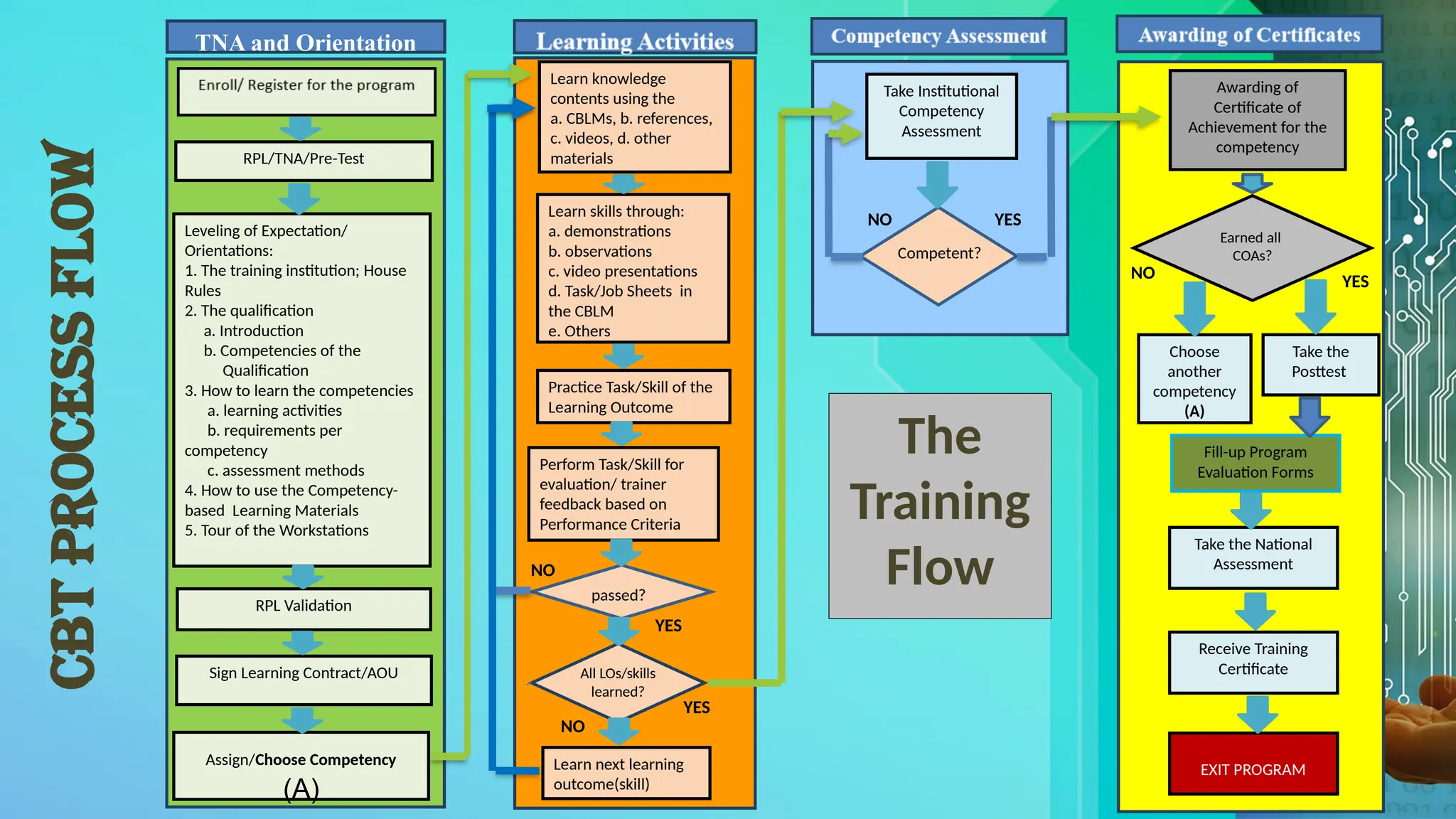
CBT
Process
Flow
TNA and Orientation
RPL/TNA/Pre-Test
Leveling of Expectation/
Orientations:
1. The training institution; House
Rules
2. The qualification
a. Introduction
b. Competencies of the
Qualification
3. How to learn the competencies
a. learning activities
b. requirements per
competency
c. assessment methods
4. How to use the Competency-
based Learning Materials
5. Tour of the Workstations
RPL Validation
Sign Learning Contract/AOU
Assign/Choose Competency
(A)
Learn knowledge
contents using the
a. CBLMs, b. references,
c. videos, d. other
materials
Learn skills through:
a. demonstrations
b. observations
c. video presentations
d. Task/Job Sheets in
the CBLM
e. Others
Practice Task/Skill of the
Learning Outcome
Perform Task/Skill for
evaluation/ trainer
feedback based on
Performance Criteria
passed?
Learn next learning
outcome(skill)
All LOs/skills
learned?
NO
YES
Take Institutional
Competency
Assessment
NO YES
The
Training
Flow
Awarding of
Certificate of
Achievement for the
competency
Earned all
COAs?
Choose
another
competency
(A)
Take the
Posttest
Fill-up Program
Evaluation Forms
Take the National
Assessment
Receive Training
Certificate
EXIT PROGRAM
NO YES
NO
YES
Competent?
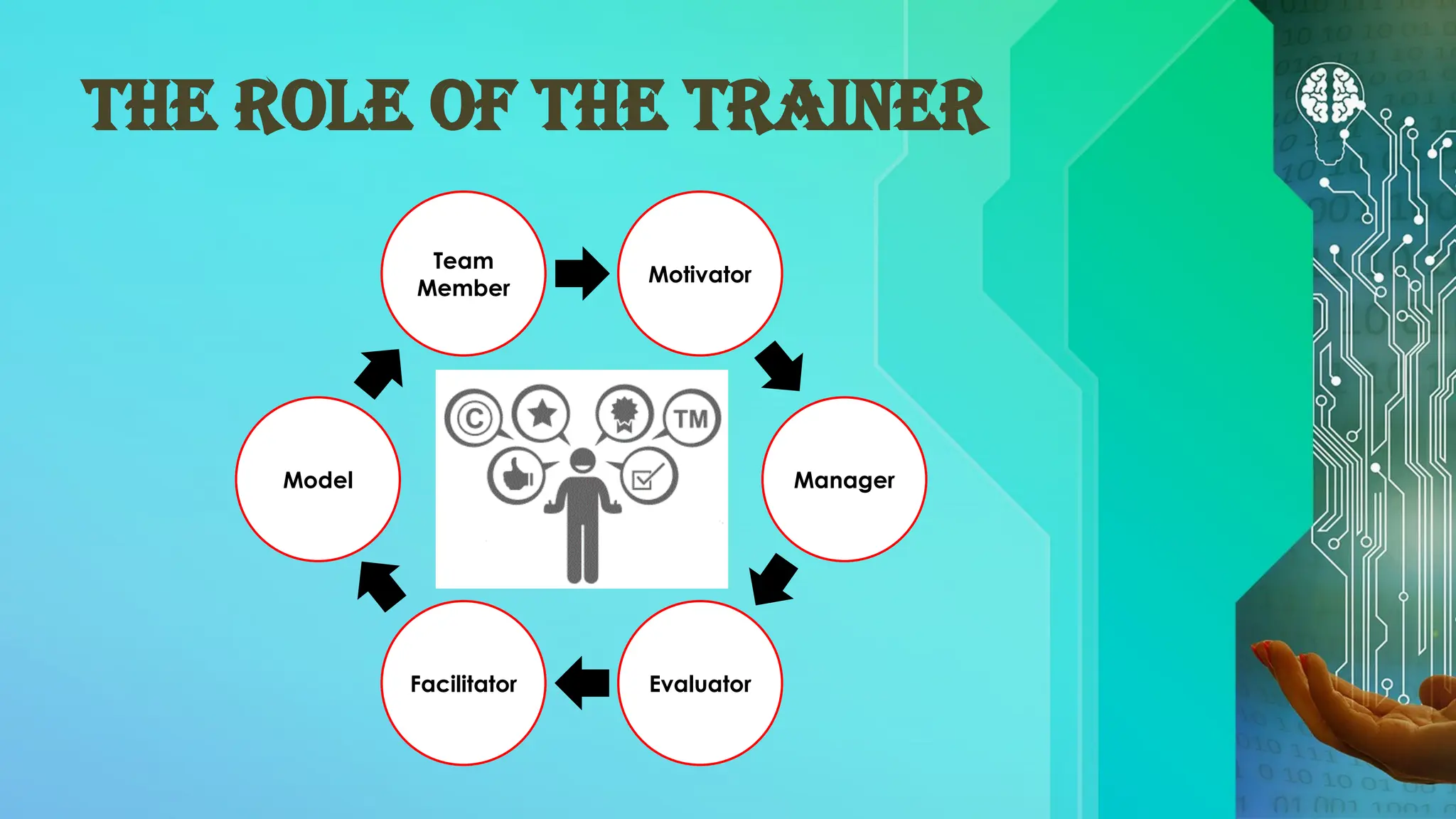
THE ROLE OF THE TRAINER
Motivator
Manager
Facilitator
Model
Evaluator
Team
Member
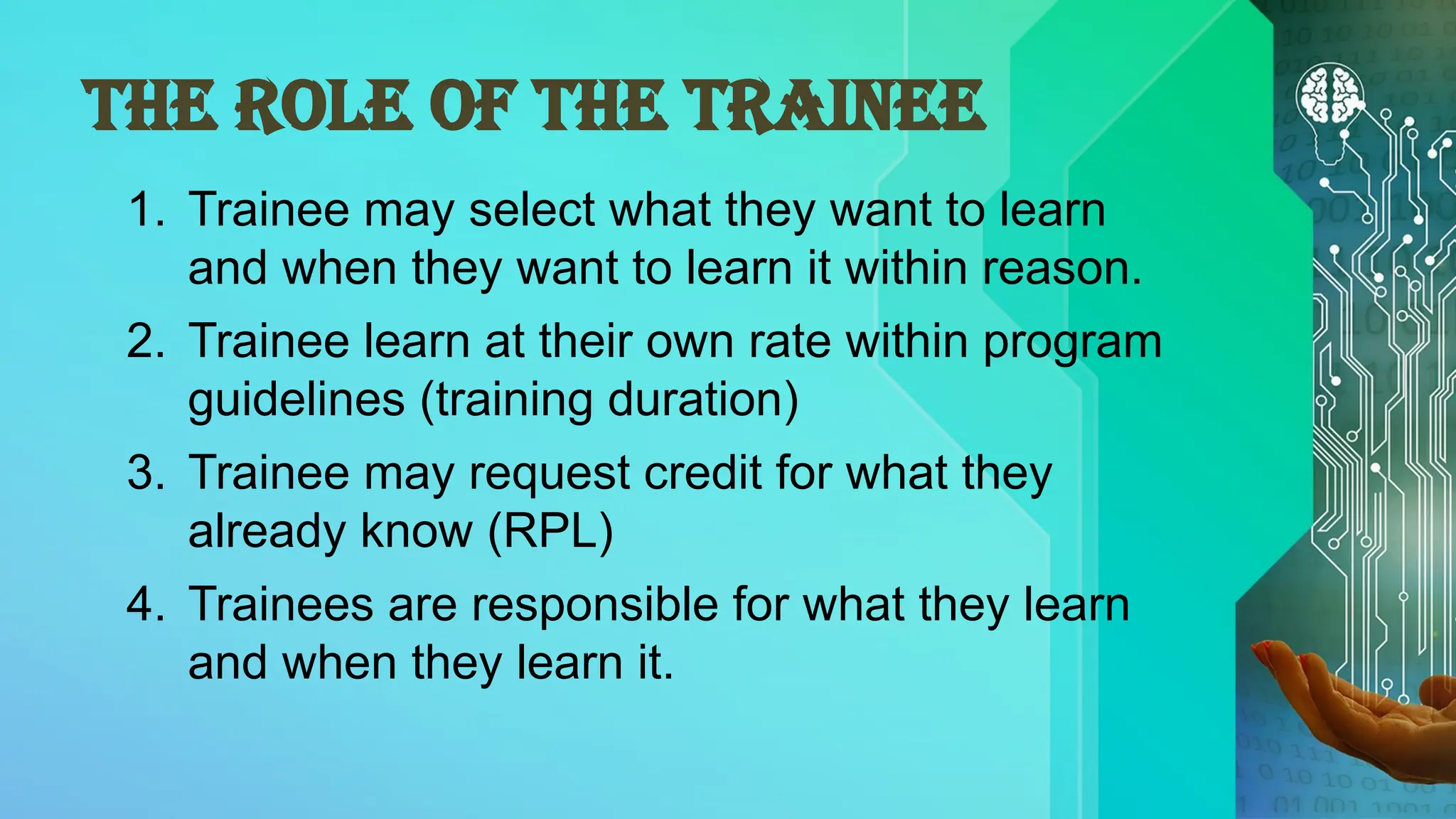
THE ROLE OF THE TRAINEE
1. Trainee may select what they want to learn
and when they want to learn it within reason.
2. Trainee learn at their own rate within program
guidelines (training duration)
3. Trainee may request credit for what they
already know (RPL)
4. Trainees are responsible for what they learn
and when they learn it.
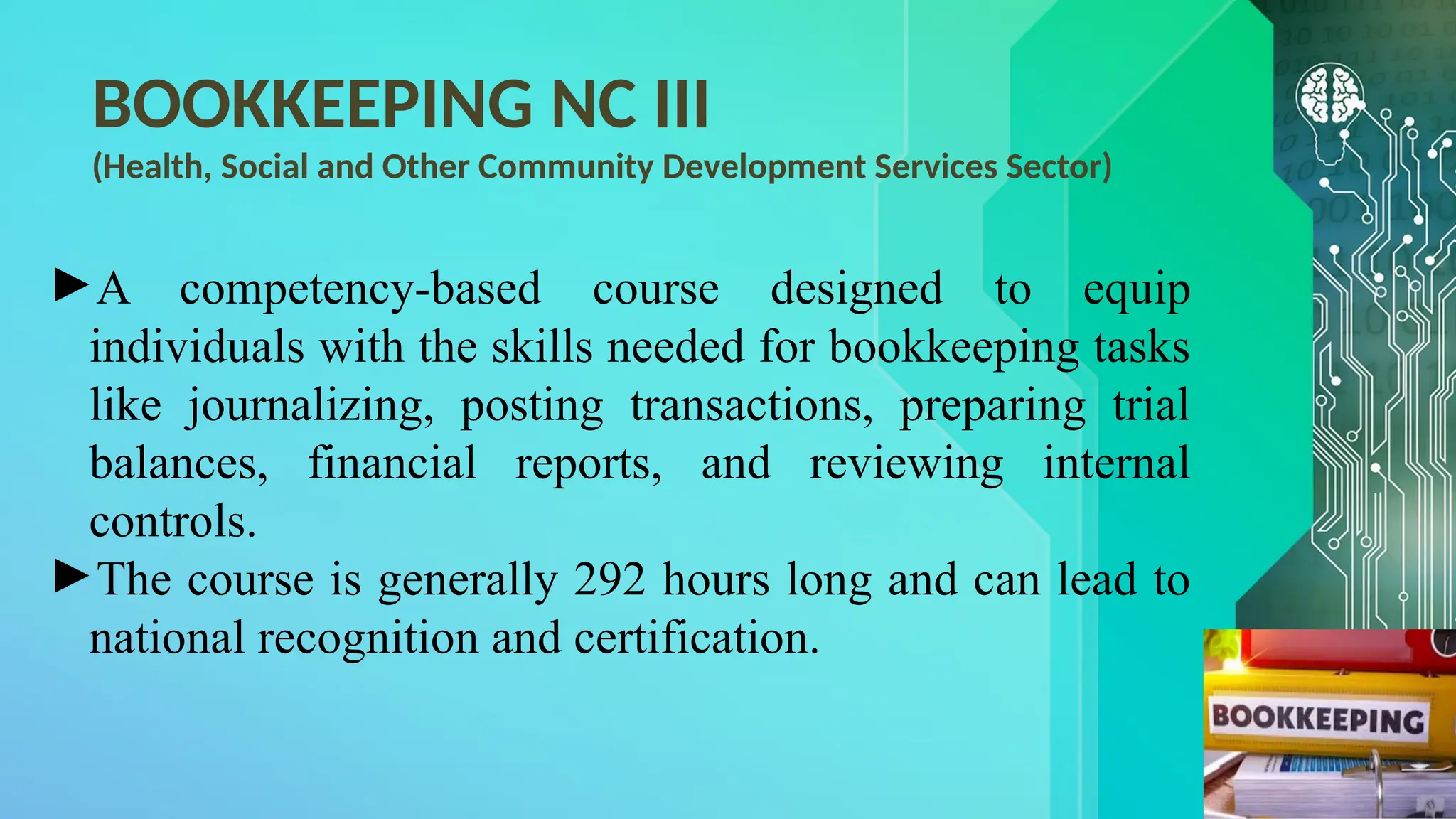
BOOKKEEPING NC III
(Health, Social and Other Community Development Services Sector)
►A competency-based course designed to equip
individuals with the skills needed for bookkeeping tasks
like journalizing, posting transactions, preparing trial
balances, financial reports, and reviewing internal
controls.
►The course is generally 292 hours long and can lead to
national recognition and certification.
Basic Competencies
•Lead workplace communication
•Lead small team
•Develop and practice negotiation skills
•Solve problems related to work activities
•Use mathematical concepts and techniques
•Use relevant technologies
Common Competencies
•Apply quality standards
•Perform computer operations
•Maintain an effective relationship with
clients and customers
•Manage own performance
Core Competencies
Unit of Competencies
1.Journalize transactions
2.Post transactions
3.Prepare trial balance
4.Prepare financial reports
5.Review internal control system
COMPETENCY BASED LEARNING MATERIALS (CBLM)
►give trainees detailed instructions to guide
them through the learning process.
►CBLM in Bookkeeping NC III - to guide learners
in acquiring the necessary knowledge, skills,
and attitudes to excel in bookkeeping activities.
COMPETENCY BASED LEARNING MATERIALS (CBLM)
1. PRELIMINARY PAGES – Instruction How to Use CBLM
2. LEARNING EXPERIENCE – Step-by-Step Instruction
on How to Read and Perform Activities per LO
3. INFORMATION SHEET – Use Self-Check and Answer
Key
4. JOB SHEET - Use Performance Criteria Checklist
5. TASK SHEET - Use Performance Criteria Checklist
6. OPERATION SHEET- -Use Performance Criteria
Checklist
Training Methodologies
►Individualized Learning
►Lecture/Discussion
►Viewing Multimedia
►Demonstration
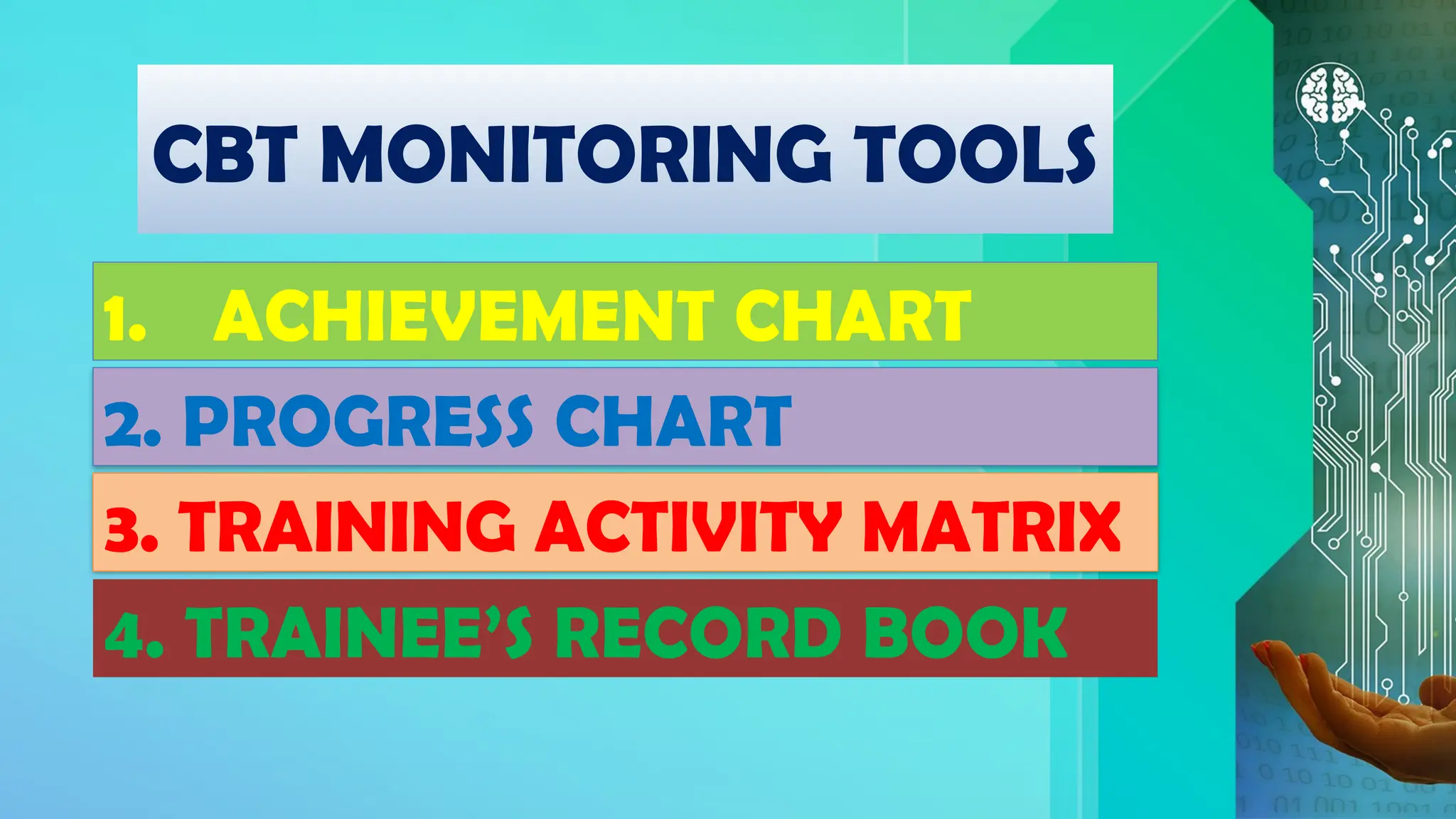
1. ACHIEVEMENT CHART
2. PROGRESS CHART
CBT MONITORING TOOLS
3. TRAINING ACTIVITY MATRIX
4. TRAINEE’S RECORD BOOK
Monitoring Tools
Achievement Chart
►used to monitor the required projects and
activities usually in the job sheets of the
CBLM.
Progress Chart
►used to monitor the learning outcomes and
competency achieved by the trainee.

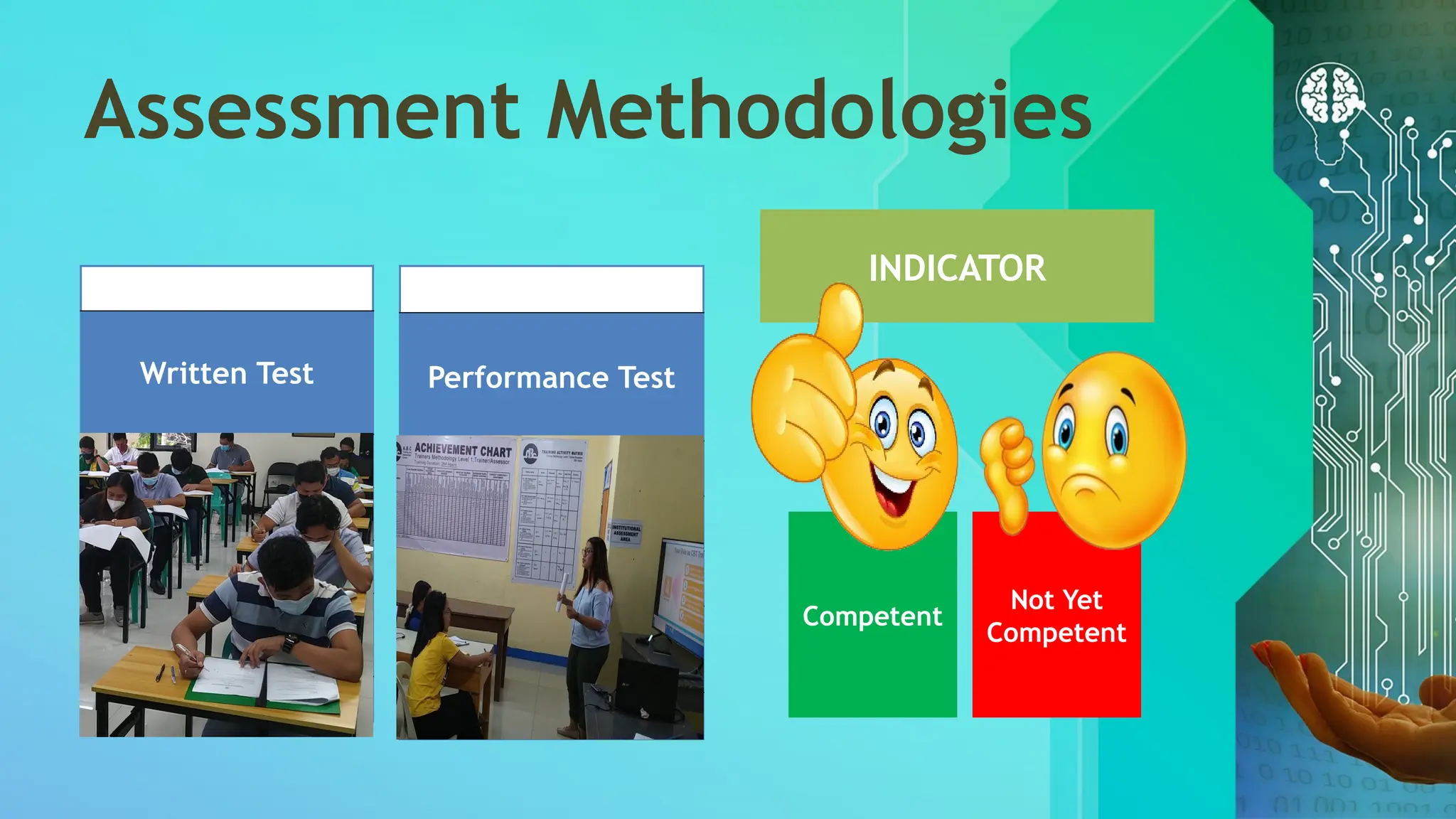
Assessment Methodologies
Written Test Performance Test
INDICATOR
Competent
Not Yet
Competent
A person who has achieved this Qualification is competent to be:
Bookkeeper
Accounting Clerk
-End of Orientation-

CBT Bookkeeping FLS (2).pptxFDFDFDFDFDFDFEF

  • 1.
  • 2.
    ABC Technical LearningCenter, Inc. • January 2, 2022 • from the Japanese word “Ikigai” which mean "a reason for living" or "a reason to be" – The four elements: • What we love: Our passions and interests • What we’re good at: Our skills and talents • What the community needs: Our contribution to society • What we can be paid for: Our livelihood
  • 3.
    ABC Technical LearningCenter Inc. • Our purpose: – We are: • Alive to • Benefit the • Community
  • 4.
    ABC Technical LearningCenter Inc. • Training Programs – Trainers Methodology Level 1 – Biomedical Equipment Servicing NCII – Computer Systems Servicing NCII – Bookkeeping NCIII • Assessment Center – Trainers Methodology Level 1 – Biomedical Equipment Servicing NCII – Computer Systems Servicing NCII – Bookkeeping NCIII
  • 5.
    CLASS RULES ANDREGULATIONS ►Attendance and punctuality is part of the student’s performance ►Grading System adheres to the policies governing assessment and certification procedure ►Trainees are expected to obey CLASS RULES AND REGULATIONS ►Trainees are expected to respect their fellow trainees and to all center personnel. ►Trainees are required to dress appropriately and decently at all times. ►Trainees are expected to maintain the cleanliness and orderliness. The trash can should be used.
  • 6.
    Training and AssessmentSchedules • Duration: – 36.5 days (292 hours) • Training Period: – May 2, 2025 to June 16, 2025 • Training Modality – Blended Learning • Individualized/Self-paced (Monday to Wednesday) • Face-to-face (Thursday and Friday)
  • 7.
    Training and AssessmentSchedules • Institutional Assessment (Written and Demonstration) – June 21-22, 2025 • Portfolio Submission – June 21-22, 2025 • National Assessment – July 5, 2025
  • 8.
    Competency Based Training(CBT) ► A training delivery approach that focuses on the competency development ► Emphasizes most on what the learner can do. ► Focuses on outcomes within specified time. ► Attainment and application of knowledge, skills and attitude to a specific level of competency.
  • 9.
    ►Competency –applying knowledge,skills and attitude to perform work activities. ►Competencies are gained through: ►Life Experience ►Formal Education ►Apprenticeship ►On-the-Job Experience ►Self-Help Programs ►Training and Development Programs
  • 10.
    • Skill—A taskperformed to a specific level of competency or proficiency which often use motor functions and typically require the manipulation of instruments and equipment – e.g., use of vacuum cleaner in cleaning carpeted floor. – Some skills, however, such as counseling, are knowledge- and attitude-based.
  • 11.
    Key features ofcompetency (Dimensions) • being able to do the job (Task skills) • knowing how and why things are done (Task Management Skills) • knowing what to do if things go wrong (Contingency Management Skills) • Knowing the right approach to do a job properly and safely. (Job/Role Environment)
  • 12.
    10 Principles ofCBT 1. The training is based on curriculum developed from the competency standards. 2. Learning is modular in its structure. 3. Training delivery is individualized and self-paced. 4. Training is based on work that must be performed 5. Training materials are directly related to the competency standards and the curriculum. 6. Assessment of learners is based in the collection of evidences of work performance based on industry or organizational required standards
  • 13.
    10 Principles ofCBT 7. Training is based on and off the job components 8. The system allows Recognition of Prior Learning (RPL) 9. The system allows for learner to enter and exit programs at different times and levels and to receive an award for competencies attained at any point 10. Approved training programs are nationally accredited
  • 14.
    CBT APPROACH TRADITIONAL ❑ Managinginstruction. ❑ Enter at about the same time. ❑ Cover the same material. ❑ Retesting is discouraged ❑ Materials, tools and supplies for only one topic are needed at a time. ❑ Most instruction is dependent upon the instructor. CBT TRAINING ❑ Managing learning. ❑ Enter various times throughout the year. ❑ Different occupations within the same time. ❑ Retesting is encouraged ❑ All materials are readily available. ❑ Manage the use of a wide variety of instructional materials
  • 15.
    CBT Process Flow TNA and Orientation RPL/TNA/Pre-Test Levelingof Expectation/ Orientations: 1. The training institution; House Rules 2. The qualification a. Introduction b. Competencies of the Qualification 3. How to learn the competencies a. learning activities b. requirements per competency c. assessment methods 4. How to use the Competency- based Learning Materials 5. Tour of the Workstations RPL Validation Sign Learning Contract/AOU Assign/Choose Competency (A) Learn knowledge contents using the a. CBLMs, b. references, c. videos, d. other materials Learn skills through: a. demonstrations b. observations c. video presentations d. Task/Job Sheets in the CBLM e. Others Practice Task/Skill of the Learning Outcome Perform Task/Skill for evaluation/ trainer feedback based on Performance Criteria passed? Learn next learning outcome(skill) All LOs/skills learned? NO YES Take Institutional Competency Assessment NO YES The Training Flow Awarding of Certificate of Achievement for the competency Earned all COAs? Choose another competency (A) Take the Posttest Fill-up Program Evaluation Forms Take the National Assessment Receive Training Certificate EXIT PROGRAM NO YES NO YES Competent?
  • 16.
    THE ROLE OFTHE TRAINER Motivator Manager Facilitator Model Evaluator Team Member
  • 17.
    THE ROLE OFTHE TRAINEE 1. Trainee may select what they want to learn and when they want to learn it within reason. 2. Trainee learn at their own rate within program guidelines (training duration) 3. Trainee may request credit for what they already know (RPL) 4. Trainees are responsible for what they learn and when they learn it.
  • 18.
    BOOKKEEPING NC III (Health,Social and Other Community Development Services Sector) ►A competency-based course designed to equip individuals with the skills needed for bookkeeping tasks like journalizing, posting transactions, preparing trial balances, financial reports, and reviewing internal controls. ►The course is generally 292 hours long and can lead to national recognition and certification.
  • 19.
    Basic Competencies •Lead workplacecommunication •Lead small team •Develop and practice negotiation skills •Solve problems related to work activities •Use mathematical concepts and techniques •Use relevant technologies
  • 20.
    Common Competencies •Apply qualitystandards •Perform computer operations •Maintain an effective relationship with clients and customers •Manage own performance
  • 21.
    Core Competencies Unit ofCompetencies 1.Journalize transactions 2.Post transactions 3.Prepare trial balance 4.Prepare financial reports 5.Review internal control system
  • 22.
    COMPETENCY BASED LEARNINGMATERIALS (CBLM) ►give trainees detailed instructions to guide them through the learning process. ►CBLM in Bookkeeping NC III - to guide learners in acquiring the necessary knowledge, skills, and attitudes to excel in bookkeeping activities.
  • 23.
    COMPETENCY BASED LEARNINGMATERIALS (CBLM) 1. PRELIMINARY PAGES – Instruction How to Use CBLM 2. LEARNING EXPERIENCE – Step-by-Step Instruction on How to Read and Perform Activities per LO 3. INFORMATION SHEET – Use Self-Check and Answer Key 4. JOB SHEET - Use Performance Criteria Checklist 5. TASK SHEET - Use Performance Criteria Checklist 6. OPERATION SHEET- -Use Performance Criteria Checklist
  • 24.
  • 25.
    1. ACHIEVEMENT CHART 2.PROGRESS CHART CBT MONITORING TOOLS 3. TRAINING ACTIVITY MATRIX 4. TRAINEE’S RECORD BOOK
  • 26.
    Monitoring Tools Achievement Chart ►usedto monitor the required projects and activities usually in the job sheets of the CBLM. Progress Chart ►used to monitor the learning outcomes and competency achieved by the trainee.
  • 27.
    Assessment Methodologies Written TestPerformance Test INDICATOR Competent Not Yet Competent
  • 28.
    A person whohas achieved this Qualification is competent to be: Bookkeeper Accounting Clerk
  • 30.