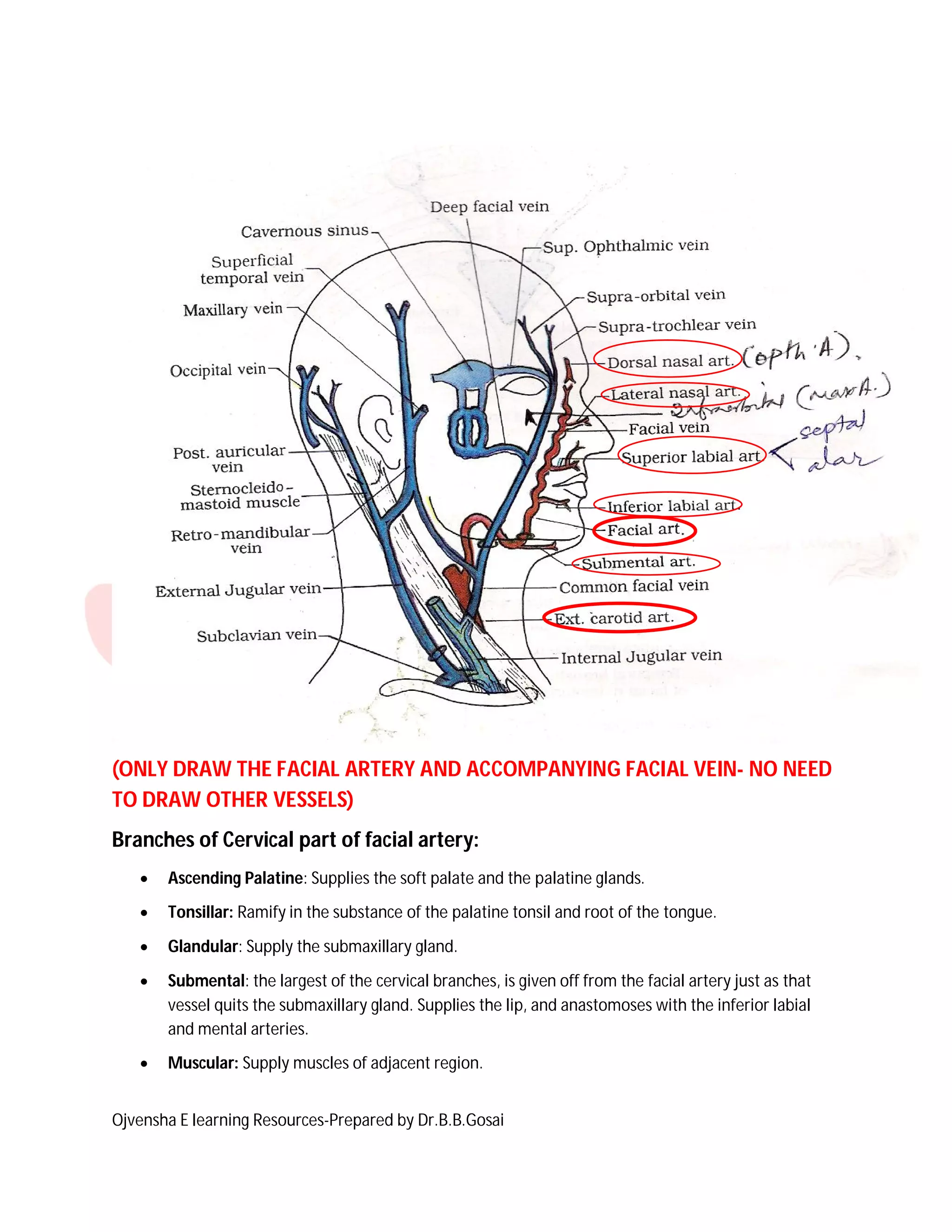
Facial Artery
              (*****Most Important Short Note)
Introduction: It is anterior branch of External carotid artery arising in carotid triangle and supply face,
palate, tonsil and nose.
Origin: From external Carotid artery

Course and Relations:
Facial artery is divided into two parts:
       Cervical Part
       Facial Part


Cervical part of facial artery:
       Arises in the carotid triangle a little above the lingual artery.

       Its origin is superficial, being covered by the integument, Platysma, and fascia.
       It then passes beneath the Digastric and Stylohyoid muscles and part of the submaxillary gland,
        and frequently beneath the hypoglossal nerve. It lies upon the Middle and superior constrictor
        of pharynx.
       It enters a groove on the posterior surface of the submaxillary gland. It then curves upward
        over the body of the mandible at the antero-inferior angle of the Masseter to enter in the face.


Facial part of facial artery:
       It enters the face by curving upward over the body of the mandible at the antero-inferior angle
        of the Masseter.
       In the face it runs upwards and medially obliquely with a tortuous course. Tortuous course
        prevents the artery being getting stretched during movement of mandible or movement of
        muscles of face.
       It runs upward across the cheek to the angle of the mouth, then ascends along the side of the
        nose, and ends at the medial cantus of the eye, as angular artery.

       Facial artery is accompanied by Facial vein throughout in its course.

Ojvensha E learning Resources-Prepared by Dr.B.B.Gosai
(ONLY DRAW THE FACIAL ARTERY AND ACCOMPANYING FACIAL VEIN- NO NEED
TO DRAW OTHER VESSELS)
Branches of Cervical part of facial artery:
      Ascending Palatine: Supplies the soft palate and the palatine glands.
      Tonsillar: Ramify in the substance of the palatine tonsil and root of the tongue.

      Glandular: Supply the submaxillary gland.

      Submental: the largest of the cervical branches, is given off from the facial artery just as that
       vessel quits the submaxillary gland. Supplies the lip, and anastomoses with the inferior labial
       and mental arteries.
      Muscular: Supply muscles of adjacent region.


Ojvensha E learning Resources-Prepared by Dr.B.B.Gosai
Branches of Facial part of facial artery:
      Inferior labial: Arises near the angle of the mouth. Supplies the labial glands, the mucous
       membrane, and the muscles of the lower lip; and anastomoses with the artery of the opposite
       side, and with the mental branch of the inferior alveolar artery.
      Superior labial: Larger and more tortuous than the inferior. It follows a similar course along the
       edge of the upper lip. A septal branch ramifies on the nasal septum as far as the point of the
       nose, and an alar branch supplies the ala of the nose.

      Lateral nasal: Ascends along the side of the nose. It supplies the ala and dorsum of the nose.

      Angular: is the terminal part of the external maxillary; it ascends to the medial angle of the
       orbit. It ends by anastomosing with the dorsal nasal branch of the ophthalmic artery.

      Muscular: Supplies muscles of face.


Applied Anatomy of facial artery:
      It is commonly palpated by anesthetists at the anteroinferior angle of masseter muscle against
       the base of mandible.
      At the medial cantus of eye there is anastomosis between angular branch of facial artery with
       dorsal nasal branch of ophthalmic artery. It is important in blockage of one or other artery.

      Tortuous course of artery prevents its stretching during movement of mandible.


                              ==================X================


Ojvensha E learning Resources-Prepared by Dr.B.B.Gosai

Facial artery dr gosai

  • 1.
    Facial Artery (*****Most Important Short Note) Introduction: It is anterior branch of External carotid artery arising in carotid triangle and supply face, palate, tonsil and nose. Origin: From external Carotid artery Course and Relations: Facial artery is divided into two parts:  Cervical Part  Facial Part Cervical part of facial artery:  Arises in the carotid triangle a little above the lingual artery.  Its origin is superficial, being covered by the integument, Platysma, and fascia.  It then passes beneath the Digastric and Stylohyoid muscles and part of the submaxillary gland, and frequently beneath the hypoglossal nerve. It lies upon the Middle and superior constrictor of pharynx.  It enters a groove on the posterior surface of the submaxillary gland. It then curves upward over the body of the mandible at the antero-inferior angle of the Masseter to enter in the face. Facial part of facial artery:  It enters the face by curving upward over the body of the mandible at the antero-inferior angle of the Masseter.  In the face it runs upwards and medially obliquely with a tortuous course. Tortuous course prevents the artery being getting stretched during movement of mandible or movement of muscles of face.  It runs upward across the cheek to the angle of the mouth, then ascends along the side of the nose, and ends at the medial cantus of the eye, as angular artery.  Facial artery is accompanied by Facial vein throughout in its course. Ojvensha E learning Resources-Prepared by Dr.B.B.Gosai
  • 2.
    (ONLY DRAW THEFACIAL ARTERY AND ACCOMPANYING FACIAL VEIN- NO NEED TO DRAW OTHER VESSELS) Branches of Cervical part of facial artery:  Ascending Palatine: Supplies the soft palate and the palatine glands.  Tonsillar: Ramify in the substance of the palatine tonsil and root of the tongue.  Glandular: Supply the submaxillary gland.  Submental: the largest of the cervical branches, is given off from the facial artery just as that vessel quits the submaxillary gland. Supplies the lip, and anastomoses with the inferior labial and mental arteries.  Muscular: Supply muscles of adjacent region. Ojvensha E learning Resources-Prepared by Dr.B.B.Gosai
  • 3.
    Branches of Facialpart of facial artery:  Inferior labial: Arises near the angle of the mouth. Supplies the labial glands, the mucous membrane, and the muscles of the lower lip; and anastomoses with the artery of the opposite side, and with the mental branch of the inferior alveolar artery.  Superior labial: Larger and more tortuous than the inferior. It follows a similar course along the edge of the upper lip. A septal branch ramifies on the nasal septum as far as the point of the nose, and an alar branch supplies the ala of the nose.  Lateral nasal: Ascends along the side of the nose. It supplies the ala and dorsum of the nose.  Angular: is the terminal part of the external maxillary; it ascends to the medial angle of the orbit. It ends by anastomosing with the dorsal nasal branch of the ophthalmic artery.  Muscular: Supplies muscles of face. Applied Anatomy of facial artery:  It is commonly palpated by anesthetists at the anteroinferior angle of masseter muscle against the base of mandible.  At the medial cantus of eye there is anastomosis between angular branch of facial artery with dorsal nasal branch of ophthalmic artery. It is important in blockage of one or other artery.  Tortuous course of artery prevents its stretching during movement of mandible. ==================X================ Ojvensha E learning Resources-Prepared by Dr.B.B.Gosai