Sexual
Differentiation
By
Vamsi Krishna Murthy Ginjupalli
UNIVERSITY OF SIENA
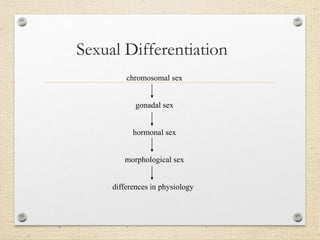
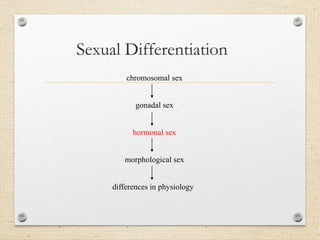
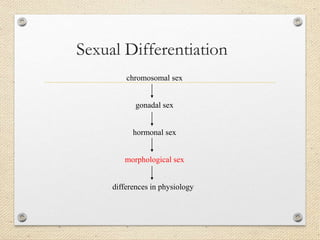
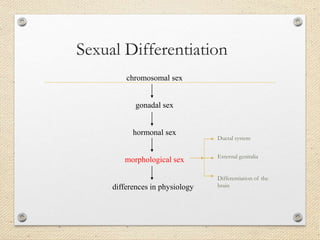
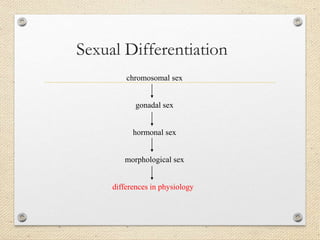
Sexual Differentiation
chromosomal sex
gonadal sex
hormonal sex
morphological sex
differences in physiology
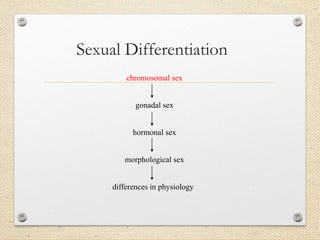
Sexual Differentiation
chromosomal sex
gonadal sex
hormonal sex
morphological sex
differences in physiology
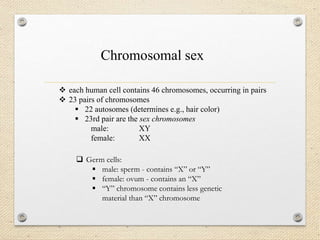
 each human cell contains 46 chromosomes, occurring in pairs
 23 pairs of chromosomes
 22 autosomes (determines e.g., hair color)
 23rd pair are the sex chromosomes
male: XY
female: XX
Chromosomal sex
 Germ cells:
 male: sperm - contains “X” or “Y”
 female: ovum - contains an “X”
 “Y” chromosome contains less genetic
material than “X” chromosome
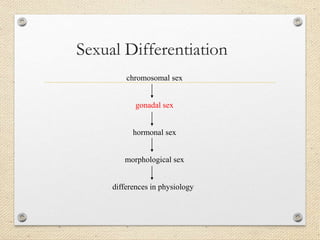
Sexual Differentiation
chromosomal sex
gonadal sex
hormonal sex
morphological sex
differences in physiology
Gonadal
Differentiation
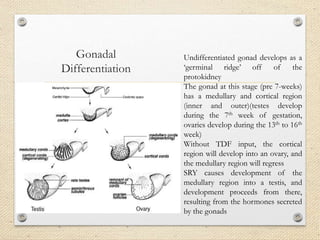
Undifferentiated gonad develops as a
‘germinal ridge’ off of the
protokidney
The gonad at this stage (pre 7-weeks)
has a medullary and cortical region
(inner and outer)(testes develop
during the 7th week of gestation,
ovaries develop during the 13th to 16th
week)
Without TDF input, the cortical
region will develop into an ovary, and
the medullary region will regress
SRY causes development of the
medullary region into a testis, and
development proceeds from there,
resulting from the hormones secreted
by the gonads
Sexual Differentiation
chromosomal sex
gonadal sex
hormonal sex
morphological sex
differences in physiology
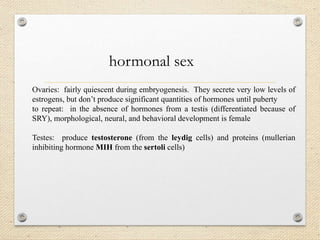
Ovaries: fairly quiescent during embryogenesis. They secrete very low levels of
estrogens, but don’t produce significant quantities of hormones until puberty
to repeat: in the absence of hormones from a testis (differentiated because of
SRY), morphological, neural, and behavioral development is female
Testes: produce testosterone (from the leydig cells) and proteins (mullerian
inhibiting hormone MIH from the sertoli cells)
hormonal sex
Sexual Differentiation
chromosomal sex
gonadal sex
hormonal sex
morphological sex
differences in physiology
Sexual Differentiation
chromosomal sex
gonadal sex
hormonal sex
morphological sex
differences in physiology
Ductal system
External genitalia
Differentiation of the
brain
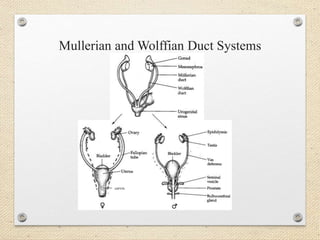
Mullerian and Wolffian Duct Systems
cervix
The progenitors for the duct systems are present for both male and females
embryologically
In contrast to gonadal development, where one gonad becomes either male or female.
mullerian vs wolffian
1) With no hormones, the mullerian duct develops, and the wolffian duct undergoes
programmed cell death (regresses and degenerates)
1) This causes formation of female internal morphology
2) Mullerian system becomes fallopian tubes, uterus, and cervix
2) With testes present:
1) Leydig cells produce testosterone, cause development of wolffian ducts (turn
off programmed cell death)
1) Wolffian ducts become vas deferens, seminal vessicles, and prostate gland
2) Sertoli cells produce Mullerian inhibitory hormone(MIH), cause regression of
mullerian ducts
1) If the sertoli cells fail to produce MIH, a male can have both male and
female internal structures
Mullerian and Wolffian Duct Systems
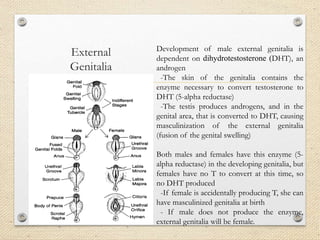
External
Genitalia
Development of male external genitalia is
dependent on dihydrotestosterone (DHT), an
androgen
-The skin of the genitalia contains the
enzyme necessary to convert testosterone to
DHT (5-alpha reductase)
-The testis produces androgens, and in the
genital area, that is converted to DHT, causing
masculinization of the external genitalia
(fusion of the genital swelling)
Both males and females have this enzyme (5-
alpha reductase) in the developing genitalia, but
females have no T to convert at this time, so
no DHT produced
-If female is accidentally producing T, she can
have masculinized genitalia at birth
- If male does not produce the enzyme,
external genitalia will be female.
Male:
 Testosterone secreted into the blood reaches the brain
 testosterone converted to estradiol and dihydrotestosterone
in the brain
 estradiol masculinizes the brain
Female:
 alpha-fetoprotein binds to estradiol
 prevents estradiol from entering the brain
 protects female brains from being masculinized by estradiol
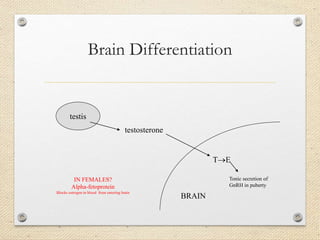
Brain Differentiation
testis
testosterone
TE
BRAIN
Tonic secretion of
GnRH in puberty
IN FEMALES?
Alpha-fetoprotein
Blocks estrogen in blood from entering brain
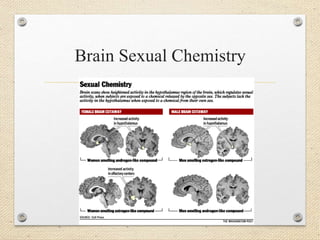
Brain Sexual Chemistry
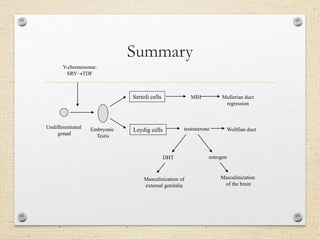
Summary
Undifferentiated
gonad
Y-chromosome:
SRYTDF
Embryonic
Testis
Sertoli cells
Leydig cells
MIH Mullerian duct
regression
testosterone Wollfian duct
DHT
Masculinization of
external genitalia
estrogen
Masculinization
of the brain
Sexual Differentiation
chromosomal sex
gonadal sex
hormonal sex
morphological sex
differences in physiology
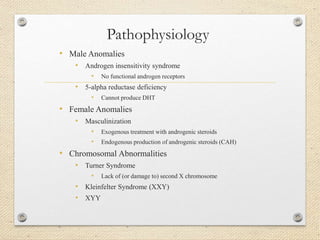
Pathophysiology
• Male Anomalies
• Androgen insensitivity syndrome
• No functional androgen receptors
• 5-alpha reductase deficiency
• Cannot produce DHT
• Female Anomalies
• Masculinization
• Exogenous treatment with androgenic steroids
• Endogenous production of androgenic steroids (CAH)
• Chromosomal Abnormalities
• Turner Syndrome
• Lack of (or damage to) second X chromosome
• Kleinfelter Syndrome (XXY)
• XYY
thank you for your attention
vamsi

Sexual Differentiation (Learn easy way)

  • 1.
    Sexual Differentiation By Vamsi Krishna MurthyGinjupalli UNIVERSITY OF SIENA
  • 2.
    Sexual Differentiation chromosomal sex gonadalsex hormonal sex morphological sex differences in physiology
  • 3.
    Sexual Differentiation chromosomal sex gonadalsex hormonal sex morphological sex differences in physiology
  • 4.
     each humancell contains 46 chromosomes, occurring in pairs  23 pairs of chromosomes  22 autosomes (determines e.g., hair color)  23rd pair are the sex chromosomes male: XY female: XX Chromosomal sex  Germ cells:  male: sperm - contains “X” or “Y”  female: ovum - contains an “X”  “Y” chromosome contains less genetic material than “X” chromosome
  • 5.
    Sexual Differentiation chromosomal sex gonadalsex hormonal sex morphological sex differences in physiology
  • 6.
    Gonadal Differentiation Undifferentiated gonad developsas a ‘germinal ridge’ off of the protokidney The gonad at this stage (pre 7-weeks) has a medullary and cortical region (inner and outer)(testes develop during the 7th week of gestation, ovaries develop during the 13th to 16th week) Without TDF input, the cortical region will develop into an ovary, and the medullary region will regress SRY causes development of the medullary region into a testis, and development proceeds from there, resulting from the hormones secreted by the gonads
  • 7.
    Sexual Differentiation chromosomal sex gonadalsex hormonal sex morphological sex differences in physiology
  • 8.
    Ovaries: fairly quiescentduring embryogenesis. They secrete very low levels of estrogens, but don’t produce significant quantities of hormones until puberty to repeat: in the absence of hormones from a testis (differentiated because of SRY), morphological, neural, and behavioral development is female Testes: produce testosterone (from the leydig cells) and proteins (mullerian inhibiting hormone MIH from the sertoli cells) hormonal sex
  • 9.
    Sexual Differentiation chromosomal sex gonadalsex hormonal sex morphological sex differences in physiology
  • 10.
    Sexual Differentiation chromosomal sex gonadalsex hormonal sex morphological sex differences in physiology Ductal system External genitalia Differentiation of the brain
  • 11.
    Mullerian and WolffianDuct Systems cervix
  • 12.
    The progenitors forthe duct systems are present for both male and females embryologically In contrast to gonadal development, where one gonad becomes either male or female. mullerian vs wolffian 1) With no hormones, the mullerian duct develops, and the wolffian duct undergoes programmed cell death (regresses and degenerates) 1) This causes formation of female internal morphology 2) Mullerian system becomes fallopian tubes, uterus, and cervix 2) With testes present: 1) Leydig cells produce testosterone, cause development of wolffian ducts (turn off programmed cell death) 1) Wolffian ducts become vas deferens, seminal vessicles, and prostate gland 2) Sertoli cells produce Mullerian inhibitory hormone(MIH), cause regression of mullerian ducts 1) If the sertoli cells fail to produce MIH, a male can have both male and female internal structures Mullerian and Wolffian Duct Systems
  • 13.
    External Genitalia Development of maleexternal genitalia is dependent on dihydrotestosterone (DHT), an androgen -The skin of the genitalia contains the enzyme necessary to convert testosterone to DHT (5-alpha reductase) -The testis produces androgens, and in the genital area, that is converted to DHT, causing masculinization of the external genitalia (fusion of the genital swelling) Both males and females have this enzyme (5- alpha reductase) in the developing genitalia, but females have no T to convert at this time, so no DHT produced -If female is accidentally producing T, she can have masculinized genitalia at birth - If male does not produce the enzyme, external genitalia will be female.
  • 14.
    Male:  Testosterone secretedinto the blood reaches the brain  testosterone converted to estradiol and dihydrotestosterone in the brain  estradiol masculinizes the brain Female:  alpha-fetoprotein binds to estradiol  prevents estradiol from entering the brain  protects female brains from being masculinized by estradiol Brain Differentiation
  • 15.
    Brain Differentiation testis testosterone TE BRAIN Tonic secretionof GnRH in puberty IN FEMALES? Alpha-fetoprotein Blocks estrogen in blood from entering brain
  • 16.
  • 17.
    Summary Undifferentiated gonad Y-chromosome: SRYTDF Embryonic Testis Sertoli cells Leydig cells MIHMullerian duct regression testosterone Wollfian duct DHT Masculinization of external genitalia estrogen Masculinization of the brain
  • 18.
    Sexual Differentiation chromosomal sex gonadalsex hormonal sex morphological sex differences in physiology
  • 19.
    Pathophysiology • Male Anomalies •Androgen insensitivity syndrome • No functional androgen receptors • 5-alpha reductase deficiency • Cannot produce DHT • Female Anomalies • Masculinization • Exogenous treatment with androgenic steroids • Endogenous production of androgenic steroids (CAH) • Chromosomal Abnormalities • Turner Syndrome • Lack of (or damage to) second X chromosome • Kleinfelter Syndrome (XXY) • XYY
  • 20.
    thank you foryour attention vamsi