ORBIT
EXTRAOCCULAR MUSCLES
Dr.B.B.Gosai
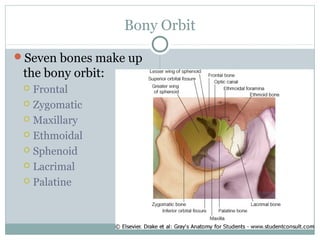
Bony Orbit
Seven bones make up

the bony orbit:
Frontal
 Zygomatic
 Maxillary
 Ethmoidal
 Sphenoid
 Lacrimal
 Palatine

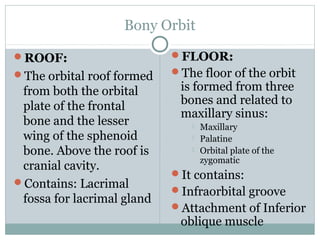
Bony Orbit
ROOF:

FLOOR:

The orbital roof formed

The floor of the orbit

from both the orbital
plate of the frontal
bone and the lesser
wing of the sphenoid
bone. Above the roof is
cranial cavity.
Contains: Lacrimal
fossa for lacrimal gland

is formed from three
bones and related to
maxillary sinus:




Maxillary
Palatine
Orbital plate of the
zygomatic

It contains:
Infraorbital groove
Attachment of Inferior

oblique muscle
Bony Orbit
MEDIAL WALL of the
orbit is formed from four
bones and related to lateral
wall of nose:





Frontal process of the
maxillary
Lacrimal
Orbital plate of the ethmoidal
Lesser wing of the sphenoid

 Lacrimal fossa for lacrimal

sac.

LATERAL WALL:
Formed from two bones:



Zygomatic
Greater wing of the sphenoid

 Thickest and strongest
 Lateral orbital tubercle

(Whitnall’s tubercle) for
attachment of lateral
check ligament
Orbital Foramina
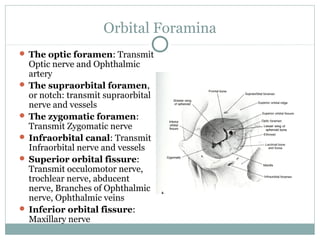
 The optic foramen: Transmit

Optic nerve and Ophthalmic
artery
 The supraorbital foramen,
or notch: transmit supraorbital
nerve and vessels
 The zygomatic foramen:
Transmit Zygomatic nerve
 Infraorbital canal: Transmit
Infraorbital nerve and vessels
 Superior orbital fissure:
Transmit occulomotor nerve,
trochlear nerve, abducent
nerve, Branches of Ophthalmic
nerve, Ophthalmic veins
 Inferior orbital fissure:
Maxillary nerve
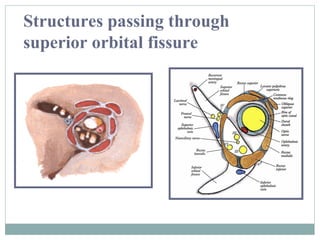
Structures passing through
superior orbital fissure
Extra ocular Muscles
in the orbit
Extraocular Muscles

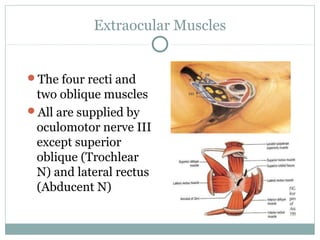
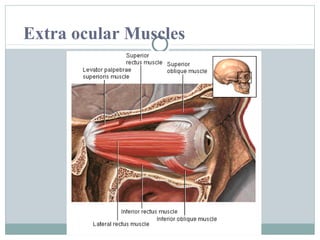
The four recti and

two oblique muscles
All are supplied by
oculomotor nerve III
except superior
oblique (Trochlear
N) and lateral rectus
(Abducent N)
Extra ocular Muscles in the Orbit
Voluntary Muscles:
1. Four Recti – Superior, inferior, medial and lateral.
2. Two Oblique – Superior & inferior.
3. Elevator of upper eyelid – Levator palpebrae
superioris.
Involuntary Muscles:
1. Superior tarsal muscle – Deeper part of levator
palpebrae superioris
2. Inferior tarsal muscle
3. Orbitalis muscle
Extra ocular Muscles
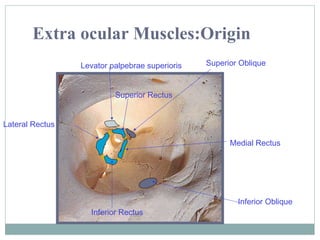
Extra ocular Muscles:Origin

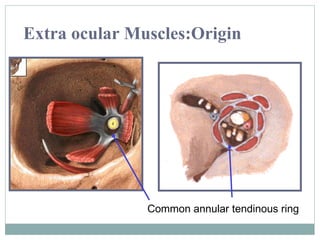
Common annular tendinous ring
Extra ocular Muscles:Origin
Levator palpebrae superioris

Superior Oblique

Superior Rectus
Lateral Rectus
Medial Rectus

Inferior Rectus

Inferior Oblique
Levator Palpebrae Superioris














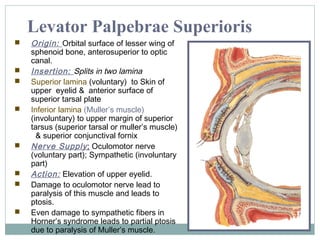
Origin: Orbital surface of lesser wing of
sphenoid bone, anterosuperior to optic
canal.
Insertion: Splits in two lamina
Superior lamina (voluntary) to Skin of
upper eyelid & anterior surface of
superior tarsal plate
Inferior lamina (Muller’s muscle)
(involuntary) to upper margin of superior
tarsus (superior tarsal or muller’s muscle)
& superior conjunctival fornix
Nerve Supply : Oculomotor nerve
(voluntary part); Sympathetic (involuntary
part)
Action: Elevation of upper eyelid.
Damage to oculomotor nerve lead to
paralysis of this muscle and leads to
ptosis.
Even damage to sympathetic fibers in
Horner’s syndrome leads to partial ptosis
due to paralysis of Muller’s muscle.
Extra ocular Muscles
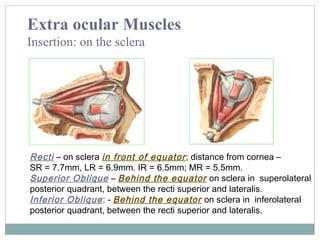
Insertion: on the sclera

Recti – on sclera in front of equator ; distance from cornea –
SR = 7.7mm, LR = 6.9mm. IR = 6.5mm; MR = 5.5mm.
Superior Oblique – Behind the equator on sclera in superolateral
posterior quadrant, between the recti superior and lateralis.
Inferior Oblique : - Behind the equator on sclera in inferolateral
posterior quadrant, between the recti superior and lateralis.
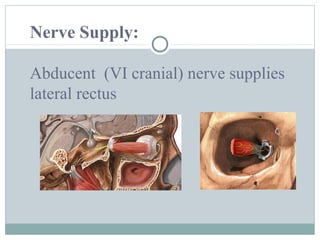
Nerve Supply:
Abducent (VI cranial) nerve supplies
lateral rectus
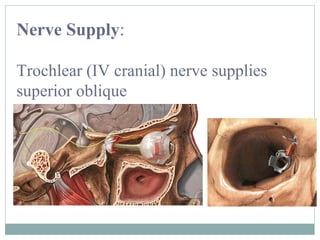
Nerve Supply:
Trochlear (IV cranial) nerve supplies
superior oblique
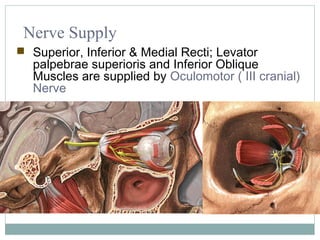
Nerve Supply
 Superior, Inferior & Medial Recti; Levator

palpebrae superioris and Inferior Oblique
Muscles are supplied by Oculomotor ( III cranial)
Nerve
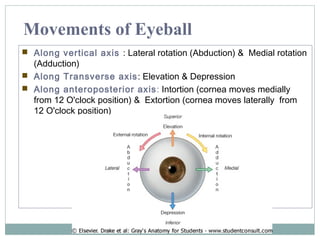
Movements of Eyeball
 Along vertical axis : Lateral rotation (Abduction) & Medial rotation

(Adduction)
 Along Transverse axis : Elevation & Depression
 Along anteroposterior axis : Intortion (cornea moves medially
from 12 O'clock position) & Extortion (cornea moves laterally from
12 O'clock position)
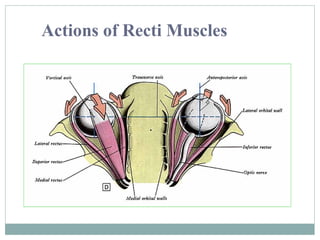
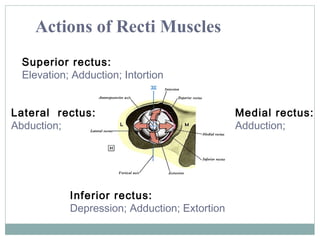
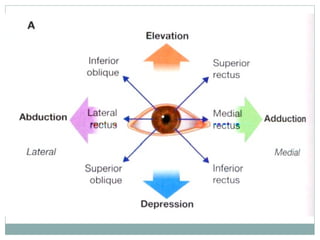
Actions of Recti Muscles
Superior rectus:
Elevation; Adduction; Intortion
Lateral rectus:
Abduction;

Inferior rectus:
Depression; Adduction; Extortion

Medial rectus:
Adduction;
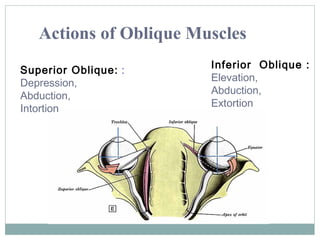
Actions of Oblique Muscles
Superior Oblique: :
Depression,
Abduction,
Intortion

Inferior Oblique :
Elevation,
Abduction,
Extortion
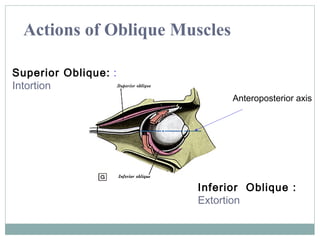
Actions of Oblique Muscles
Superior Oblique: :
Intortion

Anteroposterior axis

Inferior Oblique :
Extortion
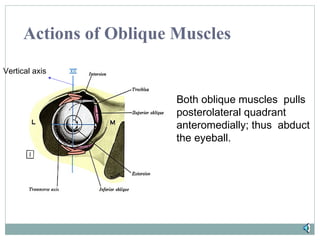
Actions of Oblique Muscles
Vertical axis

Both oblique muscles pulls
posterolateral quadrant
anteromedially; thus abduct
the eyeball.
Movements of Eyeball
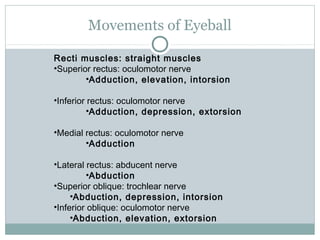
Recti muscles: straight muscles
•Superior rectus: oculomotor nerve
•Adduction, elevation, intorsion
•Inferior rectus: oculomotor nerve
•Adduction, depression, extorsion
•Medial rectus: oculomotor nerve
•Adduction
•Lateral rectus: abducent nerve
•Abduction
•Superior oblique: trochlear nerve
•Abduction, depression, intorsion
•Inferior oblique: oculomotor nerve
•Abduction, elevation, extorsion
Applied Anatomy
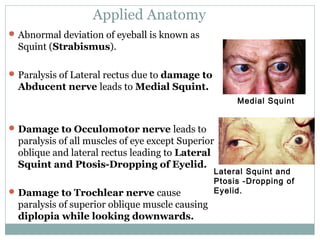
 Abnormal deviation of eyeball is known as

Squint (Strabismus).
 Paralysis of Lateral rectus due to damage to

Abducent nerve leads to Medial Squint.
Medial Squint

 Damage to Occulomotor nerve leads to

paralysis of all muscles of eye except Superior
oblique and lateral rectus leading to Lateral
Squint and Ptosis-Dropping of Eyelid.
 Damage to Trochlear nerve cause

paralysis of superior oblique muscle causing
diplopia while looking downwards.

Lateral Squint and
Ptosis -Dropping of
Eyelid.
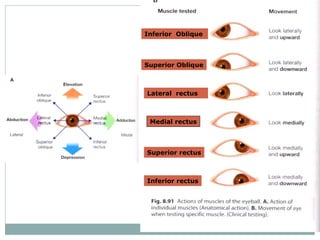
Inferior Oblique

Superior Oblique

Lateral rectus

Medial rectus

Superior rectus

Inferior rectus
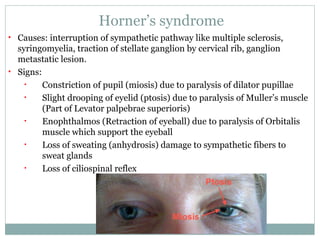
Horner’s syndrome
• Causes: interruption of sympathetic pathway like multiple sclerosis,

syringomyelia, traction of stellate ganglion by cervical rib, ganglion
metastatic lesion.
• Signs:
•
Constriction of pupil (miosis) due to paralysis of dilator pupillae
•
Slight drooping of eyelid (ptosis) due to paralysis of Muller’s muscle
(Part of Levator palpebrae superioris)
•
Enophthalmos (Retraction of eyeball) due to paralysis of Orbitalis
muscle which support the eyeball
•
Loss of sweating (anhydrosis) damage to sympathetic fibers to
sweat glands
•
Loss of ciliospinal reflex
Extraocular muscles dr.gosai

Extraocular muscles dr.gosai

  • 1.
  • 2.
    Bony Orbit Seven bonesmake up the bony orbit: Frontal  Zygomatic  Maxillary  Ethmoidal  Sphenoid  Lacrimal  Palatine 
  • 3.
    Bony Orbit ROOF: FLOOR: The orbitalroof formed The floor of the orbit from both the orbital plate of the frontal bone and the lesser wing of the sphenoid bone. Above the roof is cranial cavity. Contains: Lacrimal fossa for lacrimal gland is formed from three bones and related to maxillary sinus:    Maxillary Palatine Orbital plate of the zygomatic It contains: Infraorbital groove Attachment of Inferior oblique muscle
  • 4.
    Bony Orbit MEDIAL WALLof the orbit is formed from four bones and related to lateral wall of nose:     Frontal process of the maxillary Lacrimal Orbital plate of the ethmoidal Lesser wing of the sphenoid  Lacrimal fossa for lacrimal sac. LATERAL WALL: Formed from two bones:   Zygomatic Greater wing of the sphenoid  Thickest and strongest  Lateral orbital tubercle (Whitnall’s tubercle) for attachment of lateral check ligament
  • 5.
    Orbital Foramina  Theoptic foramen: Transmit Optic nerve and Ophthalmic artery  The supraorbital foramen, or notch: transmit supraorbital nerve and vessels  The zygomatic foramen: Transmit Zygomatic nerve  Infraorbital canal: Transmit Infraorbital nerve and vessels  Superior orbital fissure: Transmit occulomotor nerve, trochlear nerve, abducent nerve, Branches of Ophthalmic nerve, Ophthalmic veins  Inferior orbital fissure: Maxillary nerve
  • 6.
  • 7.
  • 8.
    Extraocular Muscles The fourrecti and two oblique muscles All are supplied by oculomotor nerve III except superior oblique (Trochlear N) and lateral rectus (Abducent N)
  • 9.
    Extra ocular Musclesin the Orbit Voluntary Muscles: 1. Four Recti – Superior, inferior, medial and lateral. 2. Two Oblique – Superior & inferior. 3. Elevator of upper eyelid – Levator palpebrae superioris. Involuntary Muscles: 1. Superior tarsal muscle – Deeper part of levator palpebrae superioris 2. Inferior tarsal muscle 3. Orbitalis muscle
  • 10.
  • 11.
    Extra ocular Muscles:Origin Commonannular tendinous ring
  • 12.
    Extra ocular Muscles:Origin Levatorpalpebrae superioris Superior Oblique Superior Rectus Lateral Rectus Medial Rectus Inferior Rectus Inferior Oblique
  • 13.
    Levator Palpebrae Superioris         Origin:Orbital surface of lesser wing of sphenoid bone, anterosuperior to optic canal. Insertion: Splits in two lamina Superior lamina (voluntary) to Skin of upper eyelid & anterior surface of superior tarsal plate Inferior lamina (Muller’s muscle) (involuntary) to upper margin of superior tarsus (superior tarsal or muller’s muscle) & superior conjunctival fornix Nerve Supply : Oculomotor nerve (voluntary part); Sympathetic (involuntary part) Action: Elevation of upper eyelid. Damage to oculomotor nerve lead to paralysis of this muscle and leads to ptosis. Even damage to sympathetic fibers in Horner’s syndrome leads to partial ptosis due to paralysis of Muller’s muscle.
  • 14.
    Extra ocular Muscles Insertion:on the sclera Recti – on sclera in front of equator ; distance from cornea – SR = 7.7mm, LR = 6.9mm. IR = 6.5mm; MR = 5.5mm. Superior Oblique – Behind the equator on sclera in superolateral posterior quadrant, between the recti superior and lateralis. Inferior Oblique : - Behind the equator on sclera in inferolateral posterior quadrant, between the recti superior and lateralis.
  • 15.
    Nerve Supply: Abducent (VIcranial) nerve supplies lateral rectus
  • 16.
    Nerve Supply: Trochlear (IVcranial) nerve supplies superior oblique
  • 17.
    Nerve Supply  Superior,Inferior & Medial Recti; Levator palpebrae superioris and Inferior Oblique Muscles are supplied by Oculomotor ( III cranial) Nerve
  • 18.
    Movements of Eyeball Along vertical axis : Lateral rotation (Abduction) & Medial rotation (Adduction)  Along Transverse axis : Elevation & Depression  Along anteroposterior axis : Intortion (cornea moves medially from 12 O'clock position) & Extortion (cornea moves laterally from 12 O'clock position)
  • 19.
  • 20.
    Actions of RectiMuscles Superior rectus: Elevation; Adduction; Intortion Lateral rectus: Abduction; Inferior rectus: Depression; Adduction; Extortion Medial rectus: Adduction;
  • 21.
    Actions of ObliqueMuscles Superior Oblique: : Depression, Abduction, Intortion Inferior Oblique : Elevation, Abduction, Extortion
  • 22.
    Actions of ObliqueMuscles Superior Oblique: : Intortion Anteroposterior axis Inferior Oblique : Extortion
  • 23.
    Actions of ObliqueMuscles Vertical axis Both oblique muscles pulls posterolateral quadrant anteromedially; thus abduct the eyeball.
  • 25.
    Movements of Eyeball Rectimuscles: straight muscles •Superior rectus: oculomotor nerve •Adduction, elevation, intorsion •Inferior rectus: oculomotor nerve •Adduction, depression, extorsion •Medial rectus: oculomotor nerve •Adduction •Lateral rectus: abducent nerve •Abduction •Superior oblique: trochlear nerve •Abduction, depression, intorsion •Inferior oblique: oculomotor nerve •Abduction, elevation, extorsion
  • 26.
    Applied Anatomy  Abnormaldeviation of eyeball is known as Squint (Strabismus).  Paralysis of Lateral rectus due to damage to Abducent nerve leads to Medial Squint. Medial Squint  Damage to Occulomotor nerve leads to paralysis of all muscles of eye except Superior oblique and lateral rectus leading to Lateral Squint and Ptosis-Dropping of Eyelid.  Damage to Trochlear nerve cause paralysis of superior oblique muscle causing diplopia while looking downwards. Lateral Squint and Ptosis -Dropping of Eyelid.
  • 27.
    Inferior Oblique Superior Oblique Lateralrectus Medial rectus Superior rectus Inferior rectus
  • 28.
    Horner’s syndrome • Causes:interruption of sympathetic pathway like multiple sclerosis, syringomyelia, traction of stellate ganglion by cervical rib, ganglion metastatic lesion. • Signs: • Constriction of pupil (miosis) due to paralysis of dilator pupillae • Slight drooping of eyelid (ptosis) due to paralysis of Muller’s muscle (Part of Levator palpebrae superioris) • Enophthalmos (Retraction of eyeball) due to paralysis of Orbitalis muscle which support the eyeball • Loss of sweating (anhydrosis) damage to sympathetic fibers to sweat glands • Loss of ciliospinal reflex