Principal component
analysis
PCA
 Images are high dimensional correlated data.
 Goal of PCA is to reduce the dimensionality of the data by
retaining as much as variation possible in our original data set.
 The simplet way is to keep one variable and discard all others:
not reasonable! Or we can reduce dimensionality by combining
features.
 In PCA, we can see intermediate stage as visualization.
 It is based on Eigen value and Eigen Vector.
Image Representation
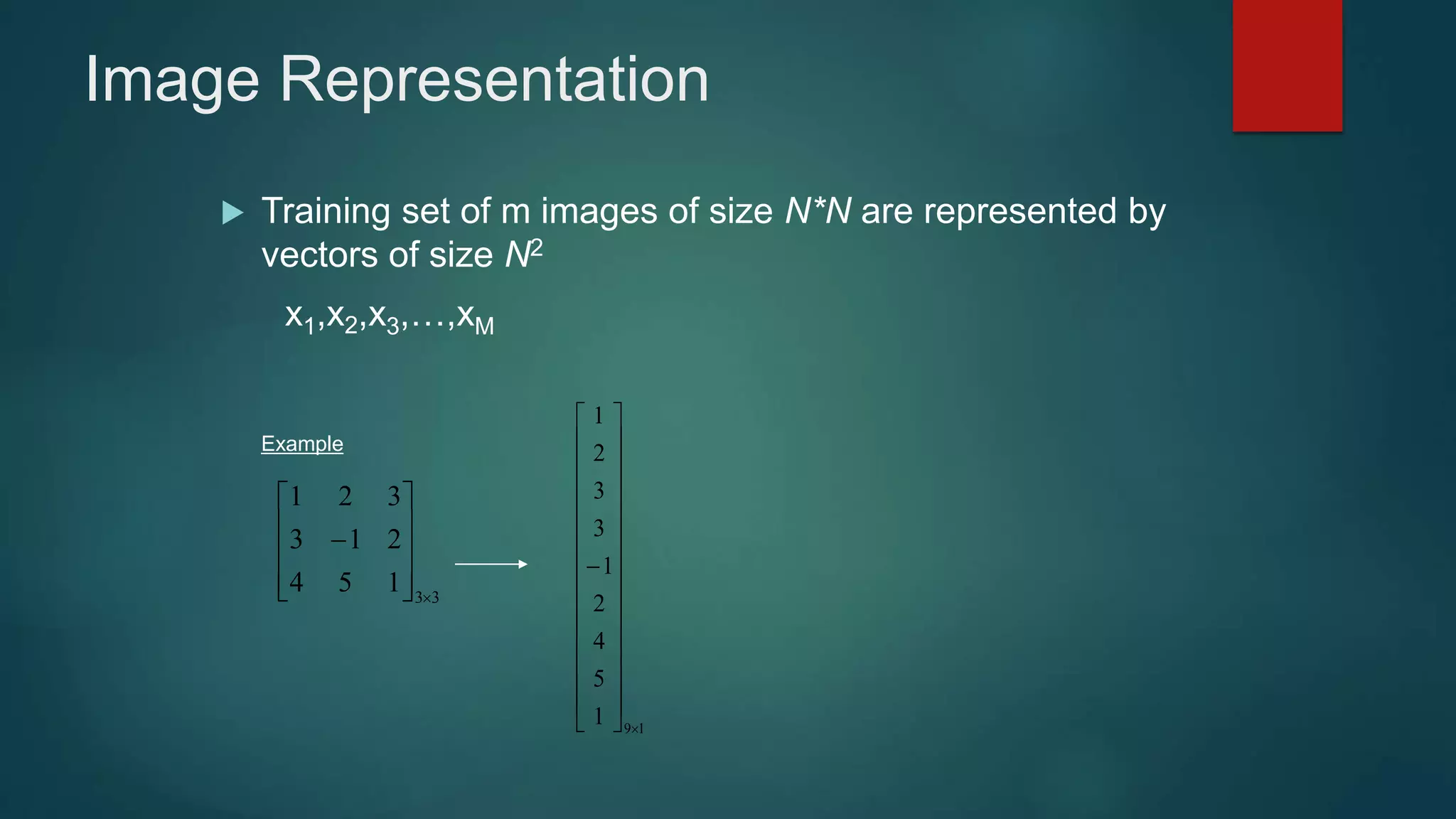
 Training set of m images of size N*N are represented by
vectors of size N2
x1,x2,x3,…,xM
Example
33
154
213
321












19
1
5
4
2
1
3
3
2
1






























Principal Component Analysis
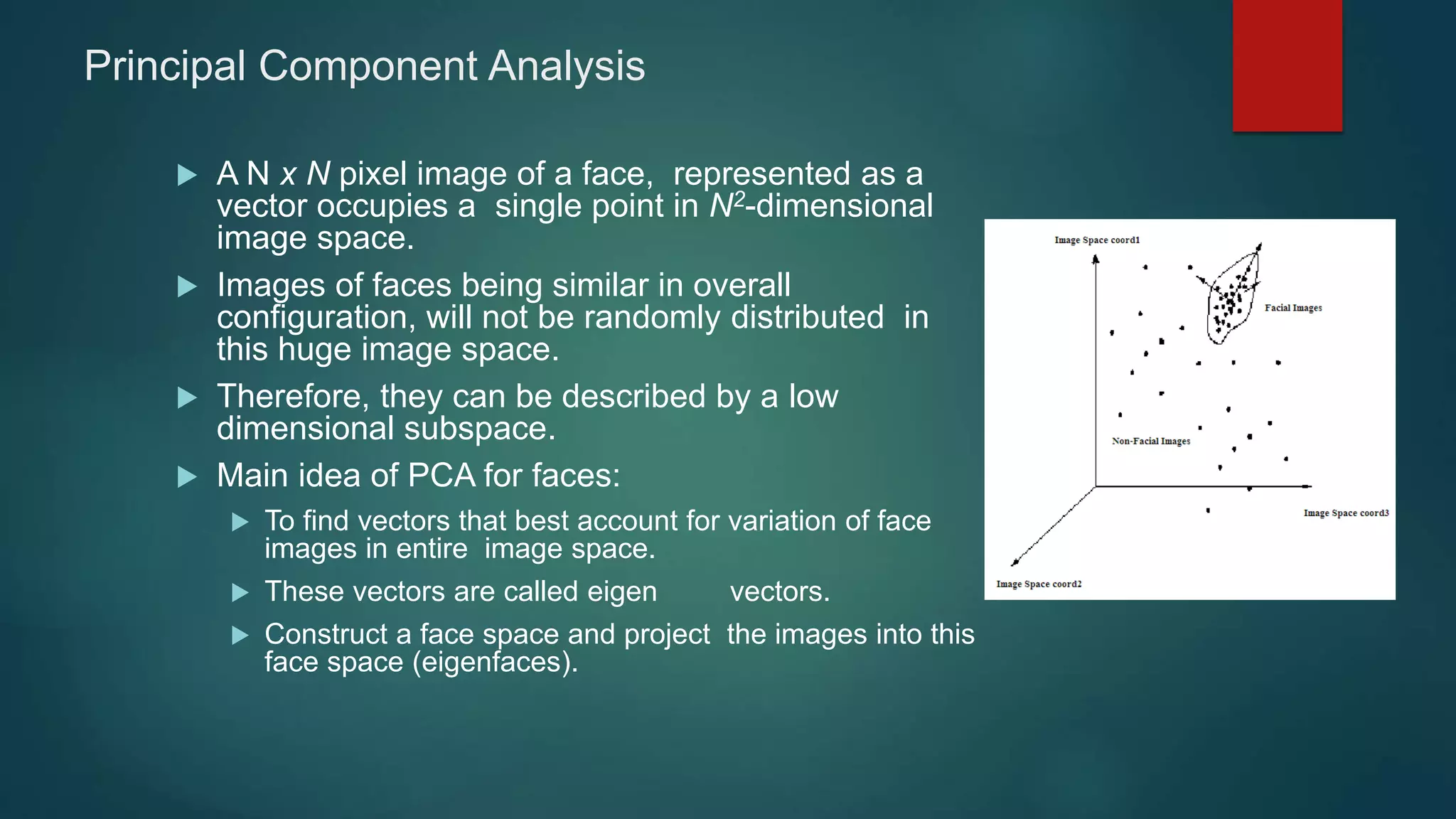
 A N x N pixel image of a face, represented as a
vector occupies a single point in N2-dimensional
image space.
 Images of faces being similar in overall
configuration, will not be randomly distributed in
this huge image space.
 Therefore, they can be described by a low
dimensional subspace.
 Main idea of PCA for faces:
 To find vectors that best account for variation of face
images in entire image space.
 These vectors are called eigen vectors.
 Construct a face space and project the images into this
face space (eigenfaces).
5
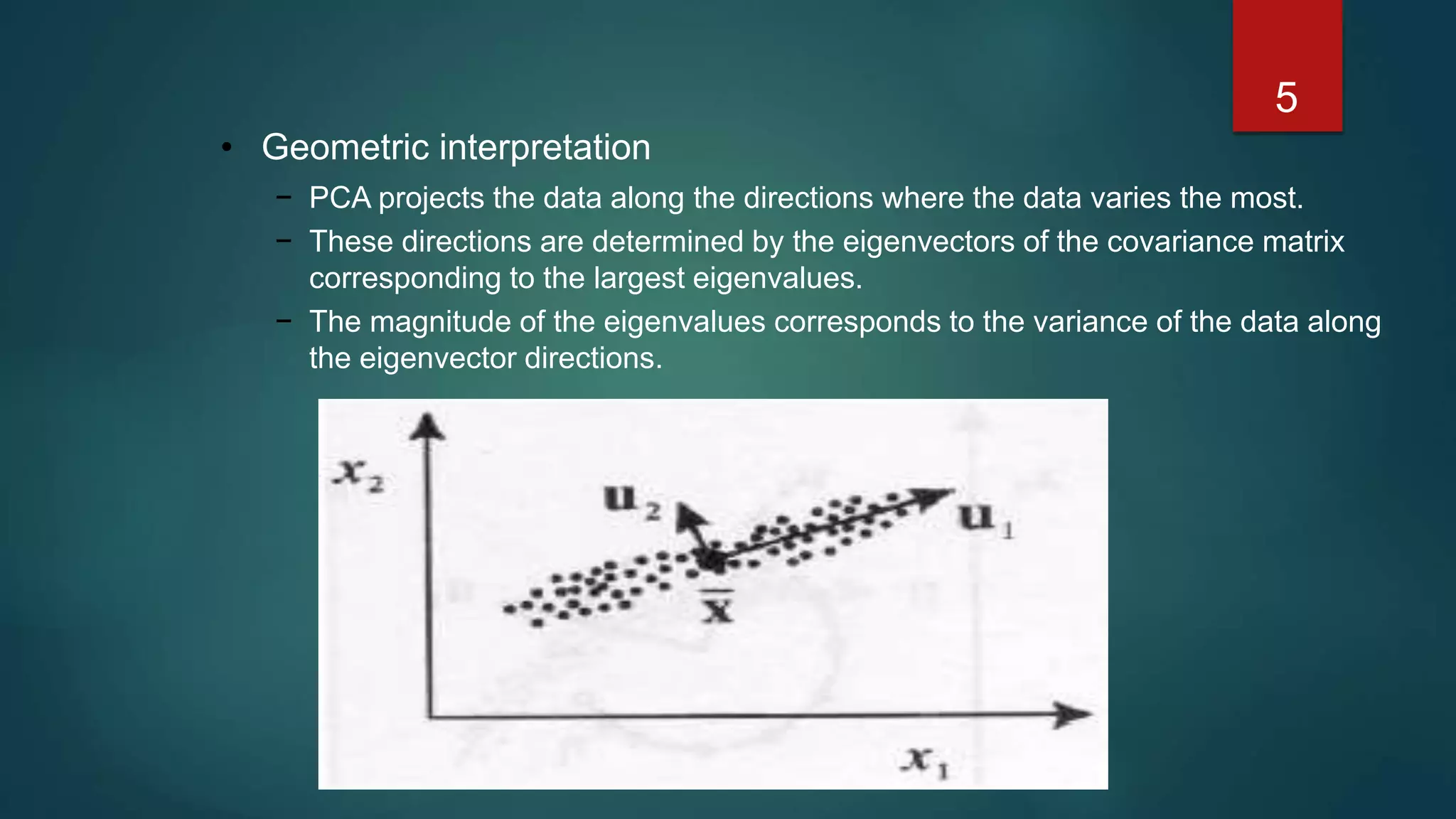
• Geometric interpretation
− PCA projects the data along the directions where the data varies the most.
− These directions are determined by the eigenvectors of the covariance matrix
corresponding to the largest eigenvalues.
− The magnitude of the eigenvalues corresponds to the variance of the data along
the eigenvector directions.
6
Eigenfaces, the algorithm
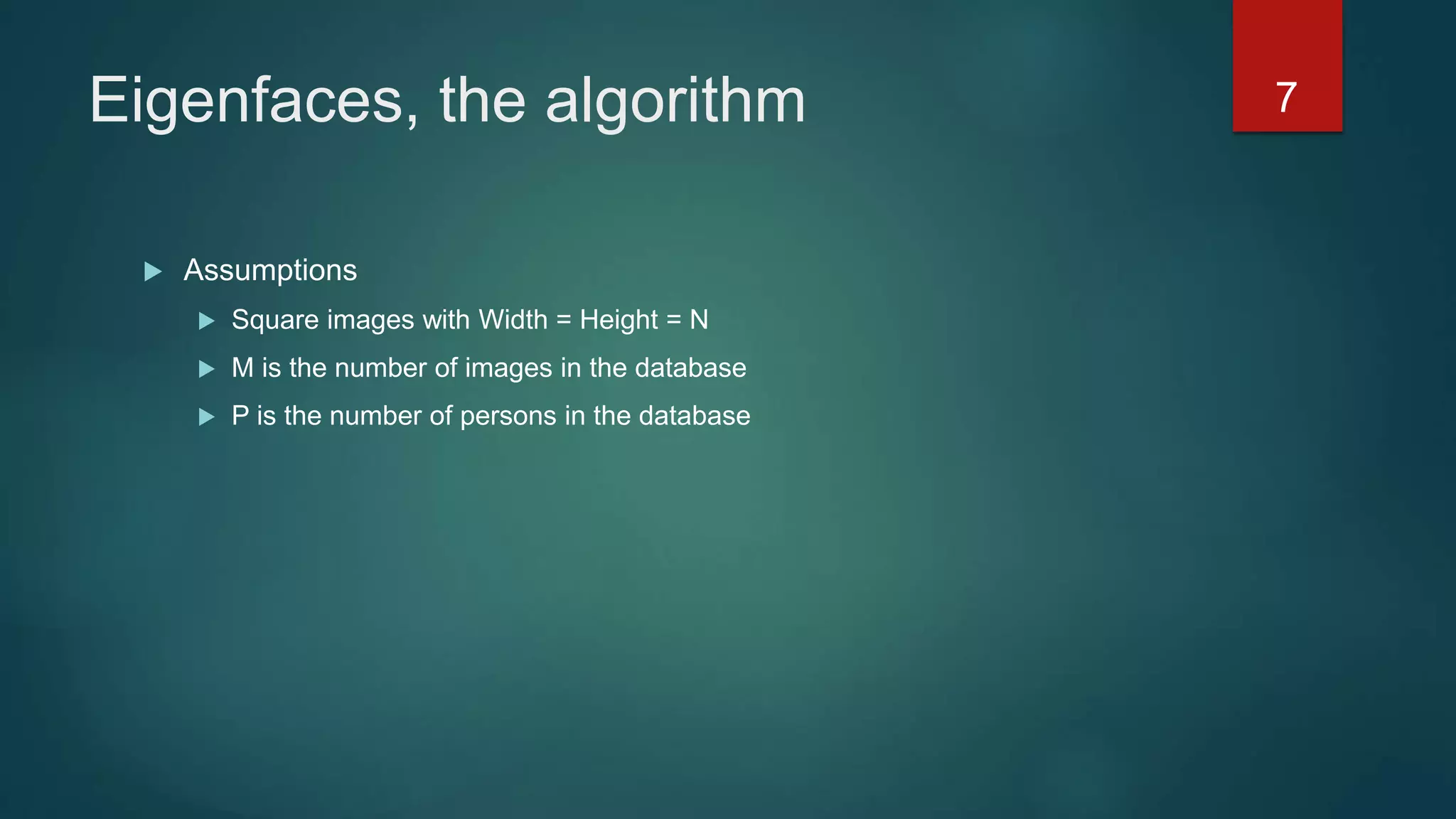
 Assumptions
 Square images with Width = Height = N
 M is the number of images in the database
 P is the number of persons in the database
7
Eigenfaces, the algorithm
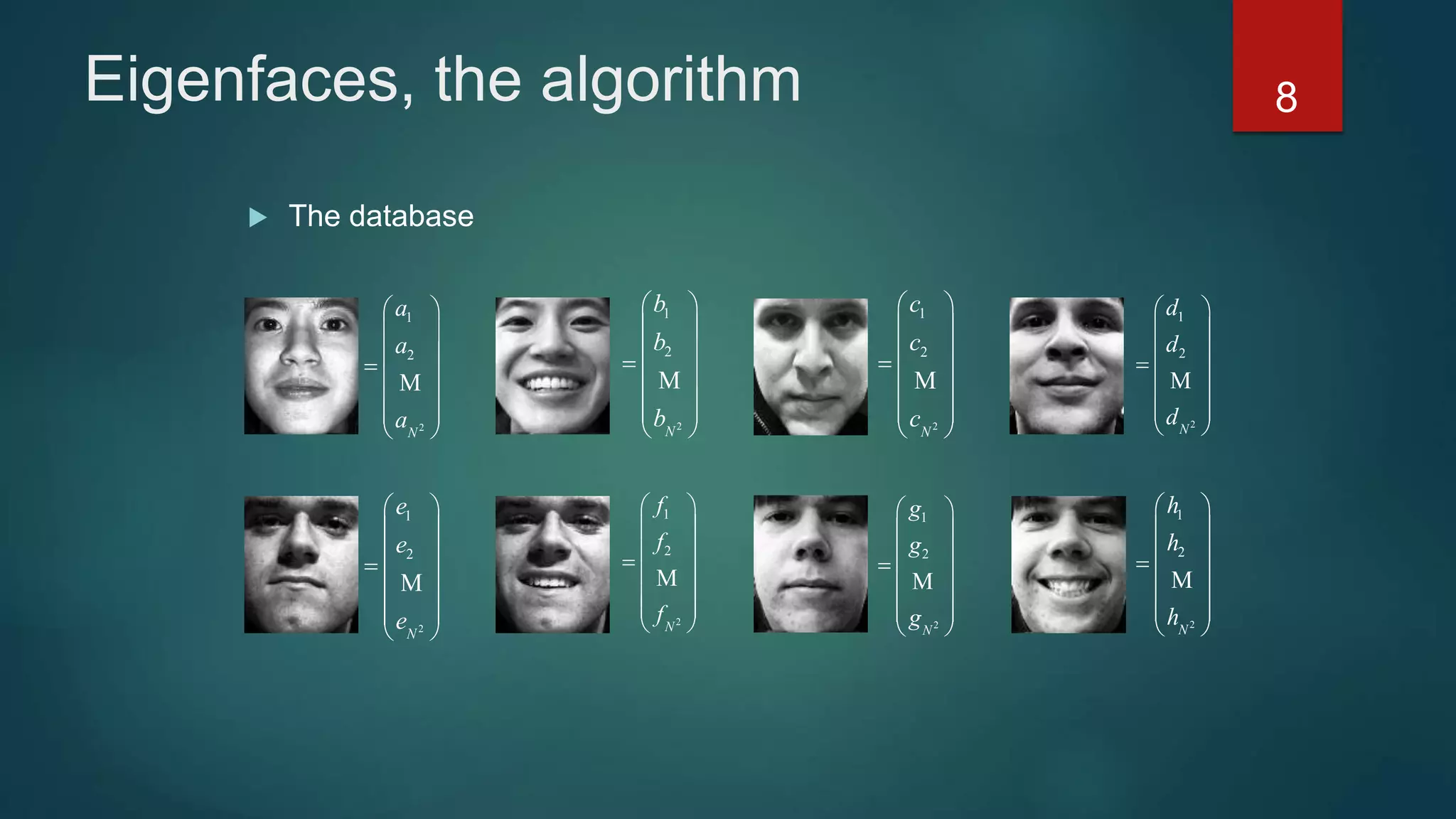
 The database
2
1
2
N
b
b
b
 
 
 
 
  
 
M
2
1
2
N
f
f
f
 
 
 
 
  
 
M
8
2
1
2
N
c
c
c
 
 
 
 
  
 
M
2
1
2
N
d
d
d
 
 
 
 
  
 
M
2
1
2
N
e
e
e
 
 
 
 
  
 
M
2
1
2
N
a
a
a
 
 
 
 
  
 
M
2
1
2
N
g
g
g
 
 
 
 
  
 
M
2
1
2
N
h
h
h
 
 
 
 
  
 
M
Eigenfaces, the algorithm
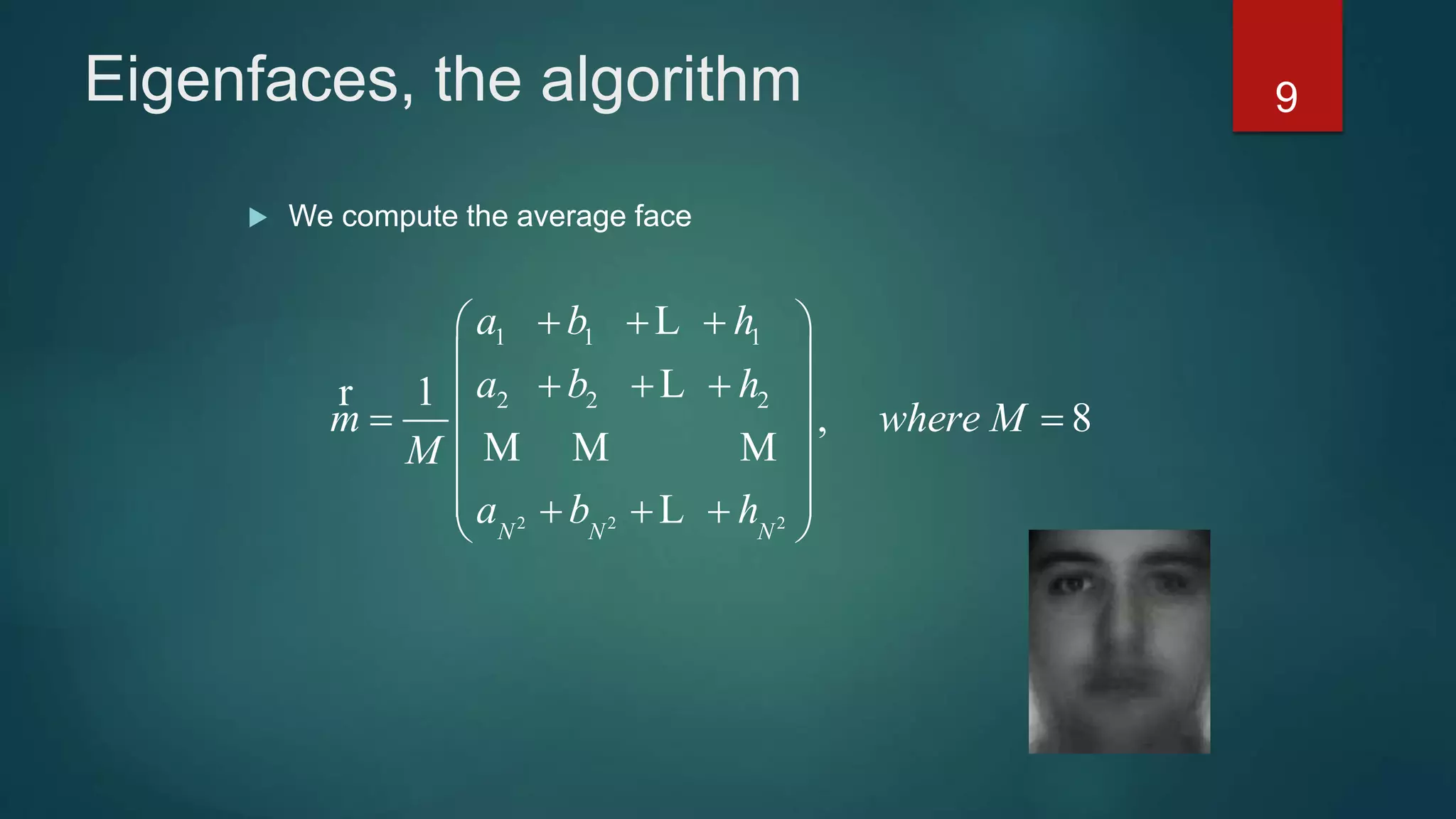
 We compute the average face
2 2 2
1 1 1
2 2 21
, 8
N N N
a b h
a b h
m where M
M
a b h
   
 
    
 
     
L
Lr
M M M
L
9
Eigenfaces, the algorithm
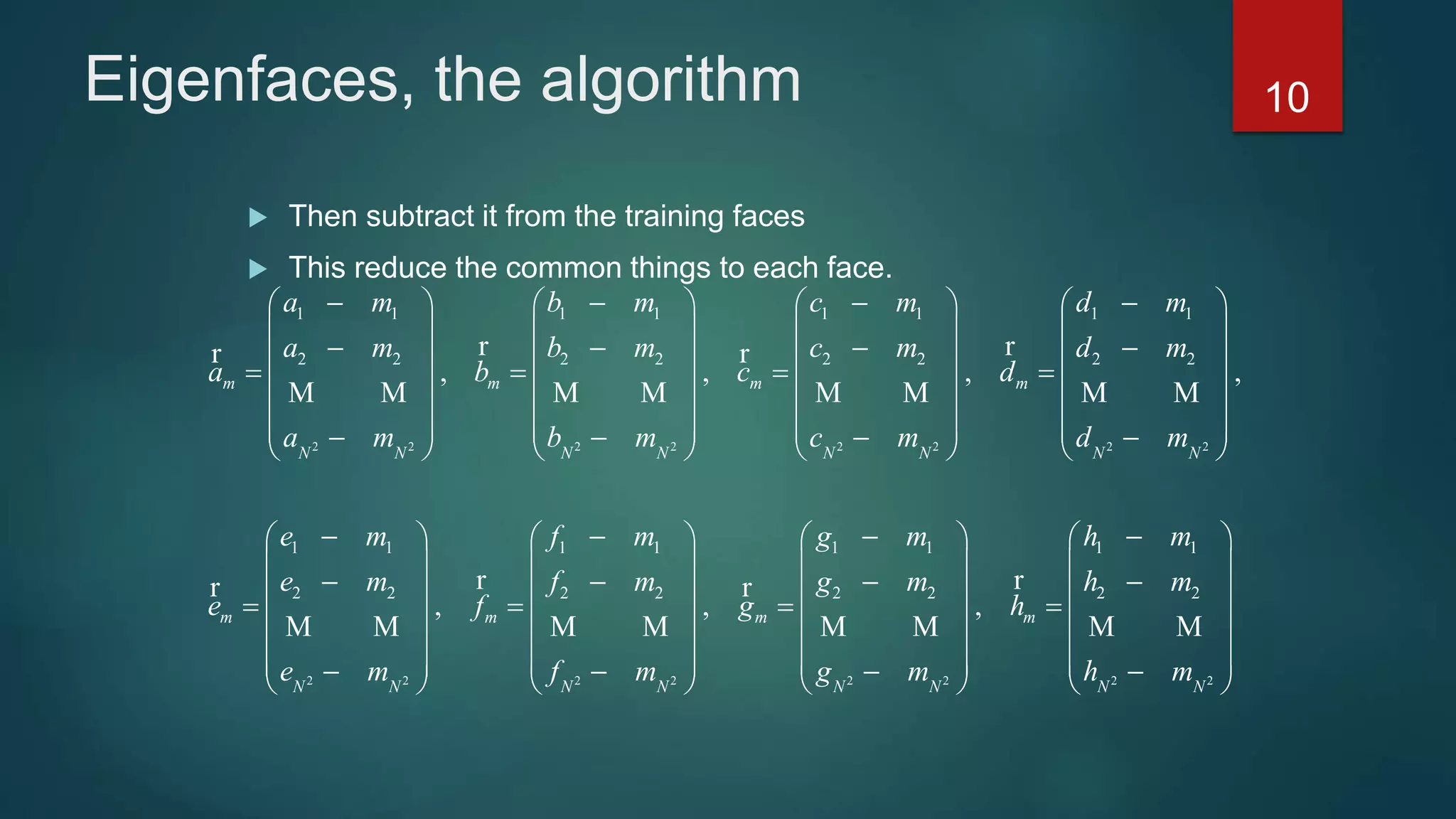
 Then subtract it from the training faces
 This reduce the common things to each face.
2 2 2 2 2 2 2 2
2 2
1 1 1 1 1 1 1 1
2 2 2 2 2 2 2 2
1 1 1 1
2 2
, , , ,
,
m m m m
N N N N N N N N
m m
N N
a m b m c m d m
a m b m c m d m
a b c d
a m b m c m d m
e m f m
e m f
e f
e m
          
       
             
       
                        
  
 
  
 
   
r rr r
M M M M M M M M
rr
M M
2 2 2 2 2 2
1 1 1 1
2 2 2 2 2 2
, ,m m
N N N N N N
g m h m
m g m h m
g h
f m g m h m
      
     
        
     
                 
rr
M M M M M M
10
Eigenfaces, the algorithm
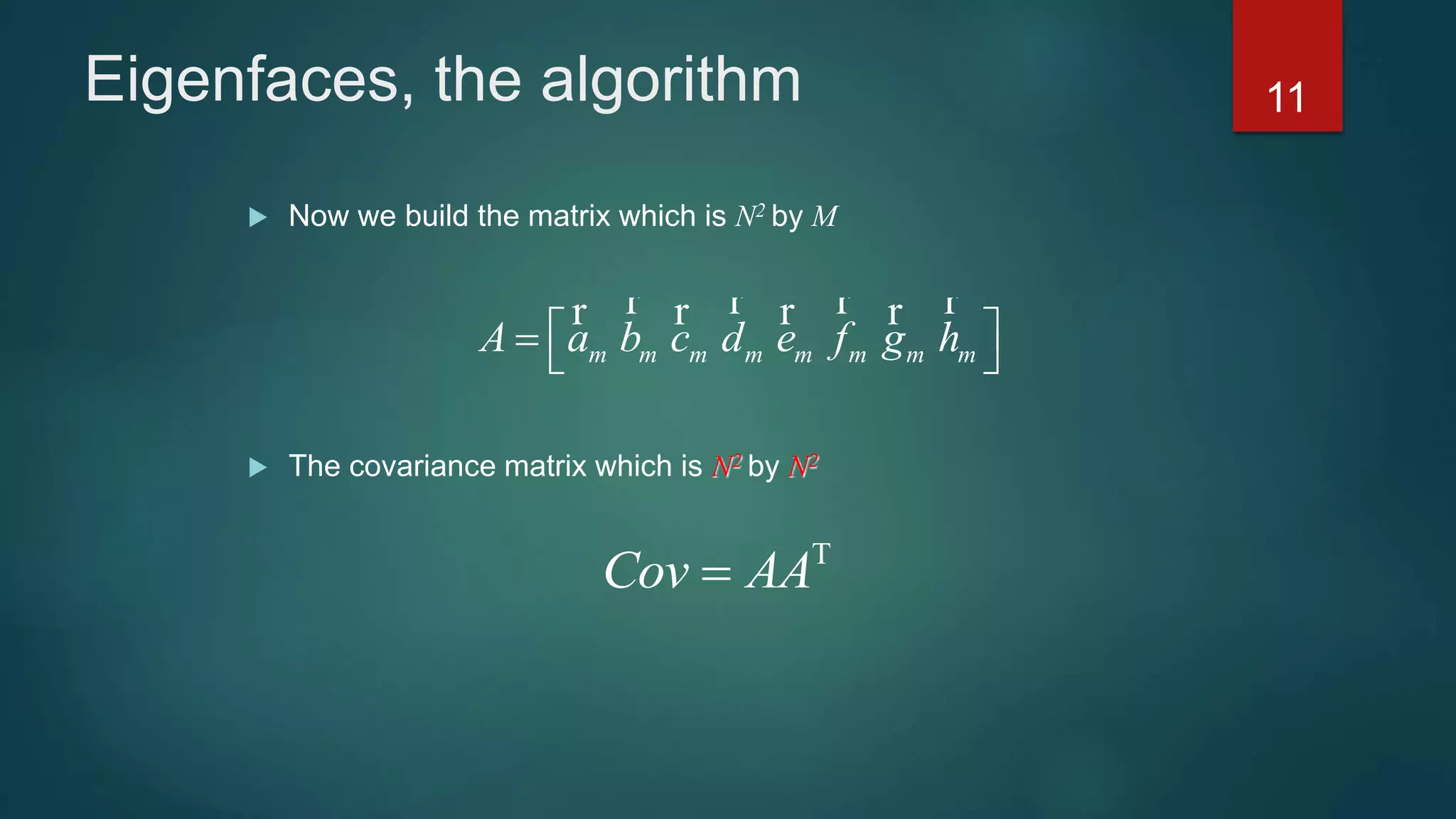
 Now we build the matrix which is N2 by M
 The covariance matrix which is N2 by N2
m m m m m m m mA a b c d e f g h   
r r r rr r r r
Cov AA

11
Eigenfaces, the algorithm
 PCA assumes that the information is carried in the variance of the
features
 Find eigenvalues of the covariance matrix
 The matrix is very large
 The computational effort is very big
 We are interested in at most M eigenvalues
 We can reduce the dimension of the matrix
12
Eigenfaces, the algorithm
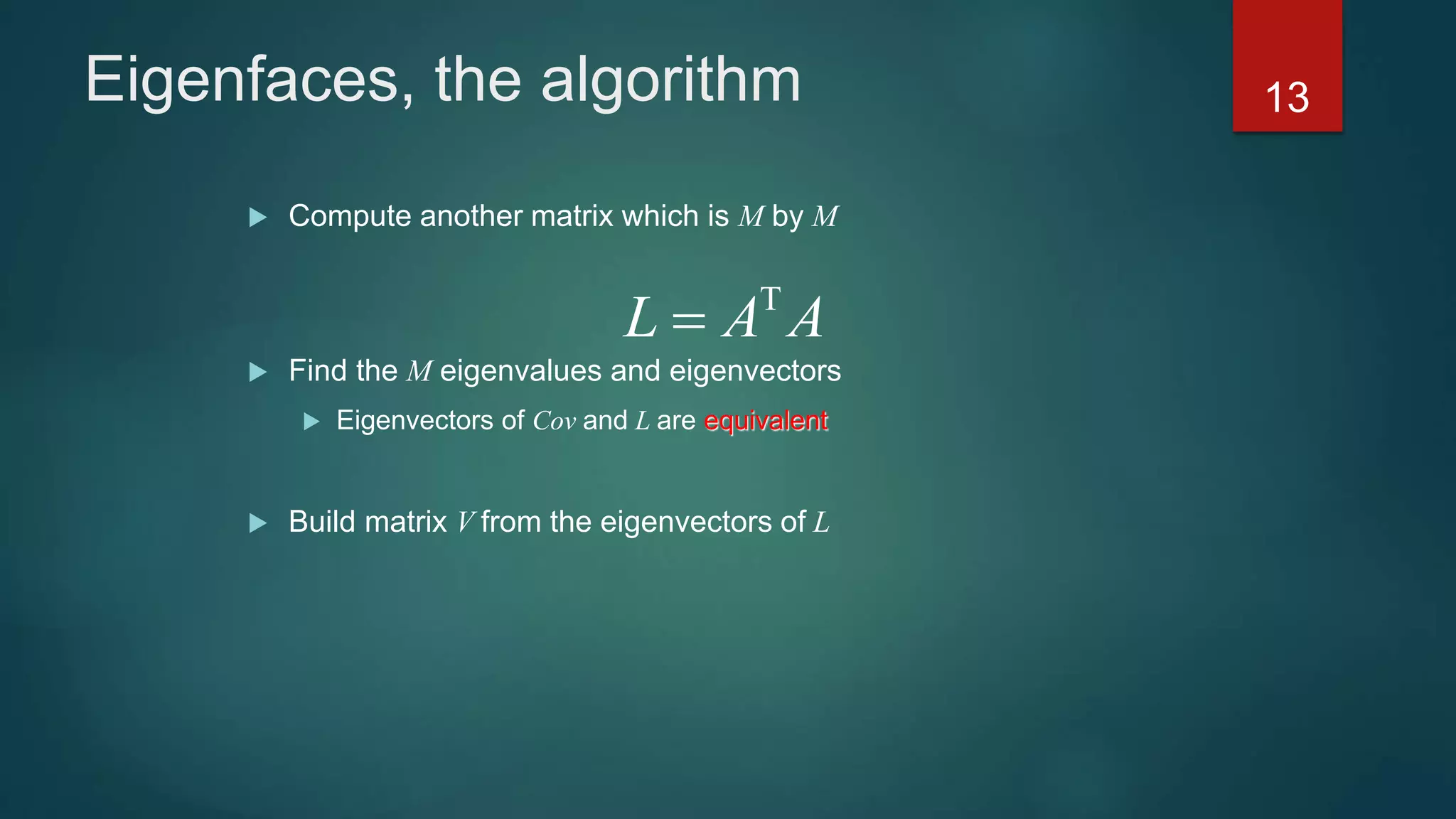
 Compute another matrix which is M by M
 Find the M eigenvalues and eigenvectors
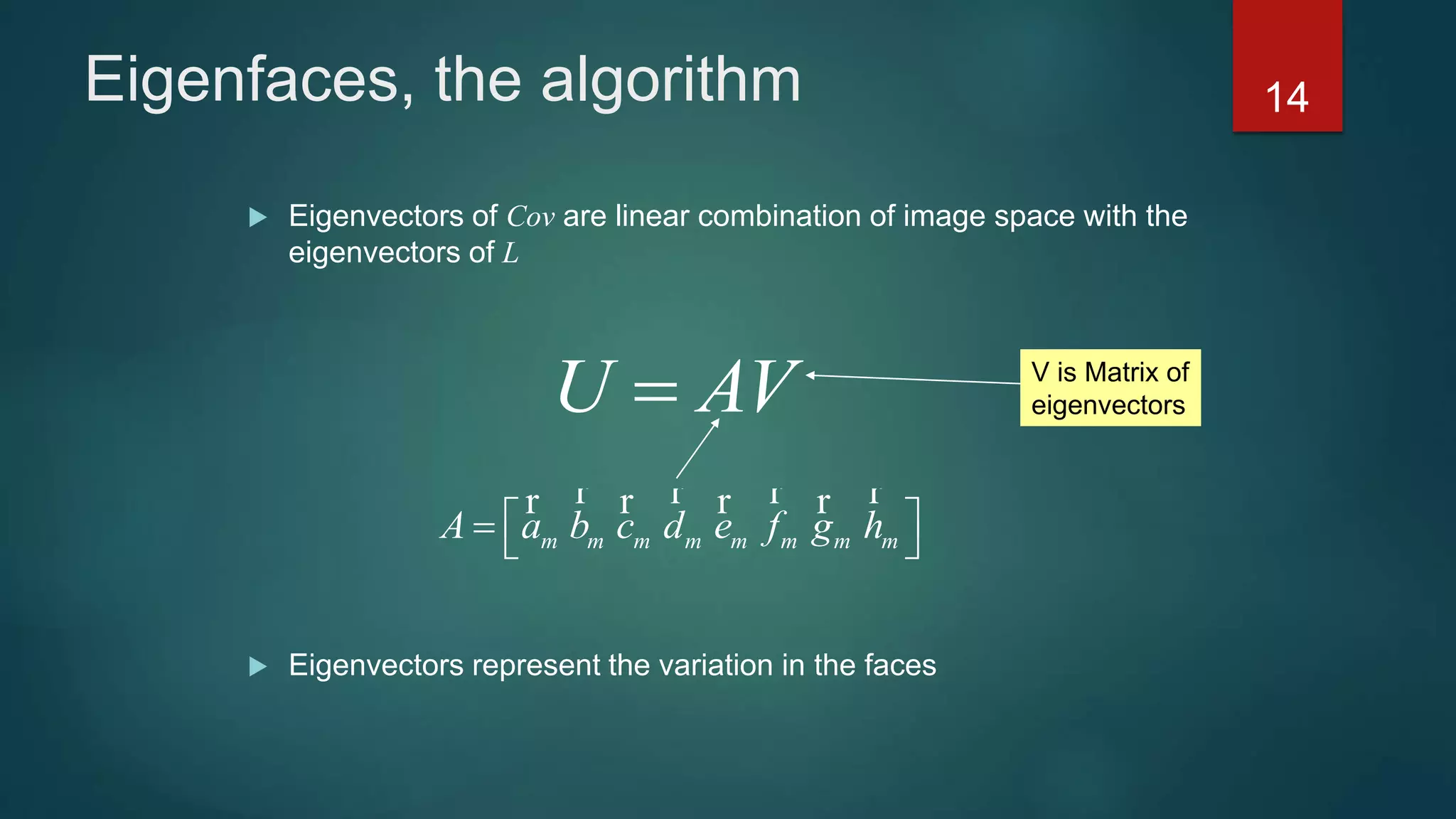
 Eigenvectors of Cov and L are equivalent
 Build matrix V from the eigenvectors of L
L A A

13
Eigenfaces, the algorithm
 Eigenvectors of Cov are linear combination of image space with the
eigenvectors of L
 Eigenvectors represent the variation in the faces
U AV
m m m m m m m mA a b c d e f g h   
r r r rr r r r
14
V is Matrix of
eigenvectors
Eigen Face
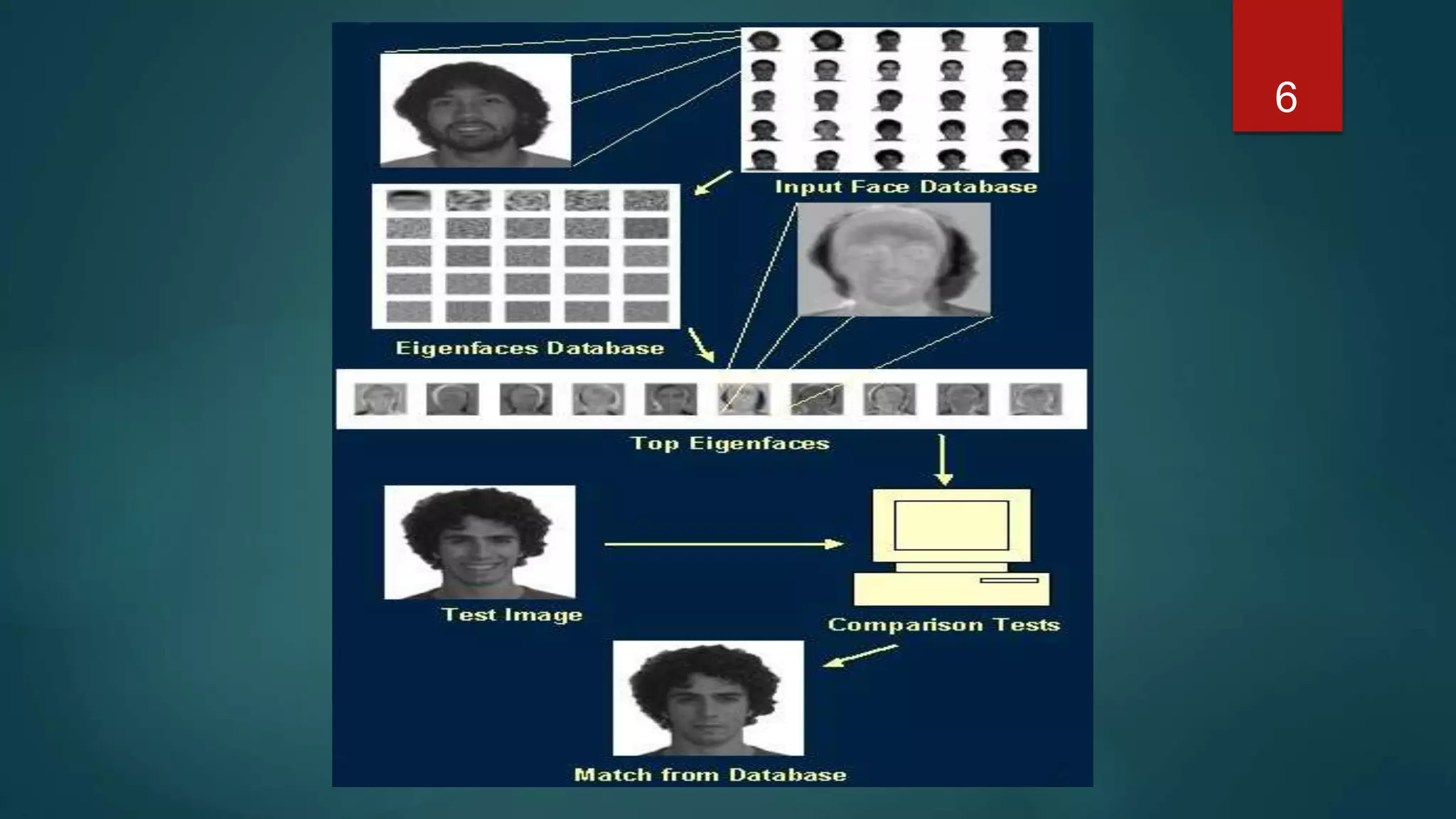
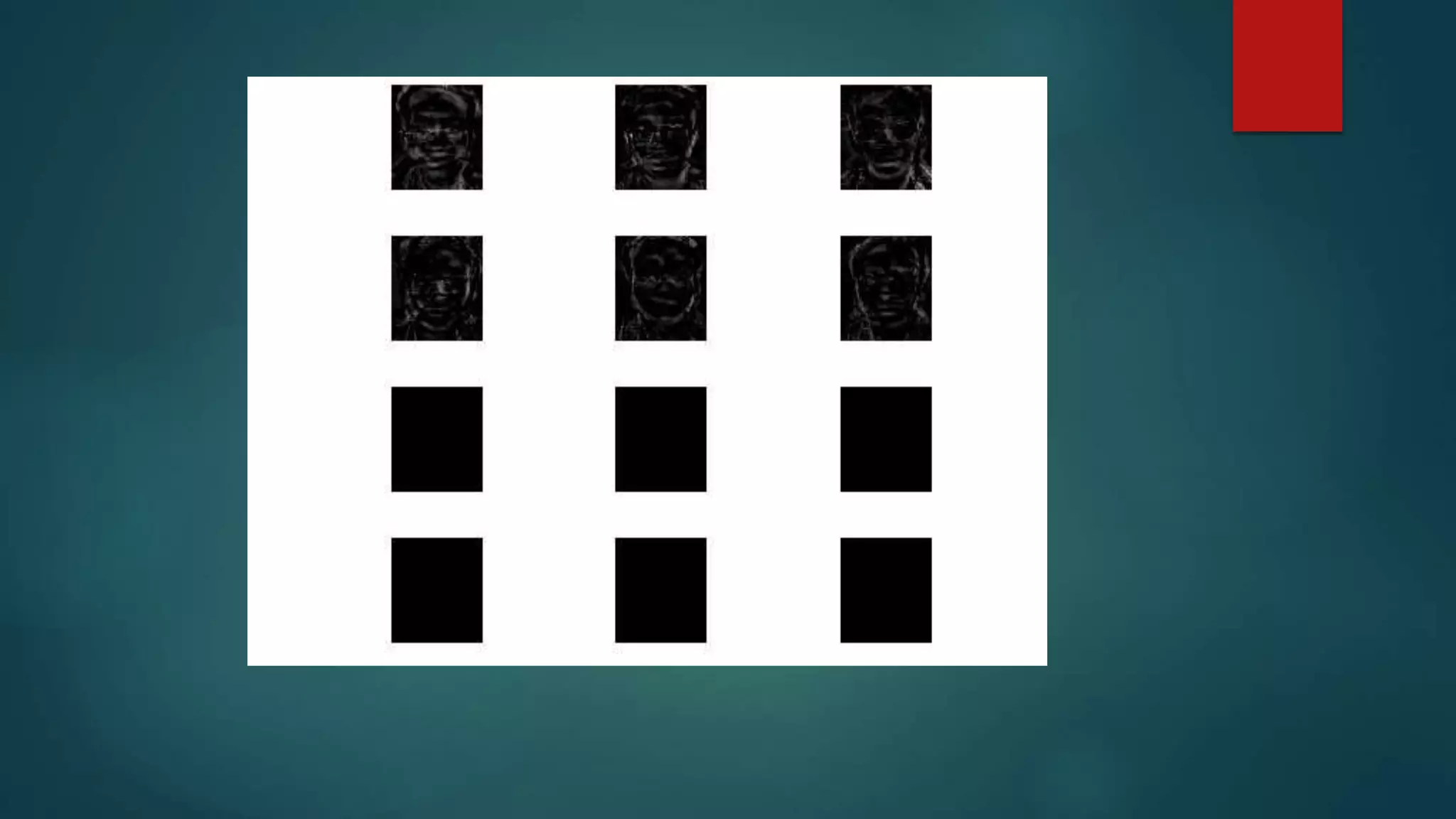
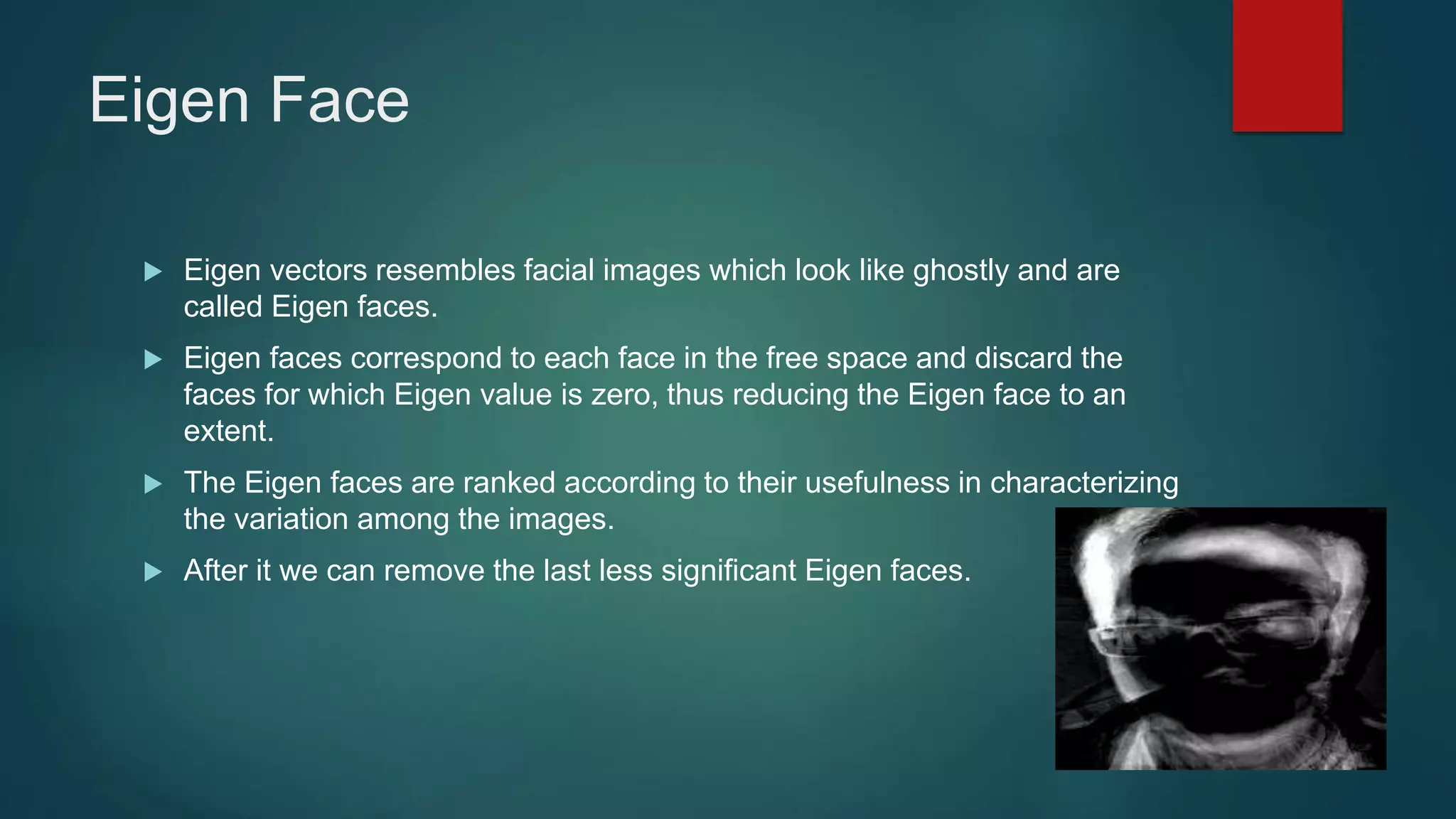
 Eigen vectors resembles facial images which look like ghostly and are
called Eigen faces.
 Eigen faces correspond to each face in the free space and discard the
faces for which Eigen value is zero, thus reducing the Eigen face to an
extent.
 The Eigen faces are ranked according to their usefulness in characterizing
the variation among the images.
 After it we can remove the last less significant Eigen faces.
Eigenfaces, the algorithm 17
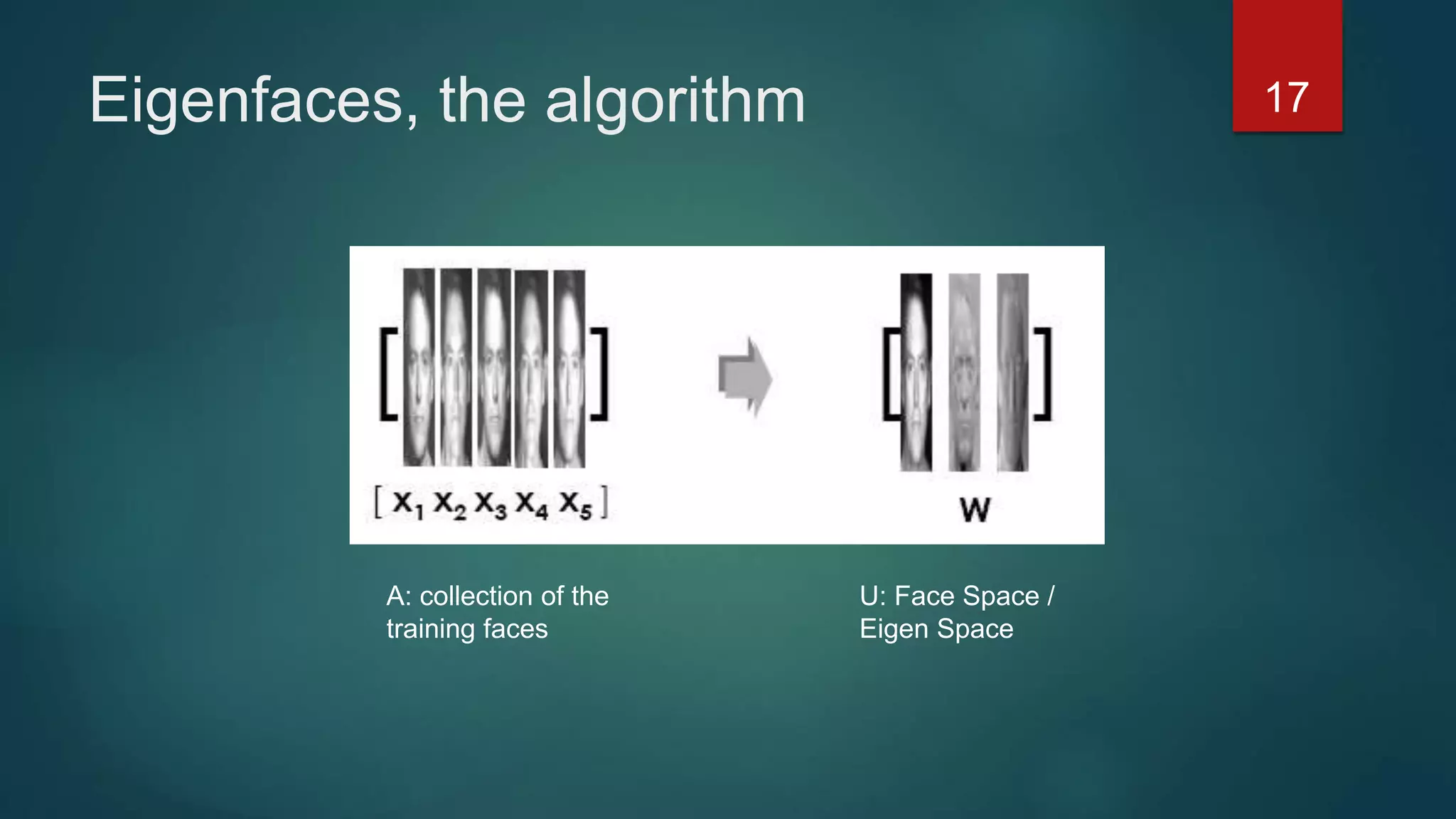
A: collection of the
training faces
U: Face Space /
Eigen Space
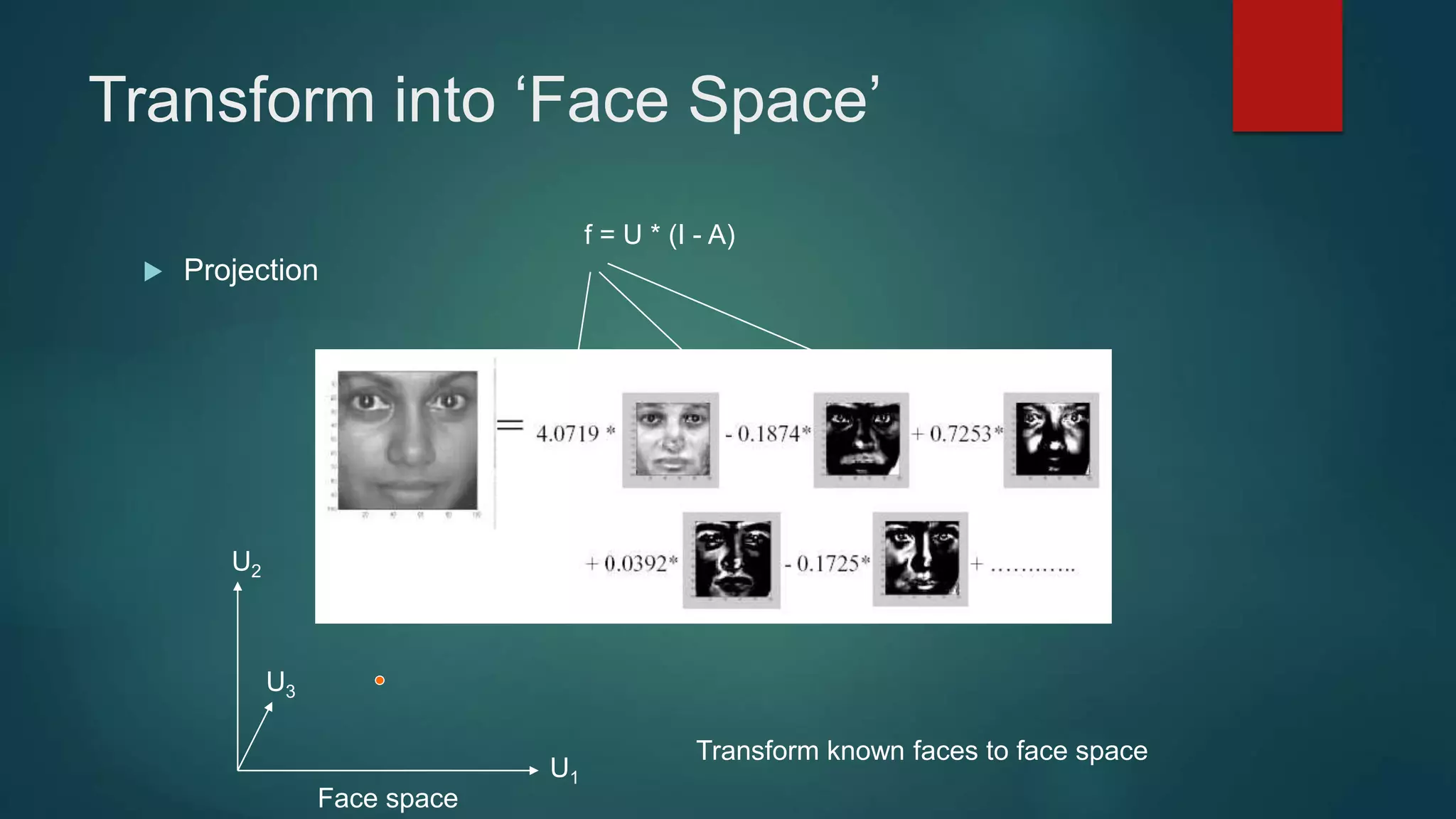
Transform into ‘Face Space’
 Projection
f = U * (I - A)
U1
U2
U3
Transform known faces to face space
Face space
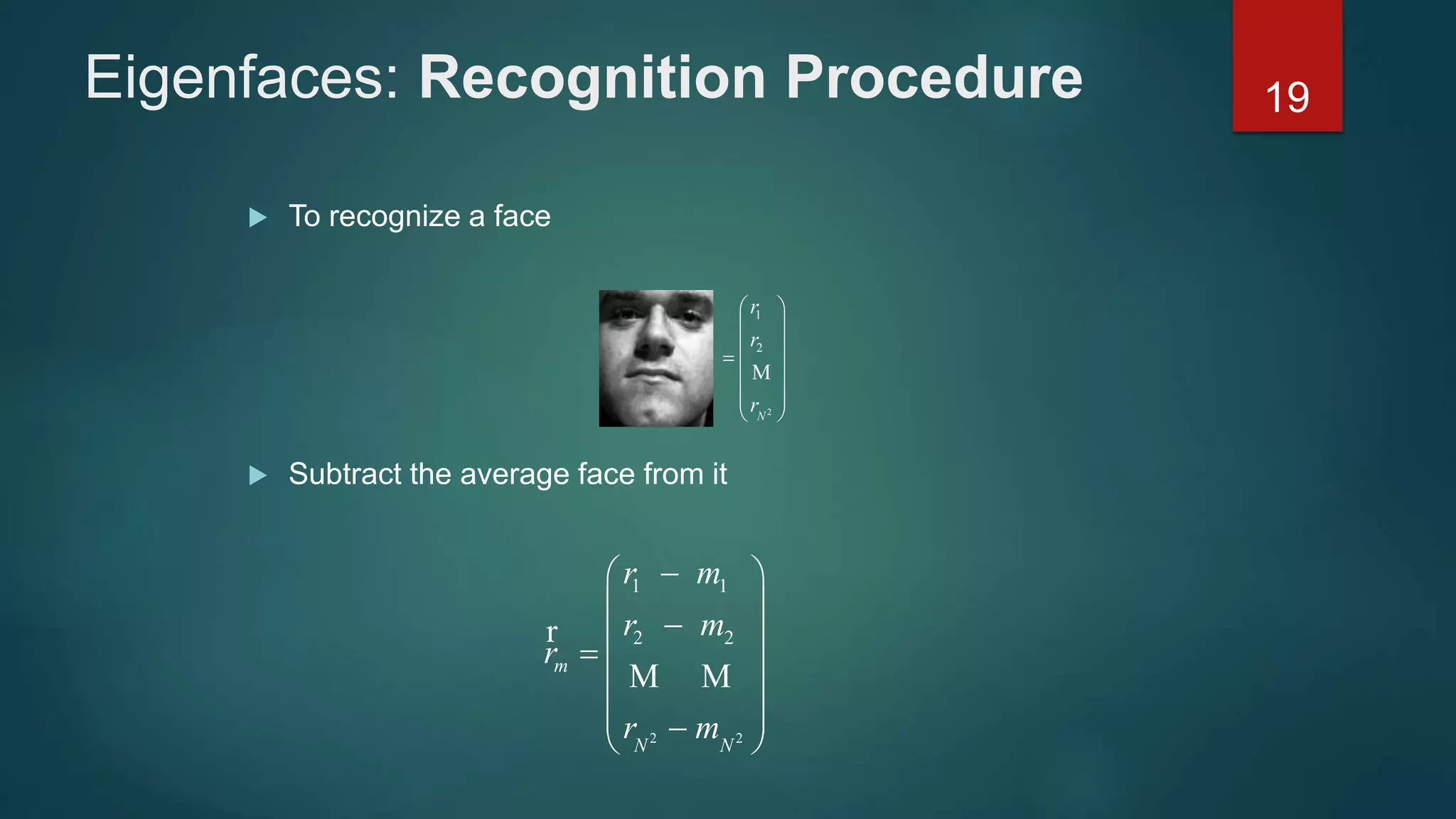
Eigenfaces: Recognition Procedure
 To recognize a face
 Subtract the average face from it
2 2
1 1
2 2
m
N N
r m
r m
r
r m
 
 
 
 
   
r
M M
2
1
2
N
r
r
r
 
 
 
 
  
 
M
19
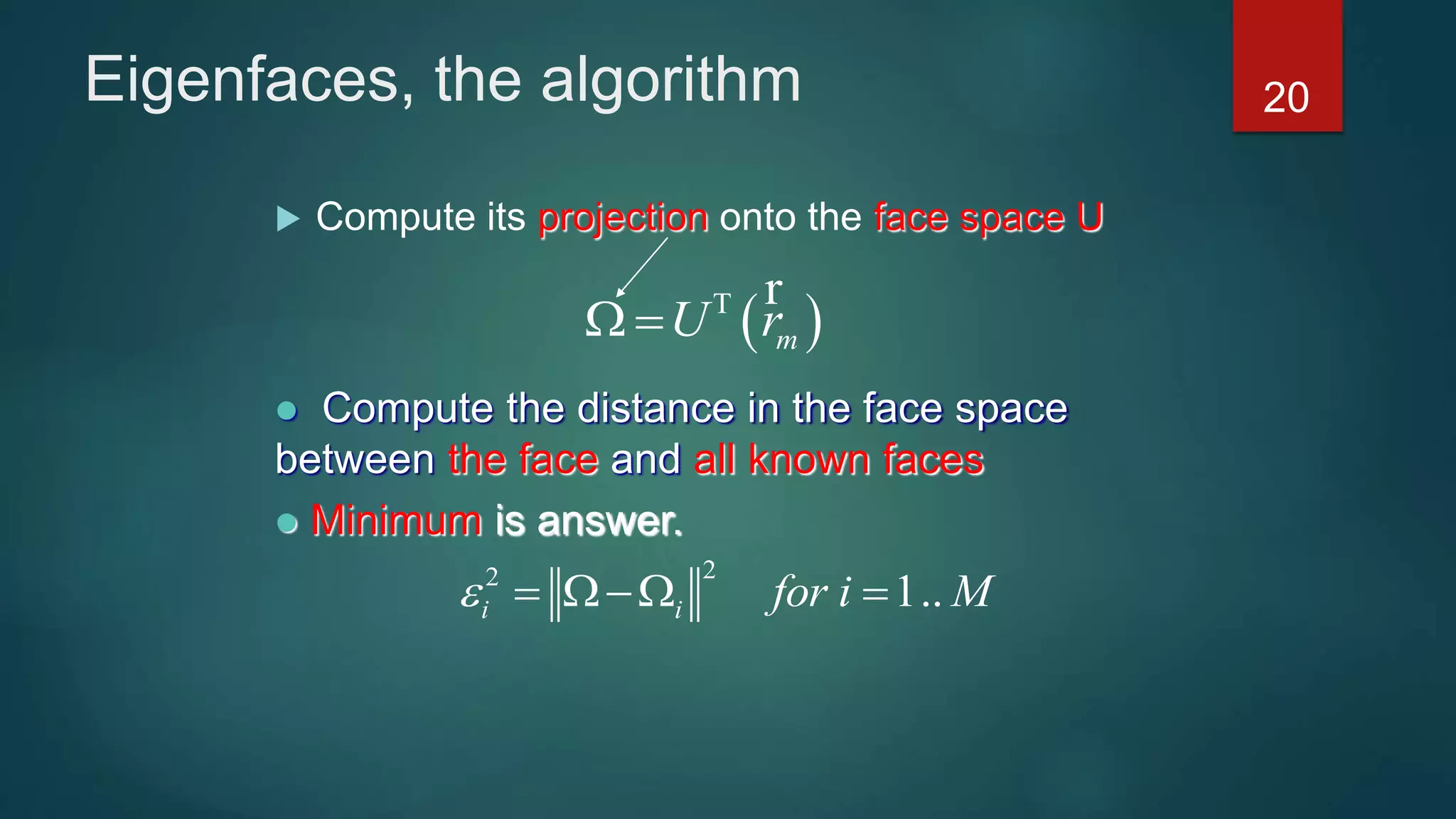
Eigenfaces, the algorithm
 Compute its projection onto the face space U
22
1..i i for i M   
20
 mU r
 
r
 Compute the distance in the face space
between the face and all known faces
 Minimum is answer.
21• Problems
− Background (de-emphasize the outside of the face – e.g., by
multiplying the input image by a 2D Gaussian window centered on
the face)
− Lighting conditions (performance degrades with light changes)
− Scale (performance decreases quickly with changes to head size)
− Orientation (performance decreases but not as fast as with scale
changes)
− plane rotations can be handled
− out-of-plane rotations are more difficult to handle

Face recognition using PCA

  • 1.
  • 2.
    PCA  Images arehigh dimensional correlated data.  Goal of PCA is to reduce the dimensionality of the data by retaining as much as variation possible in our original data set.  The simplet way is to keep one variable and discard all others: not reasonable! Or we can reduce dimensionality by combining features.  In PCA, we can see intermediate stage as visualization.  It is based on Eigen value and Eigen Vector.
  • 3.
    Image Representation  Trainingset of m images of size N*N are represented by vectors of size N2 x1,x2,x3,…,xM Example 33 154 213 321             19 1 5 4 2 1 3 3 2 1                              
  • 4.
    Principal Component Analysis A N x N pixel image of a face, represented as a vector occupies a single point in N2-dimensional image space.  Images of faces being similar in overall configuration, will not be randomly distributed in this huge image space.  Therefore, they can be described by a low dimensional subspace.  Main idea of PCA for faces:  To find vectors that best account for variation of face images in entire image space.  These vectors are called eigen vectors.  Construct a face space and project the images into this face space (eigenfaces).
  • 5.
    5 • Geometric interpretation −PCA projects the data along the directions where the data varies the most. − These directions are determined by the eigenvectors of the covariance matrix corresponding to the largest eigenvalues. − The magnitude of the eigenvalues corresponds to the variance of the data along the eigenvector directions.
  • 6.
  • 7.
    Eigenfaces, the algorithm Assumptions  Square images with Width = Height = N  M is the number of images in the database  P is the number of persons in the database 7
  • 8.
    Eigenfaces, the algorithm The database 2 1 2 N b b b              M 2 1 2 N f f f              M 8 2 1 2 N c c c              M 2 1 2 N d d d              M 2 1 2 N e e e              M 2 1 2 N a a a              M 2 1 2 N g g g              M 2 1 2 N h h h              M
  • 9.
    Eigenfaces, the algorithm We compute the average face 2 2 2 1 1 1 2 2 21 , 8 N N N a b h a b h m where M M a b h                    L Lr M M M L 9
  • 10.
    Eigenfaces, the algorithm Then subtract it from the training faces  This reduce the common things to each face. 2 2 2 2 2 2 2 2 2 2 1 1 1 1 1 1 1 1 2 2 2 2 2 2 2 2 1 1 1 1 2 2 , , , , , m m m m N N N N N N N N m m N N a m b m c m d m a m b m c m d m a b c d a m b m c m d m e m f m e m f e f e m                                                                                 r rr r M M M M M M M M rr M M 2 2 2 2 2 2 1 1 1 1 2 2 2 2 2 2 , ,m m N N N N N N g m h m m g m h m g h f m g m h m                                               rr M M M M M M 10
  • 11.
    Eigenfaces, the algorithm Now we build the matrix which is N2 by M  The covariance matrix which is N2 by N2 m m m m m m m mA a b c d e f g h    r r r rr r r r Cov AA  11
  • 12.
    Eigenfaces, the algorithm PCA assumes that the information is carried in the variance of the features  Find eigenvalues of the covariance matrix  The matrix is very large  The computational effort is very big  We are interested in at most M eigenvalues  We can reduce the dimension of the matrix 12
  • 13.
    Eigenfaces, the algorithm Compute another matrix which is M by M  Find the M eigenvalues and eigenvectors  Eigenvectors of Cov and L are equivalent  Build matrix V from the eigenvectors of L L A A  13
  • 14.
    Eigenfaces, the algorithm Eigenvectors of Cov are linear combination of image space with the eigenvectors of L  Eigenvectors represent the variation in the faces U AV m m m m m m m mA a b c d e f g h    r r r rr r r r 14 V is Matrix of eigenvectors
  • 16.
    Eigen Face  Eigenvectors resembles facial images which look like ghostly and are called Eigen faces.  Eigen faces correspond to each face in the free space and discard the faces for which Eigen value is zero, thus reducing the Eigen face to an extent.  The Eigen faces are ranked according to their usefulness in characterizing the variation among the images.  After it we can remove the last less significant Eigen faces.
  • 17.
    Eigenfaces, the algorithm17 A: collection of the training faces U: Face Space / Eigen Space
  • 18.
    Transform into ‘FaceSpace’  Projection f = U * (I - A) U1 U2 U3 Transform known faces to face space Face space
  • 19.
    Eigenfaces: Recognition Procedure To recognize a face  Subtract the average face from it 2 2 1 1 2 2 m N N r m r m r r m             r M M 2 1 2 N r r r              M 19
  • 20.
    Eigenfaces, the algorithm Compute its projection onto the face space U 22 1..i i for i M    20  mU r   r  Compute the distance in the face space between the face and all known faces  Minimum is answer.
  • 21.
    21• Problems − Background(de-emphasize the outside of the face – e.g., by multiplying the input image by a 2D Gaussian window centered on the face) − Lighting conditions (performance degrades with light changes) − Scale (performance decreases quickly with changes to head size) − Orientation (performance decreases but not as fast as with scale changes) − plane rotations can be handled − out-of-plane rotations are more difficult to handle