Presentation
On
Facial Expression Recognition System
using Deep Convolutional Neural
Networks
Presented by: Sandeep Wakchaure
Outline
 Abstract
 Introduction
 Problem Definition
 Literature survey
 Objective and Motivation
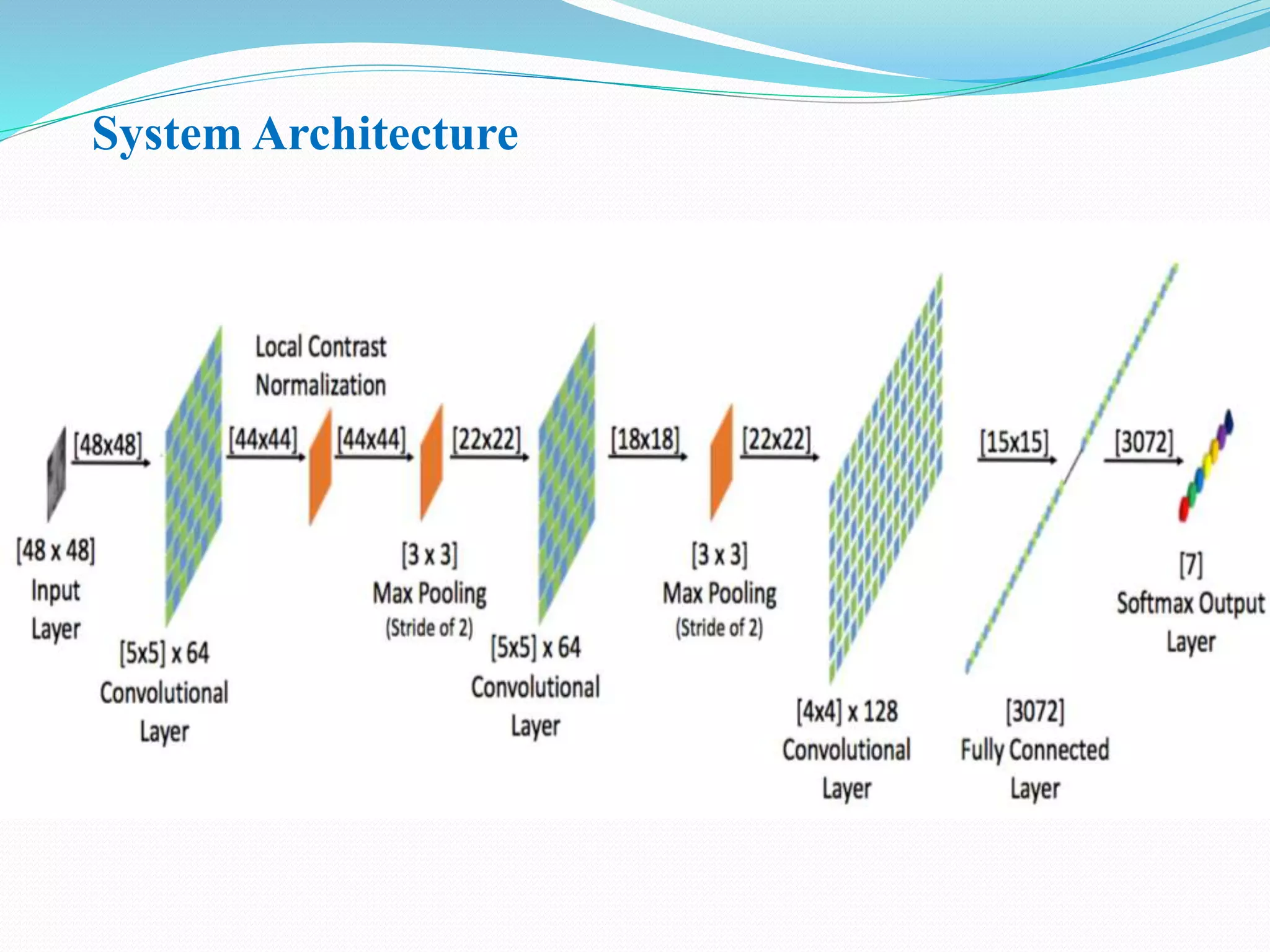
 System Architecture
 Dataset
 Application
 Project Work
 Conclusion
Abstract
In today’s world there are number of application techniques
used for face recognition, e.g Bio-matrix face recognition, payments
system, Access and Security, criminal identification, Advertising,
healthcare. The problem over these applications for recognizing facial
expression is still an ongoing research. Facial expression detection is
based on Image processing and computer vision techniques . In
this project I am presenting the system of an artificially intelligent
system which is capable of emotion recognition trough facial
expressions. This system distinguishing the seven universal emotions:
happy, disgust, anger, fearful, sad, surprise and neutral. In this there
are different layers used in the neural network after which the best
performing network is further optimized and finally return the emotion
of the user.
Facial expression recognition is the process of identifying human
emotion. This is both something that humans do automatically but
computational methodologies have also been developed.
In the facial recognition application faces are matches with the
available dataset to find out the human faces. These application are mostly
used in the biometric, government cyber security areas. In the chat boats
system or the system which interact with human should train with the
emotion recognition of the human so that the resultant action should be a
appropriate these application can be used in many places like in digital
cameras, where on the smile expression the image captured operation will
perform or in case of the automation system according to mood the system or
robot will interact with human.
Introduction
One of the current top applications of artificial intelligence using neural
networks is the recognition of faces in photos and videos. Most techniques
process visual data and search for general patterns present in human faces.
applications involve automatic blurring of faces on Google Street view
footage and automatic recognition of Facebook friends in photos.
For the development of a system that is able to recognize emotions through
Facial expressions, previous research on the way humans reveal emotions as
well as the theory of automatic image categorization is reviewed.
Some of the below papers are introduced the emotion recognition techniques
1. Prudhvi Raj Dachapally, Facial Emotion Detection Using Convolutional
Neural Network and Representational Autoencoder Units.
- Autoencoders to construct unique representation of each emotion.
- Eigth layer convolutional neural network.
Literature Survey
Cont..
Base paper:
2. Rosa Ariani, Munir, Siswo Handoko, Learners Mood Detection using
Convolutional Neural network, TCSITech, 2017 3rd international conference.
- Implemented using four layer of CNN -2 convolutional layers and 2 sub
sampling layer.
3. Amogh gudi , Recognizing Semantic features in Faces using Deep
Learning.{2014}
-Active appearance model used to classify the emotions using single layer
neural network.
Proposed System
This proposed system capable of performing automatic facial
expression or emotion recognition of seven universal emotions, considered
to be universal across cultures: disgust, anger, fear, happiness, sadness,
neutral and surprise. Such system would analyze the image of a face and
produce a calculated prediction of the expression. The approach integrates a
module for automatic face detection, by generating neural network using
training data set.
Methods to get more accuracy :
I am using Deep Convolutional neural network , where three
neural network architectures are customized, trained and subjected to
various classification task. Input image data will be provided to network and
Which returns values of the output layer the performance matrix of the final
model will generate and max value from matrix is calculated this value
represent the current emotion of the provided input.
There are several areas where the emotion recognition techniques are used l
like in digital cameras to automatically take pictures when the user smiles.
However, the most promising applications involve the Humanization of
artificial intelligent systems. If computers are able to keep track of the
mental state of the user, robots can react upon this and behave
appropriately. Emotion recognition therefore plays a key-role in improving
human machine interaction.
Focusing on objective, using neural network based artificially
intelligent Systems capable of deriving the emotion of a person through
pictures of his or her face.
Objective and Motivation
System Architecture
Example: vehicle classification system
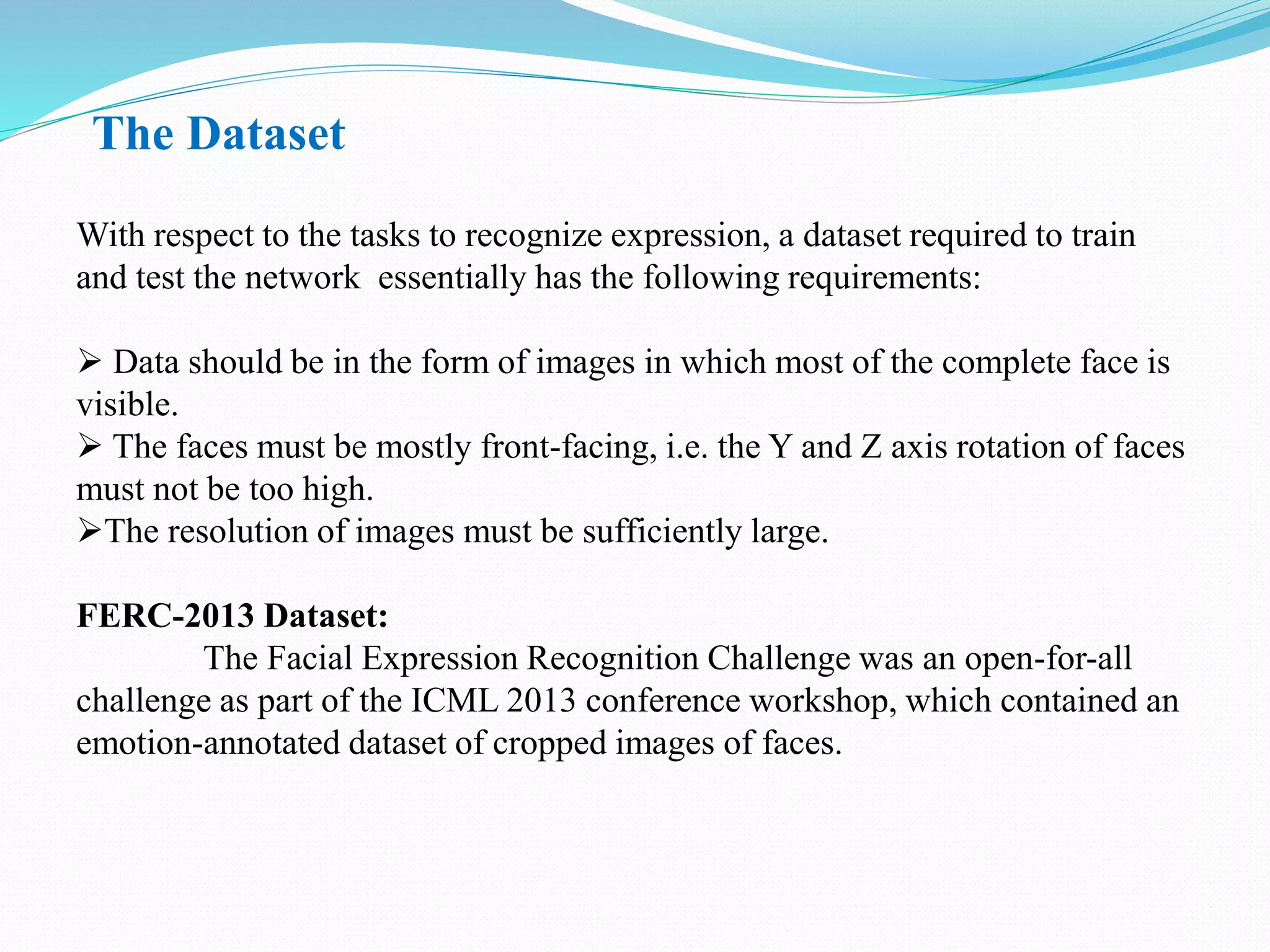
With respect to the tasks to recognize expression, a dataset required to train
and test the network essentially has the following requirements:
 Data should be in the form of images in which most of the complete face is
visible.
 The faces must be mostly front-facing, i.e. the Y and Z axis rotation of faces
must not be too high.
The resolution of images must be sufficiently large.
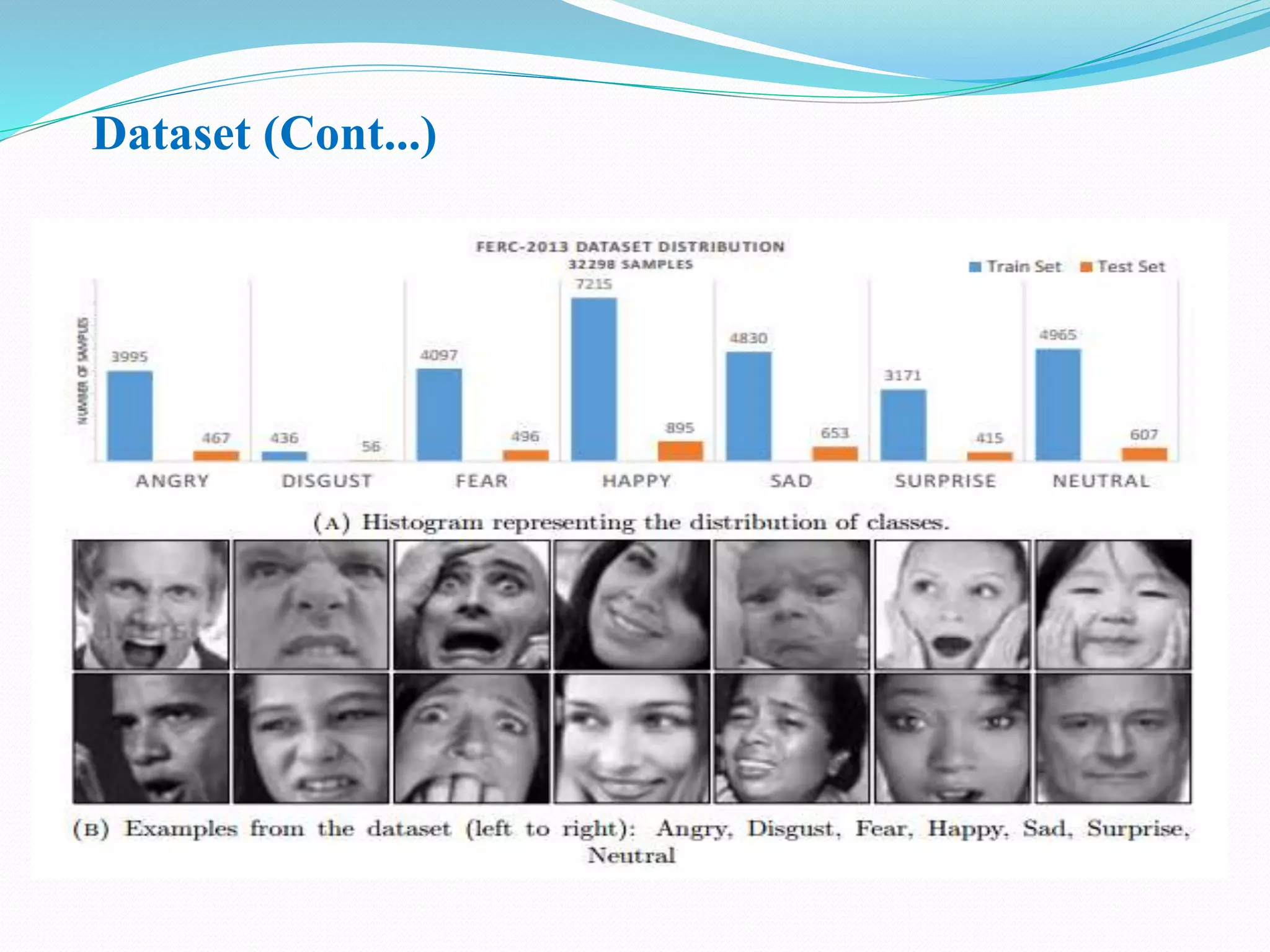
FERC-2013 Dataset:
The Facial Expression Recognition Challenge was an open-for-all
challenge as part of the ICML 2013 conference workshop, which contained an
emotion-annotated dataset of cropped images of faces.
The Dataset
Dataset (Cont...)
Application
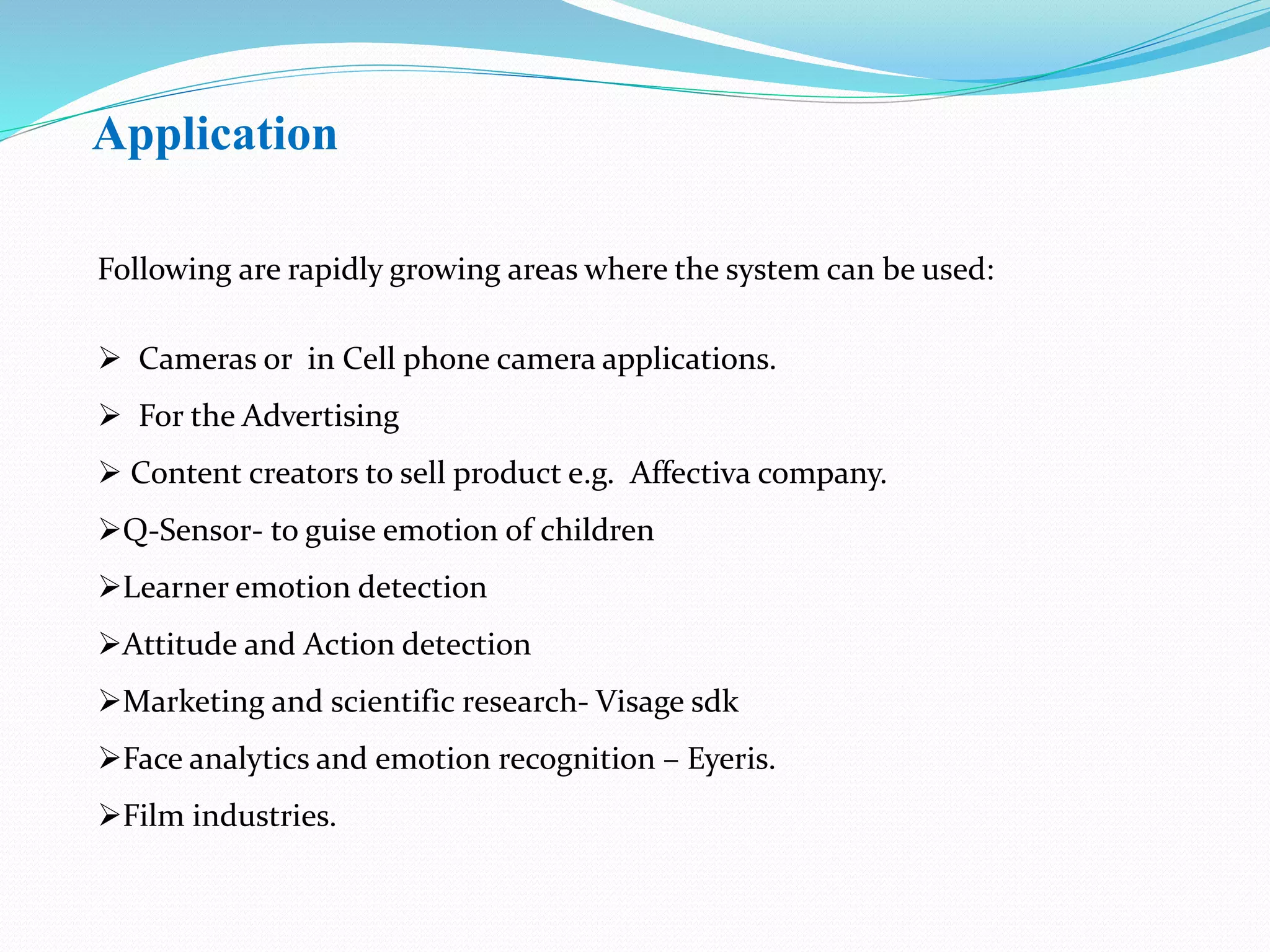
Following are rapidly growing areas where the system can be used:
 Cameras or in Cell phone camera applications.
 For the Advertising
 Content creators to sell product e.g. Affectiva company.
Q-Sensor- to guise emotion of children
Learner emotion detection
Attitude and Action detection
Marketing and scientific research- Visage sdk
Face analytics and emotion recognition – Eyeris.
Film industries.
Project work
Dependency :
- Numpy
- TensorFlow
- TFlearn
- OpenCv
I am using the FERC-2013 faces database, which is a set of 28,709 pictures
of people displaying 7 emotional expressions - angry, disgusted, fearful,
happy, sad, surprised and neutral. Or kaggle dataset
Project Modules :
- GUI model.
- data Model.
- result controller model.
Conclusion
In this project, I studied the what are the techniques used previously
which mentioned in literature survey, what are the real time
application for the proposed system which covered in objective and
motivation.
By using the mentioned dataset the neural network will be
trained and by adding maximum hidden layer i.e with deep layer in
convolutional network the result will be calculated. It covers the
concept of facial expression recognition with aimed to classify
images of faces into any of seven discrete emotion or face expression
categories that represent universal human emotions.
Biblography
[1] A. Gudi. Recognizing semantic features in faces using deep learning. arXiv
preprint ar Xiv:1512.00743, 2015.
[2] Kaggle. Challenges in representation learning: Facial expression
recognition challenge, 2013.
[3] A. Krizhevsky and G. Hinton. Learning multiple layers of features
from tiny images, 2009.
[4] A. Krizhevsky, I. Sutskever, and G. E. Hinton. Imagenet classification
with deep convolutional neural networks. In Advances in neural
information processing systems, pages 1097{1105, 2012.
[5] T. Ahsan, T. Jabid, and U.-P. Chong. Facial expression recognition using local
transitional pattern on gabor ltered facial images. IETE Technical Review,
30(1):47{52, 2013}
[6] Rosa ariani sukamto, Munir, Siswo handwoko, Learners mood detection
using convolutional neural network(CNN) {ICSITech 2017}
Cont..
Thank You!

Facial Expression Recognition System using Deep Convolutional Neural Networks.

  • 1.
    Presentation On Facial Expression RecognitionSystem using Deep Convolutional Neural Networks Presented by: Sandeep Wakchaure
  • 2.
    Outline  Abstract  Introduction Problem Definition  Literature survey  Objective and Motivation  System Architecture  Dataset  Application  Project Work  Conclusion
  • 3.
    Abstract In today’s worldthere are number of application techniques used for face recognition, e.g Bio-matrix face recognition, payments system, Access and Security, criminal identification, Advertising, healthcare. The problem over these applications for recognizing facial expression is still an ongoing research. Facial expression detection is based on Image processing and computer vision techniques . In this project I am presenting the system of an artificially intelligent system which is capable of emotion recognition trough facial expressions. This system distinguishing the seven universal emotions: happy, disgust, anger, fearful, sad, surprise and neutral. In this there are different layers used in the neural network after which the best performing network is further optimized and finally return the emotion of the user.
  • 4.
    Facial expression recognitionis the process of identifying human emotion. This is both something that humans do automatically but computational methodologies have also been developed. In the facial recognition application faces are matches with the available dataset to find out the human faces. These application are mostly used in the biometric, government cyber security areas. In the chat boats system or the system which interact with human should train with the emotion recognition of the human so that the resultant action should be a appropriate these application can be used in many places like in digital cameras, where on the smile expression the image captured operation will perform or in case of the automation system according to mood the system or robot will interact with human. Introduction
  • 5.
    One of thecurrent top applications of artificial intelligence using neural networks is the recognition of faces in photos and videos. Most techniques process visual data and search for general patterns present in human faces. applications involve automatic blurring of faces on Google Street view footage and automatic recognition of Facebook friends in photos. For the development of a system that is able to recognize emotions through Facial expressions, previous research on the way humans reveal emotions as well as the theory of automatic image categorization is reviewed. Some of the below papers are introduced the emotion recognition techniques 1. Prudhvi Raj Dachapally, Facial Emotion Detection Using Convolutional Neural Network and Representational Autoencoder Units. - Autoencoders to construct unique representation of each emotion. - Eigth layer convolutional neural network. Literature Survey
  • 6.
    Cont.. Base paper: 2. RosaAriani, Munir, Siswo Handoko, Learners Mood Detection using Convolutional Neural network, TCSITech, 2017 3rd international conference. - Implemented using four layer of CNN -2 convolutional layers and 2 sub sampling layer. 3. Amogh gudi , Recognizing Semantic features in Faces using Deep Learning.{2014} -Active appearance model used to classify the emotions using single layer neural network.
  • 7.
    Proposed System This proposedsystem capable of performing automatic facial expression or emotion recognition of seven universal emotions, considered to be universal across cultures: disgust, anger, fear, happiness, sadness, neutral and surprise. Such system would analyze the image of a face and produce a calculated prediction of the expression. The approach integrates a module for automatic face detection, by generating neural network using training data set. Methods to get more accuracy : I am using Deep Convolutional neural network , where three neural network architectures are customized, trained and subjected to various classification task. Input image data will be provided to network and Which returns values of the output layer the performance matrix of the final model will generate and max value from matrix is calculated this value represent the current emotion of the provided input.
  • 8.
    There are severalareas where the emotion recognition techniques are used l like in digital cameras to automatically take pictures when the user smiles. However, the most promising applications involve the Humanization of artificial intelligent systems. If computers are able to keep track of the mental state of the user, robots can react upon this and behave appropriately. Emotion recognition therefore plays a key-role in improving human machine interaction. Focusing on objective, using neural network based artificially intelligent Systems capable of deriving the emotion of a person through pictures of his or her face. Objective and Motivation
  • 9.
  • 10.
  • 11.
    With respect tothe tasks to recognize expression, a dataset required to train and test the network essentially has the following requirements:  Data should be in the form of images in which most of the complete face is visible.  The faces must be mostly front-facing, i.e. the Y and Z axis rotation of faces must not be too high. The resolution of images must be sufficiently large. FERC-2013 Dataset: The Facial Expression Recognition Challenge was an open-for-all challenge as part of the ICML 2013 conference workshop, which contained an emotion-annotated dataset of cropped images of faces. The Dataset
  • 12.
  • 13.
    Application Following are rapidlygrowing areas where the system can be used:  Cameras or in Cell phone camera applications.  For the Advertising  Content creators to sell product e.g. Affectiva company. Q-Sensor- to guise emotion of children Learner emotion detection Attitude and Action detection Marketing and scientific research- Visage sdk Face analytics and emotion recognition – Eyeris. Film industries.
  • 14.
    Project work Dependency : -Numpy - TensorFlow - TFlearn - OpenCv I am using the FERC-2013 faces database, which is a set of 28,709 pictures of people displaying 7 emotional expressions - angry, disgusted, fearful, happy, sad, surprised and neutral. Or kaggle dataset Project Modules : - GUI model. - data Model. - result controller model.
  • 15.
    Conclusion In this project,I studied the what are the techniques used previously which mentioned in literature survey, what are the real time application for the proposed system which covered in objective and motivation. By using the mentioned dataset the neural network will be trained and by adding maximum hidden layer i.e with deep layer in convolutional network the result will be calculated. It covers the concept of facial expression recognition with aimed to classify images of faces into any of seven discrete emotion or face expression categories that represent universal human emotions.
  • 16.
    Biblography [1] A. Gudi.Recognizing semantic features in faces using deep learning. arXiv preprint ar Xiv:1512.00743, 2015. [2] Kaggle. Challenges in representation learning: Facial expression recognition challenge, 2013. [3] A. Krizhevsky and G. Hinton. Learning multiple layers of features from tiny images, 2009. [4] A. Krizhevsky, I. Sutskever, and G. E. Hinton. Imagenet classification with deep convolutional neural networks. In Advances in neural information processing systems, pages 1097{1105, 2012.
  • 17.
    [5] T. Ahsan,T. Jabid, and U.-P. Chong. Facial expression recognition using local transitional pattern on gabor ltered facial images. IETE Technical Review, 30(1):47{52, 2013} [6] Rosa ariani sukamto, Munir, Siswo handwoko, Learners mood detection using convolutional neural network(CNN) {ICSITech 2017} Cont..
  • 18.