( CBIR )
BY : DURGA KINGE
Presentation Outline
▪ Introduction
▪ Motivation
▪ Need of CBIR
▪ Advantages
▪ Application
▪ Future Scope
▪ Conclusion
INTRODUCTION
▪ CBIR (Content-Based Image Retrieval) also known
as query by image content.
▪ CBIR is the retrieval of images based on visual
features such as colour, texture. The aim of CBIR is
to avoid the use of textual descriptions.
1.
MOTIVATION
• Image databases and collections can be enormous in size, containing
hundreds, thousands or even millions of images. The conventional
method of image retrieval is searching for a keyword that would match
the descriptive keyword assigned to the image by a human
categorizer.
Limitations of text-based approach
▪ Problem of image annotation
▫Large volumes of databases
▪ Problem of human perception
▫Depends of human perception
▫Too much responsibility on the end-user
▪ Problem of Queries that cannot be described at all,
but tap into the visual features of images.
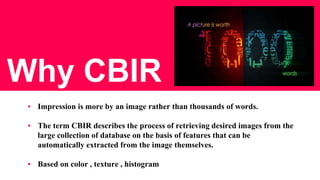
Why CBIR
▪ Impression is more by an image rather than thousands of words.
▪ The term CBIR describes the process of retrieving desired images from the
large collection of database on the basis of features that can be
automatically extracted from the image themselves.
▪ Based on color , texture , histogram
A picture is worth
a thousand words
A complex idea can
be conveyed with just
a single still image,
namely making it
possible to absorb
large amounts of data
quickly.
“
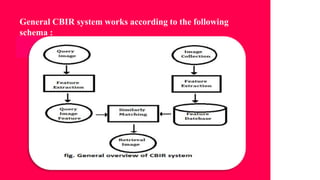
General CBIR system works according to the following
schema :
▪ It involves two steps:
▪Feature Extraction: The first step in the process is extracting image
features to a distinguishable extent.
▪Matching: The second step involves matching these features to yield
a result that is visually similar.
▪In CBIR, each image that is stored in the database has its features
extracted and compared to the features of the query image.
1
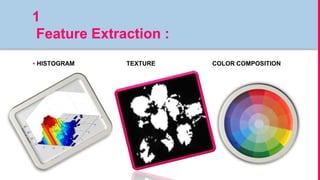
Feature Extraction :
▪ HISTOGRAM TEXTURE COLOR COMPOSITION
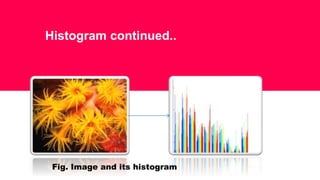
• Histogram is a measure used to describe the image.
In simple words it means the distribution of color
brightness across the image. The brightness values
range in [0..255].
• Texture is defined as the tactile quality of the
surface of an object--how it feels if touched.
• Colors can be created on computer monitors with
color spaces based on the RGB color model , using
the additive primary colors (red,green, and blue).
Histogram generation
Business
Finance
Leader Economy
Risk
Profit
Rise
Idea
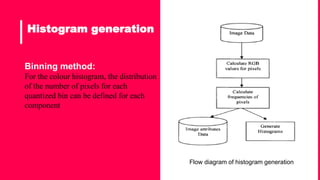
Binning method:
For the colour histogram, the distribution
of the number of pixels for each
quantized bin can be defined for each
component
Flow diagram of histogram generation
Histogram continued..
Fig. Image and its histogram
2
Matching
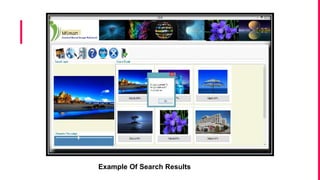
IMSmart - MY own system
Example Of Search Results
▪ It avoid the annotation of name with each image.
▪ Visual features of images are extracted automatically.
▪ Similarities of images are based on the distances between
features.
▪ It is more efficient than previous technique.
Advantages
• Crime prevention: Automatic face recognition systems, used by
police forces.
• Security Check: Finger print or retina scanning for access
privileges.
• Medical Diagnosis: Using CBIR in a medical database of medical
images to aid diagnosis by identifying similar past cases.
• Intellectual Property: Trademark image registration, where a new
candidate mark is compared with existing marks to ensure no risk of
confusing property ownership.
Applications of CBIR
CONCLUSION
▪ In this project, image colour pixel value are used as an image attribute based
method to find out minimal set of pixel value intervals for different colours. This
reduced set acts as the input to rough membership based computation to classify
different types of images.
▪ The Retrieval algorithm presented in this project mainly reduces the
computational time and at the same time increases the user interaction.
▪The results obtained are also less in number so that there is no need for the user to spend
more time in analysis.
References
• Kumar A., Esther J.” Comparative Study on CBIR based by Color Histogram, Gabor and
Wavelet Transform”, International Journal of Computer Applications (0975 – 8887)
Volume 17– No.3, March 2011.
• Arthi K, Vijayaraghavan J., “Content Based Image Retrieval Algorithm Using Colour
Models”, International Journal of Advanced Research in Computer and Communication
Engineering
• Pavani S., Shivani K., RaoVenkat T., “Similarity Analysis Of Images Using Content
Based ImageRetrieval System”,International Journal Of Engineering And Computer
Science
Thanks
!!
Any questions?
You can find me at
durga.kinge@gmail.com

CBIR

  • 1.
    ( CBIR ) BY: DURGA KINGE
  • 2.
    Presentation Outline ▪ Introduction ▪Motivation ▪ Need of CBIR ▪ Advantages ▪ Application ▪ Future Scope ▪ Conclusion
  • 3.
    INTRODUCTION ▪ CBIR (Content-BasedImage Retrieval) also known as query by image content. ▪ CBIR is the retrieval of images based on visual features such as colour, texture. The aim of CBIR is to avoid the use of textual descriptions.
  • 4.
    1. MOTIVATION • Image databasesand collections can be enormous in size, containing hundreds, thousands or even millions of images. The conventional method of image retrieval is searching for a keyword that would match the descriptive keyword assigned to the image by a human categorizer.
  • 5.
    Limitations of text-basedapproach ▪ Problem of image annotation ▫Large volumes of databases ▪ Problem of human perception ▫Depends of human perception ▫Too much responsibility on the end-user ▪ Problem of Queries that cannot be described at all, but tap into the visual features of images.
  • 6.
    Why CBIR ▪ Impressionis more by an image rather than thousands of words. ▪ The term CBIR describes the process of retrieving desired images from the large collection of database on the basis of features that can be automatically extracted from the image themselves. ▪ Based on color , texture , histogram
  • 7.
    A picture isworth a thousand words A complex idea can be conveyed with just a single still image, namely making it possible to absorb large amounts of data quickly.
  • 8.
    “ General CBIR systemworks according to the following schema :
  • 9.
    ▪ It involvestwo steps: ▪Feature Extraction: The first step in the process is extracting image features to a distinguishable extent. ▪Matching: The second step involves matching these features to yield a result that is visually similar. ▪In CBIR, each image that is stored in the database has its features extracted and compared to the features of the query image.
  • 10.
    1 Feature Extraction : ▪HISTOGRAM TEXTURE COLOR COMPOSITION
  • 11.
    • Histogram isa measure used to describe the image. In simple words it means the distribution of color brightness across the image. The brightness values range in [0..255]. • Texture is defined as the tactile quality of the surface of an object--how it feels if touched. • Colors can be created on computer monitors with color spaces based on the RGB color model , using the additive primary colors (red,green, and blue).
  • 12.
    Histogram generation Business Finance Leader Economy Risk Profit Rise Idea Binningmethod: For the colour histogram, the distribution of the number of pixels for each quantized bin can be defined for each component Flow diagram of histogram generation
  • 13.
  • 14.
  • 15.
    IMSmart - MYown system
  • 16.
  • 17.
    ▪ It avoidthe annotation of name with each image. ▪ Visual features of images are extracted automatically. ▪ Similarities of images are based on the distances between features. ▪ It is more efficient than previous technique. Advantages
  • 18.
    • Crime prevention:Automatic face recognition systems, used by police forces. • Security Check: Finger print or retina scanning for access privileges. • Medical Diagnosis: Using CBIR in a medical database of medical images to aid diagnosis by identifying similar past cases. • Intellectual Property: Trademark image registration, where a new candidate mark is compared with existing marks to ensure no risk of confusing property ownership. Applications of CBIR
  • 19.
    CONCLUSION ▪ In thisproject, image colour pixel value are used as an image attribute based method to find out minimal set of pixel value intervals for different colours. This reduced set acts as the input to rough membership based computation to classify different types of images. ▪ The Retrieval algorithm presented in this project mainly reduces the computational time and at the same time increases the user interaction. ▪The results obtained are also less in number so that there is no need for the user to spend more time in analysis.
  • 20.
    References • Kumar A.,Esther J.” Comparative Study on CBIR based by Color Histogram, Gabor and Wavelet Transform”, International Journal of Computer Applications (0975 – 8887) Volume 17– No.3, March 2011. • Arthi K, Vijayaraghavan J., “Content Based Image Retrieval Algorithm Using Colour Models”, International Journal of Advanced Research in Computer and Communication Engineering • Pavani S., Shivani K., RaoVenkat T., “Similarity Analysis Of Images Using Content Based ImageRetrieval System”,International Journal Of Engineering And Computer Science
  • 21.
    Thanks !! Any questions? You canfind me at durga.kinge@gmail.com