Farhana Adnin
B.Optom,4th
Batch
ICO,CU
Extra Ocular Muscles
ORIGIN-INSERTION
ACTION,NERVE
SUPPLY
What is EOM . . . ???
∗ There are 2 types of muscles ~
∗ 4 Recti muscles ~Superior rectus (SR)
~Inferior rectus (IR)
~Medial rectus (MR)
~Lateral rectus (LR)
∗ 2 Oblique muscles ~Superior oblique (SO)
~Inferior oblique (IO)
6 muscles . . .
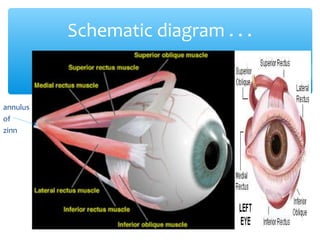
annulus
of
zinn
Schematic diagram . . .
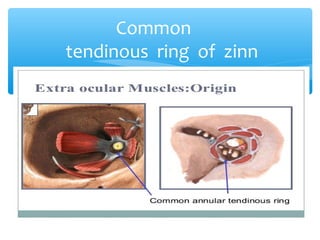
Common
tendinous ring of zinn
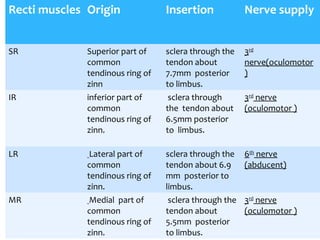
Recti muscles Origin Insertion Nerve supply
SR Superior part of
common
tendinous ring of
zinn
sclera through the
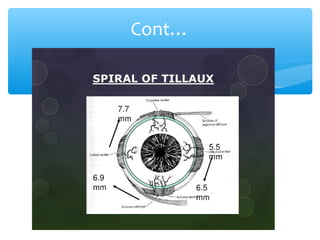
tendon about
7.7mm posterior
to limbus.
3rd
nerve(oculomotor
)
IR inferior part of
common
tendinous ring of
zinn.
sclera through
the tendon about
6.5mm posterior
to limbus.
3rd
nerve
(oculomotor )
LR Lateral part of
common
tendinous ring of
zinn.
sclera through the
tendon about 6.9
mm posterior to
limbus.
6th
nerve
(abducent)
MR Medial part of
common
tendinous ring of
zinn.
sclera through the
tendon about
5.5mm posterior
to limbus.
3rd
nerve
(oculomotor )
Cont…
Oblique
muscles
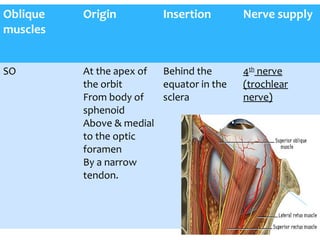
Origin Insertion Nerve supply
SO At the apex of
the orbit
From body of
sphenoid
Above & medial
to the optic
foramen
By a narrow
tendon.
Behind the
equator in the
sclera
4th
nerve
(trochlear
nerve)
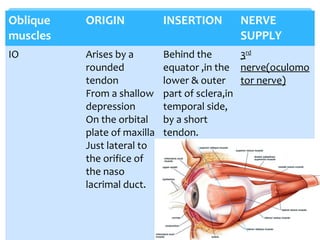
Oblique
muscles
ORIGIN INSERTION NERVE
SUPPLY
IO Arises by a
rounded
tendon
From a shallow
depression
On the orbital
plate of maxilla
Just lateral to
the orifice of
the naso
lacrimal duct.
Behind the
equator ,in the
lower & outer
part of sclera,in
temporal side,
by a short
tendon.
3rd
nerve(oculomo
tor nerve)
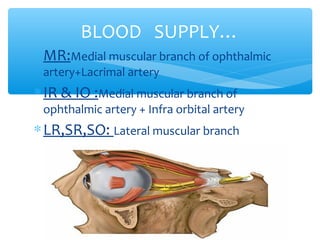
Nerve supply…(SO4LR6)~REST 3
∗MR:Medial muscular branch of ophthalmic
artery+Lacrimal artery
∗IR & IO :Medial muscular branch of
ophthalmic artery + Infra orbital artery
∗LR,SR,SO: Lateral muscular branch
BLOOD SUPPLY…
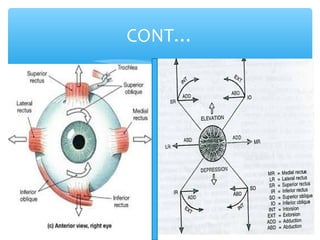
MUSCLES PRIMARY SECONDARY TERTIARY
SR Elevation Intorsion Adduction
IR Depression Extortion Adduction
LR Abduction
MR Adduction
SO Intorsion Depression Abduction
IO Extorsion Elevation Abduction
ACTIONS . . .
CONT…
Fick’s axis
∗ Z
Fick’s law : 3 axes are perpendicular to each other &
intersect at the centre of rotation.
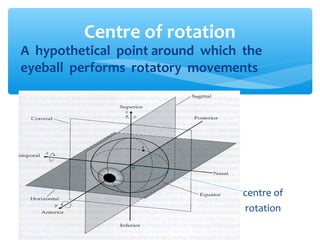
∗ A hypothetical point around which the
eyeball performs rotatory movements
centre of
rotation
Centre of rotation
Describes 3 axes-
∗ 1) X (horizontal) axis.
∗ 2)Y (antero-posterior)axis.
∗ 3)Z (vertical) axis.
Fick’s law
Ocular movements…
∗ Monocular movement:-Duction
∗ Binocular movement:-Version
-Vergence
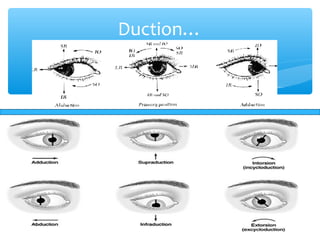
∗1)Duction: the movement of one eye
∗ Abduction
∗ Adduction
∗ Supraduction or elevation
∗ Infraduction or depression
∗ Incycloduction or intorsion
∗ Excycloduction or extorsion
Ocular movements…
Duction…
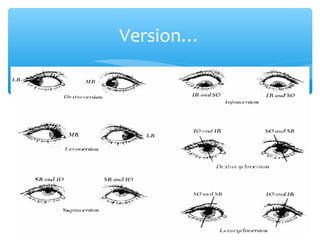
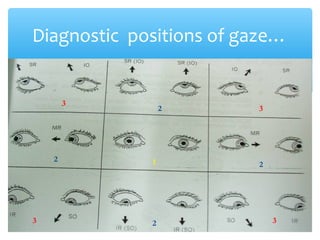
∗ 2)Version: the movement of two eyes in the same direction
1)Dextroversion
2)Levoversion
3)Supraversion
4)Infraversion
5)Dextroelevation
6)Dextrodepression
7)Levoelevation
8)Levodepression
9)Dextrocycloversion
10)Levocycloversion
Cont…
Version…
Diagnostic positions of gaze…
2 1 2
2
2
3
3
3
3
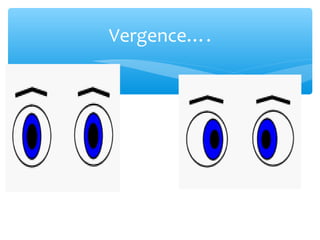
∗3)Vergence: the movement of two
eyes in opposite directions
∗ Convergence
∗ Divergence
Cont…
Vergence….
Terminology of Ocular Motility
∗ Agonist
∗ Any particular EOM producing a specific
ocular movement.e.g for abduction LR in
right eye.
∗ Synergist
∗ Two muscles moving an eye in the same
direction
∗ E.g– SR / IO - Synergist for elevation
movement
∗ Antagonist
∗ The muscles having opposite action in the
same eye
∗ Example – medial and lateral rectus
Cont…
• Yoke muscle (Contralateral
synergists)
a pair of muscle one in each eye which contract
simultaneously during version movement
• Pairs for six cardinal positions of gaze
• Dextroversion – RLR- LMR
• Levoversion – LLR- RMR
• Dextroelevation – RSR-LIO
• Levoelevation – LSR- RIO
• Dextrodepression – RIR-LSO
• Levodepression –LIR-RSO
Cont…
• Contralateral Antagonist
a pair of muscles, one in each eye having
opposite action
eg. RLR & LLR.
Cont..
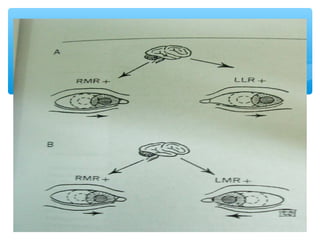
Hering’s Law
An equal and simultaneous innervation flows from
brain to a pair of muscle of both eyes which contracts
simultaneously in different binocular movements.
Laws of EOM Movements
Clinical Significance:
1. Secondary deviation > > Primary deviation
2. Inhibition palsy of the contralateral antagonist
Sherrington’s Law
During eye movement an increased flow of
innervations to the contracting agonist muscle is
accompanied by an equal and simultaneous
decreased flow of innervations to the relaxing
antagonist muscle
Cont…
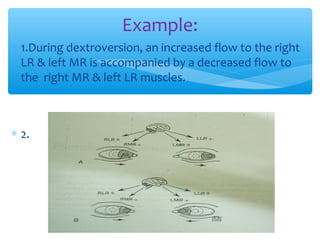
∗ 1.During dextroversion, an increased flow to the right
LR & left MR is accompanied by a decreased flow to
the right MR & left LR muscles.
∗ 2.
Example:
∗Donder's Law
For each tertiary position, there is one and only one
orientation of the vertical and horizontal meridians
of retina.
There is no rotation around the antero-posterior (Y)
axis. (no torsion or twist occur).
∗ The eye reaches all tertiary position without
movement around the Y axis.
∗ The eye always returns to the same orientation from
which it started.
Cont…
∗ Anatomy & Physiology of Eye by A.K.Khurana
∗ Binocular vision & Ocular motility by Gunter K.Von
Noorden
∗ Internet
References…
THANK YOU
FOR YOUR ATTENTION
…

Extra Ocular Motility @Farhana.Islam

  • 1.
    Farhana Adnin B.Optom,4th Batch ICO,CU Extra OcularMuscles ORIGIN-INSERTION ACTION,NERVE SUPPLY
  • 2.
    What is EOM. . . ???
  • 3.
    ∗ There are2 types of muscles ~ ∗ 4 Recti muscles ~Superior rectus (SR) ~Inferior rectus (IR) ~Medial rectus (MR) ~Lateral rectus (LR) ∗ 2 Oblique muscles ~Superior oblique (SO) ~Inferior oblique (IO) 6 muscles . . .
  • 4.
  • 5.
  • 6.
    Recti muscles OriginInsertion Nerve supply SR Superior part of common tendinous ring of zinn sclera through the tendon about 7.7mm posterior to limbus. 3rd nerve(oculomotor ) IR inferior part of common tendinous ring of zinn. sclera through the tendon about 6.5mm posterior to limbus. 3rd nerve (oculomotor ) LR Lateral part of common tendinous ring of zinn. sclera through the tendon about 6.9 mm posterior to limbus. 6th nerve (abducent) MR Medial part of common tendinous ring of zinn. sclera through the tendon about 5.5mm posterior to limbus. 3rd nerve (oculomotor )
  • 7.
  • 8.
    Oblique muscles Origin Insertion Nervesupply SO At the apex of the orbit From body of sphenoid Above & medial to the optic foramen By a narrow tendon. Behind the equator in the sclera 4th nerve (trochlear nerve)
  • 9.
    Oblique muscles ORIGIN INSERTION NERVE SUPPLY IOArises by a rounded tendon From a shallow depression On the orbital plate of maxilla Just lateral to the orifice of the naso lacrimal duct. Behind the equator ,in the lower & outer part of sclera,in temporal side, by a short tendon. 3rd nerve(oculomo tor nerve)
  • 10.
  • 11.
    ∗MR:Medial muscular branchof ophthalmic artery+Lacrimal artery ∗IR & IO :Medial muscular branch of ophthalmic artery + Infra orbital artery ∗LR,SR,SO: Lateral muscular branch BLOOD SUPPLY…
  • 12.
    MUSCLES PRIMARY SECONDARYTERTIARY SR Elevation Intorsion Adduction IR Depression Extortion Adduction LR Abduction MR Adduction SO Intorsion Depression Abduction IO Extorsion Elevation Abduction ACTIONS . . .
  • 13.
  • 14.
    Fick’s axis ∗ Z Fick’slaw : 3 axes are perpendicular to each other & intersect at the centre of rotation.
  • 15.
    ∗ A hypotheticalpoint around which the eyeball performs rotatory movements centre of rotation Centre of rotation
  • 16.
    Describes 3 axes- ∗1) X (horizontal) axis. ∗ 2)Y (antero-posterior)axis. ∗ 3)Z (vertical) axis. Fick’s law
  • 17.
    Ocular movements… ∗ Monocularmovement:-Duction ∗ Binocular movement:-Version -Vergence
  • 18.
    ∗1)Duction: the movementof one eye ∗ Abduction ∗ Adduction ∗ Supraduction or elevation ∗ Infraduction or depression ∗ Incycloduction or intorsion ∗ Excycloduction or extorsion Ocular movements…
  • 19.
  • 20.
    ∗ 2)Version: themovement of two eyes in the same direction 1)Dextroversion 2)Levoversion 3)Supraversion 4)Infraversion 5)Dextroelevation 6)Dextrodepression 7)Levoelevation 8)Levodepression 9)Dextrocycloversion 10)Levocycloversion Cont…
  • 21.
  • 22.
    Diagnostic positions ofgaze… 2 1 2 2 2 3 3 3 3
  • 23.
    ∗3)Vergence: the movementof two eyes in opposite directions ∗ Convergence ∗ Divergence Cont…
  • 24.
  • 25.
    Terminology of OcularMotility ∗ Agonist ∗ Any particular EOM producing a specific ocular movement.e.g for abduction LR in right eye. ∗ Synergist ∗ Two muscles moving an eye in the same direction ∗ E.g– SR / IO - Synergist for elevation movement
  • 26.
    ∗ Antagonist ∗ Themuscles having opposite action in the same eye ∗ Example – medial and lateral rectus Cont…
  • 27.
    • Yoke muscle(Contralateral synergists) a pair of muscle one in each eye which contract simultaneously during version movement • Pairs for six cardinal positions of gaze • Dextroversion – RLR- LMR • Levoversion – LLR- RMR • Dextroelevation – RSR-LIO • Levoelevation – LSR- RIO • Dextrodepression – RIR-LSO • Levodepression –LIR-RSO Cont…
  • 28.
    • Contralateral Antagonist apair of muscles, one in each eye having opposite action eg. RLR & LLR. Cont..
  • 29.
    Hering’s Law An equaland simultaneous innervation flows from brain to a pair of muscle of both eyes which contracts simultaneously in different binocular movements. Laws of EOM Movements
  • 31.
    Clinical Significance: 1. Secondarydeviation > > Primary deviation 2. Inhibition palsy of the contralateral antagonist
  • 32.
    Sherrington’s Law During eyemovement an increased flow of innervations to the contracting agonist muscle is accompanied by an equal and simultaneous decreased flow of innervations to the relaxing antagonist muscle Cont…
  • 33.
    ∗ 1.During dextroversion,an increased flow to the right LR & left MR is accompanied by a decreased flow to the right MR & left LR muscles. ∗ 2. Example:
  • 34.
    ∗Donder's Law For eachtertiary position, there is one and only one orientation of the vertical and horizontal meridians of retina. There is no rotation around the antero-posterior (Y) axis. (no torsion or twist occur). ∗ The eye reaches all tertiary position without movement around the Y axis. ∗ The eye always returns to the same orientation from which it started.
  • 35.
  • 36.
    ∗ Anatomy &Physiology of Eye by A.K.Khurana ∗ Binocular vision & Ocular motility by Gunter K.Von Noorden ∗ Internet References…
  • 37.
    THANK YOU FOR YOURATTENTION …