Extinctions: The EndExtinctions: The End
of Biodiversityof Biodiversity
What is Extinction?What is Extinction?
 Extinction occurs when the last existingExtinction occurs when the last existing
member of a given species diesmember of a given species dies

In other words…there aren’t any more left!In other words…there aren’t any more left!
 It is a scientific certainty when there areIt is a scientific certainty when there are
not any surviving individuals left tonot any surviving individuals left to
reproducereproduce
 Functional ExtinctionFunctional Extinction

Only a handful of individuals are leftOnly a handful of individuals are left

Odds of reproduction are slimOdds of reproduction are slim
The passenger pigeonThe passenger pigeon
 The last passenger pigeon inThe last passenger pigeon in
Wisconsin was shot in 1899.Wisconsin was shot in 1899.
 This was reportedly the last passengerThis was reportedly the last passenger
pigeon shot in the wild.pigeon shot in the wild.
 The last Passenger Pigeon, named Martha,The last Passenger Pigeon, named Martha,
died alone at Zoo in 1914.died alone at Zoo in 1914.
 Even when Martha was still alive, the speciesEven when Martha was still alive, the species
was already functionally extinct – it wouldwas already functionally extinct – it would
never return to a sustainable population.never return to a sustainable population.
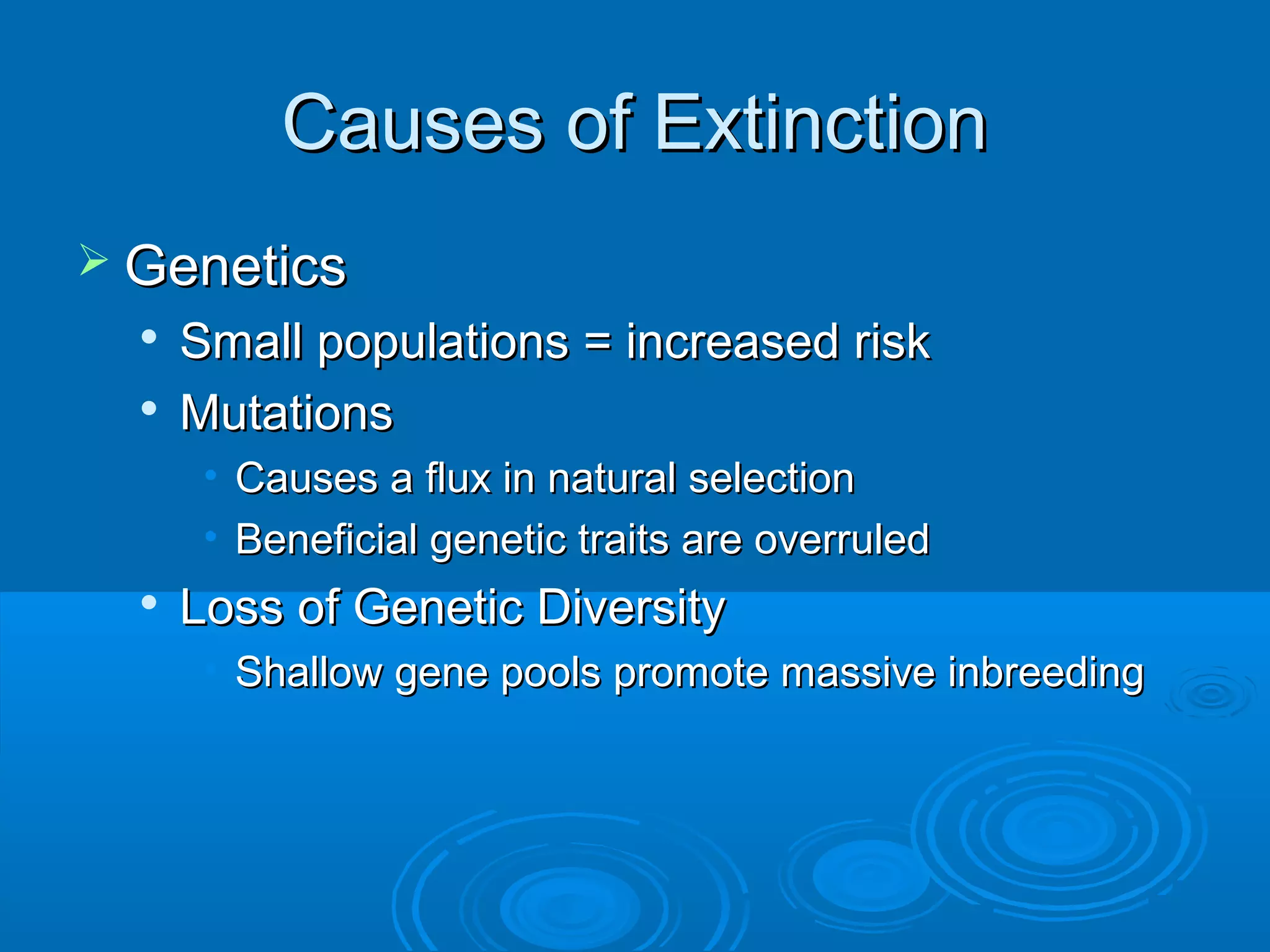
Causes of ExtinctionCauses of Extinction
 GeneticsGenetics

Small populations = increased riskSmall populations = increased risk

MutationsMutations
• Causes a flux in natural selectionCauses a flux in natural selection
• Beneficial genetic traits are overruledBeneficial genetic traits are overruled

Loss of Genetic DiversityLoss of Genetic Diversity
• Shallow gene pools promote massive inbreedingShallow gene pools promote massive inbreeding
 Extinctions occur when the environment ofExtinctions occur when the environment of
a species changes faster than the speciesa species changes faster than the species
can adapt.can adapt.
 Extinctions can be local, widespread, orExtinctions can be local, widespread, or
global.global.

For example, the timber wolf was until recentlyFor example, the timber wolf was until recently
extinct in Wisconsin but not in Minnesotaextinct in Wisconsin but not in Minnesota

Wild elk and woodland caribou are now extinctWild elk and woodland caribou are now extinct
in Wisconsin but may be found on gamein Wisconsin but may be found on game
farms.farms.
Habitat DegradationHabitat Degradation
 ToxicityToxicity

Kills off species directly through food/waterKills off species directly through food/water

Indirectly via sterilizationIndirectly via sterilization

Can occur in short spans (a single generation)Can occur in short spans (a single generation)

Can occur over several generationsCan occur over several generations
• Increasing toxicityIncreasing toxicity
• Increasing competition for habitat resourcesIncreasing competition for habitat resources
Habitat DegradationHabitat Degradation
 Destruction of HabitatDestruction of Habitat

““Save the Rainforests!”Save the Rainforests!”

Elimination of living spaceElimination of living space

Change in habitatChange in habitat
• Rainforest to pasture landsRainforest to pasture lands

Leads to diminishing resourcesLeads to diminishing resources
• Increases competitionIncreases competition

Can be caused by natural processesCan be caused by natural processes
• Volcanoes, floods, drought, etc…Volcanoes, floods, drought, etc…
CoextinctionCoextinction
 The loss of one species leads to the lossThe loss of one species leads to the loss
of anotherof another
 Chain of extinctionChain of extinction
 Can be caused by small impacts in theCan be caused by small impacts in the
beginningbeginning
 A predator looses its food sourceA predator looses its food source
 Affected by interconnectedness in natureAffected by interconnectedness in nature
Planned ExtinctionPlanned Extinction
 Human controlledHuman controlled
 Thought of to help humansThought of to help humans
 Deadly virusesDeadly viruses

SmallpoxSmallpox
• Extinct in the wildExtinct in the wild

PolioPolio
• Near extinct (only in small parts of the world)Near extinct (only in small parts of the world)
Natural Causes ofNatural Causes of
ExtinctionExtinction
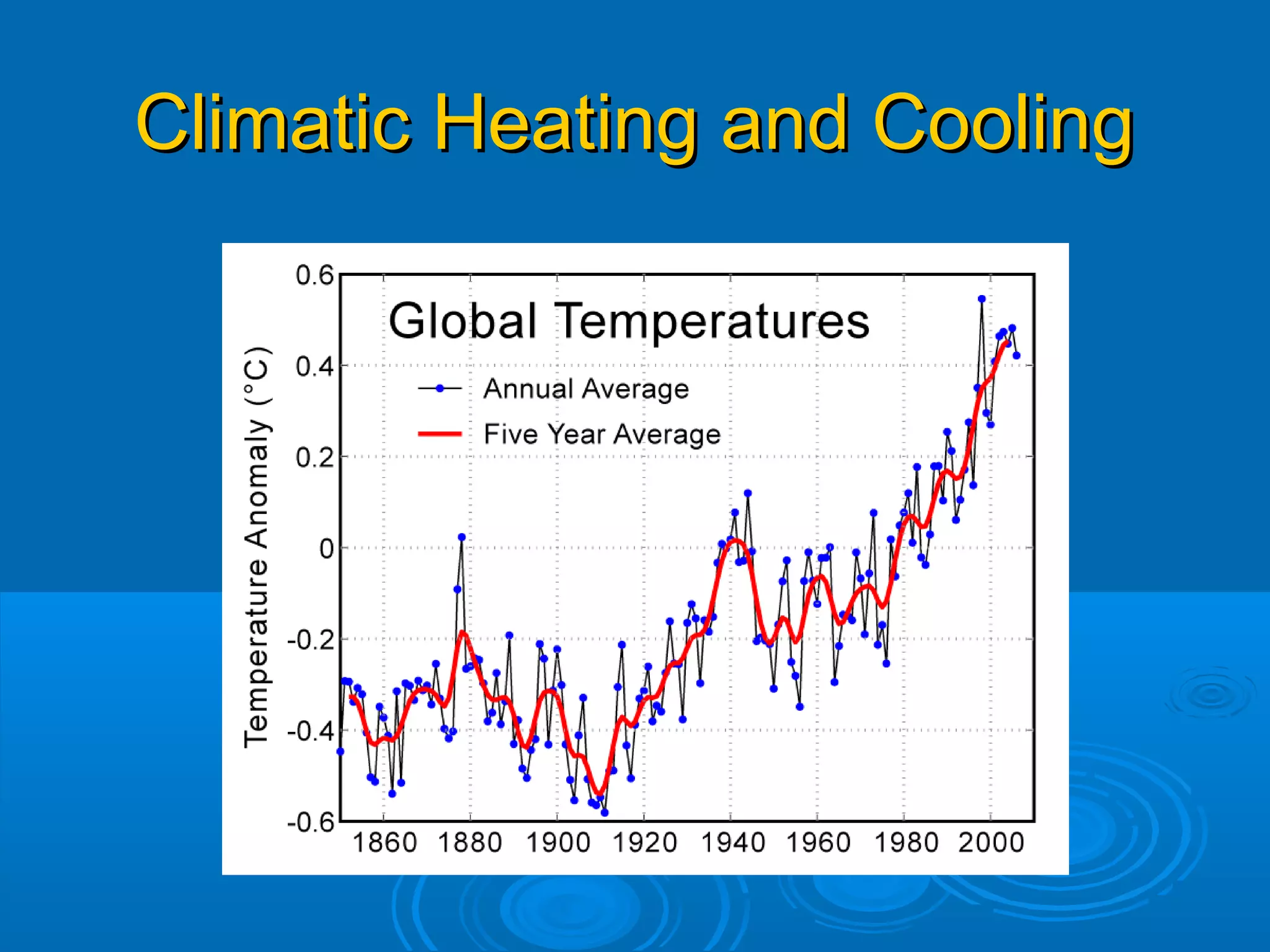
Climatic Heating and CoolingClimatic Heating and Cooling
Changes in Sea Level or CurrentsChanges in Sea Level or Currents
 www.johnstonsarchive.net/spaceart/cylmaps.htmlwww.johnstonsarchive.net/spaceart/cylmaps.html
Cosmic RadiationCosmic Radiation
 www.iit.edu/~ipro313s/home.htmlwww.iit.edu/~ipro313s/home.html
Acid RainAcid Rain
 Kills acid intolerantKills acid intolerant
speciesspecies
Disease/EpidemicsDisease/Epidemics
 Can wipe out entireCan wipe out entire
speciesspecies
 Frog with fungusFrog with fungus
diseasedisease
 Killing frogs and otherKilling frogs and other
amphibiansamphibians
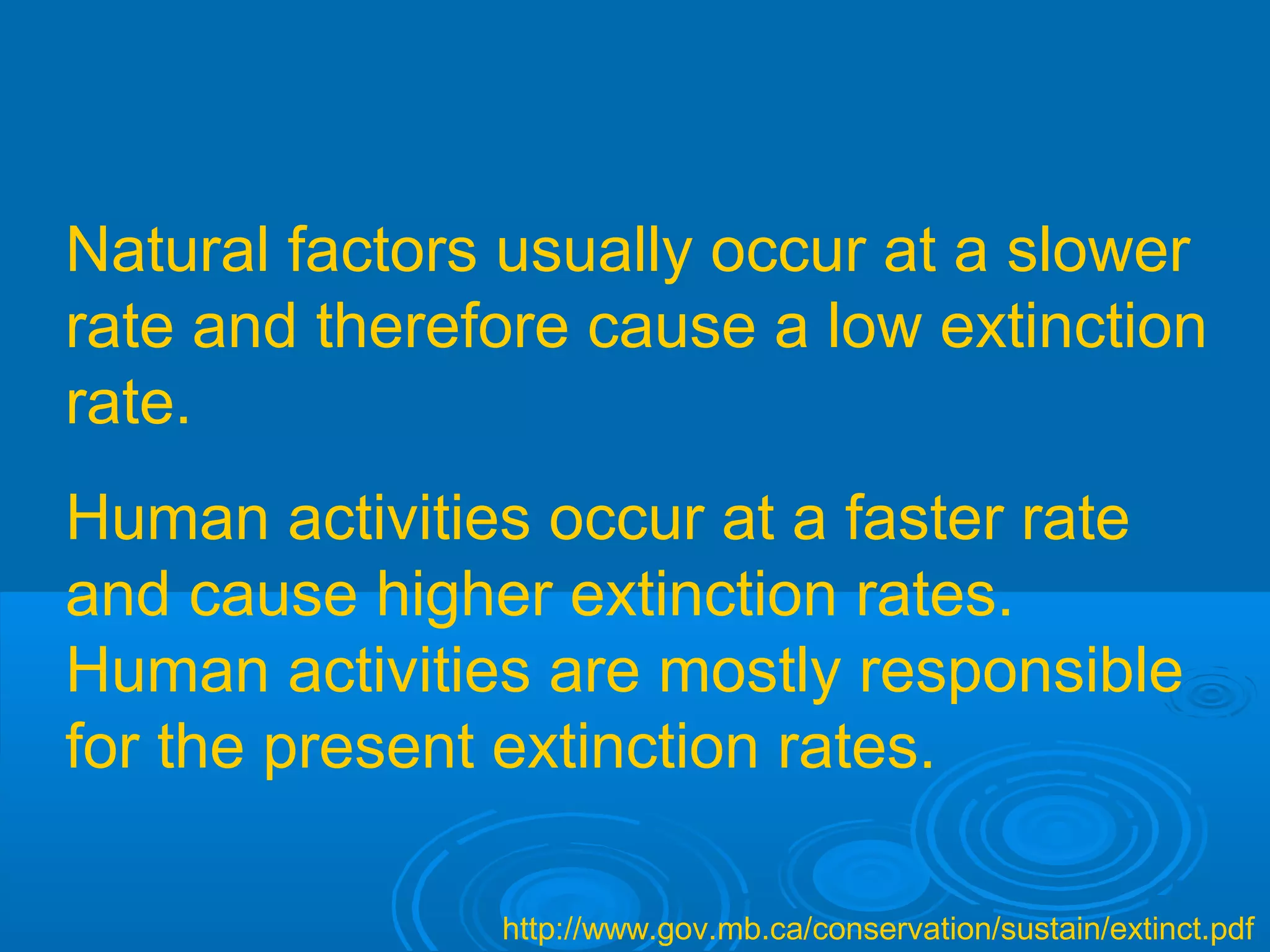
Natural factors usually occur at a slower
rate and therefore cause a low extinction
rate.
Human activities occur at a faster rate
and cause higher extinction rates.
Human activities are mostly responsible
for the present extinction rates.
http://www.gov.mb.ca/conservation/sustain/extinct.pdf
Human Causes of
Extinction
Top Human Causes of
Extinction:
Increased human population
Destruction/Fragmentation of
habitat
Pollution
Climate change/Global warming
Habitat Degradation
Habitat loss and degradation affect 86%
of all threatened birds, 86% of mammals and
88% of threatened amphibians
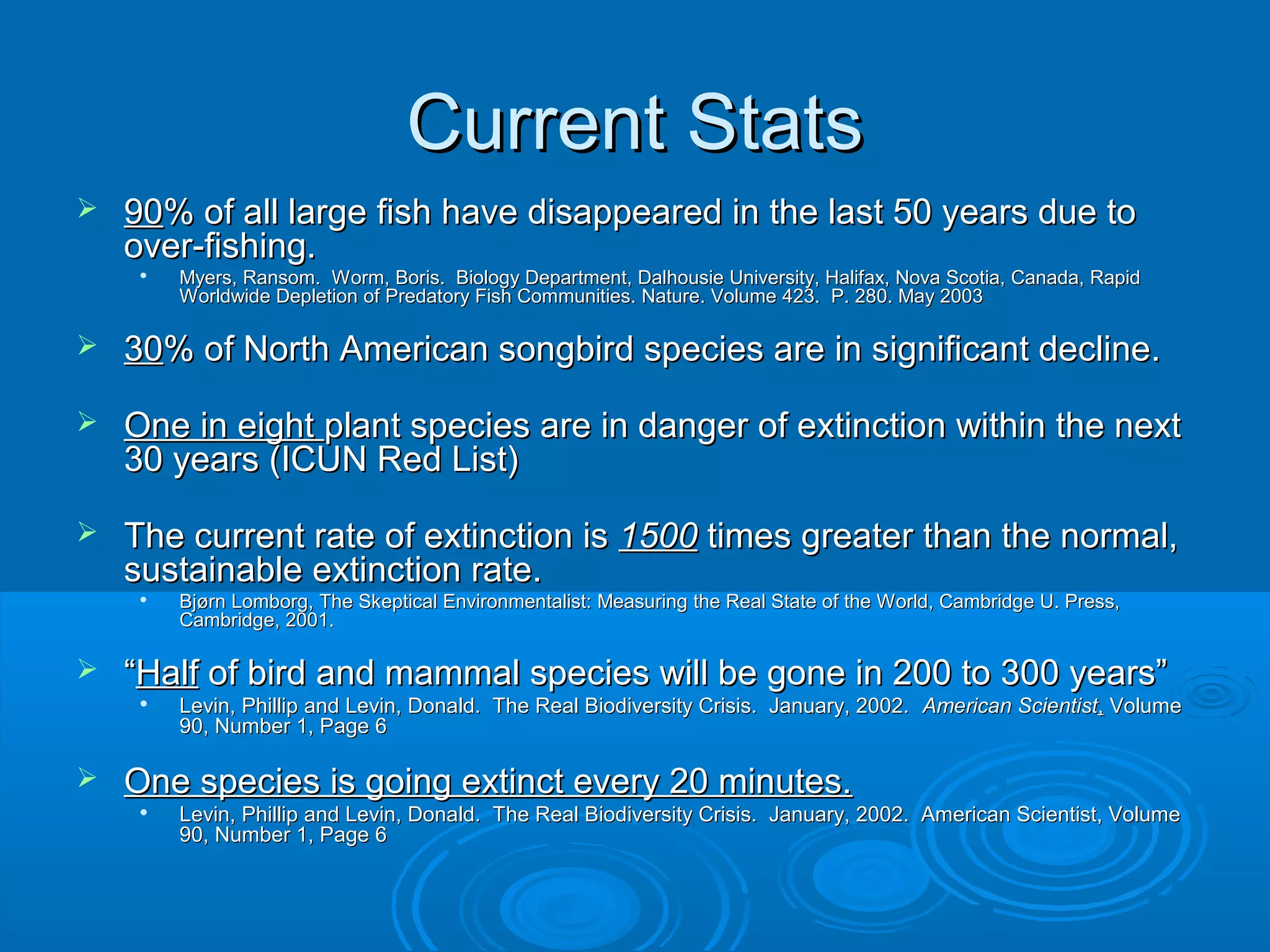
Current StatsCurrent Stats
 9090% of all large fish have disappeared in the last 50 years due to% of all large fish have disappeared in the last 50 years due to
over-fishing.over-fishing.

Myers, Ransom. Worm, Boris. Biology Department, Dalhousie University, Halifax, Nova Scotia, Canada, RapidMyers, Ransom. Worm, Boris. Biology Department, Dalhousie University, Halifax, Nova Scotia, Canada, Rapid
Worldwide Depletion of Predatory Fish Communities. Nature. Volume 423. P. 280. May 2003Worldwide Depletion of Predatory Fish Communities. Nature. Volume 423. P. 280. May 2003
 3030% of North American songbird species are in significant decline.% of North American songbird species are in significant decline.
 One in eightOne in eight plant species are in danger of extinction within the nextplant species are in danger of extinction within the next
30 years (ICUN Red List)30 years (ICUN Red List)
 The current rate of extinction isThe current rate of extinction is 15001500 times greater than the normal,times greater than the normal,
sustainable extinction rate.sustainable extinction rate.

Bjørn Lomborg, The Skeptical Environmentalist: Measuring the Real State of the World, Cambridge U. Press,Bjørn Lomborg, The Skeptical Environmentalist: Measuring the Real State of the World, Cambridge U. Press,
Cambridge, 2001.Cambridge, 2001.
 ““HalfHalf of bird and mammal species will be gone in 200 to 300 years”of bird and mammal species will be gone in 200 to 300 years”

Levin, Phillip and Levin, Donald. The Real Biodiversity Crisis. January, 2002.Levin, Phillip and Levin, Donald. The Real Biodiversity Crisis. January, 2002. American ScientistAmerican Scientist,, VolumeVolume
90, Number 1, Page 690, Number 1, Page 6
 One species is going extinct every 20 minutes.One species is going extinct every 20 minutes.

Levin, Phillip and Levin, Donald. The Real Biodiversity Crisis. January, 2002. American Scientist, VolumeLevin, Phillip and Levin, Donald. The Real Biodiversity Crisis. January, 2002. American Scientist, Volume
90, Number 1, Page 690, Number 1, Page 6
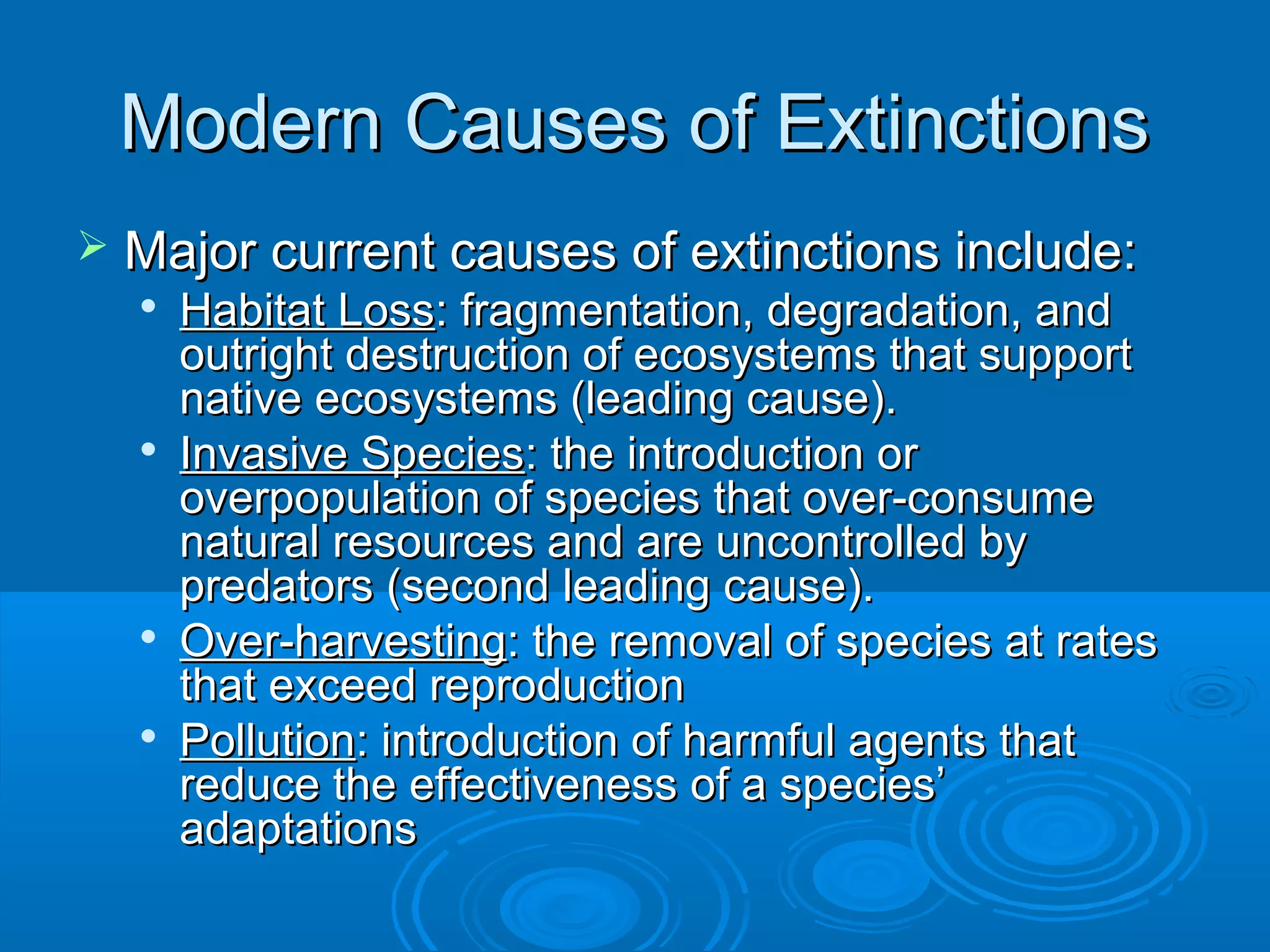
Modern Causes of ExtinctionsModern Causes of Extinctions
 Major current causes of extinctions include:Major current causes of extinctions include:

Habitat LossHabitat Loss: fragmentation, degradation, and: fragmentation, degradation, and
outright destruction of ecosystems that supportoutright destruction of ecosystems that support
native ecosystems (leading cause).native ecosystems (leading cause).

Invasive SpeciesInvasive Species: the introduction or: the introduction or
overpopulation of species that over-consumeoverpopulation of species that over-consume
natural resources and are uncontrolled bynatural resources and are uncontrolled by
predators (second leading cause).predators (second leading cause).

Over-harvestingOver-harvesting: the removal of species at rates: the removal of species at rates
that exceed reproductionthat exceed reproduction

PollutionPollution: introduction of harmful agents that: introduction of harmful agents that
reduce the effectiveness of a species’reduce the effectiveness of a species’
adaptationsadaptations
 Major Human concernsMajor Human concerns
Biodiversity & MedicineBiodiversity & Medicine
Biodiversity & AgricultureBiodiversity & Agriculture
Biodiversity & CropsBiodiversity & Crops
Biodiversity & Ecosystem ServicesBiodiversity & Ecosystem Services
 Ecosystem services include air and waterEcosystem services include air and water
purification, detoxification and decomposition ofpurification, detoxification and decomposition of
wastes, climate regulation, regeneration of soilwastes, climate regulation, regeneration of soil
fertility, and the production and maintenance offertility, and the production and maintenance of
biological diversity.biological diversity.
 These are the key ingredients of our agricultural,These are the key ingredients of our agricultural,
pharmaceutical, and industrial enterprises.pharmaceutical, and industrial enterprises.
 Such services are estimated to be worth trillions ofSuch services are estimated to be worth trillions of
dollars annually.dollars annually.

We get these services for free…for now.We get these services for free…for now.

http://www.fws.gov/endangered/esa-http://www.fws.gov/endangered/esa-
library/pdf/Why_Save_Endangered_Species_Brochure.pdflibrary/pdf/Why_Save_Endangered_Species_Brochure.pdf
Biodiversity & Moral ObligationsBiodiversity & Moral Obligations

Extinction of biodiversity

  • 1.
    Extinctions: The EndExtinctions:The End of Biodiversityof Biodiversity
  • 2.
    What is Extinction?Whatis Extinction?  Extinction occurs when the last existingExtinction occurs when the last existing member of a given species diesmember of a given species dies  In other words…there aren’t any more left!In other words…there aren’t any more left!  It is a scientific certainty when there areIt is a scientific certainty when there are not any surviving individuals left tonot any surviving individuals left to reproducereproduce  Functional ExtinctionFunctional Extinction  Only a handful of individuals are leftOnly a handful of individuals are left  Odds of reproduction are slimOdds of reproduction are slim
  • 3.
    The passenger pigeonThepassenger pigeon  The last passenger pigeon inThe last passenger pigeon in Wisconsin was shot in 1899.Wisconsin was shot in 1899.  This was reportedly the last passengerThis was reportedly the last passenger pigeon shot in the wild.pigeon shot in the wild.  The last Passenger Pigeon, named Martha,The last Passenger Pigeon, named Martha, died alone at Zoo in 1914.died alone at Zoo in 1914.  Even when Martha was still alive, the speciesEven when Martha was still alive, the species was already functionally extinct – it wouldwas already functionally extinct – it would never return to a sustainable population.never return to a sustainable population.
  • 4.
    Causes of ExtinctionCausesof Extinction  GeneticsGenetics  Small populations = increased riskSmall populations = increased risk  MutationsMutations • Causes a flux in natural selectionCauses a flux in natural selection • Beneficial genetic traits are overruledBeneficial genetic traits are overruled  Loss of Genetic DiversityLoss of Genetic Diversity • Shallow gene pools promote massive inbreedingShallow gene pools promote massive inbreeding
  • 5.
     Extinctions occurwhen the environment ofExtinctions occur when the environment of a species changes faster than the speciesa species changes faster than the species can adapt.can adapt.  Extinctions can be local, widespread, orExtinctions can be local, widespread, or global.global.  For example, the timber wolf was until recentlyFor example, the timber wolf was until recently extinct in Wisconsin but not in Minnesotaextinct in Wisconsin but not in Minnesota  Wild elk and woodland caribou are now extinctWild elk and woodland caribou are now extinct in Wisconsin but may be found on gamein Wisconsin but may be found on game farms.farms.
  • 6.
    Habitat DegradationHabitat Degradation ToxicityToxicity  Kills off species directly through food/waterKills off species directly through food/water  Indirectly via sterilizationIndirectly via sterilization  Can occur in short spans (a single generation)Can occur in short spans (a single generation)  Can occur over several generationsCan occur over several generations • Increasing toxicityIncreasing toxicity • Increasing competition for habitat resourcesIncreasing competition for habitat resources
  • 7.
    Habitat DegradationHabitat Degradation Destruction of HabitatDestruction of Habitat  ““Save the Rainforests!”Save the Rainforests!”  Elimination of living spaceElimination of living space  Change in habitatChange in habitat • Rainforest to pasture landsRainforest to pasture lands  Leads to diminishing resourcesLeads to diminishing resources • Increases competitionIncreases competition  Can be caused by natural processesCan be caused by natural processes • Volcanoes, floods, drought, etc…Volcanoes, floods, drought, etc…
  • 8.
    CoextinctionCoextinction  The lossof one species leads to the lossThe loss of one species leads to the loss of anotherof another  Chain of extinctionChain of extinction  Can be caused by small impacts in theCan be caused by small impacts in the beginningbeginning  A predator looses its food sourceA predator looses its food source  Affected by interconnectedness in natureAffected by interconnectedness in nature
  • 9.
    Planned ExtinctionPlanned Extinction Human controlledHuman controlled  Thought of to help humansThought of to help humans  Deadly virusesDeadly viruses  SmallpoxSmallpox • Extinct in the wildExtinct in the wild  PolioPolio • Near extinct (only in small parts of the world)Near extinct (only in small parts of the world)
  • 10.
    Natural Causes ofNaturalCauses of ExtinctionExtinction
  • 11.
    Climatic Heating andCoolingClimatic Heating and Cooling
  • 12.
    Changes in SeaLevel or CurrentsChanges in Sea Level or Currents  www.johnstonsarchive.net/spaceart/cylmaps.htmlwww.johnstonsarchive.net/spaceart/cylmaps.html
  • 13.
    Cosmic RadiationCosmic Radiation www.iit.edu/~ipro313s/home.htmlwww.iit.edu/~ipro313s/home.html
  • 14.
    Acid RainAcid Rain Kills acid intolerantKills acid intolerant speciesspecies
  • 15.
    Disease/EpidemicsDisease/Epidemics  Can wipeout entireCan wipe out entire speciesspecies  Frog with fungusFrog with fungus diseasedisease  Killing frogs and otherKilling frogs and other amphibiansamphibians
  • 16.
    Natural factors usuallyoccur at a slower rate and therefore cause a low extinction rate. Human activities occur at a faster rate and cause higher extinction rates. Human activities are mostly responsible for the present extinction rates. http://www.gov.mb.ca/conservation/sustain/extinct.pdf
  • 17.
  • 18.
    Top Human Causesof Extinction: Increased human population Destruction/Fragmentation of habitat Pollution Climate change/Global warming
  • 19.
    Habitat Degradation Habitat lossand degradation affect 86% of all threatened birds, 86% of mammals and 88% of threatened amphibians
  • 20.
    Current StatsCurrent Stats 9090% of all large fish have disappeared in the last 50 years due to% of all large fish have disappeared in the last 50 years due to over-fishing.over-fishing.  Myers, Ransom. Worm, Boris. Biology Department, Dalhousie University, Halifax, Nova Scotia, Canada, RapidMyers, Ransom. Worm, Boris. Biology Department, Dalhousie University, Halifax, Nova Scotia, Canada, Rapid Worldwide Depletion of Predatory Fish Communities. Nature. Volume 423. P. 280. May 2003Worldwide Depletion of Predatory Fish Communities. Nature. Volume 423. P. 280. May 2003  3030% of North American songbird species are in significant decline.% of North American songbird species are in significant decline.  One in eightOne in eight plant species are in danger of extinction within the nextplant species are in danger of extinction within the next 30 years (ICUN Red List)30 years (ICUN Red List)  The current rate of extinction isThe current rate of extinction is 15001500 times greater than the normal,times greater than the normal, sustainable extinction rate.sustainable extinction rate.  Bjørn Lomborg, The Skeptical Environmentalist: Measuring the Real State of the World, Cambridge U. Press,Bjørn Lomborg, The Skeptical Environmentalist: Measuring the Real State of the World, Cambridge U. Press, Cambridge, 2001.Cambridge, 2001.  ““HalfHalf of bird and mammal species will be gone in 200 to 300 years”of bird and mammal species will be gone in 200 to 300 years”  Levin, Phillip and Levin, Donald. The Real Biodiversity Crisis. January, 2002.Levin, Phillip and Levin, Donald. The Real Biodiversity Crisis. January, 2002. American ScientistAmerican Scientist,, VolumeVolume 90, Number 1, Page 690, Number 1, Page 6  One species is going extinct every 20 minutes.One species is going extinct every 20 minutes.  Levin, Phillip and Levin, Donald. The Real Biodiversity Crisis. January, 2002. American Scientist, VolumeLevin, Phillip and Levin, Donald. The Real Biodiversity Crisis. January, 2002. American Scientist, Volume 90, Number 1, Page 690, Number 1, Page 6
  • 21.
    Modern Causes ofExtinctionsModern Causes of Extinctions  Major current causes of extinctions include:Major current causes of extinctions include:  Habitat LossHabitat Loss: fragmentation, degradation, and: fragmentation, degradation, and outright destruction of ecosystems that supportoutright destruction of ecosystems that support native ecosystems (leading cause).native ecosystems (leading cause).  Invasive SpeciesInvasive Species: the introduction or: the introduction or overpopulation of species that over-consumeoverpopulation of species that over-consume natural resources and are uncontrolled bynatural resources and are uncontrolled by predators (second leading cause).predators (second leading cause).  Over-harvestingOver-harvesting: the removal of species at rates: the removal of species at rates that exceed reproductionthat exceed reproduction  PollutionPollution: introduction of harmful agents that: introduction of harmful agents that reduce the effectiveness of a species’reduce the effectiveness of a species’ adaptationsadaptations
  • 22.
     Major HumanconcernsMajor Human concerns
  • 23.
  • 24.
  • 25.
  • 26.
    Biodiversity & EcosystemServicesBiodiversity & Ecosystem Services  Ecosystem services include air and waterEcosystem services include air and water purification, detoxification and decomposition ofpurification, detoxification and decomposition of wastes, climate regulation, regeneration of soilwastes, climate regulation, regeneration of soil fertility, and the production and maintenance offertility, and the production and maintenance of biological diversity.biological diversity.  These are the key ingredients of our agricultural,These are the key ingredients of our agricultural, pharmaceutical, and industrial enterprises.pharmaceutical, and industrial enterprises.  Such services are estimated to be worth trillions ofSuch services are estimated to be worth trillions of dollars annually.dollars annually.  We get these services for free…for now.We get these services for free…for now.  http://www.fws.gov/endangered/esa-http://www.fws.gov/endangered/esa- library/pdf/Why_Save_Endangered_Species_Brochure.pdflibrary/pdf/Why_Save_Endangered_Species_Brochure.pdf
  • 27.
    Biodiversity & MoralObligationsBiodiversity & Moral Obligations