UNIVERSITY OF AGRICULTURAL AND
HORTICULTURAL SCIENCES, SHIMOGA
By
CHANDANA B R
Jr MSc(GPB)
Contents
Introduction
Biodiversity at different levels
Threats to biodiversity
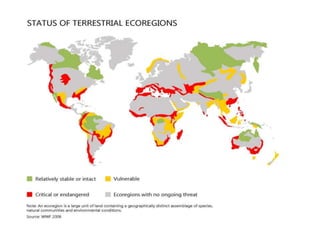
Status of terrestrial ecoregions
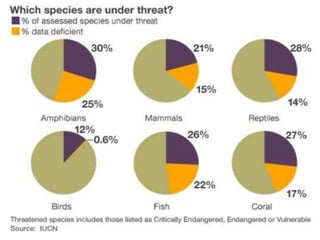
Species under threat
Animal biodiversity threats in India
Conclusion
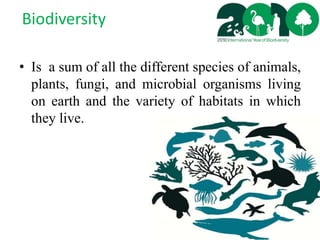
Biodiversity
• Is a sum of all the different species of animals,
plants, fungi, and microbial organisms living
on earth and the variety of habitats in which
they live.
Biodiversity at different levels
• Genetic diversity
• Species diversity
• Ecosystem diversity
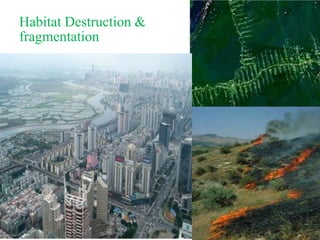
• Habitat destruction
Habitat destruction is defined as the complete
elimination of a localized or regional ecosystem
leading to the total loss of its former biological
function.
• Habitat fragmentation
Habitat fragmentation is a secondary affect of
habitat destruction,occurs when remaining
populations are isolated because the links
between habitat patches have been destroyed
Habitat Destruction &
fragmentation
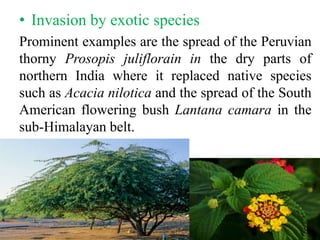
• Invasion by exotic species
Prominent examples are the spread of the Peruvian
thorny Prosopis juliflorain in the dry parts of
northern India where it replaced native species
such as Acacia nilotica and the spread of the South
American flowering bush Lantana camara in the
sub-Himalayan belt.
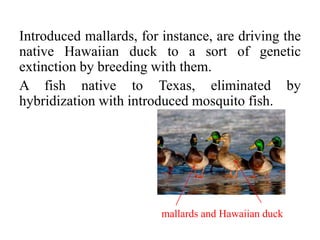
Introduced mallards, for instance, are driving the
native Hawaiian duck to a sort of genetic
extinction by breeding with them.
A fish native to Texas, eliminated by
hybridization with introduced mosquito fish.
mallards and Hawaiian duck
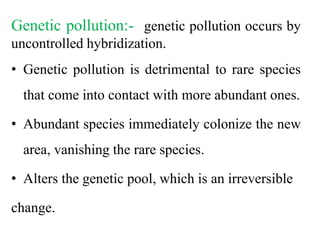
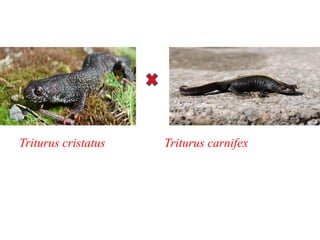
Genetic pollution:- genetic pollution occurs by
uncontrolled hybridization.
• Genetic pollution is detrimental to rare species
that come into contact with more abundant ones.
• Abundant species immediately colonize the new
area, vanishing the rare species.
• Alters the genetic pool, which is an irreversible
change.
Triturus cristatus Triturus carnifex
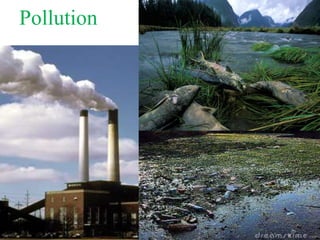
Pollution
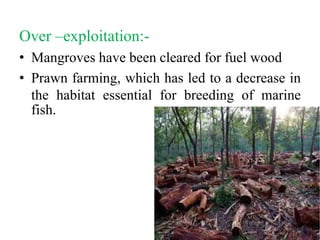
Over –exploitation:-
• Mangroves have been cleared for fuel wood
• Prawn farming, which has led to a decrease in
the habitat essential for breeding of marine
fish.
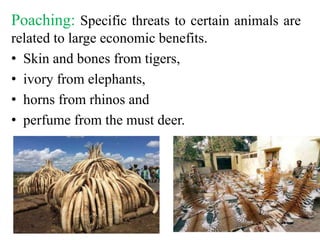
Poaching: Specific threats to certain animals are
related to large economic benefits.
• Skin and bones from tigers,
• ivory from elephants,
• horns from rhinos and
• perfume from the must deer.
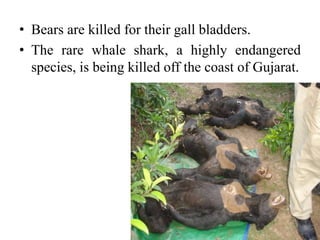
• Bears are killed for their gall bladders.
• The rare whale shark, a highly endangered
species, is being killed off the coast of Gujarat.
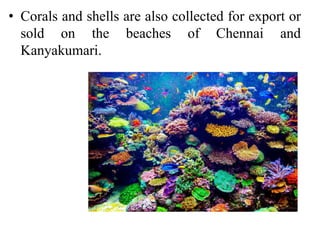
• Corals and shells are also collected for export or
sold on the beaches of Chennai and
Kanyakumari.
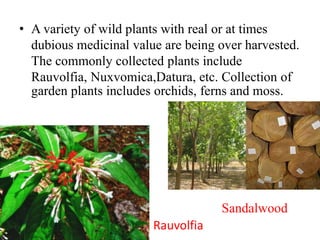
• A variety of wild plants with real or at times
dubious medicinal value are being over harvested.
The commonly collected plants include
Rauvolfia, Nuxvomica,Datura, etc. Collection of
garden plants includes orchids, ferns and moss.
• Bhringaraj Sandalwood
• RauvolfiaRauvolfia Rauvolfia
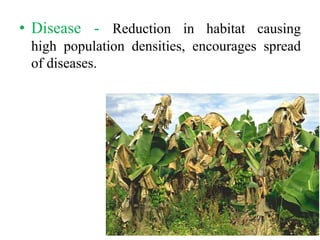
• Disease - Reduction in habitat causing
high population densities, encourages spread
of diseases.
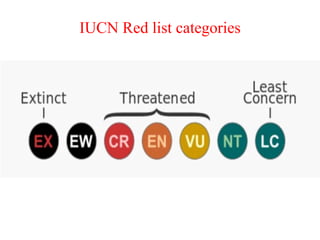
IUCN Red list categories
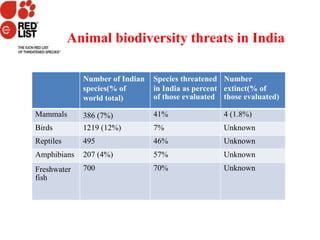
Number of Indian
species(% of
world total)
Species threatened
in India as percent
of those evaluated
Number
extinct(% of
those evaluated)
Mammals 386 (7%) 41% 4 (1.8%)
Birds 1219 (12%) 7% Unknown
Reptiles 495 46% Unknown
Amphibians 207 (4%) 57% Unknown
Freshwater
fish
700 70% Unknown
Animal biodiversity threats in India
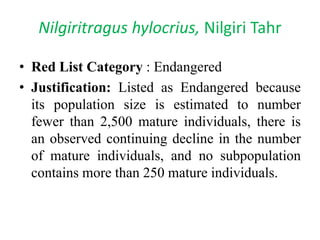
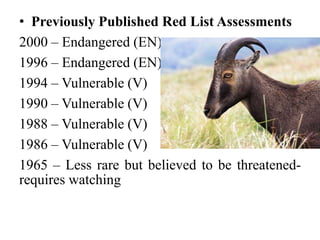
Nilgiritragus hylocrius, Nilgiri Tahr
• Red List Category : Endangered
• Justification: Listed as Endangered because
its population size is estimated to number
fewer than 2,500 mature individuals, there is
an observed continuing decline in the number
of mature individuals, and no subpopulation
contains more than 250 mature individuals.
• Previously Published Red List Assessments
2000 – Endangered (EN)
1996 – Endangered (EN)
1994 – Vulnerable (V)
1990 – Vulnerable (V)
1988 – Vulnerable (V)
1986 – Vulnerable (V)
1965 – Less rare but believed to be threatened-
requires watching
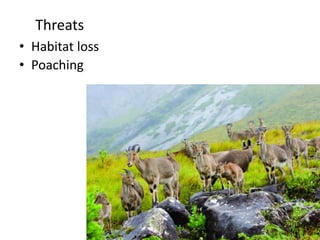
Threats
• Habitat loss
• Poaching
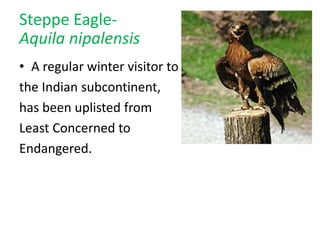
Steppe Eagle-
Aquila nipalensis
• A regular winter visitor to
the Indian subcontinent,
has been uplisted from
Least Concerned to
Endangered.
• Justification: rapid population declines within
its European range. The majority of its range
lies outside Europe where it may be exposed
to greater threats than was previously thought
and has also undergone very rapid recent
declines across much of the range.
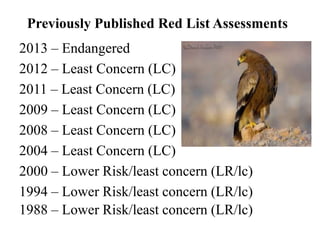
Previously Published Red List Assessments
2013 – Endangered
2012 – Least Concern (LC)
2011 – Least Concern (LC)
2009 – Least Concern (LC)
2008 – Least Concern (LC)
2004 – Least Concern (LC)
2000 – Lower Risk/least concern (LR/lc)
1994 – Lower Risk/least concern (LR/lc)
1988 – Lower Risk/least concern (LR/lc)
• Threats
 Habitat loss
 Use of veterinary drug diclofenac causes
renal failure in these birds
 High-voltage lines.
How to address the threats of
biodiversity….???
• There should be sustainable utilisation of
resources.
• International trade in wild life should be highly
regulated.
• The poaching and hunting of wildlife should
be prevented as far as practicable.
• Efforts should be made to reduce the level of
pollutants in the environment.
• Public awareness should be created regarding
biodiversity and its importance for the living
organisms.
• The habitats of migratory birds should be
protected by bilateral and multilateral
agreement.
• The over exploitation of useful products of
wild life should be prevented.
• Environmental laws should be strictly
followed.
Its Now or ‘NEVER’

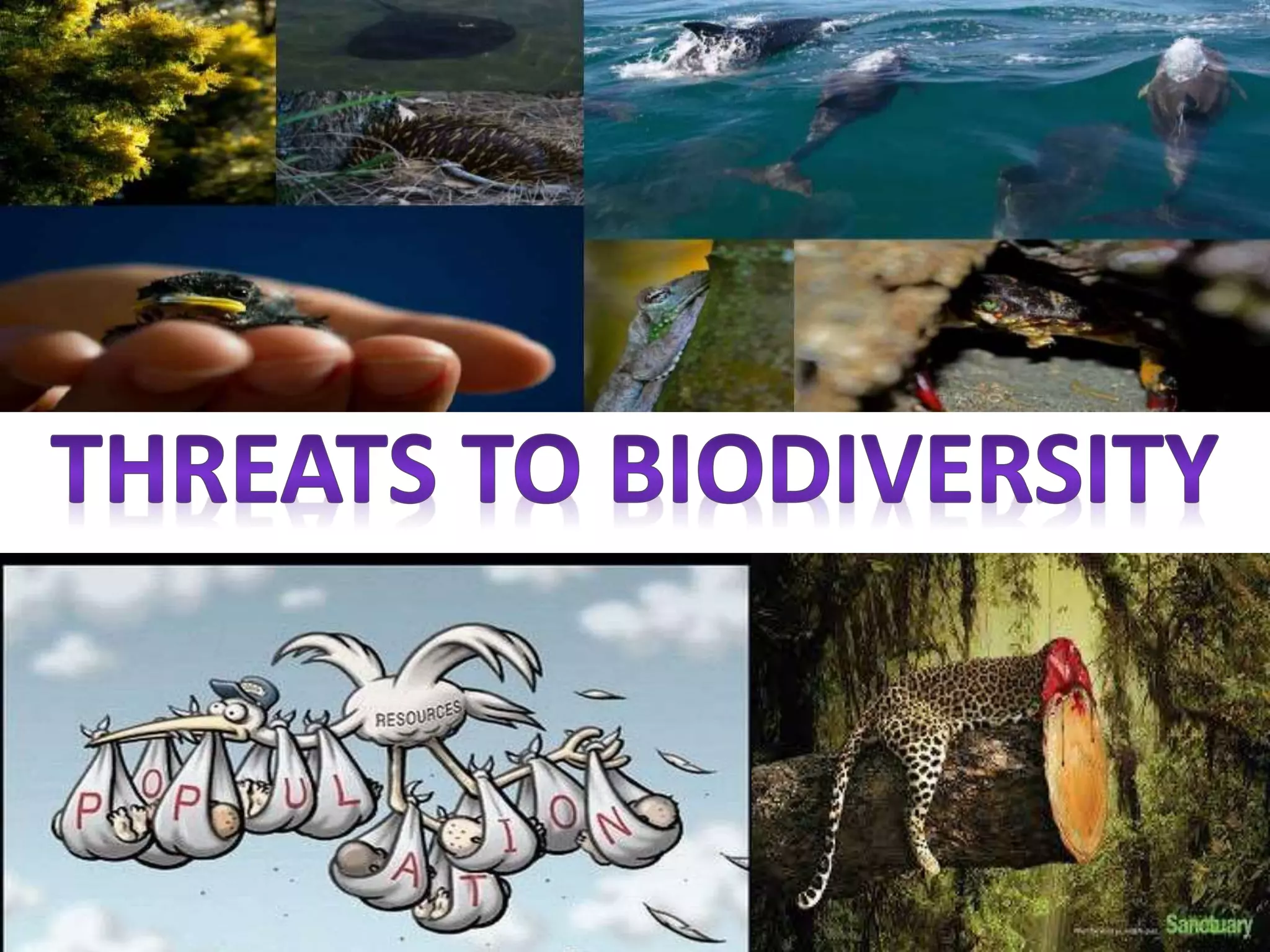
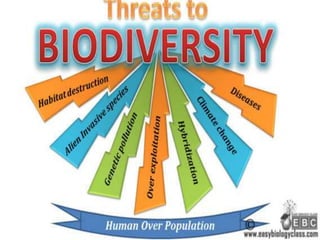
Threats to biodiversity

  • 2.
    UNIVERSITY OF AGRICULTURALAND HORTICULTURAL SCIENCES, SHIMOGA By CHANDANA B R Jr MSc(GPB)
  • 3.
    Contents Introduction Biodiversity at differentlevels Threats to biodiversity Status of terrestrial ecoregions Species under threat Animal biodiversity threats in India Conclusion
  • 4.
    Biodiversity • Is asum of all the different species of animals, plants, fungi, and microbial organisms living on earth and the variety of habitats in which they live.
  • 5.
    Biodiversity at differentlevels • Genetic diversity • Species diversity • Ecosystem diversity
  • 7.
    • Habitat destruction Habitatdestruction is defined as the complete elimination of a localized or regional ecosystem leading to the total loss of its former biological function. • Habitat fragmentation Habitat fragmentation is a secondary affect of habitat destruction,occurs when remaining populations are isolated because the links between habitat patches have been destroyed
  • 8.
  • 9.
    • Invasion byexotic species Prominent examples are the spread of the Peruvian thorny Prosopis juliflorain in the dry parts of northern India where it replaced native species such as Acacia nilotica and the spread of the South American flowering bush Lantana camara in the sub-Himalayan belt.
  • 10.
    Introduced mallards, forinstance, are driving the native Hawaiian duck to a sort of genetic extinction by breeding with them. A fish native to Texas, eliminated by hybridization with introduced mosquito fish. mallards and Hawaiian duck
  • 11.
    Genetic pollution:- geneticpollution occurs by uncontrolled hybridization. • Genetic pollution is detrimental to rare species that come into contact with more abundant ones. • Abundant species immediately colonize the new area, vanishing the rare species. • Alters the genetic pool, which is an irreversible change.
  • 12.
  • 13.
  • 14.
    Over –exploitation:- • Mangroveshave been cleared for fuel wood • Prawn farming, which has led to a decrease in the habitat essential for breeding of marine fish.
  • 15.
    Poaching: Specific threatsto certain animals are related to large economic benefits. • Skin and bones from tigers, • ivory from elephants, • horns from rhinos and • perfume from the must deer.
  • 16.
    • Bears arekilled for their gall bladders. • The rare whale shark, a highly endangered species, is being killed off the coast of Gujarat.
  • 17.
    • Corals andshells are also collected for export or sold on the beaches of Chennai and Kanyakumari.
  • 18.
    • A varietyof wild plants with real or at times dubious medicinal value are being over harvested. The commonly collected plants include Rauvolfia, Nuxvomica,Datura, etc. Collection of garden plants includes orchids, ferns and moss. • Bhringaraj Sandalwood • RauvolfiaRauvolfia Rauvolfia
  • 19.
    • Disease -Reduction in habitat causing high population densities, encourages spread of diseases.
  • 21.
    IUCN Red listcategories
  • 23.
    Number of Indian species(%of world total) Species threatened in India as percent of those evaluated Number extinct(% of those evaluated) Mammals 386 (7%) 41% 4 (1.8%) Birds 1219 (12%) 7% Unknown Reptiles 495 46% Unknown Amphibians 207 (4%) 57% Unknown Freshwater fish 700 70% Unknown Animal biodiversity threats in India
  • 24.
    Nilgiritragus hylocrius, NilgiriTahr • Red List Category : Endangered • Justification: Listed as Endangered because its population size is estimated to number fewer than 2,500 mature individuals, there is an observed continuing decline in the number of mature individuals, and no subpopulation contains more than 250 mature individuals.
  • 25.
    • Previously PublishedRed List Assessments 2000 – Endangered (EN) 1996 – Endangered (EN) 1994 – Vulnerable (V) 1990 – Vulnerable (V) 1988 – Vulnerable (V) 1986 – Vulnerable (V) 1965 – Less rare but believed to be threatened- requires watching
  • 26.
  • 27.
    Steppe Eagle- Aquila nipalensis •A regular winter visitor to the Indian subcontinent, has been uplisted from Least Concerned to Endangered.
  • 28.
    • Justification: rapidpopulation declines within its European range. The majority of its range lies outside Europe where it may be exposed to greater threats than was previously thought and has also undergone very rapid recent declines across much of the range.
  • 29.
    Previously Published RedList Assessments 2013 – Endangered 2012 – Least Concern (LC) 2011 – Least Concern (LC) 2009 – Least Concern (LC) 2008 – Least Concern (LC) 2004 – Least Concern (LC) 2000 – Lower Risk/least concern (LR/lc) 1994 – Lower Risk/least concern (LR/lc) 1988 – Lower Risk/least concern (LR/lc)
  • 30.
    • Threats  Habitatloss  Use of veterinary drug diclofenac causes renal failure in these birds  High-voltage lines.
  • 31.
    How to addressthe threats of biodiversity….??? • There should be sustainable utilisation of resources. • International trade in wild life should be highly regulated. • The poaching and hunting of wildlife should be prevented as far as practicable. • Efforts should be made to reduce the level of pollutants in the environment.
  • 32.
    • Public awarenessshould be created regarding biodiversity and its importance for the living organisms. • The habitats of migratory birds should be protected by bilateral and multilateral agreement. • The over exploitation of useful products of wild life should be prevented. • Environmental laws should be strictly followed.
  • 33.
    Its Now or‘NEVER’

Editor's Notes

  • #24 Table : Animal biodiversity threats in India