• Presented By:
• SHYED FARHAN ALI
• Chemical Engg. (IIIrd Year)
• 1413351903
WELDING OF
PLASTIC
1welding of plastic5 April 2016
CONTENT
5 April 2016 welding of plastic 2
1. Introduction
2. Classification of plastic welding
3. Welding Rod
4. Hot Sealing
5. Hot plate welding
6. Hot gas welding
7. Ultrasonic welding
8. Friction welding
9. Laser welding
INTRODUCTION
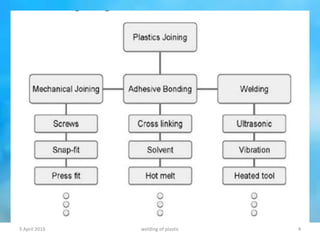
Mechanical fasteners, adhesives, and welding processes can all be employed to form
joints between engineering plastics. Mechanical fasteners can join two components
quickly, but they do not provide leak tight joint, and the localized stresses may cause
them to pull free of the polymeric material. Adhesives can provide good properties and
fully sound joints, but they are difficult to handle and slow to cure. Also joint
preparation & surface cleanliness need to be given importance in adhesive bonding.
Welding can be used to produce bonded joints with mechanical properties that
approach those of parent material. The plastic welding is confined to thermoplastic
polymers because these materials can be softened by heat. Thermosetting polymers
once hardened cannot be softened again on heating. The heat required for welding
thermoplastic polymers is less than that required for metals. Plastic welding processes
can be divide into two groups: -
a) Processes involving mechanical movement – ultrasonic welding, friction welding,
vibration welding.
b) Processes involving external heating – hot plate welding, hot gas welding and
resistive and implant welding
5 April 2016 welding of plastic 3
5 April 2016 welding of plastic 4
5 April 2016 welding of plastic 5
CLASSIFICATION OF PLASTIC WELDING
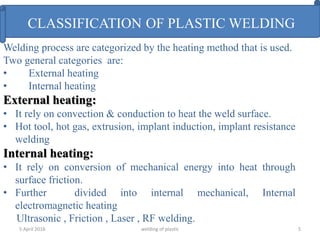
Welding process are categorized by the heating method that is used.
Two general categories are:
• External heating
• Internal heating
External heating:
• It rely on convection & conduction to heat the weld surface.
• Hot tool, hot gas, extrusion, implant induction, implant resistance
welding
Internal heating:
• It rely on conversion of mechanical energy into heat through
surface friction.
• Further divided into internal mechanical, Internal
electromagnetic heating
Ultrasonic , Friction , Laser , RF welding.
5 April 2016 welding of plastic 6
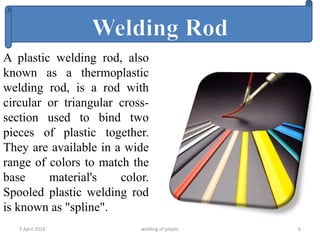
A plastic welding rod, also
known as a thermoplastic
welding rod, is a rod with
circular or triangular cross-
section used to bind two
pieces of plastic together.
They are available in a wide
range of colors to match the
base material's color.
Spooled plastic welding rod
is known as "spline".
5 April 2016 welding of plastic 7
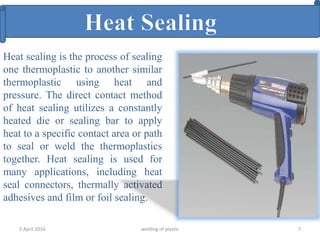
Heat sealing is the process of sealing
one thermoplastic to another similar
thermoplastic using heat and
pressure. The direct contact method
of heat sealing utilizes a constantly
heated die or sealing bar to apply
heat to a specific contact area or path
to seal or weld the thermoplastics
together. Heat sealing is used for
many applications, including heat
seal connectors, thermally activated
adhesives and film or foil sealing.
5 April 2016 welding of plastic 8
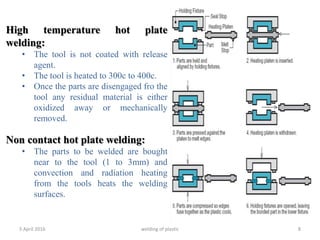
High temperature hot plate
welding:
• The tool is not coated with release
agent.
• The tool is heated to 300c to 400c.
• Once the parts are disengaged fro the
tool any residual material is either
oxidized away or mechanically
removed.
Non contact hot plate welding:
• The parts to be welded are bought
near to the tool (1 to 3mm) and
convection and radiation heating
from the tools heats the welding
surfaces.
5 April 2016 welding of plastic 9
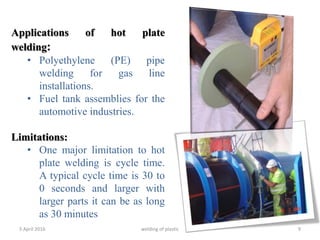
Applications of hot plate
welding:
• Polyethylene (PE) pipe
welding for gas line
installations.
• Fuel tank assemblies for the
automotive industries.
Limitations:
• One major limitation to hot
plate welding is cycle time.
A typical cycle time is 30 to
0 seconds and larger with
larger parts it can be as long
as 30 minutes
5 April 2016 welding of plastic 10
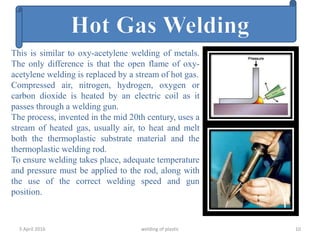
This is similar to oxy-acetylene welding of metals.
The only difference is that the open flame of oxy-
acetylene welding is replaced by a stream of hot gas.
Compressed air, nitrogen, hydrogen, oxygen or
carbon dioxide is heated by an electric coil as it
passes through a welding gun.
The process, invented in the mid 20th century, uses a
stream of heated gas, usually air, to heat and melt
both the thermoplastic substrate material and the
thermoplastic welding rod.
To ensure welding takes place, adequate temperature
and pressure must be applied to the rod, along with
the use of the correct welding speed and gun
position.
5 April 2016 welding of plastic 11
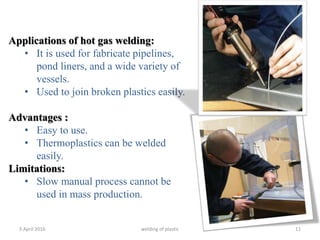
Applications of hot gas welding:
• It is used for fabricate pipelines,
pond liners, and a wide variety of
vessels.
• Used to join broken plastics easily.
Advantages :
• Easy to use.
• Thermoplastics can be welded
easily.
Limitations:
• Slow manual process cannot be
used in mass production.
5 April 2016 welding of plastic 12
Ultrasonic Welding
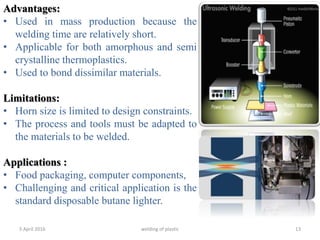
0 This method uses mechanical vibrations to form the joint. The vibrations are of high frequency.
0 The parts to be assembled are held together under pressure between the oscillating
horn and an immobile anvil and are subjected to ultrasonic vibrations of frequency 20
to 40 KHz at right angles to the contact area.
0 Alternating high frequency stresses generate heat at joint interface to produce a good
quality weld.
0 ultrasonic welding is divided into two major groups:
0 Near -field
0 Far –field
0 Near-field :
0 The distance between the horn and the weld interface less than 6mm.
0 Far-field:
0 The distance between the horn and the weld interface is greater than 6mm.
5 April 2016 welding of plastic 13
Advantages:
• Used in mass production because the
welding time are relatively short.
• Applicable for both amorphous and semi
crystalline thermoplastics.
• Used to bond dissimilar materials.
Limitations:
• Horn size is limited to design constraints.
• The process and tools must be adapted to
the materials to be welded.
Applications :
• Food packaging, computer components,
• Challenging and critical application is the
standard disposable butane lighter.
5 April 2016 welding of plastic 14
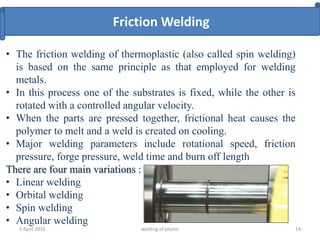
• The friction welding of thermoplastic (also called spin welding)
is based on the same principle as that employed for welding
metals.
• In this process one of the substrates is fixed, while the other is
rotated with a controlled angular velocity.
• When the parts are pressed together, frictional heat causes the
polymer to melt and a weld is created on cooling.
• Major welding parameters include rotational speed, friction
pressure, forge pressure, weld time and burn off length
There are four main variations :
• Linear welding
• Orbital welding
• Spin welding
• Angular welding
Friction Welding
5 April 2016 welding of plastic 15
Advantages:
The advantages of friction welding are
high weld quality and the simplicity and
reproducibility of the process.
Limitations:
It is suitable only for applications in
which at least one of the components is
circular and requires no angular
alignment.
Applications:
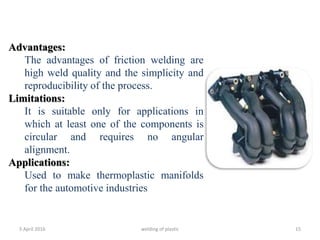
Used to make thermoplastic manifolds
for the automotive industries
5 April 2016 welding of plastic 16
LASER WELDING
There are two modes of laser beam welding:
• Surface heating
• Through transmission infrared (TTIr) welding
Surface heating:
• The surfaces of the components to be joined
are heated by direct IR/laser exposure for a
sufficient length of time to produce a molten
layer, usually for 2 to 10 s.
• Once the surface is fully melted, the IR/laser
tool is with drawn from between the parts, the
parts are forged together, and the melt is
allowed to solidify.
TTIr welding:
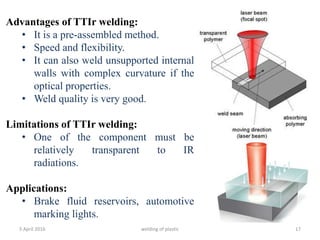
• It is based on the concept of passing laser
radiations through one of the component to be
welded while having the second component
absorb the light at the interface.
• This absorption results in heating and melting
of the interface and allows the parts to be
welded.
5 April 2016 welding of plastic 17
Advantages of TTIr welding:
• It is a pre-assembled method.
• Speed and flexibility.
• It can also weld unsupported internal
walls with complex curvature if the
optical properties.
• Weld quality is very good.
Limitations of TTIr welding:
• One of the component must be
relatively transparent to IR
radiations.
Applications:
• Brake fluid reservoirs, automotive
marking lights.
5 April 2016 welding of plastic 18
REFERENCES
1)E.Paul Degarmo, J.T Black, Ronald A Kohser,
Materials and processes in manufacturing, Prentice
Hall, India.
2)Robert A Grimm, Welding processes for plastics,
Advance materials and processes, vol 147, 1995.
3)Joining plastics in production, The welding
institute
4)Grewell D.A.; Benatar A.; Park J.B. (2003).
Plastics and Composites Welding Handbook. Hanser
Publishers, Munich.
5) www.google.com
6)www.wikipedia.com
5 April 2016 welding of plastic 19

Welding of plastic

  • 1.
    • Presented By: •SHYED FARHAN ALI • Chemical Engg. (IIIrd Year) • 1413351903 WELDING OF PLASTIC 1welding of plastic5 April 2016
  • 2.
    CONTENT 5 April 2016welding of plastic 2 1. Introduction 2. Classification of plastic welding 3. Welding Rod 4. Hot Sealing 5. Hot plate welding 6. Hot gas welding 7. Ultrasonic welding 8. Friction welding 9. Laser welding
  • 3.
    INTRODUCTION Mechanical fasteners, adhesives,and welding processes can all be employed to form joints between engineering plastics. Mechanical fasteners can join two components quickly, but they do not provide leak tight joint, and the localized stresses may cause them to pull free of the polymeric material. Adhesives can provide good properties and fully sound joints, but they are difficult to handle and slow to cure. Also joint preparation & surface cleanliness need to be given importance in adhesive bonding. Welding can be used to produce bonded joints with mechanical properties that approach those of parent material. The plastic welding is confined to thermoplastic polymers because these materials can be softened by heat. Thermosetting polymers once hardened cannot be softened again on heating. The heat required for welding thermoplastic polymers is less than that required for metals. Plastic welding processes can be divide into two groups: - a) Processes involving mechanical movement – ultrasonic welding, friction welding, vibration welding. b) Processes involving external heating – hot plate welding, hot gas welding and resistive and implant welding 5 April 2016 welding of plastic 3
  • 4.
    5 April 2016welding of plastic 4
  • 5.
    5 April 2016welding of plastic 5 CLASSIFICATION OF PLASTIC WELDING Welding process are categorized by the heating method that is used. Two general categories are: • External heating • Internal heating External heating: • It rely on convection & conduction to heat the weld surface. • Hot tool, hot gas, extrusion, implant induction, implant resistance welding Internal heating: • It rely on conversion of mechanical energy into heat through surface friction. • Further divided into internal mechanical, Internal electromagnetic heating Ultrasonic , Friction , Laser , RF welding.
  • 6.
    5 April 2016welding of plastic 6 A plastic welding rod, also known as a thermoplastic welding rod, is a rod with circular or triangular cross- section used to bind two pieces of plastic together. They are available in a wide range of colors to match the base material's color. Spooled plastic welding rod is known as "spline".
  • 7.
    5 April 2016welding of plastic 7 Heat sealing is the process of sealing one thermoplastic to another similar thermoplastic using heat and pressure. The direct contact method of heat sealing utilizes a constantly heated die or sealing bar to apply heat to a specific contact area or path to seal or weld the thermoplastics together. Heat sealing is used for many applications, including heat seal connectors, thermally activated adhesives and film or foil sealing.
  • 8.
    5 April 2016welding of plastic 8 High temperature hot plate welding: • The tool is not coated with release agent. • The tool is heated to 300c to 400c. • Once the parts are disengaged fro the tool any residual material is either oxidized away or mechanically removed. Non contact hot plate welding: • The parts to be welded are bought near to the tool (1 to 3mm) and convection and radiation heating from the tools heats the welding surfaces.
  • 9.
    5 April 2016welding of plastic 9 Applications of hot plate welding: • Polyethylene (PE) pipe welding for gas line installations. • Fuel tank assemblies for the automotive industries. Limitations: • One major limitation to hot plate welding is cycle time. A typical cycle time is 30 to 0 seconds and larger with larger parts it can be as long as 30 minutes
  • 10.
    5 April 2016welding of plastic 10 This is similar to oxy-acetylene welding of metals. The only difference is that the open flame of oxy- acetylene welding is replaced by a stream of hot gas. Compressed air, nitrogen, hydrogen, oxygen or carbon dioxide is heated by an electric coil as it passes through a welding gun. The process, invented in the mid 20th century, uses a stream of heated gas, usually air, to heat and melt both the thermoplastic substrate material and the thermoplastic welding rod. To ensure welding takes place, adequate temperature and pressure must be applied to the rod, along with the use of the correct welding speed and gun position.
  • 11.
    5 April 2016welding of plastic 11 Applications of hot gas welding: • It is used for fabricate pipelines, pond liners, and a wide variety of vessels. • Used to join broken plastics easily. Advantages : • Easy to use. • Thermoplastics can be welded easily. Limitations: • Slow manual process cannot be used in mass production.
  • 12.
    5 April 2016welding of plastic 12 Ultrasonic Welding 0 This method uses mechanical vibrations to form the joint. The vibrations are of high frequency. 0 The parts to be assembled are held together under pressure between the oscillating horn and an immobile anvil and are subjected to ultrasonic vibrations of frequency 20 to 40 KHz at right angles to the contact area. 0 Alternating high frequency stresses generate heat at joint interface to produce a good quality weld. 0 ultrasonic welding is divided into two major groups: 0 Near -field 0 Far –field 0 Near-field : 0 The distance between the horn and the weld interface less than 6mm. 0 Far-field: 0 The distance between the horn and the weld interface is greater than 6mm.
  • 13.
    5 April 2016welding of plastic 13 Advantages: • Used in mass production because the welding time are relatively short. • Applicable for both amorphous and semi crystalline thermoplastics. • Used to bond dissimilar materials. Limitations: • Horn size is limited to design constraints. • The process and tools must be adapted to the materials to be welded. Applications : • Food packaging, computer components, • Challenging and critical application is the standard disposable butane lighter.
  • 14.
    5 April 2016welding of plastic 14 • The friction welding of thermoplastic (also called spin welding) is based on the same principle as that employed for welding metals. • In this process one of the substrates is fixed, while the other is rotated with a controlled angular velocity. • When the parts are pressed together, frictional heat causes the polymer to melt and a weld is created on cooling. • Major welding parameters include rotational speed, friction pressure, forge pressure, weld time and burn off length There are four main variations : • Linear welding • Orbital welding • Spin welding • Angular welding Friction Welding
  • 15.
    5 April 2016welding of plastic 15 Advantages: The advantages of friction welding are high weld quality and the simplicity and reproducibility of the process. Limitations: It is suitable only for applications in which at least one of the components is circular and requires no angular alignment. Applications: Used to make thermoplastic manifolds for the automotive industries
  • 16.
    5 April 2016welding of plastic 16 LASER WELDING There are two modes of laser beam welding: • Surface heating • Through transmission infrared (TTIr) welding Surface heating: • The surfaces of the components to be joined are heated by direct IR/laser exposure for a sufficient length of time to produce a molten layer, usually for 2 to 10 s. • Once the surface is fully melted, the IR/laser tool is with drawn from between the parts, the parts are forged together, and the melt is allowed to solidify. TTIr welding: • It is based on the concept of passing laser radiations through one of the component to be welded while having the second component absorb the light at the interface. • This absorption results in heating and melting of the interface and allows the parts to be welded.
  • 17.
    5 April 2016welding of plastic 17 Advantages of TTIr welding: • It is a pre-assembled method. • Speed and flexibility. • It can also weld unsupported internal walls with complex curvature if the optical properties. • Weld quality is very good. Limitations of TTIr welding: • One of the component must be relatively transparent to IR radiations. Applications: • Brake fluid reservoirs, automotive marking lights.
  • 18.
    5 April 2016welding of plastic 18 REFERENCES 1)E.Paul Degarmo, J.T Black, Ronald A Kohser, Materials and processes in manufacturing, Prentice Hall, India. 2)Robert A Grimm, Welding processes for plastics, Advance materials and processes, vol 147, 1995. 3)Joining plastics in production, The welding institute 4)Grewell D.A.; Benatar A.; Park J.B. (2003). Plastics and Composites Welding Handbook. Hanser Publishers, Munich. 5) www.google.com 6)www.wikipedia.com
  • 19.
    5 April 2016welding of plastic 19