Seminar
On
Underwater welding
Submitted to: submitted by:
Department of Mechanical MOHAN BIHARI
engineering 12EEJME029 1
UNDERWATER WELDING
Mohan Bihari
12eejme029
m4ubihari@gmail.com
SEMINAR ON
2
• First under water welding by British Admiralty
– Dockyard
• In 1946, special waterproof electrodes were
developed in Holland by ‘Van der Willingen’
• 1970s: Whitey Grubbs and Dale Anderson of
Chicago Bridge & Iron (CB&I) qualified an
underwater wet welding procedure to
American Welding Society (AWS) standards.
3
INTRODUCTION TO
UNDERWATER WELDING
4
We cant lift ship and then repair it. Hence comes the use of underwater
welding
5
•Wet welding •Dry welding
6
Hyperbaric welding is the process in which
a chamber is sealed around the structure to
be welded and is filled with a gas ( He and
Oxygen) at the prevailing pressure.
7
Dry welding can be of two types
•Large habitat
•Mini habitat
Mini habitat for underwater
welding.
8
Large habitat for underwater welding
9
Large habitat underwater welding
•Welder /diver safety
•Good weld quality
•Surface monitoring
10
• Higher cost of process, training, etc
• Large quantity of costly and complex equipments
• More deep, more energy requirement.
• Cant weld if weld spot is at unreachable place
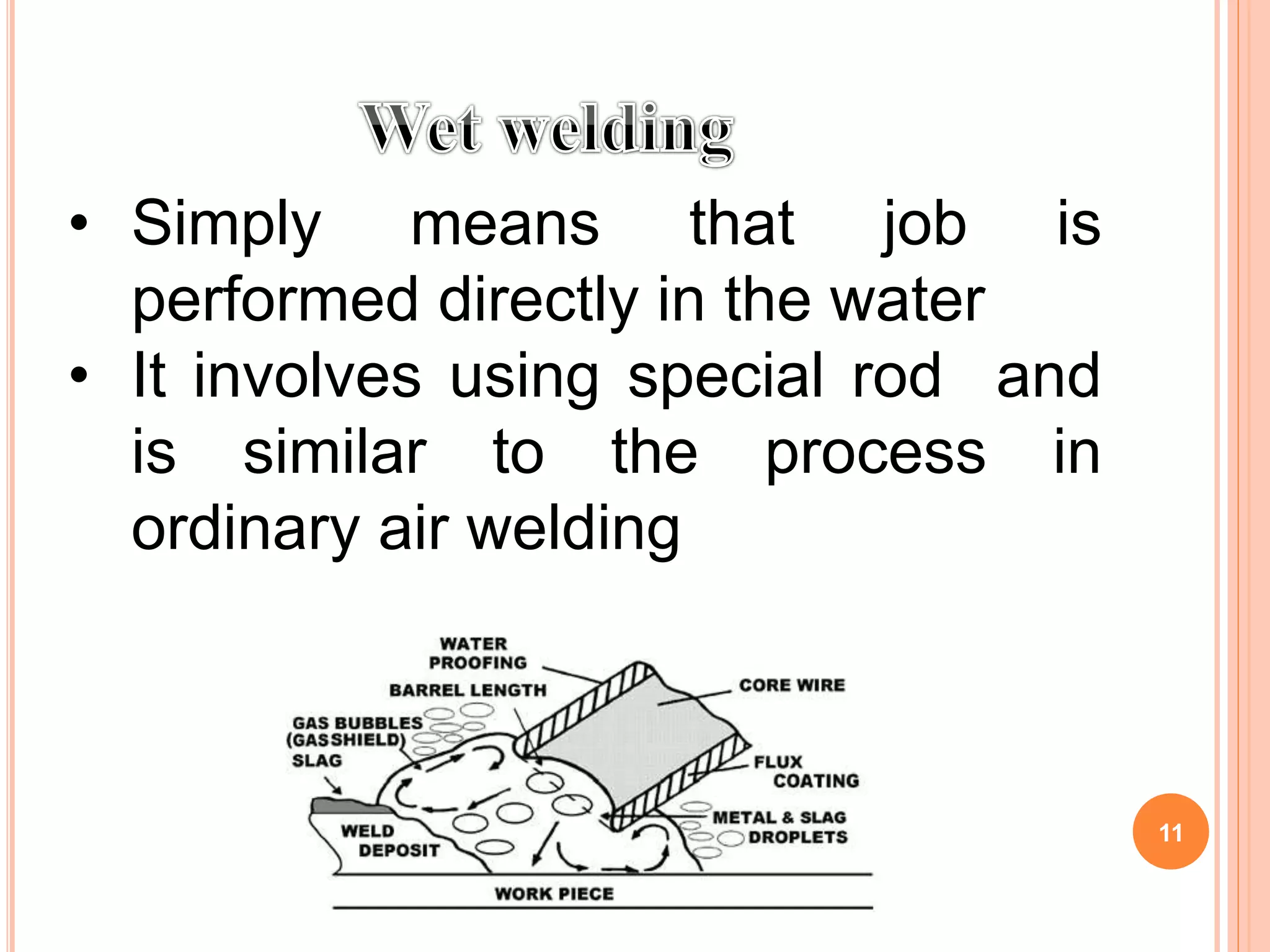
• Simply means that job is
performed directly in the water
• It involves using special rod and
is similar to the process in
ordinary air welding
11
12
• Cheapest
• Fastest
• Tensile strength is high
• Ease of access the weld spot
• No waste of time in constructing habitat
13
• Rapid quenching decreases impact strength,
Ductility.
• Hydrogen embrittlement.
• Poor visibility in water.
• Higher energy density of hydrogen, higher
efficiency.
14
15
16
 Offshore construction for tapping sea
resources.
 Temporary repair work caused by ship’s
collisions or unexpected accidents.
 Salvaging vessels sunk in the sea.
 Repair and maintenance of ships.
 Construction of large ships beyond the
capacity of existing docks.
Repair and maintenance of underwater
pipelines.
• Hydrogen and oxygen are dissociated
from the water and will travel separately
as bubbles
• Oxygen cutting is about 60 percent
efficient
• Above river beds, especially in mud,
because trapped methane gas in the
proper concentrations can explode.
17
• There is a risk to the welder/diver of electric
shock.
• There is a risk that defects may remain
undetected
• The other main area of risk is to the life or
health of the welder/diver from nitrogen
introduced into the blood steam during exposure
to air at increased pressure
18
• Start cutting at the highest point and work
downward
• By withdrawing the electrode every few
seconds to allow water to enter the cut
• Gases may be vented to the surface with a vent
tube (flexible hose) secured in place from the
high point where gases would collect to a
position above the waterline.
19
• Precautions include achieving adequate
electrical insulation of the welding
equipment
• Areas and voids must be vented or made
inert
20
• Development of alternative welding methods
like friction welding, explosive welding, and
stud welding.
• Present trend is towards automation. THOR – 1
(TIG Hyperbaric Orbital Robot) is developed
where diver performs pipefitting, installs the
track and orbital head on the pipe and the rest
process is automated.
21
22

Under water welding ppt

  • 1.
    Seminar On Underwater welding Submitted to:submitted by: Department of Mechanical MOHAN BIHARI engineering 12EEJME029 1
  • 2.
  • 3.
    • First underwater welding by British Admiralty – Dockyard • In 1946, special waterproof electrodes were developed in Holland by ‘Van der Willingen’ • 1970s: Whitey Grubbs and Dale Anderson of Chicago Bridge & Iron (CB&I) qualified an underwater wet welding procedure to American Welding Society (AWS) standards. 3
  • 4.
  • 5.
    We cant liftship and then repair it. Hence comes the use of underwater welding 5
  • 6.
  • 7.
    Hyperbaric welding isthe process in which a chamber is sealed around the structure to be welded and is filled with a gas ( He and Oxygen) at the prevailing pressure. 7
  • 8.
    Dry welding canbe of two types •Large habitat •Mini habitat Mini habitat for underwater welding. 8 Large habitat for underwater welding
  • 9.
  • 10.
    •Welder /diver safety •Goodweld quality •Surface monitoring 10 • Higher cost of process, training, etc • Large quantity of costly and complex equipments • More deep, more energy requirement. • Cant weld if weld spot is at unreachable place
  • 11.
    • Simply meansthat job is performed directly in the water • It involves using special rod and is similar to the process in ordinary air welding 11
  • 12.
  • 13.
    • Cheapest • Fastest •Tensile strength is high • Ease of access the weld spot • No waste of time in constructing habitat 13
  • 14.
    • Rapid quenchingdecreases impact strength, Ductility. • Hydrogen embrittlement. • Poor visibility in water. • Higher energy density of hydrogen, higher efficiency. 14
  • 15.
  • 16.
    16  Offshore constructionfor tapping sea resources.  Temporary repair work caused by ship’s collisions or unexpected accidents.  Salvaging vessels sunk in the sea.  Repair and maintenance of ships.  Construction of large ships beyond the capacity of existing docks. Repair and maintenance of underwater pipelines.
  • 17.
    • Hydrogen andoxygen are dissociated from the water and will travel separately as bubbles • Oxygen cutting is about 60 percent efficient • Above river beds, especially in mud, because trapped methane gas in the proper concentrations can explode. 17
  • 18.
    • There isa risk to the welder/diver of electric shock. • There is a risk that defects may remain undetected • The other main area of risk is to the life or health of the welder/diver from nitrogen introduced into the blood steam during exposure to air at increased pressure 18
  • 19.
    • Start cuttingat the highest point and work downward • By withdrawing the electrode every few seconds to allow water to enter the cut • Gases may be vented to the surface with a vent tube (flexible hose) secured in place from the high point where gases would collect to a position above the waterline. 19
  • 20.
    • Precautions includeachieving adequate electrical insulation of the welding equipment • Areas and voids must be vented or made inert 20
  • 21.
    • Development ofalternative welding methods like friction welding, explosive welding, and stud welding. • Present trend is towards automation. THOR – 1 (TIG Hyperbaric Orbital Robot) is developed where diver performs pipefitting, installs the track and orbital head on the pipe and the rest process is automated. 21
  • 22.