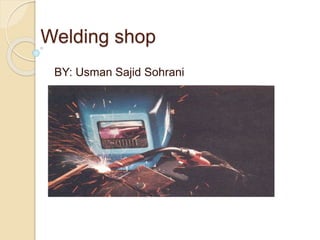
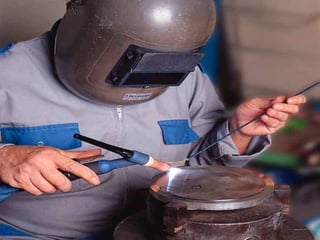
Welding shop
BY: Usman Sajid Sohrani
Overview of joining methods
 Mechanical methods
◦ Screwed fasteners, rivets,
 Adhesive bonding
 Welding
Weld & Welding
 Weld
 A joint produced by heat or pressure or both
 Welding
 Welding is a process of metal joining by applying
heat and sometimes pressure
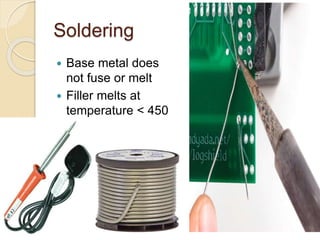
Soldering
 Base metal does
not fuse or melt
 Filler melts at
temperature < 450
C
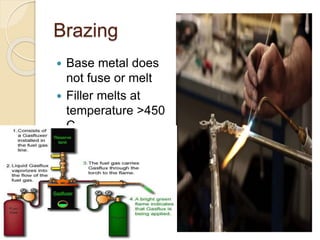
Brazing
 Base metal does
not fuse or melt
 Filler melts at
temperature >450
C
Classification of welding
 Welding processes may be classified
according to source of heat.
 Electric welding
 Gas welding
 Chemical welding
 Mechanical welding
 Laser welding
 Ultrasonic welding
 Electron beam welding
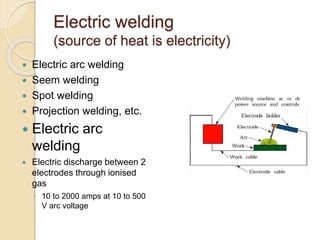
Electric welding
(source of heat is electricity)
 Electric arc welding
 Seem welding
 Spot welding
 Projection welding, etc.
 Electric arc
welding
 Electric discharge between 2
electrodes through ionised
gas
◦ 10 to 2000 amps at 10 to 500
V arc voltage
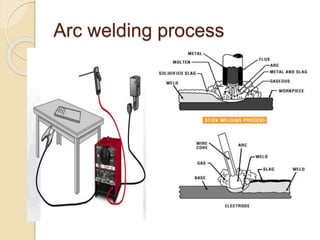
Arc welding process
Electrode
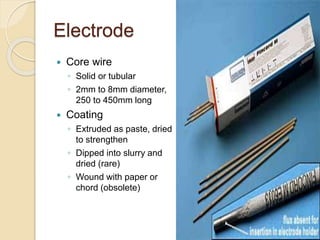
 Core wire
◦ Solid or tubular
◦ 2mm to 8mm diameter,
250 to 450mm long
 Coating
◦ Extruded as paste, dried
to strengthen
◦ Dipped into slurry and
dried (rare)
◦ Wound with paper or
chord (obsolete)
Functions of Coated Electrodes( flux
coated )
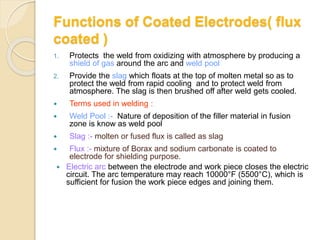
1. Protects the weld from oxidizing with atmosphere by producing a
shield of gas around the arc and weld pool
2. Provide the slag which floats at the top of molten metal so as to
protect the weld from rapid cooling and to protect weld from
atmosphere. The slag is then brushed off after weld gets cooled.
 Terms used in welding :
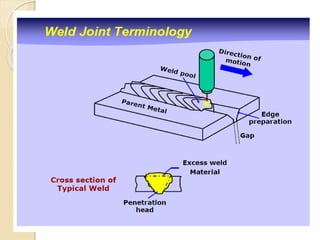
 Weld Pool :- Nature of deposition of the filler material in fusion
zone is know as weld pool
 Slag :- molten or fused flux is called as slag
 Flux :- mixture of Borax and sodium carbonate is coated to
electrode for shielding purpose.
 Electric arc between the electrode and work piece closes the electric
circuit. The arc temperature may reach 10000°F (5500°C), which is
sufficient for fusion the work piece edges and joining them.
Coding of Electrode
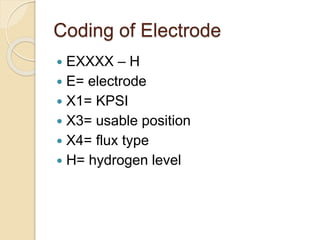
 EXXXX – H
 E= electrode
 X1= KPSI
 X3= usable position
 X4= flux type
 H= hydrogen level
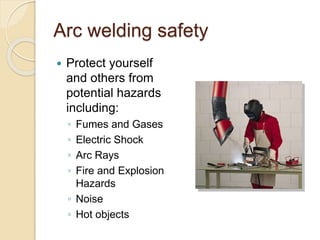
Arc welding safety
 Protect yourself
and others from
potential hazards
including:
◦ Fumes and Gases
◦ Electric Shock
◦ Arc Rays
◦ Fire and Explosion
Hazards
◦ Noise
◦ Hot objects
Gas welding
(Heat source is Gas)
Oxy fuel Gas welding or
Oxy acetylene gas welding (oxygen+ acetylene)
Preparation of acetylene
CaC2 + 2H2O → Ca(OH)2 + C2H2
 The temperature generated during the process is 33000c
 When the metal is fused, oxygen from the atmosphere and
the torch combines with molten metal and forms oxides,
results defective weld
 Fluxes are added to the welded metal to remove oxides
 Common fluxes used are made of sodium, potassium.
Lithium and borax.
 Flux can be applied as paste, powder, liquid. solid coating or
gas.
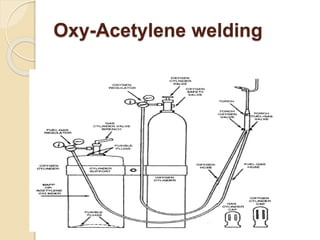
Oxy-Acetylene welding
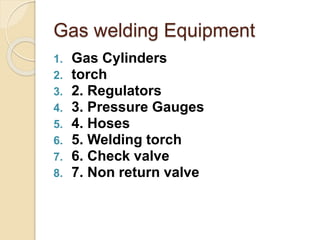
Gas welding Equipment
1. Gas Cylinders
2. torch
3. 2. Regulators
4. 3. Pressure Gauges
5. 4. Hoses
6. 5. Welding torch
7. 6. Check valve
8. 7. Non return valve
Torch Used in Oxyacetylene
Welding
TYPES OF FLAMES…
 Oxygen is turned on, flame immediately changes into a long white
inner area (Feather) surrounded by a transparent blue envelope is
called Carburizing flame (30000c)
 Addition of little more oxygen give a bright whitish cone surrounded
by the transparent blue envelope is called Neutral flame (It has a
balance of fuel gas and oxygen) (32000c)
 Used for welding steels, aluminium, copper and cast iron
 If more oxygen is added, the cone becomes darker and more
pointed, while the envelope becomes shorter and more fierce is
called Oxidizing flame
 Has the highest temperature about 34000c
 Used for welding brass and brazing operation
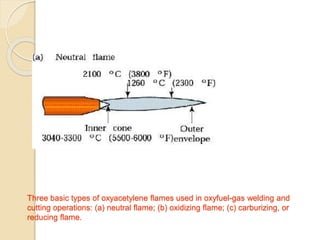
Three basic types of oxyacetylene flames used in oxyfuel-gas welding and
cutting operations: (a) neutral flame; (b) oxidizing flame; (c) carburizing, or
reducing flame.
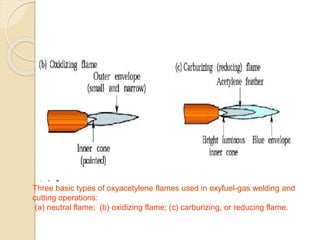
Three basic types of oxyacetylene flames used in oxyfuel-gas welding and
cutting operations:
(a) neutral flame; (b) oxidizing flame; (c) carburizing, or reducing flame.
Oxyfuel Gas Welding
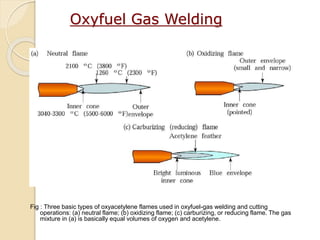
Fig : Three basic types of oxyacetylene flames used in oxyfuel-gas welding and cutting
operations: (a) neutral flame; (b) oxidizing flame; (c) carburizing, or reducing flame. The gas
mixture in (a) is basically equal volumes of oxygen and acetylene.
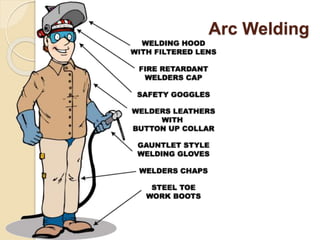
Arc Welding
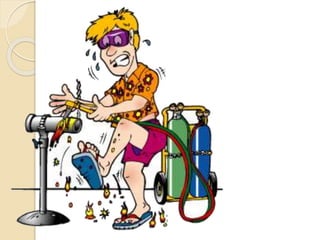
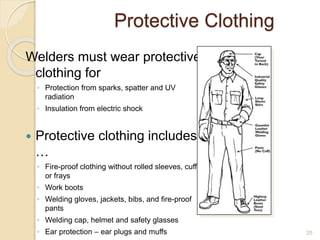
Protective Clothing
Welders must wear protective
clothing for
◦ Protection from sparks, spatter and UV
radiation
◦ Insulation from electric shock
 Protective clothing includes
…
◦ Fire-proof clothing without rolled sleeves, cuffs
or frays
◦ Work boots
◦ Welding gloves, jackets, bibs, and fire-proof
pants
◦ Welding cap, helmet and safety glasses
◦ Ear protection – ear plugs and muffs 25

Welding shop

  • 1.
  • 2.
    Overview of joiningmethods  Mechanical methods ◦ Screwed fasteners, rivets,  Adhesive bonding  Welding
  • 3.
    Weld & Welding Weld  A joint produced by heat or pressure or both  Welding  Welding is a process of metal joining by applying heat and sometimes pressure
  • 4.
    Soldering  Base metaldoes not fuse or melt  Filler melts at temperature < 450 C
  • 5.
    Brazing  Base metaldoes not fuse or melt  Filler melts at temperature >450 C
  • 6.
    Classification of welding Welding processes may be classified according to source of heat.  Electric welding  Gas welding  Chemical welding  Mechanical welding  Laser welding  Ultrasonic welding  Electron beam welding
  • 7.
    Electric welding (source ofheat is electricity)  Electric arc welding  Seem welding  Spot welding  Projection welding, etc.  Electric arc welding  Electric discharge between 2 electrodes through ionised gas ◦ 10 to 2000 amps at 10 to 500 V arc voltage
  • 8.
  • 10.
    Electrode  Core wire ◦Solid or tubular ◦ 2mm to 8mm diameter, 250 to 450mm long  Coating ◦ Extruded as paste, dried to strengthen ◦ Dipped into slurry and dried (rare) ◦ Wound with paper or chord (obsolete)
  • 11.
    Functions of CoatedElectrodes( flux coated ) 1. Protects the weld from oxidizing with atmosphere by producing a shield of gas around the arc and weld pool 2. Provide the slag which floats at the top of molten metal so as to protect the weld from rapid cooling and to protect weld from atmosphere. The slag is then brushed off after weld gets cooled.  Terms used in welding :  Weld Pool :- Nature of deposition of the filler material in fusion zone is know as weld pool  Slag :- molten or fused flux is called as slag  Flux :- mixture of Borax and sodium carbonate is coated to electrode for shielding purpose.  Electric arc between the electrode and work piece closes the electric circuit. The arc temperature may reach 10000°F (5500°C), which is sufficient for fusion the work piece edges and joining them.
  • 12.
    Coding of Electrode EXXXX – H  E= electrode  X1= KPSI  X3= usable position  X4= flux type  H= hydrogen level
  • 13.
    Arc welding safety Protect yourself and others from potential hazards including: ◦ Fumes and Gases ◦ Electric Shock ◦ Arc Rays ◦ Fire and Explosion Hazards ◦ Noise ◦ Hot objects
  • 14.
    Gas welding (Heat sourceis Gas) Oxy fuel Gas welding or Oxy acetylene gas welding (oxygen+ acetylene) Preparation of acetylene CaC2 + 2H2O → Ca(OH)2 + C2H2  The temperature generated during the process is 33000c  When the metal is fused, oxygen from the atmosphere and the torch combines with molten metal and forms oxides, results defective weld  Fluxes are added to the welded metal to remove oxides  Common fluxes used are made of sodium, potassium. Lithium and borax.  Flux can be applied as paste, powder, liquid. solid coating or gas.
  • 15.
  • 16.
    Gas welding Equipment 1.Gas Cylinders 2. torch 3. 2. Regulators 4. 3. Pressure Gauges 5. 4. Hoses 6. 5. Welding torch 7. 6. Check valve 8. 7. Non return valve
  • 17.
    Torch Used inOxyacetylene Welding
  • 18.
    TYPES OF FLAMES… Oxygen is turned on, flame immediately changes into a long white inner area (Feather) surrounded by a transparent blue envelope is called Carburizing flame (30000c)  Addition of little more oxygen give a bright whitish cone surrounded by the transparent blue envelope is called Neutral flame (It has a balance of fuel gas and oxygen) (32000c)  Used for welding steels, aluminium, copper and cast iron  If more oxygen is added, the cone becomes darker and more pointed, while the envelope becomes shorter and more fierce is called Oxidizing flame  Has the highest temperature about 34000c  Used for welding brass and brazing operation
  • 19.
    Three basic typesof oxyacetylene flames used in oxyfuel-gas welding and cutting operations: (a) neutral flame; (b) oxidizing flame; (c) carburizing, or reducing flame.
  • 20.
    Three basic typesof oxyacetylene flames used in oxyfuel-gas welding and cutting operations: (a) neutral flame; (b) oxidizing flame; (c) carburizing, or reducing flame.
  • 21.
    Oxyfuel Gas Welding Fig: Three basic types of oxyacetylene flames used in oxyfuel-gas welding and cutting operations: (a) neutral flame; (b) oxidizing flame; (c) carburizing, or reducing flame. The gas mixture in (a) is basically equal volumes of oxygen and acetylene.
  • 23.
  • 25.
    Protective Clothing Welders mustwear protective clothing for ◦ Protection from sparks, spatter and UV radiation ◦ Insulation from electric shock  Protective clothing includes … ◦ Fire-proof clothing without rolled sleeves, cuffs or frays ◦ Work boots ◦ Welding gloves, jackets, bibs, and fire-proof pants ◦ Welding cap, helmet and safety glasses ◦ Ear protection – ear plugs and muffs 25