AG 221
4/24/2008
Arc Welding Basics
2
Unit Topics
• Topics included in this
overview are:
– Introduction
 What is Arc Welding?
 Why is Welding Important?
 Why Learn to Weld?
– Careers in Welding
– The American Welding
Society (AWS)
– Welding Safety
– Basic Electricity
– Welding Fundamentals
– Welding Certification
3
Objectives
• Upon successful completion of this unit of study, you will
be able to …
– Identify definitions and terminology associated with welding
– Demonstrate safe working habits in the welding environment
– Name the parts and types of welds and weld joints
– Interpret basic welding symbol information
– Identify opportunities available to welders
Introduction
5
What is Arc Welding?
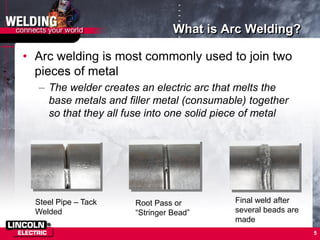
• Arc welding is most commonly used to join two
pieces of metal
– The welder creates an electric arc that melts the
base metals and filler metal (consumable) together
so that they all fuse into one solid piece of metal
Steel Pipe – Tack
Welded
Root Pass or
“Stringer Bead”
Final weld after
several beads are
made
6
Why is Welding Important?
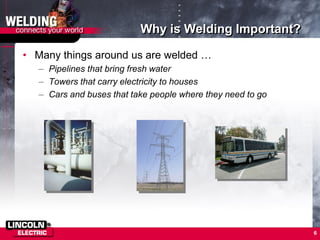
• Many things around us are welded …
– Pipelines that bring fresh water
– Towers that carry electricity to houses
– Cars and buses that take people where they need to go
7
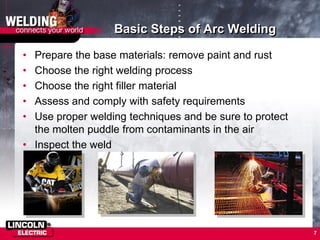
Basic Steps of Arc Welding
• Prepare the base materials: remove paint and rust
• Choose the right welding process
• Choose the right filler material
• Assess and comply with safety requirements
• Use proper welding techniques and be sure to protect
the molten puddle from contaminants in the air
• Inspect the weld
8
Welding Safety
9
• Welding can be safe when sufficient measures are
taken to protect yourself and others from potential
hazards
• Students should read and understand the following
before welding:
– Warning Labels
– Material Safety Data Sheets (MSDS)
Arc Welding Safety
10
Warning Labels
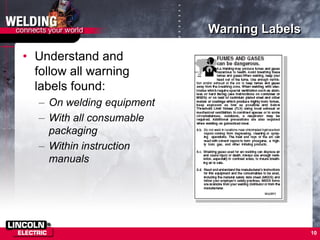
• Understand and
follow all warning
labels found:
– On welding equipment
– With all consumable
packaging
– Within instruction
manuals
11
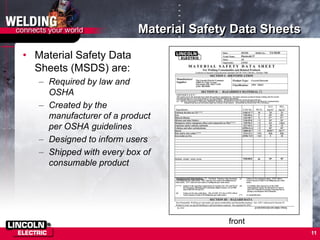
Material Safety Data Sheets
• Material Safety Data
Sheets (MSDS) are:
– Required by law and
OSHA
– Created by the
manufacturer of a product
per OSHA guidelines
– Designed to inform users
– Shipped with every box of
consumable product
front
12
MSDS - Continued
• MSDS outlines a
product’s:
 Identity and
composition
 Potential hazards
 Safe use
 Handling information
 Manufacturer
contact information
back
13
ANSI Z49.1
• ANSI Z49.1: Safety in Welding, Cutting, and Allied
Processes
– A safety document published by the American Welding Society that
covers safe practices in the welding environment
– To get your free copy, go to:
 www.aws.org/technical/facts/Z49.1-2005-all.pdf
• E205: Arc Welding Safety
– A safety document summarizing many of the hazards and safe
practices for welding
– Download and print your own copy at:
 http://content.lincolnelectric.com/pdfs/products/literature/e205.pdf
– Free copies available from Lincoln Electric at:
 www.lincolnelectric.com/products/litrequest
• Access the E-learning Site @ www.agedlearning.com
14
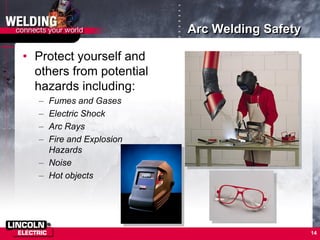
Arc Welding Safety
• Protect yourself and
others from potential
hazards including:
– Fumes and Gases
– Electric Shock
– Arc Rays
– Fire and Explosion
Hazards
– Noise
– Hot objects
15
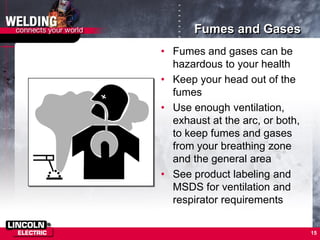
Fumes and Gases
• Fumes and gases can be
hazardous to your health
• Keep your head out of the
fumes
• Use enough ventilation,
exhaust at the arc, or both,
to keep fumes and gases
from your breathing zone
and the general area
• See product labeling and
MSDS for ventilation and
respirator requirements
16
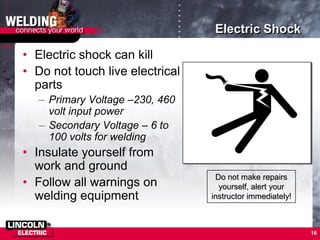
Electric Shock
• Electric shock can kill
• Do not touch live electrical
parts
– Primary Voltage –230, 460
volt input power
– Secondary Voltage – 6 to
100 volts for welding
• Insulate yourself from
work and ground
• Follow all warnings on
welding equipment
Do not make repairs
yourself, alert your
instructor immediately!
17
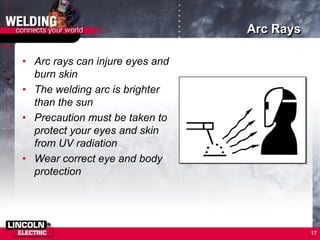
Arc Rays
• Arc rays can injure eyes and
burn skin
• The welding arc is brighter
than the sun
• Precaution must be taken to
protect your eyes and skin
from UV radiation
• Wear correct eye and body
protection
18
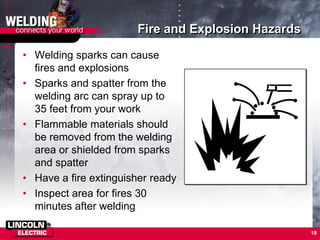
Fire and Explosion Hazards
• Welding sparks can cause
fires and explosions
• Sparks and spatter from the
welding arc can spray up to
35 feet from your work
• Flammable materials should
be removed from the welding
area or shielded from sparks
and spatter
• Have a fire extinguisher ready
• Inspect area for fires 30
minutes after welding
19
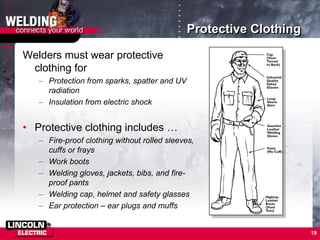
Protective Clothing
Welders must wear protective
clothing for
– Protection from sparks, spatter and UV
radiation
– Insulation from electric shock
• Protective clothing includes …
– Fire-proof clothing without rolled sleeves,
cuffs or frays
– Work boots
– Welding gloves, jackets, bibs, and fire-
proof pants
– Welding cap, helmet and safety glasses
– Ear protection – ear plugs and muffs
20
Basic Electricity and
Welding
21
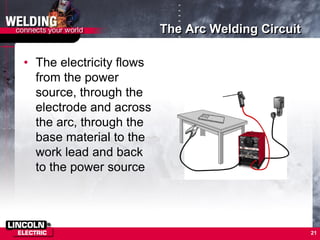
The Arc Welding Circuit
• The electricity flows
from the power
source, through the
electrode and across
the arc, through the
base material to the
work lead and back
to the power source
22
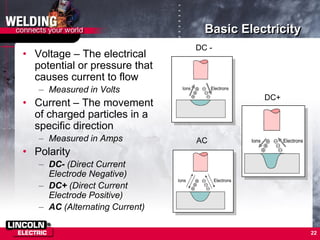
Basic Electricity
• Voltage – The electrical
potential or pressure that
causes current to flow
– Measured in Volts
• Current – The movement
of charged particles in a
specific direction
– Measured in Amps
• Polarity
– DC- (Direct Current
Electrode Negative)
– DC+ (Direct Current
Electrode Positive)
– AC (Alternating Current)
DC+
DC -
AC
23
Metals
24
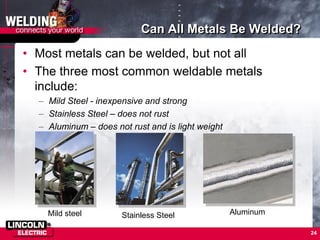
Can All Metals Be Welded?
• Most metals can be welded, but not all
• The three most common weldable metals
include:
– Mild Steel - inexpensive and strong
– Stainless Steel – does not rust
– Aluminum – does not rust and is light weight
Mild steel Stainless Steel Aluminum
25
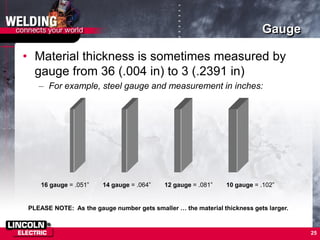
Gauge
• Material thickness is sometimes measured by
gauge from 36 (.004 in) to 3 (.2391 in)
– For example, steel gauge and measurement in inches:
PLEASE NOTE: As the gauge number gets smaller … the material thickness gets larger.
16 gauge = .051” 14 gauge = .064” 12 gauge = .081” 10 gauge = .102”
26
Types of Joints
27
Types of Joints
• There are 5 types of
joints …
28
Parts of a Weld
29
Parts of a Weld
Joint and Weld
Heat Affected Zone
30
Fillet and Groove Welds
• Groove and fillet welds can be made on many
types of joints
31
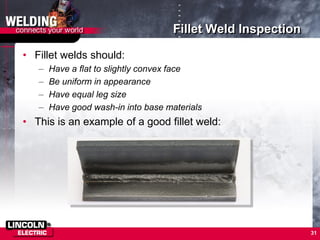
Fillet Weld Inspection
• Fillet welds should:
– Have a flat to slightly convex face
– Be uniform in appearance
– Have equal leg size
– Have good wash-in into base materials
• This is an example of a good fillet weld:
32
Welding Positions
33
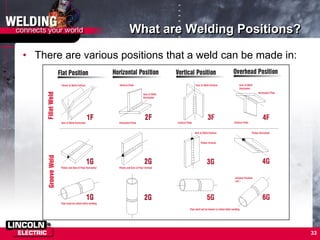
What are Welding Positions?
• There are various positions that a weld can be made in:
Classifications of Electrodes
34
Classifications of Electrodes
• Classified according to filler metal specifications
by AWS and ASTM (American Society for
Testing Materials)
– Lincoln, AIRCO, Hobart, etc. will all be the same
• Based upon four factors:
– Minimum tensile strength of the as-welded deposited
weld metal
– Type of covering
– Welding position
– Type of welding current (AC, DC+, DC-)
35
Classifications
• Electrode designated by “E” followed by a
4- or 5- digit number
• First two or three digits - minimum tensile
strength as-welded deposited weld metal
expressed in thousands of pounds per
square inch (1000psi)
–E-60xx - 60,000psi TS
–E-120xx - 120,000 psi TS
36
Classification
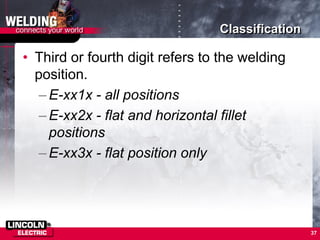
• Third or fourth digit refers to the welding
position.
–E-xx1x - all positions
–E-xx2x - flat and horizontal fillet
positions
–E-xx3x - flat position only
37
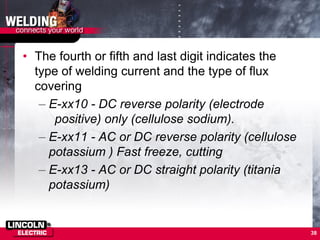
• The fourth or fifth and last digit indicates the
type of welding current and the type of flux
covering
– E-xx10 - DC reverse polarity (electrode
positive) only (cellulose sodium).
– E-xx11 - AC or DC reverse polarity (cellulose
potassium ) Fast freeze, cutting
– E-xx13 - AC or DC straight polarity (titania
potassium)
38
Selecting an Electrode
39
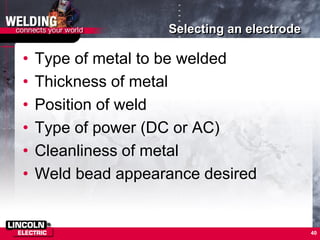
Selecting an electrode
• Type of metal to be welded
• Thickness of metal
• Position of weld
• Type of power (DC or AC)
• Cleanliness of metal
• Weld bead appearance desired
40
Selecting an electrode
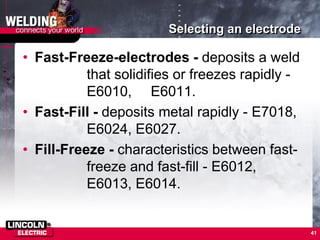
• Fast-Freeze-electrodes - deposits a weld
that solidifies or freezes rapidly -
E6010, E6011.
• Fast-Fill - deposits metal rapidly - E7018,
E6024, E6027.
• Fill-Freeze - characteristics between fast-
freeze and fast-fill - E6012,
E6013, E6014.
41

Arc Welding Basics

  • 1.
  • 2.
    2 Unit Topics • Topicsincluded in this overview are: – Introduction  What is Arc Welding?  Why is Welding Important?  Why Learn to Weld? – Careers in Welding – The American Welding Society (AWS) – Welding Safety – Basic Electricity – Welding Fundamentals – Welding Certification
  • 3.
    3 Objectives • Upon successfulcompletion of this unit of study, you will be able to … – Identify definitions and terminology associated with welding – Demonstrate safe working habits in the welding environment – Name the parts and types of welds and weld joints – Interpret basic welding symbol information – Identify opportunities available to welders
  • 4.
  • 5.
    5 What is ArcWelding? • Arc welding is most commonly used to join two pieces of metal – The welder creates an electric arc that melts the base metals and filler metal (consumable) together so that they all fuse into one solid piece of metal Steel Pipe – Tack Welded Root Pass or “Stringer Bead” Final weld after several beads are made
  • 6.
    6 Why is WeldingImportant? • Many things around us are welded … – Pipelines that bring fresh water – Towers that carry electricity to houses – Cars and buses that take people where they need to go
  • 7.
    7 Basic Steps ofArc Welding • Prepare the base materials: remove paint and rust • Choose the right welding process • Choose the right filler material • Assess and comply with safety requirements • Use proper welding techniques and be sure to protect the molten puddle from contaminants in the air • Inspect the weld
  • 8.
  • 9.
    9 • Welding canbe safe when sufficient measures are taken to protect yourself and others from potential hazards • Students should read and understand the following before welding: – Warning Labels – Material Safety Data Sheets (MSDS) Arc Welding Safety
  • 10.
    10 Warning Labels • Understandand follow all warning labels found: – On welding equipment – With all consumable packaging – Within instruction manuals
  • 11.
    11 Material Safety DataSheets • Material Safety Data Sheets (MSDS) are: – Required by law and OSHA – Created by the manufacturer of a product per OSHA guidelines – Designed to inform users – Shipped with every box of consumable product front
  • 12.
    12 MSDS - Continued •MSDS outlines a product’s:  Identity and composition  Potential hazards  Safe use  Handling information  Manufacturer contact information back
  • 13.
    13 ANSI Z49.1 • ANSIZ49.1: Safety in Welding, Cutting, and Allied Processes – A safety document published by the American Welding Society that covers safe practices in the welding environment – To get your free copy, go to:  www.aws.org/technical/facts/Z49.1-2005-all.pdf • E205: Arc Welding Safety – A safety document summarizing many of the hazards and safe practices for welding – Download and print your own copy at:  http://content.lincolnelectric.com/pdfs/products/literature/e205.pdf – Free copies available from Lincoln Electric at:  www.lincolnelectric.com/products/litrequest • Access the E-learning Site @ www.agedlearning.com
  • 14.
    14 Arc Welding Safety •Protect yourself and others from potential hazards including: – Fumes and Gases – Electric Shock – Arc Rays – Fire and Explosion Hazards – Noise – Hot objects
  • 15.
    15 Fumes and Gases •Fumes and gases can be hazardous to your health • Keep your head out of the fumes • Use enough ventilation, exhaust at the arc, or both, to keep fumes and gases from your breathing zone and the general area • See product labeling and MSDS for ventilation and respirator requirements
  • 16.
    16 Electric Shock • Electricshock can kill • Do not touch live electrical parts – Primary Voltage –230, 460 volt input power – Secondary Voltage – 6 to 100 volts for welding • Insulate yourself from work and ground • Follow all warnings on welding equipment Do not make repairs yourself, alert your instructor immediately!
  • 17.
    17 Arc Rays • Arcrays can injure eyes and burn skin • The welding arc is brighter than the sun • Precaution must be taken to protect your eyes and skin from UV radiation • Wear correct eye and body protection
  • 18.
    18 Fire and ExplosionHazards • Welding sparks can cause fires and explosions • Sparks and spatter from the welding arc can spray up to 35 feet from your work • Flammable materials should be removed from the welding area or shielded from sparks and spatter • Have a fire extinguisher ready • Inspect area for fires 30 minutes after welding
  • 19.
    19 Protective Clothing Welders mustwear protective clothing for – Protection from sparks, spatter and UV radiation – Insulation from electric shock • Protective clothing includes … – Fire-proof clothing without rolled sleeves, cuffs or frays – Work boots – Welding gloves, jackets, bibs, and fire- proof pants – Welding cap, helmet and safety glasses – Ear protection – ear plugs and muffs
  • 20.
  • 21.
    21 The Arc WeldingCircuit • The electricity flows from the power source, through the electrode and across the arc, through the base material to the work lead and back to the power source
  • 22.
    22 Basic Electricity • Voltage– The electrical potential or pressure that causes current to flow – Measured in Volts • Current – The movement of charged particles in a specific direction – Measured in Amps • Polarity – DC- (Direct Current Electrode Negative) – DC+ (Direct Current Electrode Positive) – AC (Alternating Current) DC+ DC - AC
  • 23.
  • 24.
    24 Can All MetalsBe Welded? • Most metals can be welded, but not all • The three most common weldable metals include: – Mild Steel - inexpensive and strong – Stainless Steel – does not rust – Aluminum – does not rust and is light weight Mild steel Stainless Steel Aluminum
  • 25.
    25 Gauge • Material thicknessis sometimes measured by gauge from 36 (.004 in) to 3 (.2391 in) – For example, steel gauge and measurement in inches: PLEASE NOTE: As the gauge number gets smaller … the material thickness gets larger. 16 gauge = .051” 14 gauge = .064” 12 gauge = .081” 10 gauge = .102”
  • 26.
  • 27.
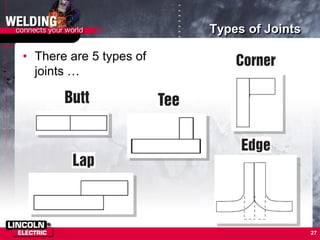
    27 Types of Joints •There are 5 types of joints …
  • 28.
  • 29.
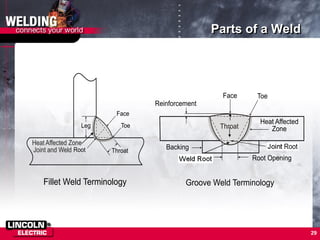
    29 Parts of aWeld Joint and Weld Heat Affected Zone
  • 30.
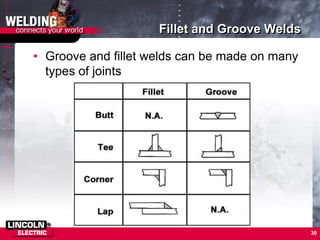
    30 Fillet and GrooveWelds • Groove and fillet welds can be made on many types of joints
  • 31.
    31 Fillet Weld Inspection •Fillet welds should: – Have a flat to slightly convex face – Be uniform in appearance – Have equal leg size – Have good wash-in into base materials • This is an example of a good fillet weld:
  • 32.
  • 33.
    33 What are WeldingPositions? • There are various positions that a weld can be made in:
  • 34.
  • 35.
    Classifications of Electrodes •Classified according to filler metal specifications by AWS and ASTM (American Society for Testing Materials) – Lincoln, AIRCO, Hobart, etc. will all be the same • Based upon four factors: – Minimum tensile strength of the as-welded deposited weld metal – Type of covering – Welding position – Type of welding current (AC, DC+, DC-) 35
  • 36.
    Classifications • Electrode designatedby “E” followed by a 4- or 5- digit number • First two or three digits - minimum tensile strength as-welded deposited weld metal expressed in thousands of pounds per square inch (1000psi) –E-60xx - 60,000psi TS –E-120xx - 120,000 psi TS 36
  • 37.
    Classification • Third orfourth digit refers to the welding position. –E-xx1x - all positions –E-xx2x - flat and horizontal fillet positions –E-xx3x - flat position only 37
  • 38.
    • The fourthor fifth and last digit indicates the type of welding current and the type of flux covering – E-xx10 - DC reverse polarity (electrode positive) only (cellulose sodium). – E-xx11 - AC or DC reverse polarity (cellulose potassium ) Fast freeze, cutting – E-xx13 - AC or DC straight polarity (titania potassium) 38
  • 39.
  • 40.
    Selecting an electrode •Type of metal to be welded • Thickness of metal • Position of weld • Type of power (DC or AC) • Cleanliness of metal • Weld bead appearance desired 40
  • 41.
    Selecting an electrode •Fast-Freeze-electrodes - deposits a weld that solidifies or freezes rapidly - E6010, E6011. • Fast-Fill - deposits metal rapidly - E7018, E6024, E6027. • Fill-Freeze - characteristics between fast- freeze and fast-fill - E6012, E6013, E6014. 41