IPV6-THE NEXT GENERATION
                PROTOCOL

Session Number
Presentation_ID   © 2002, Cisco Systems, Inc. All rights reserved.   1
Introduction


        • What is IP?
                        The Internet Protocol (IP) is the method or protocol
                        by which data is sent from one computer to
                        another on the Internet.
        • History
                        In 1978, the Office of the Secretary of Defense
                        (OSD) mandated the use of IPv4 for all “host-to-
                        host” data exchange enabling IPv4 to become the
                        mechanism for the military to create integrated
                        versus stovepiped communications.

© 2002, Cisco Systems, Inc. All rights reserved.                               2
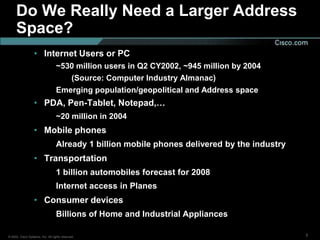
Do We Really Need a Larger Address
     Space?
                  • Internet Users or PC
                                  ~530 million users in Q2 CY2002, ~945 million by 2004
                                     (Source: Computer Industry Almanac)
                                  Emerging population/geopolitical and Address space
                  • PDA, Pen-Tablet, Notepad,…
                                  ~20 million in 2004
                  • Mobile phones
                                  Already 1 billion mobile phones delivered by the industry
                  • Transportation
                                  1 billion automobiles forecast for 2008
                                  Internet access in Planes
                  • Consumer devices
                                  Billions of Home and Industrial Appliances

© 2002, Cisco Systems, Inc. All rights reserved.                                              3
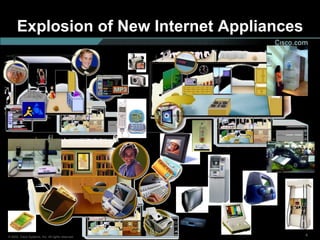
Explosion of New Internet Appliances


© 2002, Cisco Systems, Inc. All rights reserved.   4
Techniques to reduce address shortage
       in IPv4


            • Subnetting
            • Network Address Translation (NAT)
            • Classless Inter Domain Routing (CIDR)


© 2002, Cisco Systems, Inc. All rights reserved.      5
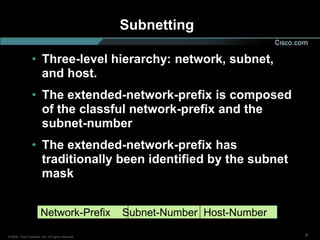
Subnetting

                 • Three-level hierarchy: network, subnet,
                   and host.
                 • The extended-network-prefix is composed
                   of the classful network-prefix and the
                   subnet-number
                 • The extended-network-prefix has
                   traditionally been identified by the subnet
                   mask


                       Network-Prefix              Subnet-Number Host-Number

© 2002, Cisco Systems, Inc. All rights reserved.                               6
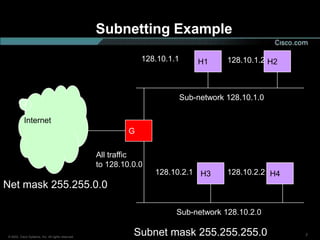
Subnetting Example
                                                                128.10.1.1       H1      128.10.1.2 H2


                                                                             Sub-network 128.10.1.0

           Internet
                                                            G

                                                   All traffic
                                                   to 128.10.0.0
                                                                   128.10.2.1 H3         128.10.2.2 H4
Net mask 255.255.0.0

                                                                         Sub-network 128.10.2.0

© 2002, Cisco Systems, Inc. All rights reserved.
                                                             Subnet mask 255.255.255.0                   7
Network Address Translation


                • Each organization-
                  single IP address                 3 Reserved ranges
                                                    10.0.0.0 – 10.255.255.255 (16,777,216 hosts)
                • Within organization
                  – each host with IP               172.16.0.0 – 172.31.255.255/12 (1,048,576
                                                    hosts)
                  unique to the orgn.,
                                                    192.168.0.0 – 192.168.255.255/16 (65,536
                  from reserved set of              hosts)
                  IP addresses


© 2002, Cisco Systems, Inc. All rights reserved.                                                   8
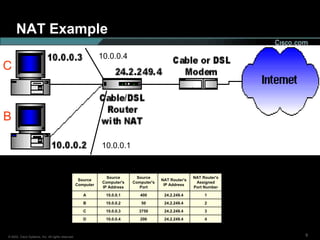
NAT Example
                                                              10.0.0.4
C


B

                                                              10.0.0.1


                                                                 Source       Source                    NAT Router's
                                                    Source                               NAT Router's
                                                               Computer's   Computer's                   Assigned
                                                   Computer                               IP Address
                                                               IP Address      Port                     Port Number

                                                      A         10.0.0.1       400        24.2.249.4         1

                                                      B         10.0.0.2       50         24.2.249.4         2

                                                      C         10.0.0.3      3750        24.2.249.4         3

                                                      D         10.0.0.4       206        24.2.249.4         4


© 2002, Cisco Systems, Inc. All rights reserved.                                                                       9
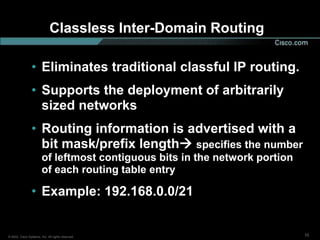
Classless Inter-Domain Routing

                 • Eliminates traditional classful IP routing.
                 • Supports the deployment of arbitrarily
                   sized networks
                 • Routing information is advertised with a
                   bit mask/prefix length specifies the number
                        of leftmost contiguous bits in the network portion
                        of each routing table entry

                 • Example: 192.168.0.0/21


© 2002, Cisco Systems, Inc. All rights reserved.                             10
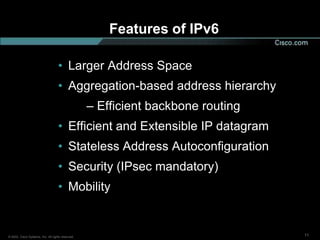
Features of IPv6

                                    • Larger Address Space
                                    • Aggregation-based address hierarchy
                                                   – Efficient backbone routing
                                    • Efficient and Extensible IP datagram
                                    • Stateless Address Autoconfiguration
                                    • Security (IPsec mandatory)
                                    • Mobility


© 2002, Cisco Systems, Inc. All rights reserved.                                  11
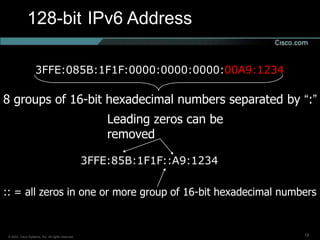
128-bit IPv6 Address

                    3FFE:085B:1F1F:0000:0000:0000:00A9:1234

8 groups of 16-bit hexadecimal numbers separated by “:”
                                                        Leading zeros can be
                                                        removed

                                                    3FFE:85B:1F1F::A9:1234

:: = all zeros in one or more group of 16-bit hexadecimal numbers


 © 2002, Cisco Systems, Inc. All rights reserved.                              12
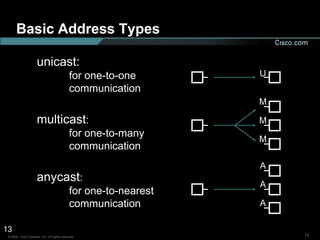
Basic Address Types

                     unicast:
                                             for one-to-one       U
                                             communication
                                                                  M

                     multicast:                                   M
                                             for one-to-many
                                                                  M
                                             communication
                                                                  A
                     anycast:
                                                                  A
                                             for one-to-nearest
                                             communication        A

13
 © 2002, Cisco Systems, Inc. All rights reserved.                     13
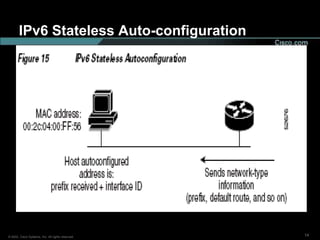
IPv6 Stateless Auto-configuration


© 2002, Cisco Systems, Inc. All rights reserved.   14
Major Improvements of
                                                        IPv6 Header
                  • No option field: Replaced by extension
                    header. Result in a fixed length, 40-byte
                    IP header.
                  • No header checksum: Result in fast
                    processing.
                  • No fragmentation at intermediate nodes:
                    Result in fast IP forwarding.


© 2002, Cisco Systems, Inc. All rights reserved.                           15
IPv6: Security Issues

                                    • Provision for
                                                    Authentication header
                                                       Guarantees authenticity and integrity of data
                                                    Encryption header
                                                       Ensures confidentiality and privacy

                                    • Encryption modes:
                                                    Transport mode
                                                    Tunnel mode

                                    • Independent of key management
                                      algorithm.
                                    • Security implementation is mandatory
                                      requirement in IPv6.
IIT 2005
AprKanpur                                                                                              16
 © 2002, Cisco Systems, Inc. All rights reserved.                                                           16
Mobility Support in IPv6

                • Mobile computers are becoming commonplace.
                • Mobile IPv6 allows a node to move from one link to
                  another without changing the address.
                • Movement can be heterogeneous, i.e., node can move
                  from an Ethernet link to a cellular packet network.
                • Mobility support in IPv6 is more efficient than
                  mobility support in IPv4.
                • There are also proposals for supporting micro-
                  mobility.


IIT 2005
AprKanpur                                                   17
 © 2002, Cisco Systems, Inc. All rights reserved.                       17
Much Still To Do


               though IPv6 today has all the functional capability of IPv4,
               • implementations are not as advanced
                      (e.g., with respect to performance, multicast support, compactness,
                      instrumentation, etc.)
               • deployment has only just begun
               • much work to be done moving application, middleware, and
                 management software to IPv6
               • much training work to be done
                      (application developers, network administrators, sales staff,…)
               • many of the advanced features of IPv6 still need specification,
                 implementation, and deployment work


18
 © 2002, Cisco Systems, Inc. All rights reserved.                                           18
Conclusion
                                      IPv6 is NEW …
                          – built on the experiences learned from IPv4
                          – new features
                          – large address space
                          – new efficient header
                          – autoconfiguration
                                      … and OLD
                          – still IP
                          – build on a solid base
                          – started in 1995, a lot of implementations and
                          tests done
© 2002, Cisco Systems, Inc. All rights reserved.                            19
Session Number
Presentation_ID   © 2002, Cisco Systems, Inc. All rights reserved.   20

Ipv6 the next generation protocol

  • 1.
    IPV6-THE NEXT GENERATION PROTOCOL Session Number Presentation_ID © 2002, Cisco Systems, Inc. All rights reserved. 1
  • 2.
    Introduction • What is IP? The Internet Protocol (IP) is the method or protocol by which data is sent from one computer to another on the Internet. • History In 1978, the Office of the Secretary of Defense (OSD) mandated the use of IPv4 for all “host-to- host” data exchange enabling IPv4 to become the mechanism for the military to create integrated versus stovepiped communications. © 2002, Cisco Systems, Inc. All rights reserved. 2
  • 3.
    Do We ReallyNeed a Larger Address Space? • Internet Users or PC ~530 million users in Q2 CY2002, ~945 million by 2004 (Source: Computer Industry Almanac) Emerging population/geopolitical and Address space • PDA, Pen-Tablet, Notepad,… ~20 million in 2004 • Mobile phones Already 1 billion mobile phones delivered by the industry • Transportation 1 billion automobiles forecast for 2008 Internet access in Planes • Consumer devices Billions of Home and Industrial Appliances © 2002, Cisco Systems, Inc. All rights reserved. 3
  • 4.
    Explosion of NewInternet Appliances © 2002, Cisco Systems, Inc. All rights reserved. 4
  • 5.
    Techniques to reduceaddress shortage in IPv4 • Subnetting • Network Address Translation (NAT) • Classless Inter Domain Routing (CIDR) © 2002, Cisco Systems, Inc. All rights reserved. 5
  • 6.
    Subnetting • Three-level hierarchy: network, subnet, and host. • The extended-network-prefix is composed of the classful network-prefix and the subnet-number • The extended-network-prefix has traditionally been identified by the subnet mask Network-Prefix Subnet-Number Host-Number © 2002, Cisco Systems, Inc. All rights reserved. 6
  • 7.
    Subnetting Example 128.10.1.1 H1 128.10.1.2 H2 Sub-network 128.10.1.0 Internet G All traffic to 128.10.0.0 128.10.2.1 H3 128.10.2.2 H4 Net mask 255.255.0.0 Sub-network 128.10.2.0 © 2002, Cisco Systems, Inc. All rights reserved. Subnet mask 255.255.255.0 7
  • 8.
    Network Address Translation • Each organization- single IP address 3 Reserved ranges 10.0.0.0 – 10.255.255.255 (16,777,216 hosts) • Within organization – each host with IP 172.16.0.0 – 172.31.255.255/12 (1,048,576 hosts) unique to the orgn., 192.168.0.0 – 192.168.255.255/16 (65,536 from reserved set of hosts) IP addresses © 2002, Cisco Systems, Inc. All rights reserved. 8
  • 9.
    NAT Example 10.0.0.4 C B 10.0.0.1 Source Source NAT Router's Source NAT Router's Computer's Computer's Assigned Computer IP Address IP Address Port Port Number A 10.0.0.1 400 24.2.249.4 1 B 10.0.0.2 50 24.2.249.4 2 C 10.0.0.3 3750 24.2.249.4 3 D 10.0.0.4 206 24.2.249.4 4 © 2002, Cisco Systems, Inc. All rights reserved. 9
  • 10.
    Classless Inter-Domain Routing • Eliminates traditional classful IP routing. • Supports the deployment of arbitrarily sized networks • Routing information is advertised with a bit mask/prefix length specifies the number of leftmost contiguous bits in the network portion of each routing table entry • Example: 192.168.0.0/21 © 2002, Cisco Systems, Inc. All rights reserved. 10
  • 11.
    Features of IPv6 • Larger Address Space • Aggregation-based address hierarchy – Efficient backbone routing • Efficient and Extensible IP datagram • Stateless Address Autoconfiguration • Security (IPsec mandatory) • Mobility © 2002, Cisco Systems, Inc. All rights reserved. 11
  • 12.
    128-bit IPv6 Address 3FFE:085B:1F1F:0000:0000:0000:00A9:1234 8 groups of 16-bit hexadecimal numbers separated by “:” Leading zeros can be removed 3FFE:85B:1F1F::A9:1234 :: = all zeros in one or more group of 16-bit hexadecimal numbers © 2002, Cisco Systems, Inc. All rights reserved. 12
  • 13.
    Basic Address Types unicast: for one-to-one U communication M multicast: M for one-to-many M communication A anycast: A for one-to-nearest communication A 13 © 2002, Cisco Systems, Inc. All rights reserved. 13
  • 14.
    IPv6 Stateless Auto-configuration ©2002, Cisco Systems, Inc. All rights reserved. 14
  • 15.
    Major Improvements of IPv6 Header • No option field: Replaced by extension header. Result in a fixed length, 40-byte IP header. • No header checksum: Result in fast processing. • No fragmentation at intermediate nodes: Result in fast IP forwarding. © 2002, Cisco Systems, Inc. All rights reserved. 15
  • 16.
    IPv6: Security Issues • Provision for Authentication header Guarantees authenticity and integrity of data Encryption header Ensures confidentiality and privacy • Encryption modes: Transport mode Tunnel mode • Independent of key management algorithm. • Security implementation is mandatory requirement in IPv6. IIT 2005 AprKanpur 16 © 2002, Cisco Systems, Inc. All rights reserved. 16
  • 17.
    Mobility Support inIPv6 • Mobile computers are becoming commonplace. • Mobile IPv6 allows a node to move from one link to another without changing the address. • Movement can be heterogeneous, i.e., node can move from an Ethernet link to a cellular packet network. • Mobility support in IPv6 is more efficient than mobility support in IPv4. • There are also proposals for supporting micro- mobility. IIT 2005 AprKanpur 17 © 2002, Cisco Systems, Inc. All rights reserved. 17
  • 18.
    Much Still ToDo though IPv6 today has all the functional capability of IPv4, • implementations are not as advanced (e.g., with respect to performance, multicast support, compactness, instrumentation, etc.) • deployment has only just begun • much work to be done moving application, middleware, and management software to IPv6 • much training work to be done (application developers, network administrators, sales staff,…) • many of the advanced features of IPv6 still need specification, implementation, and deployment work 18 © 2002, Cisco Systems, Inc. All rights reserved. 18
  • 19.
    Conclusion  IPv6 is NEW … – built on the experiences learned from IPv4 – new features – large address space – new efficient header – autoconfiguration  … and OLD – still IP – build on a solid base – started in 1995, a lot of implementations and tests done © 2002, Cisco Systems, Inc. All rights reserved. 19
  • 20.
    Session Number Presentation_ID © 2002, Cisco Systems, Inc. All rights reserved. 20