Data Communication and Networking
            (DCN)

   Practical External:-Presentation
       “Transmission Modes”


          Submitted To:-
     “Ms. Mansi Dangarwala”


          Submitted By:-
     Manaswi Sharma      (185)
Data transmission is the physical transfer of
data (a digital bit stream) over a point-to-point or
point-to-multipoint communication channel.
Communication channel is any physical media
like cables etc.
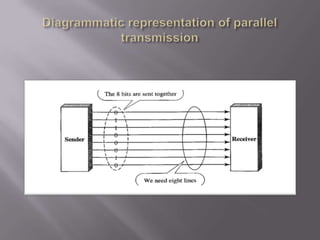
   Transmitted simultaneously on separate wires.

   Multiple circuits for connection.

   Devices close to each other.

   E.g. Data transmission between computer and
    printer.
Advantages of parallel transmission:


    1. Time required is only one clock cycle.
    2. Clock frequency can be kept low.


Disadvantages of parallel transmission:


    1. Number of wires.
    2. Too many wires.
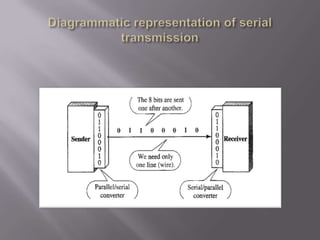
   Transmitted serially on same wire.

   Requires 1 wire to connect.

   Close or far doesn‟t create any problem.

   E.g. Data transmission between computer and
    computer.
Advantages of serial transmission:


    1. Only one wire is required.
    2. Reduced cost due to less number of conductors.


Disadvantages of serial transmission:


     1. Speed of data transfer is low.
     2. To increase speed of data transfer, clock frequency needs to
        be increased.
   In data communication, Timing control of the
    reception of bits is important. There are two
    methods of timing control for reception of bits.
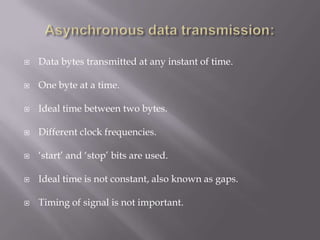
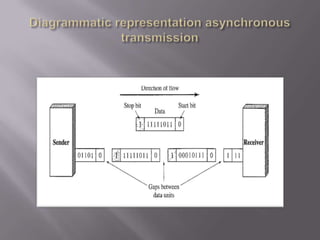
   Data bytes transmitted at any instant of time.

   One byte at a time.

   Ideal time between two bytes.

   Different clock frequencies.

   „start‟ and „stop‟ bits are used.

   Ideal time is not constant, also known as gaps.

   Timing of signal is not important.
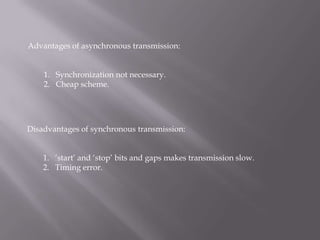
Advantages of asynchronous transmission:


    1. Synchronization not necessary.
    2. Cheap scheme.


Disadvantages of synchronous transmission:


    1. „start‟ and „stop‟ bits and gaps makes transmission slow.
    2. Timing error.
   Carried out under common master clock.

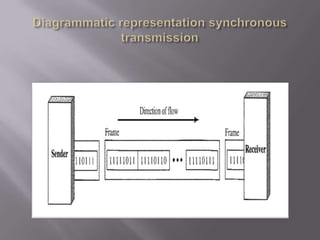
   Transmitted as a block of bits.

   Operate at same clock frequencies.

   No „start‟ and „stop‟ bits required.

   No gaps between data bytes.

   Timing of signal is important.
Advantages of asynchronous transmission:


    1. Speed of data is much.
    2. Timing errors are reduced.


Disadvantages of synchronous transmission:


    1. Data entirely dependent on timing.
    2. Devices should be properly synchronized.

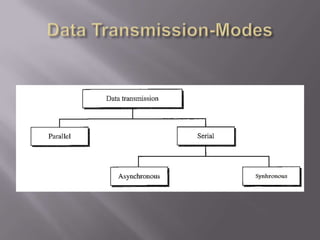
Transmission modes

  • 1.
    Data Communication andNetworking (DCN) Practical External:-Presentation “Transmission Modes” Submitted To:- “Ms. Mansi Dangarwala” Submitted By:- Manaswi Sharma (185)
  • 2.
    Data transmission isthe physical transfer of data (a digital bit stream) over a point-to-point or point-to-multipoint communication channel. Communication channel is any physical media like cables etc.
  • 4.
    Transmitted simultaneously on separate wires.  Multiple circuits for connection.  Devices close to each other.  E.g. Data transmission between computer and printer.
  • 6.
    Advantages of paralleltransmission: 1. Time required is only one clock cycle. 2. Clock frequency can be kept low. Disadvantages of parallel transmission: 1. Number of wires. 2. Too many wires.
  • 7.
    Transmitted serially on same wire.  Requires 1 wire to connect.  Close or far doesn‟t create any problem.  E.g. Data transmission between computer and computer.
  • 9.
    Advantages of serialtransmission: 1. Only one wire is required. 2. Reduced cost due to less number of conductors. Disadvantages of serial transmission: 1. Speed of data transfer is low. 2. To increase speed of data transfer, clock frequency needs to be increased.
  • 10.
    In data communication, Timing control of the reception of bits is important. There are two methods of timing control for reception of bits.
  • 11.
    Data bytes transmitted at any instant of time.  One byte at a time.  Ideal time between two bytes.  Different clock frequencies.  „start‟ and „stop‟ bits are used.  Ideal time is not constant, also known as gaps.  Timing of signal is not important.
  • 13.
    Advantages of asynchronoustransmission: 1. Synchronization not necessary. 2. Cheap scheme. Disadvantages of synchronous transmission: 1. „start‟ and „stop‟ bits and gaps makes transmission slow. 2. Timing error.
  • 14.
    Carried out under common master clock.  Transmitted as a block of bits.  Operate at same clock frequencies.  No „start‟ and „stop‟ bits required.  No gaps between data bytes.  Timing of signal is important.
  • 16.
    Advantages of asynchronoustransmission: 1. Speed of data is much. 2. Timing errors are reduced. Disadvantages of synchronous transmission: 1. Data entirely dependent on timing. 2. Devices should be properly synchronized.