TO BE PRESENTEd
BY
ZAHARAddEEN KARAMI LAWAL
Department of Computer Science and Engineering,
Faculty of Engineering and
Technology,
Jodhpur National University, Jodhpur
1
 Introduction
 Initialization
 Sharing of tables
 Updating of tables
 Advantages of DVR
 Disadvantages of DVR
 Conclusion
 References
2
Distance Vector Routing(DVR)
• In distance vector routing, the least-cost route between any
two nodes is the route with minimum distance.
• In this protocol, as the name implies, each node maintains
a vector (table) of minimum distances to every node.
• The table at each node also guides the packets to the
desired node by showing the next stop in the route (next-
hop routing).
• Each node knows how to reach any other node and the
cost. At the beginning, however, this is not the case the
distance between itself and its immediate neighbors, those
directly connected to it.
3
4
 So for the moment, we assume that each node
can send a message to the immediate neighbors
and find the distance between itself and these
neighbors. The diagram shows the initial tables for
each node. The distance for any entry that is not a
neighbor is marked as infinite (unreachable).se.
Each node can know only
5
6
• The whole idea of distance vector routing is the
sharing of information between neighbors.
• Although node A does not know about node E, node C
does. So if node C shares its routing table with A,
node A can also know how to reach node E. On the
other hand, node C does not know how to reach node
D, but node A does.
• If node A shares its routing table with node C, node C
also knows how to reach node D. In other words,
nodes
• A and C, as immediate neighbors, can improve their
routing tables if they help each other.
7
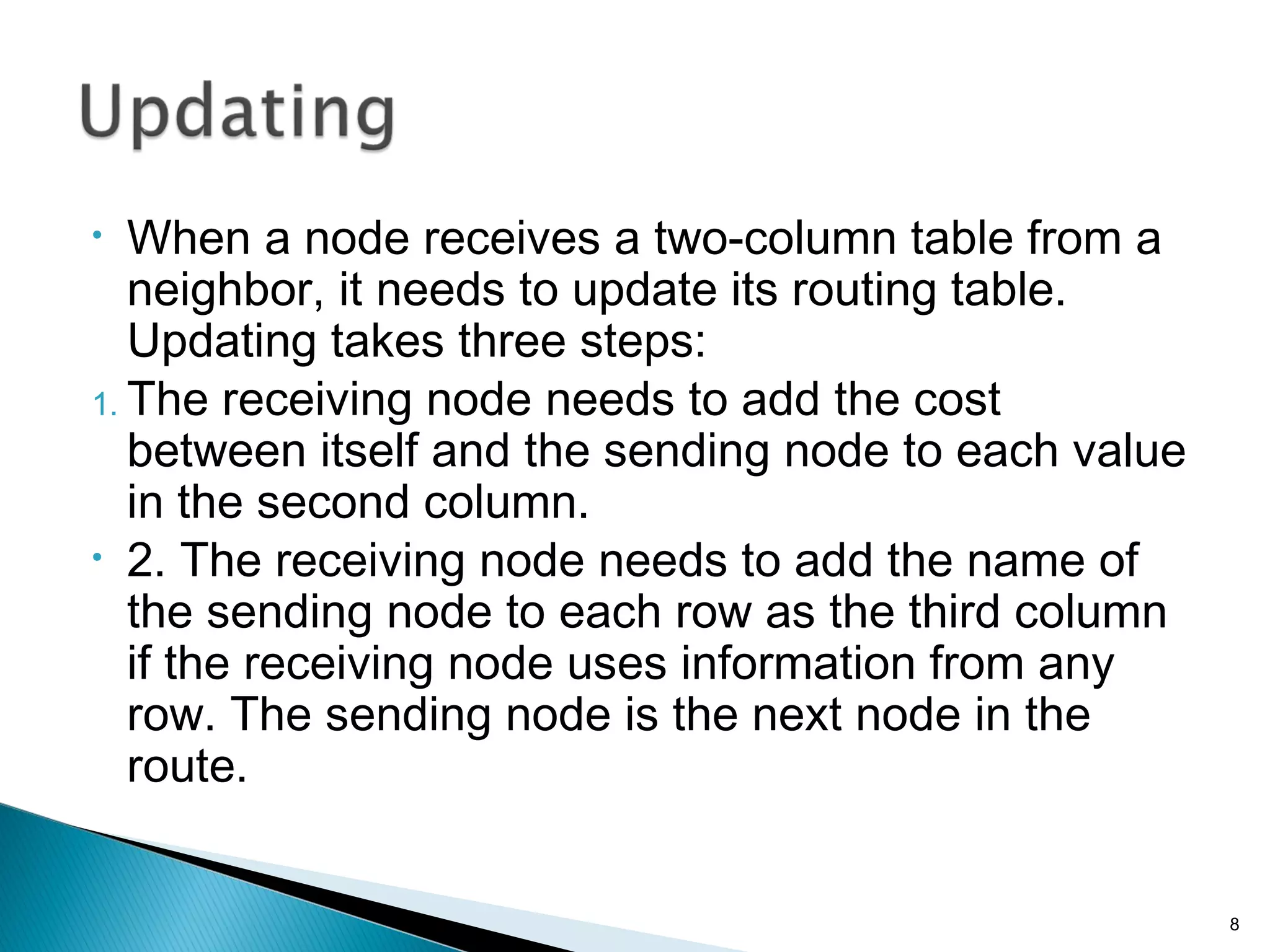
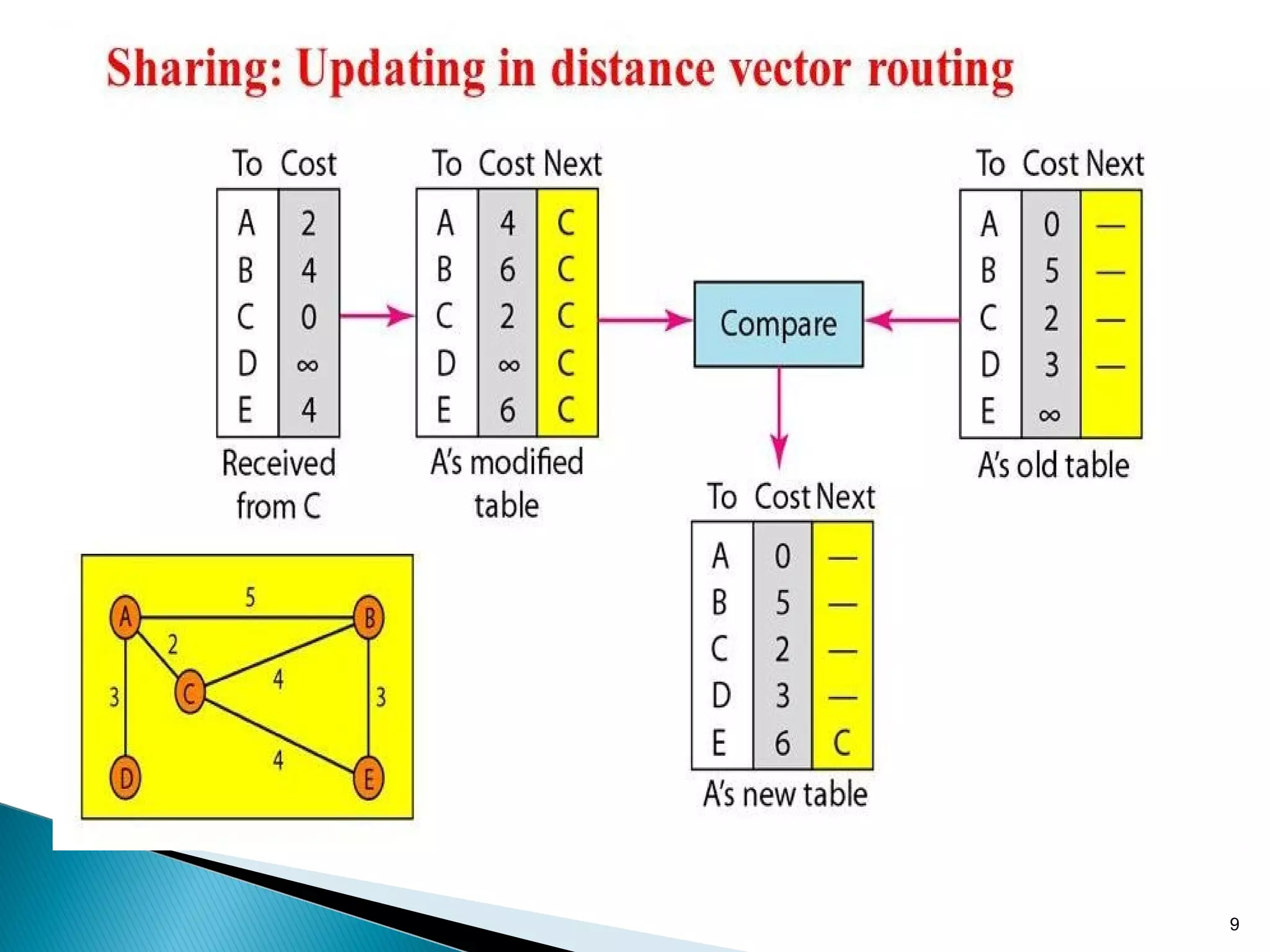
• When a node receives a two-column table from a
neighbor, it needs to update its routing table.
Updating takes three steps:
1. The receiving node needs to add the cost
between itself and the sending node to each value
in the second column.
• 2. The receiving node needs to add the name of
the sending node to each row as the third column
if the receiving node uses information from any
row. The sending node is the next node in the
route.
8
9
 3. The receiving node needs to compare each row of its
old table with the corresponding row of the modified
version of the received table.
There are two types of update these are:
1. Periodic Update
 A node sends its routing table, normally every 30 s, in a
periodic update.
2. Triggered Update
 A node sends its two-column routing table to its
neighbors anytime there is a change in its routing table.
10
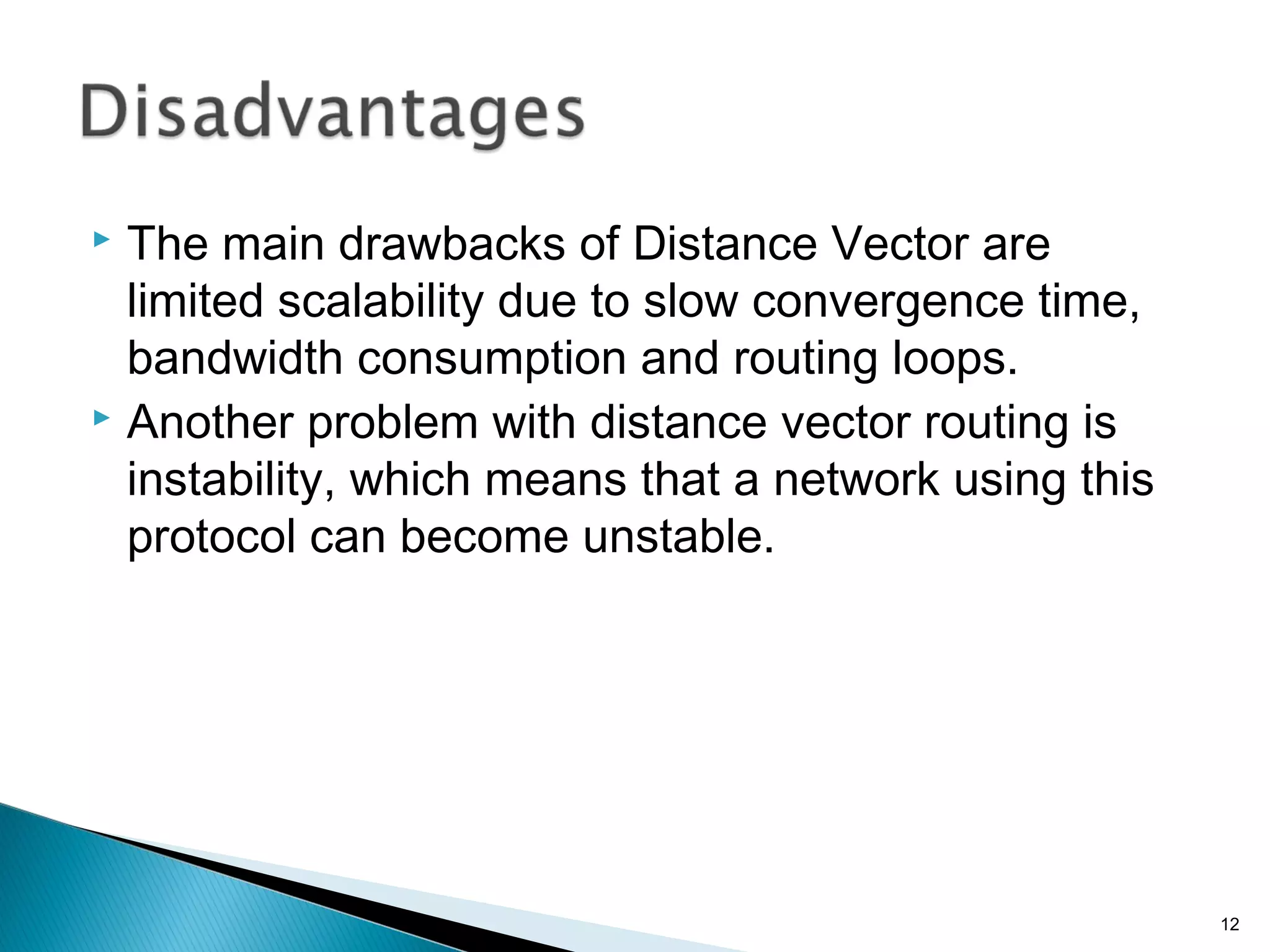
 Distance Vector is a relatively simple
approach and easy to use, implement and
maintain and does not require High-level
knowledge to deploy.
 It does not demand high bandwidth level to
send their periodic updates as the size of the
packets are relatively small. 
 distance vector protocols do not require a
large amount of CPU resources or memory to
store the routing data.
11
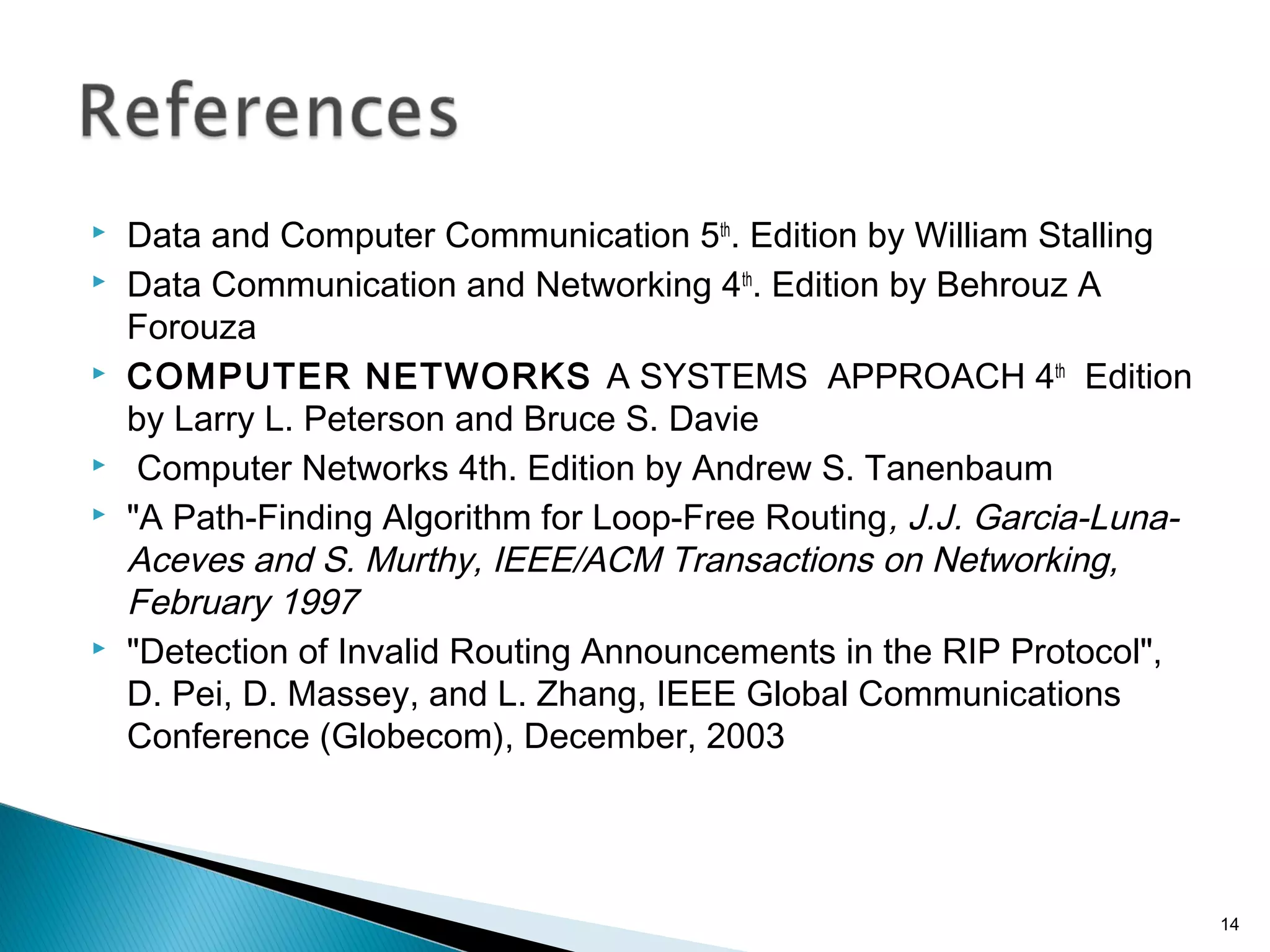
 The main drawbacks of Distance Vector are
limited scalability due to slow convergence time,
bandwidth consumption and routing loops.
 Another problem with distance vector routing is
instability, which means that a network using this
protocol can become unstable.
12
 In distance vector routing, each node shares
its routing table with its immediate neighbors
periodically and when there is a change.
 Distance vector routing as an earlier routing
protocol was also discussed.
 Sharing and update of routing tables between
neighboring nodes was also discussed.
13
 Data and Computer Communication 5th
. Edition by William Stalling
 Data Communication and Networking 4th
. Edition by Behrouz A
Forouza
 COMPUTER NETWORKS A SYSTEMS APPROACH 4th
Edition
by Larry L. Peterson and Bruce S. Davie
  Computer Networks 4th. Edition by Andrew S. Tanenbaum
 "A Path-Finding Algorithm for Loop-Free Routing, J.J. Garcia-Luna-
Aceves and S. Murthy, IEEE/ACM Transactions on Networking,
February 1997
 "Detection of Invalid Routing Announcements in the RIP Protocol",
D. Pei, D. Massey, and L. Zhang, IEEE Global Communications
Conference (Globecom), December, 2003
14

Zaharaddeen karami lawal distance vector routing

  • 1.
    TO BE PRESENTEd BY ZAHARAddEENKARAMI LAWAL Department of Computer Science and Engineering, Faculty of Engineering and Technology, Jodhpur National University, Jodhpur 1
  • 2.
     Introduction  Initialization Sharing of tables  Updating of tables  Advantages of DVR  Disadvantages of DVR  Conclusion  References 2
  • 3.
    Distance Vector Routing(DVR) •In distance vector routing, the least-cost route between any two nodes is the route with minimum distance. • In this protocol, as the name implies, each node maintains a vector (table) of minimum distances to every node. • The table at each node also guides the packets to the desired node by showing the next stop in the route (next- hop routing). • Each node knows how to reach any other node and the cost. At the beginning, however, this is not the case the distance between itself and its immediate neighbors, those directly connected to it. 3
  • 4.
  • 5.
     So forthe moment, we assume that each node can send a message to the immediate neighbors and find the distance between itself and these neighbors. The diagram shows the initial tables for each node. The distance for any entry that is not a neighbor is marked as infinite (unreachable).se. Each node can know only 5
  • 6.
  • 7.
    • The wholeidea of distance vector routing is the sharing of information between neighbors. • Although node A does not know about node E, node C does. So if node C shares its routing table with A, node A can also know how to reach node E. On the other hand, node C does not know how to reach node D, but node A does. • If node A shares its routing table with node C, node C also knows how to reach node D. In other words, nodes • A and C, as immediate neighbors, can improve their routing tables if they help each other. 7
  • 8.
    • When anode receives a two-column table from a neighbor, it needs to update its routing table. Updating takes three steps: 1. The receiving node needs to add the cost between itself and the sending node to each value in the second column. • 2. The receiving node needs to add the name of the sending node to each row as the third column if the receiving node uses information from any row. The sending node is the next node in the route. 8
  • 9.
  • 10.
     3. Thereceiving node needs to compare each row of its old table with the corresponding row of the modified version of the received table. There are two types of update these are: 1. Periodic Update  A node sends its routing table, normally every 30 s, in a periodic update. 2. Triggered Update  A node sends its two-column routing table to its neighbors anytime there is a change in its routing table. 10
  • 11.
     Distance Vectoris a relatively simple approach and easy to use, implement and maintain and does not require High-level knowledge to deploy.  It does not demand high bandwidth level to send their periodic updates as the size of the packets are relatively small.   distance vector protocols do not require a large amount of CPU resources or memory to store the routing data. 11
  • 12.
     The maindrawbacks of Distance Vector are limited scalability due to slow convergence time, bandwidth consumption and routing loops.  Another problem with distance vector routing is instability, which means that a network using this protocol can become unstable. 12
  • 13.
     In distancevector routing, each node shares its routing table with its immediate neighbors periodically and when there is a change.  Distance vector routing as an earlier routing protocol was also discussed.  Sharing and update of routing tables between neighboring nodes was also discussed. 13
  • 14.
     Data andComputer Communication 5th . Edition by William Stalling  Data Communication and Networking 4th . Edition by Behrouz A Forouza  COMPUTER NETWORKS A SYSTEMS APPROACH 4th Edition by Larry L. Peterson and Bruce S. Davie   Computer Networks 4th. Edition by Andrew S. Tanenbaum  "A Path-Finding Algorithm for Loop-Free Routing, J.J. Garcia-Luna- Aceves and S. Murthy, IEEE/ACM Transactions on Networking, February 1997  "Detection of Invalid Routing Announcements in the RIP Protocol", D. Pei, D. Massey, and L. Zhang, IEEE Global Communications Conference (Globecom), December, 2003 14