SIMPLE RULES FOR BUILDING
ROBUST MACHINE LEARNING MODELSWITH EXAMPLES IN R
Kyriakos Chatzidimitriou
Research Fellow, Aristotle University of Thessaloniki
PhD in Electrical and Computer Engineering
kyrcha@issel.ee.auth.gr
AMA Call
Early Career and Engagement IG
ABOUT ME
• Born in 1978
• 1997-2003, Diploma in Electrical and Computer Engineering, AUTH, GREECE
• 2003-2004, Worked as a developer
• 2004-2006, MSc in Computer Science, CSU, USA
• 2006-2007, Greek Army
• 2007-2012, PhD, AUTH, GREECE
• Reinforcement learning and evolutionary computing mechanisms for autonomous agents
• 2013-Now, Research Fellow, ECE, AUTH
• 2017-Now, co-founder, manager and full stack developer of Cyclopt P.C.
• Spin-off company of AUTH focusing on software analytics
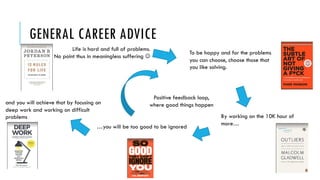
GENERAL CAREER ADVICE
Life is hard and full of problems.
No point thus in meaningless suffering J
To be happy and for the problems
you can choose, choose those that
you like solving.
By working on the 10K hour of
more…
…you will be too good to be ignored
and you will achieve that by focusing on
deep work and working on difficult
problems
Positive feedback loop,
where good things happen
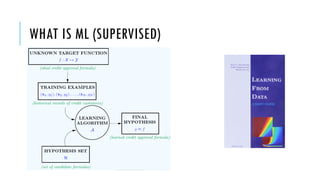
WHAT IS ML (SUPERVISED)

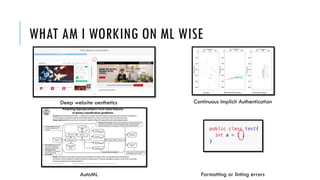
WHAT AM I WORKING ON ML WISE
Deep website aesthetics
AutoML
Continuous Implicit Authentication
Formatting or linting errors
SIMPLE RULE 1: SPLIT YOU DATA IN THREE
GREEK SONG
• «Δεν υπάρχει ευτυχία, που να κόβεται στα τρία…» – “There is no happiness split in
three…”
• Not true for ML
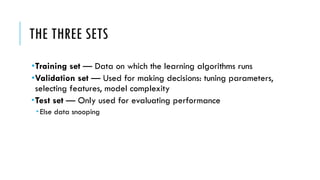
THE THREE SETS
•Training set — Data on which the learning algorithms runs
•Validation set — Used for making decisions: tuning parameters,
selecting features, model complexity
­Test set — Only used for evaluating performance
­ Else data snooping
DO NOT TAKE ANY DECISIONS ON THE TEST SET
- Do not use it for selecting ANYTHING!
- Rely on the validation score only
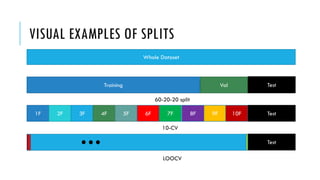
VISUAL EXAMPLES OF SPLITS
Whole Dataset
Training Val Test
1F 2F 3F 4F 5F 6F 7F 8F 9F 10F Test
Test
60-20-20 split
10-CV
LOOCV
R EXAMPLE
k = 5
results <- numeric(k)
ind <- sample(2, nrow(iris), replace=T, prob=c(0.8, 0.2))
trainval <- iris[ind==1,]
test <- iris[ind !=1,]
cv <- sample(rep(1:k, length.out=nrow(trainval)))
for(i in 1:k) {
trainData <- trainval[cv != i,]
valData <- trainval[cv == i,]
model <- naiveBayes(Species ~ ., data=trainData, laplace = 0)
pred <- predict(model, valData)
results[i] <- Accuracy(pred, valData$Species)
}
print(mean(results))
# after finding the best laplace
finalmodel <- naiveBayes(Species ~ ., data=trainval,
laplace = 0)
pred <- predict(finalmodel, test)
print(Accuracy(pred, test$Species))
Validation - 0.95 vs. 0.91 - Test
SIMPLE RULE 2: SPLIT YOUR DATA IN THREE,
CORRECTLY
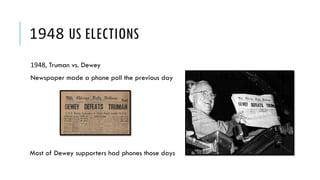
1948 US ELECTIONS
1948, Truman vs. Dewey
Newspaper made a phone poll the previous day
Most of Dewey supporters had phones those days
RULE
• Choose validation and test sets to reflect the data you expect to see in the future
• Ideally performance in validation and test sets should be the same
• Example: Let’s say validation set performance is super and test set performance is so
and so
• If from the same distribution:
• You had overfitted the validation set
• If from different distributions
• You had overfitted the validation set
• Test set is harder
• Test set is different
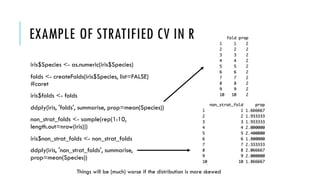
EXAMPLE OF STRATIFIED CV IN R
iris$Species <- as.numeric(iris$Species)
folds <- createFolds(iris$Species, list=FALSE)
#caret
iris$folds <- folds
ddply(iris, 'folds', summarise, prop=mean(Species))
non_strat_folds <- sample(rep(1:10,
length.out=nrow(iris)))
iris$non_strat_folds <- non_strat_folds
ddply(iris, 'non_strat_folds', summarise,
prop=mean(Species))
Things will be (much) worse if the distribution is more skewed
SIMPLE RULE 3: DATASET SIZE IS IMPORTANT
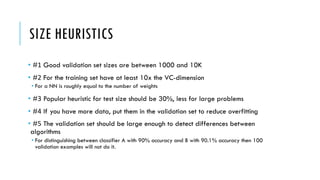
SIZE HEURISTICS
• #1 Good validation set sizes are between 1000 and 10K
• #2 For the training set have at least 10x the VC-dimension
• For a NN is roughly equal to the number of weights
• #3 Popular heuristic for test size should be 30%, less for large problems
• #4 If you have more data, put them in the validation set to reduce overfitting
• #5 The validation set should be large enough to detect differences between
algorithms
• For distinguishing between classifier A with 90% accuracy and B with 90.1% accuracy then 100
validation examples will not do it.
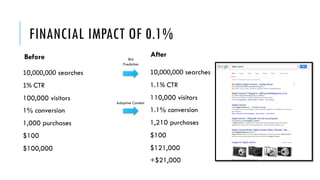
FINANCIAL IMPACT OF 0.1%
Before
10,000,000 searches
1% CTR
100,000 visitors
1% conversion
1,000 purchases
$100
$100,000
After
10,000,000 searches
1.1% CTR
110,000 visitors
1.1% conversion
1,210 purchases
$100
$121,000
+$21,000
Bid
Prediction
Adaptive Content
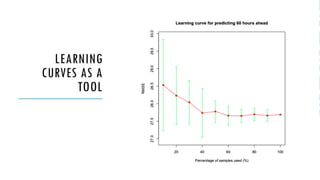
LEARNING
CURVES AS A
TOOL
SIMPLE RULE 4: CHOOSE ONE METRIC
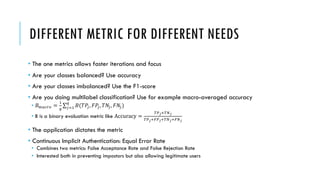
DIFFERENT METRIC FOR DIFFERENT NEEDS
• The one metrics allows faster iterations and focus
• Are your classes balanced? Use accuracy
• Are your classes imbalanced? Use the F1-score
• Are you doing multilabel classification? Use for example macro-averaged accuracy
• 𝐵"#$%& =
(
)
∑+,(
)
𝐵(𝑇𝑃+, 𝐹𝑃+, 𝑇𝑁+, 𝐹𝑁+)
• B is a binary evaluation metric like Accuracy =
:;<=:><
:;<=?;<=:><=?><
• The application dictates the metric
• Continuous Implicit Authentication: Equal Error Rate
• Combines two metrics: False Acceptance Rate and False Rejection Rate
• Interested both in preventing impostors but also allowing legitimate users
SIMPLE RULE 5: ALWAYS DO YOUR EDA
THE QUESTION TO ASK IN EXPLORATORY DATA
ANALYSIS
• Definition: Exploratory Data Analysis refers to the critical process of performing
initial investigations on data so as to discover patterns, to spot anomalies, to test
hypothesis and to check assumptions with the help of summary statistics and graphical
representations.
• Do you see what you expect to see?
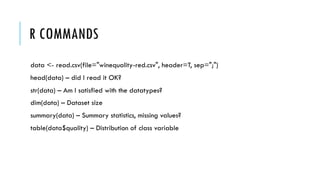
R COMMANDS
data <- read.csv(file="winequality-red.csv", header=T, sep=";")
head(data) – did I read it OK?
str(data) – Am I satisfied with the datatypes?
dim(data) – Dataset size
summary(data) – Summary statistics, missing values?
table(data$quality) – Distribution of class variable
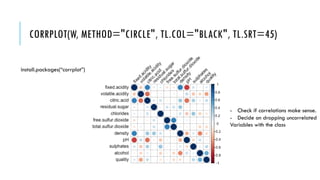
CORRPLOT(W, METHOD="CIRCLE", TL.COL="BLACK", TL.SRT=45)
install.packages(“corrplot”)
- Check if correlations make sense.
- Decide on dropping uncorrelated
Variables with the class
BOX-PLOTS
g <- list()
j <- 1
long <- melt(data)
for(i in names(data)) {
subdata = long[long$variable == i,]
g[[j]] <- ggplot(data = subdata,
aes(x=variable, y=value)) +
geom_boxplot()
j = j+1
}
grid.arrange(grobs=g, nrow = 2)
- Check outliers
DENSITY PLOTS
g <- list()
j <- 1
for(i in names(data)) {
print(i)
p <- ggplot(data = data,
aes_string(x=i)) +
geom_density()
g[[j]] <- p
j = j+1
}
grid.arrange(grobs=g, nrow = 2)
- Check normally distributed or right/positively skewed
SIMPLE RULE 6: BE CAREFUL WITH DATA
PREPROCESSING AS WELL
IMPUTING
• Imputation: the process of replacing missing data with substituting values
• Calculate statistics on training data, i.e. mean
• Use this mean to replace missing data on both the validation and the testing
datasets
• Same for normalization or standardization
• Normalization sensitive to outliers
PROPROCESSING
EXAMPLES IN R
ind <- sample(3, nrow(data), replace=TRUE,
prob=c(0.6, 0.2, 0.2))
trainData <- data[ind==1,]
valData <- data[ind==2,]
testData <- data[ind==3,]
trainMaxs <- apply(trainData[,1:11], 2, max)
trainMins <- apply(trainData[,1:11], 2, min)
normTrainData <-
sweep(sweep(trainData[,1:11], 2, trainMins, "-"),
2, (trainMaxs - trainMins), "/")
summary(normTrainData)
PROPROCESSING
EXAMPLES IN R
normValData <- sweep(sweep(valData[,1:11],
2, trainMins, "-"), 2, (trainMaxs - trainMins), "/")
Not an issue if data is big and
correct sampling is kept.
SIMPLE RULE 7: DON’T BE UNLUCKY
BE KNOWLEDGEABLE
• Aka how randomness affects results…
• If you don’t want to be unlucky do 10 times the 10-fold cross-validation and
average the averages and get precise estimates
EXAMPLE IN R
results <- numeric(100)
for(i in 1:100) {
ind <- sample(2, nrow(iris), replace=T,
prob=c(0.9, 0.1))
trainData <- iris[ind==1,]
valData <- iris[ind==2,]
model <- naiveBayes(Species ~ .,
data=trainData)
pred <- predict(model, valData)
results[i] <- Accuracy(pred,
valData$Species)
}
• Even in this simple dataset and
scenario….55/100 splits gave perfect score
in one run.
• With simple 10-fold cross-validation I could
have gotten 100% validation accuracy.
• In one run I got 70%...30% difference
based on luck.
SIMPLE RULE 8: TESTING
TEST WHICH MODEL IS SUPERIOR
­Depends on what you are doing:
­ If you work in a single dataset and you are in the industry, probably you
go with the model that has the best metric in the validation data, backed
by the testing data metric
­ If you are doing research you can add statistical testing
­ If you are building ML algorithms and you are comparing different
algorithms on a whole lot of datasets, check J. Demsar’s 2006 JMLR paper
(more than 7K citations)
CHOOSING BETWEEN TWO
• X and Y models, 10-fold CV
• For a given confidence level, we will check whether the actual difference exceeds
the confidence limit
• Decide on a confidence level: 5% or 1%
• Use Wilcoxon test
• Other tests require more assumptions that are valid with large samples
R EXAMPLEresultsMA <- numeric(10)
resultsMB <- numeric(10)
cv <- sample(rep(1:10, nrow(iris)/10))
for(i in 1:10) {
trainData <- iris[cv == i,]
valData <- iris[cv != i,]
model <- naiveBayes(Species ~ ., data=trainData)
pred <- predict(model, valData)
resultsMA[i] <- Accuracy(pred, valData$Species)
ctree = rpart(Species ~ ., data=trainData,
method="class",minsplit = 1, minbucket = 1, cp = -1)
pred <- predict(ctree, valData, type="class")
resultsMB[i] <- Accuracy(pred, valData$Species)
}
wilcoxon.test(resultsMA, resultsMB)
If p value less than confidence level
then there is statistical significance.
SIMPLE RULE 9: TIME IS MONEY
TIME IS MONEY
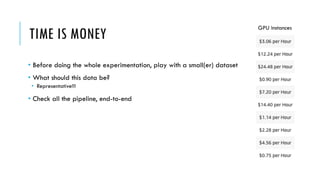
• Before doing the whole experimentation, play with a small(er) dataset
• What should this data be?
• Representative!!!
• Check all the pipeline, end-to-end
GPU instances
SIMPLE RULE 10: KNOW THY DATA
DO I HAVE ENOUGH DATA?
• Learning curves….
• Else augment
• How can one augment?
IMAGE
AUGMENTATION
https://github.com/aleju/imgaug
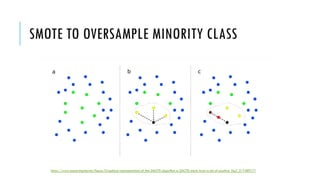
SMOTE TO OVERSAMPLE MINORITY CLASS
https://www.researchgate.net/figure/Graphical-representation-of-the-SMOTE-algorithm-a-SMOTE-starts-from-a-set-of-positive_fig2_317489171
MORE ANNOTATIONS
SIMPLE RULE 11: DECIDE ON YOUR GOAL
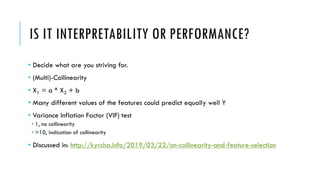
IS IT INTERPRETABILITY OR PERFORMANCE?
• Decide what are you striving for.
• (Multi)-Collinearity
• X1 = a * X2 + b
• Many different values of the features could predict equally well Y
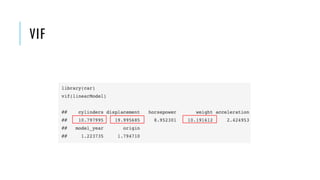
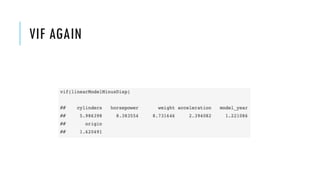
• Variance Inflation Factor (VIF) test
• 1, no collinearity
• >10, indication of collinearity
• Discussed in: http://kyrcha.info/2019/03/22/on-collinearity-and-feature-selection
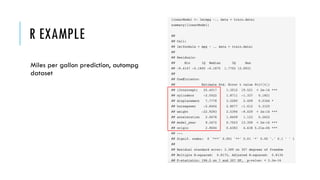
R EXAMPLE
Miles per gallon prediction, autompg
dataset
VIF
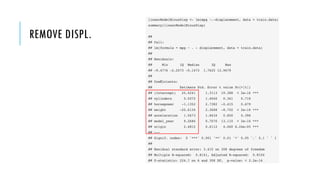
REMOVE DISPL.
VIF AGAIN
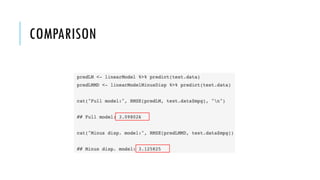
COMPARISON
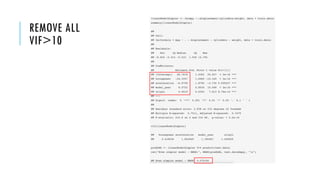
REMOVE ALL
VIF>10
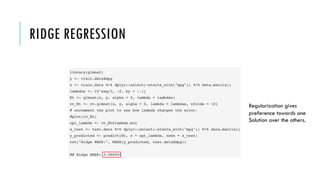
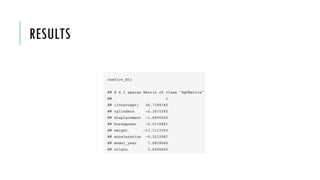
RIDGE REGRESSION
Regularization gives
preference towards one
Solution over the others.
RESULTS
SIMPLE RULE 12: START BY CHOOSING THE
CORRECT MODEL FOR YOUR PROBLEM
RANDOM FORESTS
• Nice algorithm, works on a lot of dataset (Fernandez-Delgado et al., JMLR, 2014)
• Few important parameters to tune
• Handles multiclass problems (unlike for example SVMs)
• Can handle a mixture of features and scales
SVM
- Nice algorithm, works on a lot of dataset (Fernandez-Delgado et al., JMLR, 2014)
- Robust theory behind it
- Good for binary classification and 1-class classification
­ We use it in Continuous Implicit Authentication
- Can handle sparse data
GRADIENT BOOSTING MACHINES
• Focuses on difficult samples that are hard to learn
• If you have outliers, it will boost them to be the most important points
• So have important outliers and not errors as outliers
• Is more of a black-box, even though it is tree-based
• Needs more tuning
• Easy to overfit
• Mostly better results that RF
DEEP LEARNING
• Choose if you have lots of data and computational resources
• Don’t have to throw away anything. Solves the problem end-to-end.
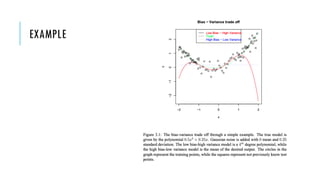
SIDENOTE: BIAS - VARIANCE
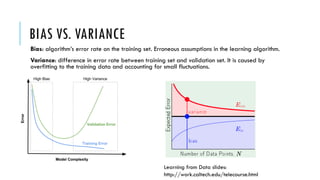
BIAS VS. VARIANCE
Bias: algorithm’s error rate on the training set. Erroneous assumptions in the learning algorithm.
Variance: difference in error rate between training set and validation set. It is caused by
overfitting to the training data and accounting for small fluctuations.
Learning from Data slides:
http://work.caltech.edu/telecourse.html
EXAMPLE
SIMPLE RULE 13: BECOME A
KNOWLEDGEABLE TRADER
BIAS VARIANCE TRADE-OFF HEURISTICS
• #1 High bias => Increase model size (usually with regularization to mitigate high
variance)
• #2 High variance => add training data (usually with a big model to handle them)
TRADE FOR BIAS
• Will reduce (avoidable) bias
• Increase model size (more neurons/layers/trees/depth etc.)
• Add more helpful features
• Reduce/remove regularization (L2/L1/dropout)
• Indifferent
•Add more training data
TRADE FOR VARIANCE
• Reduce variance
•Add more training data
•Add regularization
•Early stopping (NN)
•Remove features
•Decrease model size (prefer regularization)
• Usually big model to handle training data and then add regularization
•Add more helpful features
SIMPLE RULE 14: FINISH OFF WITH AN
ENSEMBLE
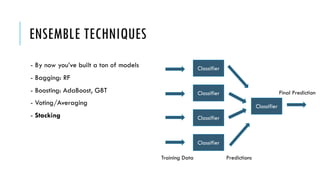
ENSEMBLE TECHNIQUES
- By now you’ve built a ton of models
- Bagging: RF
- Boosting: AdaBoost, GBT
- Voting/Averaging
- Stacking
Classifier
Classifier
Classifier
Classifier
Classifier
Final Prediction
PredictionsTraining Data
SIMPLE RULE 15: TUNE
HYPERPARAMETERS…BUT TO A POINT
TUNE THE MOST INFLUENTIAL PARAMETERS
• There is performance to be gained by parameter tuning (Bagnal and Crawley
2017)
• Tons of parameters, we can’t tune them all
• Understand how they influence training + read relevant papers/walkthroughs
• Random forests (Fernandez-Delgado et al., JMLR, 2014)
• mtry: Number of variables randomly sampled as candidates at each split.
• SVM (Fernandez-Delgado et al., JMLR, 2014)
• tuning the regularization and kernel spread
SIMPLE RULE 16: START A WATERFALL LIKE
PROCESS
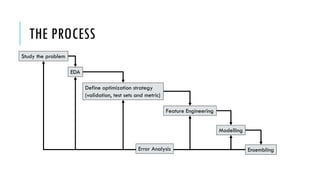
THE PROCESS
Study the problem
EDA
Define optimization strategy
(validation, test sets and metric)
Feature Engineering
Modelling
EnsemblingError Analysis
GENERAL RULE
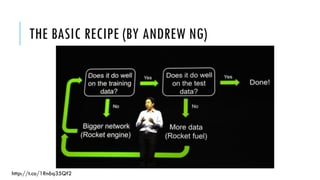
THE BASIC RECIPE (BY ANDREW NG)
http://t.co/1Rn6q35Qf2
THANK YOU
For further AMA questions open an issue at:
https://github.com/kyrcha/ama
FURTHER READING
• Personal Experiences
• Various resources over the internet and the years
• ML Yearning: https://www.mlyearning.org/
• Machine Learning from Data course: http://work.caltech.edu/telecourse.html
• Practical Machine Learning with H2O book

Simple rules for building robust machine learning models

  • 1.
    SIMPLE RULES FORBUILDING ROBUST MACHINE LEARNING MODELSWITH EXAMPLES IN R Kyriakos Chatzidimitriou Research Fellow, Aristotle University of Thessaloniki PhD in Electrical and Computer Engineering kyrcha@issel.ee.auth.gr AMA Call Early Career and Engagement IG
  • 2.
    ABOUT ME • Bornin 1978 • 1997-2003, Diploma in Electrical and Computer Engineering, AUTH, GREECE • 2003-2004, Worked as a developer • 2004-2006, MSc in Computer Science, CSU, USA • 2006-2007, Greek Army • 2007-2012, PhD, AUTH, GREECE • Reinforcement learning and evolutionary computing mechanisms for autonomous agents • 2013-Now, Research Fellow, ECE, AUTH • 2017-Now, co-founder, manager and full stack developer of Cyclopt P.C. • Spin-off company of AUTH focusing on software analytics
  • 3.
    GENERAL CAREER ADVICE Lifeis hard and full of problems. No point thus in meaningless suffering J To be happy and for the problems you can choose, choose those that you like solving. By working on the 10K hour of more… …you will be too good to be ignored and you will achieve that by focusing on deep work and working on difficult problems Positive feedback loop, where good things happen
  • 4.
    WHAT IS ML(SUPERVISED)
  • 5.
    WHAT AM IWORKING ON ML WISE Deep website aesthetics AutoML Continuous Implicit Authentication Formatting or linting errors
  • 6.
    SIMPLE RULE 1:SPLIT YOU DATA IN THREE
  • 7.
    GREEK SONG • «Δενυπάρχει ευτυχία, που να κόβεται στα τρία…» – “There is no happiness split in three…” • Not true for ML
  • 8.
    THE THREE SETS •Trainingset — Data on which the learning algorithms runs •Validation set — Used for making decisions: tuning parameters, selecting features, model complexity ­Test set — Only used for evaluating performance ­ Else data snooping
  • 9.
    DO NOT TAKEANY DECISIONS ON THE TEST SET - Do not use it for selecting ANYTHING! - Rely on the validation score only
  • 10.
    VISUAL EXAMPLES OFSPLITS Whole Dataset Training Val Test 1F 2F 3F 4F 5F 6F 7F 8F 9F 10F Test Test 60-20-20 split 10-CV LOOCV
  • 11.
    R EXAMPLE k =5 results <- numeric(k) ind <- sample(2, nrow(iris), replace=T, prob=c(0.8, 0.2)) trainval <- iris[ind==1,] test <- iris[ind !=1,] cv <- sample(rep(1:k, length.out=nrow(trainval))) for(i in 1:k) { trainData <- trainval[cv != i,] valData <- trainval[cv == i,] model <- naiveBayes(Species ~ ., data=trainData, laplace = 0) pred <- predict(model, valData) results[i] <- Accuracy(pred, valData$Species) } print(mean(results)) # after finding the best laplace finalmodel <- naiveBayes(Species ~ ., data=trainval, laplace = 0) pred <- predict(finalmodel, test) print(Accuracy(pred, test$Species)) Validation - 0.95 vs. 0.91 - Test
  • 12.
    SIMPLE RULE 2:SPLIT YOUR DATA IN THREE, CORRECTLY
  • 13.
    1948 US ELECTIONS 1948,Truman vs. Dewey Newspaper made a phone poll the previous day Most of Dewey supporters had phones those days
  • 14.
    RULE • Choose validationand test sets to reflect the data you expect to see in the future • Ideally performance in validation and test sets should be the same • Example: Let’s say validation set performance is super and test set performance is so and so • If from the same distribution: • You had overfitted the validation set • If from different distributions • You had overfitted the validation set • Test set is harder • Test set is different
  • 15.
    EXAMPLE OF STRATIFIEDCV IN R iris$Species <- as.numeric(iris$Species) folds <- createFolds(iris$Species, list=FALSE) #caret iris$folds <- folds ddply(iris, 'folds', summarise, prop=mean(Species)) non_strat_folds <- sample(rep(1:10, length.out=nrow(iris))) iris$non_strat_folds <- non_strat_folds ddply(iris, 'non_strat_folds', summarise, prop=mean(Species)) Things will be (much) worse if the distribution is more skewed
  • 16.
    SIMPLE RULE 3:DATASET SIZE IS IMPORTANT
  • 17.
    SIZE HEURISTICS • #1Good validation set sizes are between 1000 and 10K • #2 For the training set have at least 10x the VC-dimension • For a NN is roughly equal to the number of weights • #3 Popular heuristic for test size should be 30%, less for large problems • #4 If you have more data, put them in the validation set to reduce overfitting • #5 The validation set should be large enough to detect differences between algorithms • For distinguishing between classifier A with 90% accuracy and B with 90.1% accuracy then 100 validation examples will not do it.
  • 18.
    FINANCIAL IMPACT OF0.1% Before 10,000,000 searches 1% CTR 100,000 visitors 1% conversion 1,000 purchases $100 $100,000 After 10,000,000 searches 1.1% CTR 110,000 visitors 1.1% conversion 1,210 purchases $100 $121,000 +$21,000 Bid Prediction Adaptive Content
  • 19.
  • 20.
    SIMPLE RULE 4:CHOOSE ONE METRIC
  • 21.
    DIFFERENT METRIC FORDIFFERENT NEEDS • The one metrics allows faster iterations and focus • Are your classes balanced? Use accuracy • Are your classes imbalanced? Use the F1-score • Are you doing multilabel classification? Use for example macro-averaged accuracy • 𝐵"#$%& = ( ) ∑+,( ) 𝐵(𝑇𝑃+, 𝐹𝑃+, 𝑇𝑁+, 𝐹𝑁+) • B is a binary evaluation metric like Accuracy = :;<=:>< :;<=?;<=:><=?>< • The application dictates the metric • Continuous Implicit Authentication: Equal Error Rate • Combines two metrics: False Acceptance Rate and False Rejection Rate • Interested both in preventing impostors but also allowing legitimate users
  • 22.
    SIMPLE RULE 5:ALWAYS DO YOUR EDA
  • 23.
    THE QUESTION TOASK IN EXPLORATORY DATA ANALYSIS • Definition: Exploratory Data Analysis refers to the critical process of performing initial investigations on data so as to discover patterns, to spot anomalies, to test hypothesis and to check assumptions with the help of summary statistics and graphical representations. • Do you see what you expect to see?
  • 24.
    R COMMANDS data <-read.csv(file="winequality-red.csv", header=T, sep=";") head(data) – did I read it OK? str(data) – Am I satisfied with the datatypes? dim(data) – Dataset size summary(data) – Summary statistics, missing values? table(data$quality) – Distribution of class variable
  • 25.
    CORRPLOT(W, METHOD="CIRCLE", TL.COL="BLACK",TL.SRT=45) install.packages(“corrplot”) - Check if correlations make sense. - Decide on dropping uncorrelated Variables with the class
  • 26.
    BOX-PLOTS g <- list() j<- 1 long <- melt(data) for(i in names(data)) { subdata = long[long$variable == i,] g[[j]] <- ggplot(data = subdata, aes(x=variable, y=value)) + geom_boxplot() j = j+1 } grid.arrange(grobs=g, nrow = 2) - Check outliers
  • 27.
    DENSITY PLOTS g <-list() j <- 1 for(i in names(data)) { print(i) p <- ggplot(data = data, aes_string(x=i)) + geom_density() g[[j]] <- p j = j+1 } grid.arrange(grobs=g, nrow = 2) - Check normally distributed or right/positively skewed
  • 28.
    SIMPLE RULE 6:BE CAREFUL WITH DATA PREPROCESSING AS WELL
  • 29.
    IMPUTING • Imputation: theprocess of replacing missing data with substituting values • Calculate statistics on training data, i.e. mean • Use this mean to replace missing data on both the validation and the testing datasets • Same for normalization or standardization • Normalization sensitive to outliers
  • 30.
    PROPROCESSING EXAMPLES IN R ind<- sample(3, nrow(data), replace=TRUE, prob=c(0.6, 0.2, 0.2)) trainData <- data[ind==1,] valData <- data[ind==2,] testData <- data[ind==3,] trainMaxs <- apply(trainData[,1:11], 2, max) trainMins <- apply(trainData[,1:11], 2, min) normTrainData <- sweep(sweep(trainData[,1:11], 2, trainMins, "-"), 2, (trainMaxs - trainMins), "/") summary(normTrainData)
  • 31.
    PROPROCESSING EXAMPLES IN R normValData<- sweep(sweep(valData[,1:11], 2, trainMins, "-"), 2, (trainMaxs - trainMins), "/") Not an issue if data is big and correct sampling is kept.
  • 32.
    SIMPLE RULE 7:DON’T BE UNLUCKY
  • 33.
    BE KNOWLEDGEABLE • Akahow randomness affects results… • If you don’t want to be unlucky do 10 times the 10-fold cross-validation and average the averages and get precise estimates
  • 34.
    EXAMPLE IN R results<- numeric(100) for(i in 1:100) { ind <- sample(2, nrow(iris), replace=T, prob=c(0.9, 0.1)) trainData <- iris[ind==1,] valData <- iris[ind==2,] model <- naiveBayes(Species ~ ., data=trainData) pred <- predict(model, valData) results[i] <- Accuracy(pred, valData$Species) } • Even in this simple dataset and scenario….55/100 splits gave perfect score in one run. • With simple 10-fold cross-validation I could have gotten 100% validation accuracy. • In one run I got 70%...30% difference based on luck.
  • 35.
  • 36.
    TEST WHICH MODELIS SUPERIOR ­Depends on what you are doing: ­ If you work in a single dataset and you are in the industry, probably you go with the model that has the best metric in the validation data, backed by the testing data metric ­ If you are doing research you can add statistical testing ­ If you are building ML algorithms and you are comparing different algorithms on a whole lot of datasets, check J. Demsar’s 2006 JMLR paper (more than 7K citations)
  • 37.
    CHOOSING BETWEEN TWO •X and Y models, 10-fold CV • For a given confidence level, we will check whether the actual difference exceeds the confidence limit • Decide on a confidence level: 5% or 1% • Use Wilcoxon test • Other tests require more assumptions that are valid with large samples
  • 38.
    R EXAMPLEresultsMA <-numeric(10) resultsMB <- numeric(10) cv <- sample(rep(1:10, nrow(iris)/10)) for(i in 1:10) { trainData <- iris[cv == i,] valData <- iris[cv != i,] model <- naiveBayes(Species ~ ., data=trainData) pred <- predict(model, valData) resultsMA[i] <- Accuracy(pred, valData$Species) ctree = rpart(Species ~ ., data=trainData, method="class",minsplit = 1, minbucket = 1, cp = -1) pred <- predict(ctree, valData, type="class") resultsMB[i] <- Accuracy(pred, valData$Species) } wilcoxon.test(resultsMA, resultsMB) If p value less than confidence level then there is statistical significance.
  • 39.
    SIMPLE RULE 9:TIME IS MONEY
  • 40.
    TIME IS MONEY •Before doing the whole experimentation, play with a small(er) dataset • What should this data be? • Representative!!! • Check all the pipeline, end-to-end GPU instances
  • 41.
    SIMPLE RULE 10:KNOW THY DATA
  • 42.
    DO I HAVEENOUGH DATA? • Learning curves…. • Else augment • How can one augment?
  • 43.
  • 44.
    SMOTE TO OVERSAMPLEMINORITY CLASS https://www.researchgate.net/figure/Graphical-representation-of-the-SMOTE-algorithm-a-SMOTE-starts-from-a-set-of-positive_fig2_317489171
  • 45.
  • 46.
    SIMPLE RULE 11:DECIDE ON YOUR GOAL
  • 47.
    IS IT INTERPRETABILITYOR PERFORMANCE? • Decide what are you striving for. • (Multi)-Collinearity • X1 = a * X2 + b • Many different values of the features could predict equally well Y • Variance Inflation Factor (VIF) test • 1, no collinearity • >10, indication of collinearity • Discussed in: http://kyrcha.info/2019/03/22/on-collinearity-and-feature-selection
  • 48.
    R EXAMPLE Miles pergallon prediction, autompg dataset
  • 49.
  • 50.
  • 51.
  • 52.
  • 53.
  • 54.
    RIDGE REGRESSION Regularization gives preferencetowards one Solution over the others.
  • 55.
  • 56.
    SIMPLE RULE 12:START BY CHOOSING THE CORRECT MODEL FOR YOUR PROBLEM
  • 57.
    RANDOM FORESTS • Nicealgorithm, works on a lot of dataset (Fernandez-Delgado et al., JMLR, 2014) • Few important parameters to tune • Handles multiclass problems (unlike for example SVMs) • Can handle a mixture of features and scales
  • 58.
    SVM - Nice algorithm,works on a lot of dataset (Fernandez-Delgado et al., JMLR, 2014) - Robust theory behind it - Good for binary classification and 1-class classification ­ We use it in Continuous Implicit Authentication - Can handle sparse data
  • 59.
    GRADIENT BOOSTING MACHINES •Focuses on difficult samples that are hard to learn • If you have outliers, it will boost them to be the most important points • So have important outliers and not errors as outliers • Is more of a black-box, even though it is tree-based • Needs more tuning • Easy to overfit • Mostly better results that RF
  • 60.
    DEEP LEARNING • Chooseif you have lots of data and computational resources • Don’t have to throw away anything. Solves the problem end-to-end.
  • 61.
  • 62.
    BIAS VS. VARIANCE Bias:algorithm’s error rate on the training set. Erroneous assumptions in the learning algorithm. Variance: difference in error rate between training set and validation set. It is caused by overfitting to the training data and accounting for small fluctuations. Learning from Data slides: http://work.caltech.edu/telecourse.html
  • 63.
  • 64.
    SIMPLE RULE 13:BECOME A KNOWLEDGEABLE TRADER
  • 65.
    BIAS VARIANCE TRADE-OFFHEURISTICS • #1 High bias => Increase model size (usually with regularization to mitigate high variance) • #2 High variance => add training data (usually with a big model to handle them)
  • 66.
    TRADE FOR BIAS •Will reduce (avoidable) bias • Increase model size (more neurons/layers/trees/depth etc.) • Add more helpful features • Reduce/remove regularization (L2/L1/dropout) • Indifferent •Add more training data
  • 67.
    TRADE FOR VARIANCE •Reduce variance •Add more training data •Add regularization •Early stopping (NN) •Remove features •Decrease model size (prefer regularization) • Usually big model to handle training data and then add regularization •Add more helpful features
  • 68.
    SIMPLE RULE 14:FINISH OFF WITH AN ENSEMBLE
  • 69.
    ENSEMBLE TECHNIQUES - Bynow you’ve built a ton of models - Bagging: RF - Boosting: AdaBoost, GBT - Voting/Averaging - Stacking Classifier Classifier Classifier Classifier Classifier Final Prediction PredictionsTraining Data
  • 70.
    SIMPLE RULE 15:TUNE HYPERPARAMETERS…BUT TO A POINT
  • 71.
    TUNE THE MOSTINFLUENTIAL PARAMETERS • There is performance to be gained by parameter tuning (Bagnal and Crawley 2017) • Tons of parameters, we can’t tune them all • Understand how they influence training + read relevant papers/walkthroughs • Random forests (Fernandez-Delgado et al., JMLR, 2014) • mtry: Number of variables randomly sampled as candidates at each split. • SVM (Fernandez-Delgado et al., JMLR, 2014) • tuning the regularization and kernel spread
  • 72.
    SIMPLE RULE 16:START A WATERFALL LIKE PROCESS
  • 73.
    THE PROCESS Study theproblem EDA Define optimization strategy (validation, test sets and metric) Feature Engineering Modelling EnsemblingError Analysis
  • 74.
  • 75.
    THE BASIC RECIPE(BY ANDREW NG) http://t.co/1Rn6q35Qf2
  • 76.
    THANK YOU For furtherAMA questions open an issue at: https://github.com/kyrcha/ama
  • 77.
    FURTHER READING • PersonalExperiences • Various resources over the internet and the years • ML Yearning: https://www.mlyearning.org/ • Machine Learning from Data course: http://work.caltech.edu/telecourse.html • Practical Machine Learning with H2O book