•Name:- Ojaswa Maurya
•Class :- 9th C
•Roll no:- 33
•School:- Kendriya Vidyalya Ambernath
Work and energy
Topics covered in this chapter
 Concept of Work
 Factors on Which Amount of Work Done
Depends.
 Work Done by a Constant Force.
 Unit of Work.
 Work Done Against Gravitational Force.
 Nature of Work
 Positive Work .
 Negative Work .
 Zero Work .
5/16/20
2 WORK AND ENERGY
Forms of Energy
•Transformation of Energy
 Transformation of Energy in Nature
•Law of Conservation of Energy
 Verification of law of Conservation of Energy
•Rate of Doing Work : Power
 Power in Terms of Energy
Average Power
Units of Power
Commercial Unit of Energy
•ENERGY
5/16/20
3 WORK AND ENERGY
5/16/20
4 WORK AND ENERGY
Note :- In layman language the word “Work”
means any physical or mental activity that
we do in our daily life.
What is work ?
5/16/20
WORK AND ENERGY
5
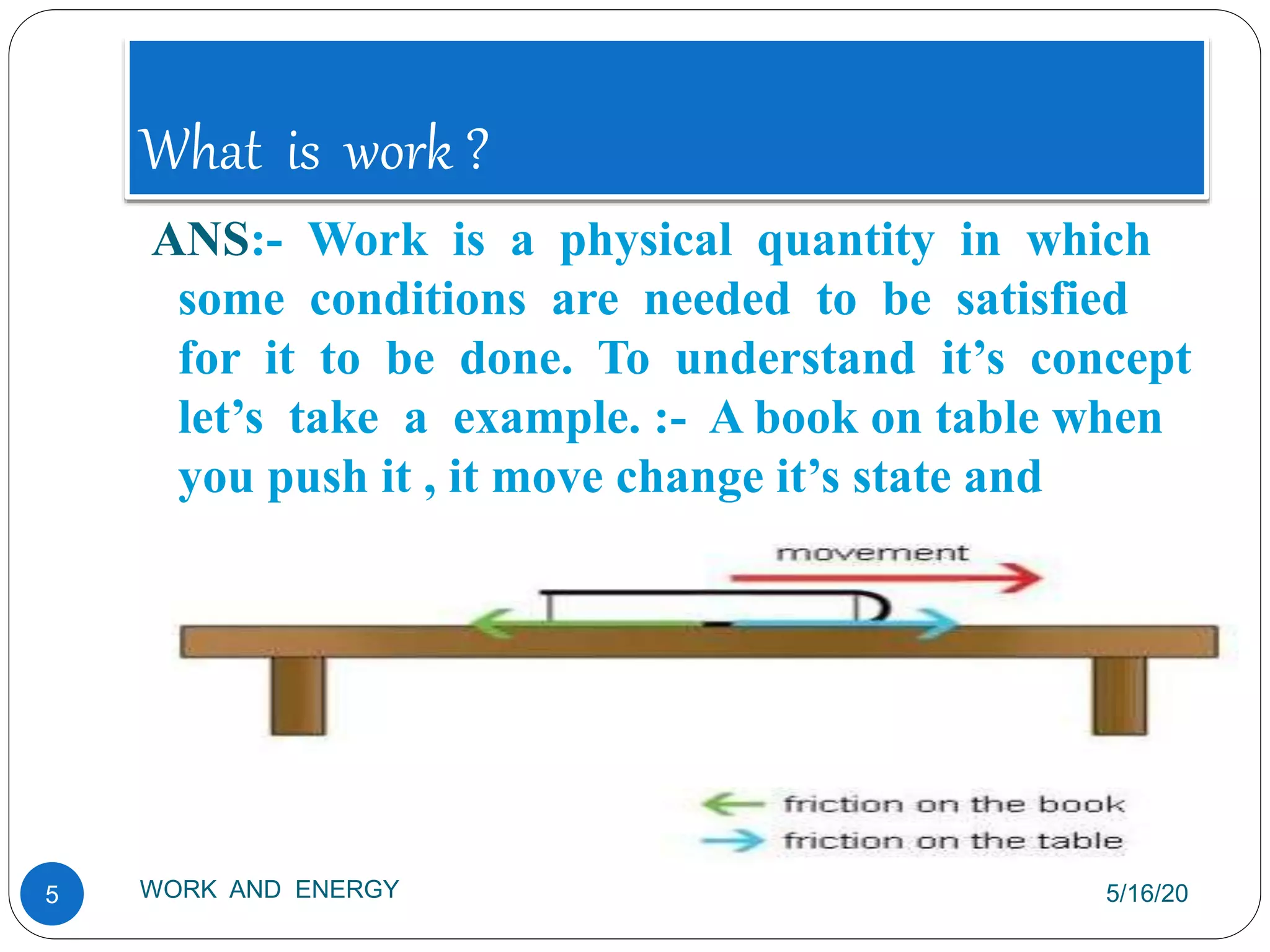
ANS:- Work is a physical quantity in which
some conditions are needed to be satisfied
for it to be done. To understand it’s concept
let’s take a example. :- A book on table when
you push it , it move change it’s state and
direction.
FACTORS ON WHICH AMOUNT OF WORK DEPENDS
5/16/20
WORK AND ENERGY
6
1. Magnitude of force applied on a body.
W is directly proportion to F
2. Displacement of body.
W is directly proportion to s
3. Work done is also depends angle of
between force and displacement.
W is directly proportion to
FSCOSt
Note:- W = work s=
displacement
F = force t= theta
Work done by constant force
5/16/20
WORK AND ENERGY
7
 A constant force F acting on a body produces
displacement s in the direction of the force, work
done W by this, force is equal to the product force
and the displacement.
W = Fs
As displacement is in direction of the applied force
=> t = 0°=> COS0°=1
5/16/20
WORK AND ENERGY
8
• A constant retarding force F acting on a body
moving with a uniform velocity along a particular
direction. The body will stop after covering certain
displacement s. In this situation the applied force is
opposing the motion of the body , applied force F is
taken as negative.
W=(-Fs)
Negative sign represent that the work is done by
retarding force
CONCLUSION:- “Work is said to be done by a
force when a force is applied on a body and body
gets displaced due to the action of applied force.”
UNIT OF WORK
5/16/20
WORK AND ENERGY
9
 The SI unit of force is Newton (N) and that of
displacement is meter (m). So the SI unit of work
is Newton meter which is written as Nm. This unit
is called joule (J) In the honor of a British
scientist, James Prescott Joule.
If F=1N,s=1m
then W=1N*1m=1Nm
Thus, 1 joule is the amount of work done on an
object when force of 1N displaces it by 1m in the
direction of force applied .
1J=1Nm
Work done against gravitational force
5/16/20
WORK AND ENERGY
10
 If we lift a bucket from ground, we do work
against gravitational force. When a body is lifted
vertically upwards the force required to lift the
body is equal to it’s weight. Thus, “whenever work
is done against gravity, then amount of work done
is equal to product of the weight of the body and
vertical distance through which the body is lifted”.
5/16/20
WORK AND ENERGY
11
Let a body of mass m be lifted vertically
upwards through a height h. Here the force
required to lift the body will be equal to weight of
the body (mg), where g is acceleration due to
gravity.
Then work done in lifting of the body
W= weight of the body * vertical distance
W=(mg)(h)
5/16/20
WORK AND ENERGY
12
POSITVE WORK
5/16/20
WORK AND ENERGY
13
Work done is said to be positive if the force
applied on an object and it’s displacement are in
the same direction or angel or angel between the
force and displacement of the object is less than
90 degree (theta < 90 degree).
Illustration 1:- when a lawn mower is pushed by
applying force along the handle at an acute angle,
work done by the applied force is positive as
shown in the figure.
5/16/20
WORK AND ENERGY
14
Illustration 2:- When a body falls under the
action of gravity, angle between the force
and displacement is zero, t=0. therefore the
work done by the body is positive.
s
Negative work
5/16/20
WORK AND ENERGY
15
 Work done is said to be negative if the applied
force on an object and it’s direction of motion is
opposite or component for the applied force and
direction of motion should be obtuse (theta > 90
degree).
Example:- A bucket is pulled upward by a force F
and it moves some distance s vertically upward.
But the force of gravity always acts in the
downward direction. Then work done by the
gravity is given by.
W=( -Fs)
5/16/20
WORK AND ENERGY
16
Illustration 1:-When a body is displaced by
distance d vertically upwards, its motion is
opposed by the gravity. In this case angel
between weight and displacement
theta=180 degree.
Work done by gravity
The motion is opposed by gravity, In this
case angel between weight and
displacement, theta=180 degree because
the gravitational force displacement are in
opposite direction.
W=(-Fs )
Thus, work done is negative.
5/16/20
WORK AND ENERGY
17
Work done by applied force
In this case, angel between applied
force and displacement, theta=0 degree,
because the applied force and
displacement are in same direction.
W=Fs
Thus, work done by the applied force is
positive
Work done by the gravity is negative
while work done by the applied force is
positive.
ZERO WORK
5/16/20
WORK AND ENERGY
18
 Work done will be 0 if
a. Force acting is zero
b. Displacement is 0
c. Angel between applied force on an object and
it’s displacement is 90 degree
Illustration1:- When a body is tied to one end of a
string and is moved in a circular path, work
done by the centripetal force is zero. Because,
force is always perpendicular to the
displacement of the body.
5/16/20
WORK AND ENERGY
19
Illustration 2:- Work done by tension in the string
of a simple pendulum is zero. Because, tension
is always perpendicular to the displacement of
the bob.
5/16/20
WORK AND ENERGY
20
What is energy ?
5/16/20
WORK AND ENERGY
21
 Energy of a body is defined as the capacity or
ability of the body to do work. The amount of
energy possessed by a body is equal to the
amount of work it can do when its energy is
released.
Note:- More the amount of energy possessed by a body,
more the amount of work it can do an vice versa.
Energy is a scalar quantity. It has only magnitude
but no direction.
5/16/20
WORK AND ENERGY
22
Unit of energy
5/16/20
WORK AND ENERGY
23
 As we know that, energy possessed by a body is
measured in terms of ability of the body to do
work. Therefore, the S.I unit of energy is the
same as the unit of work i.e. joule.
1 joule is the energy required to do 1 joule
of work.
larger unit is KJ
1KJ=1000 J
Smaller unit of energy is eV ( electron volt)
1eV=1.6*10^(-9) J
CGS unit of energy is
1J=10^7 erg
FORMS OF ENERGY
5/16/20
WORK AND ENERGY
24
ENERGY
HEAT
ENERG
Y
NIL
NIL
LIGHT
ENERG
Y
NIL
5/16/20
WORK AND ENERGY
25
HEAT ENERGY:- Heat can be defined as
the form of energy that is transferred
between two points .
EXAMPLE:-
• Steam of water
• Car engine
LIGHT ENERGY:- Light is also form of
energy to prove that let’s take example plant
make their own food with the help of light
energy or when light energy falls on
photographic plate it cause a chemical
reaction and hence image are recorded in
5/16/20
WORK AND ENERGY
26
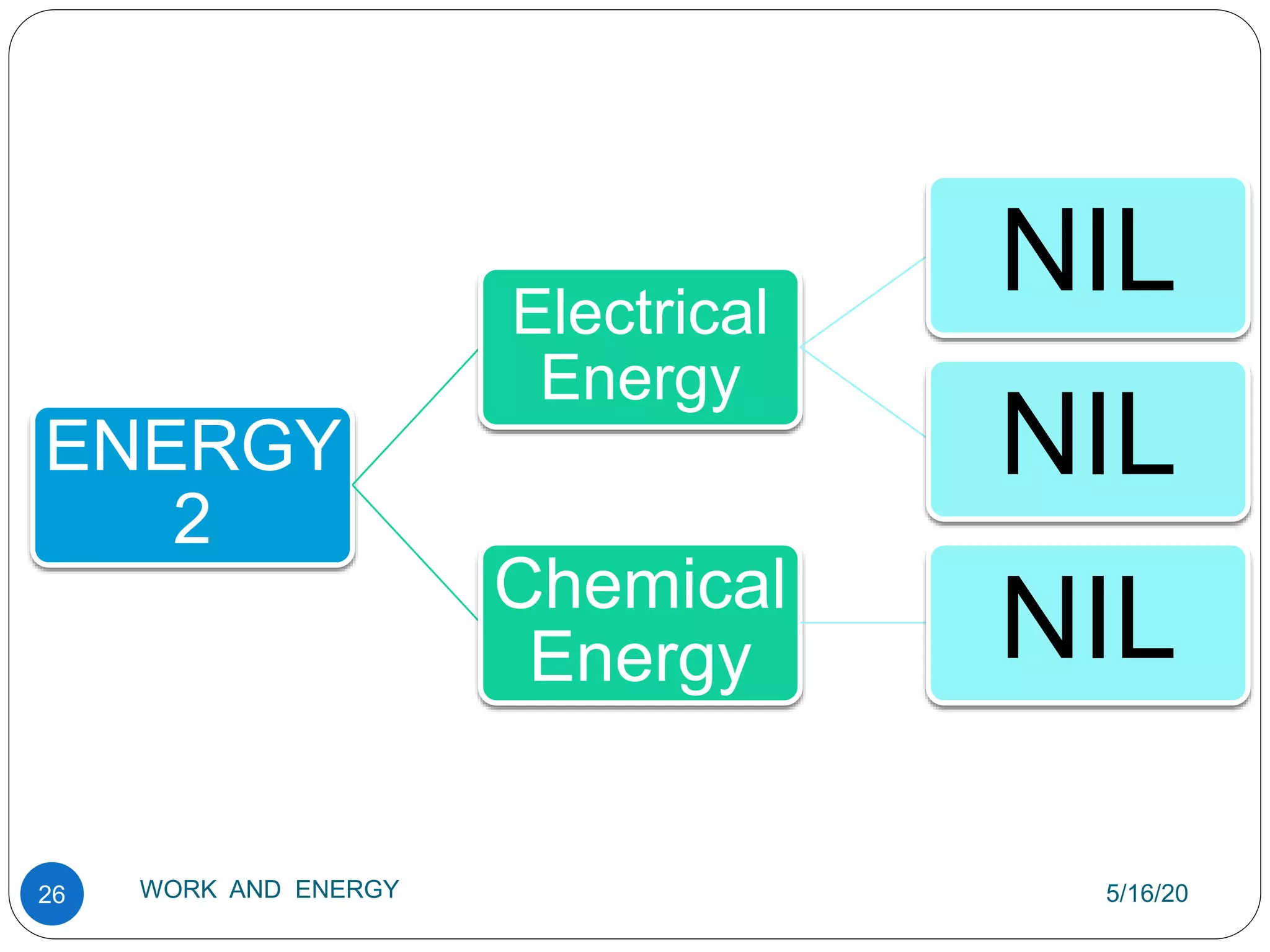
ENERGY
2
Electrical
Energy
NIL
NIL
Chemical
Energy NIL
5/16/20
WORK AND ENERGY
27
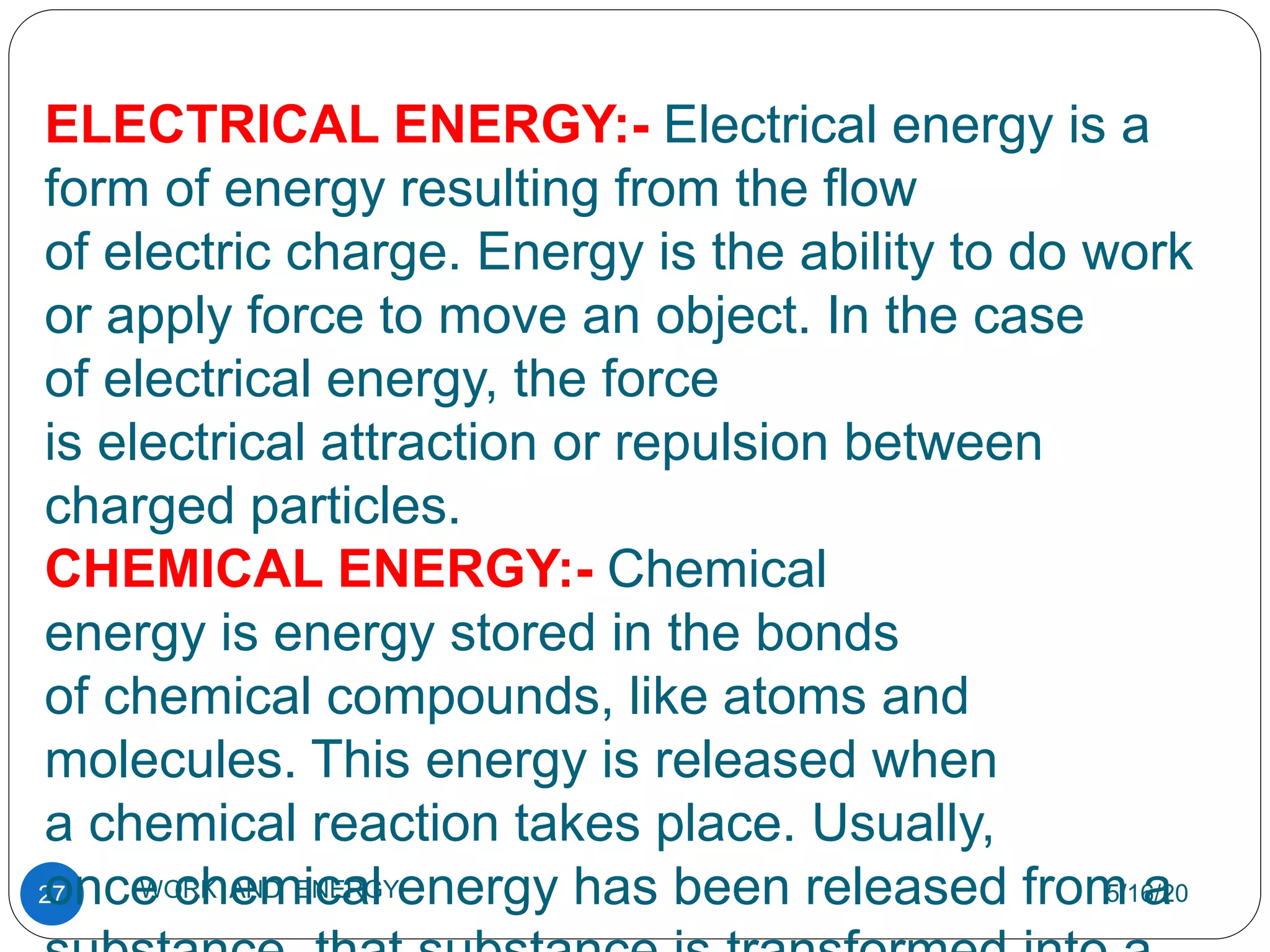
ELECTRICAL ENERGY:- Electrical energy is a
form of energy resulting from the flow
of electric charge. Energy is the ability to do work
or apply force to move an object. In the case
of electrical energy, the force
is electrical attraction or repulsion between
charged particles.
CHEMICAL ENERGY:- Chemical
energy is energy stored in the bonds
of chemical compounds, like atoms and
molecules. This energy is released when
a chemical reaction takes place. Usually,
once chemical energy has been released from a
5/16/20
WORK AND ENERGY
28
ENERG
Y 3
SOUND
ENERGY
NIL
NIL
Magnetic
Energy NIL
5/16/20
WORK AND ENERGY
29
• SOUND ENERGY:- In physics, sound energy
is a form of energy that can be heard by
humans. Sound is a mechanical wave and as
such consists physically in oscillatory elastic
compression and in oscillatory displacement of
a fluid. Therefore, the medium acts as storage
for both potential and kinetic energy.
• MEGNETIC ENERGY:- Magnetic energy and
electrostatic potential energy are related by
Maxwell's equations. The potential energy of a
magnet of magnetic moment in a magnetic
field is defined as the mechanical work of the
5/16/20
WORK AND ENERGY
30
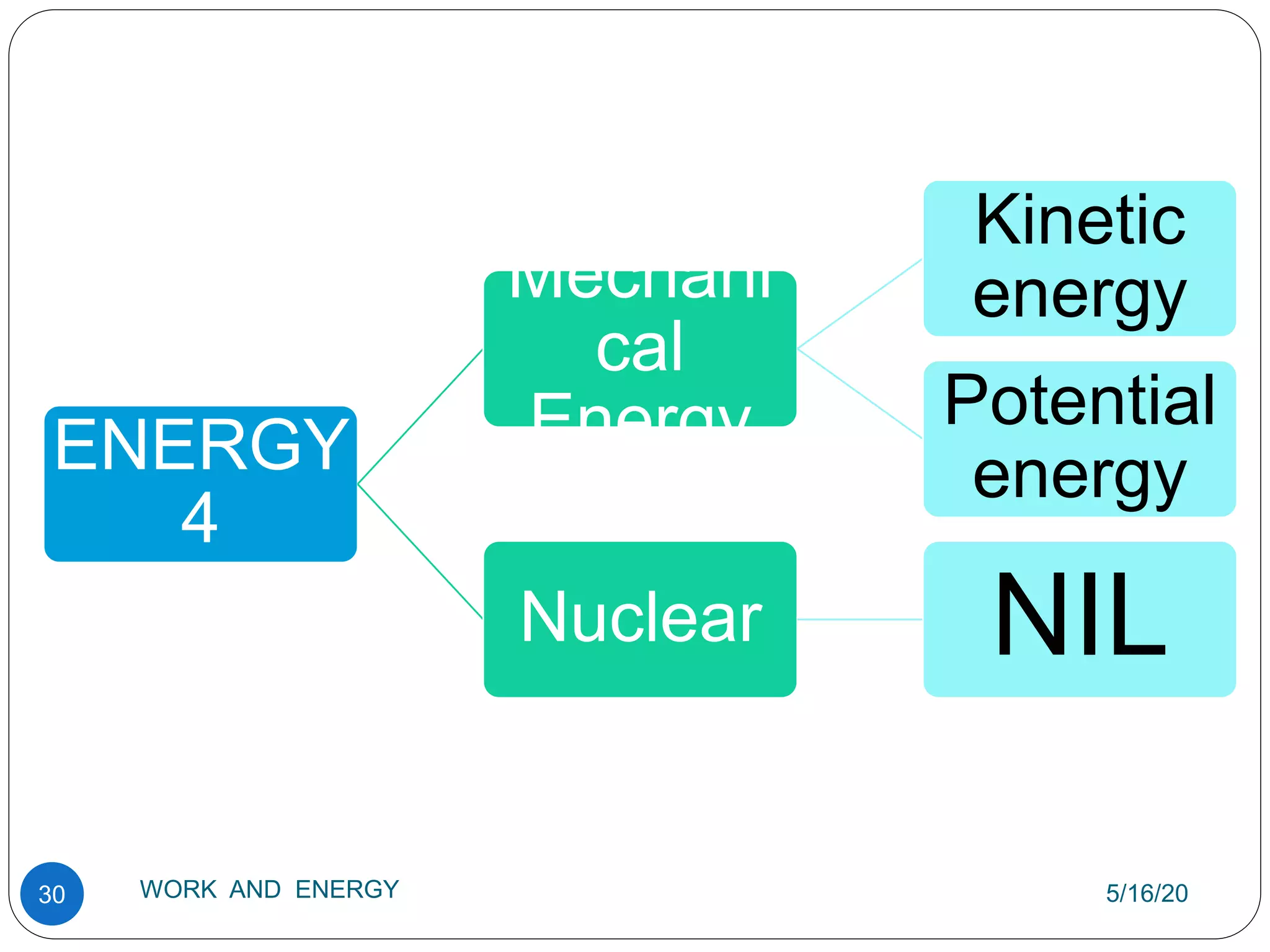
ENERGY
4
Mechani
cal
Energy
Kinetic
energy
Potential
energy
Nuclear NIL
5/16/20
WORK AND ENERGY
31
NUCLEAR ENERGY:- Nuclear power
is the use of nuclear reactions
that release nuclear energy to
generate heat, which most
frequently is then used in steam
turbines to produce electricity in
a nuclear power plant. Nuclear
power can be obtained from
nuclear fission, nuclear decay
and nuclear fusion reactions.
What is mechanical energy
5/16/20
WORK AND ENERGY
32
In physical sciences, mechanical energy
is the sum of potential energy and
kinetic energy. It is the macroscopic
energy associated with a system. The
principle of conservation of mechanical
energy states that in an isolated system
that is only subject to conservative
forces, the mechanical energy is
constant. There are two types of
mechanical energy KINETIC ENERGY
and POTENTIAL ENERGY.
MECHANICAL ENERGY
KINETIC ENERGY POTENTIAL ENERGY
5/16/20
WORK AND ENERGY
33
The energy
possessed by the
body by the virtue of
it’s motion is called
kinetic energy. An
object in motion
has the ability to do
work and hence
possesses kinetic
energy.
In physics, potential
energy is
the energy held by
an object because of
its position relative
to other objects,
stresses within
itself, its electric
charge, or other
factors.
KINETIC ENERGY
5/16/20
WORK AND ENERGY
34
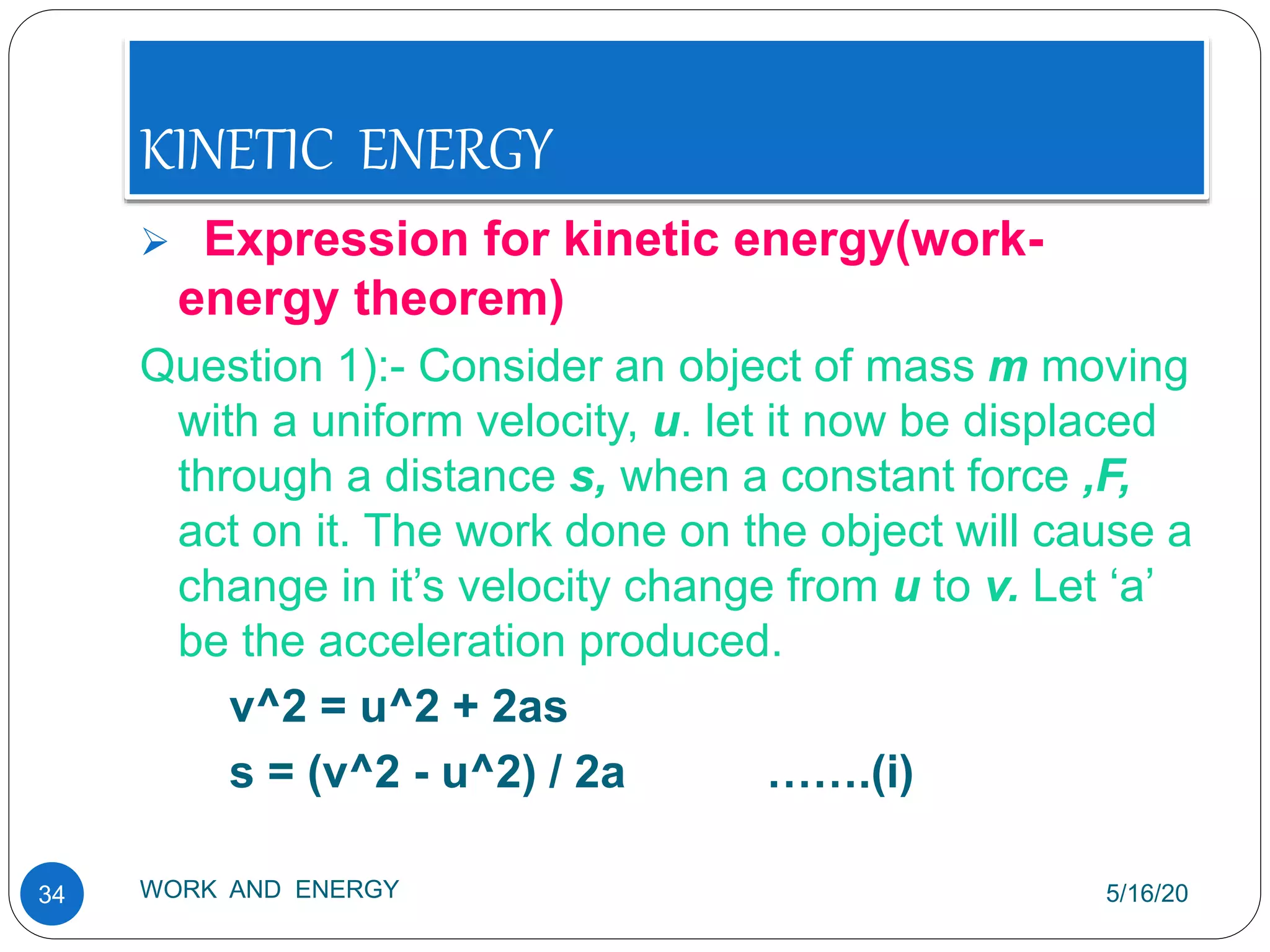
 Expression for kinetic energy(work-
energy theorem)
Question 1):- Consider an object of mass m moving
with a uniform velocity, u. let it now be displaced
through a distance s, when a constant force ,F,
act on it. The work done on the object will cause a
change in it’s velocity change from u to v. Let ‘a’
be the acceleration produced.
v^2 = u^2 + 2as
s = (v^2 - u^2) / 2a …….(i)
5/16/20
WORK AND ENERGY
35
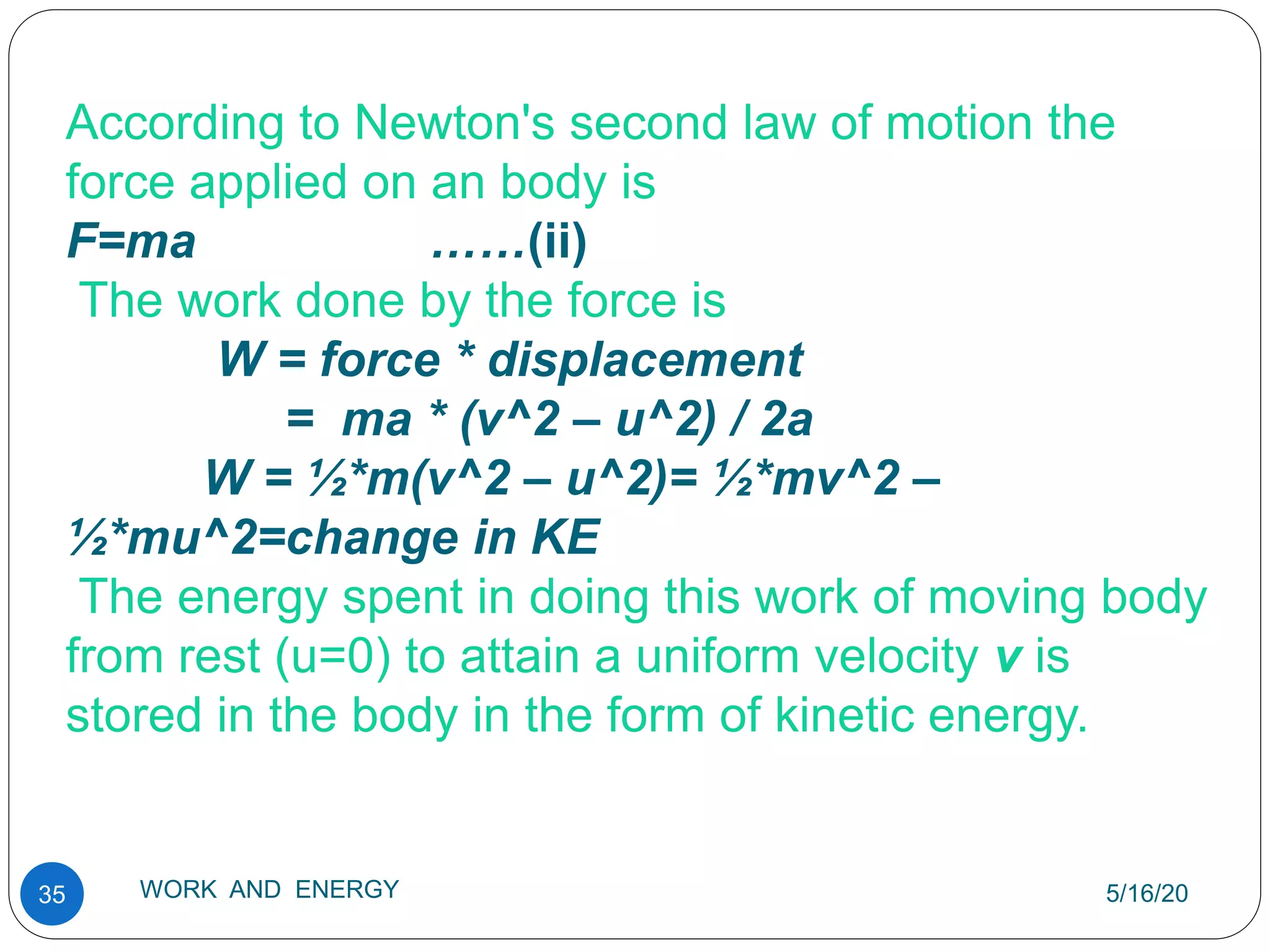
According to Newton's second law of motion the
force applied on an body is
F=ma ……(ii)
The work done by the force is
W = force * displacement
= ma * (v^2 – u^2) / 2a
W = ½*m(v^2 – u^2)= ½*mv^2 –
½*mu^2=change in KE
The energy spent in doing this work of moving body
from rest (u=0) to attain a uniform velocity v is
stored in the body in the form of kinetic energy.
5/16/20
WORK AND ENERGY
36
Therefore, work done = change in kinetic energy.
This is the work-energy theorem
So, K.E.=(1/2)*mv^2 …....(iii) [ when u= 0]
Potential energy
5/16/20
WORK AND ENERGY
37
The energy possessed by a body by the
virtue of it’s position or it’s configuration
is called potential energy. An object may
have the capacity of doing work as a
result of it’s position in a gravitational
field, an electric field or a magnetic field.
Potential energy may be positive or
negative. Potential energy is often
referred by stored energy. There are two
types of potential energy elastic
potential energy and gravitational
potential energy.
5/16/20
WORK AND ENERGY
38
ELASTIC POTENTIAL ENERGY
5/16/20
WORK AND ENERGY
39
 Elastic energy is the mechanical
potential energy stored in the
configuration of a material or
physical system as it is
subjected to elastic deformation
by work performed upon it.
Elastic energy occurs when
objects are impermanently
compressed, stretched or
5/16/20
WORK AND ENERGY
40
Some examples of elastic
potential energy.
•The coil spring of a wind-up clock.
•An archer's stretched bow.
•A bent diving board, just before a
divers jump.
•The twisted rubber band which
powers a toy airplane.
•A bouncy ball, compressed at the
moment it bounces off a brick wall.
GRAVITATIONAL POTENTIAL ENERGY
5/16/20
WORK AND ENERGY
41
In classical mechanics, the
gravitational potential at a
location is equal to the work
per unit mass that would be
needed to move an object to
that location from a fixed
reference location. It is
analogous to the electric
potential with mass playing
the role of charge
5/16/20
WORK AND ENERGY
42
 Some examples of gravitational
potential energy
(a) The work done to lift the
weight is stored in the mass-
Earth system as gravitational
potential energy.
(b) As the weight moves
downward, this gravitational
potential energy is transferred
5/16/20
WORK AND ENERGY
43
5/16/20
WORK AND ENERGY
44
5/16/20
WORK AND ENERGY
45
The change in one form of energy into
other is known as transformation of energy.
Examples:- When a piece of stone is thrown
upward. It’s kinetic energy start decreasing
and potential energy start increasing and when
the stone reaches at the maximum height of
it’s path, it’s kinetic becomes zero and it’s
potential energy becomes maximum. Thus at
the highest point, the total energy of the stone
will be only potential energy. So it can be
concluded that, “ when a body is thrown
upwards the kinetic energy of a body is
changed into potential energy.
5/16/20
WORK AND ENERGY
46
TRANSFORMATION OF ENERGY IN NATURE
5/16/20
WORK AND ENERGY
47
1. ENERGY OF WIND:- The sun heat causes
uneven heating of land and produces
different air pressure at different places.
These differences in air pressure produces
wind, having kinetic energy. Wind energy is
used to run wind mill.
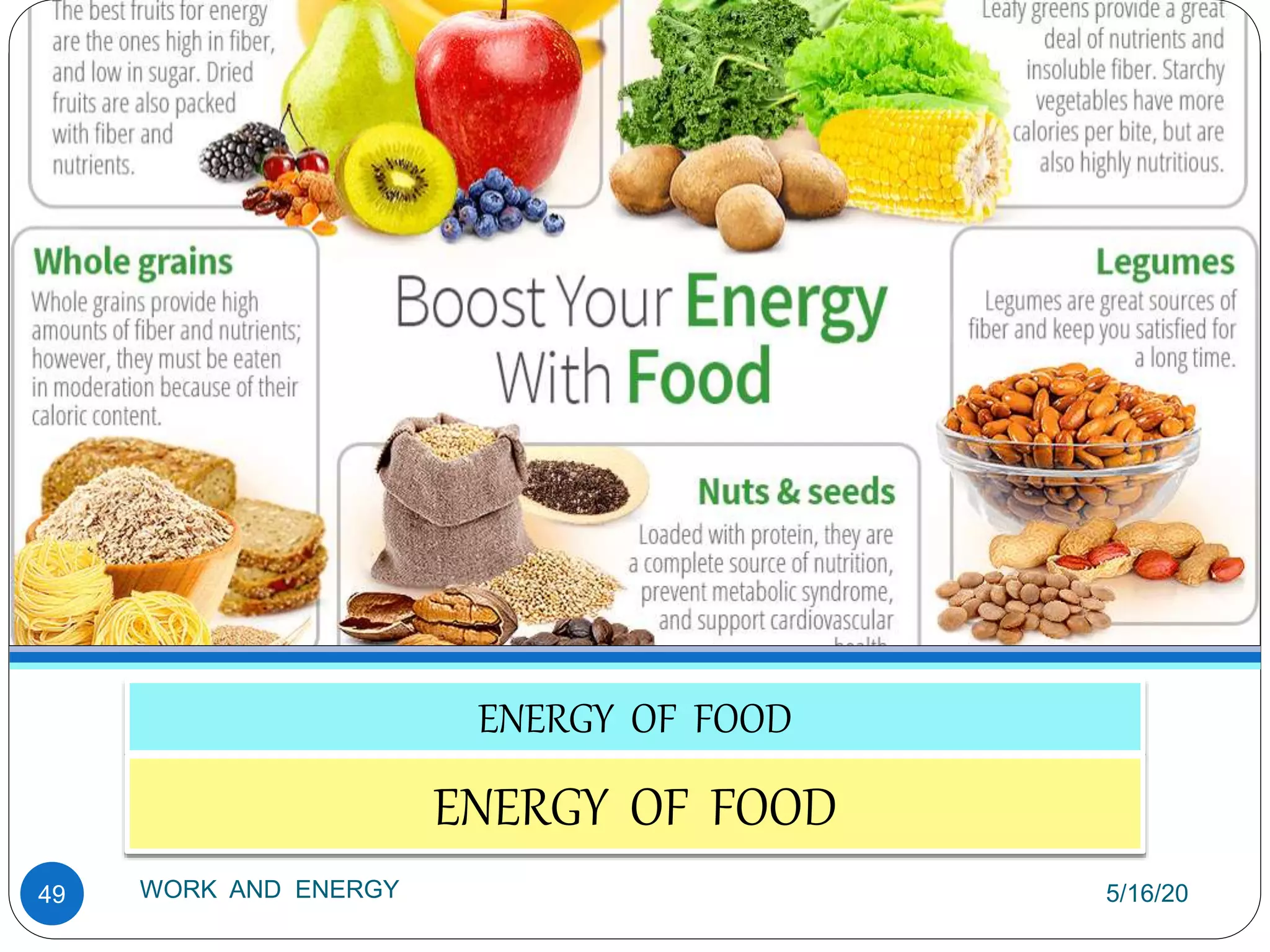
2. ENERGY OF FOOD:- The plants use the
sun energy to prepare food by the process
of photosynthesis. This energy gets stored in
food in the form of chemical energy. Humans
and animals eat these as food. This food
supplies energy to us. Muscular energy is
used by us to do work.
ENERGY OF WIND
ENERGY OF WIND
5/16/20
WORK AND ENERGY
48
ENERGY OF FOOD
ENERGY OF FOOD
5/16/20
WORK AND ENERGY
49
5/16/20
WORK AND ENERGY
50
3. ENERGY OF FOSSIL FUEL:- The dead plants
and animals buried under earth millions of years
ago have been converted into fossil fuel like coal,
petroleum, oil and natural gas. The energy of
fossil fuel have can be used to produce thermal
energy, electrical energy and mechanical energy.
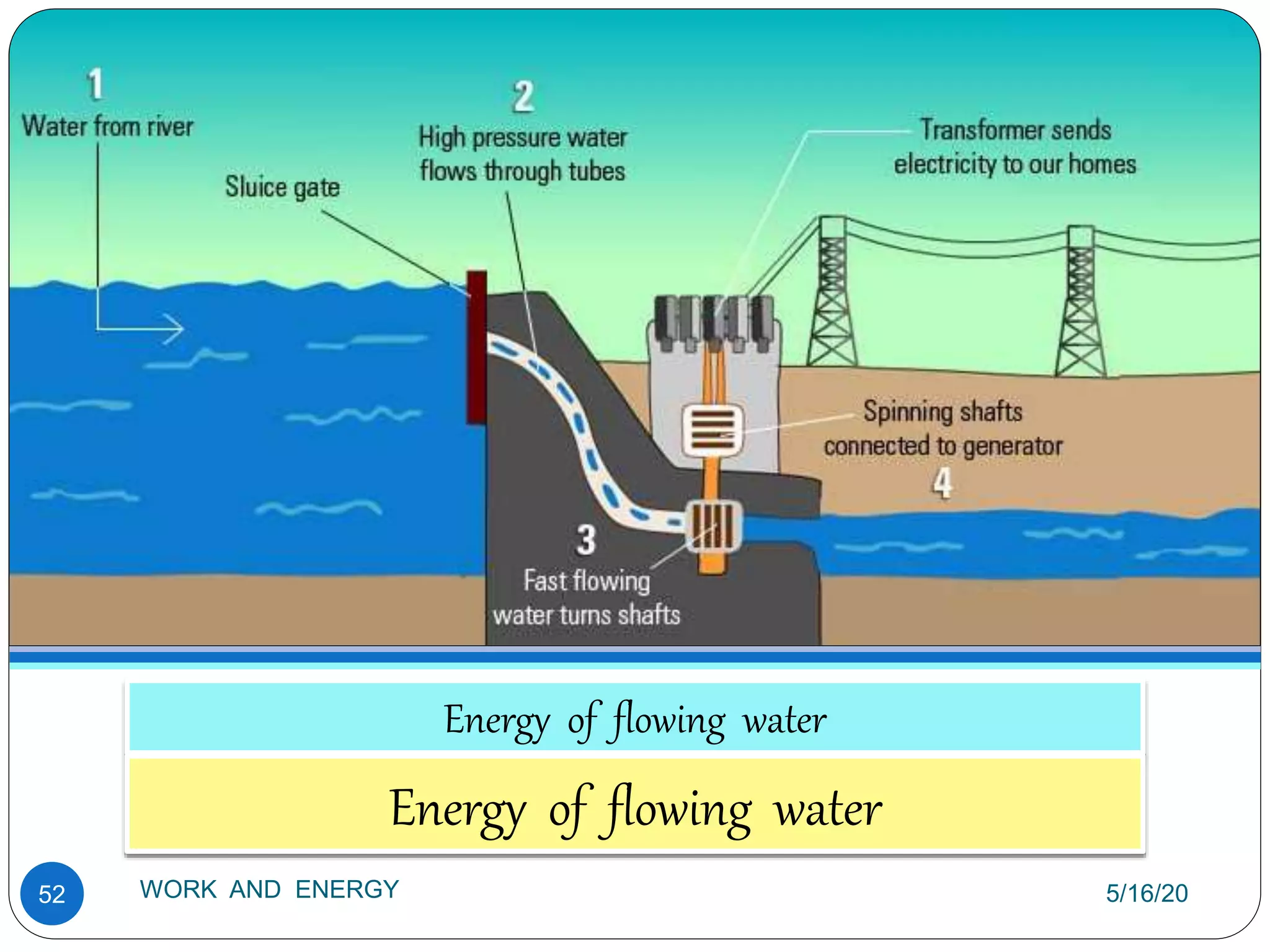
4. ENERGY OF FLOWING WATER:- The sun’s heat
energy causes water to evaporate from lakes,
rivers and oceans. The water vapours rise in the
air to form clouds. When this water falls back to
the earth in form of rain some amounts of this
stored in dam, it’s potential energy is converted
into kinetic energy which can be used to turn
turbine in the dams to generate electricity.
ENERGY OF FOSSIL FUEL
5/16/20
WORK AND ENERGY
51
Energy of flowing water
5/16/20
WORK AND ENERGY
52
5/16/20
WORK AND ENERGY
53
5/16/20
WORK AND ENERGY
54
According to the law of
conservation of energy,
energy neither be created
nor be destroyed. It can only
change from on to another
form. The total energy after
conversation will be same. It
is valid in all situation and
Verification of law of conservation of energy
5/16/20
WORK AND ENERGY
55
 Consider a body of mass m, allowed to fall
freely from a height h.
GROUND
h
x
( h-x)
A
B
C
5/16/20
WORK AND ENERGY
56
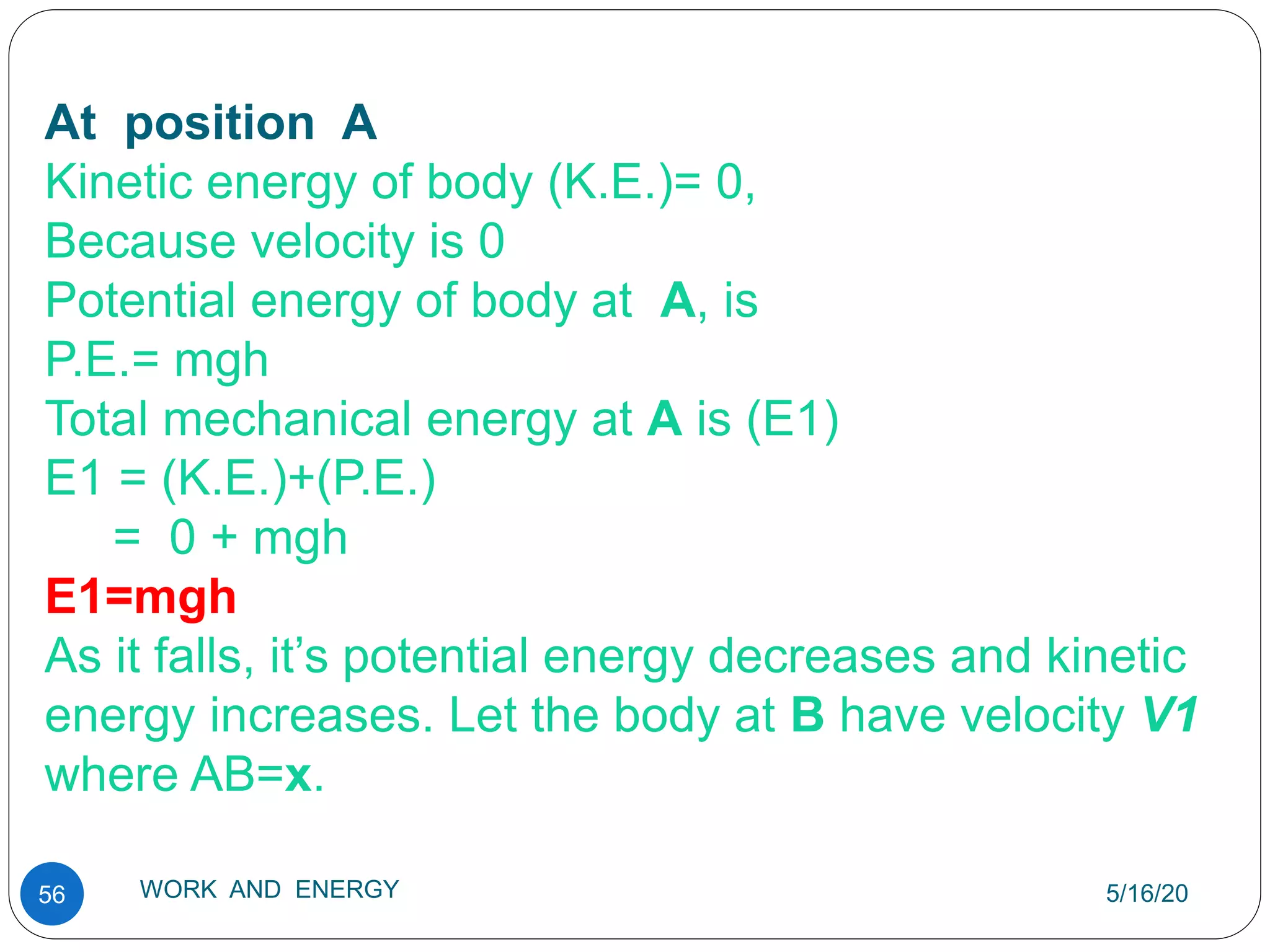
At position A
Kinetic energy of body (K.E.)= 0,
Because velocity is 0
Potential energy of body at A, is
P.E.= mgh
Total mechanical energy at A is (E1)
E1 = (K.E.)+(P.E.)
= 0 + mgh
E1=mgh
As it falls, it’s potential energy decreases and kinetic
energy increases. Let the body at B have velocity V1
where AB=x.
5/16/20
WORK AND ENERGY
57
v1^2=u^2 + 2as
v1^2=0+2gx
v1^2=2gx
At position B
Kinetic energy=(1/2)*mv1^2=(1/2)m*2gx=mgx
Potential energy=mg(h-x)
Total mechanical energy at B is (E2)
E2= K.E.+P.E.
= mgx+mg(h-x)
E2=mgh
When the body is about to reach the ground at C
with velocity v.
5/16/20
WORK AND ENERGY
58
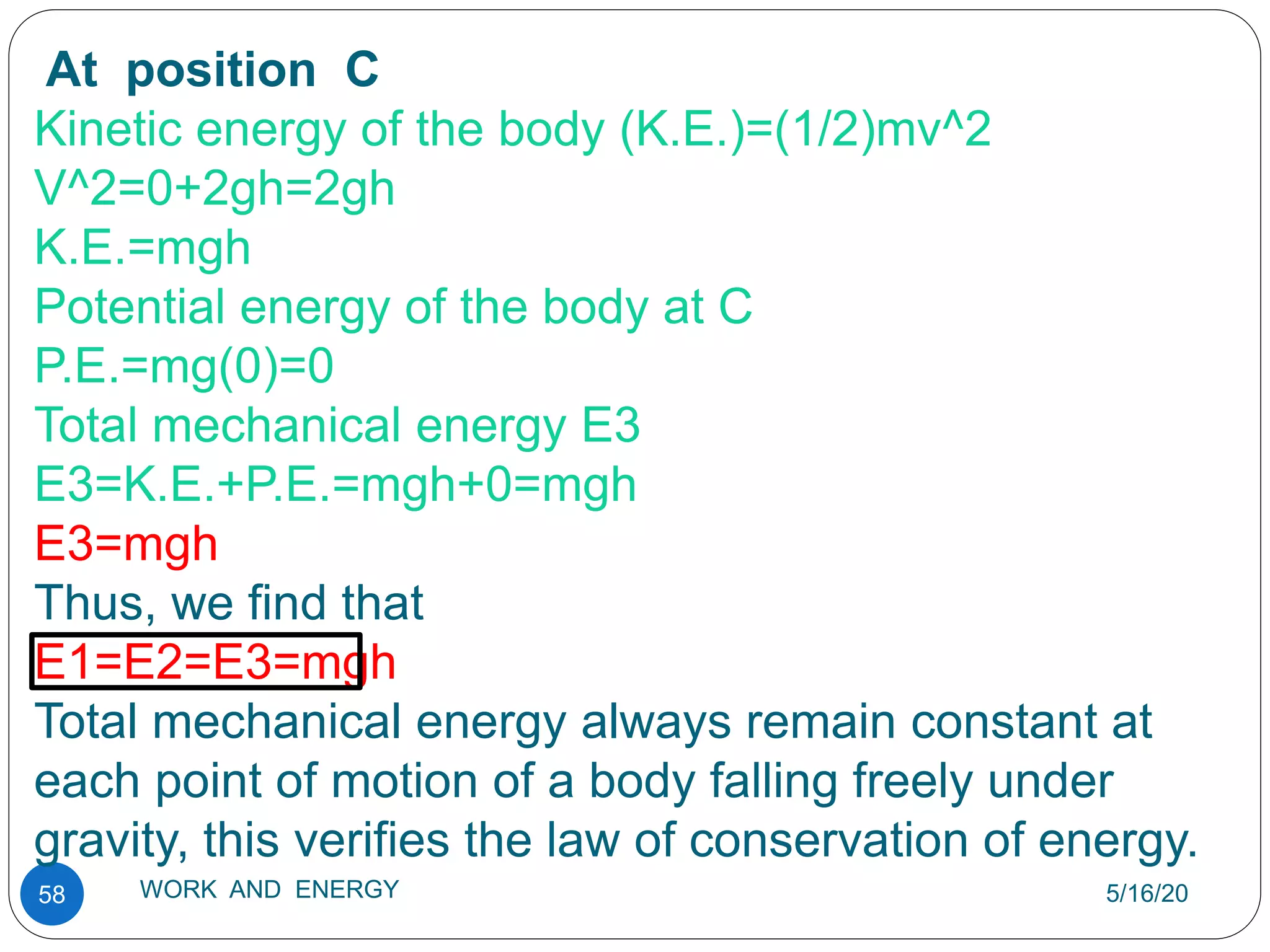
At position C
Kinetic energy of the body (K.E.)=(1/2)mv^2
V^2=0+2gh=2gh
K.E.=mgh
Potential energy of the body at C
P.E.=mg(0)=0
Total mechanical energy E3
E3=K.E.+P.E.=mgh+0=mgh
E3=mgh
Thus, we find that
E1=E2=E3=mgh
Total mechanical energy always remain constant at
each point of motion of a body falling freely under
gravity, this verifies the law of conservation of energy.
5/16/20
WORK AND ENERGY
59
CONCLUSION:-
As the body falls it’s potential energy decreases and
kinetic energy increases. The potential energy gets
converted into kinetic energy.
AT A:- The energy of the body is entirely potential
AT B:- The energy is partly kinetic and partly
potential. But total mechanical energy remains
constant.
AT C:- The energy is entirely kinetic, potential energy
is zero but total mechanical energy remains constant.
i.e.… K.E.+P.E.=Constant.
5/16/20
WORK AND ENERGY
60
5/16/20
WORK AND ENERGY
61
The definition of work say nothing
about how long it takes to do the work.
The same amount of work is done
when carrying up a load on stairs,
whether we walk up or ran up. So, why
we tired more after running up stairs in
a few second than after walking
upstairs in a few minutes? To
understand this difference we need to
talk about a measure of how fast the
work is done- power. Power is equal to
the amount of work done per unit time
5/16/20
WORK AND ENERGY
62
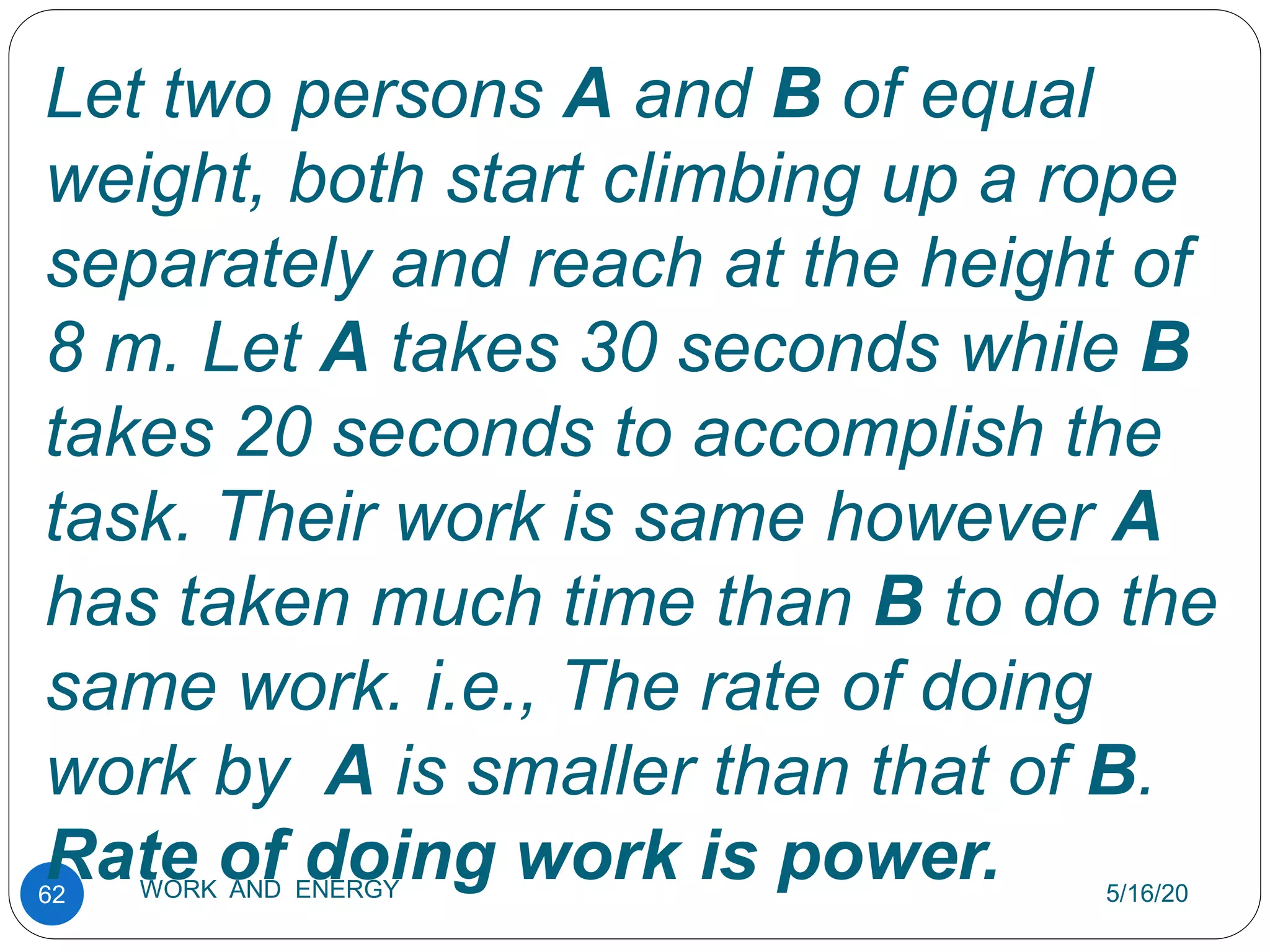
Let two persons A and B of equal
weight, both start climbing up a rope
separately and reach at the height of
8 m. Let A takes 30 seconds while B
takes 20 seconds to accomplish the
task. Their work is same however A
has taken much time than B to do the
same work. i.e., The rate of doing
work by A is smaller than that of B.
Rate of doing work is power.
5/16/20
WORK AND ENERGY
63
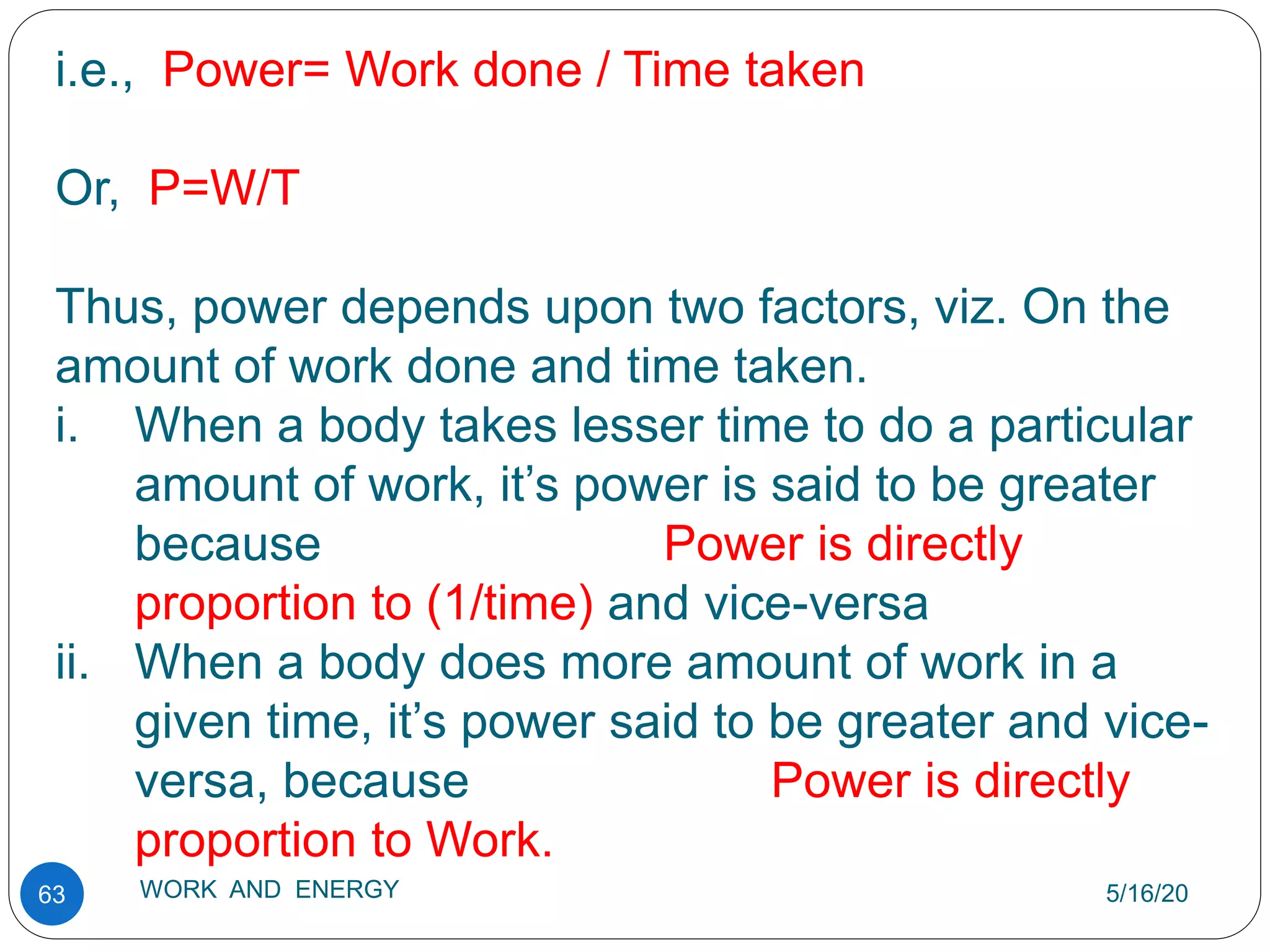
i.e., Power= Work done / Time taken
Or, P=W/T
Thus, power depends upon two factors, viz. On the
amount of work done and time taken.
i. When a body takes lesser time to do a particular
amount of work, it’s power is said to be greater
because Power is directly
proportion to (1/time) and vice-versa
ii. When a body does more amount of work in a
given time, it’s power said to be greater and vice-
versa, because Power is directly
proportion to Work.
Power in terms of energy
5/16/20
WORK AND ENERGY
64
As we know that energy is the ability of a body
to do work and power is the rate of doing
work. Thus, for doing particular work, an equal
amount of energy is required
Therefore,
Work done = Energy transferred
=> Power =(Energy transferred/Time
taken)= E/T
So, the rate of energy transferred by a body is
also called it’s power.
Average power
5/16/20
WORK AND ENERGY
65
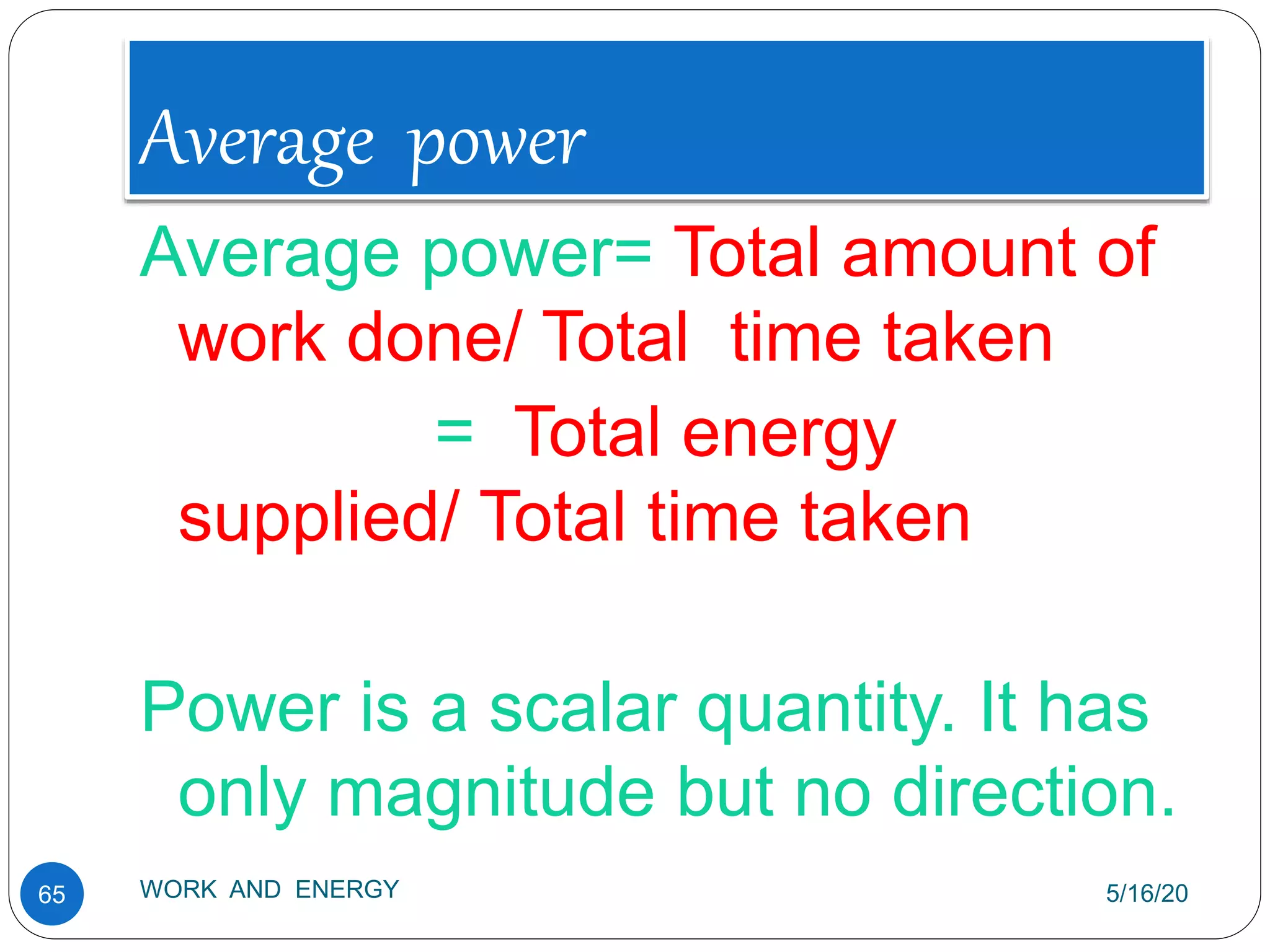
Average power= Total amount of
work done/ Total time taken
= Total energy
supplied/ Total time taken
Power is a scalar quantity. It has
only magnitude but no direction.
Units of power
5/16/20
WORK AND ENERGY
66
Work is measured in ‘joule’ and
time is measured in ‘seconds’.
So, unit of power is joule per
second. This unit of power is
called ‘watt’.
i.e., 1 watt = 1 joule/1 second
One watt is a power of an agent
which does work at the rate:- 1
joule / second.
The bigger units of power are :
1 kilowatt=1000 watt or 1kW
commercial unit of energy
5/16/20
WORK AND ENERGY
67
Kilowatt hour (kWh) or 1 unit
The electrical energy used in
household, industries and
commercial establishment are
usually expressed in kilowatt
hour.
1 kWh is the energy used in 1
hour at rate of 1000 J/s or
5/16/20
WORK AND ENERGY
68
1kWh = 1kW * 1h
= 1000 W * 3600
s
= 3600000 J
1kWh = 3.6 * 10^6 J
1 unit = 1 kilowatt
hour
5/16/20
WORK AND ENERGY
69
5/16/20
WORK AND ENERGY
70
5/16/20
WORK AND ENERGY
71
5/16/20
WORK AND ENERGY
72

Work and energy

  • 1.
    •Name:- Ojaswa Maurya •Class:- 9th C •Roll no:- 33 •School:- Kendriya Vidyalya Ambernath Work and energy
  • 2.
    Topics covered inthis chapter  Concept of Work  Factors on Which Amount of Work Done Depends.  Work Done by a Constant Force.  Unit of Work.  Work Done Against Gravitational Force.  Nature of Work  Positive Work .  Negative Work .  Zero Work . 5/16/20 2 WORK AND ENERGY
  • 3.
    Forms of Energy •Transformationof Energy  Transformation of Energy in Nature •Law of Conservation of Energy  Verification of law of Conservation of Energy •Rate of Doing Work : Power  Power in Terms of Energy Average Power Units of Power Commercial Unit of Energy •ENERGY 5/16/20 3 WORK AND ENERGY
  • 4.
    5/16/20 4 WORK ANDENERGY Note :- In layman language the word “Work” means any physical or mental activity that we do in our daily life.
  • 5.
    What is work? 5/16/20 WORK AND ENERGY 5 ANS:- Work is a physical quantity in which some conditions are needed to be satisfied for it to be done. To understand it’s concept let’s take a example. :- A book on table when you push it , it move change it’s state and direction.
  • 6.
    FACTORS ON WHICHAMOUNT OF WORK DEPENDS 5/16/20 WORK AND ENERGY 6 1. Magnitude of force applied on a body. W is directly proportion to F 2. Displacement of body. W is directly proportion to s 3. Work done is also depends angle of between force and displacement. W is directly proportion to FSCOSt Note:- W = work s= displacement F = force t= theta
  • 7.
    Work done byconstant force 5/16/20 WORK AND ENERGY 7  A constant force F acting on a body produces displacement s in the direction of the force, work done W by this, force is equal to the product force and the displacement. W = Fs As displacement is in direction of the applied force => t = 0°=> COS0°=1
  • 8.
    5/16/20 WORK AND ENERGY 8 •A constant retarding force F acting on a body moving with a uniform velocity along a particular direction. The body will stop after covering certain displacement s. In this situation the applied force is opposing the motion of the body , applied force F is taken as negative. W=(-Fs) Negative sign represent that the work is done by retarding force CONCLUSION:- “Work is said to be done by a force when a force is applied on a body and body gets displaced due to the action of applied force.”
  • 9.
    UNIT OF WORK 5/16/20 WORKAND ENERGY 9  The SI unit of force is Newton (N) and that of displacement is meter (m). So the SI unit of work is Newton meter which is written as Nm. This unit is called joule (J) In the honor of a British scientist, James Prescott Joule. If F=1N,s=1m then W=1N*1m=1Nm Thus, 1 joule is the amount of work done on an object when force of 1N displaces it by 1m in the direction of force applied . 1J=1Nm
  • 10.
    Work done againstgravitational force 5/16/20 WORK AND ENERGY 10  If we lift a bucket from ground, we do work against gravitational force. When a body is lifted vertically upwards the force required to lift the body is equal to it’s weight. Thus, “whenever work is done against gravity, then amount of work done is equal to product of the weight of the body and vertical distance through which the body is lifted”.
  • 11.
    5/16/20 WORK AND ENERGY 11 Leta body of mass m be lifted vertically upwards through a height h. Here the force required to lift the body will be equal to weight of the body (mg), where g is acceleration due to gravity. Then work done in lifting of the body W= weight of the body * vertical distance W=(mg)(h)
  • 12.
  • 13.
    POSITVE WORK 5/16/20 WORK ANDENERGY 13 Work done is said to be positive if the force applied on an object and it’s displacement are in the same direction or angel or angel between the force and displacement of the object is less than 90 degree (theta < 90 degree). Illustration 1:- when a lawn mower is pushed by applying force along the handle at an acute angle, work done by the applied force is positive as shown in the figure.
  • 14.
    5/16/20 WORK AND ENERGY 14 Illustration2:- When a body falls under the action of gravity, angle between the force and displacement is zero, t=0. therefore the work done by the body is positive. s
  • 15.
    Negative work 5/16/20 WORK ANDENERGY 15  Work done is said to be negative if the applied force on an object and it’s direction of motion is opposite or component for the applied force and direction of motion should be obtuse (theta > 90 degree). Example:- A bucket is pulled upward by a force F and it moves some distance s vertically upward. But the force of gravity always acts in the downward direction. Then work done by the gravity is given by. W=( -Fs)
  • 16.
    5/16/20 WORK AND ENERGY 16 Illustration1:-When a body is displaced by distance d vertically upwards, its motion is opposed by the gravity. In this case angel between weight and displacement theta=180 degree. Work done by gravity The motion is opposed by gravity, In this case angel between weight and displacement, theta=180 degree because the gravitational force displacement are in opposite direction. W=(-Fs ) Thus, work done is negative.
  • 17.
    5/16/20 WORK AND ENERGY 17 Workdone by applied force In this case, angel between applied force and displacement, theta=0 degree, because the applied force and displacement are in same direction. W=Fs Thus, work done by the applied force is positive Work done by the gravity is negative while work done by the applied force is positive.
  • 18.
    ZERO WORK 5/16/20 WORK ANDENERGY 18  Work done will be 0 if a. Force acting is zero b. Displacement is 0 c. Angel between applied force on an object and it’s displacement is 90 degree Illustration1:- When a body is tied to one end of a string and is moved in a circular path, work done by the centripetal force is zero. Because, force is always perpendicular to the displacement of the body.
  • 19.
    5/16/20 WORK AND ENERGY 19 Illustration2:- Work done by tension in the string of a simple pendulum is zero. Because, tension is always perpendicular to the displacement of the bob.
  • 20.
  • 21.
    What is energy? 5/16/20 WORK AND ENERGY 21  Energy of a body is defined as the capacity or ability of the body to do work. The amount of energy possessed by a body is equal to the amount of work it can do when its energy is released. Note:- More the amount of energy possessed by a body, more the amount of work it can do an vice versa. Energy is a scalar quantity. It has only magnitude but no direction.
  • 22.
  • 23.
    Unit of energy 5/16/20 WORKAND ENERGY 23  As we know that, energy possessed by a body is measured in terms of ability of the body to do work. Therefore, the S.I unit of energy is the same as the unit of work i.e. joule. 1 joule is the energy required to do 1 joule of work. larger unit is KJ 1KJ=1000 J Smaller unit of energy is eV ( electron volt) 1eV=1.6*10^(-9) J CGS unit of energy is 1J=10^7 erg
  • 24.
    FORMS OF ENERGY 5/16/20 WORKAND ENERGY 24 ENERGY HEAT ENERG Y NIL NIL LIGHT ENERG Y NIL
  • 25.
    5/16/20 WORK AND ENERGY 25 HEATENERGY:- Heat can be defined as the form of energy that is transferred between two points . EXAMPLE:- • Steam of water • Car engine LIGHT ENERGY:- Light is also form of energy to prove that let’s take example plant make their own food with the help of light energy or when light energy falls on photographic plate it cause a chemical reaction and hence image are recorded in
  • 26.
  • 27.
    5/16/20 WORK AND ENERGY 27 ELECTRICALENERGY:- Electrical energy is a form of energy resulting from the flow of electric charge. Energy is the ability to do work or apply force to move an object. In the case of electrical energy, the force is electrical attraction or repulsion between charged particles. CHEMICAL ENERGY:- Chemical energy is energy stored in the bonds of chemical compounds, like atoms and molecules. This energy is released when a chemical reaction takes place. Usually, once chemical energy has been released from a
  • 28.
    5/16/20 WORK AND ENERGY 28 ENERG Y3 SOUND ENERGY NIL NIL Magnetic Energy NIL
  • 29.
    5/16/20 WORK AND ENERGY 29 •SOUND ENERGY:- In physics, sound energy is a form of energy that can be heard by humans. Sound is a mechanical wave and as such consists physically in oscillatory elastic compression and in oscillatory displacement of a fluid. Therefore, the medium acts as storage for both potential and kinetic energy. • MEGNETIC ENERGY:- Magnetic energy and electrostatic potential energy are related by Maxwell's equations. The potential energy of a magnet of magnetic moment in a magnetic field is defined as the mechanical work of the
  • 30.
  • 31.
    5/16/20 WORK AND ENERGY 31 NUCLEARENERGY:- Nuclear power is the use of nuclear reactions that release nuclear energy to generate heat, which most frequently is then used in steam turbines to produce electricity in a nuclear power plant. Nuclear power can be obtained from nuclear fission, nuclear decay and nuclear fusion reactions.
  • 32.
    What is mechanicalenergy 5/16/20 WORK AND ENERGY 32 In physical sciences, mechanical energy is the sum of potential energy and kinetic energy. It is the macroscopic energy associated with a system. The principle of conservation of mechanical energy states that in an isolated system that is only subject to conservative forces, the mechanical energy is constant. There are two types of mechanical energy KINETIC ENERGY and POTENTIAL ENERGY.
  • 33.
    MECHANICAL ENERGY KINETIC ENERGYPOTENTIAL ENERGY 5/16/20 WORK AND ENERGY 33 The energy possessed by the body by the virtue of it’s motion is called kinetic energy. An object in motion has the ability to do work and hence possesses kinetic energy. In physics, potential energy is the energy held by an object because of its position relative to other objects, stresses within itself, its electric charge, or other factors.
  • 34.
    KINETIC ENERGY 5/16/20 WORK ANDENERGY 34  Expression for kinetic energy(work- energy theorem) Question 1):- Consider an object of mass m moving with a uniform velocity, u. let it now be displaced through a distance s, when a constant force ,F, act on it. The work done on the object will cause a change in it’s velocity change from u to v. Let ‘a’ be the acceleration produced. v^2 = u^2 + 2as s = (v^2 - u^2) / 2a …….(i)
  • 35.
    5/16/20 WORK AND ENERGY 35 Accordingto Newton's second law of motion the force applied on an body is F=ma ……(ii) The work done by the force is W = force * displacement = ma * (v^2 – u^2) / 2a W = ½*m(v^2 – u^2)= ½*mv^2 – ½*mu^2=change in KE The energy spent in doing this work of moving body from rest (u=0) to attain a uniform velocity v is stored in the body in the form of kinetic energy.
  • 36.
    5/16/20 WORK AND ENERGY 36 Therefore,work done = change in kinetic energy. This is the work-energy theorem So, K.E.=(1/2)*mv^2 …....(iii) [ when u= 0]
  • 37.
    Potential energy 5/16/20 WORK ANDENERGY 37 The energy possessed by a body by the virtue of it’s position or it’s configuration is called potential energy. An object may have the capacity of doing work as a result of it’s position in a gravitational field, an electric field or a magnetic field. Potential energy may be positive or negative. Potential energy is often referred by stored energy. There are two types of potential energy elastic potential energy and gravitational potential energy.
  • 38.
  • 39.
    ELASTIC POTENTIAL ENERGY 5/16/20 WORKAND ENERGY 39  Elastic energy is the mechanical potential energy stored in the configuration of a material or physical system as it is subjected to elastic deformation by work performed upon it. Elastic energy occurs when objects are impermanently compressed, stretched or
  • 40.
    5/16/20 WORK AND ENERGY 40 Someexamples of elastic potential energy. •The coil spring of a wind-up clock. •An archer's stretched bow. •A bent diving board, just before a divers jump. •The twisted rubber band which powers a toy airplane. •A bouncy ball, compressed at the moment it bounces off a brick wall.
  • 41.
    GRAVITATIONAL POTENTIAL ENERGY 5/16/20 WORKAND ENERGY 41 In classical mechanics, the gravitational potential at a location is equal to the work per unit mass that would be needed to move an object to that location from a fixed reference location. It is analogous to the electric potential with mass playing the role of charge
  • 42.
    5/16/20 WORK AND ENERGY 42 Some examples of gravitational potential energy (a) The work done to lift the weight is stored in the mass- Earth system as gravitational potential energy. (b) As the weight moves downward, this gravitational potential energy is transferred
  • 43.
  • 44.
  • 45.
    5/16/20 WORK AND ENERGY 45 Thechange in one form of energy into other is known as transformation of energy. Examples:- When a piece of stone is thrown upward. It’s kinetic energy start decreasing and potential energy start increasing and when the stone reaches at the maximum height of it’s path, it’s kinetic becomes zero and it’s potential energy becomes maximum. Thus at the highest point, the total energy of the stone will be only potential energy. So it can be concluded that, “ when a body is thrown upwards the kinetic energy of a body is changed into potential energy.
  • 46.
  • 47.
    TRANSFORMATION OF ENERGYIN NATURE 5/16/20 WORK AND ENERGY 47 1. ENERGY OF WIND:- The sun heat causes uneven heating of land and produces different air pressure at different places. These differences in air pressure produces wind, having kinetic energy. Wind energy is used to run wind mill. 2. ENERGY OF FOOD:- The plants use the sun energy to prepare food by the process of photosynthesis. This energy gets stored in food in the form of chemical energy. Humans and animals eat these as food. This food supplies energy to us. Muscular energy is used by us to do work.
  • 48.
    ENERGY OF WIND ENERGYOF WIND 5/16/20 WORK AND ENERGY 48
  • 49.
    ENERGY OF FOOD ENERGYOF FOOD 5/16/20 WORK AND ENERGY 49
  • 50.
    5/16/20 WORK AND ENERGY 50 3.ENERGY OF FOSSIL FUEL:- The dead plants and animals buried under earth millions of years ago have been converted into fossil fuel like coal, petroleum, oil and natural gas. The energy of fossil fuel have can be used to produce thermal energy, electrical energy and mechanical energy. 4. ENERGY OF FLOWING WATER:- The sun’s heat energy causes water to evaporate from lakes, rivers and oceans. The water vapours rise in the air to form clouds. When this water falls back to the earth in form of rain some amounts of this stored in dam, it’s potential energy is converted into kinetic energy which can be used to turn turbine in the dams to generate electricity.
  • 51.
    ENERGY OF FOSSILFUEL ENERGY OF FOSSIL FUEL 5/16/20 WORK AND ENERGY 51
  • 52.
    Energy of flowingwater Energy of flowing water 5/16/20 WORK AND ENERGY 52
  • 53.
  • 54.
    5/16/20 WORK AND ENERGY 54 Accordingto the law of conservation of energy, energy neither be created nor be destroyed. It can only change from on to another form. The total energy after conversation will be same. It is valid in all situation and
  • 55.
    Verification of lawof conservation of energy 5/16/20 WORK AND ENERGY 55  Consider a body of mass m, allowed to fall freely from a height h. GROUND h x ( h-x) A B C
  • 56.
    5/16/20 WORK AND ENERGY 56 Atposition A Kinetic energy of body (K.E.)= 0, Because velocity is 0 Potential energy of body at A, is P.E.= mgh Total mechanical energy at A is (E1) E1 = (K.E.)+(P.E.) = 0 + mgh E1=mgh As it falls, it’s potential energy decreases and kinetic energy increases. Let the body at B have velocity V1 where AB=x.
  • 57.
    5/16/20 WORK AND ENERGY 57 v1^2=u^2+ 2as v1^2=0+2gx v1^2=2gx At position B Kinetic energy=(1/2)*mv1^2=(1/2)m*2gx=mgx Potential energy=mg(h-x) Total mechanical energy at B is (E2) E2= K.E.+P.E. = mgx+mg(h-x) E2=mgh When the body is about to reach the ground at C with velocity v.
  • 58.
    5/16/20 WORK AND ENERGY 58 Atposition C Kinetic energy of the body (K.E.)=(1/2)mv^2 V^2=0+2gh=2gh K.E.=mgh Potential energy of the body at C P.E.=mg(0)=0 Total mechanical energy E3 E3=K.E.+P.E.=mgh+0=mgh E3=mgh Thus, we find that E1=E2=E3=mgh Total mechanical energy always remain constant at each point of motion of a body falling freely under gravity, this verifies the law of conservation of energy.
  • 59.
    5/16/20 WORK AND ENERGY 59 CONCLUSION:- Asthe body falls it’s potential energy decreases and kinetic energy increases. The potential energy gets converted into kinetic energy. AT A:- The energy of the body is entirely potential AT B:- The energy is partly kinetic and partly potential. But total mechanical energy remains constant. AT C:- The energy is entirely kinetic, potential energy is zero but total mechanical energy remains constant. i.e.… K.E.+P.E.=Constant.
  • 60.
  • 61.
    5/16/20 WORK AND ENERGY 61 Thedefinition of work say nothing about how long it takes to do the work. The same amount of work is done when carrying up a load on stairs, whether we walk up or ran up. So, why we tired more after running up stairs in a few second than after walking upstairs in a few minutes? To understand this difference we need to talk about a measure of how fast the work is done- power. Power is equal to the amount of work done per unit time
  • 62.
    5/16/20 WORK AND ENERGY 62 Lettwo persons A and B of equal weight, both start climbing up a rope separately and reach at the height of 8 m. Let A takes 30 seconds while B takes 20 seconds to accomplish the task. Their work is same however A has taken much time than B to do the same work. i.e., The rate of doing work by A is smaller than that of B. Rate of doing work is power.
  • 63.
    5/16/20 WORK AND ENERGY 63 i.e.,Power= Work done / Time taken Or, P=W/T Thus, power depends upon two factors, viz. On the amount of work done and time taken. i. When a body takes lesser time to do a particular amount of work, it’s power is said to be greater because Power is directly proportion to (1/time) and vice-versa ii. When a body does more amount of work in a given time, it’s power said to be greater and vice- versa, because Power is directly proportion to Work.
  • 64.
    Power in termsof energy 5/16/20 WORK AND ENERGY 64 As we know that energy is the ability of a body to do work and power is the rate of doing work. Thus, for doing particular work, an equal amount of energy is required Therefore, Work done = Energy transferred => Power =(Energy transferred/Time taken)= E/T So, the rate of energy transferred by a body is also called it’s power.
  • 65.
    Average power 5/16/20 WORK ANDENERGY 65 Average power= Total amount of work done/ Total time taken = Total energy supplied/ Total time taken Power is a scalar quantity. It has only magnitude but no direction.
  • 66.
    Units of power 5/16/20 WORKAND ENERGY 66 Work is measured in ‘joule’ and time is measured in ‘seconds’. So, unit of power is joule per second. This unit of power is called ‘watt’. i.e., 1 watt = 1 joule/1 second One watt is a power of an agent which does work at the rate:- 1 joule / second. The bigger units of power are : 1 kilowatt=1000 watt or 1kW
  • 67.
    commercial unit ofenergy 5/16/20 WORK AND ENERGY 67 Kilowatt hour (kWh) or 1 unit The electrical energy used in household, industries and commercial establishment are usually expressed in kilowatt hour. 1 kWh is the energy used in 1 hour at rate of 1000 J/s or
  • 68.
    5/16/20 WORK AND ENERGY 68 1kWh= 1kW * 1h = 1000 W * 3600 s = 3600000 J 1kWh = 3.6 * 10^6 J 1 unit = 1 kilowatt hour
  • 69.
  • 70.
  • 71.
  • 72.