Electromagnetic Waves
Learning Objectives
a) State that all electromagnetic waves are transverse waves that travel with
the same speed in vacuum and state the magnitude of this speed
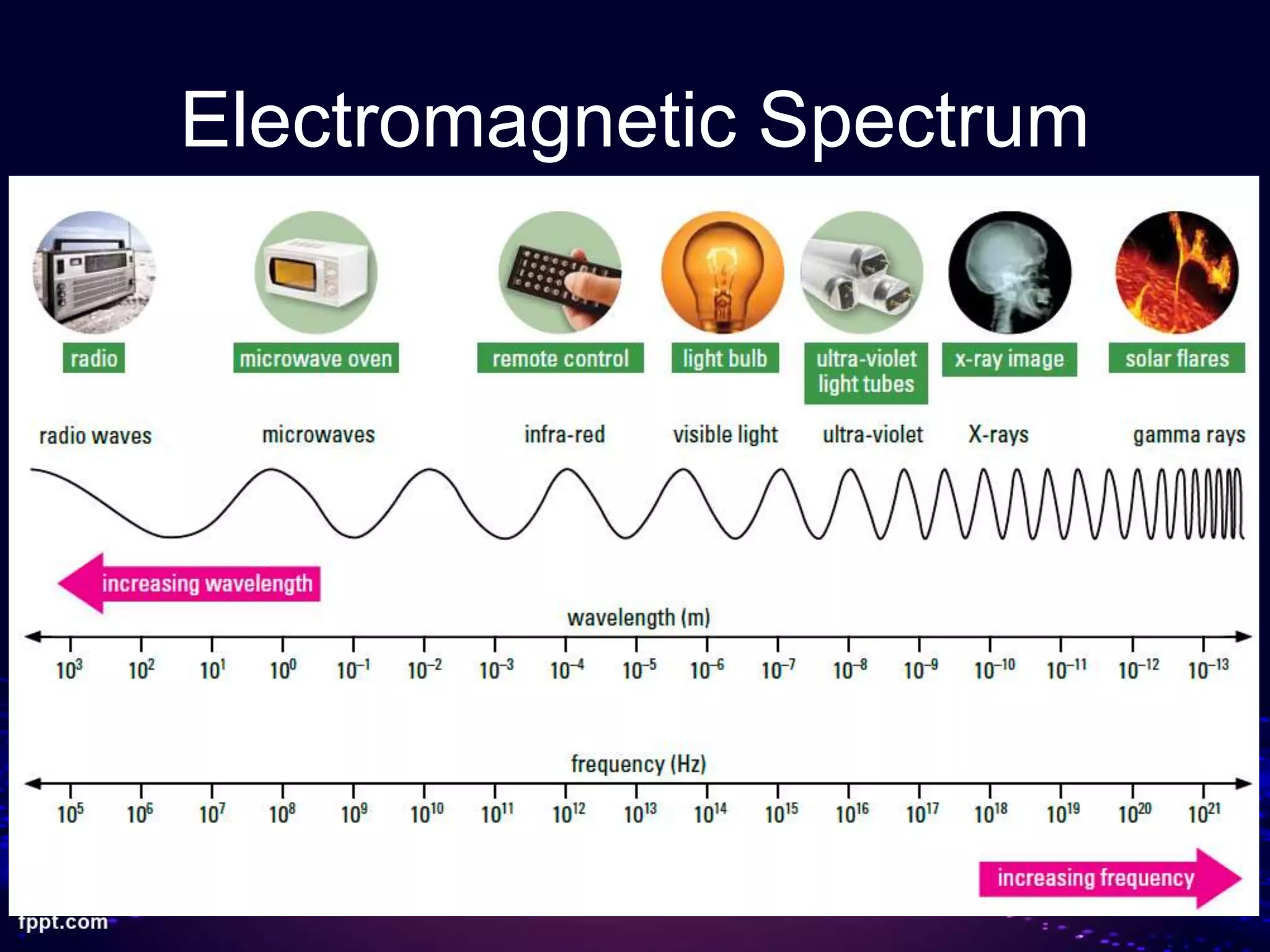
b) Describe the main components of the electromagnetic spectrum
c) State examples of the use of the following components:
i. radiowaves (e.g. radio and television communication)
ii. microwaves (e.g. microwave oven and satellite television)
iii. infra-red (e.g. infra-red remote controllers and intruder alarms)
iv. light (e.g. optical fibres for medical uses and telecommunications)
v. ultra-violet (e.g. sunbeds and sterilisation)
vi. X-rays (e.g. radiological and engineering applications)
vii. gamma rays (e.g. medical treatment)
d) describe the effects of absorbing electromagnetic waves, e.g. heating,
ionisation and damage to living cells and tissue
Electromagnetic Spectrum
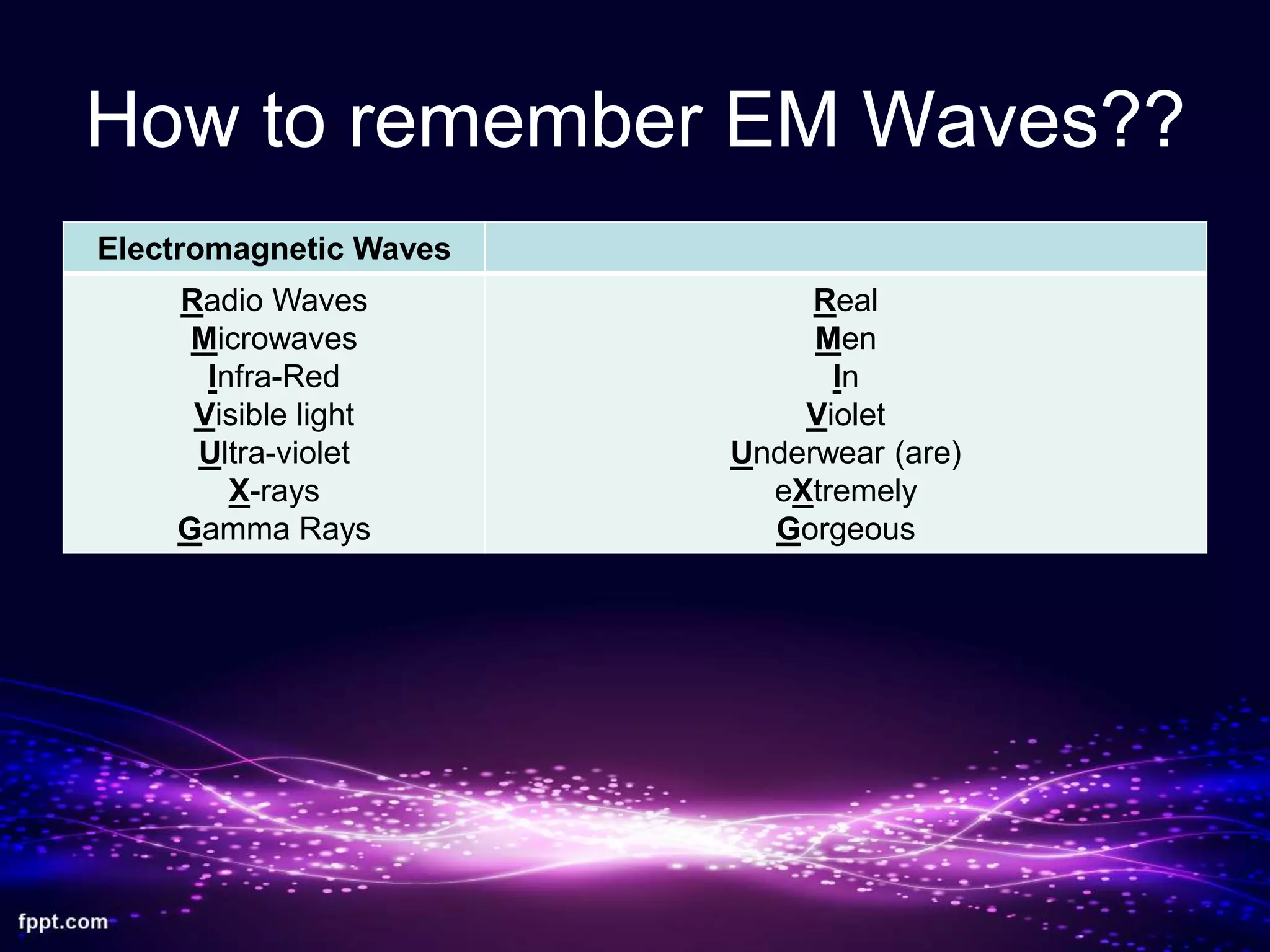
How to remember EM Waves??
Electromagnetic Waves
Radio Waves
Microwaves
Infra-Red
Visible light
Ultra-violet
X-rays
Gamma Rays
Real
Men
In
Violet
Underwear (are)
eXtremely
Gorgeous
Properties of EM Waves
1. They transfer energy from one place to another.
2. They are transverse waves.
3. They can travel through vacuum.
4. They travel through vacuum with the
speed of light = 3.0 × 10⁸ m/s.
5. Their speed is given by v = f (frequency) × λ (wavelength)
6. They obey the laws of reflection and refraction.
Relationship between f and λ
For EM waves,
v = f × λ = 3.0 × 10⁸ m/s (constant)
If f decreases, λ must increase.
If f increases, λ must decrease.
Relationship between f and λ
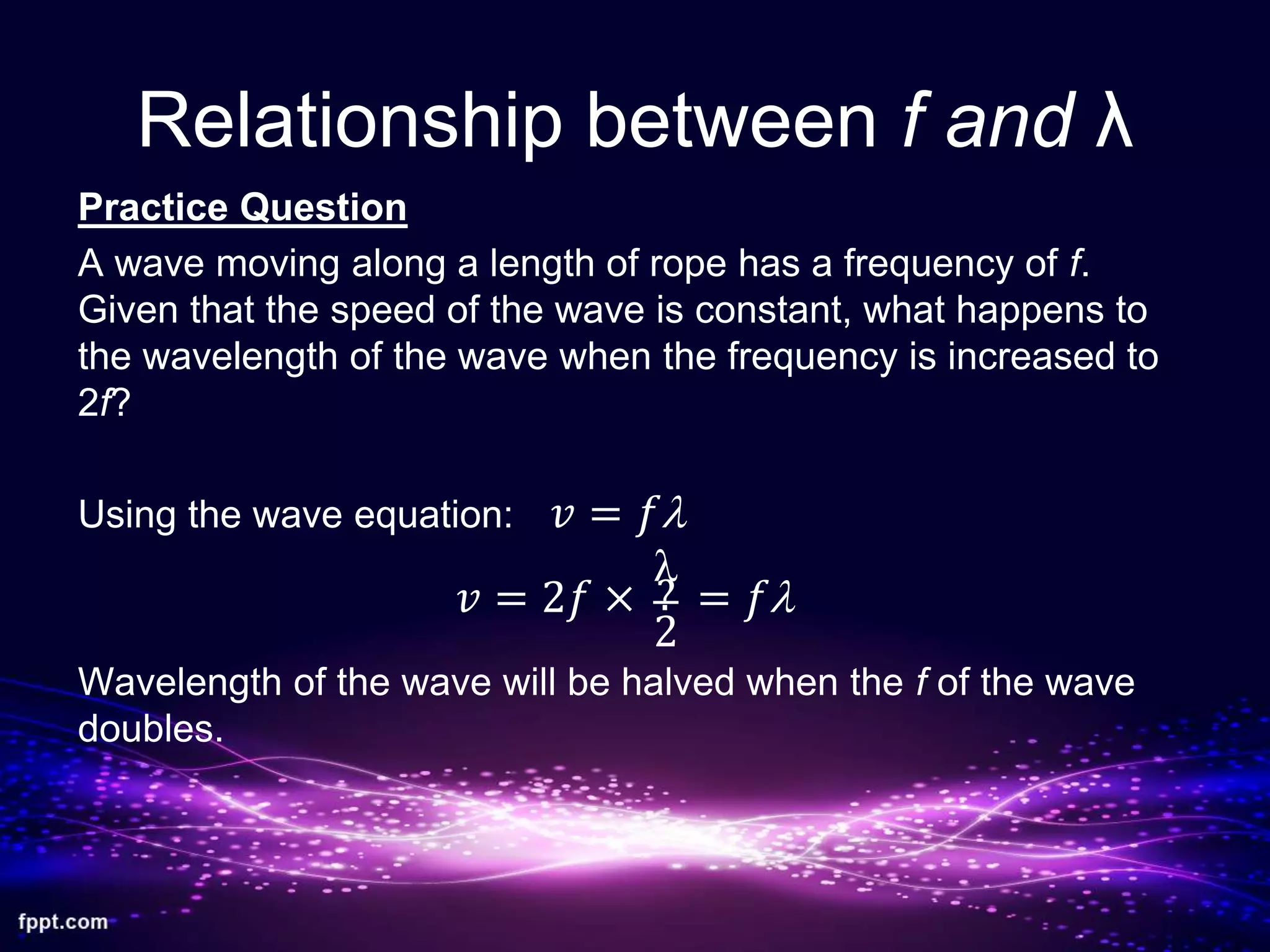
Practice Question
A wave moving along a length of rope has a frequency of f.
Given that the speed of the wave is constant, what happens to
the wavelength of the wave when the frequency is increased to
2f?
Using the wave equation:
Wavelength of the wave will be halved when the f of the wave
doubles.
𝑣 = 2𝑓 × = 𝑓l?
l
2
𝑣 = 𝑓l
Relationship between f and
energy
• The greater the frequency f, the greater the energy.
• The SHORTER the wavelength
 the HIGHER the frequency
 the GREATER the energy possessed by the wave.
• So gamma rays (highest frequency) has the highest energy.
Uses of EM Waves
Uses of EM Waves
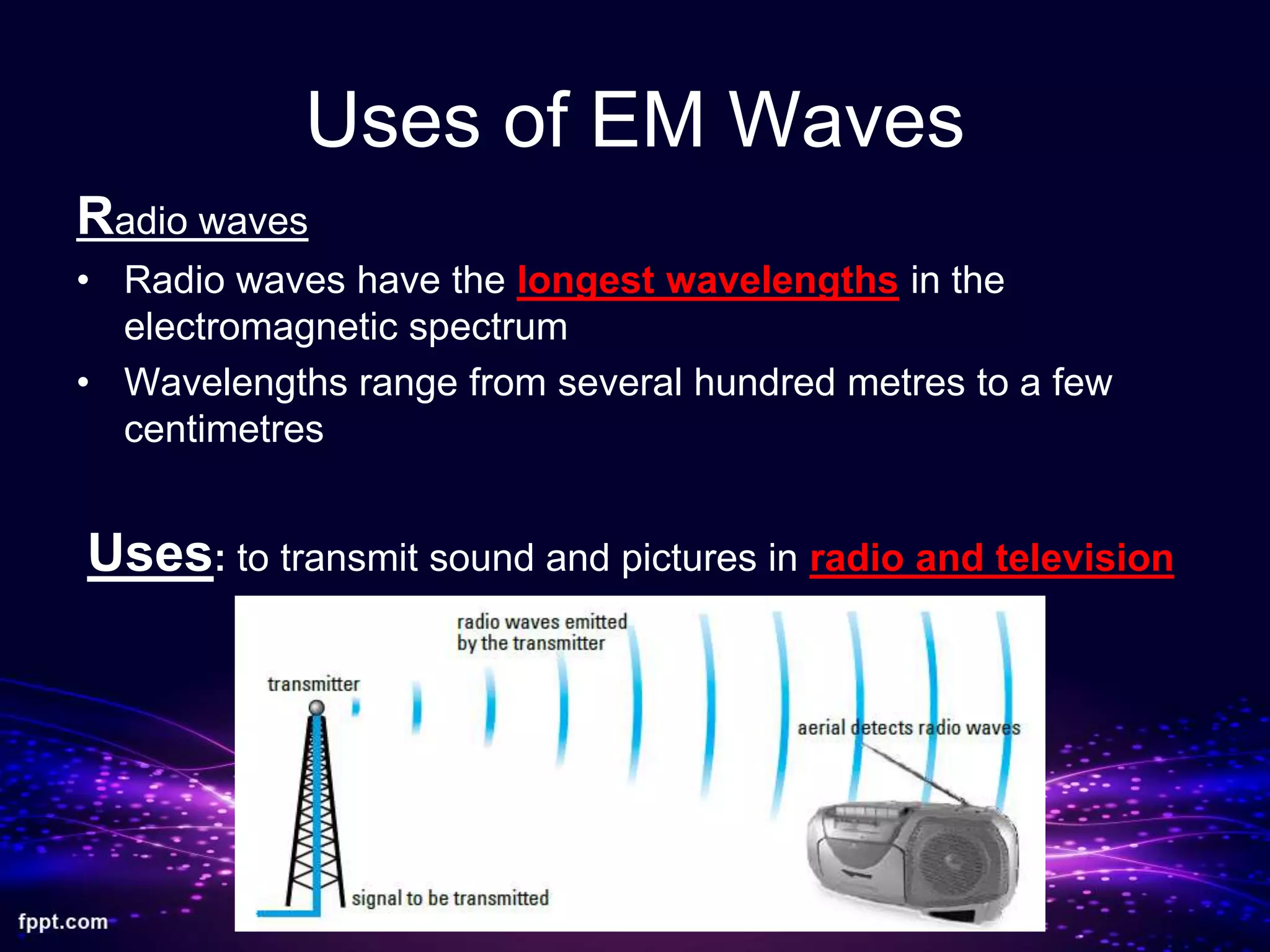
Radio waves
• Radio waves have the longest wavelengths in the
electromagnetic spectrum
• Wavelengths range from several hundred metres to a few
centimetres
Uses: to transmit sound and pictures in radio and television
Uses of EM Waves
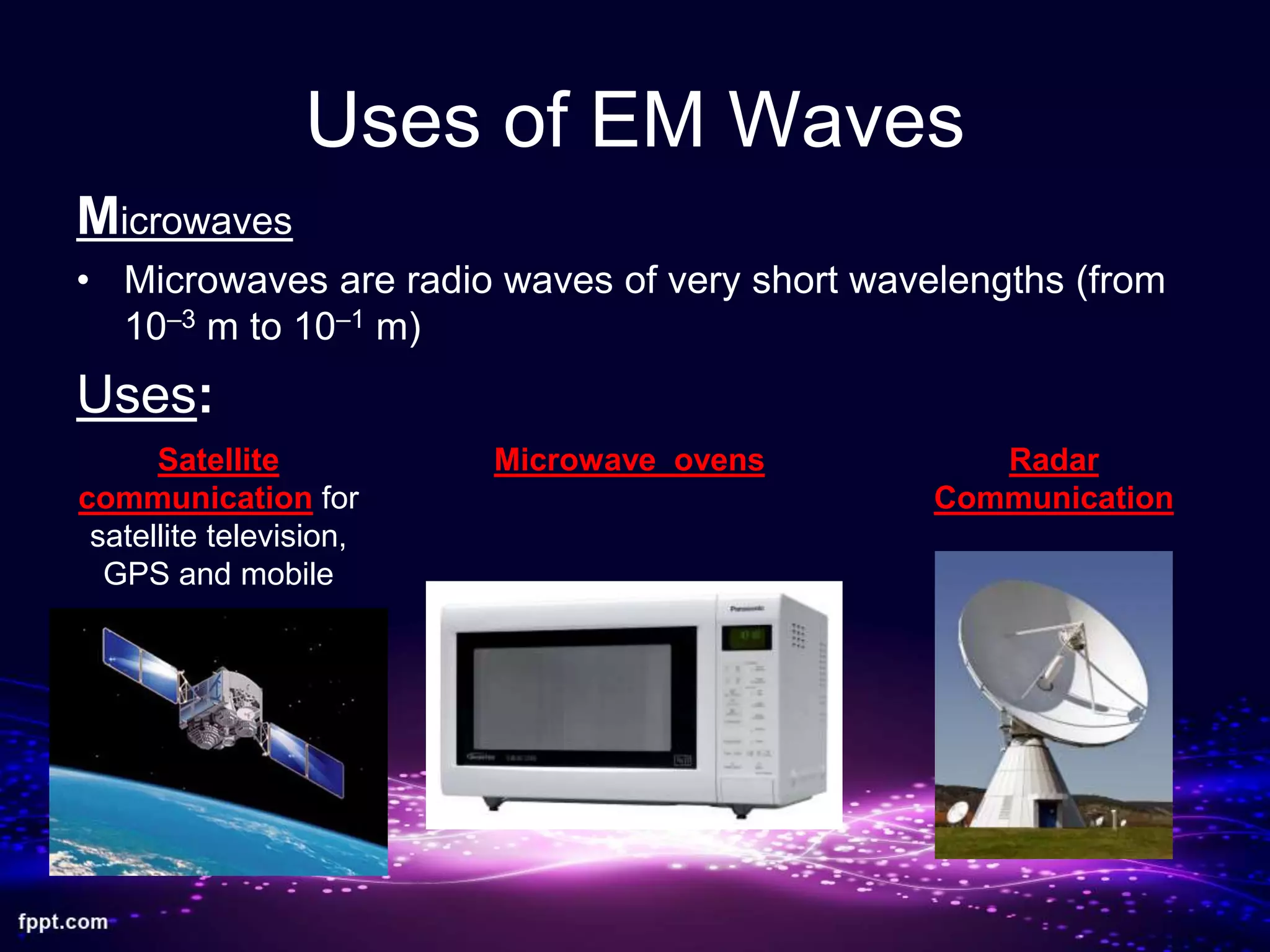
Microwaves
• Microwaves are radio waves of very short wavelengths (from
10–3 m to 10–1 m)
Uses:
Satellite
communication for
satellite television,
GPS and mobile
Microwave ovens Radar
Communication
Uses of EM Waves
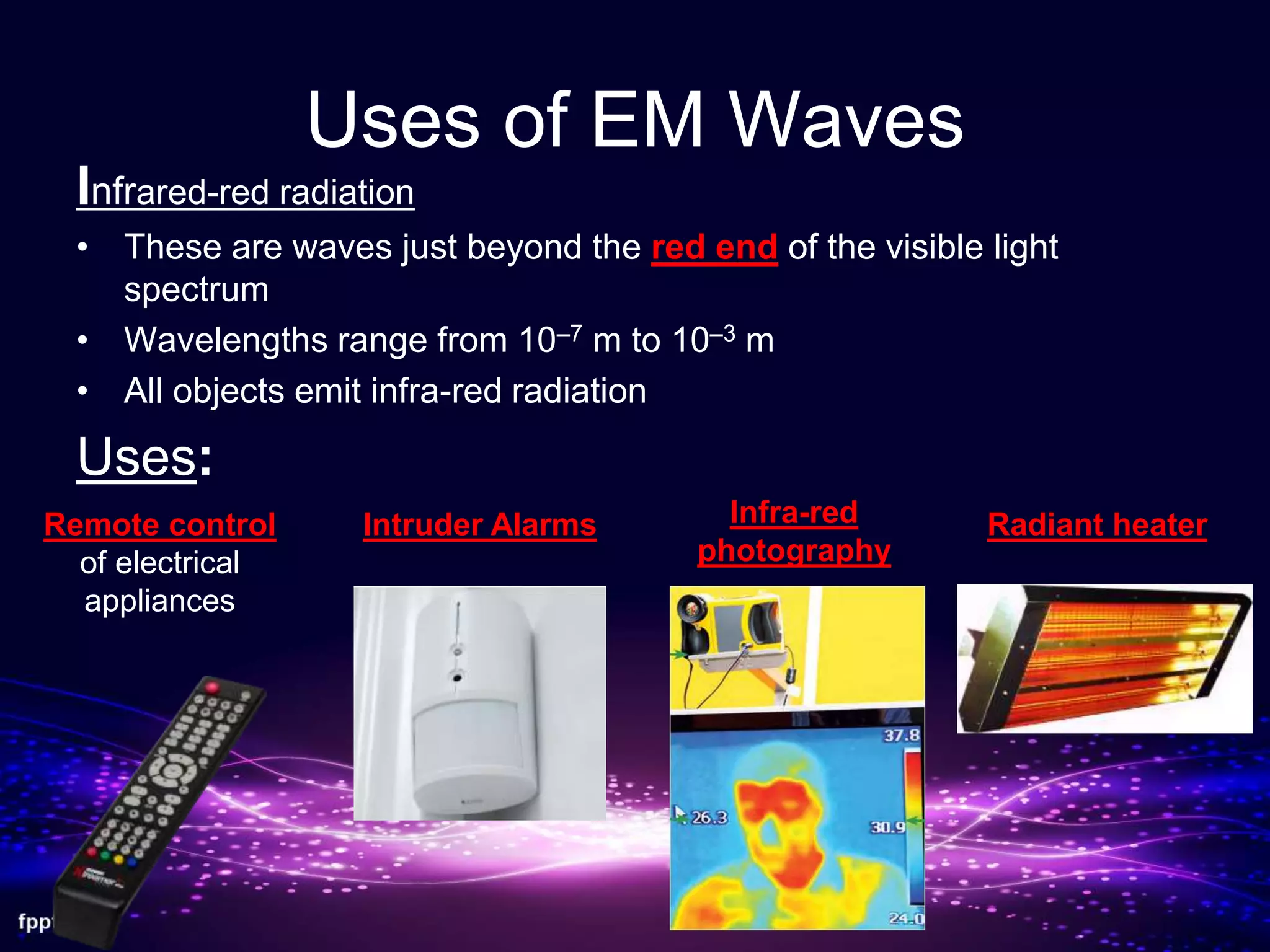
Infrared-red radiation
• These are waves just beyond the red end of the visible light
spectrum
• Wavelengths range from 10–7 m to 10–3 m
• All objects emit infra-red radiation
Uses:
Remote control
of electrical
appliances
Intruder Alarms Infra-red
photography
Radiant heater
Uses of EM Waves
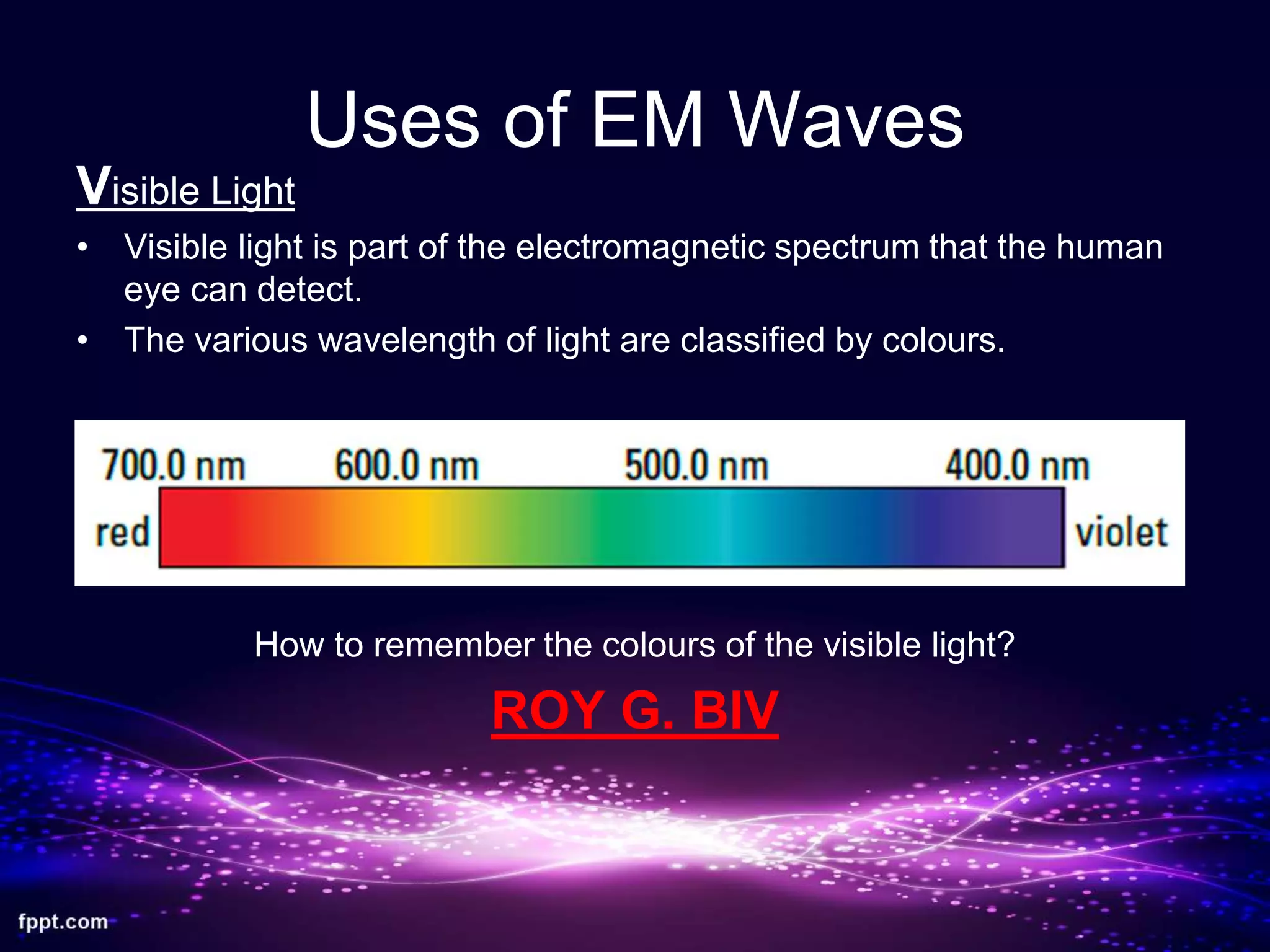
Visible Light
• Visible light is part of the electromagnetic spectrum that the human
eye can detect.
• The various wavelength of light are classified by colours.
How to remember the colours of the visible light?
ROY G. BIV
Uses of EM Waves
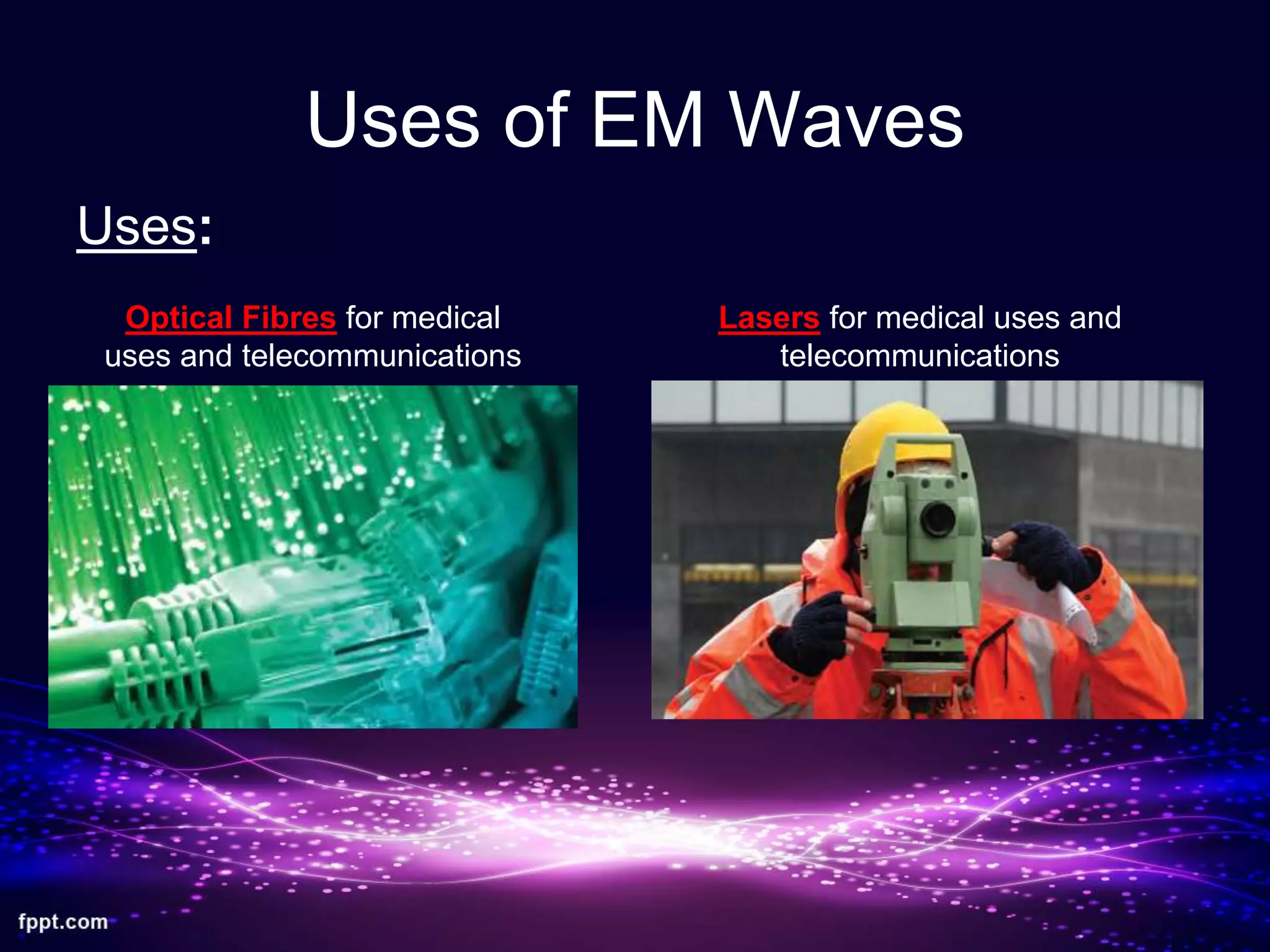
Uses:
Optical Fibres for medical
uses and telecommunications
Lasers for medical uses and
telecommunications
Uses of EM Waves
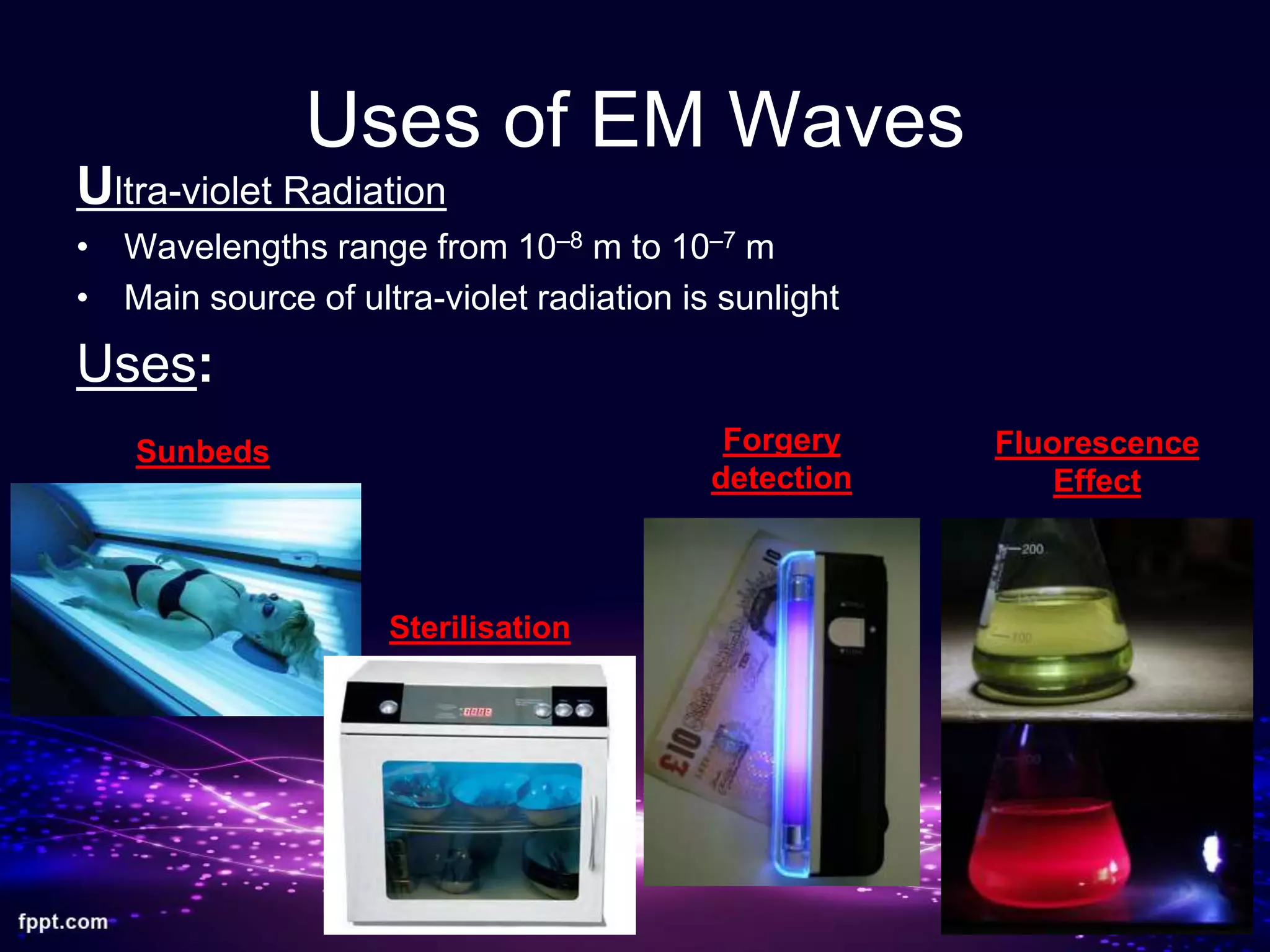
Ultra-violet Radiation
• Wavelengths range from 10–8 m to 10–7 m
• Main source of ultra-violet radiation is sunlight
Uses:
Sunbeds
Sterilisation
Forgery
detection
Fluorescence
Effect
Uses of EM Waves
X-Rays
• wavelengths ranging from about 10-13 m (10-4 nm) to 10-8 m (10 nm)
Uses:
Medical/Dental
Inspection
Checking welds
(for cracks)
Airport Security
(Baggage check)
Radiation Therapy
(Treatment of cancer)
Uses of EM Waves
Gamma Rays
• Result of the decay of radioactive nuclei
• Wavelengths range from about 10-10 m to less than 10-14 m.
• Can cause serious damage when absorbed by living tissue
• They can cause mutations which lead to cancer
• Highest frequency  highest energy
Uses:
Checking welds
(for cracks)
Sterilising
equipment
Radiation Therapy
(Treatment of cancer)
Uses of EM Waves
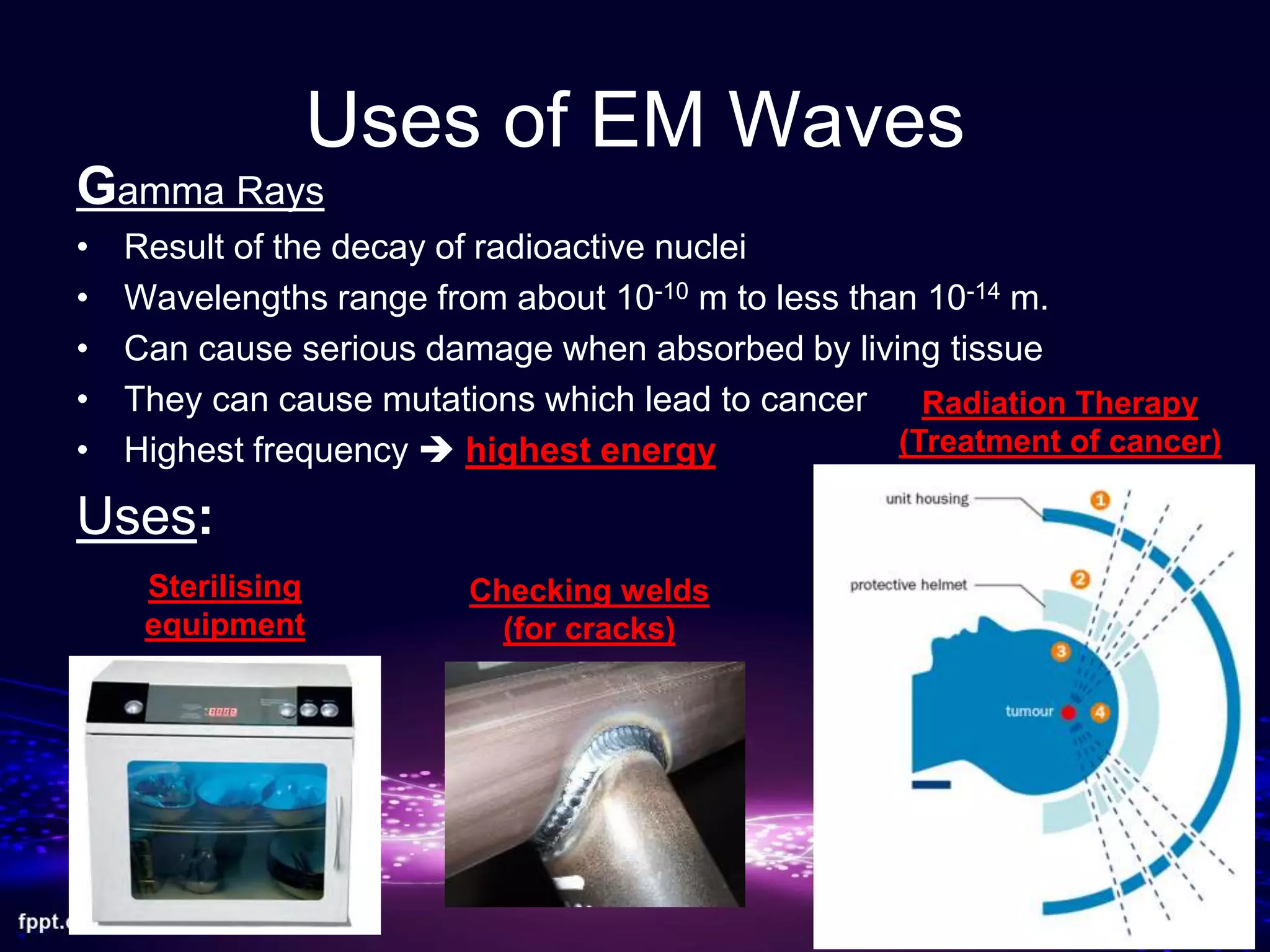
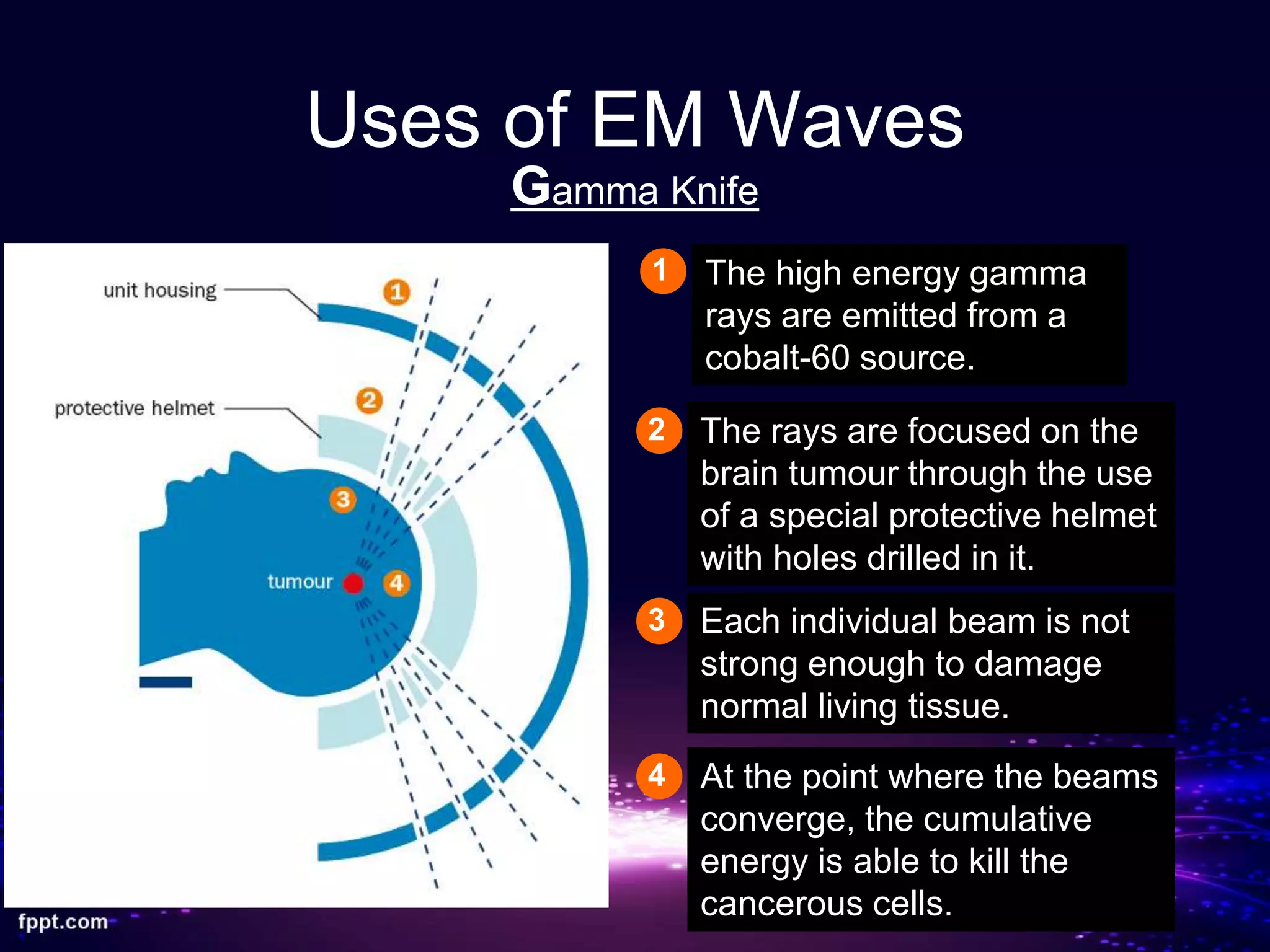
Gamma Knife
The high energy gamma
rays are emitted from a
cobalt-60 source.
The rays are focused on the
brain tumour through the use
of a special protective helmet
with holes drilled in it.
1
2
Each individual beam is not
strong enough to damage
normal living tissue.
3
At the point where the beams
converge, the cumulative
energy is able to kill the
cancerous cells.
4
Effects of EM Waves
Effects of EM Waves
Ionising radiation on living matter
 Ionising radiation is radiation that has the energy to remove
electrons from atoms or molecules.
 Exposure to ionising radiation can damage biological molecules
and lead to abnormal cell division.
 This may cause cancers and/or deformities to a developing foetus.
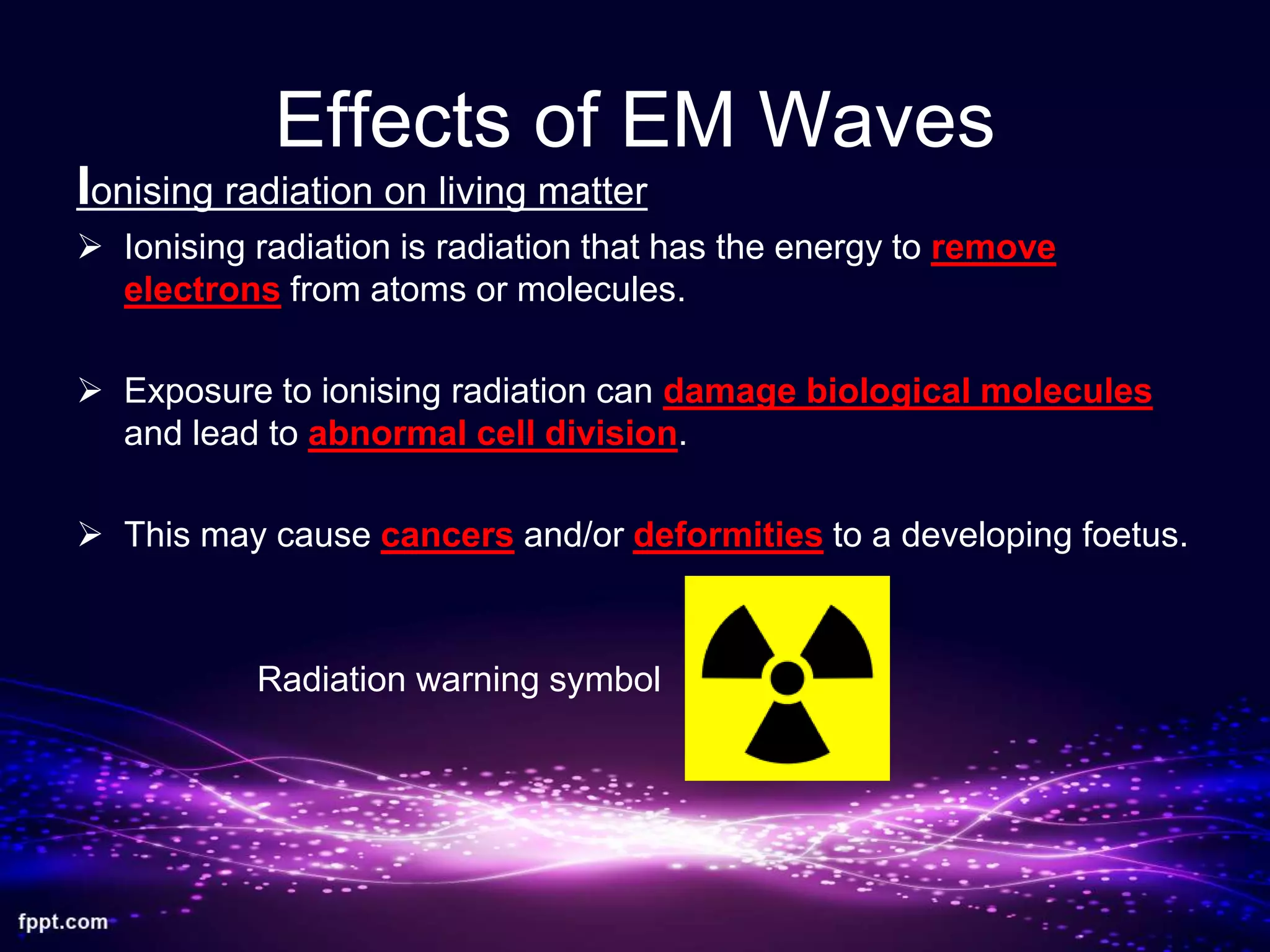
Radiation warning symbol
Effects of EM Waves
Infrared Heating
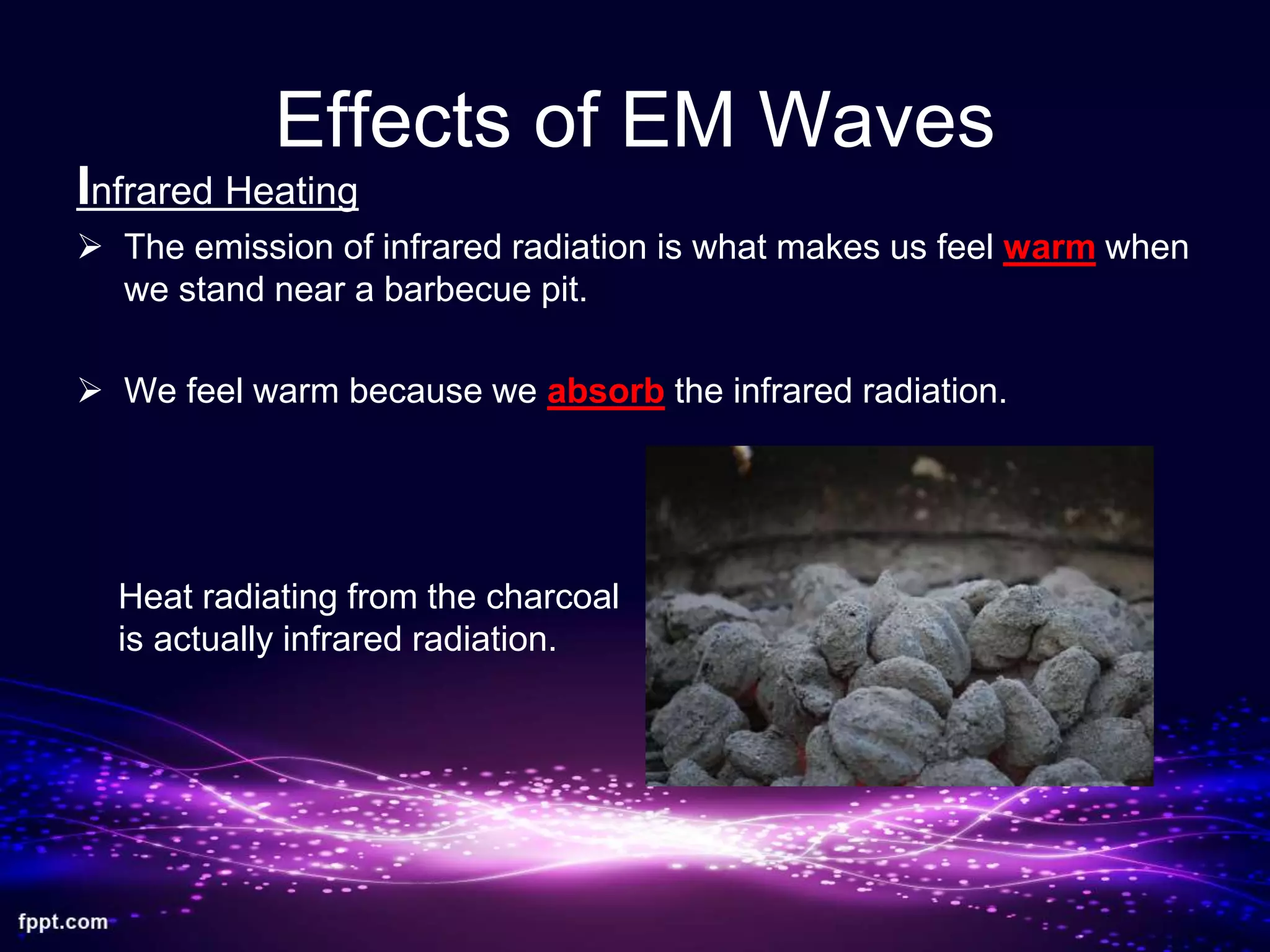
 The emission of infrared radiation is what makes us feel warm when
we stand near a barbecue pit.
 We feel warm because we absorb the infrared radiation.
Heat radiating from the charcoal
is actually infrared radiation.
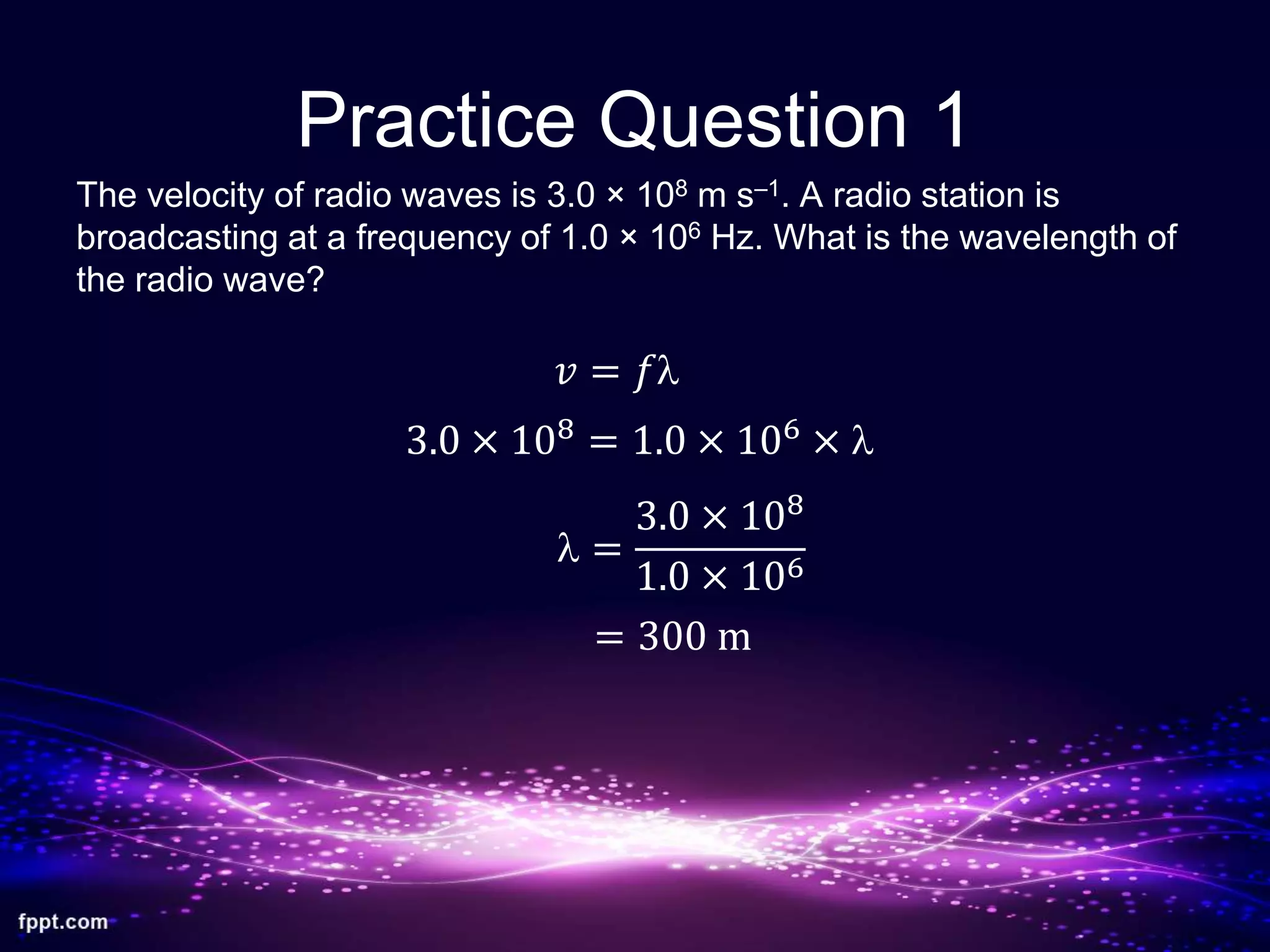
Practice Question 1
The velocity of radio waves is 3.0 × 10⁸ m s–1. A radio station is
broadcasting at a frequency of 1.0 × 10⁶ Hz. What is the wavelength of
the radio wave?
𝑣 = 𝑓l
3.0 × 108
= 1.0 × 10⁶
× l
l =
3.0 × 10⁸
1.0 × 106
= 300 m
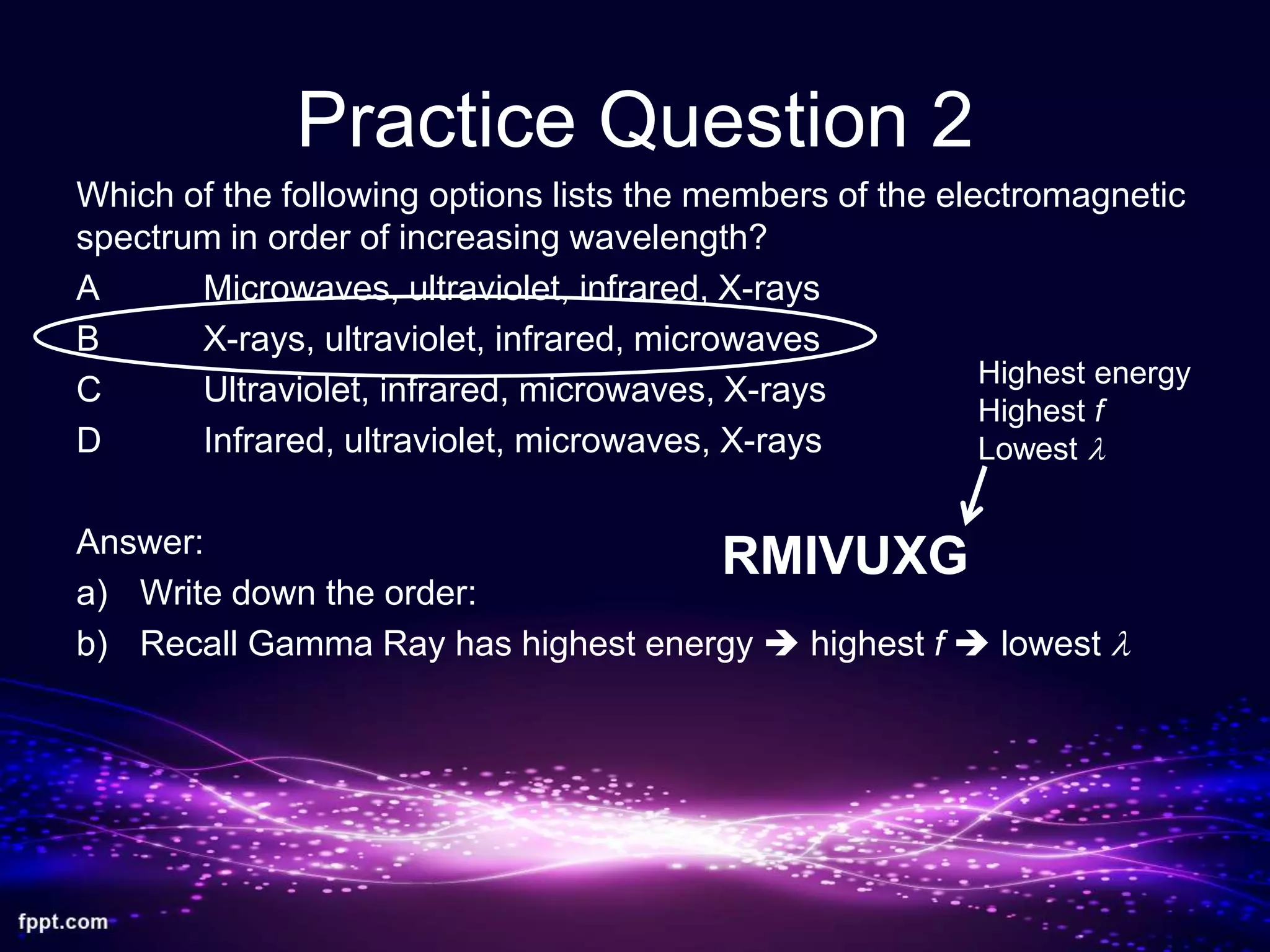
Practice Question 2
Which of the following options lists the members of the electromagnetic
spectrum in order of increasing wavelength?
A Microwaves, ultraviolet, infrared, X-rays
B X-rays, ultraviolet, infrared, microwaves
C Ultraviolet, infrared, microwaves, X-rays
D Infrared, ultraviolet, microwaves, X-rays
Answer:
a) Write down the order:
b) Recall Gamma Ray has highest energy  highest f  lowest l
RMIVUXG
Highest energy
Highest f
Lowest l
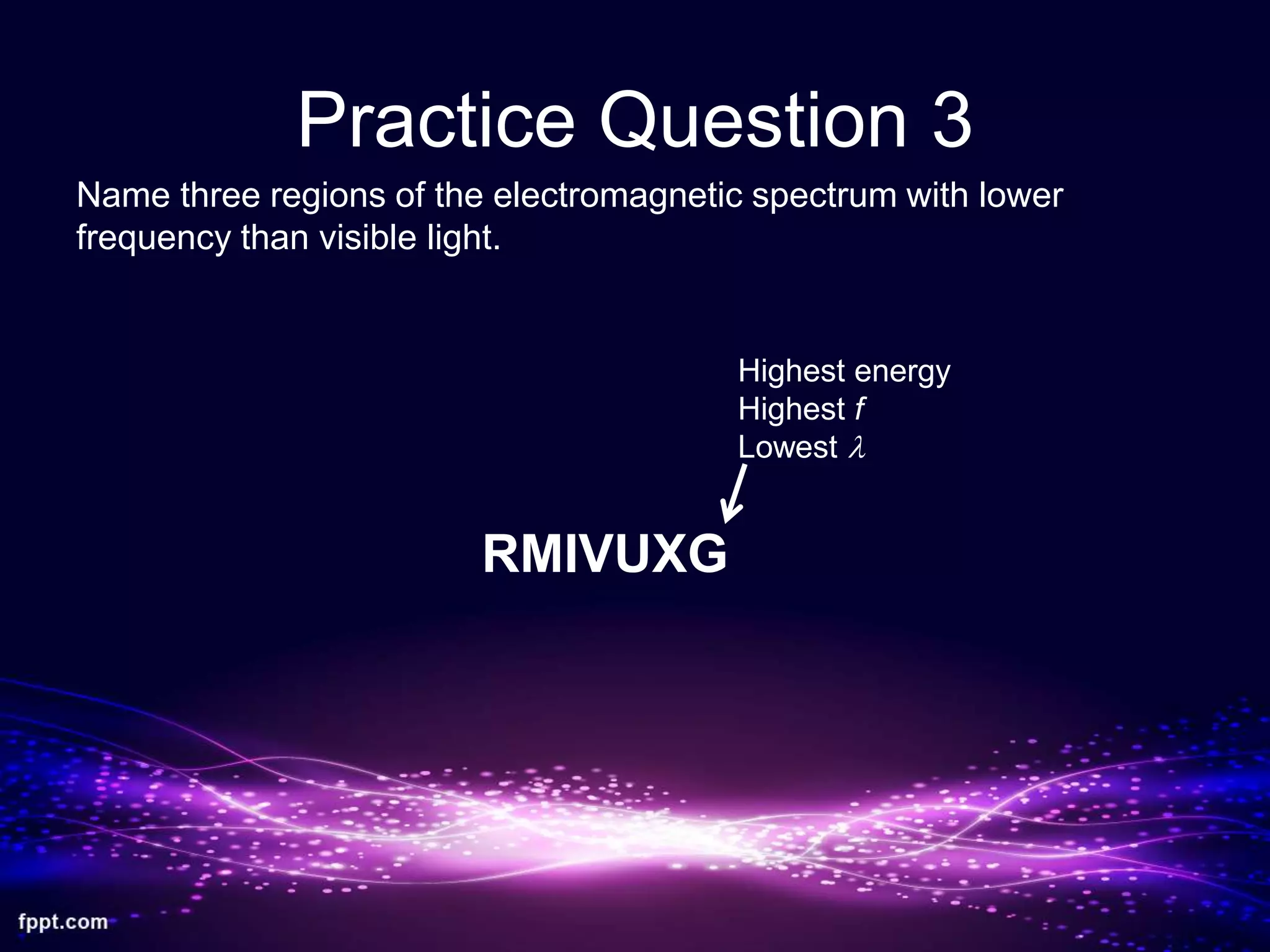
Practice Question 3
Name three regions of the electromagnetic spectrum with lower
frequency than visible light.
RMIVUXG
Highest energy
Highest f
Lowest l
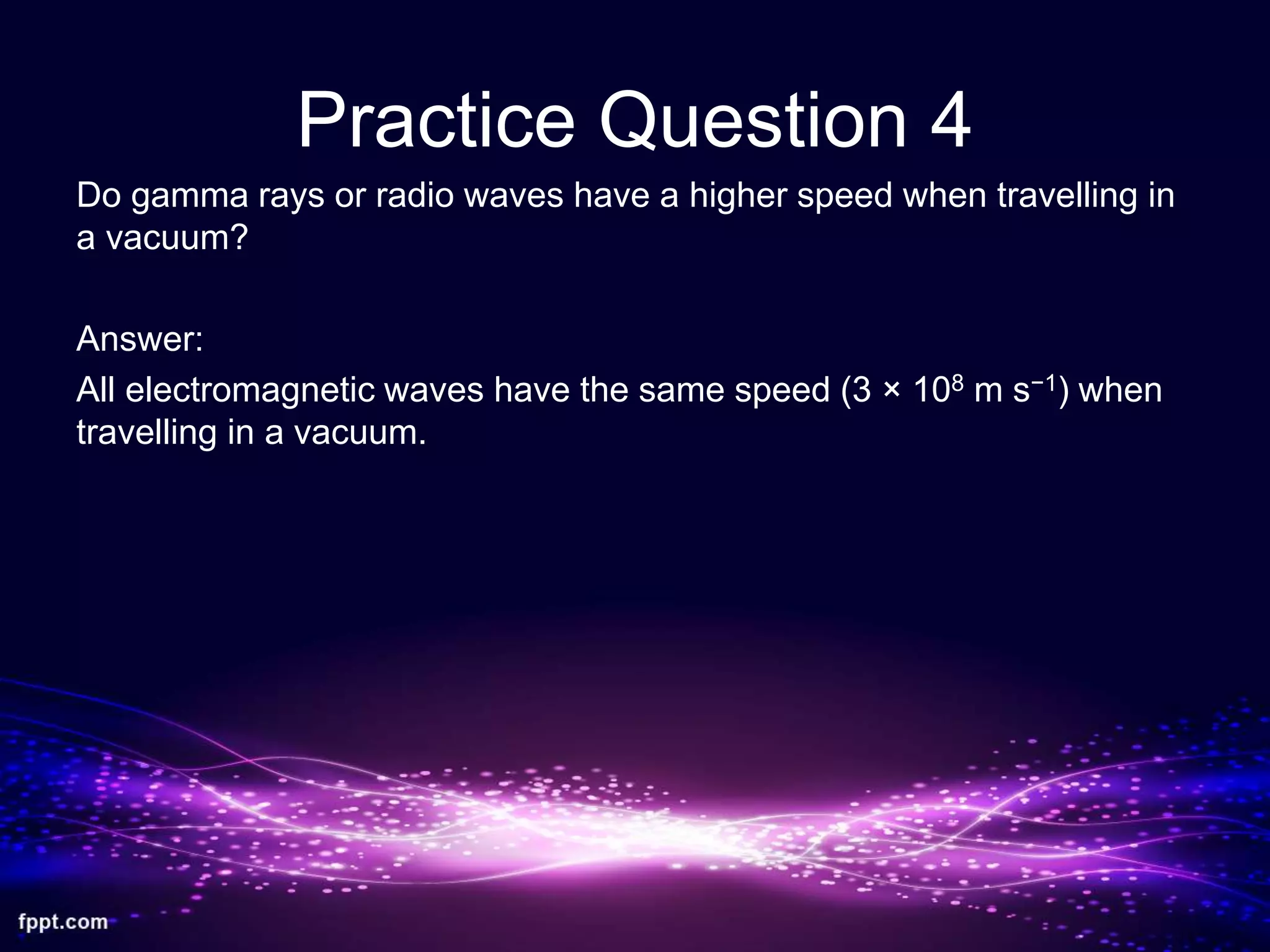
Practice Question 4
Do gamma rays or radio waves have a higher speed when travelling in
a vacuum?
Answer:
All electromagnetic waves have the same speed (3 × 10⁸ m s−1) when
travelling in a vacuum.
QUESTIONS?
Question

Exp SPA - Chp 14 EM Spectrum

  • 1.
  • 2.
    Learning Objectives a) Statethat all electromagnetic waves are transverse waves that travel with the same speed in vacuum and state the magnitude of this speed b) Describe the main components of the electromagnetic spectrum c) State examples of the use of the following components: i. radiowaves (e.g. radio and television communication) ii. microwaves (e.g. microwave oven and satellite television) iii. infra-red (e.g. infra-red remote controllers and intruder alarms) iv. light (e.g. optical fibres for medical uses and telecommunications) v. ultra-violet (e.g. sunbeds and sterilisation) vi. X-rays (e.g. radiological and engineering applications) vii. gamma rays (e.g. medical treatment) d) describe the effects of absorbing electromagnetic waves, e.g. heating, ionisation and damage to living cells and tissue
  • 3.
  • 4.
    How to rememberEM Waves?? Electromagnetic Waves Radio Waves Microwaves Infra-Red Visible light Ultra-violet X-rays Gamma Rays Real Men In Violet Underwear (are) eXtremely Gorgeous
  • 5.
    Properties of EMWaves 1. They transfer energy from one place to another. 2. They are transverse waves. 3. They can travel through vacuum. 4. They travel through vacuum with the speed of light = 3.0 × 10⁸ m/s. 5. Their speed is given by v = f (frequency) × λ (wavelength) 6. They obey the laws of reflection and refraction.
  • 6.
    Relationship between fand λ For EM waves, v = f × λ = 3.0 × 10⁸ m/s (constant) If f decreases, λ must increase. If f increases, λ must decrease.
  • 7.
    Relationship between fand λ Practice Question A wave moving along a length of rope has a frequency of f. Given that the speed of the wave is constant, what happens to the wavelength of the wave when the frequency is increased to 2f? Using the wave equation: Wavelength of the wave will be halved when the f of the wave doubles. 𝑣 = 2𝑓 × = 𝑓l? l 2 𝑣 = 𝑓l
  • 8.
    Relationship between fand energy • The greater the frequency f, the greater the energy. • The SHORTER the wavelength  the HIGHER the frequency  the GREATER the energy possessed by the wave. • So gamma rays (highest frequency) has the highest energy.
  • 9.
  • 10.
    Uses of EMWaves Radio waves • Radio waves have the longest wavelengths in the electromagnetic spectrum • Wavelengths range from several hundred metres to a few centimetres Uses: to transmit sound and pictures in radio and television
  • 11.
    Uses of EMWaves Microwaves • Microwaves are radio waves of very short wavelengths (from 10–3 m to 10–1 m) Uses: Satellite communication for satellite television, GPS and mobile Microwave ovens Radar Communication
  • 12.
    Uses of EMWaves Infrared-red radiation • These are waves just beyond the red end of the visible light spectrum • Wavelengths range from 10–7 m to 10–3 m • All objects emit infra-red radiation Uses: Remote control of electrical appliances Intruder Alarms Infra-red photography Radiant heater
  • 13.
    Uses of EMWaves Visible Light • Visible light is part of the electromagnetic spectrum that the human eye can detect. • The various wavelength of light are classified by colours. How to remember the colours of the visible light? ROY G. BIV
  • 14.
    Uses of EMWaves Uses: Optical Fibres for medical uses and telecommunications Lasers for medical uses and telecommunications
  • 15.
    Uses of EMWaves Ultra-violet Radiation • Wavelengths range from 10–8 m to 10–7 m • Main source of ultra-violet radiation is sunlight Uses: Sunbeds Sterilisation Forgery detection Fluorescence Effect
  • 16.
    Uses of EMWaves X-Rays • wavelengths ranging from about 10-13 m (10-4 nm) to 10-8 m (10 nm) Uses: Medical/Dental Inspection Checking welds (for cracks) Airport Security (Baggage check) Radiation Therapy (Treatment of cancer)
  • 17.
    Uses of EMWaves Gamma Rays • Result of the decay of radioactive nuclei • Wavelengths range from about 10-10 m to less than 10-14 m. • Can cause serious damage when absorbed by living tissue • They can cause mutations which lead to cancer • Highest frequency  highest energy Uses: Checking welds (for cracks) Sterilising equipment Radiation Therapy (Treatment of cancer)
  • 18.
    Uses of EMWaves Gamma Knife The high energy gamma rays are emitted from a cobalt-60 source. The rays are focused on the brain tumour through the use of a special protective helmet with holes drilled in it. 1 2 Each individual beam is not strong enough to damage normal living tissue. 3 At the point where the beams converge, the cumulative energy is able to kill the cancerous cells. 4
  • 19.
  • 20.
    Effects of EMWaves Ionising radiation on living matter  Ionising radiation is radiation that has the energy to remove electrons from atoms or molecules.  Exposure to ionising radiation can damage biological molecules and lead to abnormal cell division.  This may cause cancers and/or deformities to a developing foetus. Radiation warning symbol
  • 21.
    Effects of EMWaves Infrared Heating  The emission of infrared radiation is what makes us feel warm when we stand near a barbecue pit.  We feel warm because we absorb the infrared radiation. Heat radiating from the charcoal is actually infrared radiation.
  • 22.
    Practice Question 1 Thevelocity of radio waves is 3.0 × 10⁸ m s–1. A radio station is broadcasting at a frequency of 1.0 × 10⁶ Hz. What is the wavelength of the radio wave? 𝑣 = 𝑓l 3.0 × 108 = 1.0 × 10⁶ × l l = 3.0 × 10⁸ 1.0 × 106 = 300 m
  • 23.
    Practice Question 2 Whichof the following options lists the members of the electromagnetic spectrum in order of increasing wavelength? A Microwaves, ultraviolet, infrared, X-rays B X-rays, ultraviolet, infrared, microwaves C Ultraviolet, infrared, microwaves, X-rays D Infrared, ultraviolet, microwaves, X-rays Answer: a) Write down the order: b) Recall Gamma Ray has highest energy  highest f  lowest l RMIVUXG Highest energy Highest f Lowest l
  • 24.
    Practice Question 3 Namethree regions of the electromagnetic spectrum with lower frequency than visible light. RMIVUXG Highest energy Highest f Lowest l
  • 25.
    Practice Question 4 Dogamma rays or radio waves have a higher speed when travelling in a vacuum? Answer: All electromagnetic waves have the same speed (3 × 10⁸ m s−1) when travelling in a vacuum.
  • 26.