Substrates and PaintsSubstrates and Paints
 Substrates
 Hot Dipped Galvanized
 Galvalume®
 Aluminum
 Paint
 The importance of pre-treatments
 The importance of primers
 Paint systems used in our industry:
 Polyesters
 Siliconized Polyester
 Polyvinylidene Fluoride (PVDF)
SubstratesSubstrates
 Coated Carbon Steel
 Hot Dipped Galvanized
 G-90
 Galvalume
 AZ50
 Aluminum
 Alloy 3003
 Temper – H14
Hot Dipped GalvanizedHot Dipped Galvanized
 Zinc-coated carbon steel sheet that
meets ASTM A653-96
 Coating weight of G-90
 By volume consists of a minimum
thickness of .80 oz. of zinc per sq. ft.
for both sides of the steel sheet
 Great sacrificial advantages
 No applicable corrosion warranty
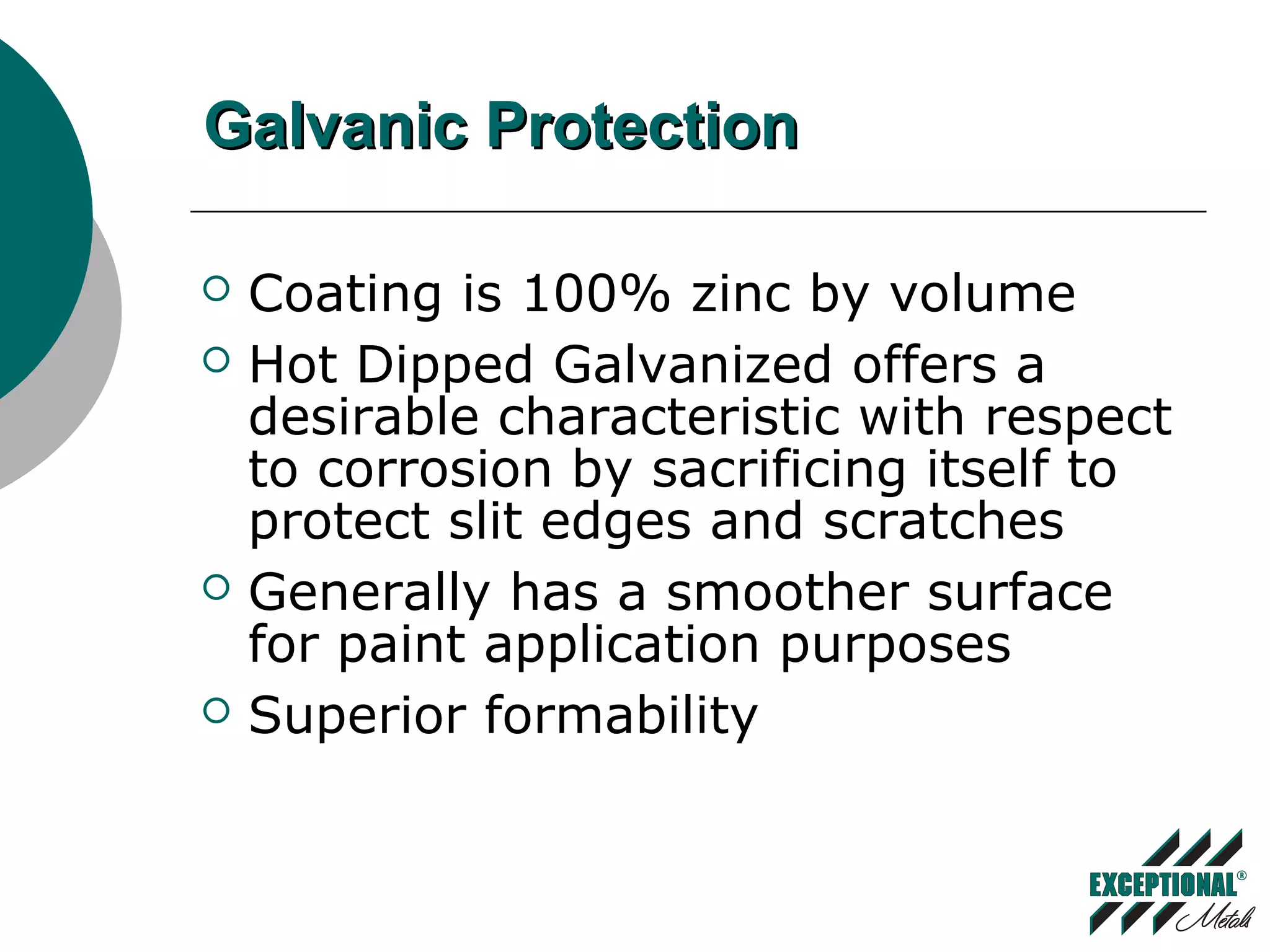
Galvanic ProtectionGalvanic Protection
 Coating is 100% zinc by volume
 Hot Dipped Galvanized offers a
desirable characteristic with respect
to corrosion by sacrificing itself to
protect slit edges and scratches
 Generally has a smoother surface
for paint application purposes
 Superior formability
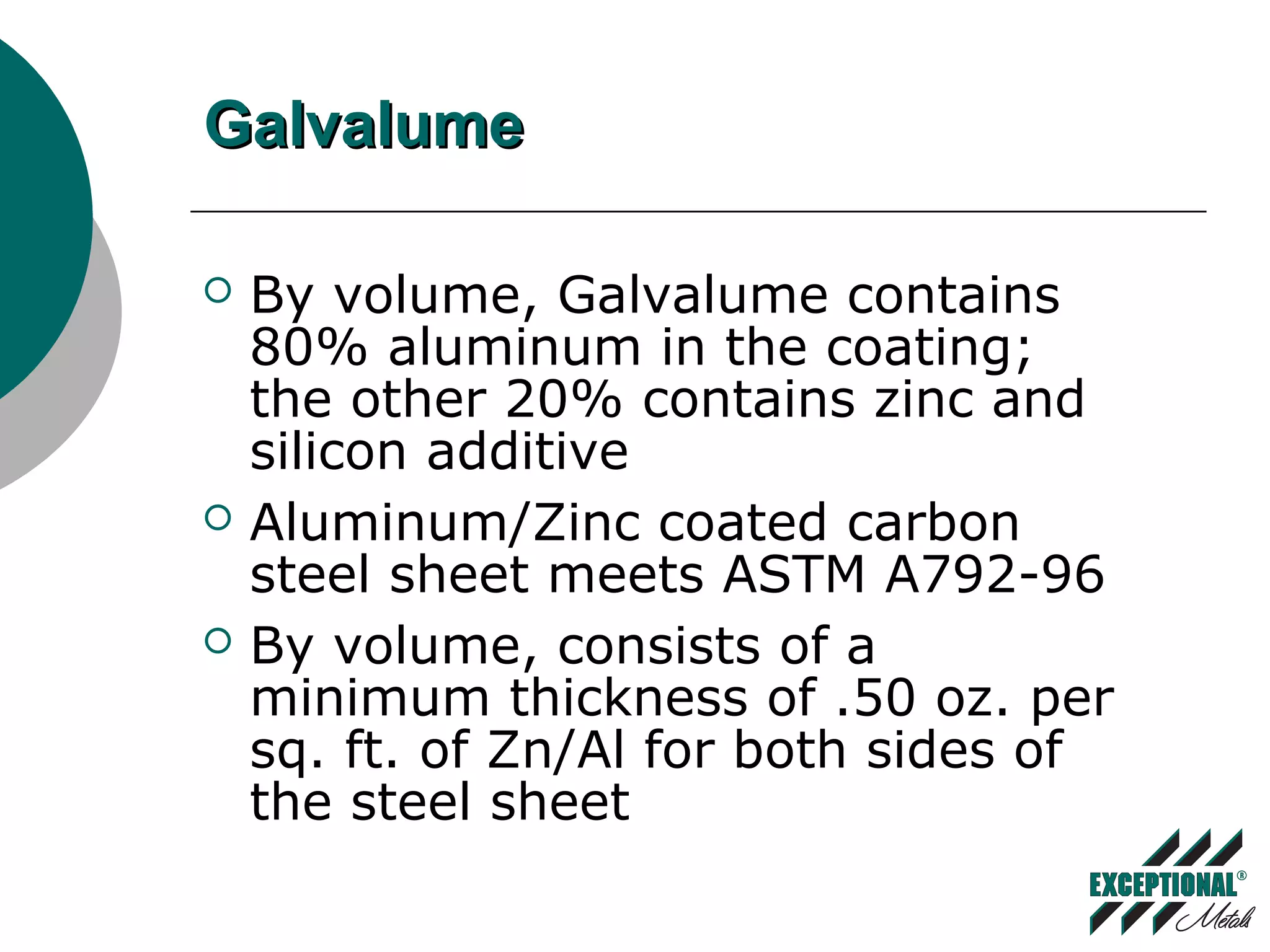
GalvalumeGalvalume
 By volume, Galvalume contains
80% aluminum in the coating;
the other 20% contains zinc and
silicon additive
 Aluminum/Zinc coated carbon
steel sheet meets ASTM A792-96
 By volume, consists of a
minimum thickness of .50 oz. per
sq. ft. of Zn/Al for both sides of
the steel sheet
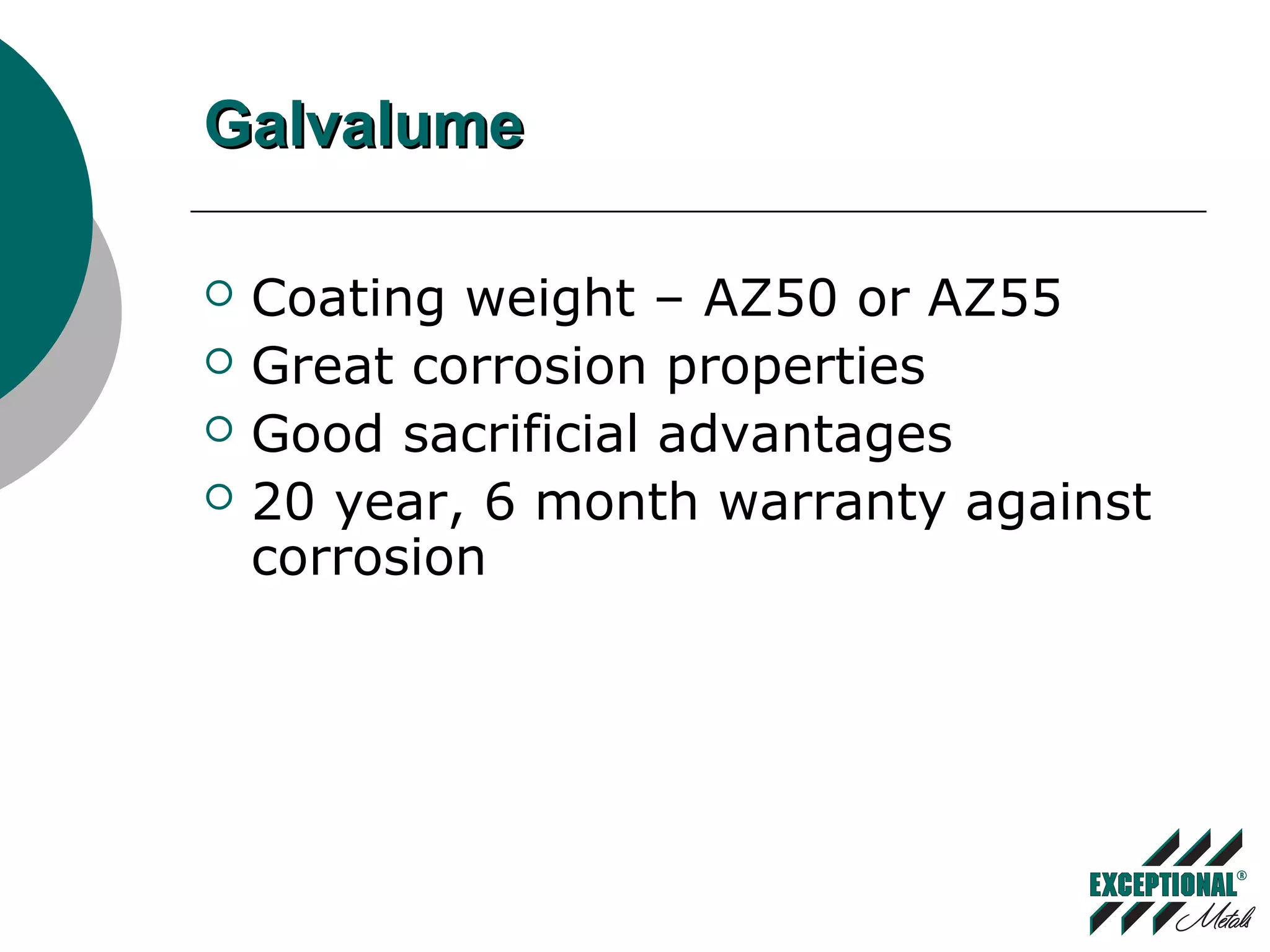
GalvalumeGalvalume
 Coating weight – AZ50 or AZ55
 Great corrosion properties
 Good sacrificial advantages
 20 year, 6 month warranty against
corrosion
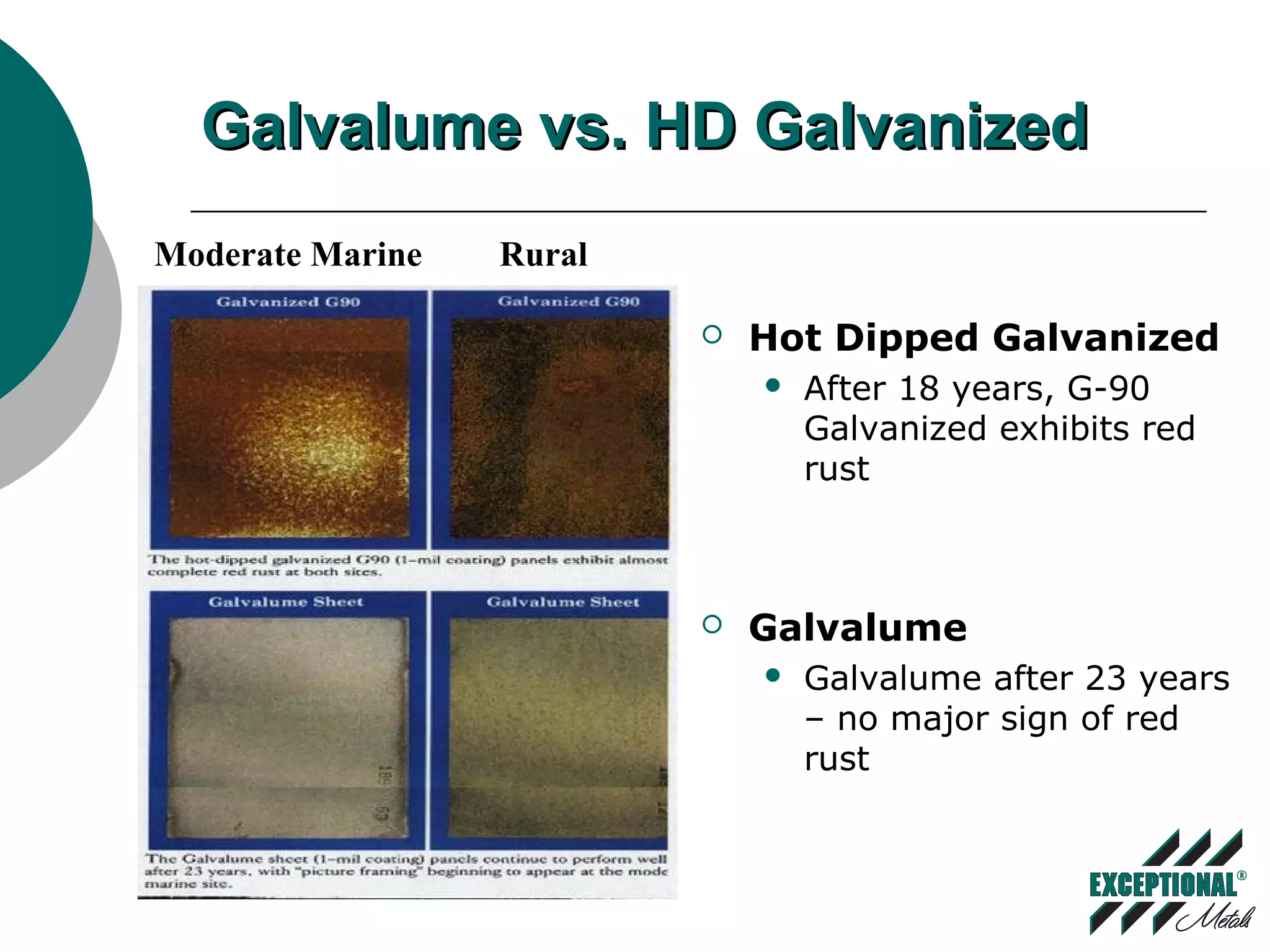
Galvalume vs. HD GalvanizedGalvalume vs. HD Galvanized
 Hot Dipped Galvanized
 After 18 years, G-90
Galvanized exhibits red
rust
 Galvalume
 Galvalume after 23 years
– no major sign of red
rust
Moderate Marine Rural
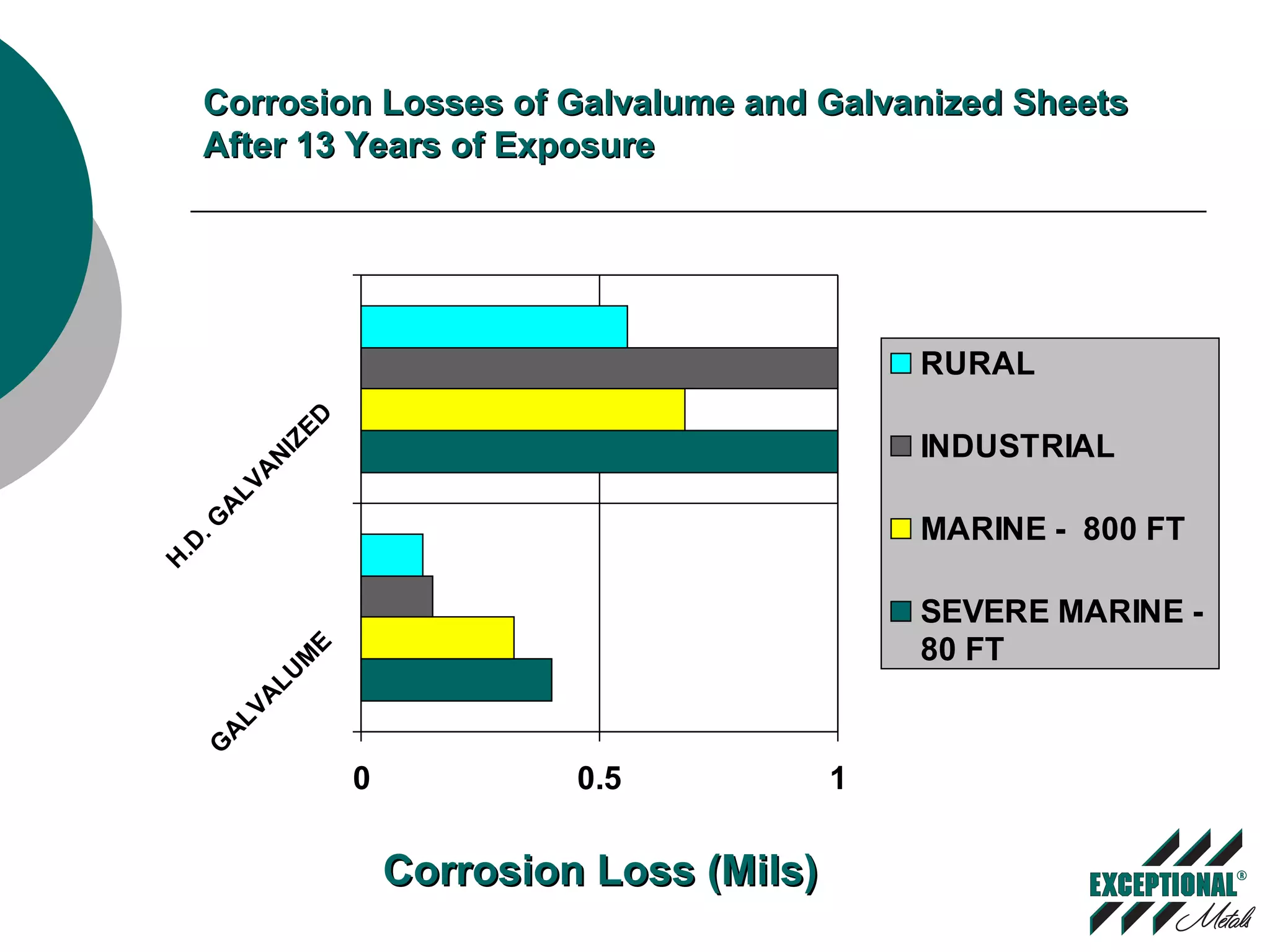
Corrosion Losses of Galvalume and Galvanized SheetsCorrosion Losses of Galvalume and Galvanized Sheets
After 13 Years of ExposureAfter 13 Years of Exposure
0 0.5 1
G
A
LVA
LU
M
E
H
.D
.G
A
LVA
N
IZED
RURAL
INDUSTRIAL
MARINE - 800 FT
SEVERE MARINE -
80 FT
Corrosion Loss (Mils)Corrosion Loss (Mils)
Salt Spray Corrosion ResistanceSalt Spray Corrosion Resistance
 With cut edges protected, the coating on
Galvalume AZ50 lasts 5 to 10 times
longer than the coating on G90 HD
Galvanized
 Salt spray tests conducted with bare cut
edges exposed, determined that the
corrosion resistance is typically three to
four times that of G90 HD Galvanized
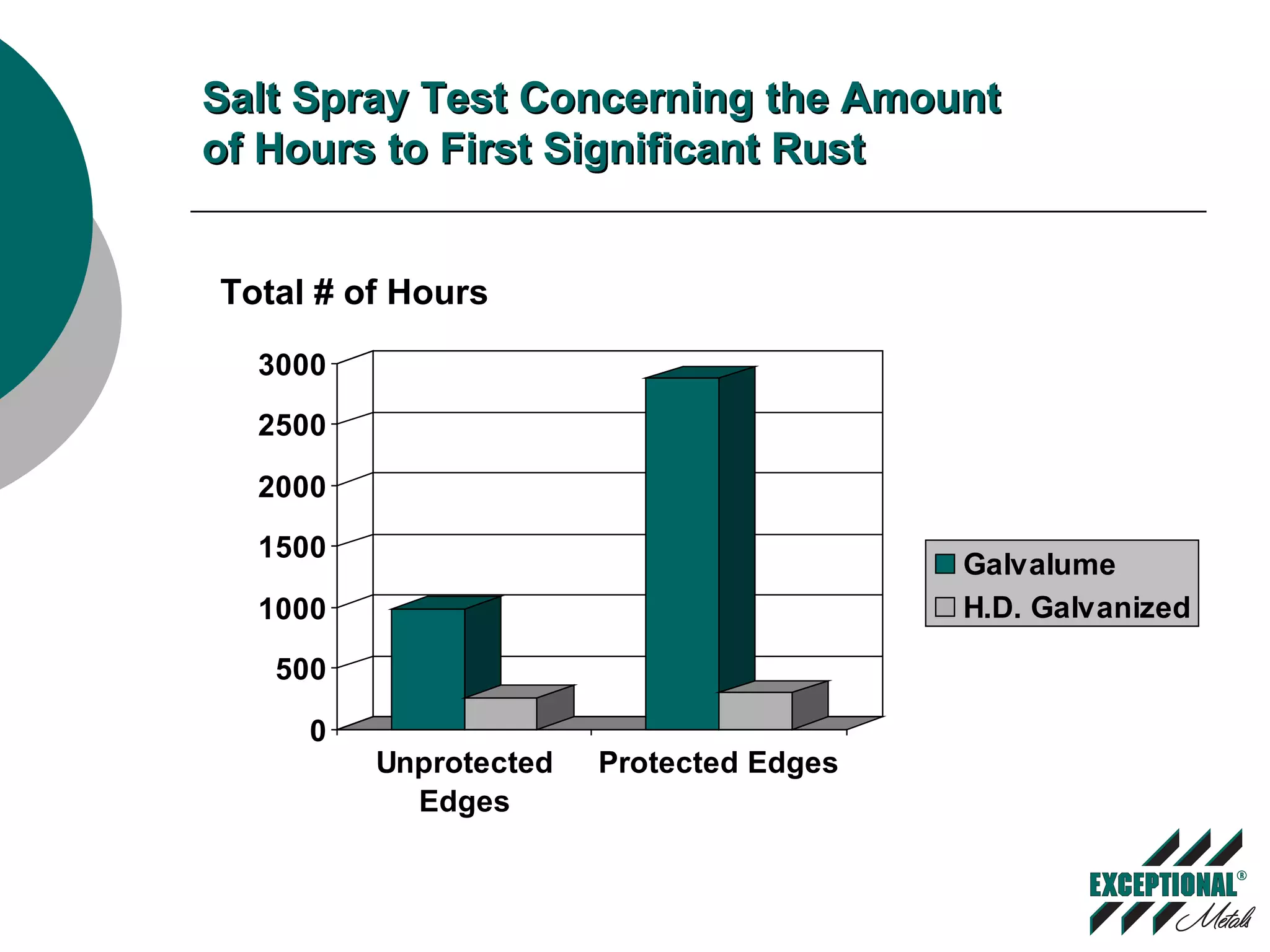
Salt Spray Test Concerning the AmountSalt Spray Test Concerning the Amount
of Hours to First Significant Rustof Hours to First Significant Rust
0
500
1000
1500
2000
2500
3000
Unprotected
Edges
Protected Edges
Galvalume
H.D. Galvanized
Total # of Hours
Aluminum
 Alloy 3003
 Temper – H14
Painted ProductsPainted Products
What a Painted Product Consists of:What a Painted Product Consists of:
Cold Rolle d
Ste e l
Zinc (HDG) or
Zinc-Alum inum
(Galvalume®)
Subs trate
Pre -Tre atme nt
Laye r
Subs trate
Pre-Tre atme nt
Laye r
Primer
(0.20 - 0.25
mils)
TRINAR ®
Topcoat
(0.70 - 0 .90 m ils )
Primer
(0.20 - 0.25
mils)
Polyester Backer
(0.30 - 0 .50 m ils )
Prepaint Cross-Section
Pre-TreatmentsPre-Treatments
 A liquid used to produce a
corrosion-resitant, organic bonding
coating on aluminum, Galvalume,
and Galvanized
 An approved chromate rinse which
is the major agent that allows the
primer to bond to the substrate
 Approved by Bethlehem Steel for
the use on Galvalume
Pre-TreatmentsPre-Treatments
 Benefits of pre-treatments
Provide superior long-term
corrosion protection
Effective on aluminum,
Galvalume and Galvanized
Coating quality is consistently
maintained
PrimerPrimer
 The base layer of the paint applied
by the coater
 Formulated to provide corrosion
protection to the base metal and to
enhance adhesion between the top
coat (paint) and the base metal
Major Components That Make Up aMajor Components That Make Up a
Paint SystemPaint System
 PigmentsPigments
 ResinResin
 SolventsSolvents
 AdditivesAdditives
PigmentsPigments
 Small solid particles
added to a paint to
enhance appearance
by providing color
and /or improve
physical (functional)
properties of a paint.
 Pigments are
protected by the
resin system.
 Types of pigments:
 Ceramic
 Earth tones
 Organic
 Two classes of
pigments:
 Appearance
 Functional
PigmentsPigments
Resin SystemsResin Systems
 The most important part of any paint
system
 The liquid “glue” of the paint system that
surrounds the pigment particles,
protecting them from environmental
pollutants such as airborne chemicals and
salt
 Types of resin systems:
 Polyester
 Siliconized Polyester
 Polyvinylidene Fluoride (PVDF)
SolventsSolvents
 The vehicle by which the pigment is
“transported” to the metal surface
 Solvents evaporate during the
curing process to permit the
formation of a paint film
AdditivesAdditives
 Any number of chemicals added to
the paint, usually in small amounts,
to bring special effects to the paint
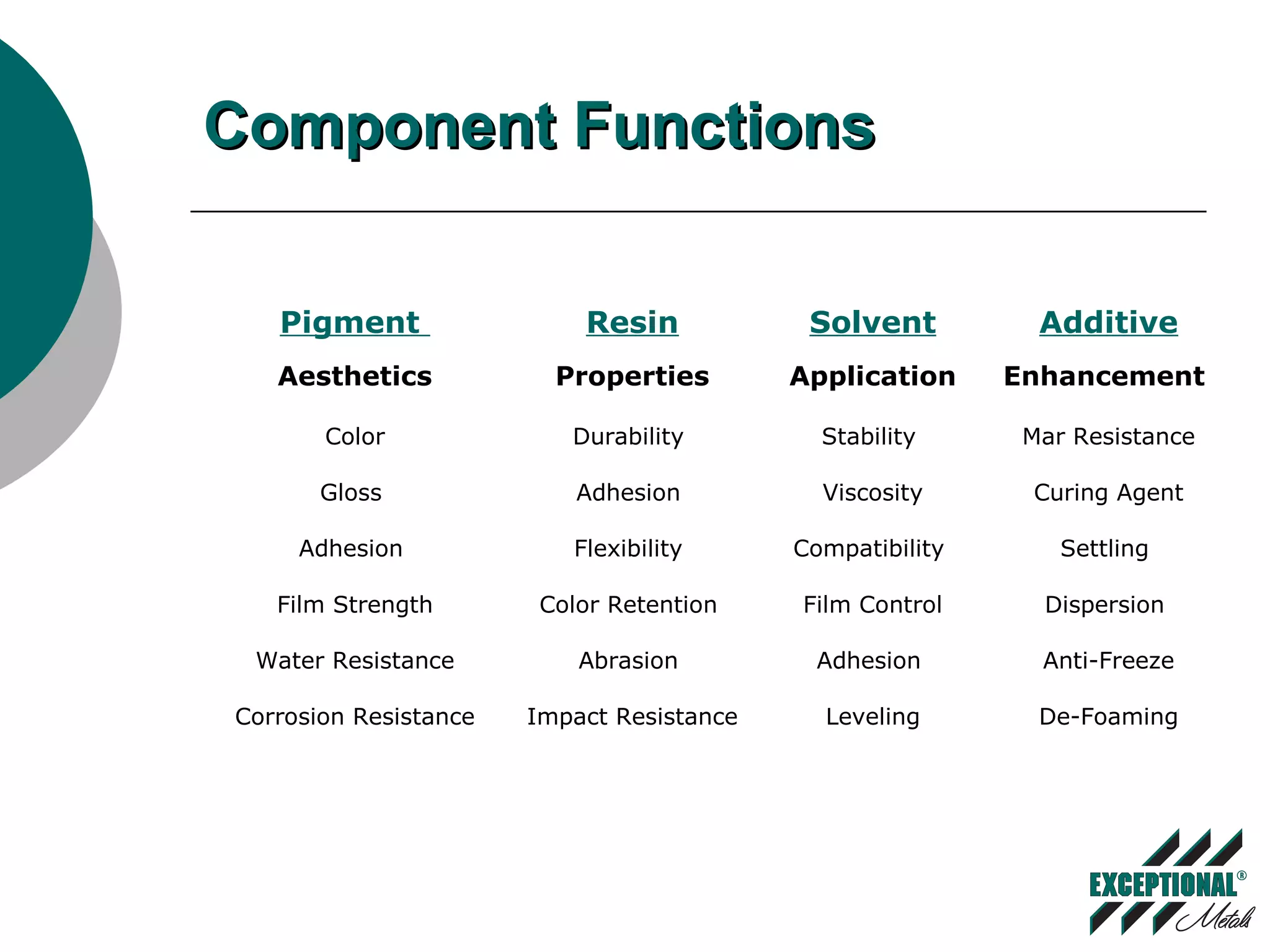
Component FunctionsComponent Functions
Pigment Resin Solvent Additive
Aesthetics Properties Application Enhancement
Color Durability Stability Mar Resistance
Gloss Adhesion Viscosity Curing Agent
Adhesion Flexibility Compatibility Settling
Film Strength Color Retention Film Control Dispersion
Water Resistance Abrasion Adhesion Anti-Freeze
Corrosion Resistance Impact Resistance Leveling De-Foaming
Types of Paint SystemsTypes of Paint Systems
 Polyester
 Siliconized Polyester
 Polyvinylidene Fluoride (PVDF)
Polyester Paint SystemsPolyester Paint Systems
 A generic polymer coating with
limited weathering performance
 End uses: interior applications
 Home appliances
 Lighting fixtures
 Wall panels
Siliconized Polyester PaintSiliconized Polyester Paint
SystemsSystems
 A generic coating type that represents a
wide range of topcoats used on pre-
painted metal in construction
 The silicon extends the service life of the
base polymer and improves weathering
 End uses:
 Metal building components
 Agricultural and corrugated panels
Polyvinylidene Fluoride (PVDF)Polyvinylidene Fluoride (PVDF)
 A fluoropolymer resin used as the
major vehicle (base resin) in the paint
system
 Paint chemistry is 70% by weight PVDF
resin
 Exhibits superior:
 Color retention
 Chalk resistance
 Corrosion resistance
 Flexibility
 Stain resistance
 Overall exterior durability
PVDF CoatingsPVDF Coatings
Architectural coatings thatArchitectural coatings that
extend building life and keep itextend building life and keep it
looking the way it was designed!looking the way it was designed!
How it worksHow it works
 Advance molecular structural of
PVDF utilizes carbon-fluorine bond –
the strongest bond known in the
chemical world – combined with a
carbon-hydrogen bond, which
creates a structure that is extremely
durable
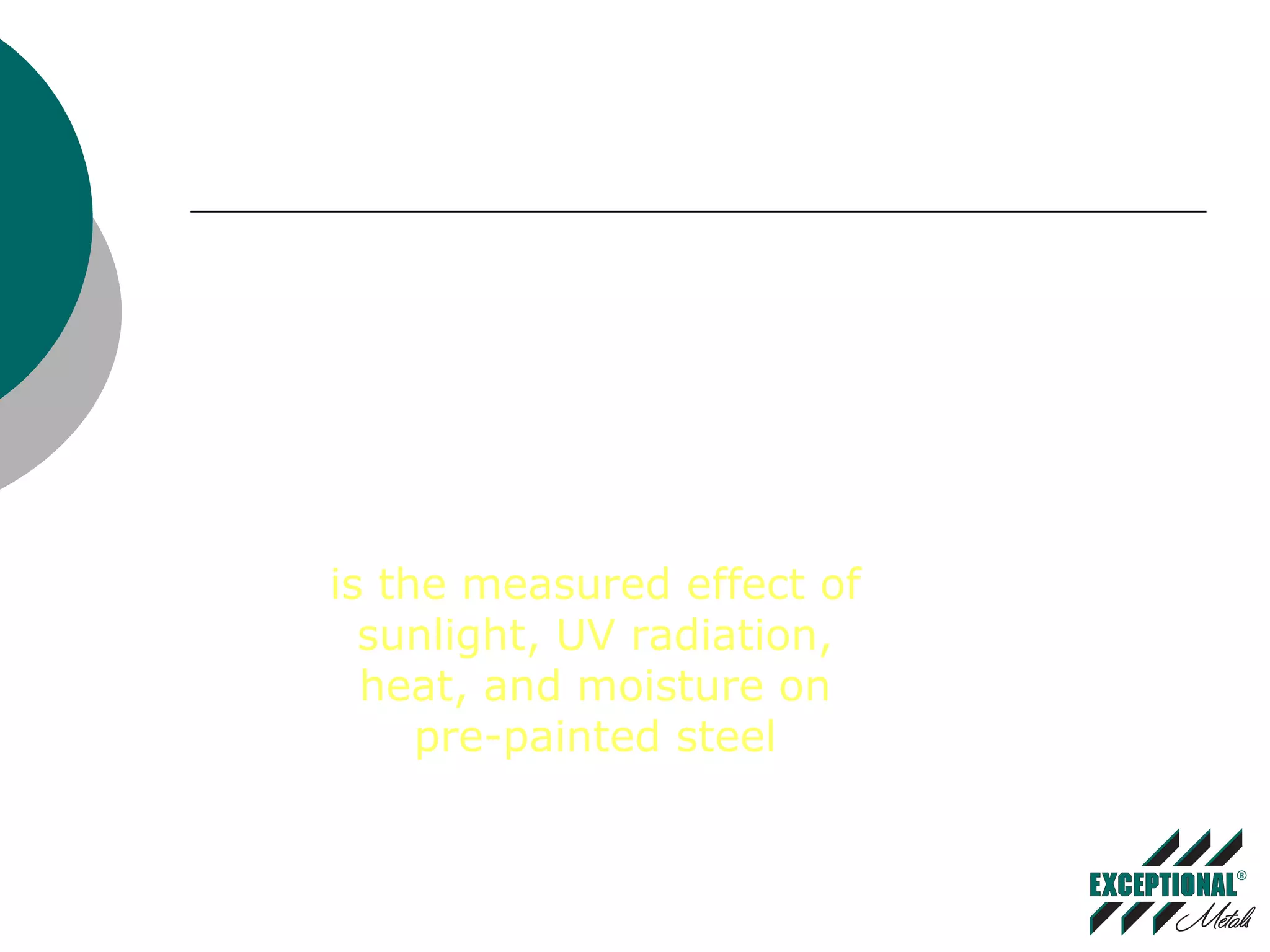
is the measured effect of
sunlight, UV radiation,
heat, and moisture on
pre-painted steel
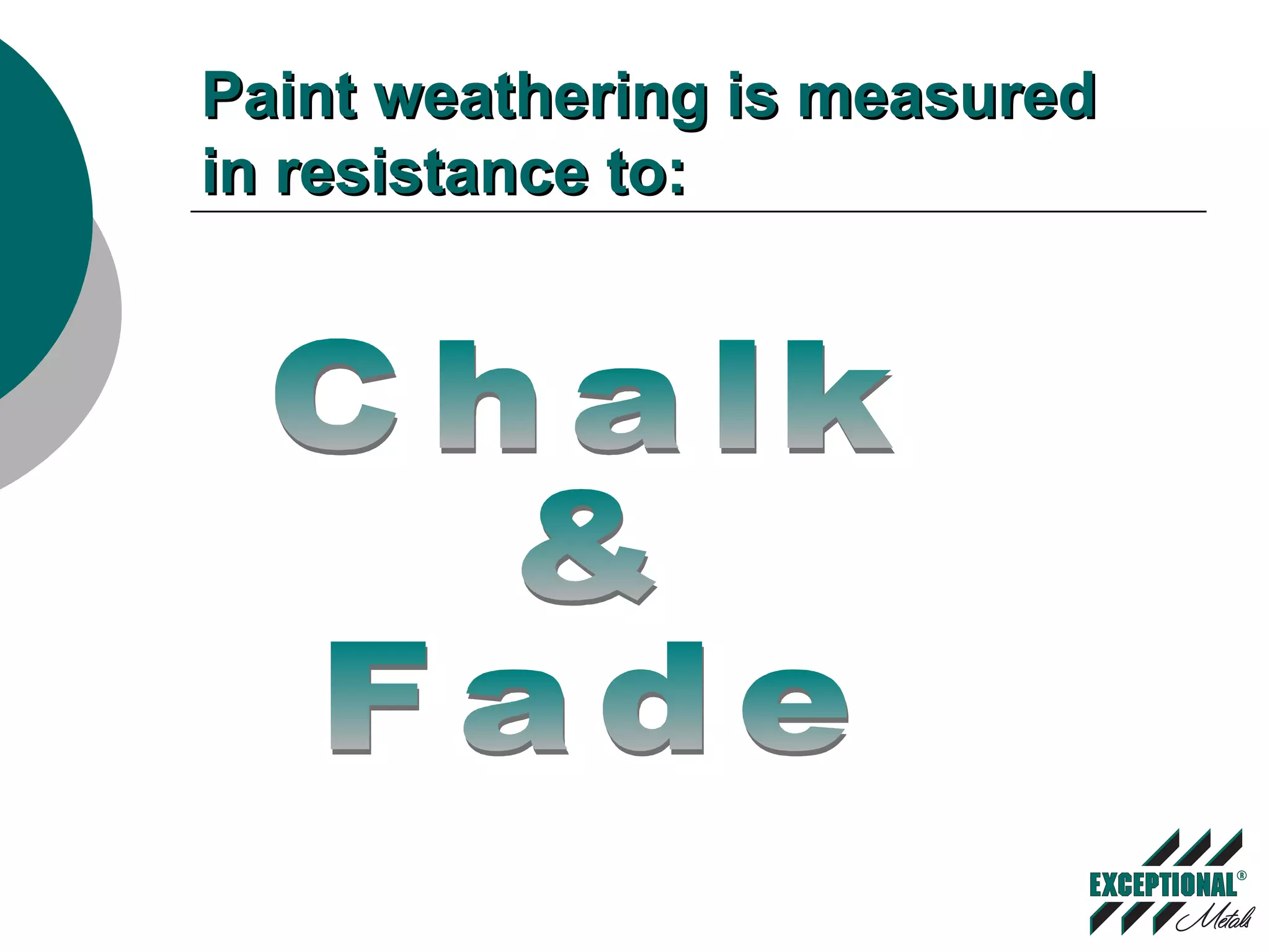
Paint weathering is measuredPaint weathering is measured
in resistance to:in resistance to:
DefinitionsDefinitions
 Chalk:
 Residue resulting from weathering
decomposition of paint films
 Visual ratings are assigned according
to ASTM D659; ratings range from 10-
0 (10 is best)
 Fade: change in a paint film color
and appearance due to
degradation from weathering and
UV radiation in sunlight
DefinitionsDefinitions
 Color fade:
 Expressed in calculated “delta E”
values or NBS units which are
measured and calculated according to
ASTM D2244
 Values range from 0 to infinity,
where0 is best; i.e., no color change
PVDF CoatingsPVDF Coatings
 Made with 70% PVDF resin –
KYNAR® 500 or HYLAR®
5000
 Exhibit excellent fabrication
flexibility and weatherability
 Use ceramic-inorganic
pigments, which provide
excellent resistance to color
chalking and fading
Cold Rolled Steel
Zinc or Zinc-Aluminum Layer
Ceramic/Inorganic Topcoat Pigment
PVDF Resins Surrounding Topcoat
Pigment
Metal
Treatment
0.2-mil
Primer
0.8-mil
Topcoat
Topcoat Layer: Protects AgainstTopcoat Layer: Protects Against
UV Radiation, Heat and MoistureUV Radiation, Heat and Moisture
South Florida Exposure Testing EMMAQUA
Exposure
Testing
Test
Panels
Mirrors
Why PVDF is # 1Why PVDF is # 1
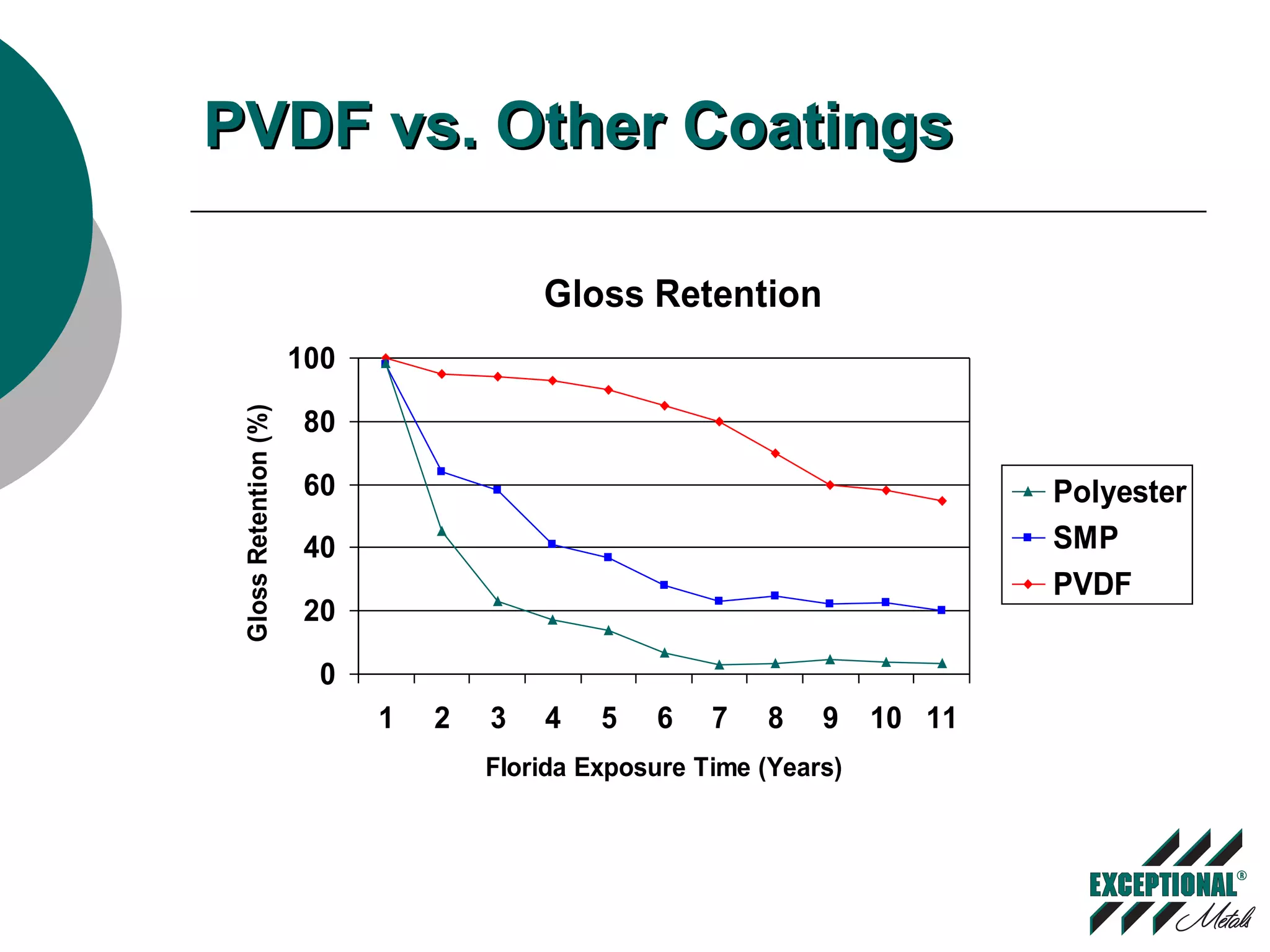
PVDF vs. Other CoatingsPVDF vs. Other Coatings
Color Change
0
5
10
15
20
25
30
0 1 2 3 4 5 6 7 8 9 10 11
Florida Exposure Time (Years)
ColorChange(deltaE)
SMP
Polyester
PVDF
PVDF vs. Other CoatingsPVDF vs. Other Coatings
Gloss Retention
0
20
40
60
80
100
1 2 3 4 5 6 7 8 9 10 11
Florida Exposure Time (Years)
GlossRetention(%)
Polyester
SMP
PVDF
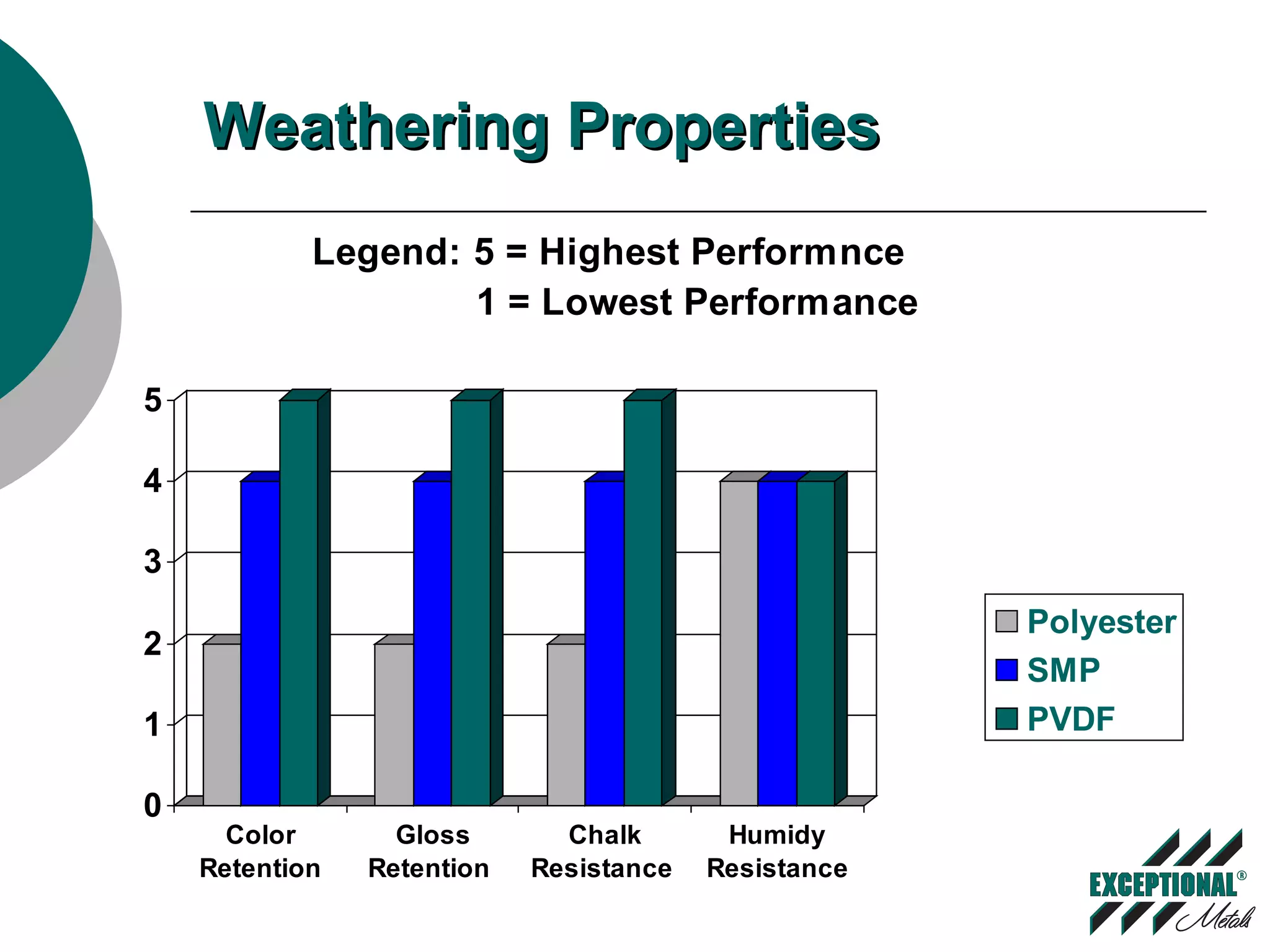
Weathering PropertiesWeathering Properties
0
1
2
3
4
5
Color
Retention
Gloss
Retention
Chalk
Resistance
Humidy
Resistance
Legend: 5 = Highest Performnce
1 = Lowest Performance
Polyester
SMP
PVDF
Physical PropertiesPhysical Properties
0
1
2
3
4
5
Abrasion
Resistance
Impact
Resistance
Film
Flexibility
Hardness Mar
Legend: 5 = Highest Performnce
1 = Lowest Performance
Polyester
SMP
PVDF
Chemical PropertiesChemical Properties
0
1
2
3
4
5
Aids& Alkalies Oil Stain Water Immersion
Legend: 5 = Highest Performnce
1 = Lowest Performance
Polyester
SMP
PVDF
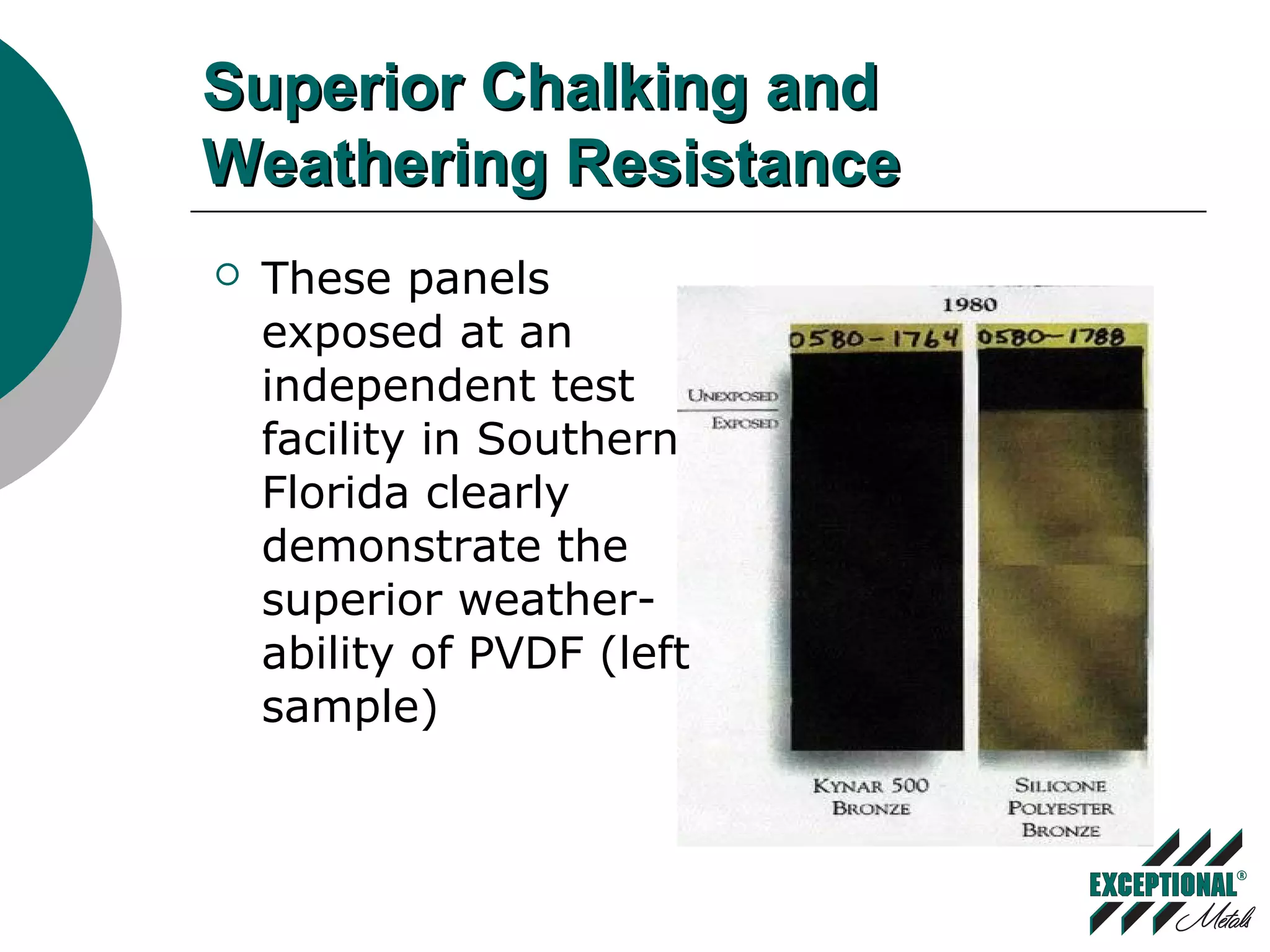
Superior Chalking andSuperior Chalking and
Weathering ResistanceWeathering Resistance
 These panels
exposed at an
independent test
facility in Southern
Florida clearly
demonstrate the
superior weather-
ability of PVDF (left
sample)
Elements of a PVDF WarrantyElements of a PVDF Warranty
 PVDF paint
warranties cover
the following for
20 years:
 Film integrity
 Color fade
 Chalk resistance
 Delamination
 PVDF paint
warranties do not
cover:
 Corrosion /
degradation of the
substrate
EXCEPTIONAL MetalsEXCEPTIONAL Metals
Offers Akzo Nobel Trinar coated products.Offers Akzo Nobel Trinar coated products.

Exmets paints

  • 1.
  • 2.
    Substrates and PaintsSubstratesand Paints  Substrates  Hot Dipped Galvanized  Galvalume®  Aluminum  Paint  The importance of pre-treatments  The importance of primers  Paint systems used in our industry:  Polyesters  Siliconized Polyester  Polyvinylidene Fluoride (PVDF)
  • 3.
    SubstratesSubstrates  Coated CarbonSteel  Hot Dipped Galvanized  G-90  Galvalume  AZ50  Aluminum  Alloy 3003  Temper – H14
  • 4.
    Hot Dipped GalvanizedHotDipped Galvanized  Zinc-coated carbon steel sheet that meets ASTM A653-96  Coating weight of G-90  By volume consists of a minimum thickness of .80 oz. of zinc per sq. ft. for both sides of the steel sheet  Great sacrificial advantages  No applicable corrosion warranty
  • 5.
    Galvanic ProtectionGalvanic Protection Coating is 100% zinc by volume  Hot Dipped Galvanized offers a desirable characteristic with respect to corrosion by sacrificing itself to protect slit edges and scratches  Generally has a smoother surface for paint application purposes  Superior formability
  • 6.
    GalvalumeGalvalume  By volume,Galvalume contains 80% aluminum in the coating; the other 20% contains zinc and silicon additive  Aluminum/Zinc coated carbon steel sheet meets ASTM A792-96  By volume, consists of a minimum thickness of .50 oz. per sq. ft. of Zn/Al for both sides of the steel sheet
  • 7.
    GalvalumeGalvalume  Coating weight– AZ50 or AZ55  Great corrosion properties  Good sacrificial advantages  20 year, 6 month warranty against corrosion
  • 8.
    Galvalume vs. HDGalvanizedGalvalume vs. HD Galvanized  Hot Dipped Galvanized  After 18 years, G-90 Galvanized exhibits red rust  Galvalume  Galvalume after 23 years – no major sign of red rust Moderate Marine Rural
  • 9.
    Corrosion Losses ofGalvalume and Galvanized SheetsCorrosion Losses of Galvalume and Galvanized Sheets After 13 Years of ExposureAfter 13 Years of Exposure 0 0.5 1 G A LVA LU M E H .D .G A LVA N IZED RURAL INDUSTRIAL MARINE - 800 FT SEVERE MARINE - 80 FT Corrosion Loss (Mils)Corrosion Loss (Mils)
  • 10.
    Salt Spray CorrosionResistanceSalt Spray Corrosion Resistance  With cut edges protected, the coating on Galvalume AZ50 lasts 5 to 10 times longer than the coating on G90 HD Galvanized  Salt spray tests conducted with bare cut edges exposed, determined that the corrosion resistance is typically three to four times that of G90 HD Galvanized
  • 11.
    Salt Spray TestConcerning the AmountSalt Spray Test Concerning the Amount of Hours to First Significant Rustof Hours to First Significant Rust 0 500 1000 1500 2000 2500 3000 Unprotected Edges Protected Edges Galvalume H.D. Galvanized Total # of Hours
  • 12.
  • 13.
  • 14.
    What a PaintedProduct Consists of:What a Painted Product Consists of: Cold Rolle d Ste e l Zinc (HDG) or Zinc-Alum inum (Galvalume®) Subs trate Pre -Tre atme nt Laye r Subs trate Pre-Tre atme nt Laye r Primer (0.20 - 0.25 mils) TRINAR ® Topcoat (0.70 - 0 .90 m ils ) Primer (0.20 - 0.25 mils) Polyester Backer (0.30 - 0 .50 m ils ) Prepaint Cross-Section
  • 15.
    Pre-TreatmentsPre-Treatments  A liquidused to produce a corrosion-resitant, organic bonding coating on aluminum, Galvalume, and Galvanized  An approved chromate rinse which is the major agent that allows the primer to bond to the substrate  Approved by Bethlehem Steel for the use on Galvalume
  • 16.
    Pre-TreatmentsPre-Treatments  Benefits ofpre-treatments Provide superior long-term corrosion protection Effective on aluminum, Galvalume and Galvanized Coating quality is consistently maintained
  • 17.
    PrimerPrimer  The baselayer of the paint applied by the coater  Formulated to provide corrosion protection to the base metal and to enhance adhesion between the top coat (paint) and the base metal
  • 18.
    Major Components ThatMake Up aMajor Components That Make Up a Paint SystemPaint System  PigmentsPigments  ResinResin  SolventsSolvents  AdditivesAdditives
  • 19.
    PigmentsPigments  Small solidparticles added to a paint to enhance appearance by providing color and /or improve physical (functional) properties of a paint.  Pigments are protected by the resin system.
  • 20.
     Types ofpigments:  Ceramic  Earth tones  Organic  Two classes of pigments:  Appearance  Functional PigmentsPigments
  • 21.
    Resin SystemsResin Systems The most important part of any paint system  The liquid “glue” of the paint system that surrounds the pigment particles, protecting them from environmental pollutants such as airborne chemicals and salt  Types of resin systems:  Polyester  Siliconized Polyester  Polyvinylidene Fluoride (PVDF)
  • 22.
    SolventsSolvents  The vehicleby which the pigment is “transported” to the metal surface  Solvents evaporate during the curing process to permit the formation of a paint film
  • 23.
    AdditivesAdditives  Any numberof chemicals added to the paint, usually in small amounts, to bring special effects to the paint
  • 24.
    Component FunctionsComponent Functions PigmentResin Solvent Additive Aesthetics Properties Application Enhancement Color Durability Stability Mar Resistance Gloss Adhesion Viscosity Curing Agent Adhesion Flexibility Compatibility Settling Film Strength Color Retention Film Control Dispersion Water Resistance Abrasion Adhesion Anti-Freeze Corrosion Resistance Impact Resistance Leveling De-Foaming
  • 25.
    Types of PaintSystemsTypes of Paint Systems  Polyester  Siliconized Polyester  Polyvinylidene Fluoride (PVDF)
  • 26.
    Polyester Paint SystemsPolyesterPaint Systems  A generic polymer coating with limited weathering performance  End uses: interior applications  Home appliances  Lighting fixtures  Wall panels
  • 27.
    Siliconized Polyester PaintSiliconizedPolyester Paint SystemsSystems  A generic coating type that represents a wide range of topcoats used on pre- painted metal in construction  The silicon extends the service life of the base polymer and improves weathering  End uses:  Metal building components  Agricultural and corrugated panels
  • 28.
    Polyvinylidene Fluoride (PVDF)PolyvinylideneFluoride (PVDF)  A fluoropolymer resin used as the major vehicle (base resin) in the paint system  Paint chemistry is 70% by weight PVDF resin  Exhibits superior:  Color retention  Chalk resistance  Corrosion resistance  Flexibility  Stain resistance  Overall exterior durability
  • 29.
    PVDF CoatingsPVDF Coatings Architecturalcoatings thatArchitectural coatings that extend building life and keep itextend building life and keep it looking the way it was designed!looking the way it was designed!
  • 30.
    How it worksHowit works  Advance molecular structural of PVDF utilizes carbon-fluorine bond – the strongest bond known in the chemical world – combined with a carbon-hydrogen bond, which creates a structure that is extremely durable
  • 31.
    is the measuredeffect of sunlight, UV radiation, heat, and moisture on pre-painted steel
  • 32.
    Paint weathering ismeasuredPaint weathering is measured in resistance to:in resistance to:
  • 33.
    DefinitionsDefinitions  Chalk:  Residueresulting from weathering decomposition of paint films  Visual ratings are assigned according to ASTM D659; ratings range from 10- 0 (10 is best)  Fade: change in a paint film color and appearance due to degradation from weathering and UV radiation in sunlight
  • 34.
    DefinitionsDefinitions  Color fade: Expressed in calculated “delta E” values or NBS units which are measured and calculated according to ASTM D2244  Values range from 0 to infinity, where0 is best; i.e., no color change
  • 35.
    PVDF CoatingsPVDF Coatings Made with 70% PVDF resin – KYNAR® 500 or HYLAR® 5000  Exhibit excellent fabrication flexibility and weatherability  Use ceramic-inorganic pigments, which provide excellent resistance to color chalking and fading
  • 36.
    Cold Rolled Steel Zincor Zinc-Aluminum Layer Ceramic/Inorganic Topcoat Pigment PVDF Resins Surrounding Topcoat Pigment Metal Treatment 0.2-mil Primer 0.8-mil Topcoat Topcoat Layer: Protects AgainstTopcoat Layer: Protects Against UV Radiation, Heat and MoistureUV Radiation, Heat and Moisture
  • 37.
    South Florida ExposureTesting EMMAQUA Exposure Testing Test Panels Mirrors
  • 38.
    Why PVDF is# 1Why PVDF is # 1
  • 39.
    PVDF vs. OtherCoatingsPVDF vs. Other Coatings Color Change 0 5 10 15 20 25 30 0 1 2 3 4 5 6 7 8 9 10 11 Florida Exposure Time (Years) ColorChange(deltaE) SMP Polyester PVDF
  • 40.
    PVDF vs. OtherCoatingsPVDF vs. Other Coatings Gloss Retention 0 20 40 60 80 100 1 2 3 4 5 6 7 8 9 10 11 Florida Exposure Time (Years) GlossRetention(%) Polyester SMP PVDF
  • 41.
  • 42.
    Physical PropertiesPhysical Properties 0 1 2 3 4 5 Abrasion Resistance Impact Resistance Film Flexibility HardnessMar Legend: 5 = Highest Performnce 1 = Lowest Performance Polyester SMP PVDF
  • 43.
    Chemical PropertiesChemical Properties 0 1 2 3 4 5 Aids&Alkalies Oil Stain Water Immersion Legend: 5 = Highest Performnce 1 = Lowest Performance Polyester SMP PVDF
  • 44.
    Superior Chalking andSuperiorChalking and Weathering ResistanceWeathering Resistance  These panels exposed at an independent test facility in Southern Florida clearly demonstrate the superior weather- ability of PVDF (left sample)
  • 45.
    Elements of aPVDF WarrantyElements of a PVDF Warranty  PVDF paint warranties cover the following for 20 years:  Film integrity  Color fade  Chalk resistance  Delamination  PVDF paint warranties do not cover:  Corrosion / degradation of the substrate
  • 46.
    EXCEPTIONAL MetalsEXCEPTIONAL Metals OffersAkzo Nobel Trinar coated products.Offers Akzo Nobel Trinar coated products.

Editor's Notes

  • #10 Corrosion Loss (Mils) Severe Marine – 80 foot Marine
  • #43 Mar rate – Kynar is more flexible and softer Polyester – SMP Harder resin