By Dr. Dida Boru
April, 2014
 A composite: a combination of two or more
chemically different materials with distinct
interface between them and having properties
better than those of the components acting
alone.
 Resin composite: a restorative dental material
containing
◦ Organic resin matrix
◦ Inorganic filler particles
◦ Coupling agent
◦ Other components
 Are high molecular weight monomers
◦ Bisphenol A glycidyl methacrylate (bis-GMA)
◦ Urethane dimethacrylate
 Terminal methacrylate groups provide sites
for free radical polymerization
 Disadvantages of bis-GMA
◦ Color instability
◦ High viscouscity ( decreased by adding TEGDMA or
EGDMA)
 May be
 Colloidal silica: inert
◦ Low cofficient of thermal expansion
◦ Improved condensability and polishibality
 Barium silicate:medium hardness
◦ Is very radiopaque
 Quartz: most widely used filler material throughout 1970’s
◦ Very stable and inert
◦ Disadvantages lack of radiopacity
 Abrasiveness
 High cofficient of thermal expansion
 Wear opposing tooth
 Zinc silicate
 Lithium aluminium silicate
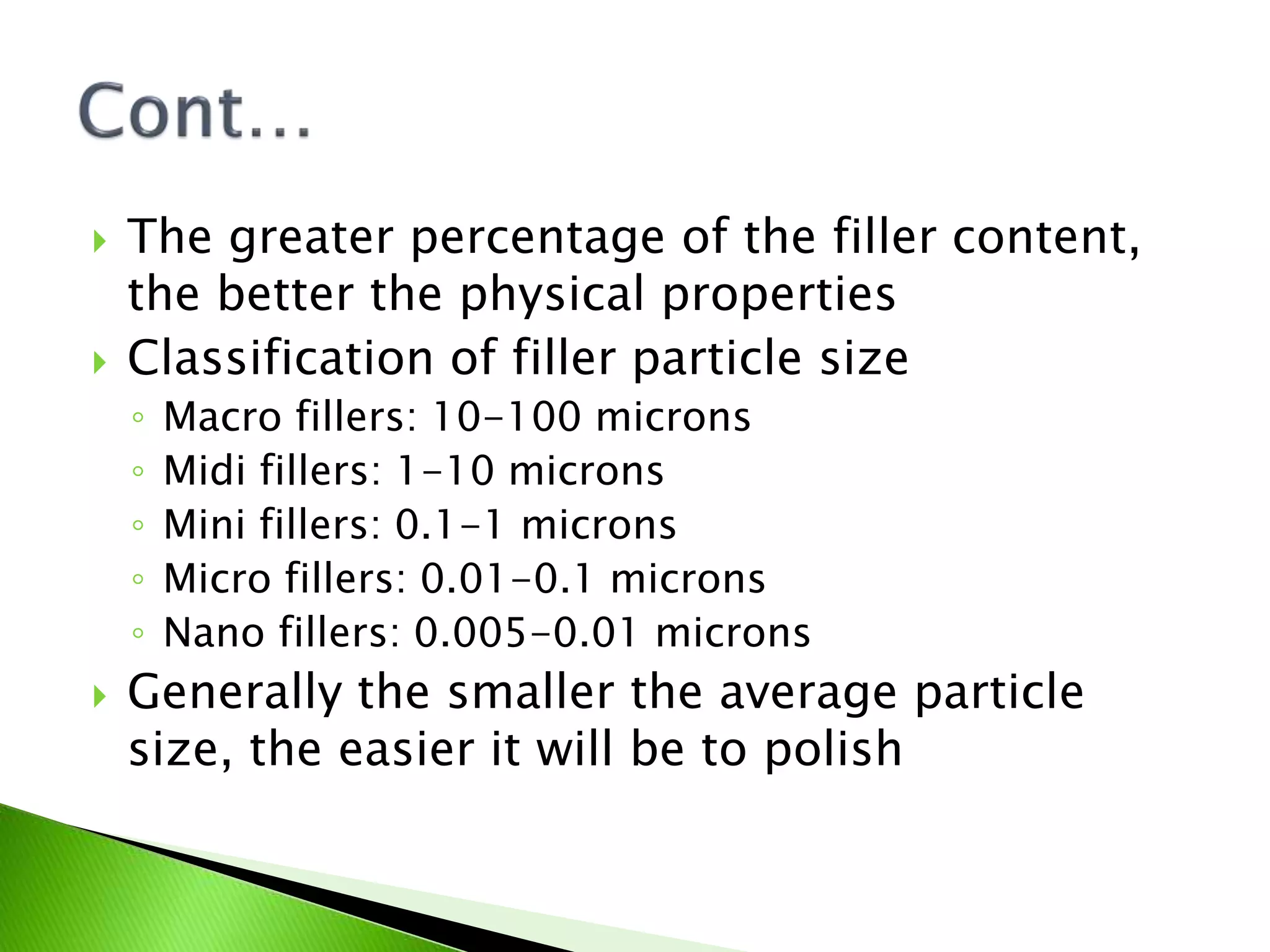
 The greater percentage of the filler content,
the better the physical properties
 Classification of filler particle size
◦ Macro fillers: 10-100 microns
◦ Midi fillers: 1-10 microns
◦ Mini fillers: 0.1-1 microns
◦ Micro fillers: 0.01-0.1 microns
◦ Nano fillers: 0.005-0.01 microns
 Generally the smaller the average particle
size, the easier it will be to polish
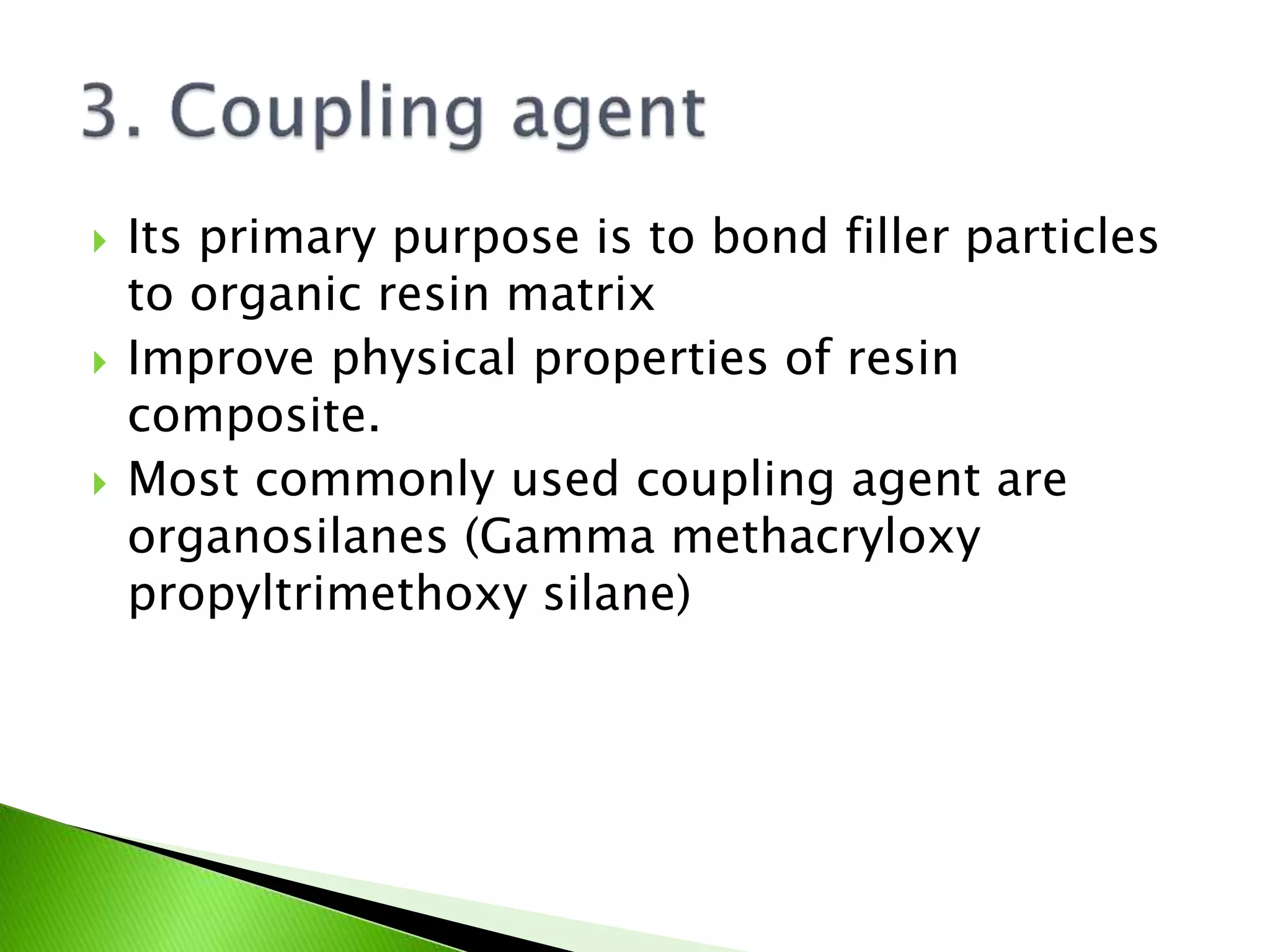
 Its primary purpose is to bond filler particles
to organic resin matrix
 Improve physical properties of resin
composite.
 Most commonly used coupling agent are
organosilanes (Gamma methacryloxy
propyltrimethoxy silane)
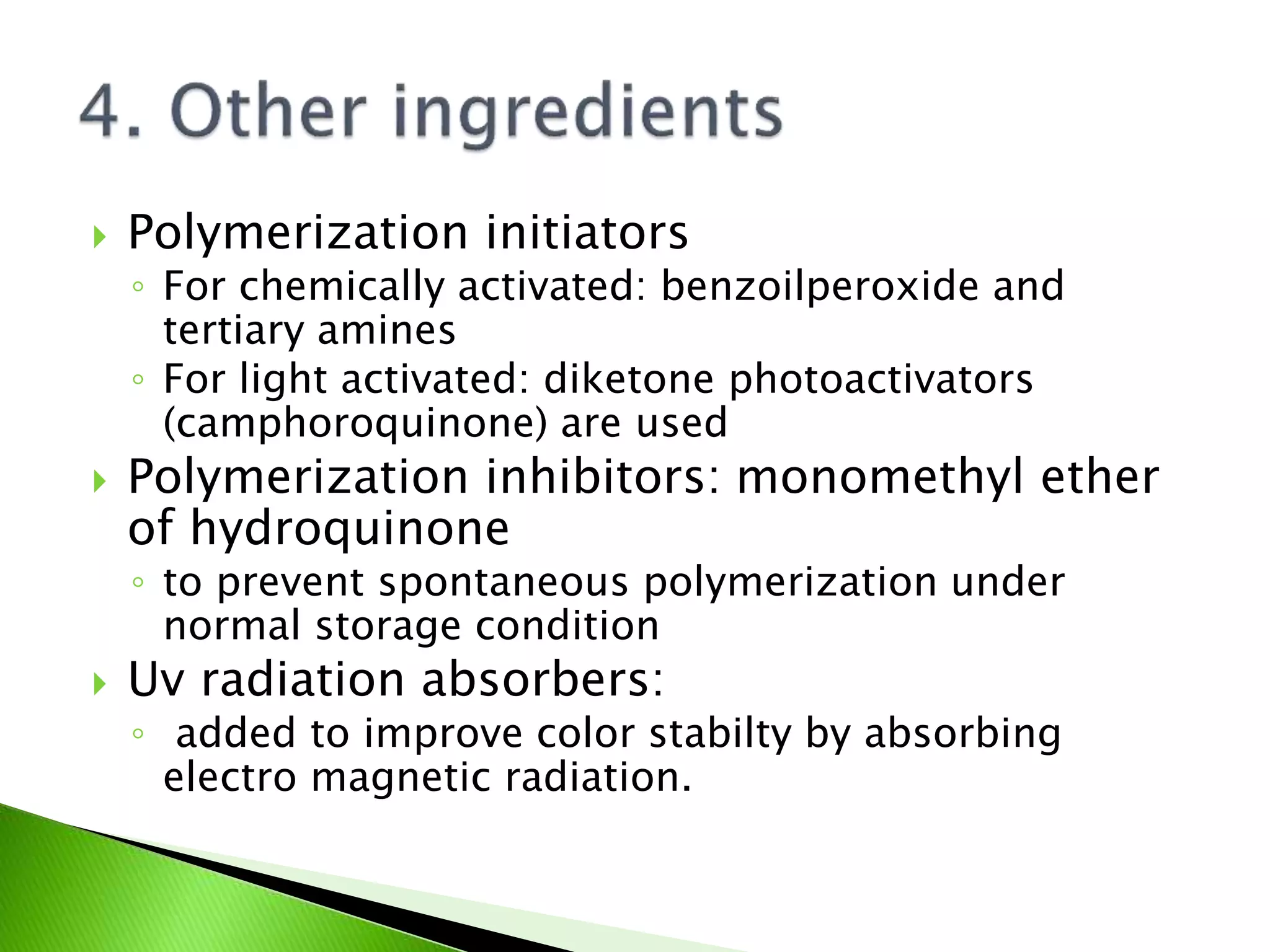
 Polymerization initiators
◦ For chemically activated: benzoilperoxide and
tertiary amines
◦ For light activated: diketone photoactivators
(camphoroquinone) are used
 Polymerization inhibitors: monomethyl ether
of hydroquinone
◦ to prevent spontaneous polymerization under
normal storage condition
 Uv radiation absorbers:
◦ added to improve color stabilty by absorbing
electro magnetic radiation.
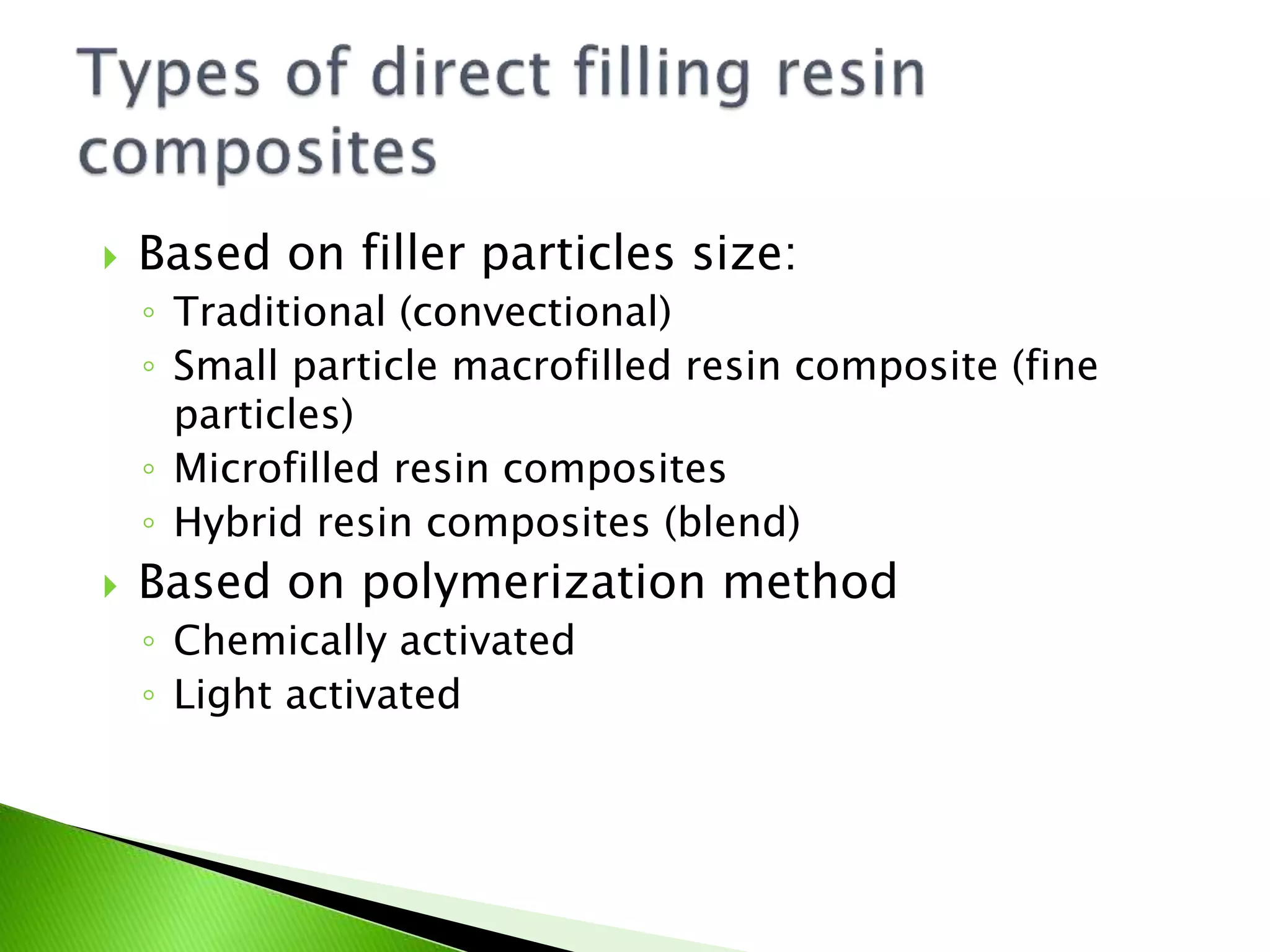
 Based on filler particles size:
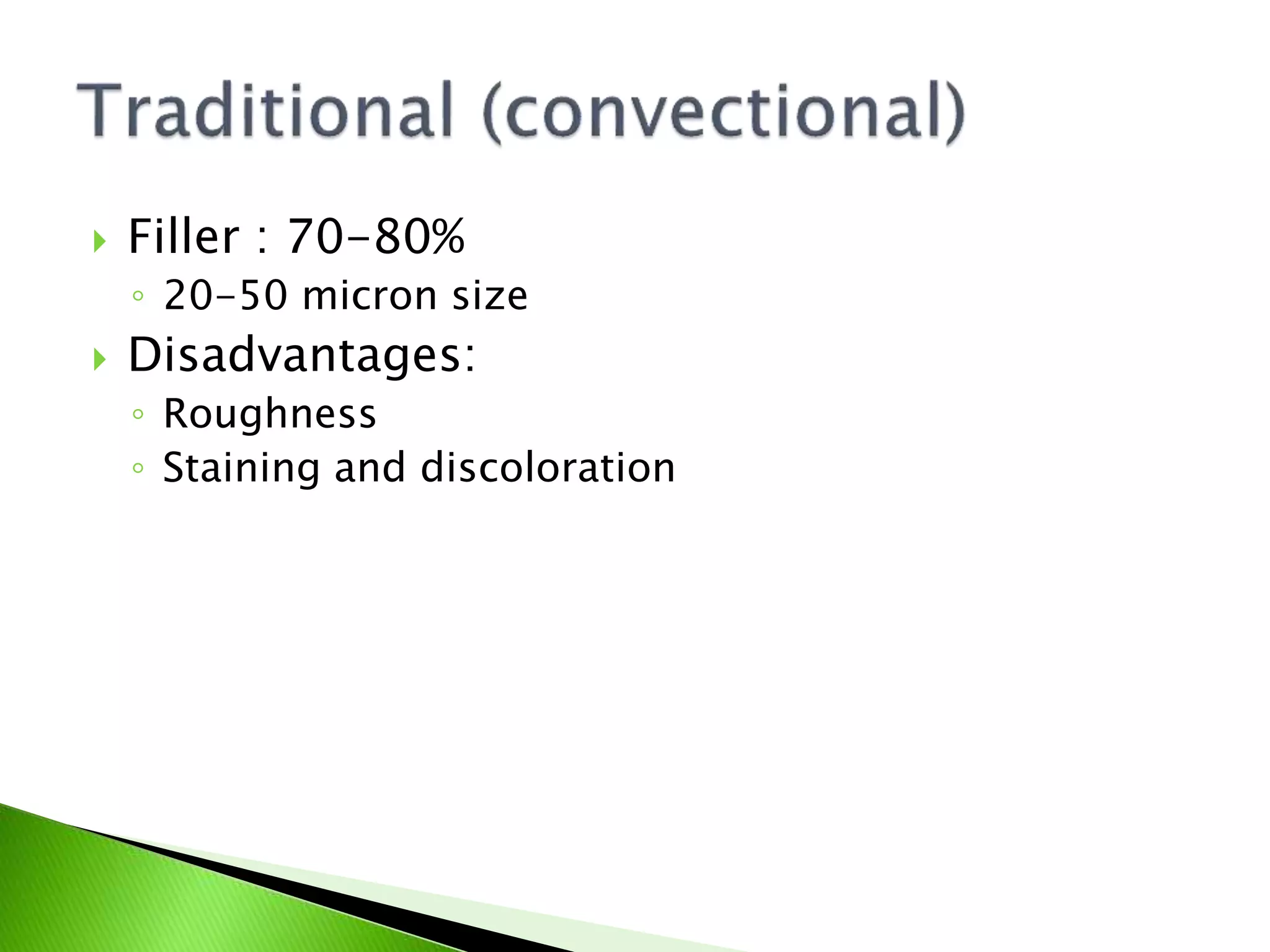
◦ Traditional (convectional)
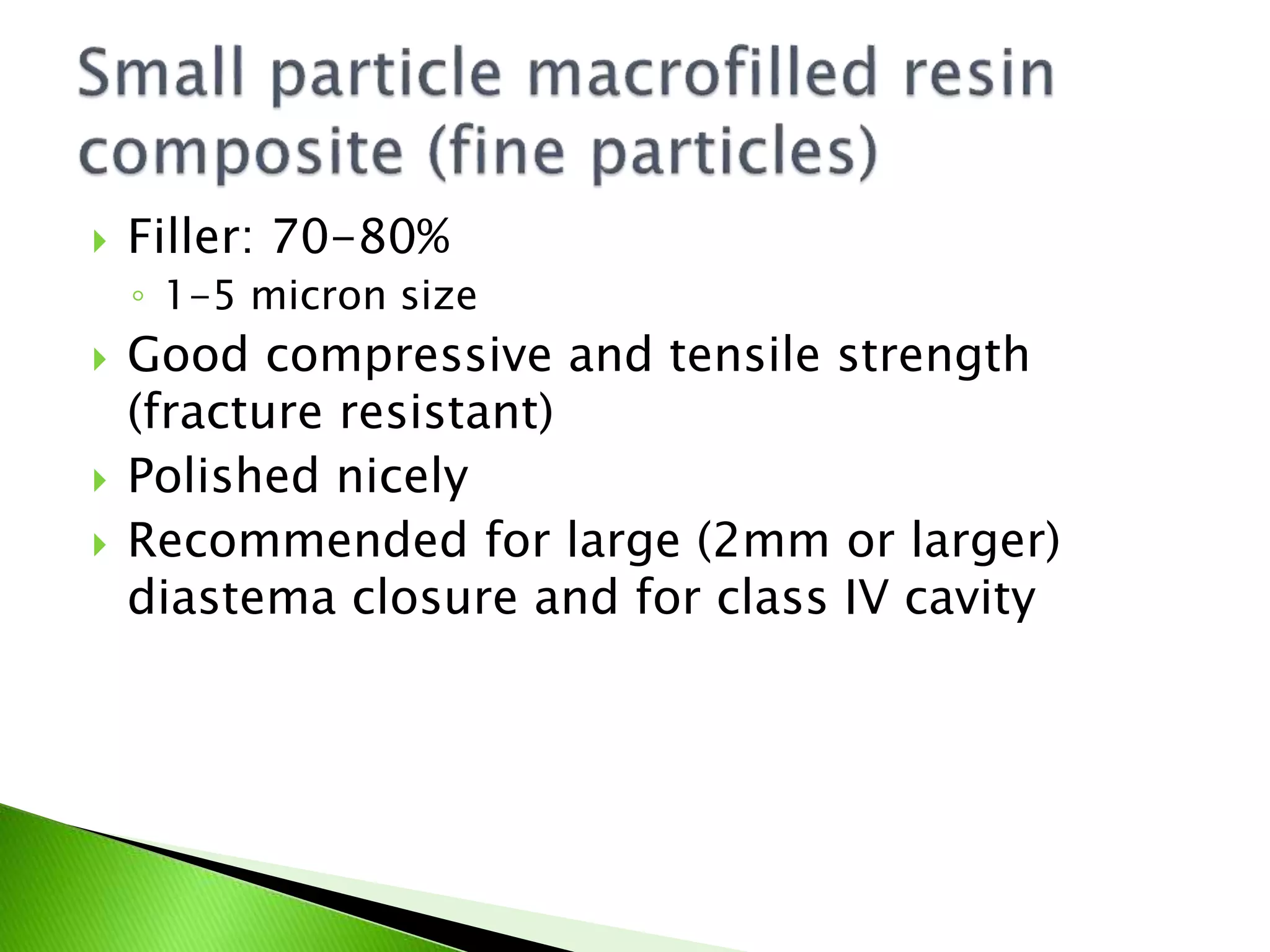
◦ Small particle macrofilled resin composite (fine
particles)
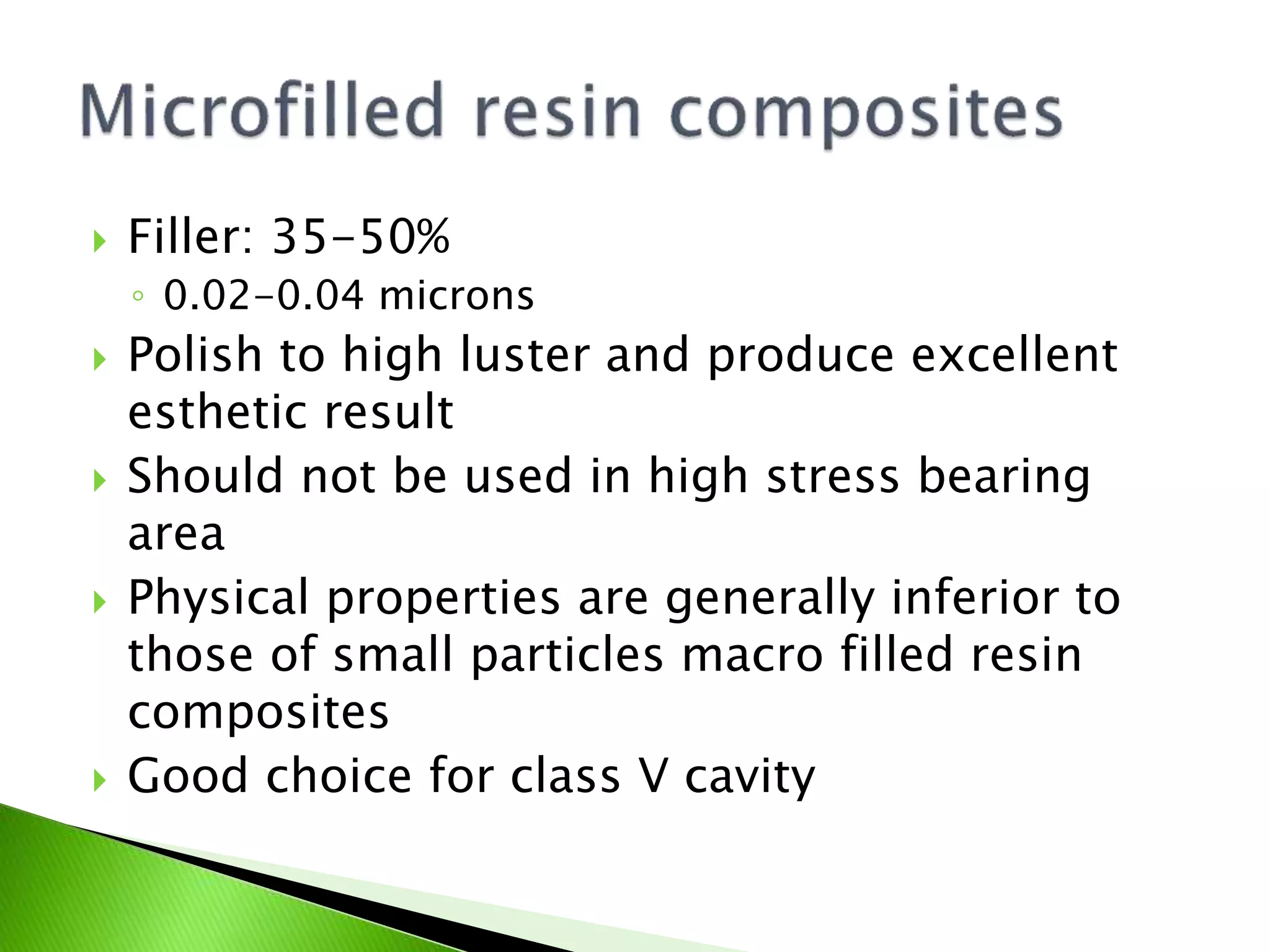
◦ Microfilled resin composites
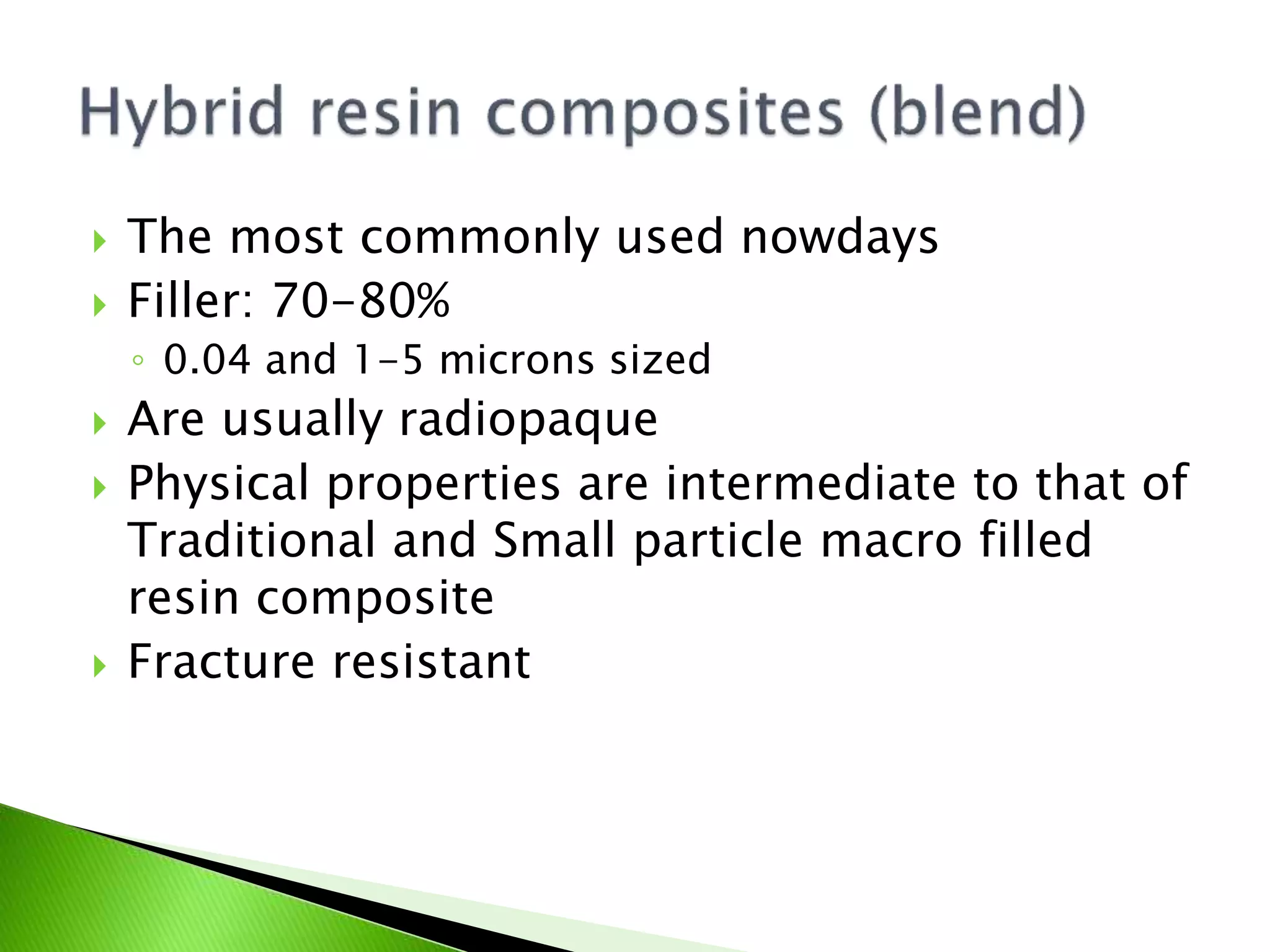
◦ Hybrid resin composites (blend)
 Based on polymerization method
◦ Chemically activated
◦ Light activated
 Filler : 70-80%
◦ 20-50 micron size
 Disadvantages:
◦ Roughness
◦ Staining and discoloration
 Filler: 70-80%
◦ 1-5 micron size
 Good compressive and tensile strength
(fracture resistant)
 Polished nicely
 Recommended for large (2mm or larger)
diastema closure and for class IV cavity
 Filler: 35-50%
◦ 0.02-0.04 microns
 Polish to high luster and produce excellent
esthetic result
 Should not be used in high stress bearing
area
 Physical properties are generally inferior to
those of small particles macro filled resin
composites
 Good choice for class V cavity
 The most commonly used nowdays
 Filler: 70-80%
◦ 0.04 and 1-5 microns sized
 Are usually radiopaque
 Physical properties are intermediate to that of
Traditional and Small particle macro filled
resin composite
 Fracture resistant
 Two paste system
 Base: contain benzoyl peroxide
 Activator (catalyst): Contain tertiary amine
 Disadvantage
◦ Contain porosity
 Ultraviolet light activated:
◦ contain benzoin methyl ether and tertiary amines
which when activated by UV light produce free
radicals
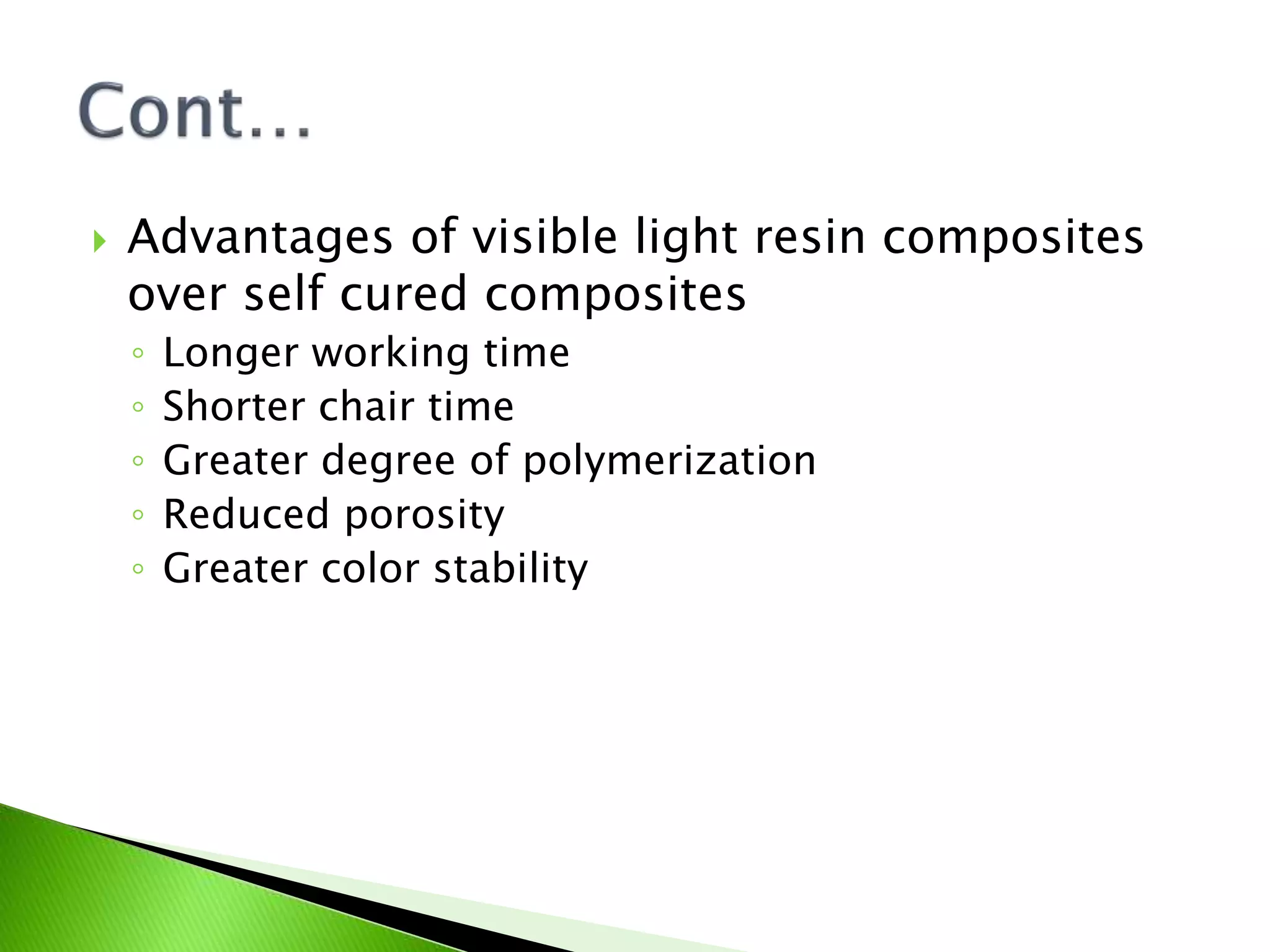
 Visible light activated:
◦ contain camphoroquinone (0.25%) photo initiator
and tertiary amines in single paste
 Advantages of visible light resin composites
over self cured composites
◦ Longer working time
◦ Shorter chair time
◦ Greater degree of polymerization
◦ Reduced porosity
◦ Greater color stability
 Disadvantages
◦ Non uniform polymerization secondary to limited
depth of penetration by the curing light
 Following light activation resin composites
continue to undergo polymerization for up to
24 hours
I. Incremental addition of resin composite
• Ensures completeness of polymerization
• Reduces polymerization shrinkage stress
II. Resin layer should not exceed 2mm in
depth
III. Minimum of 40 seconds exposure time
The most desirable finish surface for a
composite resin can be provided by
aluminum oxide disks
Contraindications for composite include
varnish and zinc oxide-eugenol
 Dr. michael Bounocore developed acid
etching technique using 85% phosphoric acid
in 1955
 Purposes
◦ Increases surface energy
◦ Chemically cleans tooth structure
◦ Creates micropores for micromechanical retention
 Standard acid etching of enamel is
application of 37% phosphoric acid for 15
seconds with 15 seconds rinsing and 15
seconds drying
 Other acids used
◦ Pyruvic acid
◦ Nitric acid
 Depth of enamel caused by enamel etchin is
approximately 10-15 microns
 Bonding agent is used instead of acid etchant
to open dentinal tubule
◦ EDTA
 Resin composite undergo volumetric
shrinkage of 1.6-5.7% during polymerization
due to monomer shrinkage
 Most detrimental effect of shrinkage is
microgap formation which results in
◦ Sensetivity
◦ Secondary caries
◦ Staining
◦ Pulpitis and necrosis
 Indications
◦ Class III cavity (except distal cavity on canines)
◦ Class IV cavity
◦ Cavity V cavity
◦ Filling gaps (diastemas) between teeth
◦ Veneering
◦ Minor reshaping of teeth
◦ Partial crowns on single teeth
◦ As Pit and fissure sealant
◦ Cementation of crowns
 Contraindications
◦ Class II cavity
◦ Class I cavity ( only indicated if requirements
fulfilled)
◦ Cavity on distal surface of canines
 Resin composite is indicated for posterior
tooth restoration if:
◦ Restoration is not in occlusal contact
◦ Isthmus is less than 1/3 of buccolingual intercuspal
dimension
◦ Cusps are not involved
◦ Margins are not involved
 Treatment area must isolated well
 Esthetics
 Low thermal conductivity
 No mercury or galvanism
 Conserves tooth structure
 Easily shaped prior to polymerization
 Time consuming to place
 Micro leakage
 Post treatment sensitivity
 Excessive wear
 Low strength
 Highly sensitive to moisture

Resin composites

  • 1.
    By Dr. DidaBoru April, 2014
  • 2.
     A composite:a combination of two or more chemically different materials with distinct interface between them and having properties better than those of the components acting alone.  Resin composite: a restorative dental material containing ◦ Organic resin matrix ◦ Inorganic filler particles ◦ Coupling agent ◦ Other components
  • 3.
     Are highmolecular weight monomers ◦ Bisphenol A glycidyl methacrylate (bis-GMA) ◦ Urethane dimethacrylate  Terminal methacrylate groups provide sites for free radical polymerization  Disadvantages of bis-GMA ◦ Color instability ◦ High viscouscity ( decreased by adding TEGDMA or EGDMA)
  • 4.
     May be Colloidal silica: inert ◦ Low cofficient of thermal expansion ◦ Improved condensability and polishibality  Barium silicate:medium hardness ◦ Is very radiopaque  Quartz: most widely used filler material throughout 1970’s ◦ Very stable and inert ◦ Disadvantages lack of radiopacity  Abrasiveness  High cofficient of thermal expansion  Wear opposing tooth  Zinc silicate  Lithium aluminium silicate
  • 5.
     The greaterpercentage of the filler content, the better the physical properties  Classification of filler particle size ◦ Macro fillers: 10-100 microns ◦ Midi fillers: 1-10 microns ◦ Mini fillers: 0.1-1 microns ◦ Micro fillers: 0.01-0.1 microns ◦ Nano fillers: 0.005-0.01 microns  Generally the smaller the average particle size, the easier it will be to polish
  • 6.
     Its primarypurpose is to bond filler particles to organic resin matrix  Improve physical properties of resin composite.  Most commonly used coupling agent are organosilanes (Gamma methacryloxy propyltrimethoxy silane)
  • 7.
     Polymerization initiators ◦For chemically activated: benzoilperoxide and tertiary amines ◦ For light activated: diketone photoactivators (camphoroquinone) are used  Polymerization inhibitors: monomethyl ether of hydroquinone ◦ to prevent spontaneous polymerization under normal storage condition  Uv radiation absorbers: ◦ added to improve color stabilty by absorbing electro magnetic radiation.
  • 8.
     Based onfiller particles size: ◦ Traditional (convectional) ◦ Small particle macrofilled resin composite (fine particles) ◦ Microfilled resin composites ◦ Hybrid resin composites (blend)  Based on polymerization method ◦ Chemically activated ◦ Light activated
  • 9.
     Filler :70-80% ◦ 20-50 micron size  Disadvantages: ◦ Roughness ◦ Staining and discoloration
  • 10.
     Filler: 70-80% ◦1-5 micron size  Good compressive and tensile strength (fracture resistant)  Polished nicely  Recommended for large (2mm or larger) diastema closure and for class IV cavity
  • 11.
     Filler: 35-50% ◦0.02-0.04 microns  Polish to high luster and produce excellent esthetic result  Should not be used in high stress bearing area  Physical properties are generally inferior to those of small particles macro filled resin composites  Good choice for class V cavity
  • 12.
     The mostcommonly used nowdays  Filler: 70-80% ◦ 0.04 and 1-5 microns sized  Are usually radiopaque  Physical properties are intermediate to that of Traditional and Small particle macro filled resin composite  Fracture resistant
  • 13.
     Two pastesystem  Base: contain benzoyl peroxide  Activator (catalyst): Contain tertiary amine  Disadvantage ◦ Contain porosity
  • 14.
     Ultraviolet lightactivated: ◦ contain benzoin methyl ether and tertiary amines which when activated by UV light produce free radicals  Visible light activated: ◦ contain camphoroquinone (0.25%) photo initiator and tertiary amines in single paste
  • 15.
     Advantages ofvisible light resin composites over self cured composites ◦ Longer working time ◦ Shorter chair time ◦ Greater degree of polymerization ◦ Reduced porosity ◦ Greater color stability
  • 16.
     Disadvantages ◦ Nonuniform polymerization secondary to limited depth of penetration by the curing light  Following light activation resin composites continue to undergo polymerization for up to 24 hours
  • 17.
    I. Incremental additionof resin composite • Ensures completeness of polymerization • Reduces polymerization shrinkage stress II. Resin layer should not exceed 2mm in depth III. Minimum of 40 seconds exposure time The most desirable finish surface for a composite resin can be provided by aluminum oxide disks Contraindications for composite include varnish and zinc oxide-eugenol
  • 18.
     Dr. michaelBounocore developed acid etching technique using 85% phosphoric acid in 1955  Purposes ◦ Increases surface energy ◦ Chemically cleans tooth structure ◦ Creates micropores for micromechanical retention  Standard acid etching of enamel is application of 37% phosphoric acid for 15 seconds with 15 seconds rinsing and 15 seconds drying
  • 19.
     Other acidsused ◦ Pyruvic acid ◦ Nitric acid  Depth of enamel caused by enamel etchin is approximately 10-15 microns  Bonding agent is used instead of acid etchant to open dentinal tubule ◦ EDTA
  • 20.
     Resin compositeundergo volumetric shrinkage of 1.6-5.7% during polymerization due to monomer shrinkage  Most detrimental effect of shrinkage is microgap formation which results in ◦ Sensetivity ◦ Secondary caries ◦ Staining ◦ Pulpitis and necrosis
  • 21.
     Indications ◦ ClassIII cavity (except distal cavity on canines) ◦ Class IV cavity ◦ Cavity V cavity ◦ Filling gaps (diastemas) between teeth ◦ Veneering ◦ Minor reshaping of teeth ◦ Partial crowns on single teeth ◦ As Pit and fissure sealant ◦ Cementation of crowns
  • 22.
     Contraindications ◦ ClassII cavity ◦ Class I cavity ( only indicated if requirements fulfilled) ◦ Cavity on distal surface of canines
  • 23.
     Resin compositeis indicated for posterior tooth restoration if: ◦ Restoration is not in occlusal contact ◦ Isthmus is less than 1/3 of buccolingual intercuspal dimension ◦ Cusps are not involved ◦ Margins are not involved  Treatment area must isolated well
  • 24.
     Esthetics  Lowthermal conductivity  No mercury or galvanism  Conserves tooth structure  Easily shaped prior to polymerization
  • 25.
     Time consumingto place  Micro leakage  Post treatment sensitivity  Excessive wear  Low strength  Highly sensitive to moisture