IJSRD - International Journal for Scientific Research & Development| Vol. 1, Issue 2, 2013 | ISSN (online): 2321-0613
All rights reserved by www.ijsrd.com 105
Speciality Elastomer Paint
Atul J. Shah1
Prof. G. B. Bhagchandani2
1, 2
L. D. College of Engineering, Ahmedabad, Gujarat
Abstract— The main objective of this review is to describe
some of the important topics related to the use of marine and
protective coatings for anti-corrosive purposes. In this
context,” protective” refers to coatings for containers, off
shore construction, pipe lines, pumps, steel structures,
chemical equipment, bridged, storage tanks and
petrochemical plants. The review aims at providing a
thorough picture of state-of-the-art in anti-corrosive coatings
systems. International and national legislation aiming at
reducing the emission of volatile organic compounds
(VOCs) have caused significant changes in the anti-
corrosive coating industries. An important aspect in the
development of new VOC –compliant, high performance
anti-corrosive coating system is a thorough knowledge of
the components in anti-corrosive coatings, their interaction,
their advantages and limitations as well as detailed
knowledge on the failure modes of anticorrosive coatings.
The different types of anticorrosive coatings are presented,
and the most widely applied generic types of binders and
pigments in anticorrosive coatings.
I. INTRODUCTION
Both organic and inorganic coatings have been widely
applied for the protection of metals against corrosion. In
many areas of coatings technology the fight against
corrosion has made significant progress in recent years.
The annual costs related to corrosion and corrosion
prevention has been estimated to constitute a significant part
of the gross national product in the world. Corrosion issues
are clearly of great importance in modern societies. In
addition to the economic costs and technological delays,
corrosion can lead to structural failures that have dramatic
consequences for humans and the surrounding environment.
Reports on the corrosion failures of metal structure, bridges,
aircrafts, automobiles, buildings, and gas pipelines are not
unusual.
Development of new “corrosion resistance” alloys
permits operation of critical processing equipment in highly
corrosive environment over an ever wider range of
conditions. Despite significant improvements in coating
technologies problems continue in the long term protection
of metal from aggressive environments.
Although the oil and pipeline industry has developed
reliable cathodic protection methods and monitoring
systems that permit safe operation in difficult environment,
these industries also experienced coating failures. One of the
main reasons for the limited number of high performance
anti-corrosive coating systems is the complexity of the
coating substrate system and the no. of factors affecting the
performance and service life of anti-corrosive coatings.
Besides the composition of the coating, this consists of
binders, pigments, solvents, extenders, and additives. The
performance and durability of anticorrosive coating depends
on several different parameters, such as type of substance as
well as several external environmental parameters. To
perform its duty effectively, an anticorrosive coating must
possess intrinsic durability, adhesion to the substrate,
adequate flexibility and toughness to withstand impacts and
cracking as well as maintain its appearance when subjected
to stress, swell, mechanical abuse, or weathering.
The coating industry is a mature industry that has been
undergoing a continual change in technology throughout the
last few decades. International and national legislation
aimed at reducing the use of volatile organic compounds has
led to significant changes in the formulation of anticorrosive
coatings, which traditionally have contained a relatively
large amount of organic solvents. The present trend of
aiming to reduce emissions of VOCs will urge the coatings
industry to develop products with high-solid contents,
powder coatings, or waterborne coatings with low amounts
of organic solvents. Although high-solid, inorganic,
waterborne and powder coatings are becoming more
frequently applied, it may be difficult to substitute solvent-
borne organic coatings completely in harsh environments.
An important aspect in the development of high
performance of coatings systems for anticorrosive purposes
in the marine and protective sector is a thorough knowledge
and understanding of the interactions between the
components in coatings. Furthermore, understanding of the
fundamental physical and chemical mechanisms responsible
for the failure of anticorrosive coatings during service may
provide a basis for the designs of novel new coatings.
In contrast to previous reviews that concern single topics the
overall intension of this paper is to combine the main topics
related to anticorrosive coatings technology. An introduction
to the different types of anticorrosive coatings presently
available, the main components in anticorrosive coatings,
novel anticorrosive coating ideas and a summary of most
important degradation mechanisms.
II. COATING ADDITIVES
Paint additives and coating additives include a wide
range of materials added to polymer resins, paints and
coatings and other substances to modify specific processing
or end-use properties. They include insulating paint
additives, powder coating additives, catalysts, wetting
agents, levellers, clarifier, coupling agents, deflocculates,
thinners, thickeners, anti-caking agents and other chemicals.
Paint Additives and Coating Additives are available in
many different forms.
A wide range of paint additives, coating additives,
insulating paint additives and powder coating additives
Speciality elastomer paint
(IJSRD/Vol. 1/Issue 2/2013/0014)
All rights reserved by www.ijsrd.com
106
made from the finest quality raw materials. These products
are effective in providing water resistance, corrosion
resistance, heat resistance and abrasion resistance. Our
paints and coatings additives are safe and environment-
friendly.
III. ANTI-CORROSION COATING
FeaturesA.
 Single pack; ready to use system (no need to mix
two components)
 Quick Drying at room temperature (Dries within 15
minutes)
 Self-Priming (No need to apply primer)
 Tough & Scratch proof
 Fire Resistance – BS-163
 Excellent resistance to U.V. Radiation
 Resistance to Acids, Alkalies & saline atmosphere.
 Stable up to 2000 o
C
 Available in all desired colour shades
Available in ‘Heat Resistant’ & Heat Conductive grades.
BenefitsB.
 Saves cost as compared to conventional protective
paints
 Reduces the delivery period due to fast & short
painting process.
 Saves Manpower & Time.
AdvantagesC.
 Easy to apply by Brush & conventional spray
techniques.
 No skill manpower requirement.
 Quick & Convenient
 Considerable reduction in painting time.
 Applicable on Ferrous & Non-ferrous metals.
ApplicationsD.
 Equipment Structural Steel
 Industrial Valves, Motors & Pumps
 Control Panels, Transformers
 Pipe Lines, Storage Tanks
 MS Structures, Chemical Plants/
Refineries/Thermal Power Complexes
IV. SPECIFICATIONS FOR ANTICORROSION
COATING
Function Polymeric based protective coating to protect
Metallic Structures from Corrosion in varied climatic
conditions.
FeaturesA.
 Self-Priming
 Single Component
 Air Drying
 Easy to Apply by Brush / Spray Techniques
Physical propertiesB.
 Form: Liquid
 Colour :As Desired
 Odour : Characteristic Solvent
 pH : Neutral
 Density : 1.01 (+/- 0.02) at 27o C
 Viscosity : 24 sec. ( B-4 Cup ) at 270 o
C
 Solid Content (By weight):
o Brush Technique :45 – 50%
o Spray Technique : 33 – 35 %
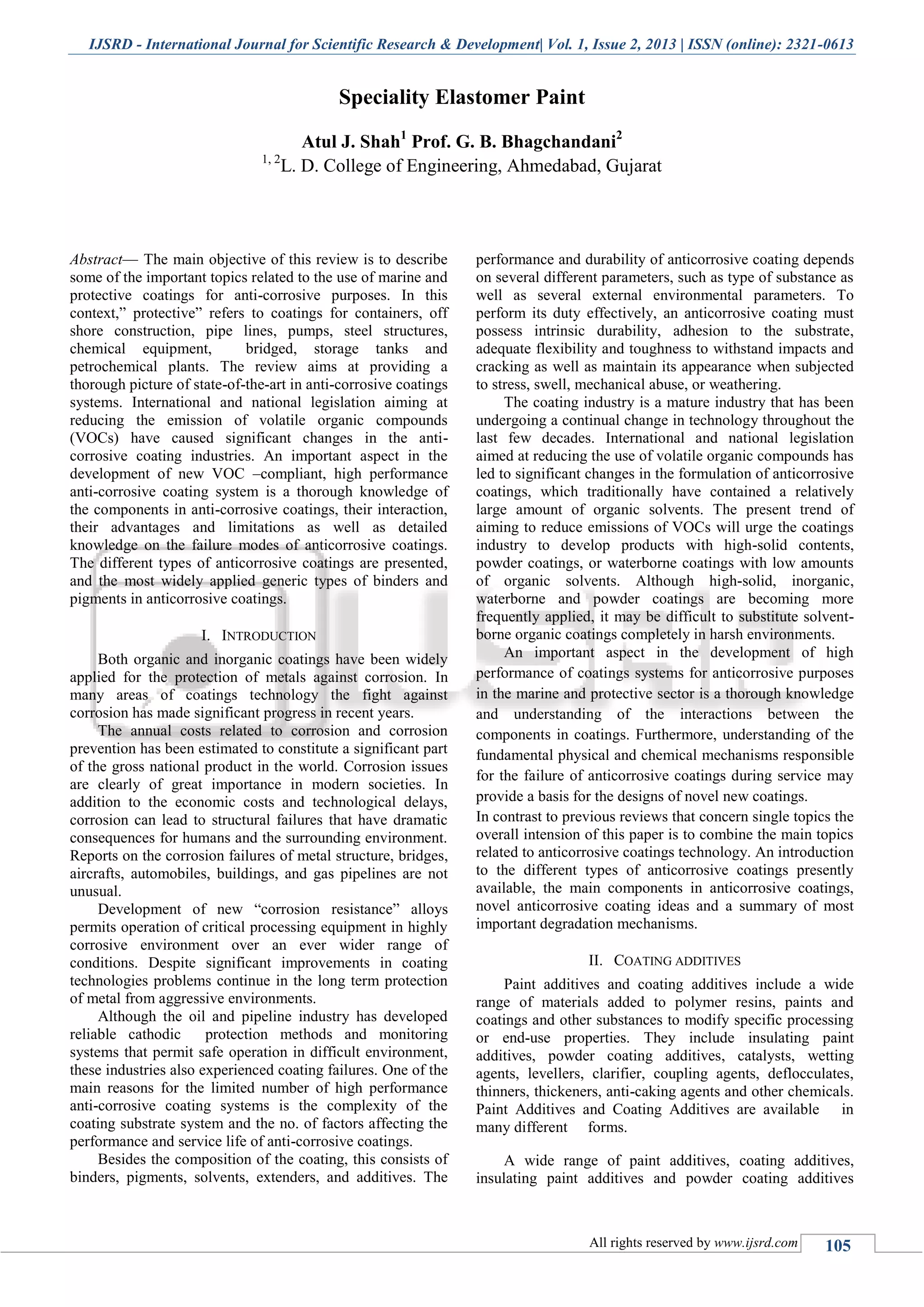
Sr.
No
.
Parameters
Syn.
Enamels
Epoxy
Anti-
Corrosiv
e
Coatings
1 Base
Alkyd resin
base
Epoxy
base(Thermosettin
g)
Specialty
Rubbers
2 System Single pack Double pack
Single
pack
3 Mixing
Thinning
with the
help of
thinner
necessary
Mixing of two
components is very
critical
Ready to
use
system
4
Necessity of
primer
Red oxide
primer
necessary
Primer necessary
Self-
priming
coating
5
Drying
period
4-5 hours 48-96 hours
10 min.
of touch
dry, 24
hrs. for
hard dry
6
Possibilities
of
adulteration
Possible possible
Not
possible
7
Acid, Alkali
and
Chemical
resistance
No
Resistance
Good Chemical
resistance
Excellent
acid,
alkali,
chemical
resistance
8
U.V.
Resistance
Poor Poor Excellent
9
Hat
resistance
Poor Poor
Stable up
to 200 o
C
10
Life
(performance
)
6 months 2-3 years
10 yrs(4-
5 yrs
highly
corrosive
atm.)
11 Shades
All I.S.
Shades
Limited shades
All
I.S.,RAL
shades
12
Salt spray
resistance
Non-
performance
; decorative
paint
96 hours 3500 hrs.
Table 1. Comparison chart
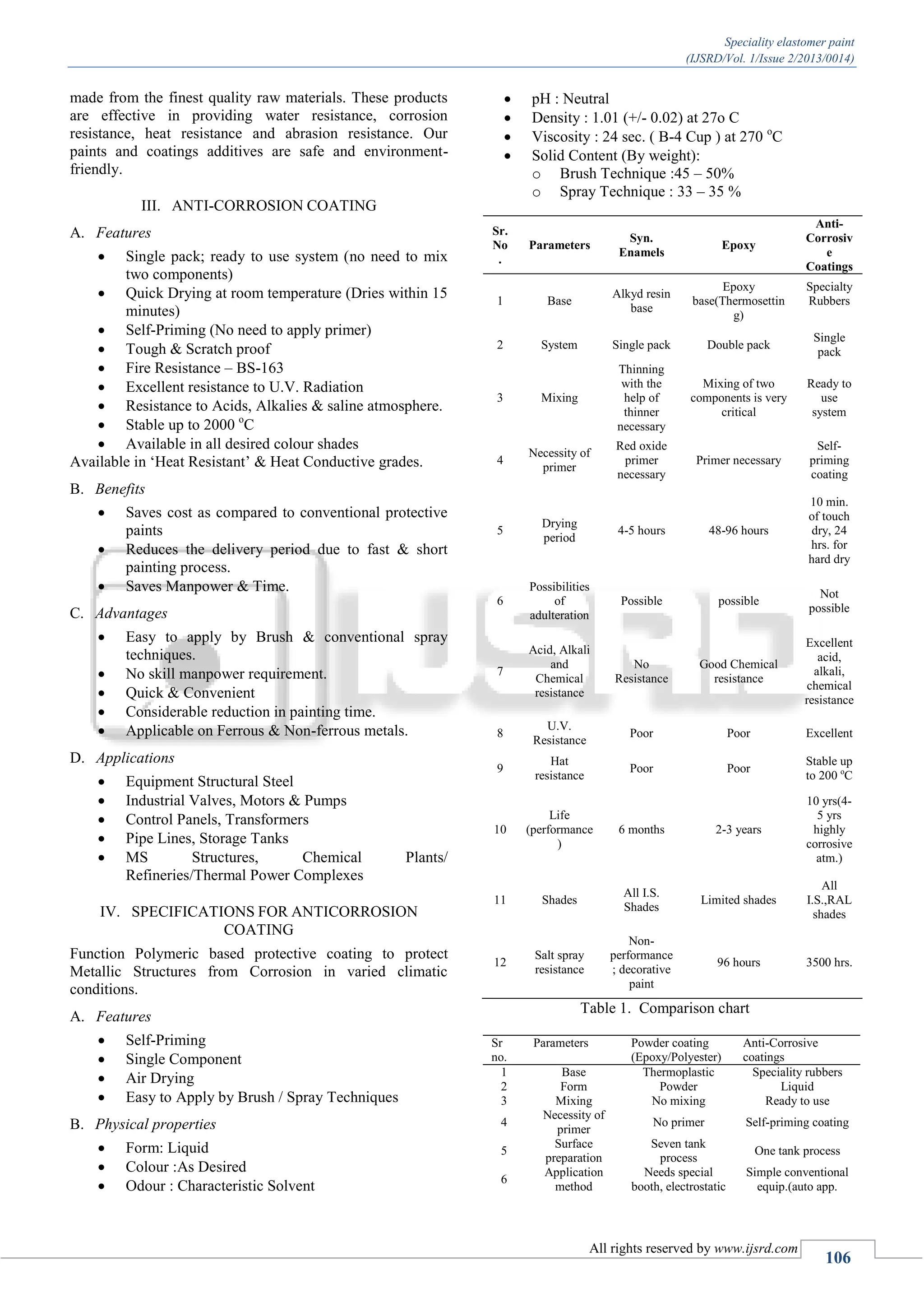
Sr
no.
Parameters Powder coating
(Epoxy/Polyester)
Anti-Corrosive
coatings
1 Base Thermoplastic Speciality rubbers
2 Form Powder Liquid
3 Mixing No mixing Ready to use
4
Necessity of
primer
No primer Self-priming coating
5
Surface
preparation
Seven tank
process
One tank process
6
Application
method
Needs special
booth, electrostatic
Simple conventional
equip.(auto app.
Speciality elastomer paint
(IJSRD/Vol. 1/Issue 2/2013/0014)
All rights reserved by www.ijsrd.com
107
gun and oven
curing
possible)
7
Energy
requirement
Huge consumption
of electricity for
oven curing
Minimum
requirement of
electricity
8 Drying period 4-8 hrs
10 min. at room
temp.
9
Environmental
safety
Disposal of sludge
is an issue
Environmental
friendly formulation
and application
10
Acid, alkali and
Chemical
resistance
Moderate Excellent
11 U.V resistance Poor Excellent
12 Heat resistance 120 o
C max. Stable up to 200 o
C
13
Life
(performance)
Not good for
outdoor
applications.
Excellent indoor &
outdoor performance
14 Finish One type of finish
Gloss, matt, textured
finish
15 Shades Limited All RAL & IS
16
Salt spray
resistance
300 hrs 1500 hrs
17
In case of
damage
Touch
up/Refinishing not
possible
Touch up/over
coating possible
18
Additional
features
- Resistance to fire
19 Cost savings -
Saves electricity,
time, manpower and
enhances production
Table 2. Powder v/s anti corrosive coating
Application propertiesC.
 Touch Dry 15 minutes
 Recoatable 20 minutes
 Hard Dry 24 hours
 Coverage 70 sq. ft. per litre per coat( Flat Area)
 Dry Film Thickness 35-40 microns / per coat –
Spray Application
 55-60 microns/per coat – Brush Application
 Application Method Conventional Spray/ Brush
Technique
 Surface Requirement Free from dust, rust, oil,
grease & any other Foreign Deposits.
Performance propertiesD.
 Flexibility (Conical Mandrel) 4mm: No Film
Crack
 Impact ( 60 Kg/Cm 2
): No Film Crack
 Adhesion Passes Gt 0
 Scratch Resistance: 4.5 kg
 Thermal Stability 1800 o
C ( Continuous)
 Immersion in cold water for 7 days : No Effect
Observed
 Immersion in Boiling water for 24 hours : No
Effect Observed
 Immersion in Lubricating Oil for 7 days : No Effect
Observed
 Immersion in Vegetable Oil for 7 Days : No Effect
Observed
 Immersion in Kerosene : No Effect Observed
 Salt Spray Resistance 1500 hours : No corrosion
 Exposure to mix. Of 20% HCL & 18% H2So4:
No Deterioration of film
V. CONCLUSION
As a technology, Anti corrosive rubber coating are alive
and well. Their success as a corrosion mitigation system,
due in no small part to their excellent chemical resistance
and ease of use has lead to a steadily increasing global
market share, which continues to grow. Anti-corrosive
rubber coatings, either as a single coat, stand-alone solution
or part of a multilayer coating, have consistently met the
demands placed upon them in a wide variety of industrial or
environmental applications. Anti-corrosive rubber coatings
have a successful track record for protecting all metals,
RCC, wood against corrosion all over the world—from the
highly aggressive environment of the extreme conditions in
the chemical, marine and water born industries. In response
to the needs of these industries novel technologies have led
to the development of new anti-corrosive rubber coating
systems, including self-healing and priming coatings,
designed to tolerate abuse on the jobsite, as well as
multilayer coatings with user friendly physical and chemical
properties. The desire for increased service life through
corrosion control systems has driven, and will continue to
drive, further advancements in anti-corrosive rubber
technology.is required day to day for different industrial
corrosion problems in so many different manners.
After all anti-corrosive rubber coating is more suitable
than different industrial coatings available in market in
respect of labour saving, material saving, quick setting and
drying time, self-priming and better storage life with
minimum coating thickness.
REFERENCES
[1] Picciotti, M., Picciotti, F., “Selecting Corrosion-
Resistant Materials.” Chem. Eng. Prog., 102 (2006), 45
[2] Fragata, F., Salai, R.P., Amorin, C., Almeida, E.,
(2006) “Compatibility and Incompatibility in
Anticorrosive Painting - The Particular Case of
Maintenance Painting.” Prog. Org. Coat., 56: 257
[3] Uniroyal co., United State of America
[4]
[5] Shipilov, S.A., Le May, I., “Structural Integrity of
Aging Buried Pipelines Having Cathodic Protection.”,
13, (2006), 1159.
doi:10.1016/j.engfailanal.2005.07.008
[6] Kouloumbi, N., Ghivalos, L.G., Pantazopoulou, P.,
“Determination of the Performance of Epoxy Coatings
Containing Feldspar Filler.” Pigment & Resin
Technology, 34, (2005), 148
[7] Dabral, M., Francis, L.F., Scriven, L.E., “Drying
Process Paths of Ternary Polymer Solution Coating.”
AlChE J., 48, (2002), 25
[8] Almeida, E., “Surface Treatments and Coatings for
Metals. A General Overview.” Ind. Eng. Chem. Res.,
40, (2001), 3. doi:10.1021/ie000209l
[9] Elsner, C.I., Cavalcanti, E., Ferraz, O., Di Sarli, A. R.,
“Evaluation of the Surface Treatment Effect on the
Anticorrosive Performance of Paint Systems on Steel.”
Prog. Org. Coat., 48, (2003), 50
[10]Santagata, D.M., Sere, P.R., Elsner, C.I., Di Sarli, A.
R., “Evaluation of the Surface Treatment Effect on the
Corrosion Performance of Paint Coated Carbon Steel.”
Prog. Org. Coat., 33, (1998), 44
Speciality elastomer paint
(IJSRD/Vol. 1/Issue 2/2013/0014)
All rights reserved by www.ijsrd.com
108
[11]Narayanan, T. N. S., “Surface Pretreatment by
Phosphate Conversion Coatings - A Review.” Rev.
Adv. Mater. Sci., 9, (2005), 130
[12]Nguyen, T., Hubbard, J.B., McFadden, G.B.,
“Mathematical Model for the Cathodic Blistering of
Organic Coatings on Steel Immersed in Electrolytes.”
J. Protect. Coat. Linings, 63, (1991), 43
[13]Weiss, K.D., “Paint and Coatings: A Mature Industry in
Transition.” Prog. Polym. Sci., 22, (1997), 203.
doi:10.1016/S0079-6700(96)00019-6
[14]Greenfield, D, Scantlebury, D, “The Protective Action
of Organic Coatings on Steel: A Review.” J. Corros.
Sci. Eng., 2 (2000)
[15]Walter, G.W., “A Critical Review of the Protection of
Metals by Paints.” Corros. Sci., 16, (1986), 39.
doi:10.1016/0010-938X(86)90121-6
[16]Chemical Publishing co. Inc., Michael and Irene Ash,
New York
[17]Bayer Germany

Speciality Elastomer Paint

  • 1.
    IJSRD - InternationalJournal for Scientific Research & Development| Vol. 1, Issue 2, 2013 | ISSN (online): 2321-0613 All rights reserved by www.ijsrd.com 105 Speciality Elastomer Paint Atul J. Shah1 Prof. G. B. Bhagchandani2 1, 2 L. D. College of Engineering, Ahmedabad, Gujarat Abstract— The main objective of this review is to describe some of the important topics related to the use of marine and protective coatings for anti-corrosive purposes. In this context,” protective” refers to coatings for containers, off shore construction, pipe lines, pumps, steel structures, chemical equipment, bridged, storage tanks and petrochemical plants. The review aims at providing a thorough picture of state-of-the-art in anti-corrosive coatings systems. International and national legislation aiming at reducing the emission of volatile organic compounds (VOCs) have caused significant changes in the anti- corrosive coating industries. An important aspect in the development of new VOC –compliant, high performance anti-corrosive coating system is a thorough knowledge of the components in anti-corrosive coatings, their interaction, their advantages and limitations as well as detailed knowledge on the failure modes of anticorrosive coatings. The different types of anticorrosive coatings are presented, and the most widely applied generic types of binders and pigments in anticorrosive coatings. I. INTRODUCTION Both organic and inorganic coatings have been widely applied for the protection of metals against corrosion. In many areas of coatings technology the fight against corrosion has made significant progress in recent years. The annual costs related to corrosion and corrosion prevention has been estimated to constitute a significant part of the gross national product in the world. Corrosion issues are clearly of great importance in modern societies. In addition to the economic costs and technological delays, corrosion can lead to structural failures that have dramatic consequences for humans and the surrounding environment. Reports on the corrosion failures of metal structure, bridges, aircrafts, automobiles, buildings, and gas pipelines are not unusual. Development of new “corrosion resistance” alloys permits operation of critical processing equipment in highly corrosive environment over an ever wider range of conditions. Despite significant improvements in coating technologies problems continue in the long term protection of metal from aggressive environments. Although the oil and pipeline industry has developed reliable cathodic protection methods and monitoring systems that permit safe operation in difficult environment, these industries also experienced coating failures. One of the main reasons for the limited number of high performance anti-corrosive coating systems is the complexity of the coating substrate system and the no. of factors affecting the performance and service life of anti-corrosive coatings. Besides the composition of the coating, this consists of binders, pigments, solvents, extenders, and additives. The performance and durability of anticorrosive coating depends on several different parameters, such as type of substance as well as several external environmental parameters. To perform its duty effectively, an anticorrosive coating must possess intrinsic durability, adhesion to the substrate, adequate flexibility and toughness to withstand impacts and cracking as well as maintain its appearance when subjected to stress, swell, mechanical abuse, or weathering. The coating industry is a mature industry that has been undergoing a continual change in technology throughout the last few decades. International and national legislation aimed at reducing the use of volatile organic compounds has led to significant changes in the formulation of anticorrosive coatings, which traditionally have contained a relatively large amount of organic solvents. The present trend of aiming to reduce emissions of VOCs will urge the coatings industry to develop products with high-solid contents, powder coatings, or waterborne coatings with low amounts of organic solvents. Although high-solid, inorganic, waterborne and powder coatings are becoming more frequently applied, it may be difficult to substitute solvent- borne organic coatings completely in harsh environments. An important aspect in the development of high performance of coatings systems for anticorrosive purposes in the marine and protective sector is a thorough knowledge and understanding of the interactions between the components in coatings. Furthermore, understanding of the fundamental physical and chemical mechanisms responsible for the failure of anticorrosive coatings during service may provide a basis for the designs of novel new coatings. In contrast to previous reviews that concern single topics the overall intension of this paper is to combine the main topics related to anticorrosive coatings technology. An introduction to the different types of anticorrosive coatings presently available, the main components in anticorrosive coatings, novel anticorrosive coating ideas and a summary of most important degradation mechanisms. II. COATING ADDITIVES Paint additives and coating additives include a wide range of materials added to polymer resins, paints and coatings and other substances to modify specific processing or end-use properties. They include insulating paint additives, powder coating additives, catalysts, wetting agents, levellers, clarifier, coupling agents, deflocculates, thinners, thickeners, anti-caking agents and other chemicals. Paint Additives and Coating Additives are available in many different forms. A wide range of paint additives, coating additives, insulating paint additives and powder coating additives
  • 2.
    Speciality elastomer paint (IJSRD/Vol.1/Issue 2/2013/0014) All rights reserved by www.ijsrd.com 106 made from the finest quality raw materials. These products are effective in providing water resistance, corrosion resistance, heat resistance and abrasion resistance. Our paints and coatings additives are safe and environment- friendly. III. ANTI-CORROSION COATING FeaturesA.  Single pack; ready to use system (no need to mix two components)  Quick Drying at room temperature (Dries within 15 minutes)  Self-Priming (No need to apply primer)  Tough & Scratch proof  Fire Resistance – BS-163  Excellent resistance to U.V. Radiation  Resistance to Acids, Alkalies & saline atmosphere.  Stable up to 2000 o C  Available in all desired colour shades Available in ‘Heat Resistant’ & Heat Conductive grades. BenefitsB.  Saves cost as compared to conventional protective paints  Reduces the delivery period due to fast & short painting process.  Saves Manpower & Time. AdvantagesC.  Easy to apply by Brush & conventional spray techniques.  No skill manpower requirement.  Quick & Convenient  Considerable reduction in painting time.  Applicable on Ferrous & Non-ferrous metals. ApplicationsD.  Equipment Structural Steel  Industrial Valves, Motors & Pumps  Control Panels, Transformers  Pipe Lines, Storage Tanks  MS Structures, Chemical Plants/ Refineries/Thermal Power Complexes IV. SPECIFICATIONS FOR ANTICORROSION COATING Function Polymeric based protective coating to protect Metallic Structures from Corrosion in varied climatic conditions. FeaturesA.  Self-Priming  Single Component  Air Drying  Easy to Apply by Brush / Spray Techniques Physical propertiesB.  Form: Liquid  Colour :As Desired  Odour : Characteristic Solvent  pH : Neutral  Density : 1.01 (+/- 0.02) at 27o C  Viscosity : 24 sec. ( B-4 Cup ) at 270 o C  Solid Content (By weight): o Brush Technique :45 – 50% o Spray Technique : 33 – 35 % Sr. No . Parameters Syn. Enamels Epoxy Anti- Corrosiv e Coatings 1 Base Alkyd resin base Epoxy base(Thermosettin g) Specialty Rubbers 2 System Single pack Double pack Single pack 3 Mixing Thinning with the help of thinner necessary Mixing of two components is very critical Ready to use system 4 Necessity of primer Red oxide primer necessary Primer necessary Self- priming coating 5 Drying period 4-5 hours 48-96 hours 10 min. of touch dry, 24 hrs. for hard dry 6 Possibilities of adulteration Possible possible Not possible 7 Acid, Alkali and Chemical resistance No Resistance Good Chemical resistance Excellent acid, alkali, chemical resistance 8 U.V. Resistance Poor Poor Excellent 9 Hat resistance Poor Poor Stable up to 200 o C 10 Life (performance ) 6 months 2-3 years 10 yrs(4- 5 yrs highly corrosive atm.) 11 Shades All I.S. Shades Limited shades All I.S.,RAL shades 12 Salt spray resistance Non- performance ; decorative paint 96 hours 3500 hrs. Table 1. Comparison chart Sr no. Parameters Powder coating (Epoxy/Polyester) Anti-Corrosive coatings 1 Base Thermoplastic Speciality rubbers 2 Form Powder Liquid 3 Mixing No mixing Ready to use 4 Necessity of primer No primer Self-priming coating 5 Surface preparation Seven tank process One tank process 6 Application method Needs special booth, electrostatic Simple conventional equip.(auto app.
  • 3.
    Speciality elastomer paint (IJSRD/Vol.1/Issue 2/2013/0014) All rights reserved by www.ijsrd.com 107 gun and oven curing possible) 7 Energy requirement Huge consumption of electricity for oven curing Minimum requirement of electricity 8 Drying period 4-8 hrs 10 min. at room temp. 9 Environmental safety Disposal of sludge is an issue Environmental friendly formulation and application 10 Acid, alkali and Chemical resistance Moderate Excellent 11 U.V resistance Poor Excellent 12 Heat resistance 120 o C max. Stable up to 200 o C 13 Life (performance) Not good for outdoor applications. Excellent indoor & outdoor performance 14 Finish One type of finish Gloss, matt, textured finish 15 Shades Limited All RAL & IS 16 Salt spray resistance 300 hrs 1500 hrs 17 In case of damage Touch up/Refinishing not possible Touch up/over coating possible 18 Additional features - Resistance to fire 19 Cost savings - Saves electricity, time, manpower and enhances production Table 2. Powder v/s anti corrosive coating Application propertiesC.  Touch Dry 15 minutes  Recoatable 20 minutes  Hard Dry 24 hours  Coverage 70 sq. ft. per litre per coat( Flat Area)  Dry Film Thickness 35-40 microns / per coat – Spray Application  55-60 microns/per coat – Brush Application  Application Method Conventional Spray/ Brush Technique  Surface Requirement Free from dust, rust, oil, grease & any other Foreign Deposits. Performance propertiesD.  Flexibility (Conical Mandrel) 4mm: No Film Crack  Impact ( 60 Kg/Cm 2 ): No Film Crack  Adhesion Passes Gt 0  Scratch Resistance: 4.5 kg  Thermal Stability 1800 o C ( Continuous)  Immersion in cold water for 7 days : No Effect Observed  Immersion in Boiling water for 24 hours : No Effect Observed  Immersion in Lubricating Oil for 7 days : No Effect Observed  Immersion in Vegetable Oil for 7 Days : No Effect Observed  Immersion in Kerosene : No Effect Observed  Salt Spray Resistance 1500 hours : No corrosion  Exposure to mix. Of 20% HCL & 18% H2So4: No Deterioration of film V. CONCLUSION As a technology, Anti corrosive rubber coating are alive and well. Their success as a corrosion mitigation system, due in no small part to their excellent chemical resistance and ease of use has lead to a steadily increasing global market share, which continues to grow. Anti-corrosive rubber coatings, either as a single coat, stand-alone solution or part of a multilayer coating, have consistently met the demands placed upon them in a wide variety of industrial or environmental applications. Anti-corrosive rubber coatings have a successful track record for protecting all metals, RCC, wood against corrosion all over the world—from the highly aggressive environment of the extreme conditions in the chemical, marine and water born industries. In response to the needs of these industries novel technologies have led to the development of new anti-corrosive rubber coating systems, including self-healing and priming coatings, designed to tolerate abuse on the jobsite, as well as multilayer coatings with user friendly physical and chemical properties. The desire for increased service life through corrosion control systems has driven, and will continue to drive, further advancements in anti-corrosive rubber technology.is required day to day for different industrial corrosion problems in so many different manners. After all anti-corrosive rubber coating is more suitable than different industrial coatings available in market in respect of labour saving, material saving, quick setting and drying time, self-priming and better storage life with minimum coating thickness. REFERENCES [1] Picciotti, M., Picciotti, F., “Selecting Corrosion- Resistant Materials.” Chem. Eng. Prog., 102 (2006), 45 [2] Fragata, F., Salai, R.P., Amorin, C., Almeida, E., (2006) “Compatibility and Incompatibility in Anticorrosive Painting - The Particular Case of Maintenance Painting.” Prog. Org. Coat., 56: 257 [3] Uniroyal co., United State of America [4] [5] Shipilov, S.A., Le May, I., “Structural Integrity of Aging Buried Pipelines Having Cathodic Protection.”, 13, (2006), 1159. doi:10.1016/j.engfailanal.2005.07.008 [6] Kouloumbi, N., Ghivalos, L.G., Pantazopoulou, P., “Determination of the Performance of Epoxy Coatings Containing Feldspar Filler.” Pigment & Resin Technology, 34, (2005), 148 [7] Dabral, M., Francis, L.F., Scriven, L.E., “Drying Process Paths of Ternary Polymer Solution Coating.” AlChE J., 48, (2002), 25 [8] Almeida, E., “Surface Treatments and Coatings for Metals. A General Overview.” Ind. Eng. Chem. Res., 40, (2001), 3. doi:10.1021/ie000209l [9] Elsner, C.I., Cavalcanti, E., Ferraz, O., Di Sarli, A. R., “Evaluation of the Surface Treatment Effect on the Anticorrosive Performance of Paint Systems on Steel.” Prog. Org. Coat., 48, (2003), 50 [10]Santagata, D.M., Sere, P.R., Elsner, C.I., Di Sarli, A. R., “Evaluation of the Surface Treatment Effect on the Corrosion Performance of Paint Coated Carbon Steel.” Prog. Org. Coat., 33, (1998), 44
  • 4.
    Speciality elastomer paint (IJSRD/Vol.1/Issue 2/2013/0014) All rights reserved by www.ijsrd.com 108 [11]Narayanan, T. N. S., “Surface Pretreatment by Phosphate Conversion Coatings - A Review.” Rev. Adv. Mater. Sci., 9, (2005), 130 [12]Nguyen, T., Hubbard, J.B., McFadden, G.B., “Mathematical Model for the Cathodic Blistering of Organic Coatings on Steel Immersed in Electrolytes.” J. Protect. Coat. Linings, 63, (1991), 43 [13]Weiss, K.D., “Paint and Coatings: A Mature Industry in Transition.” Prog. Polym. Sci., 22, (1997), 203. doi:10.1016/S0079-6700(96)00019-6 [14]Greenfield, D, Scantlebury, D, “The Protective Action of Organic Coatings on Steel: A Review.” J. Corros. Sci. Eng., 2 (2000) [15]Walter, G.W., “A Critical Review of the Protection of Metals by Paints.” Corros. Sci., 16, (1986), 39. doi:10.1016/0010-938X(86)90121-6 [16]Chemical Publishing co. Inc., Michael and Irene Ash, New York [17]Bayer Germany