RECENT ADVANCEMENTS IN
DENTURE BASE MATERIALS
AN OPTIMISTIC OUTLOOK TOWARDS NEWER POSSIBILITIES …..
SPECIAL THANKS TO
PROF.DR. T.K.GIRI SIR
&
PROF.DR. S. MUKHERJEE SIR
PRESENTED BY-
DR. DHRUBOJYOTI BANERJEE
1ST YEAR PGT
This Photo by Unknown Author is licensed under CC
BY-NC-ND
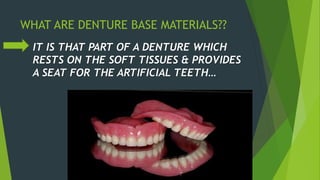
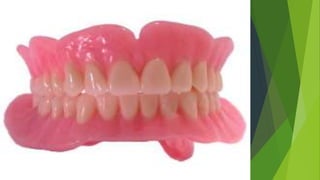
WHAT ARE DENTURE BASE MATERIALS??
IT IS THAT PART OF A DENTURE WHICH
RESTS ON THE SOFT TISSUES & PROVIDES
A SEAT FOR THE ARTIFICIAL TEETH…
Should be biologically acceptable
Should be cost efficient
ACRYLICS(PMMA)
 INTRODUCED IN 1936 BY DR. WRIGHT AND VERNON BROTHERS
 ADVANTAGES:
 EXCELLENT AESTHETICS
 EASE OF PROCESSING & REPAIR
 COST EFFICIENT
DISADVANTAGES:
 RESIDUAL MONOMER ALLERGY
 POOR MECHANICAL STRENGTH
 LOW FATIGUE STRENGTH
 POOR CONDUCTOR OF HEAT
 HIGH COFFICIENT OF THERMAL EXPANSION
 POLYMERISATION AND THERMAL SHRINKAGE
 TO OVERCOME THESE DRAWBACKS SEARCH FOR
NEWER MATERIALS BEGUN
NEW ERA IN DENTURE BASE RESINS- A REVIEW
1. Reinforced resins
a. High impact resins
b. Fiber-reinforced
2. Hypoallergenic resins
3. Resins with modified chemical structure
4. Thermoplastic resins
5. Enigma gum toning in denture bases
REINFORCED RESINS:
HIGH IMPACT RESINS
• Rubber reinforced (butadiene-styrene polymethyl methacrylate).
• Rubber particles grafted to MMA for better bond with PMMA.
CLINICAL APPLICATION:
• They are so-called because of greater impact strength & fatigue properties, hence indicated for patients
who drop their dentures repeatedly e.g. parkinsonism, senility. Available as powder-liquid system
E.g Lucitone 199 , D.P.I Tuff
FIBRE REINFORCED
 Fiber reinforcement result in a 1000% strength increase over non-reinforced
(if there is proper bonding)
A. METAL REINFORCEMENT: PROVIDES BEST REINFORCEMENTS
 NOT USED OF LATE DUE TO:
 1.UNESTHETIC
 2.EXPENSIVE
 3.POOR BONDING WITH ACRYLIC( PMMA).
 4.CORROSION PRONE
CARBON/GRAPHITE FIBRE REINFORCEMENT:
 Carbon fibers (65-70 mm length, 5 % by weight & treated
with silane coupling agent) are placed during packing.
 Anisotropic and provides greatest reinforcement of
denture base resin in terms of flexural strength
 Carbon Graphite fibres are available as-chopped,
continuous, woven, braided & tubular
ADVANTAGES
 Increases flexural strength, impact strength, prevents fatigue and
strengthens the resin.
DISADVANTAGES
 Unesthetic because of black colour but this can be covered by an
opaquer. The polishing is difficult & also weakens the finished
prosthesis. In addition, there is problem of lateral spreading of
fibers during pressing.
ARAMID FIBER REINFORCED
Aramid fiber reinforcement increases the strength
but again they are unesthetic & difficult to polish so
limited to locations where aesthetics is not
important.
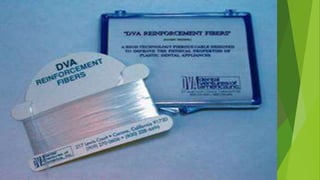
POLYETHYLENE FIBER REINFORCED
 Multifibered polyethylene strands cut to 65 mm length
& surface treated with epoxy-resin (to improve
adhesion) are placed in resin during packing.
 They develop anisotropic properties to the composite
(i.e. increase strength and stiffness in one direction).
ADVANTAGES :
 HIGHEST IMPACT STRENGTH
 HIGH MODULUS OF ELASTICITY
DISADVANTAGE :
 DECREASED TRANSVERSE STRENGTH
 FINISHING AND POLISHING IS DIFFICULT
 DOES NOT BOND WELL TO RESINS
HIGHLY DRAWN LINEAR POLYETHYLENE FIBERS (HDLPF)
 Patterns of continuous parallel fibers provide maximum reinforcement to
both maxillary & mandibular bases.
 horizontally positioned fibers in anterior part of labial flange & in region
immediately behind central incisors
 Reinforcement done with 4 layers of fibers (2 in lateral direction sandwitched
between 2layers at 45 degree from middle ones )
 In mandible, maximum stresses appear in labial & lingual second premolar
region & fracture occurs in middle region.
 Thus mandibular bases are reinforced with fibers at right angle to ridge
located close to polished & fitting surface
ADVANTAGES :
 HDLPF Have high tensile stiffness & strength
 notch insensitivity & cracks do not propagate
through array of fibers.
 The coherence is maintained even after a
large number of testing cycles.
GLASS FIBRES (HAVE BEST
AESTHETICS)
 Continuous parallel fibers provide high strength & stiffness in one direction
(anisotropic) while randomly oriented fibers provide similar properties in all
directions (isotropic properties)
 chopped fibers mixed with denture base acrylic resin enhance isotropic
mechanical properties.
 6 mm chopped glass fibers with 5% fiber in combination with injection
moulding technique result in increase in transverse strength, elastic modulus&
impact strength.
 Glass fibers may be modified by plasma polymerization technique using HEMA,
TEGDME
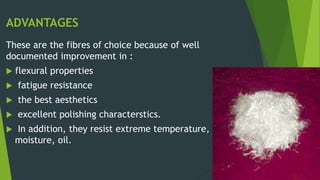
ADVANTAGES
These are the fibres of choice because of well
documented improvement in :
 flexural properties
 fatigue resistance
 the best aesthetics
 excellent polishing characterstics.
 In addition, they resist extreme temperature,
moisture, oil.
E-GLASS FIBERS
 Each strand of this E-glass is computer impregnated with a
PMMA (porous polymer) and silane coupler that allows
dissoloution bonding to acrylic. (e.g. Preat Perma Fiber )
ADVANTAGES
 Available in two forms (mesh & fiber)
 are transluscent providing esthetics.
 Because of glass fiber bonding, they also have more
strength.
COMPARISON OF IMPACT STRENGTH OF
RESINS REINFORCED WITH DIFFERENT
FIBERS:
Polyethylene > glass > thick Kevlar
>carbon >thin Kevlar > unreinforced.
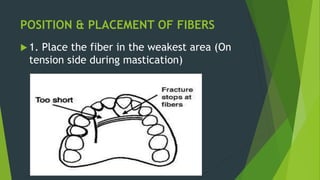
POSITION & PLACEMENT OF FIBERS
 1. Place the fiber in the weakest area (On
tension side during mastication)
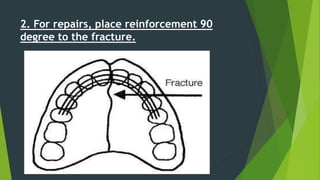
2. For repairs, place reinforcement 90
degree to the fracture.
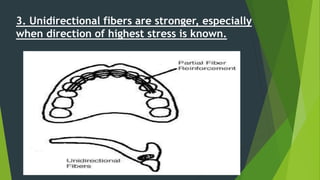
3. Unidirectional fibers are stronger, especially
when direction of highest stress is known.
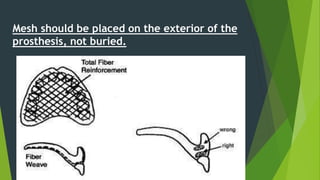
Mesh should be placed on the exterior of the
prosthesis, not buried.
HYPOALLERGENIC RESINS
 Diurethane dimethacrylate, Polyurethane, Polyethylenterephthalate and
Polybutylenterephthalate.
 Hypoallergenic denture base materials exhibit significantly lower residual
monomer content than PMMA, thus act as an alternative in allergic
patients
 Enterephthalate based (Promysan, thermoplastic) show low water
solubility than PMMA.
 Light activated indirect composite containing urethane dimethacrylate
(UDMA) is an alternative to PMMA for patients hypersensitive to PMMA
RESINS WITH MODIFIED CHEMICAL STRUCTURES
 Addition of hydroxy-apatite fillers increases fracture toughness.
 Al2O3 fillers increases the flexural strength & thermal diffusivity
that could lead to more patient satisfaction.
 2% quaternary ammonium compound displays antiseptic properties
& these dentures may be used for geriatric patients to improve their
oral health.
 Addition of ceramic or sapphire whiskers to improve thermal
diffusivity.
 Addition of 11-14% of several compounds of either bismuth or
uranium or 35% of an organo-zirconium compound impart radiopacity
equivalent to that of aluminium.
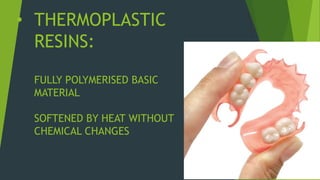
• THERMOPLASTIC
RESINS:
FULLY POLYMERISED BASIC
MATERIAL
SOFTENED BY HEAT WITHOUT
CHEMICAL CHANGES
ADVANTAGES
 EXCELLENT ESTHETICS
 UNBREAKABLE ,FLEXIBLE, LIGHT WEIGHT
 STABLE ,HIGH FATIGUE ENDURANCE
 INCREASED CREEP & WEAR RESISTANCE
 NON POROUS: NO BACTERIAL GROWTH BUT RETAINS
ENOUGH MOISTURE TO KEEP IT COMFORTABLE FOR GUMS
 CAN BE RELINED AND REPAIRED
MATERIALS USED:
THERMOPLASTIC NYLON
THERMOPLASTIC ACETAL
THERMOPLASTIC ACRYLIC
THERMOPLASTIC POLYCARBONATE
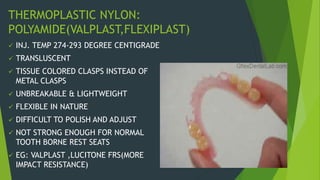
THERMOPLASTIC NYLON:
POLYAMIDE(VALPLAST,FLEXIPLAST)
 INJ. TEMP 274-293 DEGREE CENTIGRADE
 TRANSLUSCENT
 TISSUE COLORED CLASPS INSTEAD OF
METAL CLASPS
 UNBREAKABLE & LIGHTWEIGHT
 FLEXIBLE IN NATURE
 DIFFICULT TO POLISH AND ADJUST
 NOT STRONG ENOUGH FOR NORMAL
TOOTH BORNE REST SEATS
 EG: VALPLAST ,LUCITONE FRS(MORE
IMPACT RESISTANCE)
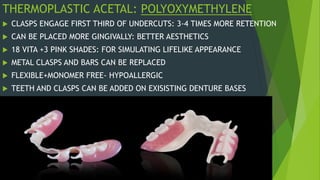
THERMOPLASTIC ACETAL: POLYOXYMETHYLENE
 CLASPS ENGAGE FIRST THIRD OF UNDERCUTS: 3-4 TIMES MORE RETENTION
 CAN BE PLACED MORE GINGIVALLY: BETTER AESTHETICS
 18 VITA +3 PINK SHADES: FOR SIMULATING LIFELIKE APPEARANCE
 METAL CLASPS AND BARS CAN BE REPLACED
 FLEXIBLE+MONOMER FREE- HYPOALLERGIC
 TEETH AND CLASPS CAN BE ADDED ON EXISISTING DENTURE BASES
 CANNOT BE USED AS MAJOR CONNECTOR
 DOES NOT SEAL THE BASE OF THE DENTURE WHICH ALLOWS
THE SEEPAGE OF FLUID
 CAN NOT BE USED AS CRIB AND CLASP WHERE DIASTEMA IS
ABSENT
 APPLICATION
 PREFORMED CLASP FOR RPDS
 PARTIAL DENTURE FRAMEWORK
 PROVISIONAL BRIDGE
 OCCLUSAL SPLINTS
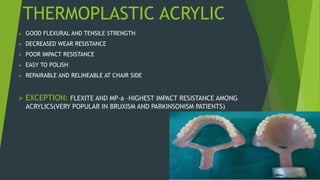
THERMOPLASTIC ACRYLIC
 GOOD FLEXURAL AND TENSILE STRENGTH
 DECREASED WEAR RESISTANCE
 POOR IMPACT RESISTANCE
 EASY TO POLISH
 REPAIRABLE AND RELINEABLE AT CHAIR SIDE
 EXCEPTION: FLEXITE AND MP-a –HIGHEST IMPACT RESISTANCE AMONG
ACRYLICS(VERY POPULAR IN BRUXISM AND PARKINSONISM PATIENTS)
THERMOPLASTIC POLYCARBONATE:
POLYMER OF BISPHENOL- A
 STRONG ,FLEXIBLEAND FRACTURE RESISTANT
 LOW WEAR RESISTANT-VDO WONT BE MAINTAINED OVER LONG TERM
 USED AS PROVITIONAL BRIDGE AND CROWN ONLY
CLINICAL ADVANTAGE
 MINIMAL RESIDUAL MONOMER-CAN BE USED IN ALLERGIC PATIENTS
 VERY LITTLE WATER ABSORPTION-LESS SMELL AND BACTERIAL GROWTH
 GOOD ADHERANCE AND COHERENCE
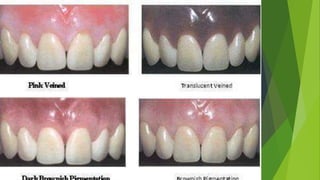
ENIGMA GUM TONING
 1) Custom shade matching of natural gingival
tissue using ‘Enigma’ colour tones.
 2) Gives extra confidence to patient in
appearance of their dentures.
 3) Available in Ivory, Light Pink, Natural Pink,
Dark Pink & Light Brown. Different colors are
mixed to get the desired gum tone.
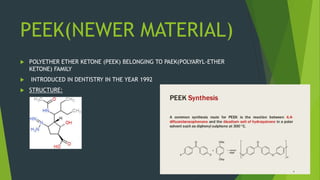
PEEK(NEWER MATERIAL)
 POLYETHER ETHER KETONE (PEEK) BELONGING TO PAEK(POLYARYL-ETHER
KETONE) FAMILY
 INTRODUCED IN DENTISTRY IN THE YEAR 1992
 STRUCTURE:
Recent advancements in denture base materials [autosaved]

Recent advancements in denture base materials [autosaved]

  • 1.
    RECENT ADVANCEMENTS IN DENTUREBASE MATERIALS AN OPTIMISTIC OUTLOOK TOWARDS NEWER POSSIBILITIES ….. SPECIAL THANKS TO PROF.DR. T.K.GIRI SIR & PROF.DR. S. MUKHERJEE SIR PRESENTED BY- DR. DHRUBOJYOTI BANERJEE 1ST YEAR PGT
  • 2.
    This Photo byUnknown Author is licensed under CC BY-NC-ND
  • 3.
    WHAT ARE DENTUREBASE MATERIALS?? IT IS THAT PART OF A DENTURE WHICH RESTS ON THE SOFT TISSUES & PROVIDES A SEAT FOR THE ARTIFICIAL TEETH…
  • 4.
    Should be biologicallyacceptable Should be cost efficient
  • 20.
    ACRYLICS(PMMA)  INTRODUCED IN1936 BY DR. WRIGHT AND VERNON BROTHERS  ADVANTAGES:  EXCELLENT AESTHETICS  EASE OF PROCESSING & REPAIR  COST EFFICIENT
  • 21.
    DISADVANTAGES:  RESIDUAL MONOMERALLERGY  POOR MECHANICAL STRENGTH  LOW FATIGUE STRENGTH  POOR CONDUCTOR OF HEAT  HIGH COFFICIENT OF THERMAL EXPANSION  POLYMERISATION AND THERMAL SHRINKAGE  TO OVERCOME THESE DRAWBACKS SEARCH FOR NEWER MATERIALS BEGUN
  • 22.
    NEW ERA INDENTURE BASE RESINS- A REVIEW 1. Reinforced resins a. High impact resins b. Fiber-reinforced 2. Hypoallergenic resins 3. Resins with modified chemical structure 4. Thermoplastic resins 5. Enigma gum toning in denture bases
  • 23.
    REINFORCED RESINS: HIGH IMPACTRESINS • Rubber reinforced (butadiene-styrene polymethyl methacrylate). • Rubber particles grafted to MMA for better bond with PMMA. CLINICAL APPLICATION: • They are so-called because of greater impact strength & fatigue properties, hence indicated for patients who drop their dentures repeatedly e.g. parkinsonism, senility. Available as powder-liquid system E.g Lucitone 199 , D.P.I Tuff
  • 24.
    FIBRE REINFORCED  Fiberreinforcement result in a 1000% strength increase over non-reinforced (if there is proper bonding) A. METAL REINFORCEMENT: PROVIDES BEST REINFORCEMENTS  NOT USED OF LATE DUE TO:  1.UNESTHETIC  2.EXPENSIVE  3.POOR BONDING WITH ACRYLIC( PMMA).  4.CORROSION PRONE
  • 25.
    CARBON/GRAPHITE FIBRE REINFORCEMENT: Carbon fibers (65-70 mm length, 5 % by weight & treated with silane coupling agent) are placed during packing.  Anisotropic and provides greatest reinforcement of denture base resin in terms of flexural strength  Carbon Graphite fibres are available as-chopped, continuous, woven, braided & tubular
  • 26.
    ADVANTAGES  Increases flexuralstrength, impact strength, prevents fatigue and strengthens the resin. DISADVANTAGES  Unesthetic because of black colour but this can be covered by an opaquer. The polishing is difficult & also weakens the finished prosthesis. In addition, there is problem of lateral spreading of fibers during pressing.
  • 27.
    ARAMID FIBER REINFORCED Aramidfiber reinforcement increases the strength but again they are unesthetic & difficult to polish so limited to locations where aesthetics is not important.
  • 28.
    POLYETHYLENE FIBER REINFORCED Multifibered polyethylene strands cut to 65 mm length & surface treated with epoxy-resin (to improve adhesion) are placed in resin during packing.  They develop anisotropic properties to the composite (i.e. increase strength and stiffness in one direction).
  • 30.
    ADVANTAGES :  HIGHESTIMPACT STRENGTH  HIGH MODULUS OF ELASTICITY DISADVANTAGE :  DECREASED TRANSVERSE STRENGTH  FINISHING AND POLISHING IS DIFFICULT  DOES NOT BOND WELL TO RESINS
  • 31.
    HIGHLY DRAWN LINEARPOLYETHYLENE FIBERS (HDLPF)  Patterns of continuous parallel fibers provide maximum reinforcement to both maxillary & mandibular bases.  horizontally positioned fibers in anterior part of labial flange & in region immediately behind central incisors  Reinforcement done with 4 layers of fibers (2 in lateral direction sandwitched between 2layers at 45 degree from middle ones )  In mandible, maximum stresses appear in labial & lingual second premolar region & fracture occurs in middle region.  Thus mandibular bases are reinforced with fibers at right angle to ridge located close to polished & fitting surface
  • 32.
    ADVANTAGES :  HDLPFHave high tensile stiffness & strength  notch insensitivity & cracks do not propagate through array of fibers.  The coherence is maintained even after a large number of testing cycles.
  • 33.
    GLASS FIBRES (HAVEBEST AESTHETICS)  Continuous parallel fibers provide high strength & stiffness in one direction (anisotropic) while randomly oriented fibers provide similar properties in all directions (isotropic properties)  chopped fibers mixed with denture base acrylic resin enhance isotropic mechanical properties.  6 mm chopped glass fibers with 5% fiber in combination with injection moulding technique result in increase in transverse strength, elastic modulus& impact strength.  Glass fibers may be modified by plasma polymerization technique using HEMA, TEGDME
  • 34.
    ADVANTAGES These are thefibres of choice because of well documented improvement in :  flexural properties  fatigue resistance  the best aesthetics  excellent polishing characterstics.  In addition, they resist extreme temperature, moisture, oil.
  • 35.
    E-GLASS FIBERS  Eachstrand of this E-glass is computer impregnated with a PMMA (porous polymer) and silane coupler that allows dissoloution bonding to acrylic. (e.g. Preat Perma Fiber ) ADVANTAGES  Available in two forms (mesh & fiber)  are transluscent providing esthetics.  Because of glass fiber bonding, they also have more strength.
  • 36.
    COMPARISON OF IMPACTSTRENGTH OF RESINS REINFORCED WITH DIFFERENT FIBERS: Polyethylene > glass > thick Kevlar >carbon >thin Kevlar > unreinforced.
  • 37.
    POSITION & PLACEMENTOF FIBERS  1. Place the fiber in the weakest area (On tension side during mastication)
  • 38.
    2. For repairs,place reinforcement 90 degree to the fracture.
  • 39.
    3. Unidirectional fibersare stronger, especially when direction of highest stress is known.
  • 40.
    Mesh should beplaced on the exterior of the prosthesis, not buried.
  • 41.
    HYPOALLERGENIC RESINS  Diurethanedimethacrylate, Polyurethane, Polyethylenterephthalate and Polybutylenterephthalate.  Hypoallergenic denture base materials exhibit significantly lower residual monomer content than PMMA, thus act as an alternative in allergic patients  Enterephthalate based (Promysan, thermoplastic) show low water solubility than PMMA.  Light activated indirect composite containing urethane dimethacrylate (UDMA) is an alternative to PMMA for patients hypersensitive to PMMA
  • 42.
    RESINS WITH MODIFIEDCHEMICAL STRUCTURES  Addition of hydroxy-apatite fillers increases fracture toughness.  Al2O3 fillers increases the flexural strength & thermal diffusivity that could lead to more patient satisfaction.  2% quaternary ammonium compound displays antiseptic properties & these dentures may be used for geriatric patients to improve their oral health.  Addition of ceramic or sapphire whiskers to improve thermal diffusivity.  Addition of 11-14% of several compounds of either bismuth or uranium or 35% of an organo-zirconium compound impart radiopacity equivalent to that of aluminium.
  • 43.
    • THERMOPLASTIC RESINS: FULLY POLYMERISEDBASIC MATERIAL SOFTENED BY HEAT WITHOUT CHEMICAL CHANGES
  • 44.
    ADVANTAGES  EXCELLENT ESTHETICS UNBREAKABLE ,FLEXIBLE, LIGHT WEIGHT  STABLE ,HIGH FATIGUE ENDURANCE  INCREASED CREEP & WEAR RESISTANCE  NON POROUS: NO BACTERIAL GROWTH BUT RETAINS ENOUGH MOISTURE TO KEEP IT COMFORTABLE FOR GUMS  CAN BE RELINED AND REPAIRED
  • 45.
    MATERIALS USED: THERMOPLASTIC NYLON THERMOPLASTICACETAL THERMOPLASTIC ACRYLIC THERMOPLASTIC POLYCARBONATE
  • 46.
    THERMOPLASTIC NYLON: POLYAMIDE(VALPLAST,FLEXIPLAST)  INJ.TEMP 274-293 DEGREE CENTIGRADE  TRANSLUSCENT  TISSUE COLORED CLASPS INSTEAD OF METAL CLASPS  UNBREAKABLE & LIGHTWEIGHT  FLEXIBLE IN NATURE  DIFFICULT TO POLISH AND ADJUST  NOT STRONG ENOUGH FOR NORMAL TOOTH BORNE REST SEATS  EG: VALPLAST ,LUCITONE FRS(MORE IMPACT RESISTANCE)
  • 47.
    THERMOPLASTIC ACETAL: POLYOXYMETHYLENE CLASPS ENGAGE FIRST THIRD OF UNDERCUTS: 3-4 TIMES MORE RETENTION  CAN BE PLACED MORE GINGIVALLY: BETTER AESTHETICS  18 VITA +3 PINK SHADES: FOR SIMULATING LIFELIKE APPEARANCE  METAL CLASPS AND BARS CAN BE REPLACED  FLEXIBLE+MONOMER FREE- HYPOALLERGIC  TEETH AND CLASPS CAN BE ADDED ON EXISISTING DENTURE BASES
  • 48.
     CANNOT BEUSED AS MAJOR CONNECTOR  DOES NOT SEAL THE BASE OF THE DENTURE WHICH ALLOWS THE SEEPAGE OF FLUID  CAN NOT BE USED AS CRIB AND CLASP WHERE DIASTEMA IS ABSENT  APPLICATION  PREFORMED CLASP FOR RPDS  PARTIAL DENTURE FRAMEWORK  PROVISIONAL BRIDGE  OCCLUSAL SPLINTS
  • 49.
    THERMOPLASTIC ACRYLIC  GOODFLEXURAL AND TENSILE STRENGTH  DECREASED WEAR RESISTANCE  POOR IMPACT RESISTANCE  EASY TO POLISH  REPAIRABLE AND RELINEABLE AT CHAIR SIDE  EXCEPTION: FLEXITE AND MP-a –HIGHEST IMPACT RESISTANCE AMONG ACRYLICS(VERY POPULAR IN BRUXISM AND PARKINSONISM PATIENTS)
  • 50.
    THERMOPLASTIC POLYCARBONATE: POLYMER OFBISPHENOL- A  STRONG ,FLEXIBLEAND FRACTURE RESISTANT  LOW WEAR RESISTANT-VDO WONT BE MAINTAINED OVER LONG TERM  USED AS PROVITIONAL BRIDGE AND CROWN ONLY CLINICAL ADVANTAGE  MINIMAL RESIDUAL MONOMER-CAN BE USED IN ALLERGIC PATIENTS  VERY LITTLE WATER ABSORPTION-LESS SMELL AND BACTERIAL GROWTH  GOOD ADHERANCE AND COHERENCE
  • 51.
    ENIGMA GUM TONING 1) Custom shade matching of natural gingival tissue using ‘Enigma’ colour tones.  2) Gives extra confidence to patient in appearance of their dentures.  3) Available in Ivory, Light Pink, Natural Pink, Dark Pink & Light Brown. Different colors are mixed to get the desired gum tone.
  • 53.
    PEEK(NEWER MATERIAL)  POLYETHERETHER KETONE (PEEK) BELONGING TO PAEK(POLYARYL-ETHER KETONE) FAMILY  INTRODUCED IN DENTISTRY IN THE YEAR 1992  STRUCTURE: