Coating Chemistry
Properties of a Coating
Desirable coating properties
include:
 Chemical Resistance
 Water Resistance
 Ease of Application
 Adhesion to Substrate
 Cohesive Strength
 Flexibility and Elongation
 Impact Resistance
 Abrasion Resistance
 Temperature Resistance
 Dielectric Strength
Classification of Coatings
Coatings are broadly classified as organic or inorganic.
Organic coatings are those whose binders have been made from living
or once- living things. All organic coatings contain carbon bond.
 Inorganic coatings use inorganic binder materials, most commonly
based on
either silicone or silicates.
The major difference between organic and inorganic coatings is heat
resistance.
Composition
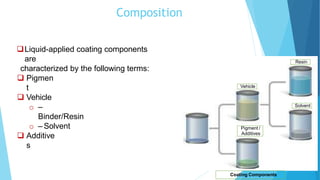
Liquid-applied coating components
are
characterized by the following terms:
 Pigmen
t
 Vehicle
o –
Binder/Resin
o – Solvent
 Additive
s
Resin
Solvent
Vehicle
Pigment /
Additives
Coating Components
Pigment
Pigments may be used to:
 Impart color
 Provide inhibitor protection
 Provide a form of cathodic protection
 Modify mechanical or electrical
properties
Additives
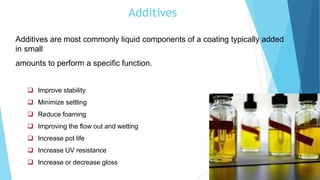
Additives are most commonly liquid components of a coating typically added
in small
amounts to perform a specific function.
 Improve stability
 Minimize settling
 Reduce foaming
 Improving the flow out and wetting
 Increase pot life
 Increase UV resistance
 Increase or decrease gloss
Solvents
 Solvents are added to liquefy the binder.
 Once the coating is applied and cured, solvents serve no
purpose.
 Solvency Power: The ability to dissolve the resin.
 Volatility: Governs the evaporation rate (the speed at which
the
solvent will leave the coating film during and after
application).
Binder
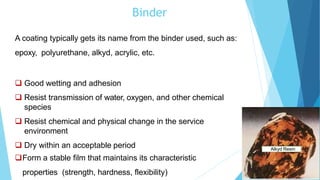
A coating typically gets its name from the binder used, such as:
epoxy, polyurethane, alkyd, acrylic, etc.
 Good wetting and adhesion
 Resist transmission of water, oxygen, and other chemical
species
 Resist chemical and physical change in the service
environment
 Dry within an acceptable period
Form a stable film that maintains its characteristic
properties (strength, hardness, flexibility)
Alkyd Resin
Modes of Protection
Corrosion control by coatings can occur by one of only three
processes:
 Barrier coatings
 Inhibitive coatings
 Sacrificial (cathodic protection)
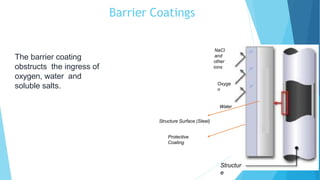
Barrier Coatings
The barrier coating
obstructs the ingress of
oxygen, water and
soluble salts.
Structur
e
NaCl
and
other
ions
Oxyge
n
Water
Structure Surface (Steel)
Protective
Coating
Inhibitive Coatings
Inhibitive coatings actively slow down
the reaction occurring at the anode,
cathode, or both:
 Must be in contact with the
substrate.
 Actually passivate the metal
surface.
Structur
NaCl
and
other
ions
Oxyge
n
Water
Structure Surface
Protective Coating
Inhibitive
Primer
Anodic and Cathodic
reaction Inhibited
Sacrificial Coatings
Sacrificial coatings use a metal that
is anodic to steel that corrodes
preferentially.
Sacrificial coatings:
Usually contain
zinc predominant
pigment.
dust as the
Must have a minimum loading of zinc
dust to be effective.
Holida
y
Local Cathode
protection at
holiday
Structure Surface
(Steel)
Adhesion
Strong adhesion is the key to coating performance and long life.
Adhesion can be:
 Chemical – Formed by a reaction between the coating and the
substrate.
 Mechanical – Associated with surface roughness or anchor pattern.
Polar – Most common for organic coatings. The resin acts as a weak
magnet on the substrate.
 Combination of all three
Coating Types and Curing
Mechanism
Curing Mechanism
Curing is used to describe the way a coating transforms from a liquid to a
solid state
There are two broad classifications for curing mechanisms:
o Nonconvertible – Cure by evaporation of the solvent with no chemical
change
to the resin.
o Convertible – Undergo a chemical change during cure and cannot be
returned to their original state.
Evaporation Cure
 Cure solely by solvent evaporation
Can be re-dissolved in the solvent
 Examples include vinyl and chlorinated
rubber
Coalescence
 Resin are dispersed in water.
 The water evaporates, the resin particles fuse
(coalesce).
Typically known as latexes or acrylic latexes.
Convertible Coatings
 Cure by one of several polymerization
mechanisms
 Resins undergo a chemical change
 Not readily re-dissolved in the solvent
 Known as thermosetting materials
 Some examples of curing types are:
o Oxidation
o Co-reaction
o Hydrolysis
o Fusion
Oxidation
Cure by reaction with atmospheric oxygen
 Unsuitable for immersion service
 Cannot withstand an alkaline environment, due to “saponification”
 Excessive film build may stop curing of the lower portion of the
coating film
 Example: Alkyd
Co-Reaction
Cure by polymerization reactions (cross-linking) between at least two chemical
entities.
Examples include:
– Epoxies, Polyurethanes, Polyureas, Polyaspartics, Polysiloxanes and several
others
Co-Reaction
 For solvent bone coatings, first step is solvent evaporation and second
step is polymerization.
 Once mixed together, applicator has a short time to apply before it gels.
The
time period when the mixed material is usable is called pot life.
 Some co-reaction cured coatings also require a period of time after
mixing but before application for the chemical reaction to start; this is
referred to as the induction time.
Hydration
Coatings require some amount of water to complete the
cure. Examples include:
o Moisture cured polyurethane
o Solvent based inorganic zinc coating based on an ethyl
silicate
Fusion
 Forced heat curing
 May be single or two component
materials
 Example is fusion-bonded epoxy (FBE)
Curing Mechanisms
Selection of Coating
The selection of a coating is based on many factors that include:
 Service environment of the coating:
 Interior or exterior
 Immersion or atmospheric
 Chemical
 In-service temperature (plus typical range and upset
conditions)
 Substrate being coated
 Size and configuration of item to be coated
 Surface preparation available and possible at job site
Selection of Coating
 Application temperature and humidity
 Life expectancy of both item being coated, and coating
 Ability of applicators
 Availability of application equipment
 Critical safety requirements, e.g., a nuclear power plant, buried
pipeline, or
commercial ship
 Budget
Generic Coating Types
o Acrylic
o Alkyds
o Chlorinated Rubber
o Epoxy
o Latex (Emulsions)
o Phenolic
o Polyaspartic
o Polyesters
o Polysiloxane
o Polyurethane
o Polyureas
o Silicones
o Vinyl Esters
o Vinyl
o Zinc
(Inorganic)
o Zinc
(Organic)
Acrylic
 Excellent UV and weathering resistance
 Can be applied as coalescence curing emulsions/ water dispersions
 Historically applied as decorative coatings rather than for corrosion
resistance
Alkyds
Oxidative curing, referred to as“oil basedpaints”
 Single package material and broad range of colors
 Can be very slow curing products, limited thickness
per coat
Can be blended with other resins to improve properties
e.g.
 With epoxies to make Epoxy Ester
 With silicones to make Silicon Alkyds
Chlorinated Rubber
 Evaporation curing
 Contains a large amount of VOC
 Eliminated in most parts of the world
 Excellent resistance to water, sunlight, and many
chemicals
 Should not be over coated with two component
coatings
Epoxy
 Two components consist of an epoxy resin (base) and a curing agent
(converter)
 Can be solvent-based, water-based, or solvent-free
 Excellent adhesion, chemical resistance, water resistance, and wet
adhesion
 Amine cured epoxies are especially sensitive to amine blush
 Exhibit chalking with atmospheric (UV) exposure
Latex (Emulsions)
 Resins normally thermoplastic resin
types
 Coalescence curing
Phenolic
Typically used where low pH environments and higher temperatures are
factors
 Excellent resistance to acids
Usually use for internal tank lining of corrosive material storage tanks
Can be blended with epoxies to make Epoxy Phenolic
Polyaspartic
 Use to achieve low- or near-zero-VOC systems
 Pot lives from five minutes to several hours
 Film builds up to 380 μm (15 mils) DFT in a
single pass
Are aliphatic Polyureas
Polyesters
 Have a short pot life
 Glass flake reinforced, high build
coatings
 Excellent moisture resistance
 Exceptionally high abrasion
resistance
Polysiloxane
 Used in services with abrasion, chemicals, extreme UV, and high
temperature
Three major categories :
o Inorganic Polysiloxane
o Epoxy-Polysiloxane Hybrids
o Acrylic-Polysiloxane Hybrids
Polyurethane
Two major types
 Aliphatic
o More resistant to UV exposure, excellent gloss and color
retention
 Aromatic
o Better chemical resistance in immersion but not UV resistant
 Main hazard is the isocyanate component
 Available with a variety of curing times
Polyureas
 Very flexible materials
 Very short cure times
 Many require the use of an epoxy primer on
steel
Silicones
 Formed by chemical modification of quartz, sand, or silicon
 Excellent high temperature and UV resistance
 Most require heat to cure but some cure at ambient
temperatures
 Also used as foul-release coatings in the marine industry
Vinyl Esters
 Often referred to as linings
 Normally two-component coatings
Excellent resistance to most of the corrosive chemicals even at higher
temperatures
 Have rather short pot life
 Excellent abrasion resistance with glassflake added
Vinyl
One of the earliest industrial coatings
 Were used on highway bridges and extensively in the marine
industry
 Banned from use in most countries due to high VOC
Zinc (Inorganic)
 Widely used primer for steel structures
 Provides cathodic protection
 Very resistant to different chemicals and especially
solvents
 Very high heat resistance with a max of 400°C (750°F)
 Disadvantages
o Can be difficult to apply
o Not for acidic environments
Zinc (Organic)
 Very different from inorganic
zinc
 Organic resin with zinc filler
 Examples epoxy, polyurethane,
etc.
 Limited cathodic protection
factor
Environmental Testing
Environmental
Effects
Environmental, or ambient, conditions can greatly affect all phases of a
coating operation.
Surface Temperatures
 Surface temperature is often different from air temperature.
Application at incorrect temperatures can cause defects.
 Minimum and maximum application temperatures should be
recognized.
 Substrate should be at least 3°C (5°F) above the determined dew
point.
Minimum Maximum
Relative Humidity
 Measure of the amount of moisture in the air compared to saturation
level.
 May affect the coating if too high or too low.
 Too high may cause solvent entrapment.
Wind Speed
Wind speed can affect the coating job by:
Blowing abrasives
Causing excessive overspray
Accelerating solvent evaporation
Contributing to the formation of dry
spray.
Dew
PointThe temperature at which moisture will begin to form on a steel
surface.
Surface Temperature Instruments
Typical instruments you may encounter
include:
o Digital Infrared Thermometers
o Mechanical Surface Contact
Thermometer
o Electronic Surface Contact
Thermometer
Digital Infrared Thermometer
Positives
 Are very simple: point, shoot, and read
 Deliver quick reading
Negatives
 Steam, dust, smoke, and/or vapors can prevent accurate
readings
 Cannot measure reflective surfaces accurately
Mechanical Surface Contact Thermometer
Magnetic surface contact thermometers are one of the most common
instruments
 Positives
o Simple and inexpensive
 Negatives
o Stabilization time can be minutes
o Easily lose their accuracy Heated Surface
Electronic Surface Contact
Thermometer
Magnetic surface contact thermometers are one of the most common
instruments
 Positives
o Quick and accurate
 Negatives
o More expensive than other surface
Relative Humidity
Instruments
 Electronic Hygrometers
 Sling Psychrometer
 Powered Air Flow
Psychrometer
Electronic Hygrometer
 Read and calculate
the:
o Temperature
o Relative humidity
o Dew point
Sling Psychrometer
 Sometimes called a whirling hygrometer
 Used to measure the ambient air temperature
 Dry-bulb temperature and wet-bulb temperature
used to calculate the dew point and relative
humidity
Powered Airflow Psychrometer
Operates in a similar way to the sling psychrometer, but air is moved
using a fan, rather than slinging the instrument.
Chart Recording Ambient
Conditions
Time
RH%
Dew Point
Ambient Temperature
Substrate Temperature
Ok to work Yes/No
Wind Speed
 Wind speed can be a safety issue when work is being performed at
heights.
 Monitoring wind direction can prevent damage to property from
overspray.
Product Technical Data
Sheet And
Material Safety Data Sheet
Product Technical Data Sheet
 Coatings Product Data Sheets (Paint Specs) provide users with valuable
information on the application aspect of a particular product.
 Communicate technical facts related to the specific material and its
application
properties.
 Common to find a small section related to safety.
Product Technical Data Sheet
 Information of critical importance to the project success:
o Surface preparation
o Storage
o Mixing and thinning
o Application procedure
o DFT requirements
 One should always consult Product Technical Data Sheets.
 It may come across discrepancies between the project specification and the
product data sheet. The holder of the specification (owner) must be contacted
for clarification
Product Technical Data
Sheet
A thorough understanding of the
Product Technical Data Sheet
cannot be over emphasized!
Material Safety Data Sheet
 Contains data regarding the properties of a particular substance.
 Provides workers and emergency personnel with critical information on
composition, handling, or working with that substance in a safe manner.
 Includes information such as melting point, boiling point, flash point, toxicity,
health effects, first aid, reactivity, storage, disposal, protective equipment, and
spill handling procedures.
 Provides information regarding the safety issues associated with any hazardous
(or potentially hazardous) material.
 Provides instructions for the correct action to take in the event of a spill,
explosion, fire, or hazardous exposure.
Material Safety Data Sheet
 When coating materials are being transported, there is a constant risk of
spillage or
exposure of others to potentially toxic chemicals.
 In some countries the law requires that MSDS be carried by transporters
whenever industrial quantities of coatings are moved by road, rail, or air.
 Inform emergency services of potential hazards in the event of a spill, fire, or
other hazard.
 Chemicals commonly used and judged to be hazardous are listed by various

Coating chemistry

  • 1.
  • 2.
    Properties of aCoating Desirable coating properties include:  Chemical Resistance  Water Resistance  Ease of Application  Adhesion to Substrate  Cohesive Strength  Flexibility and Elongation  Impact Resistance  Abrasion Resistance  Temperature Resistance  Dielectric Strength
  • 3.
    Classification of Coatings Coatingsare broadly classified as organic or inorganic. Organic coatings are those whose binders have been made from living or once- living things. All organic coatings contain carbon bond.  Inorganic coatings use inorganic binder materials, most commonly based on either silicone or silicates. The major difference between organic and inorganic coatings is heat resistance.
  • 4.
    Composition Liquid-applied coating components are characterizedby the following terms:  Pigmen t  Vehicle o – Binder/Resin o – Solvent  Additive s Resin Solvent Vehicle Pigment / Additives Coating Components
  • 5.
    Pigment Pigments may beused to:  Impart color  Provide inhibitor protection  Provide a form of cathodic protection  Modify mechanical or electrical properties
  • 6.
    Additives Additives are mostcommonly liquid components of a coating typically added in small amounts to perform a specific function.  Improve stability  Minimize settling  Reduce foaming  Improving the flow out and wetting  Increase pot life  Increase UV resistance  Increase or decrease gloss
  • 7.
    Solvents  Solvents areadded to liquefy the binder.  Once the coating is applied and cured, solvents serve no purpose.  Solvency Power: The ability to dissolve the resin.  Volatility: Governs the evaporation rate (the speed at which the solvent will leave the coating film during and after application).
  • 8.
    Binder A coating typicallygets its name from the binder used, such as: epoxy, polyurethane, alkyd, acrylic, etc.  Good wetting and adhesion  Resist transmission of water, oxygen, and other chemical species  Resist chemical and physical change in the service environment  Dry within an acceptable period Form a stable film that maintains its characteristic properties (strength, hardness, flexibility) Alkyd Resin
  • 9.
    Modes of Protection Corrosioncontrol by coatings can occur by one of only three processes:  Barrier coatings  Inhibitive coatings  Sacrificial (cathodic protection)
  • 10.
    Barrier Coatings The barriercoating obstructs the ingress of oxygen, water and soluble salts. Structur e NaCl and other ions Oxyge n Water Structure Surface (Steel) Protective Coating
  • 11.
    Inhibitive Coatings Inhibitive coatingsactively slow down the reaction occurring at the anode, cathode, or both:  Must be in contact with the substrate.  Actually passivate the metal surface. Structur NaCl and other ions Oxyge n Water Structure Surface Protective Coating Inhibitive Primer Anodic and Cathodic reaction Inhibited
  • 12.
    Sacrificial Coatings Sacrificial coatingsuse a metal that is anodic to steel that corrodes preferentially. Sacrificial coatings: Usually contain zinc predominant pigment. dust as the Must have a minimum loading of zinc dust to be effective. Holida y Local Cathode protection at holiday Structure Surface (Steel)
  • 13.
    Adhesion Strong adhesion isthe key to coating performance and long life. Adhesion can be:  Chemical – Formed by a reaction between the coating and the substrate.  Mechanical – Associated with surface roughness or anchor pattern. Polar – Most common for organic coatings. The resin acts as a weak magnet on the substrate.  Combination of all three
  • 14.
    Coating Types andCuring Mechanism
  • 15.
    Curing Mechanism Curing isused to describe the way a coating transforms from a liquid to a solid state There are two broad classifications for curing mechanisms: o Nonconvertible – Cure by evaporation of the solvent with no chemical change to the resin. o Convertible – Undergo a chemical change during cure and cannot be returned to their original state.
  • 16.
    Evaporation Cure  Curesolely by solvent evaporation Can be re-dissolved in the solvent  Examples include vinyl and chlorinated rubber
  • 17.
    Coalescence  Resin aredispersed in water.  The water evaporates, the resin particles fuse (coalesce). Typically known as latexes or acrylic latexes.
  • 18.
    Convertible Coatings  Cureby one of several polymerization mechanisms  Resins undergo a chemical change  Not readily re-dissolved in the solvent  Known as thermosetting materials  Some examples of curing types are: o Oxidation o Co-reaction o Hydrolysis o Fusion
  • 19.
    Oxidation Cure by reactionwith atmospheric oxygen  Unsuitable for immersion service  Cannot withstand an alkaline environment, due to “saponification”  Excessive film build may stop curing of the lower portion of the coating film  Example: Alkyd
  • 20.
    Co-Reaction Cure by polymerizationreactions (cross-linking) between at least two chemical entities. Examples include: – Epoxies, Polyurethanes, Polyureas, Polyaspartics, Polysiloxanes and several others
  • 21.
    Co-Reaction  For solventbone coatings, first step is solvent evaporation and second step is polymerization.  Once mixed together, applicator has a short time to apply before it gels. The time period when the mixed material is usable is called pot life.  Some co-reaction cured coatings also require a period of time after mixing but before application for the chemical reaction to start; this is referred to as the induction time.
  • 22.
    Hydration Coatings require someamount of water to complete the cure. Examples include: o Moisture cured polyurethane o Solvent based inorganic zinc coating based on an ethyl silicate
  • 23.
    Fusion  Forced heatcuring  May be single or two component materials  Example is fusion-bonded epoxy (FBE)
  • 24.
  • 25.
    Selection of Coating Theselection of a coating is based on many factors that include:  Service environment of the coating:  Interior or exterior  Immersion or atmospheric  Chemical  In-service temperature (plus typical range and upset conditions)  Substrate being coated  Size and configuration of item to be coated  Surface preparation available and possible at job site
  • 26.
    Selection of Coating Application temperature and humidity  Life expectancy of both item being coated, and coating  Ability of applicators  Availability of application equipment  Critical safety requirements, e.g., a nuclear power plant, buried pipeline, or commercial ship  Budget
  • 27.
    Generic Coating Types oAcrylic o Alkyds o Chlorinated Rubber o Epoxy o Latex (Emulsions) o Phenolic o Polyaspartic o Polyesters o Polysiloxane o Polyurethane o Polyureas o Silicones o Vinyl Esters o Vinyl o Zinc (Inorganic) o Zinc (Organic)
  • 28.
    Acrylic  Excellent UVand weathering resistance  Can be applied as coalescence curing emulsions/ water dispersions  Historically applied as decorative coatings rather than for corrosion resistance
  • 29.
    Alkyds Oxidative curing, referredto as“oil basedpaints”  Single package material and broad range of colors  Can be very slow curing products, limited thickness per coat Can be blended with other resins to improve properties e.g.  With epoxies to make Epoxy Ester  With silicones to make Silicon Alkyds
  • 30.
    Chlorinated Rubber  Evaporationcuring  Contains a large amount of VOC  Eliminated in most parts of the world  Excellent resistance to water, sunlight, and many chemicals  Should not be over coated with two component coatings
  • 31.
    Epoxy  Two componentsconsist of an epoxy resin (base) and a curing agent (converter)  Can be solvent-based, water-based, or solvent-free  Excellent adhesion, chemical resistance, water resistance, and wet adhesion  Amine cured epoxies are especially sensitive to amine blush  Exhibit chalking with atmospheric (UV) exposure
  • 32.
    Latex (Emulsions)  Resinsnormally thermoplastic resin types  Coalescence curing
  • 33.
    Phenolic Typically used wherelow pH environments and higher temperatures are factors  Excellent resistance to acids Usually use for internal tank lining of corrosive material storage tanks Can be blended with epoxies to make Epoxy Phenolic
  • 34.
    Polyaspartic  Use toachieve low- or near-zero-VOC systems  Pot lives from five minutes to several hours  Film builds up to 380 μm (15 mils) DFT in a single pass Are aliphatic Polyureas
  • 35.
    Polyesters  Have ashort pot life  Glass flake reinforced, high build coatings  Excellent moisture resistance  Exceptionally high abrasion resistance
  • 36.
    Polysiloxane  Used inservices with abrasion, chemicals, extreme UV, and high temperature Three major categories : o Inorganic Polysiloxane o Epoxy-Polysiloxane Hybrids o Acrylic-Polysiloxane Hybrids
  • 37.
    Polyurethane Two major types Aliphatic o More resistant to UV exposure, excellent gloss and color retention  Aromatic o Better chemical resistance in immersion but not UV resistant  Main hazard is the isocyanate component  Available with a variety of curing times
  • 38.
    Polyureas  Very flexiblematerials  Very short cure times  Many require the use of an epoxy primer on steel
  • 39.
    Silicones  Formed bychemical modification of quartz, sand, or silicon  Excellent high temperature and UV resistance  Most require heat to cure but some cure at ambient temperatures  Also used as foul-release coatings in the marine industry
  • 40.
    Vinyl Esters  Oftenreferred to as linings  Normally two-component coatings Excellent resistance to most of the corrosive chemicals even at higher temperatures  Have rather short pot life  Excellent abrasion resistance with glassflake added
  • 41.
    Vinyl One of theearliest industrial coatings  Were used on highway bridges and extensively in the marine industry  Banned from use in most countries due to high VOC
  • 42.
    Zinc (Inorganic)  Widelyused primer for steel structures  Provides cathodic protection  Very resistant to different chemicals and especially solvents  Very high heat resistance with a max of 400°C (750°F)  Disadvantages o Can be difficult to apply o Not for acidic environments
  • 43.
    Zinc (Organic)  Verydifferent from inorganic zinc  Organic resin with zinc filler  Examples epoxy, polyurethane, etc.  Limited cathodic protection factor
  • 44.
  • 45.
    Environmental Effects Environmental, or ambient,conditions can greatly affect all phases of a coating operation.
  • 46.
    Surface Temperatures  Surfacetemperature is often different from air temperature. Application at incorrect temperatures can cause defects.  Minimum and maximum application temperatures should be recognized.  Substrate should be at least 3°C (5°F) above the determined dew point. Minimum Maximum
  • 47.
    Relative Humidity  Measureof the amount of moisture in the air compared to saturation level.  May affect the coating if too high or too low.  Too high may cause solvent entrapment.
  • 48.
    Wind Speed Wind speedcan affect the coating job by: Blowing abrasives Causing excessive overspray Accelerating solvent evaporation Contributing to the formation of dry spray. Dew PointThe temperature at which moisture will begin to form on a steel surface.
  • 49.
    Surface Temperature Instruments Typicalinstruments you may encounter include: o Digital Infrared Thermometers o Mechanical Surface Contact Thermometer o Electronic Surface Contact Thermometer
  • 50.
    Digital Infrared Thermometer Positives Are very simple: point, shoot, and read  Deliver quick reading Negatives  Steam, dust, smoke, and/or vapors can prevent accurate readings  Cannot measure reflective surfaces accurately
  • 51.
    Mechanical Surface ContactThermometer Magnetic surface contact thermometers are one of the most common instruments  Positives o Simple and inexpensive  Negatives o Stabilization time can be minutes o Easily lose their accuracy Heated Surface
  • 52.
    Electronic Surface Contact Thermometer Magneticsurface contact thermometers are one of the most common instruments  Positives o Quick and accurate  Negatives o More expensive than other surface
  • 53.
    Relative Humidity Instruments  ElectronicHygrometers  Sling Psychrometer  Powered Air Flow Psychrometer
  • 54.
    Electronic Hygrometer  Readand calculate the: o Temperature o Relative humidity o Dew point
  • 55.
    Sling Psychrometer  Sometimescalled a whirling hygrometer  Used to measure the ambient air temperature  Dry-bulb temperature and wet-bulb temperature used to calculate the dew point and relative humidity
  • 56.
    Powered Airflow Psychrometer Operatesin a similar way to the sling psychrometer, but air is moved using a fan, rather than slinging the instrument.
  • 57.
    Chart Recording Ambient Conditions Time RH% DewPoint Ambient Temperature Substrate Temperature Ok to work Yes/No
  • 58.
    Wind Speed  Windspeed can be a safety issue when work is being performed at heights.  Monitoring wind direction can prevent damage to property from overspray.
  • 59.
    Product Technical Data SheetAnd Material Safety Data Sheet
  • 60.
    Product Technical DataSheet  Coatings Product Data Sheets (Paint Specs) provide users with valuable information on the application aspect of a particular product.  Communicate technical facts related to the specific material and its application properties.  Common to find a small section related to safety.
  • 61.
    Product Technical DataSheet  Information of critical importance to the project success: o Surface preparation o Storage o Mixing and thinning o Application procedure o DFT requirements  One should always consult Product Technical Data Sheets.  It may come across discrepancies between the project specification and the product data sheet. The holder of the specification (owner) must be contacted for clarification
  • 62.
    Product Technical Data Sheet Athorough understanding of the Product Technical Data Sheet cannot be over emphasized!
  • 63.
    Material Safety DataSheet  Contains data regarding the properties of a particular substance.  Provides workers and emergency personnel with critical information on composition, handling, or working with that substance in a safe manner.  Includes information such as melting point, boiling point, flash point, toxicity, health effects, first aid, reactivity, storage, disposal, protective equipment, and spill handling procedures.  Provides information regarding the safety issues associated with any hazardous (or potentially hazardous) material.  Provides instructions for the correct action to take in the event of a spill, explosion, fire, or hazardous exposure.
  • 64.
    Material Safety DataSheet  When coating materials are being transported, there is a constant risk of spillage or exposure of others to potentially toxic chemicals.  In some countries the law requires that MSDS be carried by transporters whenever industrial quantities of coatings are moved by road, rail, or air.  Inform emergency services of potential hazards in the event of a spill, fire, or other hazard.  Chemicals commonly used and judged to be hazardous are listed by various