DENTURE
BASE
MATERIALS
(ACRYLIC RESINS)
PREAPARED BY:-
VISHAL GOHIL
SHRUTI GOHIL
SHIVANGI GANDHI
Q.1 What are DENTURE BASE
RESINS ?
Denture base is defined as that part of
denture that rests on the foundation
tissue & to which teeth are attached.
Denture base material is any
substance of which denture base may
be made.
Q.2 Classify Denture Base
Resins.
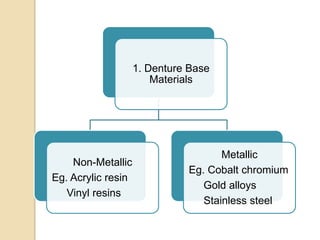
 Denture base resins are classified in
3 ways………
1. Denture Base
Materials
Non-Metallic
Eg. Acrylic resin
Vinyl resins
Metallic
Eg. Cobalt chromium
Gold alloys
Stainless steel
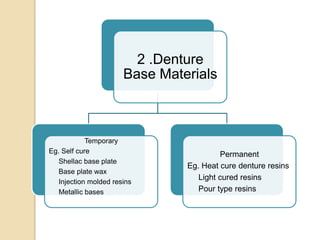
2 .Denture
Base Materials
Temporary
Eg. Self cure
Shellac base plate
Base plate wax
Injection molded resins
Metallic bases
Permanent
Eg. Heat cure denture resins
Light cured resins
Pour type resins
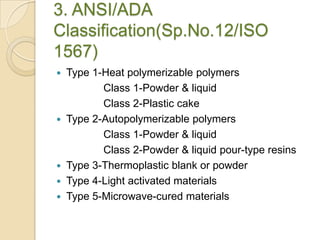
3. ANSI/ADA
Classification(Sp.No.12/ISO
1567)
 Type 1-Heat polymerizable polymers
Class 1-Powder & liquid
Class 2-Plastic cake
 Type 2-Autopolymerizable polymers
Class 1-Powder & liquid
Class 2-Powder & liquid pour-type resins
 Type 3-Thermoplastic blank or powder
 Type 4-Light activated materials
 Type 5-Microwave-cured materials
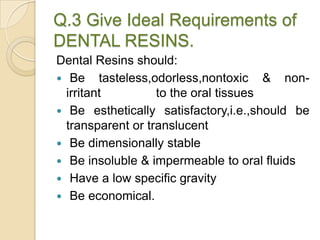
Q.3 Give Ideal Requirements of
DENTAL RESINS.
Dental Resins should:
 Be tasteless,odorless,nontoxic & non-
irritant to the oral tissues
 Be esthetically satisfactory,i.e.,should be
transparent or translucent
 Be dimensionally stable
 Be insoluble & impermeable to oral fluids
 Have a low specific gravity
 Be economical.
Q.4 Give uses of resins in
dentistry.
 Fabrication dentures
 Artificial teeth
 Tooth restoration, e.g.,fillings,inlays &
laminates
 Inlay & post-core patterns
 Models
 Splints & stents
 Custom impression trays
Q.5 What is POLYMER?
 A polymer is large & often complex
macromolecule that is made from
smaller molecules.A macromolecule is
any chemical processing a molecular
weight greater than 5000.
Q.6 What is MONOMER?
 The molecules from which the
polymer is constructed are called
MONOMERS.
Q.7 What is CO-POLYMERS?
 Polymer molecules may be prepared
from a mixture of different types of
monomers & thely are called CO-
POLYMERS.
Q.8 What is the molecular weight for various
denture polymers & of the cross-linked
resins?
 The average molecular weight for various
denture polymer range from 8000 to
39,000.
 Cross linked resin teeth may have in
excess of 6,00,000.
Q.9 What do you mean by
degree of polymerization?
 It is defined as-
total number of mers in a polymer.
 The higher the molecular weight of
the polymer made from a single
monomer,the higher the degree of
polymerization.
 The strength of the resin increases
with increase in the degree of
polymerization until a certain
molecular weight is reached.
Q.10 Give the physical structure
of polymer molecule.
 Three basic structures:
1)Linear
-Homopolymer
-Random copolymer
-Block copolymer
2)Branched
-Branched homopolymer
-Branched random
-Branched graft
3)Cross linked polymer
Q.11 What is
POLYMERIZATION?
 The term polymerization refers to a
series of chain reactions by which a
macromolecule or polymer is formed
from a group of smaller single
molecules known as ‘monomer’.
Polymer+Monomer+Heat Polymer
+Heat
(powder) (liquid)
Q.12 Name the types of
Polymerization.
 Addition Polymerization
 Condensation Polymerization
Q.13 What is Condensation
Polymerization?
 Condensation resins are divided into
two groups:
-Those in which polymerization is
accompanied by repeated elimination of
small molecules
-Those in which functional groups are
repeated in the polymer chains.The
mers are joined by functional groups.
Q.14 What is Addition
Polymerization?
 Most of the resins are produced by
addition polymerization.There is no
change in chemical composition & no
by products are formed.The structure
of monomer is repeated many times in
the polymer.
Q.15 What are physical &
chemical stages of
polymerization?
 Physical stages :-
 Wet sand stage
 Sticky stage
 Dough stage
 Rubbery stage
 Stiff stage
 Chemical stage :-
 Induction
 Propagation
 Termination
 Chain transfer
Q.16 How does inhibition of
polymerization take place?
 The reaction of polymarization are
inhibited by
 Impurities:-Impurities react with the
activated initiator or any activated nucleus
or with an activated growing chain to
prevent further growth. e.g hydroquinone.
It is added to prevent polymerization of
the monomer during storage.
 Oxygen:-Presence of oxygen also inhibit
polymerization.
Q.17 What is CO-
POLYMERIZATION?
 The macromolecule may be formed by
polymerization of a single type of
structural unit.However,in order to
improve the physical properties,it is often
advantageous to use two or more
chemically different monomers as
starting materials.The polymers thus
formed may contain units of these
monomers .Such a polymer is called a
copolymer & its process of formation is
known as CO-POLYMERIZATION.
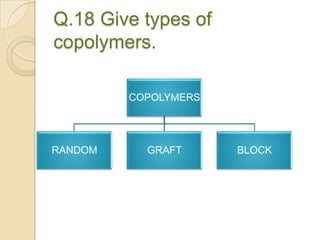
Q.18 Give types of
copolymers.
COPOLYMERS
RANDOM GRAFT BLOCK
Q.19 What is importance of
copolymerization?
 Copolymerization is used to improve
the physical properties of resin.
 Small amounts of ethyl acrylate may
be copolymerized with methyl
methacrylate to alter the flexibility.
Q.20 What is CROSS-
LINKING?Give its applications.
 The formation of chemical bonds or bridges
between the polymer chains is reffered to as
cross-linking.It forms a three-dimensional
network.
 APPLICATIONS:
1.The more recent acrylic resins are of cross-
linked variety.Cross-linking increases rigidity &
decreases solubility & water sorption.
2.Acrylic teeth are highly cross-linked to
improve its resistance to solvents,crazing &
surface stresses.
Q.21 What are PLASTICIZERS?
Give its types.
 Plasticizers are the substance added
to resins to increase the solubility of
the polymer in the monomer,to
decrease the brittleness of polymers.
 Two types: external & internal
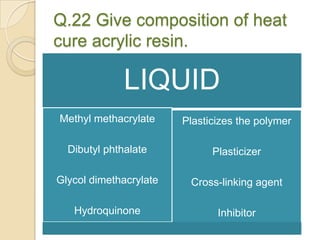
Q.22 Give composition of heat
cure acrylic resin.
LIQUID
Methyl methacrylate
Dibutyl phthalate
Glycol dimethacrylate
Hydroquinone
Plasticizes the polymer
Plasticizer
Cross-linking agent
Inhibitor
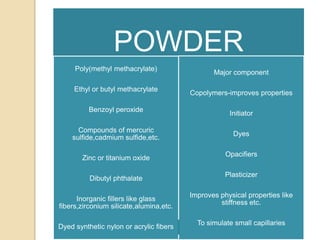
POWDER
Poly(methyl methacrylate)
Ethyl or butyl methacrylate
Benzoyl peroxide
Compounds of mercuric
sulfide,cadmium sulfide,etc.
Zinc or titanium oxide
Dibutyl phthalate
Inorganic fillers like glass
fibers,zirconium silicate,alumina,etc.
Dyed synthetic nylon or acrylic fibers
Major component
Copolymers-improves properties
Initiator
Dyes
Opacifiers
Plasticizer
Improves physical properties like
stiffness etc.
To simulate small capillaries
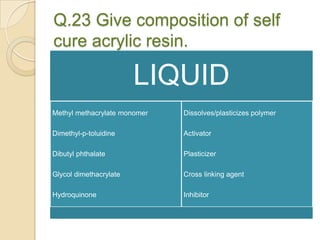
Q.23 Give composition of self
cure acrylic resin.
LIQUID
Methyl methacrylate monomer
Dimethyl-p-toluidine
Dibutyl phthalate
Glycol dimethacrylate
Hydroquinone
Dissolves/plasticizes polymer
Activator
Plasticizer
Cross linking agent
Inhibitor
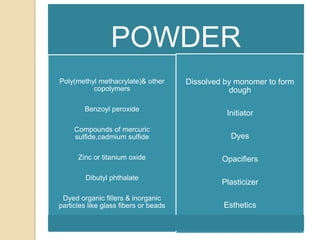
POWDER
Poly(methyl methacrylate)& other
copolymers
Benzoyl peroxide
Compounds of mercuric
sulfide,cadmium sulfide
Zinc or titanium oxide
Dibutyl phthalate
Dyed organic fillers & inorganic
particles like glass fibers or beads
Dissolved by monomer to form
dough
Initiator
Dyes
Opacifiers
Plasticizer
Esthetics
Q.24 Give difference between
heat cure & self cure acrylic
resin.
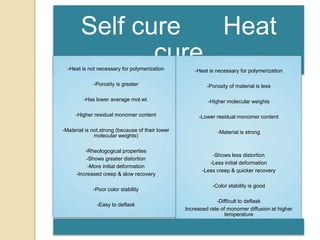
Self cure Heat
cure-Heat is not necessary for polymerization
-Porosity is greater
-Has lower average mol.wt.
-Higher residual monomer content
-Material is not,strong (because of their lower
molecular weights)
-Rheologogical properties
-Shows greater distortion
-More initial deformation
-Increased creep & slow recovery
-Poor color stability
-Easy to deflask
-Heat is necessary for polymerization
-Porosity of material is less
-Higher molecular weights
-Lower residual monomer content
-Material is strong
-Shows less distortion
-Less initial deformation
-Less creep & quicker recovery
-Color stability is good
-Difficult to deflask
Increased rate of monomer diffusion at higher
temperature
Q.1 What are the steps of
compression molding technique?
 Preparation of the waxed denture
pattern
 Preparation of the split mold
 Application of separating medium
 Mixing of powder and liquid
 Packing
 Curing
 Cooling
 Divesting, finishing and polishing
Q.2 From which wax wax pattern
is prepared?
 Blue inlay wax
Q.3 Why is application of
separation medium necessary?
 To prevent water from the mold
entering into the acrylic resin. This
may affect the rate of polymerization
and color. It can also result in crazing.
 To prevent monomer penetrating into
the mole material, causing plaster to
adhere to the acrylic resin and
producing to the rough surface.
 Help in easier retrieval of the denture
from the mold.
Q.4 Type of separating
media?
 Tinfoil
 Cellulose lacquers
 Solution of alginate compounds
 Calcium oleate
 soft soaps
 Sodium silicate
 Starches
Q.5 Why is tin foil not used as a
separating media now a days?
 Because manipulation is time
consuming & difficult.So it is replaced
by other separating media.
Q.6 Composition of Sodium
Alginate?
 2% Sodium Alginate in water
 Glycerine
 Alcohol
 Sodium Phosphate &
 Preservatives
Q.7 Setting reaction of sodium
alginate?
 It reacts with the calcium of the plaster
or stone to form of insoluble calcium
alginate.
Q.8 What precaution should be
taken while applying separating
media?
 Waxes or oils remaining on the mold
surface will interfere with the action of
the separating medium.
 Mold should be warm,not hot
continuity of the film will break if the
mold is steaming hot.
 Avoid coating the teeth as it will
prevent bonding of teeth with denture
base.
Q.9 Powder & liquid ratio of
monomer & polymer?
 Polymer-Monomer proportion=3:1 by
volume or 2:1 by weight.
Q.10 What happens if too much
monomer is used?
 There will be greater curing or
polymerization shrinkage.
 More time is needed to reach the
packing consitency.
 Porosity can occur in the denture.
Q.11 What happens if too little
monomer is used?
 Not all the polymer beads will be
wetted by monomer & the cured
acrylic will be granular.
 Dough will be difficult to manage & if
may not fuse into a continuous unit of
plastic during processing.
Q.12 Which instrument is used
for trial closure?
 Hydrolic or Mechanical press
Q.13 What is FLASH?
 The excess dough,found during trial
closure is known as FLASH.
Q.14 What is the purpose of
Bench Curing?
 Permits an equalization of pressures
throughout the mold.
 It allows time for a more uniform
dispertion of monomer throughout the
mass of dough,since the lateral material
added is usually drier than the first
added to the flask.
 It provides a longer exposure of resin
teeth to the monomer in the
dough,producing a better bond of the
teeth with the base material.
Q.15 What is CURING CYCLE?
Give temperature of curing cycle.
 Curing Cycle is the technical name for
the heating process used to control
the initial propagation of
polymerization in the denture mold.
 Heat the flask in water at 60-70ºc for 9
hours.(long cycle)
 Heat the flask T 65ºc for 90 min,then
boil for 1 hour for adequate
polymeraization of the thinner portion.
Q.16 How Cooling is done?
 The flask should be cooled slowly.
E.g., bench cooled. Fast cooling can
result in warpage of the denture due to
differential thermal contraction of the
resin & gypsum mold.Cooloing
overnight is ideal.However,bench
cooling it for 30 min & then placing it in
cold tap water for 15 min is satisfactory.
Q.17 Advantages of injection
molding technique:
 Dimensional accuracy
 No increase in vertical dimension
 Homogeneous denture base
 Good impact strength.
Q.18 Disadvantage of injection
molding technique:
 High cost of equipment
 Difficult mold design problems
 Special flask is required.
Q.19 What are the other names
of chemically activated denture
base resin?
 Self-cure,Cold-cure,Auto-
polymerizing resin
Q.20 Uses of chemically
activated denture base resin:
 For making temporary crowns & FPDs
 Construction of special trays
 For denture repair,relining & rebasing
 For making removable orthodontic
appliances.
Q.21 Advantages &
disadvantages of chemically
activated denture base resin:
 Better initial fit,which is because the curing is
carried out at room temp.Thus there is less
thermal contraction.
 Color stability is inferior to that of heat cure
resin,due to subsequent oxidation of the
tertiary amine.
 Slightly inferior properties because the
degree of polymerization of self curing
acrylics is less than that of heat cured ones
 For repairing dentures,self curing resins are
preferable to heat cured resins as heat curing
causes warpage.
Q.22 What techniques are used
for manipulation of
autopolymerizing resins?
 Sprinkle on technique
 Adapting technique
 Fluid resin technique
 Compression molding technique
Q.23 Composition of light
activated denture base resin:
 It consists of a urethane
dimethacrylate matrix with an acrylic
copolymer,Microfine silica fillers,& a
Camphoroquinone-amine photoinitator
system.One such product is known as
VLC triad.
Q.24 How is light activated
denture base resins supplied?
 It is supplied in premixed sheets
having a clay like consinstency.It is
provided in opaque light tight
packages to avoid premature
polymerization.
Q.25 How is light activated
denture base resin polymerized?
 It is polymerized in a light chamber
with blue light of 400-500 nm from
high intensity quartz-halogen bulbs.
 The denture is rotated continuously in
the chamber to provide uniform
exposure to the light source.
Q.1 Mention the processing
errors in acrylic resin.
 Porosity
 Crazing
 Denture warpage
Q.2 Give types of porosity.
 Internal porosity
 External porosity
Q.3 What is the cause of internal
porosity & How can it be
avoided? Internal porosity occurs due to vaporization of
monomer when the temperature of the resin
increases above the boiling point of monomer or
very low molecular weight polymers.
 Exothermic heat of the surface resin dissipates
easily into the investing plaster.However,in the
center of the thick portion the heat can’t be
conducted away.
 Therefore,the temperature in the thick portions
may rise above the boiling point of monomer
causing porosity.
 Avoided by Dentures with excessive thickness
should be cured using a long,low temperature
curing cycle.
Q.4 Mention the cause of
external porosity & How can it be
avoided? The cause of external porosity:
1)Lack of homogeneity
2)Lack of adequate pressure
 Lack of homogeneity is avoided by using proper
powder/liquid ratio & mixing it well.The mix is more
homogenous in the dough stage,so packing should be done
in the dough stage.
 Lack of adequate pressure is avoided by using the required
amount of dough.Check for excess or flash during trail
closure.Flash indicates adequate material.
Q.5 What is CRAZING?
 Crazing is formation of surface cracks
on the denture base resin. The cracks
may be microscopic or macroscopic in
size.In some cases it has a hazy or
foggy appearance rather than cracks.
Q.6 How porosity will create
problems for the patient?
 It makes the appearance of denture
base unsightly.
 Proper cleaning of the denture isn’t
possible, so the denture hygiene & the
oral hygiene suffers.
 It weakens the denture base and the
pores are areas of stress
concentration, thus the denture warps
as the stresses relax.
Q.7 What are the causes of
crazing?
 Mechanical stresses.
 Attack by a solvent.
 Incorporation of water.
Q.8 How will you avoid
crazing?
 Using cross linked acrylics.
 Tin toil separating medium.
 Metal molds.
Q.9 Define denture warpage?
 Denture warpage is the deformity or
change of shape of the denture which
can affect the fit of the denture.
Warpage can occur during processing
as well as at other times.
Q.10 Give types of repair
resin?
 Heat lured.
 Self cured.
Q.11 How you will take care of
acrylic denture?
 Dentures should be stored in water when not
in use, since dimensional changes can occur
on dying.
 Acrylic dentures should not be cleaned in hot
water , since processing stresses can be
released and can result in distortion.
 Abrasive dentifrices should not be used,since
the plastic is soft & can be easily scratched &
abraded.The tissue surface should be
brushed carefully with a soft brush,since any
material removed alters the fit of the denture.
 Besides physical brushing various cleaning
agents are commercially available.
Q.12 Give composition of
denture cleansers.
 Alkaline compounds
 Detergents
 Flavoring agents
 Sodium perborate
Q.13 What are the method use
to clean the denture?
 Immersion in an agent
 By brushing with the cleanser
Q.14 Give classification of
denture reliners.
 Hard or soft
 Heat cured or self cured
 Short term or long term
 Resin based or silicone based
Q.15 Give types of soft liners.
 Short term soft liners (tissue
conditioners)
 Long term soft liners
Q.16 Define tissue
conditioners,give its composition.
 Tissue conditioners are soft elastomers
used to treat irritated mucosa.
 COMPOSITION:
-These are highly plasticized acrylic
resins,supplied as powder & a liquid.
-Powder: poly(ethyl methacrylate) or one
of its copolymers.
-Liquid: Aromatic ester(butyl phthalate
butyl glycolate) in ethanol or an alcohol of
high molecular weight.
Q.17 What are the uses of tissue
conditioners?
 ILL-FITTING dentures can cause
inflammation & distortion of the oral
tissues.
 Relining an ill-fitting denture with
tissue conditioner allows the tissue to
return to normal at which point a new
denture can be made.
 As an impression material.
Q.18 What are denture
adhesives? Give its composition.
 They are highly viscous aqueous solutions
which are often used to improve the retention
of complete dentures.
 COMPOSITION:
-Keraya gum
-Tragacanth
-Sodium carboxy methyl cellulose
-Polyethylene oxide
-Flavoring agents
-Some also contain antimicrobial agents &
plasticizers.
Q.19 What are the indication of
denture adhesives?
 Temporary retention of poorly fitting
dentures.
 Patients having poor neuromuscular
control
Q.20 What is the disadvantage
of denture adhesives?
 It has an unpleasant feel , is difficult to
clean & is diluted easily by saliva.
Denture base materials

Denture base materials

  • 1.
  • 2.
    Q.1 What areDENTURE BASE RESINS ? Denture base is defined as that part of denture that rests on the foundation tissue & to which teeth are attached. Denture base material is any substance of which denture base may be made.
  • 3.
    Q.2 Classify DentureBase Resins.  Denture base resins are classified in 3 ways………
  • 4.
    1. Denture Base Materials Non-Metallic Eg.Acrylic resin Vinyl resins Metallic Eg. Cobalt chromium Gold alloys Stainless steel
  • 5.
    2 .Denture Base Materials Temporary Eg.Self cure Shellac base plate Base plate wax Injection molded resins Metallic bases Permanent Eg. Heat cure denture resins Light cured resins Pour type resins
  • 6.
    3. ANSI/ADA Classification(Sp.No.12/ISO 1567)  Type1-Heat polymerizable polymers Class 1-Powder & liquid Class 2-Plastic cake  Type 2-Autopolymerizable polymers Class 1-Powder & liquid Class 2-Powder & liquid pour-type resins  Type 3-Thermoplastic blank or powder  Type 4-Light activated materials  Type 5-Microwave-cured materials
  • 7.
    Q.3 Give IdealRequirements of DENTAL RESINS. Dental Resins should:  Be tasteless,odorless,nontoxic & non- irritant to the oral tissues  Be esthetically satisfactory,i.e.,should be transparent or translucent  Be dimensionally stable  Be insoluble & impermeable to oral fluids  Have a low specific gravity  Be economical.
  • 8.
    Q.4 Give usesof resins in dentistry.  Fabrication dentures  Artificial teeth  Tooth restoration, e.g.,fillings,inlays & laminates  Inlay & post-core patterns  Models  Splints & stents  Custom impression trays
  • 9.
    Q.5 What isPOLYMER?  A polymer is large & often complex macromolecule that is made from smaller molecules.A macromolecule is any chemical processing a molecular weight greater than 5000.
  • 10.
    Q.6 What isMONOMER?  The molecules from which the polymer is constructed are called MONOMERS.
  • 11.
    Q.7 What isCO-POLYMERS?  Polymer molecules may be prepared from a mixture of different types of monomers & thely are called CO- POLYMERS.
  • 12.
    Q.8 What isthe molecular weight for various denture polymers & of the cross-linked resins?  The average molecular weight for various denture polymer range from 8000 to 39,000.  Cross linked resin teeth may have in excess of 6,00,000.
  • 13.
    Q.9 What doyou mean by degree of polymerization?  It is defined as- total number of mers in a polymer.  The higher the molecular weight of the polymer made from a single monomer,the higher the degree of polymerization.  The strength of the resin increases with increase in the degree of polymerization until a certain molecular weight is reached.
  • 14.
    Q.10 Give thephysical structure of polymer molecule.  Three basic structures: 1)Linear -Homopolymer -Random copolymer -Block copolymer 2)Branched -Branched homopolymer -Branched random -Branched graft 3)Cross linked polymer
  • 15.
    Q.11 What is POLYMERIZATION? The term polymerization refers to a series of chain reactions by which a macromolecule or polymer is formed from a group of smaller single molecules known as ‘monomer’. Polymer+Monomer+Heat Polymer +Heat (powder) (liquid)
  • 16.
    Q.12 Name thetypes of Polymerization.  Addition Polymerization  Condensation Polymerization
  • 17.
    Q.13 What isCondensation Polymerization?  Condensation resins are divided into two groups: -Those in which polymerization is accompanied by repeated elimination of small molecules -Those in which functional groups are repeated in the polymer chains.The mers are joined by functional groups.
  • 18.
    Q.14 What isAddition Polymerization?  Most of the resins are produced by addition polymerization.There is no change in chemical composition & no by products are formed.The structure of monomer is repeated many times in the polymer.
  • 19.
    Q.15 What arephysical & chemical stages of polymerization?  Physical stages :-  Wet sand stage  Sticky stage  Dough stage  Rubbery stage  Stiff stage  Chemical stage :-  Induction  Propagation  Termination  Chain transfer
  • 20.
    Q.16 How doesinhibition of polymerization take place?  The reaction of polymarization are inhibited by  Impurities:-Impurities react with the activated initiator or any activated nucleus or with an activated growing chain to prevent further growth. e.g hydroquinone. It is added to prevent polymerization of the monomer during storage.  Oxygen:-Presence of oxygen also inhibit polymerization.
  • 21.
    Q.17 What isCO- POLYMERIZATION?  The macromolecule may be formed by polymerization of a single type of structural unit.However,in order to improve the physical properties,it is often advantageous to use two or more chemically different monomers as starting materials.The polymers thus formed may contain units of these monomers .Such a polymer is called a copolymer & its process of formation is known as CO-POLYMERIZATION.
  • 22.
    Q.18 Give typesof copolymers. COPOLYMERS RANDOM GRAFT BLOCK
  • 23.
    Q.19 What isimportance of copolymerization?  Copolymerization is used to improve the physical properties of resin.  Small amounts of ethyl acrylate may be copolymerized with methyl methacrylate to alter the flexibility.
  • 24.
    Q.20 What isCROSS- LINKING?Give its applications.  The formation of chemical bonds or bridges between the polymer chains is reffered to as cross-linking.It forms a three-dimensional network.  APPLICATIONS: 1.The more recent acrylic resins are of cross- linked variety.Cross-linking increases rigidity & decreases solubility & water sorption. 2.Acrylic teeth are highly cross-linked to improve its resistance to solvents,crazing & surface stresses.
  • 25.
    Q.21 What arePLASTICIZERS? Give its types.  Plasticizers are the substance added to resins to increase the solubility of the polymer in the monomer,to decrease the brittleness of polymers.  Two types: external & internal
  • 26.
    Q.22 Give compositionof heat cure acrylic resin. LIQUID Methyl methacrylate Dibutyl phthalate Glycol dimethacrylate Hydroquinone Plasticizes the polymer Plasticizer Cross-linking agent Inhibitor
  • 27.
    POWDER Poly(methyl methacrylate) Ethyl orbutyl methacrylate Benzoyl peroxide Compounds of mercuric sulfide,cadmium sulfide,etc. Zinc or titanium oxide Dibutyl phthalate Inorganic fillers like glass fibers,zirconium silicate,alumina,etc. Dyed synthetic nylon or acrylic fibers Major component Copolymers-improves properties Initiator Dyes Opacifiers Plasticizer Improves physical properties like stiffness etc. To simulate small capillaries
  • 28.
    Q.23 Give compositionof self cure acrylic resin. LIQUID Methyl methacrylate monomer Dimethyl-p-toluidine Dibutyl phthalate Glycol dimethacrylate Hydroquinone Dissolves/plasticizes polymer Activator Plasticizer Cross linking agent Inhibitor
  • 29.
    POWDER Poly(methyl methacrylate)& other copolymers Benzoylperoxide Compounds of mercuric sulfide,cadmium sulfide Zinc or titanium oxide Dibutyl phthalate Dyed organic fillers & inorganic particles like glass fibers or beads Dissolved by monomer to form dough Initiator Dyes Opacifiers Plasticizer Esthetics
  • 30.
    Q.24 Give differencebetween heat cure & self cure acrylic resin.
  • 31.
    Self cure Heat cure-Heatis not necessary for polymerization -Porosity is greater -Has lower average mol.wt. -Higher residual monomer content -Material is not,strong (because of their lower molecular weights) -Rheologogical properties -Shows greater distortion -More initial deformation -Increased creep & slow recovery -Poor color stability -Easy to deflask -Heat is necessary for polymerization -Porosity of material is less -Higher molecular weights -Lower residual monomer content -Material is strong -Shows less distortion -Less initial deformation -Less creep & quicker recovery -Color stability is good -Difficult to deflask Increased rate of monomer diffusion at higher temperature
  • 32.
    Q.1 What arethe steps of compression molding technique?  Preparation of the waxed denture pattern  Preparation of the split mold  Application of separating medium  Mixing of powder and liquid  Packing  Curing  Cooling  Divesting, finishing and polishing
  • 33.
    Q.2 From whichwax wax pattern is prepared?  Blue inlay wax
  • 34.
    Q.3 Why isapplication of separation medium necessary?  To prevent water from the mold entering into the acrylic resin. This may affect the rate of polymerization and color. It can also result in crazing.  To prevent monomer penetrating into the mole material, causing plaster to adhere to the acrylic resin and producing to the rough surface.  Help in easier retrieval of the denture from the mold.
  • 35.
    Q.4 Type ofseparating media?  Tinfoil  Cellulose lacquers  Solution of alginate compounds  Calcium oleate  soft soaps  Sodium silicate  Starches
  • 36.
    Q.5 Why istin foil not used as a separating media now a days?  Because manipulation is time consuming & difficult.So it is replaced by other separating media.
  • 37.
    Q.6 Composition ofSodium Alginate?  2% Sodium Alginate in water  Glycerine  Alcohol  Sodium Phosphate &  Preservatives
  • 38.
    Q.7 Setting reactionof sodium alginate?  It reacts with the calcium of the plaster or stone to form of insoluble calcium alginate.
  • 39.
    Q.8 What precautionshould be taken while applying separating media?  Waxes or oils remaining on the mold surface will interfere with the action of the separating medium.  Mold should be warm,not hot continuity of the film will break if the mold is steaming hot.  Avoid coating the teeth as it will prevent bonding of teeth with denture base.
  • 40.
    Q.9 Powder &liquid ratio of monomer & polymer?  Polymer-Monomer proportion=3:1 by volume or 2:1 by weight.
  • 41.
    Q.10 What happensif too much monomer is used?  There will be greater curing or polymerization shrinkage.  More time is needed to reach the packing consitency.  Porosity can occur in the denture.
  • 42.
    Q.11 What happensif too little monomer is used?  Not all the polymer beads will be wetted by monomer & the cured acrylic will be granular.  Dough will be difficult to manage & if may not fuse into a continuous unit of plastic during processing.
  • 43.
    Q.12 Which instrumentis used for trial closure?  Hydrolic or Mechanical press
  • 44.
    Q.13 What isFLASH?  The excess dough,found during trial closure is known as FLASH.
  • 45.
    Q.14 What isthe purpose of Bench Curing?  Permits an equalization of pressures throughout the mold.  It allows time for a more uniform dispertion of monomer throughout the mass of dough,since the lateral material added is usually drier than the first added to the flask.  It provides a longer exposure of resin teeth to the monomer in the dough,producing a better bond of the teeth with the base material.
  • 46.
    Q.15 What isCURING CYCLE? Give temperature of curing cycle.  Curing Cycle is the technical name for the heating process used to control the initial propagation of polymerization in the denture mold.  Heat the flask in water at 60-70ºc for 9 hours.(long cycle)  Heat the flask T 65ºc for 90 min,then boil for 1 hour for adequate polymeraization of the thinner portion.
  • 47.
    Q.16 How Coolingis done?  The flask should be cooled slowly. E.g., bench cooled. Fast cooling can result in warpage of the denture due to differential thermal contraction of the resin & gypsum mold.Cooloing overnight is ideal.However,bench cooling it for 30 min & then placing it in cold tap water for 15 min is satisfactory.
  • 48.
    Q.17 Advantages ofinjection molding technique:  Dimensional accuracy  No increase in vertical dimension  Homogeneous denture base  Good impact strength.
  • 49.
    Q.18 Disadvantage ofinjection molding technique:  High cost of equipment  Difficult mold design problems  Special flask is required.
  • 50.
    Q.19 What arethe other names of chemically activated denture base resin?  Self-cure,Cold-cure,Auto- polymerizing resin
  • 51.
    Q.20 Uses ofchemically activated denture base resin:  For making temporary crowns & FPDs  Construction of special trays  For denture repair,relining & rebasing  For making removable orthodontic appliances.
  • 52.
    Q.21 Advantages & disadvantagesof chemically activated denture base resin:  Better initial fit,which is because the curing is carried out at room temp.Thus there is less thermal contraction.  Color stability is inferior to that of heat cure resin,due to subsequent oxidation of the tertiary amine.  Slightly inferior properties because the degree of polymerization of self curing acrylics is less than that of heat cured ones  For repairing dentures,self curing resins are preferable to heat cured resins as heat curing causes warpage.
  • 53.
    Q.22 What techniquesare used for manipulation of autopolymerizing resins?  Sprinkle on technique  Adapting technique  Fluid resin technique  Compression molding technique
  • 54.
    Q.23 Composition oflight activated denture base resin:  It consists of a urethane dimethacrylate matrix with an acrylic copolymer,Microfine silica fillers,& a Camphoroquinone-amine photoinitator system.One such product is known as VLC triad.
  • 55.
    Q.24 How islight activated denture base resins supplied?  It is supplied in premixed sheets having a clay like consinstency.It is provided in opaque light tight packages to avoid premature polymerization.
  • 56.
    Q.25 How islight activated denture base resin polymerized?  It is polymerized in a light chamber with blue light of 400-500 nm from high intensity quartz-halogen bulbs.  The denture is rotated continuously in the chamber to provide uniform exposure to the light source.
  • 57.
    Q.1 Mention theprocessing errors in acrylic resin.  Porosity  Crazing  Denture warpage
  • 58.
    Q.2 Give typesof porosity.  Internal porosity  External porosity
  • 59.
    Q.3 What isthe cause of internal porosity & How can it be avoided? Internal porosity occurs due to vaporization of monomer when the temperature of the resin increases above the boiling point of monomer or very low molecular weight polymers.  Exothermic heat of the surface resin dissipates easily into the investing plaster.However,in the center of the thick portion the heat can’t be conducted away.  Therefore,the temperature in the thick portions may rise above the boiling point of monomer causing porosity.  Avoided by Dentures with excessive thickness should be cured using a long,low temperature curing cycle.
  • 60.
    Q.4 Mention thecause of external porosity & How can it be avoided? The cause of external porosity: 1)Lack of homogeneity 2)Lack of adequate pressure  Lack of homogeneity is avoided by using proper powder/liquid ratio & mixing it well.The mix is more homogenous in the dough stage,so packing should be done in the dough stage.  Lack of adequate pressure is avoided by using the required amount of dough.Check for excess or flash during trail closure.Flash indicates adequate material.
  • 61.
    Q.5 What isCRAZING?  Crazing is formation of surface cracks on the denture base resin. The cracks may be microscopic or macroscopic in size.In some cases it has a hazy or foggy appearance rather than cracks.
  • 62.
    Q.6 How porositywill create problems for the patient?  It makes the appearance of denture base unsightly.  Proper cleaning of the denture isn’t possible, so the denture hygiene & the oral hygiene suffers.  It weakens the denture base and the pores are areas of stress concentration, thus the denture warps as the stresses relax.
  • 63.
    Q.7 What arethe causes of crazing?  Mechanical stresses.  Attack by a solvent.  Incorporation of water.
  • 64.
    Q.8 How willyou avoid crazing?  Using cross linked acrylics.  Tin toil separating medium.  Metal molds.
  • 65.
    Q.9 Define denturewarpage?  Denture warpage is the deformity or change of shape of the denture which can affect the fit of the denture. Warpage can occur during processing as well as at other times.
  • 66.
    Q.10 Give typesof repair resin?  Heat lured.  Self cured.
  • 67.
    Q.11 How youwill take care of acrylic denture?  Dentures should be stored in water when not in use, since dimensional changes can occur on dying.  Acrylic dentures should not be cleaned in hot water , since processing stresses can be released and can result in distortion.  Abrasive dentifrices should not be used,since the plastic is soft & can be easily scratched & abraded.The tissue surface should be brushed carefully with a soft brush,since any material removed alters the fit of the denture.  Besides physical brushing various cleaning agents are commercially available.
  • 68.
    Q.12 Give compositionof denture cleansers.  Alkaline compounds  Detergents  Flavoring agents  Sodium perborate
  • 69.
    Q.13 What arethe method use to clean the denture?  Immersion in an agent  By brushing with the cleanser
  • 70.
    Q.14 Give classificationof denture reliners.  Hard or soft  Heat cured or self cured  Short term or long term  Resin based or silicone based
  • 71.
    Q.15 Give typesof soft liners.  Short term soft liners (tissue conditioners)  Long term soft liners
  • 72.
    Q.16 Define tissue conditioners,giveits composition.  Tissue conditioners are soft elastomers used to treat irritated mucosa.  COMPOSITION: -These are highly plasticized acrylic resins,supplied as powder & a liquid. -Powder: poly(ethyl methacrylate) or one of its copolymers. -Liquid: Aromatic ester(butyl phthalate butyl glycolate) in ethanol or an alcohol of high molecular weight.
  • 73.
    Q.17 What arethe uses of tissue conditioners?  ILL-FITTING dentures can cause inflammation & distortion of the oral tissues.  Relining an ill-fitting denture with tissue conditioner allows the tissue to return to normal at which point a new denture can be made.  As an impression material.
  • 74.
    Q.18 What aredenture adhesives? Give its composition.  They are highly viscous aqueous solutions which are often used to improve the retention of complete dentures.  COMPOSITION: -Keraya gum -Tragacanth -Sodium carboxy methyl cellulose -Polyethylene oxide -Flavoring agents -Some also contain antimicrobial agents & plasticizers.
  • 75.
    Q.19 What arethe indication of denture adhesives?  Temporary retention of poorly fitting dentures.  Patients having poor neuromuscular control
  • 76.
    Q.20 What isthe disadvantage of denture adhesives?  It has an unpleasant feel , is difficult to clean & is diluted easily by saliva.