EXISTENTIALISM
EXISTENTIALISM
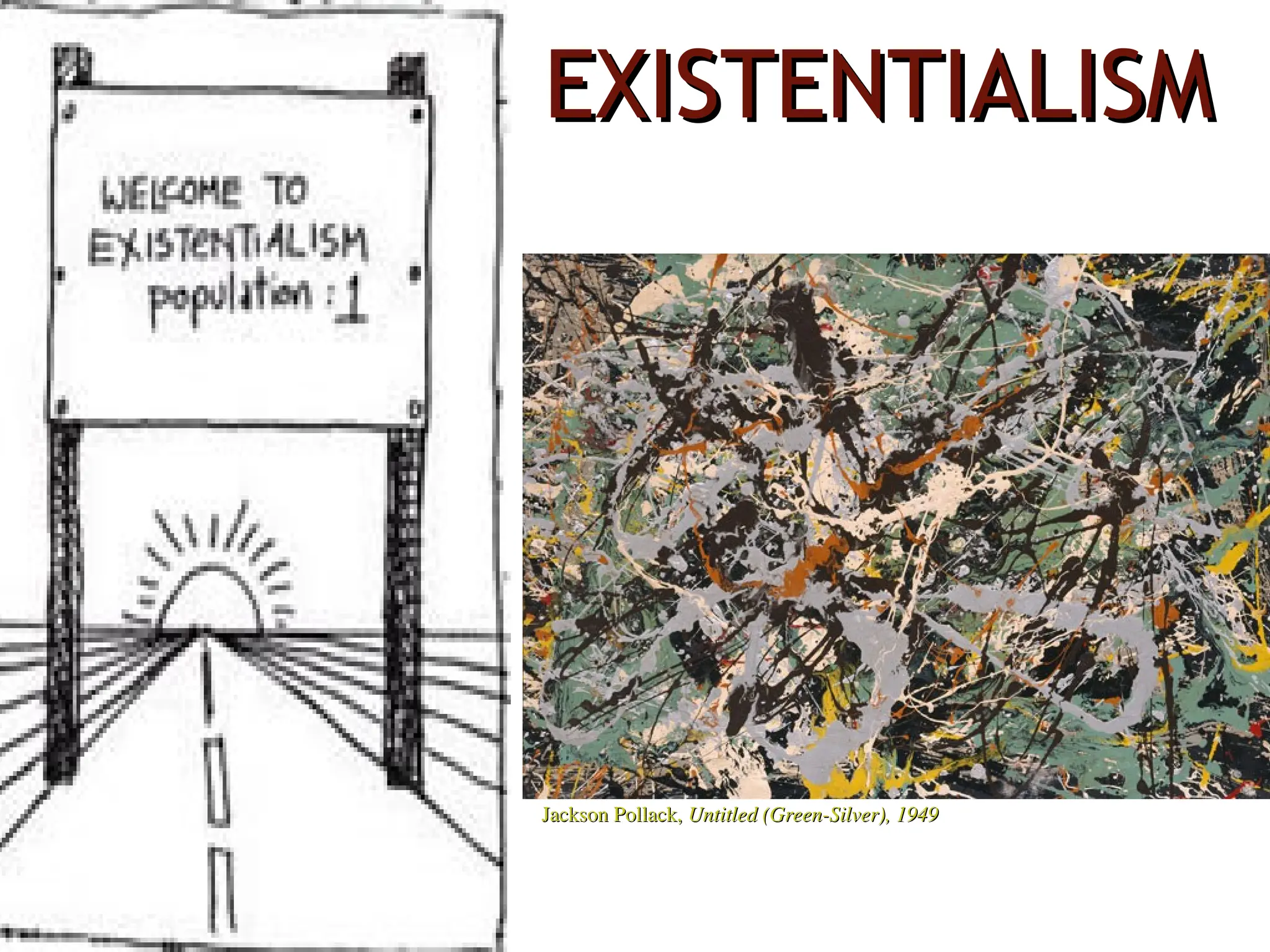
Jackson Pollack,
Jackson Pollack, Untitled (Green-Silver), 1949
Untitled (Green-Silver), 1949
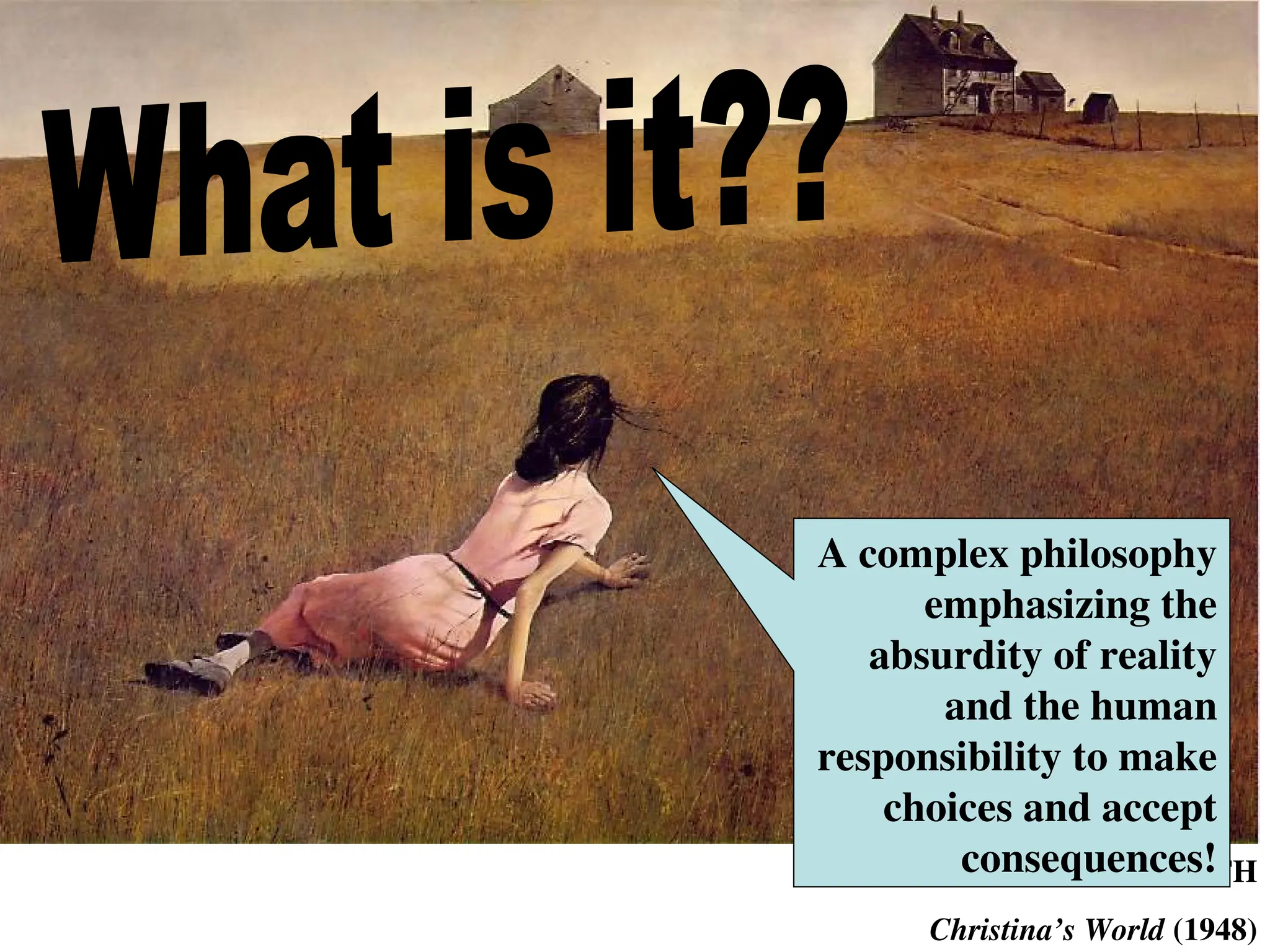
ANDREW WYETH
Christina’s World (1948)
A complex philosophy
emphasizing the
absurdity of reality
and the human
responsibility to make
choices and accept
consequences!
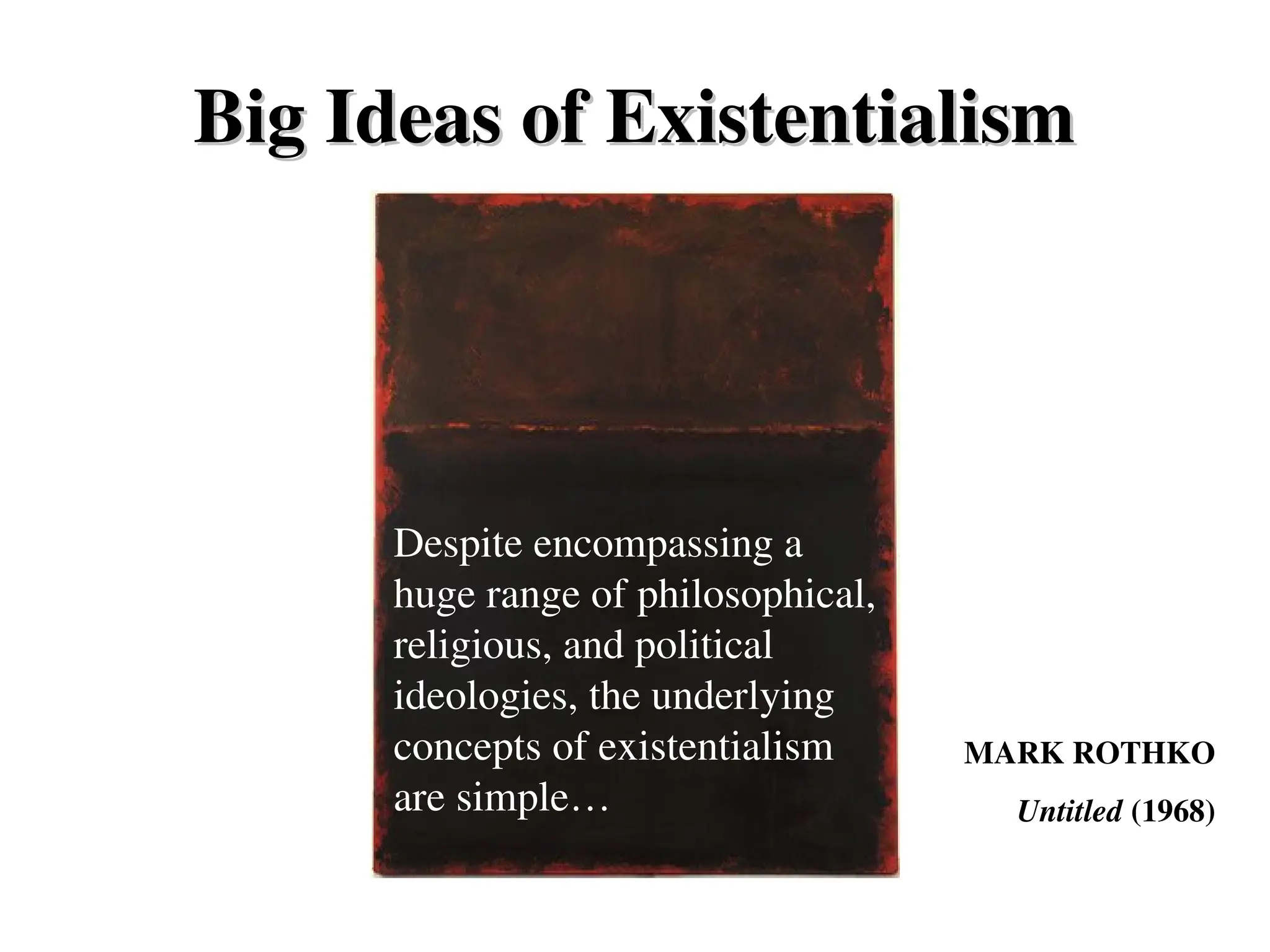
MARK ROTHKO
Untitled (1968)
Big Ideas of Existentialism
Despite encompassing a
huge range of philosophical,
religious, and political
ideologies, the underlying
concepts of existentialism
are simple…
6 Principle Concepts of
Existentialism
• Becoming a Being
• Absurd
• Choice
• Angst
• Nothingness
• Subjectivity
Existence Precedes Essence
Cogito ergo sum.
Existentialism is the title of the set of philosophical
ideals that emphasize the existence of the human being,
the lack of meaning and purpose in life, and the solitude
of human existence… “Existence precedes essence”
implies that the human being has no essence (no essential
self).
Absurdism
Absurdism
• The belief that nothing can explain or
rationalize human existence.
• There is no answer to “Why am I?”
• Humans exist in a meaningless, irrational
universe and any search for order will
bring them into direct conflict with this
universe.
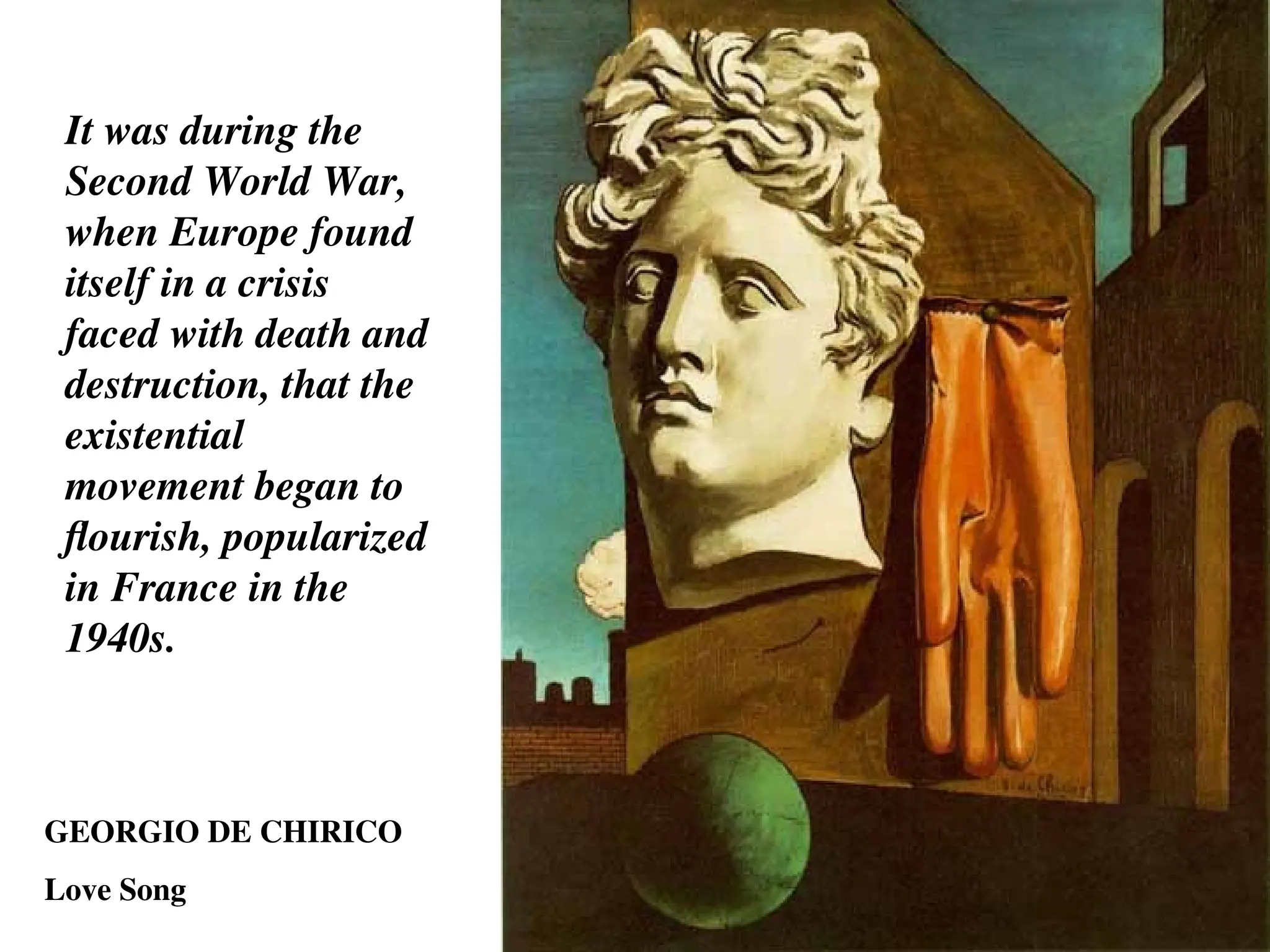
GEORGIO DE CHIRICO
Love Song
It was during the
Second World War,
when Europe found
itself in a crisis
faced with death and
destruction, that the
existential
movement began to
flourish, popularized
in France in the
1940s.
Choice and Commitment
• Humans have freedom to choose.
• Each individual makes choices that
create his or her own nature.
• Because we choose, we must accept risk
and responsibility for wherever our
commitments take us.
• “A human being is absolutely free and absolutely responsible. Anguish is
the result.” –Jean-Paul Sartre
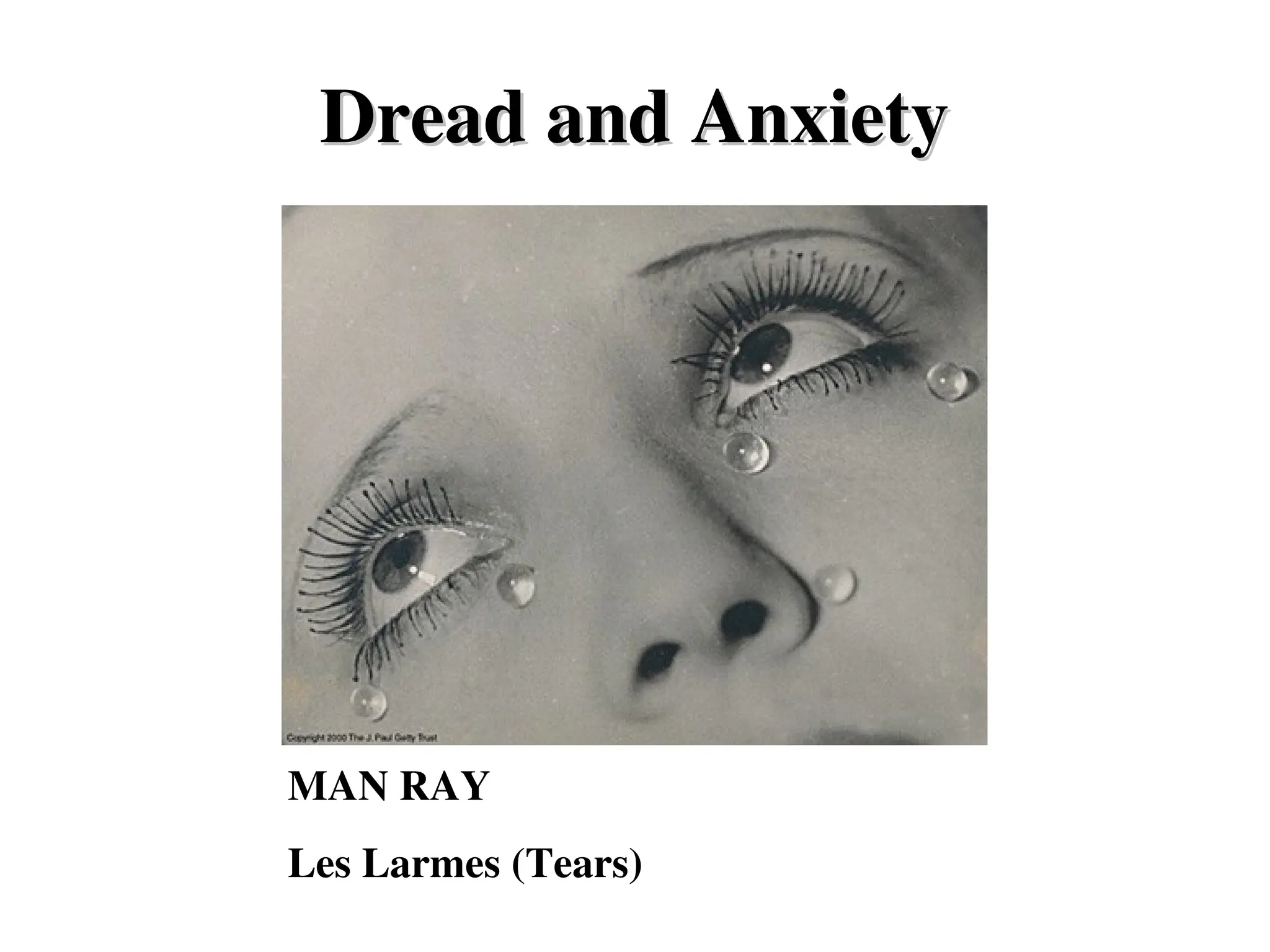
MAN RAY
Les Larmes (Tears)
Dread and Anxiety
Dread and Anxiety
Dread and Anxiety
Dread and Anxiety
• Dread is a feeling of general
apprehension. Kierkegaard interpreted it
as God’s way of calling each individual to
make a commitment to a personally valid
way of life.
• Anxiety stems from our understanding
and recognition of the total freedom of
choice that confronts us every moment,
and the individual’s confrontation with
nothingness.
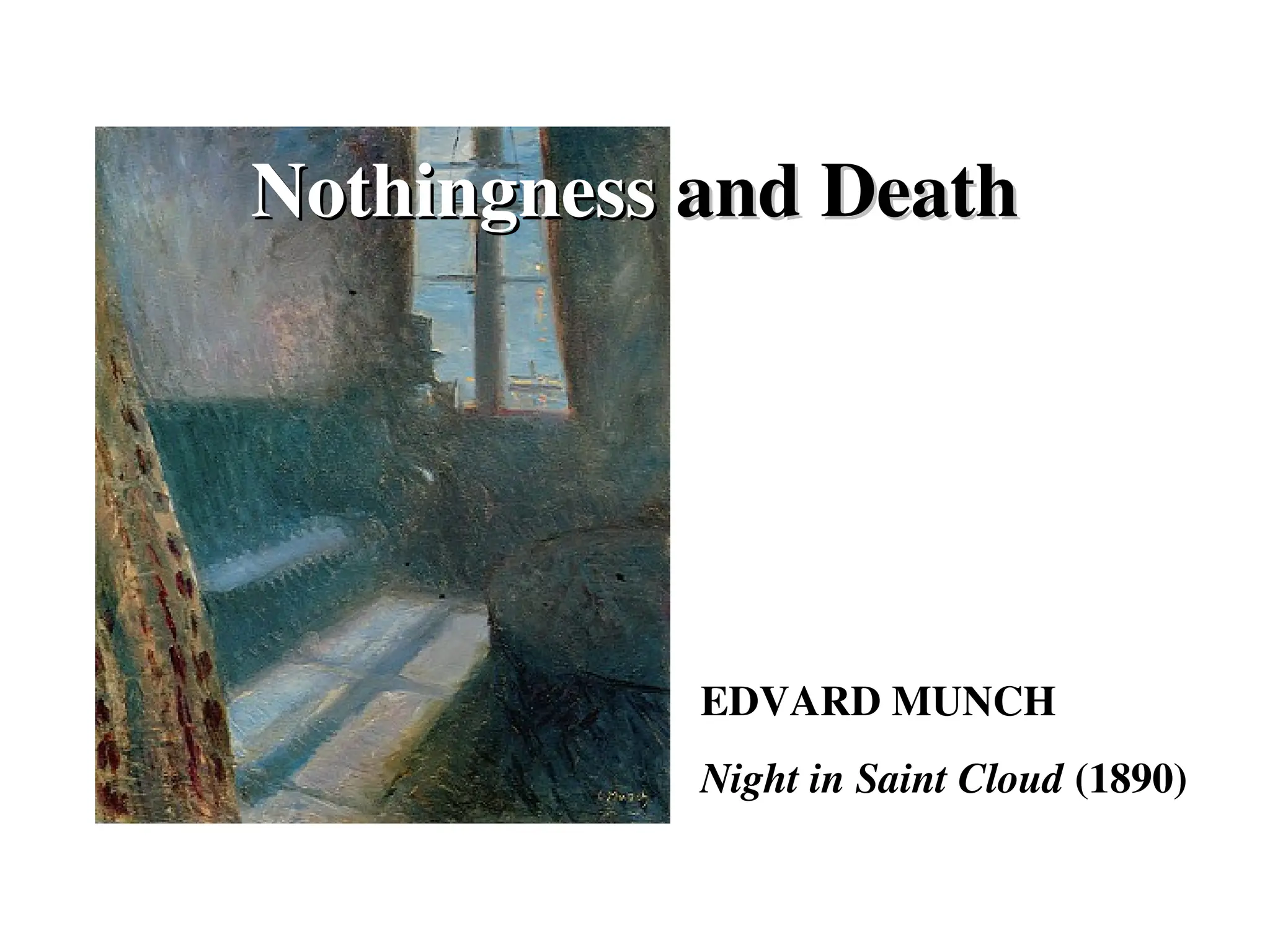
EDVARD MUNCH
Night in Saint Cloud (1890)
Nothingness
Nothingness and Death
and Death
• Death hangs over all of us. Our
awareness of it can bring freedom or
anguish.
• I am my own existence. Nothing structures
my world.
• “Nothingness is our inherent lack of self. We are in
constant pursuit of a self. Nothingness is the creative
well-spring from which all human possibilities can be
realized.” –Jean-Paul Sartre
Nothingness and Death
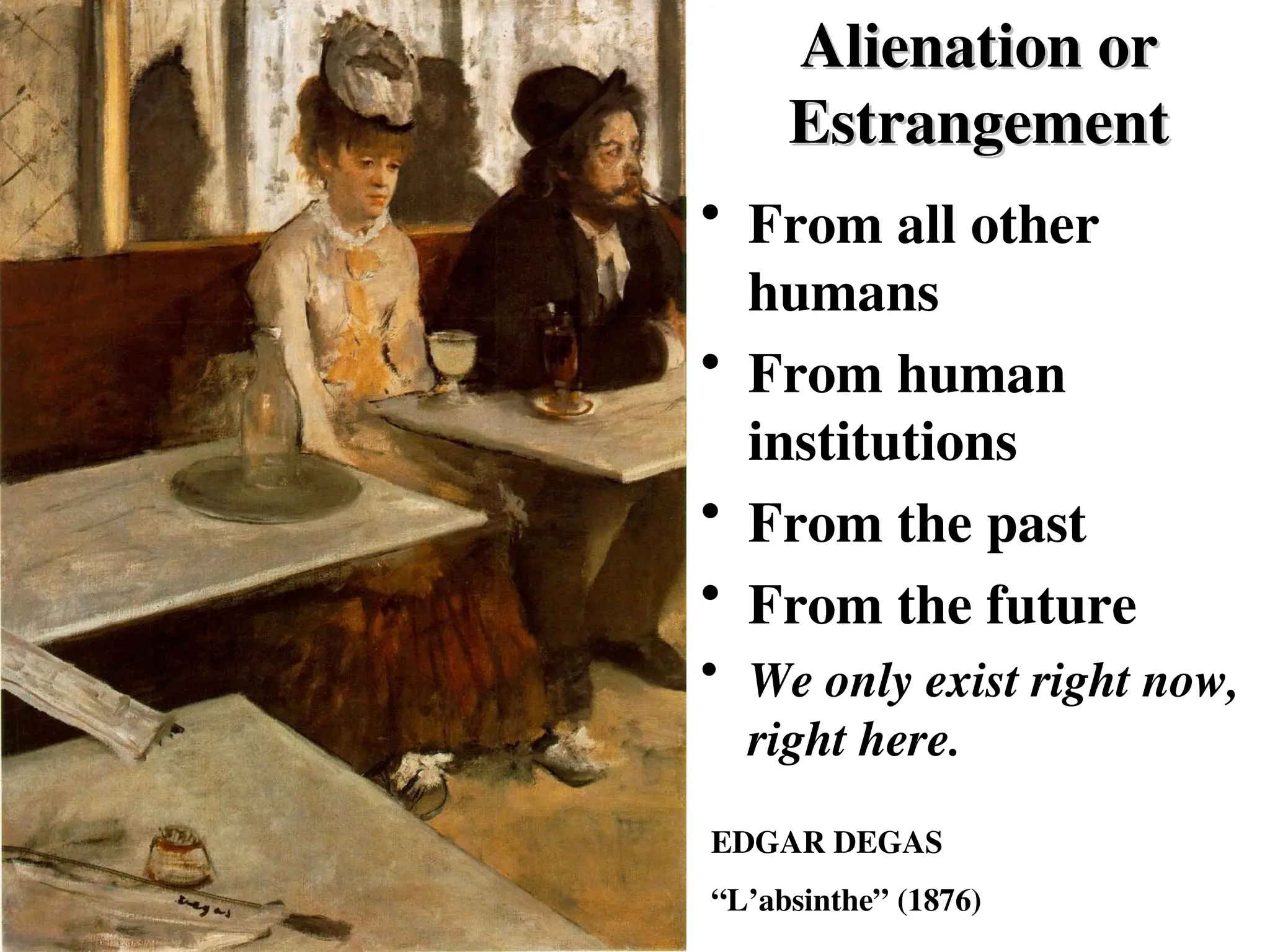
EDGAR DEGAS
“L’absinthe” (1876)
Alienation or
Alienation or
Estrangement
Estrangement
• From all other
humans
• From human
institutions
• From the past
• From the future
• We only exist right now,
right here.
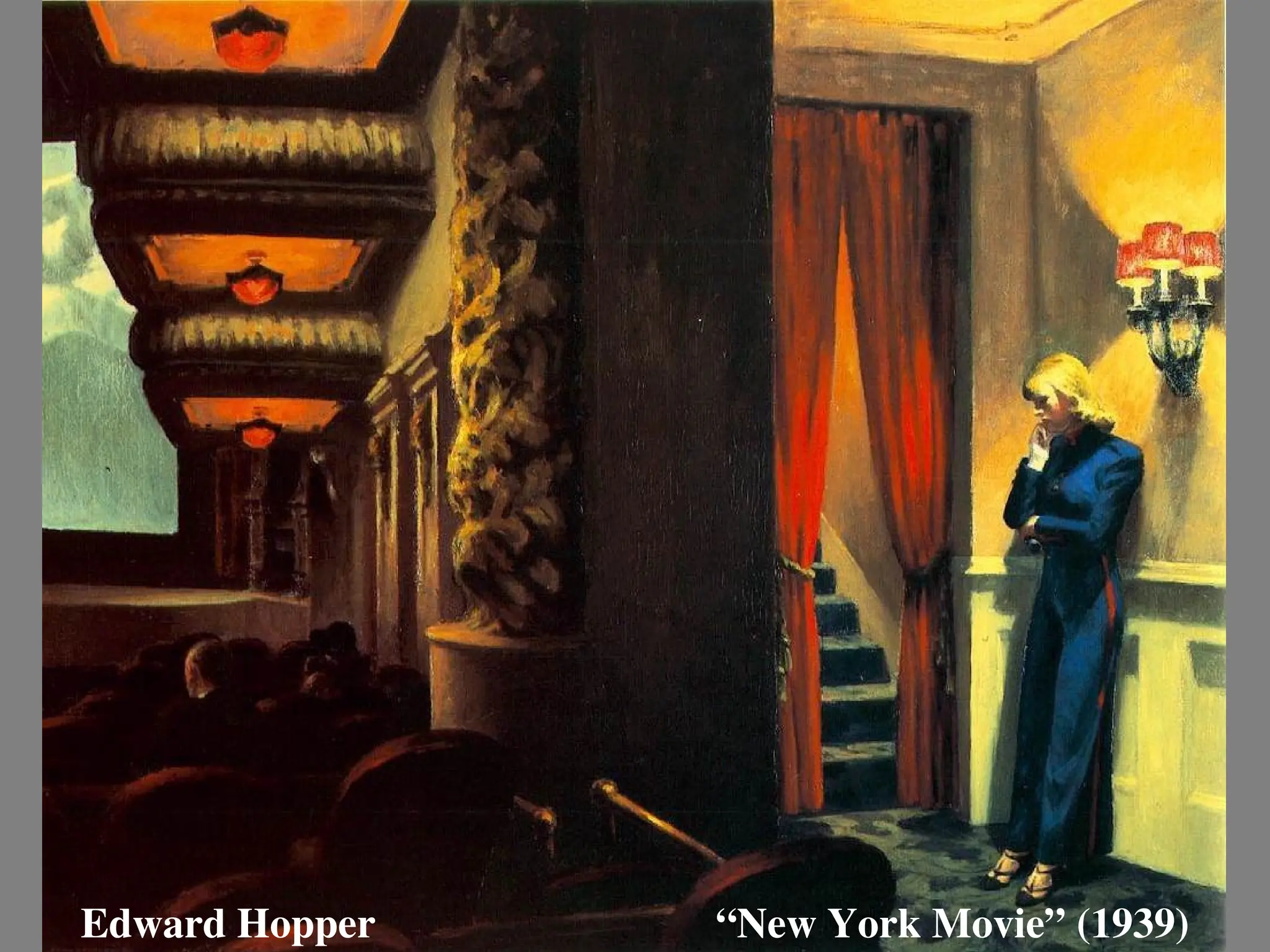
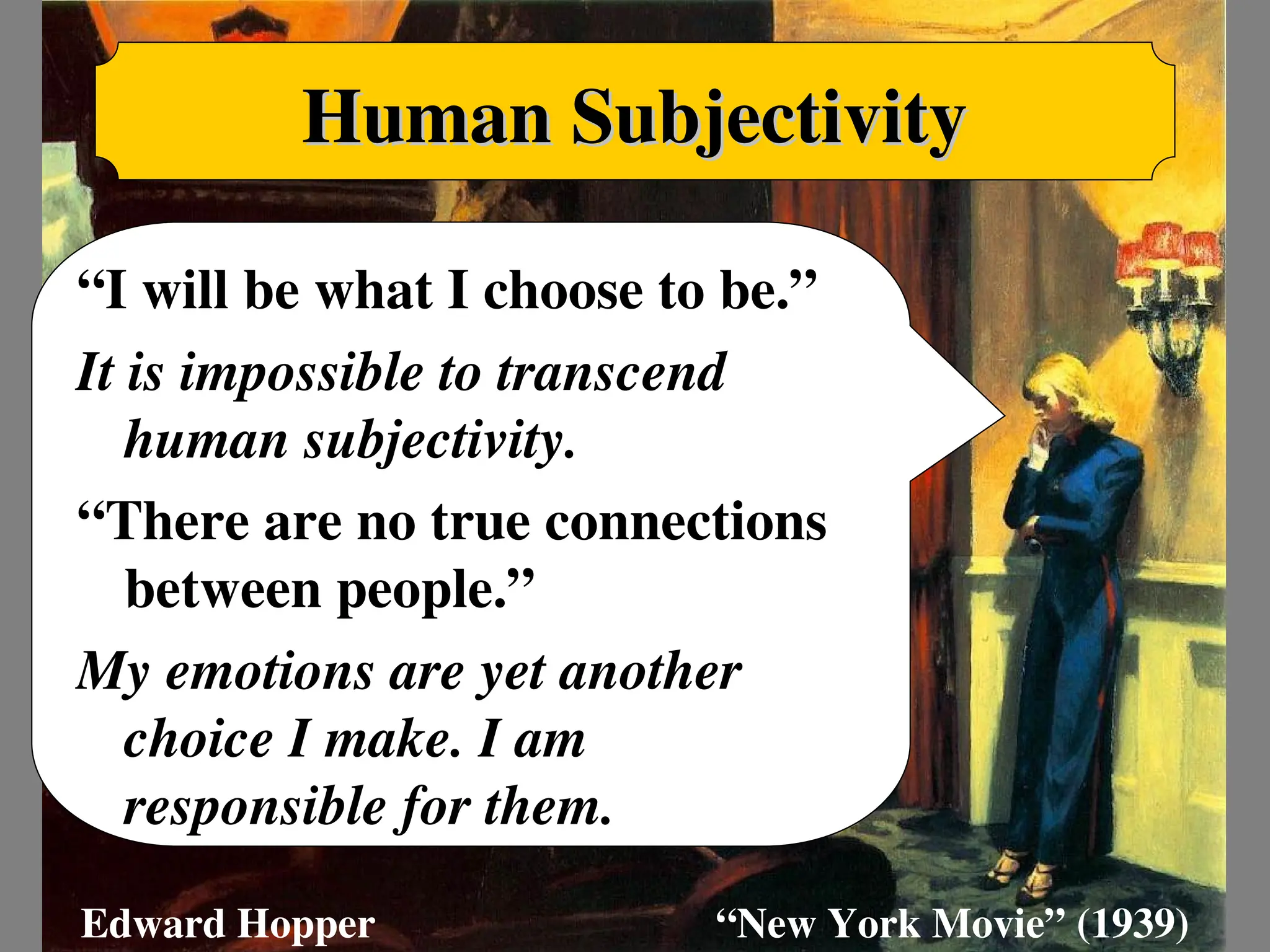
Edward Hopper “New York Movie” (1939)
Human Subjectivity
Human Subjectivity
“I will be what I choose to be.”
It is impossible to transcend
human subjectivity.
“There are no true connections
between people.”
My emotions are yet another
choice I make. I am
responsible for them.
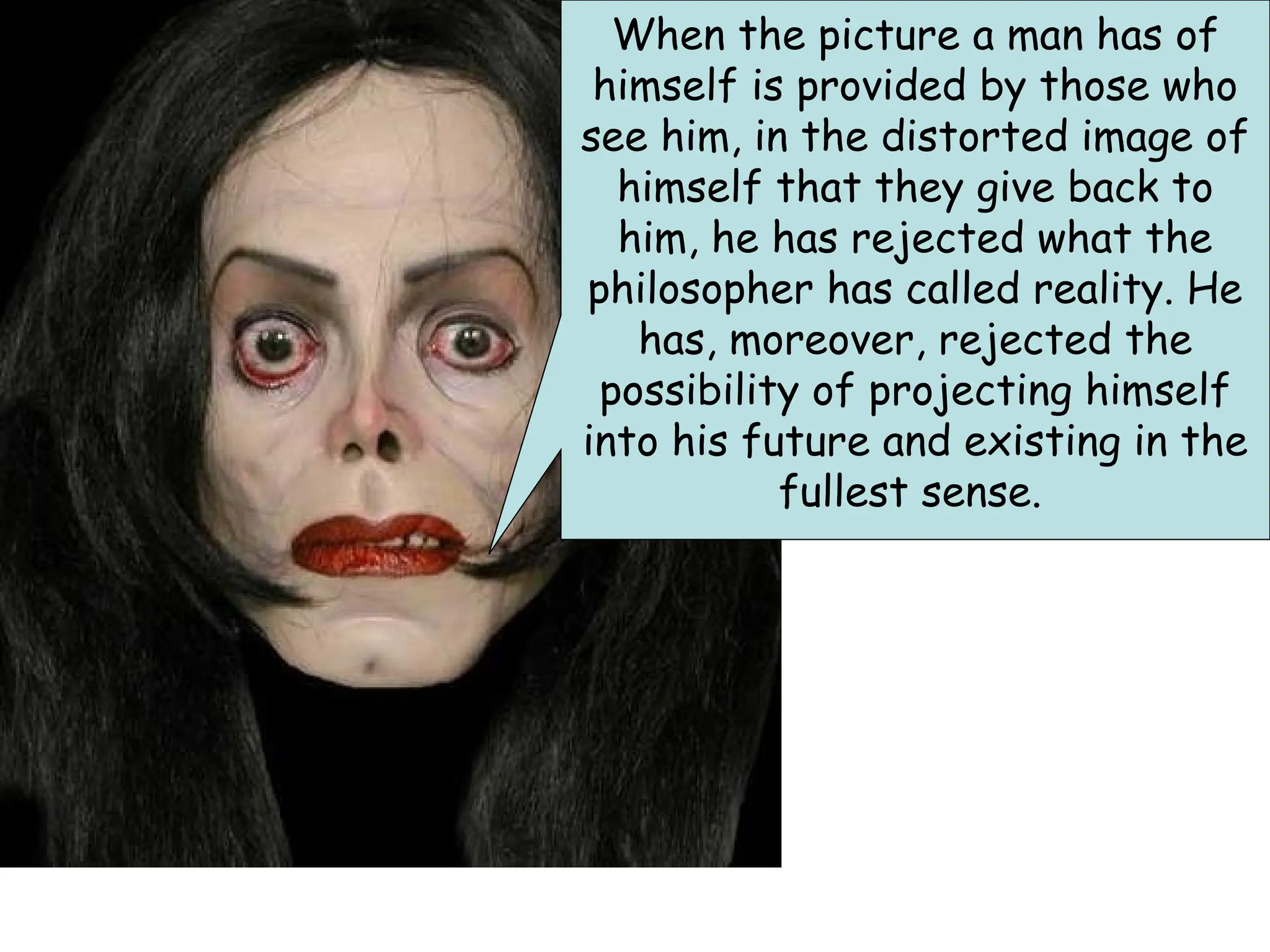
Bad Faith
When the picture a man has of
himself is provided by those who
see him, in the distorted image of
himself that they give back to
him, he has rejected what the
philosopher has called reality. He
has, moreover, rejected the
possibility of projecting himself
into his future and existing in the
fullest sense.
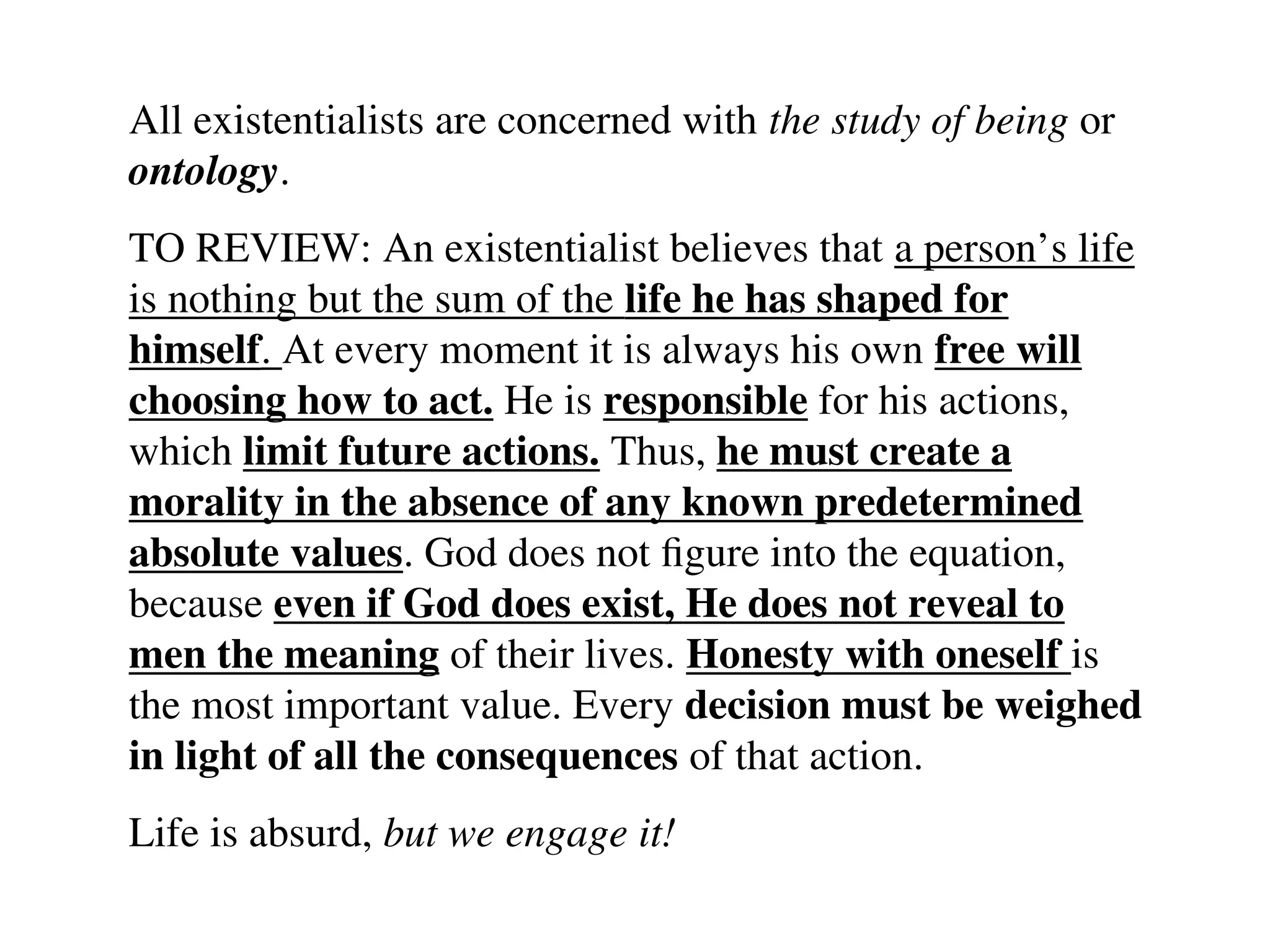
All existentialists are concerned with the study of being or
ontology.
TO REVIEW: An existentialist believes that a person’s life
is nothing but the sum of the life he has shaped for
himself. At every moment it is always his own free will
choosing how to act. He is responsible for his actions,
which limit future actions. Thus, he must create a
morality in the absence of any known predetermined
absolute values. God does not figure into the equation,
because even if God does exist, He does not reveal to
men the meaning of their lives. Honesty with oneself is
the most important value. Every decision must be weighed
in light of all the consequences of that action.
Life is absurd, but we engage it!
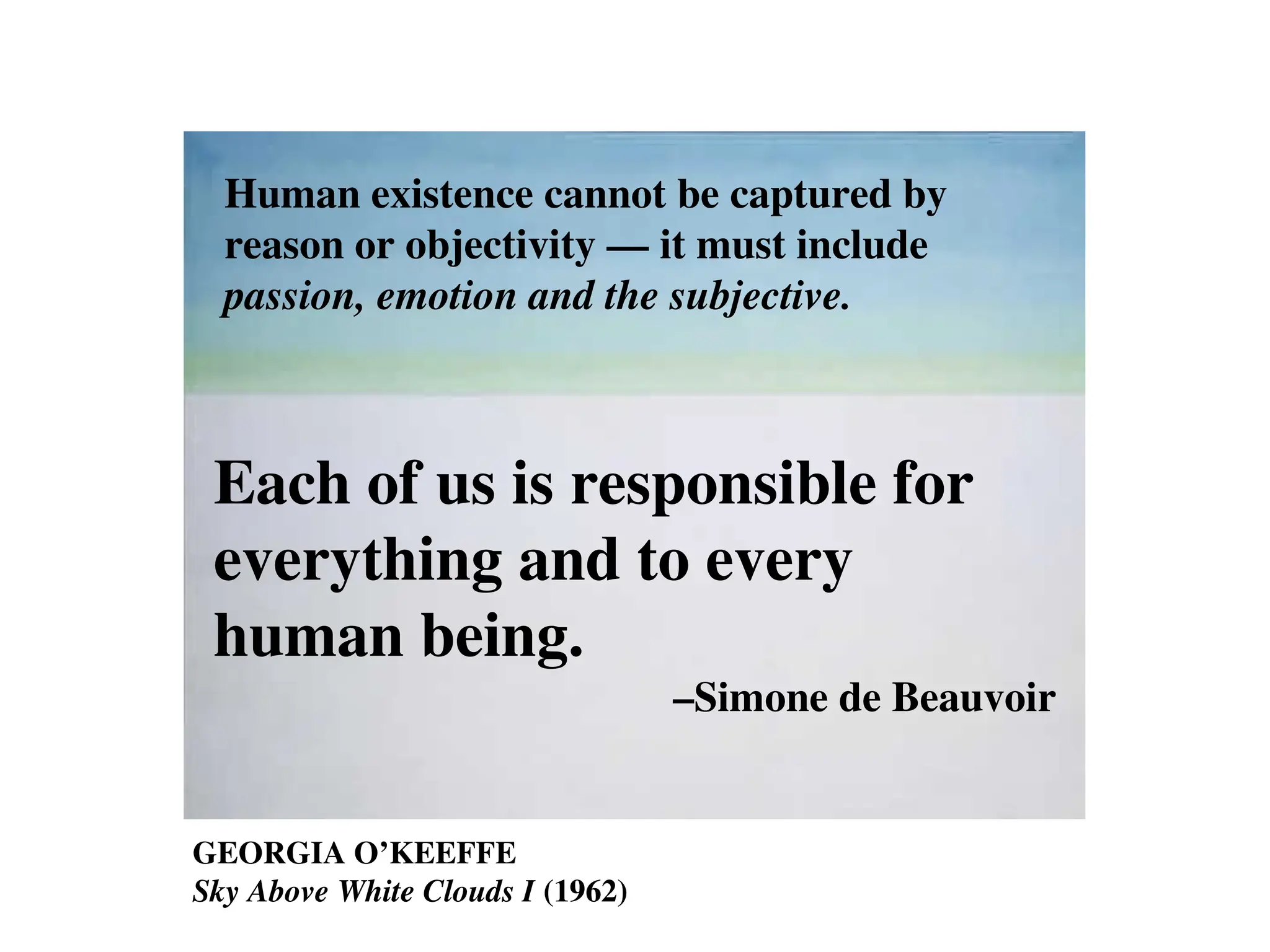
GEORGIA O’KEEFFE
Sky Above White Clouds I (1962)
Human existence cannot be captured by
reason or objectivity –– it must include
passion, emotion and the subjective.
Each of us is responsible for
everything and to every
human being.
–Simone de Beauvoir
Some Famous
Some Famous
Existentialists
Existentialists
• Søren Kierkegaard
(1813-1855)
• Friedrich Nietzsche
(1844-1900)
• Jean-Paul Sartre (1905-
1980)
• Albert Camus (1913-
1960)
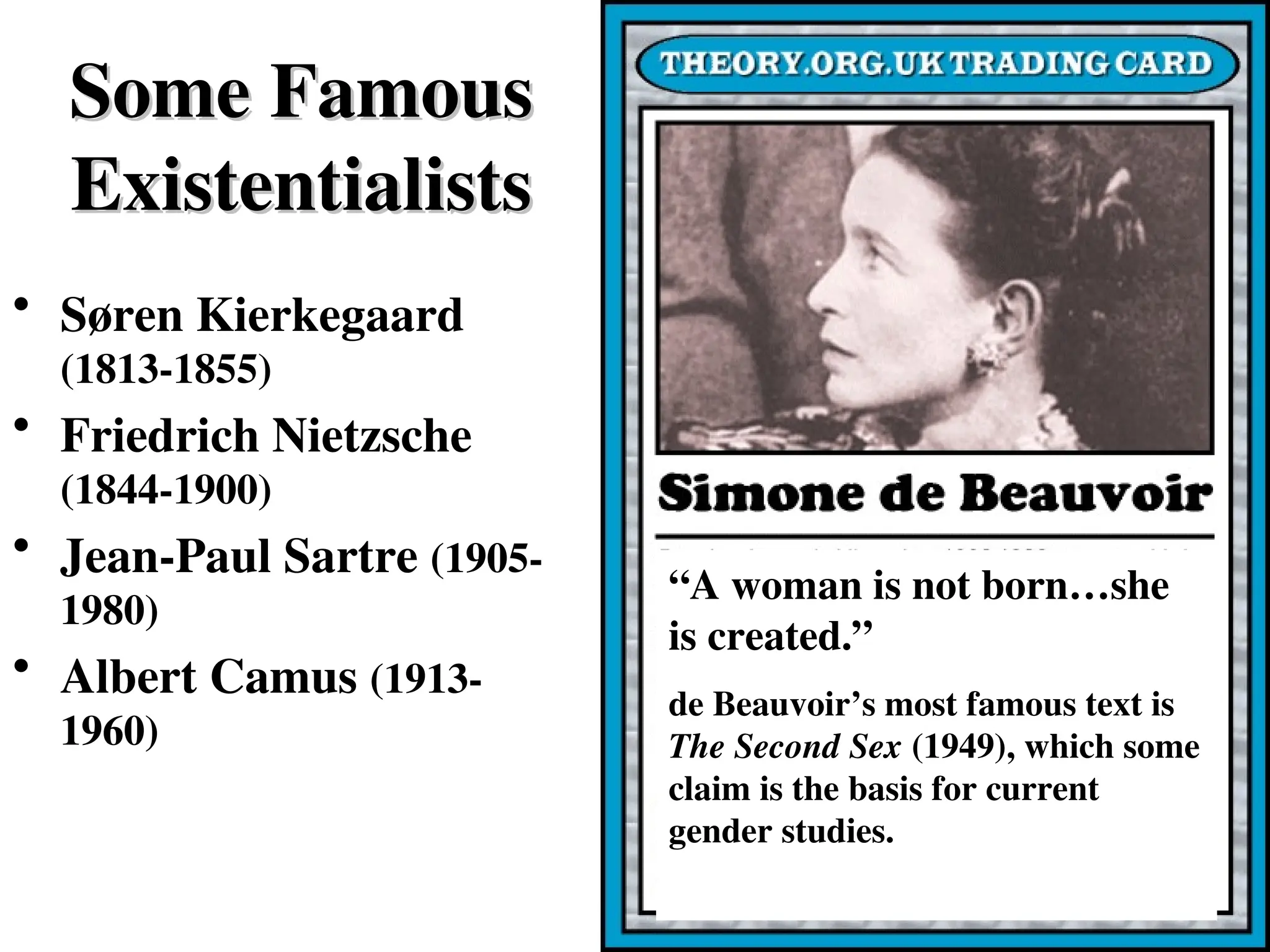
“A woman is not born…she
is created.”
de Beauvoir’s most famous text is
The Second Sex (1949), which some
claim is the basis for current
gender studies.
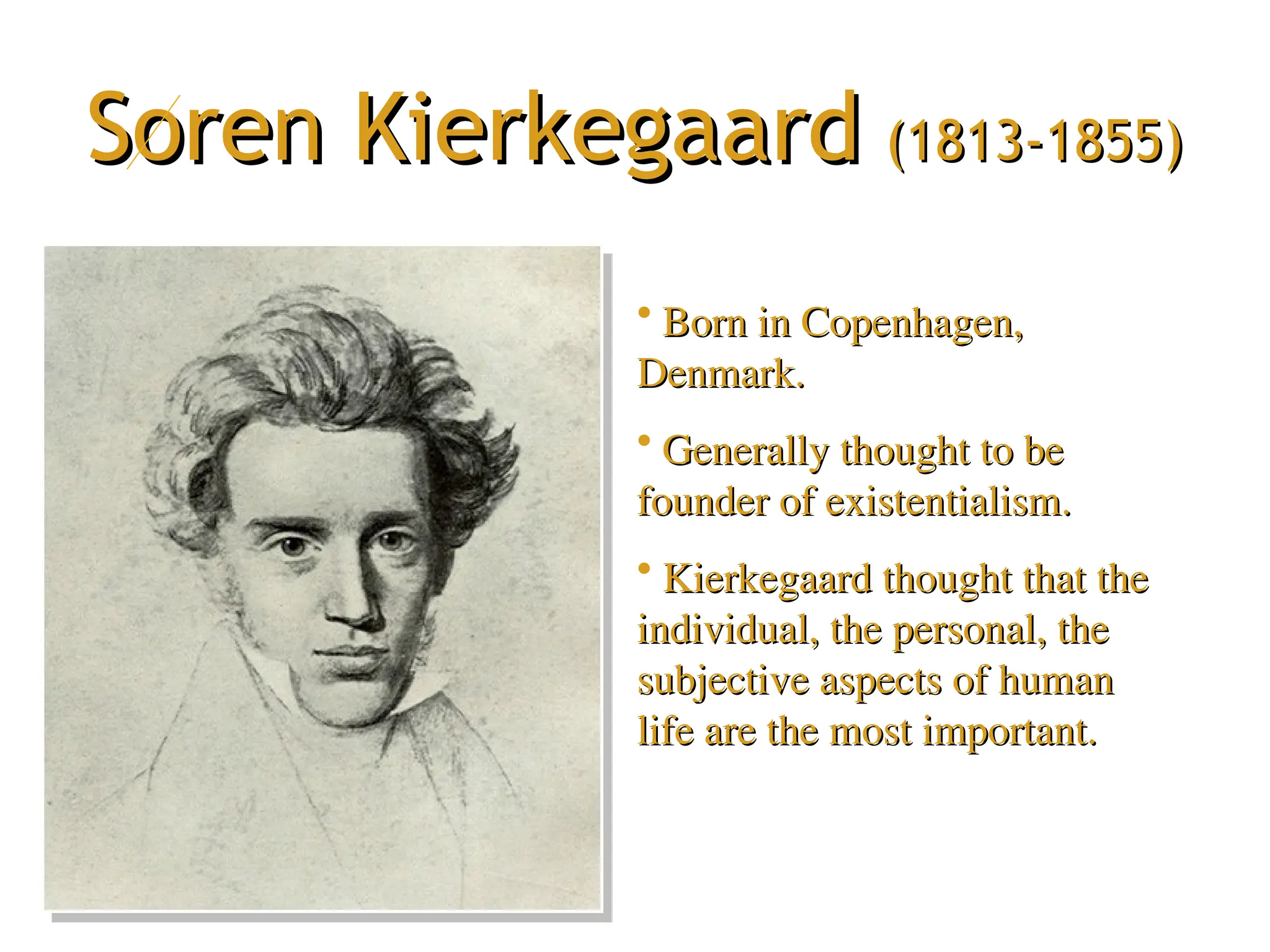
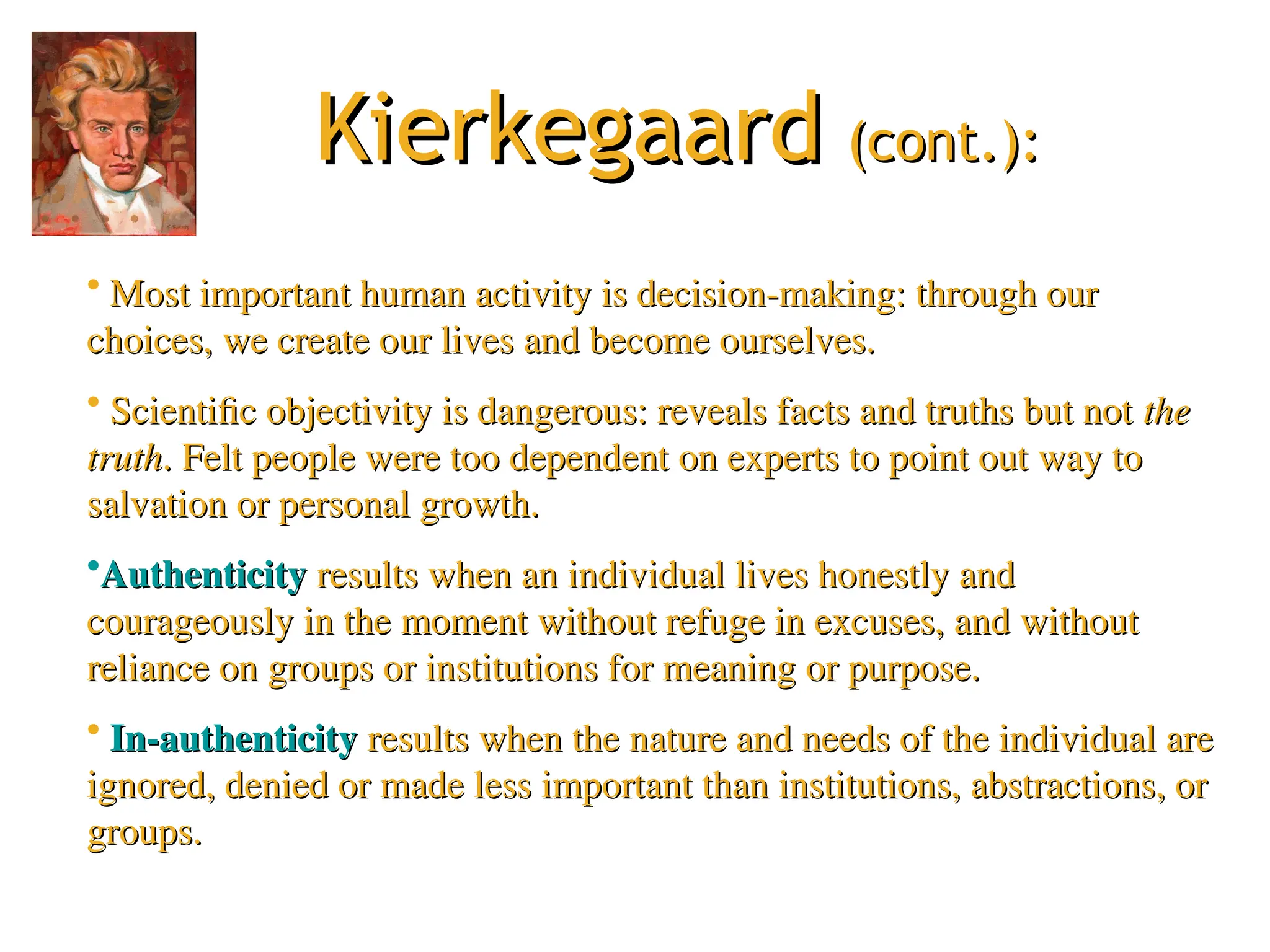
Soren Kierkegaard
Soren Kierkegaard (1813-1855)
(1813-1855)
• Born in Copenhagen,
Born in Copenhagen,
Denmark.
Denmark.
• Generally thought to be
Generally thought to be
founder of existentialism.
• Kierkegaard thought that the
Kierkegaard thought that the
individual, the personal, the
subjective aspects of human
life are the most important.
Kierkegaard
Kierkegaard (cont.):
(cont.):
• Most important human activity is decision-making: through our
Most important human activity is decision-making: through our
choices, we create our lives and become ourselves.
• Scientific objectivity is dangerous: reveals facts and truths but not
Scientific objectivity is dangerous: reveals facts and truths but not the
the
truth
truth. Felt people were too dependent on experts to point out way to
. Felt people were too dependent on experts to point out way to
salvation or personal growth.
•Authenticity
Authenticity results when an individual lives honestly and
results when an individual lives honestly and
courageously in the moment without refuge in excuses, and without
reliance on groups or institutions for meaning or purpose.
• In-authenticity
In-authenticity results when the nature and needs of the individual are
results when the nature and needs of the individual are
ignored, denied or made less important than institutions, abstractions, or
groups.
groups.
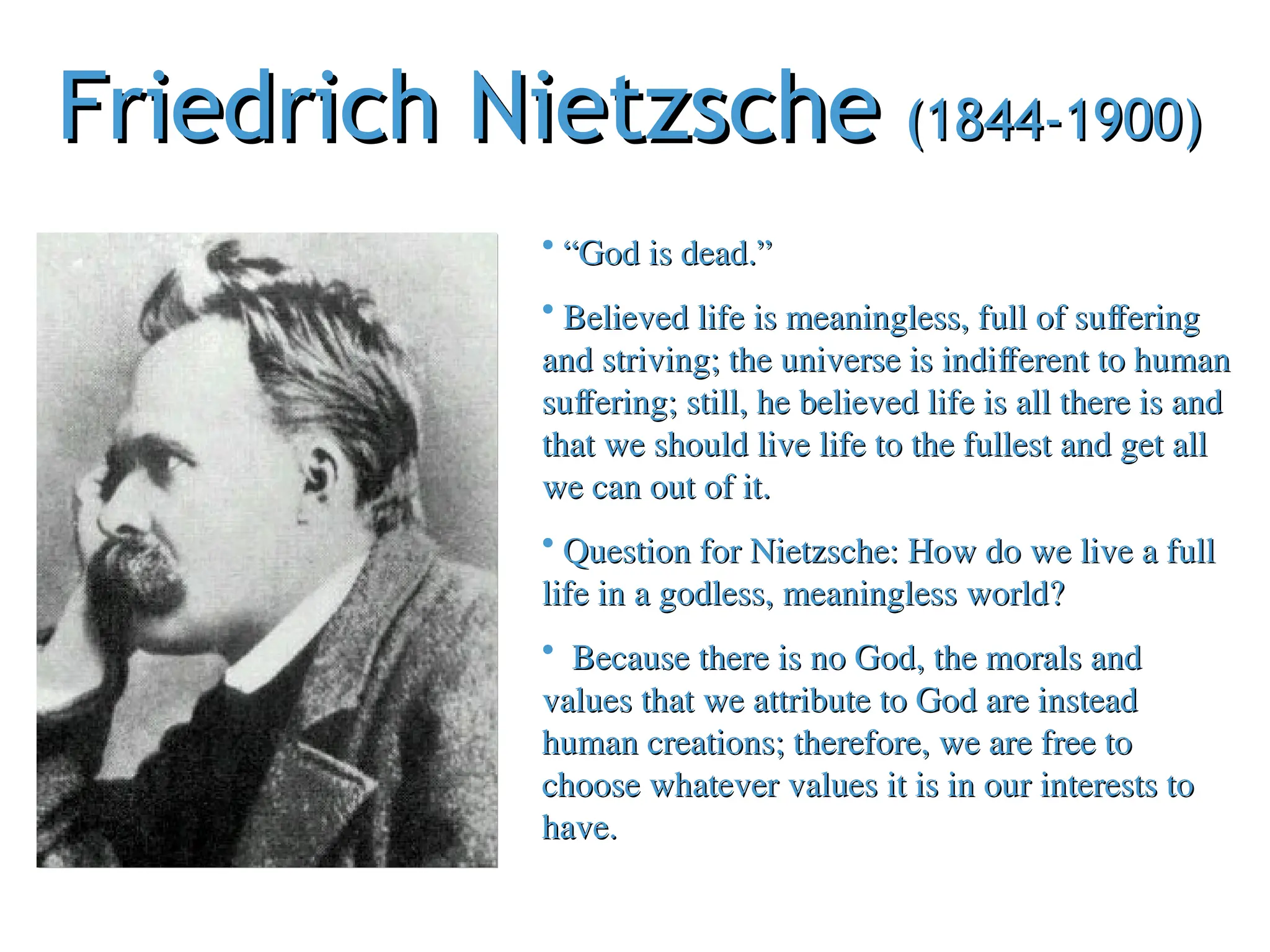
Friedrich Nietzsche
Friedrich Nietzsche (1844-1900)
(1844-1900)
• “
“God is dead.”
God is dead.”
• Believed life is meaningless, full of suffering
Believed life is meaningless, full of suffering
and striving; the universe is indifferent to human
suffering; still, he believed life is all there is and
that we should live life to the fullest and get all
we can out of it.
we can out of it.
• Question for Nietzsche: How do we live a full
Question for Nietzsche: How do we live a full
life in a godless, meaningless world?
• Because there is no God, the morals and
Because there is no God, the morals and
values that we attribute to God are instead
human creations; therefore, we are free to
choose whatever values it is in our interests to
have.
have.
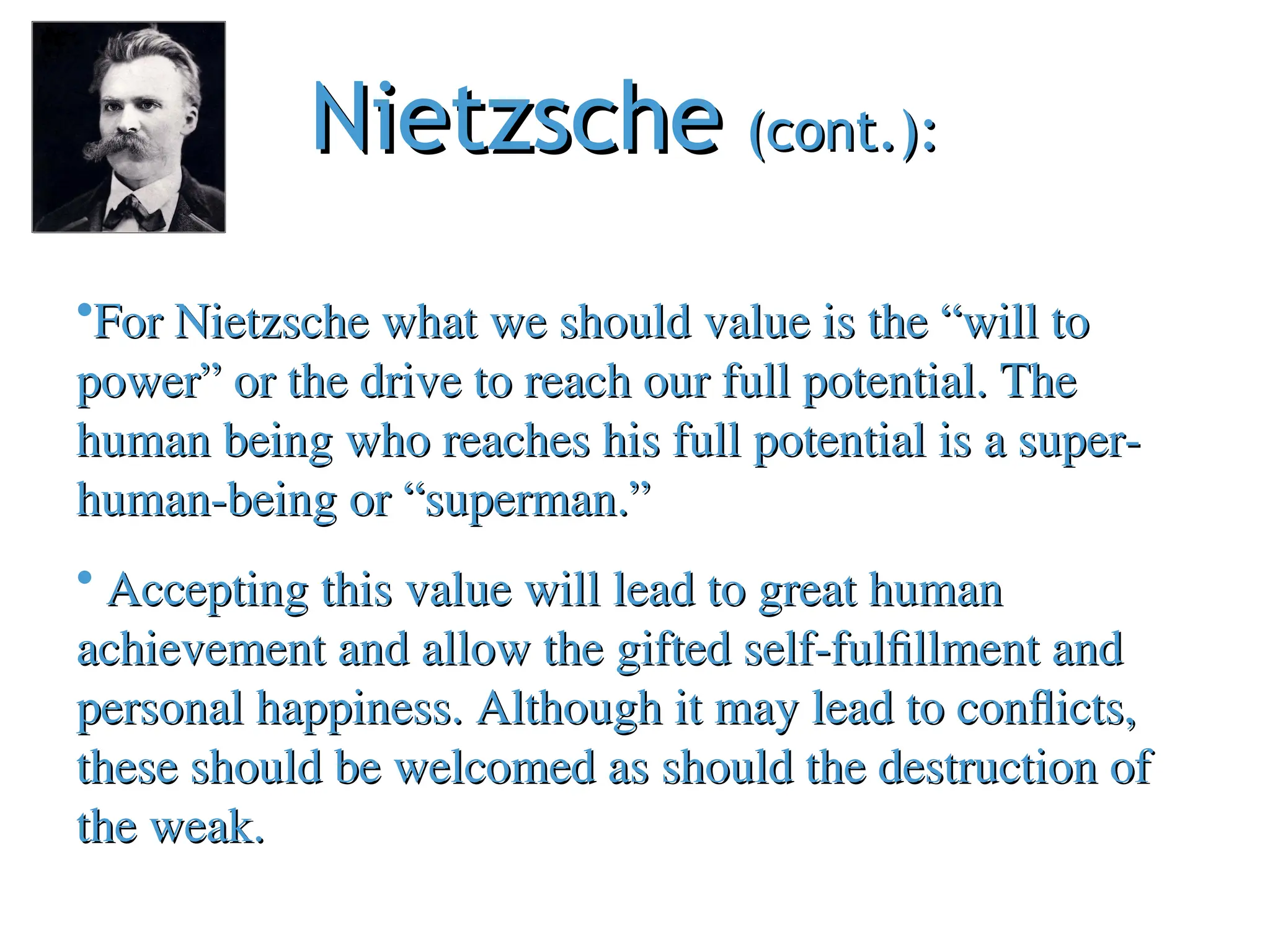
Nietzsche
Nietzsche (cont.):
(cont.):
•For Nietzsche what we should value is the “will to
For Nietzsche what we should value is the “will to
power” or the drive to reach our full potential. The
human being who reaches his full potential is a super-
human-being or “superman.”
• Accepting this value will lead to great human
Accepting this value will lead to great human
achievement and allow the gifted self-fulfillment and
personal happiness. Although it may lead to conflicts,
these should be welcomed as should the destruction of
the weak.
the weak.
Nietzsche and Nihilism
“Every belief, every considering
something-true is necessarily
false because there is simply no
true world. Nihilism is…not
only the belief that everything
deserves to perish; but one
actually puts one’s shoulder to
the plow; one destroys. For
some time now our whole
European culture has been
moving as toward a catastrophe,
with a tortured tension that is
growing from decade to decade:
restlessly, violently, headlong,
like a river that wants to reach
the end… .” (Will to Power)
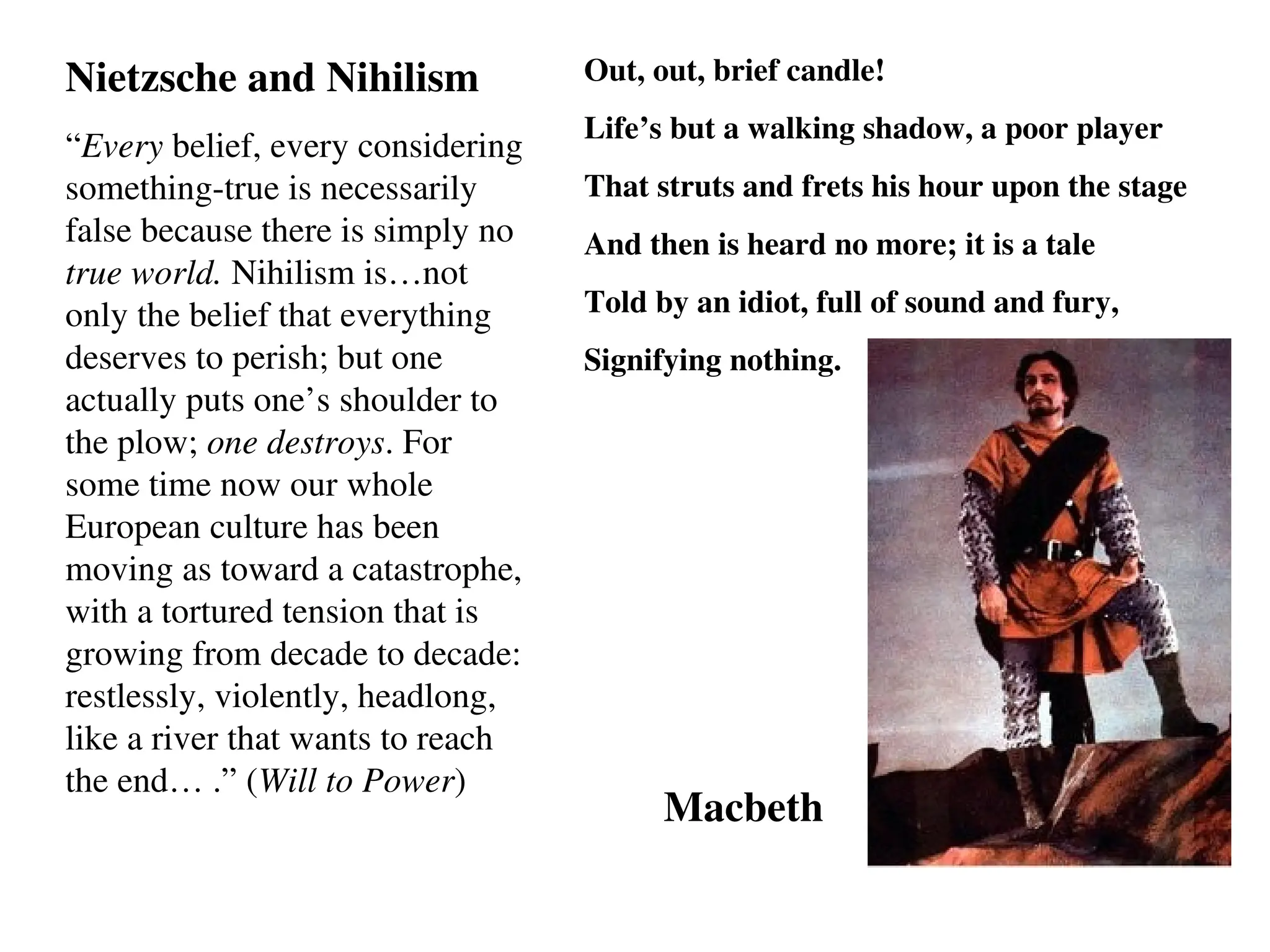
Out, out, brief candle!
Life’s but a walking shadow, a poor player
That struts and frets his hour upon the stage
And then is heard no more; it is a tale
Told by an idiot, full of sound and fury,
Signifying nothing.
Macbeth
Jean-Paul Sartre
Jean-Paul Sartre (1905-1980)
(1905-1980):
:
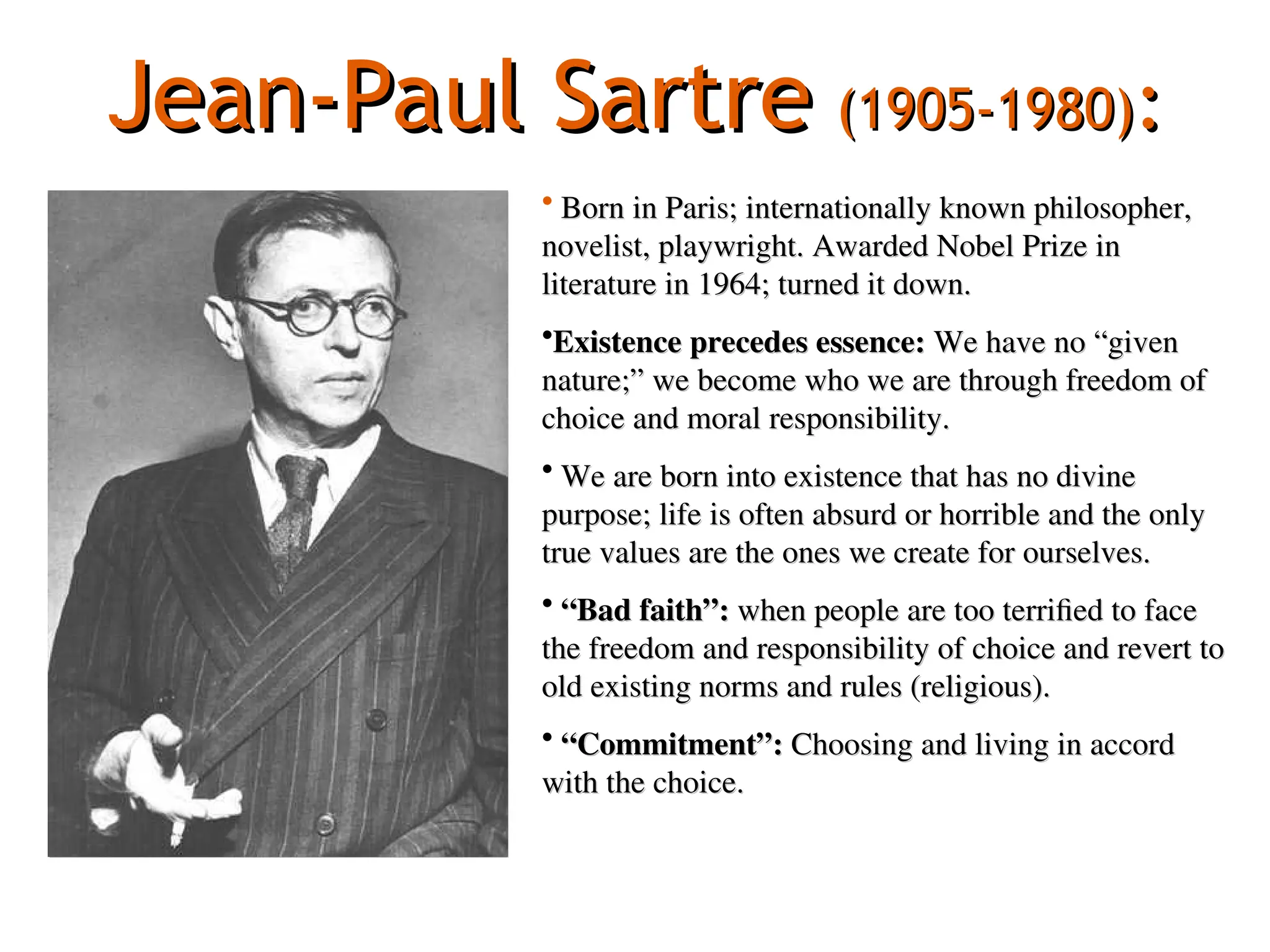
• Born in Paris; internationally known philosopher,
Born in Paris; internationally known philosopher,
novelist, playwright. Awarded Nobel Prize in
literature in 1964; turned it down.
•Existence precedes essence:
Existence precedes essence: We have no “given
We have no “given
nature;” we become who we are through freedom of
choice and moral responsibility.
• We are born into existence that has no divine
We are born into existence that has no divine
purpose; life is often absurd or horrible and the only
true values are the ones we create for ourselves.
• “
“Bad faith”:
Bad faith”: when people are too terrified to face
when people are too terrified to face
the freedom and responsibility of choice and revert to
old existing norms and rules (religious).
• “
“Commitment”:
Commitment”: Choosing and living in accord
Choosing and living in accord
with the choice.
with the choice.
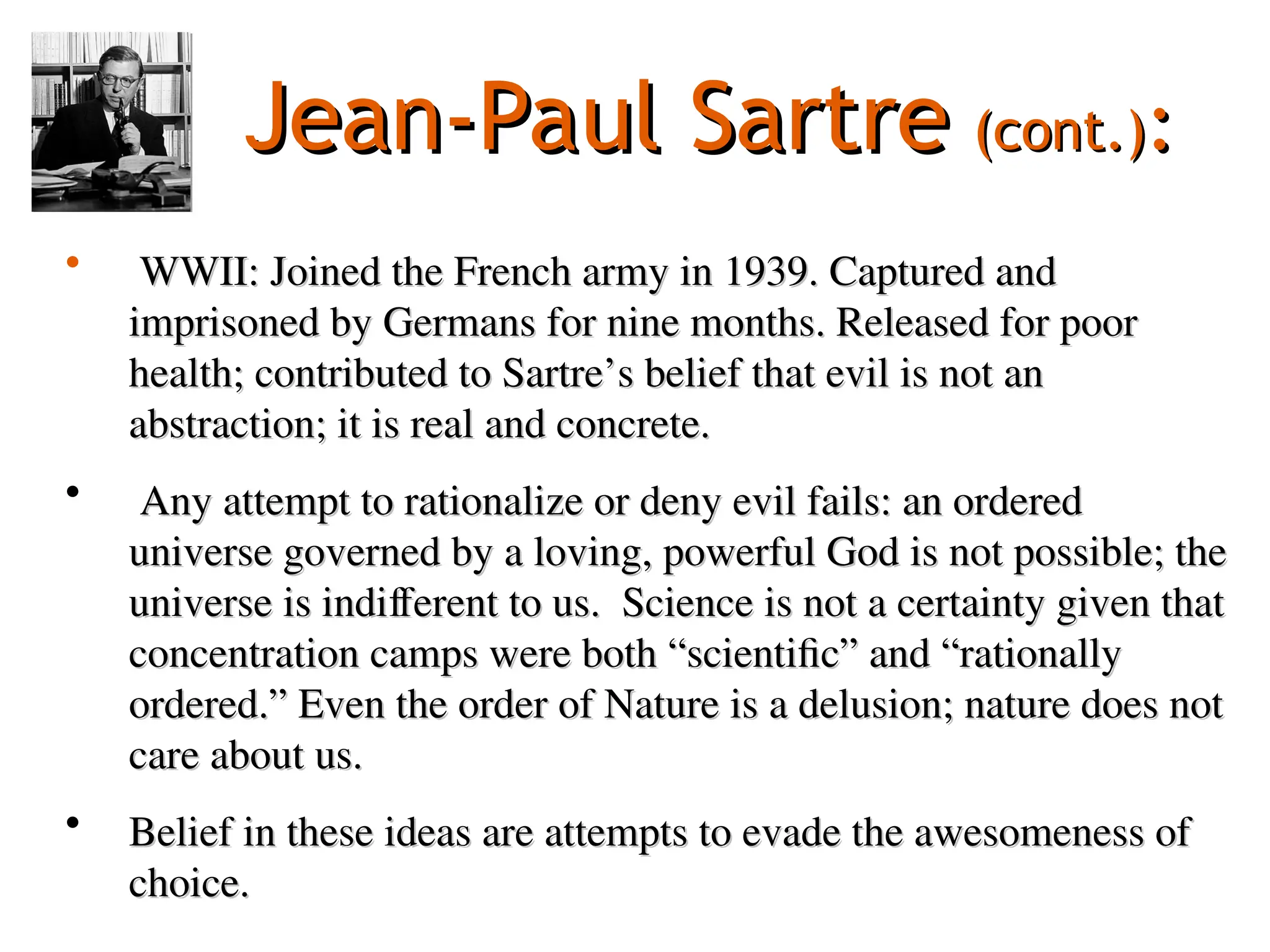
Jean-Paul Sartre
Jean-Paul Sartre (cont.)
(cont.):
:
• WWII: Joined the French army in 1939. Captured and
WWII: Joined the French army in 1939. Captured and
imprisoned by Germans for nine months. Released for poor
health; contributed to Sartre’s belief that evil is not an
abstraction; it is real and concrete.
• Any attempt to rationalize or deny evil fails: an ordered
Any attempt to rationalize or deny evil fails: an ordered
universe governed by a loving, powerful God is not possible; the
universe is indifferent to us. Science is not a certainty given that
concentration camps were both “scientific” and “rationally
ordered.” Even the order of Nature is a delusion; nature does not
care about us.
care about us.
• Belief in these ideas are attempts to evade the awesomeness of
Belief in these ideas are attempts to evade the awesomeness of
choice.
choice.
The Modern (20th) Century
Existentialists
• Franz Kafka
• Jean-Paul Sartre
• Simone de Beauvoir
• Albert Camus
• Feodor Dostoyevsky
• Ortega y Gasset
Existentialism Today
• - Often mocked by Hollywood and Madison
Avenue
• - The “mid-life crisis”
• - The excesses of the 70’s and 80’s
• -The Geico Cavemen
• Woody Allen
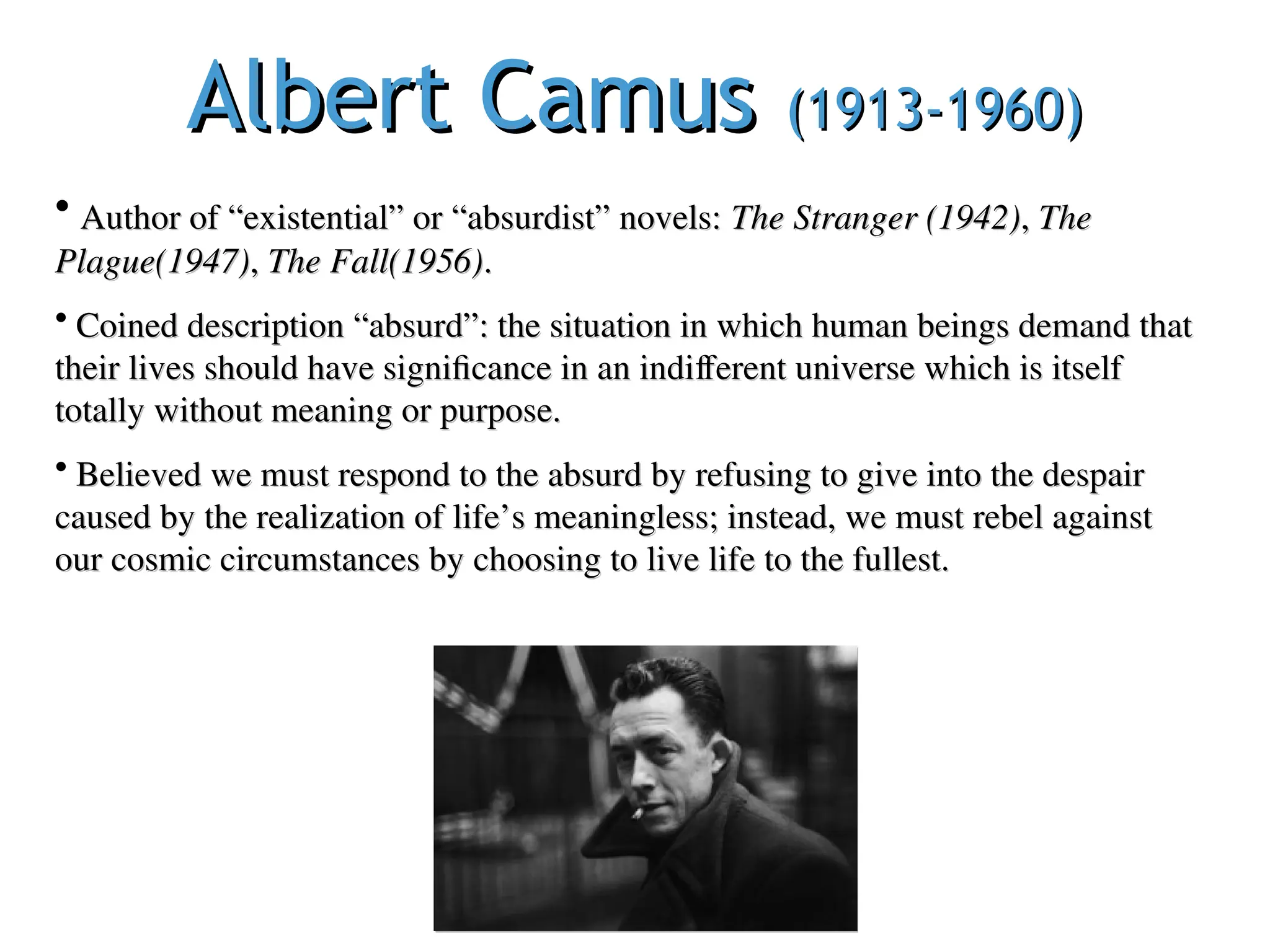
Albert Camus
Albert Camus (1913-1960)
(1913-1960)
• Author of “existential” or “absurdist” novels:
Author of “existential” or “absurdist” novels: The Stranger (1942)
The Stranger (1942),
, The
The
Plague(1947)
Plague(1947),
, The Fall(1956)
The Fall(1956).
.
• Coined description “absurd”: the situation in which human beings demand that
Coined description “absurd”: the situation in which human beings demand that
their lives should have significance in an indifferent universe which is itself
totally without meaning or purpose.
• Believed we must respond to the absurd by refusing to give into the despair
Believed we must respond to the absurd by refusing to give into the despair
caused by the realization of life’s meaningless; instead, we must rebel against
our cosmic circumstances by choosing to live life to the fullest.
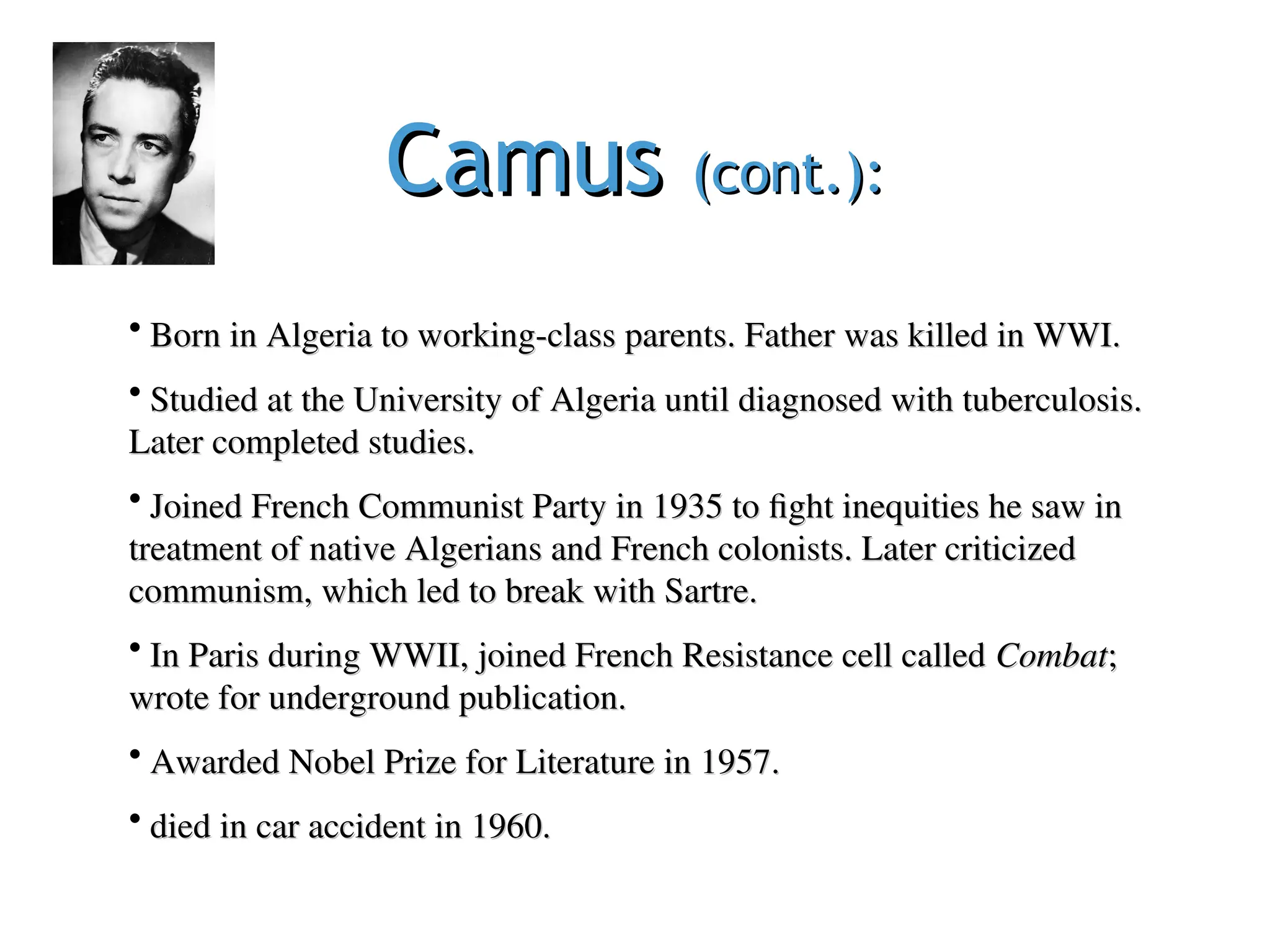
Camus
Camus (cont.):
(cont.):
• Born in Algeria to working-class parents. Father was killed in WWI.
Born in Algeria to working-class parents. Father was killed in WWI.
• Studied at the University of Algeria until diagnosed with tuberculosis.
Studied at the University of Algeria until diagnosed with tuberculosis.
Later completed studies.
• Joined French Communist Party in 1935 to fight inequities he saw in
Joined French Communist Party in 1935 to fight inequities he saw in
treatment of native Algerians and French colonists. Later criticized
communism, which led to break with Sartre.
• In Paris during WWII, joined French Resistance cell called
In Paris during WWII, joined French Resistance cell called Combat
Combat;
;
wrote for underground publication.
• Awarded Nobel Prize for Literature in 1957.
Awarded Nobel Prize for Literature in 1957.
• died in car accident in 1960.
died in car accident in 1960.
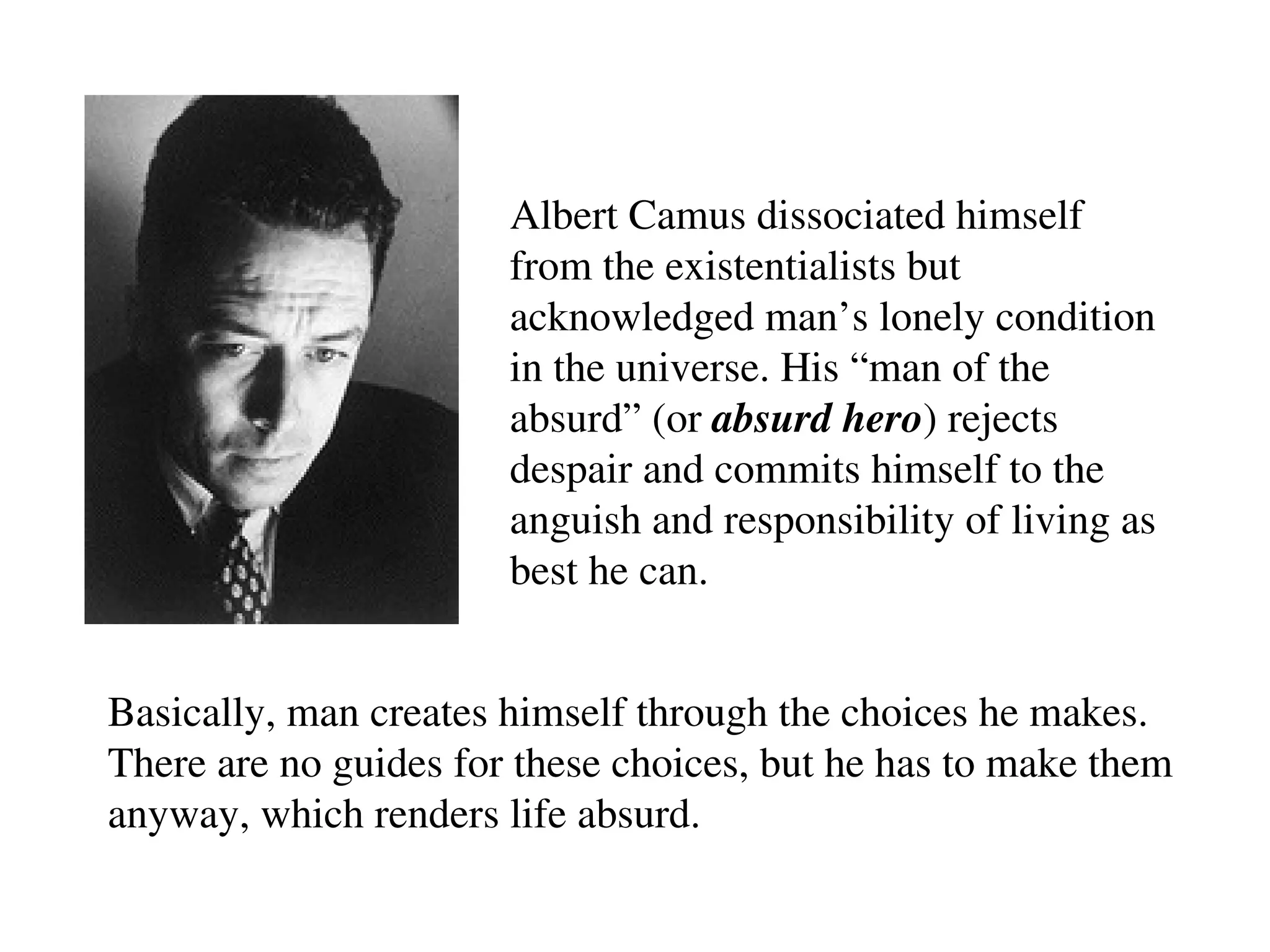
Albert Camus dissociated himself
from the existentialists but
acknowledged man’s lonely condition
in the universe. His “man of the
absurd” (or absurd hero) rejects
despair and commits himself to the
anguish and responsibility of living as
best he can.
Basically, man creates himself through the choices he makes.
There are no guides for these choices, but he has to make them
anyway, which renders life absurd.
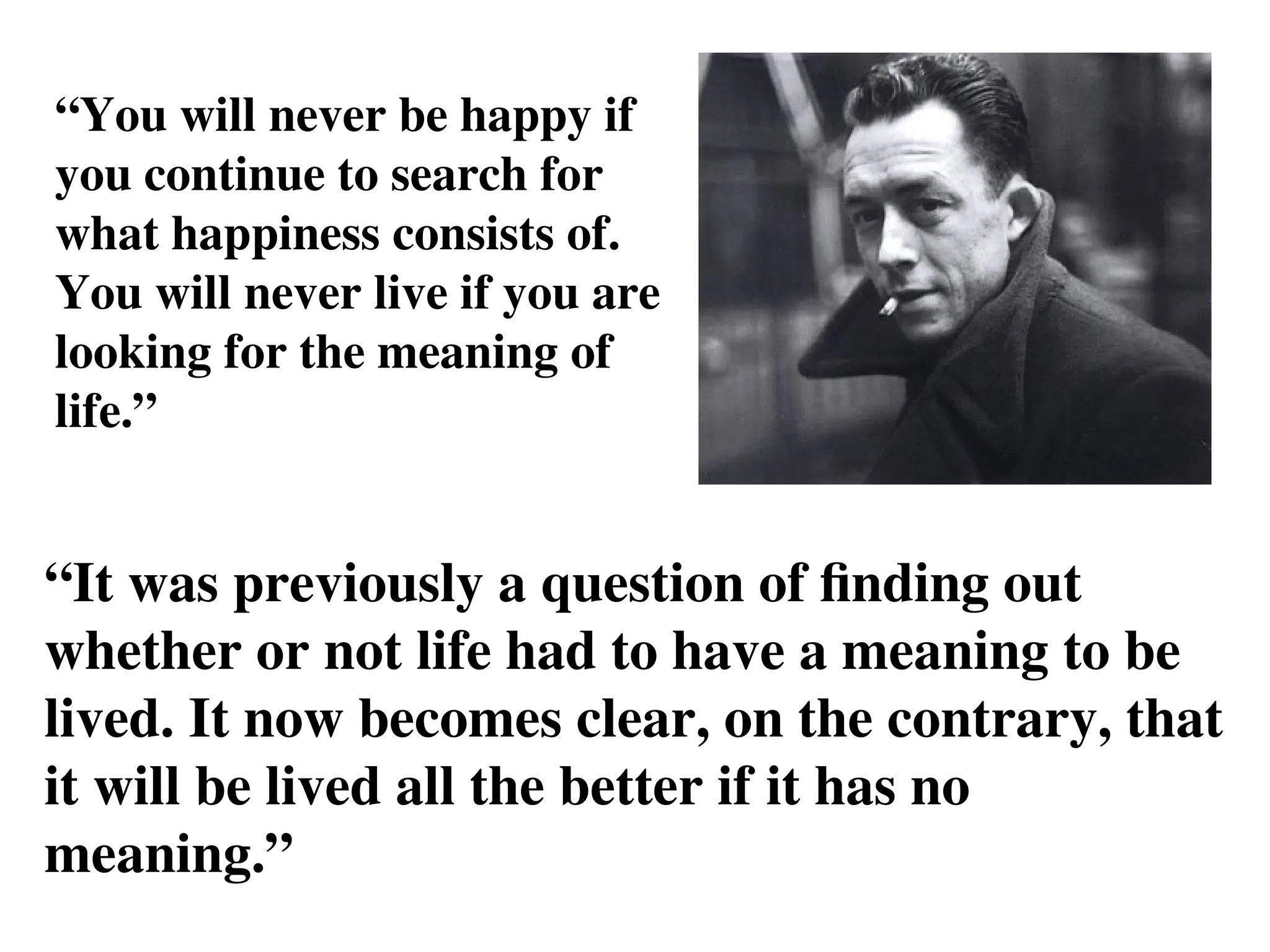
“You will never be happy if
you continue to search for
what happiness consists of.
You will never live if you are
looking for the meaning of
life.”
“It was previously a question of finding out
whether or not life had to have a meaning to be
lived. It now becomes clear, on the contrary, that
it will be lived all the better if it has no
meaning.”
Camus’ absurd world
• The world of values is never predictable nor
controllable.
• A gap exists between man’s intellectual
constructs (meaning) and the universe
(reality).
• He cannot justify new values by appeal to
convention. “Americans have always
valued free speech.”
Remember “Memento Mori”
• No ‘essential self’– Earl is the sum of each
decision he makes
• No social designed morals, ethics, or
purpose (revenge is his purpose)
• No rewards or punishments from society
• No connection to history, or the future
• What if God has already left us behind?
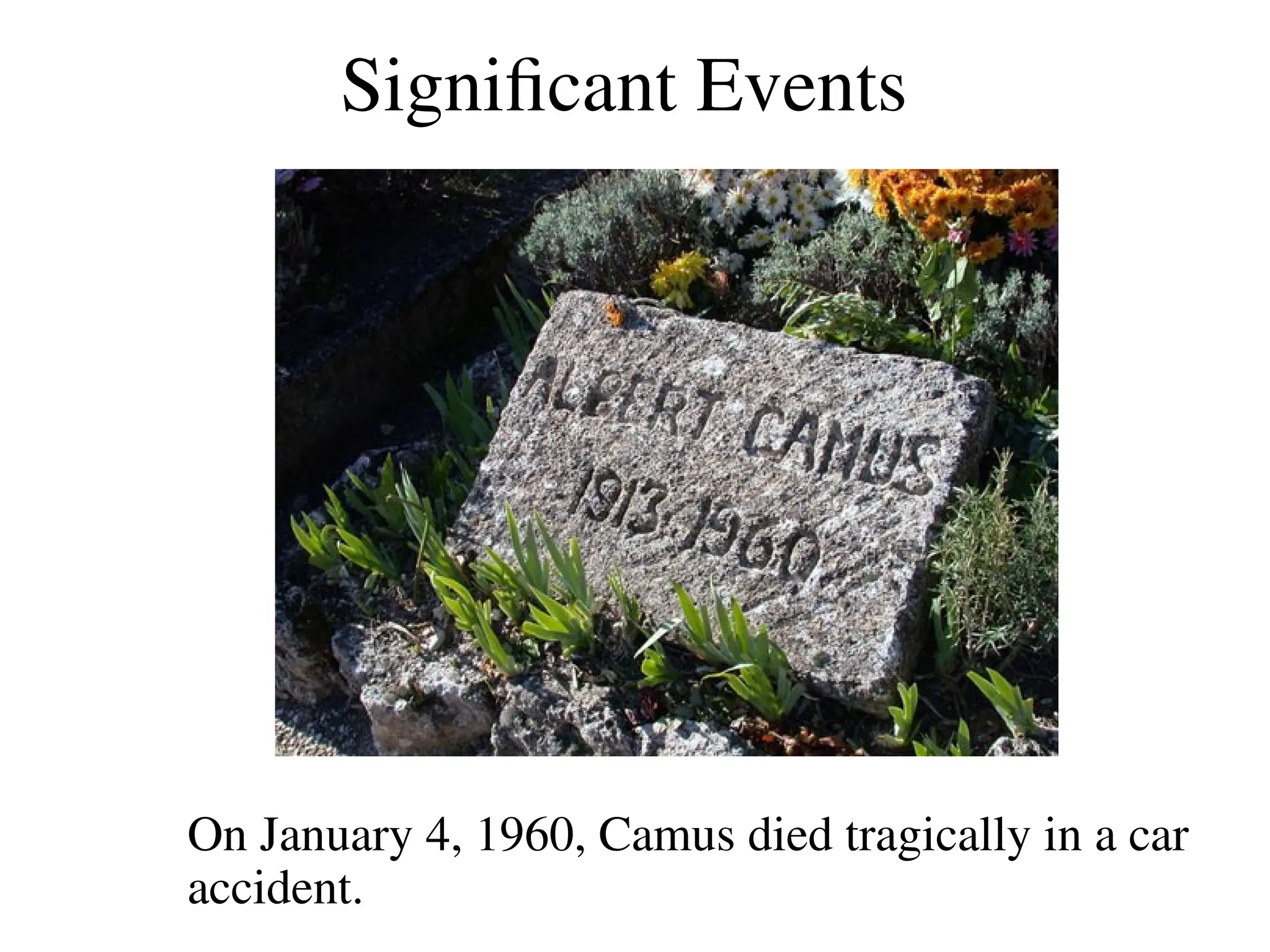
Significant Events
On January 4, 1960, Camus died tragically in a car
accident.
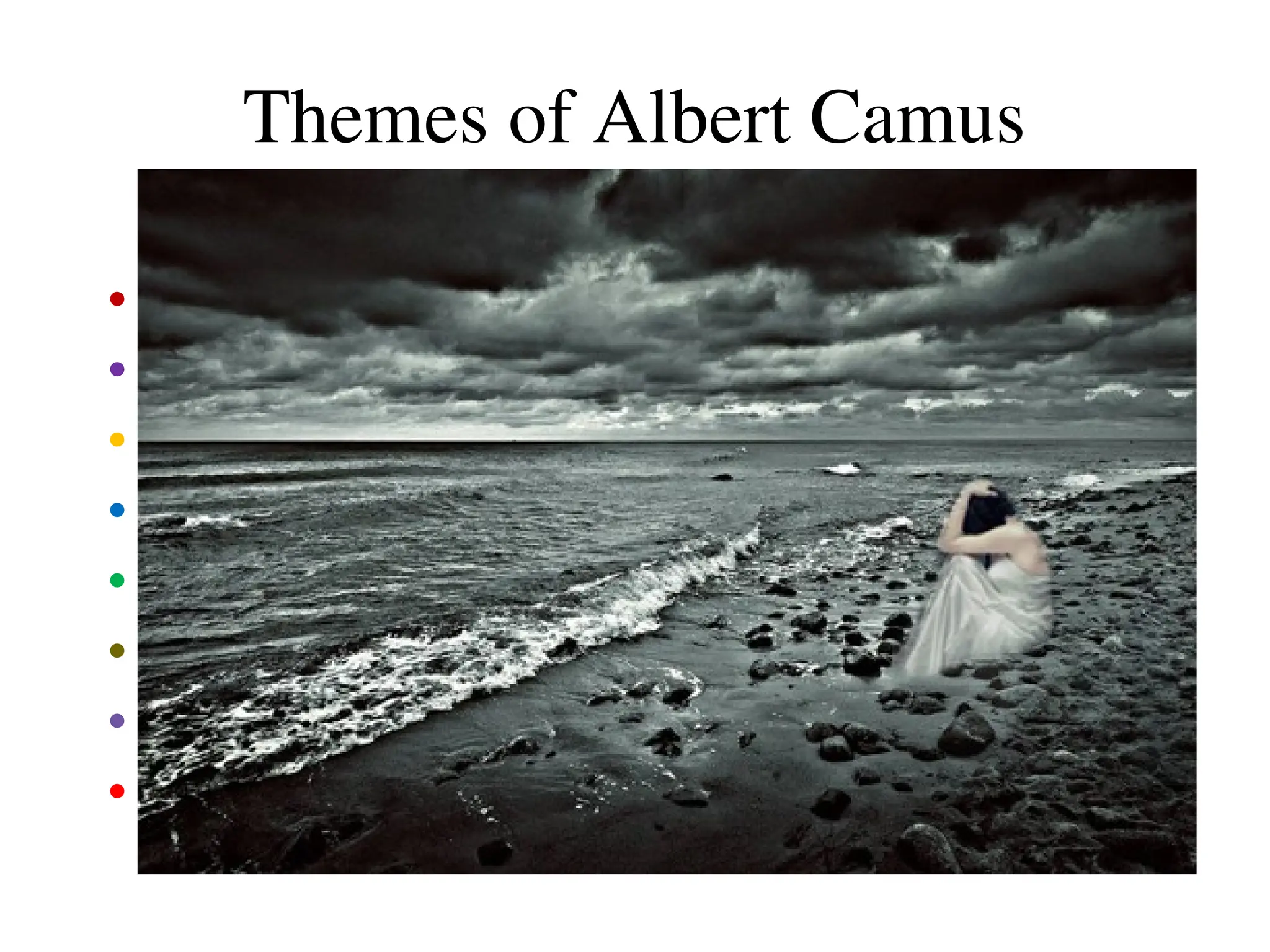
Themes of Albert Camus
• The Absurd
• Revolt
• The Outsider
• Guilt and Innocence
• Christianity vs. Paganism
• Individual vs. History and Mass Culture
• Suicide
• The Death Penalty
The Absurd
“The absurd is the product of a collision
between human desire for order meaning and
purpose and the indifferent `silence of the
universe.’”
We have only three responses to this predicament:
Physical suicide Cowardly
Religious meaning Philosophical suicide
Acceptance Only rational choice
Life can “be lived all the better if it has no meaning.”
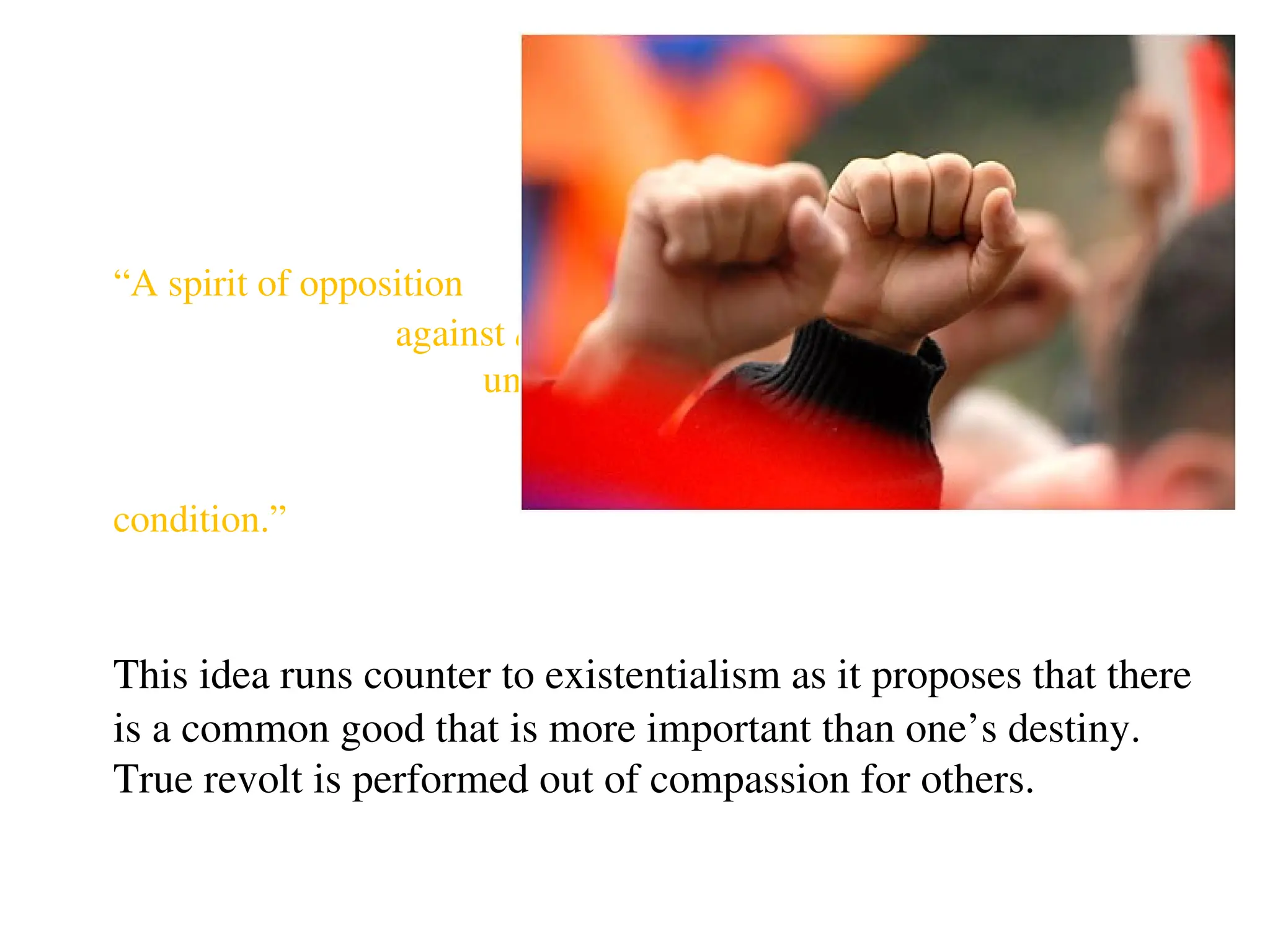
Revolt
“A spirit of opposition
against any perceived
unfairness, oppression,
or indignity in the
human
condition.”
This idea runs counter to existentialism as it proposes that there
is a common good that is more important than one’s destiny.
True revolt is performed out of compassion for others.
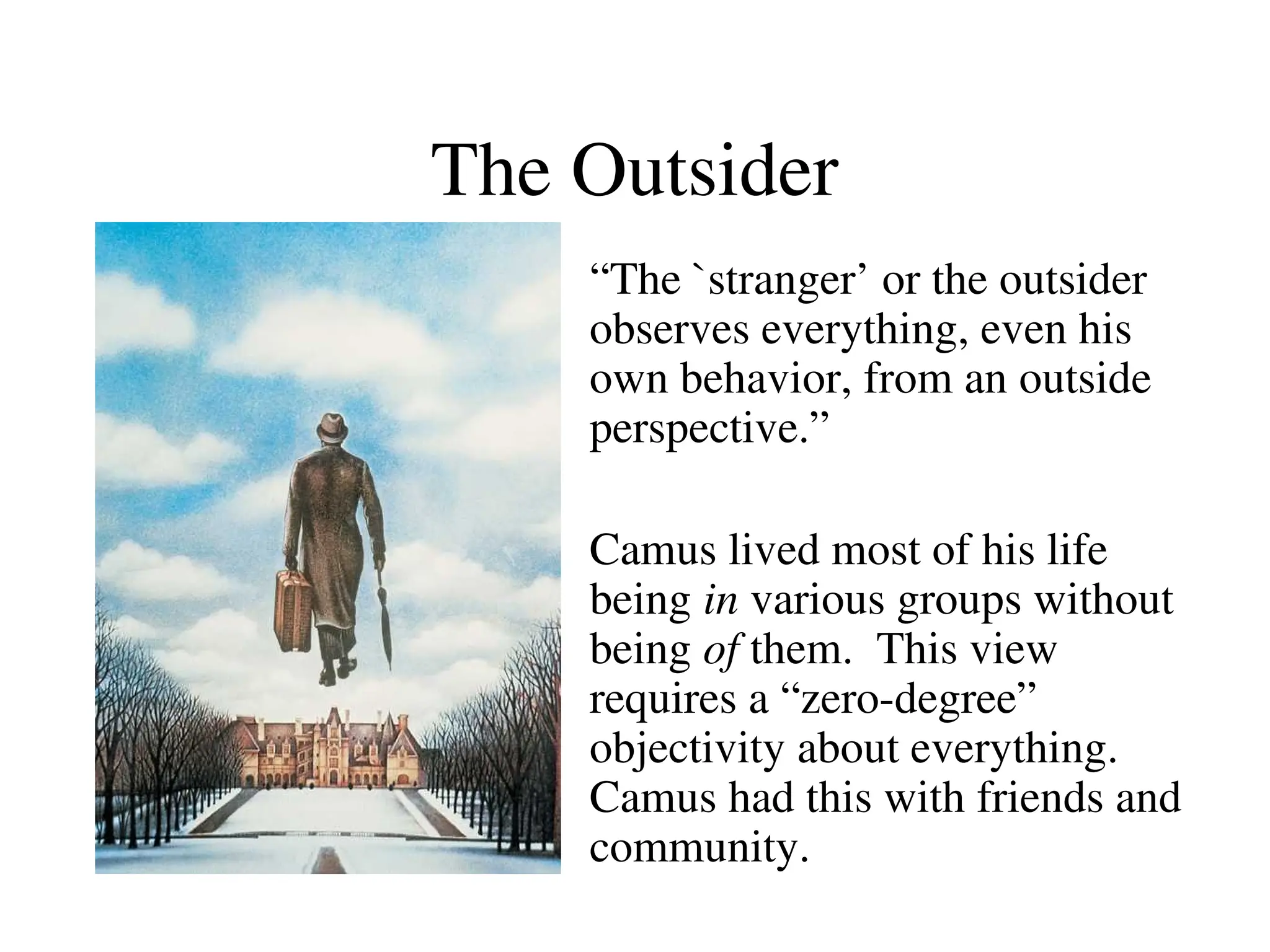
The Outsider
“The `stranger’ or the outsider
observes everything, even his
own behavior, from an outside
perspective.”
Camus lived most of his life
being in various groups without
being of them. This view
requires a “zero-degree”
objectivity about everything.
Camus had this with friends and
community.
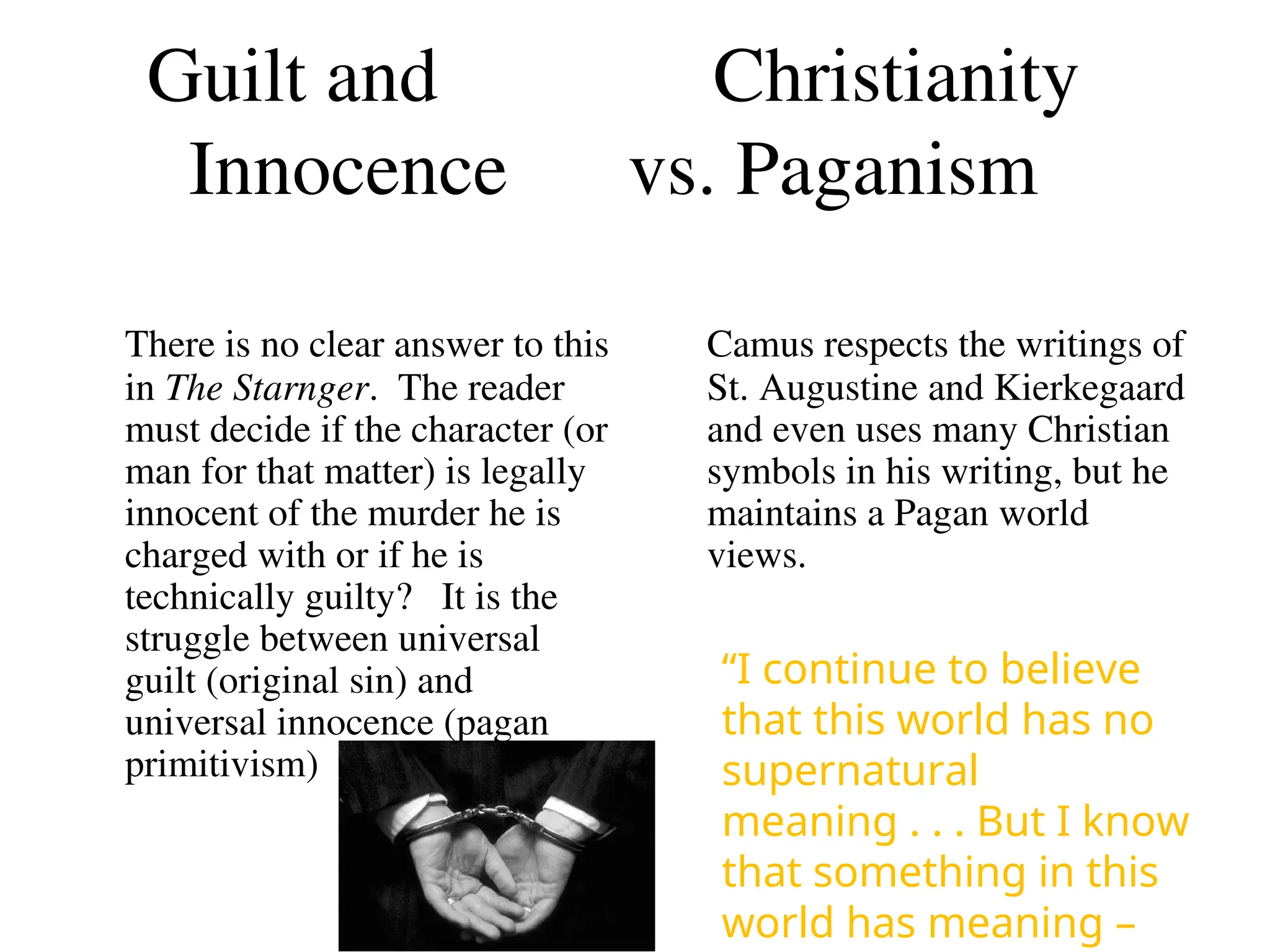
Guilt and Christianity
Innocence vs. Paganism
There is no clear answer to this
in The Starnger. The reader
must decide if the character (or
man for that matter) is legally
innocent of the murder he is
charged with or if he is
technically guilty? It is the
struggle between universal
guilt (original sin) and
universal innocence (pagan
primitivism)
Camus respects the writings of
St. Augustine and Kierkegaard
and even uses many Christian
symbols in his writing, but he
maintains a Pagan world
views.
“I continue to believe
that this world has no
supernatural
meaning . . . But I know
that something in this
world has meaning –
Individual vs. History and Mass Culture
Modern life has an alienating and
dehumanizing effect of man. We live in an
age that is becoming more impersonal
everyday. If anything, modern man lives
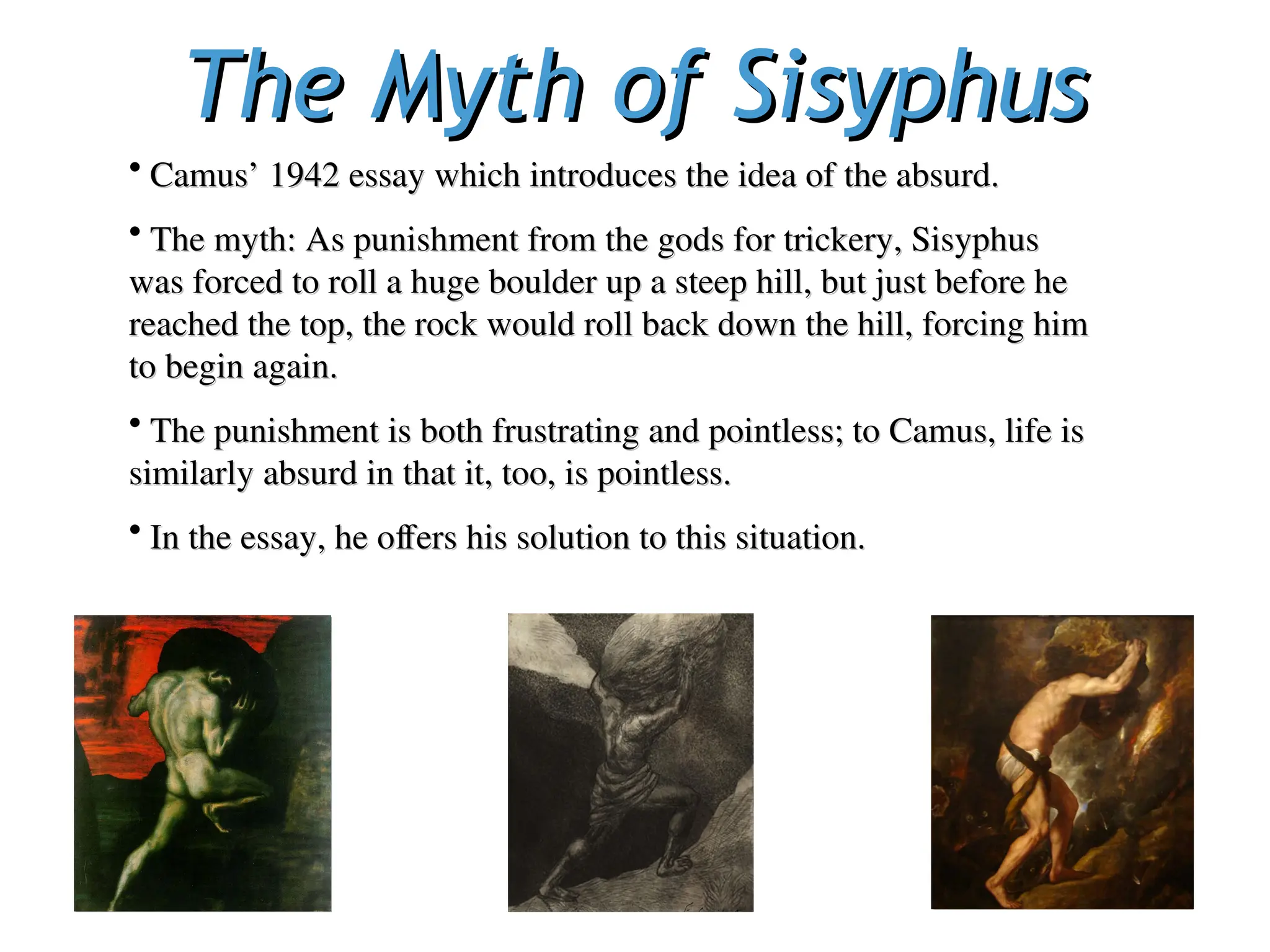
the drudgery of Sisyphus in meaningless
jobs with mind-numbing repetitions.
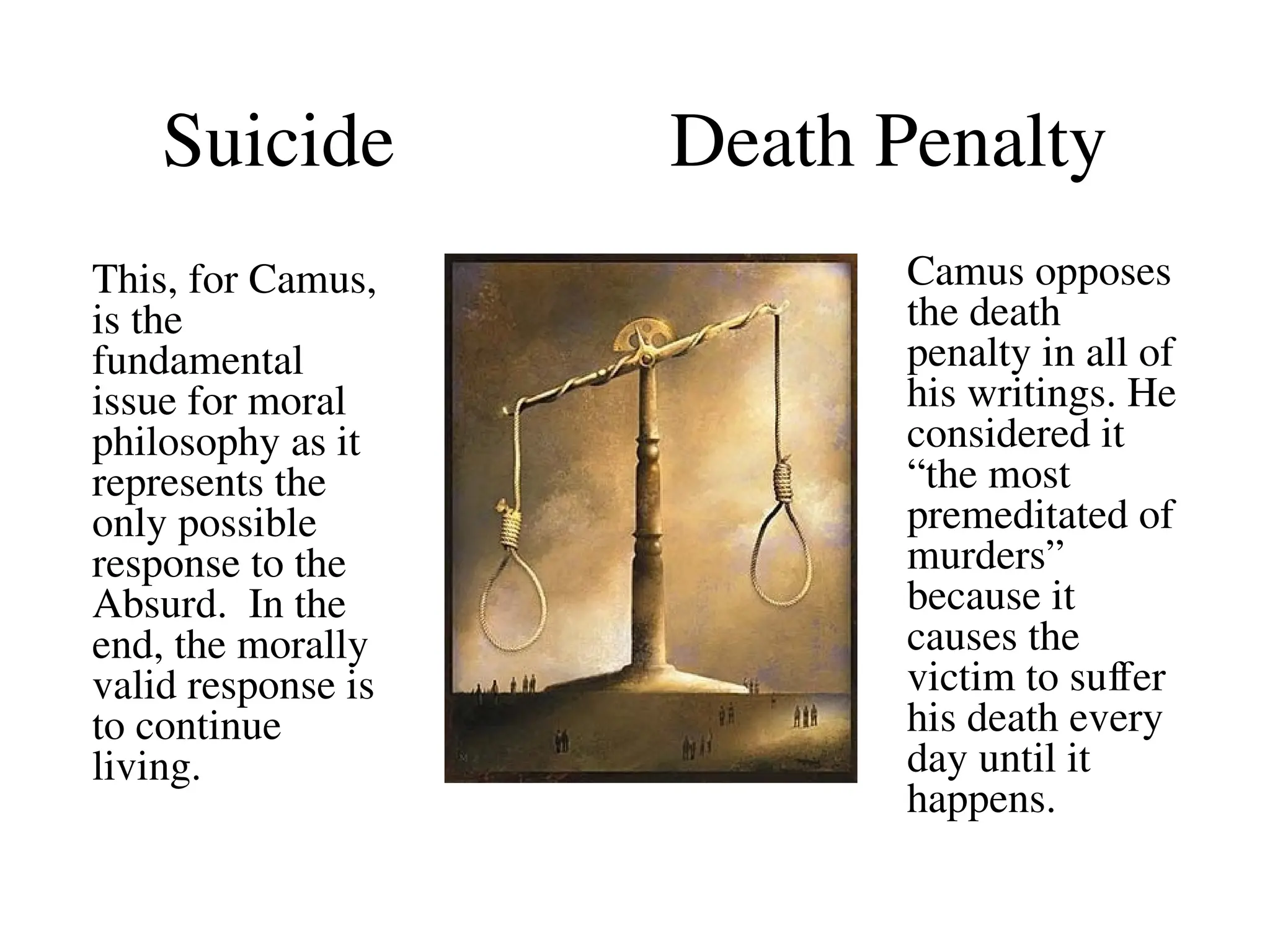
Suicide Death Penalty
This, for Camus,
is the
fundamental
issue for moral
philosophy as it
represents the
only possible
response to the
Absurd. In the
end, the morally
valid response is
to continue
living.
Camus opposes
the death
penalty in all of
his writings. He
considered it
“the most
premeditated of
murders”
because it
causes the
victim to suffer
his death every
day until it
happens.
The Myth of Sisyphus
• Camus’ 1942 essay which introduces the idea of the absurd.
Camus’ 1942 essay which introduces the idea of the absurd.
• The myth: As punishment from the gods for trickery, Sisyphus
The myth: As punishment from the gods for trickery, Sisyphus
was forced to roll a huge boulder up a steep hill, but just before he
reached the top, the rock would roll back down the hill, forcing him
to begin again.
to begin again.
• The punishment is both frustrating and pointless; to Camus, life is
The punishment is both frustrating and pointless; to Camus, life is
similarly absurd in that it, too, is pointless.
• In the essay, he offers his solution to this situation.
In the essay, he offers his solution to this situation.
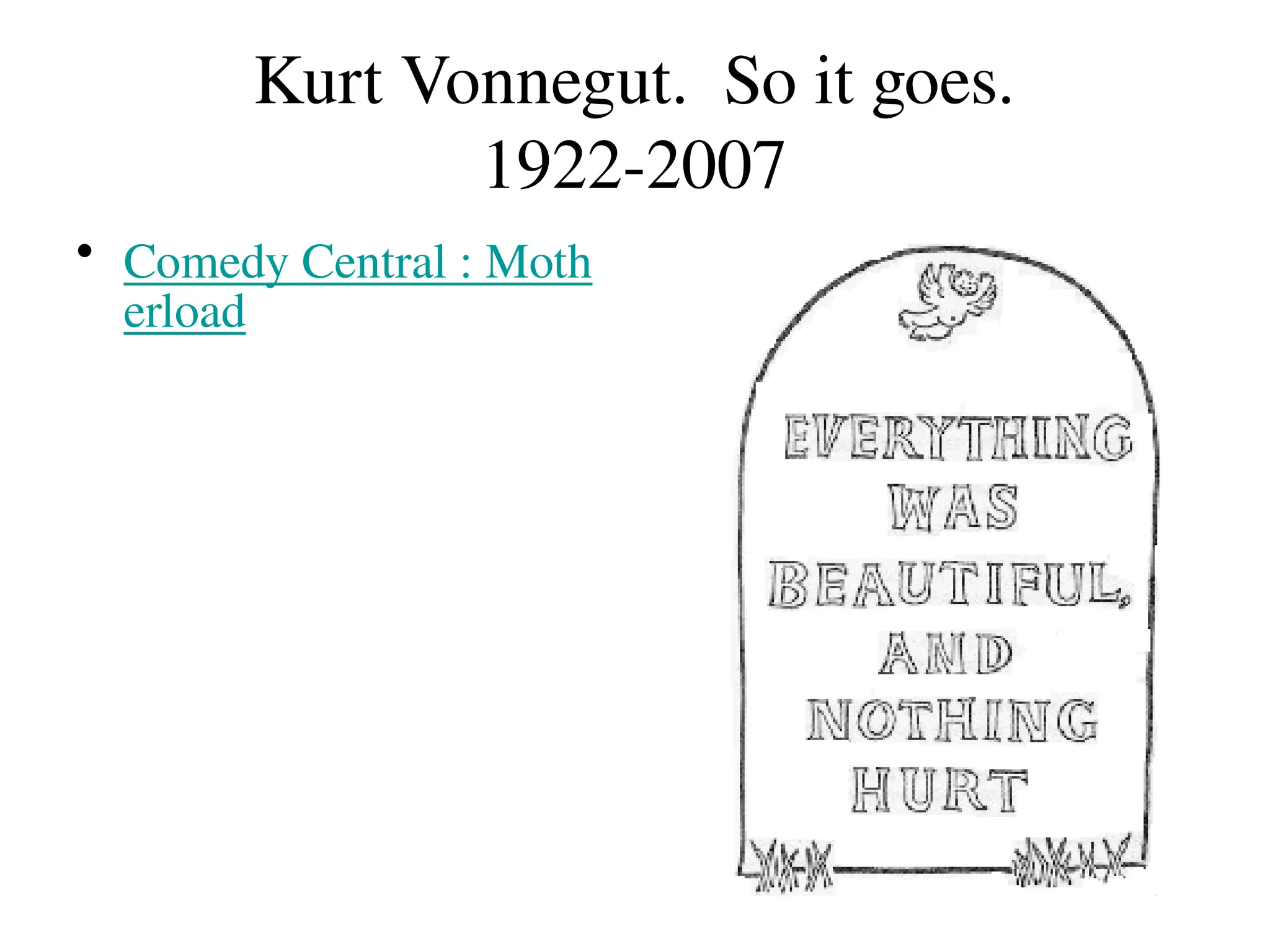
Kurt Vonnegut. So it goes.
1922-2007
• Comedy Central : Moth
erload

Absurdism and Existential through the lens of Camus

  • 1.
    EXISTENTIALISM EXISTENTIALISM Jackson Pollack, Jackson Pollack,Untitled (Green-Silver), 1949 Untitled (Green-Silver), 1949
  • 2.
    ANDREW WYETH Christina’s World(1948) A complex philosophy emphasizing the absurdity of reality and the human responsibility to make choices and accept consequences!
  • 3.
    MARK ROTHKO Untitled (1968) BigIdeas of Existentialism Big Ideas of Existentialism Despite encompassing a huge range of philosophical, religious, and political ideologies, the underlying concepts of existentialism are simple…
  • 4.
    6 Principle Conceptsof Existentialism • Becoming a Being • Absurd • Choice • Angst • Nothingness • Subjectivity
  • 5.
    Existence Precedes Essence ExistencePrecedes Essence Cogito ergo sum. Existentialism is the title of the set of philosophical ideals that emphasize the existence of the human being, the lack of meaning and purpose in life, and the solitude of human existence… “Existence precedes essence” implies that the human being has no essence (no essential self).
  • 6.
    Absurdism Absurdism • The beliefthat nothing can explain or rationalize human existence. • There is no answer to “Why am I?” • Humans exist in a meaningless, irrational universe and any search for order will bring them into direct conflict with this universe.
  • 7.
    GEORGIO DE CHIRICO LoveSong It was during the Second World War, when Europe found itself in a crisis faced with death and destruction, that the existential movement began to flourish, popularized in France in the 1940s.
  • 8.
    Choice and Commitment Choiceand Commitment • Humans have freedom to choose. • Each individual makes choices that create his or her own nature. • Because we choose, we must accept risk and responsibility for wherever our commitments take us. • “A human being is absolutely free and absolutely responsible. Anguish is the result.” –Jean-Paul Sartre
  • 9.
    MAN RAY Les Larmes(Tears) Dread and Anxiety Dread and Anxiety
  • 10.
    Dread and Anxiety Dreadand Anxiety • Dread is a feeling of general apprehension. Kierkegaard interpreted it as God’s way of calling each individual to make a commitment to a personally valid way of life. • Anxiety stems from our understanding and recognition of the total freedom of choice that confronts us every moment, and the individual’s confrontation with nothingness.
  • 11.
    EDVARD MUNCH Night inSaint Cloud (1890) Nothingness Nothingness and Death and Death
  • 12.
    • Death hangsover all of us. Our awareness of it can bring freedom or anguish. • I am my own existence. Nothing structures my world. • “Nothingness is our inherent lack of self. We are in constant pursuit of a self. Nothingness is the creative well-spring from which all human possibilities can be realized.” –Jean-Paul Sartre Nothingness and Death Nothingness and Death
  • 13.
    EDGAR DEGAS “L’absinthe” (1876) Alienationor Alienation or Estrangement Estrangement • From all other humans • From human institutions • From the past • From the future • We only exist right now, right here.
  • 14.
    Edward Hopper “NewYork Movie” (1939)
  • 15.
    Edward Hopper “NewYork Movie” (1939) Human Subjectivity Human Subjectivity “I will be what I choose to be.” It is impossible to transcend human subjectivity. “There are no true connections between people.” My emotions are yet another choice I make. I am responsible for them.
  • 16.
    Bad Faith When thepicture a man has of himself is provided by those who see him, in the distorted image of himself that they give back to him, he has rejected what the philosopher has called reality. He has, moreover, rejected the possibility of projecting himself into his future and existing in the fullest sense.
  • 17.
    All existentialists areconcerned with the study of being or ontology. TO REVIEW: An existentialist believes that a person’s life is nothing but the sum of the life he has shaped for himself. At every moment it is always his own free will choosing how to act. He is responsible for his actions, which limit future actions. Thus, he must create a morality in the absence of any known predetermined absolute values. God does not figure into the equation, because even if God does exist, He does not reveal to men the meaning of their lives. Honesty with oneself is the most important value. Every decision must be weighed in light of all the consequences of that action. Life is absurd, but we engage it!
  • 18.
    GEORGIA O’KEEFFE Sky AboveWhite Clouds I (1962) Human existence cannot be captured by reason or objectivity –– it must include passion, emotion and the subjective. Each of us is responsible for everything and to every human being. –Simone de Beauvoir
  • 19.
    Some Famous Some Famous Existentialists Existentialists •Søren Kierkegaard (1813-1855) • Friedrich Nietzsche (1844-1900) • Jean-Paul Sartre (1905- 1980) • Albert Camus (1913- 1960) “A woman is not born…she is created.” de Beauvoir’s most famous text is The Second Sex (1949), which some claim is the basis for current gender studies.
  • 20.
    Soren Kierkegaard Soren Kierkegaard(1813-1855) (1813-1855) • Born in Copenhagen, Born in Copenhagen, Denmark. Denmark. • Generally thought to be Generally thought to be founder of existentialism. founder of existentialism. • Kierkegaard thought that the Kierkegaard thought that the individual, the personal, the individual, the personal, the subjective aspects of human subjective aspects of human life are the most important. life are the most important.
  • 21.
    Kierkegaard Kierkegaard (cont.): (cont.): • Mostimportant human activity is decision-making: through our Most important human activity is decision-making: through our choices, we create our lives and become ourselves. choices, we create our lives and become ourselves. • Scientific objectivity is dangerous: reveals facts and truths but not Scientific objectivity is dangerous: reveals facts and truths but not the the truth truth. Felt people were too dependent on experts to point out way to . Felt people were too dependent on experts to point out way to salvation or personal growth. salvation or personal growth. •Authenticity Authenticity results when an individual lives honestly and results when an individual lives honestly and courageously in the moment without refuge in excuses, and without courageously in the moment without refuge in excuses, and without reliance on groups or institutions for meaning or purpose. reliance on groups or institutions for meaning or purpose. • In-authenticity In-authenticity results when the nature and needs of the individual are results when the nature and needs of the individual are ignored, denied or made less important than institutions, abstractions, or ignored, denied or made less important than institutions, abstractions, or groups. groups.
  • 22.
    Friedrich Nietzsche Friedrich Nietzsche(1844-1900) (1844-1900) • “ “God is dead.” God is dead.” • Believed life is meaningless, full of suffering Believed life is meaningless, full of suffering and striving; the universe is indifferent to human and striving; the universe is indifferent to human suffering; still, he believed life is all there is and suffering; still, he believed life is all there is and that we should live life to the fullest and get all that we should live life to the fullest and get all we can out of it. we can out of it. • Question for Nietzsche: How do we live a full Question for Nietzsche: How do we live a full life in a godless, meaningless world? life in a godless, meaningless world? • Because there is no God, the morals and Because there is no God, the morals and values that we attribute to God are instead values that we attribute to God are instead human creations; therefore, we are free to human creations; therefore, we are free to choose whatever values it is in our interests to choose whatever values it is in our interests to have. have.
  • 23.
    Nietzsche Nietzsche (cont.): (cont.): •For Nietzschewhat we should value is the “will to For Nietzsche what we should value is the “will to power” or the drive to reach our full potential. The power” or the drive to reach our full potential. The human being who reaches his full potential is a super- human being who reaches his full potential is a super- human-being or “superman.” human-being or “superman.” • Accepting this value will lead to great human Accepting this value will lead to great human achievement and allow the gifted self-fulfillment and achievement and allow the gifted self-fulfillment and personal happiness. Although it may lead to conflicts, personal happiness. Although it may lead to conflicts, these should be welcomed as should the destruction of these should be welcomed as should the destruction of the weak. the weak.
  • 24.
    Nietzsche and Nihilism “Everybelief, every considering something-true is necessarily false because there is simply no true world. Nihilism is…not only the belief that everything deserves to perish; but one actually puts one’s shoulder to the plow; one destroys. For some time now our whole European culture has been moving as toward a catastrophe, with a tortured tension that is growing from decade to decade: restlessly, violently, headlong, like a river that wants to reach the end… .” (Will to Power) Out, out, brief candle! Life’s but a walking shadow, a poor player That struts and frets his hour upon the stage And then is heard no more; it is a tale Told by an idiot, full of sound and fury, Signifying nothing. Macbeth
  • 25.
    Jean-Paul Sartre Jean-Paul Sartre(1905-1980) (1905-1980): : • Born in Paris; internationally known philosopher, Born in Paris; internationally known philosopher, novelist, playwright. Awarded Nobel Prize in novelist, playwright. Awarded Nobel Prize in literature in 1964; turned it down. literature in 1964; turned it down. •Existence precedes essence: Existence precedes essence: We have no “given We have no “given nature;” we become who we are through freedom of nature;” we become who we are through freedom of choice and moral responsibility. choice and moral responsibility. • We are born into existence that has no divine We are born into existence that has no divine purpose; life is often absurd or horrible and the only purpose; life is often absurd or horrible and the only true values are the ones we create for ourselves. true values are the ones we create for ourselves. • “ “Bad faith”: Bad faith”: when people are too terrified to face when people are too terrified to face the freedom and responsibility of choice and revert to the freedom and responsibility of choice and revert to old existing norms and rules (religious). old existing norms and rules (religious). • “ “Commitment”: Commitment”: Choosing and living in accord Choosing and living in accord with the choice. with the choice.
  • 26.
    Jean-Paul Sartre Jean-Paul Sartre(cont.) (cont.): : • WWII: Joined the French army in 1939. Captured and WWII: Joined the French army in 1939. Captured and imprisoned by Germans for nine months. Released for poor imprisoned by Germans for nine months. Released for poor health; contributed to Sartre’s belief that evil is not an health; contributed to Sartre’s belief that evil is not an abstraction; it is real and concrete. abstraction; it is real and concrete. • Any attempt to rationalize or deny evil fails: an ordered Any attempt to rationalize or deny evil fails: an ordered universe governed by a loving, powerful God is not possible; the universe governed by a loving, powerful God is not possible; the universe is indifferent to us. Science is not a certainty given that universe is indifferent to us. Science is not a certainty given that concentration camps were both “scientific” and “rationally concentration camps were both “scientific” and “rationally ordered.” Even the order of Nature is a delusion; nature does not ordered.” Even the order of Nature is a delusion; nature does not care about us. care about us. • Belief in these ideas are attempts to evade the awesomeness of Belief in these ideas are attempts to evade the awesomeness of choice. choice.
  • 27.
    The Modern (20th)Century Existentialists • Franz Kafka • Jean-Paul Sartre • Simone de Beauvoir • Albert Camus • Feodor Dostoyevsky • Ortega y Gasset
  • 28.
    Existentialism Today • -Often mocked by Hollywood and Madison Avenue • - The “mid-life crisis” • - The excesses of the 70’s and 80’s • -The Geico Cavemen • Woody Allen
  • 29.
    Albert Camus Albert Camus(1913-1960) (1913-1960) • Author of “existential” or “absurdist” novels: Author of “existential” or “absurdist” novels: The Stranger (1942) The Stranger (1942), , The The Plague(1947) Plague(1947), , The Fall(1956) The Fall(1956). . • Coined description “absurd”: the situation in which human beings demand that Coined description “absurd”: the situation in which human beings demand that their lives should have significance in an indifferent universe which is itself their lives should have significance in an indifferent universe which is itself totally without meaning or purpose. totally without meaning or purpose. • Believed we must respond to the absurd by refusing to give into the despair Believed we must respond to the absurd by refusing to give into the despair caused by the realization of life’s meaningless; instead, we must rebel against caused by the realization of life’s meaningless; instead, we must rebel against our cosmic circumstances by choosing to live life to the fullest. our cosmic circumstances by choosing to live life to the fullest.
  • 30.
    Camus Camus (cont.): (cont.): • Bornin Algeria to working-class parents. Father was killed in WWI. Born in Algeria to working-class parents. Father was killed in WWI. • Studied at the University of Algeria until diagnosed with tuberculosis. Studied at the University of Algeria until diagnosed with tuberculosis. Later completed studies. Later completed studies. • Joined French Communist Party in 1935 to fight inequities he saw in Joined French Communist Party in 1935 to fight inequities he saw in treatment of native Algerians and French colonists. Later criticized treatment of native Algerians and French colonists. Later criticized communism, which led to break with Sartre. communism, which led to break with Sartre. • In Paris during WWII, joined French Resistance cell called In Paris during WWII, joined French Resistance cell called Combat Combat; ; wrote for underground publication. wrote for underground publication. • Awarded Nobel Prize for Literature in 1957. Awarded Nobel Prize for Literature in 1957. • died in car accident in 1960. died in car accident in 1960.
  • 31.
    Albert Camus dissociatedhimself from the existentialists but acknowledged man’s lonely condition in the universe. His “man of the absurd” (or absurd hero) rejects despair and commits himself to the anguish and responsibility of living as best he can. Basically, man creates himself through the choices he makes. There are no guides for these choices, but he has to make them anyway, which renders life absurd.
  • 32.
    “You will neverbe happy if you continue to search for what happiness consists of. You will never live if you are looking for the meaning of life.” “It was previously a question of finding out whether or not life had to have a meaning to be lived. It now becomes clear, on the contrary, that it will be lived all the better if it has no meaning.”
  • 33.
    Camus’ absurd world •The world of values is never predictable nor controllable. • A gap exists between man’s intellectual constructs (meaning) and the universe (reality). • He cannot justify new values by appeal to convention. “Americans have always valued free speech.”
  • 34.
    Remember “Memento Mori” •No ‘essential self’– Earl is the sum of each decision he makes • No social designed morals, ethics, or purpose (revenge is his purpose) • No rewards or punishments from society • No connection to history, or the future • What if God has already left us behind?
  • 35.
    Significant Events On January4, 1960, Camus died tragically in a car accident.
  • 36.
    Themes of AlbertCamus • The Absurd • Revolt • The Outsider • Guilt and Innocence • Christianity vs. Paganism • Individual vs. History and Mass Culture • Suicide • The Death Penalty
  • 37.
    The Absurd “The absurdis the product of a collision between human desire for order meaning and purpose and the indifferent `silence of the universe.’” We have only three responses to this predicament: Physical suicide Cowardly Religious meaning Philosophical suicide Acceptance Only rational choice Life can “be lived all the better if it has no meaning.”
  • 38.
    Revolt “A spirit ofopposition against any perceived unfairness, oppression, or indignity in the human condition.” This idea runs counter to existentialism as it proposes that there is a common good that is more important than one’s destiny. True revolt is performed out of compassion for others.
  • 39.
    The Outsider “The `stranger’or the outsider observes everything, even his own behavior, from an outside perspective.” Camus lived most of his life being in various groups without being of them. This view requires a “zero-degree” objectivity about everything. Camus had this with friends and community.
  • 40.
    Guilt and Christianity Innocencevs. Paganism There is no clear answer to this in The Starnger. The reader must decide if the character (or man for that matter) is legally innocent of the murder he is charged with or if he is technically guilty? It is the struggle between universal guilt (original sin) and universal innocence (pagan primitivism) Camus respects the writings of St. Augustine and Kierkegaard and even uses many Christian symbols in his writing, but he maintains a Pagan world views. “I continue to believe that this world has no supernatural meaning . . . But I know that something in this world has meaning –
  • 41.
    Individual vs. Historyand Mass Culture Modern life has an alienating and dehumanizing effect of man. We live in an age that is becoming more impersonal everyday. If anything, modern man lives the drudgery of Sisyphus in meaningless jobs with mind-numbing repetitions.
  • 42.
    Suicide Death Penalty This,for Camus, is the fundamental issue for moral philosophy as it represents the only possible response to the Absurd. In the end, the morally valid response is to continue living. Camus opposes the death penalty in all of his writings. He considered it “the most premeditated of murders” because it causes the victim to suffer his death every day until it happens.
  • 43.
    The Myth ofSisyphus The Myth of Sisyphus • Camus’ 1942 essay which introduces the idea of the absurd. Camus’ 1942 essay which introduces the idea of the absurd. • The myth: As punishment from the gods for trickery, Sisyphus The myth: As punishment from the gods for trickery, Sisyphus was forced to roll a huge boulder up a steep hill, but just before he was forced to roll a huge boulder up a steep hill, but just before he reached the top, the rock would roll back down the hill, forcing him reached the top, the rock would roll back down the hill, forcing him to begin again. to begin again. • The punishment is both frustrating and pointless; to Camus, life is The punishment is both frustrating and pointless; to Camus, life is similarly absurd in that it, too, is pointless. similarly absurd in that it, too, is pointless. • In the essay, he offers his solution to this situation. In the essay, he offers his solution to this situation.
  • 44.
    Kurt Vonnegut. Soit goes. 1922-2007 • Comedy Central : Moth erload

Editor's Notes

  • #22 -Nietzsche didn’t believe in God or that we have immortal souls. -Freedom - no God, no rules we must live by.
  • #23 -Ancient morals and values come from societies unlike our own and from religions many no longer believe in. -Values such as those proposed by figures like Socrates and Jesus were wrong: protecting the weak from the strong or that justice should reign over strength. -