
Existential Therapy and Anxiety Danish Psychological Association Vingsted Centret,  Sept 2010 Emmy van Deurzen
Emmy van Deurzen Visiting Professor Middlesex University Director Dilemma Consultancy Director Existential Academy  Director New School of Psychotherapy and Counselling-London
www.existentialpsychotherapy.net www.dilemmas.org www.nspc.org.uk www.existentialacademy.com Facebook group: Existential Therapy
Author of Books on Existential Psychotherapy and Counselling
Existential Supervision Edited by Emmy van Deurzen and Sarah Young
RECENT BOOK:  2009
2010: 1. Second Edition Everyday Mysteries 2. Skills in Existential Counselling and Psychotherapy
Forthcoming Emotional Well Being and Health, with Digby Tantam, London: Sage, 2011
Other books underway Existential relationship work (co-ed with Susan Iacovou) Existential coaching (co-ed with Monica Hanaway) Third edition: Existential Counselling and Psychotherapy in Practice
Today: introduction to existential ideas and their relevance to understanding anxiety Fear: in relation to a specific object: fight, flight, freeze Anxiety: in relation to nothing: dizziness of freedom Dialectical relation with depression Reference to life itself
Socrates: the unreflected life is not worth living. The good life is passionately lived. What does it mean to live well?
Not in the sense of martyrdom, sacrifice and suffering: not being burnt by anxiety
In the sense of living life to the full in all its stark reality, contrast and contradictions, in harmony with our anxiety
Camus: Sisyphus There is but one truly serious philosophical problem and that is … whether life is or is not worth living.  (Camus: The Myth of Sisyphus) Is rolling the stone up the hill sufficient to fill a human heart?
Dark ages of therapy: blind leading the blind: do we really know how to live and how to be with anxiety and depression?
Descartes’ belief in doubt. 1596-1650 I realized that it was necessary, once in the course of my life, to demolish everything completely and start again right from the foundations if I wanted to establish anything at all. (Meditations II, p.12.)
Descartes worldview: doubt=thought cogito ergo sum
“ THE ROOTS ARE METAPHYSICS, THE TRUNK IS PHYSICS, AND THE BRANCHES EMERGING FROM THE TRUNK ARE ALL THE OTHER SCIENCES, WHICH MAY BE REDUCED TO THREE PRINCIPAL ONES, NAMELY MEDICINE, MECHANICS AND MORALS” Descartes: principles of philosophy:  tree of philosophy
School  of Life
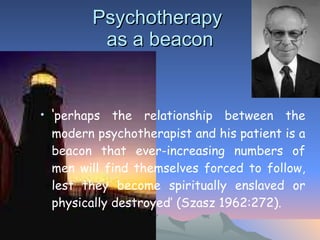
Psychotherapy  as a beacon ‘ perhaps the relationship between the modern psychotherapist and his patient is a beacon that ever-increasing numbers of men will find themselves forced to follow, lest they become spiritually enslaved or physically destroyed’ (Szasz 1962:272).
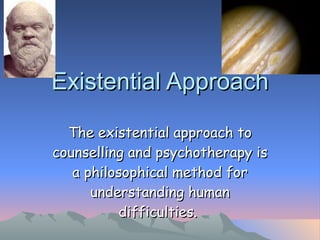
Existential Approach The existential approach to counselling and psychotherapy is a philosophical method for understanding human difficulties.
HUMAN CONDITION It focuses on the way in which  the individual struggles with the human condition and in particular with our inevitable limitations: only if we deal with the negatives are the positives on option: paradox and conflict   are central to the approach.
Can we have enduring happiness ? Happiness and unhappiness are twins that grow up together.  (Nietzsche, 1882: 270) We need to get to know both sides of life.  Only if we face our anxiety can we find peace as well
Neither positive nor negative
What is paradox in therapy? Only to the extent that we accept polarities, conflicts and contradictions do we learn to live with truth  Onto-dynamics rather than psycho-dynamics: Life is tension between opposites
Making sense of life
Energy is the flow between two poles Source: kidzoneweather.com
Dialectics:  transcendence in time Synthesis: a wider view future Thesis: my view (past ) Antithesis: your view (present)
Dialectics Thesis, antithesis, synthesis. Human evolution proceeds with constant conflict and forward movement in overcoming a previous state.  Paradoxes and dilemmas can be integrated  and gone beyond.
Dialectics Transcendence Thesis  Antithesis Synthesis
Dimensions and Tensions of Human Existence Desires Fears Physical (earth) Life pleasure Death pain Social (world) Love belonging Hate isolation Personal (man) Identity integrity Freedom disintegration Spiritual (gods) Good purpose Evil futility
Human values rediscovered.   DESIRES FEARS VALUES PHYSICAL life death vitality SOCIAL love hate reciprocity PERSONAL identity freedom integrity SPIRITUAL good evil transparency
Aim of existential therapy. Enable clients to tell the truth about their lives and themselves.  Help them live passionately and to the full.   Facilitate their greater understanding of the human condition and its contradictions. Recognize strengths and weaknesses and make the most of both. Learn to feel confident about living no matter what may come Tolerate anxiety
Existential approach not a technique It is a worldview  Integration of method Addresses universal problems  Provides philosophical questioning and logic tools  Non prescriptive Open to how life is actually experienced
Life as the guide and the goal.  What are the life issues this client is preoccupied with? What understanding of these does the therapist have? What are the client’s values and project? How can  I enhance my own engagement  with these issues, values and projects?
Questions instead of answers What does it mean to be alive? Who am I? What is the purpose of my existence? How should we live? What can I hope to achieve? Is happiness possible? What is expected of me? How should I act and be in relation to other people? Is there fairness in the world? Can I make a change for the better? Is it possible to understand life and get a grip on it? Can I find ways of overcoming my troubles? Is it necessary to suffer this much? How can I be a better person and live a worthwhile life?
Paradoxes of human existence
Exercise Make a list of six different identities, characteristics or talents you think you have. For example:• parent• gardener• bi-lingual • son/daughter • therapist • student
Exercise Think of a time when you were mistaken about your evaluation of someone: let yourself think back to how this mistaken judgement came about, without judging yourself.  Just observe the process of your own assumptions and prejudice: do you feel the anxiety involved in challenging your assumptions?  • • •  What principles do you use to guide your decisions?
The negatives that are positives Anxiety far from being something to shun and treat as a symptom to eliminate is the source of energy that makes us come to life: it is the feeling of being opened up to life and sensing our responsibility in the face of the abyss.  Our capacity for despair is what makes us deep and capable of feeling, empathy and creativity Without suffering our lives would have less meaning To be human is to be conscious and be aware of lack, trouble, difficulty and strife.
Images of happiness Walhalla, Utopia, el Dorado, Garden of Eden, Nirvana, Land of the Lotus eaters
Tree of Knowledge and Exile from Paradise: human evolution.  Man rejected happiness of Eden in order to explore life and labour.  Return to Eden is not the objective.  To understand the contrast of good and evil is to live with consciousness.
Soren Kierkegaard 1813-1855
Kierkegaard’s stages. Vegetative Animal Aesthetic Ethical Thinking Doubt Leap of Faith Spiritual
Kierkegaard Anxiety may be compared with dizziness. He whose eye happens to look down into the yawning abyss becomes dizzy.  But what is the reason for this?  It is just as much in his own eye as in the abyss, for suppose he had not looked down.  Hence anxiety is the dizziness of freedom, which emerges when the spirit wants to posit the synthesis and the freedom looks down into its own possibility, laying hold of finiteness to support itself.  (61)
Losing yourself The greatest hazard of all, losing oneself, can occur very quietly in the world, as if it were nothing at all. No other loss can occur so quietly. Any other loss- an arm, a leg, five dollars, a wife, etc. is sure to be noticed.  (Kierkegaard: Sickness unto Death:32)
Kierkegaard’s definition Anxiety is the dizziness of freedom. ‘ Whoever has learnt to be anxious in the right way has learnt the ultimate.’ (Kierkegaard 1844:155)
Ronald D. Laing 1927-1989 The Divided Self (1959), The Self and Others (1962), The Politics of Experience (1967), The Politics of the Family (1969), and Knots (1971), poems.
Laing’s ontological insecurity. ‘ The individual in the ordinary circumstances of living may feel more unreal than real; in a literal sense, more dead than alive; precariously differentiated from the rest of the world, so that his identity and autonomy are always in question. (Laing, 1960: 42.)
Consequences of insecurity Engulfment: feeling overwhelmed. Implosion: feeling unreal and empty. Petrification: turning to stone.
Looking on the bright side
Breakthrough instead of breakdown Conflicts are potential points of transformation and improvement of ourselves and our relationships so we need to be able to learn from our conflicts . Psychotherapy must remain an obstinate attempt of two people to recover the wholeness of being human through the relationship between them. (R.D. Laing, 1967:45)
Buber’s encounter The interhuman: das Zwischenmenschlichen; the in-between is where real communication takes place.  (Buber, Between Man and Man, 1929).  All actual life is encounter (ibid: 62) This is where truth is found.
Isolation There is no such thing as a separate human being, in the same way in which as Winnicott suggested there is no such thing as a baby.  We are only what we are in as much as we are connected to a world.
All living is relating Physical: relationships to nature, world of things and bodies around us Social: relationships to other people Personal: relationship to ourselves, our thoughts, dreams, memories and fantasies Spiritual: relationships to ideas, beliefs, transcendence and eternity
Different dimensions of the four spheres of existence Umwelt Mitwelt Eigenwelt Uberwelt Physical survival Nature Things Body Cosmos Social affiliation Public Others Ego Culture Personal identity Private Me Self Consciousness Spiritual meaning Sacred  God Soul Transcendence
Get structural overview of client’s life and connections Umwelt: understand physical context and embodiment: person’s relation to the world around them.  Mitwelt: describe and take into account the social, cultural and political dimension of the client’s life.  Eigenwelt: read and understand the text of the client’s life, find the narrative point of gravity. Who do they think they are? Uberwelt: recognize worldview and values: what is the purpose of the person’s life?
Exercise What is the first thing that comes to mind when you think of the idea of freedom? Describe a recent time when things did not go the way you wished. How did it feel? Describe the last time you experienced acute anxiety Describe being bored.
Being-in-the-world
Freedom and nothingness. This freedom which reveals itself to  us in anguish can be characterised by  the existence of  that nothing  which  insinuates itself between motives and  act. (Sartre 1943:35)  
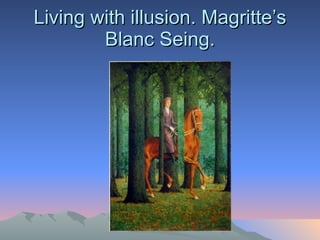
Living with illusion. Magritte’s Blanc Seing.
Authority over  the illusions  of our lives: we are nothing and this makes  us anxious   In this sense it is necessary that we  make ourselves  what we are. But what  are we  then if we have the constant obligation to make ourselves  what  we are….? Man is the being through whom nothingness comes to the world. (Sartre, 1943:59)
Sartre’s make believe We can be nothing without playing at being (Sartre, B&N: 83)
Self-deception: Magritte’s l’homme.
Van Ostade: the Alchemist Manipulating the world.
Sartre’s view on self-deception The one who practises bad faith is hiding a displeasing truth or presenting as truth a pleasing untruth.  (Sartre 1943:49).  
Inventing Human Reality We have to deal  with human reality  as a being which is  what it is not  and which is not  what it is.  (Sartre B&N:58) Leonardo da Vinci: human figure .
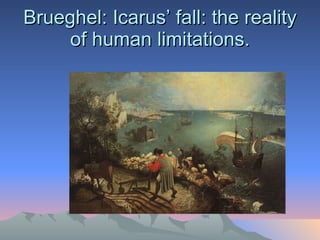
Brueghel: Icarus’ fall: the reality of human limitations.
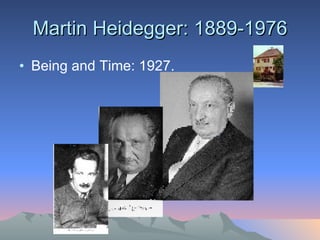
Martin Heidegger: 1889-1976 Being and Time: 1927.
Millais’ Ophelia   self-forgetfulness
A lucid view: Magritte : homesickness for what we do not know.
World absorption . .a distinctive kind of Being-in-the-World - the kind which is completely fascinated by the ‘world’ and by the Dasein-with of Others in the “they”.  Not-Being-its-self functions as a  positive  possibility of that entity which, in its essential concern, is absorbed in a world. (Heidegger 1927:176)  
Tranquillizing   The supposition of the “they” that one is leading and sustaining a full and genuine ‘life’ brings Dasein a  tranquillity , for which everything is ‘in the best of order’ and all doors are open.  Falling being-in-the-world, which tempts itself, is at the same time  tranquillizing . (Heidegger 1927:177)  
Self-dissection Yet this alienation cannot mean that Dasein gets factically torn away from itself. On the contrary, this alienation drives it into a kind of Being which borders on the most exaggerated ‘self-dissection’, tempting itself with all possibilities of explanation, so that the very ‘characterologies’ and ‘typologies’ which it has brought about are themselves already becoming something that cannot be surveyed at a glance. (Heidegger 1927:178)
Heidegger’s falling. The alienation of falling-at once tempting and tranquillizing-leads by its own movement, to Dasein’s getting entangled in itself. (Heidegger 1927:178)
Concealments If Dasein discovers the world in its own way and brings  it close, if it discloses to itself its own authentic Being,  then this discovery of the ‘world’ and this disclosure of  Dasein are always accomplished as a clearing-away of  concealments and obscurities, as a breaking up of the  disguises with which Dasein bars its own way.  (Heidegger 1927:167)  
Heidegger and anxiety Anxiety individualizes.  This individualization brings Dasein back from its falling, and makes manifest to it that authenticity and inauthenticity are possibilities of its Being. (Heidegger 1927:191)  
Bellini : Agony in the garden.
Forgetting: going to work.  A specific kind of  forgetting  is essential for the  temporality that is constitutive for letting something be  involved. The Self must forget itself if, lost in the  world of equipment, it is to be able ‘actually’ to go to  work and manipulate something. (Heidegger 1927:354)
Unheimlichkeit The call ‘says’  nothing,  which might be talked about, gives no information about events.  The call points  forward to  Dasein’s potentiality-for-Being, and it does this as a call which comes  from  uncanniness.(Heidegger 1927:280)  
Heidegger’s unheimlichkeit In anxiety one feels  ‘uncanny’.  Here the peculiar indefiniteness of that which Dasein finds itself alongside in anxiety, comes proximally to expression: the “nothing and nowhere”. But here “uncanniness” also means “not-being-at-home”. (Heidegger, 1927:188)   From an existential-ontological point of view, the “not-at-home” must be conceived as the more primordial phenomenon.’  (Heidegger, 1927:189 )
Not at home: Millet’s angelus.  
Resoluteness Resoluteness constitutes the  loyalty  of existence to its own Self (Heidegger 1927:391)  The resolute rapture which carries us away in the moment of vision is what makes an authentic future possible (Heidegger 1927:338)  
Covering up  ‘ Being false’ (  ) amounts to deceiving in the  sense of  covering up (verdecken) : putting something in  front of something (in such a ways as to let it be seen)  and thereby passing it off  as  something which it is  not .  (Heidegger 1927:33)  
Opaqueness On the other hand, Dasein’s opaqueness  [Undurchsichtigkeit] is not rooted primarily and solely in  ‘egocentric’ self-deceptions; it is rooted just as much in  lack of acquaintance with the world. (Heidegger  1927:146)  
      Inauthenticity Basic principle Truth  Untruth Dasein’s intention Coming to itself Backing away from itself Dasein’s basic objective Being-towards-Death Comfort seeking/shirking Fundamental ability Disclosing Closing off Relation to the world Uncovering  Covering up Dasein’s awakening Facing anxiety Tranquillizing Dasein’s cognition Transparency O   Authenticity   paqueness Dasein’s attitude to itself Ownmost potentiality-for-being-oneself Self-forgetfulness Dasein’s struggle Call of conscience Falling-Dispersion-the They Relationship to the future Resoluteness Irresoluteness Ultimate position  Moment of Vision Indifference
Refusing truth … the condition of there being truth is the perpetual  possibility of refusing it. (Sartre 1992:27).
Rembrand:Sacrifice of Isaac Fear and Trembling: being tested.
Despair and Death: De la Roche:  Christian  Martyr.
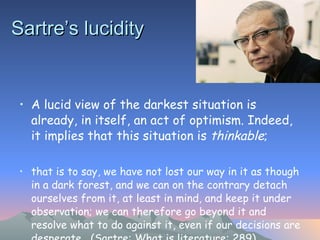
Sartre’s lucidity   A lucid view of the darkest situation is already, in itself, an act of optimism. Indeed, it implies that this situation is  thinkable ;  that is to say, we have not lost our way in it as though in a dark forest, and we can on the contrary detach ourselves from it, at least in mind, and keep it under observation; we can therefore go beyond it and resolve what to do against it, even if our decisions are desperate.  (Sartre: What is literature: 289)
Cohn’s aim of therapy. ‘ the restoration of an unlived  dimension of life, whether this is  described as forgotten, denied,  repressed or abandoned’ (Cohn  2004:384)
Aiming for truth Rothko
What is anxiety? The energy of life And energy can be used or can overwhelm you
To live is to be anxious Until we die Because we die Because we were born Because there is nothing else we can do It is life rather than death anxiety that paralyses  We have to learn to stand up and be counted;  to ek-sist in past, present and future
Our horizon is the limit of our vision Nietzsche says: the only obstacle to my freedom is my horizon, but this ‘horizon is  transparent,  it points beyond to what is not made fast, to what becomes and can become, to the possible.’ (Nietzsche).
Reclaiming TIME-SPACE Opening up the Spielraum, elbowroom or play-space in which we find the truth of being and find ourselves in freedom and in connection to all that is.
But what do we know? And what can we hope for? Learning to live is about learning from experience and from daring to formulate in words, attitude and action what our intuition and existence teaches us.  It is about being in tune with life: not as a once off, but again and again
Seasons and cycles of life We are born: live and die
Between birth and death We are helpless at birth
Wellcome exhibition: life before death, Walter Schells  Memento Mori
To live and to die
Eyes that see the world no more: finding peace
Living matters. Dying always comes sooner than we think. Life is short.  We don’t know how to live right.  Living is not easy.  Living well is extremely difficult: we have to learn how to ripen rather than wither on the vine.  We pass on what we have learnt but often fail to mention how to live a good life; what works and what doesn’t.
Our life is  in flux Things constantly change and so do we Circle of life goes on We cannot stop it
Stages of a Woman’s life
Our lives are like the seasons or the birth of day and night.
Watching life go by observers  participants  creatures  or creators  active  reactive  pro-active  passive
Life is a journey: in both space and time We are on the way towards somewhere, sometimes without knowing it: we hide or ignore our own intentions and direction. We live automatically or by default: feeling battered by the waves of life.
Captain of your ship So, how do we learn to captain our own ship to find our way through our life with deliberation?
Tight fit: Sometimes life is plain sailing, but at other times, prevailing winds are from the north, or we are having to navigate between a rock and a hard place..
Taking shortcuts The objective of life is not to get to some destination, some utopia where all will be well ever after: happiness is not the objective, but only an occasional port Taking shortcuts is usually counterproductive.  They stop us learning about life.
Nietzsche’s warning The supposed 'shorter ways' have always put mankind into great danger; at the glad tidings that such a shorter way has been found, they always desert their way  –  and lose their way
Kierkegaard’s reflective living as the knight of faith can only happen if we live for real: we can only truly learn if we live it Life has to be remembered backwards but it has to be lived forwards
Kierkegaard’s idea of time Mankind is the place where the concept of the moment arises It is only when spirit is generated out of the interaction of body and mind that the synthesis of time and eternity produces the succession of moments that is typical and exclusive of human existence.  When spirit is introduced, the eternal ceases to be mere present and becomes the possibility of continuous past, present and future.
Stages of life: Kierkegaard’s idea of progress  Vegetative; sentient ; conscious ; knowing ; self-knowing; aware of self awareness: autonomous. (determined: past based) Aesthetic: feeling (being absorbed by the present) Ethical – Ascetic: thinking (having control over the present: planning the future) Leap of Faith: jump into abyss of eternity Spiritual life: retrieve inspiration: holding the paradox finite/infinite : continuous past, present, future : mastering time.
Time streams like sand through an hourglass The more sand  remains the slower it  appears to go.  The last bit of sand  rushes through.
Passionate engagement is like fire: it eats time.  Time is fast when I am at one with the world and give myself over to being.
Painting with passion: lose 3 hours when  being at one with time expansion  of the soul world looks and  feels brighter transparency and absorption
Time is slow when I am bored and disengaged A film of mist descends over the world and I cannot connect:  time stays heavy on my hands I want time to pass: I am not engaged with life, nor with myself
Attunement to what is
Despair is being out of time Despair is awareness of boredom or impossibility: like being in a fog Not to want to be oneself, yet desperately wanting to be oneself It is inactivity in which time stands still ‘  for despair is precisely to have lost the eternal and oneself’  (Kierkegaard, Sickness unto Death:195)
How to recover the tension of the paradox The tension of the paradox is what creates life: the in-between finite and infinite, possibility and necessity, life and death, you and I, now and then, here and there.  Tension is the electric current between positive and negative pole that produces energy: it is the dynamic differential that creates life.
Kierkegaard’s paradox Personhood is a synthesis of possibility and necessity.  Its continued existence is like breathing (respiration), which is an inhaling and exhaling. (Kierkegaard, Sickness unto Death: 40)
Letting life in: breathing Air : spirit : soul : life.
Heidegger’s project (Entwurf) Anxiety is related to homelessness (Unheimlichkeit):  the fact that we  are project,  in the throw, means we are never at ease,  always unsettled On the move,  Not at home.
Anxiety turns to panic when action whirls in on itself and is blocked A feeling of dizziness and  becoming absorbed in fuzziness But it is also a staircase to somewhere inside.  You can retrieve the sense of safety  inside your own emotion Before reaching for the unfurling…
When anxiety reaches towards its potential We can see the power of the wave Learn to catch it and ride it We are like a planet, in orbit, finding  our path.
Connecting to the wave and tides Until I saw the sea  I did not know  that wind  could wrinkle water so  I never knew  that sun  could splinter a whole sea of blue  nor  did I know before,  a sea breathes in and out  upon a shore  by Lilian Moore
New prophets Eckart Tolle: Power of Now/New Earth Being in the now Letting go of the ego Being alert Present not an enemy How do I relate to the moment? What is my relationship to life? Find the space of now From not knowing find the knowing Gratitude arises  Blocks: because of memories and conceptions from the past Get rid of habitual repetitive negative thoughts
Why is this not enough? Because we have evolved to have a past, present and future, not just a now. Because the moment of now is ephemeral.  Because we have a brain that allows us to think and because thinking is as precious as feeling and sensing and intuiting Because to bring everything back to the goal of peace of mind and a happy state is to deny the challenge of life which inspires us  Perhaps a good starting point for those who are lost in themselves and in life, but there is a lot more to it: life is complex and demanding  We have to learn to master life and with it our anxiety
The challenge is: To really understand Ourselves, not just our egos, but all layers and dimensions of being Also our pasts and present and future And Levinas’ other, who sometimes needs priority or Buber’s Thou who takes us beyond I The things in this world, to work with them rather than against them The ideas that people at different times and places have come up with, finding the universals and essences that make them important
Minkowski’s idea of time Present Remote Past Mediate Past Immediate Past Immediate Future Mediate Future Remote Future
Time Zones Present: zone of activity, which includes all the other zones of time Remote past: zone of the obsolete and of history, including one’s own life myths  Mediate past: zone of loss and regret  Immediate past: zone of remorse or grief Immediate future: zone of expectation  Mediate future: zone of wish and hope or  dread and anxiety.  Remote future: zone of prayer and ethical action and also of ultimate meaning of life.
Our life is like a river We wind our own way down the road of life But the river also flows through us and we dam it up and stop the flow- forgetting our destiny and the source of our inheritance of life  Set patterns are like sediment in the river that make us stagnate Get back into the flow of life
Recapturing radical FREEDOM ‘ Freedom is not a property (Eigenschaft : characteristic) of man; man is the property (Eigentum:possession) of freedom.’ (Heidegger 1971: Schelling’s Treatise on the Essence of Human Freedom, transl. Stambaugh J. (Athens Ohio: ohio University Press 1985: 11/9).
Sartre’s existential ethics There is no abstract ethics. There is only an ethics in a situation and therefore it is concrete. An abstract ethics is that of the good conscience. It assumes that one can be ethical in a fundamentally unethical situation . (Sartre, Notes For an Ethics:17)
Things to remember We learn in context and with others To build a true learning community we need to come close to people in mutual respect And by addressing the life issues that really matter to us and our clients rather than red herrings of pathology People’s suffering and fears are the sacred fires that make us human and bring us to life It is up to us to show how these can burn safely and not destroy In order to transform and transcend them we have to make human understanding central to all we do.
Conflicts and dilemmas  are essential Conflicts are the core of existence. Things and people oppose each other. Conflict can either destroy you or deepen you.  Relationships are about tension: fission or fusion.  Most conflicts are not just with others but with the world, with beliefs and with ourselves. Conflict does not have to lead to combat.
Victimization Physical Responsibility Earthquake Flood Drought Tornado Hurricane Pandemics Tsunami Volcanic eruption Plagues Starvation War Torture Transport disasters Stampedes Persecution Terrorism Hijacking Murder Assault Rape Suicide Smoking  Drugs Alcohol Food abuse Stress Recklessness Sports Injury  STDs Abuse Extortion Blackmail Harassment Bullying Unfair dismissal Industrial injury Occupational illness Traffic accidents Homeostasis Social
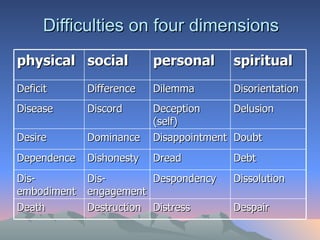
Difficulties on four dimensions physical social personal spiritual Deficit Difference Dilemma Disorientation Disease Discord Deception (self) Delusion Desire Dominance Disappointment Doubt Dependence Dishonesty Dread Debt Dis-embodiment Dis-engagement Despondency Dissolution Death Destruction Distress Despair
What helps? Those who have experienced trauma do better if they have good social support. They do significantly better if they have integrity and a sense of wholeness. (to survive trauma you either need good conscience or no conscience at all…)  The conflict or trauma has to be put to good use.  There has to be a safe place one can retreat to.  It makes a big difference whether you can take some responsibility for your fate. It helps if you feel your trauma is in some ways a proof of your character or a building block of it.  If you can claim the crisis as part of your success rather than evidence of failure and bad character: making it meaningful.
Life as hero’s journey The challenge: travelling far, braving danger in order to save the world.  Have an adventure, then return to safety: home coming, using our compass.
Find your own way Be clear of your goal  Make the most of the journey Live your life for real  Value your own resources, strengths and achievements and cherish them Welcome yourself  Harvest  your past:  your  past with all its pain and all its power: reflect on it, learn from it, transform it Trust life and give it all you have got
Ready for whatever may come Open to the force of time and the source of life Trusting day and night, light and dark, sunshine and rain Welcome yourself into the space of your existence Tune in to the truth of being For whatever life may throw at you Live in the passionate depth of life, in reverence of what is, with both joy and sorrow
Coaching for life Discovering new possibilities by being introduced to them by others
Nothing is learnt Unless you get your hands dirty
Deliberate living
Paradox and tensions of existence.  Existential approach: related to, but not the same as positive psychology and well-being research: Mihaly Csikszentmihalyi, Ed Diener, Ruut Veenhoven, Martin Seligman .  The tragic depth of being human is as important as human potential and joy.
Existential therapy: Reflecting on living in search of truth Therapists clarify ethical problems and problems in living. They ask questions: What is the person’s worldview? What is their situation? What are their values? What is their purpose in life? What has been their fate? What is their destiny? What are their struggles? What are their talents? What are their yearnings? What are their connections to the world and others? What is their attitude? What are their actions?
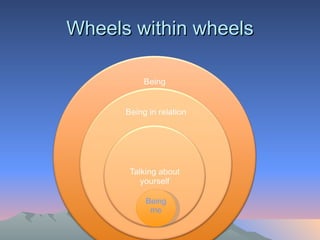
Different aspects of therapeutic relationship
Wheels within wheels Being me
Landscapes of our life Understand the Lebenswelt: the world in which we live  1.How do we experience the world? 2.What does our life landscape look like? 3.Where are we going?
Objective of therapy.  Helping a person rediscover their vision.  It is about seeing and overseeing the situation of their life. Widening their horizon. Helicopter view of life. A chance to get some perspective and make new connections.  Understand a bit more about human existence.  Encouragement to live.  Liberation.
Process of existential work Directive versus non-directive: be direct and directional instead. Situation and relation to world on four dimensions:be aware of paradox and polarities. How is the person  situated:  use emotional  compass.  Connect to  worldview and purpose.
Work on: Shift your client’s perception of their world by looking at it from different angles.  Help them to be more forthright in establishing relationships and encountering others in a direct and real way.  Help them understand their own experience, situation, dilemma and purpose. Help them face up to underlying human issues, contradictions, possibilities, limits.
Become aware of your own bias: outlook, assumptions, beliefs, prejudice, blind spots.   Locate and articulate the client’s worldview and life space. No judgements. Understanding rather than interpretation.  Recognizing difference.  Work with bias.
Values and context  Recognize your clients’ values and differentiate them from your own.  Learn to read and understand the text of the client’s life, find the narrative point of gravity, the subtext and the context.  Take into account the social, cultural and political dimension of the client’s life.  Put this in context with your own worldview and beliefs.
Existential Space  Physical space Social space Personal space Spiritual space
Your own little sphere of existence matters
Imagine a person like a sphere
That person is located in a universe with other planets, stars, suns, moons and spheres
Sphere as a planet or a cell: micro or macro level.
If a cell: connection with other cells, function and internal constitution are paramount
If planet: orbit and position matter
Merleau Ponty: Visible and Invisible Things are structures – frameworks – the stars of our life: they gravitate around us. Yet there is a secret bond between  us and them –  through perception  we enter into the  essence of the flesh (Visible and Invisible: 220)
You experience yourself as having a nucleus: a core, a heart or a soul
Perhaps we are more like suns, generating heat and light
Solar anatomy
Layers of the sun Corona, chromosphere, photosphere, convection zone, and core.
Layers of a person’s life. 4.Physical: Umwelt 3.Social: Mitwelt 2.Personal: Eigenwelt 1.Spiritual: Uberwelt
Merleau Ponty: soul The soul is the hollow of the body, the body is the distension of the soul. The soul adheres to the body as their signification adheres to the cultural things, whose reverse or other side it is. (233)
Layers of a person’s life. 4.Physical: Umwelt 3.Social: Mitwelt 2.Personal: Eigenwelt 1.Spiritual: Uberwelt
Dimensions of existence Spiritual: Good/Evil Intuitions, values, beliefs, purpose, meaning. Worldview/Ideas. Personal: Strength/Weakness Thoughts, memories, identity, freedom. Selfhood/Me. Social: Love/Hate Feelings, relations, belonging, acknowledgement. Communication/Others. Physical: Life/Death Sensations, actions, environment, body, things. Survival/World.
Different perspectives Depending on where we stand light refracts differently through the prism of life.
Our emotions colour our worldview They create different atmospheres at different times.
Emotions are our orientation. Emotions are like the weather: never none. They are the way we relate to the world.  They define the mood of the moment. They are our atmosphere and modality. They tell us where we are.  Learn to tune in rather than tune out.  Use the emotional compass.
Formulate the questions by finding the atmosphere and the mood. When we master a mood, we do so by way of a counter-mood; we are never free of moods. (Heidegger 1927:136)
pride jealousy anger- despair fear sorrow shame envy hope- desire love joy Sadness Low Happiness High Anxiety Excitement Engagement Depression Disappointment Disengagement
Emotional  Compass  1:Pride-confidence-arrogance 2:Jealousy-worry-vigilance 3:Anger-hate-despair 4:Fear-confusion-cowardice 5:Sorrow-misery-resignation Shame-emptiness-guilt:7 Envy-curiosity-aspiration:8 Hope-desire-resolve:9 Love-courage-commitment:10 Joy-thrill-excitement:11 6. Low  Despondency Depression Exhilaration Happiness 12:High Up gain Down loss
The colour of emotion
 
 
Depressed worldview
Compass of Physical Sensation Greed Stinginess Frustration Disgust Pain Need Craving Excitement Lust Pleasure Deprivation Emptiness Satisfaction Fullness Gain Survival Loss Threat
Compass of Social Feeling Care Jealousy Anger Fear Rejection Shame Envy Approval Love Acceptance Isolation Separateness Belonging Oneness Engagement Disengagement
Compass of Personal Thinking Superiority Stubbornness Defiance Deflation Humiliation Inferiority Anxiety Courage Commitment Confidence Imperfection Weakness Perfection Strength Success Failure
Compass of Spiritual Intuition Pride Prudence Wrath Resignation Disillusionment Guilt Aspiration Hope Resoluteness Bliss Futility Absurdity Meaning  Purpose Good Evil
Rising above your emotions Above the clouds the weather is steady even when it rains below. Transcending our own situation and emotions allows us to understand our own response.
Anton Chekhov Any idiot can face a crisis – it’s day to day living  that wears you out
Marcus Aurelius It is not death that a man should fear, but he should fear never beginning to live The paradox is that death, troubles, labour, failures, pain and sorrow are unavoidable and necessary They are the things that wake you up to awareness and that open you to life Yet some troubles are more like catastrophes
When crisis strikes our lives are revolutionized In the whirlwind of change we need to find steadiness, persistence and resilience
Rita’s Grief When I speak to Rita, who is grieving over her husband and small son who have perished in a car accident, the words that I say to her at first hardly reach her.  She is in a place of relative safety deep inside of herself, in a state of suspended animation behind the façade that she turns to the world. She barely engages with people at all.
Rita’s grief 2 At first it is not my words that make the link to her world, but the consistency that I can offer in being attentive and careful to not hurt her further or push her too hard.  I spend nearly half an hour in relative silence with Rita, at times formulating her fear on her behalf, gently, tentatively, checking for verification by noting her response.
Rita’s grief 3 Mostly the work consists of me letting myself be touched by her suffering and learning to tolerate her pain with her, so that I can offer reactions and words that soothe and move her forward to a place where she can begin to face what has happened to her so shockingly out of the blue. In this process she guides me and exposes more and more of her nightmarish universe to me as she perceives me as capable of venturing further into it with her.
Meaning and Purpose Find out what the inner landscape of a person is: what is meaningful to them.  Find out what your purpose in life is.
Resilience How do people overcome obstacles and deal with anxiety? How do they survive difficu lties, crises, trauma? Are there personal qualities that  enable a person  to be resilient? Are there certain ways of being that are more conducive to survival and learning from traumatic experience? Role of creative use of trauma.  Happiness is a genetic given for 50% of our happiness quotient. How do we live well?
Rita World  Physical Social  Personal  Spiritual Umwelt Take interest in objects, space  Meet others Relate to own body again Recognize value Mitwelt Leave dead behind  Love dead still Find self valid Find others valid Eigenwelt Recover sense of self care Rediscover love Love self  Find project  Uberwelt Make sense of disaster  Life with others is worthwhile  I am me and this matters There is a purpose to it all
Existential Approach The existential approach to counselling and psychotherapy is a philosophical method for understanding human difficulties: not in order to eliminate problems but in order to face them to thrive on them.
Getting help from the philosophers.  For some it is all darkness; for me too,  it is dark. But there are hands there I can take, voices to hear solider than the echoes  without. And sometimes a strange light shines, purer than the moon,  casting no shadow, that is  the halo upon the bones of the pioneers who died for truth.  R.S. Thomas, Groping:99.
EXISTENTIAL PHILOSOPHERS Philosophers of freedom Pheno- menology Existentialism Post-modernism S Ö ren Kierkegaard 1813-1855 Franz Brentano 1838-1917 Jean Paul Sartre 1905-1980 Michel Foucault 1926-1984 Friedrich Nietzsche 1844-1900 Edmund Husserl 1859-1938 Maurice Merleau Ponty 1908-1961 Paul Ricoeur 1913-2005 Karl Jaspers 1883-1969 Martin Heidegger 1889-1976 Albert Camus 1913-1960 Jacques Derrida 1931-2004
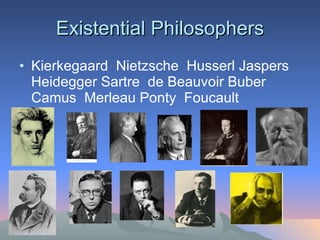
Existential Philosophers Kierkegaard  Nietzsche  Husserl Jaspers Heidegger Sartre  de Beauvoir Buber Camus  Merleau Ponty  Foucault
Existential Practitioners Binswanger  Boss  Frankl Tillich  May  Laing
Living happily or living well: an existential view Crystallization of discontent may be the beginning of insight into what is wrong.  Conflict, dilemmas and problems are an intrinsic part of being alive Being cured of difficulties is the death of possibility and creativity
Tillich’s Courage to Be Courage is the universal self-affirmation of one’s Being in the presence of the threat of non-Being (Tillich 1952:163).
Integrating non being: Paul Tillich: 1886-1965  A neurotic person can take on board only a little bit of non-being The average person can take on a limited amount of non-being The creative person can accommodate a large amount of non-being God can tolerate an infinite amount of non-being.
The negatives that are positives Anxiety far from being something to shun and treat as a symptom to eliminate is the source of energy that makes us come to life Our capacity for despair is what makes us deep and capable of feeling, empathy and creativity Without suffering our lives would have less meaning To be human is to be conscious and be aware of lack, trouble, difficulty and strife.
Being-in-the-world
Frankl’s way to meaning Experiential values : what we take from the world. Creative values : what we give to the world. Attitudinal values :the way we deal with suffering.
Baumeister (1991)  Meanings of Life   Baumeister’s four basic needs for meaning:  Need for purpose (spiritual) Need for value (social) Need for efficacy (physical) Need for self-worth  (personal) It is the process of going in the general direction of these four objectives that makes for a good life.
The right level of challenge To live a meaningful life and have goals and values is not enough: you must also feel you are capable of achieving these things.  ‘ It is necessary to find moderately difficult tasks to maintain that middle ground between boredom (too easy) and anxiety (too hard).’ (Baumeister, 1991: 41)
Different dimensions of the four spheres of existence Umwelt Mitwelt Eigenwelt Uberwelt Physical survival Nature Things Body Cosmos Social affiliation Public Others Ego Culture Personal identity Private Me Self Consciousness Spiritual meaning Sacred  God Soul Transcendence
Project, praxis, dialectics ‘ Man is characterised above all by his going beyond a situation and by what he succeeds in making of what he has been made. This is what we call the project. (Sartre, Search for a Method: 91).  We define project by praxis. Action, passion and reflection.  Constant transcendence and dialectical progression .
Find your own way Be clear of your goal and make the most of the journey Learn to live deliberately rather than by default
Emotional well being An ability to creatively encounter challenges, losses and crises Capacity for re-establishing equilibrium through strong, dynamic centre of narrative gravity Enjoyment of life, appreciation of physical world, others, self-worth and meaning.
Magritte: Empire of  Lights. Learning to live with paradox and the tensions of life
Tillich, 1966:15
Kierkegaard’s paradox Personhood is a synthesis of  possibility  and  necessity .  Its continued existence is like breathing (respiration),  which is an inhaling and exhaling. (Kierkegaard, Sickness unto Death: 40)
Inspiration and expiration
pride jealousy anger- despair fear sorrow shame envy hope- desire love joy Sadness Low Happiness High Anxiety Excitement Engagement Depression Disappointment Disengagement
  Accept unspoken givens of life: engage with them: Human evolution from: passionate engagement with problems and conflicts: understanding and overcoming
Rely on your  capacity to face  whatever  may come: find a calm confident  state of mind
Optimal living All living things are struggling for existence, even unwittingly and unwillingly. They struggle passively just to exist, to be left in what seems to be peace and quiet; and they struggle actively to grow and to expand. (Jaspers,1951:204)
Loving your Life To live well is to live in harmony with your own life and to love it in all its manifestations (Nietzsche’s Amor Fati) Challenges and difficulties to be welcomed : life as an adventure  Increase capacity for feeling or decrease it More feeling means more suffering and more reality.  Less suffering means to care less and be less sensitive, but also less tuned in to life and less creative  The choice is yours. Your life belongs to you.
www.existentialpsychotherapy.net www.dilemmas.org www.nspc.org.uk www.existentialacademy.com

Denmarkanxiety10

  • 1.
    Existential Therapy andAnxiety Danish Psychological Association Vingsted Centret, Sept 2010 Emmy van Deurzen
  • 2.
    Emmy van DeurzenVisiting Professor Middlesex University Director Dilemma Consultancy Director Existential Academy Director New School of Psychotherapy and Counselling-London
  • 3.
    www.existentialpsychotherapy.net www.dilemmas.org www.nspc.org.ukwww.existentialacademy.com Facebook group: Existential Therapy
  • 4.
    Author of Bookson Existential Psychotherapy and Counselling
  • 5.
    Existential Supervision Editedby Emmy van Deurzen and Sarah Young
  • 6.
  • 7.
    2010: 1. SecondEdition Everyday Mysteries 2. Skills in Existential Counselling and Psychotherapy
  • 8.
    Forthcoming Emotional WellBeing and Health, with Digby Tantam, London: Sage, 2011
  • 9.
    Other books underwayExistential relationship work (co-ed with Susan Iacovou) Existential coaching (co-ed with Monica Hanaway) Third edition: Existential Counselling and Psychotherapy in Practice
  • 10.
    Today: introduction toexistential ideas and their relevance to understanding anxiety Fear: in relation to a specific object: fight, flight, freeze Anxiety: in relation to nothing: dizziness of freedom Dialectical relation with depression Reference to life itself
  • 11.
    Socrates: the unreflectedlife is not worth living. The good life is passionately lived. What does it mean to live well?
  • 12.
    Not in thesense of martyrdom, sacrifice and suffering: not being burnt by anxiety
  • 13.
    In the senseof living life to the full in all its stark reality, contrast and contradictions, in harmony with our anxiety
  • 14.
    Camus: Sisyphus Thereis but one truly serious philosophical problem and that is … whether life is or is not worth living. (Camus: The Myth of Sisyphus) Is rolling the stone up the hill sufficient to fill a human heart?
  • 15.
    Dark ages oftherapy: blind leading the blind: do we really know how to live and how to be with anxiety and depression?
  • 16.
    Descartes’ belief indoubt. 1596-1650 I realized that it was necessary, once in the course of my life, to demolish everything completely and start again right from the foundations if I wanted to establish anything at all. (Meditations II, p.12.)
  • 17.
  • 18.
    “ THE ROOTSARE METAPHYSICS, THE TRUNK IS PHYSICS, AND THE BRANCHES EMERGING FROM THE TRUNK ARE ALL THE OTHER SCIENCES, WHICH MAY BE REDUCED TO THREE PRINCIPAL ONES, NAMELY MEDICINE, MECHANICS AND MORALS” Descartes: principles of philosophy: tree of philosophy
  • 19.
  • 20.
    Psychotherapy asa beacon ‘ perhaps the relationship between the modern psychotherapist and his patient is a beacon that ever-increasing numbers of men will find themselves forced to follow, lest they become spiritually enslaved or physically destroyed’ (Szasz 1962:272).
  • 21.
    Existential Approach Theexistential approach to counselling and psychotherapy is a philosophical method for understanding human difficulties.
  • 22.
    HUMAN CONDITION Itfocuses on the way in which the individual struggles with the human condition and in particular with our inevitable limitations: only if we deal with the negatives are the positives on option: paradox and conflict are central to the approach.
  • 23.
    Can we haveenduring happiness ? Happiness and unhappiness are twins that grow up together. (Nietzsche, 1882: 270) We need to get to know both sides of life. Only if we face our anxiety can we find peace as well
  • 24.
  • 25.
    What is paradoxin therapy? Only to the extent that we accept polarities, conflicts and contradictions do we learn to live with truth Onto-dynamics rather than psycho-dynamics: Life is tension between opposites
  • 26.
  • 27.
    Energy is theflow between two poles Source: kidzoneweather.com
  • 28.
    Dialectics: transcendencein time Synthesis: a wider view future Thesis: my view (past ) Antithesis: your view (present)
  • 29.
    Dialectics Thesis, antithesis,synthesis. Human evolution proceeds with constant conflict and forward movement in overcoming a previous state. Paradoxes and dilemmas can be integrated and gone beyond.
  • 30.
    Dialectics Transcendence Thesis Antithesis Synthesis
  • 31.
    Dimensions and Tensionsof Human Existence Desires Fears Physical (earth) Life pleasure Death pain Social (world) Love belonging Hate isolation Personal (man) Identity integrity Freedom disintegration Spiritual (gods) Good purpose Evil futility
  • 32.
    Human values rediscovered.  DESIRES FEARS VALUES PHYSICAL life death vitality SOCIAL love hate reciprocity PERSONAL identity freedom integrity SPIRITUAL good evil transparency
  • 33.
    Aim of existentialtherapy. Enable clients to tell the truth about their lives and themselves. Help them live passionately and to the full. Facilitate their greater understanding of the human condition and its contradictions. Recognize strengths and weaknesses and make the most of both. Learn to feel confident about living no matter what may come Tolerate anxiety
  • 34.
    Existential approach nota technique It is a worldview Integration of method Addresses universal problems Provides philosophical questioning and logic tools Non prescriptive Open to how life is actually experienced
  • 35.
    Life as theguide and the goal. What are the life issues this client is preoccupied with? What understanding of these does the therapist have? What are the client’s values and project? How can I enhance my own engagement with these issues, values and projects?
  • 36.
    Questions instead ofanswers What does it mean to be alive? Who am I? What is the purpose of my existence? How should we live? What can I hope to achieve? Is happiness possible? What is expected of me? How should I act and be in relation to other people? Is there fairness in the world? Can I make a change for the better? Is it possible to understand life and get a grip on it? Can I find ways of overcoming my troubles? Is it necessary to suffer this much? How can I be a better person and live a worthwhile life?
  • 37.
  • 38.
    Exercise Make alist of six different identities, characteristics or talents you think you have. For example:• parent• gardener• bi-lingual • son/daughter • therapist • student
  • 39.
    Exercise Think ofa time when you were mistaken about your evaluation of someone: let yourself think back to how this mistaken judgement came about, without judging yourself. Just observe the process of your own assumptions and prejudice: do you feel the anxiety involved in challenging your assumptions? • • • What principles do you use to guide your decisions?
  • 40.
    The negatives thatare positives Anxiety far from being something to shun and treat as a symptom to eliminate is the source of energy that makes us come to life: it is the feeling of being opened up to life and sensing our responsibility in the face of the abyss. Our capacity for despair is what makes us deep and capable of feeling, empathy and creativity Without suffering our lives would have less meaning To be human is to be conscious and be aware of lack, trouble, difficulty and strife.
  • 41.
    Images of happinessWalhalla, Utopia, el Dorado, Garden of Eden, Nirvana, Land of the Lotus eaters
  • 42.
    Tree of Knowledgeand Exile from Paradise: human evolution. Man rejected happiness of Eden in order to explore life and labour. Return to Eden is not the objective. To understand the contrast of good and evil is to live with consciousness.
  • 43.
  • 44.
    Kierkegaard’s stages. VegetativeAnimal Aesthetic Ethical Thinking Doubt Leap of Faith Spiritual
  • 45.
    Kierkegaard Anxiety maybe compared with dizziness. He whose eye happens to look down into the yawning abyss becomes dizzy. But what is the reason for this? It is just as much in his own eye as in the abyss, for suppose he had not looked down. Hence anxiety is the dizziness of freedom, which emerges when the spirit wants to posit the synthesis and the freedom looks down into its own possibility, laying hold of finiteness to support itself. (61)
  • 46.
    Losing yourself Thegreatest hazard of all, losing oneself, can occur very quietly in the world, as if it were nothing at all. No other loss can occur so quietly. Any other loss- an arm, a leg, five dollars, a wife, etc. is sure to be noticed. (Kierkegaard: Sickness unto Death:32)
  • 47.
    Kierkegaard’s definition Anxietyis the dizziness of freedom. ‘ Whoever has learnt to be anxious in the right way has learnt the ultimate.’ (Kierkegaard 1844:155)
  • 48.
    Ronald D. Laing1927-1989 The Divided Self (1959), The Self and Others (1962), The Politics of Experience (1967), The Politics of the Family (1969), and Knots (1971), poems.
  • 49.
    Laing’s ontological insecurity.‘ The individual in the ordinary circumstances of living may feel more unreal than real; in a literal sense, more dead than alive; precariously differentiated from the rest of the world, so that his identity and autonomy are always in question. (Laing, 1960: 42.)
  • 50.
    Consequences of insecurityEngulfment: feeling overwhelmed. Implosion: feeling unreal and empty. Petrification: turning to stone.
  • 51.
    Looking on thebright side
  • 52.
    Breakthrough instead ofbreakdown Conflicts are potential points of transformation and improvement of ourselves and our relationships so we need to be able to learn from our conflicts . Psychotherapy must remain an obstinate attempt of two people to recover the wholeness of being human through the relationship between them. (R.D. Laing, 1967:45)
  • 53.
    Buber’s encounter Theinterhuman: das Zwischenmenschlichen; the in-between is where real communication takes place. (Buber, Between Man and Man, 1929). All actual life is encounter (ibid: 62) This is where truth is found.
  • 54.
    Isolation There isno such thing as a separate human being, in the same way in which as Winnicott suggested there is no such thing as a baby. We are only what we are in as much as we are connected to a world.
  • 55.
    All living isrelating Physical: relationships to nature, world of things and bodies around us Social: relationships to other people Personal: relationship to ourselves, our thoughts, dreams, memories and fantasies Spiritual: relationships to ideas, beliefs, transcendence and eternity
  • 56.
    Different dimensions ofthe four spheres of existence Umwelt Mitwelt Eigenwelt Uberwelt Physical survival Nature Things Body Cosmos Social affiliation Public Others Ego Culture Personal identity Private Me Self Consciousness Spiritual meaning Sacred God Soul Transcendence
  • 57.
    Get structural overviewof client’s life and connections Umwelt: understand physical context and embodiment: person’s relation to the world around them. Mitwelt: describe and take into account the social, cultural and political dimension of the client’s life. Eigenwelt: read and understand the text of the client’s life, find the narrative point of gravity. Who do they think they are? Uberwelt: recognize worldview and values: what is the purpose of the person’s life?
  • 58.
    Exercise What isthe first thing that comes to mind when you think of the idea of freedom? Describe a recent time when things did not go the way you wished. How did it feel? Describe the last time you experienced acute anxiety Describe being bored.
  • 59.
  • 60.
    Freedom and nothingness.This freedom which reveals itself to us in anguish can be characterised by the existence of that nothing which insinuates itself between motives and act. (Sartre 1943:35)  
  • 61.
    Living with illusion.Magritte’s Blanc Seing.
  • 62.
    Authority over the illusions of our lives: we are nothing and this makes us anxious   In this sense it is necessary that we make ourselves what we are. But what are we then if we have the constant obligation to make ourselves what we are….? Man is the being through whom nothingness comes to the world. (Sartre, 1943:59)
  • 63.
    Sartre’s make believeWe can be nothing without playing at being (Sartre, B&N: 83)
  • 64.
  • 65.
    Van Ostade: theAlchemist Manipulating the world.
  • 66.
    Sartre’s view onself-deception The one who practises bad faith is hiding a displeasing truth or presenting as truth a pleasing untruth. (Sartre 1943:49).  
  • 67.
    Inventing Human RealityWe have to deal with human reality as a being which is what it is not and which is not what it is. (Sartre B&N:58) Leonardo da Vinci: human figure .
  • 68.
    Brueghel: Icarus’ fall:the reality of human limitations.
  • 69.
    Martin Heidegger: 1889-1976Being and Time: 1927.
  • 70.
    Millais’ Ophelia self-forgetfulness
  • 71.
    A lucid view:Magritte : homesickness for what we do not know.
  • 72.
    World absorption ..a distinctive kind of Being-in-the-World - the kind which is completely fascinated by the ‘world’ and by the Dasein-with of Others in the “they”. Not-Being-its-self functions as a positive possibility of that entity which, in its essential concern, is absorbed in a world. (Heidegger 1927:176)  
  • 73.
    Tranquillizing   Thesupposition of the “they” that one is leading and sustaining a full and genuine ‘life’ brings Dasein a tranquillity , for which everything is ‘in the best of order’ and all doors are open. Falling being-in-the-world, which tempts itself, is at the same time tranquillizing . (Heidegger 1927:177)  
  • 74.
    Self-dissection Yet thisalienation cannot mean that Dasein gets factically torn away from itself. On the contrary, this alienation drives it into a kind of Being which borders on the most exaggerated ‘self-dissection’, tempting itself with all possibilities of explanation, so that the very ‘characterologies’ and ‘typologies’ which it has brought about are themselves already becoming something that cannot be surveyed at a glance. (Heidegger 1927:178)
  • 75.
    Heidegger’s falling. Thealienation of falling-at once tempting and tranquillizing-leads by its own movement, to Dasein’s getting entangled in itself. (Heidegger 1927:178)
  • 76.
    Concealments If Daseindiscovers the world in its own way and brings it close, if it discloses to itself its own authentic Being, then this discovery of the ‘world’ and this disclosure of Dasein are always accomplished as a clearing-away of concealments and obscurities, as a breaking up of the disguises with which Dasein bars its own way. (Heidegger 1927:167)  
  • 77.
    Heidegger and anxietyAnxiety individualizes. This individualization brings Dasein back from its falling, and makes manifest to it that authenticity and inauthenticity are possibilities of its Being. (Heidegger 1927:191)  
  • 78.
    Bellini : Agonyin the garden.
  • 79.
    Forgetting: going towork. A specific kind of forgetting is essential for the temporality that is constitutive for letting something be involved. The Self must forget itself if, lost in the world of equipment, it is to be able ‘actually’ to go to work and manipulate something. (Heidegger 1927:354)
  • 80.
    Unheimlichkeit The call‘says’ nothing, which might be talked about, gives no information about events. The call points forward to Dasein’s potentiality-for-Being, and it does this as a call which comes from uncanniness.(Heidegger 1927:280)  
  • 81.
    Heidegger’s unheimlichkeit Inanxiety one feels ‘uncanny’. Here the peculiar indefiniteness of that which Dasein finds itself alongside in anxiety, comes proximally to expression: the “nothing and nowhere”. But here “uncanniness” also means “not-being-at-home”. (Heidegger, 1927:188)   From an existential-ontological point of view, the “not-at-home” must be conceived as the more primordial phenomenon.’ (Heidegger, 1927:189 )
  • 82.
    Not at home:Millet’s angelus.  
  • 83.
    Resoluteness Resoluteness constitutesthe loyalty of existence to its own Self (Heidegger 1927:391) The resolute rapture which carries us away in the moment of vision is what makes an authentic future possible (Heidegger 1927:338)  
  • 84.
    Covering up ‘ Being false’ (  ) amounts to deceiving in the sense of covering up (verdecken) : putting something in front of something (in such a ways as to let it be seen) and thereby passing it off as something which it is not . (Heidegger 1927:33)  
  • 85.
    Opaqueness On theother hand, Dasein’s opaqueness [Undurchsichtigkeit] is not rooted primarily and solely in ‘egocentric’ self-deceptions; it is rooted just as much in lack of acquaintance with the world. (Heidegger 1927:146)  
  • 86.
         Inauthenticity Basic principle Truth Untruth Dasein’s intention Coming to itself Backing away from itself Dasein’s basic objective Being-towards-Death Comfort seeking/shirking Fundamental ability Disclosing Closing off Relation to the world Uncovering Covering up Dasein’s awakening Facing anxiety Tranquillizing Dasein’s cognition Transparency O Authenticity   paqueness Dasein’s attitude to itself Ownmost potentiality-for-being-oneself Self-forgetfulness Dasein’s struggle Call of conscience Falling-Dispersion-the They Relationship to the future Resoluteness Irresoluteness Ultimate position Moment of Vision Indifference
  • 87.
    Refusing truth …the condition of there being truth is the perpetual possibility of refusing it. (Sartre 1992:27).
  • 88.
    Rembrand:Sacrifice of IsaacFear and Trembling: being tested.
  • 89.
    Despair and Death:De la Roche: Christian Martyr.
  • 90.
    Sartre’s lucidity  A lucid view of the darkest situation is already, in itself, an act of optimism. Indeed, it implies that this situation is thinkable ; that is to say, we have not lost our way in it as though in a dark forest, and we can on the contrary detach ourselves from it, at least in mind, and keep it under observation; we can therefore go beyond it and resolve what to do against it, even if our decisions are desperate. (Sartre: What is literature: 289)
  • 91.
    Cohn’s aim oftherapy. ‘ the restoration of an unlived dimension of life, whether this is described as forgotten, denied, repressed or abandoned’ (Cohn 2004:384)
  • 92.
  • 93.
    What is anxiety?The energy of life And energy can be used or can overwhelm you
  • 94.
    To live isto be anxious Until we die Because we die Because we were born Because there is nothing else we can do It is life rather than death anxiety that paralyses We have to learn to stand up and be counted; to ek-sist in past, present and future
  • 95.
    Our horizon isthe limit of our vision Nietzsche says: the only obstacle to my freedom is my horizon, but this ‘horizon is transparent, it points beyond to what is not made fast, to what becomes and can become, to the possible.’ (Nietzsche).
  • 96.
    Reclaiming TIME-SPACE Openingup the Spielraum, elbowroom or play-space in which we find the truth of being and find ourselves in freedom and in connection to all that is.
  • 97.
    But what dowe know? And what can we hope for? Learning to live is about learning from experience and from daring to formulate in words, attitude and action what our intuition and existence teaches us. It is about being in tune with life: not as a once off, but again and again
  • 98.
    Seasons and cyclesof life We are born: live and die
  • 99.
    Between birth anddeath We are helpless at birth
  • 100.
    Wellcome exhibition: lifebefore death, Walter Schells Memento Mori
  • 101.
  • 102.
    Eyes that seethe world no more: finding peace
  • 103.
    Living matters. Dyingalways comes sooner than we think. Life is short. We don’t know how to live right. Living is not easy. Living well is extremely difficult: we have to learn how to ripen rather than wither on the vine. We pass on what we have learnt but often fail to mention how to live a good life; what works and what doesn’t.
  • 104.
    Our life is in flux Things constantly change and so do we Circle of life goes on We cannot stop it
  • 105.
    Stages of aWoman’s life
  • 106.
    Our lives arelike the seasons or the birth of day and night.
  • 107.
    Watching life goby observers participants creatures or creators active reactive pro-active passive
  • 108.
    Life is ajourney: in both space and time We are on the way towards somewhere, sometimes without knowing it: we hide or ignore our own intentions and direction. We live automatically or by default: feeling battered by the waves of life.
  • 109.
    Captain of yourship So, how do we learn to captain our own ship to find our way through our life with deliberation?
  • 110.
    Tight fit: Sometimeslife is plain sailing, but at other times, prevailing winds are from the north, or we are having to navigate between a rock and a hard place..
  • 111.
    Taking shortcuts Theobjective of life is not to get to some destination, some utopia where all will be well ever after: happiness is not the objective, but only an occasional port Taking shortcuts is usually counterproductive. They stop us learning about life.
  • 112.
    Nietzsche’s warning Thesupposed 'shorter ways' have always put mankind into great danger; at the glad tidings that such a shorter way has been found, they always desert their way – and lose their way
  • 113.
    Kierkegaard’s reflective livingas the knight of faith can only happen if we live for real: we can only truly learn if we live it Life has to be remembered backwards but it has to be lived forwards
  • 114.
    Kierkegaard’s idea oftime Mankind is the place where the concept of the moment arises It is only when spirit is generated out of the interaction of body and mind that the synthesis of time and eternity produces the succession of moments that is typical and exclusive of human existence. When spirit is introduced, the eternal ceases to be mere present and becomes the possibility of continuous past, present and future.
  • 115.
    Stages of life:Kierkegaard’s idea of progress Vegetative; sentient ; conscious ; knowing ; self-knowing; aware of self awareness: autonomous. (determined: past based) Aesthetic: feeling (being absorbed by the present) Ethical – Ascetic: thinking (having control over the present: planning the future) Leap of Faith: jump into abyss of eternity Spiritual life: retrieve inspiration: holding the paradox finite/infinite : continuous past, present, future : mastering time.
  • 116.
    Time streams likesand through an hourglass The more sand remains the slower it appears to go. The last bit of sand rushes through.
  • 117.
    Passionate engagement islike fire: it eats time. Time is fast when I am at one with the world and give myself over to being.
  • 118.
    Painting with passion:lose 3 hours when being at one with time expansion of the soul world looks and feels brighter transparency and absorption
  • 119.
    Time is slowwhen I am bored and disengaged A film of mist descends over the world and I cannot connect: time stays heavy on my hands I want time to pass: I am not engaged with life, nor with myself
  • 120.
  • 121.
    Despair is beingout of time Despair is awareness of boredom or impossibility: like being in a fog Not to want to be oneself, yet desperately wanting to be oneself It is inactivity in which time stands still ‘ for despair is precisely to have lost the eternal and oneself’ (Kierkegaard, Sickness unto Death:195)
  • 122.
    How to recoverthe tension of the paradox The tension of the paradox is what creates life: the in-between finite and infinite, possibility and necessity, life and death, you and I, now and then, here and there. Tension is the electric current between positive and negative pole that produces energy: it is the dynamic differential that creates life.
  • 123.
    Kierkegaard’s paradox Personhoodis a synthesis of possibility and necessity. Its continued existence is like breathing (respiration), which is an inhaling and exhaling. (Kierkegaard, Sickness unto Death: 40)
  • 124.
    Letting life in:breathing Air : spirit : soul : life.
  • 125.
    Heidegger’s project (Entwurf)Anxiety is related to homelessness (Unheimlichkeit): the fact that we are project, in the throw, means we are never at ease, always unsettled On the move, Not at home.
  • 126.
    Anxiety turns topanic when action whirls in on itself and is blocked A feeling of dizziness and becoming absorbed in fuzziness But it is also a staircase to somewhere inside. You can retrieve the sense of safety inside your own emotion Before reaching for the unfurling…
  • 127.
    When anxiety reachestowards its potential We can see the power of the wave Learn to catch it and ride it We are like a planet, in orbit, finding our path.
  • 128.
    Connecting to thewave and tides Until I saw the sea I did not know that wind could wrinkle water so I never knew that sun could splinter a whole sea of blue nor did I know before, a sea breathes in and out upon a shore by Lilian Moore
  • 129.
    New prophets EckartTolle: Power of Now/New Earth Being in the now Letting go of the ego Being alert Present not an enemy How do I relate to the moment? What is my relationship to life? Find the space of now From not knowing find the knowing Gratitude arises Blocks: because of memories and conceptions from the past Get rid of habitual repetitive negative thoughts
  • 130.
    Why is thisnot enough? Because we have evolved to have a past, present and future, not just a now. Because the moment of now is ephemeral. Because we have a brain that allows us to think and because thinking is as precious as feeling and sensing and intuiting Because to bring everything back to the goal of peace of mind and a happy state is to deny the challenge of life which inspires us Perhaps a good starting point for those who are lost in themselves and in life, but there is a lot more to it: life is complex and demanding We have to learn to master life and with it our anxiety
  • 131.
    The challenge is:To really understand Ourselves, not just our egos, but all layers and dimensions of being Also our pasts and present and future And Levinas’ other, who sometimes needs priority or Buber’s Thou who takes us beyond I The things in this world, to work with them rather than against them The ideas that people at different times and places have come up with, finding the universals and essences that make them important
  • 132.
    Minkowski’s idea oftime Present Remote Past Mediate Past Immediate Past Immediate Future Mediate Future Remote Future
  • 133.
    Time Zones Present:zone of activity, which includes all the other zones of time Remote past: zone of the obsolete and of history, including one’s own life myths Mediate past: zone of loss and regret Immediate past: zone of remorse or grief Immediate future: zone of expectation Mediate future: zone of wish and hope or dread and anxiety. Remote future: zone of prayer and ethical action and also of ultimate meaning of life.
  • 134.
    Our life islike a river We wind our own way down the road of life But the river also flows through us and we dam it up and stop the flow- forgetting our destiny and the source of our inheritance of life Set patterns are like sediment in the river that make us stagnate Get back into the flow of life
  • 135.
    Recapturing radical FREEDOM‘ Freedom is not a property (Eigenschaft : characteristic) of man; man is the property (Eigentum:possession) of freedom.’ (Heidegger 1971: Schelling’s Treatise on the Essence of Human Freedom, transl. Stambaugh J. (Athens Ohio: ohio University Press 1985: 11/9).
  • 136.
    Sartre’s existential ethicsThere is no abstract ethics. There is only an ethics in a situation and therefore it is concrete. An abstract ethics is that of the good conscience. It assumes that one can be ethical in a fundamentally unethical situation . (Sartre, Notes For an Ethics:17)
  • 137.
    Things to rememberWe learn in context and with others To build a true learning community we need to come close to people in mutual respect And by addressing the life issues that really matter to us and our clients rather than red herrings of pathology People’s suffering and fears are the sacred fires that make us human and bring us to life It is up to us to show how these can burn safely and not destroy In order to transform and transcend them we have to make human understanding central to all we do.
  • 138.
    Conflicts and dilemmas are essential Conflicts are the core of existence. Things and people oppose each other. Conflict can either destroy you or deepen you. Relationships are about tension: fission or fusion. Most conflicts are not just with others but with the world, with beliefs and with ourselves. Conflict does not have to lead to combat.
  • 139.
    Victimization Physical ResponsibilityEarthquake Flood Drought Tornado Hurricane Pandemics Tsunami Volcanic eruption Plagues Starvation War Torture Transport disasters Stampedes Persecution Terrorism Hijacking Murder Assault Rape Suicide Smoking Drugs Alcohol Food abuse Stress Recklessness Sports Injury STDs Abuse Extortion Blackmail Harassment Bullying Unfair dismissal Industrial injury Occupational illness Traffic accidents Homeostasis Social
  • 140.
    Difficulties on fourdimensions physical social personal spiritual Deficit Difference Dilemma Disorientation Disease Discord Deception (self) Delusion Desire Dominance Disappointment Doubt Dependence Dishonesty Dread Debt Dis-embodiment Dis-engagement Despondency Dissolution Death Destruction Distress Despair
  • 141.
    What helps? Thosewho have experienced trauma do better if they have good social support. They do significantly better if they have integrity and a sense of wholeness. (to survive trauma you either need good conscience or no conscience at all…) The conflict or trauma has to be put to good use. There has to be a safe place one can retreat to. It makes a big difference whether you can take some responsibility for your fate. It helps if you feel your trauma is in some ways a proof of your character or a building block of it. If you can claim the crisis as part of your success rather than evidence of failure and bad character: making it meaningful.
  • 142.
    Life as hero’sjourney The challenge: travelling far, braving danger in order to save the world. Have an adventure, then return to safety: home coming, using our compass.
  • 143.
    Find your ownway Be clear of your goal Make the most of the journey Live your life for real Value your own resources, strengths and achievements and cherish them Welcome yourself Harvest your past: your past with all its pain and all its power: reflect on it, learn from it, transform it Trust life and give it all you have got
  • 144.
    Ready for whatevermay come Open to the force of time and the source of life Trusting day and night, light and dark, sunshine and rain Welcome yourself into the space of your existence Tune in to the truth of being For whatever life may throw at you Live in the passionate depth of life, in reverence of what is, with both joy and sorrow
  • 145.
    Coaching for lifeDiscovering new possibilities by being introduced to them by others
  • 146.
    Nothing is learntUnless you get your hands dirty
  • 147.
  • 148.
    Paradox and tensionsof existence. Existential approach: related to, but not the same as positive psychology and well-being research: Mihaly Csikszentmihalyi, Ed Diener, Ruut Veenhoven, Martin Seligman . The tragic depth of being human is as important as human potential and joy.
  • 149.
    Existential therapy: Reflectingon living in search of truth Therapists clarify ethical problems and problems in living. They ask questions: What is the person’s worldview? What is their situation? What are their values? What is their purpose in life? What has been their fate? What is their destiny? What are their struggles? What are their talents? What are their yearnings? What are their connections to the world and others? What is their attitude? What are their actions?
  • 150.
    Different aspects oftherapeutic relationship
  • 151.
  • 152.
    Landscapes of ourlife Understand the Lebenswelt: the world in which we live 1.How do we experience the world? 2.What does our life landscape look like? 3.Where are we going?
  • 153.
    Objective of therapy. Helping a person rediscover their vision. It is about seeing and overseeing the situation of their life. Widening their horizon. Helicopter view of life. A chance to get some perspective and make new connections. Understand a bit more about human existence. Encouragement to live. Liberation.
  • 154.
    Process of existentialwork Directive versus non-directive: be direct and directional instead. Situation and relation to world on four dimensions:be aware of paradox and polarities. How is the person situated: use emotional compass. Connect to worldview and purpose.
  • 155.
    Work on: Shiftyour client’s perception of their world by looking at it from different angles. Help them to be more forthright in establishing relationships and encountering others in a direct and real way. Help them understand their own experience, situation, dilemma and purpose. Help them face up to underlying human issues, contradictions, possibilities, limits.
  • 156.
    Become aware ofyour own bias: outlook, assumptions, beliefs, prejudice, blind spots. Locate and articulate the client’s worldview and life space. No judgements. Understanding rather than interpretation. Recognizing difference. Work with bias.
  • 157.
    Values and context Recognize your clients’ values and differentiate them from your own. Learn to read and understand the text of the client’s life, find the narrative point of gravity, the subtext and the context. Take into account the social, cultural and political dimension of the client’s life. Put this in context with your own worldview and beliefs.
  • 158.
    Existential Space Physical space Social space Personal space Spiritual space
  • 159.
    Your own littlesphere of existence matters
  • 160.
    Imagine a personlike a sphere
  • 161.
    That person islocated in a universe with other planets, stars, suns, moons and spheres
  • 162.
    Sphere as aplanet or a cell: micro or macro level.
  • 163.
    If a cell:connection with other cells, function and internal constitution are paramount
  • 164.
    If planet: orbitand position matter
  • 165.
    Merleau Ponty: Visibleand Invisible Things are structures – frameworks – the stars of our life: they gravitate around us. Yet there is a secret bond between us and them – through perception we enter into the essence of the flesh (Visible and Invisible: 220)
  • 166.
    You experience yourselfas having a nucleus: a core, a heart or a soul
  • 167.
    Perhaps we aremore like suns, generating heat and light
  • 168.
  • 169.
    Layers of thesun Corona, chromosphere, photosphere, convection zone, and core.
  • 170.
    Layers of aperson’s life. 4.Physical: Umwelt 3.Social: Mitwelt 2.Personal: Eigenwelt 1.Spiritual: Uberwelt
  • 171.
    Merleau Ponty: soulThe soul is the hollow of the body, the body is the distension of the soul. The soul adheres to the body as their signification adheres to the cultural things, whose reverse or other side it is. (233)
  • 172.
    Layers of aperson’s life. 4.Physical: Umwelt 3.Social: Mitwelt 2.Personal: Eigenwelt 1.Spiritual: Uberwelt
  • 173.
    Dimensions of existenceSpiritual: Good/Evil Intuitions, values, beliefs, purpose, meaning. Worldview/Ideas. Personal: Strength/Weakness Thoughts, memories, identity, freedom. Selfhood/Me. Social: Love/Hate Feelings, relations, belonging, acknowledgement. Communication/Others. Physical: Life/Death Sensations, actions, environment, body, things. Survival/World.
  • 174.
    Different perspectives Dependingon where we stand light refracts differently through the prism of life.
  • 175.
    Our emotions colourour worldview They create different atmospheres at different times.
  • 176.
    Emotions are ourorientation. Emotions are like the weather: never none. They are the way we relate to the world. They define the mood of the moment. They are our atmosphere and modality. They tell us where we are. Learn to tune in rather than tune out. Use the emotional compass.
  • 177.
    Formulate the questionsby finding the atmosphere and the mood. When we master a mood, we do so by way of a counter-mood; we are never free of moods. (Heidegger 1927:136)
  • 178.
    pride jealousy anger-despair fear sorrow shame envy hope- desire love joy Sadness Low Happiness High Anxiety Excitement Engagement Depression Disappointment Disengagement
  • 179.
    Emotional Compass 1:Pride-confidence-arrogance 2:Jealousy-worry-vigilance 3:Anger-hate-despair 4:Fear-confusion-cowardice 5:Sorrow-misery-resignation Shame-emptiness-guilt:7 Envy-curiosity-aspiration:8 Hope-desire-resolve:9 Love-courage-commitment:10 Joy-thrill-excitement:11 6. Low Despondency Depression Exhilaration Happiness 12:High Up gain Down loss
  • 180.
  • 181.
  • 182.
  • 183.
  • 184.
    Compass of PhysicalSensation Greed Stinginess Frustration Disgust Pain Need Craving Excitement Lust Pleasure Deprivation Emptiness Satisfaction Fullness Gain Survival Loss Threat
  • 185.
    Compass of SocialFeeling Care Jealousy Anger Fear Rejection Shame Envy Approval Love Acceptance Isolation Separateness Belonging Oneness Engagement Disengagement
  • 186.
    Compass of PersonalThinking Superiority Stubbornness Defiance Deflation Humiliation Inferiority Anxiety Courage Commitment Confidence Imperfection Weakness Perfection Strength Success Failure
  • 187.
    Compass of SpiritualIntuition Pride Prudence Wrath Resignation Disillusionment Guilt Aspiration Hope Resoluteness Bliss Futility Absurdity Meaning Purpose Good Evil
  • 188.
    Rising above youremotions Above the clouds the weather is steady even when it rains below. Transcending our own situation and emotions allows us to understand our own response.
  • 189.
    Anton Chekhov Anyidiot can face a crisis – it’s day to day living that wears you out
  • 190.
    Marcus Aurelius Itis not death that a man should fear, but he should fear never beginning to live The paradox is that death, troubles, labour, failures, pain and sorrow are unavoidable and necessary They are the things that wake you up to awareness and that open you to life Yet some troubles are more like catastrophes
  • 191.
    When crisis strikesour lives are revolutionized In the whirlwind of change we need to find steadiness, persistence and resilience
  • 192.
    Rita’s Grief WhenI speak to Rita, who is grieving over her husband and small son who have perished in a car accident, the words that I say to her at first hardly reach her. She is in a place of relative safety deep inside of herself, in a state of suspended animation behind the façade that she turns to the world. She barely engages with people at all.
  • 193.
    Rita’s grief 2At first it is not my words that make the link to her world, but the consistency that I can offer in being attentive and careful to not hurt her further or push her too hard. I spend nearly half an hour in relative silence with Rita, at times formulating her fear on her behalf, gently, tentatively, checking for verification by noting her response.
  • 194.
    Rita’s grief 3Mostly the work consists of me letting myself be touched by her suffering and learning to tolerate her pain with her, so that I can offer reactions and words that soothe and move her forward to a place where she can begin to face what has happened to her so shockingly out of the blue. In this process she guides me and exposes more and more of her nightmarish universe to me as she perceives me as capable of venturing further into it with her.
  • 195.
    Meaning and PurposeFind out what the inner landscape of a person is: what is meaningful to them. Find out what your purpose in life is.
  • 196.
    Resilience How dopeople overcome obstacles and deal with anxiety? How do they survive difficu lties, crises, trauma? Are there personal qualities that enable a person to be resilient? Are there certain ways of being that are more conducive to survival and learning from traumatic experience? Role of creative use of trauma. Happiness is a genetic given for 50% of our happiness quotient. How do we live well?
  • 197.
    Rita World Physical Social Personal Spiritual Umwelt Take interest in objects, space Meet others Relate to own body again Recognize value Mitwelt Leave dead behind Love dead still Find self valid Find others valid Eigenwelt Recover sense of self care Rediscover love Love self Find project Uberwelt Make sense of disaster Life with others is worthwhile I am me and this matters There is a purpose to it all
  • 198.
    Existential Approach Theexistential approach to counselling and psychotherapy is a philosophical method for understanding human difficulties: not in order to eliminate problems but in order to face them to thrive on them.
  • 199.
    Getting help fromthe philosophers. For some it is all darkness; for me too, it is dark. But there are hands there I can take, voices to hear solider than the echoes without. And sometimes a strange light shines, purer than the moon, casting no shadow, that is the halo upon the bones of the pioneers who died for truth. R.S. Thomas, Groping:99.
  • 200.
    EXISTENTIAL PHILOSOPHERS Philosophersof freedom Pheno- menology Existentialism Post-modernism S Ö ren Kierkegaard 1813-1855 Franz Brentano 1838-1917 Jean Paul Sartre 1905-1980 Michel Foucault 1926-1984 Friedrich Nietzsche 1844-1900 Edmund Husserl 1859-1938 Maurice Merleau Ponty 1908-1961 Paul Ricoeur 1913-2005 Karl Jaspers 1883-1969 Martin Heidegger 1889-1976 Albert Camus 1913-1960 Jacques Derrida 1931-2004
  • 201.
    Existential Philosophers Kierkegaard Nietzsche Husserl Jaspers Heidegger Sartre de Beauvoir Buber Camus Merleau Ponty Foucault
  • 202.
    Existential Practitioners Binswanger Boss Frankl Tillich May Laing
  • 203.
    Living happily orliving well: an existential view Crystallization of discontent may be the beginning of insight into what is wrong. Conflict, dilemmas and problems are an intrinsic part of being alive Being cured of difficulties is the death of possibility and creativity
  • 204.
    Tillich’s Courage toBe Courage is the universal self-affirmation of one’s Being in the presence of the threat of non-Being (Tillich 1952:163).
  • 205.
    Integrating non being:Paul Tillich: 1886-1965 A neurotic person can take on board only a little bit of non-being The average person can take on a limited amount of non-being The creative person can accommodate a large amount of non-being God can tolerate an infinite amount of non-being.
  • 206.
    The negatives thatare positives Anxiety far from being something to shun and treat as a symptom to eliminate is the source of energy that makes us come to life Our capacity for despair is what makes us deep and capable of feeling, empathy and creativity Without suffering our lives would have less meaning To be human is to be conscious and be aware of lack, trouble, difficulty and strife.
  • 207.
  • 208.
    Frankl’s way tomeaning Experiential values : what we take from the world. Creative values : what we give to the world. Attitudinal values :the way we deal with suffering.
  • 209.
    Baumeister (1991) Meanings of Life Baumeister’s four basic needs for meaning: Need for purpose (spiritual) Need for value (social) Need for efficacy (physical) Need for self-worth (personal) It is the process of going in the general direction of these four objectives that makes for a good life.
  • 210.
    The right levelof challenge To live a meaningful life and have goals and values is not enough: you must also feel you are capable of achieving these things. ‘ It is necessary to find moderately difficult tasks to maintain that middle ground between boredom (too easy) and anxiety (too hard).’ (Baumeister, 1991: 41)
  • 211.
    Different dimensions ofthe four spheres of existence Umwelt Mitwelt Eigenwelt Uberwelt Physical survival Nature Things Body Cosmos Social affiliation Public Others Ego Culture Personal identity Private Me Self Consciousness Spiritual meaning Sacred God Soul Transcendence
  • 212.
    Project, praxis, dialectics‘ Man is characterised above all by his going beyond a situation and by what he succeeds in making of what he has been made. This is what we call the project. (Sartre, Search for a Method: 91). We define project by praxis. Action, passion and reflection. Constant transcendence and dialectical progression .
  • 213.
    Find your ownway Be clear of your goal and make the most of the journey Learn to live deliberately rather than by default
  • 214.
    Emotional well beingAn ability to creatively encounter challenges, losses and crises Capacity for re-establishing equilibrium through strong, dynamic centre of narrative gravity Enjoyment of life, appreciation of physical world, others, self-worth and meaning.
  • 215.
    Magritte: Empire of Lights. Learning to live with paradox and the tensions of life
  • 216.
  • 217.
    Kierkegaard’s paradox Personhoodis a synthesis of possibility and necessity . Its continued existence is like breathing (respiration), which is an inhaling and exhaling. (Kierkegaard, Sickness unto Death: 40)
  • 218.
  • 219.
    pride jealousy anger-despair fear sorrow shame envy hope- desire love joy Sadness Low Happiness High Anxiety Excitement Engagement Depression Disappointment Disengagement
  • 220.
      Accept unspokengivens of life: engage with them: Human evolution from: passionate engagement with problems and conflicts: understanding and overcoming
  • 221.
    Rely on your capacity to face whatever may come: find a calm confident state of mind
  • 222.
    Optimal living Allliving things are struggling for existence, even unwittingly and unwillingly. They struggle passively just to exist, to be left in what seems to be peace and quiet; and they struggle actively to grow and to expand. (Jaspers,1951:204)
  • 223.
    Loving your LifeTo live well is to live in harmony with your own life and to love it in all its manifestations (Nietzsche’s Amor Fati) Challenges and difficulties to be welcomed : life as an adventure Increase capacity for feeling or decrease it More feeling means more suffering and more reality. Less suffering means to care less and be less sensitive, but also less tuned in to life and less creative The choice is yours. Your life belongs to you.
  • 224.

Editor's Notes

  • #192 To insert this slide into your presentation Save this template as a presentation (.ppt file) on your computer. Open the presentation that will contain the image slide. On the Slides tab, place your insertion point after the slide that will precede the image slide. (Make sure you don't select a slide. Your insertion point should be between the slides.) On the Insert menu, click Slides from Files . In the Slide Finder dialog box, click the Find Presentation tab. Click Browse , locate and select the presentation that contains the image slide, and then click Open . In the Slides from Files dialog box, select the image slide. Select the Keep source formatting check box. If you do not select this check box, the copied slide will inherit the design of the slide that precedes it in the presentation. Click Insert . Click Close .