PERSONALITY – KEY TO CURE

Dr.V.Veera Balaji Kumar
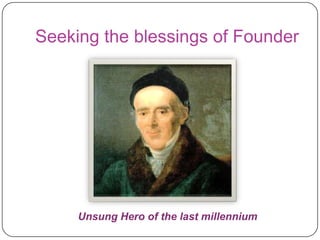
Seeking the blessings of Founder

Unsung Hero of the last millennium
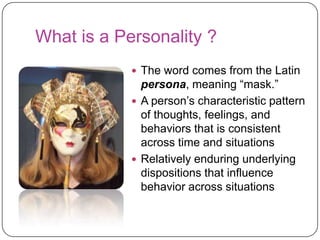
What is a Personality ?
 The word comes from the Latin

persona, meaning “mask.”
 A person’s characteristic pattern
of thoughts, feelings, and
behaviors that is consistent
across time and situations
 Relatively enduring underlying
dispositions that influence
behavior across situations
Nature vs. Nurture
 Sociologists debate what determines

personality and social behavior.
 Some argue that it is heredity – the
transmission of genetic characteristics from
parents to children.
 Others suggest that the social environment –
contact with other people – determines
personality.
 This debate is usually referred to in terms of
nature versus nurture, or inherited genes
versus environment and social learning.
Blending of factors…
 Most social scientists assume that personality

and social behavior result from a blending of
heredity and social environmental influences.
 They believe that environmental factors have
the greatest influence.
 Heredity, birth order, parents, and cultural
environment are among the principal factors
that social scientists see influencing
personality and behavior.
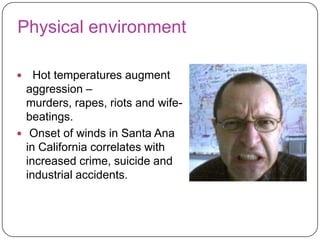
Physical environment
Hot temperatures augment
aggression –
murders, rapes, riots and wifebeatings.
 Onset of winds in Santa Ana
in California correlates with
increased crime, suicide and
industrial accidents.

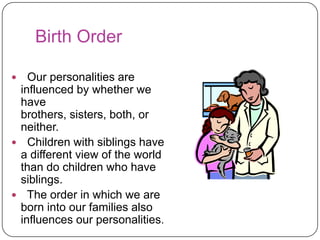
Birth Order
Our personalities are
influenced by whether we
have
brothers, sisters, both, or
neither.
 Children with siblings have
a different view of the world
than do children who have
siblings.
 The order in which we are
born into our families also
influences our personalities.

Birth Order
 People born first or last in a

family have a different
perspective than do people in
the middle.
 Example: first born are likely to
be achievement oriented and
responsible.
 Later born are more likely to be
better in social
relationships, affectionate, friend
ly, or rebels and risk-takers.
Parental Characteristics
Parents influence their childrens’
personalities. The age of the
parent can be a bearing on the
children’s development. (EX.
Younger vs. older)
 Other parental characteristics like
level of education, religious
orientation, economic
status, occupation, and cultural
heritage can and often do influence
a child’s personality and their social
behavior.

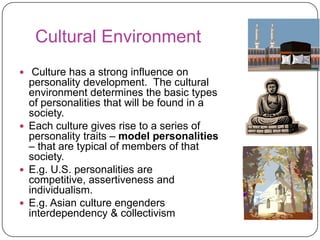
Cultural Environment
 Culture has a strong influence on

personality development. The cultural
environment determines the basic types
of personalities that will be found in a
society.
 Each culture gives rise to a series of
personality traits – model personalities
– that are typical of members of that
society.
 E.g. U.S. personalities are
competitive, assertiveness and
individualism.
 E.g. Asian culture engenders
interdependency & collectivism
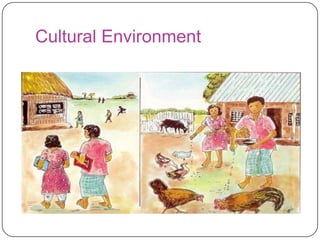
Cultural Environment
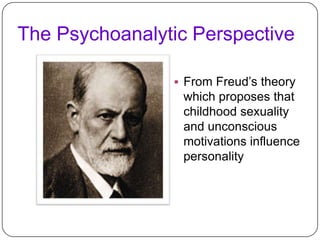
The Psychoanalytic Perspective
 From Freud’s theory

which proposes that
childhood sexuality
and unconscious
motivations influence
personality
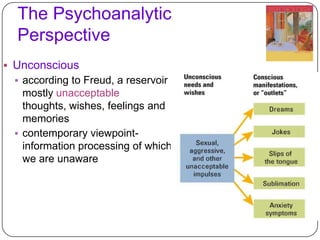
The Psychoanalytic
Perspective
 Unconscious
 according to Freud, a reservoir of

mostly unacceptable
thoughts, wishes, feelings and
memories
 contemporary viewpointinformation processing of which
we are unaware
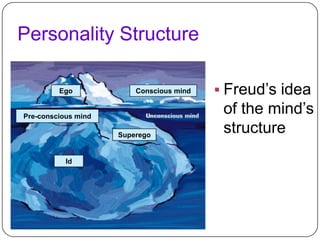
Personality Structure
Ego

Conscious mind

Pre-conscious mind
Superego

Id

 Freud’s idea

of the mind’s
structure
Homeopathic personalities
 Each of homeopathic remedies (mostly

polychrest) has a unique personality – a unique
way of thinking, feeling and behaving.
 A intellectual, Critical, Angry and Untidy, Sulphur.
 A neat and tidy; anxious, restless and fearful
Arsenicum.
 A gregarious, affectionate, excitable and fearful
Phosphorus.
Fixing medicines for people
 A common mistake is to brand a patient as

Staphysagria patient or Pulsatilla patient.
 Personalities change across life time.
 A Natrum mur may change to Sepia or even to a
Phosphorus personality.
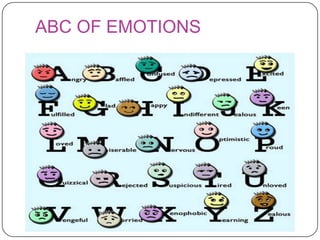
ABC OF EMOTIONS
Personality – key to cure

Personality – key to cure

  • 1.
    PERSONALITY – KEYTO CURE Dr.V.Veera Balaji Kumar
  • 2.
    Seeking the blessingsof Founder Unsung Hero of the last millennium
  • 3.
    What is aPersonality ?  The word comes from the Latin persona, meaning “mask.”  A person’s characteristic pattern of thoughts, feelings, and behaviors that is consistent across time and situations  Relatively enduring underlying dispositions that influence behavior across situations
  • 4.
    Nature vs. Nurture Sociologists debate what determines personality and social behavior.  Some argue that it is heredity – the transmission of genetic characteristics from parents to children.  Others suggest that the social environment – contact with other people – determines personality.  This debate is usually referred to in terms of nature versus nurture, or inherited genes versus environment and social learning.
  • 5.
    Blending of factors… Most social scientists assume that personality and social behavior result from a blending of heredity and social environmental influences.  They believe that environmental factors have the greatest influence.  Heredity, birth order, parents, and cultural environment are among the principal factors that social scientists see influencing personality and behavior.
  • 6.
    Physical environment Hot temperaturesaugment aggression – murders, rapes, riots and wifebeatings.  Onset of winds in Santa Ana in California correlates with increased crime, suicide and industrial accidents. 
  • 7.
    Birth Order Our personalitiesare influenced by whether we have brothers, sisters, both, or neither.  Children with siblings have a different view of the world than do children who have siblings.  The order in which we are born into our families also influences our personalities. 
  • 8.
    Birth Order  Peopleborn first or last in a family have a different perspective than do people in the middle.  Example: first born are likely to be achievement oriented and responsible.  Later born are more likely to be better in social relationships, affectionate, friend ly, or rebels and risk-takers.
  • 9.
    Parental Characteristics Parents influencetheir childrens’ personalities. The age of the parent can be a bearing on the children’s development. (EX. Younger vs. older)  Other parental characteristics like level of education, religious orientation, economic status, occupation, and cultural heritage can and often do influence a child’s personality and their social behavior. 
  • 10.
    Cultural Environment  Culturehas a strong influence on personality development. The cultural environment determines the basic types of personalities that will be found in a society.  Each culture gives rise to a series of personality traits – model personalities – that are typical of members of that society.  E.g. U.S. personalities are competitive, assertiveness and individualism.  E.g. Asian culture engenders interdependency & collectivism
  • 11.
  • 12.
    The Psychoanalytic Perspective From Freud’s theory which proposes that childhood sexuality and unconscious motivations influence personality
  • 13.
    The Psychoanalytic Perspective  Unconscious according to Freud, a reservoir of mostly unacceptable thoughts, wishes, feelings and memories  contemporary viewpointinformation processing of which we are unaware
  • 14.
    Personality Structure Ego Conscious mind Pre-consciousmind Superego Id  Freud’s idea of the mind’s structure
  • 15.
    Homeopathic personalities  Eachof homeopathic remedies (mostly polychrest) has a unique personality – a unique way of thinking, feeling and behaving.  A intellectual, Critical, Angry and Untidy, Sulphur.  A neat and tidy; anxious, restless and fearful Arsenicum.  A gregarious, affectionate, excitable and fearful Phosphorus.
  • 16.
    Fixing medicines forpeople  A common mistake is to brand a patient as Staphysagria patient or Pulsatilla patient.  Personalities change across life time.  A Natrum mur may change to Sepia or even to a Phosphorus personality.
  • 17.