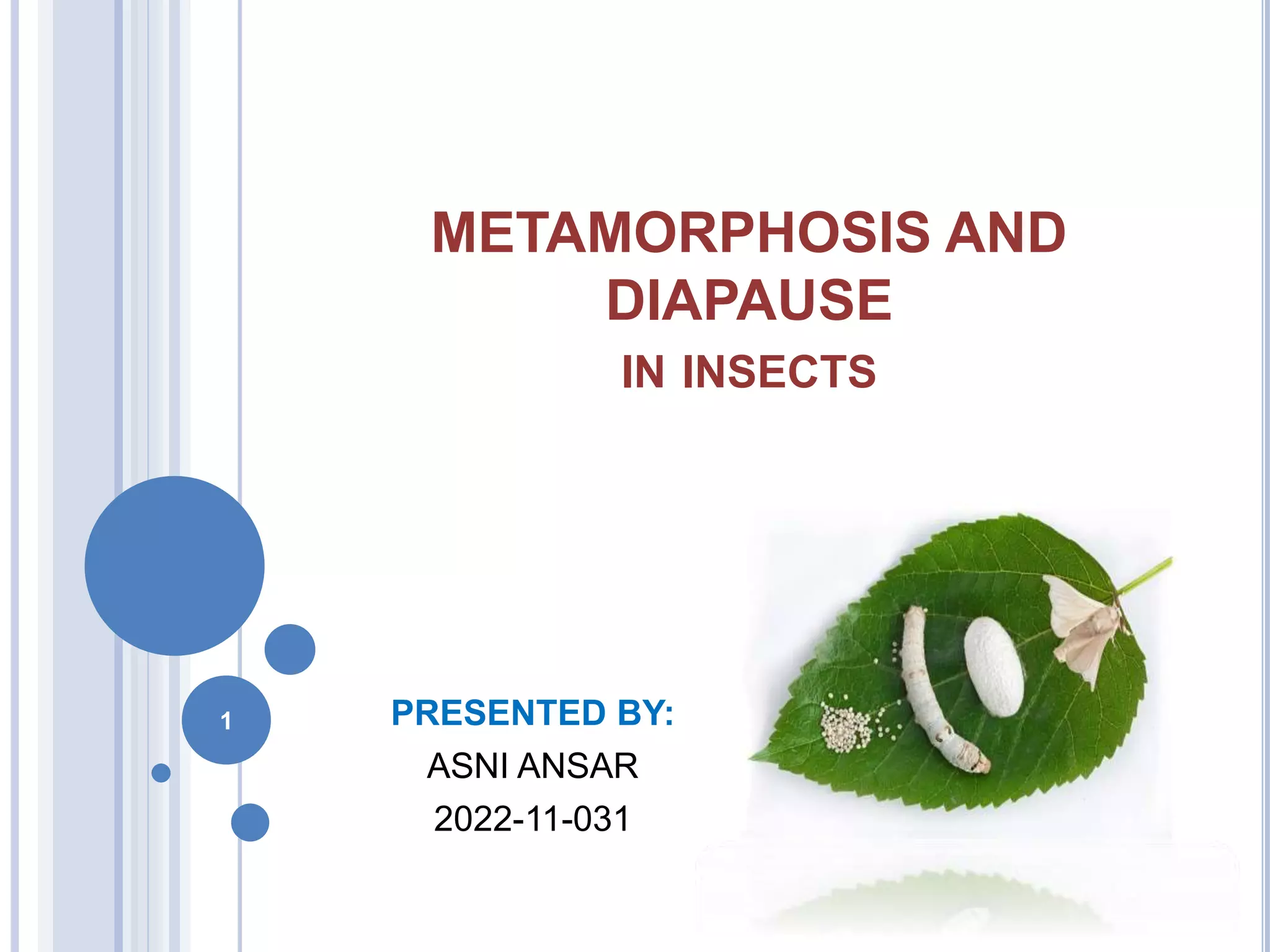
METAMORPHOSIS AND
DIAPAUSE
IN INSECTS
PRESENTED BY:
ASNI ANSAR
2022-11-031
1
CONTENTS
 Introduction
 Types of metamorphosis
 Hormonal control of metamorphosis
 Diapause
 Types of diapause
 Phases of diapause
 Factors affecting diapause
 Conclusion
 Reference
2
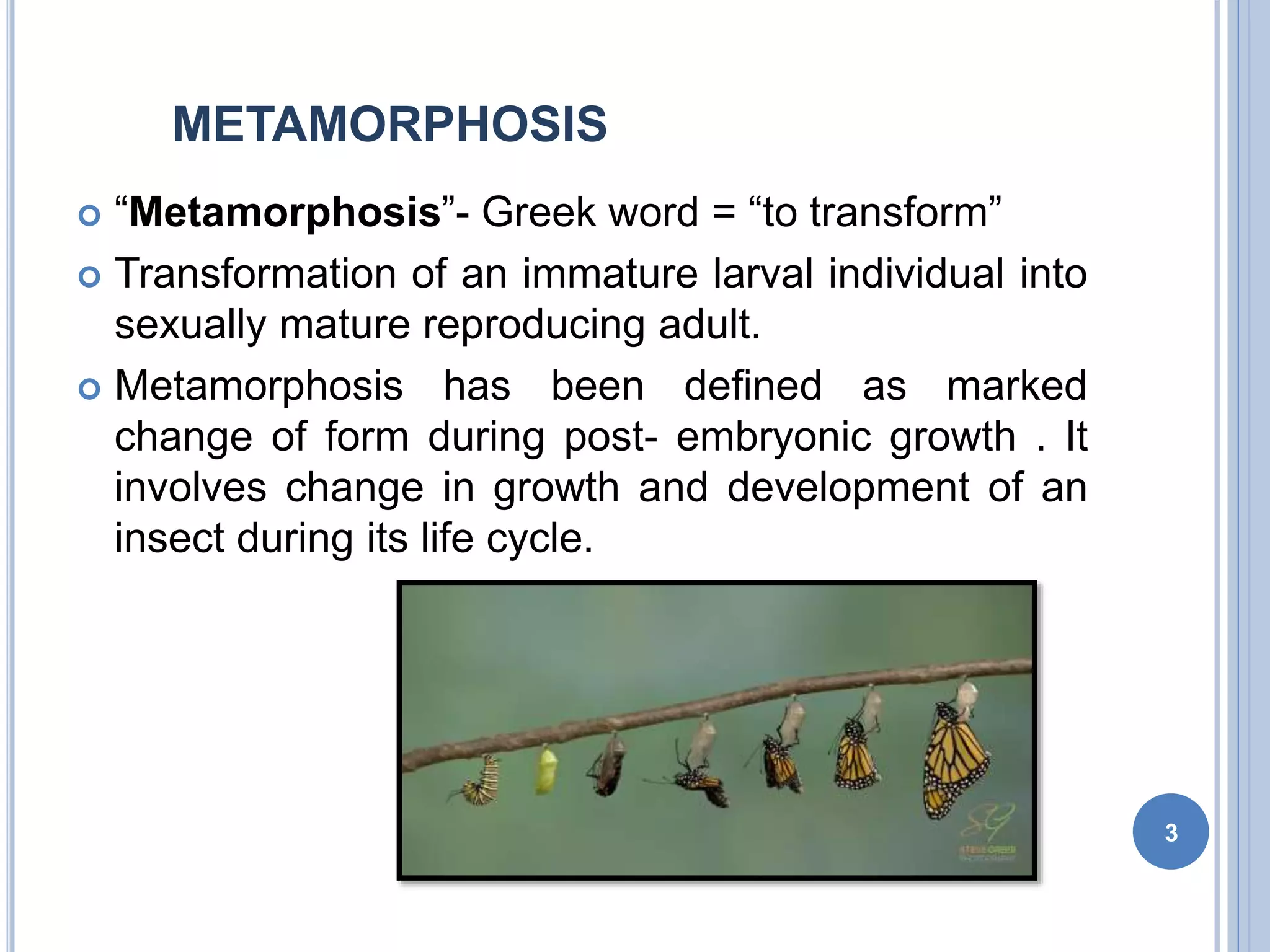
METAMORPHOSIS
 “Metamorphosis”- Greek word = “to transform”
 Transformation of an immature larval individual into
sexually mature reproducing adult.
 Metamorphosis has been defined as marked
change of form during post- embryonic growth . It
involves change in growth and development of an
insect during its life cycle.
3
TYPES OF METAMORPHOSIS:
Ametamorphosis
Incomplete
metamorphosis
Gradual
metamorphosis
Complete
metamorphosis
4
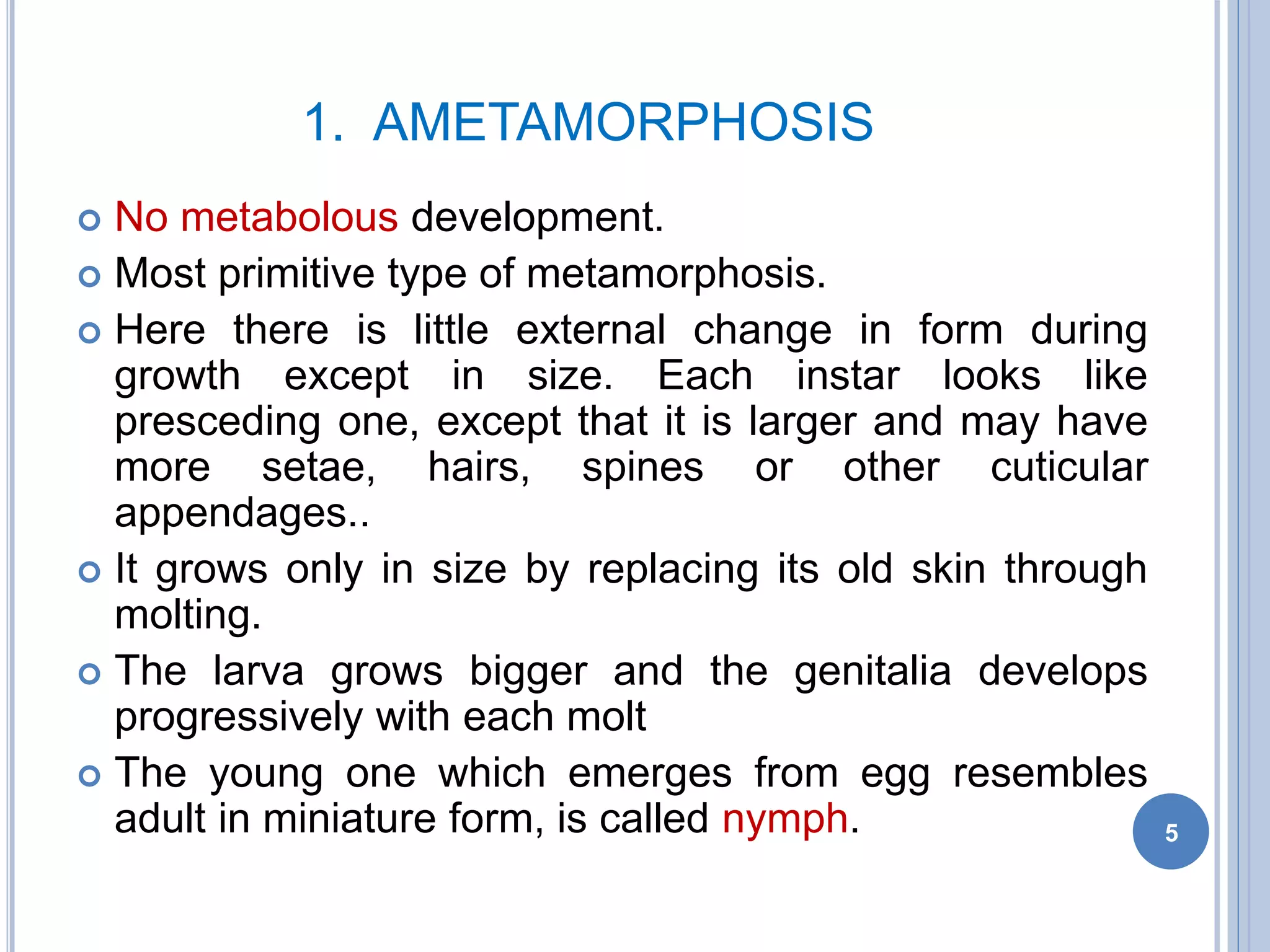
1. AMETAMORPHOSIS
 No metabolous development.
 Most primitive type of metamorphosis.
 Here there is little external change in form during
growth except in size. Each instar looks like
presceding one, except that it is larger and may have
more setae, hairs, spines or other cuticular
appendages..
 It grows only in size by replacing its old skin through
molting.
 The larva grows bigger and the genitalia develops
progressively with each molt
 The young one which emerges from egg resembles
adult in miniature form, is called nymph. 5
 The reproductive organs are undeveloped in
nymph and after molting the nymph becomes an
adult.
 Both forms i.e., the nymphs and adults live in the
same habitat and partake the same food.
 In this group belong those insects which are
wingless and have descended from a wingless
ancestory.
 This is the characteristic feature of Apterygotes
(e.g., Silverfish-Lepisma Linnaeus and thysanura
and collombola).
6
Ex: The silverfish hatched from egg looks like an
adult and undergoes subtle anatomical changes
between molts.
Immature silverfish molts 6–7 times until it reaches
sexually mature adult stage.
In favorable conditions, silverfish may typically
continue to molt during its lifespan and molts 25–66
times to become adult.
7
2. INCOMPLETE METAMORPHOSIS
 Hemimetabolous development.
 Life cycle: egg, naiad and adult.
 The immature stage is called a naiad, and naiad
typically resemble the adult but lack wings.
 External wing pads appear during nymphal growth,
but they do not transform into functional wings until
the adult molt.
 Progressive development of wings occurs at each
moult.
 Apart from being small, the larval wing buds differ
from the adult wing in lacking membraneous basal
region and accessory sclerites. 8
 In general, The wing arise in such a way that the
lateral margin of wing buds become the coastal
margin of the adult wings.
 But in odonata, the bud arise in an erect
position, the margin near the midline becomes
the coastal margin.
9
 The genitalia develop progressively by modification
of the terminal abdominal segment, but with a more
marked alteration at final moult.
10
11
 To this group belong the Ephemeroptera (mayflies),
plecoptera(stoneflies) and odonata (dragonfly).
IN EPHEMEROPTERA:
 The adult mayfly deposit eggs in water. The young on
hatching have special adaptation for living in water,
such as tracheal gills and modification of the body
form.
 Escape from the water is accomplished in last moult.
 During this phase, insect have to undergo
transformation from aquatic to aerial respiration, and
change in digestive system.
 Many mayfly nymphs, when mature, come to the
surface of water and crawl to a support to rest; the
subimago soon escapes and flies to a nearby
place.
 The mayfly that first emerges as a winged form is
not true adult; this form is called sub-imago.
 The sub-imago have to moult again to become
sexually mature. This final moult occures within few
hours.
12
DISTINCTIVE CHARACTERISTICS:
 The nymphs and adults live in entirely different
habitats.
 The nymphs possess many modifications, as
tracheal gills, legs for clinging, clambering, or
burrowing, bodies for swimming, and mouth- parts
for taking food in the water.
 Special adaptations are required for the adults to
escape from the last nymphal skin.
 The adults are aerial and in the case of dragonflies
and damselflies require new methods of capturing
food, or, in the case of mayflies and most stoneflies,
take no food, or very little, but inflate the alimentary
canal with air to aid in flight.
13
3. GRADUAL METAMORPHOSIS
 Paurometabolic development.
 Life cycle: egg, nymph, and adult.
 The newly emerged young one closely resembles
the adult in general body form, habits and habitat
but many adult characters like wings and
reproductive organs are not developed and their
relative proportions of the body also differs.
 The wings develop as wing pads on second and
third thoracic segments at an early stage and
gradually increase in size during each successive
molt.
14
 The external genitalia also develops gradually after
each molt.
 These nymphs lead an independent life and attain
adult features through several molts.
 Characteristic feature of gradual metamorphosis
are the growth in size at each moult, appearance of
external wing buds and the development of external
genital appendages.
 Paurometabolous development is found in less
primitive forms like orthoptera, dermaptera, isoptera
, hemiptera and thysanoptera.
15
EX: In grasshoppers, before becoming adults the
nymphs undergo 5–6 molts to change their body
form. The nymph stage is species specific and
lasts for a period of 5–10 days depending upon
the weather conditions like temperature and
humidity.
16
4. COMPLETE METAMORPHOSIS
 Holometabolous development
 Life cycle : egg, larva, pupa and adult
 Larva do not resemble adult
 Immatures: adapted for feeding
 Adult: adapted for reproduction and dispersal
 Wing developement is internal.
 Development of the wings internally within the larva
is restricted by lack of space
17
 This problem becomes more acute as the insect
approaches the adult condition and the flight
muscles also increase in size.
 Thus, development can only be completed after
the wings are everted and, for this reason, two
molts are necessary in the transformation from
larva to adult.
 At the first, from larva to pupa, the wings are
everted and grow to some extent. Further growth
occurs and the adult cuticle is laid down at the
pupa– adult molts.
18
19
DISTINCTIVE CHARACTERISTICS :
• The larval stage provides a distinct feeding and
growth period.
• The larvae do not bear any resemblance to the
adults.
• The food, habits and habitats of the larvae are
usually distinctive and different from those of the
adults.
• There is a new stage, the pupa.
•Remarkable internal and external changes take
place in the pupal stage.
• The wings develop internally during larval growth
and are evaginated just before the last larval skin is
shed.
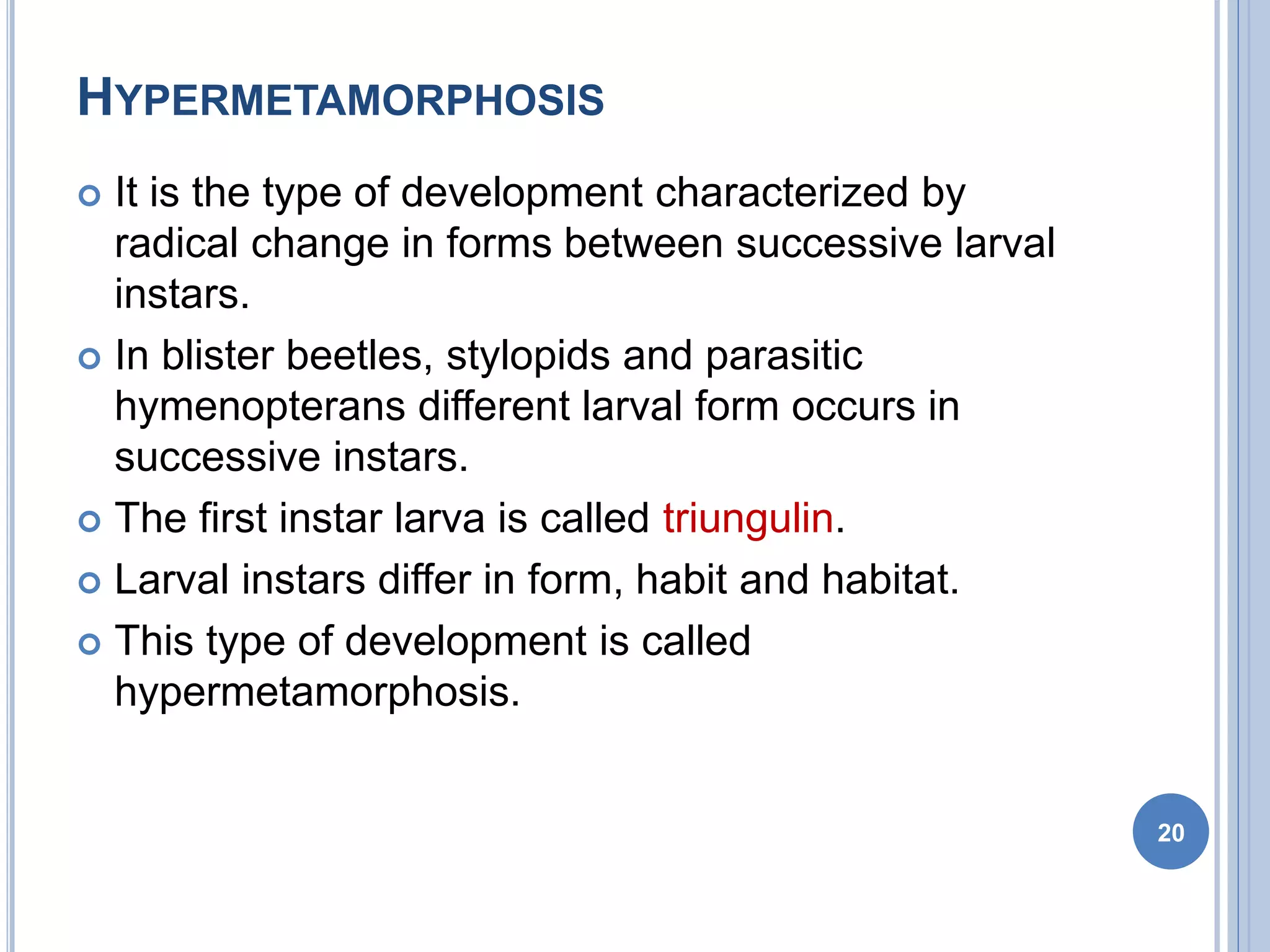
HYPERMETAMORPHOSIS
 It is the type of development characterized by
radical change in forms between successive larval
instars.
 In blister beetles, stylopids and parasitic
hymenopterans different larval form occurs in
successive instars.
 The first instar larva is called triungulin.
 Larval instars differ in form, habit and habitat.
 This type of development is called
hypermetamorphosis.
20
 In blister beetles (Meloidae), the larva hatches as free-
living campodeiform which can actively search for food.
 After locating the food source, the larva soon molts to
second stage i.e., eruciform (caterpillar like).
 Further, it has to pass through either two or more
additional larval instars, where it may remain as
eruciform or become scarabaeiform.
21
22
HORMONAL CONTROL OF
METAMORPHOSIS
 V. B. Wigglesworth (1930)- The role of hormones in
the physiology of molting.
 During growth phase, immature insects require large
exoskelton.
 The whole procedure of development of an insect is
influenced mainly by three hormones:
Prothoracicotropic hormone (PTTH), Ecdysone and
Juvenile hormone which are secreted by neuro-
secretory cells (NSC) present in the brain, Prothoracic
gland and corpora allata respectively.
23
 The signals are sent by the developing body of the
insect to the brain and direct it to activate the
clusters of neurosecretory cells which then produce
PTTH which passes down into neurohemal organ,
Corpora Cardiaca (CC) to release stored PTTH into
the circulatory system.
 The prothoracic glands get stimulated by this to
secrete Ecdysone.
 The active form of ecdysone triggers a series of
physiological events leading to the formation of a
new exoskeleton by the process known as apolysis.
24
25
 PTTH is a peptide hormone with a molecular weight of
approximately 40,000, and it stimulates the production
of ecdysone by the prothoracic gland.
 This ecdysone is modified in peripheral tissues to
become the active molting hormone 20-
hydroxyecdysone.Each molt is initiated by one or
more pulses of 20-hydroxyecdyso
 For a larval molt, the first pulse produces a small rise in
the hydroxyecdysone concentration in the larval
hemolymph (blood) and elicits a change in cellular
commitment.
 A second, large pulse of hydroxyecdysone initiates the
differentiation events associated with molting.
 The resulting hydroxyecdysone, in the absence of high
levels of JH, commits the cells to pupal development.
26
JUVENILE HORMONE:
 Juvenile hormone is secreted by the corpora allata.
 The secretory cells of the corpora allata are active
during larval molts but inactive during the
metamorphic molt.
 As long as JH is present, the hydroxyecdysone-
stimulated molts result in a new larval instar.
 In the last larval instar, however, the medial nerve
from the brain to the corpora allata inhibits the gland
from producing JH, and there is a simultaneous
increase in the body's ability to degrade existing JH
 Both these mechanisms cause JH levels to drop
below a critical threshold value.
27
 It is the responsibility of JH to maintain the insect in
its young state and it modifies expression of the
molt, acts in conjunction with ecdysone.
 JH favors the synthesis of larval structures and
adult differentiation and thus considered as a
modifying agent.
 In immature insects, juvenile hormone (JH) is
secreted by the corpora allata prior to each molt.
 JH inhibits the genes that promote development of
adult characteristics- insect remain immature.
 Corpora allata becomes atrophied in last larval
stage and stops producing JH causing the insect to
molt into an adult.
28
DIAPAUSE
 Diapause is a period of suspended or arrested
development during an insect’s life cycle.
 Word diapause was coined by wheeler.
 Insect diapause is usually triggered by environmental
cues, like changes in daylight, temperature or food
availability.
CHARECTERSTICS:
 low rate of metabolism
 low O2 consumption
 low body weight,
 low body water content and
 vitamin deficiency in the blood. 29
30
 Highly evolved form of
dormancy and is
maintained irrespective
of environment
 Diapause is not an
immediate effect.
 Irreversible dormancy
 Long adaptive form of
dormancy.
 Temporarily inhibited
by unfavorable
environment.
 Quiescence is an
immediate response.
 Reversible dormancy.
 Short or long
depending on
environmental
conditions
DIAPAUSE QUISCENCE
TYPES OF DIAPAUSE:
INFLUENCE OF ENVIRONMENTAL FACTORS
1. FACULTATIVE :
Multivoltine- cotton pink bollworm
Stage of suspended activity of the insect due to
unfavourable conditions and with the onset of
favourable condition, the insect regains its original
activity.
2. OBLIGATE :
Univoltine- egg diapuse in silk worm
Stage of suspended activity of the insect which is a
hereditary character controlled by genes and is
species specific.
31
SEASONAL VARIATION
32
 The period of
suspended activity in
individuals occurring
due to seasonal high
temperature.
 Summer diapause
 Red hairy caterpillar
 The period of
suspended activity in
individuals occurring
due to seasonal low
temperature.
 Winter diapause
 Pink bollworm
AESTIVATION
HIBERNATION
PHASES OF DIAPAUSE
I. PRE- DIAPAUSE:
 Induction phase
 Preparation phase
II. DIAPAUSE
 Initiation phase
 Maintenance phase
 Termination phase
III.POST- DIAPAUSE 33
1. PRE DIAPAUSE PHASE
Induction phase:
 Happens before the beginning of unfavourable
environmental cues ( stimuli).
 These specific environmental stimuli are known as
“token stimuli”
 Token stimuli can be any change in photoperiod,
thermoperiod or allelochemicals from food source.
 Direct development caeces, followed by regulated
metabolic suppressions to diapause pathway.
34
Preparation phase:
 Characterized by behavioral activities/ physiological
process
 Insects prepare their bodies for the life process
suspension
 Insects accumulate and store molecules such as lipids,
proteins and carbohydrates
 To survive during diapause.
EXAMPLE:
Diapausing puparia of flesh fly increases –
amount of cuticular hydrocarbons- they have double
the quantity of hydrocarbon – lining puparium -
reducing the loss of water.
35
DIAPAUSE PHASE:
Initiation phase:
 Most important phase to begin diapause.
 Begins when morphological development ceases.
 The cessation includes releasing special enzymes,
changing colour, behaviour change etc.
EXAMPLE:
Adults of fire bug have enzymatic complement-
to accumulate polyhydric alcohols- molecule that
help in lowering freezing point-to avoid freezing
injury during diapause.
36
Maintenance phase:
 Here, insect experiences lowered metabolism and
developmental arrest.
 Sensitivity to certain stimuli which act to prevent
termination of diapause, such as photoperiod and
temperature is increased.
 They grow more sensitive to these stimuli as time
progress.
37
Termination phase:
 Diapause intensity decreases to its minimum level
 Subsequent resumption of direct development is
enabled.
3. Post-Diapause:
 A phase of inactivity or quiescence occurs in insects.
 Here ,the insects eventually start resuming their
physiological development, if the environmental
conditions are favourable.
38
FACTORS AFFECTING DIAPAUSE
 Photoperiod:
The alternating phases of light and dark in the day.
seasonal changes to the photoperiod cue the start
or end of diapause for many insects.
 Temperature:
alternating phases of cooler and warmer
temperatures, also influences diapause. Some
insects require specific thermal cues to end the
diapause phase.
 Food:
As the growing season ends, the diminishing quality
of their food sources may help trigger a diapause
phase in an insect species. 39
LIFE STAGE OF INSECT
 Egg diapause :Bombyx mori,
Poekilocerus pictus
 Larval diapause :Pectinophora gossypiella
 Pre-pupal diapause : Plodia interpunctella
 Pupal diapause : Pieris brassicae,
Amsacta albistriga
 Adult diapause :holotrichia, epilachna sp.
 Imaginary diapause :Aedes aegypti
40
HORMONAL MECHANISM
1. EMBRYONIC DIAPAUSE:
 May occur at any of several stages of embryonic
development:
* just after germ band formation.
* around the time of blastokinesis
* at full grown larval stage just before hatching
 Ex: mulberry silkworm, Bombyx mori
41
MECHANISM
 Silkworm females having long days and warm
temperatures during egg and early larval periods
lay eggs that enter diapause.
 The female sub-oesphageal ganglion secretes
diapause hormone, which acts on ovary.
 Increases permebality of ovary.
 Results in egg arrest at germ band stage.
42
2. LARVAL DIAPAUSE:
 Mostly occurring in last larval instar.
 Ex: southwestern corn borer, Diatraea grandiosella
rice stem borer ,Chilo suppressalis
MECHANISM:
 Larval diapause is initiated and maintained by
continued activity of CA- resulting in high JH.
 Here, JH is responsible for the maintainence of
larval diapause.
43
3. PUPAL DIAPAUSE:
 Maintained by the endocrine gland by the
interaction of brain and prothoracic gland.
 Ex: Giant silkmoth, Hyalophora ceropia
American bollworm, Helicoverpa armigera
MECHANISM:
 Occurs due to failure of brain to secrete PTTH.
 Diapausing pupae are characterized by a high
glycerol content, low temperature and low
respiratory rate.
 PTTH production was reactivated when the pupa
was brought back to room temperature.
44
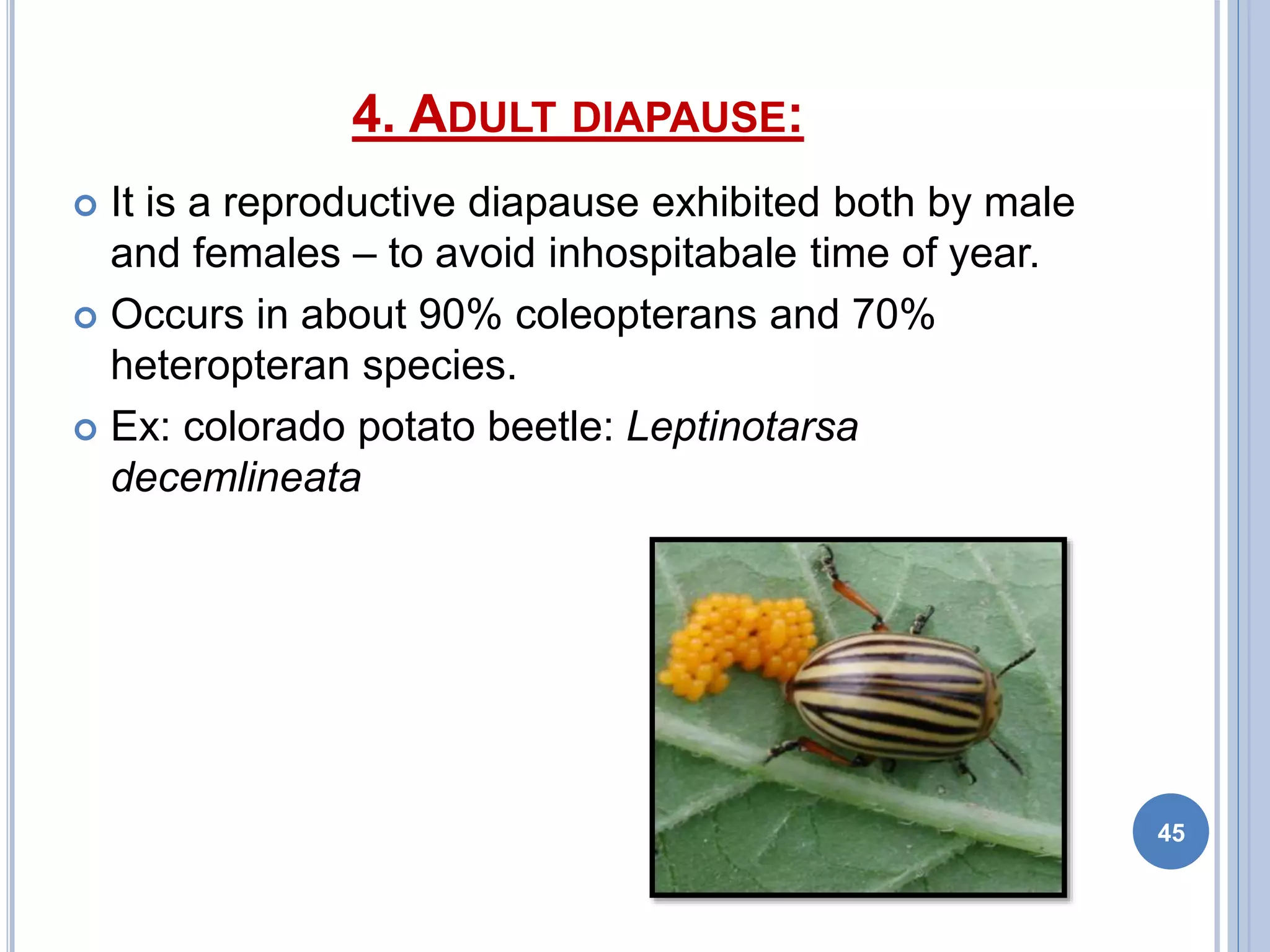
4. ADULT DIAPAUSE:
 It is a reproductive diapause exhibited both by male
and females – to avoid inhospitabale time of year.
 Occurs in about 90% coleopterans and 70%
heteropteran species.
 Ex: colorado potato beetle: Leptinotarsa
decemlineata
45
MECHANISM:
 Due to lack of JH.
 Females: cessasation of oogenesis,
 Males: regression of accessory glands.
 Flight muscles are not developed.
 With the termination of diapause, beetle remerge
from soil- flight muscles are reconstructed and
oogenesis is resumed.
46
CONCLUSION
 Insects clearly posses a range of coordinated and
integrated mechanism that have evolved to allow
them to survive under adverse conditions.
 Diapause is an important part of the life cycle in
many species of invertebrates.
 Embryonic and larval diapauses are each induced
by the presence of DH and JH.
 Pupal and adult diapause results from the lack of
PTTH and JH respectively.
47
REFERENCE
 The insects structure and function- R F Chapman
 Robert Matheson. Entomology for introductory
courses
 Larval Development and Molting-Amritpal Singh
Kaleka, Navkiran Kaur
 The Evolution of Insect Metamorphosis- James
W. Truman
48
49

metamorphosis and diapause in insects.pptx

  • 1.
  • 2.
    CONTENTS  Introduction  Typesof metamorphosis  Hormonal control of metamorphosis  Diapause  Types of diapause  Phases of diapause  Factors affecting diapause  Conclusion  Reference 2
  • 3.
    METAMORPHOSIS  “Metamorphosis”- Greekword = “to transform”  Transformation of an immature larval individual into sexually mature reproducing adult.  Metamorphosis has been defined as marked change of form during post- embryonic growth . It involves change in growth and development of an insect during its life cycle. 3
  • 4.
  • 5.
    1. AMETAMORPHOSIS  Nometabolous development.  Most primitive type of metamorphosis.  Here there is little external change in form during growth except in size. Each instar looks like presceding one, except that it is larger and may have more setae, hairs, spines or other cuticular appendages..  It grows only in size by replacing its old skin through molting.  The larva grows bigger and the genitalia develops progressively with each molt  The young one which emerges from egg resembles adult in miniature form, is called nymph. 5
  • 6.
     The reproductiveorgans are undeveloped in nymph and after molting the nymph becomes an adult.  Both forms i.e., the nymphs and adults live in the same habitat and partake the same food.  In this group belong those insects which are wingless and have descended from a wingless ancestory.  This is the characteristic feature of Apterygotes (e.g., Silverfish-Lepisma Linnaeus and thysanura and collombola). 6
  • 7.
    Ex: The silverfishhatched from egg looks like an adult and undergoes subtle anatomical changes between molts. Immature silverfish molts 6–7 times until it reaches sexually mature adult stage. In favorable conditions, silverfish may typically continue to molt during its lifespan and molts 25–66 times to become adult. 7
  • 8.
    2. INCOMPLETE METAMORPHOSIS Hemimetabolous development.  Life cycle: egg, naiad and adult.  The immature stage is called a naiad, and naiad typically resemble the adult but lack wings.  External wing pads appear during nymphal growth, but they do not transform into functional wings until the adult molt.  Progressive development of wings occurs at each moult.  Apart from being small, the larval wing buds differ from the adult wing in lacking membraneous basal region and accessory sclerites. 8
  • 9.
     In general,The wing arise in such a way that the lateral margin of wing buds become the coastal margin of the adult wings.  But in odonata, the bud arise in an erect position, the margin near the midline becomes the coastal margin. 9
  • 10.
     The genitaliadevelop progressively by modification of the terminal abdominal segment, but with a more marked alteration at final moult. 10
  • 11.
    11  To thisgroup belong the Ephemeroptera (mayflies), plecoptera(stoneflies) and odonata (dragonfly). IN EPHEMEROPTERA:  The adult mayfly deposit eggs in water. The young on hatching have special adaptation for living in water, such as tracheal gills and modification of the body form.  Escape from the water is accomplished in last moult.  During this phase, insect have to undergo transformation from aquatic to aerial respiration, and change in digestive system.
  • 12.
     Many mayflynymphs, when mature, come to the surface of water and crawl to a support to rest; the subimago soon escapes and flies to a nearby place.  The mayfly that first emerges as a winged form is not true adult; this form is called sub-imago.  The sub-imago have to moult again to become sexually mature. This final moult occures within few hours. 12
  • 13.
    DISTINCTIVE CHARACTERISTICS:  Thenymphs and adults live in entirely different habitats.  The nymphs possess many modifications, as tracheal gills, legs for clinging, clambering, or burrowing, bodies for swimming, and mouth- parts for taking food in the water.  Special adaptations are required for the adults to escape from the last nymphal skin.  The adults are aerial and in the case of dragonflies and damselflies require new methods of capturing food, or, in the case of mayflies and most stoneflies, take no food, or very little, but inflate the alimentary canal with air to aid in flight. 13
  • 14.
    3. GRADUAL METAMORPHOSIS Paurometabolic development.  Life cycle: egg, nymph, and adult.  The newly emerged young one closely resembles the adult in general body form, habits and habitat but many adult characters like wings and reproductive organs are not developed and their relative proportions of the body also differs.  The wings develop as wing pads on second and third thoracic segments at an early stage and gradually increase in size during each successive molt. 14
  • 15.
     The externalgenitalia also develops gradually after each molt.  These nymphs lead an independent life and attain adult features through several molts.  Characteristic feature of gradual metamorphosis are the growth in size at each moult, appearance of external wing buds and the development of external genital appendages.  Paurometabolous development is found in less primitive forms like orthoptera, dermaptera, isoptera , hemiptera and thysanoptera. 15
  • 16.
    EX: In grasshoppers,before becoming adults the nymphs undergo 5–6 molts to change their body form. The nymph stage is species specific and lasts for a period of 5–10 days depending upon the weather conditions like temperature and humidity. 16
  • 17.
    4. COMPLETE METAMORPHOSIS Holometabolous development  Life cycle : egg, larva, pupa and adult  Larva do not resemble adult  Immatures: adapted for feeding  Adult: adapted for reproduction and dispersal  Wing developement is internal.  Development of the wings internally within the larva is restricted by lack of space 17
  • 18.
     This problembecomes more acute as the insect approaches the adult condition and the flight muscles also increase in size.  Thus, development can only be completed after the wings are everted and, for this reason, two molts are necessary in the transformation from larva to adult.  At the first, from larva to pupa, the wings are everted and grow to some extent. Further growth occurs and the adult cuticle is laid down at the pupa– adult molts. 18
  • 19.
    19 DISTINCTIVE CHARACTERISTICS : •The larval stage provides a distinct feeding and growth period. • The larvae do not bear any resemblance to the adults. • The food, habits and habitats of the larvae are usually distinctive and different from those of the adults. • There is a new stage, the pupa. •Remarkable internal and external changes take place in the pupal stage. • The wings develop internally during larval growth and are evaginated just before the last larval skin is shed.
  • 20.
    HYPERMETAMORPHOSIS  It isthe type of development characterized by radical change in forms between successive larval instars.  In blister beetles, stylopids and parasitic hymenopterans different larval form occurs in successive instars.  The first instar larva is called triungulin.  Larval instars differ in form, habit and habitat.  This type of development is called hypermetamorphosis. 20
  • 21.
     In blisterbeetles (Meloidae), the larva hatches as free- living campodeiform which can actively search for food.  After locating the food source, the larva soon molts to second stage i.e., eruciform (caterpillar like).  Further, it has to pass through either two or more additional larval instars, where it may remain as eruciform or become scarabaeiform. 21
  • 22.
  • 23.
    HORMONAL CONTROL OF METAMORPHOSIS V. B. Wigglesworth (1930)- The role of hormones in the physiology of molting.  During growth phase, immature insects require large exoskelton.  The whole procedure of development of an insect is influenced mainly by three hormones: Prothoracicotropic hormone (PTTH), Ecdysone and Juvenile hormone which are secreted by neuro- secretory cells (NSC) present in the brain, Prothoracic gland and corpora allata respectively. 23
  • 24.
     The signalsare sent by the developing body of the insect to the brain and direct it to activate the clusters of neurosecretory cells which then produce PTTH which passes down into neurohemal organ, Corpora Cardiaca (CC) to release stored PTTH into the circulatory system.  The prothoracic glands get stimulated by this to secrete Ecdysone.  The active form of ecdysone triggers a series of physiological events leading to the formation of a new exoskeleton by the process known as apolysis. 24
  • 25.
  • 26.
     PTTH isa peptide hormone with a molecular weight of approximately 40,000, and it stimulates the production of ecdysone by the prothoracic gland.  This ecdysone is modified in peripheral tissues to become the active molting hormone 20- hydroxyecdysone.Each molt is initiated by one or more pulses of 20-hydroxyecdyso  For a larval molt, the first pulse produces a small rise in the hydroxyecdysone concentration in the larval hemolymph (blood) and elicits a change in cellular commitment.  A second, large pulse of hydroxyecdysone initiates the differentiation events associated with molting.  The resulting hydroxyecdysone, in the absence of high levels of JH, commits the cells to pupal development. 26
  • 27.
    JUVENILE HORMONE:  Juvenilehormone is secreted by the corpora allata.  The secretory cells of the corpora allata are active during larval molts but inactive during the metamorphic molt.  As long as JH is present, the hydroxyecdysone- stimulated molts result in a new larval instar.  In the last larval instar, however, the medial nerve from the brain to the corpora allata inhibits the gland from producing JH, and there is a simultaneous increase in the body's ability to degrade existing JH  Both these mechanisms cause JH levels to drop below a critical threshold value. 27
  • 28.
     It isthe responsibility of JH to maintain the insect in its young state and it modifies expression of the molt, acts in conjunction with ecdysone.  JH favors the synthesis of larval structures and adult differentiation and thus considered as a modifying agent.  In immature insects, juvenile hormone (JH) is secreted by the corpora allata prior to each molt.  JH inhibits the genes that promote development of adult characteristics- insect remain immature.  Corpora allata becomes atrophied in last larval stage and stops producing JH causing the insect to molt into an adult. 28
  • 29.
    DIAPAUSE  Diapause isa period of suspended or arrested development during an insect’s life cycle.  Word diapause was coined by wheeler.  Insect diapause is usually triggered by environmental cues, like changes in daylight, temperature or food availability. CHARECTERSTICS:  low rate of metabolism  low O2 consumption  low body weight,  low body water content and  vitamin deficiency in the blood. 29
  • 30.
    30  Highly evolvedform of dormancy and is maintained irrespective of environment  Diapause is not an immediate effect.  Irreversible dormancy  Long adaptive form of dormancy.  Temporarily inhibited by unfavorable environment.  Quiescence is an immediate response.  Reversible dormancy.  Short or long depending on environmental conditions DIAPAUSE QUISCENCE
  • 31.
    TYPES OF DIAPAUSE: INFLUENCEOF ENVIRONMENTAL FACTORS 1. FACULTATIVE : Multivoltine- cotton pink bollworm Stage of suspended activity of the insect due to unfavourable conditions and with the onset of favourable condition, the insect regains its original activity. 2. OBLIGATE : Univoltine- egg diapuse in silk worm Stage of suspended activity of the insect which is a hereditary character controlled by genes and is species specific. 31
  • 32.
    SEASONAL VARIATION 32  Theperiod of suspended activity in individuals occurring due to seasonal high temperature.  Summer diapause  Red hairy caterpillar  The period of suspended activity in individuals occurring due to seasonal low temperature.  Winter diapause  Pink bollworm AESTIVATION HIBERNATION
  • 33.
    PHASES OF DIAPAUSE I.PRE- DIAPAUSE:  Induction phase  Preparation phase II. DIAPAUSE  Initiation phase  Maintenance phase  Termination phase III.POST- DIAPAUSE 33
  • 34.
    1. PRE DIAPAUSEPHASE Induction phase:  Happens before the beginning of unfavourable environmental cues ( stimuli).  These specific environmental stimuli are known as “token stimuli”  Token stimuli can be any change in photoperiod, thermoperiod or allelochemicals from food source.  Direct development caeces, followed by regulated metabolic suppressions to diapause pathway. 34
  • 35.
    Preparation phase:  Characterizedby behavioral activities/ physiological process  Insects prepare their bodies for the life process suspension  Insects accumulate and store molecules such as lipids, proteins and carbohydrates  To survive during diapause. EXAMPLE: Diapausing puparia of flesh fly increases – amount of cuticular hydrocarbons- they have double the quantity of hydrocarbon – lining puparium - reducing the loss of water. 35
  • 36.
    DIAPAUSE PHASE: Initiation phase: Most important phase to begin diapause.  Begins when morphological development ceases.  The cessation includes releasing special enzymes, changing colour, behaviour change etc. EXAMPLE: Adults of fire bug have enzymatic complement- to accumulate polyhydric alcohols- molecule that help in lowering freezing point-to avoid freezing injury during diapause. 36
  • 37.
    Maintenance phase:  Here,insect experiences lowered metabolism and developmental arrest.  Sensitivity to certain stimuli which act to prevent termination of diapause, such as photoperiod and temperature is increased.  They grow more sensitive to these stimuli as time progress. 37
  • 38.
    Termination phase:  Diapauseintensity decreases to its minimum level  Subsequent resumption of direct development is enabled. 3. Post-Diapause:  A phase of inactivity or quiescence occurs in insects.  Here ,the insects eventually start resuming their physiological development, if the environmental conditions are favourable. 38
  • 39.
    FACTORS AFFECTING DIAPAUSE Photoperiod: The alternating phases of light and dark in the day. seasonal changes to the photoperiod cue the start or end of diapause for many insects.  Temperature: alternating phases of cooler and warmer temperatures, also influences diapause. Some insects require specific thermal cues to end the diapause phase.  Food: As the growing season ends, the diminishing quality of their food sources may help trigger a diapause phase in an insect species. 39
  • 40.
    LIFE STAGE OFINSECT  Egg diapause :Bombyx mori, Poekilocerus pictus  Larval diapause :Pectinophora gossypiella  Pre-pupal diapause : Plodia interpunctella  Pupal diapause : Pieris brassicae, Amsacta albistriga  Adult diapause :holotrichia, epilachna sp.  Imaginary diapause :Aedes aegypti 40
  • 41.
    HORMONAL MECHANISM 1. EMBRYONICDIAPAUSE:  May occur at any of several stages of embryonic development: * just after germ band formation. * around the time of blastokinesis * at full grown larval stage just before hatching  Ex: mulberry silkworm, Bombyx mori 41
  • 42.
    MECHANISM  Silkworm femaleshaving long days and warm temperatures during egg and early larval periods lay eggs that enter diapause.  The female sub-oesphageal ganglion secretes diapause hormone, which acts on ovary.  Increases permebality of ovary.  Results in egg arrest at germ band stage. 42
  • 43.
    2. LARVAL DIAPAUSE: Mostly occurring in last larval instar.  Ex: southwestern corn borer, Diatraea grandiosella rice stem borer ,Chilo suppressalis MECHANISM:  Larval diapause is initiated and maintained by continued activity of CA- resulting in high JH.  Here, JH is responsible for the maintainence of larval diapause. 43
  • 44.
    3. PUPAL DIAPAUSE: Maintained by the endocrine gland by the interaction of brain and prothoracic gland.  Ex: Giant silkmoth, Hyalophora ceropia American bollworm, Helicoverpa armigera MECHANISM:  Occurs due to failure of brain to secrete PTTH.  Diapausing pupae are characterized by a high glycerol content, low temperature and low respiratory rate.  PTTH production was reactivated when the pupa was brought back to room temperature. 44
  • 45.
    4. ADULT DIAPAUSE: It is a reproductive diapause exhibited both by male and females – to avoid inhospitabale time of year.  Occurs in about 90% coleopterans and 70% heteropteran species.  Ex: colorado potato beetle: Leptinotarsa decemlineata 45
  • 46.
    MECHANISM:  Due tolack of JH.  Females: cessasation of oogenesis,  Males: regression of accessory glands.  Flight muscles are not developed.  With the termination of diapause, beetle remerge from soil- flight muscles are reconstructed and oogenesis is resumed. 46
  • 47.
    CONCLUSION  Insects clearlyposses a range of coordinated and integrated mechanism that have evolved to allow them to survive under adverse conditions.  Diapause is an important part of the life cycle in many species of invertebrates.  Embryonic and larval diapauses are each induced by the presence of DH and JH.  Pupal and adult diapause results from the lack of PTTH and JH respectively. 47
  • 48.
    REFERENCE  The insectsstructure and function- R F Chapman  Robert Matheson. Entomology for introductory courses  Larval Development and Molting-Amritpal Singh Kaleka, Navkiran Kaur  The Evolution of Insect Metamorphosis- James W. Truman 48
  • 49.

Editor's Notes