Excel
Charts and Graphs
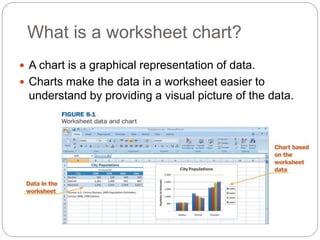
What is a worksheet chart?
ď‚— A chart is a graphical representation of data.
ď‚— Charts make the data in a worksheet easier to
understand by providing a visual picture of the data.
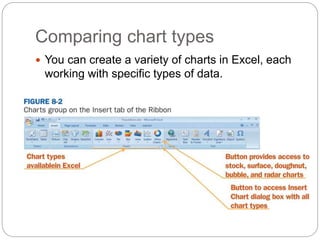
Comparing chart types
ď‚— You can create a variety of charts in Excel, each
working with specific types of data.
Chart types
ď‚— Column chart (bar graph): Uses bars to illustrate
values in a worksheet, and shows relationships
among categories.
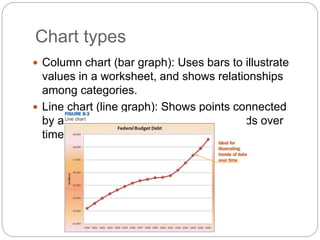
ď‚— Line chart (line graph): Shows points connected
by a line, and is ideal for illustrating trends over
time.
Chart types
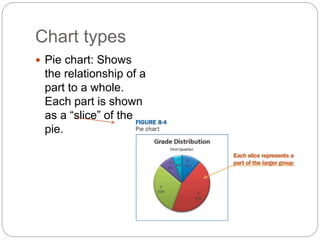
ď‚— Pie chart: Shows
the relationship of a
part to a whole.
Each part is shown
as a “slice” of the
pie.
Creating charts
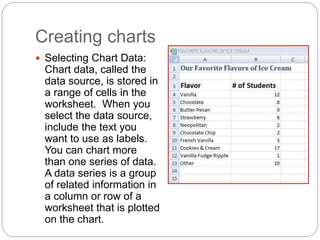
ď‚— Selecting Chart Data:
Chart data, called the
data source, is stored in
a range of cells in the
worksheet. When you
select the data source,
include the text you
want to use as labels.
You can chart more
than one series of data.
A data series is a group
of related information in
a column or row of a
worksheet that is plotted
on the chart.
Creating charts
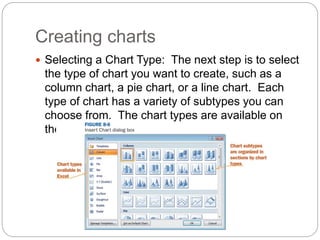
ď‚— Selecting a Chart Type: The next step is to select
the type of chart you want to create, such as a
column chart, a pie chart, or a line chart. Each
type of chart has a variety of subtypes you can
choose from. The chart types are available on
the Insert tab in the Charts group.
Creating charts
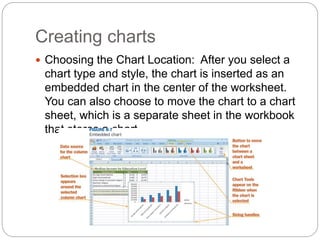
ď‚— Choosing the Chart Location: After you select a
chart type and style, the chart is inserted as an
embedded chart in the center of the worksheet.
You can also choose to move the chart to a chart
sheet, which is a separate sheet in the workbook
that stores a chart.
Troubleshooting tip
ď‚— Embedded charts are useful when you want to
print a chart next to the data the chart illustrates.
ď‚— When a chart will be displayed or printed without
the data used to create the chart, a separate
chart sheet is usually more appropriate.
ď‚— A chart, whether embedded in a worksheet or on
a chart sheet, is considered part of a workbook.
ď‚— When you save the workbook, you also save the
charts you have created.
Making a separate chart sheet
ď‚— You can choose to move the chart to a chart
sheet, which is a separate sheet in the workbook
that stores a chart.
ď‚— A chart sheet displays the chart without its data
source.
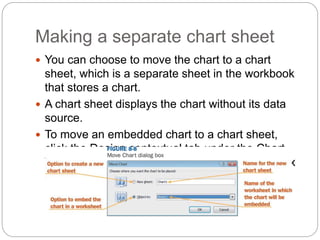
ď‚— To move an embedded chart to a chart sheet,
click the Design contextual tab under the Chart
Tools on the Ribbon. The Move Chart dialog box
appears, as shown below:
Design a chart
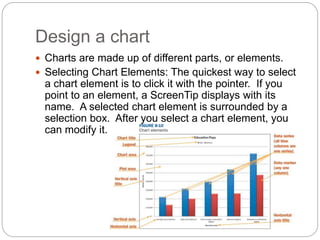
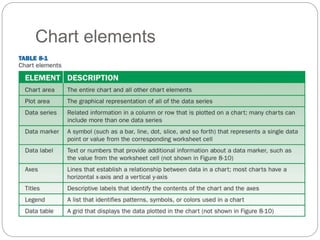
ď‚— Charts are made up of different parts, or elements.
ď‚— Selecting Chart Elements: The quickest way to select
a chart element is to click it with the pointer. If you
point to an element, a ScreenTip displays with its
name. A selected chart element is surrounded by a
selection box. After you select a chart element, you
can modify it.
Chart elements
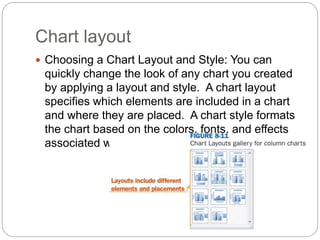
Chart layout
ď‚— Choosing a Chart Layout and Style: You can
quickly change the look of any chart you created
by applying a layout and style. A chart layout
specifies which elements are included in a chart
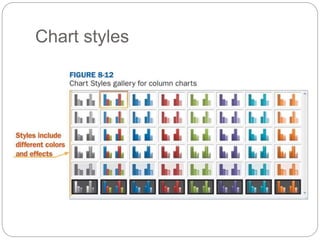
and where they are placed. A chart style formats
the chart based on the colors, fonts, and effects
associated with the workbook’s theme.
Chart styles
Arranging chart elements
ď‚— Arranging Chart Elements: You can create a
specific look for a chart by specifying which chart
elements appear in the chart and where they are
located. For example, you can choose when and
where to display the chart title, axis titles, legend,
data labels, data table, axes, gridlines, and the
plot area.
1. Select the chart.
2. Then, click the Layout tab under Chart Tools on
the Ribbon.
3. The Labels, Axes, and Background groups
contain buttons for each element.

excel charts and graphs.ppt

  • 1.
  • 2.
    What is aworksheet chart? ď‚— A chart is a graphical representation of data. ď‚— Charts make the data in a worksheet easier to understand by providing a visual picture of the data.
  • 3.
    Comparing chart types ď‚—You can create a variety of charts in Excel, each working with specific types of data.
  • 4.
    Chart types ď‚— Columnchart (bar graph): Uses bars to illustrate values in a worksheet, and shows relationships among categories. ď‚— Line chart (line graph): Shows points connected by a line, and is ideal for illustrating trends over time.
  • 5.
    Chart types  Piechart: Shows the relationship of a part to a whole. Each part is shown as a “slice” of the pie.
  • 6.
    Creating charts ď‚— SelectingChart Data: Chart data, called the data source, is stored in a range of cells in the worksheet. When you select the data source, include the text you want to use as labels. You can chart more than one series of data. A data series is a group of related information in a column or row of a worksheet that is plotted on the chart.
  • 7.
    Creating charts ď‚— Selectinga Chart Type: The next step is to select the type of chart you want to create, such as a column chart, a pie chart, or a line chart. Each type of chart has a variety of subtypes you can choose from. The chart types are available on the Insert tab in the Charts group.
  • 8.
    Creating charts ď‚— Choosingthe Chart Location: After you select a chart type and style, the chart is inserted as an embedded chart in the center of the worksheet. You can also choose to move the chart to a chart sheet, which is a separate sheet in the workbook that stores a chart.
  • 9.
    Troubleshooting tip ď‚— Embeddedcharts are useful when you want to print a chart next to the data the chart illustrates. ď‚— When a chart will be displayed or printed without the data used to create the chart, a separate chart sheet is usually more appropriate. ď‚— A chart, whether embedded in a worksheet or on a chart sheet, is considered part of a workbook. ď‚— When you save the workbook, you also save the charts you have created.
  • 10.
    Making a separatechart sheet ď‚— You can choose to move the chart to a chart sheet, which is a separate sheet in the workbook that stores a chart. ď‚— A chart sheet displays the chart without its data source. ď‚— To move an embedded chart to a chart sheet, click the Design contextual tab under the Chart Tools on the Ribbon. The Move Chart dialog box appears, as shown below:
  • 11.
    Design a chart ď‚—Charts are made up of different parts, or elements. ď‚— Selecting Chart Elements: The quickest way to select a chart element is to click it with the pointer. If you point to an element, a ScreenTip displays with its name. A selected chart element is surrounded by a selection box. After you select a chart element, you can modify it.
  • 12.
  • 13.
    Chart layout  Choosinga Chart Layout and Style: You can quickly change the look of any chart you created by applying a layout and style. A chart layout specifies which elements are included in a chart and where they are placed. A chart style formats the chart based on the colors, fonts, and effects associated with the workbook’s theme.
  • 14.
  • 15.
    Arranging chart elements ď‚—Arranging Chart Elements: You can create a specific look for a chart by specifying which chart elements appear in the chart and where they are located. For example, you can choose when and where to display the chart title, axis titles, legend, data labels, data table, axes, gridlines, and the plot area. 1. Select the chart. 2. Then, click the Layout tab under Chart Tools on the Ribbon. 3. The Labels, Axes, and Background groups contain buttons for each element.