Dr. Umair Khan
House officer
SW-2 BVH Bahawalpur

 Patient named abdul rehman he met an accident 13
days before and his right leg was amputated and
then patient was shifted from orthopedics ward to
COD with acute abdominal pain, tenderness and
severe guarding . Patient was initially resuscitated
with fluids and nasogastric tube passed and foley's
catheter passed and investigated. There was free
fluid in abdomen and exploratory laparotomy was
planned……
CASE PRESENTATION

An acute intra-abdominal condition of abrupt onset
that is usually associated with pain due inflammation,
perforation, obstruction, infarction or rupture of
abdominal organs in previously healthy person and
usually requiring emergency intervention.
How will we define acute abdomen

It has an acute onset, it can have many
potential etiologies and may required
immediate medical or surgical
intervention, also is mostly accompany by
signs of peritoneal irritation (with some
exceptions) like: rigidity, tenderness (with
or without rebound), involuntary guarding,
also may or may not have signs of
hypotension and shock.
Acute abdomen

• Gastrointestinal tract disorders
Nonspecific abdominal pain
Appendicitis
Small and large bowel obstruction
Perforated peptic ulcer
Incarcerated hernia
Bowel perforation
Meckel's diverticulitis
Boerhaave's syndrome
Diverticulitis
Inflammatory bowel disorders
Mallory-Weiss syndrome
Gastroenteritis
Acute gastritis
Mesenteric adenitis
Parasitic infections
Causes of acute abdomen:

Liver, spleen, and biliary tract disorders
 Acute cholecystitis
 Acute cholangitis
 Hepatic abscess
 Ruptured hepatic tumor
 Spontaneous rupture of the spleen
 Splenic infarct
 Biliary colic
 Acute hepatitis
 Pancreatic disorders
 Acute pancreatitis

Urinary tract disorders
 Ureteral or renal colic
Acute pyelonephritis
 Acute cystitis
 Renal infarct
Gynecologic disorders
 Ruptured ectopic pregnancy
 Twisted ovarian tumor
 Ruptured ovarian follicle cyst
 Acute salpingitis
 Dysmenorrhea
 Endometrios

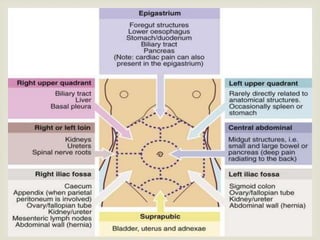
Visceral pain
 – Distention, inflammation or
ischaemia in hollow viscous
& solid organs
 – Localisation depends on the
embryologic origin of the
organ:
• Forgut to epigastrium
• Midgut to umbilicus
• Hindgut to the
hypogastric region
• Parietal pain
 – is localised to the
dermatome above the site
of the stimulus.
 • Referred pain
 – produces symptoms, not
signs e.g. tenderness
Types of Pain:


 Location of Pain
 visceral pain :is elicited by distention, by
inflammation or ischemia stimulating the receptor neurons, or by
direct involvement (e.g., malignant infiltration) of sensory nerves.
The centrally perceived sensation is generally slow in
onset, dull, poorly localized, and protracted
 parietal pain : is mediated by both C and A delta nerve
fibers, the latter being responsible for the transmission of more
acute, sharper, better-localized pain sensation. Direct irritation of
the somatically innervated parietal peritoneum (especially the
anterior and upper parts) by pus, bile, urine, or gastrointestinal
secretions leads to more precisely localized pain
 Referred pain :denotes noxious (usually cutaneous)
sensations perceived at a site distant from that of a strong primary
stimulus. Distorted central perception of the site of pain is due totory taking…..
How to proceed:

Spreading or shifting pain
parallels the course of the underlying
condition. The site of pain at onset should
be distinguished from the site at
presentation
• Mode of Onset and Progression of Pain
The mode of onset of pain reflects the
nature and severity of the inciting process.
Onset may be explosive (within
seconds), rapidly progressive (within 1–2 days).

• Sharp superficial constant pain due to severe peritoneal irritation is typical of perforated ulcer or a ruptured
appendix, ovarian cyst, or ectopic pregnancy
• The gripping, mounting pain of small bowel obstruction (and occasionally early pancreatitis) is usually
intermittent, vague, deep-seated, and crescendo at first but soon becomes sharper, unremitting, and better localized
• Unlike the disquieting but bearable pain associated with bowel obstruction, pain caused by lesions occluding
smaller conduits (bile ducts, uterine tubes, and ureters) rapidly becomes unbearably intense
• colic if there are pain-free intervals that reflect intermittent smooth muscle contractions, as in ureteral colic
• "biliary colic" is a misnomer because biliary pain does not remit. The reason is that the gallbladder and bile
duct, in contrast to the ureters and intestine, do not have peristaltic movements
• The "aching discomfort" of ulcer pain
• the "stabbing, breathtaking" pain of acute pancreatitis and mesenteric infarction
• the "searing" pain of ruptured aortic aneurysm
Character of Pain : The nature, severity, and
periodicity of pain provide useful clues to the
underlying cause

• Despite the use of such descriptive terms, the quality of
visceral pain is not a reliable clue to its cause.
gas stoppage sign :
An occasional patient will deny pain but
complain of a vague feeling of abdominal fullness that feels as though it
might be relieved by a bowel movement. It is due to reflex ileus induced by
an inflammatory lesion walled off from the free peritoneal cavity, as in
retrocecal or retroileal appendicitis.
factors that aggravate or relieve pain
 Pain caused by localized peritonitis, especially
when it affects upper abdominal organs, tends
to be exacerbated by movement or deep
breathing.

Other associated features:
 Constipation
 Diarrhea
 Vomiting
 Hematemesis
 Jaundice
 Hematuria

How to investigate

Abdominal exam
• Inspection
• Auscultation
• Cough Tenderness
• Percussion
• Guarding or rigidity
Palpation
– Light palpation
– Deep palpation
– Rebound tenderness
– Punch tenderness
• Costal area
• Costovertebral area
• Special tests/signs
• Rectal and pelvic examination
Examination

 General Principles of Timing of Diagnostic
Studies in an Acute Abdomen
 Immediate
 Blood Hematocrit, white
 blood cell count,
 urea, creatinine,
 crossmatching,
 arterial gases.
 Clotting studies,
 amylase,
 Liver function tests
 Urine Microscopy,
 Dipstick test
Investigation

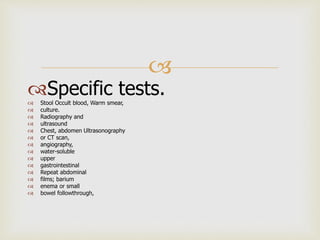
Specific tests. Stool Occult blood, Warm smear,
 culture.
 Radiography and
 ultrasound
 Chest, abdomen Ultrasonography
 or CT scan,
 angiography,
 water-soluble
 upper
 gastrointestinal
 Repeat abdominal
 films; barium
 enema or small
 bowel followthrough,

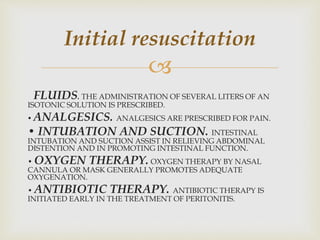
FLUIDS. THE ADMINISTRATION OF SEVERAL LITERS OF AN
ISOTONIC SOLUTION IS PRESCRIBED.
• ANALGESICS. ANALGESICS ARE PRESCRIBED FOR PAIN.
• INTUBATION AND SUCTION. INTESTINAL
INTUBATION AND SUCTION ASSIST IN RELIEVING ABDOMINAL
DISTENTION AND IN PROMOTING INTESTINAL FUNCTION.
• OXYGEN THERAPY. OXYGEN THERAPY BY NASAL
CANNULA OR MASK GENERALLY PROMOTES ADEQUATE
OXYGENATION.
• ANTIBIOTIC THERAPY. ANTIBIOTIC THERAPY IS
INITIATED EARLY IN THE TREATMENT OF PERITONITIS.
Initial resuscitation
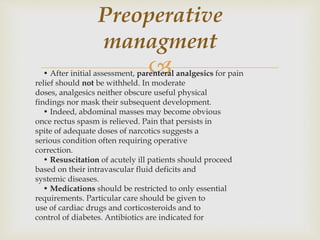
• After initial assessment, parenteral analgesics for pain
relief should not be withheld. In moderate
doses, analgesics neither obscure useful physical
findings nor mask their subsequent development.
• Indeed, abdominal masses may become obvious
once rectus spasm is relieved. Pain that persists in
spite of adequate doses of narcotics suggests a
serious condition often requiring operative
correction.
• Resuscitation of acutely ill patients should proceed
based on their intravascular fluid deficits and
systemic diseases.
• Medications should be restricted to only essential
requirements. Particular care should be given to
use of cardiac drugs and corticosteroids and to
control of diabetes. Antibiotics are indicated for
Preoperative
managment

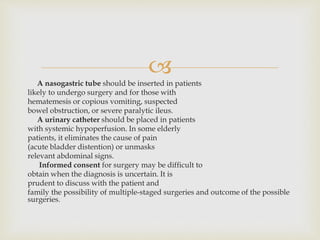
A nasogastric tube should be inserted in patients
likely to undergo surgery and for those with
hematemesis or copious vomiting, suspected
bowel obstruction, or severe paralytic ileus.
A urinary catheter should be placed in patients
with systemic hypoperfusion. In some elderly
patients, it eliminates the cause of pain
(acute bladder distention) or unmasks
relevant abdominal signs.
Informed consent for surgery may be difficult to
obtain when the diagnosis is uncertain. It is
prudent to discuss with the patient and
family the possibility of multiple-staged surgeries and outcome of the possible
surgeries.
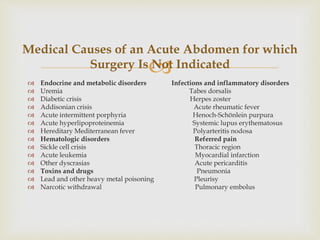
 Endocrine and metabolic disorders Infections and inflammatory disorders
 Uremia Tabes dorsalis
 Diabetic crisis Herpes zoster
 Addisonian crisis Acute rheumatic fever
 Acute intermittent porphyria Henoch-Schönlein purpura
 Acute hyperlipoproteinemia Systemic lupus erythematosus
 Hereditary Mediterranean fever Polyarteritis nodosa
 Hematologic disorders Referred pain
 Sickle cell crisis Thoracic region
 Acute leukemia Myocardial infarction
 Other dyscrasias Acute pericarditis
 Toxins and drugs Pneumonia
 Lead and other heavy metal poisoning Pleurisy
 Narcotic withdrawal Pulmonary embolus
Medical Causes of an Acute Abdomen for which
Surgery Is Not Indicated

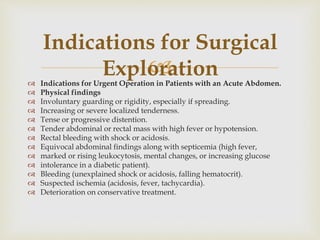
 Indications for Urgent Operation in Patients with an Acute Abdomen.
 Physical findings
 Involuntary guarding or rigidity, especially if spreading.
 Increasing or severe localized tenderness.
 Tense or progressive distention.
 Tender abdominal or rectal mass with high fever or hypotension.
 Rectal bleeding with shock or acidosis.
 Equivocal abdominal findings along with septicemia (high fever,
 marked or rising leukocytosis, mental changes, or increasing glucose
 intolerance in a diabetic patient).
 Bleeding (unexplained shock or acidosis, falling hematocrit).
 Suspected ischemia (acidosis, fever, tachycardia).
 Deterioration on conservative treatment.
Indications for Surgical
Exploration


Acute abdomen

  • 1.
    Dr. Umair Khan Houseofficer SW-2 BVH Bahawalpur
  • 2.
      Patient namedabdul rehman he met an accident 13 days before and his right leg was amputated and then patient was shifted from orthopedics ward to COD with acute abdominal pain, tenderness and severe guarding . Patient was initially resuscitated with fluids and nasogastric tube passed and foley's catheter passed and investigated. There was free fluid in abdomen and exploratory laparotomy was planned…… CASE PRESENTATION
  • 3.
     An acute intra-abdominalcondition of abrupt onset that is usually associated with pain due inflammation, perforation, obstruction, infarction or rupture of abdominal organs in previously healthy person and usually requiring emergency intervention. How will we define acute abdomen
  • 4.
     It has anacute onset, it can have many potential etiologies and may required immediate medical or surgical intervention, also is mostly accompany by signs of peritoneal irritation (with some exceptions) like: rigidity, tenderness (with or without rebound), involuntary guarding, also may or may not have signs of hypotension and shock. Acute abdomen
  • 5.
     • Gastrointestinal tractdisorders Nonspecific abdominal pain Appendicitis Small and large bowel obstruction Perforated peptic ulcer Incarcerated hernia Bowel perforation Meckel's diverticulitis Boerhaave's syndrome Diverticulitis Inflammatory bowel disorders Mallory-Weiss syndrome Gastroenteritis Acute gastritis Mesenteric adenitis Parasitic infections Causes of acute abdomen:
  • 6.
     Liver, spleen, andbiliary tract disorders  Acute cholecystitis  Acute cholangitis  Hepatic abscess  Ruptured hepatic tumor  Spontaneous rupture of the spleen  Splenic infarct  Biliary colic  Acute hepatitis  Pancreatic disorders  Acute pancreatitis
  • 7.
     Urinary tract disorders Ureteral or renal colic Acute pyelonephritis  Acute cystitis  Renal infarct Gynecologic disorders  Ruptured ectopic pregnancy  Twisted ovarian tumor  Ruptured ovarian follicle cyst  Acute salpingitis  Dysmenorrhea  Endometrios
  • 8.
     Visceral pain  –Distention, inflammation or ischaemia in hollow viscous & solid organs  – Localisation depends on the embryologic origin of the organ: • Forgut to epigastrium • Midgut to umbilicus • Hindgut to the hypogastric region • Parietal pain  – is localised to the dermatome above the site of the stimulus.  • Referred pain  – produces symptoms, not signs e.g. tenderness Types of Pain:
  • 9.
  • 10.
      Location ofPain  visceral pain :is elicited by distention, by inflammation or ischemia stimulating the receptor neurons, or by direct involvement (e.g., malignant infiltration) of sensory nerves. The centrally perceived sensation is generally slow in onset, dull, poorly localized, and protracted  parietal pain : is mediated by both C and A delta nerve fibers, the latter being responsible for the transmission of more acute, sharper, better-localized pain sensation. Direct irritation of the somatically innervated parietal peritoneum (especially the anterior and upper parts) by pus, bile, urine, or gastrointestinal secretions leads to more precisely localized pain  Referred pain :denotes noxious (usually cutaneous) sensations perceived at a site distant from that of a strong primary stimulus. Distorted central perception of the site of pain is due totory taking….. How to proceed:
  • 11.
     Spreading or shiftingpain parallels the course of the underlying condition. The site of pain at onset should be distinguished from the site at presentation • Mode of Onset and Progression of Pain The mode of onset of pain reflects the nature and severity of the inciting process. Onset may be explosive (within seconds), rapidly progressive (within 1–2 days).
  • 12.
     • Sharp superficialconstant pain due to severe peritoneal irritation is typical of perforated ulcer or a ruptured appendix, ovarian cyst, or ectopic pregnancy • The gripping, mounting pain of small bowel obstruction (and occasionally early pancreatitis) is usually intermittent, vague, deep-seated, and crescendo at first but soon becomes sharper, unremitting, and better localized • Unlike the disquieting but bearable pain associated with bowel obstruction, pain caused by lesions occluding smaller conduits (bile ducts, uterine tubes, and ureters) rapidly becomes unbearably intense • colic if there are pain-free intervals that reflect intermittent smooth muscle contractions, as in ureteral colic • "biliary colic" is a misnomer because biliary pain does not remit. The reason is that the gallbladder and bile duct, in contrast to the ureters and intestine, do not have peristaltic movements • The "aching discomfort" of ulcer pain • the "stabbing, breathtaking" pain of acute pancreatitis and mesenteric infarction • the "searing" pain of ruptured aortic aneurysm Character of Pain : The nature, severity, and periodicity of pain provide useful clues to the underlying cause
  • 13.
     • Despite theuse of such descriptive terms, the quality of visceral pain is not a reliable clue to its cause. gas stoppage sign : An occasional patient will deny pain but complain of a vague feeling of abdominal fullness that feels as though it might be relieved by a bowel movement. It is due to reflex ileus induced by an inflammatory lesion walled off from the free peritoneal cavity, as in retrocecal or retroileal appendicitis. factors that aggravate or relieve pain  Pain caused by localized peritonitis, especially when it affects upper abdominal organs, tends to be exacerbated by movement or deep breathing.
  • 14.
     Other associated features: Constipation  Diarrhea  Vomiting  Hematemesis  Jaundice  Hematuria
  • 15.
  • 16.
     Abdominal exam • Inspection •Auscultation • Cough Tenderness • Percussion • Guarding or rigidity Palpation – Light palpation – Deep palpation – Rebound tenderness – Punch tenderness • Costal area • Costovertebral area • Special tests/signs • Rectal and pelvic examination Examination
  • 17.
      General Principlesof Timing of Diagnostic Studies in an Acute Abdomen  Immediate  Blood Hematocrit, white  blood cell count,  urea, creatinine,  crossmatching,  arterial gases.  Clotting studies,  amylase,  Liver function tests  Urine Microscopy,  Dipstick test Investigation
  • 18.
     Specific tests. StoolOccult blood, Warm smear,  culture.  Radiography and  ultrasound  Chest, abdomen Ultrasonography  or CT scan,  angiography,  water-soluble  upper  gastrointestinal  Repeat abdominal  films; barium  enema or small  bowel followthrough,
  • 19.
     FLUIDS. THE ADMINISTRATIONOF SEVERAL LITERS OF AN ISOTONIC SOLUTION IS PRESCRIBED. • ANALGESICS. ANALGESICS ARE PRESCRIBED FOR PAIN. • INTUBATION AND SUCTION. INTESTINAL INTUBATION AND SUCTION ASSIST IN RELIEVING ABDOMINAL DISTENTION AND IN PROMOTING INTESTINAL FUNCTION. • OXYGEN THERAPY. OXYGEN THERAPY BY NASAL CANNULA OR MASK GENERALLY PROMOTES ADEQUATE OXYGENATION. • ANTIBIOTIC THERAPY. ANTIBIOTIC THERAPY IS INITIATED EARLY IN THE TREATMENT OF PERITONITIS. Initial resuscitation
  • 20.
    • After initialassessment, parenteral analgesics for pain relief should not be withheld. In moderate doses, analgesics neither obscure useful physical findings nor mask their subsequent development. • Indeed, abdominal masses may become obvious once rectus spasm is relieved. Pain that persists in spite of adequate doses of narcotics suggests a serious condition often requiring operative correction. • Resuscitation of acutely ill patients should proceed based on their intravascular fluid deficits and systemic diseases. • Medications should be restricted to only essential requirements. Particular care should be given to use of cardiac drugs and corticosteroids and to control of diabetes. Antibiotics are indicated for Preoperative managment
  • 21.
     A nasogastric tubeshould be inserted in patients likely to undergo surgery and for those with hematemesis or copious vomiting, suspected bowel obstruction, or severe paralytic ileus. A urinary catheter should be placed in patients with systemic hypoperfusion. In some elderly patients, it eliminates the cause of pain (acute bladder distention) or unmasks relevant abdominal signs. Informed consent for surgery may be difficult to obtain when the diagnosis is uncertain. It is prudent to discuss with the patient and family the possibility of multiple-staged surgeries and outcome of the possible surgeries.
  • 22.
     Endocrine andmetabolic disorders Infections and inflammatory disorders  Uremia Tabes dorsalis  Diabetic crisis Herpes zoster  Addisonian crisis Acute rheumatic fever  Acute intermittent porphyria Henoch-Schönlein purpura  Acute hyperlipoproteinemia Systemic lupus erythematosus  Hereditary Mediterranean fever Polyarteritis nodosa  Hematologic disorders Referred pain  Sickle cell crisis Thoracic region  Acute leukemia Myocardial infarction  Other dyscrasias Acute pericarditis  Toxins and drugs Pneumonia  Lead and other heavy metal poisoning Pleurisy  Narcotic withdrawal Pulmonary embolus Medical Causes of an Acute Abdomen for which Surgery Is Not Indicated
  • 23.
      Indications forUrgent Operation in Patients with an Acute Abdomen.  Physical findings  Involuntary guarding or rigidity, especially if spreading.  Increasing or severe localized tenderness.  Tense or progressive distention.  Tender abdominal or rectal mass with high fever or hypotension.  Rectal bleeding with shock or acidosis.  Equivocal abdominal findings along with septicemia (high fever,  marked or rising leukocytosis, mental changes, or increasing glucose  intolerance in a diabetic patient).  Bleeding (unexplained shock or acidosis, falling hematocrit).  Suspected ischemia (acidosis, fever, tachycardia).  Deterioration on conservative treatment. Indications for Surgical Exploration
  • 24.