
Bio 22 Lab
Bettina Lee
Josh Protacio
Justin Tcheng
Darla Teylan
EXERCISE 17:
PHYSIOLOGY OF
DIGESTION
(BENEDICT’S TEST)
Be familiar with the biochemical
tests for STARCH
Determine effects of enzymes, pH,
and temperature on the digestion of
carbohydrates
OBJECTIVES
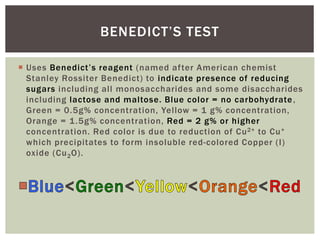
 Uses Benedict’s reagent (named after American chemist
Stanley Rossiter Benedict) to indicate presence of reducing
sugars including all monosaccharides and some disaccharides
including lactose and maltose. Blue color = no carbohydrate,
Green = 0.5g% concentration, Yellow = 1 g% concentration,
Orange = 1.5g% concentration, Red = 2 g% or higher
concentration. Red color is due to reduction of Cu2+ to Cu+
which precipitates to form insoluble red-colored Copper (I)
oxide (Cu2O).
BENEDICT’S TEST
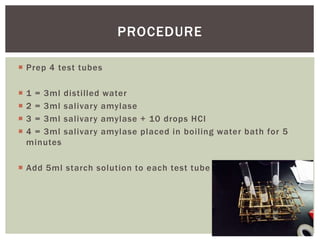
 Prep 4 test tubes
 1 = 3ml distilled water
 2 = 3ml salivary amylase
 3 = 3ml salivary amylase + 10 drops HCl
 4 = 3ml salivary amylase placed in boiling water bath for 5
minutes
 Add 5ml starch solution to each test tube
PROCEDURE
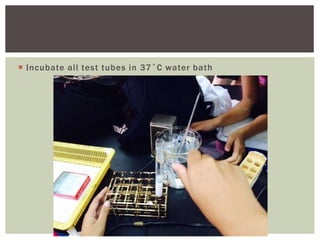
 Incubate all test tubes in 37˚C water bath
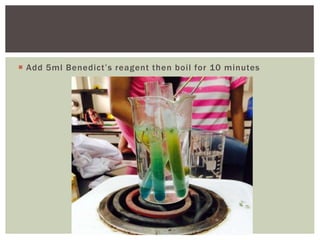
 Add 5ml Benedict’s reagent then boil for 10 minutes
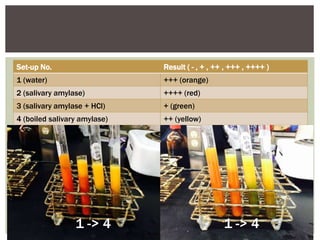
Set-up No. Result ( - , + , ++ , +++ , ++++ )
1 (water) +++ (orange)
2 (salivary amylase) ++++ (red)
3 (salivary amylase + HCl) + (green)
4 (boiled salivary amylase) ++ (yellow)
1 -> 4 1 -> 4
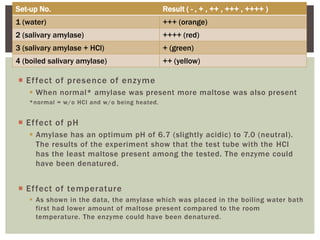
 Effect of presence of enzyme
 When normal* amylase was present more maltose was also present
*normal = w/o HCl and w/o being heated.
 Effect of pH
 Amylase has an optimum pH of 6.7 (slightly acidic) to 7.0 (neutral).
The results of the experiment show that the test tube with the HCl
has the least maltose present among the tested. The enzyme could
have been denatured.
 Effect of temperature
 As shown in the data, the amylase which was placed in the boiling water bath
first had lower amount of maltose present compared to the room
temperature. The enzyme could have been denatured.
Set-up No. Result ( - , + , ++ , +++ , ++++ )
1 (water) +++ (orange)
2 (salivary amylase) ++++ (red)
3 (salivary amylase + HCl) + (green)
4 (boiled salivary amylase) ++ (yellow)
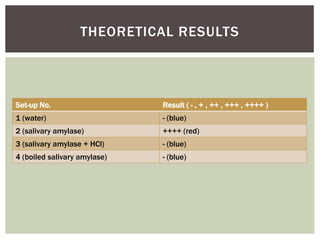
THEORETICAL RESULTS
Set-up No. Result ( - , + , ++ , +++ , ++++ )
1 (water) - (blue)
2 (salivary amylase) ++++ (red)
3 (salivary amylase + HCl) - (blue)
4 (boiled salivary amylase) - (blue)

Ex 17 - Digestive physiology (Benedict's test)

  • 1.
    Bio 22 Lab BettinaLee Josh Protacio Justin Tcheng Darla Teylan EXERCISE 17: PHYSIOLOGY OF DIGESTION (BENEDICT’S TEST)
  • 2.
    Be familiar withthe biochemical tests for STARCH Determine effects of enzymes, pH, and temperature on the digestion of carbohydrates OBJECTIVES
  • 3.
     Uses Benedict’sreagent (named after American chemist Stanley Rossiter Benedict) to indicate presence of reducing sugars including all monosaccharides and some disaccharides including lactose and maltose. Blue color = no carbohydrate, Green = 0.5g% concentration, Yellow = 1 g% concentration, Orange = 1.5g% concentration, Red = 2 g% or higher concentration. Red color is due to reduction of Cu2+ to Cu+ which precipitates to form insoluble red-colored Copper (I) oxide (Cu2O). BENEDICT’S TEST
  • 4.
     Prep 4test tubes  1 = 3ml distilled water  2 = 3ml salivary amylase  3 = 3ml salivary amylase + 10 drops HCl  4 = 3ml salivary amylase placed in boiling water bath for 5 minutes  Add 5ml starch solution to each test tube PROCEDURE
  • 5.
     Incubate alltest tubes in 37˚C water bath
  • 6.
     Add 5mlBenedict’s reagent then boil for 10 minutes
  • 7.
    Set-up No. Result( - , + , ++ , +++ , ++++ ) 1 (water) +++ (orange) 2 (salivary amylase) ++++ (red) 3 (salivary amylase + HCl) + (green) 4 (boiled salivary amylase) ++ (yellow) 1 -> 4 1 -> 4
  • 8.
     Effect ofpresence of enzyme  When normal* amylase was present more maltose was also present *normal = w/o HCl and w/o being heated.  Effect of pH  Amylase has an optimum pH of 6.7 (slightly acidic) to 7.0 (neutral). The results of the experiment show that the test tube with the HCl has the least maltose present among the tested. The enzyme could have been denatured.  Effect of temperature  As shown in the data, the amylase which was placed in the boiling water bath first had lower amount of maltose present compared to the room temperature. The enzyme could have been denatured. Set-up No. Result ( - , + , ++ , +++ , ++++ ) 1 (water) +++ (orange) 2 (salivary amylase) ++++ (red) 3 (salivary amylase + HCl) + (green) 4 (boiled salivary amylase) ++ (yellow)
  • 9.
    THEORETICAL RESULTS Set-up No.Result ( - , + , ++ , +++ , ++++ ) 1 (water) - (blue) 2 (salivary amylase) ++++ (red) 3 (salivary amylase + HCl) - (blue) 4 (boiled salivary amylase) - (blue)