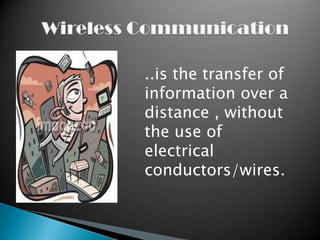
..is the transfer of
information over a
distance , without
the use of
electrical
conductors/wires.
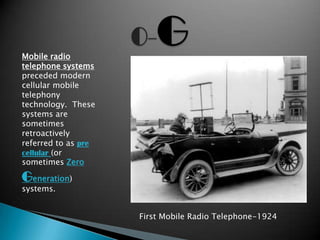
Mobile radio
telephone systems
preceded modern
cellular mobile
telephony
technology. These
systems are
sometimes
retroactively
referred to as pre
cellular (or
sometimes Zero

Generation)
systems.


                     First Mobile Radio Telephone-1924
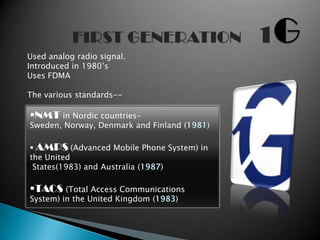
Used analog radio signal.
Introduced in 1980’s
Uses FDMA

The various standards--

NMT in Nordic countries-
Sweden, Norway, Denmark and Finland (   )

 AMPS (Advanced Mobile Phone System) in
the United
 States(1983) and Australia ( )

TACS (Total Access Communications
System) in the United Kingdom (   )
 As Its Analog So It Was Highly Susceptible To Noise


 Traffic Was Not Encrypted So Anyone Could

   Eavesdrop By Tuning To The Correct Frequency
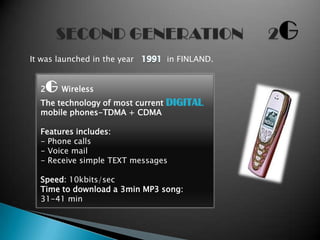
It was launched in the year        in FINLAND.


  2   G Wireless
  The technology of most current   DIGITAL
  mobile phones-TDMA + CDMA

  Features includes:
  - Phone calls
  - Voice mail
  - Receive simple TEXT messages

  Speed: 10kbits/sec
  Time to download a 3min MP3 song:
  31-41 min
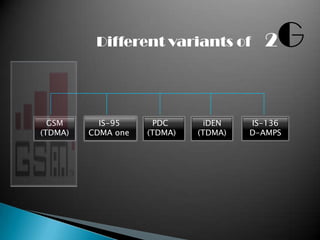
Different variants of         2  G

  GSM      IS-95     PDC      iDEN    IS-136
(TDMA)   CDMA one   (TDMA)   (TDMA)   D-AMPS
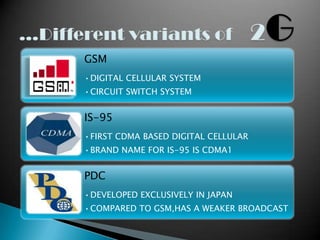
GSM
•DIGITAL CELLULAR SYSTEM
•CIRCUIT SWITCH SYSTEM


IS-95
•FIRST CDMA BASED DIGITAL CELLULAR
•BRAND NAME FOR IS-95 IS CDMA1


PDC
•DEVELOPED EXCLUSIVELY IN JAPAN
•COMPARED TO GSM,HAS A WEAKER BROADCAST
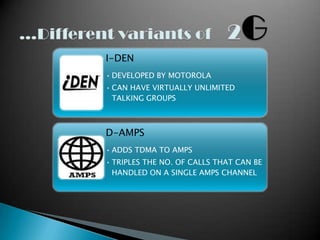
I-DEN
• DEVELOPED BY MOTOROLA
• CAN HAVE VIRTUALLY UNLIMITED
  TALKING GROUPS


D-AMPS
• ADDS TDMA TO AMPS
• TRIPLES THE NO. OF CALLS THAT CAN BE
  HANDLED ON A SINGLE AMPS CHANNEL
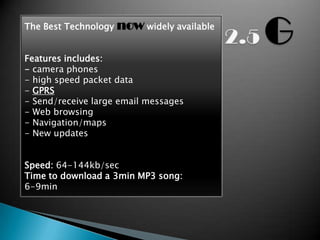
The Best Technology   now widely available

Features includes:
- camera phones
- high speed packet data
- GPRS
- Send/receive large email messages
- Web browsing
- Navigation/maps
- New updates


Speed: 64-144kb/sec
Time to download a 3min MP3 song:
6-9min
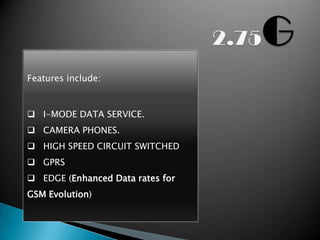
Features include:


 I-MODE DATA SERVICE.
 CAMERA PHONES.
 HIGH SPEED CIRCUIT SWITCHED
 GPRS
 EDGE (Enhanced Data rates for
GSM Evolution)
2G networks were built mainly for voice data and slow
transmission. Due to rapid changes in user expectation, they do
not meet today's wireless needs.
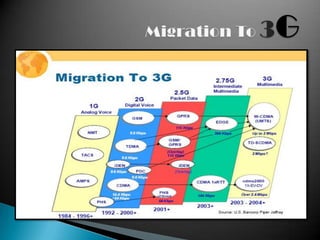
Cellular mobile telecommunications networks are being upgraded
to use 3G technologies from 1999 to 2010. Japan was the first
country to introduce 3G nationally, and in Japan the transition to

3G  was largely completed in 2006. Korea then adopted 3G
Networks soon after and the transition was made as early as
2004.
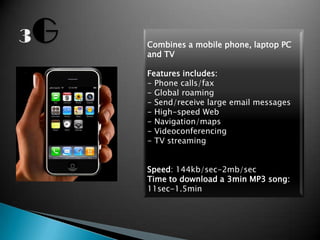
Combines a mobile phone, laptop PC
and TV

Features includes:
- Phone calls/fax
- Global roaming
- Send/receive large email messages
- High-speed Web
- Navigation/maps
- Videoconferencing
- TV streaming


Speed: 144kb/sec-2mb/sec
Time to download a 3min MP3 song:
11sec-1.5min
Capability To Support Circuit And Packet Data At High
    Bit Rates:
•                  or higher in high mobility (vehicular) traffic
•                  for pedestrian traffic
•                  or higher for indoor traffic

Interoperability and roaming

Common billing/user profiles:
 • Sharing of usage/rate information between service
   providers
 • Standardized call detail recording
 • Standardized user profiles
Capability to determine geographic position of
 mobiles and report it to both the network and the
 mobile terminal

Support of multimedia services/capabilities:
 • Fixed and variable rate bit traffic Bandwidth on
   demand
 • Multimedia mail store and forward
 • Broadband access up to
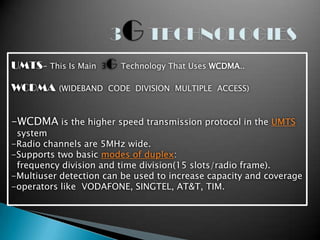
UMTS- This Is Main   3   G Technology That Uses WCDMA..
WCDMA     (WIDEBAND CODE DIVISION MULTIPLE ACCESS)


-WCDMA is the higher speed transmission protocol in the UMTS
 system
-Radio channels are 5MHz wide.
-Supports two basic modes of duplex:
 frequency division and time division(15 slots/radio frame).
-Multiuser detection can be used to increase capacity and coverage
-operators like VODAFONE, SINGTEL, AT&T, TIM.
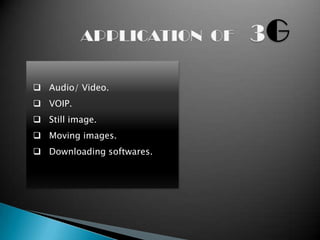
 Audio/ Video.
 VOIP.
 Still image.
 Moving images.
 Downloading softwares.
Features include:
- An efficient system.
- High network capacity.
- Huge data rate.
- Smooth hand off
- Seamless connectivity & global roaming.
- High quality of service.
-An all IP. Packet switched network.


Speed:
 Suppose to allow data transfer up to
          outdoor and          indoor.
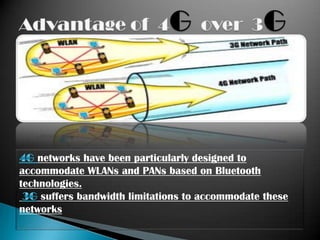
networks have been particularly designed to
accommodate WLANs and PANs based on Bluetooth
technologies.
     suffers bandwidth limitations to accommodate these
networks
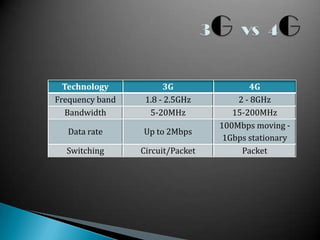
Technology           3G                4G
Frequency band    1.8 - 2.5GHz        2 - 8GHz
   Bandwidth       5-20MHz           15-200MHz
                                  100Mbps moving -
   Data rate     Up to 2Mbps
                                   1Gbps stationary
  Switching      Circuit/Packet        Packet
Data Communications And Networking- B. A.
Forouzan
www.Wikipedia.com
www.nmscommunications.com
www.mobilealliance.com
Encarta Encyclopedia

Mobile generation presentation

  • 2.
    ..is the transferof information over a distance , without the use of electrical conductors/wires.
  • 3.
    Mobile radio telephone systems precededmodern cellular mobile telephony technology. These systems are sometimes retroactively referred to as pre cellular (or sometimes Zero Generation) systems. First Mobile Radio Telephone-1924
  • 4.
    Used analog radiosignal. Introduced in 1980’s Uses FDMA The various standards-- NMT in Nordic countries- Sweden, Norway, Denmark and Finland ( )  AMPS (Advanced Mobile Phone System) in the United States(1983) and Australia ( ) TACS (Total Access Communications System) in the United Kingdom ( )
  • 5.
     As ItsAnalog So It Was Highly Susceptible To Noise  Traffic Was Not Encrypted So Anyone Could Eavesdrop By Tuning To The Correct Frequency
  • 6.
    It was launchedin the year in FINLAND. 2 G Wireless The technology of most current DIGITAL mobile phones-TDMA + CDMA Features includes: - Phone calls - Voice mail - Receive simple TEXT messages Speed: 10kbits/sec Time to download a 3min MP3 song: 31-41 min
  • 7.
    Different variants of 2 G GSM IS-95 PDC iDEN IS-136 (TDMA) CDMA one (TDMA) (TDMA) D-AMPS
  • 8.
    GSM •DIGITAL CELLULAR SYSTEM •CIRCUITSWITCH SYSTEM IS-95 •FIRST CDMA BASED DIGITAL CELLULAR •BRAND NAME FOR IS-95 IS CDMA1 PDC •DEVELOPED EXCLUSIVELY IN JAPAN •COMPARED TO GSM,HAS A WEAKER BROADCAST
  • 9.
    I-DEN • DEVELOPED BYMOTOROLA • CAN HAVE VIRTUALLY UNLIMITED TALKING GROUPS D-AMPS • ADDS TDMA TO AMPS • TRIPLES THE NO. OF CALLS THAT CAN BE HANDLED ON A SINGLE AMPS CHANNEL
  • 10.
    The Best Technology now widely available Features includes: - camera phones - high speed packet data - GPRS - Send/receive large email messages - Web browsing - Navigation/maps - New updates Speed: 64-144kb/sec Time to download a 3min MP3 song: 6-9min
  • 11.
    Features include:  I-MODEDATA SERVICE.  CAMERA PHONES.  HIGH SPEED CIRCUIT SWITCHED  GPRS  EDGE (Enhanced Data rates for GSM Evolution)
  • 12.
    2G networks werebuilt mainly for voice data and slow transmission. Due to rapid changes in user expectation, they do not meet today's wireless needs. Cellular mobile telecommunications networks are being upgraded to use 3G technologies from 1999 to 2010. Japan was the first country to introduce 3G nationally, and in Japan the transition to 3G was largely completed in 2006. Korea then adopted 3G Networks soon after and the transition was made as early as 2004.
  • 13.
    Combines a mobilephone, laptop PC and TV Features includes: - Phone calls/fax - Global roaming - Send/receive large email messages - High-speed Web - Navigation/maps - Videoconferencing - TV streaming Speed: 144kb/sec-2mb/sec Time to download a 3min MP3 song: 11sec-1.5min
  • 14.
    Capability To SupportCircuit And Packet Data At High Bit Rates: • or higher in high mobility (vehicular) traffic • for pedestrian traffic • or higher for indoor traffic Interoperability and roaming Common billing/user profiles: • Sharing of usage/rate information between service providers • Standardized call detail recording • Standardized user profiles
  • 15.
    Capability to determinegeographic position of mobiles and report it to both the network and the mobile terminal Support of multimedia services/capabilities: • Fixed and variable rate bit traffic Bandwidth on demand • Multimedia mail store and forward • Broadband access up to
  • 16.
    UMTS- This IsMain 3 G Technology That Uses WCDMA.. WCDMA (WIDEBAND CODE DIVISION MULTIPLE ACCESS) -WCDMA is the higher speed transmission protocol in the UMTS system -Radio channels are 5MHz wide. -Supports two basic modes of duplex: frequency division and time division(15 slots/radio frame). -Multiuser detection can be used to increase capacity and coverage -operators like VODAFONE, SINGTEL, AT&T, TIM.
  • 17.
     Audio/ Video. VOIP.  Still image.  Moving images.  Downloading softwares.
  • 19.
    Features include: - Anefficient system. - High network capacity. - Huge data rate. - Smooth hand off - Seamless connectivity & global roaming. - High quality of service. -An all IP. Packet switched network. Speed: Suppose to allow data transfer up to outdoor and indoor.
  • 20.
    networks have beenparticularly designed to accommodate WLANs and PANs based on Bluetooth technologies. suffers bandwidth limitations to accommodate these networks
  • 21.
    Technology 3G 4G Frequency band 1.8 - 2.5GHz 2 - 8GHz Bandwidth 5-20MHz 15-200MHz 100Mbps moving - Data rate Up to 2Mbps 1Gbps stationary Switching Circuit/Packet Packet
  • 23.
    Data Communications AndNetworking- B. A. Forouzan www.Wikipedia.com www.nmscommunications.com www.mobilealliance.com Encarta Encyclopedia