Seminar on
SUMMER TRAINING
from
BSNL
BY:- Pankaj Kumar Tiwari
CONTENTS
• Introduction to BSNL
• Overview of telecommunication network
• Overview of broadband access technology
• 3-G communication
• Over view of optical fiber communication
• Summary
Introduction to BSNL
• BSNL is an Indian state-owned telecommunications
company.
• It was incorporated on 15 September 2000.
• It is India’s largest and oldest communication
service provider.
• Before 2000 ,it was known as Department of
telecommunication (DoT).
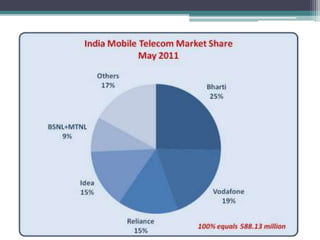
• BSNL is at 5th position as an operator with
Market share of 9%.
Overview of telecommunication
Network
• The telephone is a telecommunication device that is
used to transmit and receive electronically or
digitally encoded speech between two or more
people.
• Telecommunication network carry information
signals among entities.
• The communication switching system enables the
universal connectivity
• The telecommunication links and switching are
mainly designed for voice communication.
• In telephone system the frequency it passes are
restricted to between 300 to3400Hz.
Switching system fundamentals
• Telecommunication switching system generally
perform three basic function.
• They transmit signals over the connection or over
separate channels to convey the identity of the called
address.
• They establish connection through a switching
network for conversational use during the call.
• They process the signal information to control and
supervise the establishment and disconnection of
the switching network connection.
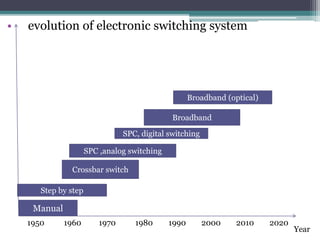
• evolution of electronic switching system
Manual
Step by step
1950 1960 1970 1980 1990 2000 2010 2020
Crossbar switch
SPC ,analog switching
SPC, digital switching
Broadband
Broadband (optical)
Year
Overview of Broadband technology
Introduction
• A concept of broadband services and the means
of access technologies to bridge the customer
and service provider is emerged out through out
the world .
• Broadband refers to high speed internet access.
• The rapid growth of distributed business
application , e-commerce generate the demand
for bandwidth and access network.
Definition of Broadband
• Broadband is the nonspecific term for high speed
digital internet access. There are the various ways to
define the broadband.
• Term for evolving digital technologies that provide
customers a high speed data network connection.
• The federal communication commission defines
broadband as an advanced telecommunication
capability.
• Delivers service & facilities with an upstream and
downstream speed range varies from 128Kbps to
100Mbps.
Need of Broadband
• Professional activities
• Entertainment activities
• Consumer activities
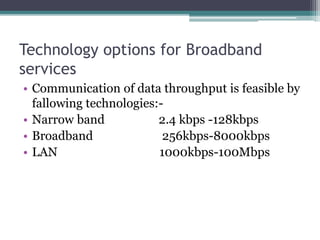
Technology options for Broadband
services
• Communication of data throughput is feasible by
fallowing technologies:-
• Narrow band 2.4 kbps -128kbps
• Broadband 256kbps-8000kbps
• LAN 1000kbps-100Mbps
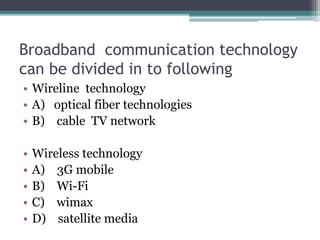
Broadband communication technology
can be divided in to following
• Wireline technology
• A) optical fiber technologies
• B) cable TV network
• Wireless technology
• A) 3G mobile
• B) Wi-Fi
• C) wimax
• D) satellite media
3G communication
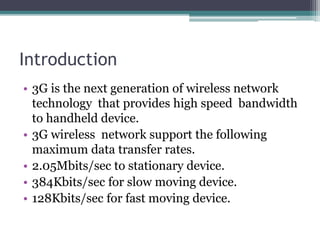
Introduction
• 3G is the next generation of wireless network
technology that provides high speed bandwidth
to handheld device.
• 3G wireless network support the following
maximum data transfer rates.
• 2.05Mbits/sec to stationary device.
• 384Kbits/sec for slow moving device.
• 128Kbits/sec for fast moving device.
Charecterstics
• Always on connectivity. 3G network use IP
connectivity.
• Multimedia service with streaming audio and
video.
• Instant messaging with audio and video clips.
• Fast download of large files.
Advantage of 3G
• More bandwidth.
• Security.
• Reliability.
• Fixed and variable data rates.
• Always online device.
• Rich multimedia.
Disadvantage
• Costly
• Content provisioning to make service popular.
• More high power requirement.
• Application
• Business application
• Multi media services
• Gaming industry
Overview of optical fibre
communication
• An optical fibre ( or fiber ) is a glass or plastic
fibre that carries light along it’s length.
• It has two main component layers: Core &
Cladding.
• Light is kept in the “core” of optical fibre.
• Cladding is for the protection of fibre.
Optical Fibre Construction
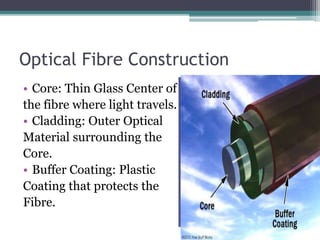
• Core: Thin Glass Center of
the fibre where light travels.
• Cladding: Outer Optical
Material surrounding the
Core.
• Buffer Coating: Plastic
Coating that protects the
Fibre.
Material Used
• The “Core” , & the lower refractive index
“Cladding” , are typically made of high quality
silica glass, though they can be both made of
plastic as well.
Fiber Optic Layers.
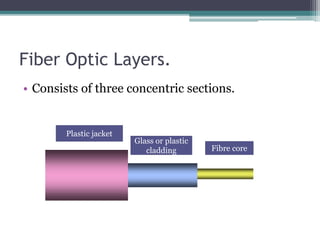
• Consists of three concentric sections.
Plastic jacket
Glass or plastic
cladding Fibre core
Mode Of Propagation
Two main categories that are used in Fibre
Optic Communications are:
• Single mode Optical Fibre
• Multi- Mode Optical Fibre
Single Mode Fibres
• Single-mode fibers – used to transmit one signal per
fiber (used in telephone and cable TV). They have
small cores(9 microns in diameter) and transmit
infra-red light from laser.
Multi-mode Fibres
• Multi-mode fibers – used to transmit many
signals per fiber (used in computer networks).
They have larger cores(62.5 microns in
diameter) and transmit infra-red light from
LED.
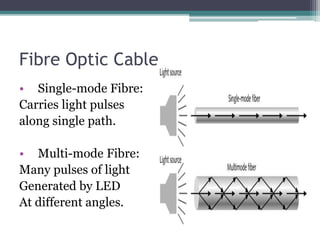
Fibre Optic Cable
• Single-mode Fibre:
Carries light pulses
along single path.
• Multi-mode Fibre:
Many pulses of light
Generated by LED
At different angles.
Fiber Optic Communication
• It is a method of transmitting information from
one place to another by sending light through an
optical fiber.
• The light forms an electromagnetic carrier wave
that is modulated to carry information.
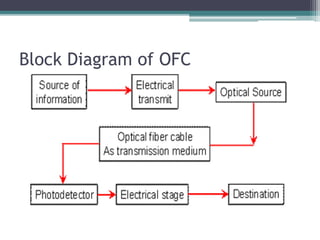
Block Diagram of OFC
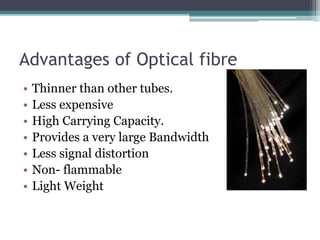
Advantages of Optical fibre
• Thinner than other tubes.
• Less expensive
• High Carrying Capacity.
• Provides a very large Bandwidth
• Less signal distortion
• Non- flammable
• Light Weight
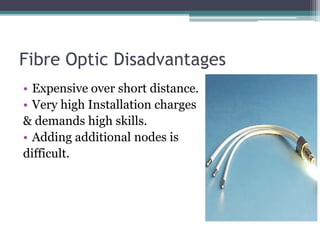
Fibre Optic Disadvantages
• Expensive over short distance.
• Very high Installation charges
& demands high skills.
• Adding additional nodes is
difficult.
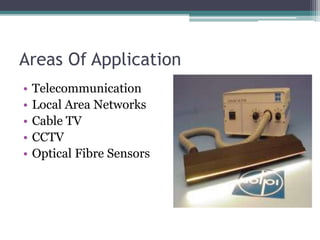
Areas Of Application
• Telecommunication
• Local Area Networks
• Cable TV
• CCTV
• Optical Fibre Sensors
Summary
• So we can say that our daily routine is dependent
on the communication technique like that 3G,
Broad band & optical fibre etc.
Seminar on BSNL

Seminar on BSNL

  • 1.
  • 2.
    CONTENTS • Introduction toBSNL • Overview of telecommunication network • Overview of broadband access technology • 3-G communication • Over view of optical fiber communication • Summary
  • 3.
    Introduction to BSNL •BSNL is an Indian state-owned telecommunications company. • It was incorporated on 15 September 2000. • It is India’s largest and oldest communication service provider. • Before 2000 ,it was known as Department of telecommunication (DoT). • BSNL is at 5th position as an operator with Market share of 9%.
  • 5.
    Overview of telecommunication Network •The telephone is a telecommunication device that is used to transmit and receive electronically or digitally encoded speech between two or more people. • Telecommunication network carry information signals among entities. • The communication switching system enables the universal connectivity • The telecommunication links and switching are mainly designed for voice communication. • In telephone system the frequency it passes are restricted to between 300 to3400Hz.
  • 6.
    Switching system fundamentals •Telecommunication switching system generally perform three basic function. • They transmit signals over the connection or over separate channels to convey the identity of the called address. • They establish connection through a switching network for conversational use during the call. • They process the signal information to control and supervise the establishment and disconnection of the switching network connection.
  • 7.
    • evolution ofelectronic switching system Manual Step by step 1950 1960 1970 1980 1990 2000 2010 2020 Crossbar switch SPC ,analog switching SPC, digital switching Broadband Broadband (optical) Year
  • 8.
  • 9.
    Introduction • A conceptof broadband services and the means of access technologies to bridge the customer and service provider is emerged out through out the world . • Broadband refers to high speed internet access. • The rapid growth of distributed business application , e-commerce generate the demand for bandwidth and access network.
  • 10.
    Definition of Broadband •Broadband is the nonspecific term for high speed digital internet access. There are the various ways to define the broadband. • Term for evolving digital technologies that provide customers a high speed data network connection. • The federal communication commission defines broadband as an advanced telecommunication capability. • Delivers service & facilities with an upstream and downstream speed range varies from 128Kbps to 100Mbps.
  • 11.
    Need of Broadband •Professional activities • Entertainment activities • Consumer activities
  • 12.
    Technology options forBroadband services • Communication of data throughput is feasible by fallowing technologies:- • Narrow band 2.4 kbps -128kbps • Broadband 256kbps-8000kbps • LAN 1000kbps-100Mbps
  • 13.
    Broadband communication technology canbe divided in to following • Wireline technology • A) optical fiber technologies • B) cable TV network • Wireless technology • A) 3G mobile • B) Wi-Fi • C) wimax • D) satellite media
  • 14.
  • 15.
    Introduction • 3G isthe next generation of wireless network technology that provides high speed bandwidth to handheld device. • 3G wireless network support the following maximum data transfer rates. • 2.05Mbits/sec to stationary device. • 384Kbits/sec for slow moving device. • 128Kbits/sec for fast moving device.
  • 16.
    Charecterstics • Always onconnectivity. 3G network use IP connectivity. • Multimedia service with streaming audio and video. • Instant messaging with audio and video clips. • Fast download of large files.
  • 17.
    Advantage of 3G •More bandwidth. • Security. • Reliability. • Fixed and variable data rates. • Always online device. • Rich multimedia.
  • 18.
    Disadvantage • Costly • Contentprovisioning to make service popular. • More high power requirement. • Application • Business application • Multi media services • Gaming industry
  • 19.
    Overview of opticalfibre communication
  • 20.
    • An opticalfibre ( or fiber ) is a glass or plastic fibre that carries light along it’s length. • It has two main component layers: Core & Cladding. • Light is kept in the “core” of optical fibre. • Cladding is for the protection of fibre.
  • 21.
    Optical Fibre Construction •Core: Thin Glass Center of the fibre where light travels. • Cladding: Outer Optical Material surrounding the Core. • Buffer Coating: Plastic Coating that protects the Fibre.
  • 22.
    Material Used • The“Core” , & the lower refractive index “Cladding” , are typically made of high quality silica glass, though they can be both made of plastic as well.
  • 23.
    Fiber Optic Layers. •Consists of three concentric sections. Plastic jacket Glass or plastic cladding Fibre core
  • 24.
    Mode Of Propagation Twomain categories that are used in Fibre Optic Communications are: • Single mode Optical Fibre • Multi- Mode Optical Fibre
  • 25.
    Single Mode Fibres •Single-mode fibers – used to transmit one signal per fiber (used in telephone and cable TV). They have small cores(9 microns in diameter) and transmit infra-red light from laser.
  • 26.
    Multi-mode Fibres • Multi-modefibers – used to transmit many signals per fiber (used in computer networks). They have larger cores(62.5 microns in diameter) and transmit infra-red light from LED.
  • 27.
    Fibre Optic Cable •Single-mode Fibre: Carries light pulses along single path. • Multi-mode Fibre: Many pulses of light Generated by LED At different angles.
  • 28.
    Fiber Optic Communication •It is a method of transmitting information from one place to another by sending light through an optical fiber. • The light forms an electromagnetic carrier wave that is modulated to carry information.
  • 29.
  • 30.
    Advantages of Opticalfibre • Thinner than other tubes. • Less expensive • High Carrying Capacity. • Provides a very large Bandwidth • Less signal distortion • Non- flammable • Light Weight
  • 31.
    Fibre Optic Disadvantages •Expensive over short distance. • Very high Installation charges & demands high skills. • Adding additional nodes is difficult.
  • 32.
    Areas Of Application •Telecommunication • Local Area Networks • Cable TV • CCTV • Optical Fibre Sensors
  • 33.
    Summary • So wecan say that our daily routine is dependent on the communication technique like that 3G, Broad band & optical fibre etc.

Editor's Notes

  • #7 Xbcsljask;pls’ksnklcsklj;oskj