4G
Data Communication
Prepared By
Muhammad Ahmed
Syed Kazim Raza
Muhammad Awais
Contents
Mobile System Generations
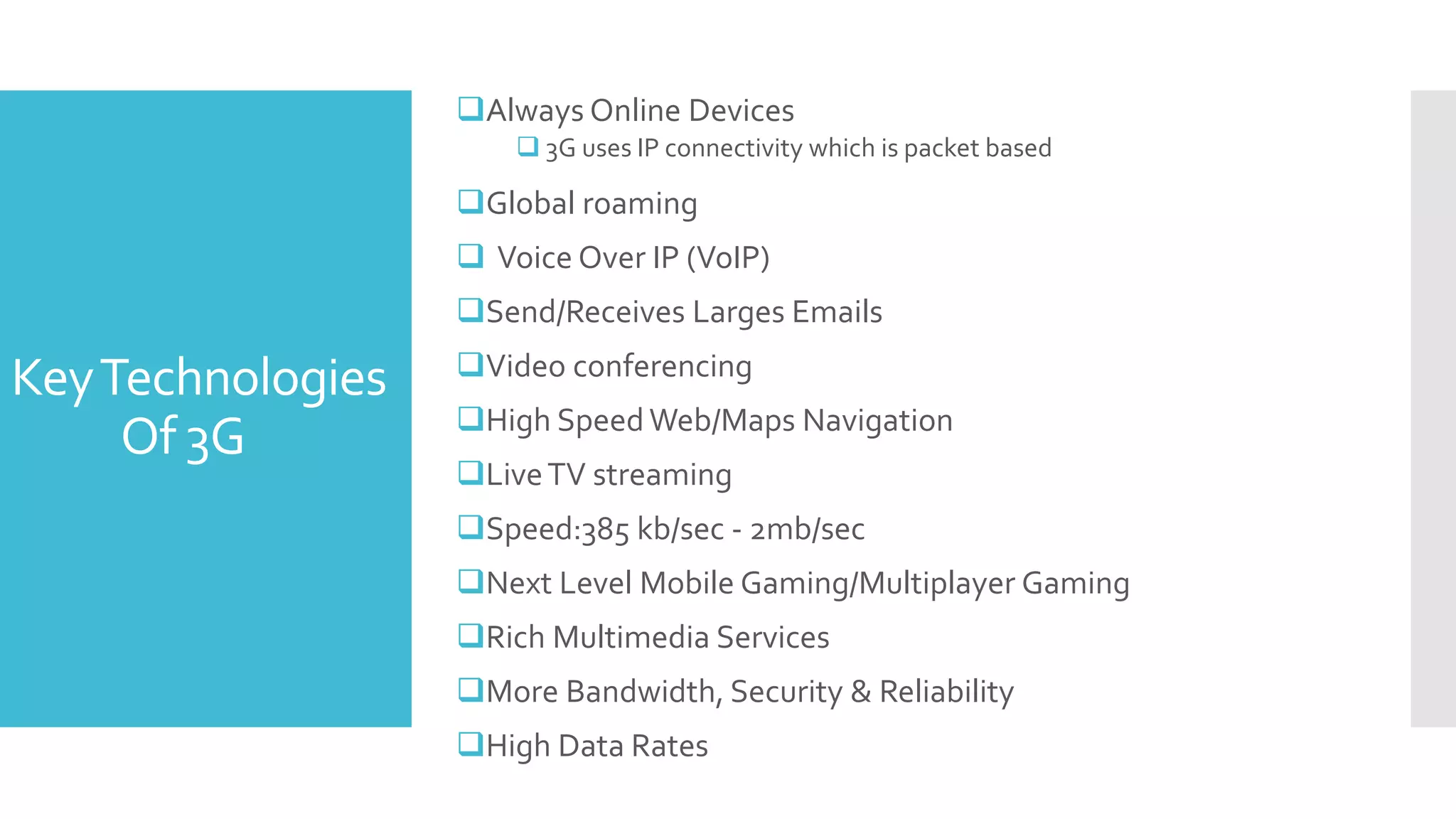
KeyTechnologiesOf 3G
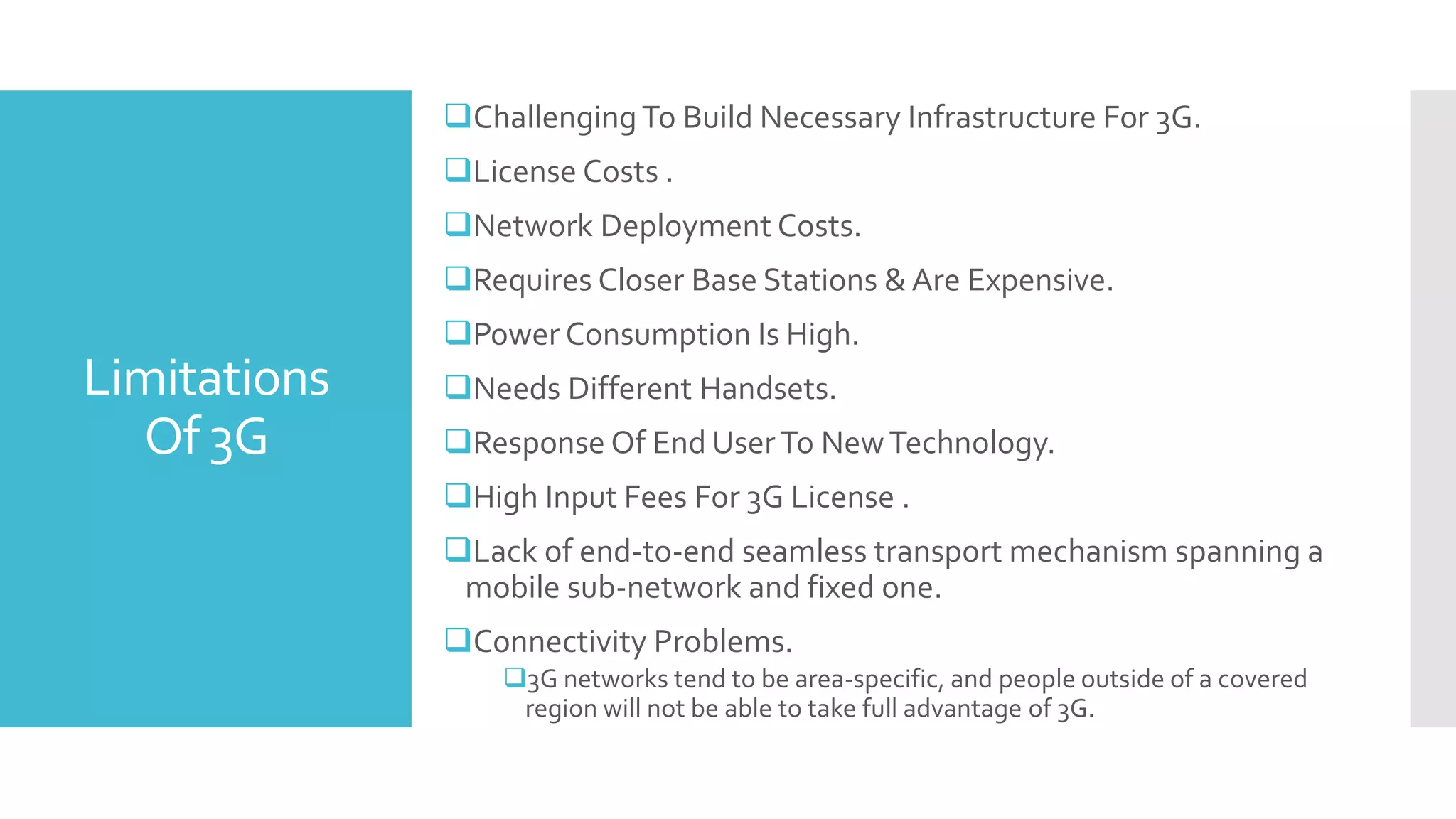
LimitationsOf 3G
3G vs 4g
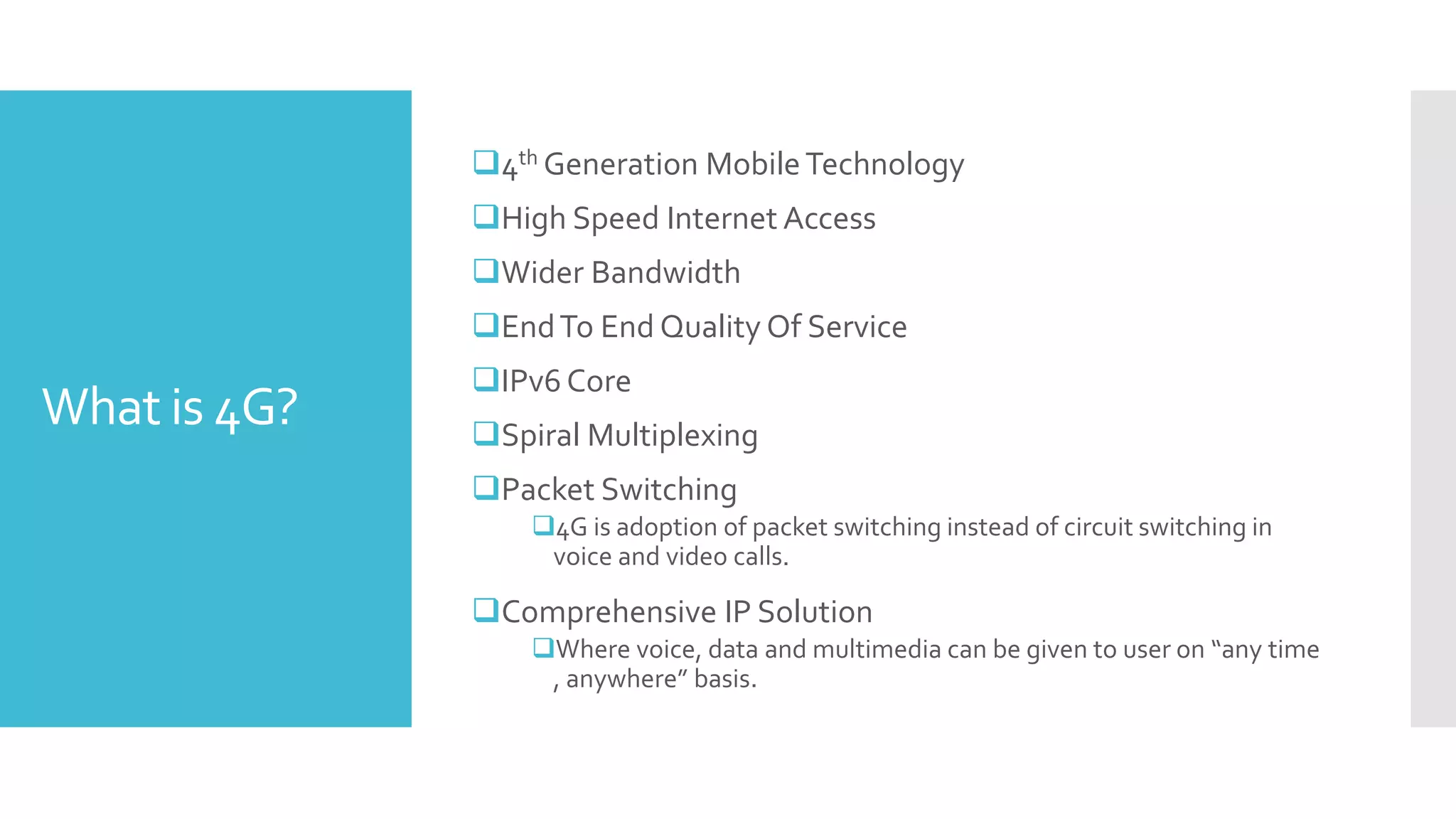
What is 4G?
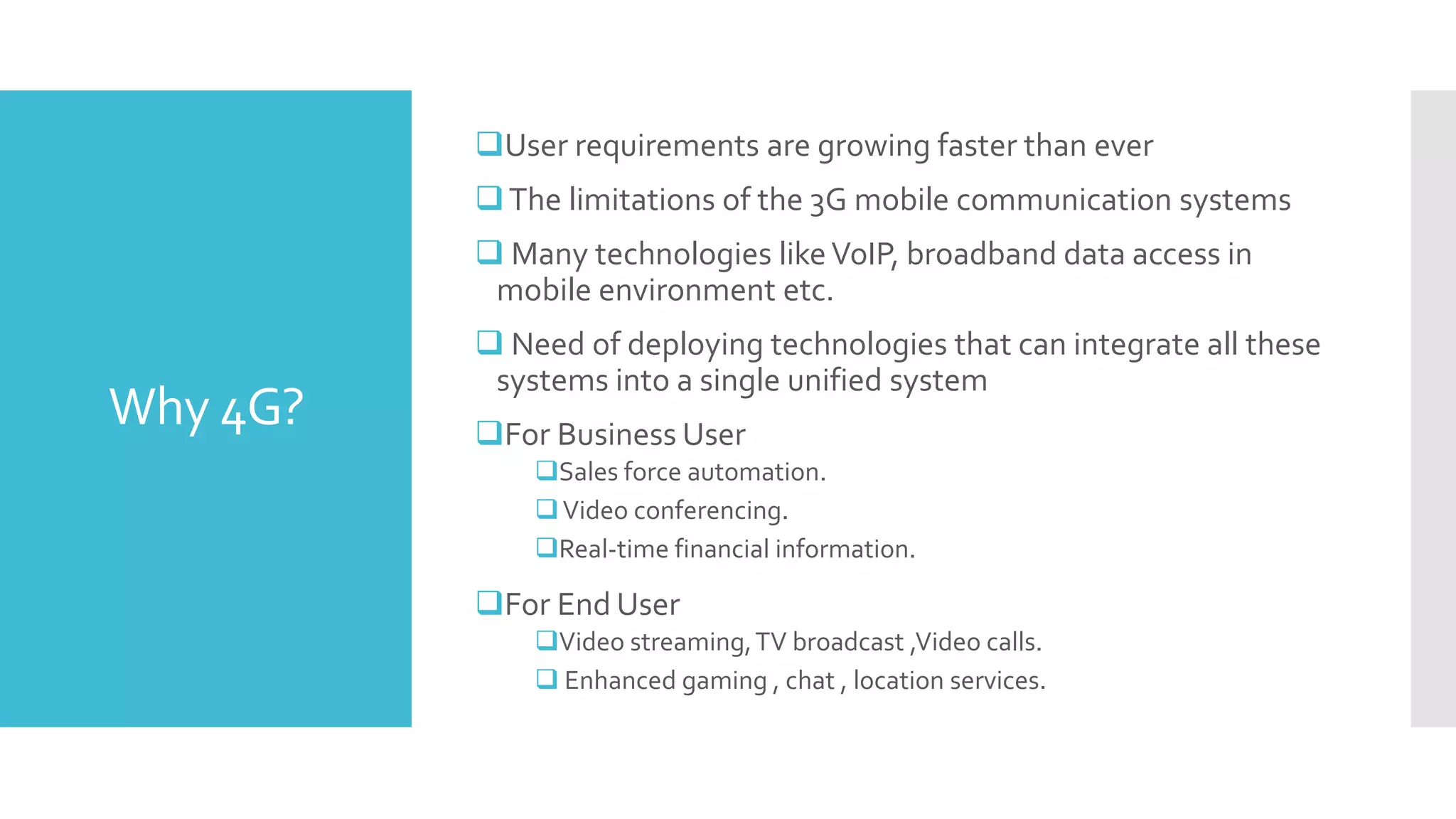
Why 4G?
How Fast is 4G?
Factors Effecting Speed
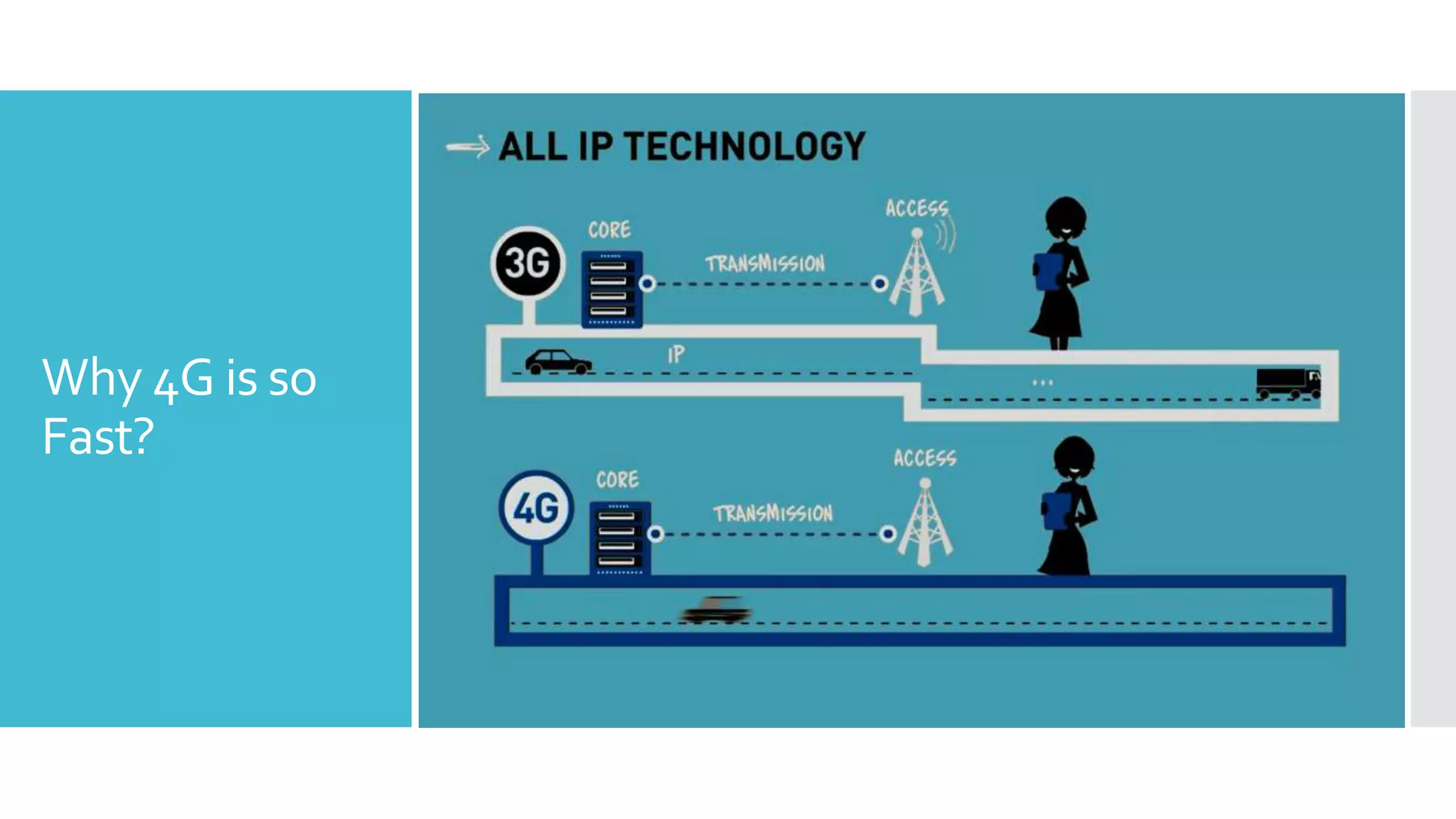
Why 4G is so Fast?
Technologies Used in 4G
OFDM
MIMO
IPv6
VoIP
UWB
QOS
SDR
4G Applications
Advantages of 4G
Disadvantages of 4G
Limitations of 4G
Future of 4G & 5G
MobileSystem
Generations
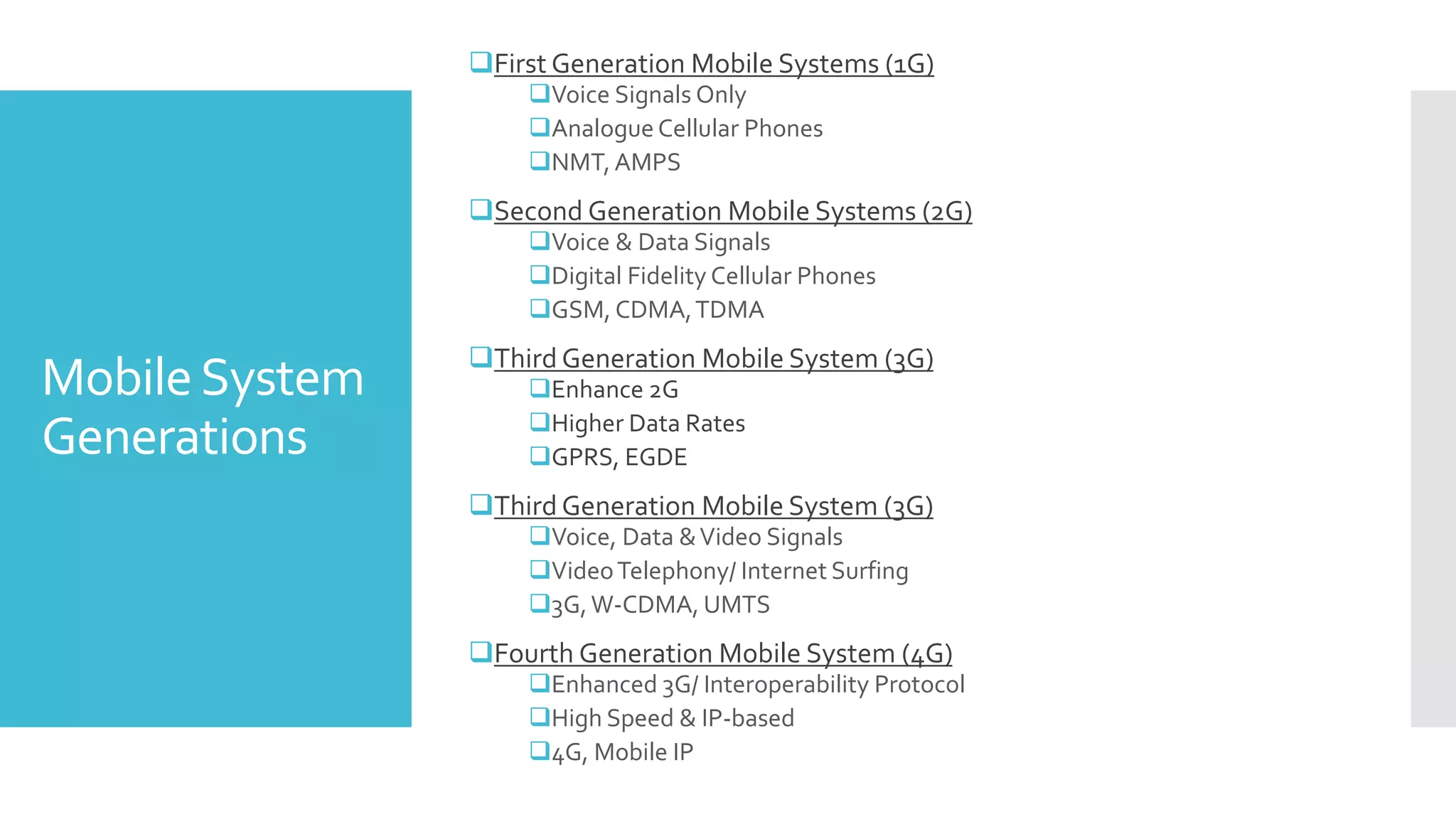
First Generation Mobile Systems (1G)
Voice Signals Only
Analogue Cellular Phones
NMT, AMPS
Second Generation Mobile Systems (2G)
Voice & Data Signals
Digital Fidelity Cellular Phones
GSM, CDMA,TDMA
Third Generation Mobile System (3G)
Enhance 2G
Higher Data Rates
GPRS, EGDE
Third Generation Mobile System (3G)
Voice, Data &Video Signals
VideoTelephony/ Internet Surfing
3G,W-CDMA, UMTS
Fourth Generation Mobile System (4G)
Enhanced 3G/ Interoperability Protocol
High Speed & IP-based
4G, Mobile IP
MobileSystem
Generations
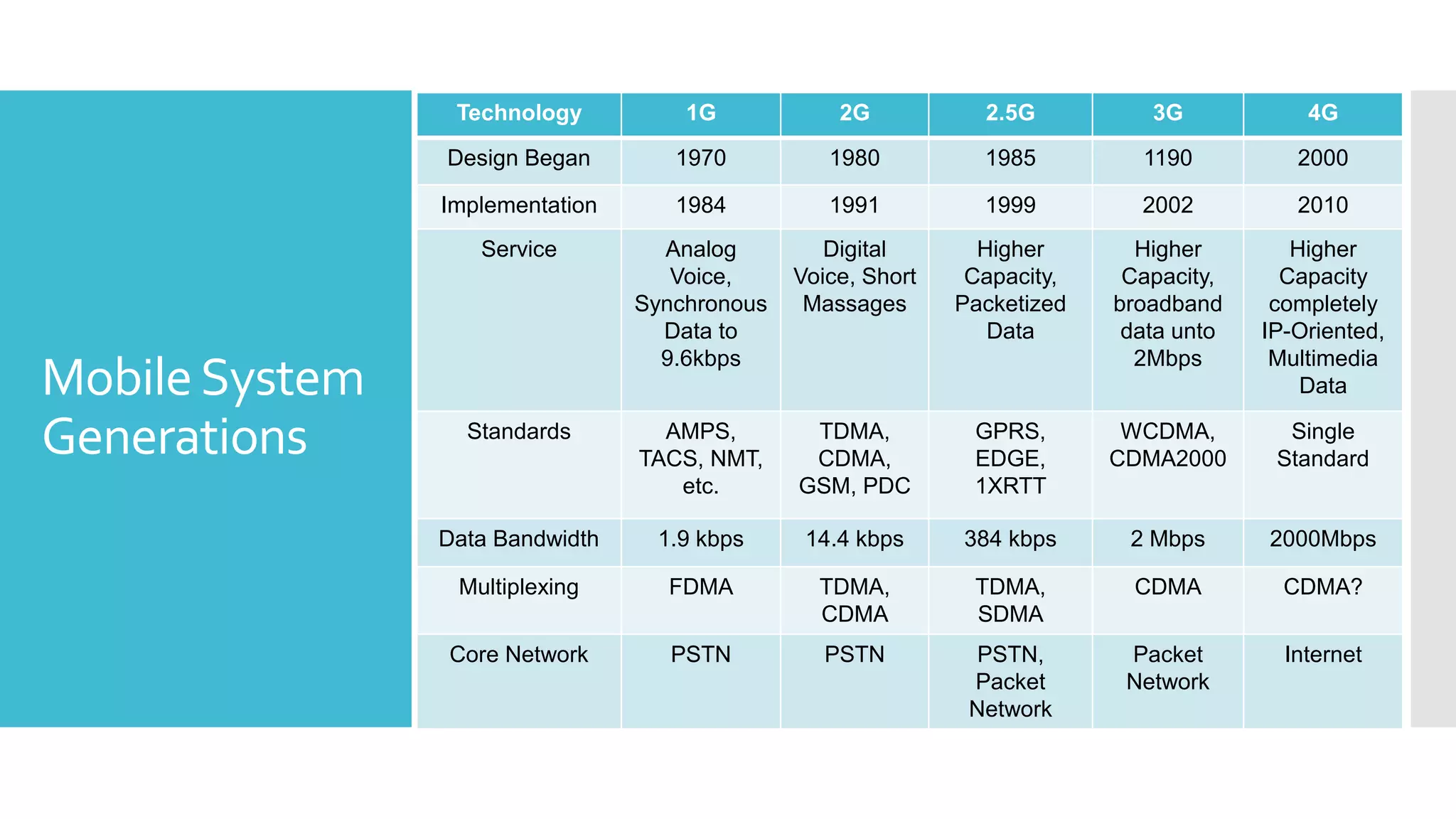
Technology 1G 2G 2.5G 3G 4G
Design Began 1970 1980 1985 1190 2000
Implementation 1984 1991 1999 2002 2010
Service Analog
Voice,
Synchronous
Data to
9.6kbps
Digital
Voice, Short
Massages
Higher
Capacity,
Packetized
Data
Higher
Capacity,
broadband
data unto
2Mbps
Higher
Capacity
completely
IP-Oriented,
Multimedia
Data
Standards AMPS,
TACS, NMT,
etc.
TDMA,
CDMA,
GSM, PDC
GPRS,
EDGE,
1XRTT
WCDMA,
CDMA2000
Single
Standard
Data Bandwidth 1.9 kbps 14.4 kbps 384 kbps 2 Mbps 2000Mbps
Multiplexing FDMA TDMA,
CDMA
TDMA,
SDMA
CDMA CDMA?
Core Network PSTN PSTN PSTN,
Packet
Network
Packet
Network
Internet
KeyTechnologies
Of 3G
Always Online Devices
 3G uses IP connectivity which is packet based
Global roaming
 Voice Over IP (VoIP)
Send/Receives Larges Emails
Video conferencing
High SpeedWeb/Maps Navigation
LiveTV streaming
Speed:385 kb/sec - 2mb/sec
Next Level Mobile Gaming/Multiplayer Gaming
Rich Multimedia Services
More Bandwidth, Security & Reliability
High Data Rates
Limitations
Of 3G
ChallengingTo Build Necessary Infrastructure For 3G.
License Costs .
Network Deployment Costs.
Requires Closer Base Stations & Are Expensive.
Power Consumption Is High.
Needs Different Handsets.
Response Of End UserTo NewTechnology.
High Input Fees For 3G License .
Lack of end-to-end seamless transport mechanism spanning a
mobile sub-network and fixed one.
Connectivity Problems.
3G networks tend to be area-specific, and people outside of a covered
region will not be able to take full advantage of 3G.
What is 4G?
4th Generation MobileTechnology
High Speed Internet Access
Wider Bandwidth
EndTo End Quality Of Service
IPv6 Core
Spiral Multiplexing
Packet Switching
4G is adoption of packet switching instead of circuit switching in
voice and video calls.
Comprehensive IP Solution
Where voice, data and multimedia can be given to user on “any time
, anywhere” basis.
Why 4G?
User requirements are growing faster than ever
The limitations of the 3G mobile communication systems
 Many technologies likeVoIP, broadband data access in
mobile environment etc.
 Need of deploying technologies that can integrate all these
systems into a single unified system
For Business User
Sales force automation.
Video conferencing.
Real-time financial information.
For End User
Video streaming,TV broadcast ,Video calls.
 Enhanced gaming , chat , location services.
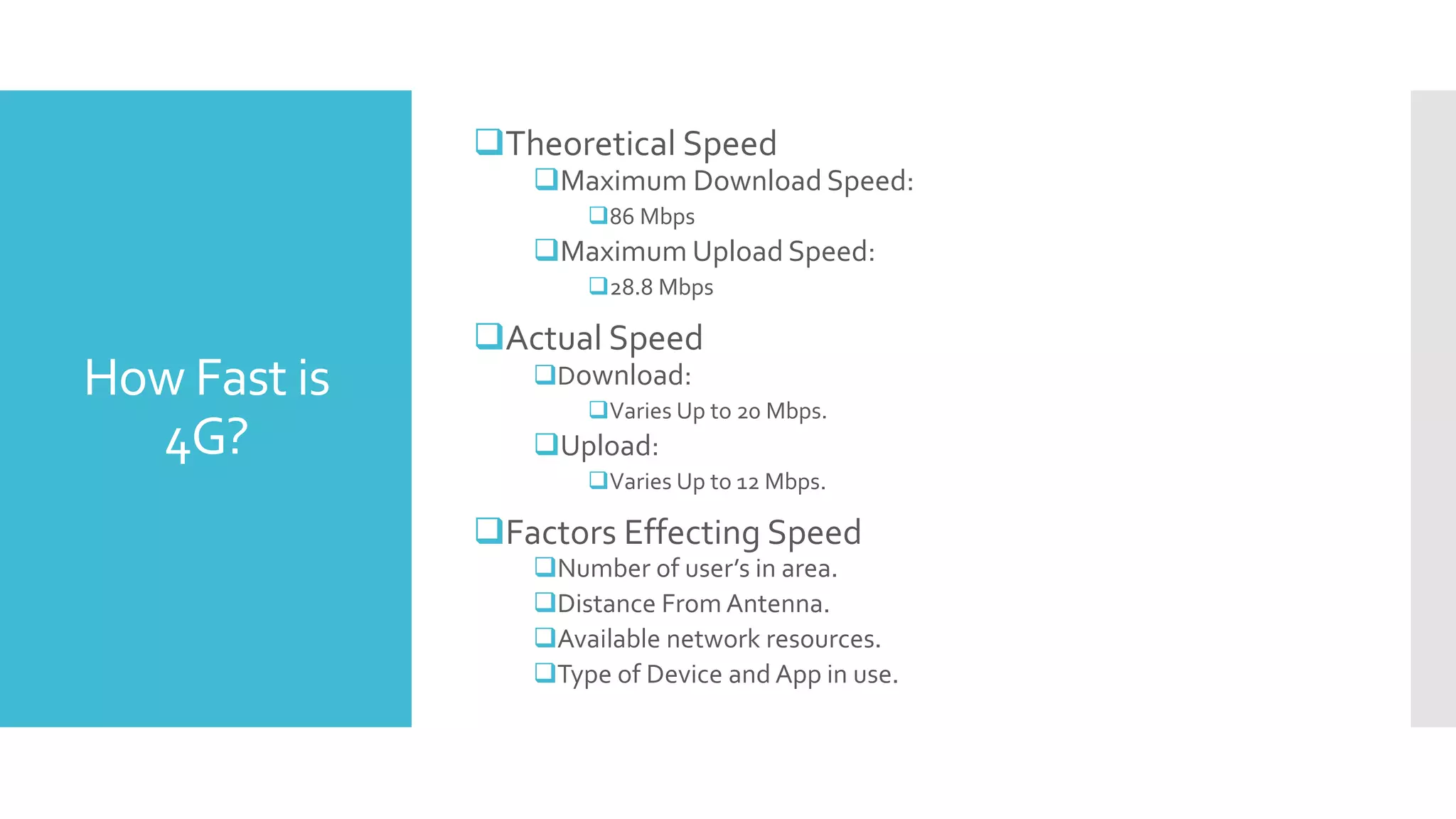
How Fast is
4G?
Theoretical Speed
Maximum Download Speed:
86 Mbps
Maximum Upload Speed:
28.8 Mbps
Actual Speed
Download:
Varies Up to 20 Mbps.
Upload:
Varies Up to 12 Mbps.
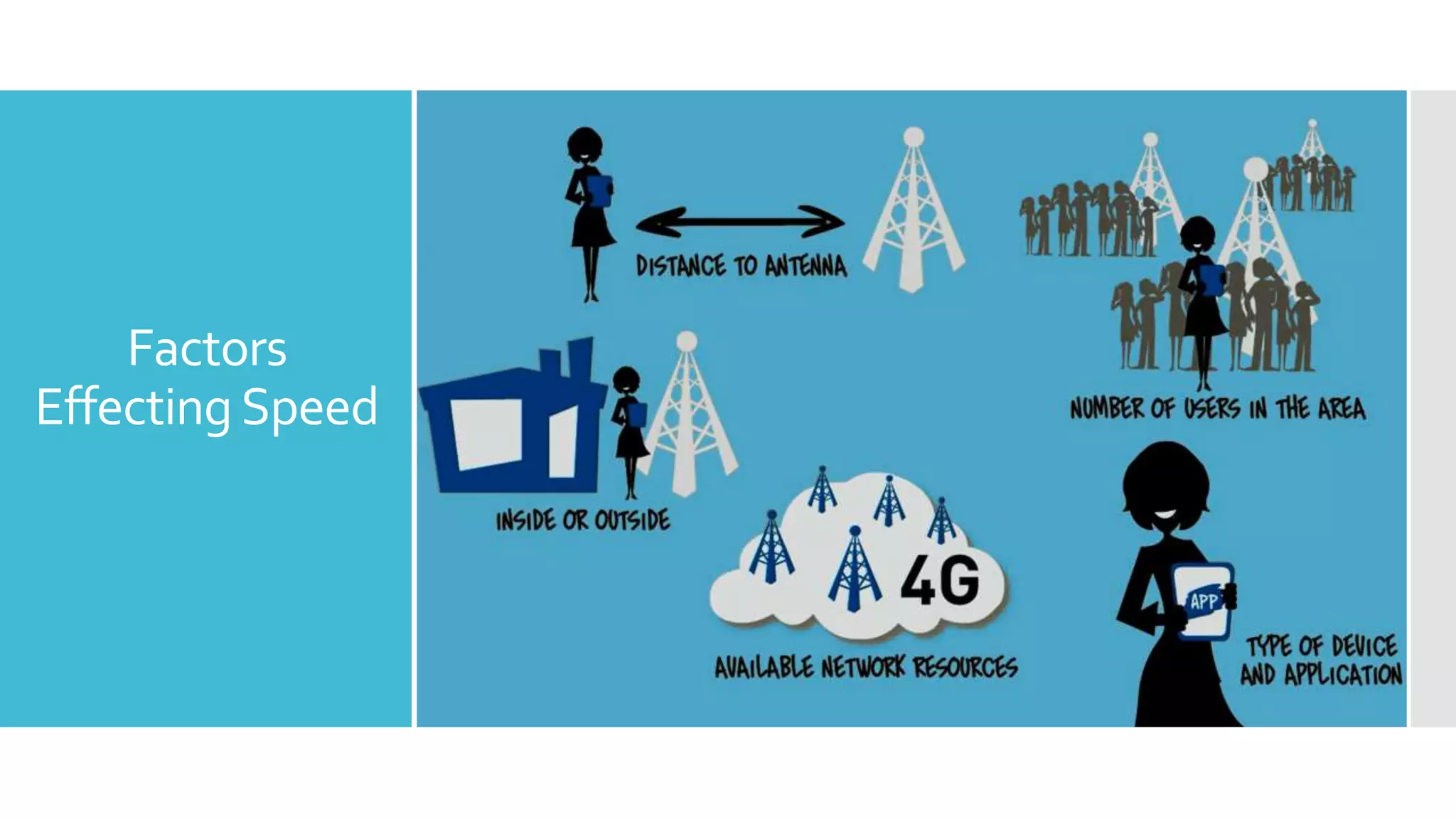
Factors Effecting Speed
Number of user’s in area.
Distance From Antenna.
Available network resources.
Type of Device and App in use.
Factors
EffectingSpeed
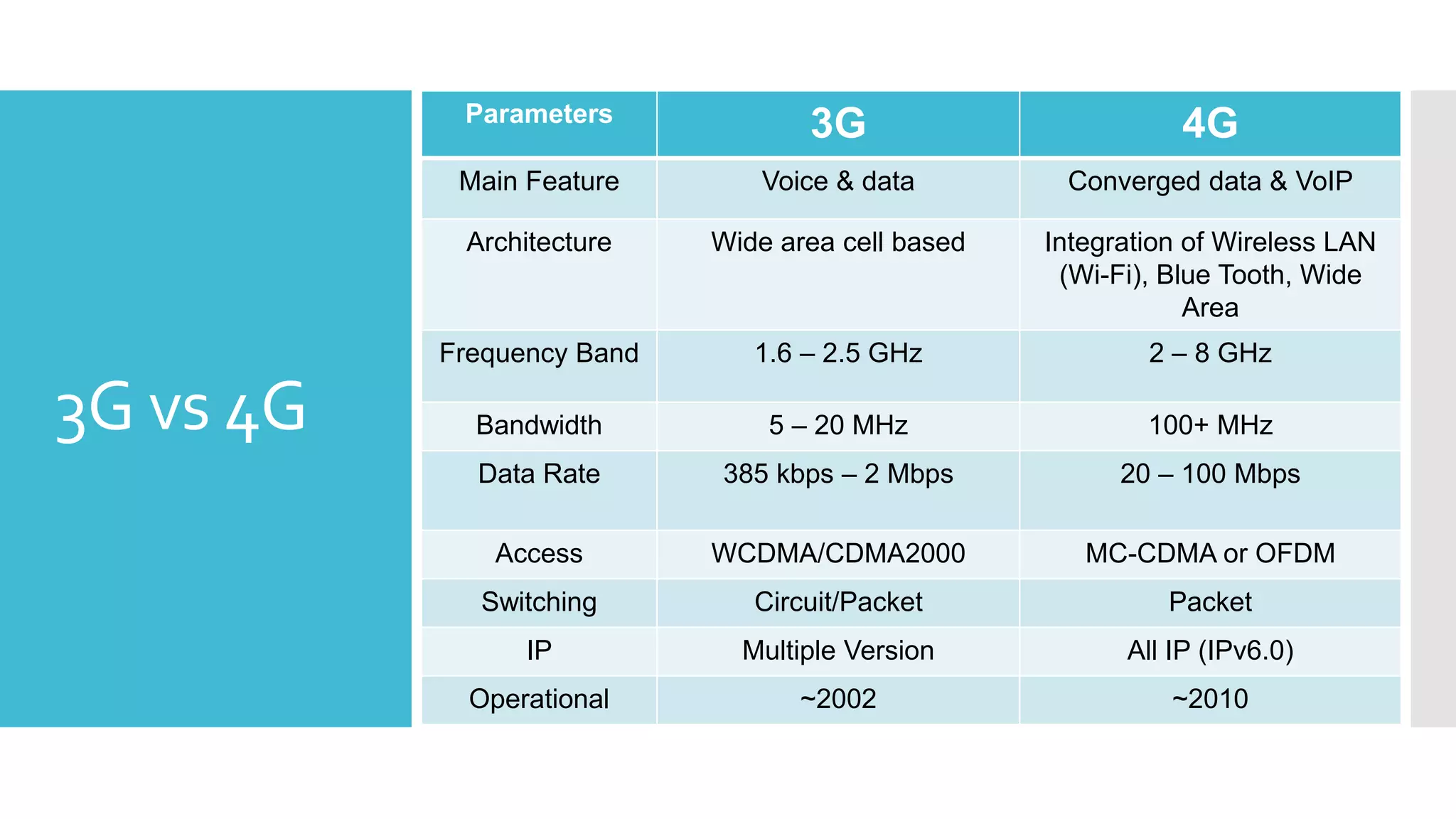
3G vs 4G
Parameters
3G 4G
Main Feature Voice & data Converged data & VoIP
Architecture Wide area cell based Integration of Wireless LAN
(Wi-Fi), Blue Tooth, Wide
Area
Frequency Band 1.6 – 2.5 GHz 2 – 8 GHz
Bandwidth 5 – 20 MHz 100+ MHz
Data Rate 385 kbps – 2 Mbps 20 – 100 Mbps
Access WCDMA/CDMA2000 MC-CDMA or OFDM
Switching Circuit/Packet Packet
IP Multiple Version All IP (IPv6.0)
Operational ~2002 ~2010
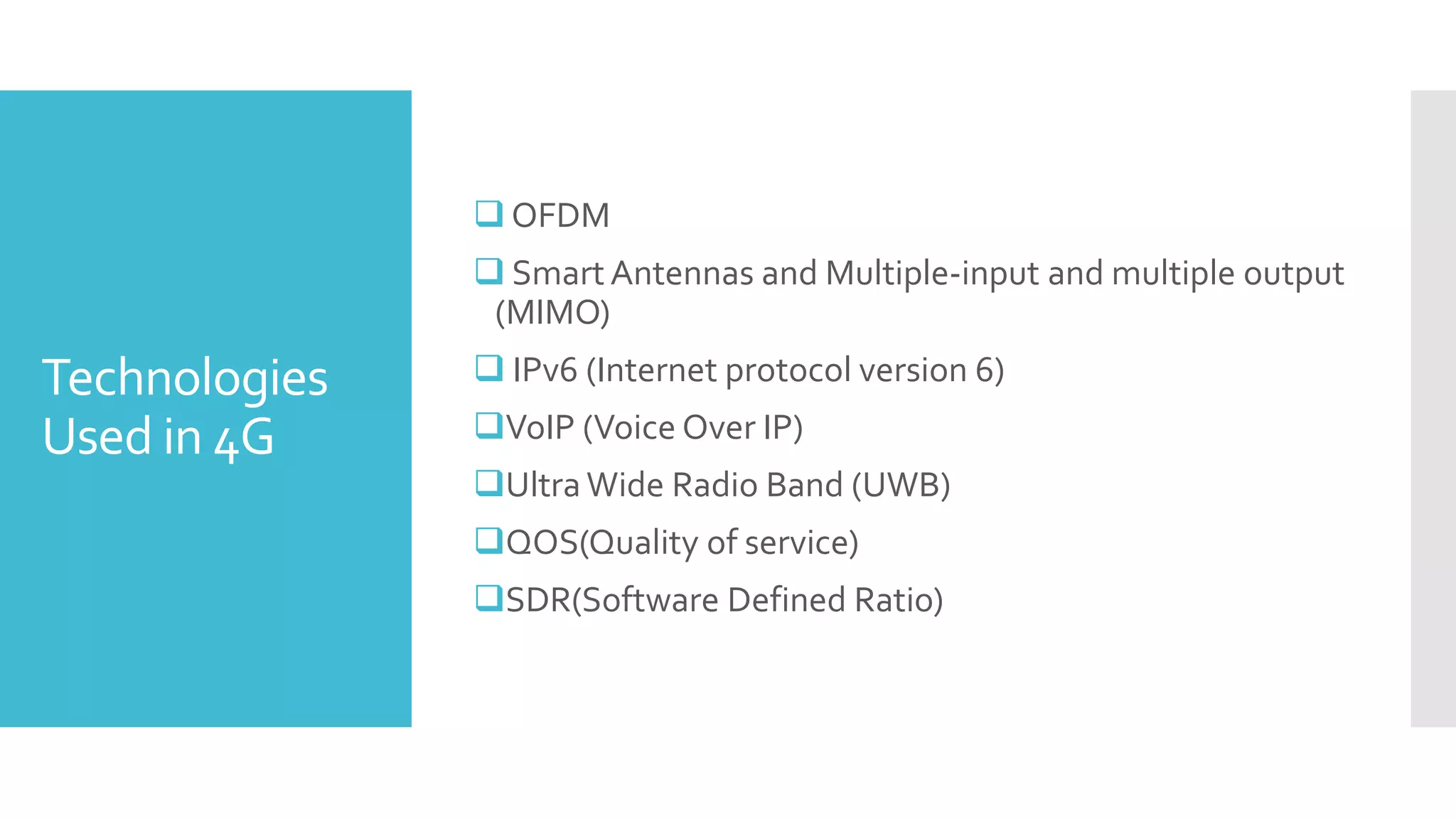
Technologies
Used in 4G
 OFDM
 Smart Antennas and Multiple-input and multiple output
(MIMO)
 IPv6 (Internet protocol version 6)
VoIP (Voice Over IP)
Ultra Wide Radio Band (UWB)
QOS(Quality of service)
SDR(Software Defined Ratio)
OFDM
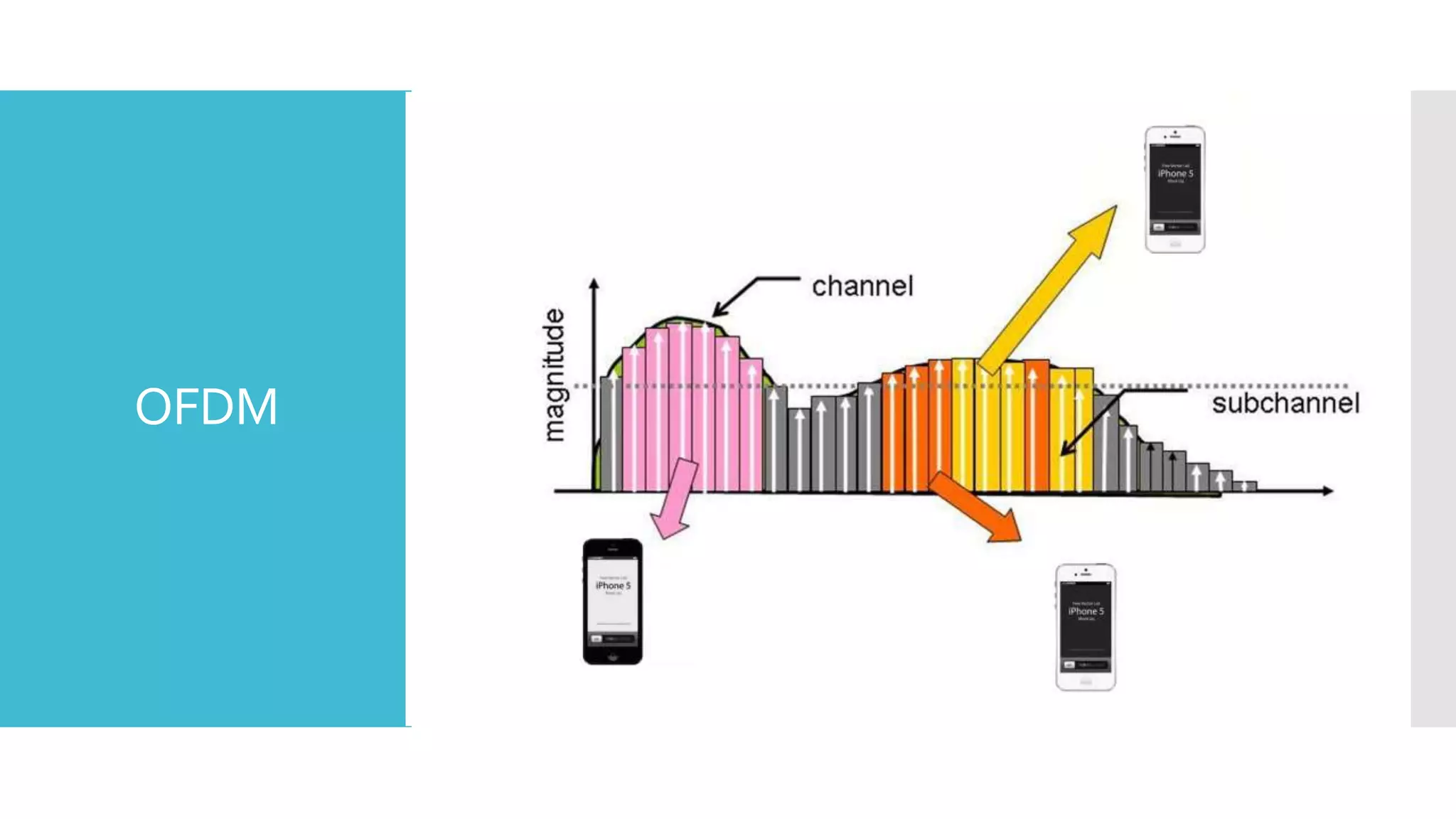
Orthogonal frequency-division multiplexing(OFDM)
(OFDM) is a method of encoding digital data on multiple carrier
frequencies.
Single channel utilizes multiple sub-carriers on adjacent frequencies.
Sub-carriers in an OFDM system are precisely orthogonal to one another
thus they are able to overlap without interfering.
It allows transfer of more data than other forms of multiplexing (time,
frequency, code, etc.).
OFDM
Smart
Antennas and
Multiple-input
and multiple
output (MIMO)
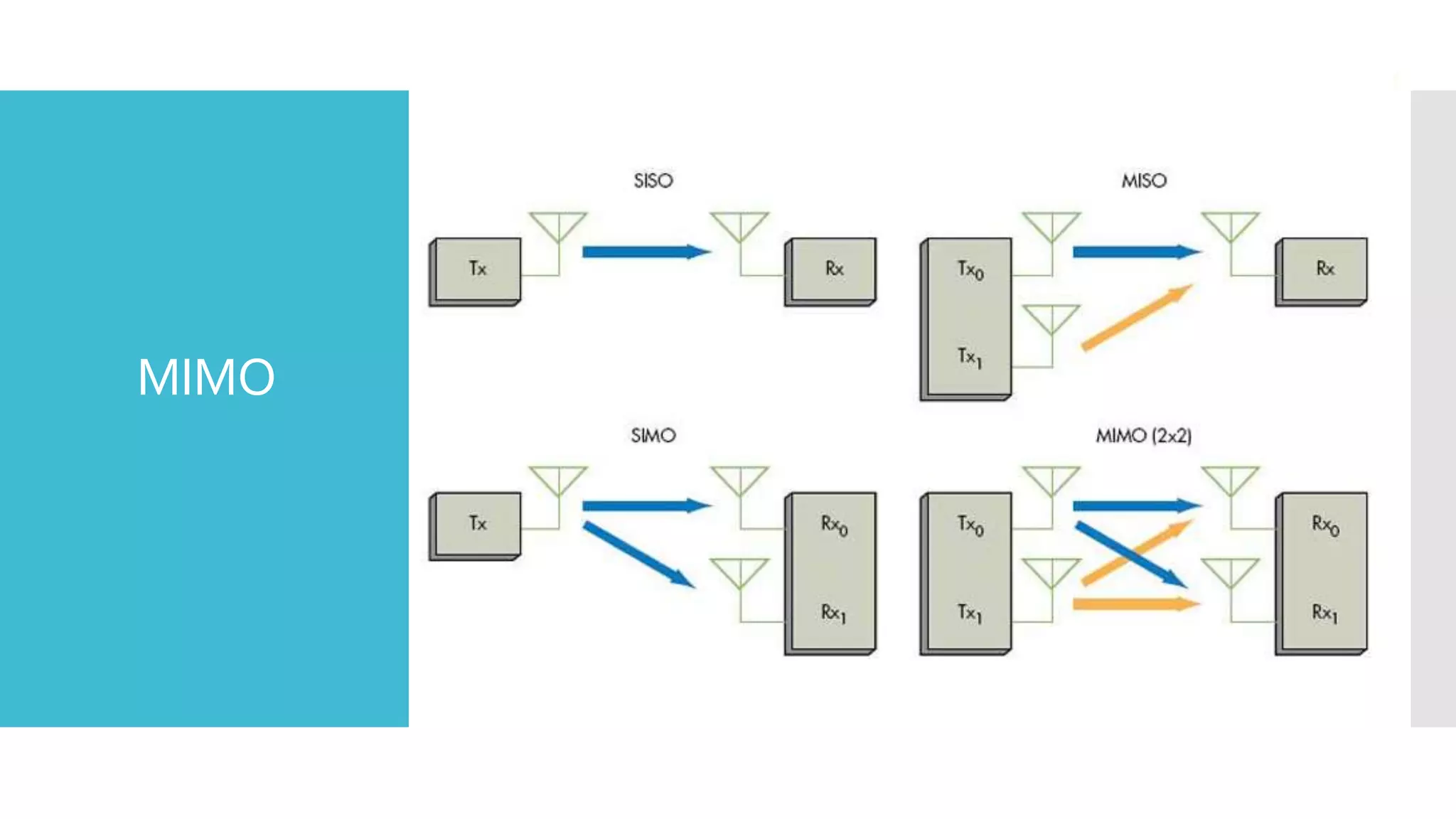
Before MIMO
SISO
Single Input Single Output
SIMO
Single Input Multiple Output
MISO
Multiple Input Single Output
Multiple-input and Multiple-output (MIMO)
Robust Radio Channel
 Effects of fading and multipath interference mitigated o
No breaks in voice calls or data
HigherThroughput
Faster downloads
 More Mbps with existing spectrum and power
Enables 4GWireless Broadband applications o
WLAN (IEEE 802.11n/ad)
WiMAX (IEEE 802.16m)
 LTE-A (3GPP Rel 10)
MIMO
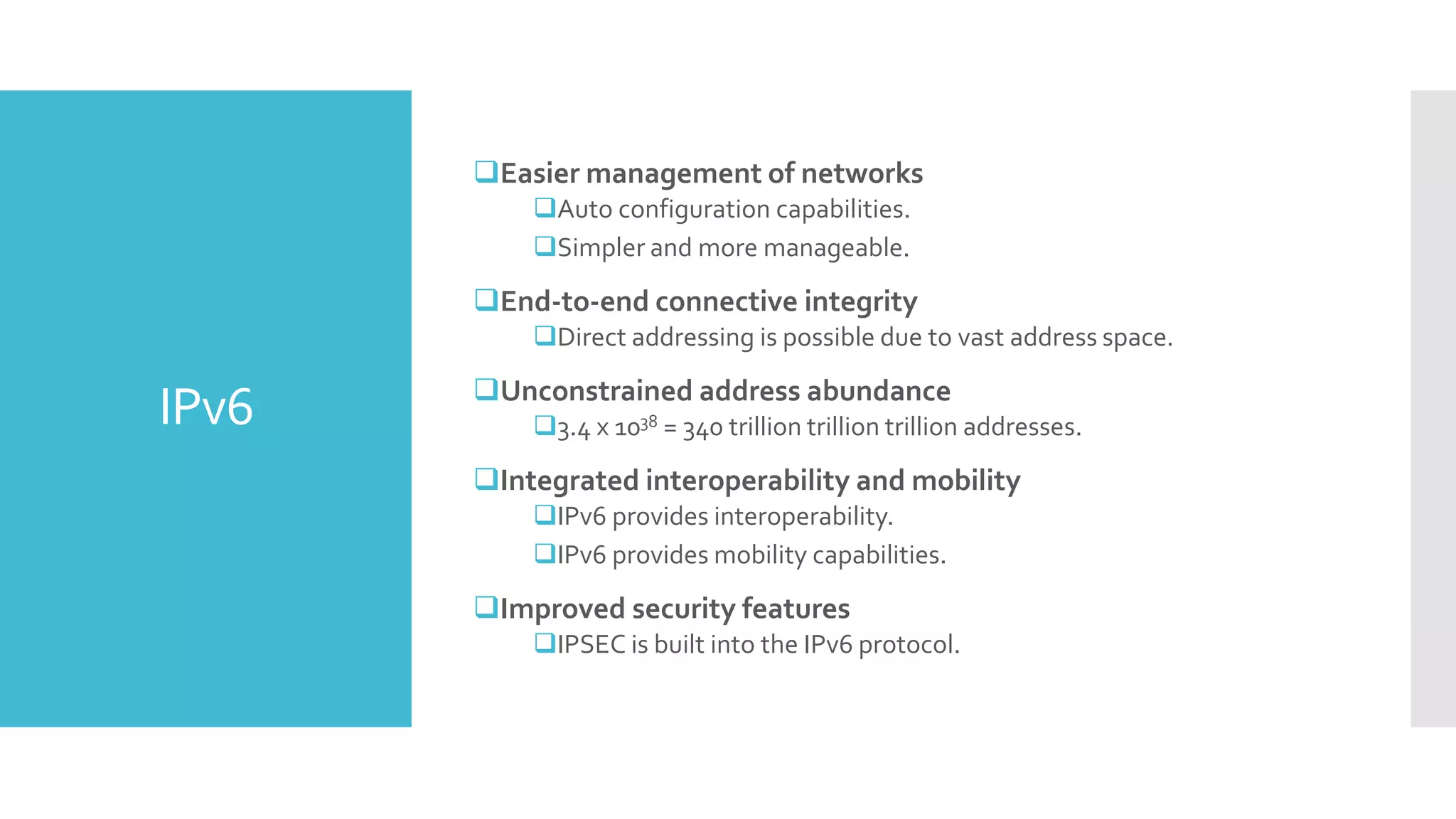
IPv6
Easier management of networks
Auto configuration capabilities.
Simpler and more manageable.
End-to-end connective integrity
Direct addressing is possible due to vast address space.
Unconstrained address abundance
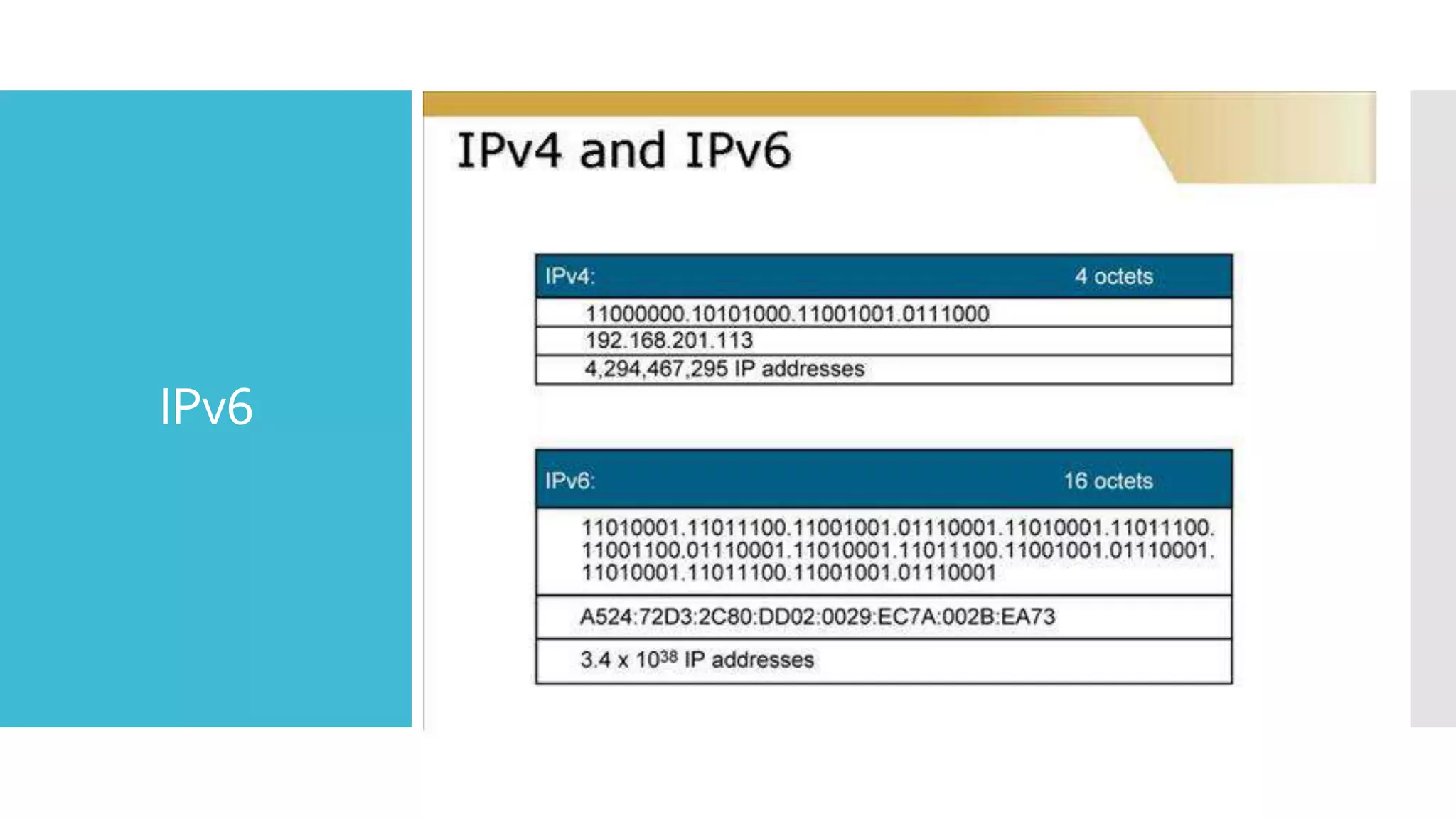
3.4 x 1038 = 340 trillion trillion trillion addresses.
Integrated interoperability and mobility
IPv6 provides interoperability.
IPv6 provides mobility capabilities.
Improved security features
IPSEC is built into the IPv6 protocol.
IPv6
VoIP
(VoiceOver IP)
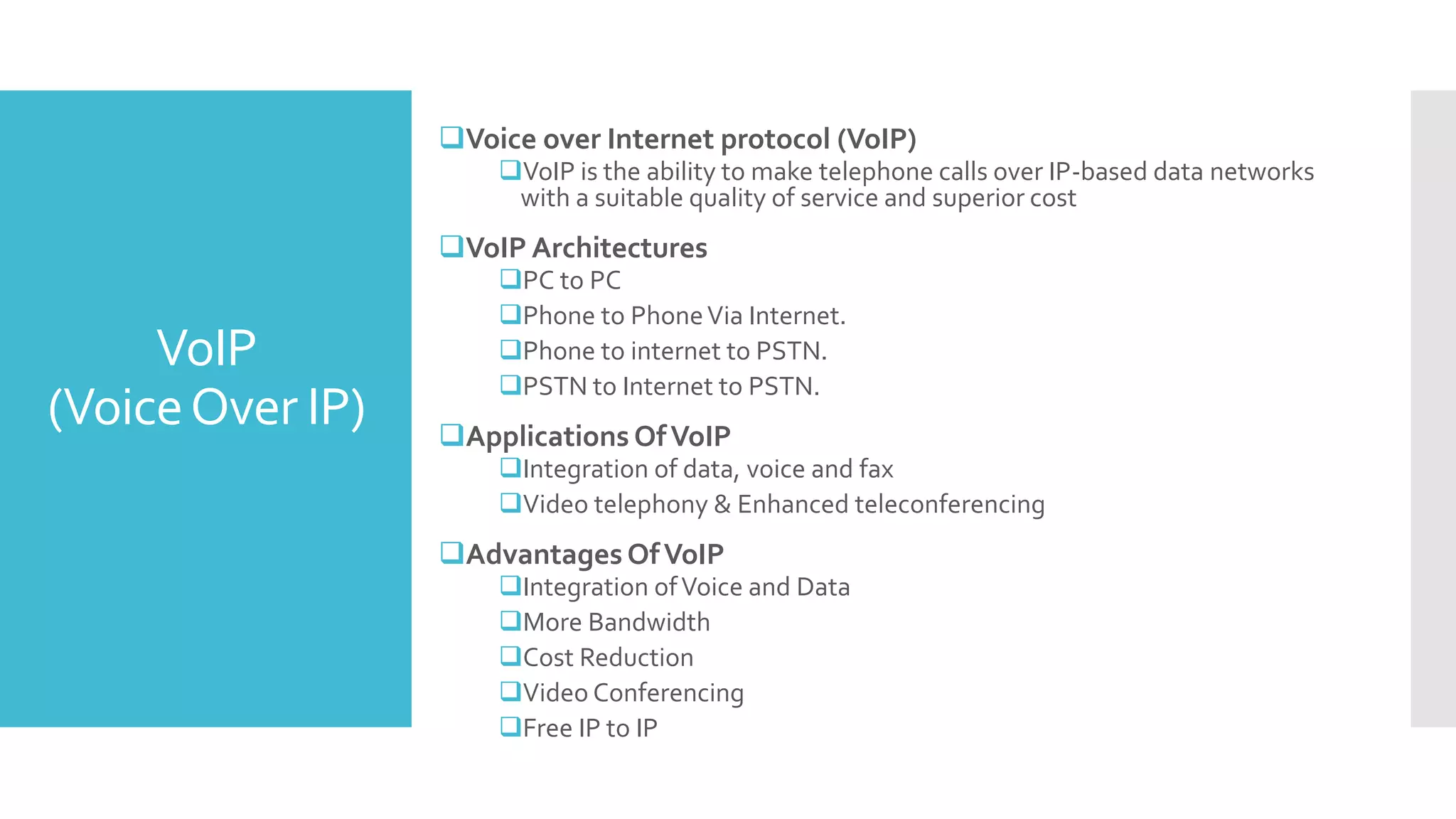
Voice over Internet protocol (VoIP)
VoIP is the ability to make telephone calls over IP-based data networks
with a suitable quality of service and superior cost
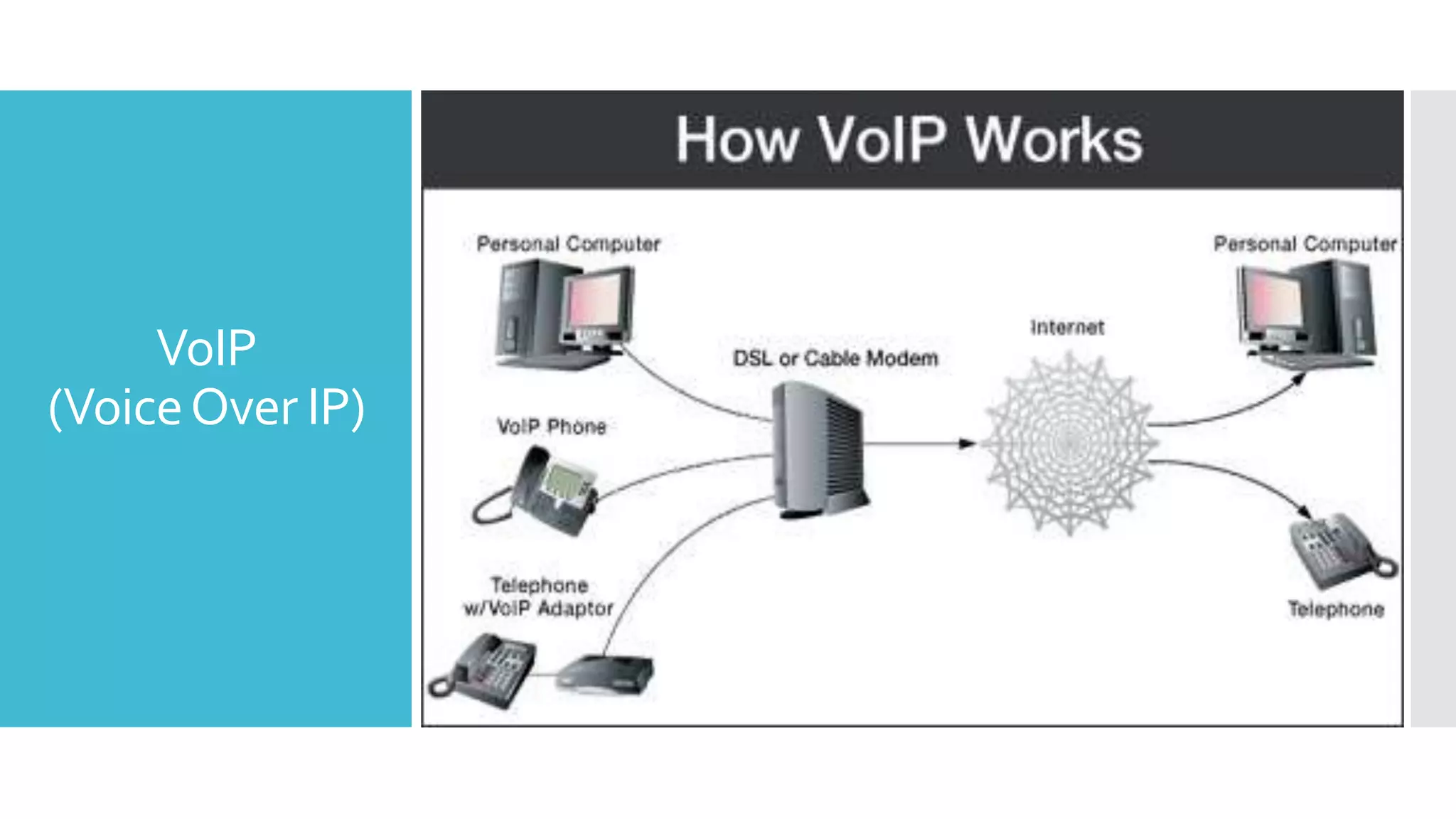
VoIP Architectures
PC to PC
Phone to PhoneVia Internet.
Phone to internet to PSTN.
PSTN to Internet to PSTN.
Applications OfVoIP
Integration of data, voice and fax
Video telephony & Enhanced teleconferencing
Advantages OfVoIP
Integration ofVoice and Data
More Bandwidth
Cost Reduction
Video Conferencing
Free IP to IP
VoIP
(VoiceOver IP)
UltraWide
Radio Band
(UWB)
Ultra Wide Radio Band (UWB)
Wireless technology for transmitting large amounts of digital data over a
wide spectrum of frequency bands with very low power for a short distance.
Ideally suited for short-range and high-speed data transmissions.
Advantages Of UWB
Spectrum reuse.
High data rate in short range.
Low power.
Low cost.
Applications Of UWB
Communications
Radar
IntelligenceSensors
Military communications
 Ground penetrating radar
Intelligent airbag, driving and parking aids
QOS
(Quality of
service)
QOS(Quality of service)
It is the idea that transmission rates, error rates, and other characteristics can
be measured, improved, and, to some extent, guaranteed in advance.
QoS is especially important for the new generation of Internet applications.
QoS involves prioritization of network traffic.
Applications
VoIP
Video-on-demand
SDR(Software
Defined Ratio)
SDR(Software Defined Ratio)
A radio communication system where components that have been
typically implemented in hardware are instead implemented by
means of software on a personal computer or embedded system.
Advantages
Complete Base band processing digital.
Software upgrading of commercial radios.
Generic hardware can be used for a variety of applications.
Software prototyping faster and cheaper than hardware
prototyping.
Why 4G is so
Fast?
4G
Applications
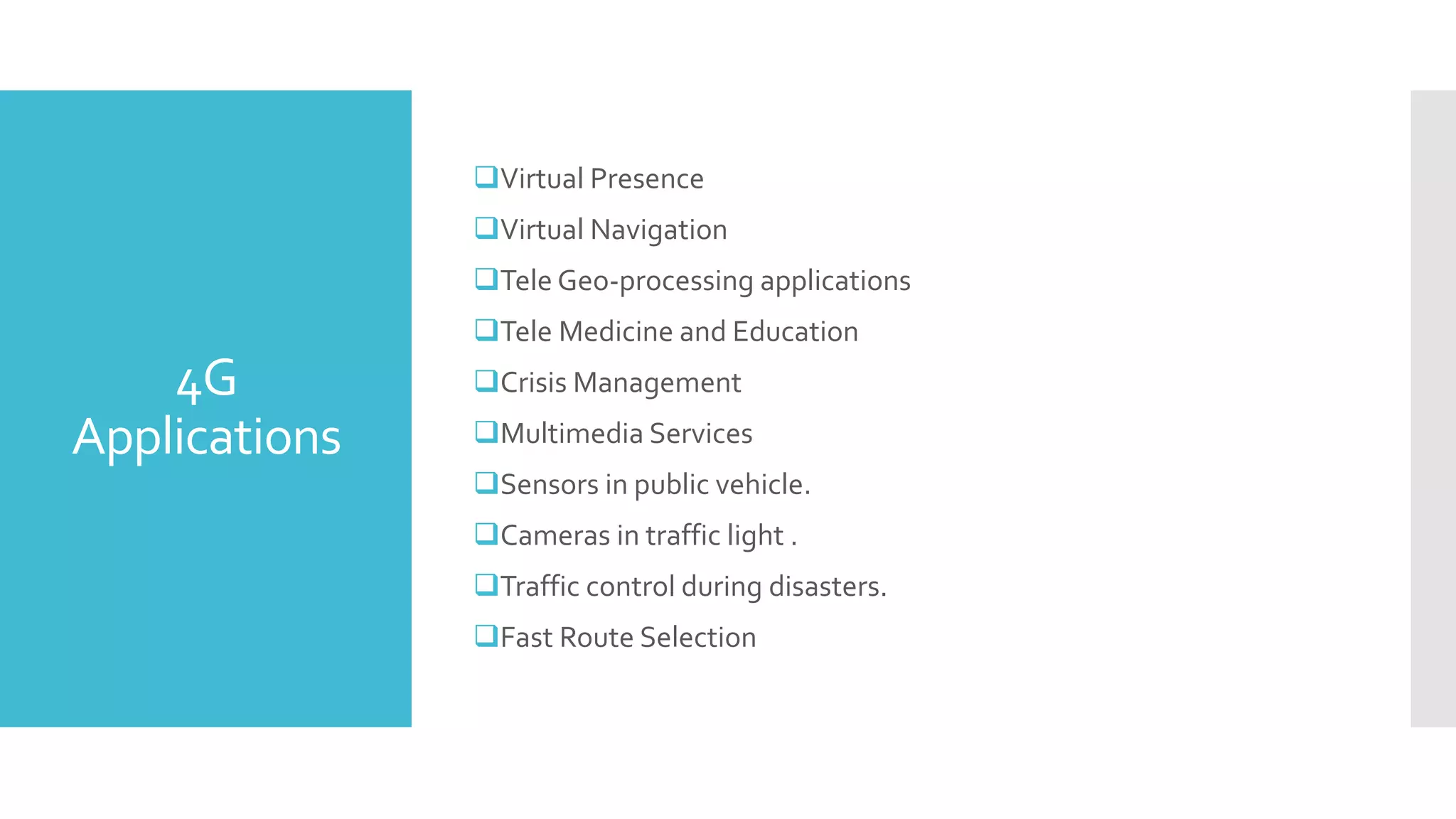
Virtual Presence
Virtual Navigation
Tele Geo-processing applications
Tele Medicine and Education
Crisis Management
Multimedia Services
Sensors in public vehicle.
Cameras in traffic light .
Traffic control during disasters.
Fast Route Selection
Virtual Presence
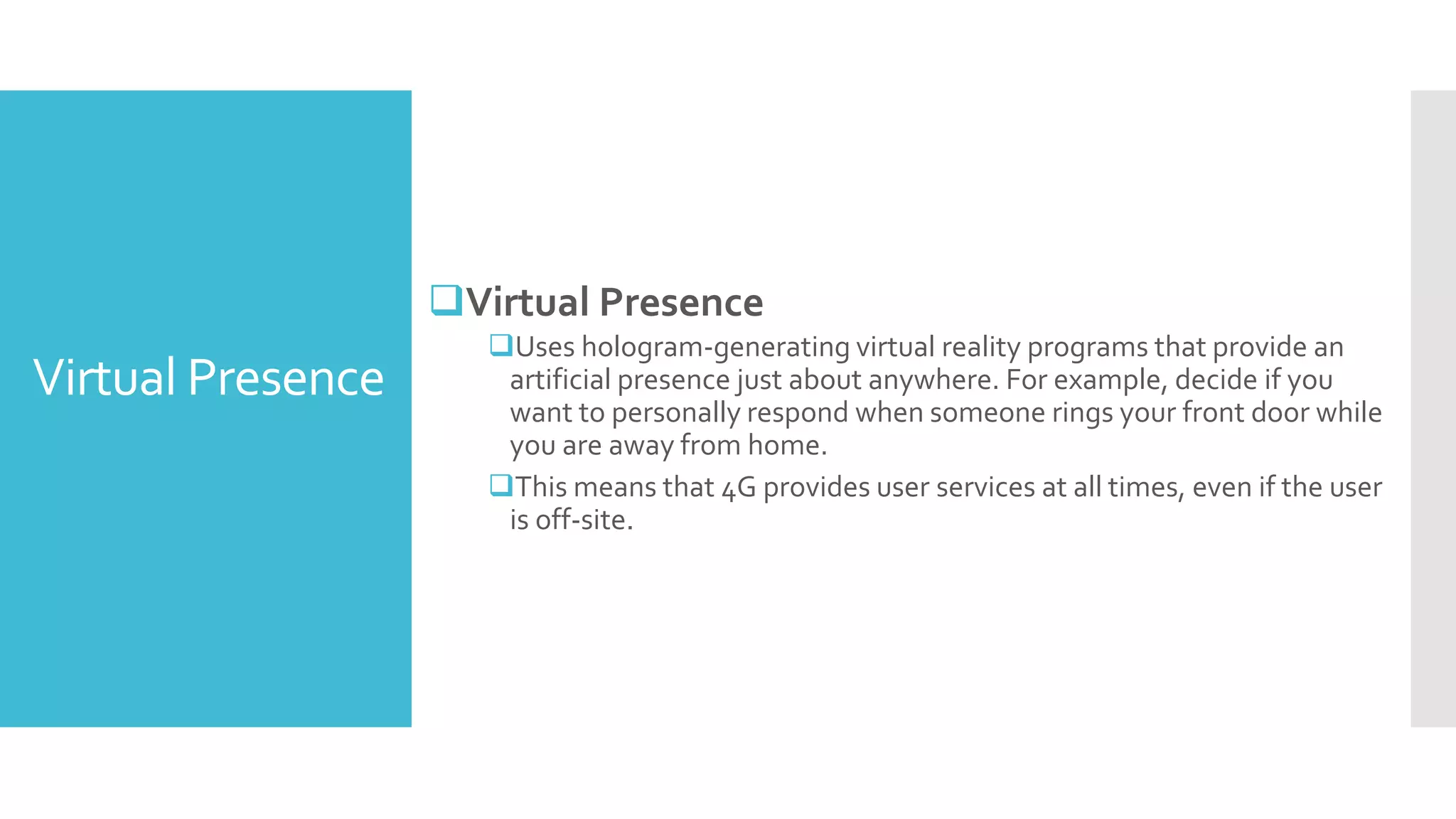
Virtual Presence
Uses hologram-generating virtual reality programs that provide an
artificial presence just about anywhere. For example, decide if you
want to personally respond when someone rings your front door while
you are away from home.
This means that 4G provides user services at all times, even if the user
is off-site.
Virtual
Navigation
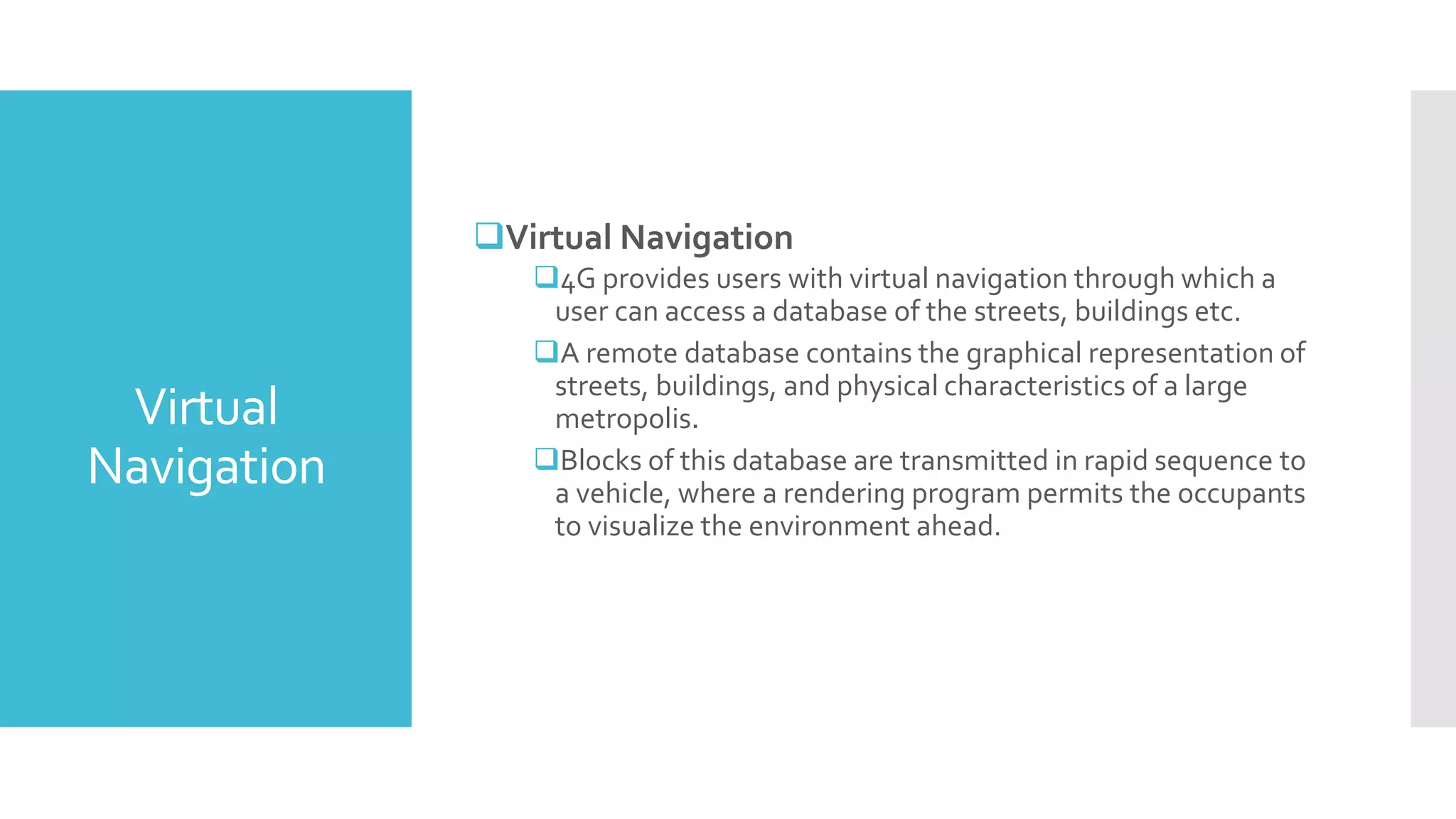
Virtual Navigation
4G provides users with virtual navigation through which a
user can access a database of the streets, buildings etc.
A remote database contains the graphical representation of
streets, buildings, and physical characteristics of a large
metropolis.
Blocks of this database are transmitted in rapid sequence to
a vehicle, where a rendering program permits the occupants
to visualize the environment ahead.
TeleGeo-processing
applications
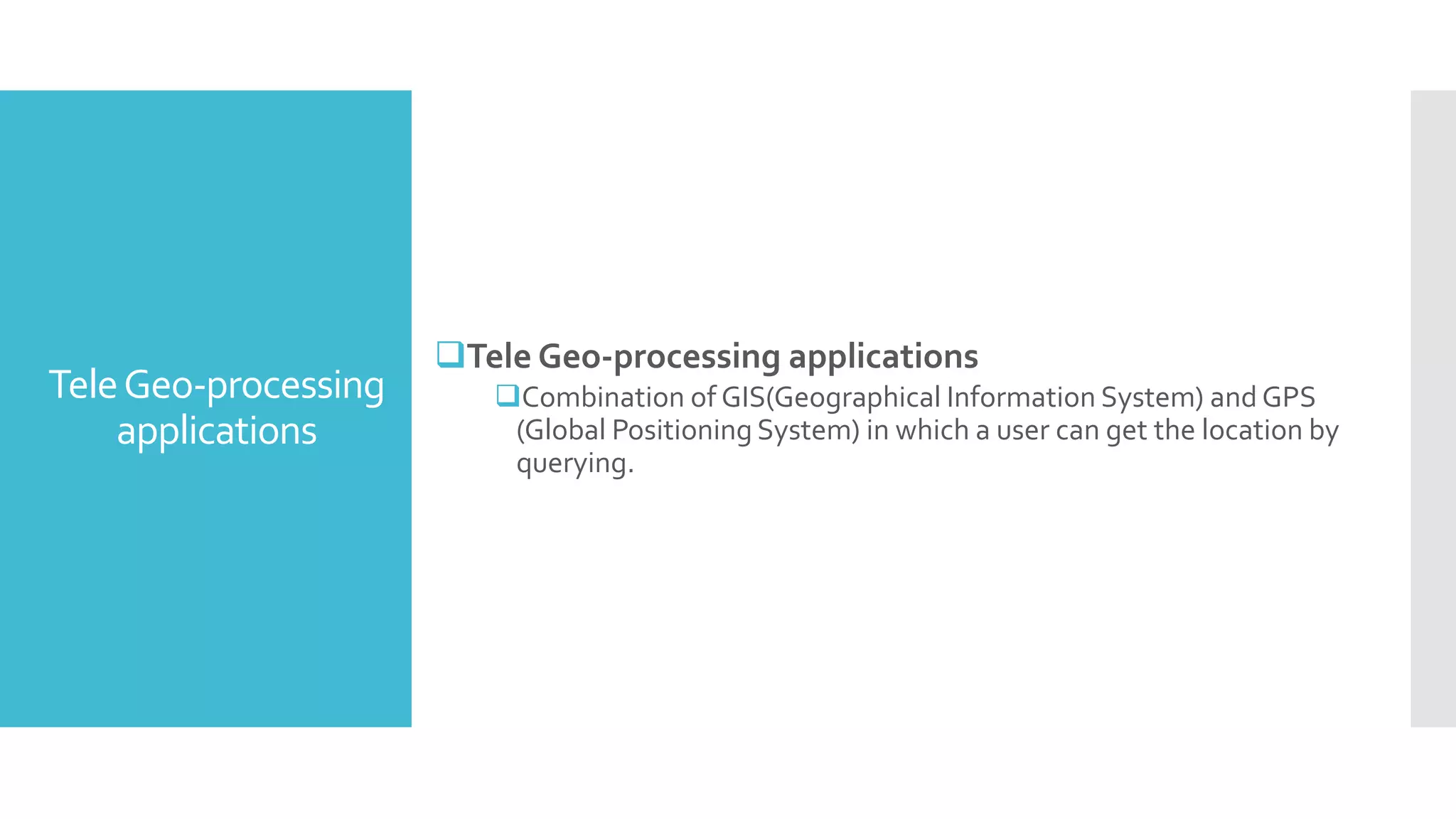
Tele Geo-processing applications
Combination of GIS(Geographical Information System) and GPS
(Global Positioning System) in which a user can get the location by
querying.
Tele Medicine
and Education
&
Crisis
Management
Tele Medicine and Education
4G will support remote health monitoring of patients. For
people who are interested in life long education, 4G provides
a good opportunity.
Crisis Management
 Natural disasters can cause break down in communication
systems. In today’s world it might take days or 7 weeks to
restore the system. But in 4G it is expected to restore such
crisis issues in a few hours.
MULTIMEDIA
Support for interactive multimedia, voice , streaming video,
Internet and other broadband services.
4G wireless systems are expected to deliver efficient
multimedia services at very high data rates.
Video Streaming is performed when a user requires real-time
video services, in which the server delivers data continuously
at a playback rate.
Sensors in
public vehicle
 Sensors in public vehicle.
 Putting a chemical‐biological‐nuclear (CBN) warning sensor on every
government‐owned vehicle instantly creates a mobile fleet that is the
equivalent of an army of highly trained dogs.
 As these vehicles go about their daily duties of law enforcement, garbage
collection, sewage and water maintenance, etc.The sensors on the vehicles
can talk to fixed devices mounted on light poles throughout the area, so
positive detection can be reported in real time.
 Since 4G networks can include inherent geo‐location without GPS, first
responders will know where the vehicle is when it detects it.
Camera in
traffic light
Camera in traffic light
Some major cities have deployed cameras on traffic lights and send
those images back to a central command center.This is generally
done using fiber, which limits where the cameras can be hung, i.e.,
no fiber, no camera.
4G networks allow cities to deploy cameras and backhaul them
wirelessly.
Fast Route
Selection
&
Traffic control
during disasters
Fast Route Selection
Using a 4G network, those images can also be sent from the
command center back out to the streets.Ambulances and fire trucks
facing congestion can query various cameras to choose an alternate
route.
Police, stuck in traffic on major thoroughfares, can look ahead and
make a decision as to whether it would be faster to stay on the main
roads or exit to side roads.
Traffic control during disasters
4G networks can allow officials to access traffic control boxes to
change inland traffic lanes to green. Instead of having to send
officers to every box on roads being overwhelmed by civilians who
are evacuating, it can all be done remotely, and dynamically.
Advantages of
4G
Quickly download files over a wireless network.
Extremely high voice quality.
Easily access Internet, IM, Social Networks, streaming media, video
calling, etc.
Higher bandwidth.
4G is 10 times faster than 3G.
Support for interactive multimedia, voice , Internet and other broadband
services.
Seamless network of multiple protocol and air interfaces.
Disadvantages
Of 4G
New frequencies means new components in cell towers.
Higher data prices for consumers.
Consumer is forced to buy a new device to support the 4G.
It is impossible to make your current equipment compatible with
the 4G network.
Carriers and providers have to plan carefully to make sure that
expenses are kept realistic.
Needs complex hardware.
LimitationsOf
4G
NewTechnology
4G is still passing through research and, therefore, there are some
problems that need to be fixed in order for the users to benefit from
it fully.
Operating Areas
Operating area is one of the major limitations.Although 2G
networks are frequently used.This drawback passes over into future
generation.
Misconception
The extensive publicity to 3G networks nowadays gives unrealistic
expectations in communications available at anytime, anywhere.
The public should understand that high speed data communications
will not be equivalent to the wired Internet.
Conclusion
4G can be best described in one word “ MAGIC”, which stands
for:
 “M” Mobile multimedia
 “A” Anytime Anywhere
 “G” Global mobility support
 “I” Integrated wireless
 “ C” Customized Personal services.
Though 4G is facing challenges and problems we believe that
future research will overcome these challenges and integrate
newly developed services to 4G networks making them available
to everyone, anytime and everywhere.
References
 http://en.wikiversity.org/wiki/4G_Wireless_systems
 http://connectindia-2011.blogspot.com/2011_04_01_archive.html
 http://www.slideshare.net/cgoyal4/generations-of-mobile-
communicationg-vs
 http://www.scribd.com/doc/210781507/4g
 http://my.safaribooksonline.com/book/-/9789332508156/23dot-
next-generation-cellular-technology-4g/c23s9_xhtml
 https://about4glte.wordpress.com/applications/

4G technology (Fourth Generation Mobile System)

  • 1.
    4G Data Communication Prepared By MuhammadAhmed Syed Kazim Raza Muhammad Awais
  • 2.
    Contents Mobile System Generations KeyTechnologiesOf3G LimitationsOf 3G 3G vs 4g What is 4G? Why 4G? How Fast is 4G? Factors Effecting Speed Why 4G is so Fast? Technologies Used in 4G OFDM MIMO IPv6 VoIP UWB QOS SDR 4G Applications Advantages of 4G Disadvantages of 4G Limitations of 4G Future of 4G & 5G
  • 3.
    MobileSystem Generations First Generation MobileSystems (1G) Voice Signals Only Analogue Cellular Phones NMT, AMPS Second Generation Mobile Systems (2G) Voice & Data Signals Digital Fidelity Cellular Phones GSM, CDMA,TDMA Third Generation Mobile System (3G) Enhance 2G Higher Data Rates GPRS, EGDE Third Generation Mobile System (3G) Voice, Data &Video Signals VideoTelephony/ Internet Surfing 3G,W-CDMA, UMTS Fourth Generation Mobile System (4G) Enhanced 3G/ Interoperability Protocol High Speed & IP-based 4G, Mobile IP
  • 4.
    MobileSystem Generations Technology 1G 2G2.5G 3G 4G Design Began 1970 1980 1985 1190 2000 Implementation 1984 1991 1999 2002 2010 Service Analog Voice, Synchronous Data to 9.6kbps Digital Voice, Short Massages Higher Capacity, Packetized Data Higher Capacity, broadband data unto 2Mbps Higher Capacity completely IP-Oriented, Multimedia Data Standards AMPS, TACS, NMT, etc. TDMA, CDMA, GSM, PDC GPRS, EDGE, 1XRTT WCDMA, CDMA2000 Single Standard Data Bandwidth 1.9 kbps 14.4 kbps 384 kbps 2 Mbps 2000Mbps Multiplexing FDMA TDMA, CDMA TDMA, SDMA CDMA CDMA? Core Network PSTN PSTN PSTN, Packet Network Packet Network Internet
  • 5.
    KeyTechnologies Of 3G Always OnlineDevices  3G uses IP connectivity which is packet based Global roaming  Voice Over IP (VoIP) Send/Receives Larges Emails Video conferencing High SpeedWeb/Maps Navigation LiveTV streaming Speed:385 kb/sec - 2mb/sec Next Level Mobile Gaming/Multiplayer Gaming Rich Multimedia Services More Bandwidth, Security & Reliability High Data Rates
  • 6.
    Limitations Of 3G ChallengingTo BuildNecessary Infrastructure For 3G. License Costs . Network Deployment Costs. Requires Closer Base Stations & Are Expensive. Power Consumption Is High. Needs Different Handsets. Response Of End UserTo NewTechnology. High Input Fees For 3G License . Lack of end-to-end seamless transport mechanism spanning a mobile sub-network and fixed one. Connectivity Problems. 3G networks tend to be area-specific, and people outside of a covered region will not be able to take full advantage of 3G.
  • 7.
    What is 4G? 4thGeneration MobileTechnology High Speed Internet Access Wider Bandwidth EndTo End Quality Of Service IPv6 Core Spiral Multiplexing Packet Switching 4G is adoption of packet switching instead of circuit switching in voice and video calls. Comprehensive IP Solution Where voice, data and multimedia can be given to user on “any time , anywhere” basis.
  • 8.
    Why 4G? User requirementsare growing faster than ever The limitations of the 3G mobile communication systems  Many technologies likeVoIP, broadband data access in mobile environment etc.  Need of deploying technologies that can integrate all these systems into a single unified system For Business User Sales force automation. Video conferencing. Real-time financial information. For End User Video streaming,TV broadcast ,Video calls.  Enhanced gaming , chat , location services.
  • 9.
    How Fast is 4G? TheoreticalSpeed Maximum Download Speed: 86 Mbps Maximum Upload Speed: 28.8 Mbps Actual Speed Download: Varies Up to 20 Mbps. Upload: Varies Up to 12 Mbps. Factors Effecting Speed Number of user’s in area. Distance From Antenna. Available network resources. Type of Device and App in use.
  • 10.
  • 11.
    3G vs 4G Parameters 3G4G Main Feature Voice & data Converged data & VoIP Architecture Wide area cell based Integration of Wireless LAN (Wi-Fi), Blue Tooth, Wide Area Frequency Band 1.6 – 2.5 GHz 2 – 8 GHz Bandwidth 5 – 20 MHz 100+ MHz Data Rate 385 kbps – 2 Mbps 20 – 100 Mbps Access WCDMA/CDMA2000 MC-CDMA or OFDM Switching Circuit/Packet Packet IP Multiple Version All IP (IPv6.0) Operational ~2002 ~2010
  • 12.
    Technologies Used in 4G OFDM  Smart Antennas and Multiple-input and multiple output (MIMO)  IPv6 (Internet protocol version 6) VoIP (Voice Over IP) Ultra Wide Radio Band (UWB) QOS(Quality of service) SDR(Software Defined Ratio)
  • 13.
    OFDM Orthogonal frequency-division multiplexing(OFDM) (OFDM)is a method of encoding digital data on multiple carrier frequencies. Single channel utilizes multiple sub-carriers on adjacent frequencies. Sub-carriers in an OFDM system are precisely orthogonal to one another thus they are able to overlap without interfering. It allows transfer of more data than other forms of multiplexing (time, frequency, code, etc.).
  • 14.
  • 15.
    Smart Antennas and Multiple-input and multiple output(MIMO) Before MIMO SISO Single Input Single Output SIMO Single Input Multiple Output MISO Multiple Input Single Output Multiple-input and Multiple-output (MIMO) Robust Radio Channel  Effects of fading and multipath interference mitigated o No breaks in voice calls or data HigherThroughput Faster downloads  More Mbps with existing spectrum and power Enables 4GWireless Broadband applications o WLAN (IEEE 802.11n/ad) WiMAX (IEEE 802.16m)  LTE-A (3GPP Rel 10)
  • 16.
  • 17.
    IPv6 Easier management ofnetworks Auto configuration capabilities. Simpler and more manageable. End-to-end connective integrity Direct addressing is possible due to vast address space. Unconstrained address abundance 3.4 x 1038 = 340 trillion trillion trillion addresses. Integrated interoperability and mobility IPv6 provides interoperability. IPv6 provides mobility capabilities. Improved security features IPSEC is built into the IPv6 protocol.
  • 18.
  • 19.
    VoIP (VoiceOver IP) Voice overInternet protocol (VoIP) VoIP is the ability to make telephone calls over IP-based data networks with a suitable quality of service and superior cost VoIP Architectures PC to PC Phone to PhoneVia Internet. Phone to internet to PSTN. PSTN to Internet to PSTN. Applications OfVoIP Integration of data, voice and fax Video telephony & Enhanced teleconferencing Advantages OfVoIP Integration ofVoice and Data More Bandwidth Cost Reduction Video Conferencing Free IP to IP
  • 20.
  • 21.
    UltraWide Radio Band (UWB) Ultra WideRadio Band (UWB) Wireless technology for transmitting large amounts of digital data over a wide spectrum of frequency bands with very low power for a short distance. Ideally suited for short-range and high-speed data transmissions. Advantages Of UWB Spectrum reuse. High data rate in short range. Low power. Low cost. Applications Of UWB Communications Radar IntelligenceSensors Military communications  Ground penetrating radar Intelligent airbag, driving and parking aids
  • 22.
    QOS (Quality of service) QOS(Quality ofservice) It is the idea that transmission rates, error rates, and other characteristics can be measured, improved, and, to some extent, guaranteed in advance. QoS is especially important for the new generation of Internet applications. QoS involves prioritization of network traffic. Applications VoIP Video-on-demand
  • 23.
    SDR(Software Defined Ratio) SDR(Software DefinedRatio) A radio communication system where components that have been typically implemented in hardware are instead implemented by means of software on a personal computer or embedded system. Advantages Complete Base band processing digital. Software upgrading of commercial radios. Generic hardware can be used for a variety of applications. Software prototyping faster and cheaper than hardware prototyping.
  • 24.
    Why 4G isso Fast?
  • 25.
    4G Applications Virtual Presence Virtual Navigation TeleGeo-processing applications Tele Medicine and Education Crisis Management Multimedia Services Sensors in public vehicle. Cameras in traffic light . Traffic control during disasters. Fast Route Selection
  • 26.
    Virtual Presence Virtual Presence Useshologram-generating virtual reality programs that provide an artificial presence just about anywhere. For example, decide if you want to personally respond when someone rings your front door while you are away from home. This means that 4G provides user services at all times, even if the user is off-site.
  • 27.
    Virtual Navigation Virtual Navigation 4G providesusers with virtual navigation through which a user can access a database of the streets, buildings etc. A remote database contains the graphical representation of streets, buildings, and physical characteristics of a large metropolis. Blocks of this database are transmitted in rapid sequence to a vehicle, where a rendering program permits the occupants to visualize the environment ahead.
  • 28.
    TeleGeo-processing applications Tele Geo-processing applications Combinationof GIS(Geographical Information System) and GPS (Global Positioning System) in which a user can get the location by querying.
  • 29.
    Tele Medicine and Education & Crisis Management TeleMedicine and Education 4G will support remote health monitoring of patients. For people who are interested in life long education, 4G provides a good opportunity. Crisis Management  Natural disasters can cause break down in communication systems. In today’s world it might take days or 7 weeks to restore the system. But in 4G it is expected to restore such crisis issues in a few hours.
  • 30.
    MULTIMEDIA Support for interactivemultimedia, voice , streaming video, Internet and other broadband services. 4G wireless systems are expected to deliver efficient multimedia services at very high data rates. Video Streaming is performed when a user requires real-time video services, in which the server delivers data continuously at a playback rate.
  • 31.
    Sensors in public vehicle Sensors in public vehicle.  Putting a chemical‐biological‐nuclear (CBN) warning sensor on every government‐owned vehicle instantly creates a mobile fleet that is the equivalent of an army of highly trained dogs.  As these vehicles go about their daily duties of law enforcement, garbage collection, sewage and water maintenance, etc.The sensors on the vehicles can talk to fixed devices mounted on light poles throughout the area, so positive detection can be reported in real time.  Since 4G networks can include inherent geo‐location without GPS, first responders will know where the vehicle is when it detects it.
  • 32.
    Camera in traffic light Camerain traffic light Some major cities have deployed cameras on traffic lights and send those images back to a central command center.This is generally done using fiber, which limits where the cameras can be hung, i.e., no fiber, no camera. 4G networks allow cities to deploy cameras and backhaul them wirelessly.
  • 33.
    Fast Route Selection & Traffic control duringdisasters Fast Route Selection Using a 4G network, those images can also be sent from the command center back out to the streets.Ambulances and fire trucks facing congestion can query various cameras to choose an alternate route. Police, stuck in traffic on major thoroughfares, can look ahead and make a decision as to whether it would be faster to stay on the main roads or exit to side roads. Traffic control during disasters 4G networks can allow officials to access traffic control boxes to change inland traffic lanes to green. Instead of having to send officers to every box on roads being overwhelmed by civilians who are evacuating, it can all be done remotely, and dynamically.
  • 34.
    Advantages of 4G Quickly downloadfiles over a wireless network. Extremely high voice quality. Easily access Internet, IM, Social Networks, streaming media, video calling, etc. Higher bandwidth. 4G is 10 times faster than 3G. Support for interactive multimedia, voice , Internet and other broadband services. Seamless network of multiple protocol and air interfaces.
  • 35.
    Disadvantages Of 4G New frequenciesmeans new components in cell towers. Higher data prices for consumers. Consumer is forced to buy a new device to support the 4G. It is impossible to make your current equipment compatible with the 4G network. Carriers and providers have to plan carefully to make sure that expenses are kept realistic. Needs complex hardware.
  • 36.
    LimitationsOf 4G NewTechnology 4G is stillpassing through research and, therefore, there are some problems that need to be fixed in order for the users to benefit from it fully. Operating Areas Operating area is one of the major limitations.Although 2G networks are frequently used.This drawback passes over into future generation. Misconception The extensive publicity to 3G networks nowadays gives unrealistic expectations in communications available at anytime, anywhere. The public should understand that high speed data communications will not be equivalent to the wired Internet.
  • 37.
    Conclusion 4G can bebest described in one word “ MAGIC”, which stands for:  “M” Mobile multimedia  “A” Anytime Anywhere  “G” Global mobility support  “I” Integrated wireless  “ C” Customized Personal services. Though 4G is facing challenges and problems we believe that future research will overcome these challenges and integrate newly developed services to 4G networks making them available to everyone, anytime and everywhere.
  • 38.
    References  http://en.wikiversity.org/wiki/4G_Wireless_systems  http://connectindia-2011.blogspot.com/2011_04_01_archive.html http://www.slideshare.net/cgoyal4/generations-of-mobile- communicationg-vs  http://www.scribd.com/doc/210781507/4g  http://my.safaribooksonline.com/book/-/9789332508156/23dot- next-generation-cellular-technology-4g/c23s9_xhtml  https://about4glte.wordpress.com/applications/