5G Mobile Technology
prepared By :tahmid rongon
CONTENTS
 INTRODUCTION TO 5G TECHNOLOGY
 REQUIREMENTS
 EVOLUTION FROM 1G TO 5G
 ARCHITECTURE OF 5G
 HARDWARE AND SOFTWARE OF 5G
 FEATURES, ADVANTAGES, DISADVANTAGES &
APPLICATIONS
 CONCLUSION
 REFERENCES
DEFINATION OF 5G
• 5G Technology stands for 5th Generation Mobile
technology which was started from late 2010s.
 Complete wireless communication
with almost no limitations.
 It is highly supportable to WWWW
(Wireless World Wide Web).
REQUIREMENTS
 The Next Generation Mobile Networks Alliance defines the
following requirements that a 5G standard should fulfill:
 Data rates of tens of megabits per second for tens of
thousands of users
 Data rates of 100 megabits per second for metropolitan areas
 1 Gb per second simultaneously to many workers on the same
office floor
 Several hundreds of thousands of simultaneous connections
for wireless sensors
 Spectral efficiency significantly enhanced compared to 4G
 Coverage improved
 Signaling efficiency enhanced
 Latency reduced significantly compared to LTE
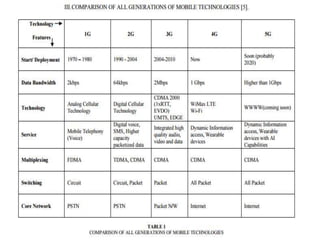
Evolution
 Mobile communication has become more popular in
last few years due to fast revolution in mobile
technology. This revolution is due to very high increase
in mobile customers. This revolution is from-
1G - the first generation
2G- the second generation
3G - the third generation
4G - the fourth generation and
5G - the fifth second generation
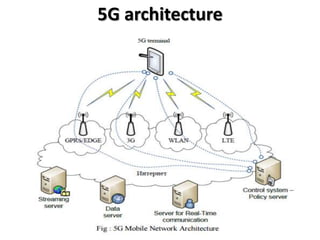
5G architecture
Services
GPRS (General Packet Radio Service)
 It is used to transmit data at 60kb/sec.
 It also consumes less battery during sending and receiving
mail or to browse internet.
EDGE (Exchanged Data Rate for GSM Evolution)
 It is an advanced version of GPRS.
 It provides a data speed of 473kb/sec.
3G
• 3G makes it possible to do video call on mobile network.
• It also provides efficient way to browse internet on
mobile network.
Services
WLAN (Wireless Local Area Network)
 WLAN provides short range, high speed wireless
data connection between mobile data device
using radio signal.
LTE (Long Term Evolution)
LTE is a standard for mobile communication for
high speed data transmission for mobile network.
 It has speed up to 100mbps.
Hardware & Software of 5G
Technology
5G Hardware:
Uses UWB( Ultra Wide Band) Networks with
Higher Band Width with low Energy levels.
(Band Width) BW is of 4000 Mbps which is
400 times faster than today wireless networks.
Uses Smart Antenna.
Uses CDMA (Code Division Multiple Access)
Hardware & Software of 5G
Technology
5G Software :
5G Will be Standard Unified Standard of
different wireless networks, Including LAN
technologies, LAN/WAN, WW, Unified IP &
Seamless combination of broadband.
Software Includes Radio, Encryption, flexibility
and Antivirus.
Features of 5G Technology
5G technology offer high resolution for crazy cell
phone user and bidirectional large bandwidth
shaping.
The uploading and downloading speed of 5G
technology touching the peak.
The advanced billing interfaces of 5G technology
makes it more attractive and effective.
By 5G technology a user can get better and fast
solution.
Features of 5G Technology
The remote diagnostics also a great feature of 5G
technology.
The 5G technology is providing up to 25 Mbps
connectivity speed.
The 5G technology also support virtual private
network.
The 5G technology network offering enhanced
and available connectivity just about the world.
 5G technology offer transporter class gateway
with unparalleled consistency.
Advantages:
 The advantages of the 5G technology are as follows:
 It posses very high speed, high capacity and low cost per bit.
 It supports multimedia, voice, and internet.
 It also offers global access and service portability.
 It has very high uploading and downloading speed.
 It offers high resolution and bi-directional large bandwidth for
mad mobile users.
 Data Bandwidth of >1 Gbps or Higher.
 Dynamic Information Access.
 Available at Low Cost.
Disadvantages:
 The following are the disadvantages of the 5G technology:
 It is an under processing technology.
 It is difficult to get a high seed in some parts of the world.
 Security and privacy are yet to be solved.
 Many old machines will not support 5G.
Applications:
 The 5G technology has the following applications in different fields:
 Helps in knowing weather, location and can control the OC’s by the
handsets.
 To make the learning of education much easier.
 At the same time, it has the applications in the medical field also.
 Natural disasters can be detected; can visualize the universe, planets,
and galaxies.
 Wearable devices with Artificial Intelligence capabilities.
 Media Independent handover.
 Pervasive (Global) networks.
 Radio resource management.
 VoIP (Voice over IP) enabled device.
 With 6th sense technology.
Conclusion
 All totally the best way to help all users is to use 5G
as the next wireless system and in totally it is safety
and secure for public, this the need that demands the
solution.
 Today’s wired society is going wireless and if it has
problem, 5G is answer.
 5G technology is going to give tough competition to
Computers and Laptops.
 It will be available in the market 2020 at Affordable
cost with more reliability than previous mobiles.
References
• https://en.wikipedia.org/wiki/5G#History
• https://www.gsmaintelligence.com/research/
?file=141208-5g.pdf&download
• http://studymafia.org/5g-technology-ppt-and-
pdf-seminar-report-free/
• http://studymafia.org/wp-
content/uploads/2016/08/CSE-5G-
Technology-Report-PDF.pdf

5G Mobile Technology-By TAHMID RONGON

  • 1.
  • 2.
    CONTENTS  INTRODUCTION TO5G TECHNOLOGY  REQUIREMENTS  EVOLUTION FROM 1G TO 5G  ARCHITECTURE OF 5G  HARDWARE AND SOFTWARE OF 5G  FEATURES, ADVANTAGES, DISADVANTAGES & APPLICATIONS  CONCLUSION  REFERENCES
  • 3.
    DEFINATION OF 5G •5G Technology stands for 5th Generation Mobile technology which was started from late 2010s.  Complete wireless communication with almost no limitations.  It is highly supportable to WWWW (Wireless World Wide Web).
  • 4.
    REQUIREMENTS  The NextGeneration Mobile Networks Alliance defines the following requirements that a 5G standard should fulfill:  Data rates of tens of megabits per second for tens of thousands of users  Data rates of 100 megabits per second for metropolitan areas  1 Gb per second simultaneously to many workers on the same office floor  Several hundreds of thousands of simultaneous connections for wireless sensors  Spectral efficiency significantly enhanced compared to 4G  Coverage improved  Signaling efficiency enhanced  Latency reduced significantly compared to LTE
  • 5.
    Evolution  Mobile communicationhas become more popular in last few years due to fast revolution in mobile technology. This revolution is due to very high increase in mobile customers. This revolution is from- 1G - the first generation 2G- the second generation 3G - the third generation 4G - the fourth generation and 5G - the fifth second generation
  • 7.
  • 8.
    Services GPRS (General PacketRadio Service)  It is used to transmit data at 60kb/sec.  It also consumes less battery during sending and receiving mail or to browse internet. EDGE (Exchanged Data Rate for GSM Evolution)  It is an advanced version of GPRS.  It provides a data speed of 473kb/sec. 3G • 3G makes it possible to do video call on mobile network. • It also provides efficient way to browse internet on mobile network.
  • 9.
    Services WLAN (Wireless LocalArea Network)  WLAN provides short range, high speed wireless data connection between mobile data device using radio signal. LTE (Long Term Evolution) LTE is a standard for mobile communication for high speed data transmission for mobile network.  It has speed up to 100mbps.
  • 10.
    Hardware & Softwareof 5G Technology 5G Hardware: Uses UWB( Ultra Wide Band) Networks with Higher Band Width with low Energy levels. (Band Width) BW is of 4000 Mbps which is 400 times faster than today wireless networks. Uses Smart Antenna. Uses CDMA (Code Division Multiple Access)
  • 11.
    Hardware & Softwareof 5G Technology 5G Software : 5G Will be Standard Unified Standard of different wireless networks, Including LAN technologies, LAN/WAN, WW, Unified IP & Seamless combination of broadband. Software Includes Radio, Encryption, flexibility and Antivirus.
  • 12.
    Features of 5GTechnology 5G technology offer high resolution for crazy cell phone user and bidirectional large bandwidth shaping. The uploading and downloading speed of 5G technology touching the peak. The advanced billing interfaces of 5G technology makes it more attractive and effective. By 5G technology a user can get better and fast solution.
  • 13.
    Features of 5GTechnology The remote diagnostics also a great feature of 5G technology. The 5G technology is providing up to 25 Mbps connectivity speed. The 5G technology also support virtual private network. The 5G technology network offering enhanced and available connectivity just about the world.  5G technology offer transporter class gateway with unparalleled consistency.
  • 14.
    Advantages:  The advantagesof the 5G technology are as follows:  It posses very high speed, high capacity and low cost per bit.  It supports multimedia, voice, and internet.  It also offers global access and service portability.  It has very high uploading and downloading speed.  It offers high resolution and bi-directional large bandwidth for mad mobile users.  Data Bandwidth of >1 Gbps or Higher.  Dynamic Information Access.  Available at Low Cost.
  • 15.
    Disadvantages:  The followingare the disadvantages of the 5G technology:  It is an under processing technology.  It is difficult to get a high seed in some parts of the world.  Security and privacy are yet to be solved.  Many old machines will not support 5G.
  • 16.
    Applications:  The 5Gtechnology has the following applications in different fields:  Helps in knowing weather, location and can control the OC’s by the handsets.  To make the learning of education much easier.  At the same time, it has the applications in the medical field also.  Natural disasters can be detected; can visualize the universe, planets, and galaxies.  Wearable devices with Artificial Intelligence capabilities.  Media Independent handover.  Pervasive (Global) networks.  Radio resource management.  VoIP (Voice over IP) enabled device.  With 6th sense technology.
  • 17.
    Conclusion  All totallythe best way to help all users is to use 5G as the next wireless system and in totally it is safety and secure for public, this the need that demands the solution.  Today’s wired society is going wireless and if it has problem, 5G is answer.  5G technology is going to give tough competition to Computers and Laptops.  It will be available in the market 2020 at Affordable cost with more reliability than previous mobiles.
  • 18.
    References • https://en.wikipedia.org/wiki/5G#History • https://www.gsmaintelligence.com/research/ ?file=141208-5g.pdf&download •http://studymafia.org/5g-technology-ppt-and- pdf-seminar-report-free/ • http://studymafia.org/wp- content/uploads/2016/08/CSE-5G- Technology-Report-PDF.pdf