Prepared By
Gashbin Jalal
Koraz ayub
KaraNawzad
Sivan Ibrahim
Kozhan Nawzad
Mobile Generation
Supervisored by
Avin
Contents:
• Introduction
• History
• First Generation(1G)
• Second Generation(2G)
• Third Generation(3G)
• Fourth Generation(4G)
• Conclusion
Introduction
Mobile communication, an integral aspect of contemporary living, has
transformed how we connect and communicate seamlessly. In the present
era, diverse technologies like 5G highlight its evolution, playing a pivotal
role in shaping modern societal interactions and global connectivity.
History:
>Introduction of Handheld Mobile Phones (1973):
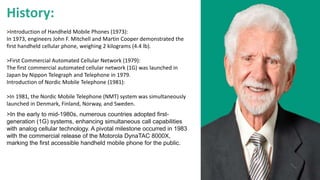
In 1973, engineers John F. Mitchell and Martin Cooper demonstrated the
first handheld cellular phone, weighing 2 kilograms (4.4 lb).
>First Commercial Automated Cellular Network (1979):
The first commercial automated cellular network (1G) was launched in
Japan by Nippon Telegraph and Telephone in 1979.
Introduction of Nordic Mobile Telephone (1981):
>In 1981, the Nordic Mobile Telephone (NMT) system was simultaneously
launched in Denmark, Finland, Norway, and Sweden.
>In the early to mid-1980s, numerous countries adopted first-
generation (1G) systems, enhancing simultaneous call capabilities
with analog cellular technology. A pivotal milestone occurred in 1983
with the commercial release of the Motorola DynaTAC 8000X,
marking the first accessible handheld mobile phone for the public.
1
G
>First-generation mobile networks relied on analogue radio systems, which meant that users
could only make phone calls and not send or receive text messages.
>The 1G network was first introduced in Japan in 1979 before being rolled out in other
countries, such as the USA, in 1980
>It was limited to voice calls, and offered a maximum speed of 2.4 kbps.
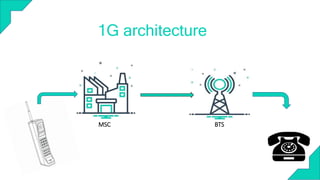
BTS
MSC
1G architecture
4G
>Technically , the first commercially deployed 4G network came out in1998
>based on International Mobile Telecommunications-Advanced (IMT-Advanced)
>download speeds of up to 100 Mbps in a fast-moving vehicle and up to 1 Gbps when the user is walking or stationary,
Advantage
* Better download speed.
* Extremely high voice quality.
* Easy access to Internet, IM, social networks, streaming media, video calling.
* Higher bandwidth.
Fourth Generation
References
• https://www.thalesgroup.com/en/markets/digital-identity-and-
security/inspired/basics-of-mobile-networking/milestones

Multilevel modulation techniques (MFSK, M-ray PSK& M-ray QAM)

  • 1.
    Prepared By Gashbin Jalal Korazayub KaraNawzad Sivan Ibrahim Kozhan Nawzad Mobile Generation Supervisored by Avin
  • 2.
    Contents: • Introduction • History •First Generation(1G) • Second Generation(2G) • Third Generation(3G) • Fourth Generation(4G) • Conclusion
  • 3.
    Introduction Mobile communication, anintegral aspect of contemporary living, has transformed how we connect and communicate seamlessly. In the present era, diverse technologies like 5G highlight its evolution, playing a pivotal role in shaping modern societal interactions and global connectivity.
  • 4.
    History: >Introduction of HandheldMobile Phones (1973): In 1973, engineers John F. Mitchell and Martin Cooper demonstrated the first handheld cellular phone, weighing 2 kilograms (4.4 lb). >First Commercial Automated Cellular Network (1979): The first commercial automated cellular network (1G) was launched in Japan by Nippon Telegraph and Telephone in 1979. Introduction of Nordic Mobile Telephone (1981): >In 1981, the Nordic Mobile Telephone (NMT) system was simultaneously launched in Denmark, Finland, Norway, and Sweden. >In the early to mid-1980s, numerous countries adopted first- generation (1G) systems, enhancing simultaneous call capabilities with analog cellular technology. A pivotal milestone occurred in 1983 with the commercial release of the Motorola DynaTAC 8000X, marking the first accessible handheld mobile phone for the public.
  • 5.
    1 G >First-generation mobile networksrelied on analogue radio systems, which meant that users could only make phone calls and not send or receive text messages. >The 1G network was first introduced in Japan in 1979 before being rolled out in other countries, such as the USA, in 1980 >It was limited to voice calls, and offered a maximum speed of 2.4 kbps.
  • 6.
  • 7.
    4G >Technically , thefirst commercially deployed 4G network came out in1998 >based on International Mobile Telecommunications-Advanced (IMT-Advanced) >download speeds of up to 100 Mbps in a fast-moving vehicle and up to 1 Gbps when the user is walking or stationary, Advantage * Better download speed. * Extremely high voice quality. * Easy access to Internet, IM, social networks, streaming media, video calling. * Higher bandwidth. Fourth Generation
  • 9.