AVINASH PPT
EVIDENCESOF
EVOLUTION
A PRESENTATION BY AVINASH MADHUKAR & ANAMIKA YADAV
It is the net directional changes or any
cumulative changes in the characteristics of
organisms or population over many generations
which give rise to new species sharing a
common ancestors.
It is a slow and gradually continue process.
First single celled organism appeared on earth
around 3.5 billion year ago.
First multicellular organisms evolve around 600
Millions years ago.
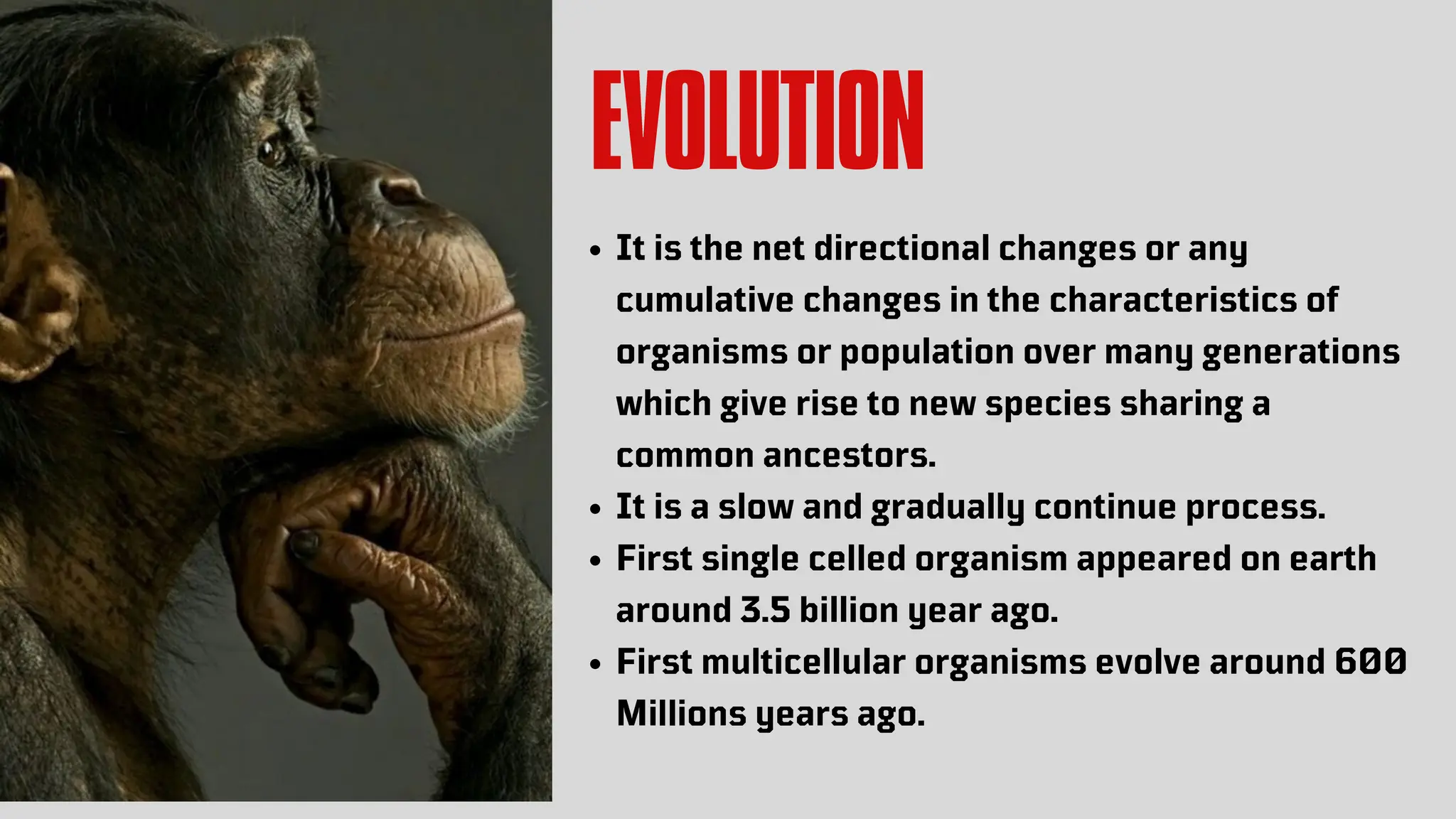
EVOLUTION
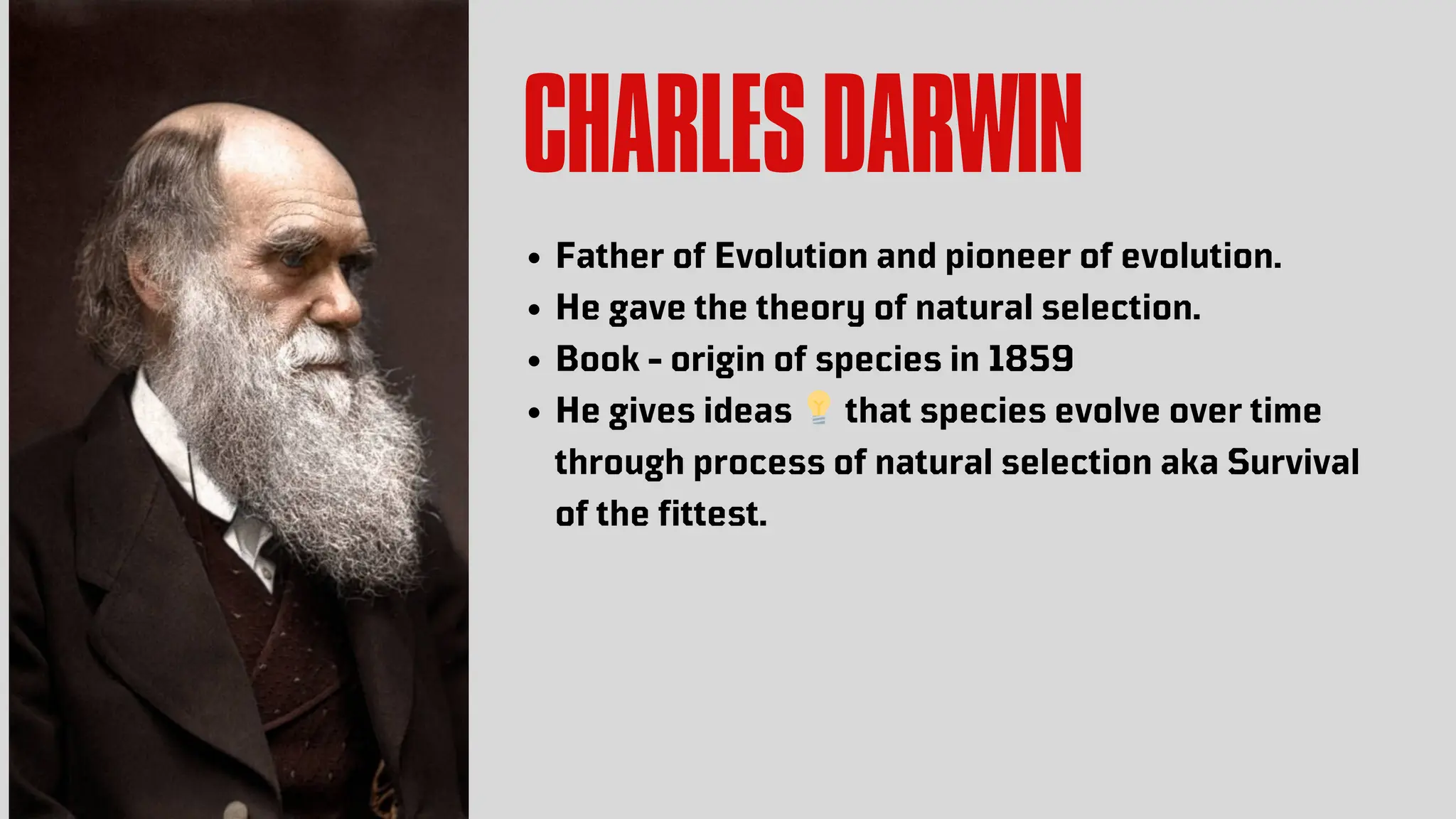
CHARLESDARWIN
Father of Evolution and pioneer of evolution.
He gave the theory of natural selection.
Book - origin of species in 1859
He gives ideas 💡that species evolve over time
through process of natural selection aka Survival
of the fittest.
WHYDOESEVOLUTIONHAPPENS.?
1. Natural selection.
2. Mutation - changes in genetics makeup
3. Gene flow - exchange of genetic material over different population of species.

4. Genetic drift - random changes in allele frequencies in a small population due to
changes event.
5. Adaptive radiations.
6. Speciation - over long periods of time accumulation of Genetic changes can lead
to the formation of new species.
There are several theories given by scientists which proves the above Reason.
EVIDENCESOFEVOLUTION
1. Palaeontology
2. Comparative Anatomy
3. Connective link animals
4. Taxonomy
5. Embryology
6. Cytology and Biochemistry
7. Genetics
8. Geographical distribution
PALAEONTOLOGY
The branch of Biology which deals with the study of ancient life on the
basis of fossils.
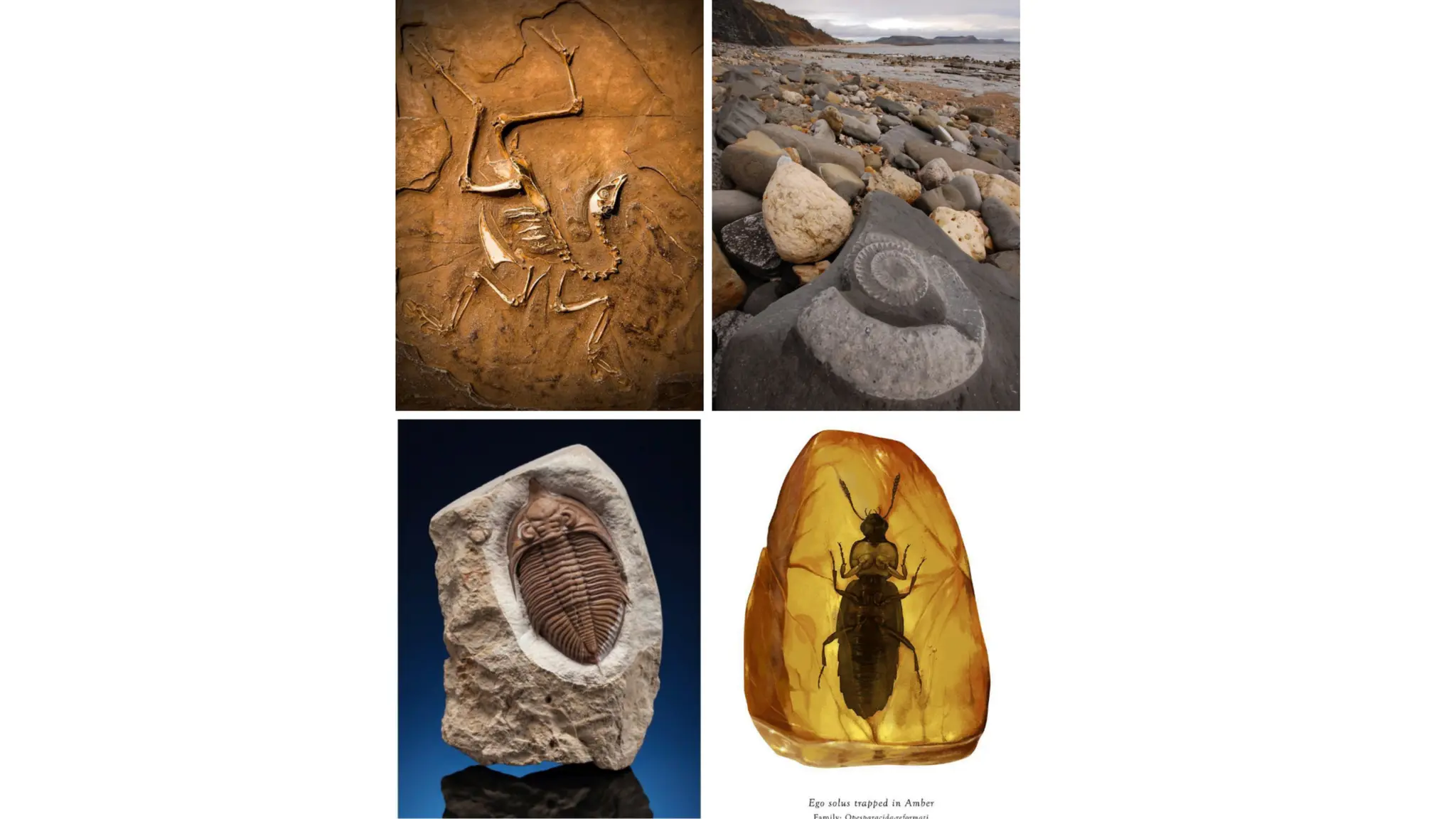
Fossils - It is a part of an animal or plant that lived thousand or millions
of the years ago, which is turned into rocks by the process of Fossilization.
Fossilization - typically occurs when the remanins are buried in
sediments, preventing decomposition and mineral gradually replaced the
organic material preserving it as a fossil.
This process of Fossilization can be of different type like Natural
sedimentation, mineral infiltration, petrification, impression, ect.
DETERMINATIONOFAGEOFFOSSIL
Radioactive Decaying : bases on the older the rocks the less radioactive.
1.
A. Carbon Dating - used to determine the age of younger fossils which still
contain organic material (C14) Test.
B. Potassium - argon and Uranium lead method - due to decline in radioactively
-> non-radioactive this method is used.
By estimating the rate at which Uranium decay to lead or potassium to argon
the accurate dating of rocks and fossils can possible.
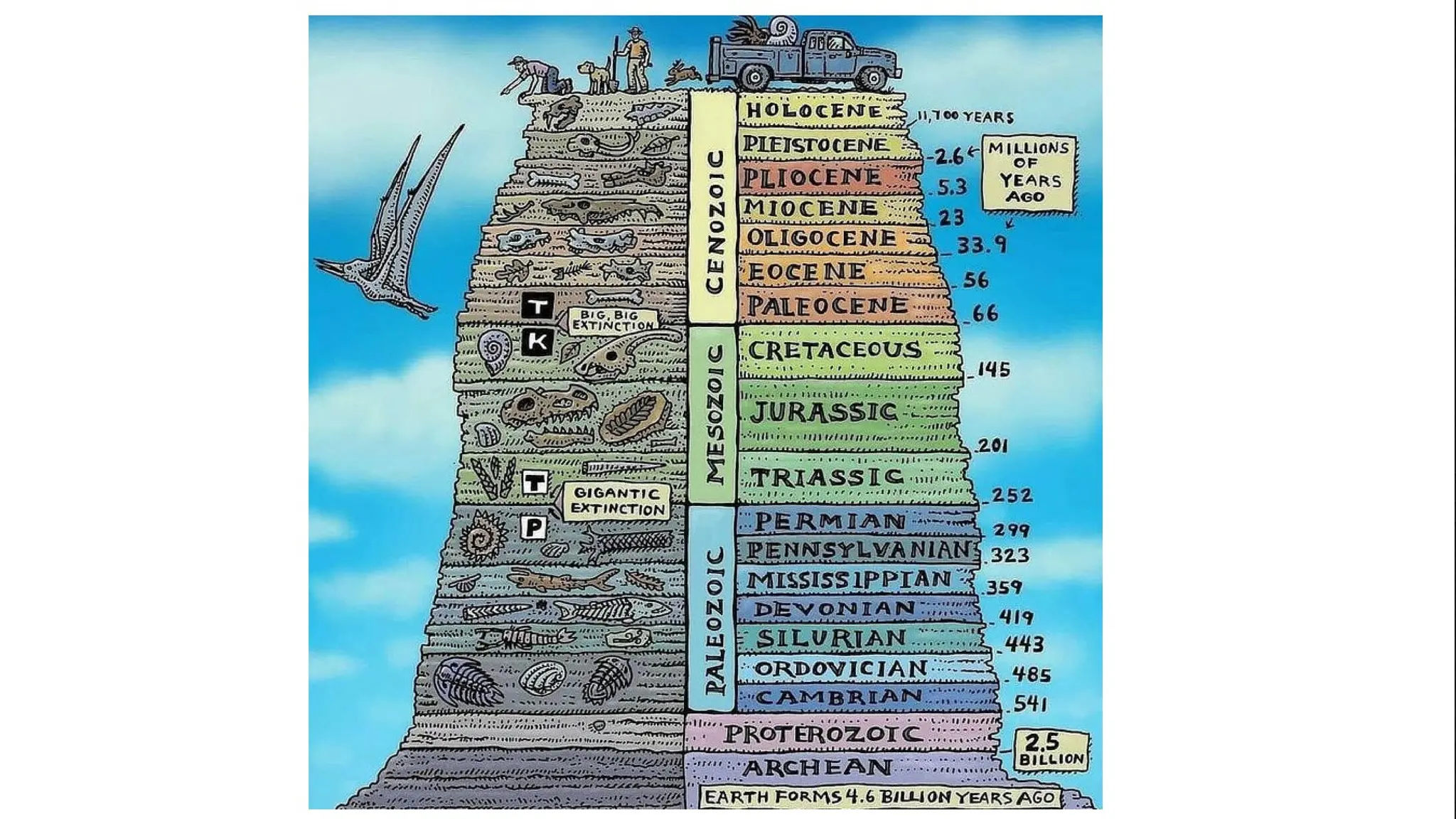
2. The Geological Time Scale - is the “calendar” for events in Earth history. It
subdivides all time into named units of abstract time called—in descending
order of duration—eons, eras, periods, epochs, and ages.
IMPORTANCEOFFOSSIL
It helped to know about the extinct species of plant and animals.
It study show that animals and plants of different geological ages
evolved by time.
Complete evolutionary history of the present day species can be
constructed on the basis of fossils.
Transitional forms are better known through the study of fossils
which shows evolution of :-
Amphibians -> Reptiles -> Aves -> Mammals
COMPARATIVEANATOMY
A. Divergent Evolution or Homology
It is a process by which different organisms which having common
ancestors develops different traits or characters to adapt to the changes
of environmental condition.
The structures fromed due to the divergent evolution are called as
Homologus structures.
Homologus structure - an certain structure which is similar in
anatomically but performs different functions.
The similarity in Homologus structure are called Homology.
Pentadactyle limbs
It consists of 5 digits and it is best example of homology, it is found in all
classes of Vertebrates i.e amphibians, reptiles, aves, mammels.
All this animals having 5 digits and similar anatomical structure humrus,
radius, alna, carpal, meta carpal and phalanges.
But due to evolution they are modified for performing different functions
in each of the animals.
ex - in birds wings are modified for flying.
ex - in horses 2 & 5 digits are reduced for support or running.
ex - in whales limbs are modified into flippers for steering.
All this animals
having 5 digits and
similar anatomical
structure humrus,
radius, alna, carpal,
meta carpal and
phalanges.
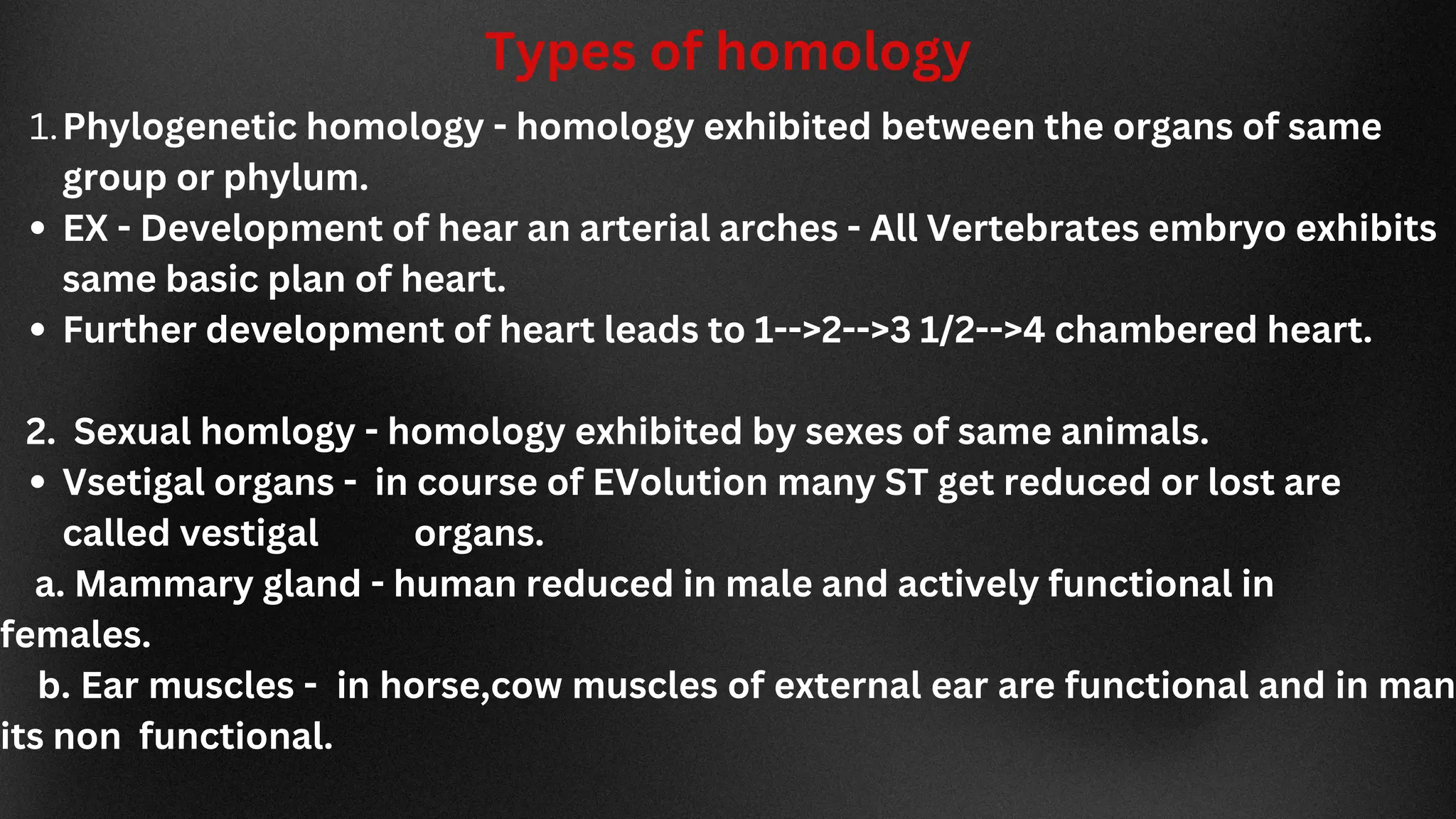
Types of homology
Phylogenetic homology - homology exhibited between the organs of same
group or phylum.
EX - Development of hear an arterial arches - All Vertebrates embryo exhibits
same basic plan of heart.
Further development of heart leads to 1-->2-->3 1/2-->4 chambered heart.
Vsetigal organs - in course of EVolution many ST get reduced or lost are
called vestigal organs.
1.
2. Sexual homlogy - homology exhibited by sexes of same animals.
a. Mammary gland - human reduced in male and actively functional in
females.
b. Ear muscles - in horse,cow muscles of external ear are functional and in man
its non functional.
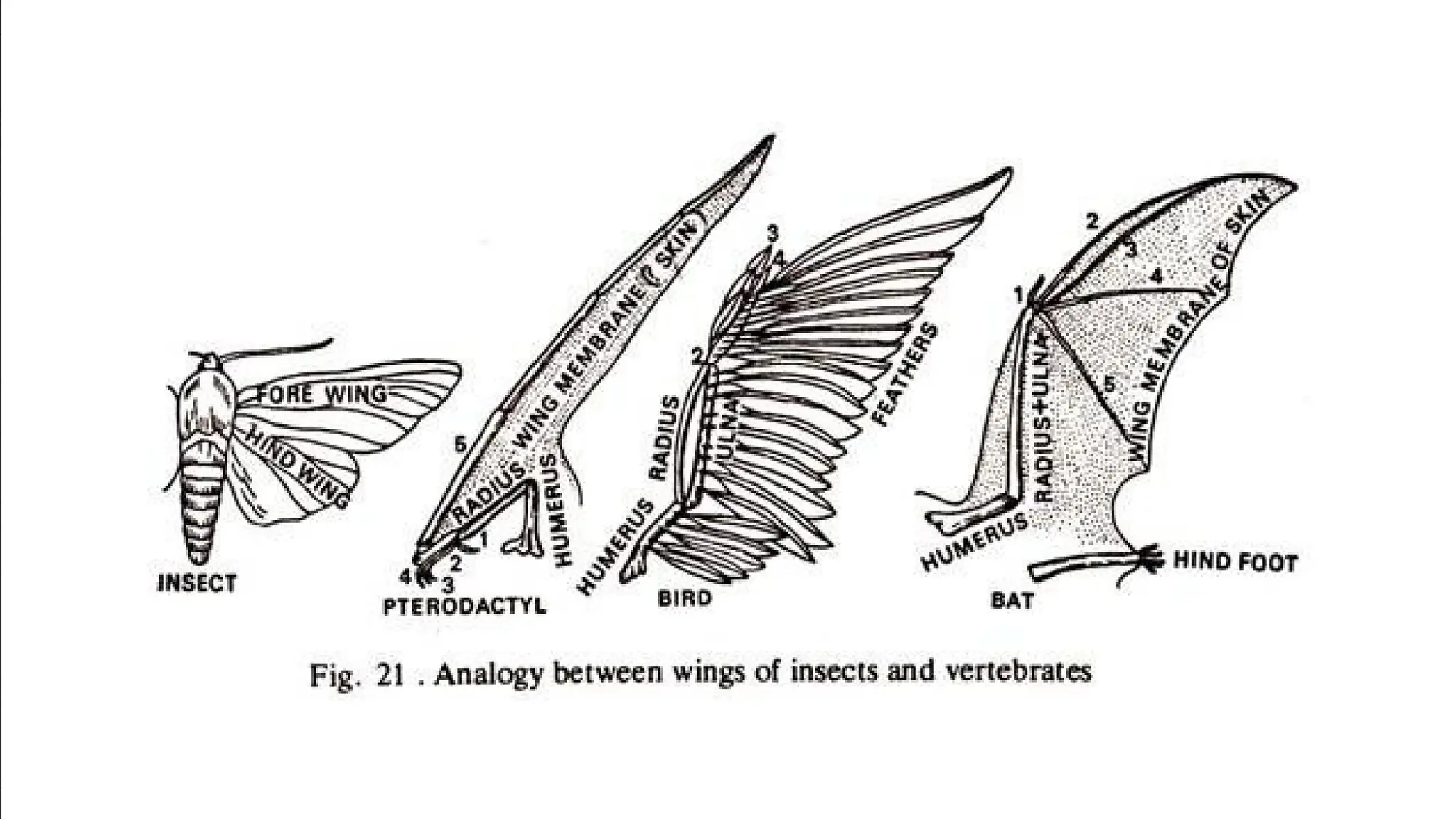
B. Convergent evolution or Analogy
It is a process of evolution in which organism that are not closely related
independently evolve similar structures.
Such structures are called Analogus Structures.
We can also say that it is different anatomy but perform similar
functions with having no common ancestory.
Examples
Wings of Birds and Butterfly
1.
Wings of both the organism perform same functions whcih is flying.
But their id no fundamental resemblance in their structure of wings.
Examples
1. Wings of Birds and Butterfly
Wings of both the organism perform same functions
whcih is flying.
But their id no fundamental resemblance in their
structure of wings.
2. Eyes of octopus and Vertebrates
Both having similar eye in every small structure but
only difference is retina of vertebrates eye is
inverted.
Octopus have non inverted eye.
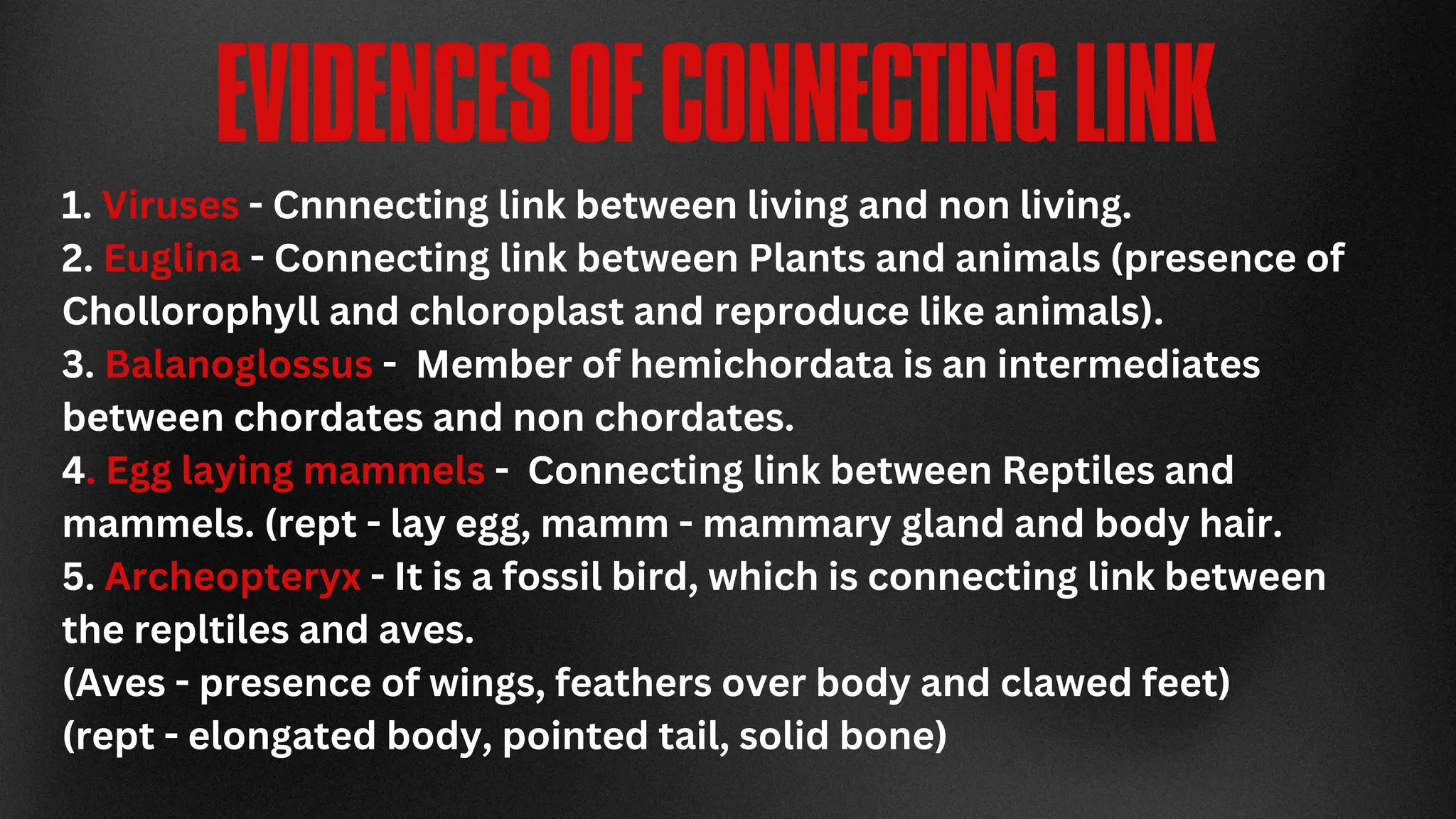
EVIDENCESOFCONNECTINGLINK
1. Viruses - Cnnnecting link between living and non living.
2. Euglina - Connecting link between Plants and animals (presence of
Chollorophyll and chloroplast and reproduce like animals).
3. Balanoglossus - Member of hemichordata is an intermediates
between chordates and non chordates.
4. Egg laying mammels - Connecting link between Reptiles and
mammels. (rept - lay egg, mamm - mammary gland and body hair.
5. Archeopteryx - It is a fossil bird, which is connecting link between
the repltiles and aves.
(Aves - presence of wings, feathers over body and clawed feet)
(rept - elongated body, pointed tail, solid bone)
EVIDENCESFROMTAXONOMY
Idetification, description and naming of organism is known as taxonomy.
To catogrise them properly an artifical system of classification is developed
which is based on the basis of superficial resembelance.
Development of various evolution thories there is another system was
introduce called as Natural System.
It is totally based on Homology and not on the analogy.
It holds the fact that thefundamental similarities among the group are due
to origin from a common ancestors.
The difference between them is formed due to evolution by time.
Example
1. Classification of Chordata
It includes 5 classes of vertebrates and 2 groups of
invertebrates.
these animals are inter related by passing one
fundamental structure called Notochord.
Except Notochord there is no fundamental structure
common between them.
Notochord
It is longitudunal flexiable hollow dorsal nerve tube,
perforated, pharynx sementel nerve blocks etc.
CATEGORIESFORCLASSIFICATION
Phylum
Class
Order
Genus
Species
1.
2.
3.
4.
5.
Evolution Tree
It is diagramatic form of classification which resembles like a tree of
evolution
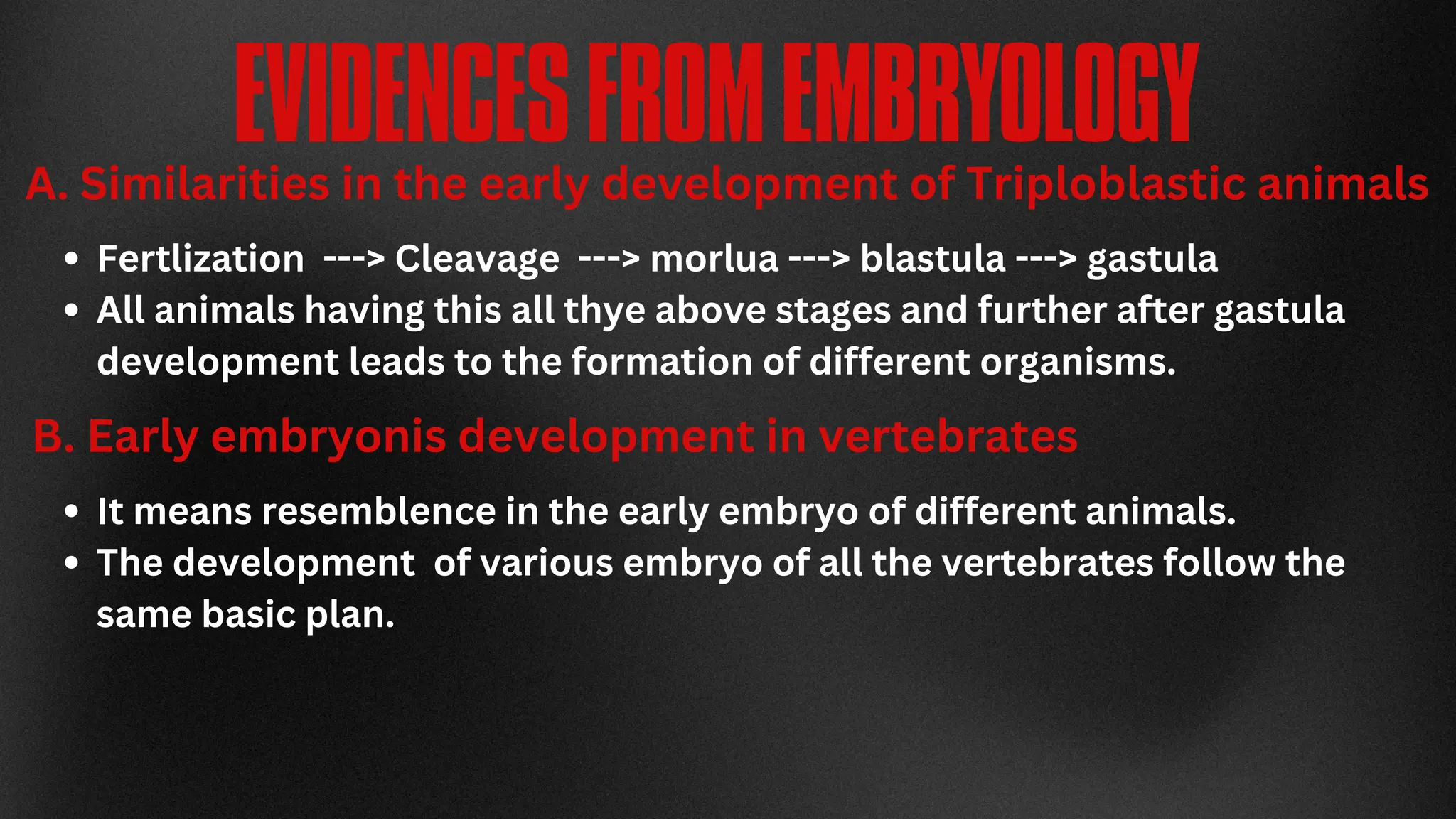
EVIDENCESFROMEMBRYOLOGY
A. Similarities in the early development of Triploblastic animals
Fertlization ---> Cleavage ---> morlua ---> blastula ---> gastula
All animals having this all thye above stages and further after gastula
development leads to the formation of different organisms.
B. Early embryonis development in vertebrates
It means resemblence in the early embryo of different animals.
The development of various embryo of all the vertebrates follow the
same basic plan.
C. Development of Vertebrate organs
Basic structure of organs are similar only further developments are done
which leads to formation of complex organ or current Modern organ or
formation of complex organ system.
FISHES (two chambered heart)
AMPHIBIAN (three chambered heart)
AVES and MAMMMALS (four Chambered heart)
All the above shows they all show a common ancestory.
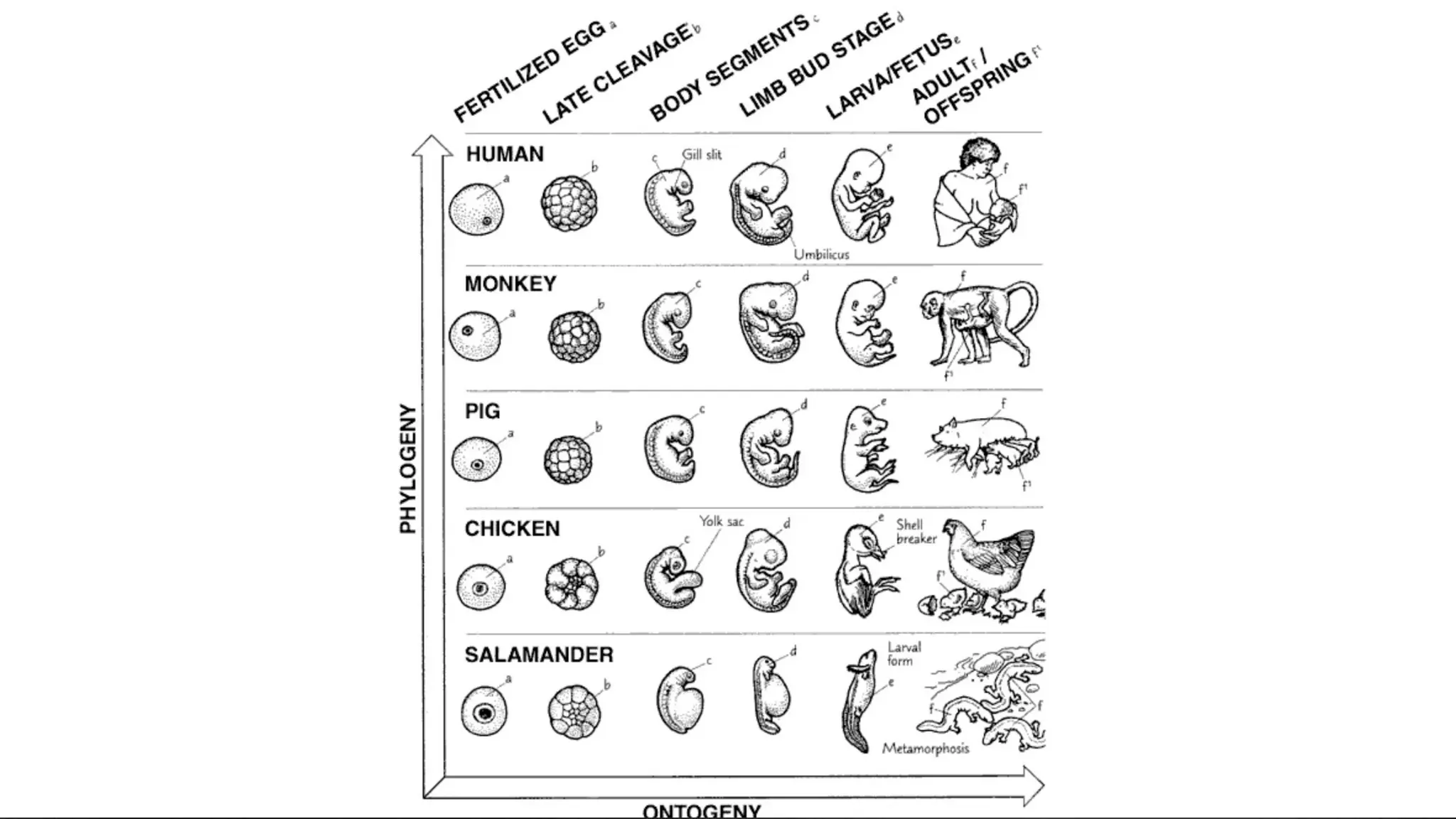
D. Recaplication theory or Biogenetic law
Given by Carl Von Bear (1828) and modified by Ernst hackel.
Its States Ontogeny recapitulates phylogeny.
In other words embryo of some animals shows similarities to embryo of
some other animals.
Ex development of Gills, tadpole larvae of frogs.
EVIDENCESFROMCYTOLOGYANDBIOCHEMISTRY
A. Basic cellular Structure
If we observe the cell structure then it is made from Chemical like Nucleic
acid, ATP, Cytochrome C (group of proteins) (ETS) and cell organelles like
ER, mitochondria, ribosome, protoplasm, nucleoplasm etc.
The Same cell structure is present in almost all the living organisms.
This shows or strongly supports that all the living organism shows a
common ancestry.
Even the virus (host specific) which is quite different from all the living
organism possess nucleic acid.
B.Enzyme
Amylase & Trypsin
Present in all animals (sponges to Mammalia).
That both enzymes are also known as universal Enzyme because it is
present in entire animal kingdom.
Function – Amylase digests carbohydrates, lipase digests fats, and trypsin
digests proteins.
C. Hormones
PRL and Thyroxine (adenohypophysis of pitutary and thyroid)
All the vertebrates possess PRL hormones and these hormones do same
function in all vertebrates organisms.
Functions of Thyroxine
Regulation of BMRS
Support erythropoiesis.
Control metabolism of Carbohydrate, proteins and fats.
D. Blood Proteins
Hematin crystal
Human is closest to Chimpanzees & gorillas, which means our blood
proteins is closely similar to Chimpanzees & gorillas it is because of we are
evolved from a common ancestor.
Similar in Cows, goats and sheep & in cat and dog also.
EVIDENCESFROMGENETICS
It involves 2 process Heredity and Variation.
Heredity – Similar characters passed from one generation to next
generation.
Variation – Different between same animal (because of resources) due to
environmental adaptations.
The variation and Mutation are responsible for the new adaptive species.
This new Species are not formed by the accumulation of minute variation
or natural selection but are formed due to suddenly appearing variatation
which is called Mutation.
Mutation – the change occurring in germplasm or hereditary substance of
living organism.
EVIDENCEFROMBIOGEOGRAPHYDISTRIBUTION
It is the study of geological species distribution, which is influenced by
both biotic and abiotic factors.
Some species are endemic and are only found in a particular region, while
others are generalists and are distributed worldwide.
Species that evolved before the breakup of continents are distributed
worldwide and found in only certain regions of the planet.
This types of species are known as Endemic species.
Generalists: species which live in a wide variety of geographic areas.
Continental Drift - the movement of continents resulting from the motion
of tectonic plates.
The huge land mass Pangea broke up 200 M years ago.
Australia
It has between 600,000 and 700,000 species of plants and animals.
But Approximately 3/4 of living plant and mammal species are endemic
species found solely in Australia.
KANGAROO
AUSTRALIAN SNUBFIN DOLPHIN
SUGAR GLIDERS
Examples
1. Palaeontology
2. Comparative Anatomy
3. Connective link animals
4. Taxonomy
5. Embryology
6. Cytology and Biochemistry
7. Genetics
8. Geographical distribution
CONCULSIONANDRECALL
THANKYOU
Special Thanks to
Dr Hema Kulkarni mam

Evidences of Evoltions by Avi_20231130_143245_0000.pdf

  • 1.
    AVINASH PPT EVIDENCESOF EVOLUTION A PRESENTATIONBY AVINASH MADHUKAR & ANAMIKA YADAV
  • 2.
    It is thenet directional changes or any cumulative changes in the characteristics of organisms or population over many generations which give rise to new species sharing a common ancestors. It is a slow and gradually continue process. First single celled organism appeared on earth around 3.5 billion year ago. First multicellular organisms evolve around 600 Millions years ago. EVOLUTION
  • 4.
    CHARLESDARWIN Father of Evolutionand pioneer of evolution. He gave the theory of natural selection. Book - origin of species in 1859 He gives ideas 💡that species evolve over time through process of natural selection aka Survival of the fittest.
  • 5.
    WHYDOESEVOLUTIONHAPPENS.? 1. Natural selection. 2.Mutation - changes in genetics makeup 3. Gene flow - exchange of genetic material over different population of species. 4. Genetic drift - random changes in allele frequencies in a small population due to changes event. 5. Adaptive radiations. 6. Speciation - over long periods of time accumulation of Genetic changes can lead to the formation of new species. There are several theories given by scientists which proves the above Reason.
  • 6.
    EVIDENCESOFEVOLUTION 1. Palaeontology 2. ComparativeAnatomy 3. Connective link animals 4. Taxonomy 5. Embryology 6. Cytology and Biochemistry 7. Genetics 8. Geographical distribution
  • 7.
    PALAEONTOLOGY The branch ofBiology which deals with the study of ancient life on the basis of fossils. Fossils - It is a part of an animal or plant that lived thousand or millions of the years ago, which is turned into rocks by the process of Fossilization. Fossilization - typically occurs when the remanins are buried in sediments, preventing decomposition and mineral gradually replaced the organic material preserving it as a fossil. This process of Fossilization can be of different type like Natural sedimentation, mineral infiltration, petrification, impression, ect.
  • 9.
    DETERMINATIONOFAGEOFFOSSIL Radioactive Decaying :bases on the older the rocks the less radioactive. 1. A. Carbon Dating - used to determine the age of younger fossils which still contain organic material (C14) Test. B. Potassium - argon and Uranium lead method - due to decline in radioactively -> non-radioactive this method is used. By estimating the rate at which Uranium decay to lead or potassium to argon the accurate dating of rocks and fossils can possible. 2. The Geological Time Scale - is the “calendar” for events in Earth history. It subdivides all time into named units of abstract time called—in descending order of duration—eons, eras, periods, epochs, and ages.
  • 11.
    IMPORTANCEOFFOSSIL It helped toknow about the extinct species of plant and animals. It study show that animals and plants of different geological ages evolved by time. Complete evolutionary history of the present day species can be constructed on the basis of fossils. Transitional forms are better known through the study of fossils which shows evolution of :- Amphibians -> Reptiles -> Aves -> Mammals
  • 13.
    COMPARATIVEANATOMY A. Divergent Evolutionor Homology It is a process by which different organisms which having common ancestors develops different traits or characters to adapt to the changes of environmental condition. The structures fromed due to the divergent evolution are called as Homologus structures. Homologus structure - an certain structure which is similar in anatomically but performs different functions. The similarity in Homologus structure are called Homology.
  • 14.
    Pentadactyle limbs It consistsof 5 digits and it is best example of homology, it is found in all classes of Vertebrates i.e amphibians, reptiles, aves, mammels. All this animals having 5 digits and similar anatomical structure humrus, radius, alna, carpal, meta carpal and phalanges. But due to evolution they are modified for performing different functions in each of the animals. ex - in birds wings are modified for flying. ex - in horses 2 & 5 digits are reduced for support or running. ex - in whales limbs are modified into flippers for steering.
  • 15.
    All this animals having5 digits and similar anatomical structure humrus, radius, alna, carpal, meta carpal and phalanges.
  • 16.
    Types of homology Phylogenetichomology - homology exhibited between the organs of same group or phylum. EX - Development of hear an arterial arches - All Vertebrates embryo exhibits same basic plan of heart. Further development of heart leads to 1-->2-->3 1/2-->4 chambered heart. Vsetigal organs - in course of EVolution many ST get reduced or lost are called vestigal organs. 1. 2. Sexual homlogy - homology exhibited by sexes of same animals. a. Mammary gland - human reduced in male and actively functional in females. b. Ear muscles - in horse,cow muscles of external ear are functional and in man its non functional.
  • 17.
    B. Convergent evolutionor Analogy It is a process of evolution in which organism that are not closely related independently evolve similar structures. Such structures are called Analogus Structures. We can also say that it is different anatomy but perform similar functions with having no common ancestory. Examples Wings of Birds and Butterfly 1. Wings of both the organism perform same functions whcih is flying. But their id no fundamental resemblance in their structure of wings.
  • 18.
    Examples 1. Wings ofBirds and Butterfly Wings of both the organism perform same functions whcih is flying. But their id no fundamental resemblance in their structure of wings. 2. Eyes of octopus and Vertebrates Both having similar eye in every small structure but only difference is retina of vertebrates eye is inverted. Octopus have non inverted eye.
  • 21.
    EVIDENCESOFCONNECTINGLINK 1. Viruses -Cnnnecting link between living and non living. 2. Euglina - Connecting link between Plants and animals (presence of Chollorophyll and chloroplast and reproduce like animals). 3. Balanoglossus - Member of hemichordata is an intermediates between chordates and non chordates. 4. Egg laying mammels - Connecting link between Reptiles and mammels. (rept - lay egg, mamm - mammary gland and body hair. 5. Archeopteryx - It is a fossil bird, which is connecting link between the repltiles and aves. (Aves - presence of wings, feathers over body and clawed feet) (rept - elongated body, pointed tail, solid bone)
  • 22.
    EVIDENCESFROMTAXONOMY Idetification, description andnaming of organism is known as taxonomy. To catogrise them properly an artifical system of classification is developed which is based on the basis of superficial resembelance. Development of various evolution thories there is another system was introduce called as Natural System. It is totally based on Homology and not on the analogy. It holds the fact that thefundamental similarities among the group are due to origin from a common ancestors. The difference between them is formed due to evolution by time.
  • 23.
    Example 1. Classification ofChordata It includes 5 classes of vertebrates and 2 groups of invertebrates. these animals are inter related by passing one fundamental structure called Notochord. Except Notochord there is no fundamental structure common between them. Notochord It is longitudunal flexiable hollow dorsal nerve tube, perforated, pharynx sementel nerve blocks etc.
  • 24.
    CATEGORIESFORCLASSIFICATION Phylum Class Order Genus Species 1. 2. 3. 4. 5. Evolution Tree It isdiagramatic form of classification which resembles like a tree of evolution
  • 26.
    EVIDENCESFROMEMBRYOLOGY A. Similarities inthe early development of Triploblastic animals Fertlization ---> Cleavage ---> morlua ---> blastula ---> gastula All animals having this all thye above stages and further after gastula development leads to the formation of different organisms. B. Early embryonis development in vertebrates It means resemblence in the early embryo of different animals. The development of various embryo of all the vertebrates follow the same basic plan.
  • 27.
    C. Development ofVertebrate organs Basic structure of organs are similar only further developments are done which leads to formation of complex organ or current Modern organ or formation of complex organ system. FISHES (two chambered heart) AMPHIBIAN (three chambered heart) AVES and MAMMMALS (four Chambered heart) All the above shows they all show a common ancestory. D. Recaplication theory or Biogenetic law Given by Carl Von Bear (1828) and modified by Ernst hackel. Its States Ontogeny recapitulates phylogeny. In other words embryo of some animals shows similarities to embryo of some other animals. Ex development of Gills, tadpole larvae of frogs.
  • 29.
    EVIDENCESFROMCYTOLOGYANDBIOCHEMISTRY A. Basic cellularStructure If we observe the cell structure then it is made from Chemical like Nucleic acid, ATP, Cytochrome C (group of proteins) (ETS) and cell organelles like ER, mitochondria, ribosome, protoplasm, nucleoplasm etc. The Same cell structure is present in almost all the living organisms. This shows or strongly supports that all the living organism shows a common ancestry. Even the virus (host specific) which is quite different from all the living organism possess nucleic acid.
  • 30.
    B.Enzyme Amylase & Trypsin Presentin all animals (sponges to Mammalia). That both enzymes are also known as universal Enzyme because it is present in entire animal kingdom. Function – Amylase digests carbohydrates, lipase digests fats, and trypsin digests proteins. C. Hormones PRL and Thyroxine (adenohypophysis of pitutary and thyroid) All the vertebrates possess PRL hormones and these hormones do same function in all vertebrates organisms. Functions of Thyroxine Regulation of BMRS Support erythropoiesis.
  • 31.
    Control metabolism ofCarbohydrate, proteins and fats. D. Blood Proteins Hematin crystal Human is closest to Chimpanzees & gorillas, which means our blood proteins is closely similar to Chimpanzees & gorillas it is because of we are evolved from a common ancestor. Similar in Cows, goats and sheep & in cat and dog also.
  • 32.
    EVIDENCESFROMGENETICS It involves 2process Heredity and Variation. Heredity – Similar characters passed from one generation to next generation. Variation – Different between same animal (because of resources) due to environmental adaptations. The variation and Mutation are responsible for the new adaptive species. This new Species are not formed by the accumulation of minute variation or natural selection but are formed due to suddenly appearing variatation which is called Mutation. Mutation – the change occurring in germplasm or hereditary substance of living organism.
  • 33.
    EVIDENCEFROMBIOGEOGRAPHYDISTRIBUTION It is thestudy of geological species distribution, which is influenced by both biotic and abiotic factors. Some species are endemic and are only found in a particular region, while others are generalists and are distributed worldwide. Species that evolved before the breakup of continents are distributed worldwide and found in only certain regions of the planet. This types of species are known as Endemic species. Generalists: species which live in a wide variety of geographic areas. Continental Drift - the movement of continents resulting from the motion of tectonic plates. The huge land mass Pangea broke up 200 M years ago.
  • 35.
    Australia It has between600,000 and 700,000 species of plants and animals. But Approximately 3/4 of living plant and mammal species are endemic species found solely in Australia. KANGAROO AUSTRALIAN SNUBFIN DOLPHIN SUGAR GLIDERS Examples
  • 36.
    1. Palaeontology 2. ComparativeAnatomy 3. Connective link animals 4. Taxonomy 5. Embryology 6. Cytology and Biochemistry 7. Genetics 8. Geographical distribution CONCULSIONANDRECALL
  • 37.