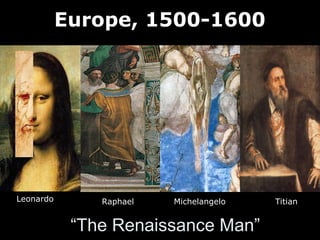
“The Renaissance Man”
Leonardo MichelangeloRaphael Titian
Europe, 1500-1600
Italy
Dates and Places:
• 1500 to 1600
• High Ren. (1495-1520)
• Rome, Florence
Milan, and Venice
Events & People:
• Humanism
• Reformation/
Counter-Reformation
• Powerful courts &
Catholic church
• Artist-genius –
raised funds for elaborate art projects
highly competitive
Italy
Themes:
• Life of Christ and the Virgin Mary,
saints
• Portraiture
• Classical mythology/antiquity
• Allegory, poesia
• Nature as muse
Forms:
• Balance, harmony, ideal beauty
(Greco-Roman)
• Disegno (drawing & design)
• Venetian color (colorito), Mannerist
distortion
• Fresco (buon and secco)
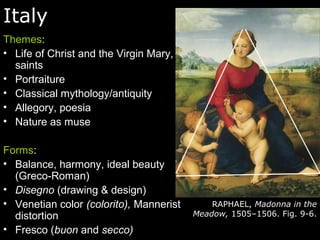
RAPHAEL, Madonna in the
Meadow, 1505–1506. Fig. 9-6.
Italy
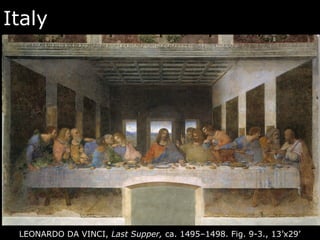
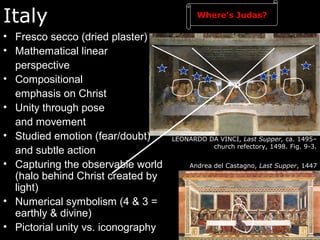
LEONARDO DA VINCI, Last Supper, ca. 1495–1498. Fig. 9-3., 13’x29’
Italy
• Fresco secco (dried plaster)
• Mathematical linear
perspective
• Compositional
emphasis on Christ
• Unity through pose
and movement
• Studied emotion (fear/doubt)
and subtle action
• Capturing the observable world
(halo behind Christ created by
light)
• Numerical symbolism (4 & 3 =
earthly & divine)
• Pictorial unity vs. iconography
LEONARDO DA VINCI, Last Supper, ca. 1495–
church refectory, 1498. Fig. 9-3.
Where’s Judas?
Andrea del Castagno, Last Supper, 1447
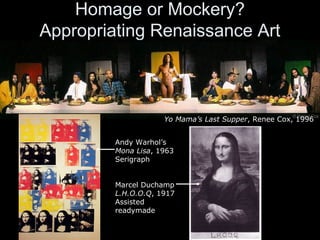
Homage or Mockery?
Appropriating Renaissance Art
Yo Mama’s Last Supper, Renee Cox, 1996
Andy Warhol’s
Mona Lisa, 1963
Serigraph
Marcel Duchamp
L.H.O.O.Q, 1917
Assisted
readymade
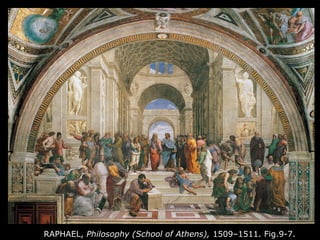
RAPHAEL, Philosophy (School of Athens), 1509–1511. Fig.9-7.
Italy
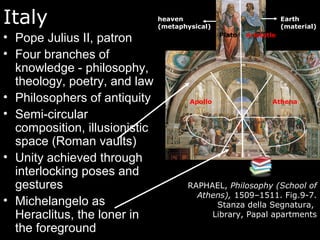
• Pope Julius II, patron
• Four branches of
knowledge - philosophy,
theology, poetry, and law
• Philosophers of antiquity
• Semi-circular
composition, illusionistic
space (Roman vaults)
• Unity achieved through
interlocking poses and
gestures
• Michelangelo as
Heraclitus, the loner in
the foreground
RAPHAEL, Philosophy (School of
Athens), 1509–1511. Fig.9-7.
Stanza della Segnatura,
Library, Papal apartments
Apollo Athena
Plato Aristotle
heaven
(metaphysical)
Earth
(material)
Italy
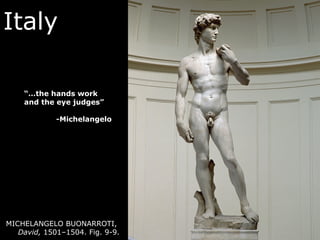
MICHELANGELO BUONARROTI,
David, 1501–1504. Fig. 9-9.
“…the hands work
and the eye judges”
-Michelangelo
Italy
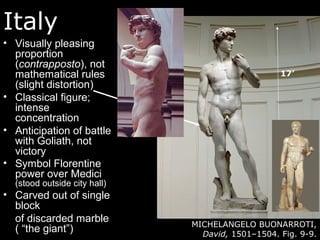
• Visually pleasing
proportion
(contrapposto), not
mathematical rules
(slight distortion)
• Classical figure;
intense
concentration
• Anticipation of battle
with Goliath, not
victory
• Symbol Florentine
power over Medici
(stood outside city hall)
• Carved out of single
block
of discarded marble
( “the giant”) MICHELANGELO BUONARROTI,
David, 1501–1504. Fig. 9-9.
17’
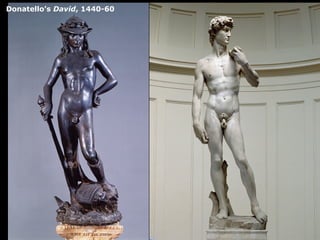
Donatello’s David, 1440-60
Italy
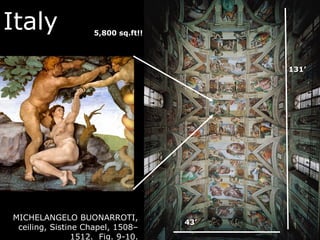
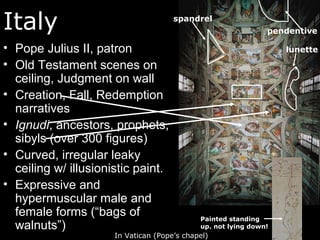
MICHELANGELO BUONARROTI,
ceiling, Sistine Chapel, 1508–
1512. Fig. 9-10.
5,800 sq.ft!!
131’
43’
Italy
• Pope Julius II, patron
• Old Testament scenes on
ceiling, Judgment on wall
• Creation, Fall, Redemption
narratives
• Ignudi, ancestors, prophets,
sibyls (over 300 figures)
• Curved, irregular leaky
ceiling w/ illusionistic paint.
• Expressive and
hypermuscular male and
female forms (“bags of
walnuts”)
In Vatican (Pope’s chapel)
spandrel
lunette
Painted standing
up. not lying down!
pendentive
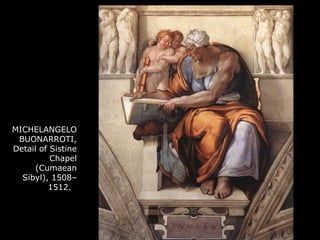
MICHELANGELO
BUONARROTI,
Detail of Sistine
Chapel
(Cumaean
Sibyl), 1508–
1512.
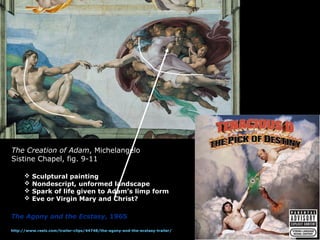
The Creation of Adam, Michelangelo
Sistine Chapel, fig. 9-11
 Sculptural painting
 Nondescript, unformed landscape
 Spark of life given to Adam’s limp form
 Eve or Virgin Mary and Christ?
The Agony and the Ecstasy, 1965
http://www.reelz.com/trailer-clips/44748/the-agony-and-the-ecstasy-trailer/
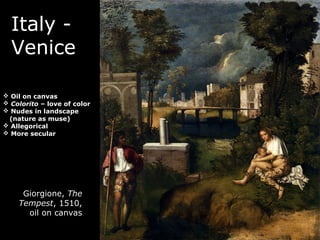
Italy -
Venice
Giorgione, The
Tempest, 1510,
oil on canvas
 Oil on canvas
 Colorito – love of color
 Nudes in landscape
(nature as muse)
 Allegorical
 More secular
Italy - Venice
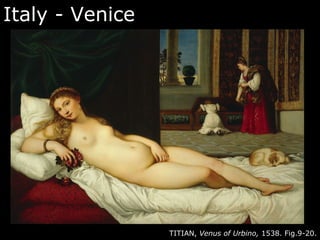
TITIAN, Venus of Urbino, 1538. Fig.9-20.
Italy - Venice
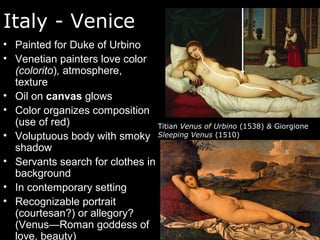
• Painted for Duke of Urbino
• Venetian painters love color
(colorito), atmosphere,
texture
• Oil on canvas glows
• Color organizes composition
(use of red)
• Voluptuous body with smoky
shadow
• Servants search for clothes in
background
• In contemporary setting
• Recognizable portrait
(courtesan?) or allegory?
(Venus—Roman goddess of
love, beauty)
Titian Venus of Urbino (1538) & Giorgione
Sleeping Venus (1510)
Italy - Architecture
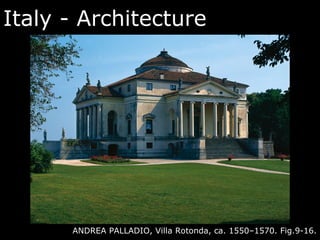
ANDREA PALLADIO, Villa Rotonda, ca. 1550–1570. Fig.9-16.
Italy
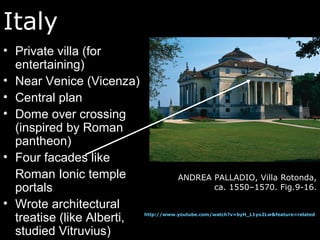
• Private villa (for
entertaining)
• Near Venice (Vicenza)
• Central plan
• Dome over crossing
(inspired by Roman
pantheon)
• Four facades like
Roman Ionic temple
portals
• Wrote architectural
treatise (like Alberti,
studied Vitruvius)
ANDREA PALLADIO, Villa Rotonda,
ca. 1550–1570. Fig.9-16.
http://www.youtube.com/watch?v=byH_L1yo2Lw&feature=related
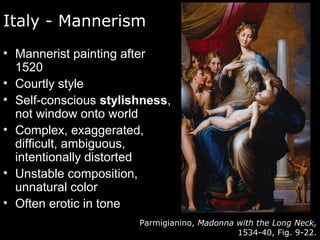
Italy - Mannerism
• Mannerist painting after
1520
• Courtly style
• Self-conscious stylishness,
not window onto world
• Complex, exaggerated,
difficult, ambiguous,
intentionally distorted
• Unstable composition,
unnatural color
• Often erotic in tone
Parmigianino, Madonna with the Long Neck,
1534-40, Fig. 9-22.
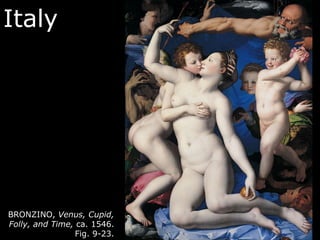
Italy
.
BRONZINO, Venus, Cupid,
Folly, and Time, ca. 1546.
Fig. 9-23.
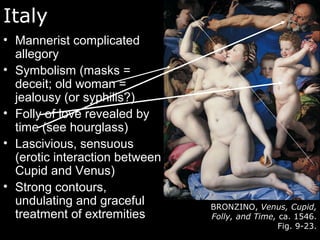
Italy
• Mannerist complicated
allegory
• Symbolism (masks =
deceit; old woman =
jealousy (or syphilis?)
• Folly of love revealed by
time (see hourglass)
• Lascivious, sensuous
(erotic interaction between
Cupid and Venus)
• Strong contours,
undulating and graceful
treatment of extremities
BRONZINO, Venus, Cupid,
Folly, and Time, ca. 1546.
Fig. 9-23.
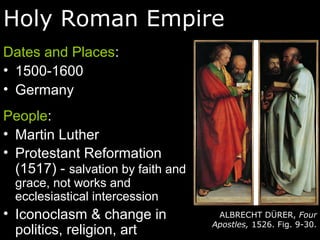
Holy Roman Empire
Dates and Places:
• 1500-1600
• Germany
People:
• Martin Luther
• Protestant Reformation
(1517) - salvation by faith and
grace, not works and
ecclesiastical intercession
• Iconoclasm & change in
politics, religion, art
ALBRECHT DÜRER, Four
Apostles, 1526. Fig. 9-30.
Holy Roman Empire
Themes:
• Life of Christ, Virgin Mary,
Saints
• Temptation and suffering
• Portraits
Forms:
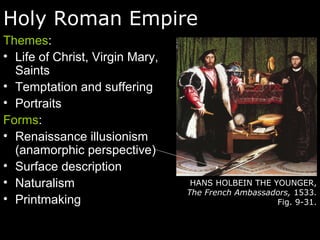
• Renaissance illusionism
(anamorphic perspective)
• Surface description
• Naturalism
• Printmaking
HANS HOLBEIN THE YOUNGER,
The French Ambassadors, 1533.
Fig. 9-31.
Holy Roman Empire
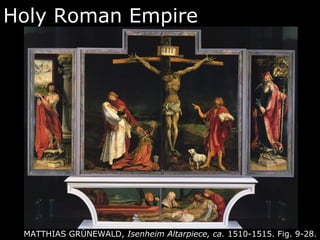
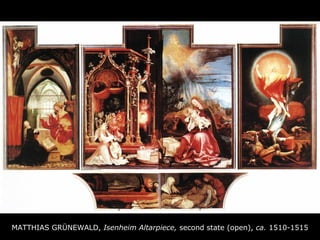
MATTHIAS GRÜNEWALD, Isenheim Altarpiece, ca. 1510-1515. Fig. 9-28.
Holy Roman Empire
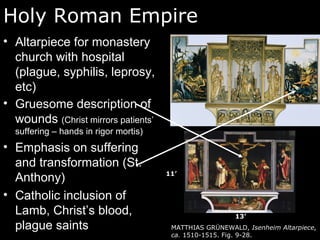
• Altarpiece for monastery
church with hospital
(plague, syphilis, leprosy,
etc)
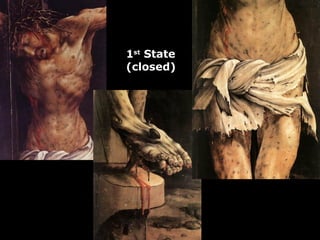
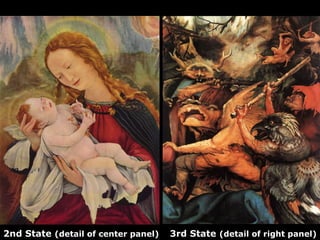
• Gruesome description of
wounds (Christ mirrors patients’
suffering – hands in rigor mortis)
• Emphasis on suffering
and transformation (St.
Anthony)
• Catholic inclusion of
Lamb, Christ’s blood,
plague saints MATTHIAS GRÜNEWALD, Isenheim Altarpiece,
ca. 1510-1515. Fig. 9-28.
11’
13’
1st
State
(closed)
MATTHIAS GRÜNEWALD, Isenheim Altarpiece, second state (open), ca. 1510-1515
2nd State (detail of center panel) 3rd State (detail of right panel)
Holy
Roman
Empire
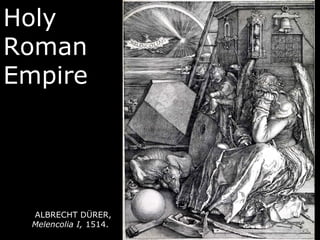
ALBRECHT DÜRER,
Melencolia I, 1514.
Holy Roman Empire
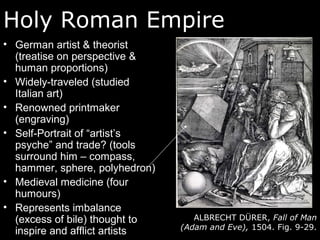
• German artist & theorist
(treatise on perspective &
human proportions)
• Widely-traveled (studied
Italian art)
• Renowned printmaker
(engraving)
• Self-Portrait of “artist’s
psyche” and trade? (tools
surround him – compass,
hammer, sphere, polyhedron)
• Medieval medicine (four
humours)
• Represents imbalance
(excess of bile) thought to
inspire and afflict artists
ALBRECHT DÜRER, Fall of Man
(Adam and Eve), 1504. Fig. 9-29.
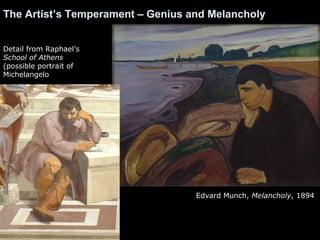
The Artist’s Temperament – Genius and Melancholy
Edvard Munch, Melancholy, 1894
Detail from Raphael’s
School of Athens
(possible portrait of
Michelangelo
The Netherlands
Dates and Places:
• 1500 to 1600
• Holland, Belgium,
Luxembourg
People:
• Protestants
• Merchant class and
peasants
• Seek independence
from Spain
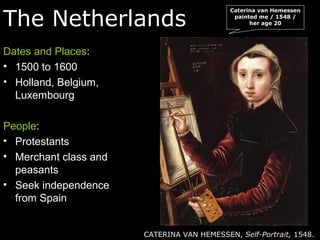
CATERINA VAN HEMESSEN, Self-Portrait, 1548.
Caterina van Hemessen
painted me / 1548 /
her age 20
The Netherlands
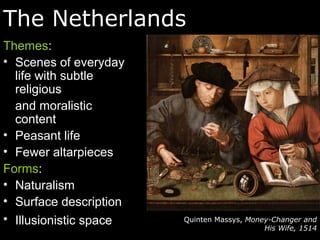
Themes:
• Scenes of everyday
life with subtle
religious
and moralistic
content
• Peasant life
• Fewer altarpieces
Forms:
• Naturalism
• Surface description
• Illusionistic space Quinten Massys, Money-Changer and
His Wife, 1514
The Netherlands
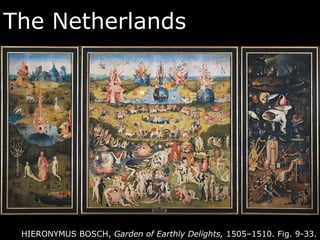
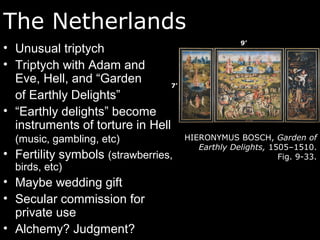
HIERONYMUS BOSCH, Garden of Earthly Delights, 1505–1510. Fig. 9-33.
The Netherlands
• Unusual triptych
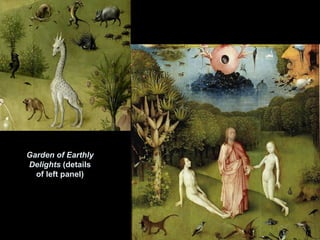
• Triptych with Adam and
Eve, Hell, and “Garden
of Earthly Delights”
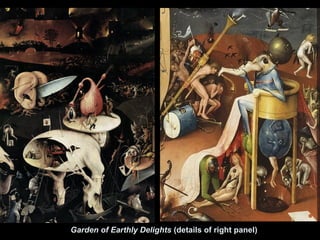
• “Earthly delights” become
instruments of torture in Hell
(music, gambling, etc)
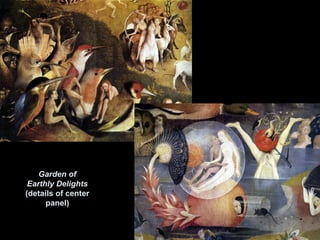
• Fertility symbols (strawberries,
birds, etc)
• Maybe wedding gift
• Secular commission for
private use
• Alchemy? Judgment?
HIERONYMUS BOSCH, Garden of
Earthly Delights, 1505–1510.
Fig. 9-33.
7’
9’
Garden of Earthly
Delights (details
of left panel)
Garden of
Earthly Delights
(details of center
panel)
Garden of Earthly Delights (details of right panel)
The Netherlands
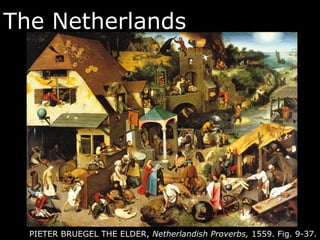
PIETER BRUEGEL THE ELDER, Netherlandish Proverbs, 1559. Fig. 9-37.
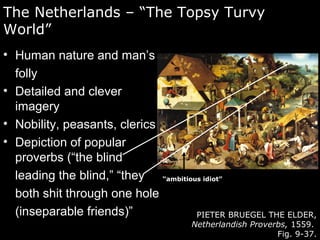
The Netherlands – “The Topsy Turvy
World”
• Human nature and man’s
folly
• Detailed and clever
imagery
• Nobility, peasants, clerics
• Depiction of popular
proverbs (“the blind
leading the blind,” “they
both shit through one hole
(inseparable friends)” PIETER BRUEGEL THE ELDER,
Netherlandish Proverbs, 1559.
Fig. 9-37.
“ambitious idiot”
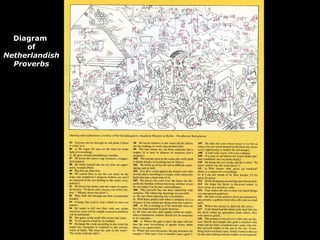
Diagram
of
Netherlandish
Proverbs
Spain
Dates and Places:
• 1500 to 1600
• Iberian Peninsula
and the Americas
People:
• Pious, Catholic
• Conservative monarchs
• Expanding empire
Themes:
• Life of Christ, Virgin Mary and
Saints
• Portraits
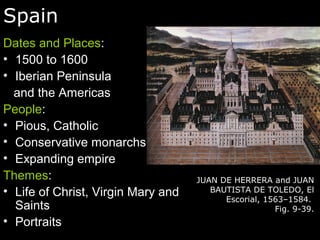
JUAN DE HERRERA and JUAN
BAUTISTA DE TOLEDO, El
Escorial, 1563–1584.
Fig. 9-39.
Spain
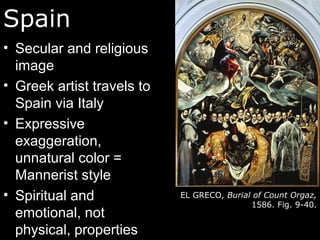
• Secular and religious
image
• Greek artist travels to
Spain via Italy
• Expressive
exaggeration,
unnatural color =
Mannerist style
• Spiritual and
emotional, not
physical, properties
EL GRECO, Burial of Count Orgaz,
1586. Fig. 9-40.

Europe, 1500-1600

  • 1.
    “The Renaissance Man” LeonardoMichelangeloRaphael Titian Europe, 1500-1600
  • 2.
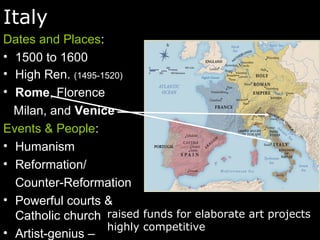
    Italy Dates and Places: •1500 to 1600 • High Ren. (1495-1520) • Rome, Florence Milan, and Venice Events & People: • Humanism • Reformation/ Counter-Reformation • Powerful courts & Catholic church • Artist-genius – raised funds for elaborate art projects highly competitive
  • 3.
    Italy Themes: • Life ofChrist and the Virgin Mary, saints • Portraiture • Classical mythology/antiquity • Allegory, poesia • Nature as muse Forms: • Balance, harmony, ideal beauty (Greco-Roman) • Disegno (drawing & design) • Venetian color (colorito), Mannerist distortion • Fresco (buon and secco) RAPHAEL, Madonna in the Meadow, 1505–1506. Fig. 9-6.
  • 4.
    Italy LEONARDO DA VINCI,Last Supper, ca. 1495–1498. Fig. 9-3., 13’x29’
  • 5.
    Italy • Fresco secco(dried plaster) • Mathematical linear perspective • Compositional emphasis on Christ • Unity through pose and movement • Studied emotion (fear/doubt) and subtle action • Capturing the observable world (halo behind Christ created by light) • Numerical symbolism (4 & 3 = earthly & divine) • Pictorial unity vs. iconography LEONARDO DA VINCI, Last Supper, ca. 1495– church refectory, 1498. Fig. 9-3. Where’s Judas? Andrea del Castagno, Last Supper, 1447
  • 6.
    Homage or Mockery? AppropriatingRenaissance Art Yo Mama’s Last Supper, Renee Cox, 1996 Andy Warhol’s Mona Lisa, 1963 Serigraph Marcel Duchamp L.H.O.O.Q, 1917 Assisted readymade
  • 7.
    RAPHAEL, Philosophy (Schoolof Athens), 1509–1511. Fig.9-7.
  • 8.
    Italy • Pope JuliusII, patron • Four branches of knowledge - philosophy, theology, poetry, and law • Philosophers of antiquity • Semi-circular composition, illusionistic space (Roman vaults) • Unity achieved through interlocking poses and gestures • Michelangelo as Heraclitus, the loner in the foreground RAPHAEL, Philosophy (School of Athens), 1509–1511. Fig.9-7. Stanza della Segnatura, Library, Papal apartments Apollo Athena Plato Aristotle heaven (metaphysical) Earth (material)
  • 9.
    Italy MICHELANGELO BUONARROTI, David, 1501–1504.Fig. 9-9. “…the hands work and the eye judges” -Michelangelo
  • 10.
    Italy • Visually pleasing proportion (contrapposto),not mathematical rules (slight distortion) • Classical figure; intense concentration • Anticipation of battle with Goliath, not victory • Symbol Florentine power over Medici (stood outside city hall) • Carved out of single block of discarded marble ( “the giant”) MICHELANGELO BUONARROTI, David, 1501–1504. Fig. 9-9. 17’
  • 11.
  • 12.
    Italy MICHELANGELO BUONARROTI, ceiling, SistineChapel, 1508– 1512. Fig. 9-10. 5,800 sq.ft!! 131’ 43’
  • 13.
    Italy • Pope JuliusII, patron • Old Testament scenes on ceiling, Judgment on wall • Creation, Fall, Redemption narratives • Ignudi, ancestors, prophets, sibyls (over 300 figures) • Curved, irregular leaky ceiling w/ illusionistic paint. • Expressive and hypermuscular male and female forms (“bags of walnuts”) In Vatican (Pope’s chapel) spandrel lunette Painted standing up. not lying down! pendentive
  • 14.
  • 15.
    The Creation ofAdam, Michelangelo Sistine Chapel, fig. 9-11  Sculptural painting  Nondescript, unformed landscape  Spark of life given to Adam’s limp form  Eve or Virgin Mary and Christ? The Agony and the Ecstasy, 1965 http://www.reelz.com/trailer-clips/44748/the-agony-and-the-ecstasy-trailer/
  • 16.
    Italy - Venice Giorgione, The Tempest,1510, oil on canvas  Oil on canvas  Colorito – love of color  Nudes in landscape (nature as muse)  Allegorical  More secular
  • 17.
    Italy - Venice TITIAN,Venus of Urbino, 1538. Fig.9-20.
  • 18.
    Italy - Venice •Painted for Duke of Urbino • Venetian painters love color (colorito), atmosphere, texture • Oil on canvas glows • Color organizes composition (use of red) • Voluptuous body with smoky shadow • Servants search for clothes in background • In contemporary setting • Recognizable portrait (courtesan?) or allegory? (Venus—Roman goddess of love, beauty) Titian Venus of Urbino (1538) & Giorgione Sleeping Venus (1510)
  • 19.
    Italy - Architecture ANDREAPALLADIO, Villa Rotonda, ca. 1550–1570. Fig.9-16.
  • 20.
    Italy • Private villa(for entertaining) • Near Venice (Vicenza) • Central plan • Dome over crossing (inspired by Roman pantheon) • Four facades like Roman Ionic temple portals • Wrote architectural treatise (like Alberti, studied Vitruvius) ANDREA PALLADIO, Villa Rotonda, ca. 1550–1570. Fig.9-16. http://www.youtube.com/watch?v=byH_L1yo2Lw&feature=related
  • 21.
    Italy - Mannerism •Mannerist painting after 1520 • Courtly style • Self-conscious stylishness, not window onto world • Complex, exaggerated, difficult, ambiguous, intentionally distorted • Unstable composition, unnatural color • Often erotic in tone Parmigianino, Madonna with the Long Neck, 1534-40, Fig. 9-22.
  • 22.
    Italy . BRONZINO, Venus, Cupid, Folly,and Time, ca. 1546. Fig. 9-23.
  • 23.
    Italy • Mannerist complicated allegory •Symbolism (masks = deceit; old woman = jealousy (or syphilis?) • Folly of love revealed by time (see hourglass) • Lascivious, sensuous (erotic interaction between Cupid and Venus) • Strong contours, undulating and graceful treatment of extremities BRONZINO, Venus, Cupid, Folly, and Time, ca. 1546. Fig. 9-23.
  • 24.
    Holy Roman Empire Datesand Places: • 1500-1600 • Germany People: • Martin Luther • Protestant Reformation (1517) - salvation by faith and grace, not works and ecclesiastical intercession • Iconoclasm & change in politics, religion, art ALBRECHT DÜRER, Four Apostles, 1526. Fig. 9-30.
  • 25.
    Holy Roman Empire Themes: •Life of Christ, Virgin Mary, Saints • Temptation and suffering • Portraits Forms: • Renaissance illusionism (anamorphic perspective) • Surface description • Naturalism • Printmaking HANS HOLBEIN THE YOUNGER, The French Ambassadors, 1533. Fig. 9-31.
  • 26.
    Holy Roman Empire MATTHIASGRÜNEWALD, Isenheim Altarpiece, ca. 1510-1515. Fig. 9-28.
  • 27.
    Holy Roman Empire •Altarpiece for monastery church with hospital (plague, syphilis, leprosy, etc) • Gruesome description of wounds (Christ mirrors patients’ suffering – hands in rigor mortis) • Emphasis on suffering and transformation (St. Anthony) • Catholic inclusion of Lamb, Christ’s blood, plague saints MATTHIAS GRÜNEWALD, Isenheim Altarpiece, ca. 1510-1515. Fig. 9-28. 11’ 13’
  • 28.
  • 29.
    MATTHIAS GRÜNEWALD, IsenheimAltarpiece, second state (open), ca. 1510-1515
  • 30.
    2nd State (detailof center panel) 3rd State (detail of right panel)
  • 31.
  • 32.
    Holy Roman Empire •German artist & theorist (treatise on perspective & human proportions) • Widely-traveled (studied Italian art) • Renowned printmaker (engraving) • Self-Portrait of “artist’s psyche” and trade? (tools surround him – compass, hammer, sphere, polyhedron) • Medieval medicine (four humours) • Represents imbalance (excess of bile) thought to inspire and afflict artists ALBRECHT DÜRER, Fall of Man (Adam and Eve), 1504. Fig. 9-29.
  • 33.
    The Artist’s Temperament– Genius and Melancholy Edvard Munch, Melancholy, 1894 Detail from Raphael’s School of Athens (possible portrait of Michelangelo
  • 34.
    The Netherlands Dates andPlaces: • 1500 to 1600 • Holland, Belgium, Luxembourg People: • Protestants • Merchant class and peasants • Seek independence from Spain CATERINA VAN HEMESSEN, Self-Portrait, 1548. Caterina van Hemessen painted me / 1548 / her age 20
  • 35.
    The Netherlands Themes: • Scenesof everyday life with subtle religious and moralistic content • Peasant life • Fewer altarpieces Forms: • Naturalism • Surface description • Illusionistic space Quinten Massys, Money-Changer and His Wife, 1514
  • 36.
    The Netherlands HIERONYMUS BOSCH,Garden of Earthly Delights, 1505–1510. Fig. 9-33.
  • 37.
    The Netherlands • Unusualtriptych • Triptych with Adam and Eve, Hell, and “Garden of Earthly Delights” • “Earthly delights” become instruments of torture in Hell (music, gambling, etc) • Fertility symbols (strawberries, birds, etc) • Maybe wedding gift • Secular commission for private use • Alchemy? Judgment? HIERONYMUS BOSCH, Garden of Earthly Delights, 1505–1510. Fig. 9-33. 7’ 9’
  • 38.
    Garden of Earthly Delights(details of left panel)
  • 39.
  • 40.
    Garden of EarthlyDelights (details of right panel)
  • 41.
    The Netherlands PIETER BRUEGELTHE ELDER, Netherlandish Proverbs, 1559. Fig. 9-37.
  • 42.
    The Netherlands –“The Topsy Turvy World” • Human nature and man’s folly • Detailed and clever imagery • Nobility, peasants, clerics • Depiction of popular proverbs (“the blind leading the blind,” “they both shit through one hole (inseparable friends)” PIETER BRUEGEL THE ELDER, Netherlandish Proverbs, 1559. Fig. 9-37. “ambitious idiot”
  • 43.
  • 44.
    Spain Dates and Places: •1500 to 1600 • Iberian Peninsula and the Americas People: • Pious, Catholic • Conservative monarchs • Expanding empire Themes: • Life of Christ, Virgin Mary and Saints • Portraits JUAN DE HERRERA and JUAN BAUTISTA DE TOLEDO, El Escorial, 1563–1584. Fig. 9-39.
  • 45.
    Spain • Secular andreligious image • Greek artist travels to Spain via Italy • Expressive exaggeration, unnatural color = Mannerist style • Spiritual and emotional, not physical, properties EL GRECO, Burial of Count Orgaz, 1586. Fig. 9-40.

Editor's Notes

  • #2 Leonardo – from Vinci, near Florence; art one of many interests (also mathematics, science, engineering (in fact heavily involved in military engineering projects in Milan for Sforza family, main patron, optics); extensive notebooks on human anatomy, botany, etc; many works unfinished, few paintings; preoccupied with laws governing processes and flux of nature and considered sight most important function; believed in supremacy of painting (wrote Treatise on Painting )-best for conveying the “soul” of man through subtle changes in lighting, gesture, expression Raphael—died year after Leo in 1520; heightened sense of grace, sweetness and lyricism and perfected compositional unity through interlocking gesture and expression; from Umbria near Urbino; father was a painter; studied in Florence from 1504-08; forewent Leo’s interest in dusky modeling to clarity and crispness in composition, saturated colors Michelangelo (la terribilita) – if leo and raphael more subtle and graceful, Mich work outwardly heroic and masculine; and contrary to Leo, Mich believed sculpture highest art form, since it mimicked the act of divine creation, although he is most known for his paintings, commissions he reluctantly took; he was also an architect and poet; archetype of the troubled genius; constantly disgruntled, sometimes paranoid, and feared persecution (portrait as flayed skin above). He also had stinky feet since legend had it he wouldn’t remove his pants or shoes for weeks at a time being preoccupied with work; he was a great believer in concept first, believing that in his sculpture, the artist could envision the image within and carving then became a process of removing excess, freeing the object locked in stone, so his process wasn’t so mathematical or precise, but rather intuitive. In this, he championed artistic self-expression. He was the consummate rule-breaker. Both leo and mich received Medici patronage
  • #14 Entrance to chapel at Last Judgement; proceed backward in time toward altar; prophets and sibyls foretold coming of Christ; ancestors of christ in spandrels, old test. Scenes in pendentives; all scenes compartmentalized using illusionistic arch elements; overall themes are conflict between good and evil, youth and age