South and Southeast Asia


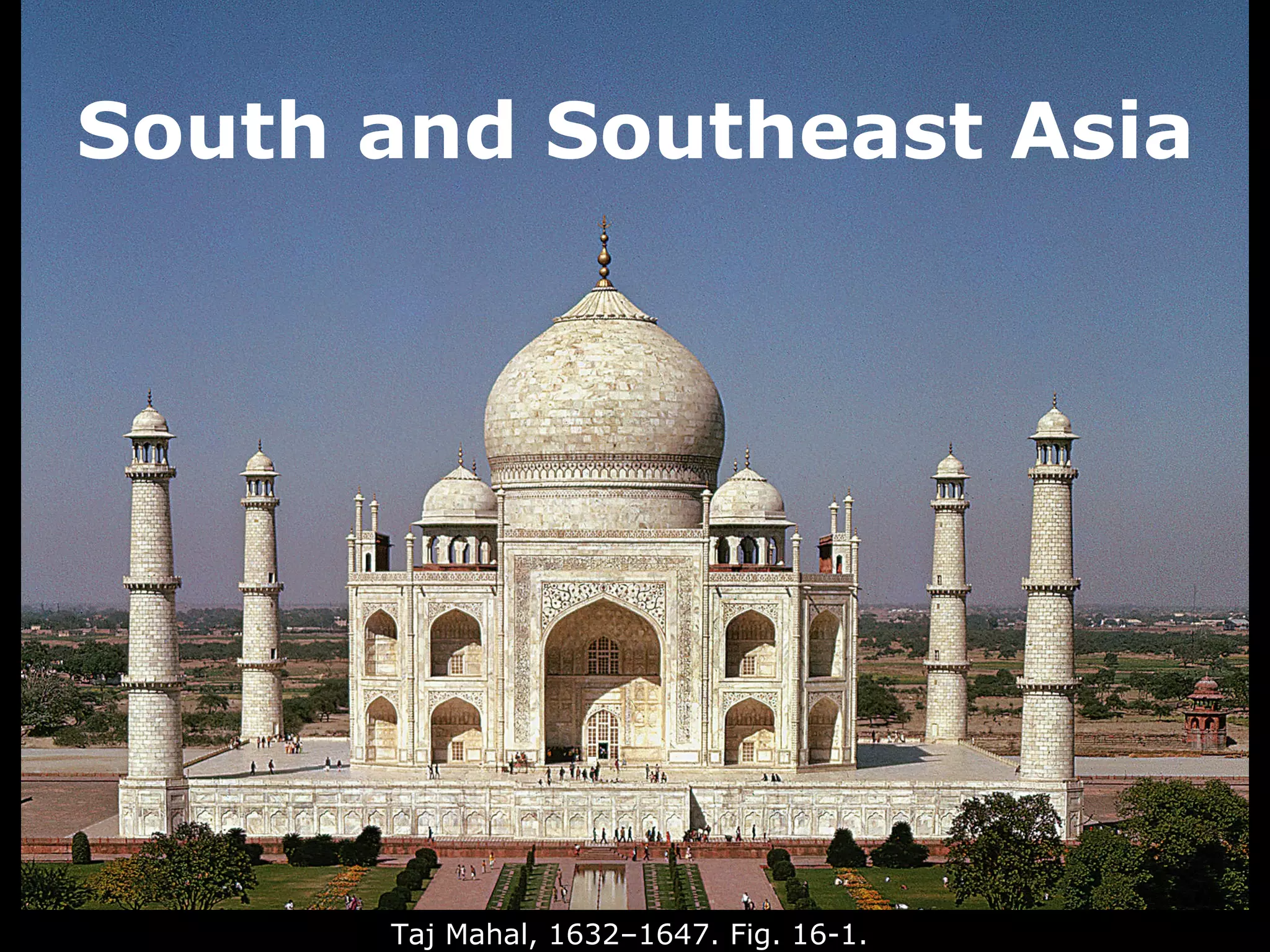
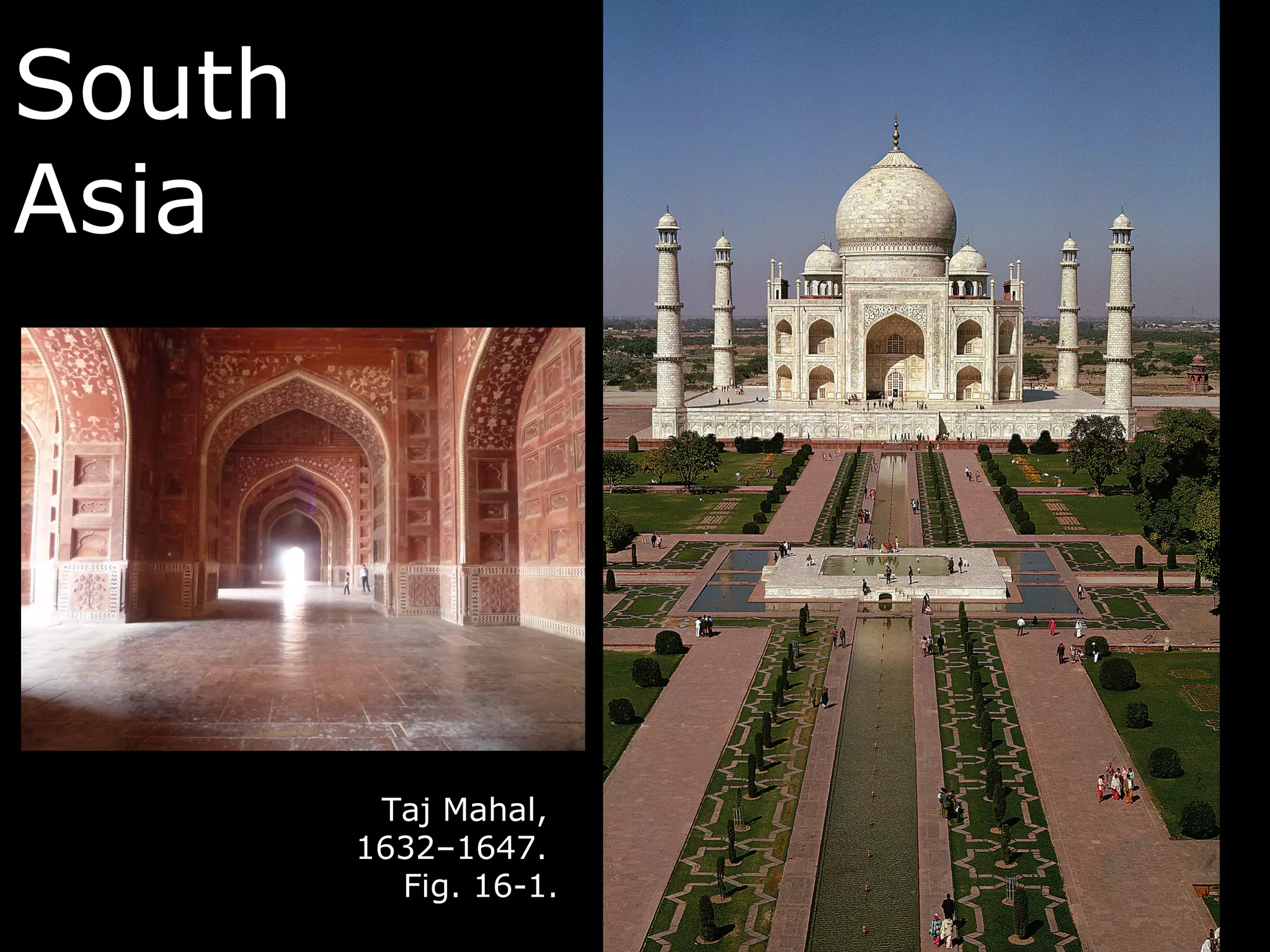
      Taj Mahal, 1632–1647. Fig. 16-1.
South Asia
Dates and Places:
• 2600BCE to 1857CE
• Indian subcontinent
People:
• Cultural diversity & religious
  tolerance, polytheism
• Indus civilization
• Buddhism, Hinduism (developed
  in later centuries BCE and early
  CE out of Vedic & Upanishad
  texts)
• Buddha (figure who advocated
  ascetism as end to rebirth
  (samsara) and path to
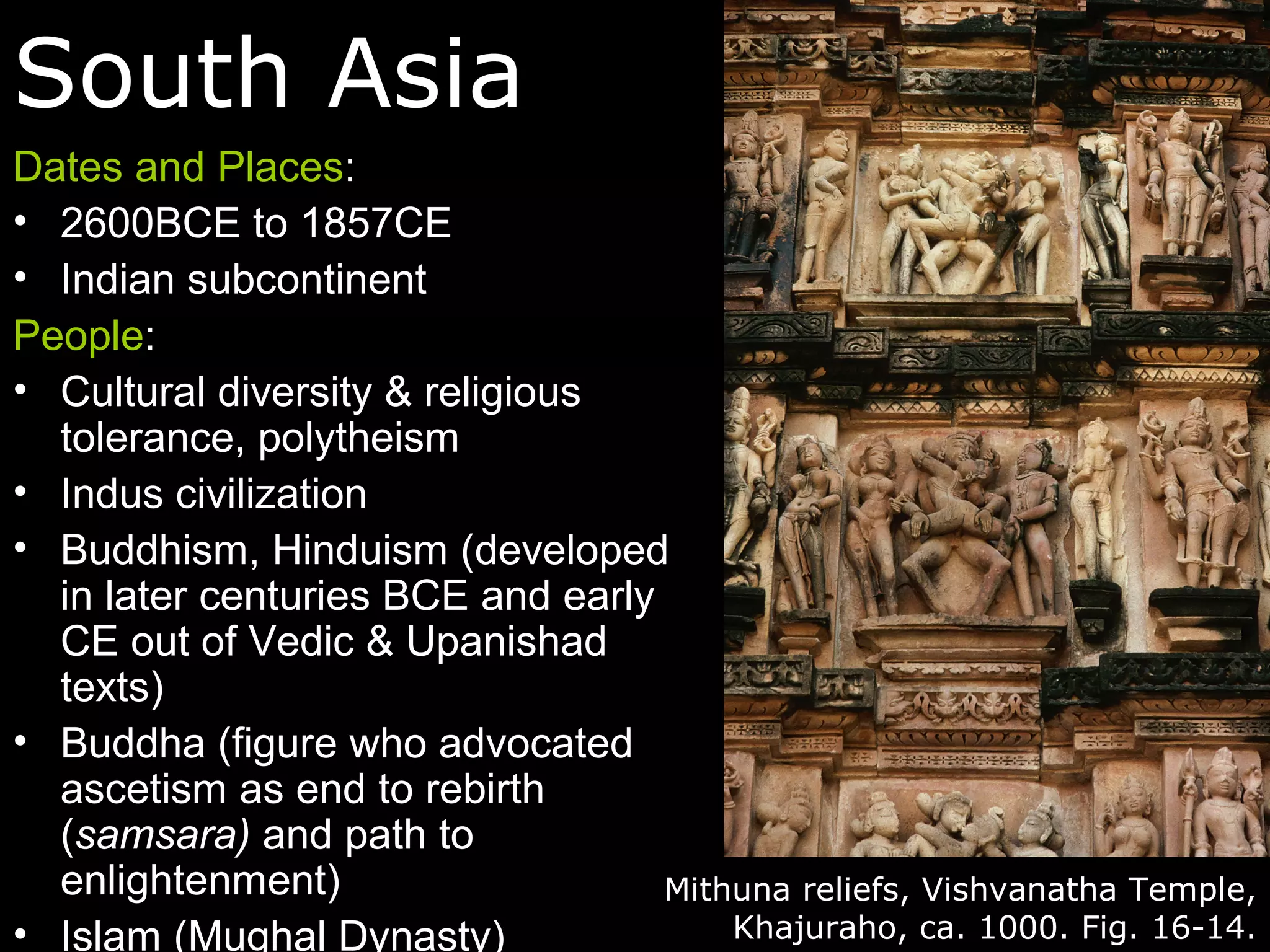
  enlightenment)                   Mithuna reliefs, Vishvanatha Temple,
• Islam (Mughal Dynasty)               Khajuraho, ca. 1000. Fig. 16-14.
South Asia
Themes:
• Deities of Buddhism
  and Hinduism
• Scenes from the
  Mughal court
• Temples
Forms:
• Stupas, temples
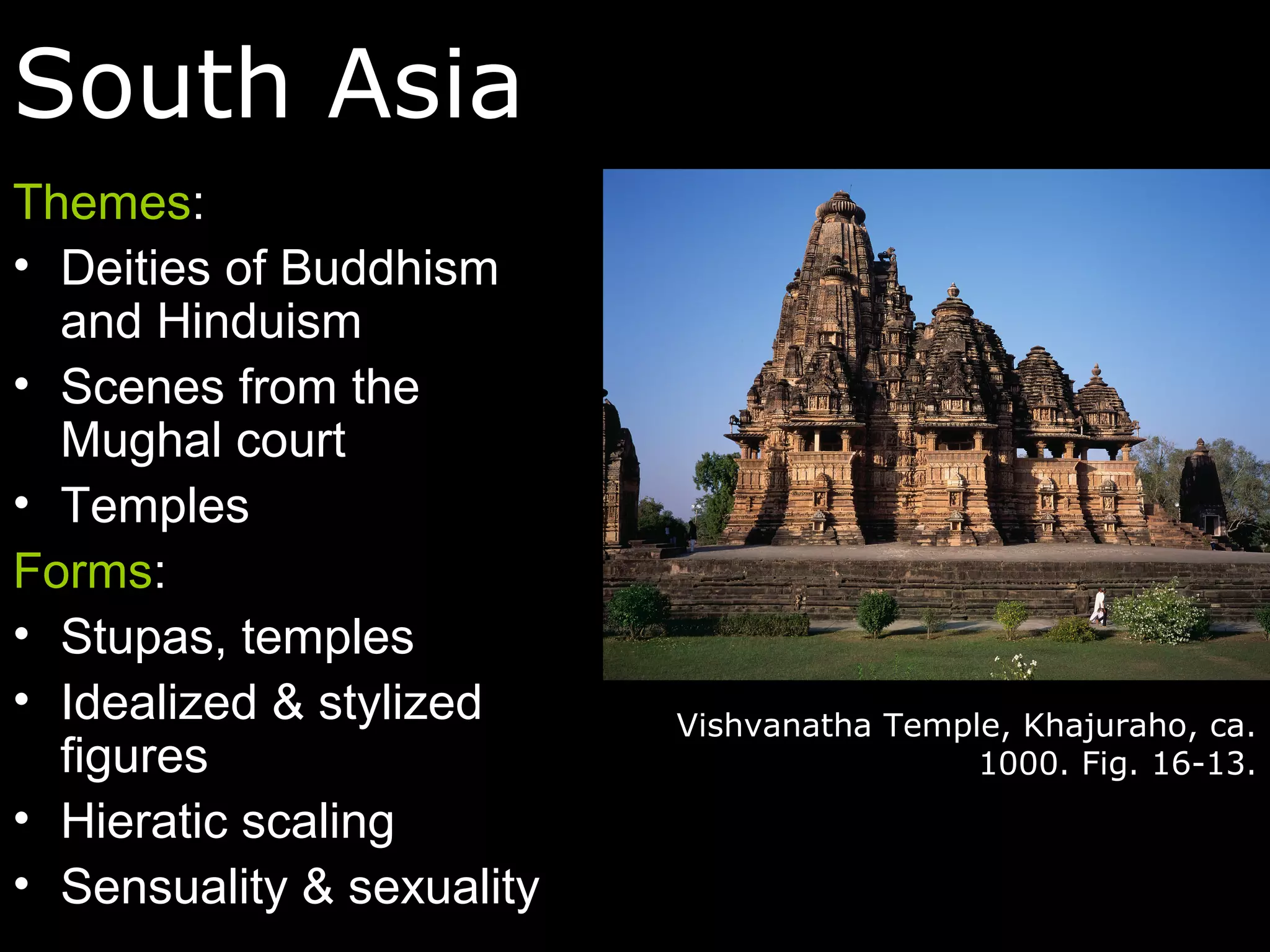
• Idealized & stylized     Vishvanatha Temple, Khajuraho, ca.
  figures                                   1000. Fig. 16-13.
• Hieratic scaling
• Sensuality & sexuality
South Asia


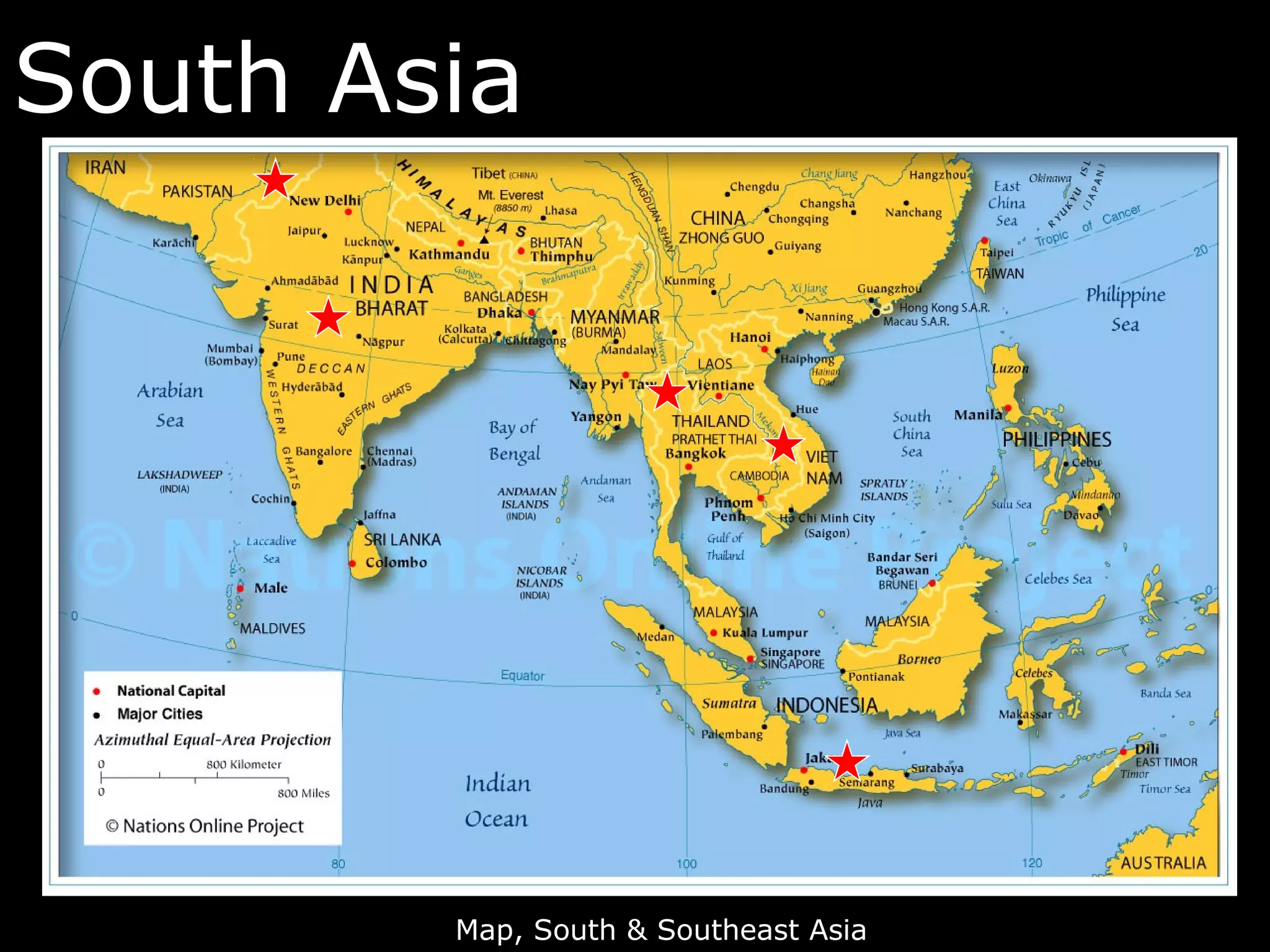
        Map, South & Southeast Asia
South Asia


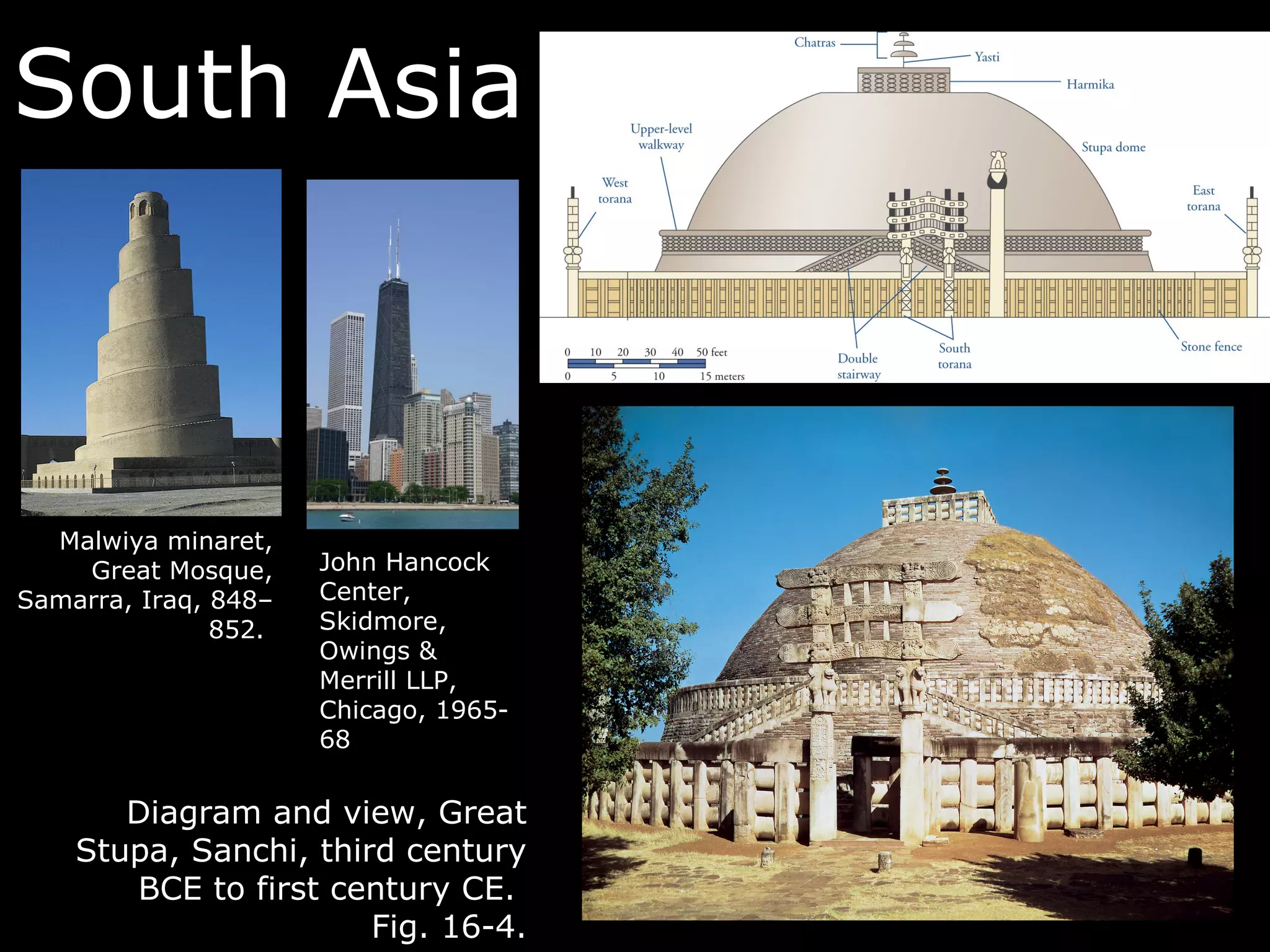
  Malwiya minaret,
    Great Mosque,     John Hancock
Samarra, Iraq, 848–   Center,
               852.   Skidmore,
                      Owings &
                      Merrill LLP,
                      Chicago, 1965-
                      68


       Diagram and view, Great
    Stupa, Sanchi, third century
       BCE to first century CE.
                       Fig. 16-4.
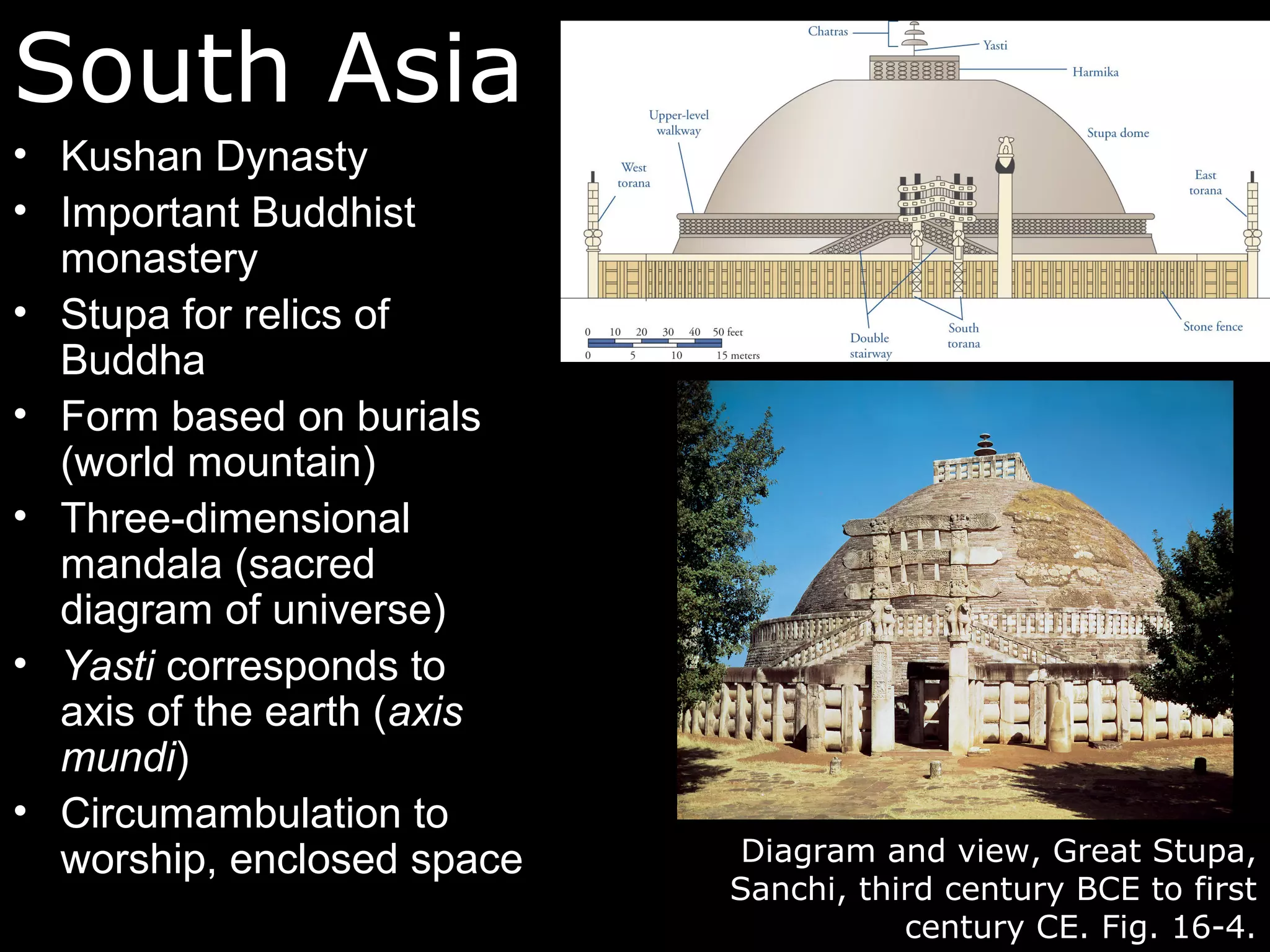
South Asia
• Kushan Dynasty
• Important Buddhist
  monastery
• Stupa for relics of
  Buddha
• Form based on burials
  (world mountain)
• Three-dimensional
  mandala (sacred
  diagram of universe)
• Yasti corresponds to
  axis of the earth (axis
  mundi)
• Circumambulation to
  worship, enclosed space    Diagram and view, Great Stupa,
                            Sanchi, third century BCE to first
                                       century CE. Fig. 16-4.
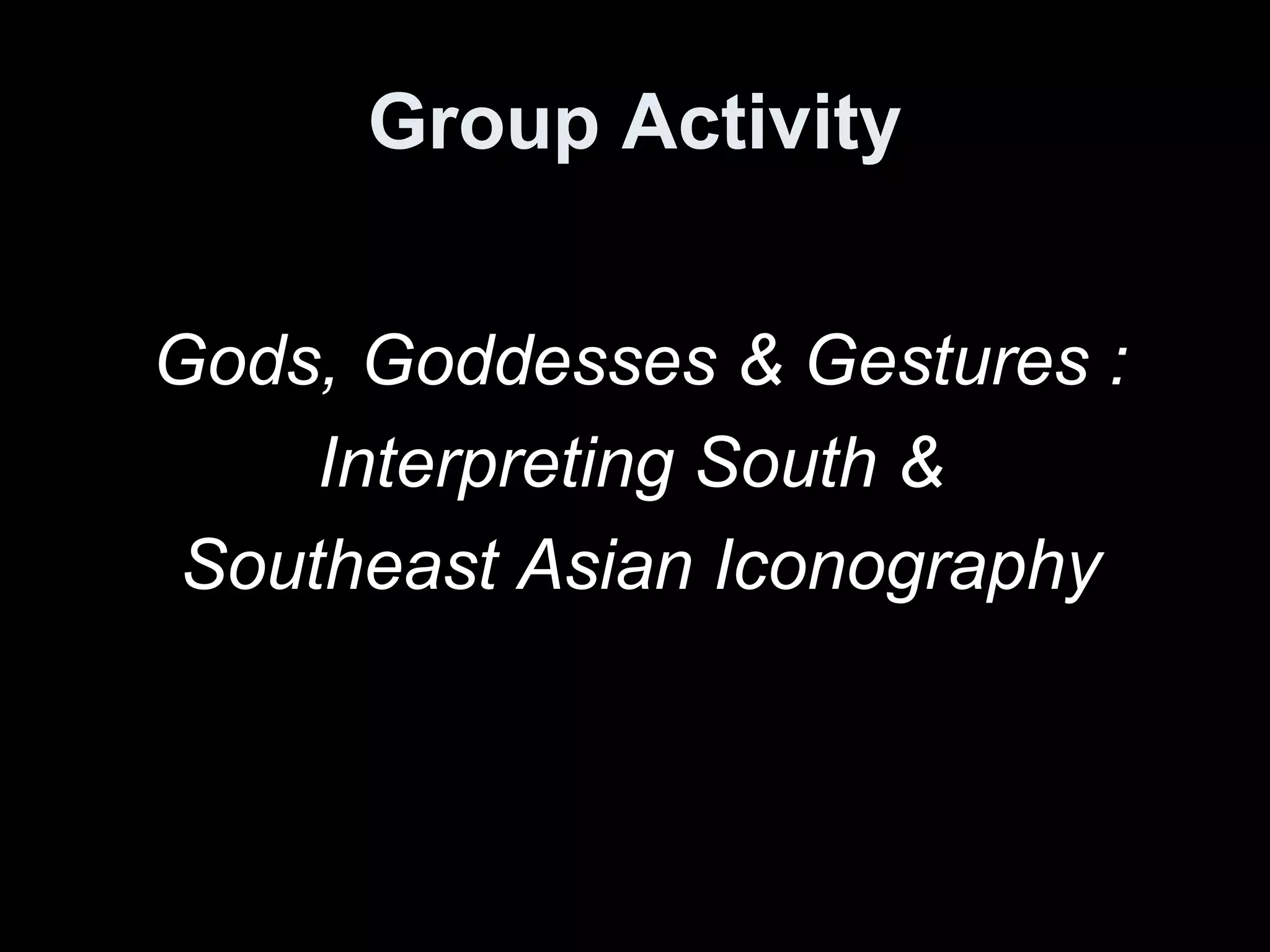
Group Activity


Gods, Goddesses & Gestures :
     Interpreting South &
 Southeast Asian Iconography
South Asia
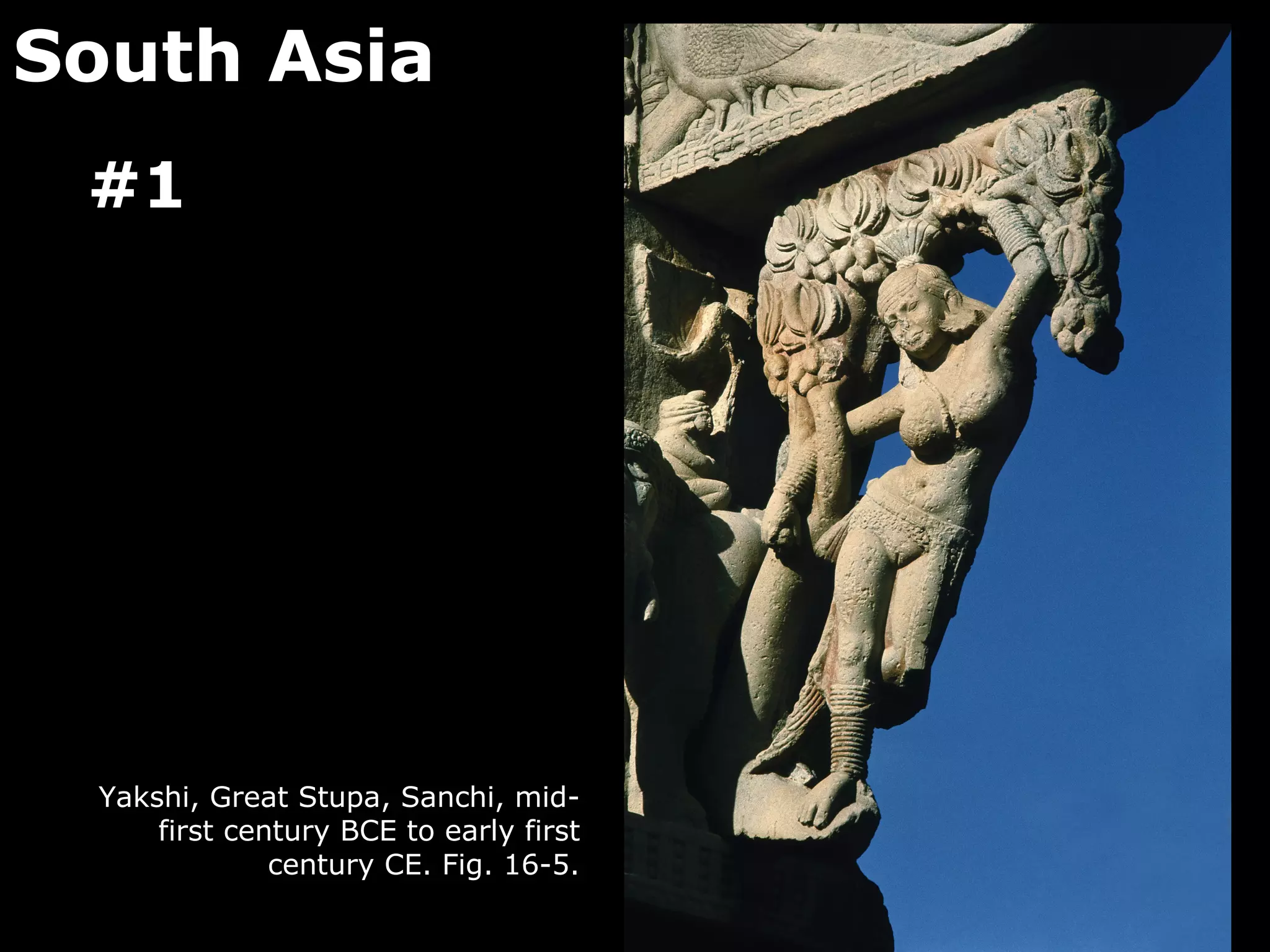
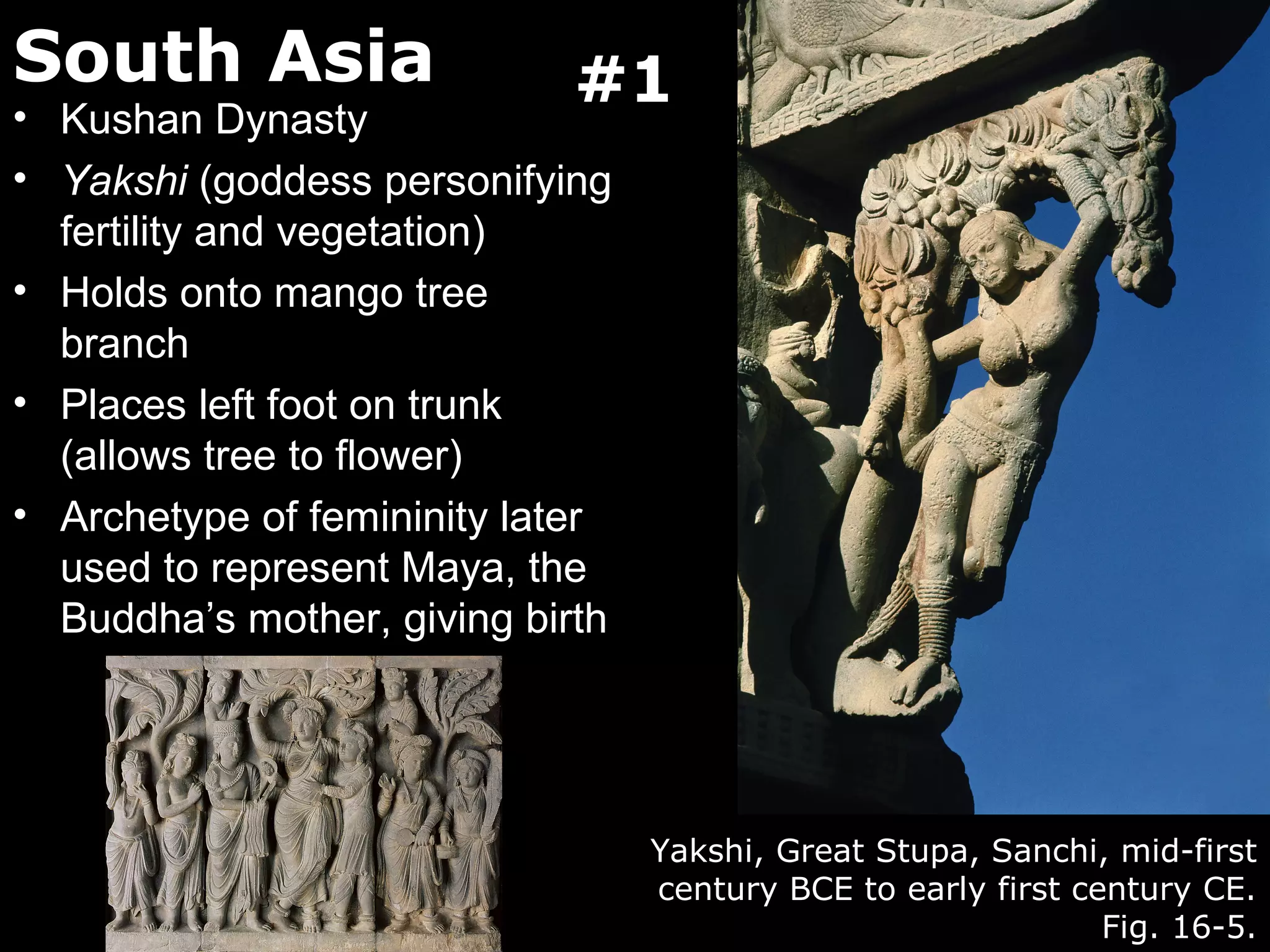
 #1


  Yakshi, Great Stupa, Sanchi, mid-
      first century BCE to early first
               century CE. Fig. 16-5.
South Asia                   #1
• Kushan Dynasty
• Yakshi (goddess personifying
  fertility and vegetation)
• Holds onto mango tree
  branch
• Places left foot on trunk
  (allows tree to flower)
• Archetype of femininity later
  used to represent Maya, the
  Buddha’s mother, giving birth


                                  Yakshi, Great Stupa, Sanchi, mid-first
                                  century BCE to early first century CE.
                                                               Fig. 16-5.
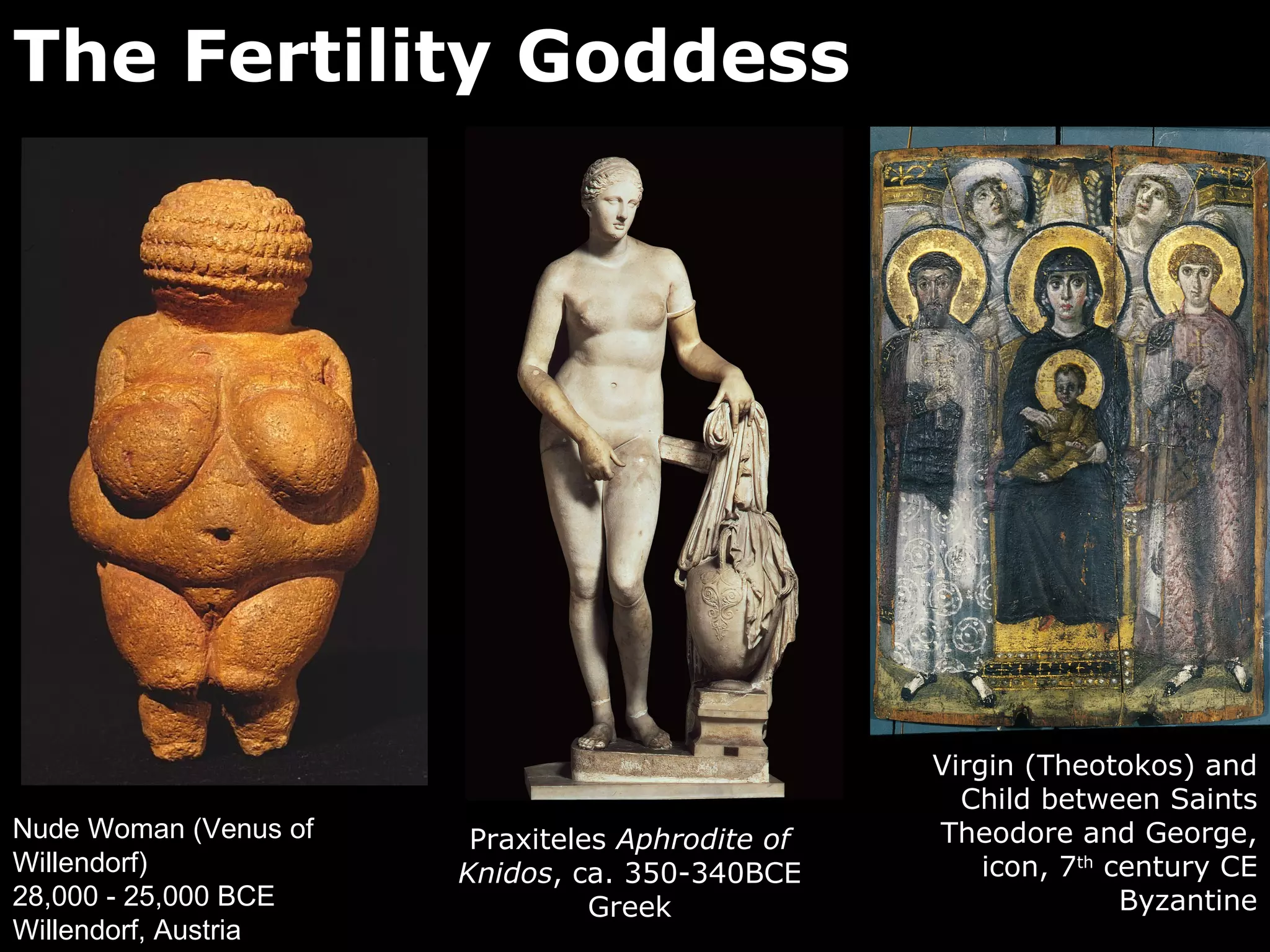
The Fertility Goddess


                                                  Virgin (Theotokos) and
                                                    Child between Saints
Nude Woman (Venus of    Praxiteles Aphrodite of   Theodore and George,
Willendorf)            Knidos, ca. 350-340BCE         icon, 7th century CE
28,000 - 25,000 BCE              Greek                           Byzantine
Willendorf, Austria
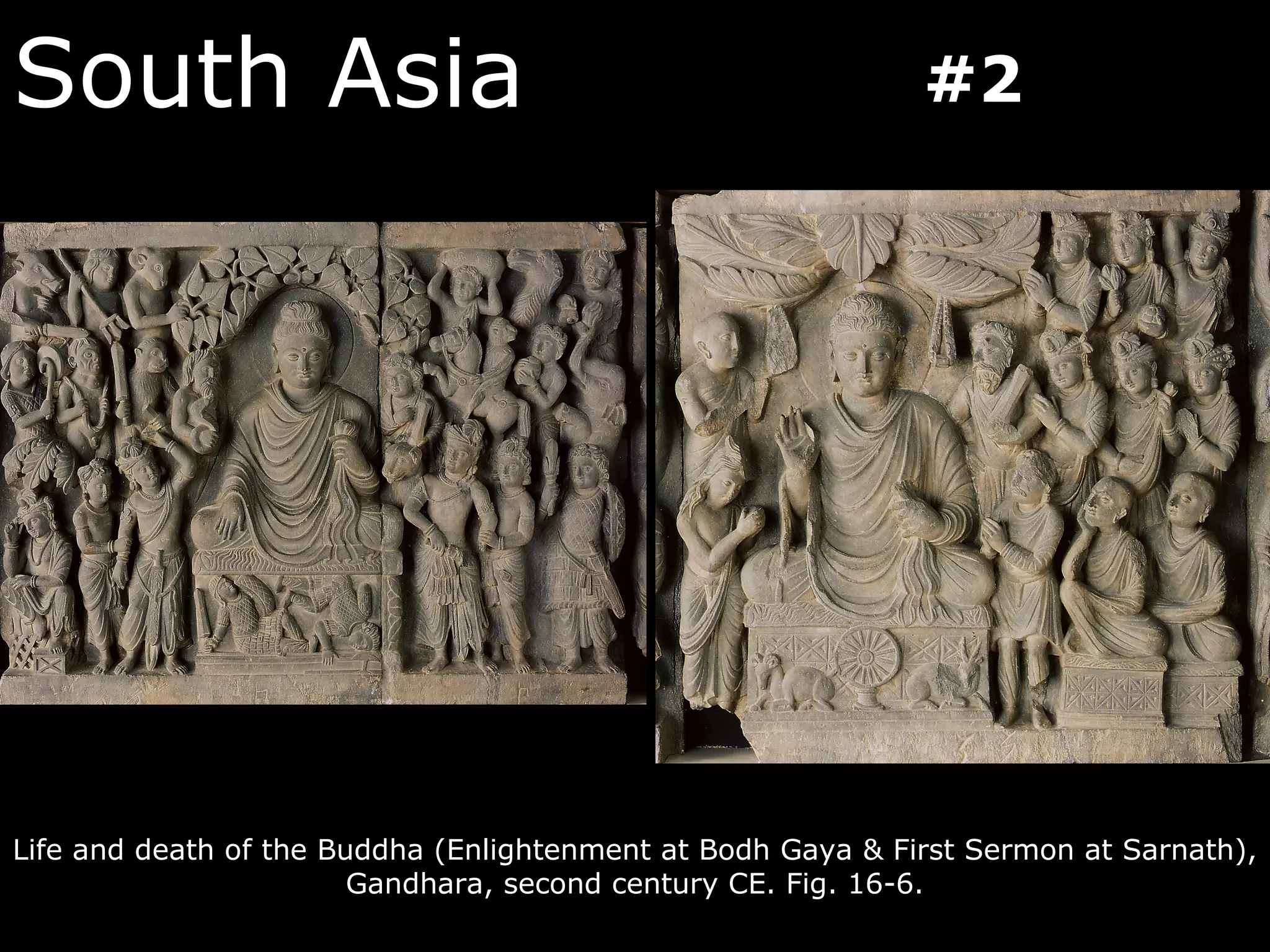
South Asia                                                   #2


Life and death of the Buddha (Enlightenment at Bodh Gaya & First Sermon at Sarnath),
                        Gandhara, second century CE. Fig. 16-6.
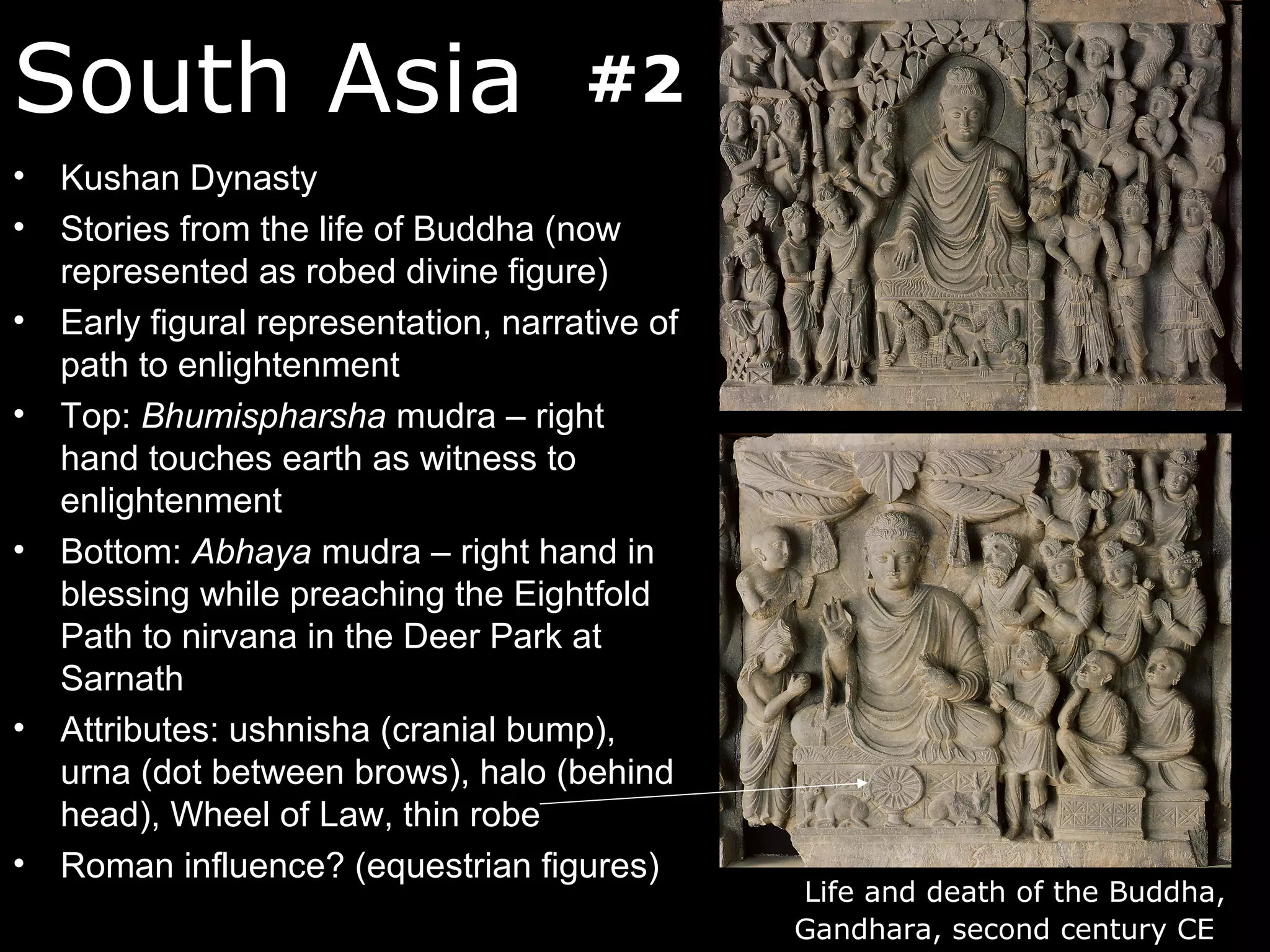
South Asia                             #2
•   Kushan Dynasty
•   Stories from the life of Buddha (now
    represented as robed divine figure)
•   Early figural representation, narrative of
    path to enlightenment
•   Top: Bhumispharsha mudra – right
    hand touches earth as witness to
    enlightenment
•   Bottom: Abhaya mudra – right hand in
    blessing while preaching the Eightfold
    Path to nirvana in the Deer Park at
    Sarnath
•   Attributes: ushnisha (cranial bump),
    urna (dot between brows), halo (behind
    head), Wheel of Law, thin robe
•   Roman influence? (equestrian figures)
                                                 Life and death of the Buddha,
                                                 Gandhara, second century CE
South Asia
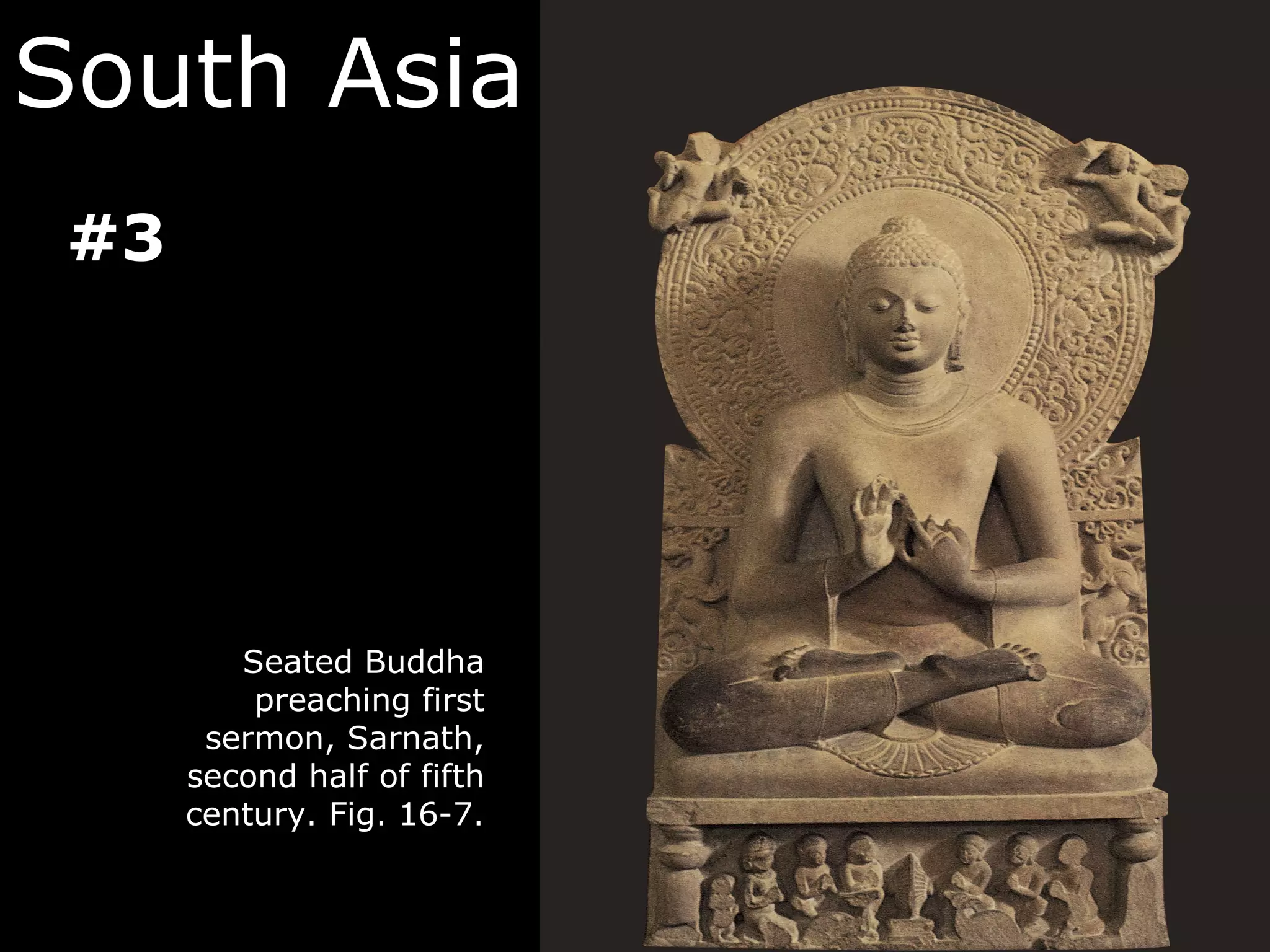
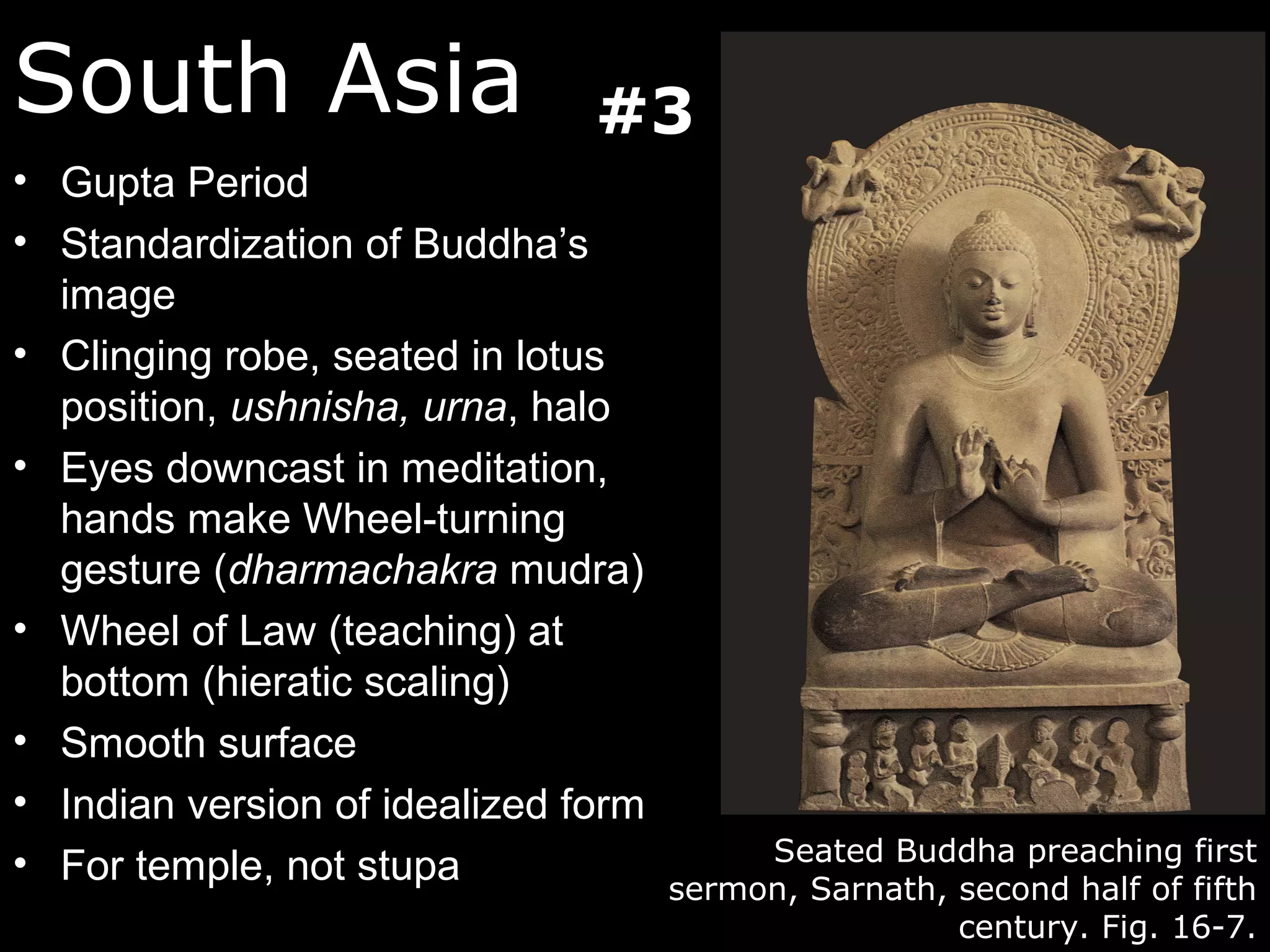
 #3


         Seated Buddha
          preaching first
       sermon, Sarnath,
      second half of fifth
      century. Fig. 16-7.
South Asia                     #3
• Gupta Period
• Standardization of Buddha’s
  image
• Clinging robe, seated in lotus
  position, ushnisha, urna, halo
• Eyes downcast in meditation,
  hands make Wheel-turning
  gesture (dharmachakra mudra)
• Wheel of Law (teaching) at
  bottom (hieratic scaling)
• Smooth surface
• Indian version of idealized form
• For temple, not stupa                   Seated Buddha preaching first
                                     sermon, Sarnath, second half of fifth
                                                      century. Fig. 16-7.
South Asia
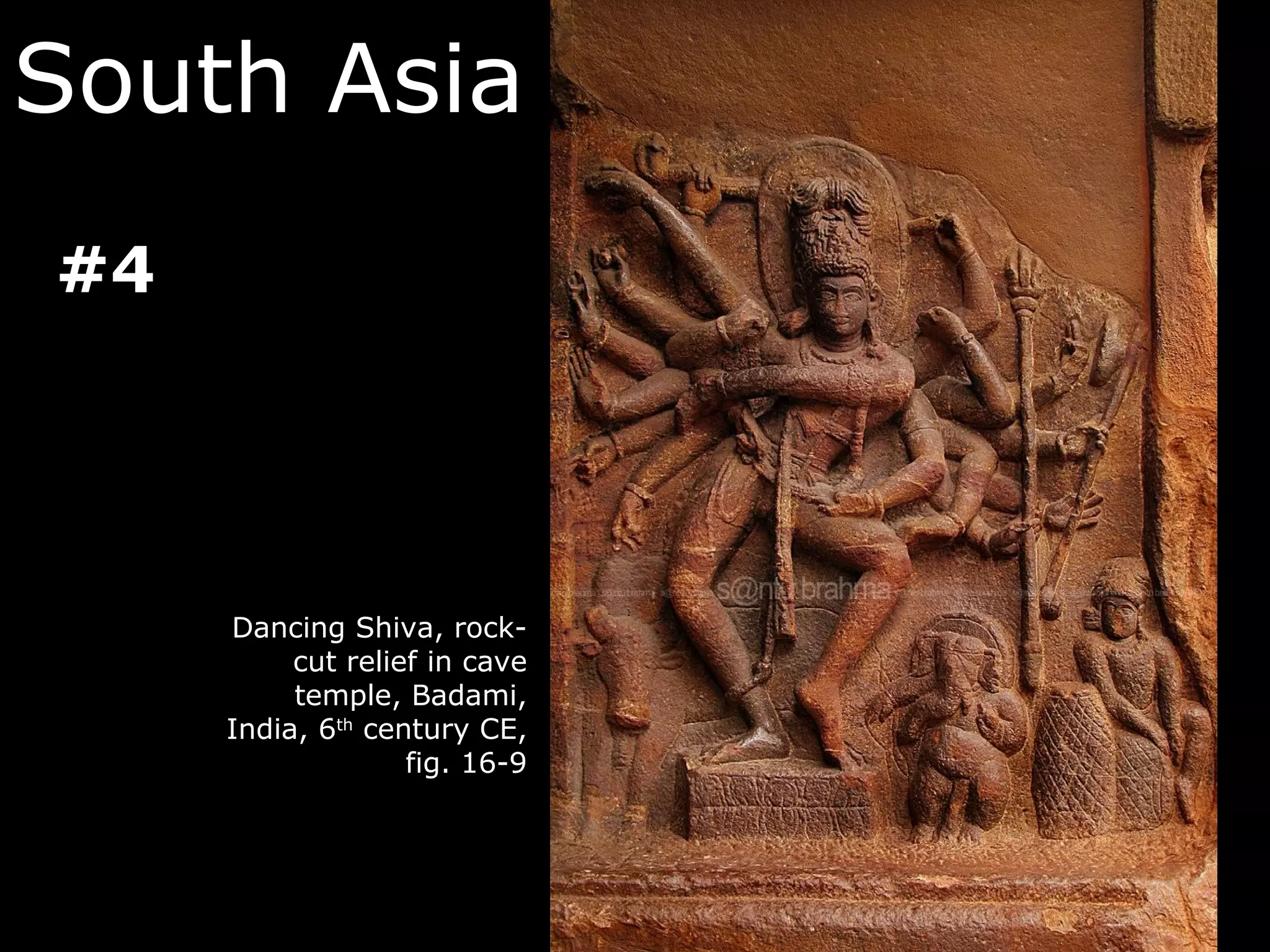
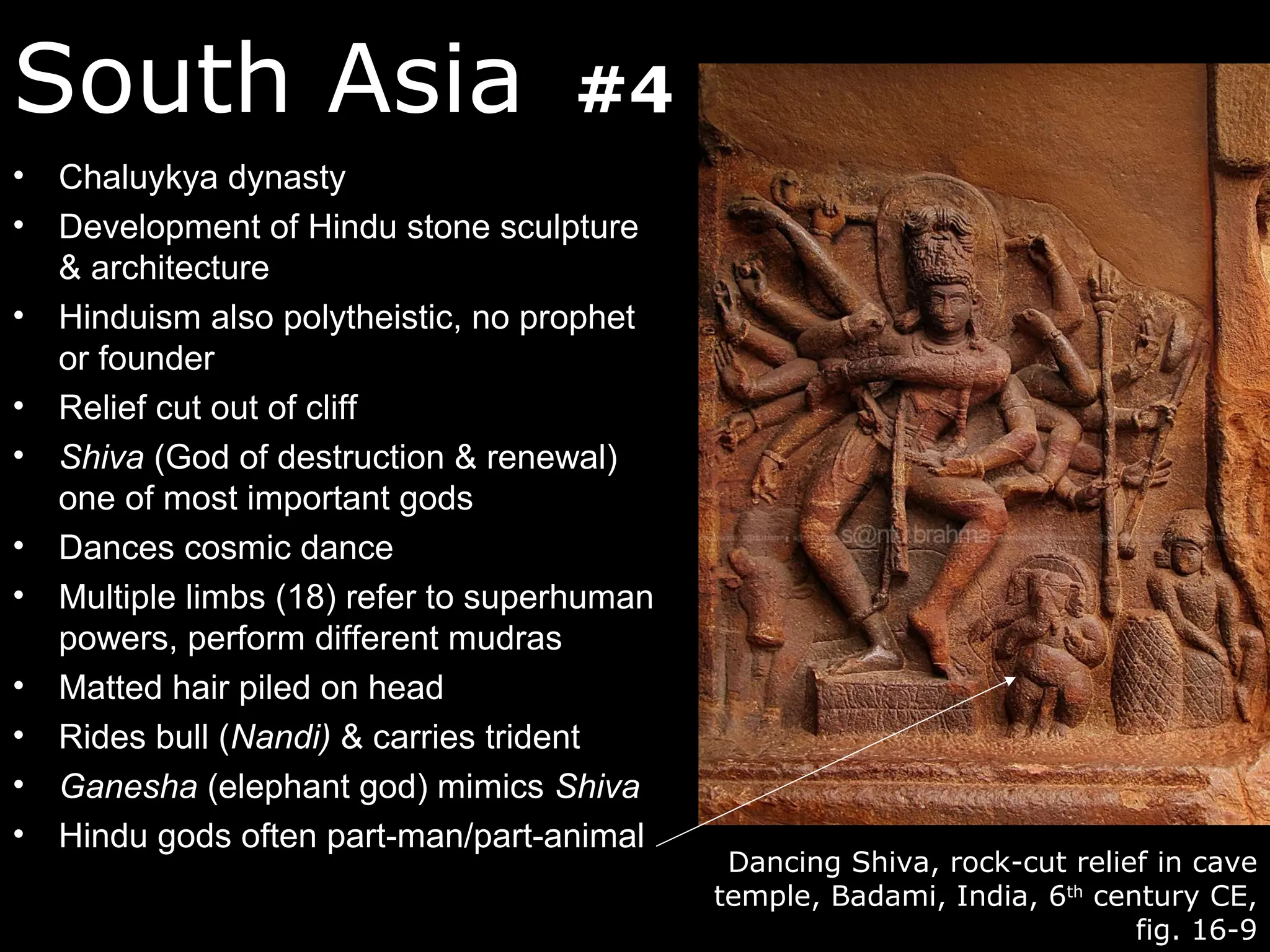
#4


     Dancing Shiva, rock-
          cut relief in cave
          temple, Badami,
     India, 6th century CE,
                   fig. 16-9
South Asia                         #4
• Chaluykya dynasty
• Development of Hindu stone sculpture
  & architecture
• Hinduism also polytheistic, no prophet
  or founder
• Relief cut out of cliff
• Shiva (God of destruction & renewal)
  one of most important gods
• Dances cosmic dance
• Multiple limbs (18) refer to superhuman
  powers, perform different mudras
• Matted hair piled on head
• Rides bull (Nandi) & carries trident
• Ganesha (elephant god) mimics Shiva
• Hindu gods often part-man/part-animal
                                             Dancing Shiva, rock-cut relief in cave
                                            temple, Badami, India, 6th century CE,
                                                                          fig. 16-9
South
Asia -
Mughal
Empire


      BASAWAN and
CHATAR MUNI, Akbar
    and the Elephant
 Hawai, Akbarnama,
ca. 1590. Fig. 16-15.
South Asia
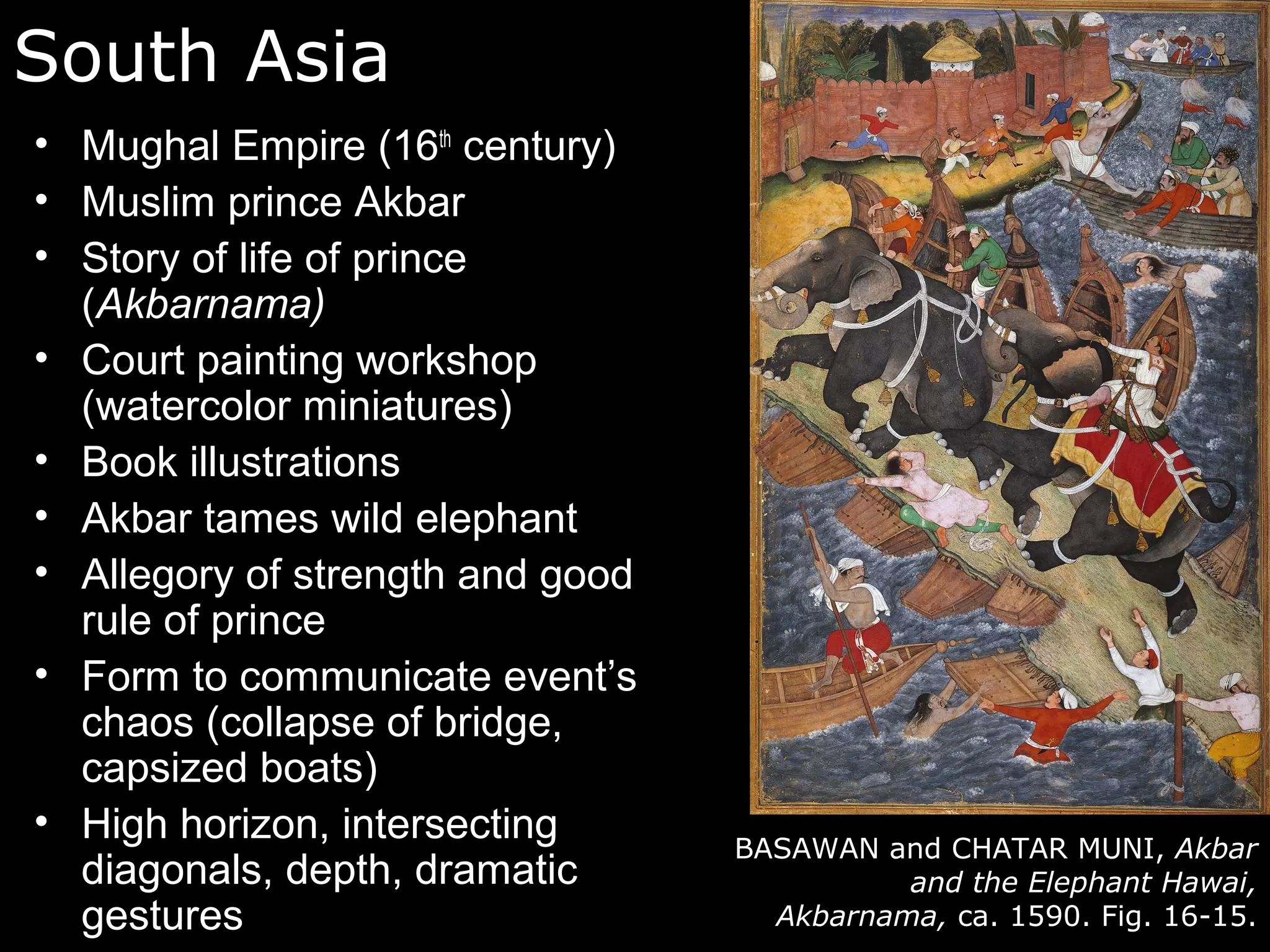
• Mughal Empire (16th century)
• Muslim prince Akbar
• Story of life of prince
  (Akbarnama)
• Court painting workshop
  (watercolor miniatures)
• Book illustrations
• Akbar tames wild elephant
• Allegory of strength and good
  rule of prince
• Form to communicate event’s
  chaos (collapse of bridge,
  capsized boats)
• High horizon, intersecting
                                  BASAWAN and CHATAR MUNI, Akbar
  diagonals, depth, dramatic                and the Elephant Hawai,
  gestures                          Akbarnama, ca. 1590. Fig. 16-15.
South
Asia


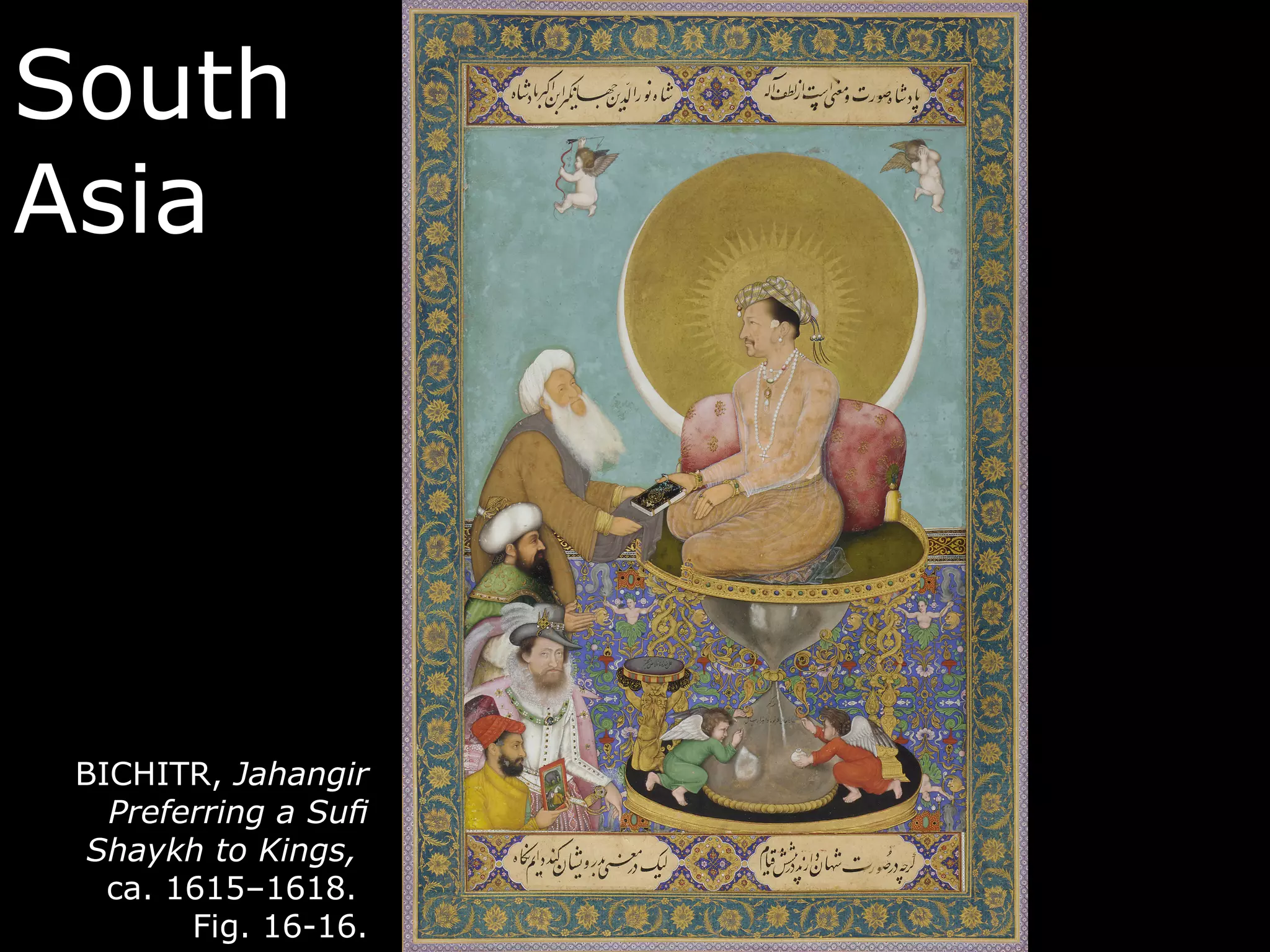
 BICHITR, Jahangir
   Preferring a Sufi
  Shaykh to Kings,
   ca. 1615–1618.
        Fig. 16-16.
South Asia
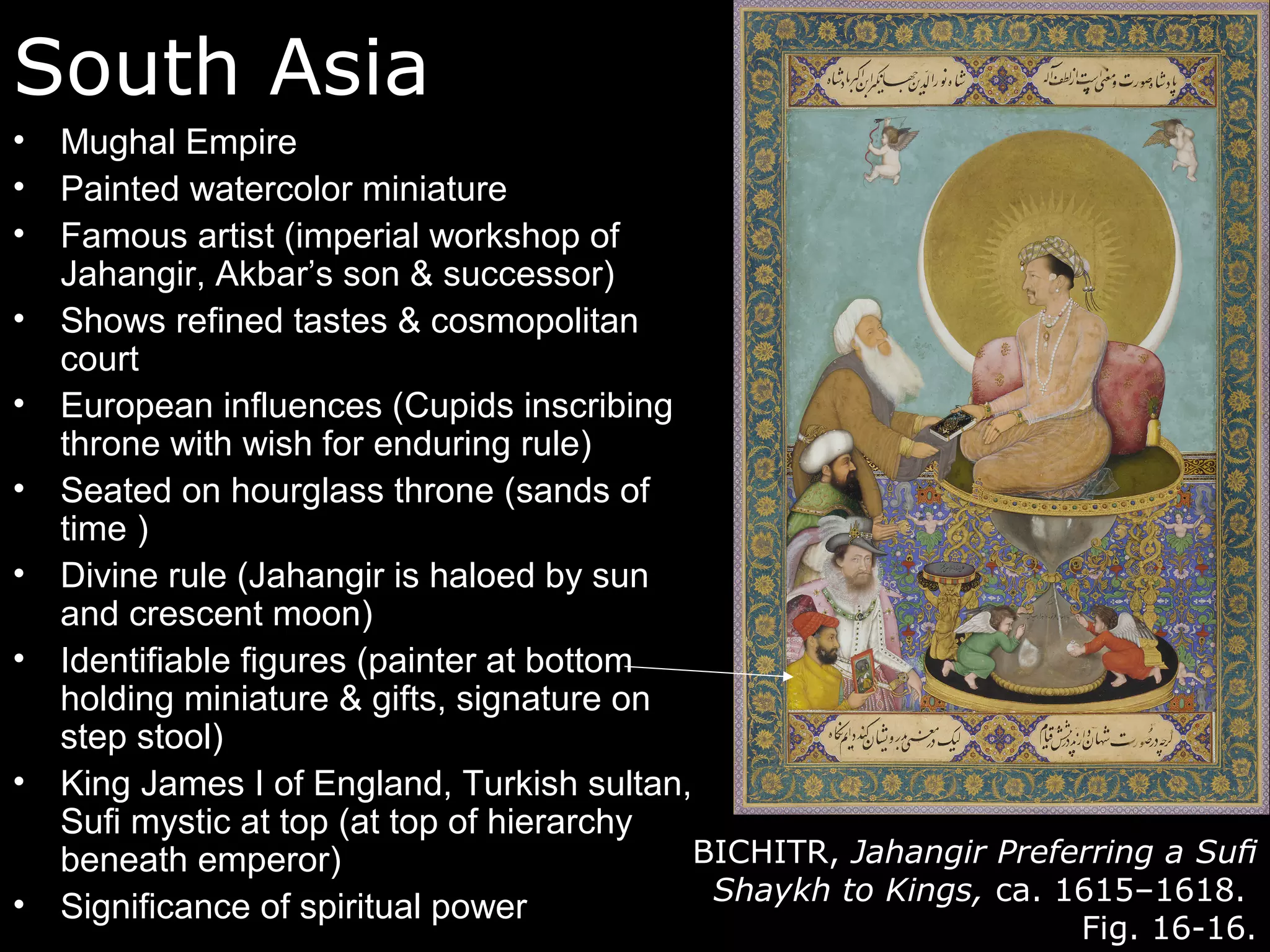
•   Mughal Empire
•   Painted watercolor miniature
•   Famous artist (imperial workshop of
    Jahangir, Akbar’s son & successor)
•   Shows refined tastes & cosmopolitan
    court
•   European influences (Cupids inscribing
    throne with wish for enduring rule)
•   Seated on hourglass throne (sands of
    time )
•   Divine rule (Jahangir is haloed by sun
    and crescent moon)
•   Identifiable figures (painter at bottom
    holding miniature & gifts, signature on
    step stool)
•   King James I of England, Turkish sultan,
    Sufi mystic at top (at top of hierarchy
    beneath emperor)                         BICHITR, Jahangir Preferring a Sufi
•                                             Shaykh to Kings, ca. 1615–1618.
    Significance of spiritual power
                                                                   Fig. 16-16.
South
Asia


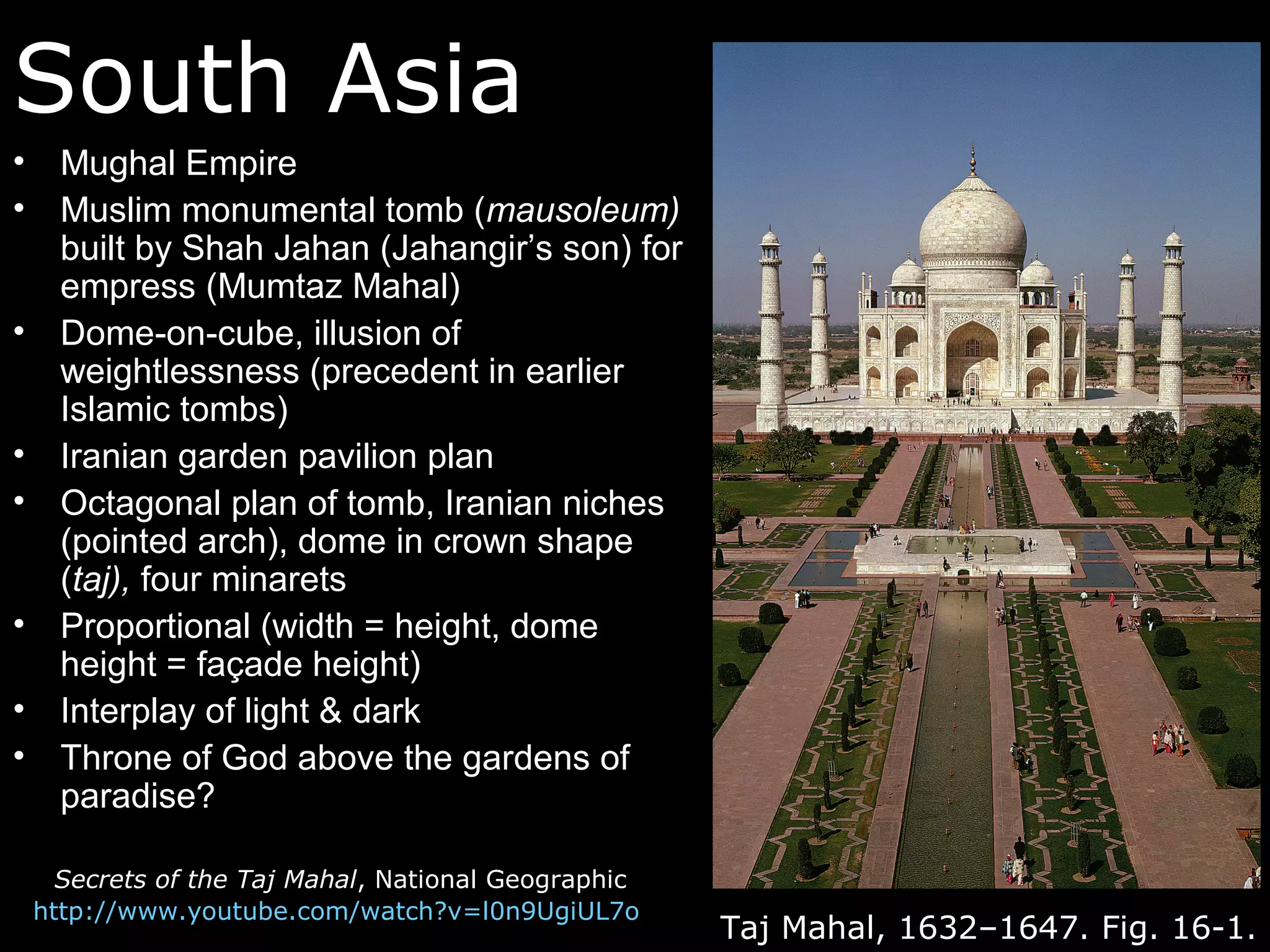
         Taj Mahal,
        1632–1647.
          Fig. 16-1.
South Asia
•     Mughal Empire
•     Muslim monumental tomb (mausoleum)
      built by Shah Jahan (Jahangir’s son) for
      empress (Mumtaz Mahal)
•     Dome-on-cube, illusion of
      weightlessness (precedent in earlier
      Islamic tombs)
•     Iranian garden pavilion plan
•     Octagonal plan of tomb, Iranian niches
      (pointed arch), dome in crown shape
      (taj), four minarets
•     Proportional (width = height, dome
      height = façade height)
•     Interplay of light & dark
•     Throne of God above the gardens of
      paradise?

      Secrets of the Taj Mahal, National Geographic
    http://www.youtube.com/watch?v=l0n9UgiUL7o
                                                      Taj Mahal, 1632–1647. Fig. 16-1.
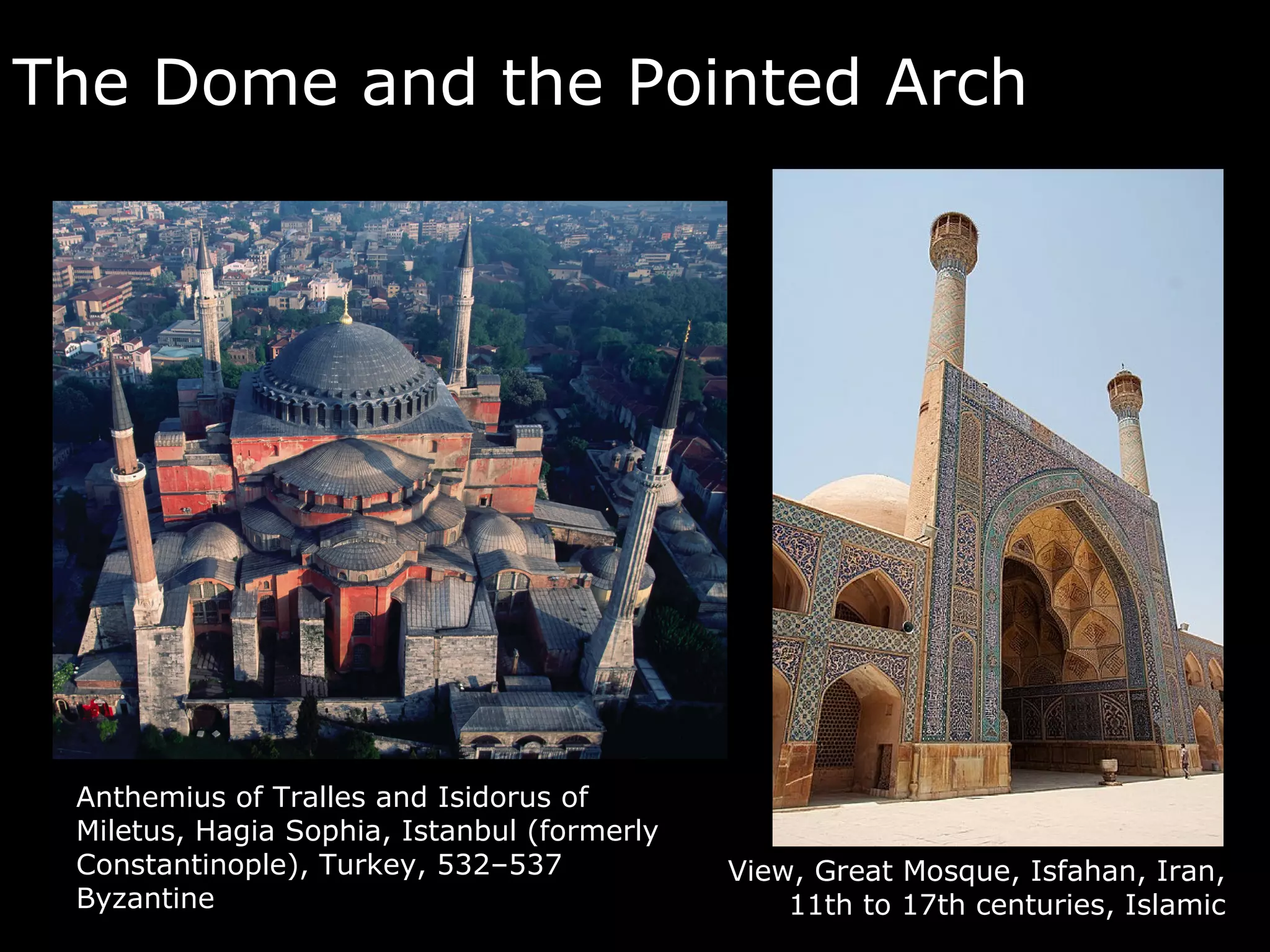
The Dome and the Pointed Arch


 Anthemius of Tralles and Isidorus of
 Miletus, Hagia Sophia, Istanbul (formerly
 Constantinople), Turkey, 532–537            View, Great Mosque, Isfahan, Iran,
 Byzantine                                       11th to 17th centuries, Islamic
Southeast Asia
Dates and Places:
• Beginning first
  millennium CE
• Java, Cambodia,
  Thailand, Myanmar
People:
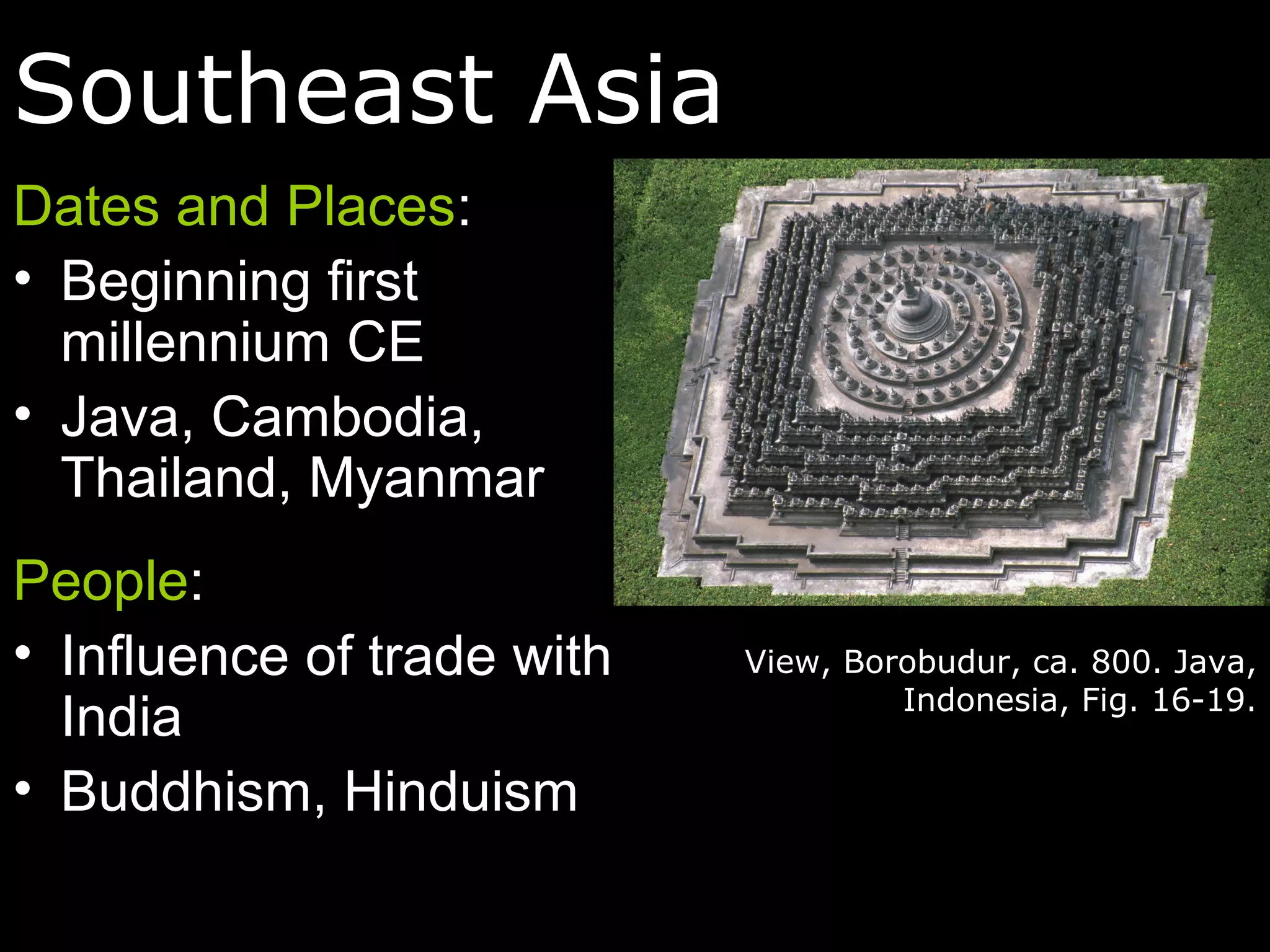
• Influence of trade with   View, Borobudur, ca. 800. Java,
                                     Indonesia, Fig. 16-19.
  India
• Buddhism, Hinduism
Southeast Asia
Themes:
• Temples
• Deities

Forms:
• Stone construction
• Regional taste
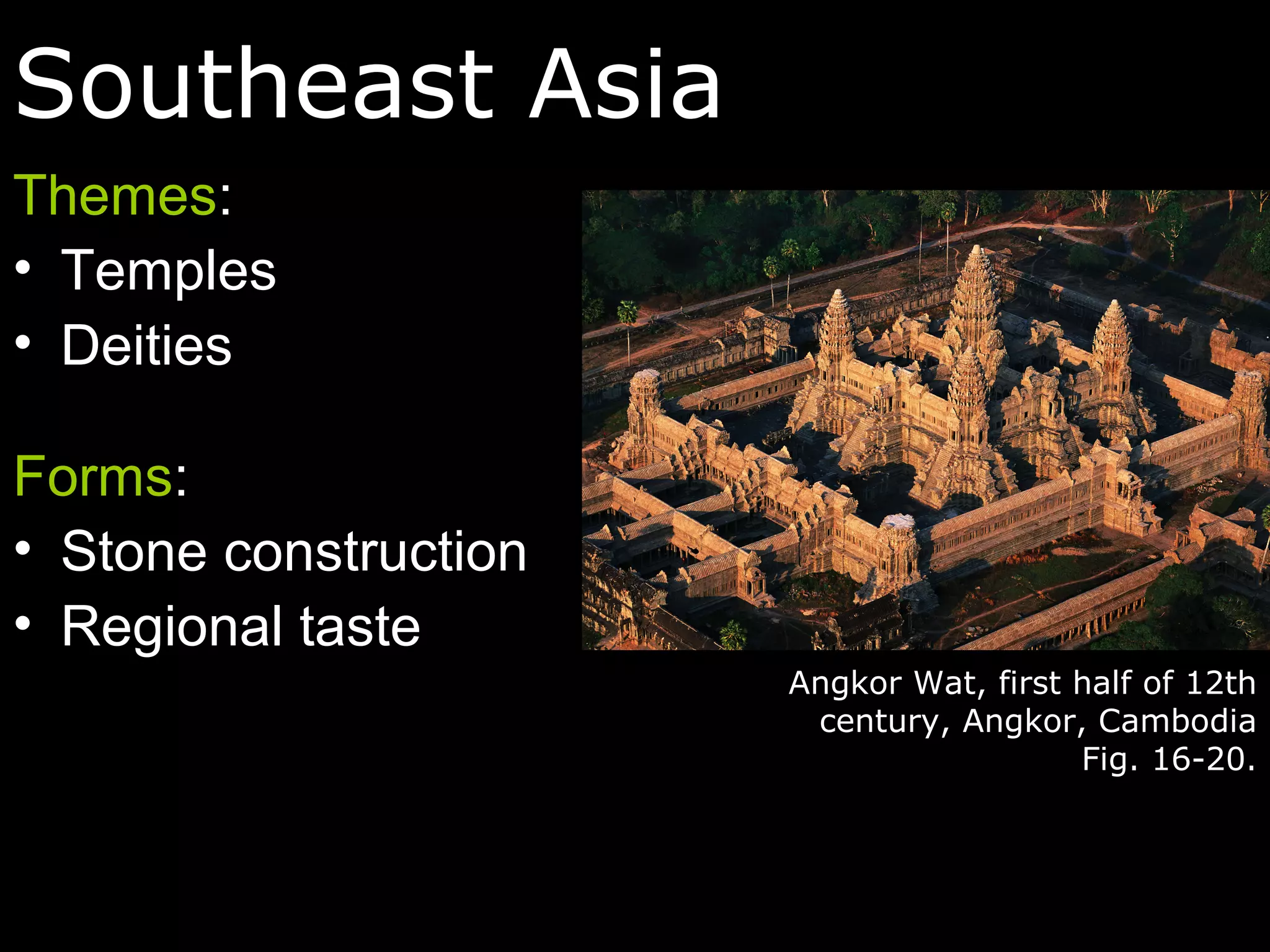
                       Angkor Wat, first half of 12th
                        century, Angkor, Cambodia
                                         Fig. 16-20.
Southeast Asia
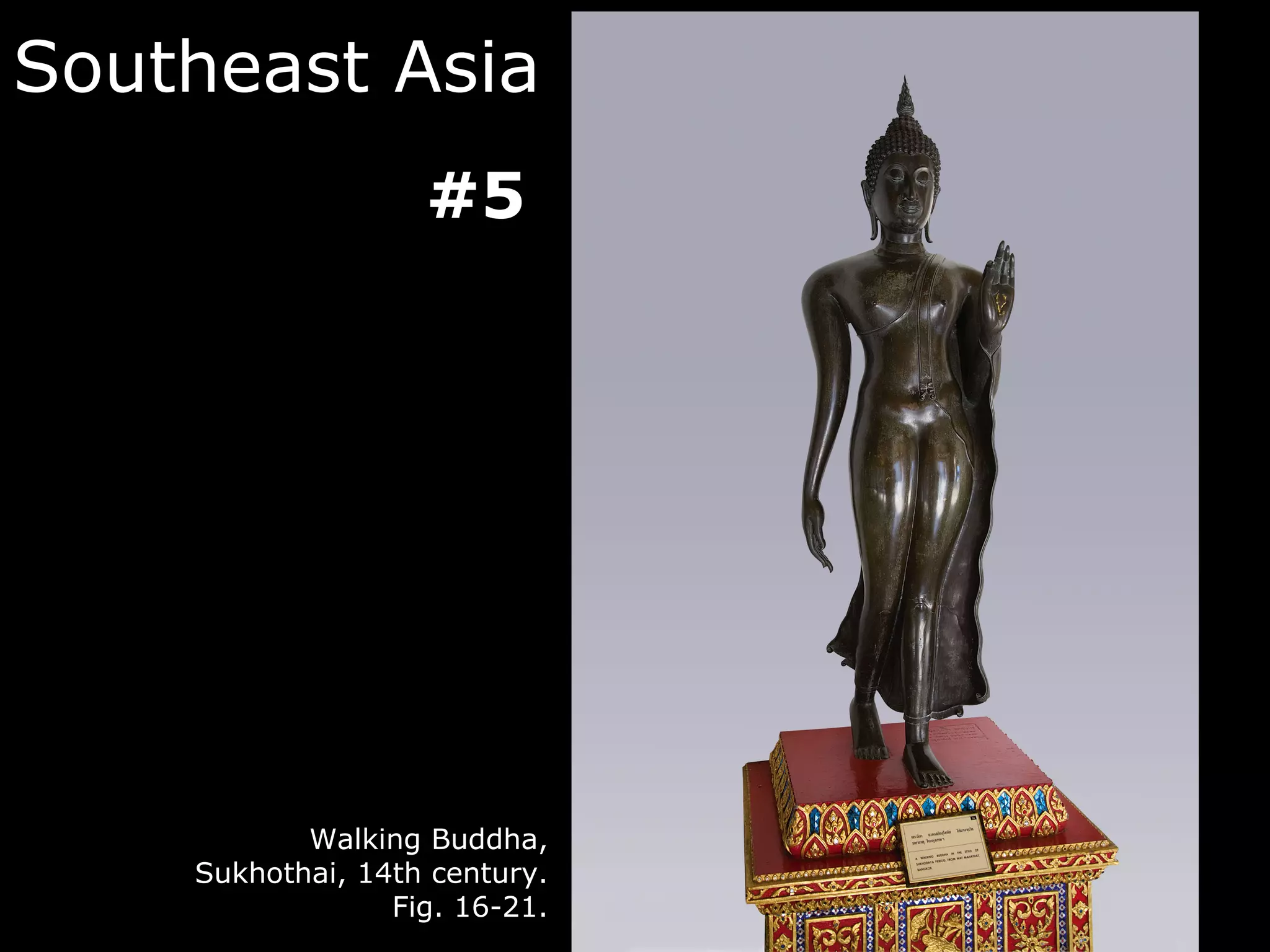
                   #5


           Walking Buddha,
    Sukhothai, 14th century.
                 Fig. 16-21.
Southeast Asia
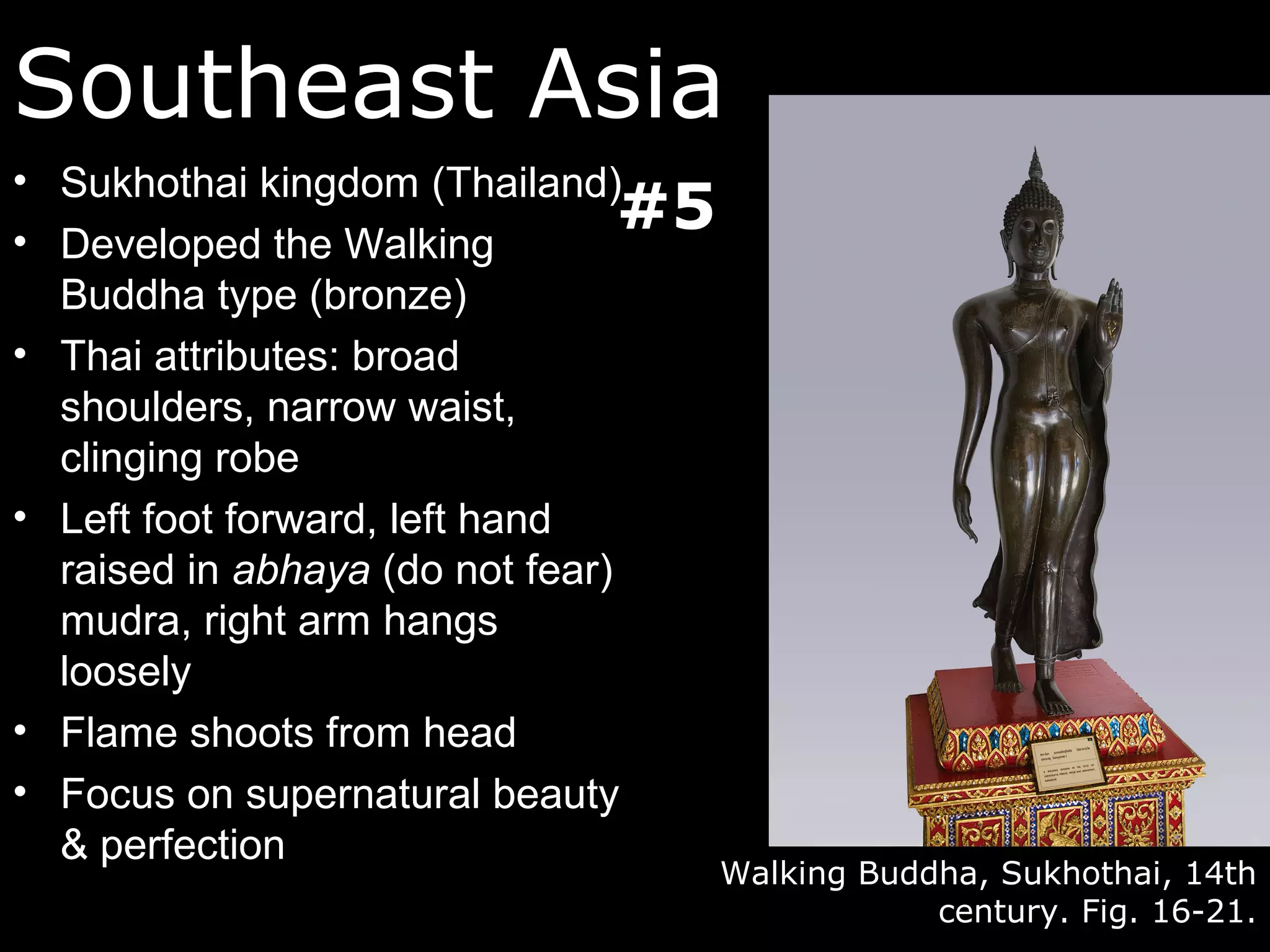
• Sukhothai kingdom (Thailand)
• Developed the Walking
                                 #5
  Buddha type (bronze)
• Thai attributes: broad
  shoulders, narrow waist,
  clinging robe
• Left foot forward, left hand
  raised in abhaya (do not fear)
  mudra, right arm hangs
  loosely
• Flame shoots from head
• Focus on supernatural beauty
  & perfection
                                      Walking Buddha, Sukhothai, 14th
                                                  century. Fig. 16-21.

Lecture, South and Southeast Asia

  • 1.
    South and SoutheastAsia Taj Mahal, 1632–1647. Fig. 16-1.
  • 2.
    South Asia Dates andPlaces: • 2600BCE to 1857CE • Indian subcontinent People: • Cultural diversity & religious tolerance, polytheism • Indus civilization • Buddhism, Hinduism (developed in later centuries BCE and early CE out of Vedic & Upanishad texts) • Buddha (figure who advocated ascetism as end to rebirth (samsara) and path to enlightenment) Mithuna reliefs, Vishvanatha Temple, • Islam (Mughal Dynasty) Khajuraho, ca. 1000. Fig. 16-14.
  • 3.
    South Asia Themes: • Deitiesof Buddhism and Hinduism • Scenes from the Mughal court • Temples Forms: • Stupas, temples • Idealized & stylized Vishvanatha Temple, Khajuraho, ca. figures 1000. Fig. 16-13. • Hieratic scaling • Sensuality & sexuality
  • 4.
    South Asia Map, South & Southeast Asia
  • 5.
    South Asia Malwiya minaret, Great Mosque, John Hancock Samarra, Iraq, 848– Center, 852. Skidmore, Owings & Merrill LLP, Chicago, 1965- 68 Diagram and view, Great Stupa, Sanchi, third century BCE to first century CE. Fig. 16-4.
  • 6.
    South Asia • KushanDynasty • Important Buddhist monastery • Stupa for relics of Buddha • Form based on burials (world mountain) • Three-dimensional mandala (sacred diagram of universe) • Yasti corresponds to axis of the earth (axis mundi) • Circumambulation to worship, enclosed space Diagram and view, Great Stupa, Sanchi, third century BCE to first century CE. Fig. 16-4.
  • 7.
    Group Activity Gods, Goddesses& Gestures : Interpreting South & Southeast Asian Iconography
  • 8.
    South Asia #1 Yakshi, Great Stupa, Sanchi, mid- first century BCE to early first century CE. Fig. 16-5.
  • 9.
    South Asia #1 • Kushan Dynasty • Yakshi (goddess personifying fertility and vegetation) • Holds onto mango tree branch • Places left foot on trunk (allows tree to flower) • Archetype of femininity later used to represent Maya, the Buddha’s mother, giving birth Yakshi, Great Stupa, Sanchi, mid-first century BCE to early first century CE. Fig. 16-5.
  • 10.
    The Fertility Goddess Virgin (Theotokos) and Child between Saints Nude Woman (Venus of Praxiteles Aphrodite of Theodore and George, Willendorf) Knidos, ca. 350-340BCE icon, 7th century CE 28,000 - 25,000 BCE Greek Byzantine Willendorf, Austria
  • 11.
    South Asia #2 Life and death of the Buddha (Enlightenment at Bodh Gaya & First Sermon at Sarnath), Gandhara, second century CE. Fig. 16-6.
  • 12.
    South Asia #2 • Kushan Dynasty • Stories from the life of Buddha (now represented as robed divine figure) • Early figural representation, narrative of path to enlightenment • Top: Bhumispharsha mudra – right hand touches earth as witness to enlightenment • Bottom: Abhaya mudra – right hand in blessing while preaching the Eightfold Path to nirvana in the Deer Park at Sarnath • Attributes: ushnisha (cranial bump), urna (dot between brows), halo (behind head), Wheel of Law, thin robe • Roman influence? (equestrian figures) Life and death of the Buddha, Gandhara, second century CE
  • 13.
    South Asia #3 Seated Buddha preaching first sermon, Sarnath, second half of fifth century. Fig. 16-7.
  • 14.
    South Asia #3 • Gupta Period • Standardization of Buddha’s image • Clinging robe, seated in lotus position, ushnisha, urna, halo • Eyes downcast in meditation, hands make Wheel-turning gesture (dharmachakra mudra) • Wheel of Law (teaching) at bottom (hieratic scaling) • Smooth surface • Indian version of idealized form • For temple, not stupa Seated Buddha preaching first sermon, Sarnath, second half of fifth century. Fig. 16-7.
  • 15.
    South Asia #4 Dancing Shiva, rock- cut relief in cave temple, Badami, India, 6th century CE, fig. 16-9
  • 16.
    South Asia #4 • Chaluykya dynasty • Development of Hindu stone sculpture & architecture • Hinduism also polytheistic, no prophet or founder • Relief cut out of cliff • Shiva (God of destruction & renewal) one of most important gods • Dances cosmic dance • Multiple limbs (18) refer to superhuman powers, perform different mudras • Matted hair piled on head • Rides bull (Nandi) & carries trident • Ganesha (elephant god) mimics Shiva • Hindu gods often part-man/part-animal Dancing Shiva, rock-cut relief in cave temple, Badami, India, 6th century CE, fig. 16-9
  • 17.
    South Asia - Mughal Empire BASAWAN and CHATAR MUNI, Akbar and the Elephant Hawai, Akbarnama, ca. 1590. Fig. 16-15.
  • 18.
    South Asia • MughalEmpire (16th century) • Muslim prince Akbar • Story of life of prince (Akbarnama) • Court painting workshop (watercolor miniatures) • Book illustrations • Akbar tames wild elephant • Allegory of strength and good rule of prince • Form to communicate event’s chaos (collapse of bridge, capsized boats) • High horizon, intersecting BASAWAN and CHATAR MUNI, Akbar diagonals, depth, dramatic and the Elephant Hawai, gestures Akbarnama, ca. 1590. Fig. 16-15.
  • 19.
    South Asia BICHITR, Jahangir Preferring a Sufi Shaykh to Kings, ca. 1615–1618. Fig. 16-16.
  • 20.
    South Asia • Mughal Empire • Painted watercolor miniature • Famous artist (imperial workshop of Jahangir, Akbar’s son & successor) • Shows refined tastes & cosmopolitan court • European influences (Cupids inscribing throne with wish for enduring rule) • Seated on hourglass throne (sands of time ) • Divine rule (Jahangir is haloed by sun and crescent moon) • Identifiable figures (painter at bottom holding miniature & gifts, signature on step stool) • King James I of England, Turkish sultan, Sufi mystic at top (at top of hierarchy beneath emperor) BICHITR, Jahangir Preferring a Sufi • Shaykh to Kings, ca. 1615–1618. Significance of spiritual power Fig. 16-16.
  • 21.
    South Asia Taj Mahal, 1632–1647. Fig. 16-1.
  • 22.
    South Asia • Mughal Empire • Muslim monumental tomb (mausoleum) built by Shah Jahan (Jahangir’s son) for empress (Mumtaz Mahal) • Dome-on-cube, illusion of weightlessness (precedent in earlier Islamic tombs) • Iranian garden pavilion plan • Octagonal plan of tomb, Iranian niches (pointed arch), dome in crown shape (taj), four minarets • Proportional (width = height, dome height = façade height) • Interplay of light & dark • Throne of God above the gardens of paradise? Secrets of the Taj Mahal, National Geographic http://www.youtube.com/watch?v=l0n9UgiUL7o Taj Mahal, 1632–1647. Fig. 16-1.
  • 23.
    The Dome andthe Pointed Arch Anthemius of Tralles and Isidorus of Miletus, Hagia Sophia, Istanbul (formerly Constantinople), Turkey, 532–537 View, Great Mosque, Isfahan, Iran, Byzantine 11th to 17th centuries, Islamic
  • 24.
    Southeast Asia Dates andPlaces: • Beginning first millennium CE • Java, Cambodia, Thailand, Myanmar People: • Influence of trade with View, Borobudur, ca. 800. Java, Indonesia, Fig. 16-19. India • Buddhism, Hinduism
  • 25.
    Southeast Asia Themes: • Temples •Deities Forms: • Stone construction • Regional taste Angkor Wat, first half of 12th century, Angkor, Cambodia Fig. 16-20.
  • 26.
    Southeast Asia #5 Walking Buddha, Sukhothai, 14th century. Fig. 16-21.
  • 27.
    Southeast Asia • Sukhothaikingdom (Thailand) • Developed the Walking #5 Buddha type (bronze) • Thai attributes: broad shoulders, narrow waist, clinging robe • Left foot forward, left hand raised in abhaya (do not fear) mudra, right arm hangs loosely • Flame shoots from head • Focus on supernatural beauty & perfection Walking Buddha, Sukhothai, 14th century. Fig. 16-21.