History of 20th Century Art 
1965 - 70
1965 - 70 
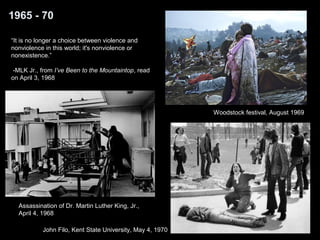
“It is no longer a choice between violence and 
nonviolence in this world; it's nonviolence or 
nonexistence.” 
-MLK Jr., from I’ve Been to the Mountaintop, read 
on April 3, 1968 
Assassination of Dr. Martin Luther King, Jr., 
April 4, 1968 
John Filo, Kent State University, May 4, 1970 
Woodstock festival, August 1969
Word Presentations 
• Anti-illusionism 
• Deskilling 
• Other important concepts addressed 
today: serial forms, voyeurism, part-object, 
entropy
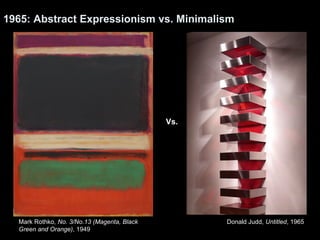
1965: Abstract Expressionism vs. Minimalism 
Vs. 
Mark Rothko, No. 3/No.13 (Magenta, Black Donald Judd, Untitled, 1965 
Green and Orange), 1949
1965: Minimalism Close Read 
Group Discussion Questions 
(write down answers and hand in at end of class) 
• In his article “Specific Objects” (1965), artist and critic Donald Judd outlined 
the essential characteristics of Minimalist art. What are these? See pp. 536- 
37 in your textbook. 
• Fellow artist Robert Morris wrote that this new art shouted “…no to 
transcendence and spiritual values, heroic scale, anguished decisions, 
historicizing narrative, valuable artifact, intelligent structure, interesting visual 
experience.” What do you think explains this defiance against past art forms? 
Do you see the same in other art of 1960s? If so, how? 
• Then, review your observations about your assigned focus artwork and be 
prepared to share it with the class.
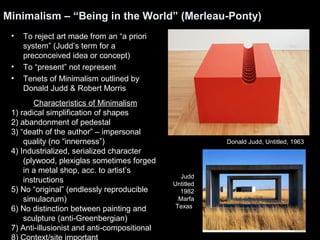
Minimalism – “Being in the World” (Merleau-Ponty) 
• To reject art made from an “a priori 
system” (Judd’s term for a 
preconceived idea or concept) 
• To “present” not represent 
• Tenets of Minimalism outlined by 
Donald Judd & Robert Morris 
Characteristics of Minimalism 
1) radical simplification of shapes 
2) abandonment of pedestal 
3) “death of the author” – impersonal 
quality (no “innerness”) 
4) Industrialized, serialized character 
(plywood, plexiglas sometimes forged 
in a metal shop, acc. to artist’s 
instructions 
5) No “original” (endlessly reproducible 
simulacrum) 
6) No distinction between painting and 
sculpture (anti-Greenbergian) 
7) Anti-illusionist and anti-compositional 
8) Context/site important 
Donald Judd, Untitled, 1963 
Judd 
Untitled 
1982 
Marfa 
Texas
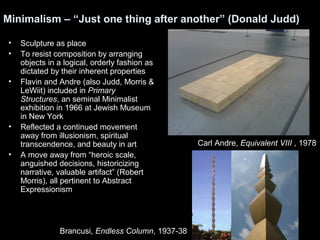
Minimalism – “Just one thing after another” (Donald Judd) 
• Sculpture as place 
• To resist composition by arranging 
objects in a logical, orderly fashion as 
dictated by their inherent properties 
• Flavin and Andre (also Judd, Morris & 
LeWiit) included in Primary 
Structures, an seminal Minimalist 
exhibition in 1966 at Jewish Museum 
in New York 
• Reflected a continued movement 
away from illusionism, spiritual 
transcendence, and beauty in art 
• A move away from “heroic scale, 
anguished decisions, historicizing 
narrative, valuable artifact” (Robert 
Morris), all pertinent to Abstract 
Expressionism 
Carl Andre, Equivalent VIII , 1978 
Brancusi, Endless Column, 1937-38
Minimalism – “Being in the World” (Merleau-Ponty) 
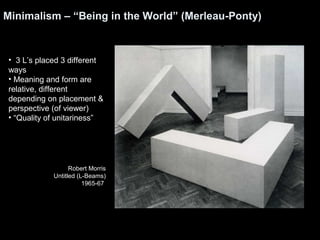
• 3 L’s placed 3 different 
ways 
• Meaning and form are 
relative, different 
depending on placement & 
perspective (of viewer) 
• “Quality of unitariness” 
Robert Morris 
Untitled (L-Beams) 
1965-67
Conceptual Art – Duchamp’s Last Word 
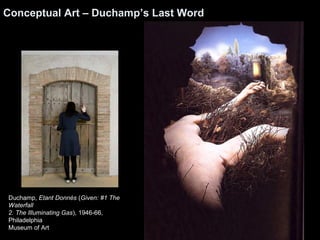
Duchamp, Etant Donnés (Given: #1 The 
Waterfall 
2. The Illuminating Gas), 1946-66, 
Philadelphia 
Museum of Art
Conceptual Art: Duchamp’s Last Word 
• Thought to have given up art for chess 
• Resurgence in popularity in 1960s (major 
retrospective at Pasadena Art Museum in 
1963) 
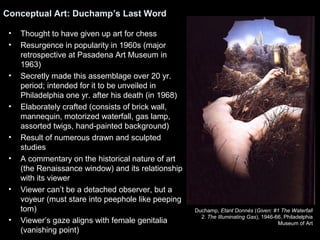
• Secretly made this assemblage over 20 yr. 
period; intended for it to be unveiled in 
Philadelphia one yr. after his death (in 1968) 
• Elaborately crafted (consists of brick wall, 
mannequin, motorized waterfall, gas lamp, 
assorted twigs, hand-painted background) 
• Result of numerous drawn and sculpted 
studies 
• A commentary on the historical nature of art 
(the Renaissance window) and its relationship 
with its viewer 
• Viewer can’t be a detached observer, but a 
voyeur (must stare into peephole like peeping 
tom) 
• Viewer’s gaze aligns with female genitalia 
(vanishing point) 
Duchamp, Etant Donnés (Given: #1 The Waterfall 
2. The Illuminating Gas), 1946-66, Philadelphia 
Museum of Art
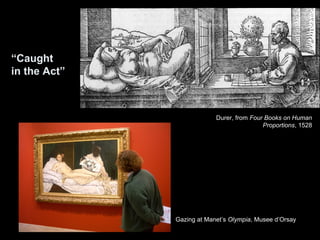
“Caught 
in the Act” 
Durer, from Four Books on Human 
Proportions, 1528 
Gazing at Manet’s Olympia, Musee d’Orsay
Postminimalism 
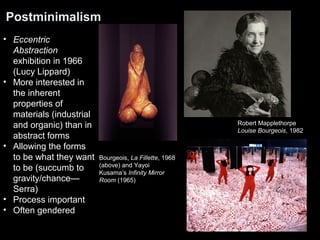
Bourgeois, La Fillette, 1968 
(above) and Yayoi 
Kusama’s Infinity Mirror 
Room (1965) 
Robert Mapplethorpe 
Louise Bourgeois, 1982 
• Eccentric 
Abstraction 
exhibition in 1966 
(Lucy Lippard) 
• More interested in 
the inherent 
properties of 
materials (industrial 
and organic) than in 
abstract forms 
• Allowing the forms 
to be what they want 
to be (succumb to 
gravity/chance— 
Serra) 
• Process important 
• Often gendered
Postminimalism 
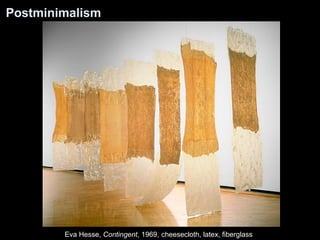
Eva Hesse, Contingent, 1969, cheesecloth, latex, fiberglass
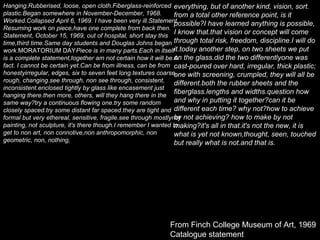
everything, but of another kind, vision, sort.
 
from a total other reference point, is it 
possible?
I have learned anything is possible, 
I know that.
that vision or concept will come 
through total risk, freedom, discipline.
I will do 
it.
today another step, on two sheets we put 
on the glass.
did the two differentlyone was 
cast-poured over hard, irregular, thick plastic; 
one with screening, crumpled, they will all be 
different.
both the rubber sheets and the 
fiberglass.
lengths and widths.
question how 
and why in putting it together?
can it be 
different each time?
 why not?
how to achieve 
by not achieving?
 how to make by not 
making?
it's all in that.
it's not the new, it is 
what is yet not known,thought, seen, touched 
but really what is not.
and that is.
 
Hanging.
Rubberised, loose, open cloth.
Fiberglass-reinforced 
plastic.
Began somewhere in November-December, 1968.
 
Worked.
Collapsed April 6, 1969.
 I have been very ill.
Statement.
 
Resuming work on piece,have one complete from back then.
 
Statement, October 15, 1969, out of hospital, short stay this 
time,third time.
Same day students and Douglas Johns began 
work.
MORATORIUM DAYPiece is in many parts.
Each in itself 
is a complete statement,together am not certain how it will be.
A 
fact.
 I cannot be certain yet.
Can be from illness, can be from 
honestyirregular, edges, six to seven feet long.
textures coarse, 
rough, changing.
see through, non see through, consistent, 
inconsistent.
enclosed tightly by glass like encasement just 
hanging there.
then more, others, will they hang there in the 
same way?
try a continuous flowing one.
try some random 
closely spaced.
try some distant far spaced.
they are tight and 
formal but very ethereal, sensitive, fragile.
see through mostlynot 
painting, not sculpture, it's there though.
I remember I wanted to 
get to non art, non connotive,non anthropomorphic, non 
geometric, non, nothing, 
From Finch College Museum of Art, 1969 
Catalogue statement
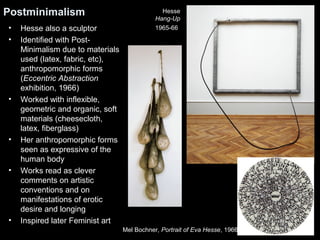
Postminimalism Hesse 
• Hesse also a sculptor 
• Identified with Post- 
Minimalism due to materials 
used (latex, fabric, etc), 
anthropomorphic forms 
(Eccentric Abstraction 
exhibition, 1966) 
• Worked with inflexible, 
geometric and organic, soft 
materials (cheesecloth, 
latex, fiberglass) 
• Her anthropomorphic forms 
seen as expressive of the 
human body 
• Works read as clever 
comments on artistic 
conventions and on 
manifestations of erotic 
desire and longing 
• Inspired later Feminist art 
Hang-Up 
1965-66 
Mel Bochner, Portrait of Eva Hesse, 1966
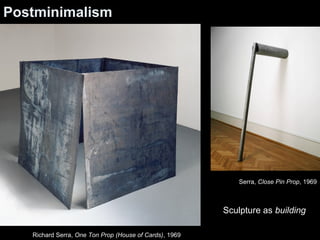
Richard Serra, One Ton Prop (House of Cards), 1969 
Serra, Close Pin Prop, 1969 
Postminimalism 
Sculpture as building
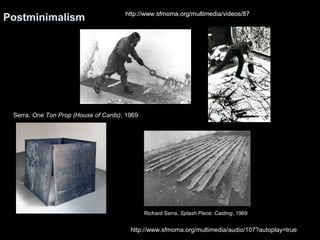
Postminimalism http://www.sfmoma.org/multimedia/videos/87 
Richard Serra, Splash Piece: Casting, 1969 
Serra, One Ton Prop (House of Cards), 1969 
http://www.sfmoma.org/multimedia/audio/107?autoplay=true
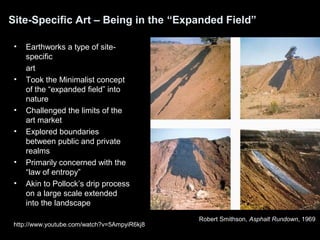
Site-Specific Art – Being in the “Expanded Field” 
• Earthworks a type of site-specific 
art 
• Took the Minimalist concept 
of the “expanded field” into 
nature 
• Challenged the limits of the 
art market 
• Explored boundaries 
between public and private 
realms 
• Primarily concerned with the 
“law of entropy” 
• Akin to Pollock’s drip process 
on a large scale extended 
into the landscape 
Robert Smithson, Asphalt Rundown, 1969 
http://www.youtube.com/watch?v=5AmpyiR6kj8
Site-Specific Art – Being in the “Expanded Field” 
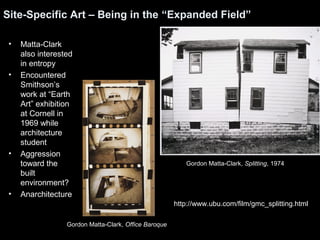
• Matta-Clark 
also interested 
in entropy 
• Encountered 
Smithson’s 
work at “Earth 
Art” exhibition 
at Cornell in 
1969 while 
architecture 
student 
• Aggression 
toward the 
built 
environment? 
• Anarchitecture 
Gordon Matta-Clark, Splitting, 1974 
http://www.ubu.com/film/gmc_splitting.html 
Gordon Matta-Clark, Office Baroque
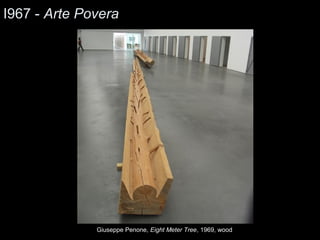
I967 - Arte Povera 
Giuseppe Penone, Eight Meter Tree, 1969, wood
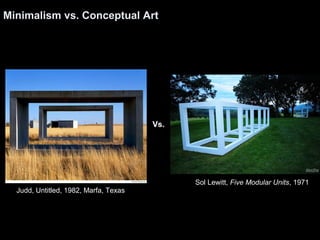
Minimalism vs. Conceptual Art 
Judd, Untitled, 1982, Marfa, Texas 
Vs. 
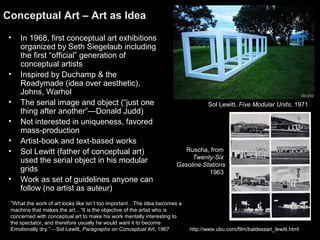
Sol Lewitt, Five Modular Units, 1971
Conceptual Art – Art as Idea 
• In 1968, first conceptual art exhibitions 
organized by Seth Siegelaub including 
the first “official” generation of 
conceptual artists 
• Inspired by Duchamp & the 
Readymade (idea over aesthetic), 
Johns, Warhol 
• The serial image and object (“just one 
thing after another”—Donald Judd) 
• Not interested in uniqueness, favored 
mass-production 
• Artist-book and text-based works 
• Sol Lewitt (father of conceptual art) 
used the serial object in his modular 
grids 
• Work as set of guidelines anyone can 
follow (no artist as auteur) 
“What the work of art looks like isn’t too important…The idea becomes a 
machine that makes the art…“It is the objective of the artist who is 
concerned with conceptual art to make his work mentally interesting to 
the spectator, and therefore usually he would want it to become 
Emotionally dry.” – Sol Lewitt, Paragraphs on Conceptual Art, 1967 
Sol Lewitt, Five Modular Units, 1971 
Ruscha, from 
Twenty-Six 
Gasoline Stations 
1963 
http://www.ubu.com/film/baldessari_lewitt.html
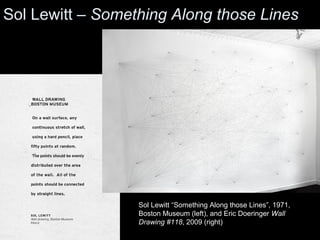
Sol Lewitt – Something Along those Lines 
Sol Lewitt “Something Along those Lines”, 1971, 
Boston Museum (left), and Eric Doeringer Wall 
Drawing #118, 2009 (right)
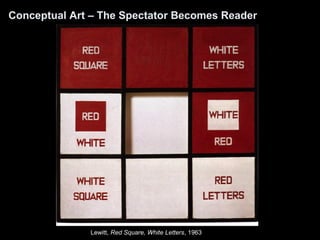
Conceptual Art – The Spectator Becomes Reader 
Lewitt, Red Square, White Letters, 1963
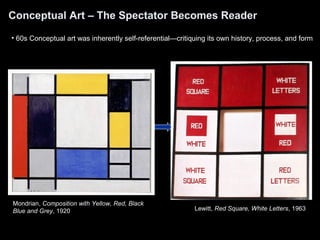
Conceptual Art – The Spectator Becomes Reader 
• 60s Conceptual art was inherently self-referential—critiquing its own history, process, and form 
Mondrian, Composition with Yellow, Red, Black 
Blue and Grey, 1920 Lewitt, Red Square, White Letters, 1963

Lecture, 1965-69

  • 1.
    History of 20thCentury Art 1965 - 70
  • 2.
    1965 - 70 “It is no longer a choice between violence and nonviolence in this world; it's nonviolence or nonexistence.” -MLK Jr., from I’ve Been to the Mountaintop, read on April 3, 1968 Assassination of Dr. Martin Luther King, Jr., April 4, 1968 John Filo, Kent State University, May 4, 1970 Woodstock festival, August 1969
  • 3.
    Word Presentations •Anti-illusionism • Deskilling • Other important concepts addressed today: serial forms, voyeurism, part-object, entropy
  • 4.
    1965: Abstract Expressionismvs. Minimalism Vs. Mark Rothko, No. 3/No.13 (Magenta, Black Donald Judd, Untitled, 1965 Green and Orange), 1949
  • 5.
    1965: Minimalism CloseRead Group Discussion Questions (write down answers and hand in at end of class) • In his article “Specific Objects” (1965), artist and critic Donald Judd outlined the essential characteristics of Minimalist art. What are these? See pp. 536- 37 in your textbook. • Fellow artist Robert Morris wrote that this new art shouted “…no to transcendence and spiritual values, heroic scale, anguished decisions, historicizing narrative, valuable artifact, intelligent structure, interesting visual experience.” What do you think explains this defiance against past art forms? Do you see the same in other art of 1960s? If so, how? • Then, review your observations about your assigned focus artwork and be prepared to share it with the class.
  • 6.
    Minimalism – “Beingin the World” (Merleau-Ponty) • To reject art made from an “a priori system” (Judd’s term for a preconceived idea or concept) • To “present” not represent • Tenets of Minimalism outlined by Donald Judd & Robert Morris Characteristics of Minimalism 1) radical simplification of shapes 2) abandonment of pedestal 3) “death of the author” – impersonal quality (no “innerness”) 4) Industrialized, serialized character (plywood, plexiglas sometimes forged in a metal shop, acc. to artist’s instructions 5) No “original” (endlessly reproducible simulacrum) 6) No distinction between painting and sculpture (anti-Greenbergian) 7) Anti-illusionist and anti-compositional 8) Context/site important Donald Judd, Untitled, 1963 Judd Untitled 1982 Marfa Texas
  • 7.
    Minimalism – “Justone thing after another” (Donald Judd) • Sculpture as place • To resist composition by arranging objects in a logical, orderly fashion as dictated by their inherent properties • Flavin and Andre (also Judd, Morris & LeWiit) included in Primary Structures, an seminal Minimalist exhibition in 1966 at Jewish Museum in New York • Reflected a continued movement away from illusionism, spiritual transcendence, and beauty in art • A move away from “heroic scale, anguished decisions, historicizing narrative, valuable artifact” (Robert Morris), all pertinent to Abstract Expressionism Carl Andre, Equivalent VIII , 1978 Brancusi, Endless Column, 1937-38
  • 8.
    Minimalism – “Beingin the World” (Merleau-Ponty) • 3 L’s placed 3 different ways • Meaning and form are relative, different depending on placement & perspective (of viewer) • “Quality of unitariness” Robert Morris Untitled (L-Beams) 1965-67
  • 9.
    Conceptual Art –Duchamp’s Last Word Duchamp, Etant Donnés (Given: #1 The Waterfall 2. The Illuminating Gas), 1946-66, Philadelphia Museum of Art
  • 10.
    Conceptual Art: Duchamp’sLast Word • Thought to have given up art for chess • Resurgence in popularity in 1960s (major retrospective at Pasadena Art Museum in 1963) • Secretly made this assemblage over 20 yr. period; intended for it to be unveiled in Philadelphia one yr. after his death (in 1968) • Elaborately crafted (consists of brick wall, mannequin, motorized waterfall, gas lamp, assorted twigs, hand-painted background) • Result of numerous drawn and sculpted studies • A commentary on the historical nature of art (the Renaissance window) and its relationship with its viewer • Viewer can’t be a detached observer, but a voyeur (must stare into peephole like peeping tom) • Viewer’s gaze aligns with female genitalia (vanishing point) Duchamp, Etant Donnés (Given: #1 The Waterfall 2. The Illuminating Gas), 1946-66, Philadelphia Museum of Art
  • 12.
    “Caught in theAct” Durer, from Four Books on Human Proportions, 1528 Gazing at Manet’s Olympia, Musee d’Orsay
  • 13.
    Postminimalism Bourgeois, LaFillette, 1968 (above) and Yayoi Kusama’s Infinity Mirror Room (1965) Robert Mapplethorpe Louise Bourgeois, 1982 • Eccentric Abstraction exhibition in 1966 (Lucy Lippard) • More interested in the inherent properties of materials (industrial and organic) than in abstract forms • Allowing the forms to be what they want to be (succumb to gravity/chance— Serra) • Process important • Often gendered
  • 14.
    Postminimalism Eva Hesse,Contingent, 1969, cheesecloth, latex, fiberglass
  • 15.
    everything, but ofanother kind, vision, sort.
 from a total other reference point, is it possible?
I have learned anything is possible, I know that.
that vision or concept will come through total risk, freedom, discipline.
I will do it.
today another step, on two sheets we put on the glass.
did the two differentlyone was cast-poured over hard, irregular, thick plastic; one with screening, crumpled, they will all be different.
both the rubber sheets and the fiberglass.
lengths and widths.
question how and why in putting it together?
can it be different each time?
 why not?
how to achieve by not achieving?
 how to make by not making?
it's all in that.
it's not the new, it is what is yet not known,thought, seen, touched but really what is not.
and that is.
 Hanging.
Rubberised, loose, open cloth.
Fiberglass-reinforced plastic.
Began somewhere in November-December, 1968.
 Worked.
Collapsed April 6, 1969.
 I have been very ill.
Statement.
 Resuming work on piece,have one complete from back then.
 Statement, October 15, 1969, out of hospital, short stay this time,third time.
Same day students and Douglas Johns began work.
MORATORIUM DAYPiece is in many parts.
Each in itself is a complete statement,together am not certain how it will be.
A fact.
 I cannot be certain yet.
Can be from illness, can be from honestyirregular, edges, six to seven feet long.
textures coarse, rough, changing.
see through, non see through, consistent, inconsistent.
enclosed tightly by glass like encasement just hanging there.
then more, others, will they hang there in the same way?
try a continuous flowing one.
try some random closely spaced.
try some distant far spaced.
they are tight and formal but very ethereal, sensitive, fragile.
see through mostlynot painting, not sculpture, it's there though.
I remember I wanted to get to non art, non connotive,non anthropomorphic, non geometric, non, nothing, From Finch College Museum of Art, 1969 Catalogue statement
  • 16.
    Postminimalism Hesse •Hesse also a sculptor • Identified with Post- Minimalism due to materials used (latex, fabric, etc), anthropomorphic forms (Eccentric Abstraction exhibition, 1966) • Worked with inflexible, geometric and organic, soft materials (cheesecloth, latex, fiberglass) • Her anthropomorphic forms seen as expressive of the human body • Works read as clever comments on artistic conventions and on manifestations of erotic desire and longing • Inspired later Feminist art Hang-Up 1965-66 Mel Bochner, Portrait of Eva Hesse, 1966
  • 17.
    Richard Serra, OneTon Prop (House of Cards), 1969 Serra, Close Pin Prop, 1969 Postminimalism Sculpture as building
  • 18.
    Postminimalism http://www.sfmoma.org/multimedia/videos/87 RichardSerra, Splash Piece: Casting, 1969 Serra, One Ton Prop (House of Cards), 1969 http://www.sfmoma.org/multimedia/audio/107?autoplay=true
  • 19.
    Site-Specific Art –Being in the “Expanded Field” • Earthworks a type of site-specific art • Took the Minimalist concept of the “expanded field” into nature • Challenged the limits of the art market • Explored boundaries between public and private realms • Primarily concerned with the “law of entropy” • Akin to Pollock’s drip process on a large scale extended into the landscape Robert Smithson, Asphalt Rundown, 1969 http://www.youtube.com/watch?v=5AmpyiR6kj8
  • 20.
    Site-Specific Art –Being in the “Expanded Field” • Matta-Clark also interested in entropy • Encountered Smithson’s work at “Earth Art” exhibition at Cornell in 1969 while architecture student • Aggression toward the built environment? • Anarchitecture Gordon Matta-Clark, Splitting, 1974 http://www.ubu.com/film/gmc_splitting.html Gordon Matta-Clark, Office Baroque
  • 21.
    I967 - ArtePovera Giuseppe Penone, Eight Meter Tree, 1969, wood
  • 22.
    Minimalism vs. ConceptualArt Judd, Untitled, 1982, Marfa, Texas Vs. Sol Lewitt, Five Modular Units, 1971
  • 23.
    Conceptual Art –Art as Idea • In 1968, first conceptual art exhibitions organized by Seth Siegelaub including the first “official” generation of conceptual artists • Inspired by Duchamp & the Readymade (idea over aesthetic), Johns, Warhol • The serial image and object (“just one thing after another”—Donald Judd) • Not interested in uniqueness, favored mass-production • Artist-book and text-based works • Sol Lewitt (father of conceptual art) used the serial object in his modular grids • Work as set of guidelines anyone can follow (no artist as auteur) “What the work of art looks like isn’t too important…The idea becomes a machine that makes the art…“It is the objective of the artist who is concerned with conceptual art to make his work mentally interesting to the spectator, and therefore usually he would want it to become Emotionally dry.” – Sol Lewitt, Paragraphs on Conceptual Art, 1967 Sol Lewitt, Five Modular Units, 1971 Ruscha, from Twenty-Six Gasoline Stations 1963 http://www.ubu.com/film/baldessari_lewitt.html
  • 24.
    Sol Lewitt –Something Along those Lines Sol Lewitt “Something Along those Lines”, 1971, Boston Museum (left), and Eric Doeringer Wall Drawing #118, 2009 (right)
  • 25.
    Conceptual Art –The Spectator Becomes Reader Lewitt, Red Square, White Letters, 1963
  • 26.
    Conceptual Art –The Spectator Becomes Reader • 60s Conceptual art was inherently self-referential—critiquing its own history, process, and form Mondrian, Composition with Yellow, Red, Black Blue and Grey, 1920 Lewitt, Red Square, White Letters, 1963

Editor's Notes

  • #3 The late 1960s was a turbulent time in the U.S. Martin Luther King Jr. was assassinated, the Vietnam War raged on, “Tricky Dick” (Richard Nixon) was elected in 1968 with a promise to end the war, and organized protests in resistance to war occurred, with at least one ending tragically. In response, movements for peace and love emerged, culminating in Woodstock in 1969. It was also during this period and throughout the 70s that avant-garde art became radicalized. Centuries of preconceptions about the nature of art were challenged. In an effort to deconstruct the history of illusionism, some artists dealt with the most basic geometric and organic forms in large-scale sculptures. Others rejected making objects altogether and either used their bodies as canvas or reached out into the “expanded field,” making art environments indoor and out. If 50s mainstream culture championed the commodified art object (particularly abstract painting) and individual, subjective expression, then much 60s and 70s avant-garde art was not easily bought and sold and was either made collectively or meant to be more communal in nature (about the relationship between the viewer and the art work). While it might not look like typical art for the people (a public mural, for example), 60s art often is. Let’s see why that is.
  • #27 If conceptual art is a critique of modernism from within, what characterizes modernism? -visual primacy -physical concreteness, the object -aesthetic autonomy -self-reflexiveness -artisanal competence and manual virtuosity