
Euro Market
Prepared By:
Mohammed Jasir PV
Asst. Professor
MIIMS Puthanangadi
Contact No: 9605 69 32 66
Euro Market
Euro Currency Market
Euro Market
• It is a large market comprising many member nations of EU
• It facilitates the free movement of goods and services
• In other words efficient trade mechanisms such as low tariffs, quotas etc.
and have a centralized monetary policy
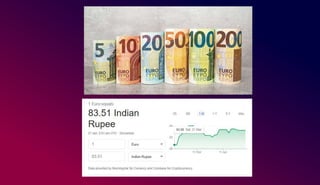
• Using a common currency - Euro (Most of them)
• The euro market acts as a major source for international trade
More about EM
• Single market for EU
• The European commission describes the single market as "one territory
without any internal borders or other regulatory obstacles to the free
movement of goods and services."
• Free flow of goods and services
• Intended to improve efficiency, stimulate trade and help growth etc.
– (Deeper economic integration)
• Eurozone / Euro Area
A euromarket can be used to describe the
financial market for Eurocurrencies
Terms
• Euro
• European Union
• Euro Currency
• Euro Bank
• Euro Market (2 Description)
• Eurocurrency is currency deposited by national governments
or corporations, outside of its home market. Commonly it is currency held
in banks located outside of the country which issues the currency.
• For example, a US dollar denominated deposit in a Singapore bank is
Eurocurrency
• It is accumulated in European banks that deal in other currencies such as
American dollar, Japanese Yen, Swiss Francs, etc.
Euro Currency
Euro Bank
• A Eurobank is a financial institution that accepts foreign currency
denominated deposits and makes foreign currency loans.
• Eurobank does not necessarily have to be located on the continent of
Europe; it can be anywhere in the world.
• For example, a bank located in the United States that extends loans or
holds deposits in Japanese yen is a Eurobank.
Eurocurrency Market
• The Eurocurrency market consists of Euro Banks that accepts deposits and
offers credit in foreign currencies.
• Eurocurrency refers to a currency that is freely convertible and is deposited
in a bank present in a country where the currency is non-domestic.
• The bank can be either a foreign bank or a foreign branch of a domestic
bank
Features about Euro Market
• International Market
• Independent Market
• Wholesale Market
• Competitive Market
• Short term market
• Inter-Bank Market
Features of Euro-currency market
1. International Market
The Euro-currency market is an international market which accepts
deposits and gives credit in currencies from throughout the world.
2. Independent Market
It is a free and independent market which does not function under the
control of any monetary authority.
3. Wholesale Market
– It is a wholesale market in which different currencies are bought and
sold usually above $ 1 million.
Contd..
4. Competitive Market
– It is a highly competitive market in which the supply and demand for
currencies depends on interest rate changes of Euro-banks.
5. Short-Term Market
– It is a short-term money market in which deposits in different
currencies are usually accepted for a period ranging from a few days to
a year and interest is paid on them.
6. Inter-Bank Market
– It is an inter-bank market in which the Euro-banks borrow and lend
dollars and other Euro-currencies from each other.
Euro Market

Euro Market

  • 1.
    Euro Market Prepared By: MohammedJasir PV Asst. Professor MIIMS Puthanangadi Contact No: 9605 69 32 66
  • 2.
  • 3.
    Euro Market • Itis a large market comprising many member nations of EU • It facilitates the free movement of goods and services • In other words efficient trade mechanisms such as low tariffs, quotas etc. and have a centralized monetary policy • Using a common currency - Euro (Most of them) • The euro market acts as a major source for international trade
  • 4.
    More about EM •Single market for EU • The European commission describes the single market as "one territory without any internal borders or other regulatory obstacles to the free movement of goods and services." • Free flow of goods and services • Intended to improve efficiency, stimulate trade and help growth etc. – (Deeper economic integration) • Eurozone / Euro Area
  • 6.
    A euromarket canbe used to describe the financial market for Eurocurrencies
  • 7.
    Terms • Euro • EuropeanUnion • Euro Currency • Euro Bank • Euro Market (2 Description)
  • 8.
    • Eurocurrency iscurrency deposited by national governments or corporations, outside of its home market. Commonly it is currency held in banks located outside of the country which issues the currency. • For example, a US dollar denominated deposit in a Singapore bank is Eurocurrency • It is accumulated in European banks that deal in other currencies such as American dollar, Japanese Yen, Swiss Francs, etc. Euro Currency
  • 9.
    Euro Bank • AEurobank is a financial institution that accepts foreign currency denominated deposits and makes foreign currency loans. • Eurobank does not necessarily have to be located on the continent of Europe; it can be anywhere in the world. • For example, a bank located in the United States that extends loans or holds deposits in Japanese yen is a Eurobank.
  • 10.
    Eurocurrency Market • TheEurocurrency market consists of Euro Banks that accepts deposits and offers credit in foreign currencies. • Eurocurrency refers to a currency that is freely convertible and is deposited in a bank present in a country where the currency is non-domestic. • The bank can be either a foreign bank or a foreign branch of a domestic bank
  • 11.
    Features about EuroMarket • International Market • Independent Market • Wholesale Market • Competitive Market • Short term market • Inter-Bank Market
  • 12.
    Features of Euro-currencymarket 1. International Market The Euro-currency market is an international market which accepts deposits and gives credit in currencies from throughout the world. 2. Independent Market It is a free and independent market which does not function under the control of any monetary authority. 3. Wholesale Market – It is a wholesale market in which different currencies are bought and sold usually above $ 1 million.
  • 13.
    Contd.. 4. Competitive Market –It is a highly competitive market in which the supply and demand for currencies depends on interest rate changes of Euro-banks. 5. Short-Term Market – It is a short-term money market in which deposits in different currencies are usually accepted for a period ranging from a few days to a year and interest is paid on them. 6. Inter-Bank Market – It is an inter-bank market in which the Euro-banks borrow and lend dollars and other Euro-currencies from each other.