GROUP MEMBERS


Keyur Mota.

33



Ankita Nagap.

34



Manali Nare.

35



Subhakti Palekar.

36



Rupali Palve.

37
CONTENTS










Introduction.
Types of capital market instrument
Equity share
Preference share
Debenture
Bonds
Difference between equity- debt securities
Conclusion
Reference
INTRODUCTION





The capital market is the market for securities
where companies and the government can rise long
term fund.
It is a place where buyers and sellers of securities
can enter into transactions to purchase and sell
shares, bonds and debentures.
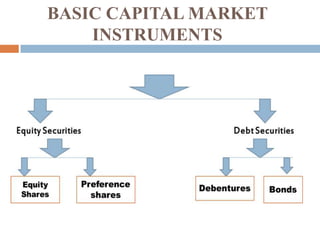
BASIC CAPITAL MARKET
INSTRUMENTS
EQUITY SHARES








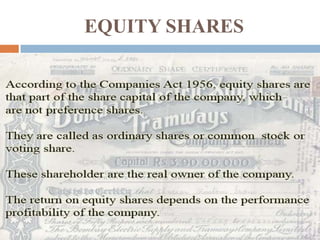
According to the Companies Act 1956, equity shares
are that part of the share capital of the
company, which are not preference shares.
They are called as ordinary shares or common stock
or voting share.
These shareholder are the real owner of the
company.
The return on equity shares depends on the
performance profitability of the company.
MERITS OF EQUITY SHARES


A permanent source of finance to the company



No fixed rate of dividend



Easy liquidity and marketability
LIMITATIONS OF EQUITY
SHARES


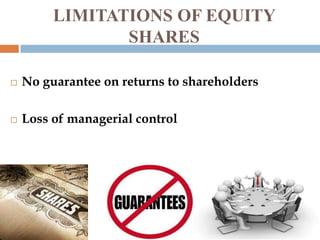
No guarantee on returns to shareholders



Loss of managerial control
PREFERENCE SHARES






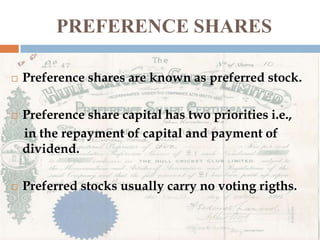
Preference shares are known as preferred stock.
Preference share capital has two priorities i.e.,
in the repayment of capital and payment of
dividend.
Preferred stocks usually carry no voting rigths.
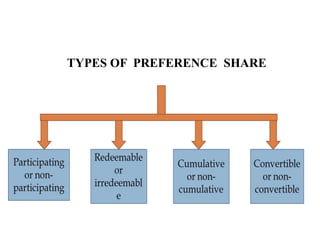
TYPES OF PREFERENCE SHARE
MERITS OF PREFERENCE SHARE CAPITAL
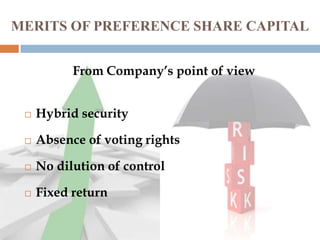
From Company’s point of view


Hybrid security



Absence of voting rights



No dilution of control



Fixed return
LIMITATIONS OF PREFERENCE SHARES
From Investor ’s point of view


Not secured



Not an attractive investment



No right to participate in the management
DEBENTURES




When a corporation is in need of fund in addition
to share capital it borrows money by issuing
debentures.
The debenture holder gets interest which is fixed
at the time of issue.
TYPES OF DEBENTURES

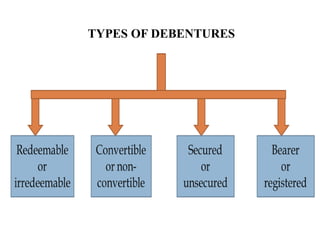
Redeemable
or
irredeemable

Convertible
or nonconvertible

Secured
or
unsecured

Bearer
or
registered
MERITS OF DEBENTURES


No loss of managerial control



A Flexible source of finance



Reduces burden of tax of the company
LIMITATION OF DEBENTURES


Fixed rate on interest



Companies may have to mortgage their assets



Not an attractive investment from company’s
point of view.
BONDS






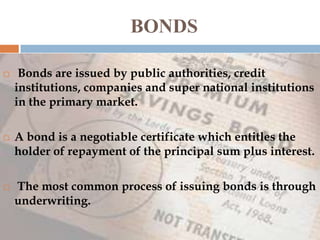
Bonds are issued by public authorities, credit
institutions, companies and super national institutions
in the primary market.

A bond is a negotiable certificate which entitles the
holder of repayment of the principal sum plus interest.
The most common process of issuing bonds is through
underwriting.
TYPES OF BONDS


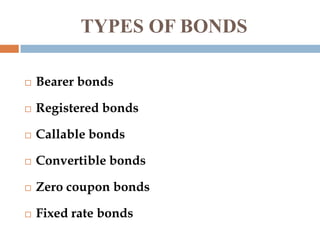
Bearer bonds



Registered bonds



Callable bonds



Convertible bonds



Zero coupon bonds



Fixed rate bonds
DIFFERENCE BETWEEN
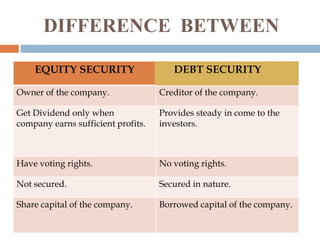
EQUITY SECURITY

DEBT SECURITY

Owner of the company.

Creditor of the company.

Get Dividend only when
company earns sufficient profits.

 .
Provides steady in come to the
investors.

Have voting rights.

No voting rights.

Not secured.

Secured in nature.

Share capital of the company.

Borrowed capital of the company.
CONCLUSION
Capital market plays an important role in
ensuring the emergence of a vigorous and efficient
economy.
It facilitates the internationalization of an
economy by linking it with the rest of the world.
REFERENCE
BIBLIOGRAPHY




Financial Markets
And Financial
Services In IndiaBenson Kunjukuju
Equity Market-IIAnita Bobade.

WEBLIOGRAPHY




www.inc.com/ency
clopedia
www.martinfowler.
com
Capital market instruments

Capital market instruments