Presented by – Mohit Singhal
Bcom Hons (Section – B)
Roll No. 2166
Ramjas College
Explaining crucial terms used in forward markets
1 2 3 4 5
2
Forward rate
Forward rate is the rate quoted by foreign traders for the
purchase or sale of foreign currency in future.
A forward rate is an interest rate applicable to a financial
transaction that will take place in the future. Forward rates
are calculated from the spot rate, and are adjusted for the
cost of carry to determine the future interest rate that
equates the total return of a longer-term investment with a
strategy of rolling over a shorter-term investment.
MOHIT SINGHAL - RAMJAS COLLEGE 3
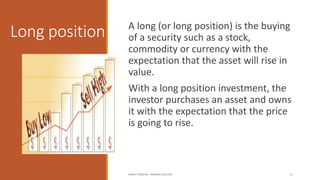
Long position A long (or long position) is the buying
of a security such as a stock,
commodity or currency with the
expectation that the asset will rise in
value.
With a long position investment, the
investor purchases an asset and owns
it with the expectation that the price
is going to rise.
MOHIT SINGHAL - RAMJAS COLLEGE 4
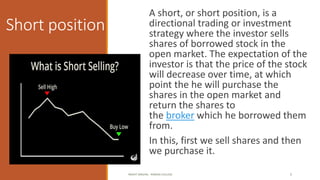
Short position
A short, or short position, is a
directional trading or investment
strategy where the investor sells
shares of borrowed stock in the
open market. The expectation of the

investor is that the price of the stock
will decrease over time, at which
point the he will purchase the
shares in the open market and
return the shares to
the broker which he borrowed them
from.
In this, first we sell shares and then
we purchase it.
MOHIT SINGHAL - RAMJAS COLLEGE 5
Forward premium and discount
Transactions in foreign exchange market may be spot transactions or forward
transactions.
Spot transactions or exchange in foreign exchange require receipts and payments
to be made immediately, ie within two business days after the transactions are
agreed upon to allow for clearing of cheques and is transacted at spot rate.
On the other hand, forward transactions or exchange involve an agreement
today to buy or sell a specified amount of foreign currency at a specified future
date at a rate mutually agreed upon today. This rate is known as forward rate.
MOHIT SINGHAL - RAMJAS COLLEGE 6
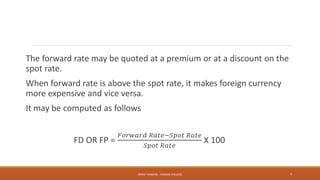
The forward rate may be quoted at a premium or at a discount on the
spot rate.
When forward rate is above the spot rate, it makes foreign currency
more expensive and vice versa.
It may be computed as follows
FD OR FP =
𝐹𝑜𝑟𝑤𝑎𝑟𝑑 𝑅𝑎𝑡𝑒−𝑆𝑝𝑜𝑡 𝑅𝑎𝑡𝑒
𝑆𝑝𝑜𝑡 𝑅𝑎𝑡𝑒
X 100
MOHIT SINGHAL - RAMJAS COLLEGE 7
Arbitrage
MOHIT SINGHAL - RAMJAS COLLEGE 8
What is arbitrage??
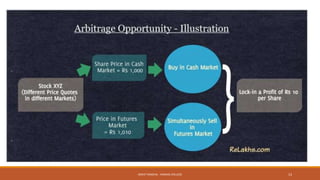
Arbitrage is the practice of taking advantage of
a price difference between two or more
markets and considered as an opportunity to
buy an asset at a low price then immediately
selling it on a different market for a higher
price which helps an investor to have a risk free
profit at zero cost or low costs.
MOHIT SINGHAL - RAMJAS COLLEGE 9
Two point arbitrage
When two currencies and two monetary centres
are involved, it is called a two point arbitrage.
MOHIT SINGHAL - RAMJAS COLLEGE 10
Two point arbitrageOnePound
$1.98 in
New York
$2.02 in
London
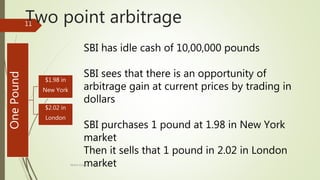
SBI has idle cash of 10,00,000 pounds
SBI sees that there is an opportunity of
arbitrage gain at current prices by trading in
dollars
SBI purchases 1 pound at 1.98 in New York
market
Then it sells that 1 pound in 2.02 in London
marketMohit Singhal - Ramjas college
11
ImpactOnePound
$1.98 in
New York
$2.02 in
London
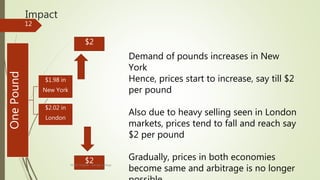
Demand of pounds increases in New
York
Hence, prices start to increase, say till $2
per pound
Also due to heavy selling seen in London
markets, prices tend to fall and reach say
$2 per pound
Gradually, prices in both economies
become same and arbitrage is no longer
$2
$2Mohit Singhal - Ramjas college
12
MOHIT SINGHAL - RAMJAS COLLEGE 13
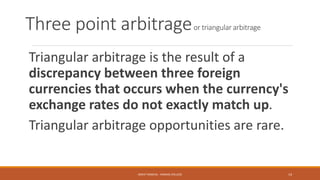
Three point arbitrageor triangular arbitrage
Triangular arbitrage is the result of a
discrepancy between three foreign
currencies that occurs when the currency's
exchange rates do not exactly match up.
Triangular arbitrage opportunities are rare.
MOHIT SINGHAL - RAMJAS COLLEGE 14
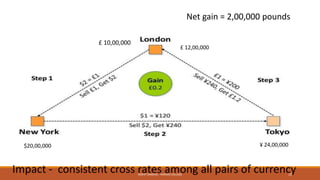
£ 10,00,000
$20,00,000 ¥ 24,00,000
£ 12,00,000
Net gain = 2,00,000 pounds
Impact - consistent cross rates among all pairs of currencyMOHIT SINGHAL - RAMJAS COLLEGE 15
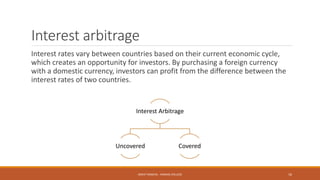
Interest arbitrage
Interest rates vary between countries based on their current economic cycle,
which creates an opportunity for investors. By purchasing a foreign currency
with a domestic currency, investors can profit from the difference between the
interest rates of two countries.
Interest Arbitrage
Uncovered Covered
MOHIT SINGHAL - RAMJAS COLLEGE 16
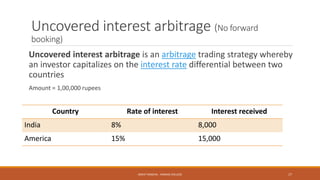
Uncovered interest arbitrage (No forward
booking)
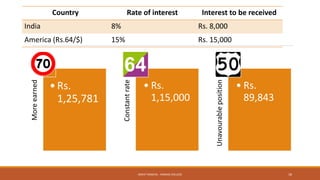
Uncovered interest arbitrage is an arbitrage trading strategy whereby
an investor capitalizes on the interest rate differential between two
countries
Amount = 1,00,000 rupees
Country Rate of interest Interest received
India 8% 8,000
America 15% 15,000
MOHIT SINGHAL - RAMJAS COLLEGE 17
Country Rate of interest Interest to be received
India 8% Rs. 8,000
America (Rs.64/$) 15% Rs. 15,000
Moreearned
•Rs.
1,25,781
Constantrate
• Rs.
1,15,000
Unavourableposition
• Rs.
89,843
MOHIT SINGHAL - RAMJAS COLLEGE 18
Covered interest arbitrage (forward booking)
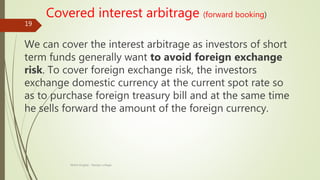
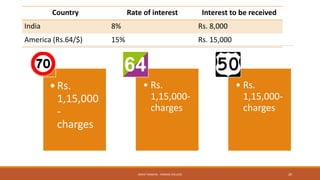
We can cover the interest arbitrage as investors of short
term funds generally want to avoid foreign exchange
risk. To cover foreign exchange risk, the investors
exchange domestic currency at the current spot rate so
as to purchase foreign treasury bill and at the same time
he sells forward the amount of the foreign currency.
Mohit Singhal - Ramjas college
19
Country Rate of interest Interest to be received
India 8% Rs. 8,000
America (Rs.64/$) 15% Rs. 15,000
•Rs.
1,15,000
-
charges
• Rs.
1,15,000-
charges
• Rs.
1,15,000-
charges
MOHIT SINGHAL - RAMJAS COLLEGE 20
MOHIT SINGHAL - RAMJAS COLLEGE 21
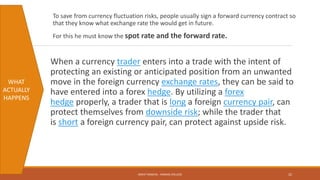
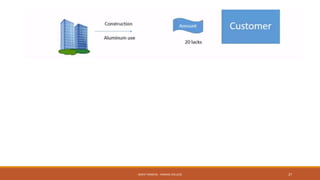
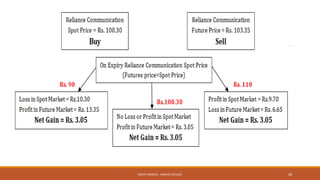
To save from currency fluctuation risks, people usually sign a forward currency contract so
that they know what exchange rate the would get in future.
For this he must know the spot rate and the forward rate.
When a currency trader enters into a trade with the intent of
protecting an existing or anticipated position from an unwanted
move in the foreign currency exchange rates, they can be said to
have entered into a forex hedge. By utilizing a forex
hedge properly, a trader that is long a foreign currency pair, can
protect themselves from downside risk; while the trader that
is short a foreign currency pair, can protect against upside risk.
WHAT
ACTUALLY
HAPPENS
MOHIT SINGHAL - RAMJAS COLLEGE 22
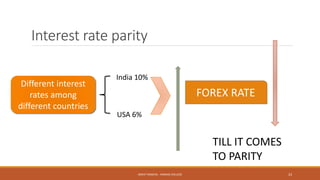
Interest rate parity
Different interest
rates among
different countries
India 10%
USA 6%
FOREX RATE
TILL IT COMES
TO PARITY
MOHIT SINGHAL - RAMJAS COLLEGE 23
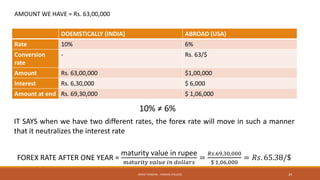
DOEMSTICALLY (INDIA) ABROAD (USA)
Rate 10% 6%
Conversion
rate
- Rs. 63/$
Amount Rs. 63,00,000 $1,00,000
Interest Rs. 6,30,000 $ 6,000
Amount at end Rs. 69,30,000 $ 1,06,000
AMOUNT WE HAVE = Rs. 63,00,000
10% ≠ 6%
IT SAYS when we have two different rates, the forex rate will move in such a manner
that it neutralizes the interest rate
FOREX RATE AFTER ONE YEAR =
maturity value in rupee
maturity 𝑣𝑎𝑙𝑢𝑒 𝑖𝑛 𝑑𝑜𝑙𝑙𝑎𝑟𝑠
=
𝑅𝑠.69,30,000
$ 1,06,000
= 𝑅𝑠. 65.38/$
MOHIT SINGHAL - RAMJAS COLLEGE 24
MOHIT SINGHAL - RAMJAS COLLEGE 25
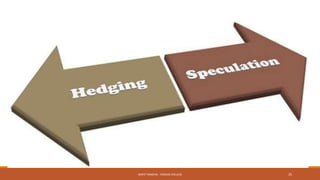
Hedging
When a currency trader enters into a trade with the intent of
protecting an existing or anticipated position from an unwanted
move in the foreign currency exchange rates, they can be said to have
entered into a forex hedge. By utilizing a forex hedge properly, a
trader that is long a foreign currency pair, can protect themselves
from downside risk; while the trader that is short a foreign currency
pair, can protect against upside risk.
BEST WAY TO DESCRIBE HEDGING IS “INSURANCE OF RISK”
MOHIT SINGHAL - RAMJAS COLLEGE 26
MOHIT SINGHAL - RAMJAS COLLEGE 27
MOHIT SINGHAL - RAMJAS COLLEGE 28
Speculators
The speculators are not genuine investors. They buy
securities with a hope to sell them in future at a profit. They
are not interested in holding the securities for longer period.
MOHIT SINGHAL - RAMJAS COLLEGE 29
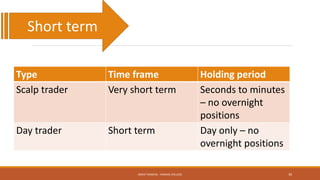
Type Time frame Holding period
Scalp trader Very short term Seconds to minutes
– no overnight
positions
Day trader Short term Day only – no
overnight positions
Short term
MOHIT SINGHAL - RAMJAS COLLEGE 30
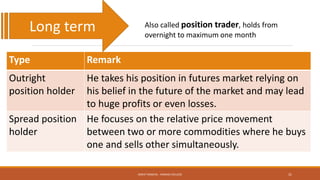
Type Remark
Outright
position holder
He takes his position in futures market relying on
his belief in the future of the market and may lead
to huge profits or even losses.
Spread position
holder
He focuses on the relative price movement
between two or more commodities where he buys
one and sells other simultaneously.
Long term Also called position trader, holds from
overnight to maximum one month
MOHIT SINGHAL - RAMJAS COLLEGE 31
THANK YOU
MOHIT SINGHAL - RAMJAS COLLEGE 32

Forward market, arbitrage, hedging and speculation

  • 1.
    Presented by –Mohit Singhal Bcom Hons (Section – B) Roll No. 2166 Ramjas College
  • 2.
    Explaining crucial termsused in forward markets 1 2 3 4 5 2
  • 3.
    Forward rate Forward rateis the rate quoted by foreign traders for the purchase or sale of foreign currency in future. A forward rate is an interest rate applicable to a financial transaction that will take place in the future. Forward rates are calculated from the spot rate, and are adjusted for the cost of carry to determine the future interest rate that equates the total return of a longer-term investment with a strategy of rolling over a shorter-term investment. MOHIT SINGHAL - RAMJAS COLLEGE 3
  • 4.
    Long position Along (or long position) is the buying of a security such as a stock, commodity or currency with the expectation that the asset will rise in value. With a long position investment, the investor purchases an asset and owns it with the expectation that the price is going to rise. MOHIT SINGHAL - RAMJAS COLLEGE 4
  • 5.
    Short position A short,or short position, is a directional trading or investment strategy where the investor sells shares of borrowed stock in the open market. The expectation of the investor is that the price of the stock will decrease over time, at which point the he will purchase the shares in the open market and return the shares to the broker which he borrowed them from. In this, first we sell shares and then we purchase it. MOHIT SINGHAL - RAMJAS COLLEGE 5
  • 6.
    Forward premium anddiscount Transactions in foreign exchange market may be spot transactions or forward transactions. Spot transactions or exchange in foreign exchange require receipts and payments to be made immediately, ie within two business days after the transactions are agreed upon to allow for clearing of cheques and is transacted at spot rate. On the other hand, forward transactions or exchange involve an agreement today to buy or sell a specified amount of foreign currency at a specified future date at a rate mutually agreed upon today. This rate is known as forward rate. MOHIT SINGHAL - RAMJAS COLLEGE 6
  • 7.
    The forward ratemay be quoted at a premium or at a discount on the spot rate. When forward rate is above the spot rate, it makes foreign currency more expensive and vice versa. It may be computed as follows FD OR FP = 𝐹𝑜𝑟𝑤𝑎𝑟𝑑 𝑅𝑎𝑡𝑒−𝑆𝑝𝑜𝑡 𝑅𝑎𝑡𝑒 𝑆𝑝𝑜𝑡 𝑅𝑎𝑡𝑒 X 100 MOHIT SINGHAL - RAMJAS COLLEGE 7
  • 8.
    Arbitrage MOHIT SINGHAL -RAMJAS COLLEGE 8
  • 9.
    What is arbitrage?? Arbitrageis the practice of taking advantage of a price difference between two or more markets and considered as an opportunity to buy an asset at a low price then immediately selling it on a different market for a higher price which helps an investor to have a risk free profit at zero cost or low costs. MOHIT SINGHAL - RAMJAS COLLEGE 9
  • 10.
    Two point arbitrage Whentwo currencies and two monetary centres are involved, it is called a two point arbitrage. MOHIT SINGHAL - RAMJAS COLLEGE 10
  • 11.
    Two point arbitrageOnePound $1.98in New York $2.02 in London SBI has idle cash of 10,00,000 pounds SBI sees that there is an opportunity of arbitrage gain at current prices by trading in dollars SBI purchases 1 pound at 1.98 in New York market Then it sells that 1 pound in 2.02 in London marketMohit Singhal - Ramjas college 11
  • 12.
    ImpactOnePound $1.98 in New York $2.02in London Demand of pounds increases in New York Hence, prices start to increase, say till $2 per pound Also due to heavy selling seen in London markets, prices tend to fall and reach say $2 per pound Gradually, prices in both economies become same and arbitrage is no longer $2 $2Mohit Singhal - Ramjas college 12
  • 13.
    MOHIT SINGHAL -RAMJAS COLLEGE 13
  • 14.
    Three point arbitrageortriangular arbitrage Triangular arbitrage is the result of a discrepancy between three foreign currencies that occurs when the currency's exchange rates do not exactly match up. Triangular arbitrage opportunities are rare. MOHIT SINGHAL - RAMJAS COLLEGE 14
  • 15.
    £ 10,00,000 $20,00,000 ¥24,00,000 £ 12,00,000 Net gain = 2,00,000 pounds Impact - consistent cross rates among all pairs of currencyMOHIT SINGHAL - RAMJAS COLLEGE 15
  • 16.
    Interest arbitrage Interest ratesvary between countries based on their current economic cycle, which creates an opportunity for investors. By purchasing a foreign currency with a domestic currency, investors can profit from the difference between the interest rates of two countries. Interest Arbitrage Uncovered Covered MOHIT SINGHAL - RAMJAS COLLEGE 16
  • 17.
    Uncovered interest arbitrage(No forward booking) Uncovered interest arbitrage is an arbitrage trading strategy whereby an investor capitalizes on the interest rate differential between two countries Amount = 1,00,000 rupees Country Rate of interest Interest received India 8% 8,000 America 15% 15,000 MOHIT SINGHAL - RAMJAS COLLEGE 17
  • 18.
    Country Rate ofinterest Interest to be received India 8% Rs. 8,000 America (Rs.64/$) 15% Rs. 15,000 Moreearned •Rs. 1,25,781 Constantrate • Rs. 1,15,000 Unavourableposition • Rs. 89,843 MOHIT SINGHAL - RAMJAS COLLEGE 18
  • 19.
    Covered interest arbitrage(forward booking) We can cover the interest arbitrage as investors of short term funds generally want to avoid foreign exchange risk. To cover foreign exchange risk, the investors exchange domestic currency at the current spot rate so as to purchase foreign treasury bill and at the same time he sells forward the amount of the foreign currency. Mohit Singhal - Ramjas college 19
  • 20.
    Country Rate ofinterest Interest to be received India 8% Rs. 8,000 America (Rs.64/$) 15% Rs. 15,000 •Rs. 1,15,000 - charges • Rs. 1,15,000- charges • Rs. 1,15,000- charges MOHIT SINGHAL - RAMJAS COLLEGE 20
  • 21.
    MOHIT SINGHAL -RAMJAS COLLEGE 21
  • 22.
    To save fromcurrency fluctuation risks, people usually sign a forward currency contract so that they know what exchange rate the would get in future. For this he must know the spot rate and the forward rate. When a currency trader enters into a trade with the intent of protecting an existing or anticipated position from an unwanted move in the foreign currency exchange rates, they can be said to have entered into a forex hedge. By utilizing a forex hedge properly, a trader that is long a foreign currency pair, can protect themselves from downside risk; while the trader that is short a foreign currency pair, can protect against upside risk. WHAT ACTUALLY HAPPENS MOHIT SINGHAL - RAMJAS COLLEGE 22
  • 23.
    Interest rate parity Differentinterest rates among different countries India 10% USA 6% FOREX RATE TILL IT COMES TO PARITY MOHIT SINGHAL - RAMJAS COLLEGE 23
  • 24.
    DOEMSTICALLY (INDIA) ABROAD(USA) Rate 10% 6% Conversion rate - Rs. 63/$ Amount Rs. 63,00,000 $1,00,000 Interest Rs. 6,30,000 $ 6,000 Amount at end Rs. 69,30,000 $ 1,06,000 AMOUNT WE HAVE = Rs. 63,00,000 10% ≠ 6% IT SAYS when we have two different rates, the forex rate will move in such a manner that it neutralizes the interest rate FOREX RATE AFTER ONE YEAR = maturity value in rupee maturity 𝑣𝑎𝑙𝑢𝑒 𝑖𝑛 𝑑𝑜𝑙𝑙𝑎𝑟𝑠 = 𝑅𝑠.69,30,000 $ 1,06,000 = 𝑅𝑠. 65.38/$ MOHIT SINGHAL - RAMJAS COLLEGE 24
  • 25.
    MOHIT SINGHAL -RAMJAS COLLEGE 25
  • 26.
    Hedging When a currencytrader enters into a trade with the intent of protecting an existing or anticipated position from an unwanted move in the foreign currency exchange rates, they can be said to have entered into a forex hedge. By utilizing a forex hedge properly, a trader that is long a foreign currency pair, can protect themselves from downside risk; while the trader that is short a foreign currency pair, can protect against upside risk. BEST WAY TO DESCRIBE HEDGING IS “INSURANCE OF RISK” MOHIT SINGHAL - RAMJAS COLLEGE 26
  • 27.
    MOHIT SINGHAL -RAMJAS COLLEGE 27
  • 28.
    MOHIT SINGHAL -RAMJAS COLLEGE 28
  • 29.
    Speculators The speculators arenot genuine investors. They buy securities with a hope to sell them in future at a profit. They are not interested in holding the securities for longer period. MOHIT SINGHAL - RAMJAS COLLEGE 29
  • 30.
    Type Time frameHolding period Scalp trader Very short term Seconds to minutes – no overnight positions Day trader Short term Day only – no overnight positions Short term MOHIT SINGHAL - RAMJAS COLLEGE 30
  • 31.
    Type Remark Outright position holder Hetakes his position in futures market relying on his belief in the future of the market and may lead to huge profits or even losses. Spread position holder He focuses on the relative price movement between two or more commodities where he buys one and sells other simultaneously. Long term Also called position trader, holds from overnight to maximum one month MOHIT SINGHAL - RAMJAS COLLEGE 31
  • 32.
    THANK YOU MOHIT SINGHAL- RAMJAS COLLEGE 32