GLIBENCLAMIDE ANTI-DIABETIC DRUG
DIABETES MELLITUS Diabetes Mellitus Is Due To A Disorder Of Carbohydrate, protein And Lipid Metabolism As A Result Of An Absolute Or Deficiency In Metabolically Active Insulin. IN OLDER DAYS Diabetes = Over Abundant Urine Or Melting of flesh in urine MELLITUS = Sweet As Honey
TYPES OF  DIABETES MELLITUS Improper Working Of Pancreas Is Diabetes Mellitus.  SO TYPES ARE DIABETES MELLITUS TYPE-I  =  IDDM DIABETES MELLITUS TYPE-II =  NIDDM DIABETES TYPE-II  a  =  NORMAL WEIGHT OR THIN DIABETES DIABETES TYPE-II b  = OVER WEIGHT DIABETES ABOUT 80% OF TYPE 2 DIABETES ARE OVERWEIGHT
60 g 18 cm Below liver Under stomach Acinar cells Islets of langerhans
Acinar cell makes bulk of pancreas and make digestive enzymes Islets of langerhans are only 1-2%of pancreas
They are responsible for the release of insulin and somastatin and glucagon. Beta cells are for insulin
INSULIN 51 amino acids in chain Orally rapidly destroyed Half-life 7-10 minutes C-peptide s s A-chain
INSULIN SECRETION 10 5 0  1  2 Insulin secretion FOOD INSULIN EFFECT 25-50 UNITS  OR 1-2 mg OF INSULIN IS SECRETED EACH DAY
INSULIN EFFECTS SUGAR CONSUMING GLUCOSE TRANSPORT FUNCTIONTHROUGH THE CELL MEMEBRANE TO THE MUSCLE AND FAT CELLS GLYCOGEN FORMATION FROM GLUCOSE IN LIVER & MUSCLES FORMATION OF FATS FROMGLUCOSE INSULIN PREVENTS THE ACTION OF LIPOLYTIC HARMONES
SUGAR-PROVIDING Absorption of carbohydrates in the intestine Glycogenolysis = glucose molecules come from glycogen (|stored form of sugar in the body) GLUCONEOGENSIS = FROM PROTEIN IN THE LIVER. OR Synthesis Of Glucose From Another Fundamental Unit(aminoacids) INSULIN EFFECTS
TYPE-I DIABETES ABSOLUTE INSULIN  DEFICIENCY  DUE TO INABILITY OF BETSA CELLS TO RELEASE INSULIN
TYPE-II DIABETES RELATIVE INSULIN DEFICIENCY NUMBER OF INSULIN RECEPTORS COMPLEX IS TOO LOW
INSULIN RECEPTOR GLUCOSE MEMBRANE EFFECTS RECEPTOR SECOND  MESSENGER ENZYME EFFECTS LYSOSOME INSULIN
DIAGNOSIS FASTING BLOOD SUGAR POST PRANDIAL GLUCOSE LEVEL GLUCOSE TOLERANCE TEST GLYCOSYLATED HEMOGLOBIN LEVELS URINE GLUCOSE LEVELS
REFERENCE VALUES CONDITION FBS RBS LEVEL AT 120 mg NORMAL BELOW 115 BELOW 200 BELOW 140 IMPAIRED 115-139 ABOVE 200 140-199 DM ABOVE 140 ABOVE 200 ABOVE  200
HbA1c The HbA1c is a blood test that measures your average blood sugar over two to three months. The term ‘HbA1c’ refers to changes in the haemoglobin molecule.  Glucose can attach itself to the haemoglobin molecule. The difference is that once the glucose is attached, it remains there until the red cell dies. Red cells live for about three months. As blood glucose levels rise, more and more glucose becomes attached to the haemoglobin molecule. The HbA1c test measures how much glucose has become attached and therefore provides an indication of your average blood glucose for the past 6 weeks or so
HbA1c
COMPLICATIONS DUE TO INCREASE BLOOD GLUCOSE LEVELS RETINOPATHY NEUROPATHY NEPHEROPATHY MICRO ANGIOPATHY MACROANGIOPATHY
PILLARS FOR THE DIABETIC TREATMENT  DIABETIC THERAPY PHYSICAL  ACTIVITY DIET EUGLUCON MEDICAL TREAMENT DIABETIC INSTRUCTION + SELF-MONITORING
Diabetes  is on of the  most common  metabolic diseases The prevalence of Diabetes is  increasing  all around the  world  especially in  developing countries .
Management of Diabetes DIET EXERCISE OHA INSULIN
Oral anti-hyperglycemic agents Sulfonylureas:  FIRST GENERATION   Chlorpropamide-Glyburide-Acetohexamide-Tolbutamide-Tolazamide-  SECOND GENERATION Glibenclamide-Glipizide-Glibornurid- Glimepride GLICLAZIDE * Biguanides:   Phenformin  Metformin * a-glycosidase inhibitors: Acarbose - Miglitol * Thiazolidendiones: Troglitazone  Ciglitazone Pioglitazon  englitazone * Meglitinide: Repaglinide
Biguanides (Metformin) Trade names: Glucophage, NEOPHAGE, NEODIPAR. Mode of action: reduces hepatic glucose production decreased intestinal absorption of glucose increases peripheral utilization of glucose in muscle & fat tissue decreased insulin requirements for glucose disposal
Biguanides (Metformin) Precautions:   chronic renal or cardiac failure    hepatic impairment   elderly   excessive alcohol intake Side effects: gastrointestinal disturbances  metallic taste malabsorption of B12 Administer:   with or after meals
Sulphonylurea Generic :  Trade : Administer : Glipizide Minidiab before meals Gliclazide Diamicron with meals Glibenclamide Euglucon Before meals Tolbutamide Rastinon with meals
Sulphonylureas Mode of action: increase pancreatic insulin secretion  may improve insulin sensitivity in peripheral tissue and decrease hepatic glucose output
Sulphonylureas Contra-indications :   pregnancy, surgery, severe renal failure, type 1, hypersensitivity Precautions: renal impairment, hepatic impairment, elderly Side effects: hypoglycemia weight gain
Alpha Glucosidase Inhibitor  (Acarbose) Trade name: Glucobay Mode of action: delays breakdown of CHO such as starch & sucrose Contra-indications: pregnancy renal impairment gastrointestinal disorders
Alpha Glucosidase Inhibitor  (Acarbose) Precautions: high sucrose diet Side effects: gastrointestinal rash erythema Important considerations: take directly before or with the first few spoons of the meal
Repaglinide Trade Name: NovoNorm Mode of action: short acting oral hypoglycaemic agent stimulates pancreatic insulin release
Repaglinide Contra-indications: type 1 diabetes, pregnancy, lactation, children  < 12 years Precautions: impaired renal or hepatic function Side effects: hypoglycaemia, gastrointestinal upset, raised Left's, blurred vision
Thiazolidinedione (Rezulin) Trade name: Rosiglitazone, Poiglitizone Mode of action: improves sensitivity to insulin in skeletal muscle and adipose tissue inhibits glucose release from the liver
Thiazolidinedione Contra-indications heart failure, moderate to severe hepatic impairment. Precautions oedema or heart failure anovulatory premenopausal women with insulin resistance as ovulation may resume (consider contraception.
Glucose Regulation Glucose Sources: Endogenous (liver)  Diet  GLUCOSE REGULATION IN BODY: LIVER  PANCREAS KIDNEY  ADIPOSE TISSUE GI TRACT
MODE OF ACTION OF EUGLUCON ATP dependent K+  channels VDCC Ca++ CHANNEL Ca++ ACTIVATED  CHANNEL Ca++ RESTING CELL K+
MODE OF ACTION OF EUGLUCON ATP dependent K+  channels VDCC Ca++ CHANNEL Ca++ ACTIVATED  CHANNEL Ca++ DEPOLARIZATION K+ INSULIN SECRETION CA++
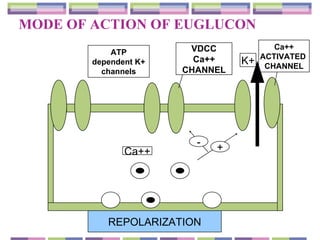
MODE OF ACTION OF EUGLUCON ATP dependent K+  channels VDCC Ca++ CHANNEL Ca++ ACTIVATED  CHANNEL Ca++ REPOLARIZATION K+ - +
EUGLUCON EUGLUCON IS AVAILBLE AS WHITE,OBLONG, SCORED, CONTAINING 5mg  GLIBENCLAMIDE
EUGLUCON STIMULATE BETA-CELLS OF PANCREAS TO RELEASE INSULIN INCREASE SENSITIVITY OF THE PERIPHERAL TISSUE TO INSULIN MILD DIURESIS
EUGLUCON RAPIDLY ABSORBED MAX.BLOOD LEVEL WITHIN 1-4  HOURS BIOAVAILIBILITY 90-100 % PROTEIN BINDING  90 % VOLUME OF DISTRIBUTION 155ml/kg ELIMINATION HALF-LIFE BIPHASIC 2.1 HOURS  &  10 HOURS
EUGLUCON EXECRETION 50%  KIDNEY 50% FECES HIGHEST TISSUE CONCENTRATION IN LIVER NO TERTOGENEIC EFFECTS CONTERA INDICATIONS TYPE-1 DIABETES DIABETIC COMA KETO-ACIDOSIS SDVERE RENAL IMSUFFICENCY PREGANACY HYPERSENSITIVITY TO GLIBENCLAMIDE
EUGLUCON GLIBECLAMIDE EXCRETION THROUGH  BILE  RENAL FUNCTION 53% 47% NORMAL FUNCTION 79% 21% MODERATE IMPAIRMENT 94% 6% SEVERE IMPAIRMENT DEPENDING UPON THE DEGREE OF RENAL EXCRETION DISORDER,AN INCREASE EXCRETION IN THE BILE AND FECES OCCURS AS COMPENSATORY EFFECT
EUGLUCON ADVERSE REACTION NAUSEA AND EPIGASTRIC BLOATING ALLERGY SKIN REACTION ALLERGY CROSSS REACTION SULPHONAMIDES EFFECTS HAEMATOPOIETIC SYSTEM HAEMOLYTIC ANAMEIA CHOLESATITIC JAUNDICE HEPATITIS INDICATIONS NIDDM “(TYPE-II)  MATURITY ONSET DIABETES, WNENEVER TREATMENT BY DIET ALONE PROVES INADIQUATE
EUGLUCON Dosage Administration Administration scheme Daily Dose To Be Taken ½ - 1 - 2 - 2 1
EUGLUCON INSULIN SECRETION IN RHYTHM WITH MEALS NO RISK OF ACCUMLATION DUE TO DUAL ROUTE OF EXCRETION. NORMALIZE TISSUE RESPONSE TO ENDDOGENOUS INSULIN. IMPROVES DISTURBED LIPID PROFILE. BETTER PATIENT COMPLIANCE. LOW INCIDENCE OF ADVERSE RECATIONS. RELIABLE LONG-THERAPY.
EUGLUCON POWERFUL MOBLIZATION OF THE DELAYED INSULIN SECRETION. PARTICULARLY GREAT SYNERGISTIC WITH GLUCOSE. RELEASE OF INSULIN WHEN NEEDED: AFTER EVERY MEAL. SMOOTH DAILY BLOOD SUGAR PROFILE. MOSTLY SINGLE DOSGE ADMINISTRATION. BREAKING THROUGH OF PERIPHERAL INSULIN RESISTANCE. REDUCTION OF PLATELET AGGREGATION. BETTER STABILIZATION. MORE DIABETICS CAN BE OPTIMALLY CONTROLLED. EXCELLENT  TOLERANCE.
THANK YOU

Euglucon

  • 1.
  • 2.
    DIABETES MELLITUS DiabetesMellitus Is Due To A Disorder Of Carbohydrate, protein And Lipid Metabolism As A Result Of An Absolute Or Deficiency In Metabolically Active Insulin. IN OLDER DAYS Diabetes = Over Abundant Urine Or Melting of flesh in urine MELLITUS = Sweet As Honey
  • 3.
    TYPES OF DIABETES MELLITUS Improper Working Of Pancreas Is Diabetes Mellitus. SO TYPES ARE DIABETES MELLITUS TYPE-I = IDDM DIABETES MELLITUS TYPE-II = NIDDM DIABETES TYPE-II a = NORMAL WEIGHT OR THIN DIABETES DIABETES TYPE-II b = OVER WEIGHT DIABETES ABOUT 80% OF TYPE 2 DIABETES ARE OVERWEIGHT
  • 4.
    60 g 18cm Below liver Under stomach Acinar cells Islets of langerhans
  • 5.
    Acinar cell makesbulk of pancreas and make digestive enzymes Islets of langerhans are only 1-2%of pancreas
  • 6.
    They are responsiblefor the release of insulin and somastatin and glucagon. Beta cells are for insulin
  • 7.
    INSULIN 51 aminoacids in chain Orally rapidly destroyed Half-life 7-10 minutes C-peptide s s A-chain
  • 8.
    INSULIN SECRETION 105 0 1 2 Insulin secretion FOOD INSULIN EFFECT 25-50 UNITS OR 1-2 mg OF INSULIN IS SECRETED EACH DAY
  • 9.
    INSULIN EFFECTS SUGARCONSUMING GLUCOSE TRANSPORT FUNCTIONTHROUGH THE CELL MEMEBRANE TO THE MUSCLE AND FAT CELLS GLYCOGEN FORMATION FROM GLUCOSE IN LIVER & MUSCLES FORMATION OF FATS FROMGLUCOSE INSULIN PREVENTS THE ACTION OF LIPOLYTIC HARMONES
  • 10.
    SUGAR-PROVIDING Absorption ofcarbohydrates in the intestine Glycogenolysis = glucose molecules come from glycogen (|stored form of sugar in the body) GLUCONEOGENSIS = FROM PROTEIN IN THE LIVER. OR Synthesis Of Glucose From Another Fundamental Unit(aminoacids) INSULIN EFFECTS
  • 11.
    TYPE-I DIABETES ABSOLUTEINSULIN DEFICIENCY DUE TO INABILITY OF BETSA CELLS TO RELEASE INSULIN
  • 12.
    TYPE-II DIABETES RELATIVEINSULIN DEFICIENCY NUMBER OF INSULIN RECEPTORS COMPLEX IS TOO LOW
  • 13.
    INSULIN RECEPTOR GLUCOSEMEMBRANE EFFECTS RECEPTOR SECOND MESSENGER ENZYME EFFECTS LYSOSOME INSULIN
  • 14.
    DIAGNOSIS FASTING BLOODSUGAR POST PRANDIAL GLUCOSE LEVEL GLUCOSE TOLERANCE TEST GLYCOSYLATED HEMOGLOBIN LEVELS URINE GLUCOSE LEVELS
  • 15.
    REFERENCE VALUES CONDITIONFBS RBS LEVEL AT 120 mg NORMAL BELOW 115 BELOW 200 BELOW 140 IMPAIRED 115-139 ABOVE 200 140-199 DM ABOVE 140 ABOVE 200 ABOVE 200
  • 16.
    HbA1c The HbA1cis a blood test that measures your average blood sugar over two to three months. The term ‘HbA1c’ refers to changes in the haemoglobin molecule. Glucose can attach itself to the haemoglobin molecule. The difference is that once the glucose is attached, it remains there until the red cell dies. Red cells live for about three months. As blood glucose levels rise, more and more glucose becomes attached to the haemoglobin molecule. The HbA1c test measures how much glucose has become attached and therefore provides an indication of your average blood glucose for the past 6 weeks or so
  • 17.
  • 18.
    COMPLICATIONS DUE TOINCREASE BLOOD GLUCOSE LEVELS RETINOPATHY NEUROPATHY NEPHEROPATHY MICRO ANGIOPATHY MACROANGIOPATHY
  • 19.
    PILLARS FOR THEDIABETIC TREATMENT DIABETIC THERAPY PHYSICAL ACTIVITY DIET EUGLUCON MEDICAL TREAMENT DIABETIC INSTRUCTION + SELF-MONITORING
  • 20.
    Diabetes ison of the most common metabolic diseases The prevalence of Diabetes is increasing all around the world especially in developing countries .
  • 21.
    Management of DiabetesDIET EXERCISE OHA INSULIN
  • 22.
    Oral anti-hyperglycemic agentsSulfonylureas: FIRST GENERATION Chlorpropamide-Glyburide-Acetohexamide-Tolbutamide-Tolazamide- SECOND GENERATION Glibenclamide-Glipizide-Glibornurid- Glimepride GLICLAZIDE * Biguanides: Phenformin Metformin * a-glycosidase inhibitors: Acarbose - Miglitol * Thiazolidendiones: Troglitazone Ciglitazone Pioglitazon englitazone * Meglitinide: Repaglinide
  • 23.
    Biguanides (Metformin) Tradenames: Glucophage, NEOPHAGE, NEODIPAR. Mode of action: reduces hepatic glucose production decreased intestinal absorption of glucose increases peripheral utilization of glucose in muscle & fat tissue decreased insulin requirements for glucose disposal
  • 24.
    Biguanides (Metformin) Precautions: chronic renal or cardiac failure hepatic impairment elderly excessive alcohol intake Side effects: gastrointestinal disturbances metallic taste malabsorption of B12 Administer: with or after meals
  • 25.
    Sulphonylurea Generic : Trade : Administer : Glipizide Minidiab before meals Gliclazide Diamicron with meals Glibenclamide Euglucon Before meals Tolbutamide Rastinon with meals
  • 26.
    Sulphonylureas Mode ofaction: increase pancreatic insulin secretion may improve insulin sensitivity in peripheral tissue and decrease hepatic glucose output
  • 27.
    Sulphonylureas Contra-indications : pregnancy, surgery, severe renal failure, type 1, hypersensitivity Precautions: renal impairment, hepatic impairment, elderly Side effects: hypoglycemia weight gain
  • 28.
    Alpha Glucosidase Inhibitor (Acarbose) Trade name: Glucobay Mode of action: delays breakdown of CHO such as starch & sucrose Contra-indications: pregnancy renal impairment gastrointestinal disorders
  • 29.
    Alpha Glucosidase Inhibitor (Acarbose) Precautions: high sucrose diet Side effects: gastrointestinal rash erythema Important considerations: take directly before or with the first few spoons of the meal
  • 30.
    Repaglinide Trade Name:NovoNorm Mode of action: short acting oral hypoglycaemic agent stimulates pancreatic insulin release
  • 31.
    Repaglinide Contra-indications: type1 diabetes, pregnancy, lactation, children < 12 years Precautions: impaired renal or hepatic function Side effects: hypoglycaemia, gastrointestinal upset, raised Left's, blurred vision
  • 32.
    Thiazolidinedione (Rezulin) Tradename: Rosiglitazone, Poiglitizone Mode of action: improves sensitivity to insulin in skeletal muscle and adipose tissue inhibits glucose release from the liver
  • 33.
    Thiazolidinedione Contra-indications heartfailure, moderate to severe hepatic impairment. Precautions oedema or heart failure anovulatory premenopausal women with insulin resistance as ovulation may resume (consider contraception.
  • 34.
    Glucose Regulation GlucoseSources: Endogenous (liver) Diet GLUCOSE REGULATION IN BODY: LIVER PANCREAS KIDNEY ADIPOSE TISSUE GI TRACT
  • 35.
    MODE OF ACTIONOF EUGLUCON ATP dependent K+ channels VDCC Ca++ CHANNEL Ca++ ACTIVATED CHANNEL Ca++ RESTING CELL K+
  • 36.
    MODE OF ACTIONOF EUGLUCON ATP dependent K+ channels VDCC Ca++ CHANNEL Ca++ ACTIVATED CHANNEL Ca++ DEPOLARIZATION K+ INSULIN SECRETION CA++
  • 37.
    MODE OF ACTIONOF EUGLUCON ATP dependent K+ channels VDCC Ca++ CHANNEL Ca++ ACTIVATED CHANNEL Ca++ REPOLARIZATION K+ - +
  • 38.
    EUGLUCON EUGLUCON ISAVAILBLE AS WHITE,OBLONG, SCORED, CONTAINING 5mg GLIBENCLAMIDE
  • 39.
    EUGLUCON STIMULATE BETA-CELLSOF PANCREAS TO RELEASE INSULIN INCREASE SENSITIVITY OF THE PERIPHERAL TISSUE TO INSULIN MILD DIURESIS
  • 40.
    EUGLUCON RAPIDLY ABSORBEDMAX.BLOOD LEVEL WITHIN 1-4 HOURS BIOAVAILIBILITY 90-100 % PROTEIN BINDING 90 % VOLUME OF DISTRIBUTION 155ml/kg ELIMINATION HALF-LIFE BIPHASIC 2.1 HOURS & 10 HOURS
  • 41.
    EUGLUCON EXECRETION 50% KIDNEY 50% FECES HIGHEST TISSUE CONCENTRATION IN LIVER NO TERTOGENEIC EFFECTS CONTERA INDICATIONS TYPE-1 DIABETES DIABETIC COMA KETO-ACIDOSIS SDVERE RENAL IMSUFFICENCY PREGANACY HYPERSENSITIVITY TO GLIBENCLAMIDE
  • 42.
    EUGLUCON GLIBECLAMIDE EXCRETIONTHROUGH BILE RENAL FUNCTION 53% 47% NORMAL FUNCTION 79% 21% MODERATE IMPAIRMENT 94% 6% SEVERE IMPAIRMENT DEPENDING UPON THE DEGREE OF RENAL EXCRETION DISORDER,AN INCREASE EXCRETION IN THE BILE AND FECES OCCURS AS COMPENSATORY EFFECT
  • 43.
    EUGLUCON ADVERSE REACTIONNAUSEA AND EPIGASTRIC BLOATING ALLERGY SKIN REACTION ALLERGY CROSSS REACTION SULPHONAMIDES EFFECTS HAEMATOPOIETIC SYSTEM HAEMOLYTIC ANAMEIA CHOLESATITIC JAUNDICE HEPATITIS INDICATIONS NIDDM “(TYPE-II) MATURITY ONSET DIABETES, WNENEVER TREATMENT BY DIET ALONE PROVES INADIQUATE
  • 44.
    EUGLUCON Dosage AdministrationAdministration scheme Daily Dose To Be Taken ½ - 1 - 2 - 2 1
  • 45.
    EUGLUCON INSULIN SECRETIONIN RHYTHM WITH MEALS NO RISK OF ACCUMLATION DUE TO DUAL ROUTE OF EXCRETION. NORMALIZE TISSUE RESPONSE TO ENDDOGENOUS INSULIN. IMPROVES DISTURBED LIPID PROFILE. BETTER PATIENT COMPLIANCE. LOW INCIDENCE OF ADVERSE RECATIONS. RELIABLE LONG-THERAPY.
  • 46.
    EUGLUCON POWERFUL MOBLIZATIONOF THE DELAYED INSULIN SECRETION. PARTICULARLY GREAT SYNERGISTIC WITH GLUCOSE. RELEASE OF INSULIN WHEN NEEDED: AFTER EVERY MEAL. SMOOTH DAILY BLOOD SUGAR PROFILE. MOSTLY SINGLE DOSGE ADMINISTRATION. BREAKING THROUGH OF PERIPHERAL INSULIN RESISTANCE. REDUCTION OF PLATELET AGGREGATION. BETTER STABILIZATION. MORE DIABETICS CAN BE OPTIMALLY CONTROLLED. EXCELLENT TOLERANCE.
  • 47.

Editor's Notes

  • #24 Presenter’s Notes Metformin is absorbed along the entire gastrointestinal mucosa and improves peripheral and hepatic sensitivity to insulin. This results in increased uptake of glucose by peripheral tissues and decreased hepatic glucose production. It is not stored in the liver and it is excreted in the urine. It does not stimulate insulin production or release from the pancreas and therefore does not cause hypoglycemia. It is the treatment of choice in patients who are overweight.
  • #25 Presenter’s Notes Renal disease is the only absolute contra-indication to metformin and serum creatinine should be checked routinely. Gastrointestinal disturbances may include anorexia, nausea, diarrhea and a metallic taste. Lactic acidosis can be caused by excessive alcohol and symptoms include nausea, vomiting &amp; diarrhea. Metformin is taken with meals to decrease gastrointestinal effects.
  • #26 Presenter’s Notes Sulphonyureas stimulate insulin secretion by increasing pancreatic beta cell responsiveness to glucose. All people taking Sulphonylureas should receive information about the prevention and treatment of hypoglycemia. Glipizide is a potent but shorter acting OHA. Must be given before meals or it loses 40 % efficacy. Metabolism occurs mainly in the liver. It is contra-indicated in severe renal or hepatic failure. Gliclazide restores the diminished first phase of insulin secretion that is common in type 2 diabetes. It is absorbed along the gastrointestinal tract. The liver is the probable site of metabolism. Glibenclamide is a strong and long acting OHA. Should be used in caution in the elderly. Hypoglycemia may be severe, prolonged and fatal. Tolbutamide is the drug of choice in renal disease. It is relatively short acting in comparison to other Sulphonylureas. Contra-indicated in severe renal or hepatic impairment.
  • #27 Presenter’s Notes Sulphonyureas can be used in conjunction with a biguanide. This is due to the different modes of action egg metformin and localized. There is no value in using two different types of Sulphonylureas as they do not complement each other egg localized and glipizide.
  • #28 Presenter’s notes All Sulphonylureas can cause hypoglycemia and this risk increases with age and impaired renal function. Hypoglycemia is more common with longer acting sulphonylurea egg chloropropramide and glibenclamide. Weight gain can occur due to increased insulin production.
  • #29 Presenter’s notes Used if other oral agents are ineffective. It can be used in conjunction with metformin and sulphonylurea. The action depends on inhibition of intestinal enzymes involved in the digestion of some carbohydrates and thereby reduces the post prandial rise in blood glucose levels. Precautions and side effects : gastrointestinal: flatulence, abdominal pain and distention does not produce hypoglycaemia when used alone need to treat hypoglycaemia, with quick acting glucose.
  • #30 Presenter’s notes
  • #31 Presenter’s Notes Use: Type 2 diabetes (as monotherapy or with metformin). Repaglinide is a novel short-acting oral hypoglycaemic agent structurally unrelated to the sulphonylurea drugs. It lowers blood glucose levels acutely by stimulating the release of insulin from the pancreas, an effect which is dependent upon functioning beta cells in the pancreas. Note: Meal related dosing means a person only needs to take this medication when eating a meal.
  • #32 Presenter’s Notes Like other oral hypoglycaemic agents (sulphonylureas) repaginate is capable of causing hypoglycaemia. People with impaired renal or hepatic function may be exposed to higher concentrations of repaginate than would occur with the usual doses prescribed for people with normal function. Therefore, a more conservative dose titration with longer titration intervals should be considered. The safety of repaginate during pregnancy has not been established.
  • #33 Presenter’s Notes Rezulin is currently only to be used as adjunct therapy with insulin. It is the first medication released from this class. It is absorbed within 2-3 hours of ingestion. It should be taken with food to increase absorption. Half life of 16-34 hours.
  • #34 Presenter’s Notes Rare cases of idiosyncratic hepatocellular injury have been reported and so regular monitoring is essential.